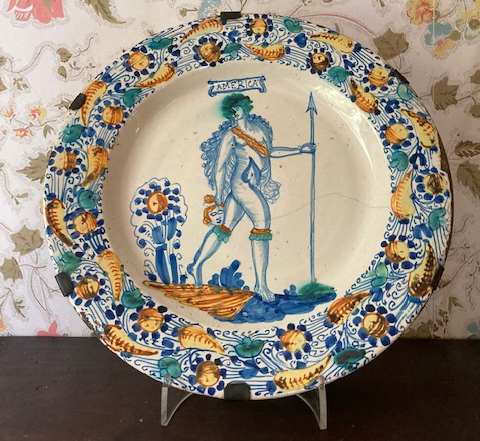
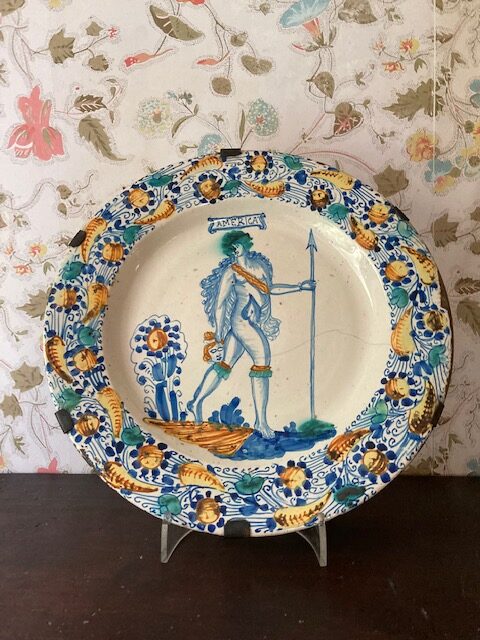
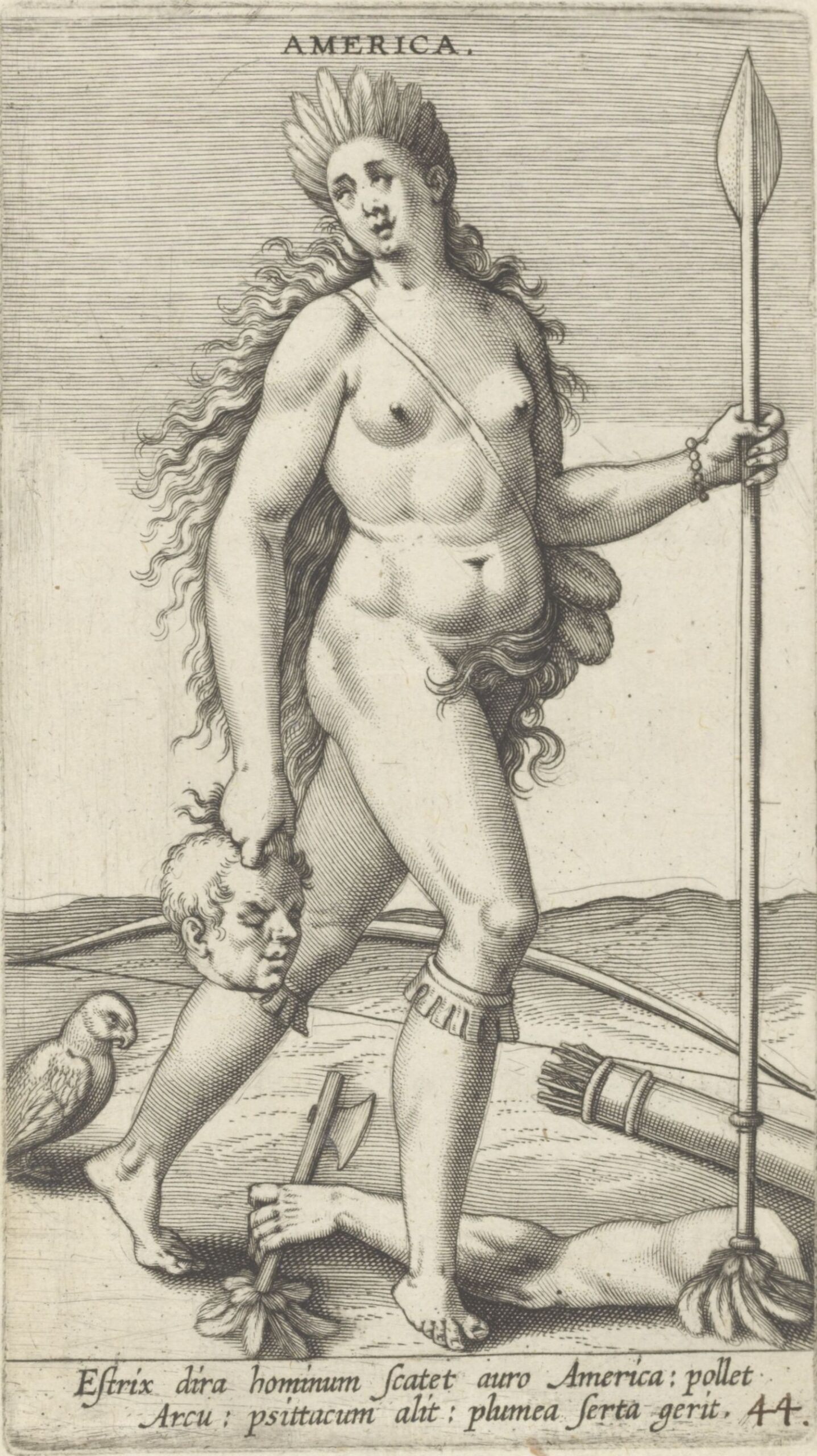
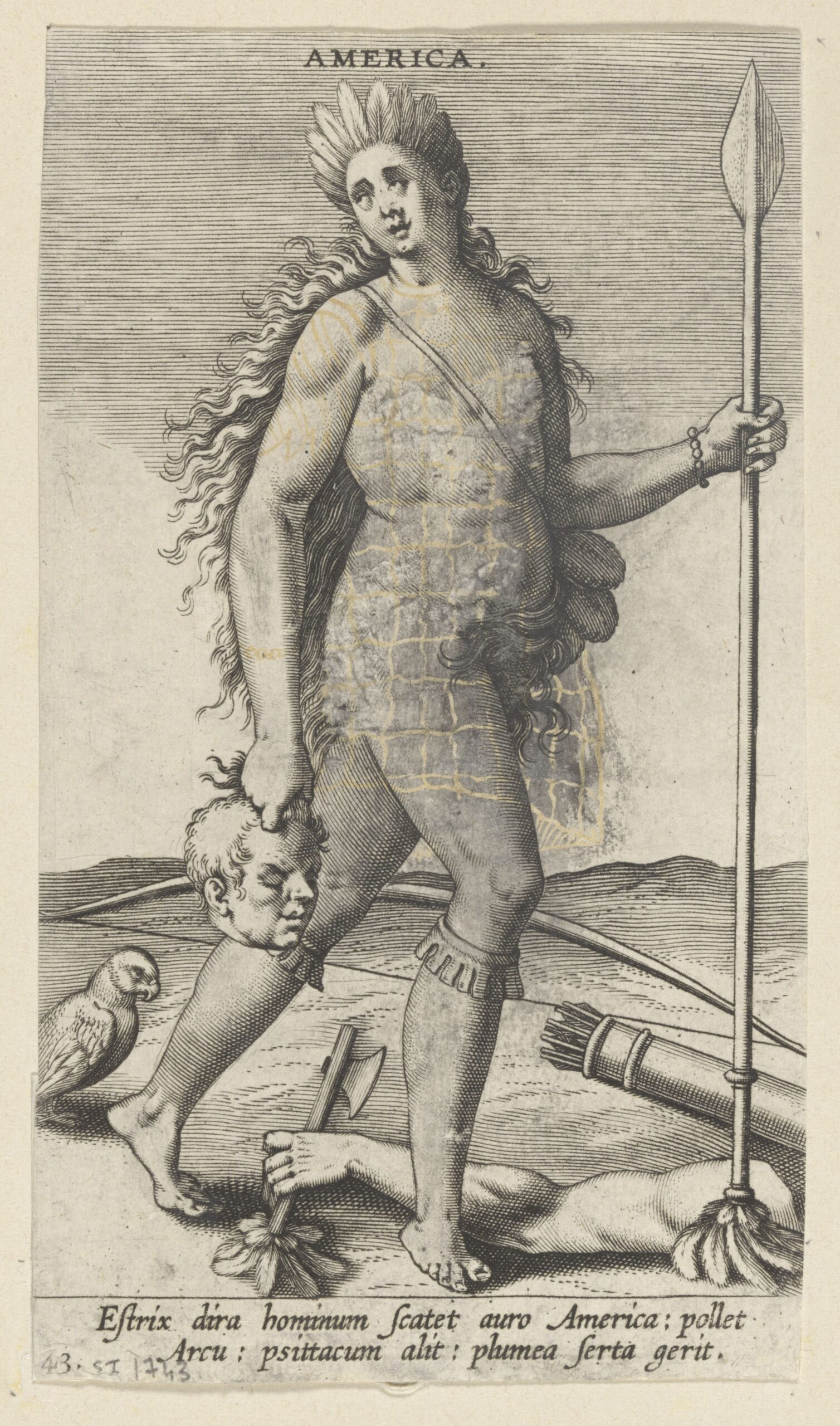
And not only their own kind. I return to the dish, the starting point for this long journey of imagination. It was the severed head that had pushed me into action—a severed European head, dangling like a basketball from the hand of a Native woman. On seeing it for the first time, in the antiques shop, my response was that of my historian self: shock, puzzlement, curiosity. Now I must try for something else, the likely response of European selves coming upon it at around the time it was made. I picture, say, a Portuguese merchant preparing for a visit to trading partners in Rio de Janeiro. Or a young Spanish woman considering a marriage proposal from a rancher in Upper Peru. Or a Dutch sailor heading off on a long ocean voyage to one of the islands in the West Indies.
I understand that for all of them it’s more than cannibalism alone. That head is a symbol, gathering together a host of concerns about the vast and still largely unknown New World. In effect, it’s a warning: if you go there, watch out. America is a very foreign, very dangerous place.
I look for a final time at the 400-year-old dish. It seems the same as before—yet also different. Like other such artifacts subjected to inquiry, it carries the impress of all I have learned. Native Americans, European colonists, explorers, soldiers, missionaries, cannibal feasts, best-selling books, learned discourse, public pageants, agitated chatter from dock-sides to drawing rooms—nothing less (or more) than… history itself.
Further Reading:
This short essay draws on a vast literature about early European contacts with the Americas. For entering that subject, see classic studies by J. H. Eliott, The Old World and the New, 1492-1650 (Cambridge, UK, 1970); Anthony Pagden, European Encounters with the New World: From Renaissance to Romanticism (New Haven, CT, 1993) and Tzvetan Todorov, The Conquest of America: The Question of the Other, Richard Howard, trans. (Norman, OK, 1983). See also: Karen Ordahl Kupperman, ed., America in European Consciousness, 1493-1750 (Chapel Hill, NC, 1993), and Benjamin Schmidt, Innocence Abroad: The Dutch Imagination and the New World, 1570-1670 (Cambridge, UK, 2001). On the key sources cited in the essay, see: Neil L. Whitehead and Michael Harbsmeier, eds., Hans Staden’s True History: An Account of Cannibal Captivity in Brazil (Chapel Hill, NC, 2008), Jean de Léry, History of a Voyage to the Land of Brazil, Janet Whatley, ed. and trans. (Berkeley, CA, 1992), and Roger Schlesinger and Arthur P. Stabler, eds., Andre Thevet’s North America: A Sixteenth-Century View, Roger Schlesinger, trans. (Cambridge, UK, 1998). See also Theodore deBry, America: The Complete Plates, 1590-1602 (Providence, RI, n.d.). The best general study of cannibalism is Frank Lestringnant, Cannibals: The Discovery and Representation of the Cannibal from Columbus to Jules Verne, Rosemary Morris, trans. (Cambridge, UK, 1994). See also Francis Barker, Peter Hulme, and Margaret Iversen, eds., Cannibalism and the Colonial World (Cambridge, UK, 1998) and Michael Gaudio, Engraving the Savage: The New World and Techniques of Civilization (Minneapolis, 2008). On the dish itself, see Charlotte Wilcoxen, “A Spanish Puzzle,” in American Ceramics Circle Journal X (1997), 32-34.
This article originally appeared in October 2026.
John Demos is the Samuel Knight Professor of History Emeritus at Yale University. He is the author of many books and articles on early American history, including The Unredeemed Captive: A Family Story From Early America and The Heathen School: A Story of Hope and Betrayal in the Age of the Early Republic.


.jpg)