Padding Out History: Menstrual Management in the Nineteenth- and Early Twentieth-Century United States

It is not too often that a historian can view an intimate object from a woman’s daily life over one hundred and fifty years ago. Yet, by researching how women handled their menstrual cycles in the nineteenth century, I did just that at the Valentine Museum in Richmond, Virginia. Standing in the reading room at the Valentine Museum, I observed as an archivist laid out ten pieces of undyed cotton fabric, all varying sizes, with blood stains lingering on most of them. Though I had booked an appointment specifically to see these pieces of fabric, which were several menstrual pads, belts, and postpartum abdominal wraps, I could not touch them. Instead, the archivist sat and watched as I took pictures of and sketched the cloths laid out on the table. When I needed to take pictures of the other side of the items, I asked for them to be moved, and the archivist dutifully stood up, gloves on her hand, and moved them around so I could keep working.

A woman named Susan Smith Massie originally owned these knitted sanitary pads and long cotton belts around the 1850s, though I theorize her daughters or other female relatives would have also used them when their periods first started, before they learned to knit and sew their own. Knowing the name of a woman and seeing her original, handmade items—still stained with blood—is quite extraordinary; most people would have found it reasonable to dispose of such items, not save them for posterity so they could one day enter a museum. Because of the lack of surviving items, and nature of bodily fluids, the archival record leaves little behind regarding menstrual management for much of history.

Figure 1a: Sketch done while in the reading room at the Valentine Museum in Richmond, Virginia depicting the four cotton belts from the Massie Collection, along with the author’s notes regarding the size, stains, and make.
Figure 1b: Sketch done while in the reading room at the Valentine Museum in Richmond, Virginia depicting the two knitted sanitary pads from the Massie Collection, along with notes.

With a dearth of sources at my fingertips, the Massie pads and belts proved a valuable find. Originally, I thought the question of menstrual management in the nineteenth–century United States would not be so challenging to explore. Yet I found myself unable to find books or journal articles to cite when I first began digging. This only increased the urgency of my research. Instead of giving up, I found ways to work backwards, using mass produced and manufactured products from the twentieth century to infer what and how women created at home for their periods in earlier decades. I then turned to medical history, focusing on midwives, who would have been women’s first stop for nearly all of American history, and then medical texts written by male physicians as women’s medical care became professionalized. Altogether, working backwards from the early twentieth century allowed me to create a hypothesis of how a mobile or working women in the early nineteenth century would have handled her cycles, especially if she worked away from the home or frequently traveled.

Figure 2: A “Form-Fit” Sanitary Apron product box (ca. 1906). This product likely copied earlier handmade items created by women to have another layer of protection between their undergarments and their clothing. Courtesy of the Museum of Menstruation Collection, Archives Center, National Museum of American History.

Of course, not all women would have had a monthly cycle, though whether their periods were just inconsistent or nonexistent varied. Some women would have had no menstrual cycle, or amenorrhea, because of their ill health or congenital issues. However, physicians in the early and mid-nineteenth century believed any inconsistency in menstrual cycles would harm the menstruator. A delayed or suppressed period caused by sickness or poor nutrition would concern any woman. Therefore, despite the hardship of having a period, women likely wanted to have a regular cycle and may even have sought to induce menstruation when they missed multiple month’s cycles in a row.

Health literature in the early American republic centered on regular menstruation and gave women many tips on inducing periods if they had irregular cycles. For women with problematic cycles, male physicians recommended bland diets and food with fiber, but also more unusual remedies, including water cures. Rest was the common prescription for a menstruating woman, but even this had specific parameters: for example, Dr. William A. Alcott, in his 1850 work, The Young Woman’s Book of Health, railed against the decadence of feather beds, but did allow that women should use comforters, which are thickly insulated blankets.

Figure 3: Title page from Dr. William A. Alcott, The Young Woman’s Book of Health, 1850. Courtesy of the National Library of Medicine.

Midwives are another valuable resource to suss out information about the general lived experiences of menstruators. Midwives remained the main provider of female healthcare until the late nineteenth century. Women in any sized settlement and town would visit the local midwife for help with painful or suppressed periods. Women could buy herbs or teas for suppressed periods, painful periods, or maybe even an abortifacient, if needed. For example, Martha Ballard, a midwife who worked in the town of Hallowell, Maine for decades, felt concern when a local woman had an “‘obstructed’” period in 1789. In this case, Ballard “‘prescribed the use of particular herbs’” for a woman named Genny Cool. Though Ballard uses the term “obstructed” to describe Cool’s issue, which hinted towards a suppressed menstruation, there is a distinct possibility that these herbs, which are not named, could have “been employed to induce abortion” for Cool. Obstruction, therefore, could have multiple meanings, and Ballard grew and collected herbs such as tansy, “a plant associated in some herbals with abortion,” but in her practice, often “seems to have been employed as an anthelmintic, that is, an agent for expelling worms.” Other herbs also had uses beyond menstrual issues. Rue and savin, for example, could both be used to restore menstruation, but were known to cause abortions, and in the case of savin, had been used for such since Roman antiquity. The blurry lines between restoring menstruation and aborting early pregnancy meant that a particular woman’s use of the herb could be unclear. Yet, most herbs could be used to restore or help menstruation.

Women could also produce emmenagogues, which are herbal medicines that would start a woman’s menstrual cycle, on their own from more commonly found botanicals. In fact, women used emmenagogues so often that “[o]fficial, sectarian, and folk medicine” prescribed emmenagogues to women in the nineteenth century. An 1880 medical index listed seventeen botanicals that promised to start one’s menstrual cycle, such as ergot, chamomile, yarrow, cotton root, parsley, cherries, and others. Though lay and medical texts prescribed herbal remedies to induce menstruation, women had other treatment options. For example, as “the logic of a medical system that attributed many diseases, including amenorrhea, to sluggishness of blood or an obstruction to circulation, cures were to be found by inducing sweating” which included steam, warm baths, and “breathing the vapors of emmenagogic [sic] herbs.” But many women probably started with teas, including “14 different kinds of herbal teas,” with ingredients that could be found on most farms, such as ginger or wintergreen leaves, to induce menstruation or to handle the effects of a painful period. Martha Ballard’s diary included a number of herbs and their descriptions from her long-standing midwifery practice in late eighteenth-century Maine. Among those are “Balm,” hops, rue, and yarrow. “Balm” could have been a reference to “an herb used for inducing perspiration and suppressing menstruation,” or a Balm of Gilead used to create a cough syrup. The other three, however, are directly linked to dealing with menstrual issues. Ballard, as well, collected parsley and chamomile, and while these were not directly linked to menstruation, such herbs were often used to either induce menstruation or help with pain.

Innovations in menstrual technology that emerged in the late nineteenth and early twentieth century allow us to infer what techniques women used to manage their periods in earlier decades by analyzing what issues new products aimed to ‘solve.’ Instead of taking for granted that the products were almost the same, I seek to trace earlier methods of menstrual technology by pinpointing the issues of handmade methods. For example, a number of the new products sought to alleviate issues of chafing. Therefore, it can be gleaned that women in the nineteenth century and earlier often dealt with issues of chafing from their homemade menstrual rags, an issue exacerbated when away from home. Likely bulky, with pins in the undergarments that may not have stayed in place, mobile women would have dealt with the discomfort of rags and clothes in their clothes while traveling. Chafing would have been another burden to the body as she traveled, causing discomfort, or even infections and other issues from the raw skin.

How did women, especially those away from home, collect the menstrual blood expelled during her cycle in the nineteenth century? We begin by exploring the undergarments of women in the early American republic. Many women wore crotchless underwear in the early- to mid-nineteenth century. Crotchless underwear created two problems for menstruating women: napkins and cloths could not be pinned directly to the crotch of undergarments, and there was also no fabric in the crotch to catch any blood if the menstruater started early or got caught unprepared. Though some scholars have suggested that women freely bled throughout much of history, others find this unconvincing. First, bleeding onto oneself would cause discomfort. Second, free bleeding would increase the labor of laundering one’s clothing, which would already be an arduous task for women traveling and staying in the homes of others. The use of crotchless underwear further complicates an argument for free bleeding, as women would have bled down their legs, not into the gusset of the underwear. Instead, crotchless underwear underscores the need for belts to secure cloths to the body
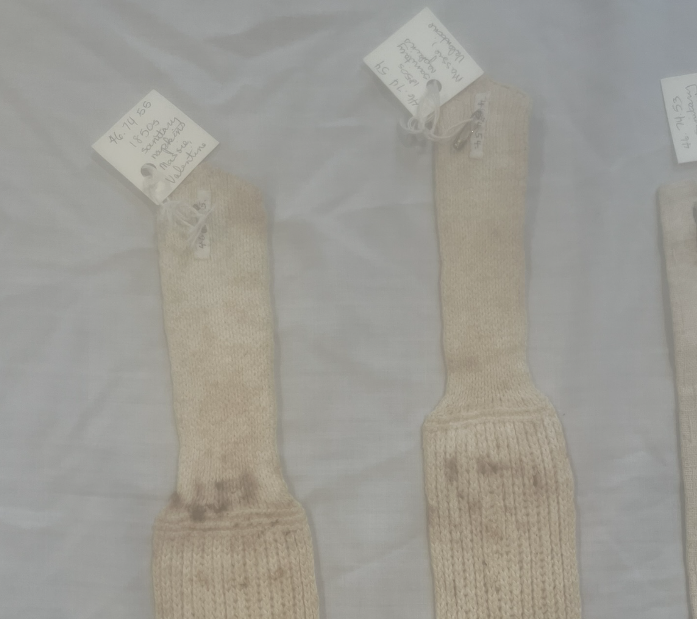
Figure 4: Women’s undergarments dating from ca. the 1840s from either the United States or Europe. These undergarments have a wide waistband, an open gusset, and tapered pant legs with lace detail. These would be similar undergarments to what the Massie women would have worn in the 1850s and show how most underwear had no gusset between the leg, unlike modern underwear. Drawers (1840s), Gift of Mrs. Alfred Kramer, 1937, Metropolitan Museum of Art.

Extant handmade menstrual technology can elucidate how at least some women in the nineteenth century handled their periods. We return to the Massie set of pads and belts held at the Valentine Museum. This particular set, with two napkins knitted out of cotton yarn and the belts sewn from cotton fabric, shows consistent signs of use and stains. The knitted sanitary napkins, which are around twenty-five inches long and three inches wide, both have a hole at the wider, tapered end. This hole could have been used with a button or other fastener, or the belts included in the set may have been fed through the hole to hold the napkin up as the belt fit around the waist. The other end may have been pinned into the wearer’s undergarments.

Figure 5: The two surviving menstrual pads from the 1850s, held at the Valentine Museum in Richmond, VA. These pads are knitted out of cotton yarn and have reddish brown stains demonstrating consistent use. The pictured ends have no holes, but the other end is tapered and has a hole for buttons/looping. Photo author’s own.

For both napkins, the wider end with the hole shows reddish-brown stains, likely menstrual blood from the wearer. Small reddish-brown spots dot other parts of the gusset. Though the wearer would have cleaned the piece, which would have included scrubbing out blood stains, not all would be removed. Those left could have been from blood collecting in the same places from each cycle, re-staining the gusset with use and making it harder to remove. The user may have also been more concerned with removing blood from the middle of the gusset, where blood would have been most likely to collect, as the core of the gusset shows less blood stains.

Figure 6: Four surviving menstrual belts held at the Valentine Museum in Richmond, VA dated from the 1840s. These belts were not used to collect blood, but instead to hold up a menstrual pad in place by looping through the pad between the legs and wrapping the belt around the wearer’s waist. Photo author’s own.

A product insert dated to circa 1914 documents an early manufactured product documents both advances in menstrual technology in the early twentieth century, but also how similar new products were to existing home remedies. Constructed out of elastic and designed to be washed and reused, the “Form-Fit” elastic belt produced by the Logan Company belt operated similarly to earlier homemade menstrual products that were meant to be reused. Part of the packaging of the Logan Company “Form-Fit” sanitary belt reads “It is constructed without buttons, buckles, or any other contrivance that would cause annoyance when worn, either under or over the corset.” This note tells us three things: first, that women were still using buttons, pins, and other closures to attach cloth and napkins to their undergarments in the early twentieth century; and second, that using these closures was seen as a nuisance and something to be fixed by new menstrual technology produced via manufacturing. Finally, we see that women still sought to have reusable items to handle their period at this time, and that fully disposable products did not dominate the market yet.

Figure 7a: “Form-Fit Elastic Sanitary Belt” product box front (ca. 1906). Courtesy of the Museum of Menstruation Collection, Archives Center, National Museum of American History.
Figure 7b: “Form-Fit Elastic Sanitary Belt” product box back (ca. 1906). Courtesy of the Museum of Menstruation Collection, Archives Center, National Museum of American History.

In many ways, the shape of this elastic belt is reminiscent of the knitted sanitary napkin held at the Valentine Museum, though the older, knitted sanitary pad is much longer, and has a hole that would have been used in conjunction with some sort of fastener. This makes the assertion that the Form-Fit needs no “buttons, buckles, or any other contrivance” noteworthy. Women did not want to use fasteners, and preferred elastic once available, likely because buttons or pins caused discomfort. Though knitted items have some stretch, the elastic belt could still be stretched much further, meaning the overall length could be shorter. Also, the Form-Fit sanitary belt has both the napkin and the belt as one piece, while the homemade set has separate pads and belts. A marketed, mass-produced product sought to make menstrual management easier: less pieces, less fastens, and less discomfort. Yet, the overall shape of a large napkin held close to the crotch between the legs and a loop around the waist remains consistent.

Overall, a menstruating woman would have done the following during her cycle: she would have avoided free bleeding, and if she started her period unprepared, she would have used any sort of rags or cloth on hand to stop the flow of blood down her skirts, legs, or to the ground. Limiting the number of stains on clothing would help with the labor of laundering clothes as she traveled and boarded in others’ homes. She would use handmade woven or knitted belts, as well as pins or buttons, to join the cloths used as pads to her crotchless undergarments, a standard practice. However, with the amount of traveling she did on foot or on horseback, the level of movement and physical activity meant that she was still more likely to bleed onto her clothes. Therefore, she probably wore a sort of menstrual apron around her backside, further protecting the skirts of her dress from blood stains.


Further Reading:

Secondary Literature:

Tess Frydman, “America’s Bloody History: Menstruation Management in the Mid-Nineteenth Century,” MA Thesis. University of Delaware, 2018.

Sara Read, “‘Thy Righteousness is but a menstrual clout’: Sanitary Practices and Prejudice in Early Modern England,” Early Modern Women: An Interdisciplinary Journal 3, no. 1 (2008-9), 1-25.

Sara Read, Menstruation and the Female Body in Early Modern England (London: Palgrave Macmillan UK, 2013).

Etienne Van de Walle and Elisha Renne, eds. Regulating Menstruation: Beliefs, Practices, Interpretations (Chicago: University of Chicago, 2001).

 Primary Sources:

William A. Alcott, The Young Woman’s Book of Health (Boston: Tappan, Whittemore and Mason, 1850). Retrieved from the National Library of Medicine.

Lydia Maria Child, The Family Nurse; Or, Companion of the Frugal Housewife (London: Richard Bentley, New Burlington-Street, 1837). Retrieved from Google Books.


This article originally appeared in November 2025.


Caroline Greer is an Assistant Professor of Public History at Radford University. She graduated from George Mason University with a Ph.D. in History in 2025 and wrote a dissertation entitled “Sites of Spectacle and Sites of Sacrifice: The Female Itinerant Preacher’s Body in the Nineteenth Century U.S.” which considers the role of gender in early female preachers’ ministries, and also explores the topic of menstruation and pregnancy.