Hesperus was founded as a baroque ensemble in Arlington, Va., in 1979, but quickly expanded its repertoire to include colonial American music. The D.C. area, including Virginia and Maryland, is a marvelous place to research and perform music from seventeenth- and eighteenth-century America; there are many restored historical sites, most of which regularly present concerts and festivals. The Library of Congress has one of the best collections of colonial and Federal American music in the country, and Colonial Williamsburg and Monticello both provide many additional resources.
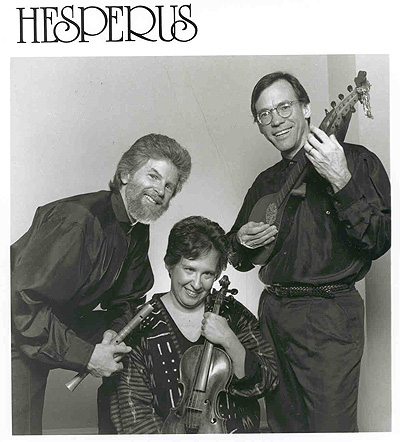
Hesperus Early American Band 1982-89. Courtesy of Chancey/Hesperus.
The earliest colonists brought the music of their homelands with them; American music before the mid-eighteenth century represents the diversity of our nation of immigrants. As the colonies began to see themselves as independent from Great Britain politically and economically, they began to develop a cultural independence as well. The creative energy that carved out a new nation also fueled its lively, idiosyncratic musical style. That energy wasn’t reflected in its pleasant but undistinguished parlor/classical music, but rather in other genres: dance music, broadside ballads and ballad operas, dissonant, modal devotional hymns, marches, and play-party songs.
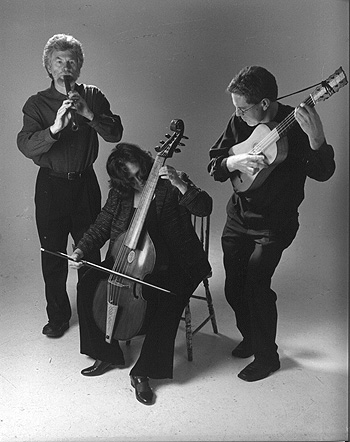
Hesperus Early American Band 1989-2005. Courtesy of Chancey/Hesperus.
Our concerts feature a mixture of classical and popular musics, with a good representation of Scots-Irish ballads, dances, variation sets, and airs. We frequently program such British composers/collectors as John Playford (The English Country Dancing Master), Benjamin Carr (The Division Flute), and Thomas Ravenscroft (Deuteromelia, Pammelia); Scots-Irish composers/collectors Burke Thumoth, Turloch O’Carolan, and James Oswald, as well as tunes from such lute manuscripts as the Rowallan and the Dixon. We also program vocal music by composers of the First New England School: William Billings, Daniel Read and Supply Belcher, whose music became the cornerstone of our current Sacred Harp repertoire. One of our biggest sources for dance music is the Library of Congress’s collection of Cotillion books. Printed between 1780 and 1850, they drew from an intriguing mixture of French round-o’s and rigaudons, Irish jigs, Scottish reels, English country dances, opera arias, and a smattering of other European popular tunes. The broadside ballad was vastly popular: taking a familiar tune as a model, scribblers would pen a lyric about some happening of the day—such as a battle, a murder or hanging—and print it on a wide sheet of paper known as a broadside. Since it was “sung to the tune of,” people didn’t have to read music. Particularly during the ups and downs of war or an especially vituperative presidential election, the broadside ballads expressed current popular sentiment as up-to-date as any blog.
Our approach to this eclectic repertoire can be summarized as informed and participatory. In our opinion, very little written music was meant to be played as written (even there, the eighteenth-century printer’s typical slipshod proofreading can obscure a composer’s original intentions). Much written popular music was meant as a memory aid, a foundation for improvisation and arrangements. Rather than reading the music and playing it as written in the classical style, we learn from current, continuous living traditions, extrapolating from modern-day traditional rural fiddle players like Tommy Jarrell and Clyde Davenport; ballad singers such as Jean Ritchie and Molly Andrews; Irish fiddlers like Kevin Burke and Brendan Mulvihill, and Scottish fiddlers Bonnie Rideout and Elke Baker. In order to best reflect the different styles of music, we’ve studied with many of these performers, as well as inviting many of them to perform with us.
“Bobbing Joe Medley: Bobbing Joe,” Tina Chancey, violin, Mark Cudek, recorder, Scott Reiss, hammered dulcimer. Track from Early American Roots (1997). Courtesy of Chancey/Hesperus.
“Federal Overture,” by Benjamin Carr. Scott Reiss, recorder, Tina Chancey, fiddle, Grant Harried, lute, guitar. Track from Colonial America: spirited sounds from across the sea to the shores of the new land (2003). Courtesy of Chancey/Hesperus.
This article originally appeared in issue 13.2 (Winter, 2013).
Twenty-First Century Perspectives on the Eighteenth Century
Comments on the American Revolution Reborn
The essays that were delivered at the American Revolution Reborn conference are substantive and creative, and in their larger iterations, they will surely make real contributions to our understanding of the unrest on North America’s eastern seaboard in the 1770s. Instead of reviewing those works, however, I would like to take the opportunity to consider what was not discussed, to outline themes and subjects that were absent from the proceedings in Philadelphia. The conference sought “new perspectives for the twenty-first century,” and though a number of papers identified new avenues of exploration, I wonder if we need to be still more adventurous if we wish to chart a course that captures the imagination of coming generations. We could strike out in any number of new directions, but in this brief reconnaissance, I will identify four that seem pertinent to both the 1700s and to our lives today.
The Environment
With the exception of David Hsiung’s wonderful essay, the environment was notably absent from the work presented at the American Revolution Reborn conference, though it is difficult to envision a more relevant perspective for the twenty-first century. Species extinction, invasive species, zoonosis, climate change—these are words that speak to current concerns. Open the newspaper (I should say go to the Times URL), and there is yet another alarming story about sudden beehive collapse or white-nose syndrome, the fungus destroying bats in North America. Or about tornados, droughts, polar vortexes, and global warming.
Though climate has long been a subject within the historian’s ken, global warming has sparked renewed interest in the subject, and scholars are exploring the cultural, political, and economic consequences of climate change with increasing urgency. Geoffrey Parker investigates the worldwide impact of disruptive weather patterns in the seventeenth century in Global Crisis: War, Climate Change, and Catastrophe in the Seventeenth Century. And Sherry Johnson tackles a related subject in her recent book Climate and Catastrophe in Cuba and the Atlantic World in the Age of Revolution. As she pointed out in a recent William and Mary Quarterly article, the unusual climate fluctuations in the Age of Revolution had implications for mainland as well as insular colonists. But that is just the tip of an iceberg that is worth exploring further.
Like the environmental sciences, the biological sciences may help us map new terrain in Revolutionary America. The discipline grows daily by leaps and bounds, and at least one part of it—emerging infectious diseases—has crossed over from the pages of Scienceand Nature into the public arena, as suggested by a spate of popular books on the subject (Hot Zone, Killer Germs, Rising Plague) and by Steven Soderbergh’s feature film Contagion. Elizabeth Fenn’s Pox Americana is a brilliant example of what can be accomplished by a historian who takes biology and epidemiology seriously, as is J. R. McNeill’s Mosquito Empires, which contains several chapters relevant to the eighteenth century.
Those studies are forerunners in an interdisciplinary enterprise that will continue to advance. In the near future, it may be possible to write an early American history that considers the role of gut microbiota, which, as scientists are documenting, play a critical role in everything from obesity to disease progression. Perhaps it will even be possible to explore historical epigenetics—how the environment in the wider world and in the womb shaped gene expression—though such path-breaking work would for the moment have to be largely speculative.
Geographic Information Systems
GIS (geographic information systems) is a third direction worth pursuing. It is everywhere in our lives today, and is at the root of every location-based app, including the ubiquitous Google Maps. As a historical tool, it gives scholars the ability to store information spatially and to explore spatial correlations. Ironically, though GIS did not make an appearance at the conference, Revolutionary Philadelphia is the subject of at least two major GIS projects, one created by Nancy Hagedorn and Ann Deakin, the other by Billy Smith and Paul Sivitz. In addition, the Greater Philadelphia GeoHistory Network collects geographically organized historical information about the city from all eras.
This enormously powerful and flexible technology could have all kinds of applications to early America—from plotting population to mapping land use, crime, markets, epidemics, and the like. Brian Donahue used it with award-winning results in his book The Great Meadow. I am currently plotting the North American population between 1500 and 1790, using a combination of historical maps, county-level population statistics, and statistical modeling. (Updates to this project will be posted at www.ehistory.org.)
Digital Humanities
A fourth direction leads to the digital humanities. The meaning of the term is frustratingly nebulous—it encompasses the digitization of traditional printed sources, the statistical analysis of texts, and innovative experiments in crowd-sourcing—and many existing projects unintentionally underscore the difficulty of building and maintaining easy-to-use, functioning Web applications. Despite these growing pains, the potential of Web-based projects to reinvigorate a profession that is too reliant on the monograph is very real. Crowd-sourcing—harnessing the knowledge of thousands of people—makes it possible to accomplish a much larger project than any one or two scholars could undertake on their own. It also can engage a broad public audience in ways that are not possible with most books. In collaboration with Steve Berry, my fellow co-director at eHistory.org, I recently completed one such project, IndianNation.org. A kind of Facebook for the dead, the site contains a profile page for every Native American on the 1900 census and invites the public to upload documents, photos, and stories. With the assistance of Elizabeth Fenn, we have also created an interactive site mapping every reference to the great smallpox epidemic that swept through North America in the 1770s.
West of the Revolution
It is not by chance that Fenn’s work on smallpox is continental in scope and Parker’s on climate change is global. Viruses and weather patterns do not honor political borders. We have a better understanding today than we did in the twentieth century that environmental transformations cascade across the land, with impacts felt far away. We recognize that we are not often in control of our lives, that in an age of global trade decisions made an ocean away by people we have never met can affect our lives, and that microscopic viruses and invasive fungi can do the same.
If and when we turn to these subjects, I wonder if the American Revolution will still occupy its central, dominant place in the study of early American history. Perhaps, as we increasingly appreciate the manifold ways that we are interdependent—on bacteria and bees, on climate and keystone species—our focus on the Declaration of Independence will wane.
In fact, in the 1770s in North America there were numerous regions undergoing their own tumultuous revolutions that underscore human interdependence, as I discuss in my forthcoming book, West of the Revolution: An Uncommon History of 1776. In Alaska, Russians were moving up the Aleutian archipelago, destroying sea otters as they went, transforming the ocean environment and the island communities they invaded. In San Francisco, the Spanish established the first European colony in the area, triggering an environmental cataclysm that most of us can only imagine. In the Black Hills, Lakota migrants founded their own colony, part of the environmental transformation of the Great Plains that was set off by the rise of equestrian bison hunting. In Saskatchewan, the Hudson’s Bay Company built its first inland trading post, the initial step in a transcontinental race for beaver, a keystone species whose disappearance remade entire forests in ways that are far-reaching and revolutionary. Across the continent, people struggled to come to terms with their rapidly changing world.
Imagine if the most renowned departments in early American history encouraged their graduate students not to locate a bit of untrammeled ground on the Revolution’s well-trod eastern seaboard but to strike out for the West. The subject matter of early American history would be revolutionized at a stroke, making an old field new overnight. All this is to say that our search for new perspectives for the new century may take us to places that we have not yet visited.
Further reading
On the East-Coast bias of early American history, see Claudio Saunt, “Go West: Mapping Early American Historiography,” William and Mary Quarterly 65:4 (October 2008): 745-78; and Saunt, West of the Revolution: An Uncommon History of 1776 (New York, 2014). On climate change and history, see Sherry Johnson, “El Niño, Environmental Crisis, and the Emergence of Alternative Markets in the Hispanic Caribbean, 1760s-70s,” William and Mary Quarterly 62:3 (July 2005): 365-410; Johnson, Climate and Catastrophe in Cuba and the Atlantic World in the Age of Revolution (Chapel Hill, N.C., 2011); and Geoffrey Parker, Global Crisis: War, Climate Change, and Catastrophe in the Seventeenth Century (New Haven, Conn., 2013).
Books that popularize epidemiology include Richard Preston, The Hot Zone (New York, 1994); Brad Spellberg, Rising Plague: The Global Threat from Deadly Bacteria and Our Dwindling Arsenal to Fight Them (Amherst, N.Y., 2009); and Barry E. Zimmerman, Killer Germs: Microbes and Diseases that Threaten Humanity (rev. and updated. Chicago, 2003). Two outstanding works that merge history and the biological sciences are Elizabeth A. Fenn, Pox Americana: The Great Smallpox Epidemic of 1775-82 (New York, 2001); and J.R. McNeill, Mosquito Empires: Ecology and War in the Great Caribbean, 1620-1914 (New York, 2010).
For basic introductions to epigenetics and gut biota, see respectively Nessy Carey, The Epigenetics Revolution: How Modern Biology is Rewriting Our Understanding of Genetics, Disease, and Inheritance (New York, 2012); and “Human Microbiota,” Science (special supplement). For a cautionary note on using epigenetics to understand human behavior, see Greg Miller, “The Seductive Allure of Behavioral Epigenetics, Science 329: 5987 (July 2, 2010): 24-27.
For an introduction to historical GIS and the digital humanities, see David J. Bodenhamer, John Corrigan, and Trevor M. Harris, eds., GIS and the Future of Humanities Scholarship (Bloomington, Ind., 2010). An award-winning example of historical GIS is Brian Donahue, The Great Meadow: Farmersand the Land in Colonial Concord (New Haven, Conn., 2007). The environmental and biological threats that we face today are briefly outlined in Matthew C. Fisher, et al., “Emerging Fungal Threats to Animal, Plant and Ecosystem Health,” Nature 484:7393 (April 12, 2012): 186-94.
This article originally appeared in issue 14.3 (Spring, 2014).
Claudio Saunt is the Richard B. Russell Professor of American History at the University of Georgia and the author of West of the Revolution: An Uncommon History of 1776 (W.W. Norton, June 2014).
Free Silver and the Constitution of Man
The money debate and immigration at the turn of the century
In 1889, Harvard economist Francis A. Walker described the “social effects of paper money” that ranged from bad taste—”wanton bravery of apparel and equipage”—to dangerous consumer desires, which undermined the father’s authority. Paper money, Walker observed, led to the “the creation of a countless host of artificial necessities in the family beyond the power of the husband and Father to supply without a resort to questionable devices or reckless speculations.” Not only driven to recklessness, these fathers adopted “humiliating imitations of foreign habits of living.” Paper money undermined “that fit and natural leadership of taste and fashion which is the best protection society can have against sordid material aims.” And it elicited “manners at once gross and effeminate,” which led to “democracy without equality or fraternity, and exclusiveness without pride or character.”
Paper money threatened patriarchy; it drove otherwise respectable men to immoral or dangerous speculations. Paper bills produced both “effeminacy” and coarseness, encouraging foreign habits. How did paper money manage this cultural crime spree? Not by raising prices—in this passage Walker never mentions higher prices. Instead, by removing society from a basis in “real values,” paper money overturned natural laws and natural social hierarchies. It decentered the self.
Walker was probably America’s leading labor economist in the 1890s. He was also supervisor of the census. The two roles may seem only indirectly linked, but in Walker’s case, they were not. Like most of his peers, he imagined steady global progress marching directly towards the United States of America and its “fit and natural leadership of taste and opinion.” To reinforce that notion, he founded his economics, his sense of social hierarchy, and his view of money in natural law. “Money,” Walker declared in 1895, “is a product of evolution, a result of the ages.” In political economy as in society, in the markets and cultural capitals of the world, “the better [gold] has gradually crowded the worse out of existence.” Like other “hard money” economists, Walker championed gold as the natural money of the superior races. As supervisor of the census, he also called eastern- and southern-European workers racially inferior and argued vehemently that American society had no place for them. For Walker, bad blood and bad money were of a piece: both displaced the superior products of superior races. Walker’s assumptions about both bad blood and bad money reduced the complex, constant renegotiations of value and identity in the marketplace to simplistic, comforting essentials, a “bottom line” of nonnegotiable truths supposedly written by nature. This reduction made the dazzling, unsettling economic and social world of the gilded age more comprehensible and less disturbing.
Rapid transformations in the techniques of credit and exchange had made it hard to be certain about money. Was it gold? silver? Was it a paper promise to pay or a legal compulsion? a socially convenient medium of exchange or a material with intrinsic properties governed by natural law? The United States in 1896 had “probably the most heterogeneous system of money of any of the civilized countries,” wrote the deputy assistant to the treasurer. Gold and silver coins circulated along with “greenback” United States notes, treasury notes of 1890, and gold and silver certificates, “and it is due solely to the unbounded faith of the people in the unlimited credit of the nation that all these kinds [of money] have for so many years circulated side by side.” But that faith was neither unlimited nor unbounded—each kind of money occupied a different position in the raging debate over hard or soft money that had dominated American politics since Reconstruction. The currency’s heterogeneity in 1896 mirrored the nation’s ethnic, racial, and economic diversity: the anxiety about both that characterized the 1890s makes the connection between money and the sense of self unmistakeable.
The federal government had resorted to legal tender “greenbacks” to pay for the Civil War—fiat money that derived its value from the fact that law compelled acceptance. Greenbacks quickly depreciated relative to gold; but a general prosperity followed the war, and many voters attributed that prosperity and even the Northern victory to the greenback economy’s easy credit and mild inflation. Indignant gold men denounced greenbacks as bad faith, and the prosperity as false: gold formed the only proper basis for a modern economy. Gold bugs fought incessantly with greenbackers from 1865 through the 1870s. Attempts to contract the currency, to “redeem” the greenbacks, alternated with measures designed to preserve and even expand their circulation. Complicating the issue, after 1873, those arguing for a bimetallic, silver and gold monetary standard adopted the greenbackers’ inflationary rhetoric—making silver also a “real money” commodity would increase the amount of money in circulation and raise prices. But silverites shared the gold bugs’ faith in intrinsic value and natural law—silver, they argued, also enjoyed a timeless and universal “intrinsic value.” A series of awkward compromises followed, until the election of 1896 and the Gold Standard Act the year after.
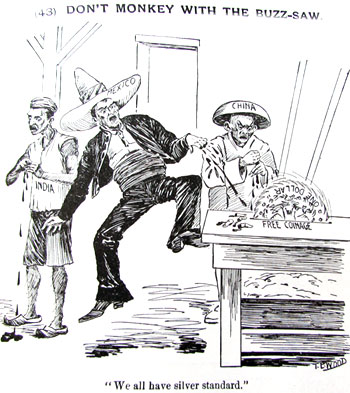
“Don’t monkey with the buzz-saw,” from Sound Currency (1895). Courtesy of the Library of Congress.
The intrinsic-value claims associated with silver and gold bear a close resemblance to the era’s essentialist notions of identity—that is, its theories of racial character. Both use often identical metaphors and both establish their claims on the authority of what they regarded as natural law. In the work of those political economists who argued most strenuously for specie money and who also opposed immigration, essentialist ideas about gold and silver and about identity come together, and it was this conjunction of “specie” and “species” that gave gold standard arguments their popular force.
Arguments for both gold and silver depended heavily on fantasies of intrinsic, natural value. “Who or what gave these metals . . . their peculiar qualities for serving as coined money?” asked A Currency Primer of 1896. “Men did not,” came the answer. “Law did not. Government could not. It was done by Nature.” “Nature has decreed of what materials our money should be, and has even indicated the proportions of money to be made of each metal”—that is, the ratio of gold to silver—”and nature is more potent than legislation.” Relatively unstudied by historians, the nineteenth-century specie fetish presents an extraordinary wealth, as it were, of preposterous claims about essential value. Arguments for gold and silver described those metals’ intrinsic physical properties using Darwinist language. Economist David A. Wells insisted, for example, that “in civilized nations, natural selection has determined the use of gold as a standard.” An 1897 textbook on the money problem argued for gold on the grounds that “the ultimate value of real money rests on the market value of itself.” In other words, its value is its value, which is itself, its intrinsic properties.
Such essentialist accounts of gold’s magical properties filled this void of meaning by relating gold’s use to evolutionary development. William Trenholm, director of the U.S. Rubber Company and comptroller of the currency under President Grover Cleveland, argued in The People’s Money that “there must be a natural law . . . which tends always to establish as a standard of value the material of highest intrinsic value available at the time” and that “it is obvious that, in fixing upon silver and gold to be the standards of value, modern nations have simply followed a natural law.” Trenholm used the language of the social Darwinist Herbert Spencer and Darwin himself to argue for gold. The fantasy of stability in gold and the fantasy of stability in race have the same root origin or cause: fear of market negotiability. Both fantasies seemed to give existing hierarchies the status of natural law.
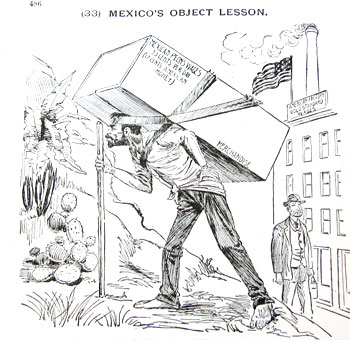
Primitive peoples thus used base materials. “Iron once served the Lacedæmonians as money,” Walker claimed, “but it would be an impossible money today for any but a nation of savages.” Over time, humble materials gave way to more valuable metals. “The history of money and the history of the civilization of the human race are intertwined,” argued A Currency Primer. “Gold is the standard of civilization and Christianity,” insisted another gold bug. “As Mexico adheres to the implements of which the farmers of the United States discarded fifty years ago, so does it adhere to a standard of value [silver] which this country . . . discarded in 1834.” “The brass ‘cash’ of China,” A Financial Catechism announced, “indicate[s] that the people are in an extreme state of degradation; the silver dollar of Mexico represents a higher condition of the people; the gold coin . . . of the United States . . . represents the highest condition.” Like monotheism, suggested Trenholm, “gold mono-mettalism is the unavoidable destiny of this country.”
“Mexico’s object lesson,” from Sound Currency (1895). Courtesy of the Library of Congress.
Late-nineteenth-century political economists unmistakably associated gold as money with civilization, advancement, and racial superiority—not coincidentally the ideological cornerstones of American empire. The gold standard became the mark of the imperializing civilization; the silver currencies of “pagan Asiatics,” that of the justly imperialized. “Turn your eyes to the countries having the silver standard alone—Mexico, South America, Asia—and those having the gold standard,” an American gold bug wrote, “and there is no room for argument. The latter countries are prosperous, intelligent, and progressive; the former embarrassed, poor, and ignorant.” A gold-bug tract of 1892 argued similarly that “fair tests of the state of civilization in any country” included “the kind of money it uses”: only the poorer nations of the world used silver. “Congress cannot cause us to be born again, and into the Hindu, Chinese, Japanese or even into the Mexican or South American silver-handling type,” it concluded. “Silver has served a useful purpose as a standard,” another tract argued, “but it has yielded to the survival of the fittest.” These authors connected gold to an interracial economic struggle, linking America’s racial “value” to gold’s intrinsic superiority.
Gold-standard arguments reflected a more generalized concern about and fascination with the insubstantiality of character, race, and value in labor. Mass production changed the meaning of individual labor and work itself. It made workers machine-like and interchangeable, depriving them of their traditional identity as artisans. But it also made identity more negotiable—immigrants might “assimilate” and become American; their “racial” difference was negotiable. Facing intense competition, lowered wages, and deskilling in the 1890s, many workers found refuge in nativism and racial typologies that posed essential, nonnegotiable differences between Anglo-Saxon, “Latin” [Italian], Semitic, Slavic, black, and Asian workers. In this view black Americans were simply not “union material,” and as Samuel Gompers later put it, “The Caucasians . . . are not going to let their standard of living be destroyed by negroes, Chinamen, Japs or any others.” In the 1890s, native white workers responded strongly to racially based economic arguments about the low character of imported workers. Alarmed by the census of 1890, which revealed a massive increase in immigration from eastern and southern Europe, Walker warned that new immigrants would beat down wages. “They have none of the inherited instincts and tendencies” compatible with self-government. “They are,” he claimed, “beaten men from beaten races, representing the worst failures in the struggle for existence.” Walker blamed their poor wages on their poor genetic stock, their willingness to settle. Poor nations try to escape poverty by issuing paper money, he argued in Money, Trade and Industry. And they do this “in defiance of the laws of its distribution,” which demonstrated that the poverty of their people stemmed from “vices of industrial character” or, simply put, bad racial character.
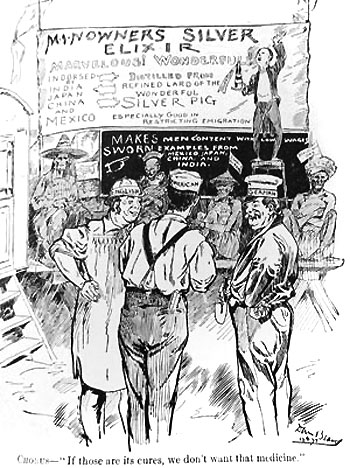
“If those are its cures, we don’t want that medicine,” from Sound Currency (1895). Courtesy of the Library of Congress.
Economist William Z. Ripley similarly contrasted the “urban activity” of the acquisitive, mercantile “Teuton” to the “reactionary passivity” of the “Alpine” and especially of the “Alpine Celt.” As historian Lawrence Glickman and others have argued, native workers feared immigrants as poor consumers, people with few needs who needed only small wages. Undistracted by consumption, unambitious, they simply hoarded with what novelist Frank Norris in McTeague called the “instinct” of “peasant blood”—”saving for the sake of saving, hoarding without knowing why.”
Arguments for gold aimed at the working class often linked gold to both a high standard of living and the intrinsic superiority of the Anglo-Saxon race. “Take a look at the company before you sit down at the feast,” an anti-silver tract warned workingmen. Who had silverites invited? “Half civilized, half clad peoples, who are weak and ignorant, who have little or no commerce; where bullfights abound and schools do not; where human labor is in sharp competition with the meek and lowly jackass; where the breech-clout is preferred to a full suit.” A “sound money” cartoon published and distributed free to newspapers in 1896 depicted three workingmen labeled “English,” “American,” and “German” standing in front of a barker’s wagon. The barker sells “Minowners silver elixir: Indorsed by India, Japan, China and Mexico [sic].” The barker’s sign describes the elixir as “especially good in restricting emigration.” Gaunt, poorly clad stereotypes of Mexican, Chinese, Japanese, and Indian workers sit beneath the sign looking lean, hungry, and sinister. “If those are its cures,” says the caption, “we don’t want that medicine.” The cartoon linked a high standard of living to the gold standard; it also linked both to the essential racial difference between northern-European whites and peoples of color.
Political economists imagined race relations as problems of exchange. Herbert Spenser saw poorer races perpetuating their inferiority by biologically exchanging and reproducing bad traits, bad genes driving out the good. Walker similarly looked at the 1890 census and saw immigrants overwhelming native stock as they strained resources and drove down wages. They “lacked the enterprising spirit” and so would swamp the economy. The time had come, Walker argued, when “the nation’s birthright shall no longer be recklessly squandered” through open door immigration. Without action, the Anglo-Saxon “birthright,” which included a high standard of living, would vanish, squandered like easy paper money, as lazy immigrants accepted less and drove good character out of the market.
The influence of these arguments was evident by 1903, when workers on the Panama Canal had been segregated by task and by pay into two groups: white workers, known as “gold” workers, who took their pay in gold, and black workers, or “silver workers,” who were paid with silver coins. Economics and racism worked together to produce the basic categories for organizing labor. “What prevents Congress from legislating the value of a dollar?” asked the gold-bug “financial catechism” of 1895. Is it the Constitution? “Not the Constitution of the United States,” came the answer, “but the constitution of man.”
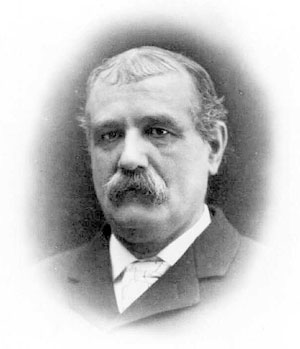
Francis Amasa Walker, about 1895. Courtesy of Wikipedia.
Money, we could say, is a shorthand sign for what difference means. We symbolize the difference between skilled and unskilled workers by paying skilled workers more; we use a shorthand symbol, the price, to say what the difference between “standard” and “deluxe” means. But if money seems unstable, so might the system of making sense of difference. Walker, quoted at the start of this essay, saw paper money as the source of unstable character. Gold drew his interest because it offered, in a time of increasing economic dynamism and ethnic diversity, to stabilize the meaning of difference; it offered a “gold standard” through which immigrants and the racially different might be put in their place. His nativist anxiety masqueraded (as similar sentiments of free marketeers do today) as fantasies of natural market law.
Further Reading:
Pamphlets, tracts, articles, and books on the money question rained down like autumn leaves in the 1890s. Francis A. Walker’s sentiments appear in Money in its Relations to Trade and Industry (New York, 1889) and Money and Banking (Boston, 1902 [reprint of 1895 ed.]). The single best evidence on the gold-bug position may be the periodical Sound Currency, published in the mid-1890s and quoted extensively here. On its extraordinary reach and effectiveness see James Livingston, Origins of the Federal Reserve System: Money, Class and Corporate Capitalism (Ithaca, N.Y., 1986). Among recent books that deal with immigration and economics, Mathew Frye Jacobson, Barbarian Virtues (New York, 2001) and Katrina Irving, Immigrant Mothers (Bloomington, Ill., 2000) are most pertinent. The author established some of these arguments in O’Malley, “Specie and Species: Race and the Money Question in the Nineteenth Century,” in American Historical Review 99 (Spring 1994): 369-395; Gretchen Ritter’s Goldbugs and Greenbacks: The Antimonopoly Tradition and the Politics of Finance, 1865-1896 (Cambridge, Mass., 1999) looks at race and money arguments in similar ways. For theoretical background on money as a symbol, see John Joseph Goux, Symbolic Economies (Ithaca, N.Y., 1990), David Graeber, Toward an Anthropological Theory of Value (London, 2001), Marc Shell, Money, Language and Thought (Baltimore, Md., 1991) and Art and Money (Chicago, 1995), and Viviana Zelizer, The Social Meaning of Money (Princeton, 1997).
This article originally appeared in issue 6.3 (April, 2006).
Michael O’Malley is associate professor of history and art history at George Mason University. He is studying the money question in American history, as well as studying the history of recorded sound.
Seeing a Different Visual World
Graphics in nineteenth-century America
From the vantage point of our twenty-first century, so saturated with visual media, it is hard to imagine that the nineteenth century experienced one of the greatest visual revolutions in history. Technological innovations—from the invention of photography to the development of a variety of mechanized processes for reproducing images on a scale never before imagined—coupled with expanding transportation and communications networks, engendered a veritable avalanche of pictorial publications and products. The vast effusion of graphic materials confronting the nineteenth-century American included an ever-increasing range of illustrated periodicals; the blossoming of the political cartoon; individual decorative, portrait, comic, and genre prints; trade cards; greeting cards; sheet music covers; theater and campaign posters; and overbearing billboards. Indeed, faced with what the historian Jean-Louis Comolli has termed “the frenzy of the visible,” nineteenth-century cultural conservatives such as Nation editor E. L. Godkin decried the leveling of American taste to the common denominator of “chromo-civilization”—a metaphor for diluted “pseudo-culture” named after the popular color print so ubiquitous in household parlors.
Until relatively recently, this resplendent or horrifying (depending on your perspective) nineteenth-century visual culture was of little note to historians. Or, to be more accurate, its history was relegated largely to illustrations tipped into the binding of published monographs (usually not even gathered by the authors) or used as mildly informative decoration in survey texts. Trained with a decided bias in favor of the Word and against the suspiciously inviting Image, historians’ orientation to the past remained largely logocentric, or as the art historian Barbara Maria Stafford put it, “anti-ocular.” The visual realm of U.S. history was left to the art historians, who in turn left the popular graphic world to largely unrecognized collectors and aficionados of ephemera.
We owe a great deal to the latter for creating the foundation upon which recent scholarly work on the popular visual world has been built. The twelve essays in this special issue of Common-place reflect the “visual turn” in U.S. historiography over the last decade. They also suggest the stunning range of topics and approaches characterizing the field of visual history, including: caricature and woman suffrage; the visualization of the industrializing city; the impact of pictorial publications on national identity; the role of portrait prints in the invention of public personas; the visual manifestations of popular political metaphors; the transformation of craft and credo in wood engraving; the visualization of progress in the antithetical figure of the Chinese worker; women engravers’ struggle for representation in their trade and in illustrations of women workers; the emergence of alternative African American political cartooning; the unintended vernacular uses of published ephemera; and the creation of graphic archives during the Gilded Age.
In short, as this collection of essays attests, embedded in the seemingly regimented lines, archaic visual codes, and quaint pictorial conventions of nineteenth-century graphics is a universe of actions and ideas that the realm of text often fails to capture. In their explorations of that universe, historians have begun uncovering the myriad ways popular graphics engaged with, embodied, and shaped the tumultuous culture, society, politics, and economy of nineteenth-century America.
This special issue of Common-place comes at a propitious time for the American Antiquarian Society (AAS), one of the journal’s underwriters. In 2005, the society’s governing board approved the creation of a Center for Historic American Visual Culture. The AAS is eminently suited for this activity because of its experience in hosting workshops, seminars, and conferences for scholars in many disciplines. The fellowship program, established in the early 1970s, is well regarded and has for the past decade had two fellowships specifically for scholars using prints or studying visual culture. Recent generous support from AAS member Jay T. Last and his wife Deborah enables the AAS to offer an increased number of fellowships for those studying visual culture. The graphic arts collection at the AAS includes prints published from the late seventeenth century through the nineteenth century as well as engraved, printed, and lithographed ephemera, much of it pictorial. There are illustrated sheet music covers, maps of the United States, drawings, and photographs as well. Among the activities planned for the center are workshops for secondary-school and collegiate teachers on interpreting visual evidence for the classroom, lectures for the general public, additional fellowship programs, and conferences focusing on the visual dimension of American history.
But the connection between this special issue of Common-place and the new Center for Historic American Visual Culture is more than a happy accident. There is a profound technological convergence that makes both enterprises possible. In much the way that new printing technologies revolutionized the nineteenth-century visual world, so digital technology is revolutionizing our study of that world. Now, on-line journals such as Common-place can recover and communicate the experience of past visual culture by publishing much more than just textual analyses of visual experience. Unconstrained by the costs of reprinting high-quality images, we are able to present a range of visual materials and (by linking images to larger versions) afford a level of interaction inconceivable for an ordinary print journal. We hope you take full advantage of this opportunity to observe pictorial details and techniques. And we look forward to the many ways the new Center for Historic American Visual Culture will further the project, so beautifully articulated in the work presented here, of bringing together old worlds of print and new worlds of digital technology.
This article originally appeared in issue 7.3 (April, 2007).
Georgia B. Barnhill is the Andrew W. Mellon Curator of Graphic Arts at the American Antiquarian Society and coordinates the activities of the Center for Historic American Visual Culture. She has written and lectured extensively on American prints and book illustrations of the eighteenth and nineteenth centuries. Her most recent publication is The Bibliography on American Prints of the Seventeenth through the Nineteenth Centuries, published by the American Historical Print Collectors Society and Oak Knoll Press.
Joshua Brown is executive director of the American Social History Project and professor of history at the Graduate Center, City University of New York. His most recent book (coauthored with Eric Foner) is Forever Free: The Story of Emancipation and Reconstruction.
Ian Gordon is an associate professor in history at the National University of Singapore. He is the author of Comic Strips and Consumer Culture (Washington and London, 1998) and an editor of the forthcoming Film and Comic Books (Jackson, Miss., 2007).
“Let Them Study as Men and Work as Women”
I begin with a paradox: After the Civil War, middle-class white women increasingly assumed public roles in cultural, political, and economic arenas, but their achievements were rarely depicted in the illustrated press. In the engravings of popular pictorial weeklies such as Frank Leslie’s Illustrated Newspaper and Harper’s Weekly, women were typically represented as victims, criminals, workers in manual trades, denizens of the household, or shoppers. The rare appearance of female professionals, politicos, and culture workers begs explanation. Even on those occasions when middle-class white women were shown, they were rarely depicted as working professionals or assertive public figures. With the exception of cartoons, most of the illustrations of these women were static and constrained—portraits, rather than the rich narratives that characterized other illustrations.
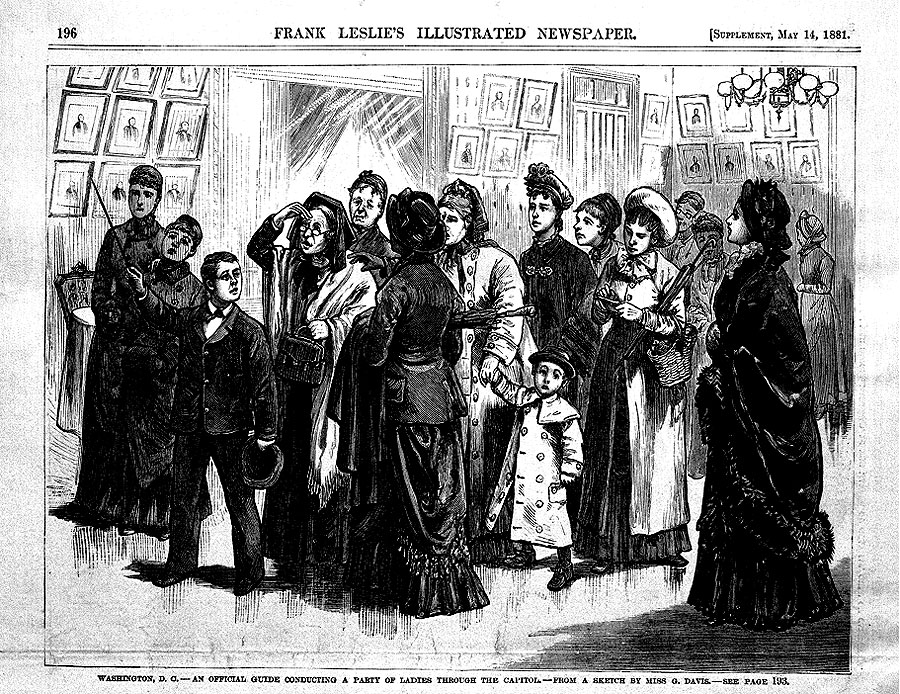
This tendency to visually exclude active, working, middle-class white women obscured the uncomfortable fact that increasing numbers of white, middle-class families relied on the material contributions of their wives, sisters, and daughters. The work of Georgina A. Davis, an engraver and staff artist for Frank Leslie’s Illustrated Newspaper, illustrates the conventional depictions of middle-class women. But it also suggests ways at least one professional woman attempted to challenge these conventional depictions. An 1881 illustration by Davis is an example of the paradox I am describing (fig. 1); can you identify the artist-reporter in the picture?
Davis’s signature appeared over one hundred times in her first decade at Frank Leslie’s Illustrated Newspaper (1880-1890), making hers a familiar name to readers. As a staff artist at a major nineteenth-century illustrated weekly, Davis’s career was not at all typical for women working in commercial art. Although many other women artists contributed to the illustrated press as free-lancers, Davis’s longevity and permanent staff position more closely resembled male artists’ careers. By the time Frank Leslie’s accepted her first illustration in 1880, Davis was already an established painter and engraver. Her first critically noticed illustration, “The Bridge of Sighs,” appeared in 1872 in the art journal the Aldine and later found a place in the Women’s Pavilion at the 1876 Philadelphia Centennial Exposition.
Fig.1. “Washington, D. C.—An official guide conducting a party of ladies through the Capitol—From a sketch by Miss G. Davis.” From Frank Leslie’s Illustrated Newspaper (May 14, 1881, supplement). Courtesy of Rutgers University. (Click image to enlarge.)
That the earliest critical attention Davis received referenced Thomas Hood’s popular poem, also entitled “The Bridge of Sighs,” presents us immediately with the limitations artists faced in representing women’s work. The poem describes the discovery of a deceased young prostitute. The fallen woman in Hood’s poem follows a narrative trajectory—from wronged and seduced, to sinning and wrong, to suicide as righting all wrongs—that painters and illustrators of this era drew on to create a visual vocabulary of female victimization. As the embodiment of lost respectability and purity, the figure of the prostitute pointed to the particular dangers women faced in the modernizing, commercial city.
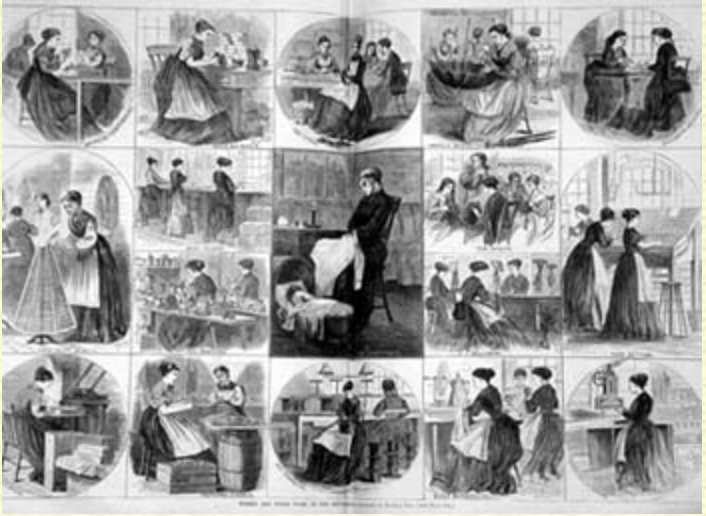
Fig. 2. Stanley Fox, “Women and their Work in the Metropolis.” From Harper’s Bazar (April 18, 1868). Courtesy of the American Antiquarian Society. A larger version of this image can be viewed on the AAS Website. (Click image to enlarge.)
Additionally, for women’s rights supporters, the fallen woman dramatized the problem of female dependence and the scarcity of lucrative and respectable occupations for women. One widely advocated solution to these problems was training in art and design. Beginning in the early 1850s, schools of design for women were established in New England, Philadelphia, Baltimore, and New York to prepare female artists for employment in manufacturing and publishing. The founders of these design schools hoped to create opportunities for women to work at “congenial pursuits,” while elevating the design of American manufactures, thereby solving two distinct yet related problems: the dilemma of female self-support (always aligned with maintaining female purity) and the presumed inferiority of American art and design. In a familiar republican combination, maintaining women’s purity was part of the prescription for maintaining national ideals. And in reducing women’s material dependence on others, design schools would also help to eliminate national dependence on European art and design. The dissemination of art through print culture and art education dedicated to enhancing the design of manufactured products also promised to elevate popular taste and sustain democratic values.
At the Cooper Union Female School of Design (the name of the New York School of Design for Women after its adoption into Peter Cooper’s great experiment in free education for mechanics in 1859), Georgina Davis studied with women who intended to become self-supporting artists and engravers as well as with women for whom art would remain an avocation. Although tuition was free for industrial pupils (those who intended to work), the classes were during the day when less financially secure working women were unable to attend. Those who could attend typically included women from the families of farmers, ministers, engravers, clerks, and merchants. Their fathers and brothers assumed that if they remained unmarried, these sisters and daughters would need a respectable career path. Unlike the starving seamstress or the prostitute, both represented as victims of male commercial culture, the women trained as designers, wood engravers, and illustrators represented a new, respectable, potentially comfortable form of female industry.
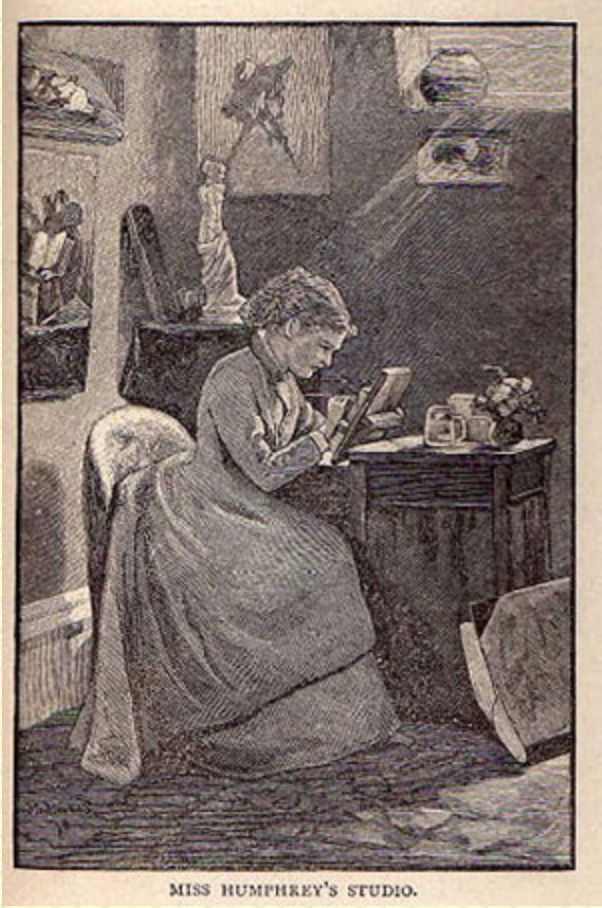
Fig. 3. Artist unknown, “Miss Humphrey’s Studio.” From S. W. G. Benjamin, Our American Artists, second series (Boston, 1881). Author’s collection.
The distinctiveness of this new form of female work is suggested by two engravings. The first, an 1868 Harper’s Bazar double-page engraving of “Women and their Work in the Metropolis,” featured a sleeping seamstress, cradle at her feet, at the center of a series of smaller vignettes about working women (fig. 2). The seamstress’s portrait is larger than the others, perhaps indicating the significance of sewing as a source of women’s employment; moreover, except for her child, she is shown alone and at home, unlike the surrounding vignettes—the latter depicting women working with other women in shops and factories. Compare this image to a portrait of Lizbeth B. Humphrey, an illustrator and classmate of Davis at the Cooper Union Female School of Design (fig. 3). Humphrey, pictured in her Boston studio bent to her task, her work lit by a nearly celestial beam of light, is surrounded by markers of art and culture—statuary, sketches, and flowers. Like the seamstress,
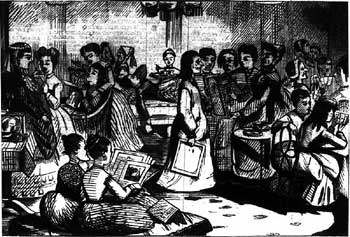
Fig. 4. Artist unknown, “The Ladies Club at Delmonico’s.” From Harper’s Bazar (May 16, 1868). Courtesy of Rutgers University. (Click image to enlarge.)
Humphrey is shown laboring in isolation; both figures’ respectability is anchored in their privacy and their domestic distance from commerce. Davis and Humphrey, as members of the first group of women to attend design schools, represented a kind of test case for self-support. Could a new kind of working woman forge a different, less dependent path for urban American womanhood while maintaining her middle-class respectability?
Midcentury women’s rights periodicals supported the emergence of this new profession for women, regularly noting the efforts of women artists and profiling their schools and organizations. The success of women artists provided a clear validation of female accomplishment and symbolized women’s independence. Some women artists, Davis among them, created new associations to support and promote their achievements, notably Sorosis, the first club for women professionals. Sorosis (drawn from the Greek for sister) gathered together women artists, physicians, editors, writers, businesswomen, and fashionable modistes in a new formation that emphasized women’s autonomy, cultural authority, and productivity. Urbane, commercial, and public, the women in Sorosis made it possible for middle-class women readers to imagine identities beyond the home.
Fierce resistance to such incursions into these masculine professional and social precincts and identities forms another part of the visual iconography that structured the possibilities for representing middle-class women’s work. Cartoons in the illustrated press such as “The Ladies’ Club at Delmonico’s” dismissively lampooned the women’s professional identities and working lives, picturing them at leisure, playing cards, drinking tea, reading newspapers and avant-garde texts (hence the copy of Darwin’s Origin of the Species in the foreground), and looking at prints (fig. 4).
Fig. 5. Artist unknown, “Treasury Department—The new secretary looking around.” From Harper’s Bazar (April 3, 1869). Courtesy of Rutgers University.
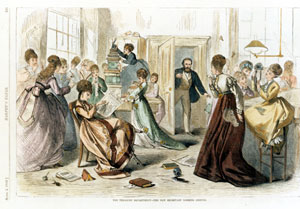
The advent of middle-class women as clerks in the U.S. Treasury Department during the Civil War elicited similar responses in the illustrated press. An 1869 Harper’s Bazar cartoon shows a male surprising a female work force as it studies bonnets, reads Harper’s publications, crochets, plays, and gossips (fig. 5). Identified as part of the middling classes by their reading matter (both the Bazar and Harper’s Weekly appear in the cartoon), the women clerks could not be pictured actually working outside the home.
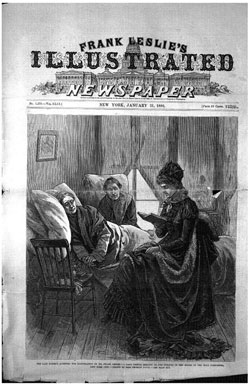
Fig. 6. “The last subject accepted for illustration by Mr. Frank Leslie—A Lady Visitor Reading to the Inmates of the House of the Holy Comforter, New York City—Drawn by Miss Georgie Davis.” From Frank Leslie’s Illustrated Newspaper (January 31, 1880). Courtesy of Rutgers University. (Click image to enlarge.)
While Davis supported women’s professional aspirations and worked actively as a commercial artist for almost thirty years, the images she made rarely depicted middle-class women at work. Whether working as a staff artist for Frank Leslie’s and the Salvation Army newspaper the War Cry, or as an illustrator for the children’s book publisher McLoughlin Brothers, there was little call for her to represent working middle-class women. Intent on portraying white middle-class women as part of a gender economy that portrayed them solely as homemakers and consumers, most iconography in the illustrated press visualized an acceptable public femininity that ignored the movement of middle-class women into the professions and other forms of paid, respectable employment. We can view the charity volunteer, the benevolent lady, more occasionally the teacher, and frequently the shopper, but the book agent, publishers’ reader, the journalist, the business woman, and the working artist are rarely glimpsed.
Davis covered “the benevolent beat” for Frank Leslie’s, reporting on charity institutions, fund-raising fairs, and various Ladies Bountiful around town—the few public venues where ladies made an unchaperoned appearance. “A Lady Visitor Reading to the Inmates of the House of the Holy Comforter” shows womanhood at its ideological best: pious, graceful, and devoted to those less fortunate (fig. 6).
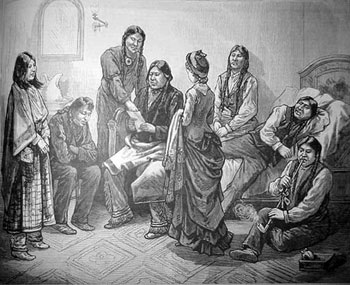
Fig. 7. “Illustrated interview of Our Lady Artist with the Ute Indian Chiefs and Prisoners in Washington, D. C.—From a sketch by Miss Georgie A. Davis.” From Frank Leslie’s Illustrated Newspaper (April 3, 1880). Courtesy of Special Collections Division, Newark Public Library.
The insistence on locating middle-class women in domestic settings is particularly striking given the increased visibility of middle-class women in urban public spaces. The lady in public generated a good deal of ambivalence among many observers. Her presence was evidence of changing mores as she paraded in venues that signaled pleasure and consumption, including the new urban shopping, art, and entertainment districts. In street scenes, department stores, and theaters we occasionally glimpse middle class women’s presence and
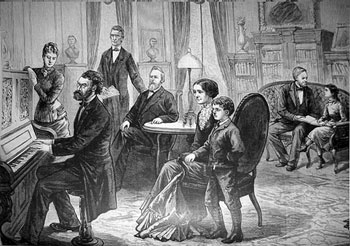
Fig. 8. “Washington, D. C.—Social life in the national capital—An evening in the private parlors of the executive mansion—From a sketch by Miss Georgie A. Davis.” From Frank Leslie’s Illustrated Newspaper (April 3, 1880). Courtesy of Special Collections Division, Newark Public Library. (Click image to enlarge.)
enlarged mobility in the city. But most often women are shown in these new public settings caged in interiors that recall the domestic parlor, or they are depicted in need of male protection and assistance. The dominance of these kinds of images and the relative absence of alternative visions make the forms of Davis’s self-representation interesting. How do Davis’s self-depictions subvert as well as align with this logic of constraint and control?
One of Davis’s first illustrations for Frank Leslie’s, “An Illustrated Interview of Our Lady Artist with the Ute Indian Chiefs and Prisoners,” in 1880 promises to present a “new” woman (fig. 7). Davis depicts the “lady artist” facing a group of Ute men, looking on as they read a document she may have presented to them. Other Ute men lounge on a bed or sit on the floor, one smoking just behind the modest walking skirt. The artist is presented in profile, neatly dressed, carefully bonneted with a shawl over one arm. She is not drawing or writing, so her identity must be inferred from the picture’s caption and the subject’s respectable dress and posture. Yet is she respectable?
The image also could be read as locating white womanhood as an integral part of a hierarchy of colonial relations of power. The artist is the only white person in a room that seems markedly homosocial and “other.” Although she remains standing, there is an air of quiet command in her attentiveness and some daring in her solo venture into what appears to be a hotel room filled with men who until recently were waging war against the U.S. government. The only other woman present is a Ute who stands apart from the group of men, also looking toward the white woman visitor. Displaying the physiognomic codes that denoted racial, ethnic, and class hierarchies in the period, the Ute woman’s coarser features, passivity, and clothing mark her as less civilized and thus subordinate to white womanhood. Nonetheless, the lady artist is snared in the gazes of at least two of those men, pinning her to her place and raising questions about her autonomy. By including herself in the illustration, Davis records her own presence and her authority as the image maker, yet she is also markedly out of place.
Fig. 9. G. A. Davis, “New York City—The waiting-room in the building of the Working Woman’s Protective Union.” From Frank Leslie’s Illustrated Newspaper (February 5, 1881). Courtesy of American Social History Project. (Click image to enlarge.)
Compare this illustration with one Davis made during the same trip to Washington, “Social life in the national capital—An evening in the private parlors of the executive mansion” (fig. 8). In this engraving women continue to look on as men act, but the scene is decidedly domestic, tranquil, and filled with the marks of bourgeois comfort and respectability. There is no bedstead with its murmurings of sexuality; instead, the scene is anchored by the mother/child dyad at the center, bringing to the fore woman’s maternal love and woman’s place within the domestic order. The artist is not visible, making the scene a commonplace image of domesticity rather than the particular record Davis offered of the Utes.
Fig. 10. G. A. Davis, “Pawning the Wedding-Ring.” From Frank Leslie’s Illustrated Newspaper (February 9, 1889). Courtesy of Rutgers University. (Click image to enlarge.)
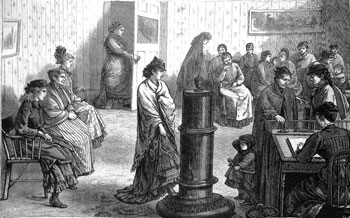
Two other illustrations by Davis help delineate the narrow parameters within which working women could be portrayed. In an 1881 engraving, she captured a diverse group of women waiting in the anteroom of the Working Woman’s Protective Union (fig. 9). Although the vast majority of the union’s clients labored in the garment industry and as domestic servants, Davis chooses here to show us women who could be typographers, stenographers, and telegraph operators as well as women in manual pursuits. The young woman warming her foot on the stove and especially the woman behind the desk appear to be new “types,” recognizing the fact that by 1870 over one-third of New York City’s workforce was female. While earlier the inability to distinguish between those who worked and those who did not registered as social unease, Davis’s image suggests that some forms of paid work no longer placed women outside the bounds of respectability. The seated female clerk in the right foreground, checking a register for an older woman who waits patiently, acknowledged that benevolent enterprises had emerged as major employers of educated single women and that women created and sustained the institutional infrastructure of charity.
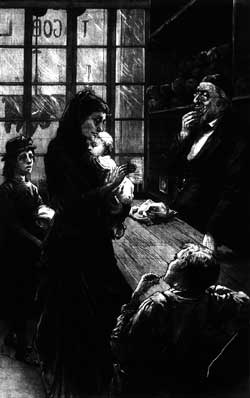
On the other hand, an image Davis made late in her career at Leslie’s demonstrates the persistent anxiety about women in commercial settings. In “Pawning the Wedding-Ring,” Davis centers her narrative on a young woman holding a baby as she hands her ring to a pawnbroker (fig. 10). The image is at once sentimental about marriage and forthright about the continuing economic plight of some women. Although the pawnbroker’s stereotypic physiognomy (and trade) identifies him as Jewish, the central figure evokes a ragged Madonna of the streets, a pictorial convention that often signified the immigrant working poor. The worried mother returns us to an earlier regime of female economic dependence, as her only hope for feeding her child is to pawn the symbol of matrimony. But she does this not as a typical middle-class mother, dependent on her husband’s income. Rather she is a poor immigrant. For middle-class women, the struggle to survive is now revealed by the varieties of respectable working women in the waiting room of the Women’s Protective Union.
Fig. 11. “A summer holiday abroad, No. 6—In and around London and Oxford. Drawn by Miss G. A. Davis, expressly for ‘Frank Leslie’s Illustrated Newspaper.’” From Frank Leslie’s Illustrated Newspaper (October 25, 1884). Courtesy of Rutgers University. (Click image to enlarge.)
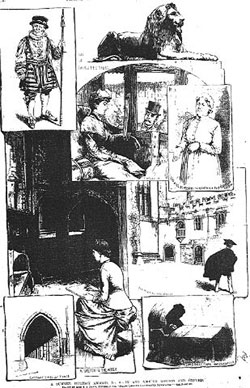
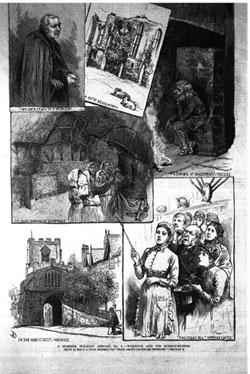
Davis explored her own socio-economic status again in a series of illustrated travel accounts. Appearing in nine installments from 1883 to 1885, the accounts follow the familiar path of the Victorian travel narrative. They begin with the departure and attendant customs inspections and then move on to representations of landmarks and “natives.” Traveling in England, Belgium, Holland, and Germany, Davis repeatedly inserts the artist-reporter into scenes of famous “sights” as she recounts her trip. In these sketches from life, she is clearly the author seen drawing the interior of Westminster Abbey (fig. 11). Although the woman artist has her back to us she is in a public, if sacred, space, recording her experience for readers. Unlike her first appearance with the Utes in the 1880 engraving, the working role of the artist is more fully revealed here. In a visit to Warwick Castle, Davis’s active, productive self is made all the more explicit as she shows herself, the artist-reporter, eagerly jotting notes and making quick sketches (fig. 12).Davis’s freedom to represent herself may have been the result of her distance from American shores; it may also express her growing self-confidence as a figure in the world of illustration. The latter is certainly suggested by the range of her creative work. Through the 1880s, while still working as a Frank Leslie’s staff artist, Davis learned to etch and exhibited her work. She also benefited from publishers’ active promotion of their illustrators. It had become clear to publishers that linking their products to particular artists helped sell those products.
Fig. 12. “A summer holiday abroad, No. 6—Warwick and its surroundings. Drawn by Miss G. A. Davis, expressly for ‘Frank Leslie’s Illustrated Newspaper.’” From Frank Leslie’s Illustrated Newspaper 44 (September 6, 1884). Courtesy of Rutgers University. (Click image to enlarge.)’
The reorganization and professionalization of artistic training in formal institutional settings, and especially the expanding numbers of women crowding into art schools, made the figure of the woman artist at the turn of the century culturally significant and potentially subversive. Much like the “world turned upside down” images of woman suffragists in the 1850s and 1860s, Gilded Age cartoons of women artists warned of the likelihood that their work would render them masculine. Cultural meanings attached to the figure of the woman artist shifted: she did not simply offer a symbol feminists could draw on to dramatize women’s entrance into public spaces and work; she had become a more threatening force, potentially undermining the status of the arts professions in general. In response, male artists, critics, and gallery owners built informal and formal institutions (such as clubs and exhibition venues) that excluded and marginalized women artists, that fostered an image of the professional artist as male, and that equated the highest aesthetic values with men.
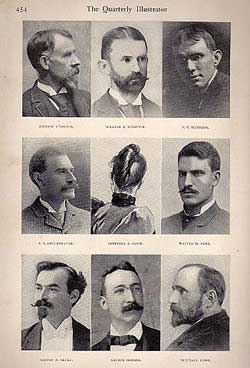
Davis’s only known self-portrait appeared in the Quarterly Illustrator in 1894 and suggests some of the tensions at play as definitions of high and low and feminine and masculine were redrawn. The Quarterly Illustrator, published by Harry C. Jones from 1893 to 1894 in New York City,was an unparalleled venue for anointing illustrators as personalities, even celebrities. In the years before Davis’s portrait was published, she had received significant critical attention. And her growing fame makes it difficult to read her self-presentation in this very public guidebook to American illustration (fig. 13). Her “portrait” stands in stark contrast to the photographs of the mustachioed and bearded male artists who surround her. Sketched rather than photographed, we focus on her hair, the angle of her shoulders, and the light shimmering on her head and her puffed sleeves.
Fig. 13. The Quarterly Illustrator 2 (January-March and October-December 1894). Author’s collection. (Click image to enlarge.)
Other portraits of women artists in the same volume are similar to those of the male artists’ partly because they are photographs. But, like Davis’s drawing, they also emphasize feminine details of hair, jewelry, and clothing. Although male artists are frequently shown in their workplace, the studio, or holding brushes and palettes, the tools of their trade, few women artists are so portrayed. In this context, Davis’s self-representation is more than idiosyncratic, more than an expression of individual desire to foster mystery or preserve anonymity. As a drawing, her self-portrait draws attention to her skills as an artist. At the same time, the composition lends the portrait a certain ambiguity. Thoroughly fashionable and feminine, the sitter cannot be masculinized—but is she working, is she professional?
Fig. 14. Alice Barber Stephens, “The Woman in Business.” Cover of Ladies’ Home Journal (September 1897). Courtesy of Rutgers University. (Click image to enlarge.)
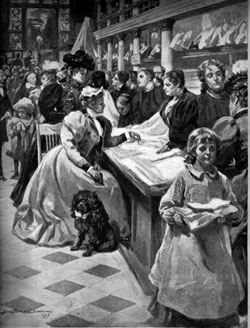
Davis’s self-portrait demonstrates the difficulties of inscribing middle-class women’s work into the visual record. Negotiating between the prostitute, the seamstress, the suffragist, and the domestic angel proved wearing, unprofitable, and perhaps impossible. By the end of the nineteenth century, popular depictions of working women rarely included middle-class women. Instead, they showed women whose physiognomies might have defined them as respectable but whose work could never define them in that way. Alice Barber Stephens, like Davis a pioneering woman illustrator, created a cover for the Ladies Home Journal as part of the magazine’s series on “The American Woman.” Her only image of women at work, “The Woman in Business,” published in 1897, clearly identifies the woman in business as subordinate to the woman who consumes (fig. 14). Standing caged behind the store counter, this archetypal working woman presents fabric to her customer—a seated, fashionable woman, shopping with her dog.
Davis’s self-image, made at a moment when her distinctive signature was well known, captures the paradox of representing middle-class women as workers. Her portrait appeared as pictures of young, white women at leisure drawn by male illustrators became popular icons of American womanhood. By the first decades of the twentieth century, portrayals of the leisure-loving Gibson Girl, Fisher Girl, or Christy Girl had come to dominate the popular press. It was these bicycling, swimming, golfing, and flirting middle-class women who filled the pages of the new mass circulation magazines. These “new women” served as emblems of pleasure and consumption, reinforcing the belief that middle-class white women were simply the beneficiaries of middle-class male achievement.
Further Reading:
Kathleen D. McCarthy, Women’s Culture: American Philanthropy and Art, 1830-1930 (Chicago, 1991) and Nina de Angeli Walls, Art, Industry and Women’s Education in Philadelphia (Westport, Conn., 2001) offer detailed accounts of the American design-school movement. Diana Korzenik’s Drawn to Art: A Nineteenth-Century American Dream (Hanover, N.H., 1985) alerts us to the popularity and outreach of American art education in the period, suggesting how hundreds of rural girls found their way into design schools. Several recent exhibition catalogues provide useful biographical sketches of individual illustrators, designers, and engravers and further develop the story of women who pioneered in these professions. These include: Helena Wright’s, With Pen & Graver: Women Graphic Artists before 1900 (Washington, D.C., 1995); Judy Larson’s introduction to Enchanted Images: American Children’s Illustration, 1850-1920 (Santa Barbara, Calif., 1981); and Phyllis Peet’s American Women of the Etching Revival (Atlanta, 1988). Alice Kessler-Harris’s study of women wage earners Out to Work: A History of Wage-Earning Women in the United States (New York, 1982) provides the best overall summary of the issues confronting women workers throughout the nineteenth century. For more on white middle-class women’s movement into paid work, Angel Kwolek-Folland, Engendering Business: Men and Women in the Corporate Office, 1870-1930 (Baltimore, 1994); Mary P. Ryan, In the Cradle of the Middle Class: The Family In Oneida County, New York, 1790-1865 (New York, 1984); Cindy S. Aron, Ladies and Gentleman of the Civil Service: Middle Workers in Victorian America (New York, 1987); and Ava Baron, ed., Work Engendered: Toward a New History of American Labor (Ithaca, N.Y., 1990). In Difficult Subjects: Working Women and Visual Culture, Britain 1880-1914 (London, 2002), Kristina Huneault explores the representation of working-class women in advertising, popular culture, painting, and photography. To explore the impact of Leslie’s publications and understand its readership, consult Joshua Brown, Beyond the Lines: Pictorial Reporting, Everyday Life and the Crisis of Gilded Age America (Berkeley, 2002). Michelle Bogart considers the cultural location of illustrators and illustration in the Gilded Age as the lines between popular and high art hardened in Artists, Advertising and the Borders of Art (Chicago, 1985). Two recent studies debate women artists’ attitudes toward professionalization and their training: Kirsten Swinth, Painting Profesionals: Women, Art and the Development of Modern American Art, 1870-1930 (Chapel Hill, 2001), and Laura Prieto, At Home in the Studio: The Professionalization of Women Artists in America (Cambridge, Mass., 2001); while Sarah Burns’s Inventing the Modern Artist: Art and Culture in Gilded Age America (New Haven, 1996) considers the shifting cultural significance of artists and illustrators and their modes of self representation in the period. Carolyn Kitch surveys the emergence of the American girl in popular periodicals in The Girl on the Magazine Cover: The Origins of Visual Stereotypes in American Mass Media (Chapel Hill, 2001) and Off the Pedestal: New Women in the Art of Homer, Chase and Sargent (New Brunswick, Conn., 2006) traces her emergence in American painting.
This article originally appeared in issue 7.3 (April, 2007).
Barbara J. Balliet teaches women’s and gender studies at Rutgers University-New Brunswick. She is completing a book on the work and lives of women engravers and illustrators in the second half of the nineteenth century.
Imitation is the Sincerest Form of Appropriation
Scrapbooks and extra-illustration
As children, my friends and I satirized our teachers and classmates in imitation movie posters and newspapers, devoting at least as much attention to drawing Times Roman type’s thick and thin lines and the serifs on the corners of the letters as we did to our words of mockery. Our teasing seemed to gain power from the familiar, authoritative forms of print, even the ballyhooing cry of the monster-movie poster. (“Thrill to the hunt for x and y! Scream in horror as the amazing Mr. Metzler claims to measure angels!”) We learned to feel we had a stake in these forms of media and turned to them to demonstrate our cultural prowess—if not in math, at least in media.
Making a monster-movie poster or mock newspaper was a way of dressing ourselves in grown-up clothes and taking on the voices that spoke to us with such authority at the movies, in books, and in newspapers. We borrowed that authority to protest the difficulties of our studies and the impositions of our teachers. Our attention to form announced our expertise and gave us a feeling of mastery and control.
Nineteenth-century readers who made scrapbooks also borrowed and imitated the visual and physical trappings of existing, authoritative forms of media to bestow authority on what otherwise might have seemed miscellaneous selections of odds and ends from the newspaper. They turned their ragtag clipping collections into dignified books. While people of all ages, classes, and both genders made scrapbooks, another group, nearly all wealthy men, borrowed and elaborated the form of the book to house collections of prints and to demonstrate their taste and reach as collectors of engravings, etchings, mezzotints, and lithographs. These are the “extra-illustrators” who found in the process of recasting and personalizing books a means to reclaim the luxury and rarity of a printed form that, thanks to mechanized printing, had become commonplace.
Scrapbooks
Americans made scrapbooks to “preserve the good things that fly on the leaves of the winged press,” as one magazine put it. Authors, public speakers, and actors clipped records of their work; suffragists and African Americans documented their collective struggles; women and men of all classes created scrapbooks of poetry, stories, and the miscellaneous-knowledge columns later known as “fun facts.”
Accounts of scrapbook making often feature the family working together to cut apart newspapers and redistribute them into the members’ scrapbooks (fig. 1). In one such account written in 1873, young Hubert “is enamored of voyages and travels, and his big book has become almost a gazetteer. He arranges the articles alphabetically, and we often refer to them for information that we cannot find in books.” The other children in this family have their scrapbooks on housekeeping, cookery, and poetry. There’s Susie’s “Guide to Health” and Charlie’s “Horticultural Guide”; Hartley takes the mechanical and scientific items while “Libbie enjoys the pictures, and the baby glories in the wastepaper.”
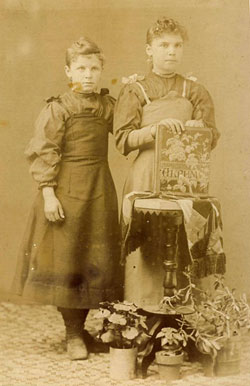
Fig. 1. Embossed albums used as scrapbooks were often valued possessions. Girls with album, circa 1880s. Author’s collection.
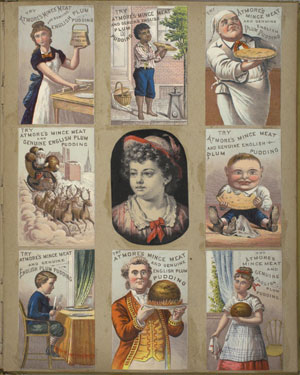
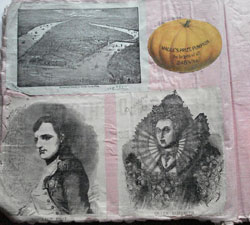
In this account, pictures are decidedly inferior objects—just one step up from wastepaper, entirely for the amusement of the preliterate child. The description accords with the evidence. It was common in the nineteenth century to make cloth scrapbooks—as durable as today’s board books—for young children and to fill them with pictures from seed catalogs, advertising cards, and other sources (fig. 2). Children and young people also made scrapbooks from the colorful and elaborate advertising cards that proliferated in the 1880s (fig. 3). But scrapbooks created to save newspaper and magazine items often used few of the pictures from those publications. Perhaps pictures undercut the seriousness of a homemade object that mimicked the look of a book or newspaper.
Fig. 2. Cloth scrapbook. Children and young people made scrapbooks from the colorful and elaborate advertising cards that proliferated in the 1880s. Author’s collection.
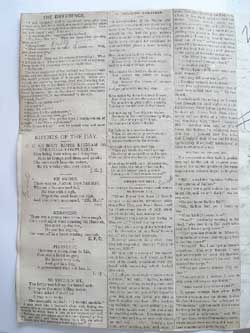
The form of the printed magazine or newspaper became more engaging to the nineteenth-century scrapbook makers, who then recirculated the texts among friends or saved them for later enjoyment and reference. Although scrapbook makers had far greater potential freedom in their page composition than magazine and newspaper editors who were bound by the layout restrictions of hot metal type, they rarely used that freedom, instead pasting their collections down in sober parallel columns, imitating the newspapers themselves—no cutting loose in wild diagonals, hardly anything sideways, rarely a heading straddling more than a single column (fig. 4). Indeed, student scrapbooks made in school were sometimes discussed as though they were newspapers.
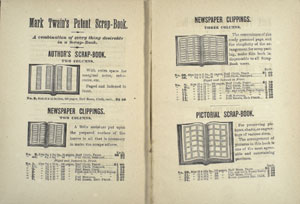
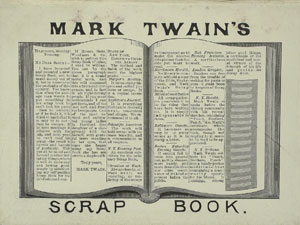
The tendency to imitate the layout of newspapers was encouraged with preformatted scrapbooks such as the one patented by Mark Twain. Twain’s scrapbook was produced in many sizes and advertised with the claim that it would forestall utterances of profanity that resulted from not finding the gluepot (figs. 5 and 6). But not many people used such books.
Densely covering the page had a special appeal for scrapbook makers who pasted their clippings over the pages of printed books, full bookkeeping ledgers, and other discarded records. They preferred to obscure the type, whether it was last year’s Patent Office reports or a book of sermons. The handsome, authoritative bindings of such books seem to have given them special appeal—and certainly such reuse implied a judgment that the original contents were not worth saving.
Margaret Lynn, in a 1914 memoir of her Missouri Valley childhood, recalled that she and her siblings fashioned scrapbooks from agricultural and horticultural reports, a box of which her family received each year. These tedious reports were not blank, but rather were empty of any meaning for Lynn; making them into scrapbooks redeemed them.
From our point of view the books were quite unreadable and almost pitifully useless . . . It didn’t seem possible that so many books should be published with absolutely nothing in them. They were full of pictures, and that was promising, for naturally one expects the presence of pictures to indicate literature of the lighter sort. But such pictures as they were when you came to look at them! Common bugs in all stages of unbeautiful growth; worms only less ugly than in life; hens, mere hens, standing up to have their pictures taken . . . You opened up a nice, shiny, infolded sheet, evidently intended in creation for a beautiful picture, and found it held only drawings of windmills or churns.
Fig. 3. Advertising card scrapbook. First page of a scrapbook, ca. 1880. Scrapbook and Graphic Arts Collection at the American Antiquarian Society. Gift of Nancy and Randall Burkett, 2006. Courtesy of the American Antiquarian Society.
Lynn felt a passionate connection to literature, a craving for the company of “folks in books.” But standard literature seemed unconnected to the life around her. The poets she read spoke of flowers she had never seen, and she asked, “Who had ever heard of the Missouri in a novel or a poem?” At least she could collect poetry she admired in the local press and obliterate the hens and worms with it. In other words, in her scrapbook she physically replayed literature’s ability to carry her away from churns.
Fig. 4. Typical U.S. newspaper scrapbook, circa 1880s. Author’s collection.
In one version of this creative act, the essential art lay less in the newly imposed text itself than in the formality with which it was imposed on the scrapbook. Margaret Lynn and her siblings were sometimes particularly attentive in their scrapbook making to “the nice management which brought everything out even at the bottom of the page.” Her brother Henry, who didn’t like poetry, was nonetheless eager to have it for his scrapbook, since it lent itself to book-like blocks of print. “Mary, with her customary readiness of device,” meanwhile, “filled in her inch or half-inch spaces with miscellaneous obituary notices. It didn’t matter if she didn’t know the people, she said; they were dead just the same.” Lynn’s description matches the aesthetic of many book-based scrapbooks. Their makers seem nearly as concerned with obliterating the text beneath as with creating new text.
Extra-Illustration
Commercial publishing changed enormously during the course of the nineteenth century. With the rise of such inventions as the Hoe press, not only did cheap newspapers and magazines proliferate, but so too did affordable books. From a luxury item, available only to well-off Americans, even hard cover books now became affordable and pedestrian consumer goods. To maintain the superior status of their libraries, self-described bibliophiles and “bibliomaniacs” took up book collecting and created categories of rare editions. They also took up “extra-illustrating” or “grangerizing,” turning mass-produced books into forums for displaying their own wealth, taste, and the sheer ability to appropriate the form of the book for their own collecting.
Extra-illustrators took apart existing books, inserting pictures, autographs, and other material with some relationship to the original, often having them expensively rebound. In an extra-illustrated theater history, for example, a reference to the actor “Garrick’s drama of ‘Gulliver in Lilliput'” is followed by three small pictures of Jonathan Swift (each mounted on a full page), playbills, a two-page print depicting Gulliver at Brobdingnag and a series of other tangentially related illustrations. When an extra-illustrator was done with it, a 250-page book might have been enlarged to ten volumes. Extra-illustration transformed ordinary books into a frame or armature for the compiler’s collection of visual images; sometimes the leaves of the original text are hard to find between the pages of prints.
Fig. 5. Two-page advertisement found in the back of Punch, Brothers, Punch! and Other Sketches, by Mark Twain (2nd issue, 1878.) Courtesy of the American Antiquarian Society.
The extra-illustration fad started in eighteenth-century England as a way for gentlemen to demonstrate their wealth and taste by essentially recreating a book with costly prints. For these extra-illustrators, there was nothing sacrosanct about either the form or market value of a book. It was, like the homes they improved, another arena in which to demonstrate ownership and taste.
Fig. 6. Mark Twain’s letter to Slote about his new scrapbook, from Twain’s Punch, Brothers, Punch! and Other Sketches (2nd issue, 1878). Courtesy of the American Antiquarian Society.
In 1769, James Granger, who gave his name to the extra-illustration fad, published a two-volume Biographical History of England from Egbert the Great to the Revolution with the express purpose of serving extra-illustrators. As the book’s full title noted, it was adapted to a methodical catalogue of engraved Britishheads . . . with a preface showing the utility of a collection of engraved portraits. Print sellers eventually saw in the grangerizers an opportunity for sales. In the late 1700s they began commissioning specific sets of prints to be sold along with books that were particularly popular with extra-illustrators. Sets of illustrations for these works were sometimes keyed to the correct page number.
To ensure that the extra-illustrated book would not be mistaken for a scrapbook, one authority explained that grangerizers should add magazine and newspaper articles only if they had the paper split (literally separating its front and back faces), so that type appeared only on one side—something the average scrapbook-maker could not afford. Such an article would evidently be valued for its now specialized visual qualities and the expense of preparing it for extra-illustration, not just for its particular content.
Much like their British counterparts, American grangerizers often embellished works of historical importance. Curtis Guild (1827-1911), founder and editor of the Boston newspaper the Commercial Bulletin, included in his oeuvre an elaborately extra-illustrated life of George Washington as well as one of Ben Franklin. He defended his work against bibliophiles who condemned grangerizers for destroying valuable books by asserting that picture dealers who served grangerizers purchase “old or damaged books, odd volumes, magazines, and pamphlets containing portraits, which they carefully extract, cleanse, and prepare for sale.” Though they break up books, the extracted pictures sell for much more in the aggregate than “the stupid old volume, and the plates distributed do better service and contribute to further enrich an already interesting and valuable volume by being inserted therein.”
Guild hailed the extra-illustrator as a public servant. In illustrating Washington Irving’s Life of Washington, for example, he had gathered “autographic letters, choice old prints, plans, proclamations . . . and curious Revolutionary documents,” which by the end of the nineteenth century had become too scarce, because they had been “taken by collectors or museums, or have become lost or scattered.” Binding them into a book “in sumptuous dress” for his own private library seemed to a collector like Guild essential to “preserving” an orderly record of America’s past, even as it removed them from the public domain.
Guild’s method is perhaps best illustrated by the title of his Franklin book. The original was simply Life and Times of Benjamin Franklin,written by James Parton and published in New York in 1864. In a special title page Guild had printed for his version of the work he appended the following to the original title: Extended and Illustrated by the insertion of Portraits, Views, Engravings, Manuscripts, Curious Printed Documents, Original Autographic Letters, etc. collected from various sources in Europe and America by Curtis Guild, Boston, 1881 (figs. 7 and 8).
Among the eclectic items encompassed by this description was a page from Parton’s manuscript (actually copied by Parton from the printed version since, by the time Guild asked for the item, Parton no longer had the original) and illustrations having only the most tangential connection to the text. So, for example, where Parton notes that the word “Franklin” appears in Chaucer, Guild adds an engraving of Chaucer.
The willfully tangential quality of the illustrations, illustrating terms that even an indexer would skip, suggests that Guild was not seeking to make his copy of the text more useful, but rather was playing with the skeleton of the book, improvising far away from the melody. He thus showed his virtuoso ability to reach into odd corners of visual culture and supply references to nearly anything. And of course he demonstrated the reach of his purse. Fortunately, he underlined in pencil the word or line in the text to which the added illustrations referred. Otherwise, it would sometimes be impossible to determine the logic behind his extra-illustrating. Reading an extra-illustrated book is like going on a treasure hunt, searching for the connections the maker might have had in mind and thereby putting the work of that bibliophile, rather than the author, front and center.
In addition to books about the founders, books about famous American authors were common subjects for American grangerizers. Several extra-illustrators, for example, produced grangerized copies of prominent Boston publisher James T. Fields’s Yesterdays with Authors (1872). The book’s purpose had been to celebrate American authors by putting them on the same footing with British authors. It therefore included anecdotes about visits with Dickens side by side with vignettes celebrating the genius of Hawthorne. The book drew heavily on Fields’s correspondence, and later editions came ready-illustrated with engravings of authors and facsimile autographs. Extra-illustrators jumped in as fans, demonstrating their connections with the authors, their power to procure autographed correspondence written by them, as well as actual letters by Fields. The grangerizer, too, as any reader would see, could navigate the waters of literary celebrity.
Curtis Guild transformed his 1887 edition of Yesterdays with Authors by adding 250 portraits and views and 105 original autographs and manuscripts, so that it took up four volumes. Not content with adding visual marginalia to Fields’s book, Guild took another step and wrote a book, elaborating his work on Fields’s book. Guild’s A Chat about Celebrities, published in 1897 by Boston publishers Lee and Shepard, presents his own anecdotes about celebrities and connects them to the pictures and autographs he used to illustrate Fields’s book. It was essentially a set of verbal glosses on his visual glosses on Fields’s book, now far removed from Fields.
Fig. 7. Title page from The Life and Times of Benjamin Franklin, by James Parton (New York, 1864). Extended and illustrated for Curtis Guild (Boston, 1881). Courtesy of the Massachusetts Historical Society.
Friendly reviewers praised Guild for the intimacy the book offered. “Although there is not much method in such a book of chatty reminiscences,” still, they are entertainingly given. The book starts the reader with Fields’s coterie at the Old Corner Bookstore in Boston, from which “he is conducted to England’s memorial spots, and . . . shakes hands with Thackeray and Wilkie Collins,” California’s Overland Monthly noted. The origin of this admiring review hints at the attraction Guild’s book might have had for readers far from the centers of the literary universe. With such a text, the reader in distant California gains an intimate glimpse of the literary world into which this industrious grangerizer had inserted himself.
Fig. 8. Front end paper from The Life and Times of Benjamin Franklin, by James Parton (New York, 1864). Extended and illustrated for Curtis Guild (Boston: 1881). Courtesy of the Massachusetts Historical Society.
The self-consciously iconoclastic little magazine the Chap-Book, on the other hand, went straight for the economics of extra-illustration that underlay A Chat about Celebrities: “The startling fact that he owns a book on which he has spent Four Hundred Dollars constitutes the chief interest of Mr. Guild’s latest publication . . . when he is not speaking of himself or of the Three Hundred and Sixty-Four Things he bought with his Four Hundred Dollars, he is seldom at his best.” The Chap-Book understood that the extra-illustrated book is really a book about its maker and his spending power.
Prominent grangerizers like Guild and Robert Hoe, who extra-illustrated thirty different copies of the same edition of Izaak Walton’s Compleat Angler, among other works, were intimately involved in the mass production of print—Guild as a newspaper publisher, Hoe as a member of the family firm responsible for the rotary presses that helped make print cheap enough for scrapbook makers to clip with abandon. They hardly needed to borrow the form of the newspaper to endow their works with grandeur, as scrapbook makers did. But their involvement in extra-illustration and in collecting rare books set them apart from scrapbook makers who used Hoe and Guild’s products.
Grangerizers were sometimes explicit about their desire to distinguish themselves from scrapbook makers. “I do not approve of haphazard commercial products made up of half-tones from magazines and fragments of documents and signatures inserted,” one collector (and autograph dealer) wrote. An extra-illustrated book, in contrast, should collect “fine impressions of scarce engravings and interesting autograph letters.” The result should exhibit the grangerizer’s “cultivated and disciplined mind.” Discipline in choosing would ensure that the extra-illustrator would not “make a picture scrap-book of [his] volumes.”
As technological change made magazine and book illustrations cheaper and more common, grangerizing fell out of fashion. What was the thrill of showing off a handsomely bound book full of pictures, when a door-to-door salesman of subscription books had a suitcase full of them? There was little point in demonstrating one’s power to lavishly illustrate if nearly everyone could not only afford richly illustrated texts but could easily obtain images from a rapidly proliferating universe of cheaply reproduced photographic images.
While extra-illustrators prized their works according to the rarity of the materials they obtained for them, scrapbook makers took the mass-produced press and created unique objects from it by selecting and organizing its contents according to their own tastes and interests. The scrapbooks they left behind offer insights into their reading and participation in the press as readers, clippers, and imitators.
Further Reading:
The 1873 visitor to a scrapbook-making family was Julia Colman, in her “Among the Scrap-books,” The Ladies’ Repository, August 1873. Margaret Lynn’s reminiscences can be found in her A Stepdaughter of the Prairie (New York, 1914) and of clipping scrapbooks in my “Scissorizing and Scrapbooks: Nineteenth Century Reading, Remaking, and Recirculating,” in Lisa Gitelman and Geoff Pingree, eds., New Media: 1740-1915 (Cambridge, Mass., 2003). A longer consideration of children’s advertising scrapbooks is in my The Adman in the Parlor: Magazines and the Gendering of Consumer Culture, 1880s-1910s (New York, 1996). For more on other types of scrapbooks see Susan Tucker et al., eds, The Scrapbook in American Life (Philadelphia, 2006).
Curtis Guild’s comments on his grangerizing work are in A Chat About Celebrities, or The Story of a Book (Boston, 1897); the unfriendly unsigned review is in the Chap-Book (July 1, 1897); the autograph dealer Thomas Madigan made his comments in his Word Shadows of the Great: The Lure of Autograph Collecting (New York, 1930); remarks contrasting the grangerized book with the scrapbook are in Daniel Tredwell, A Monograph on Privately Illustrated Books: A Plea for Bibliomania (Long Island, N.Y., 1892). For more on the history and uses of extra-illustrated books in England, important sources include articles by Lucy Peltz, “The Pleasure of the Book: Extra-Illustration, an 18th-Century Fashion,” things 8 (Summer 1998) and “The Extra-Illustration of London: The Gendered Spaces and Practices of Antiquarianism in the Late Eighteenth Century,” in Martin Myrone and Lucy Peltz, eds., Producing the Past: Aspects of Antiquarian Culture and Practice 1700-1850 (Aldershot, Hampshire, 1999); the chapter “Illustrious Heads” in Marcia Pointon’s Hanging the Head: Portraiture and Social Formation in Eighteenth-Century England (New Haven, 1993); and Robert A. Shaddy’s “Grangerizing: One of the Unfortunate Stages of Bibliomania,” The Book Collector (Winter 2000).
This article originally appeared in issue 7.3 (April, 2007).
Ellen Gruber Garvey is the author of The Adman in the Parlor: Magazines and the Gendering of Consumer Culture and is writing a book on nineteenth-century readers’ interactions with the press, Book, Paper, Scissors: Scrapbooks Remake Nineteenth Century Print Culture. She is an associate professor of English at New Jersey City University.
Cities in Review
Carl Bridenbaugh, Cities in the Wilderness: The First Century of Urban Life in America, 1625-1742. New York: Oxford University Press, 1938. 500 pp.
Carl Bridenbaugh, Cities in Revolt: Urban Life in America, 1743-1776. New York: Oxford University Press, 1955. 526 pp.
Re-reading by Benjamin L. Carp
The act of giving Carl Bridenbaugh’s Cities volumes another look is unlike a similar exercise for, say, White Over Black or Roll, Jordan, Roll. Neither of the Cities works will ever be the proverbial “book I read in grad school.” No pair of current graduate students will sip beer at the AHA ten years from now and reminisce about the nights they slogged through a thousand pages of sewage, turtle frolics, and underwriters. Few professors, even among the harshest comps directors, would be so cruel and exacting. Nevertheless, the two books will long continue to stare up at scholarly texts from the footnotes, and their merit in that respect is worthy of historians’ renewed notice.
The principal reason why we should continue to read Bridenbaugh’s books, after all, is their encyclopedic coverage of British America’s five largest cities–Boston, Newport, New York, Philadelphia, and Charleston–over a 150-year period. Cities in the Wilderness (CW) and Cities in Revolt (CR) present a comprehensive overview of the cities’ growth, economic conditions, urban problems, society, and cultural ferment. Bridenbaugh covers a staggering scope of material, impossible to delineate fully. Suffice it to say, however, that the two volumes contain everything you ever wanted to know (and sometimes more) about the problems of porcine infestation, quack practitioners, and retailing at auction. Though such topics may seem trivial, together the details give one a vivid sensory experience of the city dwellers’ worlds. Bridenbaugh delves into his subjects’ minds to illuminate their inspirations, resentments, and civic pride, even as he studiously chronicles the drier elements of urban regulations, economic patterns, and demography. There are surprising gems even in the indices, where one finds “Nothingarians,” Ezra Stiles’s handy term for the irreligious. Organizing these vast piles of evidence (and providing generous footnotes so that readers can track them down) was Bridenbaugh’s most impressive achievement. One need not read the books from cover to cover to benefit from their findings. Bridenbaugh adheres to a strict organizational regimen, allowing readers to find with ease all references to fuel procurement or religion.
In some ways, the cities Bridenbaugh chronicles were nothing special in their day. They owed their growth to physical advantages that fostered trade, they gradually developed specialized economic functions and crafts, and they did their best to ward off fire, crime, vice, poverty, and disease. They had multiple taverns, public buildings, houses of worship, mobs, sophisticated entertainment, and intellectual opportunities–and while these factors differentiated them from the countryside, they were unexceptionable in Europe. The cities did, according to Bridenbaugh, have some uniquely American characteristics. They lacked the traditions and inherited aristocracy of European cities. Instead, especially in New England, new traditions of town government helped raise revenue, build infrastructure, and solve urban problems–often more efficiently than their Old World counterparts. Their rapid progress was remarkable. The North American cities contained diverse populations whose religious beliefs (or level of religious belief), ethnic and racial backgrounds, and social class achieved a variety that would have been less familiar back East. They dealt with wars, economic downturn, debt, taxation, imperial unrest, and eventually a revolt against the British crown. Urban associations and intercity alliances comprised a social capital (though the author did not use this term) allowing the American cities to meet these economic and political challenges. Bridenbaugh put forth a model for early American urbanization (if not explicitly), and few scholars since have picked up the threads of his narrative.
Bridenbaugh’s themes are worthy of consideration and debate among those interested in early America. The author charts the growth of the five cities from seaside villages to bustling towns to increasingly sizeable cities. Once they reach this extent, Bridenbaugh expresses his belief that for each city, the sum was greater than its constituent parts. No mere aggregations of people, these communities cultivated a growing civic consciousness, responsibility, and power. In this respect, Bridenbaugh believes the North American cities were superior to European models in dealing with urban problems. Furthermore, the sum of colonial urban life became greater than the five cities themselves, as “Constant communication . . . served to forge these communities into an integrated urban society” (CR, 418). The American cities produced a shared, rich culture that depended upon their characteristic “interchange and companionship of social living” (CW, 464). With the cities’ growing political awareness and new methods and ideas, Bridenbaugh celebrates them as the seedbeds of a nascent American identity, the Enlightenment in the New World, the American Revolution, and its concurrent social transformations.
Critics recognized many of these conclusions as grossly oversimplified or too narrowly applicable. While Bridenbaugh assures us that the cities diverged from the countryside in significant ways, he provides his readers with no way to make substantive comparisons between the culture of his cities and that of the Chesapeake region, the Appalachian backcountry, and the rest of rural America. While the author claims that Cities in Revolt is “not a history of the American Revolution” (vii), the conclusion of that volume contains a number of bold pronouncements about the events of that era. His final remarks about the Revolution are not necessarily incorrect; nevertheless, the conclusion feels as if the author tacked on arguments about the Revolution to the end of the book about urban life. These criticisms may be unfair. Many works of history, before and certainly after the publication of the Cities books, address the lingering questions that Bridenbaugh left unanswered. A macrohistory to shame all microhistories, the author undertook a project of tremendous breadth and returned with a veritable treasure trove of vibrant detail.
A curious paradox strikes the reader of Bridenbaugh’s books. In the introduction to Cities in Revolt the author announces his conviction “that it is people who make history” (vii), yet in a way there really aren’t any people in the Cities books. Certainly a variety of characters, from Benjamin Franklin on down (as he saw it), flit in and out of these thousand pages. Printers became “civic leaders and molders of public opinion” (CR, 385). Lawyers “became indispensable in American cities” (CR, 95). Doctors and scientists disseminated their new discoveries. Seamen, limners, prostitutes, dancing masters, hawkers, booksellers, watchmen, schoolteachers, criminals, clergymen, scavengers, stray animals, immigrants, retailers, and artisans populate every page. Bridenbaugh drops familiar names such as Henry Laurens or George Whitefield as readily as he immortalizes more obscure ferrymen, tavernkeepers, and orphan apprentices. The five main characters in the Cities volumes, however, are Boston, Newport, New York, Philadelphia, and Charleston. The cities themselves, as we chronicle their growth from infancy to maturity, take on a life of their own. One gets the impression of five driven schoolchildren in competition with one another to see who can build the strongest prisons, offer the widest variety of retail goods, and harbor the most musicians. Bridenbaugh applauds their achievements and scolds their lapses.
We encounter further difficulty with Bridenbaugh’s books as we discover that his sources and his discussion skew heavily towards city dwellers from the uppermost social echelon. This elitism is sometimes difficult for the contemporary reader to stomach. He has a few too many disparaging references to “country yokels,” and some of his remarks about women are needlessly chauvinistic. He calls blacks and Indians “the most dangerous threat to law and order,” since both groups “more readily adopted the white man’s vices than his virtues” (CW, 379). He utters such pronouncements as, “it is the upper classes who determine the characteristics of any society” (CW, 464), or “most members of both middle and lower classes in the towns accepted with cheerful awareness their assigned stations in life” (CW, 256). Whenever he discusses the urban poor, Bridenbaugh spuriously minimizes their numbers as well as their suffering, unless it is to praise elite overseers for taking care of them. Indeed, whenever he sees a colonial aristocrat rumble past in a carriage or announces a marriage of great families, Bridenbaugh is patently unable to contain his excitement.
In this celebration of urban life, the wealthiest city dwellers are eventually joined by members of what Bridenbaugh calls the middle class. Largely shopkeepers and artisans, this group plays a small role in Cities in the Wilderness and then assumes its revolutionary mantle of importance in the second book. By the middle of the eighteenth century they are “[b]y far the largest proportion of urban population” (CR, 146). He describes them as “[s]ensible, shrewd, frugal, ostentatiously moral, generally honest,” public spirited, and upwardly mobile (CR, 147). Their economic strivings led to “democratic yearnings” (CR, 332) for political power, and the city’s printers became their influential spokespersons–artisans who made sure that when a shot was heard, it would be heard ’round the world. The author both elevates the middle class and identifies its members with the Whig movement–they become the heroes of the prerevolutionary decade just as they were the putative heroes of the Eisenhower era in which Bridenbaugh wrote.
The merchants and printers, Bridenbaugh asserts, were primarily responsible for the intercolonial culture he discovers. Commerce prompted the important social and cultural interchanges of the eighteenth century. The merchants, as the engines turning that commerce, became the only “distinct social group” in the colonies with a common outlook. “Under their leadership the spirit of commerce pervaded the towns, infecting even the womenfolk and children” (CW, 340). By the 1760s and 1770s, the printers “developed a sense of common purpose equal to if not exceeding that of the colonial merchants” (CR, 391). Of course, as Gary Nash and Marcus Rediker remind us, the wheels of commerce could not have turned without the seamen of the Atlantic world. This group, too, formed an intercolonial social group with a common, distinct outlook. Such networks of colonists, inside and outside the cities, pervaded the eighteenth-century Atlantic world, and it is to Bridenbaugh’s discredit that he focused so narrowly on the men of the counting houses and print shops. At the same time, the author’s instincts were correct to emphasize the cities as the key points of exchange for these networks.
It may be unfair to criticize Bridenbaugh for his elitism; after all, in 1938 the Social Register held a lot less irony for academics than it does for us today. Nevertheless, such language will strike many historians as offensive as they recall Bridenbaugh’s ignominious presidential address to the American Historical Association in 1962. In this address, Bridenbaugh not only repudiated what his cities (and society generally) had become, but inveighed against “urban-bred scholars,” which his listeners interpreted as unseemly ethnic prejudice. This was a particularly incongruous thing for Bridenbaugh to say, given that he celebrated cosmopolitanism and disapproved of nativism when he found it among his historical subjects (CW, 477). Possibly the author internalized a few too many of Benjamin Franklin’s screeds against immigration.
Bridenbaugh’s AHA address as well as his Cities books evince a yearning for a bucolic, organic American society–one characterized by a growing consensus rather than fragmentation. Daniel Boorstin cites Bridenbaugh in the bibliography of The Americans: The Colonial Experience (New York, 1964) and mentions him in his acknowledgments. It is hardly surprising, therefore, that Boorstin’s counterprogressive, triumphalist history found its reflection in Bridenbaugh’s Cities books. Look at how these pragmatic city fathers paved the streets and built architectural wonders! Look at how they developed a tight-knit sense of community amidst creeping urban problems! Look at how these budding villages ultimately came to rival the cities of Europe!
On the other hand, Bridenbaugh also spawned Boorstin’s ideological adversaries in the New Social History (a phrase now as hoary as “New Coke”). Bridenbaugh paid attention to demography, economic cycles, participatory republicanism, artisans, women, workers, and slaves. Certainly many of his conclusions were simplistic, his aims descriptive rather than analytical, and his methods neither as quantitative nor as comprehensive as those of his successors. Still, in 1995 Alfred F. Young allowed that the Cities books were among the very best of the old social history monographs. Bridenbaugh paved the way for subsequent generations interested in social and cultural history, the everyday life of early Americans.
Whatever superlatives (or expletives) we might use, the fact remains that the Cities books are no longer in print. Although time and markets have dictated that this be the case, a glance around the field reveals that almost no book has given us reason to supplant Bridenbaugh entirely from our shelves. We have followed early American historians to the Maine frontier, around scores of New England villages, up the Southern backcountry, and back across the Atlantic. Certainly we have also enjoyed masterful works on individual cities, regional groups of cities, or specific thematic treatments of cities; rarely, however, has any scholar attempted to capture the urban experience on so broad a scale. Gary Nash complained in 1979 that no one had done it since Bridenbaugh; now we in turn should lament that no one else has taken up the task since Nash’s Urban Crucible.
Apparently historians no longer regard the urban experience as central to colonial life. Perhaps this stems from a Jeffersonian impulse (though it is based on a misunderstanding of Thomas Jefferson’s thinking) to revile the cities as sores on the body politic. Many historians may favor the national myth that casts the true American as a yeoman farmer. On that note, although America was a rural country through the end of the nineteenth century and an urban country when Bridenbaugh was conducting his research, the United States was a suburban country by the 1990 census. Raised in suburban tracts and employed in sleepy college towns, it is possible that few academics have a sense anymore of the urban dynamic that inspired Bridenbaugh’s work.
Certainly there appears to be a valid demographic rationale for neglecting colonial urban history: after all, 95 percent of Anglo-Americans lived outside of cities on the eve of the American Revolution, to say nothing of the Indians. Scholars now approach the past with a more egalitarian mindset than Bridenbaugh did. Therefore, just because the cities and their elite inhabitants yield a rich plurality of sources does not justify undue attention to the wealthy literati who penned those sources, particularly when we still have so much catching up to do in documenting the lives of women, blacks, rural people, Indians, and the poor. Yet we are forced to contend with Bridenbaugh’s claim that the cities, despite their small size, had a disproportionate influence on the lives of colonial Americans and on the American Revolution.
Thus, given the dynamism of colonial cities and their significant influence on the lives of other colonists, it is high time we looked to Bridenbaugh for cues and clues in a renewed study of colonial American urban life. In many ways, such a study would correspond with current cultural trends as well as scholarly approaches. Many downtown areas have become resurgent meccas for an urbane, cosmopolitan crowd (David Brooks’s “Bobos in Paradise”) in search of the dynamism and multiculturalism that only cities can provide. As academics sit down at their tables in these areas armed with latté and laptop, they are sure to find Bridenbaugh a compelling basis for new lines of research. The variety of historical schools and methodologies that the profession has developed since 1955 will present fascinating possibilities for this urban revival in early American history.
Much work has already been done. Some of Bridenbaugh’s chosen topics–intellectual life, entrepreneurship, taverns, disease, town planning, con artists, firefighters–have received more updated treatment since the books were written. Other topics have been neglected (quick: name five books on municipal governance in colonial America). Meanwhile, historians have pursued new subjects largely absent from the Cities books, including urban slavery, parades, and consumer culture. If Benjamin Franklin personified colonial urban America for Bridenbaugh, then surely since 1981 the shoemaker George Robert Twelves Hewes has claimed a greater share of our conception of the Revolutionary cities. Other scholars have made use of new and vital methods to add fresh dimensions to the urban centers, from material culture or new archaeological digs to theories of the public sphere or the imagined community. The current emphasis on the Atlantic world surely will shed further light on the cities, those crucial nodes of exchange of commodities, culture, and people. Many young scholars have used space as their rubric for exploring a number of early American history topics. Bridenbaugh regarded the proximity of city dwellers to one another–”the marrow of urban existence”–as a major theme of his work (CR 419), and the colonists’ interaction in public and private spaces is fruitful material for scholarly research in a number of thematic directions. For scholars interested in political culture, it would be interesting to verify Bridenbaugh’s claim that a widespread sense of civic responsibility characterized the face-to-face cities of the colonial period. Whatever their methods, the researchers currently working on Faneuil Hall, waterfront life, coffeehouses, natural disasters (the “catastrophists”), and other promising subjects have no doubt checked with Bridenbaugh on their way to the archives.
Bridenbaugh’s two volumes on the Cities are out of print but not out of mind. While their suitability in the classroom setting might be limited, their utility in research commands notice. The cities of early America are rich with possibilities for study, and the archival resources are vast. Bridenbaugh provides an initial guidepost to these sources. If his methods have become outdated and his attitudes strike us as retrograde, his conclusions still bear further exploration. The very heft of these tomes reminds us of the cities’ outsized importance in the society, economy, politics, and culture of early America.
This article originally appeared in issue 3.4 (July, 2003).
Benjamin L. Carp is a Ph.D. candidate at the University of Virginia. He has written articles for The William and Mary Quarterly and Civil War History, and his dissertation explores political mobilization in Carl Bridenbaugh’s five cities during the years leading up to the American Revolution.
Nurturing Romance
Twenty-five years ago, when I organized a college history course on the American city, it started at the beginning (in the seventeenth century) and finished at the end (in the twentieth century). That was, after all, the story line—from the beginning to the end—in the history courses that I had experienced (and mostly relished) as a student. When I teach the same course today, at Lake Forest College, the narrative is more complicated. I begin with the conclusion, circa 2000, before moving backwards chronologically to the seventeenth century. And it ends where it began, in the present!
Playful? Certainly! How a syllabus is devised, and more importantly how its narrative is recast over the years, should result from an imaginative—playful—approach to the art and craft of teaching. Why did I depart from convention in this case? Students chided me (gently), via casual conversation and (mostly friendly) comments written in their end-of-course evaluations, that they wished their syllabus allocated more space for contemporary American cities. Ultimately I deduced that many students enrolled because of their interest in cities as they experience them today. My objective was to historically frame their experiences with contemporary cities. Hence my delicate task: nurturing romance between then and now.
History 263: American Cities meets over a fifteen-week semester, a total of forty-five hourly sessions. The tempo is fast, between allegro and vivace. My purpose—inspired by Eric E. Lampard, an influential urban historian—is the construction of a global scaffold for the urban history of the United States encompassing the nineteenth and twentieth centuries. The point of departure is the rapidly accelerated pace of urbanization during the nineteenth century. The very first session is called “A Century of Cities.” We sketch—but do not plumb—how urbanization exercised a dynamic, transforming effect, spawned by England’s Industrial Revolution. Ingraining Manchester in my students’ historical sensibilities, I portray it—visually and in words—as the shock city of the modern world, circa 1840 (that almost noir phrase devised by Asa Briggs, an English social historian). Then we travel across the Atlantic Ocean, hastily tracing the unfolding of urban networks in the United States. Chicago, in the 1890s (the world’s fastest growing city in the final quarter of the nineteenth century, claims Briggs), is the next shock city. In the middle of the twentieth century, Los Angeles assumed the Briggs artifice as a consequence of its extraordinary ascent from regional center for production and distribution into a global city lately characterized by David Rieff as the capital of the third world. (When its population first eclipsed one hundred thousand in 1900, Los Angeles ranked thirty-sixth in population among the nation’s cities, ahead of Memphis but behind Omaha!)
Fig. 1. History 263 field study of Chicago neighborhoods, 2002. Courtesy of Lake Forest College.
After the fifth class session we have traversed the entirety of the nineteenth and twentieth centuries. Multiple things have happened as we march, double step, toward the present. First, the students develop a vocabulary of (often contestable) terms (e.g., edge city, dual metropolis, sun belt, new federalism, technoburb, new urbanism, underclass, hyperpauperization, spatial mismatch). Secondly, I strive to expand their geographic sensibilities (and my own) by studying—still on the surface—the causes and circumstances of urban growth in its most extreme form during the fourth quarter of the twentieth century. Particular attention is given to nonwestern cities (e.g., Bombay, Ho Chi Minh City, Jakarta, and Manila.) In so doing, the students visualize the stark yet memorable work of photographer Sebastiâo Salgado, whom I myself stumbled upon in a recent exhibit organized by the International Center of Photography in New York City. We also examine population data, compiled by the United Nations, on the geographic distribution of the world’s largest cities. Finally, each student pursues a quantitative research project framed in the final quarter of the twentieth century. Focused on Chicago, it is tied to their reading of William Julius Wilson’s When Work Disappears: The World of the New Urban Poor (New York, 1996).
At this point History 263 reverts back three centuries in a kind of Rip Van Winkle in reverse! Freshly awakened, students inhabit the seventeenth century, not the twenty-first. Now the class studies the coastline cities from Boston to Charleston—the largest population concentration in 1700 was Boston’s (6,700)—to explore the roots as well as the manifestations of the earliest urbanization in British North America.
Luckily, my students are not asleep. Rather, I find them alert for comprehending—even appreciating—their subject matter. (Although quite the opposite was true when I taught the course from chronological beginning to end; then students frequently lamented that they were being compelled to study cities at a remove of 350 years.) By the time we travel to the eighteenth century, we are fastening upon the ingredients basic to the history of urban development (e.g., market economies, transportation networks, spatial organization and differentiation, demography and cultures, gender, enterprise, infrastructure, governance, public services, health, and safety, and westward expansion.) Special emphasis is given over to the lack of provision for cities in the federal system created by the Constitution, rendering their status in the nation-state perpetually unresolved.
Fig. 2. Map from D.W. Meinig, Continental America, 1800-1867, volume 2 of The Shaping of America: A Geographical Perspective on 500 Years of History (1993). Courtesy Yale University Press.
Entering into the nineteenth century, the narrative approaches a significant intersection: the juncture where students entered this course four weeks earlier. Over five weeks I immerse them (again) in the nineteenth century and the American version of the Industrial Revolution. We view cities, both close up and from a distance, by occupying sundry vantage points from one session to another. On a microcosmic level, we study the intricacies of daily urban life as we learn about how people lived, worked, and organized themselves in a century of momentous change. Charles E. Rosenberg’s The Cholera Years, The United States in 1832, 1849, and 1866 (Chicago, 1987), with a new afterward, lends itself admirably to this, no more so than in the session given over to “Smelling the Pre-Civil War City.” Two weeks later, nearing the close of the nineteenth century, we read the Bedford edition of How the Other Half Lives (New York, 1996), wisely edited by Daniel Leviatan; while Jacob Riis appears prosaic in the eyes of some teachers of undergraduates, for me his (contestable) images and his life story as well their ramifications constitute another teachable moment. On a macro level, our scope encompasses the proliferating systems and networks that unfolded across the expansive geographic plane of the nation-state. Starting with the Gallatin Plan for internal improvements (1808), too much neglected in today’s classrooms, we sequentially learn about turnpikes, steam boats, the Erie Canal, and successive innovations in rail transport as well as communications over the span of the century.
Much of this, I gladly confide, derives from my lifelong inclination for historical geography. I can ascribe it to an inspired and beloved third-grade teacher. Meta Wentink at Public School #1 in Clifton, New Jersey, some fifty years ago, taught us about Mediterranean civilizations. (Phoenicia was lavender on her wonderful wall maps.) Much more recently its impulse is the cultural geographer D. W. Meinig, whose scholarship employs artful cartography for a powerful geographic narration of American history. (Meinig’s oeuvre lends itself to constructing American history courses in any number of configurations. His multivolume The Shaping of America is a frequently consulted staple in my personal library. The fourth and concluding volume is awaited, avidly.)
The nation-state, referred to earlier as indispensable to History 263, amplifies its narrative by underscoring that the urban and the political must be considered interdependently. In so doing it reveals dramatic exercises of public as well as private authority. In some cases—none more so than the New York City Draft Riot of 1863—it illustrates classic examples of interaction between local, state, and federal entities. We study a number of other circumstances: the inability of municipal governments to address the consequences of rapid urbanization; occasional collapses of civil order in cities during the three decades preceding 1863; and collisions of labor and capital during the last third of the nineteenth century. Like so many instructors, I invoke Jane Addams’s Twenty Years at Hull-House, selecting (from among several options) the exceptional Bedford edition assembled by Victoria Bissell Brown. Addams—in my eyes, must reading for undergraduates regardless of concentration or aspiration—fosters recognition of the radically changed sociological landscape in American cities and the much-needed reordering of the nation-state as the nineteenth and twentieth centuries converged.
Fig. 3. Jane Addams Memorial by Mitchell Siporin (1910-76), Illinois Federal Art Project, WPA, 1936. Tempera on paper. Courtesy the National Archives.
The twentieth century is the destination most coveted by my students and in its current iteration History 263 seemingly satisfies their aspiration. Reaching this point in the eleventh week of the semester, our attention is given over to a sequence of topically organized, often in-depth explorations that culminate in the present day. Focal points include race, with particular emphasis on Chicago; politics, especially the Chicago regimes of Anton J. Cermak, Richard J. Daley, Harold Washington, and Richard M. Daley; the Great Depression, focusing upon its large scale redefinition of the nation-state; interregional demographic shifts, especially to the sun belt; transportation advances, most notably motorized vehicles; technological innovations, with emphasis on aeronautics, climate controlled environments, and global communications; and suburbanization.
And to fortify this coverage of twentieth-century urban America, I punctuate the culmination of History 263 with a field study and a research assignment. Students are required to participate in a day-long (9:00 A.M. to 5:00 P.M.) field study of Chicago neighborhoods that I conduct on a Saturday as the end of the semester approaches. I once read—and accept as fact until convinced otherwise—that as Woodrow Wilson wrote the dissertation at Johns Hopkins University that became Congressional Government (1885) not once did he travel from Baltimore to observe the deliberations of the national legislature. Recounting this to my students, I advance the proposition that Chicago (thirty miles to the south) comprises our geographically extended classroom. (The James S. Kemper Foundation and the Andrew W. Mellon Foundation underwrite Chicago-centered curricular initiatives at Lake Forest College.) Traveling by chartered coach, I construct for them (with gratitude to Rhys Isaacs for the concept) a series of vivid glimpses that includes four walking tours (a neighborhood of single-family homes, dating to the 1920s, on the northwest side; Richard J. Daley’s neighborhood of Bridgeport; the Prairie Avenue Historic District; and the Gold Coast). What they discover is the dual metropolis (decay amid glitter, despair amid opportunity). We also make a brief visit to the Chicago Historical Society.
Fig. 4. “Tenement House on Mulbery Street, 1879,” Harper’s Weekly, April 5, 1879. Wood engraving by William A. Rogers.
The second research assignment is framed by the students’ compulsion to immerse themselves in the late twentieth century. Ostensibly fixed in the final twenty years of the century, this project involves a storehouse of statistical data that the students must extract from a census report available on the Internet that analyzes the nation’s hundred largest cities between 1790 and 1990. Each student examines a specific city, fulfilling several goals: calculate as well as analyze statistical data for the assigned city plus its metropolitan region, its state, and its census region; construct well-designed statistical tables, ideally using Excel; access, scan, and properly document maps and photographs for integration into the text; rely upon print sources in writing a historically informed interpretation; integrate D. W. Meinig’s The Shaping of America into the analysis; and assess their city and its metropolis, comparing it both regionally and nationally between 1980 and 2000.
When I encounter former students, whether six months or six years hence, they occasionally offer me their recollections of History 263. Frequently cited aspects of the course include: Manchester, England (which more than a few eventually travel to as a result of this course); the photography of Salgado and Riis; our session about urban smells; the transformations wrought by the Erie Canal on the nation’s geographic organization; the compulsion of Americans to own a single-family home; and our Chicago neighborhoods field study. Students mention as well the images frequently integrated into almost every class session: hundreds of slides (including many maps), online visual resources, and occasional clips of film. (None of the imagery surpasses the Ric Burns rendition of the New York City Draft Riot of 1863, produced for New York: A Documentary Film [1999].) I also hope that my students possess an inventory of women and men (e.g., Willis Carrier, DeWitt Clinton, Oscar DePriest, Jane Jacobs, Florence Kelley, Robert Koch, Francis Cabot Lowell, Mary E. McDowell, Mary Kingsbury Simkovitch, Frank Julian Sprague, Mary Ovington White, and Kemmons Wilson) who stand apart from the mainstays that dominate American history survey courses.
At the semester’s conclusion, I would like to believe, my students’ early present-mindedness is receding. I am convinced that they respond warmly to the complicated narrative that started their course at the conclusion, circa 2000, before suddenly reverting to the seventeenth century. Perhaps their fixation on present-day concerns has shifted as a consequence of their newly acquired and richly fortified historical sensibilities. This is one benchmark of liberal learning, even if undergraduates do not yet grasp it firmly. Encouraged by my students’ enthusiasm, I persevere in nurturing romance between then and now.
Further reading:
A recent version of the syllabus for History 263: American Cities is available for consultation online. Elemental to this course’s architecture (though not to be confused with its assigned reading, which is available in the online syllabus) are Adna Ferrin Weber, The Growth of Cities in the Nineteenth Century: A Study in Statistics (New York, 1899); Asa Briggs, Victorian Cities, with forward by Andrew Lees and Lynn Hollen Lees (Berkeley, 1993); Eric E. Lampard, “The Urbanizing World,” in H. J. Dyos & Michael Wolff, eds., The Victorian City: Images and Realities, 2 vols. (London, 1973), 1:3-58; D. W. Meinig, The Shaping of America, A Geographical Perspective on 500 Years of History, 3 vols. to date (New Haven, 1986, 1993, and 1998); and Eric H. Monkkonen, America Becomes Urban, The Development of U.S. Cities and Towns, 1780-1980 (Berkeley, 1988). An abundant source of statistical data (e.g., housing, traffic, energy, consumer products) that I rely upon is Theodore Caplow et al., The First Measured Century, An Illustrated Guide to Trends in America, 1900-2000 (Washington, D.C., 2001). Regarding Sebastiâo Salgado, I draw upon his book Migrations,Humanity in Transition (New York, 2000); assessing Salgado is Michael Kimmelman, New York Times, July 13, 2001, B27.
This article originally appeared in issue 3.4 (July, 2003).
Michael H. Ebner is the A.B. Dick Professor of History at Lake Forest College and the author of Creating Chicago’s North Shore: A Suburban History (Chicago, 1988).
Reckoning
“As long as we have a politics of race in America,” historian David Blight writes in his prize-winning study, Race and Reunion (Cambridge, Mass., 2001), “we will have a politics of Civil War memory.” A pretty impoverished politics, apparently, since the need for reconciliation led white Americans, North and South, to remember the war but forget that it was about slavery. “The inexorable drive for reunion both used and trumped race,” Blight argues, which goes a long way toward explaining the self-bloating Civil War re-enactors, Scarlett O’Hara impersonators, and dewy-eyed Dixie defenders journalist Tony Horwitz portrayed in his Confederates in the Attic (New York, 1998). And now–hold onto your hoop skirt and grab your space helmet–the Lost Cause has been taken up in outer space.
This September, FOX television debuted Firefly, a genre-busting sci-fi/western written by the acclaimed Joss Whedon, creator of Buffy the Vampire Slayer. Buffy, now in its sixth season, is adored as much by girls who begged for the latest Barbie for Christmas as by graduate students disappointed not to find the unabridged OED under the tree. But Firefly struggled mightily, and, in the end, futilely, to find its audience, and I’ve yet to meet a historian–okay, or really, anyone other than me–who actually watched it, but it’s still worth pondering. “Set 500 years in the future in the wake of a universal civil war” between a loose confederation of secessionist planets and the “Alliance” (a global U.S.-China superpower), Firefly chronicles the adventures of a ragtag crew of civil war veterans and carpetbaggers, led by Captain Mal Reynolds, “a defeated soldier who opposed the unification of the planets by the Alliance to no avail.”
Firefly‘s Lost Cause allegory is not subtle. Its actors drawl their drawl (“I reckon it’s a red asteroid!”). They wear boots and suspenders and corsets and, yes, hoop skirts. The show’s musical score sounds like something Ken Burns commissioned. And Mal, thrown out of a two-bit saloon on a barren dusty, Alliance planet, is prone to cry, “We shall rise again!”
Why? In the early 1980s, Whedon, now thirty-eight, was an undergraduate student of Richard Slotkin’s at Wesleyan. Beginning with the publication of his Regeneration through Violence (Middletown, Conn., 1973), Slotkin, a literary critic and sometime novelist, has persistently emphasized the importance of the frontier, and of frontier violence, in the American imagination. Firefly swallows this notion whole while taking literally the Jack Kennedy/Gene Roddenberry notion that space is the final frontier. But Firefly’s frontier is more Southern than Western, more Jefferson Davis than John Wayne.
Whedon has a weird way of explaining all of this. “Mal’s politics are very reactionary and ‘Big government is bad’ and ‘Don’t interfere with my life,'” Whedon told the New York Times. “And sometimes he’s wrong–because sometimes the Alliance is America, this beautiful shining light of democracy. But sometimes the Alliance is America in Vietnam: we have a lot of petty politics, we are way out of our league and we have no right to control these people. And yet! Sometimes the Alliance is America in Nazi Germany. And Mal can’t see that, because he was a Vietnamese.”
Huh? Add to Whedon’s dizzying defense that sometimes, most of the time, the Alliance is the Union, which begs the question, what happened to Mal’s slaves? There are slaves in Firefly‘s universe, exploited laborers in shantytowns on miserable planets and fugitives in renegade maroon communities on the outskirts of cities, all of whom Mal takes pains to aid (although not to liberate). But if there’s slavery in Firefly‘s universe, there’s no such thing as race. In the venerable tradition of Star Trek, the Serenity, Mal’s rusting, creaky spaceship, is a kind of multicultural Noah’s Ark. Hell, everything dun gone galactical, as the captain might complain–except that when Mal curses, he curses in Mandarin.
Whedon embraces television as a force for social change. “It’s better to be a spy in the house of love, you know?” he told the New York Times. “If I made ‘Buffy the Lesbian Separatist,’ a series of lectures on PBS on why there should be feminism, no one would be coming to the party.” Okay, Buffy’s a feminist, but what’s the point of Firefly? “Yes, it’s a space show, but it’s also an intellectual drama about nine underdogs struggling in the moral chaos of a postglobalist universe,” Whedon says. “It’s about the search for meaning.” Danger, Will Robinson! A search for meaning set in an imagined universe that serves as an allegory for the post-Civil War American South but which fails to wrestle with the legacy of slavery?
In December, FOX moved to cancel Firefly, citing lackluster ratings. Fans have launched a campaign to have the series picked up by another network (Hello, PBS?) but it’s probably a lost cause. Still, it raises the question: if Joss Whedon, spy in the house of love, isn’t willing or able to wrestle with the legacy of slavery, who is? In the last few years, activists and journalists investigating the debate over reparations have had much to say on the matter. Consider the special eighty-page magazine pullout section of the Hartford (Conn.) Courant, published last September, and tellingly titled “Complicity.” Meanwhile, some professional historians have urged against specifically moral engagement with the issue. “Historians should attempt to put some distance between scholarship and the values of the society in which he or she functions,” writes David Eltis, in The Rise of African Slavery in the Americas (Cambridge, Eng., 2000). If we “condemn what happened in the past . . . on the basis of modern values,” then we’ll never truly “understand the past.” Another approach, taken by scholars like David Blight and Marcus Wood, is to track how, why, and when slavery moves in and out of our range of vision. Wood, in Blind Memory (New York, 2000), his stunning study of the visual representation of slavery, argues that “the act of ignoring conforms to a state of willed blindness.” If the past is a foreign country, in other words, historians have an obligation to take their readers beyond the usual tourist destinations.
No doubt it was too much to ask of Firefly that its post-Confederate galaxy tackle emancipation and reconstruction. As the historian Walter Johnson has written in Soul by Soul (Cambridge, Mass., 1999), a landmark book on the antebellum slave market, “When slavery was over and the slave market was closed, former slaves and slaveholders alike found themselves marooned on a shoal of history.” A century and a half of post-emancipation American race relations demonstrate that the shoals of history are a wretched place to shipwreck–a final frontier from which no ship called Serenity has much hope of dislodging us.
This article originally appeared in issue 3.2 (January, 2003).
Menu: Introduction to Special Issue on Food
This special issue of Common-place explores food. It particularly investigates the production and consumption of food during the age of experiment, that period between 1820 and 1890 in the United States after the soil crisis of the early nineteenth century disrupted customary agriculture and before scientific agriculture became institutionalized nationally in the system of experimental stations legislated into being by the Hatch Act (1887).
Just as current experimentation in agriculture is driven by the increasingly deleterious effects of conventional agriculture on the land (the mineralization of soils, the depletion of aquifers by “thirsty” GMO crops, the growing toxicity of fields subjected to heavy-handed and repeated chemical supplementations), the nineteenth-century age of experiment began in response to a soil crisis. The need to renovate fields whose fertility had been exhausted by repeated plantings of cash crops such as tobacco, cotton, and corn led farmers to introduce new cultivars into new rotations employing new manuring schemes. Change brought benefits. The range of fruits and vegetables available at market expanded, and the great age of plant and livestock breeding commenced. During this period, reading became a necessity for food growers and an advantage for food preparers. A world of agricultural letters burgeoned after the launching of The American Farmer in 1819. A rich cookbook literature also grew expansively decade by decade over the course of the century. The era of experiment was marked by several features besides the recourse to print culture: the widespread abandonment of the old humoral picture of nutrition and medicine and the adoption after 1845 of the food chemistry of Justus Liebig; the organization of agricultural societies and cooking schools; the integration of farms and households into local, regional, and national food markets; the rise of market growers and seed brokers; the creation and promotion of model farms and plantations; the expansion of the world of competitive exhibitions in fairs and livestock shows, and the shift from hearthside to stove top cookery. One can also point to the proliferation of sumptuary ideologies and food philosophies aimed at perfecting the body while purifying the spirit.
Food Studies in 2011 has become a complex set of engagements between what had been different inquiries. Best known to historians, perhaps, has been the recovery of the creative kitchen and garden labors of women and domestic servants in the conduct of common life, the approach exemplified by Elizabeth Fox-Genovese’s Within the Plantation Household or Rebecca Sharpless’s Cooking in Other Women’s Kitchens. Then, there is the search for origins, the attempt to trace cultural legacies, an approach exemplified by Karen Hess’s The Carolina Rice Kitchen. Another approach, associated with lived history projects, is the recovery of old cooking practices in works such as William Rubel’s The Magic of Fire: Hearth Cooking. Gardeners have engaged in horticultural recoveries, exploring the bio-archive in germ plasm banks to restore landrace grains and heirloom plants to cultivation and promote their culinary use; gardener, writer, and heirloom seed champion William Woys Weaver serves as a case in point here. Then there is the exploration of agricultural literature to locate the best practices of pre-industrial farming in an attempt to supply an effective alternative to the chemical supplementation schemes, GMO plant breeding, and water-intensive cultivation practices of conventional farming.
In this issue the contributions reflect all of these approaches. Jan Longone, the cookbook collector and scholar, shows us the genre in light of its representational innovations, rather than as a vehicle for transmitting the cultural past. Trudy Eden in her examination of the problems of interpreting recipes does treat the past—the experiential past of the recipe reader making sense of the bespoken dimensions of the written instructions. Eden suggests what more we have to know to make the dishes work. As a challenge to cook-readers, the editor has gathered a representative sampling of recipes to adapt to home use. Michael Twitty, who demonstrates antebellum African-American hearthside cooking for historical sites, reflects on what he has learned beyond what has been captured in the written record, about that distinctive and influential foodway. Caroline Sloat, using a wealth of primary sources, meditates on the unrestrained harvesting of wild pigeons, which offers a foretaste of the twenty-first century depletion of the oceanic fisheries. Three pieces treat, respectively, grains, fruits, and vegetables. Glenn Roberts, one of the most celebrated restorers of the world’s landrace grains, explains how and why these ancient crops have become imperiled and what is being done to keep them in cultivation. Bernard Herman discusses the cultivation of the fig and its survival on the landscape despite its minimal circulation through the market system. I explore the place of root vegetables in the operation of farms, and how the tastes of animals mattered as greatly as humans in instructing the creation of new varieties by plant breeders. The contents of the issue fulfill the imperatives of the new Food Studies: to view eating as an agricultural act, to understand consumption in conjunction with production and processing, to view instruction in light of practice, and the past in tension with the present.
What, in the end, are the stakes of these recoveries? Repatriating cultivars developed during the experimental age (when taste stood foremost amongst the desiderata in breeding, not transportability, eye appeal, or disease resistance) restores pleasurability to the center of the eating experience. For growers, the recovery of the best practices of pre-industrial growers arms those who desire an alternative to our increasingly costly industrial system with knowledge of how to build soil, improve taste, and enhance the productivity of grains and vegetables. This is a knowledge that contemporary organic farmers have in large measure lost. Farming will not be right in the United States until the bees fly above our heads and the earthworms replenish the soil beneath our feet. When science marries with old wisdom and gastronomy encourages agricultural sustainability as well as pleasure, then the new initiatives in food studies will have borne fruit.
This article originally appeared in issue 11.3 (April, 2011).
David Shields is McClintock Professor of Southern Letters at the University of South Carolina and Chairman of the Carolina Gold Rice Foundation. His most recent books are The Golden Seed; Writings on the History and Culture of Carolina Gold Rice (2010) and Pioneering American Wine (2009). His website, Traditional American Vegetables, about heirloom vegetable gardening and cookery, will be launched on May 1, 2011.