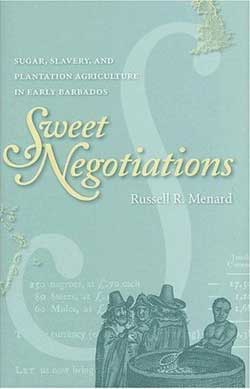
Russell R. Menard, Sweet Negotiations: Sugar, Slavery, and Plantation Agriculture in Early Barbados. Charlottesville: University of Virginia Press, 2006. xvii+ 181 pp., cloth, $39.50.
In the slim but weighty Sweet Negotiations: Sugar, Slavery, and Plantation Agriculture in Early Barbados, Russell R. Menard confronts one of the most enduring and widely accepted claims in the history of the Atlantic world: that the arrival of sugar in Barbados was the key transformative moment in the development of that island, the British empire, and the Atlantic economy (check the index to any U.S. survey textbook). In a matter of just 181 pages, Menard disassembles this 350-year-old thesis and in its stead suggests the more “prosaic term sugar boom” (4). This change is not simply an exercise in semantics. Rather, Menard uses it to reconceptualize the nature of sugar itself, the role of colonial planters as innovators, and the development of this “hub” of empire.
Menard does not deny that sugar took hold in Barbados very rapidly. Experimented with in the island’s early years, colonists reintroduced sugarcane at the end of the 1630s and after a decade of improving planting and processing techniques succeeded in producing valuable harvests by the mid-1640s. African slaves who had learned highly technical skills in Dutch or Portuguese plantations in Brazil were most likely key in Barbados’s planters’ eventual ability to produce palatable muscovado. Once established, the crop flourished. By 1649 sugar was the chief commodity used in local exchange, and by the mid-1660s, 60 percent of the island was planted with sugarcane and the crop accounted for 90 percent of the value of all Barbadian exports. By 1680 the island looked dramatically different than it had forty years earlier as large plantations replaced small and African slaves replaced mixed forms of free and unfree labor. For those familiar with Caribbean history, little of this is new. What Menard questions is the assumption that there was something inherent in sugar itself that caused it to revolutionize “Barbados [and the Atlantic] by introducing African slavery and large plantations” (123-4).
Menard contends that sugar did not inaugurate these changes. Instead he argues, “Barbados was already on the way to becoming a plantation colony and a slave society” when planters reintroduced sugar, thanks to an ongoing export boom. The critical crops in this earlier period were the “minor staples” tobacco and cotton (12). In general, forward-looking innovative planters vacillated between these crops during the 1630s and early 1640s as prices fluctuated, supplementing their production with indigo and ginger. This crop diversity was important because, as Menard shows, it enabled planters to respond to international price swings and thus allowed an export sector independent of any one commodity to develop. Barbadians’ experiments with plantation agriculture and the success they had with these commodities (cotton more than the others) made it possible for them to accumulate capital and to enhance their reputation as planters, both elements that then allowed their subsequent investment in sugar at the end of the 1640s.
The argument that a mixed export sector, as opposed to monoculture, was pivotal in the early stages of the development of a profitable, extractive colonial economy is a significant and important corrective to single-staple models of colonial economic growth.
Beyond critiquing the sugar-revolution thesis for its failure to explain Barbados’s economic development, Menard also argues that the socioeconomic implications of the thesis—namely that large, integrated plantations worked by gangs of slaves “simply emerged fully developed” in Barbados with sugar cultivation—oversimplifies the complexity with which Barbadians constructed a sugar economy (91). In its place he offers a much richer picture of Barbados’s early history in which small and large planters coexisted, experimented with new technologies, and utilized both European and African sources of labor through the early years of the sugar boom. Menard’s analysis emphasizes the innovativeness of colonial planters and metropolitan merchant investors who turned to integrated plantations worked by large numbers of African slaves, not (to borrow from Winthrop Jordan) because of the unique properties of a selected crop, but in response to changing market conditions. The inability of the English indentured market to supply the voracious needs of planters during the general export boom, for example, prompted them to increase their purchases of African slaves. Here Atlantic markets, not sugar itself, stimulated a reorganization of Barbados’s social make-up.
Menard is not alone in arguing for a reevaluation of the sugar revolution. But what he, as one of the most esteemed historians of the Atlantic economy, offers is a lucid and at times devastatingly simple case that makes it unmistakably clear that sugar alone did not revolutionize Barbados in the seventeenth century. But where do we go from here? How should such a conclusion change the way we think about the history of the Caribbean? Though Menard often reminds readers that Barbados was part of a larger empire and oceanic system, his work remains rooted firmly in Barbados. Sweet Negotiations, therefore, only offers hints of how scholars can apply this revision of the sugar revolution to a wider spatial field.
One promising hint is Menard’s emphasis on the importance of minor staples and the colonists who produced (and I might add, distributed) them. By dating important innovations to the pre-sugar period, Menard suggests that sugar was not the only crop that mattered in the Caribbean. There is still much to learn from diverse agricultural production, and historians of the Atlantic economy could profitably concentrate our energies on colonies such as the English Leeward Islands. Recent interest notwithstanding, scholars have largely neglected these colonies, assuming their histories mirrored Barbados’s, albeit with a slightly later and less spectacular sugar revolution. But seen through Menard’s prism of a diverse export boom and innovative planters, places such as the Leewards, where planters cultivated a wide variety of tropical commodities through the first decades of the eighteenth century, have much to teach us. Only by more fully understanding both why colonists chose to produce minor staples and how they—together with merchants, imperial agents, servants, and slaves—financed their enterprises, organized labor, and constructed supply and distribution networks can we get a firmer grasp on the evolution of seventeenth-century plantation societies. By moving from a narrative centered on the revolutionary nature of a single commodity to one that focuses on the ability of colonists to shape local economies, Menard has shown us that we have much still to learn about the foundations of Atlantic empires. It is time to get to work.
Further Reading:
The classic studies of the sugar revolution are Eric Williams, Capitalism and Slavery (1944; reprint, London, 1964); Richard Dunn, Sugar and Slaves:The Rise of the Planter Class in the English West Indies, 1624-1713 (Chapel Hill, N.C., 1972); and Richard Sheridan, Sugar and Slavery: An Economic History of the British West Indies, 1623-1775 (Barbados, 1974). For several works that have also recently questioned the accuracy of the thesis, see B. W. Higman, “The Sugar Revolution,” Economic History Review, 2d ser., 53 (2000): 213-236; Larry G. Gragg, Englishmen Transplanted: The English Colonization of Barbados, 1627-1660 (Oxford, 2003); and the essays in Stuart B. Schwartz, ed., Tropical Babylons: Sugar and the Making of the Atlantic World, 1450-1680 (Chapel Hill, N.C., 2004). Meanwhile David Hancock has called for a renewed focus on “the agricultural nature of the colonial economy, and its decentralized, indeed opportunistic evolution through the efforts of individual adventurers and entrepreneurs” in David Hancock, “‘A World of Business to Do’: William Freeman and the Foundations of England’s Commercial Empire, 1645-1707,” William and Mary Quarterly, 3d ser., 57 (2000): 3-34.
This article originally appeared in issue 7.2 (January, 2007).
Christian J. Koot is a visiting assistant professor of history at Colgate University. He is currently working on a book manuscript that examines the role the transmission of culture, goods, and entrepreneurial activities across imperial boundaries played in the development of New York City and the Caribbean during the seventeenth century.
Enslaved Bodies, Enslaved Selves
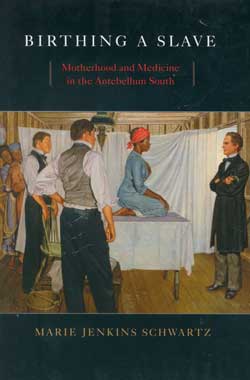
Marie Jenkins Schwartz, Birthing a Slave: Motherhood and Medicine in the Antebellum South. Cambridge, Mass. : Harvard University Press, 2006. 401 pp., cloth, $29.95.
In 1834, South Carolina slaveholder James Henry Hammond composed a detailed guide for plantation management. He offered a series of suggestions, large and small, on topics ranging from crop production to animal husbandry. Enslaved women’s reproductive health in particular—pregnancy, childbirth, and breast feeding—fascinated Hammond, a self-proclaimed expert on homeopathic medicine. No detail of the “peculiar institution” was too private for his public observations. Despite his own lack of medical training, he advised slaveholders that with the appropriate manuals and materials, they too could manage their bondswomen’s reproductive lives. In Birthing a Slave: Motherhood and Medicine in the Antebellum South, historian Marie Jenkins Schwartz explores precisely this struggle over enslaved women’s bodies: between slaveholders like Hammond, the physicians they hired, and the enslaved community’s folk traditions.
After the United States withdrew from the transatlantic slave trade in 1808, planters like Hammond recognized that the institution of slavery depended upon enslaved women’s ability to reproduce. “During the antebellum era,” as Schwartz explains, “the expectation increased among members of the slaveholding class that enslaved women would contribute to the economic success of the plantation not only through productive labor but also through procreation” (11). While scholars have acknowledged this defining characteristic of nineteenth-century American slavery, the intricacies of the subject have been surprisingly unexplored, at least until now. As Schwartz makes clear, in the decades preceding the Civil War, slaveholders eager to expand their labor force took active, often coercive, steps to increase the number of children “born into bondage” (1). They commissioned southern physicians to tend to their bondswomen’s reproductive health. Such doctors, eager to expand their patient pool and to demonstrate their expertise, monitored slave pregnancies and childbirths and attempted to treat a range of bondswomen’s reproductive ailments: infertility, menstrual difficulties, gynecological cancers, and postpartum complications. Slaveholders like Hammond and the doctors they hired couched such interventions in the language of paternalism. “Professional” medical care ostensibly evinced a master’s concern for his enslaved property.
Yet masters’ efforts to provide reproductive medicine often collided with the preferences of enslaved women, who commonly favored traditional healing practices over “modern” intervention. Whenever possible, expectant enslaved mothers looked to other bondswomen for help with pregnancy and delivery. But, as Schwartz notes, masters and plantation doctors often ignored an enslaved mother’s wishes, privileging her life and ability to reproduce over the life of her unborn child. Plantation doctors understood that they worked for the slaveholder, not the patient, and elevated their reputations over their patients’ desires. Ultimately, enslaved women struggled to make medical choices “in a society that did not define control of one’s body as a fundamental right of slaves” (3).
Schwartz organizes Birthing a Slave “thematically around a woman’s reproductive life: fertility, pregnancy, childbirth, postnatal complications, gynecological disorders, and the related topic of cancer and other tumors” (6). Each of these sections illustrates the manifold ways the system of slavery affected black women’s spiritual and physical well-being. The crude, often dangerous realities of nineteenth-century medicine wreaked havoc on black women’s bodies. Schwartz’s detailed discussion of gynecological cancers is especially good at exposing this tragic reality of antebellum slave life, when planters privileged black women’s economic worth and surgeons prioritized medical breakthroughs at the expense of black women’s comfort, even at the end of these patients’ lives. A more perfunctory closing chapter, “Freedwomen’s Health,” sketches how medical relationships between white doctors and black female patients evolved after emancipation, when physicians fled their practices to fight for the Confederacy, and under Jim Crow, when a resurgence of racial animosity impeded black women from receiving professional medical care.
The swiftness of the last chapter notwithstanding, Birthing a Slave is painstakingly researched and meticulously documented. Schwartz withholds no detail about enslaved women’s gynecological health from her readers, no matter how graphic. The agonies of childbirth before the advent of anesthesia; the black market for stillborn and aborted fetuses; and ovarian, uterine, and breast cancers before modern pain management are each unearthed with uncommon archival capability. Drawing upon antebellum physicians’ case histories, medical records, and published journals; slaveholders’ plantation records and account books; and the recollections of former slaves and their descendants, Schwartz reconstructs an exhaustive portrait of some of the most intimate—and important—details of antebellum slave life (6-7). Her historical intrusiveness is the perfect analogue for the ways slave owners and physicians poked and prodded enslaved women (33).
As Schwartz convincingly demonstrates, the history of reproductive health touches upon nearly every debate that has dominated slavery studies over the past several decades: resistance and agency, hegemony, paternalism, family, culture, and religion. For its historiographical reach, analytical breadth, and archival depth, Birthing a Slave will be of great interest to scholars of African American history, southern history, women’s history, and the history of medicine. This book is impeccably researched and beautifully written. Schwartz has admirably tackled a sensitive subject with analytical grace and narrative skill. While it may not be the right book to savor over a morning coffee, Birthing a Slave is social history at its finest.
This article originally appeared in issue 7.2 (January, 2007).
Hilary Moss is an assistant professor of history and black studies at Amherst College. She is currently completing a book manuscript on race, citizenship, and education in antebellum America.
Before the Apple Ripened
Robert E. Wright, The First Wall Street: Chestnut Street, Philadelphia, and the Birth of American Finance. Chicago and London: The University of Chicago Press, 2006. 210 pp., cloth, $25.00.
When, in the mid-twentieth century, Marshall McLuhan observed that “the medium is the message,” he was speaking of airplanes, telephones, and televisions—technological innovations that collapsed distance and enabled “extensions of man” into places and spaces faraway and foreign. For the financial historian Robert Wright, “the IOU”—a “promise to pay”—answered the same purpose in the late eighteenth century (2). Capaciously defined to encompass promissory notes, bank notes, shares of stock, insurance policies, interest-bearing bonds, mortgages, rental agreements, contracts, and loans, IOUs were debtors’ promises to pay lenders. And because they were just promises recorded on nothing more precious than paper, offering or accepting IOUs involved risks. Yet once the risks and rewards of IOUs could be assessed and brokers had the ability to deal with clients not just on the opposite side of their desks but across cities, states, and even nations, the financial sector unleashed the energy and sharpened the maximizing instincts of an ever-widening cohort of interdependent economic actors. In an era of limited state capacities and great distances, the exchange of IOUs gave rise to a far-flung “web of self-interest” (67).
“Financial history,” Wright believes, “is the story of the competition between different means of linking the savings of investors to the spending of entrepreneurs” (4). In the United States, he contends, this story began at a specific place and with an identifiable cast of characters: the financial community gathered on Chestnut Street in Philadelphia. From there, between the late 1770s and early 1820s, there emerged an efficient market to exchange IOUs, mitigate risk, and steer funds toward promising projects. This development, in turn, facilitated the country’s commercial consolidation and prosperity by “ensuring that good wealth-creating ideas [did] not die of neglect” (7).
The First Wall Street posits four reasons that Philadelphia “led [a] change to modernity” in the eras of the Revolution and early republic: the city was the national capital, and as such was the country’s commercial capital, a “focal point of mercantile information” (11). The city’s financiers, including Clement Biddle, Stephen Girard, Robert Morris, and Thomas Willing, were innovative market-makers and institution-builders. And lastly, the city was the home to the nation’s central banks, the Bank of North America and the first and second banks of the United States thereafter. Bundled together, the city’s markets and institutions for a time were its most valuable asset because, in the intimate setting of a recognized financial district, Chestnut Street offered market participants greater transparency, flexibility, and information, empowering people to make more informed decisions and reducing what economists call “transaction costs.”
Canvassing a variety of institutions—commercial and savings banks, the U.S. Mint, and marine, life, and property insurance companies—Wright uses often colorful vignettes to illustrate the degree to which Philadelphia brokers and financiers developed risk assessment criteria to offer credit and financial services to cash-poor artisans and merchants, matching them with people who were flush with capital but reluctant to see their money vanish in a bursting bubble. Along the way, he provides a cogent financial history of the early United States. Readers see Alexander Hamilton promote a national unit of currency with the U.S. Mint and bind the federal union through the assumption of state Revolutionary War debts funded by the Bank of the United States. They learn how the U.S. Mint functioned and how the city’s fire codes were enacted at the urging of its subscription fire insurance company. They witness canal plans falter in the face of Erie Canal competition and more promising railroad opportunities. They are shown how savings banks like the Philadelphia Savings Fund Society began mirroring the kind of local credit network that Quaker meetings had long provided. Less renowned men—like Moses Lancaster and Michael Hillegas—share space with the titans of early American business to illuminate the impact institutional changes and macroeconomic forces had on microeconomic households, a connection long neglected by economic historians, with notable exceptions such as Naomi Lamoreaux’s work on firms or David Hancock’s study of mercantile networks.
Robert Wright here draws heavily on his own work and that of fellow banking historians David Cowen and Howard Bodenhorn. His language is accessible, tethered to mortal terrain by a voice sometimes conversational, even mischievously so. His immodest aspiration for this brief work is that it “change the public’s perception of finance” (12). That goal is a worthy one. Today nearly half of all Americans own market-traded securities and anyone can gorge themselves on high-interest credit-card debt, yet Wall Street’s idea of deep history is a five-year moving-average price graph. Few investors or debtors have developed a sense of history beyond what is found at a Bloomberg terminal.
Wright dates the marriage of America to the financial industry to the 1780s, a decade when a financial revolution followed a political revolution, which itself was caused in part by, of all things, inflation. In Wright’s view, that is, there is no partitioning political revolution from commercial revolution. Banks, corporations, and even the heroic Alexander Hamilton were as much democratizing forces, Wright insists, as were the events of the American Revolution. Yet cannot commercial banks have been both useful and exclusive? Cannot they have helped secure the stability of the new United States while perpetuating the inequalities of wealthy that maintained a pre-Revolutionary social order? Wright’s own evidence shows that savings banks were founded expressly because their forebearers were too picky to lend to lesser sorts.
Economic historians sometimes isolate themselves from both the public and their colleagues in other disciplines by relying on abstract theory and the comfortable distance of observational macroeconomics. Wright, in contrast, gets close to his sources, and his efforts pay dividends. This book shows how the early American economy and its component institutions worked. But in charting the decline of Chestnut Street and the political reasons for various institutions’ shuttering, Wright’s narrative is less persuasive because it lacks nuance. Martin Van Buren’s hostility toward the Second Bank of the United States was not the prevailing reason for Andrew Jackson’s veto, and a “lack of vision” or “lack of investor interest” does not fully explain the failure of the Philadelphians to dig a canal to rival the Erie (129, 122). Like saying that Aaron Burr “murdered” Hamilton, causality seems substituted by caricature (150).
Wright should have stuck to his original promise to change the public perception of finance. If IOUs became more liquid, portable, and transparent over time, then Chestnut Street’s slide was nobody’s fault. Decades before the first scoop of Erie Canal dirt was moved and years before the national political pole shifted to Washington, D.C., the deep waters and coastal connections of New York Harbor began attracting business once destined for Philadelphia. As a medium of exchange, the commercial IOU’s message was mobility; Manhattan’s port never froze, and by the mid-1790s it had a rough institutional parity with Philadelphia. Capital floes drifted there because the city had lower transaction costs. The subsequent failures of the central banks were political decisions that reflected microeconomic realities: Chestnut Street lacked the efficiencies offered by New York’s advantageous locale. And once the national capital moved to Washington, it lost the political clout of a capital. The toppling of Philadelphia was never personal. It was just business.
This article originally appeared in issue 7.2 (January, 2007).
Brian Phillips Murphy is a Ph.D. candidate in history at the University of Virginia in Charlottesville. His dissertation, titled “The Politics Corporations Make,” explores how business corporations and internal improvement coalitions were catalysts for state formation and political party development in New York. He is a former financial journalist.
Listening to the Evidence of the African American Slave Experience
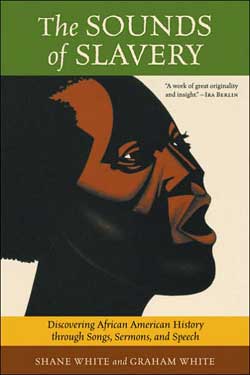
Shane White and Graham White, The Sounds of Slavery: Discovering African American History through Songs, Sermons, and Speech. Boston: Beacon Press, 2005. 242 pp., cloth, $29.95.
In this captivating and persuasive book, Shane White and Graham White explore the aural dimension of the African American slave experience. To gain leverage on a topic that poses considerable challenges to the would-be researcher, the authors mine an impressive array of sources including colonial and antebellum newspapers, diaries kept by white Southerners, the travel writing of white visitors to slaveholding regions, slave memoirs, interviews conducted with former slaves, and early postbellum efforts to publish the music sung by African American slaves. The authors also include in their analysis a discussion of the sounds of African American singers, preachers, and storytellers recorded in the 1930s and housed in the Archive of Folk Culture in the Library of Congress. Remarkably, the authors have managed to include in The Sounds of Slavery a compact disc with eighteen of the tracks discussed in the book. As readers make their way through the authors’ argument, they can therefore listen directly to African American voices and enjoy an unusual opportunity not only to assess the authors’ treatment of primary sources but also to appreciate in full force the dramatic and moving tones of a culture built in the shadows of slavery. As the authors so aptly suggest, these tracks “bring us about as close as we are ever going to get to hearing some of the familiar—and to whites often ‘weird’ and ‘unforgettable’—sounds of slavery” (xxii).
The opening chapter of the book conveys the depths of suffering experienced by African American slaves who consistently struggled to maintain their own sense of humanity. The oppression of the slave system could be heard across the landscape in the form of plantations’ bells that instructed slaves to begin their long workdays in the fields and, more poignantly, in the tormented cries of slaves whose families and communities were torn apart by the sale of loved ones and the piteous screams of slaves whipped for their alleged transgressions. That the terrible power of the white master class was applied through the dimension of sound is a realization that enables the modern student of slavery to more fully appreciate the horrors of the institution of slavery, a system of oppression that whites policed with the crack of the lash, the sounding of the bell, and unleashing of hounds whose barks communicated to the slaves that one of their number was very likely about to be dragged back into immediate white control and subjected to brutal corporal punishment. And yet, as much as the authors unflinchingly chronicle the hideous aural dimensions of American slavery, they weave into their work the contrapuntal theme of African American resilience and creativity. Belying the title of the first chapter, “All we knowed was go and come by de bells and horns,” is the wealth of evidence offered throughout this book that slaves managed to create a coherent black culture predicated on their resistance to white authority and their commitment to values and aesthetics that were removed from the European and white American tradition.
In ritualized celebrations such as the Pinkster holiday that emerged in the New York region and the Jonkonnu festival celebrated in North Carolina, the singing and joyful sounding of African American voices worked in tandem with the instruments and drums wielded by black musicians to create a sensory experience that clearly belonged to the slaves themselves. White witnesses to these performances sometimes marveled at them and sometimes bemoaned what they deemed the alien noises emanating from the African American participants, but in either case, whites were acknowledging that they stood outside the cultural space forged through African American sounds. Indeed, even when the slaves gathered in mourning as opposed to celebration, their funeral hymns and sermons left no doubt that in moments of grief as well as exultation, an African American aural aesthetic would serve as the arbiter of the communal experience.
The slaves’ achievement in forging their own ways of singing, speaking, and, by extension, listening offered them a counterweight to the mastery of their white owners. Slaves’ field calls, for example, enabled African Americans to communicate freely with each other even when they remained within eye- and earshot of white authority figures. Slaves could holler their frustrations and outrage over their enslaved status or warn their coworkers that the overseer was approaching because they expressed themselves in terms and rhythms outside the realm of white comprehension. Not surprisingly, white listeners failed to appreciate the complexity of African American vocal techniques, which reflected and reinterpreted particular African musical traits such as the use of falsetto, yodeling, and a sensitivity to tonal variation—techniques that this book’s audience can listen to in a number of the tracks included on the CD.
One of the most fascinating themes running through The Sounds of Slavery is the extent to which whites took note of (and some satisfaction in) the cultural boundaries that blocked them from understanding African American sounds even while they simultaneously complained about these boundaries and sought to compel African Americans to obey white conventions for language and music. The ambiguous nature of white audience’s response to African American sounds was perhaps most apparent in the setting of Christian worship. For white Christian authorities, the liturgy was understood as something to be respected and obeyed as a ritualized enactment of Christian fealty to godly authority. Slaves, by contrast, exercised a very different understanding of liturgy, viewing it as an opportunity for improvisation and creativity that was understood to be in keeping with a state of divine inspiration. Through the employment of musical conventions such as “sampling” and the expansion of song lyrics achieved through the restatement of particular words and phrases (“parallel statement”), African American worshippers were carefully responding and interacting with each other exactly because each individual was free to shape the collective sound (62-63).
In the second half of the book, the authors take many of the themes explicated in their exploration of the African American musical tradition and use them to explore black language and black preaching. By the time that Shane White and Graham White introduce the reader to the preaching of a twentieth-century Texan, the Reverend Sin-Killer Griffin, they are able to frame his sermon in the context of the well-defined conventions structuring African American speech. Although whites frequently dismissed men such as Griffin as unsophisticated and undisciplined, the authors reveal how Griffin’s oratory style was characterized by features such as “the power of the preacher’s imagery; the lavish use of biblical texts; the rhythms and tonal contours of elevated speech; the incessant call-and-response; the grainy tautness of the preacher’s voice (signifying intensity); [and] the surprising juxtapositions” of verses from different biblical texts (142). In the book’s final chapters, the authors offer portraits of the “soundtracks” of a range of urban African American communities. Weaving together strands of evidence from a number of primary and secondary sources, Shane White and Graham White recreate the atmosphere of the city streets, which African Americans turned into markets, religious meeting places, areas for dance and ritualized celebration, and also zones of confrontation with suspicious whites. In these final chapters, the authors suggest that white distaste for some of the defining features of the urban slave experience foreshadowed the concerns of their postbellum descendants who sought new methods of racial control once slavery itself had been abolished. As they do throughout the book, Shane White and Graham White establish beyond any doubt that the unique sounds of African American culture simultaneously sparked white hostility and also provided African Americans with a means of resisting white authority.
A brief epilogue exploring emancipation tantalizes readers with an avenue of analysis that the structure of the book does not permit the authors to follow fully. As indicated by their deft use of the audio recordings and oral evidence from the 1930s, the authors repeatedly demonstrate continuities in the defining characteristics of the African American culture of sound. As such, it would have been interesting—to say the least—to hear the authors extend their story into the later nineteenth and early twentieth centuries.
The Sounds of Slavery is one of the very best books I have read on any dimension of the slave experience. It is also a book that manages to speak to the questions of professional scholars while painting a vivid portrait of the past that will satisfy a general audience.
This article originally appeared in issue 7.2 (January, 2007).
Jeffrey Robert Young is a lecturer in the undergraduate honors program at Georgia State University. His most recent book Proslavery and Sectional Thought in the Early South, 1740-1829: An Anthology was just published by the University of South Carolina Press in 2006.
Perfect or Perverted?
Hermaphroditism and homosexuality in nineteenth-century America
[F]rom the anatomical point of view, the hermaphrodite is neither a monstrosity nor a freak of nature, but a creature devoid of ordinary development, that is, not developed sexually in conformity to its species. Physiologically, the hermaphrodite is a degenerate, impotent and sterile, imperfect in impulse and characteristic equilibrium, on account of unstable and perverted sex (1892).
So wrote an anonymous author in an 1892 medical journal. By the late nineteenth century, hermaphrodites (a historical term used to describe those born with discordance among the multiple components of sex anatomy: internal reproductive organs, external genitalia, and chromosomes) were no longer ostensibly considered “monstrous” or “freaks of nature,” though they continued to inspire a mixture of pity, disgust, and fascination, even among medical men, who we might have expected to be dispassionate about anomalous bodies. In colonial America, before surgery became an option to “fix” what was “wrong,” early interpreters saw unusual genitals as evidence of nature gone awry. Ministers and medical practitioners saw providence or the diabolical in “monstrous births.” And mothers were often blamed for their babies’ anatomies, for folk wisdom taught that maternal imagination could cause all kinds of birth anomalies. Medical men, and midwives as well, made pronouncements about gender that had extensive legal ramifications—whether to settle cases of bastardy or impotence, confirm or deny rape accusations, or substantiate divorce proceedings.
These early discussions of atypical genitalia tended to assume the immutability of sex. One was either male or female, and in cases where the physical appurtenances of sex suggested ambiguity, most commentators simply reverted to the language of deformity. Medical jurisprudence manuals and gynecological treatises of the eighteenth century generally doubted the existence of hermaphrodites as they were then defined: having a complete and perfect set of male and female sexual organs. Medical men instead insisted that many so labeled were simply women with enlarged clitorises. The mistaken belief in hermaphrodites, some medical authorities suggested, was due to ignorance of human anatomy, particularly that of the female. If hermaphrodites were really women with large clitorises, then their condition could lead to two evils: it could hinder coitus and promote sexual relations between women.
By the early nineteenth century, newly authoritative and professionalized physicians took the liberty of assigning a gender to people (not just infants) with uncertain genitals, even if that assignment opposed the patient’s preference and contradicted that individual’s previous gender performance. Like the rest of nineteenth-century society, doctors held the institution of marriage in high esteem and attempted to create genital organs that might accommodate normative marital relations. There were also legal reasons for “proving” that patients were either male or female, whether the question was one of enfranchisement, inheritance, or divorce. The existence of chromosomes or hormones was not yet known, nor was inspection of internal gonads then possible. Confounded physicians could but observe the often contradictory genitalia, and consequently their pronouncements depended as much on traditional stereotypical social indicators as on biological markers when they decreed a physically anomalous individual male or female. Nevertheless, decree they did, for convention required that a person be clearly male or female.
In the last decades of the nineteenth century the controversy over the definition of hermaphroditism intensified. The nineteenth-century medical journal articles can be interpreted as conversations amongst doctors, as they read and rebutted each other’s work. Often physicians referenced previously published cases in order to buttress their own opinions. The cases concerning hermaphroditism were no exception. Doctors cited sixteenth-century precedents, for example, in order to prove to their colleagues that hermaphrodites did not exist, despite the cases of ambiguous sex that they continued to see. The patients they evaluated, then, were “really” men or women, and doctors published their unusual cases to prove their points and validate their medical authority. Despite their fundamental disagreement over whether or not there was such a thing as a true hermaphrodite, these doctors had much in common. Most of them asserted their own importance in making decisions regarding their patients’ genders. Most of them wanted to see their patients involved in heterosexual relationships, especially marriage. And, much like the above anonymous medical manual contributor, most of them associated hermaphroditism (to the extent that they admitted its existence) with sexual perversion.
The (Im)possibility of Perfect Hermaphrodites
Although medical men wanted to ensure the specificity and stability of each person’s sex, uncertainties regarding the criteria for femaleness or maleness abounded in the nineteenth century. Were there people for whom sex could not be firmly established?
In his account of a hermaphrodite orangutan, Richard Harlan made the point that a perfect set of male and female organs could be found in even the highest class of animals, as in monkeys. He also described a person living in Lisbon whose genitals “united both sexes in apparently great perfection.” Illustration from Richard Harlan, MD, Description of an Hermaphrodite Orang Outang. Lately Living in Philadelphia (Philadelphia, 1827). Courtesy of the New York Academy of Medicine Library.
In Samuel Farr’s 1787 medical jurisprudence textbook, published in America in 1819, “perfect” hermaphrodites were defined as those “partaking of the distinguishing marks of both sexes, with a power of enjoyment from each.” Whereas earlier writers had required a perfect complement of parts to qualify as a hermaphrodite, Farr pushed the definition a crucial step further by adding “a power of enjoyment.” Hermaphrodites had to have both sets of organs and had to be able to use either one for sexual satisfaction. Could a hermaphrodite derive sexual pleasure as both a female and a male? That seemed impossible to most writers, though they revisited the question repeatedly throughout the eighteenth and nineteenth centuries. More than one nineteenth-century commentator also wondered if hermaphrodites would be able to impregnate themselves. But medical men were sure the answer was no. No such instance had ever been found.
By the mid-nineteenth century, some American doctors had become familiar with the sorting and stabilizing efforts of Isidore Geoffroy Saint-Hilaire, author of Histoire des anomalies de l’organization, published in 1832-1836 and soon excerpted in English in Theodric Romeyn Beck’s prominent medical jurisprudence textbook of 1838. Geoffroy Saint-Hilaire argued that hermaphroditism, per se, did not exist; as Beck translated the passage: “the external organs (as a penis and clitoris) have never been found perfectly double.” Geoffroy Saint Hilaire believed that anatomists had resolved the debate about hermaphroditism once and for all; he concluded that “it is anatomically and physiologically impossible.” Echoing Geoffroy Saint-Hilaire, John North, author of a two-part article on hermaphroditism and other “monstrosities” published in America in 1840, also denied the existence of perfect hermaphrodites. “Although we see many instances of true hermaphroditism in the animal and vegetable kingdoms,” he remarked, “no such cases have ever existed in the human subject; no human hermaphrodite, in the proper sense of the term, has ever existed; not a single so-called hermaphrodite in man has even been capable of performing the sexual functions of both sexes.”
But despite assertions to the contrary, some physicians were convinced that the people they saw were indeed hermaphrodites, though they sometimes tempered their assertions by labeling a person a “spurious,” “false,” or “pseudohermaphrodite” if their external genitalia did not align with their internal anatomy. In 1850, Dr. Jonathan Neill, a professor of anatomy at the University of Pennsylvania, presented a subject who he believed was “certainly entitled to the term hermaphrodite.” The person, already deceased, arrived at the anatomical rooms of the university for an autopsy. Not much was known about the subject, other than that she “resided among the degraded blacks in the lower portion of the city,” according to the coroner’s jury, and that she died of “drunkenness and exposure.” The jury was able to surmise from her teeth and “general appearance” that she was between twenty-five and thirty years old when she died. Though the subject dressed in women’s clothes, Dr. Neill was not entirely persuaded that she was female. She had large breasts and no hair on her face, two markers that typically would indicate femaleness. But other secondary sex characteristics suggested maleness. Neill wrote that if one looked only at the ratio of the broad shoulders to the narrow hips and also at the shape of the limbs, it would “have indicated the male sex.”
What were the definitive markers of sex, then? Did large breasts and a smooth face trump narrow hips and broad shoulders? Upon inspection, the genitalia revealed a similar ambiguity. Dr. Neill said that from a “superficial view” of her genitals, “almost any one would have pronounced the subject to have been a hypospadic male.” (Hypospadias is a condition whereby the urethral opening is not at the tip of the penis, but underneath instead. In severe cases, the opening falls closer to the scrotum, which can resemble the labia majora.) Since this person was dead, Dr. Neill could go beyond the superficial and perform an autopsy to search for other clues. Inside the body, Neill discovered female reproductive organs: uterus, fallopian tubes, small ovaries, and a narrow vagina “of the proper length.” Now considered more female than male, Neill classified the subject’s condition as “spurious hermaphroditism in the female.”
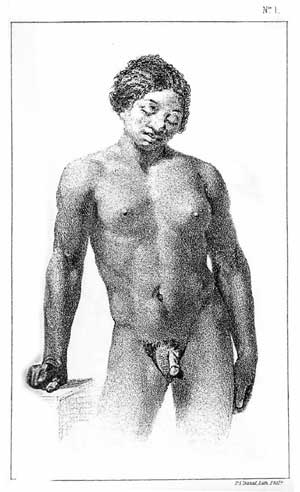
Five years later, doctors France Wharton and Moreton Stillé mentioned the case in their textbook, A Treatise on Medical Jurisprudence. What Neill thought most would have seen as a hypospadic penis, Wharton and Stillé described as both a long clitoris and a penis. In an unusual display of uncertainty, the two described the subject as having a clitoris five inches long in one sentence and a penis in the next. Perhaps Wharton and Stillé were puzzled by the drawing of the subject included alongside Neill’s article.
Illustration from Dr. John Neill, “Case of Hermaphroditism,” Summary of the Transactions of the College of Physicians of Philadelphia 1 (1850): 114. Courtesy of the Yale Medical Library.
Following Neill’s description, the subject’s picture revealed an athletic male physique: broad shoulders, narrow hips, and muscular limbs. She had breasts and a smooth face, and the genitals looked more male than female, as Neill originally suggested. A second drawing depicted a closer view of the penis/clitoris with a vaginal opening underneath. Perhaps Dr. Neill was right to conclude that the person was “certainly entitled to the term hermaphrodite.” The visual portrayal of the subject is as confusing as the genitals; the coroner had said that the subject died of drunkenness and exposure and lived “among the degraded blacks in the lower portion of the city.” The figure here looks more like a Greek god/goddess than someone devastated by alcohol and poverty. Furthermore, as the subject arrived at the university already dead, the image of her posing elegantly, standing against a table, adds to the general uncertainty of the case.
Wharton and Stillé recognized that the definition of hermaphroditism was shifting, though their language betrays a continued commitment to the monster motif. “Hermaphroditism” was no longer used only to describe the “perfect” union of male and female organs in one individual, which, along with self-impregnation, seemed impossible. By the mid-nineteenth century, the term was coming to be used more broadly without the qualifying “perfect” to describe, as they put it, “all those cases in which doubts exist concerning the real sex, in consequence of some aberration from the normal type of the genital organs.” This development, in turn, reflects the growing acknowledgement within the medical community that it was often difficult to determine a person’s sex, particularly at a young age or even, as in Neill’s case above, after death. “We can only hope to approximate to the truth,” noted Wharton and Stillé, “by observing whether there is not some regularity in the freaks of nature, and thus discover, if possible, some uniform correspondence between the visible deviations and those which are hidden from our view.” Urging restraint, Wharton and Stillé cautioned against a hasty pronunciation of a person’s “true” sex, a prudence that went largely unheeded in the twentieth century.
Hermaphrodites and Homosexuals
Those authorities who believed in the impossibility of hermaphrodites did not deny that sometimes people were born with a mixture of male and female organs. Rather, they held that, despite such bodily conformations, each person had a true sex to which he or she belonged. Their denial of hermaphrodites, then, meant simply that doctors would have to look harder to determine each patient’s core identity. If hermaphrodites were, at best, exceedingly rare, then ambiguously sexed patients were simply men or women who just needed to learn their true sex. Of course, this knowledge could lead to trouble. Suppose, for example, patient X was living as male in sexual intimacy with a woman. If a doctor decided patient X was really not a man at all, but rather a woman, then X’s relationship was homosexual. Hermaphroditism thus had the potential of fostering homosexuality and, by association with this prohibited “vice,” with perversity and immorality, as the epigraph suggests.
In the late nineteenth century, doctors began to sort the differences between alleged hermaphrodites and homosexuals. To modern readers, the distinctions seem obvious: hermaphroditism concerned physical anomalies. Homosexuality has nothing to do with the shape of one’s genitals; it concerns sexual orientation. People born with ambiguous genitalia may or may not experience same-sex desire, just as people born with unequivocal genitalia may or may not. Though some scientists today search for genetic or hormonal clues to homosexuality’s origin, thus connecting propensity to biology, the predominant view is that same-sex desire is not dependent on manifest physical traits. That is, even scientists investigating biological causes do not typically study genital anatomy.
In the late nineteenth and early twentieth century, some doctors drew a distinction similar to the one commonly used today: hermaphrodites necessarily had unusual genital anatomies; homosexuals did not. The divergence, however, was not clear-cut. Doctors often equated hermaphrodites and homosexuals. For example, if hermaphrodites’ genitals were ambiguous, thus masking their “true” sex, then might their sexual intercourse constitute homosexuality? And similarly, since homosexuals preferred intimacy with members of their same sex, then might they suffer from a “mental” or “psychical” hermaphroditism, a deformity centered in the brain, which is also an organ? Though possessed of “normal” genitalia, such deviants (as they were then called) might nonetheless be pushed by their hermaphroditic mental organ to feel and act transgressively. Some adherents to this opinion wanted to amend negative views about same-sex desire by proving it was congenital—just as many today assert that sexual proclivity is biological, innate, and immutable rather than “a choice” and hence immoral. But far more physicians viewed homosexuality with disgust and had no such agenda; for them homosexuality was a freely chosen and vile outrage. In the process, then, of conflating the categories, hermaphroditism became further entangled with negative associations of homosexual degeneracy. Whereas in earlier years it was connected with monstrosity and duplicity, in the late nineteenth and early twentieth centuries, hermaphroditism became virtually synonymous with immorality and perversion.
Both these tendencies—to equate hermaphroditism with monstrosity or with social and sexual deviancy—reflected the persistent power of Western society’s binary conception of sexuality. And many of the questions that had animated the medical and legal literature in the eighteenth and early nineteenth centuries thus continued to hold sway into the modern era: Could one legitimately remain outside this inflexible bifurcation? If not, and one had to be designated female or male, how would that choice be decided? Would doctors choose for their patients? How would doctors deal with patients whom they believed were living as the wrong gender? Would they persuade patients to switch genders in midlife? Would they urge surgery to make their patients’ bodies fit more neatly into one or the other category? And how would people whose genitals were under scrutiny respond? Would they listen to their doctors? Or would they ignore their advice and continue living their lives as they chose? What would be the criteria for choosing a gender? Would doctors and patients make their decisions based on secondary sex characteristics, on gender performance? How important would sexual desire come to be in the assessment?
In 1897 Dr. William Lee Howard published an article called “Psychical Hermaphroditism” in which he separated inversion from consideration of unusual genitalia but nonetheless applied the term “hermaphroditism” to what he saw as “perversion.” According to Howard, the genitals of the “pervert” are typically “normal in appearance and function.” Inversion, then, was purely a psychological condition and not something structural at all. Like hermaphroditism, though, inversion was congenital, rather than acquired. Howard quoted one of his patients, a thirty-year-old man, who said he loved men just as other men loved women. The patient explained, “I can define my disposition no better than to say that I seem to be a female in a perfectly formed male body, for, so far as I know, I am a well-formed man, capable of performing all of man’s functions sexually. Yet as far back as I can remember, surely as young as nine years, I seemed to have the strongest possible desire to be a girl, and used to wonder if by some peculiar magic I might not be transformed. I played with dolls; girls were my companions; their tastes were my tastes; flowers and millinery interested me and do now.” Thus a new twist on hermaphroditism emerged, an inversion that involved the mind rather than strictly the body.
By the end of the nineteenth century, “psychosexual,” “mental,” or “psychical” hermaphroditism were all terms doctors used to describe patients who admitted to same-sex desire or cross-gender identification. People with normal genitalia who confessed to an “inverted” gender identity, like Dr. Howard’s patient above, were termed “hermaphrodites” as were people with ambiguous genitalia, whatever their sexual inclinations. Hermaphroditism became a term that could be used to describe either a physical condition (with or without homosexuality) or a psychological one involving same-sex desire.
In the medical discussion of hermaphroditism, we can see how, rather than merely describing atypical conformation, doctors created the notion of the freakish or perverse hermaphrodite. The hermaphrodite could be treated and normalized through surgical procedures, which would culminate not only in satisfactory genitalia, but in the performance of the suitable social role in marriage. Surgeries typically offered to women included opening of vaginal occlusion, testicular removal, and clitoral excision. Surgeries for men with hypospadias included straightening the penis and extending the urethra through the penis. All of these operations made the patients “fitter” for heterosexual penetration, and the doctors wrote their case studies with intercourse and marriage as the primary indicator of a successful outcome.
In the early twentieth century, it was still all but impossible for a person to be labeled a true hermaphrodite, and doctors continued to search for clues as to a person’s true sex. Many of the themes surrounding hermaphrodites endured from the colonial period, including the tendency to simply deny hermaphroditism. The motifs of monstrosity, mistaken sex, deliberate deceit or fraud, and the potential for celibacy or non-heterosexual intimacy continued to capture doctors’ imaginations and arouse their anxiety. But other notions, such as blaming mothers’ harmful thoughts or questioning whether or not those born with unusual anatomies had souls, gradually receded. As in earlier periods, a commitment to heterosexual marriage reinforced binary notions of human sex. Doctors believed that surgery was warranted in many of these cases, not necessarily for the health, comfort, or pleasure of the patient, but to preclude the undesirable potential for homosexual sex. According to some physicians, even life-long celibacy, via castration, was preferable to homosexuality. Into the twentieth century, doctors’ primary motivation was not to enable the patient to have the partner s/he wanted but was rather to affirm normative conceptions of marriage and sex.
Further Reading:
For a historical interpretation of intersex that focuses on England and France, see Alice Domurat Dreger, Hermaphrodites and the Medical Invention of Sex (Cambridge, Mass., 1998). If you’re interested in the nineteenth century in particular, see Christina Matta, “Ambiguous Bodies and Deviant Sexualities: Hermaphrodites, Homosexuality, and Surgery in the United States, 1850-1904,” Perspectives in Biology and Medicine 48:1 (2005): 74-83. For a broader chronological perspective, see my “Impossible Hermaphrodites: Intersex in America, 1620-1960,” Journal of American History 92:2 (2005): 411-441. For a contemporary examination of the medical, political, and gendered issues regarding intersex, see Suzanne Kessler, Lessons from the Intersexed (New Brunswick, N.J., 1998). For a personal account that highlights the shame and secrecy that attends medical interference, see Cheryl Chase, “Hermaphrodites with Attitude: Mapping the Emergence of Intersex Political Activism,” GLQ 4:2 (1998): 189-211.
Regarding surgical solutions to genital anomalies, “correction” may have been the goal, but as many intersex people have noted, surgery sometimes brought more harm than good, including further operations to eliminate scar tissue and procedures that necessarily resulted in the loss of sexual sensation. Today, intersex activist groups such as ISNA (Intersex Society of North America) advocate delaying surgery until a patient is old enough to make these irrevocable decisions for himself or herself. See Howard Devore, “Growing up in the Surgical Maelstrom,” and Sven Nicholson, “Take Charge! A Guide to Home Catheterization,” both in Alice Domurat Dreger, ed., Intersex in the Age of Ethics (Hagerstown, Md., 1999): 78-81, 201-08.
This article originally appeared in issue 8.2 (July, 2008).
Elizabeth Reis is completing a book titled Bodies in Doubt: An American History of Intersex, to be published by Johns Hopkins University Press. She is an associate professor of women’s and gender studies and history at the University of Oregon.
On the Career
I have been known to sputter with rage at the narrative of salvific white masculinity institutionalized by our practice of dividing American literary history at 1865, the formal end of the Civil War. Erasing Reconstruction, as well as many of the writers who matured during the decades bracketing the war, the ideological implications of this divide—ante or post—can be hard to challenge in both scholarship and teaching, as can the honor it confers to militarized white heroism. So it would be hard to overstate my enthusiasm for Cody Marrs’s Nineteenth-Century American Literature and the Long Civil War, particularly as the book offers a satisfying alternative model in the idea of transbellum literature or “literature that stretches (as the etymology implies) across and beyond the war itself.” Rather than forcing a choice between sides, the transbellum engages the Civil War in all its multiple, messy moments—its excruciating preamble, its shockingly bloody battles, and its sometimes exhilarating, sometimes demoralizing results.
That the lingering questions Marrs’s book inspired for me are not related to the Civil War thus came as a big surprise. As important as the concept of the transbellum is, in other words, I find the book’s implicit defense of disciplinarity to be one of its chief achievements. For not only does Marrs encourage his readers to think more flexibly about how literary periods work, he does so in a way that posits the importance of thinking about the contours of our discipline—the study of literature—at a moment when interdisciplinarity has become a default feature of our critical practice. If Frederic Jameson’s “Always historicize!” is, as Jennifer Fleissner notes, “the most sacred of critical commandments,” then recent exegetical practice interprets it as “Be interdisciplinary!” To fully understand a literary text, in other words, the scholar must circulate broadly, rejecting the narrow constraints of disciplinary boundaries in search of the farthest-reaching interpretation of the text’s meaning; the reading is always better on the other side of the disciplinary fence. “Context is not optional” in contemporary literary scholarship, Rita Felski quips.
As Marrs and others underscore, interdisciplinarity assumes the stability of disciplines as its organizing principle, relying on their contours to fuel its prescribed transgressive maneuvers. By establishing the limits of American literature’s periods, Marrs weakens the very stability of disciplinary structure that makes interdisciplinarity feasible. Yet rethinking literary periods is not the only way that he challenges the dominance of default interdisciplinarity. Rather than importing a paradigm from elsewhere, as does Rita Felski, for example, Marrs offers a different solution: he revives the author, famously killed off by Roland Barthes. Of course, the author has never really been dead, nor has Marrs resuscitated his person in the form of biographical criticism. Still, it bears stressing that Marrs’s interest in author-centered criticism returns to fundamental features of our discipline in a way that productively challenges the supremacy of interdisciplinarity.
Rather than the author’s person or biography, Marrs suggests that it is the career that most usefully “bridge[s] the historical and the transhistorical, unfolding in ways that disclose the influence of particular events on given works and, at the same time, the broader imaginative connections with which those works are bound up.” For mid-century writers, whose careers are bifurcated by the Civil War, there are immediate benefits in reorienting our approach to the career as a whole; the career “enable[s] us to read multilinearly across eras and genres that are often kept quite separate from one another,” he explains. What emerges from thinking in terms of the career, and in defining it as “a hermeneutic category,” is thus renewed attention to how we understand the relationship between the part and the whole, the individual text and the lifelong career. For Marrs, there are two immediate benefits to approaching mid-century writers via their transbellum careers. First, it provides a means of charting the evolving ways that time is represented in literature, which Marrs notes is key to understanding both the author’s works and the “shape and impact of the war itself.” Marrs further proposes that knowing what an author reads is central to exploring his or her career. Here, again, his commitment to literary study as a disciplinary practice emerges: rather than studying the “broad print networks or discursive formations” indexed by an author’s reading, Marrs celebrates reading’s “volatility,” the multiple ways in which it “can yield new ideas, subvert old ones, and produce an almost infinite variety of pleasures, doubts, and surprises.” When we “take the idea of the authorial career seriously,” we are able to appreciate this “infinite variety” more robustly.
Despite its importance, the discussion of the career in Nineteenth-Century American Literature and the Long Civil War is tantalizingly brief. Still, I think we can read Marrs’s insights as contributing productively to the developing field of career criticism. Much of this work explores how the career as an idea shapes the evolution of poets (often, but not exclusively, preromantic poets) and their artistic production. Distilling an older notion of career as a course or progress through life from the professionalized concept that emerges in the twentieth century, scholars, like Jesse Zuba, who join Marrs in considering the value of the career as a key critical category explore how writers might self-consciously progress through a set of genres. What all these scholars note is that plots emerge across careers, tales of success and failure, of experimentation and capitulation. Such plots are complicated by changing conceptions of what it means to write, by professionalization variously understood, and by institutional or market forces; at the same time, however, they all agree that the career is as important to consider as genre or subject.
As Marrs makes clear, the career plot of transbellum authors reveals the many ways in which periodization has distorted what we could know about the works of writers stranded for too long on one side of the Civil War divide. His is a recuperative tale. But it is worth noting that career plots can introduce distortions of their own. As Barbara Johnson notes at the beginning of “Melville’s Fist,” for example, the tendency to read Billy Budd as the culmination of Melville’s career—as a kind of “last will and testament”—problematically “grant[s] it a privileged, determining position in the body of [Melville’s] work,” giving it “the metalinguistic authority to confer finality and intelligibility upon all that precedes it.” While Johnson’s reading of Billy Budd ignores the decades of poetry Melville wrote prior to his death, works Marrs rightly insists should be understood as important components of his career, her caution about how we correlate part and whole—the kind of authority we grant to any individual part to define the whole—is always charged, always challenging. That is to say, the danger that Johnson so elegantly underscores is the lure of teleology, the tendency to look for completion or culmination at the end of an author’s career. As she and Marrs make clear, however, careers are more complicated than our attempts to understand them to date have been. Only when we actually read the career for its plot, for what it can tell us about an author, the times in which she wrote, and how she wrote about those times, will we be able to appreciate fully the value of the career as a component of literary analysis.
The figure of the author’s work as a body points to another element of the career that is potentially generative—the difference between a career and a biography. Both shift focus away from moments or incidents to a conception of the whole, but where biography is primarily retrospective, a career always retains the contingency of a not-yet-completed trajectory. After all, career is, provocatively, also a verb on the move, bringing with it a sense of momentum and the tantalizing possibility of change, of directions that might still be taken or explored.
A brief consideration of two authors—not precisely transbellum but almost—suggests the potential benefits of following Marrs and others in thinking more specifically about the career. Henry James (1843-1916) and Elizabeth Stuart Phelps (1844-1911) were exact contemporaries. Both were prolific authors, both published regularly in the prestigious periodicals of the day, both were invested in shaping their careers (and in making them pay). Where Phelps managed her career in ways that were popular in the nineteenth century, but that fell out of favor in the twentieth, James famously structured the terms of his own reception, a process that culminated in the New York Edition. I think it’s fair to say that James grasped what it meant to cultivate a career, crafting its narrative in compelling ways. That Phelps could not do so, hampered both by the success of writers like James and by the ways that emergent notions of literary periods made her works old-fashioned before she wrote them, clarifies for me why she became a comparatively obscure writer. Juxtaposing the careers of Phelps and James—transrealism perhaps—changes both writers for me. I see Phelps as more ambivalent about positions that had seemed fixed, and James as more conventional than I sometimes acknowledge—allowing me to identify points of intersection and influence occluded by a more narrow focus on either individual works or specific literary movements. That their careers overlap, intersect, and conflict provides another example of what Marrs demonstrates across his excellent book: thinking in terms of the career can reshape both how we see the works of individual authors and the trajectory of American literature writ large.
Further Reading
Rita Felski, “Context Stinks!” New Literary History 42:4 (2011): 573-591.
Jennifer Fleissner, “Historicism Blues,” American Literary History 25:4 (2013): 699-717.
Barbara Johnson, “Melville’s Fist: The Execution of Billy Budd,” Studies in Romanticism 18:4 (1979): 567-599.
Jesse Zuba, The First Book: Twentieth-Century Poetic Careers in America (Princeton, 2015).
This article originally appeared in issue 17.1 (Fall, 2016).
Elizabeth Duquette is an associate professor of English at Gettysburg College. She is the author of Loyal Subjects: Bonds of Nation, Race, and Allegiance in Nineteenth-Century America (2010), and the co-editor of Elizabeth Stuart Phelps: Selected Tales, Essays, and Poems (2014). She is currently writing a book on Napoleon Bonaparte’s American empire.
Cotton Mather to Edmund Ruffin, the Musical Journey
I am trying to be a serious person in these serious times, but permit me to take moment to follow up on the Early American History Band Names thread from a while back. Mention was made of the 90s power pop outfit Cotton Mather, out of Austin, TX.
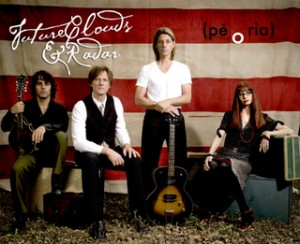
I have just learned that Cotton Mather leader Robert Harrison’s new band, Future Clouds and Radar, has a new album coming out next week, and that the American history references continue, albeit to a later period. Song #2 on Peoria is something called “Old Edmund Ruffin.” The rumor is that FC&R is doing a little tour through my environs (Columbia, Chicago, St. Louis & Louisville) week after next, so I look forward to asking Harrison how he came to name pop bands and songs after Puritan theologians and hyper-secessionist editors.
Future Clouds and Radar’s eponymous debut album from last year is also very much worth seeking out. An epic two-CD set, the best song on that collection (video below) also has some geek value. It’s “Build Havana” and appears to use Fidel Castro’s capital city as a metaphor for the sort of relationship that the singer would like to have: “Our love’s in currency that I can’t hold.” I think this metaphor might qualify Robert Harrison as a socialist under current rules, so John McCain might want to look into that. Most struggling indie rock bands do stand in need of some wealth-spreading.
This article originally appeared in issue 9.1 (October, 2008).
Jeffrey L. Pasley is associate professor of history at the University of Missouri and the author of “The Tyranny of Printers”: Newspaper Politics in the Early American Republic (2001), along with numerous articles and book chapters, most recently the entry on Philip Freneau in Greil Marcus’s forthcoming New Literary History of America. He is currently completing a book on the presidential election of 1796 for the University Press of Kansas and also writes the blog Publick Occurrences 2.0 for some Website called Common-place.
Fun with Political Geography
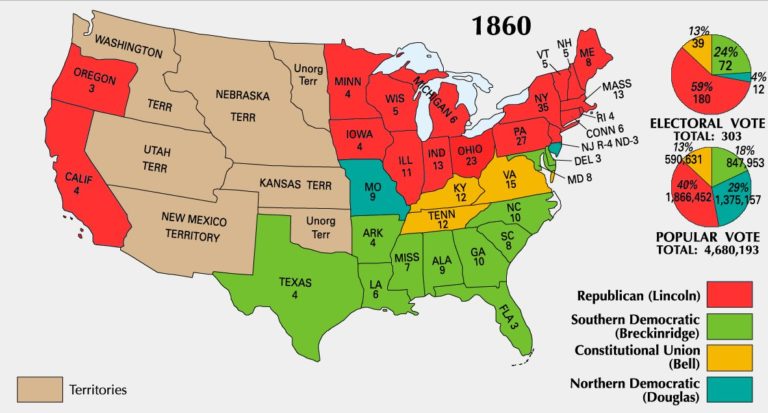
My students and I had fun discussing political geography today. For instance, take a look at these two maps side by side. First, we have the presidential electoral map from 1860, from the National Atlas of the United States:
Then we have this recent study, from Open Left, depicting how white men (the only ones eligible to vote in 1860) voted in 2008:
Now, obviously it would be very easy to overdraw an analysis from these two maps. And indeed, I think Open Left is a bit too Whiggish (despite trying not to be Whiggish) about the links between the expansion of voting rights and the election of Progressive presidential candidates–after all, the expanded electorate has certainly elected its share of conservative Presidents.
But it’s still pretty interesting.
This article originally appeared in issue 10.1 (October, 2009).
Jeffrey L. Pasley is associate professor of history at the University of Missouri and the author of “The Tyranny of Printers”: Newspaper Politics in the Early American Republic (2001), along with numerous articles and book chapters, most recently the entry on Philip Freneau in Greil Marcus’s forthcoming New Literary History of America. He is currently completing a book on the presidential election of 1796 for the University Press of Kansas and also writes the blog Publick Occurrences 2.0 for some Website called Common-place.
Reviving the Folk Revival
Bob Dylan couldn’t have put it better: the times they are a-changin’. Way back in the twentieth century, I did everything I could to get my friends—Washington lawyers, New York consultants—to listen to the old-time music. Having worked my way through the record shops and public libraries of Arlington, Virginia, and Calgary, Alberta, among other places, I was convinced that the next step in my own musical journey was not further study of the sacred texts, but evangelism pure and simple.
“Start with something easy, like Bill Monroe, the Stanley Brothers, or even Hank Williams,” I’d say, “Then on to the Carter Family, Dock Boggs, Alfred Karnes . . . here’s a tape I made you.” For all of my missionary zeal, though—the late-night taping, the clever juxtapositions between Georgia string bands and Western swing—it never worked. “Thanks,” they’d offer with a weak smile, filing my musical tracts away under the passenger seat of the Volvo or above the vacuum cleaner in the hall closet. I began to give up.
And then, something happened. “I’m flying to New York tomorrow—can’t miss the O Brother concert!” The soundtracks to my peers’ lives suddenly changed. Where there had been Mingus and Coltrane, there now were Sara, Maybelle, and A. P. Carter. Where there was Beck, Blur, and Hole, now there was Ralph Stanley. One day I even heard Alan Lomax’s Sounds of the South, recorded in the field in 1959, playing in the supermarket. It turned out to be Moby, but I still could not believe my ears.
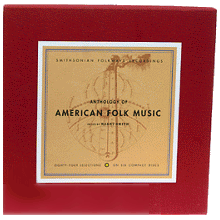
As an enthusiast, I was pleased and astonished that everyone had suddenly decided to join my cult. As a historian, however, I was not that surprised. The folk revival is, of course, nothing new. After all, Dylan himself was a product, in part, of a folk revival that, in the 1950s and ’60s, claimed one of the same roots of today’s revival: Harry Smith’s 1952 Anthology of American Folk Music.
Fig. 1. Anthology of American Folk Music, collected by Harry Smith, Washington: Smithsonian, 1952.
This six-volume set, originally released in 1952, was arguably the most important single influence on the music of the 1960s, shaping not only the folk revival but rock and roll, as well. As the liner notes to the edition released in 1997 by Smithsonian Folkways Recordings proudly advertise, several generations of musicians on the road to Damascus have been struck down by the Harry Smith Anthology, including Bob Dylan and Elvis Costello, and virtually every track on the set, with the exception of some of the more obscure religious and Cajun numbers, have been covered by acts ranging from Peggy Seeger to Nick Cave and the Bad Seeds to Taj Mahal to Huey Lewis and the News. Now, with its re-release, followed up more recently by Harry Smith’s elusive fourth volume on Revenant Records, the Anthology seems poised to spark another revival.
Why, then, does this music keep reappearing? What drives contemporary audiences to spend their money on re-releases, re-mixes and covers of songs recorded as early as the 1920s, and created in the nineteenth, eighteenth, and seventeenth centuries? What caused Smith, and other collectors like Lomax and Ruth Crawford Seeger, to devote years, decades, entire careers to capture and preserve these forms?
In part, the recurring taste for folk music has to be explained by a recurring desire in American culture: the desire to strip away the awful effects of consumer culture and return to a simpler, harder, more authentic time. From Thoreau in the mid-nineteenth century to Naomi Klein in our own day, this desire to rid ourselves of our Nikes, our Britneys, and our “gewgaws upon the mantelpiece” has been almost as constant as consumerism itself. Cultural Jeremiahs, there is a part of us that believes that we truly are doomed, and that only by getting back to our roots can we be saved.
This desire has certainly played a part in the apotheosis of folk music; it is the “Old, Weird America,” after all, that has most captivated listeners like Greil Marcus, perhaps the most famous critic of the Anthology. And it certainly motivated Smith and his revivalist allies. In contrast to the falsely sweet and oppressively conformist post-war consumer culture the revivalists perceived all around them, Smith’s Anthology, along with Crawford Seeger’s American Folk Songs for Children (1948) and Lomax’s Folk Songs of North America (1960), promised something strange, hard and true, and something that seemed to be disappearing.
Tellingly, the Anthology begins with Dick Justice’s “Henry Lee,” which Smith chose not because he liked it, but because it was the oldest example he had found of a Child ballad, named for the songs collected in Francis J. Child’s English and Scottish Popular Ballads (1882-98). By collecting these songs, then, Smith and his colleagues were not just saving the music of the past, but saving their audiences from the menace of “progress.”
What is a bit strange about all of this, however, is the fact that the musicians who recorded the tracks that Smith wished so fervently to preserve were themselves quite keen to sell themselves on the very market Smith despised. After all, all of the songs contained on the Anthology were originally set down in the boom years of commercial recording preceding the Great Depression, years that saw the emergence not only of a commercial industry in country music, but also in the blues. Justice himself left Logan County, West Virginia, in 1929 to record his songs in Chicago, presumably because he wished to strike it rich.
Like the “Soggy Bottom Boys” of the Coen Brothers’ film, who heard they could get a tenner for singing into a can, Justice and the legions of musical migrants who made the music that would end up on the Anthology did not think of themselves as vestigial remnants of a transplanted Elizabethan culture. As such, they represent not a dying past of homemade banjos, isolated rural communities, and weird murder ballads, but the integration of Appalachia into a nationalizing market and consumer culture. Indeed, if one looks at the songs Smith chose not to include on his anthology, such as Justice’s “Cocaine,” recorded in 1929, one begins to see that the “Old, Weird America” was a land of drug addiction, repossessed furniture, and interracial mixing—in other words, it was a lot more like the “Jazz Age” (and like the racially intermixed America Smith himself hoped for) than the disappearing past.
What should we make of today’s folk revival, then? It seems to me that today’s folk revival—the folk revival of Moby, who sampled Lomax’s ethnomusicological subjects into a collection of songs that would all end up as backing tracks for advertisements (and who, incidentally, didn’t pay any significant royalties to the original artists until Lomax’s family made him), and of O Brother Where Art Thou, whose genially grubby cast care as much about hair-care products as freedom—is in some ways more authentic than the “authenticity” promised by the Anthology. For while Smith and his cohort sought to erase the traces of the market from the music he found, in order to preserve a world before radio from the ravages of history, the performers he collected saw things very differently. Following in the footsteps of the murder balladeers before them (who were, after all, entrepreneurs), the musicians seem to have seen “traditional” music as just one of many choices in a range of options that included vaudeville, the radio, and the phonograph records that they consumed, as well as produced. For them, this was a good thing, not the beginning of the end. So, go out then, and listen to the music, and keep Smith’s dream alive. But remember, the “Old, Weird America” isn’t as weird as it seems.
Further Reading:
See Bruce Bastin, Red River Blues: The Blues Tradition in the Southeast (London, 1986); Ronald D. Eller, Miners, Millhands and Mountaineers: Industrialization of the Appalachian South, 1880-1930 (Knoxville, Tenn., 1982); Benjamin Filene, Romancing the Folk: Public Memory and American Roots Music (Chapel Hill, 2000); Bill Malone, Country Music U. S. A.: A Fifty Year History (Austin, 1968); Richard Peterson, Creating Country Music: Fabricating Authenticity (Chicago, 1997); David Whisnant, All That Is Native and Fine: The Politics of Culture in an American Region (Chapel Hill, 1983). For a broad sample of twentieth-century American folk on the Web, see the Library of Congress’s American Memory Performing Arts Collection especially, The John and Ruby Lomax 1939 Southern States Recording Trip. CDs mentioned: Various Artists, Anthology of American Folk Music (Smithsonian Folkways 40090, 1997, $79); Various Artists, Anthology Of American Folk Music Volume 4 (Revenant Records, 2000, $31.98).
This article originally appeared in issue 3.2 (January, 2003).
JoAnne Mancini is lecturer in American studies at the University of Sussex, in Brighton, England. She is the author of essays in Critical Inquiry and American Quarterly and a forthcoming book on the emergence of visual modernism in the United States. She is currently writing a book called “The Global Anthology: Country, Folk and World Music and the American Response to Modernity.”
The World in a Grain of Sand: Archival research in Dominica
“Notes and papers are in disarray,” noted the clerk of Dominica’s House of Assembly in January 1791, “making it difficult–if not impossible–to accurately manage the island’s business.” Heat and humidity had wreaked havoc on governmental paper trails, with “storms and hurricanes destroying whole sets of documents,” while “seasonal rains and insects eat away at what remains.” Complicating matters further, Dominica, a small eastern Caribbean island, had changed hands between Britain and France no fewer than four times before 1791. To combat these “erosions of important colony and government papers,” House committee members proposed that “a sum be immediately set aside to provide suitable archival accommodation.” In 2004, the National Archives of Dominica still waits for that recommendation to be implemented.
Most North American archives and libraries face problems of funding, conservation, and access, but–while not minimizing the obstacles U.S. institutions face–their problems pale in comparison to those of their West Indian counterparts. Small, often government-dependent organizations, many Caribbean archives remain unknown and unused by regional and overseas scholars. K. E. Ingram’s Manuscript Sources for the History of the West Indies provides the best overview of the region’s research resources, and is invaluable for scholars looking beyond the Public Records Office in their study of the British Caribbean, but his survey has limits. Ingram’s directorship of the West Indies Special Collections at the University of the West Indies, Mona, Jamaica, enabled him to scour that island’s archives and records thoroughly, and subsequent editions have added important information about Barbadian and Trinidadian archives, as well as Caribbean research materials in North America, Britain, New Zealand, and South Africa. But Ingram’s compendium only scratches the surface of what survives elsewhere in the West Indies.
Fig. 1. Renita Charles outside the National Archives of Dominica, Roseau. Photograph by the author.
My dissertation uses the history of coffee–its cultivation, trade, and consumption–as a means for exploring the social, economic, and political relationships between North America and the Caribbean in the late eighteenth and early nineteenth centuries. Ingram’s volume was invaluable during my nine months of research in Jamaica two years ago, but of little use for planning my two weeks in Dominica this past April. Instead, I disembarked on the island a blank slate and spent my first day in Dominica getting the lay of the land, with periodic calls to one Lennox Honychurch, a man everyone in Dominica–from the guesthouse staff, to the local diner waitress, to the museum curator–said would be able to tell me everything I wanted to know about Dominica and the National Archives. Honychurch, who served in Dominica’s House of Assembly from 1975 to 1979 and assisted in negotiations for the island’s independence from Britain in 1978, was educated in Dominica, Barbados, and Oxford, and currently serves on the faculty of the University of the West Indies School for Continuing Studies in Dominica. When I finally tracked him down, my first question was, “Where in the world is Dominica’s National Archive?” This is a harder question than it might seem, for while most Dominicans knew of Honychurch, most scratched their heads when asked about the archive. Some were unaware they had an archive. I could not find it listed in the telephone directory, there is no sign above the door proclaiming “National Archives,” or even “archive,” or even a street number, for that matter. Honychurch told me to look for a small, white, one-room building on Independence Street, with an orange-tiled roof, across from the adult shoe store (as opposed to the children’s shoe store, which is one block west).
The archive does not have an online or printed catalogue, which is probably why its visitors’ sign-in book has so few entries. More the pity, since it is one of those rare places with a collection broad enough to cater to a wealth of interests, and yet manageable enough to really work through. Those interested in colonial governance might look at the Laws of Dominica (1775-1841), Minutes of the Privy Council (1775-1892), Minutes of the House of Assembly (1787-1892), as well as correspondence from past island governors and London agents. Scholars of plantation agriculture or land use could examine Grants, Conveyances, Leases, Mortgages (1763-1843) for all island parishes, and the Book of Wills (1774-97, partial). Information about enslaved laborers and manumissions is available in the Register of Slave Returns (1817-1831), triannual reports of all enslaved laborers by name, occupation, age, sale, relocation, births, or deaths, as well as the Register of Manumissions (1794-96). Finally, Dominica’s strategic position between two French islands, both as a military outpost and as a potential smuggling hub, is traceable in the records of the Court of Vice Admiralty (1792-1838). An in-house list of collections can get you started, but your best asset is archivist Renita Charles, who diligently wades through boxes of materials arranged on industrial steel shelves in the one-room building (unlike most archives, there are no mysterious trips to behind-the-scenes rooms of stored materials; Dominica’s historic documents collection is all there in the room with you, along with one desk occupied by Ms. Charles and a second for visiting scholars).
Fig. 2. Clouds Bar, Point Michel, Dominica. Photograph by the author.
The archive, however, is just one of Dominica’s research opportunities. At the end of my first week, I offered Ms. Charles a ride home. She lives about six miles south of Roseau in Point Michel. The car ride not only let me repay the enormous debt I had been accruing by monopolizing her time each day, but gave her a chance to talk about her country, her job, and her hopes for future training (as I write, Ms. Charles is participating in an archival training and certification program for six weeks in Belize). As further proof of my thanks, I invited Ms. Charles to join me for a rum punch and we retired to the Clouds Bar where I met the owner, Ms. Melvina Boyer.
Ms. Boyer is not a historian, but she is an important member of her community and likes to make visitors feel welcome. After a bit of small talk, Ms. Boyer asked what I was studying. When I mentioned coffee, she turned to Ms. Charles and asked if I had met any of the older men in town. Coffee is a dying industry in Dominica; it has been in decline for some time, superseded by sugar and then limes by the mid-nineteenth century. But farmers continue to grow it even today, on the same plots of land, with the same estate names, as those found in eighteenth-century accounts. Most have shifted from arabica to robusta beans, but a few older trees can still be found scattered around. We finished our drink, said our thanks, and departed, but instead of walking back to the car, Ms. Charles continued two more blocks, explaining that Mr. Toussaint, who now specialized in root vegetables and donkey manure, used to plant coffee and might be willing to tell me what he knew. This was how, at eight o’clock at night, we were knocking unbidden on his door. Toussaint was happy to help, but since he did not have a car I would have to drive to his farm, five miles up the mountain road. He asked me to come back in the morning. “Be sure,” he admonished, “to bring transport with 4 x 4.”
Fig. 3. Mr. Toussaint on his farm above Point Michel, Dominica. Photograph by the author.
True to his word, Mr. Toussaint was waiting when I arrived in a jeep the following morning. Dominica is only twenty-nine miles long and sixteen miles wide. What most guide books fail to tell you, however, is that Dominica, the most mountainous island in the Caribbean, is about fifty miles of vertically sheer cliffs high–or at least that is how it feels on the back roads of the island interior. As recently as five years ago, Mr. Toussaint, now eighty-six, grew coffee for profit, selling his beans to the Dominica-based Bellot P.W. & Co. Ltd. for roasting and grinding. But while some Caribbean countries’ specialty coffee markets have been revitalized–notably Jamaica’s and Puerto Rico’s, and on a much smaller scale Haiti’s–Dominica’s has continued to decline. The income from a pound of beans, Mr. Toussaint lamented, is no longer worth the labor he would employ to pick it. As a result, Toussaint has let his trees go feral. Instead of being topped at five or six feet–the comfortable height for picking coffee cherries–his now tower over ten feet high, and the air is sweet from the fermenting berries that litter the ground around them.
He showed me the outlines of the stone walls that formerly marked the entrance to this eighteenth-century estate, and the cisterns for catching rainwater. In addition to being the most mountainous, Dominica also boasts a higher rainfall and more rivers than any other Caribbean island. These precipitation levels, along with high elevations, made it ideal for coffee cultivation in the first place. Records of Toussaint’s farm, formerly part of Morne Rouge Estate, show it was a thriving coffee plantation in the early nineteenth century. The Register of Slave Returns list sixty-nine slaves, thirty-eight male and thirty-one female, working the property in 1817. Twenty-four laborers are listed as Africans, and forty-five as creole. At that time, Morne Rouge was owned by Jean Louis Bellot, ancestor of the founders of today’s Bellot Company, and was a sizable estate in a colony where most coffee farms averaged fewer than thirty slaves.
Fig. 4. Bois Cotlette near Soufriere, pictured here in 1905, is one of the oldest surviving coffee farms in the Caribbean. Private collection of Michael Didier.
Thanking Mr. Toussaint for his time, and for the enormous bag of carrots, callaloo (similar to spinach), tania, and dasheen (both root vegetables like yams) that he had harvested and pressed into my hands, I took him back down the hill and headed off for Bois Cotlette Estate, another former coffee plantation located in St. Mark’s Parish. Bois Cotlette is the pride and joy of Mr. Michael Didier, who is painstakingly restoring the plantation. The house has been in the Didier family for generations, and was still used as the family home by his grandfather, pictured here with his wife and children in front of the house in 1905. Two generations of neglect, however, have given the surrounding rain forest more than enough time to reclaim the land. To date, Mr. Didier has restored the animal-powered pulping mill and stabilized the exterior of the main house. The remains of a small windmill still stand among the trees, as do the boiling pots and kettles that provide evidence of small-scale sugar production.
Bois Cotlette also appears in the Register of Slave Returns in 1817 with seventy-eight slaves. In 1823, however, the owner, Charles Port, died, and Jean Baptiste Dupigney, manager of Bellot’s Morne Rouge Estate, purchased the property. Dupigney could afford the land, but not the maintenance of so large a labor force. To help finance the debt he acquired buying Bois Cotlette, he sold the majority of the estate’s slaves by 1826, reducing the number of enslaved laborers to twenty. He continued to grow limited amounts of coffee, however, and retained two skilled slaves–a carpenter and a cooper–to construct the hogsheads and barrels needed to ship his much diminished crop to port.
It is one thing to read about the place or track down published and manuscript sources of its history in metropolitan repositories. It is quite something else to see Dominica on the ground. On a map, the distance from Toussaint’s coffee farm or Bois Cotlette to Soufriere Bay, the nearest port town, is less than five miles. The journey–even by car–takes over an hour. Imagine the same distance on foot or by mule two hundred years ago.
Fig. 5. Bois Cotlette, May 2004. Photograph by the author.
This began as an essay on the riches of Dominica’s National Archives, but it is difficult to separate what survives on paper with what exists on the island. Dominica, like many Caribbean nations, bears the imprint of its plantation and slave-dependent past in ways that are difficult to fathom in North America. It is a place where history lives, not in reconstructed villages or museums, but in the names and places that still dot the landscape, and in crumbling coffee farm houses and outbuildings threatened more by the encroaching wilderness than by developmental sprawl. It is a place of pride and generosity, and it returns more than the cost of an airline ticket. I look forward to returning as soon and as often as I can.
The National Archive is part of Dominica’s National Documentation Center and Public Library, Victoria Street, Roseau, Dominica Commonwealth.
Telephone: (767) 448-2401 ext. 3093
Fax: (767) 448-7928
Email: publiclibrary@cwdom.dm; library@cwdom.dm
Further Reading:
K. E. Ingram, Manuscript Sources for the History of the West Indies: With Special Reference to Jamaica in the National Library of Jamaica and Supplementary Sources in the West Indies, North America, and United Kingdom and Elsewhere (Barbados, 2000), and Sources of Jamaican History, 1655-1838: A Bibliographical Survey with Particular Reference to Manuscript Sources (Zug, 1976). For a less up-to-date volume that moves beyond Jamaica, Barbados, and Trinidad, see Edward Cecil Baker, A Guide to the Records of the Leeward Islands (Oxford, 1965), and A Guide to the Records of the Windward Islands (Oxford, 1968). For the history of Dominica, see Thomas Atwood, The History of the Island of Dominica: Containing a Description of its Situation, Extent, Climate, Rivers, Mountains, Natural Productions, & c. (London, 1791, reprinted, London, 1971); Lennox Honychurch, The Dominica Story: A History of the Island (Oxford, 1975, reprinted 1984); Michel-Rolph Troillot, Peasants and Capital: Dominica in the World Economy (Baltimore, 1988). For the history of coffee in Dominica and the Lesser Antilles, see Michel-Rolph Troillot, “Coffee Planters and Coffee Slaves in the Antilles: The Impact of a Secondary Commodity,” in Ira Berlin and Philip D. Morgan, eds., Cultivation and Culture: Labor and the Shaping of Slave Life in the Americas (Charlottesville, 1993); B.W. Higman, Slave Populations of the British Caribbean, 1807-1834 (Baltimore, 1984); and Simon Smith, “Accounting for Taste: British Coffee Consumption in Historical Perspective,” Journal of Interdisciplinary History (Autumn, 1996): 183-214.
The author would like to thank Roderick McDonald, both for accompanying her on this research trip and for drawing her attention to the 1791 quotation about the disarray of Dominica’s state papers.
This article originally appeared in issue 5.1 (October, 2004).
Michelle L. Craig is a doctoral candidate in the department of history, University of Michigan where she is completing her dissertation entitled “From Cultivation to Cup: How Coffee Shaped the Atlantic World, 1765-1812.” She has conducted research in Jamaica, Dominica, the Bahamas, and Puerto Rico, as well as England and the United States.