The Prospect and Challenges of Rewriting the History of the American Revolution
Every revolution is a civil war. But the American Revolution was peculiar, because it has been deemed a civil war in so many senses. A civil war within the British Empire between English people on both sides of the ocean. A civil war in the colonies between the Patriots and the Loyalists. A civil war among the Patriots to determine “who shall rule at home.” And now, in the new scholarship, a civil war between Americans who chose sides and those who refused to choose sides unless and until they were forced to do so. It is this last sort of civil war that has long escaped the sight of historians.
As Hannah Arendt remarked, revolutions in modern times have usually been related to war, and war has usually released violence destructive not only of life and property but also of social relations and psychological stability. For those not voluntarily involved in such civil strife, the devastation might have been especially severe and hazardous. For them, the very meaning of the Revolution might not have been what it was for partisans on either side.
These presentations reinforce our belief that “the transforming hand of revolution” did indeed transform many things. We are always told that the Revolution promoted changes in the political structure and the social order, lifting some prominent people to historical positions and crowning them “Founding Fathers.” These papers tell us that the Revolution also altered and remolded the lives of tens of thousands of ordinary Americans and that many of them were distressed, frustrated, and even forced into exile during the war. The Revolution created divisions, tensions, and resentments in families and communities across the continent. The consequences of these conflicts left imprints on the social fabric that await exploration and explanation. In other words, the legacies of the movement for independence were much more complicated and diversified than we used to imagine.
While reflecting on such matters, I cannot help thinking about the historiography of the Chinese revolutions of the twentieth century. It is well known that China went through a number of uprisings and revolutions in the past hundred years. Those rebellions were genuine civil wars, which had a profound impact on the lives and the social relations of hundreds of millions of people. Chinese historians have only recently begun to touch such topics: the experience of ordinary Manchu people after the Qing dynasty was overthrown in the revolution of 1911, the attitudes of peasants toward the land reforms of the 1940s and 1950s, the tribulations of anti-revolutionaries after the revolutionary Party’s takeover of China in 1949. And this new research has not yet been incorporated into the mainstream of the scholarship on the Chinese revolutions.
My impression is that the turn of attention to the uncommitted not only provides new and different lenses to see the meaning of the American Revolution but also indicates possibilities of rewriting its history. The past is often portrayed in ways that celebrate the victors, and we are all familiar with versions of history that function as propaganda for those who hold power. If we focus on the disaffected, the neutrals, the losers, and all those others who were “in but not of the Revolution,” and if we reveal the destructive effects of a constructive rebellion, we may deconstruct some of the many myths that have enveloped the struggle and achieve a more balanced and nuanced picture of it.
Nonetheless, I think there are great challenges in this kind of rewriting. First, our understanding of the past is restricted primarily by survivals from the past. If there are not good sources, there are not good histories. The scarcity of evidence pertaining to commoners in the Revolution may entice us to say more on the basis of less. Even if we unearth some individuals for whom there are substantial records, we may still have difficulties reading the meaning of their lives in wider social and historical contexts.
Second, it is unclear how to encompass ordinary Americans and the founding elite in the same framework of interpretation. Were these groups always antagonistic in the Revolution? Were the elites always the less moral ones when they were in conflict with commoners? The leaders of the rebellion surely had aspirations, disillusionments, anxieties, and fears that were different from those of the lower and middling ranks, but the difference was not necessarily to their disadvantage. When Daniel Shays and his fellows mounted their protests in western Massachusetts, their primary concern was probably their own distress in the aftermath of the winning of the war. When the framers gathered in Philadelphia in 1787 to deliberate on a new form of government for the United States, they probably cherished their own interests too. But the men who met in that constitutional convention were also aware that their newborn nation had come to a complicated and dangerous pass, and they believed they had a duty to steer it safely through. The result of their assumption of such a mission turned out to be somewhat constructive for the young republic in terms of political order, socio-economic development, and national security. An empathic understanding of those Revolutionary leaders is still meaningful and significant.
Last, there are methodological factors that do matter. In dealing with the personal, social, and psychological dimensions of the Revolution, we may need to employ a variety of approaches and perspectives, such as those of social history and the new cultural history. In any case, we need to think about the overlaps and differences in the history of the American Revolution and the history of revolutionary America. We need to ask some basic questions: What was the American Revolution? What is the American Revolution now? What are the bounds, if any, of the American Revolution? Whose experiences must be incorporated into narratives of the American Revolution? And in all of this, we need to be careful. If we extend the reach of the Revolution too far, we risk fragmenting it or imposing on it a burden beyond its power to bear.
This article originally appeared in issue 14.3 (Spring, 2014).
Li Jianming is a professor of history at Peking University.
Salem Repossessed
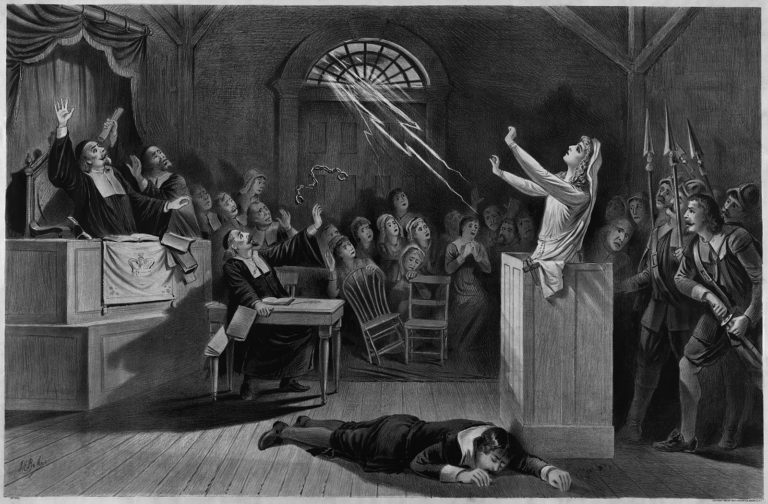
The typo in the Playbill did not bode well. According to the program, the action of The Crucible begins “in the spring of the year 1792.” Clearly, uncovering the real history of the 1692 Salem witch trials was not a high priority. Like all productions of the play since its premier in 1953, director Richard Eyre’s Crucible, just opened on Broadway, tells us much more about its own time than about colonial America. That strange mixture of timelessness and timeliness is the play’s greatest strength, and, paradoxically, its greatest weakness. It’s always relevant, but always just a little bit trite.
Most Americans learn what they know about the Salem witch trials from high school readings of Arthur Miller’s most famous play. All things considered, this is really too bad. Miller’s Salem–an indictment of McCarthy’s red baiting–is a far cry from the world Cotton Mather knew. A large part of the audience during the preview performance on February 28 was teenagers, including a whole row of students clearly there on school assignment. For these students, as for many college undergraduates, Salem will be forever the story of a young, virile John Proctor (the real man was in his sixties), a seductive adolescent Abigail Williams (who was only eleven at the time of the trials), and a scheme by unscrupulous townspeople to steal land from their neighbors. Most importantly, The Crucible is what most of these readers and theater-goers will associate with the phrase “witch hunt,” whether describing historical events or the rounding up of al Qaeda suspects.
Fig. 1. Laura Linney and Liam Neeson. Illustration by John McCoy.
Eyre’s production, at the Virginia Theatre, first announces its interpretation of witch-hunting through its sets. Tim Hetley’s set design and Paul Gallo’s lighting present us with stark, bare rooms, illuminated from above with streaks and bars of light. The effect manages to suggest at once a church and a prison, a combination that reflects prevailing popular opinion about the Salem trials: that they were a product of an oppressive religion mixed with unyielding government authority. This is in fact the interpretation that Miller himself put forward in his notes on the script: that the trials were about the power of “theocracy” in New England.
Eyre presses this point too far. When Tituba (Patrice Johnson), the Reverend Samuel Parris’s West Indian slave, is accused of witchcraft in the first act, she quickly confesses, with Parris egging her on. Eyre plays this scene like a televangelist revival meeting, with Tituba waving her hands above her head and chanting her lines in a near-parody of Southern Baptist singsong. One almost expects Parris (Christopher Evan Welch) to turn to the audience and ask for donations or for Tammy Faye to enter, stage right. Eyre’s attempt to modernize the magico-religious worldview of seventeenth-century Calvinists falls flat, and inspired little more than laughter from the audience.
Indeed, the full hall at the Virginia Theatre snickered every time God, the Devil, or magic was mentioned. For a New York theater-going audience the notion that such ideas could carry intellectual and emotional weight seemed ludicrous. They even tittered during a scene in which the possessed girls turn on one of their own–one of the most terrifying moments in the play.
And yet the audience was drawn into the play’s world. The other half of theocracy’s power, the power of unrestrained legal authority, is something Americans–especially those who’ve sat through a few too many Oliver Stone movies–can easily comprehend. Eyre makes the law’s abusive power the emotional center of the production. He presents John Proctor (Liam Neeson) not as a man brought down by sexual indiscretion with a scheming woman, Abigail Williams, but as Everyman caught in a Kafkaesque legal system.
One disadvantage of this approach is that Abigail (Angela Bettis) becomes a mere device to set the action in motion. This may explain why Bettis’s performance seemed uninspired. Despite her vixenish beauty, there is little sexual spark between her and Neeson. Bettis’s speeches about the hypocrisy of Salem’s “Christian women and covenanted men” are delivered dutifully, without the seething resentment that the script suggests. Even Abigail’s best scene–where she turns on her former ally Mary Warren in order to discredit Warren’s recantation–plays here like the revenge of a junior high alpha girl. Similarly, Laura Linney’s Elizabeth Proctor fades into the background. Her character seems truly to be little more than, in Abigail’s words “a cold sniveling woman.”
Since putting the law at the center of the play pushes the female characters to the margins, it is doubly important that the male leads capture the audience’s imagination. And they do. Neeson portrays John Proctor as a man whose independence and simple moral code tragically bring about his downfall, a portrayal well suited to Neeson’s physicality: his broad shouldered physique and bluntly handsome face fit Proctor’s earthy personality. The director takes advantage of this asset by having Proctor strip to the waist and vigorously splash himself with water on his return from the fields. The scene serves to distance Proctor from the (unearned) stereotype of the “Puritan”–a sexless, repressed human being who is a hypocrite at heart. As Proctor splutters and stamps, suddenly Abigail’s description of him as a “stallion” rings true, and not just the sexual connotation. This is a man who will take action without giving much thought to possible consequences.
Proctor’s main adversary is the steely Deputy Governor Danforth (Brian Murray). Danforth’s faith sustains him and gives him moral certainty even as innocents go to the gallows. In this spirit, he delivers what may be the most chilling speech in the play, expounding upon the necessity for relying on spectral evidence in cases of witchcraft, with reasoning that is in fact very close to seventeenth-century thinking on the matter: “Witchcraft is ipso facto, on its face, an invisible crime, is it not? Therefore who may possibly be witness to it?” Murray delivers these lines with a cold conviction and unctuous reasonableness that brooks no disagreement.
Proctor finds himself caught in this nightmare logic. When he tries to disprove the unprovable, he himself is accused. In the end, it is Proctor’s virtue that is his tragic flaw, ably embodied by Neeson. Clenching and unclenching his fists, Neeson’s decision to die rather than give a false confession seems wrung from him against his will–but once he makes it, he walks offstage to the gallows with the same bullheaded determination that characterizes his entire performance. And here, at last, the audience was won. The same crowd that laughed at God and the Devil sat rapt as Proctor made his moral choice (and greeted Neeson with a standing ovation at his curtain call).
Historians as well as artists, over the years, have offered more than a few interpretations of what really happened in Salem in 1692. But the use and abuse of power lies at the heart of all of them. What kind of power is abused is a sign of the times. Most recently, a 1996 Hollywood film starring Daniel Day Lewis and Winona Ryder presented the witch trials as a parable about sexual harassment (of Proctor by Williams, in a sort of seventeenth-century version of Fatal Attraction.) The current Broadway production focuses squarely on how fear of hidden evils can lead to abuses of the law, blindly supported by an unthinking public. History may have been the last thing on the audience’s mind in New York in this year of tragedy, but, in the end, they could not help but be profoundly moved by a Crucible that plays like a cautionary tale about the loss of civil liberties.
This article originally appeared in issue 2.3 (April, 2002).
Rebecca Tannenbaum is visiting assistant professor of history at Yale University and the author of the forthcoming Healer’s Calling.
An Outlaw and Her Ghost Writer: Enigmas of female celebrity in early America
Historians are often lucky in their sources. My dissertation, for example, focused on the lives of four women, all of whom had extensive letter collections or diaries, or both. Whatever difficulties I may have had with my dissertation’s argument, or structure, I was not at a loss for primary material. I knew the reading habits, political interests, and social engagements of my subjects. I even knew what they ate and how well they slept at night. I have subsequently discovered, however, that other historical characters left no paper trail to follow, or worse, one that is elusive, uninformative, or downright misleading. Yet these can be the most interesting people of all, and the lack of sources is tantalizing and frustrating. I am now in just such a predicament.
A few years ago I was seduced by the story of a woman who tried to kidnap the governor of Pennsylvania in 1816. The reason you probably have not heard of Ann Carson is because she did not succeed in her attempt. But she didleave a memoir in which she explained the circumstances of her plan and her subsequent criminal activities. Foolishly, I was overjoyed at the prospect of such an abundance of riches. The History of the Celebrated Mrs. Ann Carson (1822) is a two-hundred-page tell-all tale of love, lust, murder, and criminal daring. Yet this seemingly transparent memoir is about as clear as mud when it comes to inconsequential details like names, dates, and actual events. So the real work then began. Each of Carson’s crimes needed substantiation in legal records, newspapers, census records, and city directories. With a great deal of help from my then co-author Susan Klepp, who introduced me to the memoir, we corroborated almost all of Carson’s activities. We also discovered that trial transcripts existed for three of Carson’s four trials. We found evidence of what she did, and, because of the memoir, we had Carson’s interpretation of events. And such a nice juicy story!
I thought I had been lucky in my sources once again, until Susan and I learned that Carson did not write her memoir. She had a ghost writer named Mary Clark Carr. Nine years after Carson’s death, this Mary Carr published a much expanded second edition of Carson’s biography, with a new title, The Memoirs of the Celebrated and Beautiful Mrs. Ann Carson (1838). Only this time, she revealed herself to be the true author of the History, and she told her side of the story for the first time. Here Carr, not Carson, is the heroine of the piece. Mary Carr explains to her readers the true nature of her relationship with the self-styled “beautiful and celebrated” Ann Carson, including the fact that Carson continued to associate with “gentlemen of the black cloth” while living with Carr. And after relying on Mary Carr for room, board, and authorship, Carson betrayed Carr’s trust by stealing her furniture and the unsold copies of the History. The Memoirs offers an intriguing glimpse into the life of this literary ambulance chaser–a woman who walked a fine line between respectability and notoriety. Mary Clark Carr, it turns out, is even more interesting than Ann Carson. Anyone with a gun and a few friends can kidnap a governor, but how many women in the early republic had the talent, initiative, and opportunity to earn their living by writing?
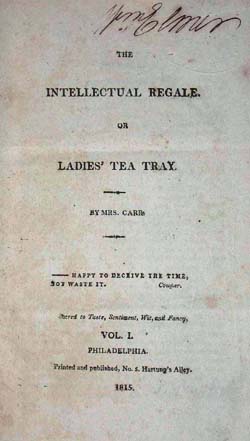
Fig. 1. Title page of Mary Clark Carr’s, Intellectual Regale, or Ladies’ Tea Tray (Philadelphia, 1815). Courtesy of the American Antiquarian Society.
But unfortunately Carr has been much harder to track down. If the History revealed every nook and cranny of Carson’s loves, hates, sexual encounters, and criminal exploits (she was a self-promoter extraordinaire), Mary Carr did her best to keep her private life private–except when she had some reason to do otherwise. And even when she did share facts about herself, they are partial, undated, and unsubstantiated.
I have been completely unsuccessful in uncovering any vital statistics for Carr. She claims to have first met Carson when the two attended confirmation classes under Bishop White at Christ Church (Carson was born in 1785 so I assume this would have been sometime in the 1790s). But no records of a Mary Clark (or any other Marys of the right age) exist. Carr also claimed that her husband died about the same time as Carson’s second husband, Richard Smith, in the summer of 1816. There are no death records for any male named Carr at that time. Mary Carr publicly expressed her wish to be buried where Benjamin Franklin was laid to rest in Christ Church burial ground. But again, the burial records list no Mary Carr. I know only what Carr was willing to reveal.
I soon discovered that Carr wrote other books, and they offer further tantalizing hints about her life. To begin with, Carson probably chose Carr to write the History because Carson knew Carr as the editor of the Intellectual Regale, or Ladies Tea-Tray, a short-lived women’s magazine. In December 1814, Carr announced in a Philadelphia newspaper, the United States Gazette, her proposal for “a Weekly Miscellaneous Paper.” Carr made her motives for undertaking such a risky venture clear: “A Mother will brave death for the support of her children, and she has five who look up to her for support and protection; and by patronizing this work each subscriber will contribute their mite towards assisting her with her family.” Her husband, alive at the time, was never mentioned.
The Tea Tray is unremarkable in its content (F. L. Mott did not even list it in his chronology of magazines). But it is noteworthy for what it reveals about Carr’s business and domestic affairs. Carr inserted frequent comments, apologies, and announcements in the magazine. Almost every issue mentions the difficulties she faced. For instance, Carr relocated her home and the Tea-Tray office in 1815 when she could not pay her rent. She then notified contributors that “in the confusion of moving, several communications have been lost.” A notice in a June 1815 issue reads, “We have to beg pardon from Miss E. B. and our friend S. for not presenting theirs earlier: but they unfortunately fell behind a bureau, from whence they were this week rescued.” Two weeks later another note states, “The editress is mortified to be obliged to present Edgar’s answer to William imperfect. But a part of the copy was carried out of the window by the wind, and was not missed till too late to be replaced.” We can imagine Carr’s household, with five small children and a distracted mother, as untidy, noisy, and disorganized. Unfortunately this information, which delights the modern historian with its peek into the quotidian disarray of Carr’s existence, probably drove away subscribers. The Tea-Tray ended in December 1816, after struggling along, without sufficient funding, for two years.
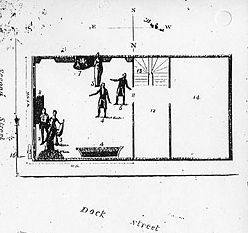
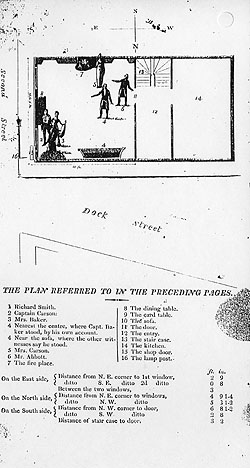
Fig. 2. A diagram from The Trials of Richard Smith (Philadelphia, 1816). Courtesy of the author.
But what happened between the time the Tea-Tray folded in 1816 and Carr agreed to write Carson’s memoir in 1822? The Memoirshints that Carr published poems and songs. But none seem to have survived. More intriguing still, Carr was a hanger-on in the theatrical world. In addition to The Intellectual Regale, or Ladies Tea-Tray, the History, and the Memoirs, Carr authored several plays (one, TheFair Americans, was performed in Philadelphia in 1815) and two theatrical biographies.
In 1837 Carr published The History of Edwin Forrest.A year later A Concise History of the Life and Amours of Thomas S. Hamblin appeared. Carr included autobiographical details in the biographies to lend authenticity to her version of the lives of these famous (and in the case of Hamblin, infamous) men. For instance, Carr claimed a friendship with Forrest’s brother, William, and based most of what she related in the biography on conversations with him “in the green room of the Chatham Street [New York] theater.” Carr admitted that she had only a nodding acquaintance with Edwin Forrest. What is remarkable, frustrating, and tantalizing is that Carr says she gave the youthful Edwin Forrest “free admission to the theatre of which I was then manager.” Furthermore, she claims he partly owed his professional success to the reviews Carr wrote of his performances, “on his first coming into New York.” Carr managed a Philadelphia theater? Carr wrote theatrical reviews in New York? According to secondary sources, no Philadelphia theaters (there were only a handful) were managed by Carr or by any other woman in the second decade of the nineteenth century. Nor have I been able to find any reviews in her name, unsurprising since many reviews were anonymous. Was Carr lying? I can only assume that there were enough people who could have verified or denied her claims to make it unlikely that she would have fabricated this story.
There is further autobiographical material in Carr’s biography of Thomas Hamblin. Carr wrote it, she says, to expose to the world his greed and immorality, and to show how he had wronged his former wife, actress Elizabeth Blanchard. There may also have been an element of spite in its production: Carr says that Hamblin refused to stage her play The Fair Americans after telling her to her face that “he would be glad to see her prosper.” This biography was written, in large part, as a narrative dictated to Carr by Blanchard, with whom Carr became friends sometime after the Hamblins arrived in New York in 1825. The biography is engaging and salacious (among other things, Carr alleges that Hamblin procured many of his actresses from brothels). But it also hints at Carr’s activities after 1824, the last year chronicled in the Memoirs. In Hamblin’s biography, Carr recounts conversations she witnessed firsthand and confidences shared with her by William Forrest. She also claims that she “edited and published a dramatic paper in New York.” Which one? When? Again I have no evidence to confirm this.
Mary Carr seems to have moved back and forth between Philadelphia and New York, attending the theater and writing critical (and anonymous) reviews of many of the performers named in Hamblin’s biography. What happened to her remains a mystery. I do not know where she died. I do not even know when she died. Mary Carr is an intriguing woman: a pioneer for female authors, publishers, theatrical managers, and critics. But of course I only have her word for that.
This article originally appeared in issue 5.3 (April, 2005).
Susan Branson is associate professor of historical studies at the University of Texas at Dallas. Her book, Notorious by Design: Women, Crime, and Class in Nineteenth-Century America, forthcoming from the University of Pennsylvania Press, details the lives and experiences of Ann Carson and Mary Carr.
Introduction: Special Issue on Money
Money Matters
Money. It’s a constant preoccupation, whether anyone wants to admit it or not. People obsess about how to get it or daydream about what could be done with it: a new car, a meal at a fancy restaurant, a child’s college education. But most of us rarely stop to contemplate a larger question. What is money, really? Is it the change in your pocket, the bills in your purse, the vaporous flicker of a bank balance on a computer screen? Or is it something more substantial, like gold and silver?
One of the strangest incarnations of this ancient question has surfaced recently, in the development of real-life markets for virtual goods. Internet game players can go on eBay and pay real U.S. dollars for magic powers, enchanted weapons, or goblin gold—rare and precious items that exist only in the fantasy world of online gaming. This raises some peculiar questions. If your gaming alter ego defeats a dragon and wins a virtual pot of gold, do you have to pay income taxes on its market value? Will the IRS accept virtual gold as legal tender for the payment of taxes?
Odd as this may seem, virtual gold is only the latest permutation of a subject that has been a constant obsession in American history, from the founding of the first colonies to the present. If, as some historians argue, capitalism arrived with the first ships, so, too, did monetary experimentation, arguments about what money was, and debates about how it could legitimately be used. The experimentation was less a choice than a necessity: the first settlements were rich in promise but poor in precious metals. The imperial powers of Europe may have been awash in gold and silver from the mines of the New World, but their coins rarely lingered long in colonial coffers, thanks to imbalances in trade. The colonists necessarily developed what may seem (by today’s standards) a bewildering diversity of substitute currencies—everything from wampum to tobacco to gunpowder.
But it is an obsession with paper money that has distinguished American monetary history. Beginning with the first notes issued by a government in the Western world (the Massachusetts Bay Colony), through a war of independence underwritten with paper money (the Continental Dollar) and a similar experiment during the Civil War (the greenback), paper money has been a recurrent motif in the nation’s history. To many who watched these experiments unfold, the willingness to accept paper in place of coin seemed an act of alchemy, a radical reordering of value that substituted trust and confidence for “real,” intrinsic worth. Yet what once seemed like a sham has become the foundation of the money supply today. Absent a gold standard, faith in the fiscal prudence of the nation-state has become the basis of value.
Money is more than a medium of exchange or repository of value; it is also an incarnation of political sovereignty. Money, as we know it today, cannot exist without the formally defined political entities we have come to call nation-states. It is these that give money a value that transcends the particular qualities of money itself. But perhaps more importantly, without money there can be no nation-states. Few appendages of government do more to reinforce the power of the state than money. Hence, as early modern governments worked out their own meaning, the value, quantity, and reliability of their money were always central concerns. A state with a feeble or suspect money supply lacked the ability to enhance what John Brewer has called “the sinews of power”—overseas commerce, internal taxation, and military strength. Whether in seventeenth-century England, which witnessed an acrimonious debate over whether government could dictate the value of coin, or in the colonies, where assemblies claimed the right to print their own bills of credit, the story of money making has also been the story of nation making. Look at the audacious message of imperial ambition that adorned coins minted in Massachusetts. Examine the nationalist messages on Ben Franklin’s revolutionary currency, the dollar signs that first appeared in the 1790s, and the symbols of federal sovereignty that adorn the first legal tender notes. They all speak the language of sovereignty, and as these monies passed from hand to hand, they did more than facilitate exchange: they built—and rebuilt—a nation.
Yet if money is so often an emissary of sovereignty, it does not obey the boundaries set by sovereign powers. Silver from the mines of Potosi circulated in the colonies in the eighteenth century and in the United States in the nineteenth, where it remained legal tender until midcentury. Only after the discovery of gold in California and silver in bordering territories did the United States manage to mint substantial quantities of its own coin. A good argument can be made, in fact, that the federal government became truly sovereign—truly the superior governing power—only with these developments, for they allowed the government, really for the first time, a significant measure of control over money that circulated within its borders.
Things have come full circle since that time, with paper dollars competing with, if not supplanting, local currencies in countries as different as Canada and Ecuador. The mighty dollar has become the global currency of choice, a kind of monetary lingua franca that ties together disparate nations in a common circulation. The connection between money and sovereignty has grown so strong that now it is neither gold nor silver—what Mark Peterson calls “big money”—that has supreme value in the global market place. It is power, the same sovereign power that lay behind all those peculiar eighteenth-century symbols that adorn American currency.
The history of money, then, is about much, much more than the thing itself; it is about all the things that money has come to represent: power, value, wealth, etc. Indeed, to even think about money as a “thing,” as an object easily grasped and identified, is to conceive of it in terms too narrow. The history of money is also about processes of representation and documentation, whether in ledger books, balance sheets, or online bank accounts. In the endless business of monetary exchange, there inevitably arises a desire to measure wealth and fix value—to capture a sense of what someone or something is worth. But as anyone following the fortunes of the stock market, the federal government’s finances, or the housing market knows full well, these distillations of value are fleeting approximations. They are not so much a reflection of objective reality as an exercise in collective wish fulfillment. Money is a fickle beast; it does not sit still and can evaporate at a moment’s notice. Value means nothing unless it is translated into “real” money. And yet real money is no stable store of value. Whether greenbacks or gold, its value depends on the endless fluctuations of the now-global market.
There’s a history to all this, and for the most part, it is rarely told—which is not to say that historians have failed to appreciate economic forces; witness the scholarly fascination with the “market revolution” or the transition to capitalism in the early republic. But for all the attention to such massive economic shifts, the money that made those transformations possible has all too often escaped scrutiny. While economists have written extensively about money, they have done so as if it can be captured and described by the laws of physics. They write of quantity or velocity. The essays in this special issue of Common-place approach money from a somewhat different perspective. They treat it in a qualitative rather than a quantitative fashion, revisiting subjects that have been neglected, if not forgotten.
In so doing, these essays introduce a cast of characters both familiar and strange: money-lending Puritans, bills of credit that speak the language of satire, poetry-spouting bankers, and racist gold bugs with dreams of empire—to name but a few. As different as these stories may seem, all lead to a larger point: money does matter. We hope you agree.
This article originally appeared in issue 6.3 (April, 2006).
Stephen Mihm is assistant professor of history at the University of Georgia. He is the author of the forthcoming Making Money, Creating Confidence: Counterfeiting and Capitalism in the Nineteenth-Century United States (Harvard, 2007).
Mark Peterson teaches in the history department at the University of Iowa. He is the author of The Price of Redemption: The Spiritual Economy of Puritan New England (Stanford, 1997) and is at work on a book on Boston in the Atlantic World.
Have You Heard the News About the Silver Fleet?
The Dutch appetite for Spanish silver
It usually happens when the Dutch national soccer team is winning a game. Someone in the crowd begins to sing the opening lines of an old song:
Have you heard the news about the silver fleet,
The silver fleet from Spain?
They had lots of Spanish silver coins on board
And oranges as well.
Piet Hein, Piet Hein, Piet Hein, his name is short,
His deeds are big,
His deeds are big,
And he has captured the silver fleet.
Then the rest of the crowd chimes in, filling the stadium with the chant:
He has captured, has captured the silver fleet,
He has captured the silver fleet!
One of the few events of the seventeenth century that still arouses the Dutch imagination, the defeat of the Spanish fleet as it sailed from New Spain to Seville in 1628 epitomizes the seventeenth-century Dutch obsession with Spanish silver. To the Dutch, Spanish power in Europe was based on the seemingly endless supply of precious metals from the New World. The association of America with Spanish silver—or Spain with American silver—was accentuated during a “ceremony of possession” in the Strait of Magellan on August 25, 1599. Exhausted from protracted hardships, the six chief officers of a Dutch fleet decided to form the Brotherhood of the Unleashed Lion. They swore to each other that neither danger, necessity, nor fear of death would make them act to the prejudice of the fatherland. Their intention, they went on, had been to harm the “hereditary enemy” as much as possible, planting Dutch arms in the province—America—from where the Spanish king amassed the treasures that he used to sustain a lengthy war against the Netherlands.
In 1621, the Dutch government allowed a group of merchants to create the Dutch West India Company (WIC). The company’s main purpose was to coordinate Dutch mercantile activities in the Atlantic Basin. But the WIC had another, less obvious purpose: to serve the cause of Dutch patriots fighting for independence from Spain, the political and economic capital of the Habsburg Empire. The Estates General, the representative body that governed the revolting Dutch, concluded that the war against Spain would succeed only if extended to Spain’s American provinces. To this end, the WIC was charged with overseeing attacks on Spanish possessions in the Americas. It was necessary, wrote one of its directors, Johannes de Laet, to “cut off the nerves of the King of Spain’s annual income and the veins from the blood and the life-giving spirit spread in that large body [i.e., the Spanish empire].” The WIC therefore organized an expedition aimed at the conquest of Brazil’s capital city Bahia. Brazil was not a major source of silver, but the Portuguese colony—since 1580 Portugal had been part of the Habsburg Empire—was the world’s largest producer of sugar, a commodity almost as valuable as silver. In May 1624, a Dutch fleet caught the Portuguese defenders by surprise, and the Dutch became masters of the city, only to lose control again the next year. Brief as it was, this interlude further whetted the Dutch appetite for precious metals. In October 1624, many Dutch officers made off with gold, jewels, silver specie, and bullion after a richly laden Iberian fleet, on its way to Spain, unsuspectingly put into Bahia. The silver alone weighed two hundred and fifty thousand pounds.
Some American silver ended up in the hands of the ubiquitous Dutch privateers, or government-sanctioned pirates. Privateering had been the West India Company’s main activity in its start-up years, but the major commodity seized was sugar, not precious metals. The lure of silver remained, however. For years on end, the Dutch studied the movements in the West Indies of the flotas and galeones—the shipping fleets that formed the lifeline of Spain’s Atlantic empire.
Spain’s colonial defense had been organized in a systematic way since the 1560s, with naval escorts for transatlantic fleets, cruiser squadrons in the Caribbean, and fortifications built to protect the principal Caribbean ports. To many, it seemed foolhardy to try to seize a Spanish silver fleet, but that is precisely what the WIC managed to do. On September 8, 1628, in the Cuban bay of Matanzas, a Dutch naval force under the command of Piet Hein (1588-1629), equipped with twenty-three hundred sailors and one thousand soldiers, approached the Spanish flota bound for Seville from Veracruz. The ships carried precious metals, indigo, cochineal, tobacco, and dyewood. Just to count all the silver coins on the ships required several days. Gross proceeds of the seizure would amount to an estimated 11.5 million guilders, or roughly one million pounds sterling. Faced with the sudden appearance of the Dutch fleet, the Spanish commanders decided to seek safe harbor in the Cuban town of Matanzas, but before the ships could anchor, they ran aground on a sandbank. Some two thousand Spanish crewmembers and passengers thus found themselves swimming to the beach or rowing ashore amidst a shower of enemy gunfire. Demoralized, the Spaniards abandoned their ships and pushed on, some barefoot, others in only their shirts, many losing their way in the mountains. And yet, there was a silver lining: all who could make off with precious cargo did so. The general, admiral, and officers, as well as passengers, functionaries, sailors, and soldiers absconded with large amounts of gold and silver, a costly failure for Piet Hein. But still, there was enough left by the fleeing Spaniards to give the Dutch a dizzying haul.
From the moment he first heard the news, Spain’s King Philip IV considered meting out an exemplary punishment to the fleet commanders—putting their heads on display in Matanzas as an eternal reminder of the ignominious event. General Juan de Benavides Bazán did indeed lose his battle against infamy in the spring of 1634, when his life ended on the gallows in Seville. The contrast with the reception that was given to the Dutch commander in his home country could not have been greater. Huge crowds in The Hague, Leiden, Haarlem, and Amsterdam welcomed Piet Hein as a hero. His valor appealed to the imagination of many young men, especially orphans, who broke off their vocational training to sign up as sailors with the WIC.
Not everyone shared in the euphoria about the capture of the silver fleet. Three or four dozen drunken soldiers and sailors who had sailed with Piet Hein tried to force their way into the so-called West India House, the WIC headquarters in Amsterdam, with drums beating. They suspected that the confiscated silver was stored in the building and that the directors had adjusted their estimate of the spoils downwards so they would not have to pay the soldiers and sailors, whom they owed three or four months’ pay. One eyewitness remarked that the group could have succeeded in their endeavor had they not been so noisy.
Investors in the WIC cashed in on the capture of the fleet, receiving a dividend of 70 percent on investment for the year. The company directors were also pleased about the fear Piet Hein had instilled in enemy ranks. One treasure fleet from Peru, for instance, was held up, delaying payment for Habsburg soldiers in the Netherlands, to the benefit of the Dutch army.
Between 1629 and 1640 the Dutch would make four more attempts to capture a Spanish silver fleet, but these ended in failure. Not all was in vain, though. One fleet from New Spain did not reach its destination in 1631, having lost its battle with the elements, and private individuals incurred losses that totaled an estimated five million pesos, or a little more than the value of Piet Hein’s entire booty. This catastrophe was not simply the result of bad luck. Rather, it was at least in part a result of Spanish fear of the Dutch, fear that had delayed departure until late in the year—the hurricane season.
With its profits soaring, the West India Company decided to return to Brazil. Since Piet Hein was no longer in the service of the WIC (he had been killed in action while fighting Dunkirk privateers), Hendrick Loncq was appointed as the general of the Dutch fleet. Loncq’s expedition was successful, enabling the Dutch to establish a foothold in Pernambuco, the sugar-producing captaincy in northern Brazil, and making it necessary to add other colonies to the Dutch empire. The Company directors were particularly keen on incorporating Angola in their empire. Not only, they thought, would that guarantee a steady import of African slaves, but it would surely deal the Spanish archenemy a severe blow since his silver mines would be unable to operate without the influx of Africans. Little did they know that Indians, not Africans, made up the bulk of the miners.
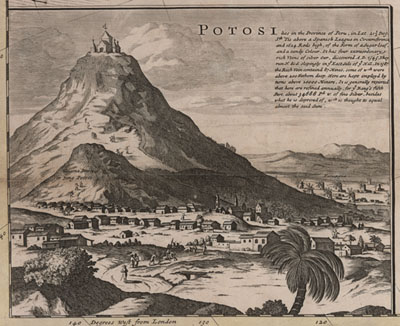
Inset of Potosí on Hermann Moll, Map of South America. Courtesy of the John Carter Brown Library at Brown University.
The Dutch invasion of Brazil also opened up the possibility of finding precious metals in South America. From the early seventeenth century, the search for silver had been a leitmotif in Dutch activities on the American mainland. An important reason to pursue colonization in Guiana was the discovery of a mine that yielded both gold and silver, or so it was believed. And Brazil promised to offer even more mineral wealth. Six Brazilian Indians who had been brought to the United Provinces after the defeat in Bahia informed the Dutch about the existence of silver, lead, and crystal reserves in the vicinity of Ceará. It would not be hard, the natives asserted, to locate the silver: everyone could spot it in passing. They had themselves used small pieces of it as weight for their fishnets. When these assertions were finally tested by explorers two decades later, no silver was found. Other expeditions into the interior were equally frustrating, but the stream of people who claimed to know the location of mines never stopped. A local Portuguese monk reported, for example, that a mountain in a wooded area near the town of Sergipe was home to two silver mines “as good as those of Potosí in Peru.”
Potosí appears almost mythical in some of the stories, but the Dutch knew that it was an actual place that they might be able to reach, in spite of its remote location. In 1641 Governor Johan Maurits sent an expedition to the island of São Luis off Maranhão in northern Brazil, which was believed to provide access to the mines of Peru. In the same year another expedition, guided by scores of natives, marched to the interior of Paraíba to find out if the mines of Potosí could be reached through a backdoor. Although neither endeavor was successful, the search for American silver continued for a few more years. The end finally came around 1648, when after three generations of warfare Spain buried the hatchet with the Netherlanders and presented them with a gift more precious than silver: independence.
Further Reading:
The capture of the silver fleet is documented in S. P. L’Honoré Naber and Irene A. Wright, eds., Piet Heyn en de Zilvervloot. Bescheiden uit Nederlandsche en Spaansche Archieven (Utrecht, 1928) and Irene A. Wright, ed., Bescheiden over de verovering van de Zilvervloot door Piet Heyn (Utrecht, 1928). Information about the Dutch search for Brazilian silver can be gleaned from “Memorie door den Kolonnel Artichofsky, bij zijn vertrek uit Brazilië in 1637 overgeleverd aan Graaf Maurits en zijnen Geheimen Raad,” Kroniek van het Historisch Genootschap gevestigd te Utrecht25, fifth series, volume 5 (1869): 253-349 and “Journaux et Nouvelles tirées de la bouche de Marins Hollandais et Portugais de la Navigation aux Antilles et sur les Côtes du Brésil. Manuscrit de Hessel Gerritsz traduit pour la Bibliothèque Nationale de Rio de Janeiro par E. J. Bondam,” Annaes da Bibliotheca Nacional do Rio de Janeiro XXIX (1907): 97-179.
This article originally appeared in issue 6.3 (April, 2006).
Wim Klooster is an assistant professor of history at Clark University. His most recent books are Power and the City in the Netherlandic World (forthcoming in 2006; coedited with Wayne te Brake) and The Atlantic World: Essays on Slavery, Migration, and Imagination (2005; coedited with Alfred Padula).
Paper Money Gets Personal
Reading credit and character in early America
“Money talks,” we’re often told, because it can convey far more meaning than mere words. But in eighteenth-century America, paper money could literally talk. When I undertook years ago to write a book on economics and letters in early America, I expected that paper money would figure thematically in the era’s essays, broadsides, poetry, novels, and drama. I was surprised to discover, however, that paper money was often a literary character with much to say: a tale-telling traveler, a shameless liar, a martyr offering up his dying words.
As literary devices, these talking personae produce mixed results. Sometimes they are clever, and just as often they are contrived and heavy handed. But, putting aside the question of their literary merit, I have often wondered why writers were inclined to make paper money a fictional character in the first place. Why give a piece of money an identity and a platform from which to speak? What can this peculiar literary maneuver tell us about paper money as a social phenomenon?
By turning paper money into the character Paper Money, writers could draw a compelling analogy between personal and national credibility. In contrast to coins or “hard money,” which obtained currency through the metal’s market value, paper money relied extensively on the faith of buyers and sellers in the government’s word. These “bills of credit,” which constituted a debt on the government’s part, were essentially IOUs issued by legislative proclamation at times when there were not enough metal coins in the public coffers to cover expenses. Like an individual seeking credit, then, the government needed to offer proof of its integrity to make these monetary promises convincing. As one Massachusetts politician proclaimed in 1787, states “become respectable on the same principles by which the character of individuals is maintained.” This analogy was serviceable to both critics and supporters of paper money.
In the hands of critics, the persona of Paper Money becomes, not surprisingly, a charlatan. He speaks words the reader can never entirely trust, and he dramatizes the risks inherent in all forms of money that rely on verbal promises rather than tangible forms of wealth. When Benjamin Franklin penned an essay publicly supporting a 1775 issue of Continental dollars, for example, critics responded with a series of satiric pieces depicting Paper Money as a social-climbing masquerader. In these satires, man and money mislead readers in similar ways. Franklin is the humbug who fashions himself as learned by speaking a smattering of Latin. Paper Money, who not coincidentally bears Latin mottoes, is also an imposter of sorts: he proclaims a value that cannot be backed up by collateral.
Fig. 1. Reproduced from the original held by the Department of Special Collections of the University Libraries of Notre Dame.
such writings, the persona of Hard Money often provides a foil to his paper counterpart. Hard Money insists that the accurate assessment of personal character and monetary value alike is the prerogative of an elite class of “reading men” who are “able to conceive that first appearances are oftentimes deceitful, and that all is not gold that glitters.” He is a man of substance, honorable birth, and fluency in all languages (metal’s widespread acceptability making it universally conversant). Paper Money, by contrast, is the obscure and untrustworthy child of a Philadelphia printer and given to “affecting an importance, as if he had been equal to the solid coin.” In the most obvious sense, he is the brainchild of Franklin, a retired printer, and the product of the Philadelphia printing house Hall and Sellers. But Paper Money’s parentage also aligns credit use with the tradesman. In the class-conscious satire of these essays, “substance” refers both to the tangible material of metal coins and to the status and capital of landowners.
This character’s lineage also implicates paper credit in a larger print culture that is susceptible to corruption. By making possible mass-produced and standardized texts, printing lent an aura of legitimacy to paper money, promissory notes, newspapers, tracts, broadsides, and other media. But a man might also hide behind print and assume a false identity in a newspaper or broadside that he could not so easily assume in a face-to-face encounter. And a printed bill might seem official and yet still make promises it could not keep. Worse yet, it might be a fake, for the more standardized and generally reproducible a bill was, the more easily it might be counterfeited.
A decade later, a series of speeches by Paper Money in the Worcester Magazine dramatically illustrated these risks for readers. In the September 1786 issue, the much maligned Paper Money defends himself by reminding readers that he was instrumental in funding the Revolutionary War. But, in the November issue, Paper Money rescinds this claim and admits to having been a “tool of knavery, dishonesty, fraud, and injustice.” In the January 1787 issue, however, Paper Money announces that the November speech was submitted by an “imposter.” He repeals the repeal and stands by what he said in the first speech. Paper Money has been impersonated in print, highlighting just how easily a paper bill might be counterfeited.
The November masquerade is somewhat ironic, given that it aims to castigate dishonesty, but its creator would likely have drawn a distinction between the impersonation of a fictional device and that of a living individual. To the writer of the November speech, the real frauds are paper money and its supporters. Such a critic would perceive little difference between these supporters and a man like Stephen Burroughs, the notorious eighteenth-century confidence man whose dreams of easy wealth drove him to counterfeit coins. One might argue that Burroughs distorted the initial logic behind credit by creating unauthorized money that constituted theft rather than borrowing. But, in the minds of its opponents, even legitimate paper money was a counterfeit like the one Burroughs admired—a pretense of material value that is not present or tangible.
Fig. 2. Reproduced from the original held by the Department of Special Collections of the University Libraries of Notre Dame.
As we might expect, paper money cuts a very different figure in the literary efforts of its supporters. Advocates of paper money did not deny its risks, but they also saw it as a resource that could expand the money supply and, in so doing, facilitate exchange and stimulate enterprise. In their writings, the character Paper Money is still a man lacking in “substance,” but his insubstantiality takes on a decidedly positive spin.
Paper Money cannot match Hard Money in material value, but, as a printed text, he is kin to the progeny of great authors: “If a Printing-office was the place of my nativity,” he writes, “so has it been of the noblest productions that ever blessed or adorned the world.” He boasts elsewhere, “I am by the mother’s side of the family of Paper; a family that has been of more service to the commonwealth of letters than all of the name of Hard-Money that ever have existed.” Paper Money acts without the backing of material wealth and so is a testament to the power of legal language. In a political climate that has enshrined documents like the Constitution and Declaration of Independence, his lineage is something to be celebrated.
This version of Paper Money certainly lacks wealth and status, but for this reason, it also fits nicely into a story of American opportunity. A case in point is “The Adventures of a Continental Dollar,” a serial narrative of which two installments appeared in The United States Magazine before the periodical folded in December 1779. In this tale, Paper Money admits he has neither the capital nor prestige that Hard Money enjoys, but he insists nevertheless that readers not overlook his potential. Far from an “upstart coxcomb,” as his detractors have dubbed him, he is an “enterprising genius.” This Paper Money is the son not of the printer but of Liberty. He is a risk-taker, born “in the centre of the vast continent of North-America” where “boundless and unexplored regions” are fit for such “free and uncountrouled souls” as his.
The spaciousness of the American continent links paper money to New World exploration and immigration. Readers of North American settlement narratives and promotional tracts know how consistently they embrace the language of potential and opportunity. It is worth emphasizing, however, how often such narratives make debt and credit use the first step to realizing that potential and acting on that opportunity. In William Bradford’s archetypal account of the Plymouth colony, the Puritans must brave rough waters and a hostile wilderness but also borrow heavily from London merchants in order to finance their journey. In the next century, J. Hector St. John de Crèvecoeur’s “What is an American?” would proclaim that the model American immigrant uses borrowing to exceed the limitations of his capital and convert dreams to reality.
Fig. 3. Reproduced from the original held by the Department of Special Collections of the University Libraries of Notre Dame.
In keeping with this equation of indebtedness with liberation, Paper Money sometimes figures as a martyr who has died bringing about individual and collective autonomy. A broadside by Joseph Green, published as the colony of Massachusetts began retiring its bills of credit in 1750, features the “Dying Speech” of a paper bill who is soon to be permanently removed from circulation and relegated to the flames. Although the speaker admits that his value was inflated and he was manipulated to serve “the worst of Mortals,” he also reminds his readers that he helped the poor man in distress and provided funding to fight colonial wars and build communities. Similarly, Green’s 1781 ballad broadside, “A Mournful Lamentation On the untimely Death of Paper Money,” eulogizes paper money as a martyr who died for American freedom:
He rais’d and paid our Armies brave. To guard our threaten’d State; Whose val’rous Deeds their Country save, And num’rous Foes defeat.
Sung to the traditional English tune of “Chevy Chase,” this ballad celebrates a recently retired issue of Continental money for its role in national independence.
Although Green laments the death of Paper Money, other writers considered his death essential to American success. For example, M’Fingal, John Trumbull’s 1782 epic poem of the Revolution, proclaims that the Continental dollar must die in order to do its duty. Marching to his grave in the vision of the fourth canto, Paper Money appears limping on crutches, draped in tattered robes, and bearing a breastplate that reads, “The faith of all th’ United States.” Although an admirable patriot, he must “perish in his country’s cause,” for only with the retirement of its debt can the nation’s honor be maintained. Trumbull anticipates the day when the Continental bill will lie buried in eternalpeace, and he does not envision a permanent national paper money.
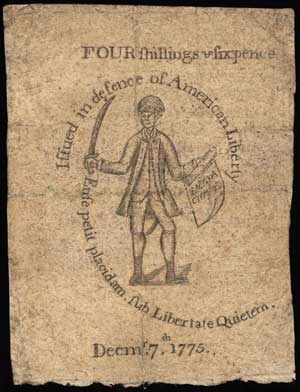
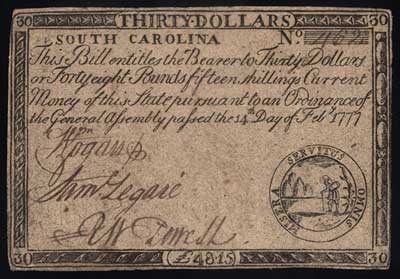
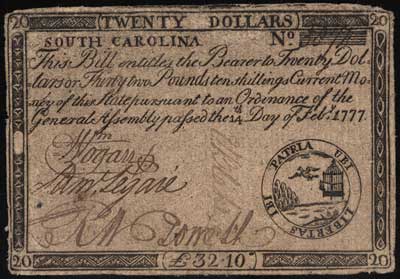
That Paper Money, as living hero and martyr, was often a national liberator was amply reinforced by the rhetoric of bills themselves. The 1775 “Sword in Hand” bill (fig.1), engraved by Paul Revere and issued by Massachusetts at the start of military conflict with England, features a soldier holding the Magna Charta and the words, “Issued in defence of American Liberty.” In another issue the following year, the soldier’s Magna Charta is replaced by the Declaration of Independence. Two 1777 South Carolina bills also celebrate freedom (figs. 2 and 3). One announces Servitus Omnis Misera, or, “All Forms of Slavery Are Wretched” (with obvious irony, given the prevalence of chattel slavery in the region). A second bill features a bird fleeing a cage and the motto Ubi Libertas Ibi Patria, or, “Where There Is Liberty, There is Homeland.”
Fig. 4. Reproduced from the original held by the Department of Special Collections of the University Libraries of Notre Dame.
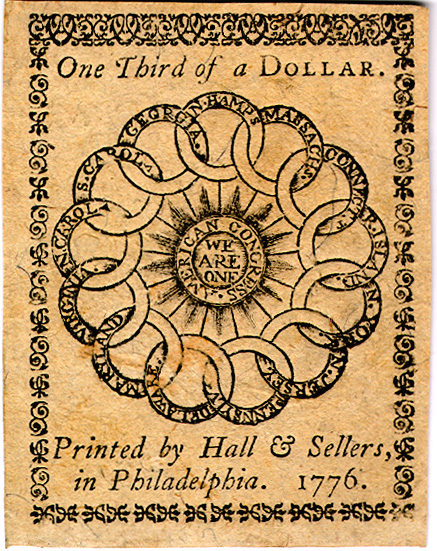
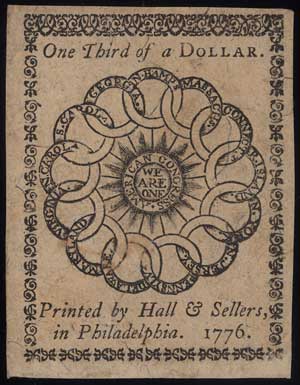
Even in his most flattering portraits, the figure of Paper Money must compensate for his deficiencies. Paper money is a “necessity” in the specific eighteenth-century sense of the term: prompted by pressing economic constraints and a paucity of monetary options. But that should not obscure the extent to which many writers perceived the instability of credit schemes and their reliance on popular opinion as a valuable communal resource. If commercial credit was the trust one placed in a person’s ability and willingness to meet financial obligations, public credit was the trust one placed in a government’s ability and willingness to do so. What initiated public credit was a debt, and hence a limitation, on the government’s part, but public credit was nevertheless an expression of confidence in the new nation’s viability. For this reason, the rhetoric of Continental dollars typically tried to foster this confidence by implicitly linking financial venture to communal commitment. In a one-third dollar bill (fig.4), for example, the motto, “We are One,” is accompanied by the image of thirteen interlocking rings, suggesting that the fates of all states are intertwined by the political and economic venture of rebellion.
If we return to “The Adventures of a Continental Dollar,” it is clear that Paper Money necessarily relies more than Hard Money on faith and that such faith figures as a valuable expression of public commitment. Speaking of men who publicly endorsed him shortly after his birth in America, Paper Money recalls, “They were the first men that owned me, and stood up for me in the infancy of my affairs, entered into a league with me, and stood firm to it in despite of all the hazards of an uncertain fortune.” Here Paper Money acknowledges the hazards he has brought to the new nation but also insists these hazards exact a measure of commitment. In this and other instances, the speaking bill describes financial faith but also, in so doing, attempts to solicit faith from the reader as well. When Paper Money speaks, in other words, he has in mind a reader who may well be in a position to extend his or her credit to the nation’s money.
As twenty-first-century readers, we cannot experience the persona of Paper Money just as our eighteenth-century counterparts did. These bills are not our own but the relics of a past era. Monetary experience has changed dramatically, and we have no expectations today that our greenbacks will ever be redeemed for metal coins. We might be optimistic or pessimistic about the strength of the dollar or of our economy in general, but we do not think of a paper bill as a voucher awaiting redemption. Eighteenth-century paper money talked by using legal language to proclaim a value not backed by collateral, and buyers and sellers were not always sure how to read these promises. At times a trickster, at times an underdog beseeching support, Paper Money took to talking as a response to Americans’ mixture of skepticism and faith.
Further Reading:
For general histories of early American money, see Eric P. Newman’s The Early Paper Money of America (Iola, Wisc., 1990) and William G. Anderson’s The Price of Liberty: The Public Debt of the American Revolution (Charlottesville, Va., 1983). Newman’s book includes facsimiles of many bills, and more images of bills can be found on the Website Colonial Currency, a project of the Robert H. Gore, Jr. Numismatic Endowment at the University of Notre Dame. For a sustained analysis of paper money and early American writing, see Jennifer J. Baker’s Securing the Commonwealth: Debt, Speculation, and Writing in the Making of Early America (Baltimore, 2005). For examples of Paper Money as a literary protagonist, see Joseph Green, “The Dying Speech of Old Tenor” (Boston, 1750) and “A Mournful Lamentation On the untimely Death of Paper Money” (Wilmington, Del., 1781); “The Adventures of a Continental Dollar,” United States Magazine (June 1779): 264-268 and (September 1779): 385-387; “Paper Money once more speaketh for itself!” Worcester Magazine 2:31 (November 1, 1786): 372-373; “Paper Money once more speaketh for itself!” Worcester Magazine 2:40 (January 1, 1787): 482-484; “Paper Money, raised from the dead, speaketh for itself!” Worcester Magazine 1:25 (September 15, 1786): 294; “Reply of Continental Currency to the Representation and Remonstrance of Hard Money” United States Magazine (February 1779): 72-81; “The Representation of Remonstrance of Hard Money,” United States Magazine (January 1779): 28-31.
This article originally appeared in issue 6.3 (April, 2006).
Jennifer J. Baker is assistant professor of English at Yale and the author of Securing the Commonwealth: Debt, Speculation, and Writing in the Making of Early America (Baltimore, 2005). She is currently writing a book on antebellum American literature and the Victorian life sciences.
“A Bank on Parnassus”
Nicholas Biddle and the beauty of banking
“The Tomb of Many Fortunes”
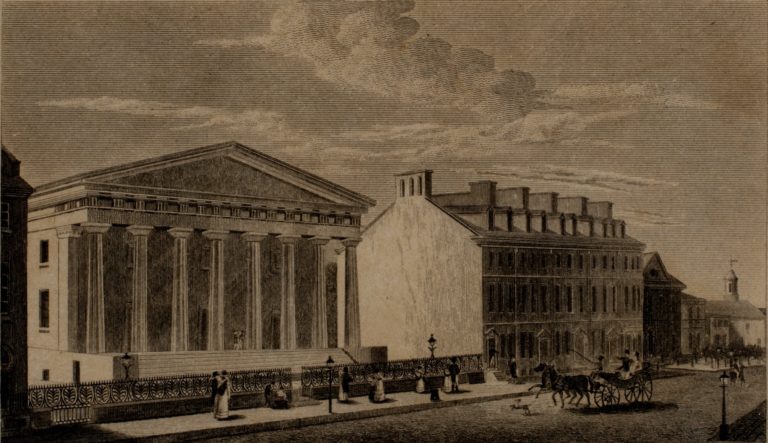
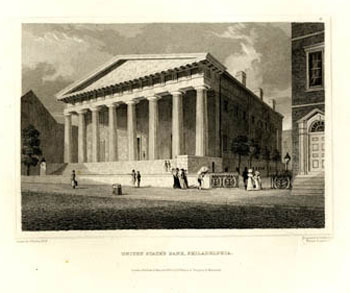
When Charles Dickens visited Philadelphia in 1842, he found a ruined capital. “Looking out of my chamber-window, before going to bed,” he wrote of his first night, “I saw, on the opposite side of the way, a handsome building of white marble, which had a mournful ghost-like aspect, dreary to behold.” The next morning, he learned why. “It was the Tomb of many fortunes; the Great Catacomb of investment; the memorable United States Bank. The stoppage of this bank, with all its ruinous consequences, had cast (as I was told on every side) a gloom on Philadelphia, under the depressing effect of which it yet laboured.” Outside the shuttered city, Dickens paused over another deserted monument to its past prosperity: “a most splendid unfinished marble structure for the Girard College . . . which, if completed according to the original design will be perhaps the richest edifice of modern times.”
The stone frames of the bank and the college stood as the most celebrated examples of the Greek Revival in antebellum America, the architectural expression of the newly won riches of planters and financiers. Had Dickens traveled a little farther up the Delaware River, he would have come upon a third classical memorial to the moneyed men of the new Athens, a brick mansion encased in a massive marble colonnade modeled on the Temple of Theseus. There lived the deposed president of both the United States Bank and Girard College, the chief sponsor of the Greek Revival, Nicholas Biddle. Dismissed by the bank stockholders and college trustees, he was spending his last days, as William Cullen Bryant wrote upon Biddle’s death two years later, “in elegant retirement, which, if justice had taken place, would have been spent in the penitentiary.”
Having begun his career as one of the first Americans to tour the ruins of ancient Greece, Biddle may have taken what he called a “melancholy satisfaction” in his own demise amid the Grecian relics of the early republic and the national bank that both united and divided it. The bond that he forged between classical beauty and modern banking helps to explain what made the Bank War of the 1830s the climactic struggle of the new nation and a precursor of the Civil War soon to follow. The long conflict over money and banking in nineteenth-century politics came down to a question of representation: what did the nation’s founding principle of representative government mean for the governance of the burgeoning market economy, and what did the new forms of currency on which it depended themselves represent? Americans’ answers to those questions had much to do with the different ways they understood representation in literature and art as well as in politics and economics. For, like classicism, what came to be called the “money question” formed a central part of the popular culture of the nineteenth century, before becoming the exclusive province of an educated elite.
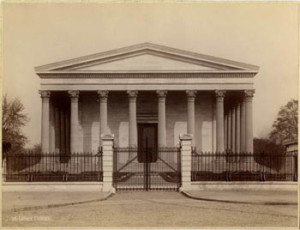
Girard College, 1899. City Views Collection; Courtesy of the American Antiquarian Society.
“A Bank on Parnassus”
When Nicholas Biddle became president of the Bank of the United States in 1823, the only business he had ever run was his wife’s family estate, and his sole experience in banking consisted of a two-year term on the bank’s board of directors. His national reputation derived rather from his work as editor of the leading American literary journal, author of the standard history of the Lewis and Clark expedition, and amateur authority on ancient Greece. “Alas!” Biddle mused in a poem, “had the ancients, who so much surpass us, / In their pure golden age, fixed a bank on Parnassus, / What a model of wisdom and pleasure to follow! / Only think now—to sign one’s bank-notes like Apollo!” “Enclosed in my vast marble tomb,” as he called the bank’s new headquarters modeled on the Parthenon, he pictured himself “’Mid vaults of damp stone and huge chests of cold iron, / That would quell all the fancy of Shakespeare or Byron.” But the obituary for his youthful passions proved premature, for Biddle’s subsequent financial career owed much to his earlier literary one.
Born with the early republic in 1786, Biddle was the son of a prosperous Philadelphia merchant. A prodigious reader as a child, he entered the University of Pennsylvania at the age of ten. At thirteen, he transferred to the College of New Jersey (now Princeton University), where he excelled in Latin and Greek and took a leading role in a debating society as “Grammaticus.” Returning to Philadelphia to study law, Biddle joined a circle of local luminaries who wrote for the nation’s premier literary magazine, the Port Folio, which wedded love of belles lettres to contempt for democratic politics. His own contributions reflected his restlessness for a higher office commensurate with his talents. In the form of a letter to the journal’s editor, Biddle mocked the pseudo-military “manœuvres” and “reconnoitring” of “valourous knights” and “damsels” at a tea party, describing himself as a “mere ‘looker-on here in Vienna,’” like the Duke in Shakespeare’s Measure for Measure. Disdaining melodramatic efforts to find heroism within ordinary life, he longed for the means to turn his “looker-on” into a leader.
When the American minister to France, John Armstrong, invited Biddle to join him as an unpaid secretary in 1804, he leaped at the chance. The following year, he embarked from Paris on a grand tour of Europe, joining a growing stream of travelers through southern Italy and on to Greece. Being a mere observer now proved invaluable as he moved freely among Greek peasants and their Turkish occupiers as well as among warring British and French forces. “I look from my window so coolly on the noise of Trieste that I seem like one of Plato’s wise men who sees the vanity of the shadows which deceive the people in the hole,” he wrote in his journal. Biddle’s pilgrimage culminated among the ruins of golden-age Greece, which he was reputedly only the second American to see. (The first, a young Grecophile from Charleston named Joseph Allen Smith, preceded him by just a few years.) “I believe the turn of my mind, or what may properly be called my genius, has at length decided itself,” Biddle wrote to his brother. “. . . To govern men, and particularly by means of eloquence . . . a study which roused the slumbering glories of Greece.”
Though Biddle’s legal practice upon returning home fell short of his lofty ambition, his business flourished. At the same time, he became increasingly involved in running the Port Folio, and he took over as editor in January 1812. He made the journal a platform for the kind of impassioned patriotism he identified with classical oratory. Not “cold and prudent calculation” but “kindred feelings” must bind Americans in common struggle, Biddle wrote amid the War of 1812, calling for poetry and song that would “make us not merely know, but feel that we have a country.” Among the most influential works of American literary nationalism in this period came from Biddle’s own pen. In 1810, Colonel William Clark hired him to edit the journals of the Lewis and Clark expedition of 1804-06. Biddle completely reworked the chronicle, adding extensive material based on his own research, merging the journals of the two commanders into a seamless narrative whose genteel prose bore faint resemblance to the raw material. His two-volume History of the Expedition of Captains Lewis and Clark (1814) served as the definitive account until the journals themselves were published in 1904-05. Submerging the personal conflicts and courts-martial of the original company, he fashioned “our national epic of exploration,” as the naturalist Elliott Coues wrote in 1893.
At twenty-four, Biddle was elected to the lower house of the Pennsylvania legislature, and four years later he entered the state senate. He gravitated toward the mercantile and nationalist wing of the Republican party, promoting a network of roads, canals, and river improvements designed to make Philadelphia the metropole of an agricultural empire stretching from the Great Lakes to the Gulf of Mexico. In this effort, as in his related support for Philadelphia’s first Bank of the United States, Biddle largely lost out to the agrarian wing of the party, loyal to the Jeffersonian ideal of limited government and decentralized development. Retreating from the statehouse to his country estate, he ran twice for Congress and appealed repeatedly for a federal appointment, without success.
Plato’s wise man appeared a poor fit for electoral politics. Biddle later became a sought-after public speaker, and he often used the occasions to decry the decline of the “philosophical statesman” whose learning made him a leader rather than a follower of his constituents. “Undoubtedly the public councils should reflect the public sentiment,” he said in a eulogy for Thomas Jefferson in 1827, “but that mirror may be dimmed by being too closely breathed on.” On the eve of the Jacksonian revolution in American politics, which enfranchised many poor and propertyless men for the first time, Biddle harked back to an earlier elitist model of republican government. At the same time, he looked forward to the growing importance of money and banking, in which he found an alternative system of representation.
“Serving Men”
In 1829, Biddle wrote a poem for his young daughter, Meta. Published together with an earlier poem about banking, “Ode to Bogle” was a mock tribute to the leader of a surprisingly similar occupation: Robert Bogle, the city’s first “public waiter” or caterer, who transformed the position of private butler into a kind of public office for black Philadelphians. Much as Biddle’s bank controlled the cash and credit vital to all kinds of commercial enterprise, so Bogle presided as the ultimate arbiter of taste and decorum at baptisms, weddings, and funerals. In an age when statesmen were devolving into mere servants, as Biddle saw it, Bogle symbolized the rising power of “serving men” themselves. Yet if democracy meant rule by representatives in this sense, Biddle could claim a comparable authority for the role of public banker, which he more than any other American defined.
The competition for that honor was peculiarly intense. For unlike European banking, which was generally the business of wealthy families, American banking was born public, the creature of the state governments that chartered the first commercial banks in the years after the Revolutionary War. Modeled on lone national banks like the Bank of England, public incorporation remained the rule in the new nation as the number of banks mushroomed—from just three when Biddle was born to more than three hundred by the time he became president of the Bank of the United States. These “state banks” were supposed to help support the state governments and promote economic development in exchange for the corporate privileges they enjoyed. Chief among these privileges was limited liability, which meant that a bank’s owners were not legally liable for its debts beyond what they individually invested. Limited liability allowed banks to lend out much more money, in the form of paper notes redeemable in gold or silver, than the gold or silver they actually kept in their vaults. Amid a chronic shortage of coin, these banknotes served as Americans’ main currency until the federal government began printing its own paper money during the Civil War.
Whom did state banks, which were primarily privately owned and operated, really represent? What did banknotes, whose value rested largely on trust, likewise represent? The wrenching national debate over these issues focused on the Bank of the United States, chartered by Congress from 1791 to 1811 and again from 1816 to 1836. As the exclusive depository for the revenues of the federal government, the Bank of the United States collected the notes of all the other banks. It was intended to use its power as their biggest creditor to ensure that state banks behaved like public servants in practice as well as in theory.
Biddle’s earliest comments on the controversy over banks’ control of the money supply came in a speech championing the recharter of the first Bank of the United States, delivered before the Pennsylvania House of Representatives on his twenty-fifth birthday. In sweeping terms, he refuted the popular charge that a representative government had no right to delegate its Constitutional authority over currency to an unelected body of self-interested stockholders. Deputizing private persons to provide public services, he argued, was simply the most effective means of attaining some of the basic ends for which government was empowered. Far from establishing a “monied aristocracy,” chartered banks protected poor debtors from rich creditors by interposing between them “an association of individuals whose private or political feelings are merged” in the service of the collective. A public corporation represented the American people better than either elected officials or private individuals could.
“I have however little concern with Banks,” Biddle wrote to President James Monroe in 1819, accepting his appointment to the board of the second Bank of the United States. Three years later, he wrote to another board member that the next president of the bank ought to be someone with “talent for business rather than what is commonly called a man of business,” for businessmen lacked “liberal habits of thinking,” and he should likewise “stand well with the Govt” without being “an active partizan.” In other words, the job should go to an impartial observer such as himself, as it shortly did.
Under Biddle’s direction, the bank took a dominant role in guiding the dizzying expansion of the market economy in the 1820s and 30s. He reined in lending by the state banks while turning up the volume of paper issued by the Bank of the United States’ eighteen branches, aiming to create a uniform national currency under the bank’s control. He geared the bank’s business away from small farmers and toward merchants engaged in long-distance trade between the cotton plantations of the American South and the industrializing regions of the American Northeast and Europe. Biddle’s promotion of large-scale development based on staple-crop production for a world market ran counter to the teachings of Adam Smith’s Wealth of Nations (1776), one of the founding texts of classical economics. Smith and his many American disciples within the ranks of Jeffersonian and later Jacksonian democrats favored a broader diffusion of wealth among smaller farmers and tradesmen producing a wider range of goods for a mainly domestic market. But the deepest difference between Biddle’s outlook and that of Smithian political economy concerned his understanding of money.
According to the traditional view dating back to Aristotle, money was simply something of sufficiently stable value that could be divided into standard units and passed from hand to hand, so that it could serve as a measure of value in general and a means of exchanging other goods. Age-old proscriptions on profiting from monetary transactions gained force from the presumption that money was merely a “sterile” medium of exchange, possessing no productive power of its own. Beginning in the fifteenth century, however, the development of banknotes and other kinds of paper currency led European merchants and bankers toward a view of money as much more than an intermediary. Allied with monarchical governments, financiers came to see the money supply as a fundamental force in its own right, like a great river of liquidity irrigating commercial farms, powering manufactories, and carrying trade on its current.
It was this “mercantilist” conception of money that Smith repudiated. Far from being the golden goose that merchants and monarchs imagined, money was for the classical economists essentially what it had been for pre-mercantilist thinkers: a “veil” covering the “natural economy” of land and labor, goods and services. In the late eighteenth century, this deep-rooted dispute blossomed into a major political issue on both sides of the Atlantic. Developments in banking made it possible for the kinds of bills and notes long used by merchants to circulate much more widely, becoming common currency. Currency came unhitched from gold, silver, or other commodities and attached instead to credit instruments, while the credit instruments themselves became detached from their original lenders and borrowers. Money took on a life of its own, apart from the industry and commerce it was meant to represent.
Nowadays, we are so accustomed to viewing money as autonomous in this way that early Americans’ preoccupation with what lay beneath the “cash nexus” (as Thomas Carlyle called it) can seem simple-minded, bespeaking an apparent inability to think abstractly or an uneasiness with flux and fluidity in general. But to people schooled in the struggle against British rule, the growing power of money and of those who controlled it naturally raised the specter of corruption and tyranny. For, as a popular writer put it, “Money is as much the representative of the property of the people, as the legislature are the representatives of their constituents.” The further money became separated from the property and people it was supposed to represent, the more many Americans worried that the banking system was becoming an irresponsible power unto itself.
Biddle’s answer to this problem came less in his short-lived policies and pronouncements than in his enduring architectural influence. Joining his ideas about representative government to his notions of classical beauty, he created an artistic idiom that helped validate the authority of bankers and bank money in democratic America.
“Nicholas Biddle.” Painting by Thomas Sully, 1826. Courtesy of the Andalusia Foundation.
“Refined Simplicity”
Biddle was famously handsome. Proud of his looks, he sat for at least eighteen portraits, recording his development from the rakish youth in a French drawing of 1805 into the elder statesman with the Grecian portico of the national bank in the background in an engraved painting of 1837. Probably his best-known likeness, painted by Thomas Sully in 1826, depicts the boyish president of the bank in romantic repose, softly lit in an open-necked shirt and fur-collared coat, his long brown hair draping his flushed face as he sits pensively at a window opening onto a cloudy seascape—the picture of a poet with more on his mind than cotton bills and discount rates.
Biddle drew the face of American banking with equal panache. He began sketching it long before he became a banker, in his painstaking traveler’s notes on ancient Athenian architecture. Back in Pennsylvania, he persuaded his prospective mother-in-law to let him build a Doric garden house at the family estate, twenty years before he had the main mansion renovated along similar lines. European architects had been copying Greek temple remains since the mid-eighteenth century, but the Greek Revival made little headway in the United States before the 1820s. Revolutionary-era Americans’ enthusiasm for the ancients ran strongly toward republican Rome, and early national architecture clung to the stately red-brick boxes of British and Dutch colonialism—with the crucial exception of Jefferson’s classical Roman plans for the University of Virginia and Monticello. Awestruck by the ruins of Greece, Biddle believed such buildings could have a similarly ennobling effect in his own country. Like patriotic songs and epics of exploration, the timeless grandeur of Greek design could awaken in Americans a visceral sense of national unity.
What Biddle called its “refined simplicity,” evoking at once republican virtue and romantic idealism, made the Greek temple a fitting symbol for his vision of banking. He was hardly the first to connect the two. Commercial banking and neoclassical architecture arose together in Renaissance Italy, and eighteenth-century bankers became the leading patrons of the Greek Revival in Britain. The first authentically Grecian building in the United States was the Bank of Pennsylvania, designed by Benjamin Henry Latrobe and constructed between 1798 and 1800. In 1811, Biddle published in the Port FolioLatrobe’s manifesto for the Greek Revival, calling for Philadelphia to capitalize on its financial wealth (and abundance of marble) by becoming “the Athens of the Western world.” Biddle took an eager interest in his friend William Strickland’s Doric design for the second Bank of the United States, built between 1818 and 1824. As chair of the bank’s building committee and then as president, he saw to it that branches of the bank across the country—and scores of state banks as well—came to be modeled on Greek temples.
More broadly, Biddle sponsored the rapid spread of the Greek Revival from its hub in Philadelphia throughout the Bank of the United States’ principal dominion, extending along the Atlantic seaboard from Washington and Baltimore to New York, westward across the “inland empire” of canal towns to the riverbank cities and frontier communities of the Northwest Territory, and southward through the old tobacco country of Virginia and North Carolina. Cotton planters brought neoclassical architecture to the Deep South, following the lead of Biddle’s nemesis, Andrew Jackson, who had his Tennessee manor rebuilt to fit his image as a latter-day Cincinnatus. But the white-columned mansions of the cotton kingdom only loosely resembled the Greek models that Biddle promoted in the North. By the 1830s, these were generally viewed as “the ‘official’ style of financial Whiggery,” in the words of the architectural historian Roger G. Kennedy.
United States Bank, Philadelphia, 1831. Drawn by C. Burton and engraved and printed by Fenner, Sears, and Co., London, March 1831. Courtesy of the American Antiquarian Society.
Like the Whig party, which split from the Democrats after Jackson vetoed the recharter of Biddle’s bank, the Greek Revival appeared avowedly in but not of the revolutionary tide that swept across the Atlantic around 1830. The democratic ferment from Poland to Paris to the English Parliament went furthest in the United States, inspired in part by the recent triumph of the Greek revolution against the Ottoman Empire. The “refined simplicity” of the Grecian style associated the fortunes of finance with the ascendance of popular politics. Yet at the same time, as the historian Caroline Winterer has shown, classics scholars came to identify Greek art with a defiantly unpopular reverence for beauty, truth, and genius as opposed to the money-grubbing mediocrity of Jacksonian America. Such superiority naturally appealed to profit-driven southern planters who fancied themselves courtly cavaliers. In much the same way, the antimodern character of the Greek Revival lent itself to Biddle’s image of banking as a critical check on the irresponsibility of “men of business” and their representatives in government.
Both sides in the Bank War cast themselves as guardians of representative government against corruption. The crux of the Jacksonian position was that the Bank of the United States, like all specially chartered banks, served the private interest of its investors at the expense of the public interest represented by elected officials, conferring quasi-governmental power upon a “paper aristocracy.” The paper currency such banks created, untethered to either the gold and silver for which it substituted or the purchases and sales for which it served, likewise turned money into an end in itself, fueling a vicious cycle of boom and bust that Jacksonians chalked up to “speculation.” Defenders of the Bank of the United States countered that the danger to democracy came from politicians who followed too faithfully the caprice of popular sentiment, who vowed “that they will never act nor think nor speak but as we direct them,” as Biddle said in an 1835 talk to Princeton alumni. A free people depended on the “independence” of public servants able to represent its real interests rather than its “crude opinions.” The national bank’s very autonomy enabled it to play such a regulative role, without which, he warned, a free market could sustain itself no better than a free people. The national bank’s necessary instrument for governing the market economy was its control over the supply of paper money. And the bank’s Grecian architecture set its sovereignty in stone.
“Melancholy Satisfaction”
Ever since visiting Greece, Biddle had been drawn to architecture as a lasting memorial to its makers. Calling for the construction of a monument to George Washington in 1811, he recalled the relics of ancient republics, which “still shed their melancholy glories on the desert.” Addressing the Princeton alumni a quarter-century later, he was reminded again of the marble fragments and crumbling columns, “all that represent the buried glories of Sparta, of Corinth, or Argos.” In leading the Greek Revival, he looked forward with “melancholy satisfaction” to the ruins of his own realm. Freed from the political fray in which it was born, the bleached remains of the Bank of the United States might finally attain the Olympian authority for which it stood.
“Andalusia.” Nicholas Biddle’s country estate. Painting by Thomas U. Walter, ca. 1836. Courtesy of the Andalusia Foundation.
In his desire to remove public banking from the political arena, Biddle was ahead of his time. President Bush’s recent nomination of Ben Bernacke as chair of the Federal Reserve barely registered in American politics, though the job wields more power than Biddle’s did. When the selection of the nation’s chief banker attracts little interest beyond Wall Street, it is hard to imagine that the president of the national bank was once almost as controversial as the president of the United States. In Biddle’s lifetime, the separation of currency from commerce became an open, urgent political question, comparable to the separation of labor from capital. The money question remained hotly contested throughout the nineteenth and early twentieth centuries, only gradually becoming eclipsed along with the labor question. The beauty of banking was Biddle’s effort to bring that contest to a close.
Further Reading:
Charles Dickens’s comments may be found in his American Notes (New York, 1996). For an admiring biography, see Thomas Payne Govan, Nicholas Biddle: Nationalist and Public Banker, 1786-1844 (Chicago, 1959). Bray Hammond, Banks and Politics in America: From the Revolution to the Civil War (Princeton, 1957) remains the fullest survey of its subject, including a spirited defense of Biddle’s ideas about banking along with much biographical detail. For a brief and judicious synthesis of the Bank War and its broader political context, see Harry L. Watson, Liberty and Power: The Politics of Jacksonian America (New York, 1990); readers interested in a more in-depth treatment should consult John M. McFaul, The Politics of Jacksonian Finance (Ithaca, 1972) and Robert V. Remini, Andrew Jackson and the Bank War: A Study in the Growth of Presidential Power (New York, 1967). Major L. Wilson, “The ‘Country’ versus the ‘Court’: A Republican Consensus and Party Debate in the Bank War,” Journal of the History of the Early Republic 15 (Winter 1995): 619-47, discusses the common concern with corruption and conspiracy on both sides of the Bank War. On Adam Smith’s Wealth of Nations in the early American republic, see Michael Merrill, “The Anticapitalist Origins of the United States,” Review: A Journal of the Ferdinand Braudel Center (Fall 1990): 465-97. For a lively history of Greek Revival architecture, see Roger G. Kennedy, Greek Revival America (New York, 1989), which includes an excellent discussion of Biddle’s leading role, as does Architecture, Men, Women and Money in America, 1600-1860 (New York, 1985) by the same author. For a rich study of classicism in American thought and culture in this period, see Caroline Winterer, The Culture of Classicism: Ancient Greece and Rome in American Intellectual Life, 1780-1910 (Baltimore, 2002). On Biddle’s travels in Greece, see R. A. McNeal, ed., Nicholas Biddle in Greece: The Journals and Letters (University Park, Penn., 1993). On his history of the Lewis and Clark expedition, see Gunther Barth, “Timeless Journals: Reading Lewis and Clark with Nicholas Biddle’s Help,” Pacific Historical Review, 63:4 (Nov. 1994): 499-519. On the many portraits of Biddle, see Nicholas B. Wainwright, “Nicholas Biddle in Portraiture,” Antiques 108 (Nov. 1975): 956-64. On Robert Bogle and the profession of public waiter, see W. E. B. Du Bois, The Philadelphia Negro: A Social Study (Philadelphia, 1996).
This article originally appeared in issue 6.3 (April, 2006).
Jeffrey Sklansky is associate professor of nineteenth- and twentieth-century American intellectual and cultural history at Oregon State University and author of The Soul’s Economy: Market Society and Selfhood in American Thought, 1820-1920 (Chapel Hill, 2002). He is currently working on a book about the rise and fall of the “money question” in the nineteenth-century United States.
Bookkeeping as Ideology
Capitalist knowledge in nineteenth-century America
Of all the numerous claims made on behalf of bookkeeping in the nineteenth century its importance as an ideology was never noticed. In fact, it was adamantly ignored. The exploding number of those charged with posting accounts, and with teaching others how to do so, all preferred to emphasize bookkeeping’s rigorous, scientific character, together with its consequent ability to uncover the truth buried within a mass of disinterested figures. Frederick Beck made a representative claim in his Young Accountant’s Guide, first published in 1831: “Mercantile Book-keeping is the art of recording and stating accounts in such manner, that the true state of each and all the accounts, and the merchant’s situation, may at any time be easily, speedily, and distinctly comprehended and known.” In other words, accounts, which would obstinately refuse to add up if anyone tried to make them tell anything but the whole story, were perceived as an island of disinterested neutrality in the era’s tidal wave of profit seeking. They were, so to speak, an ontological check on what everyone agreed to be the national free-for-all in pursuit of riches.
In fact, locating incontestable truth within the very heart of business avarice had considerable ideological value in the age of capital. Christopher Columbus Marsh, an author of accounting manuals and bookkeeping promotional literature, explained in 1835 that the science of bookkeeping was distinct from the art of trading. “You may be an excellent business man, and no book-keeper at all; or, an accomplished book-keeper and possess few requisites indispensable in the character of a merchant.” The latter, as everyone knew, was bound “by a thousand threads” to “every change in the market.” It was little wonder, then, that the merchant was invariably so anxious, animated, depressed, and disappointed, for those threads “may be severed in an hour by a wave on the ocean of political opinions, policy, or local interests.” Bookkeeping, on the other hand, was immune to such shocks for it was dependent on nothing but itself. It recognized no other policies or interests, and certainly no political opinions. As a result, the bookkeeper “eats and sleeps as usual,” in contrast to the merchant. In fact, the widespread public interest in bookkeeping during the early decades of industrial revolution meant that everyone slept a little better.
Why was this so? Because keeping accounts became as important to the social life of a market society as it was to proper business administration. Nineteenth-century capitalists were frantic system builders, not because of any innate personality trait or some vague ethical imperative handed down by the Protestant Reformation, but because they had destroyed the existing foundations of social order in their rise to power. Such “creative destruction” gave birth to a post-agrarian conundrum, which defined the liberal age: how could stability be founded on the ever-shifting value of exchange—that is, on the fluid relations governing merchandise, consignments, stocks, shipments, moveables, bills receivable, bills payable, drafts, remittances, commissions, insurance, and interest payments? These were all bookkeepers’ categories, of course, and they became the basis of a balanced picture of the whole economy, “easily, speedily, and distinctly comprehended and known,” as Frederick Beck claimed. Bookkeeping, in other words, proved that the constantly varying signs of value—whether Mr. Holmes’s broadcloth, Mr. Brown’s hardware, Mr. Lloyd’s miscellaneous merchandise, or Mr. Jones’s bill payable at thirty days’ sight—could serve as the foundation of equilibrium and that the perpetual movement of commodities was actually the key to stability. In a dialectic suited to such revolutionary times, the problem thus became its own solution. Once the source of instability, monetized trade and the individual ambition that drove it now emerged as the foundation of certainty, if not, in fact, of truth: that is, of the “bottom line.”
Title page of Mayhew’s Practical Book-keeping: Embracing Single and Double Entry, Commercial Calculations, and the Philosophy and Morals of Business, by Ira Mayhew (1864). Courtesy of the American Antiquarian Society.
This is why a technology invented in the fourteenth century achieved unprecedented popularity in the nineteenth. By the 1830s bookkeeping was a subject of common-school curricula, of scores of competing instructional methods, of public lectures on the fast-growing Lyceum circuit, of morning and evening classes in Mercantile Libraries and in the country’s numerous new “commercial academies,” and even of parlor entertainments that filled leisure hours. For instance, Henry Patterson, a young business clerk recently arrived to New York City from Suckasunny, New Jersey, attended a double-entry study group every Tuesday evening, which counted among its regular participants “Mr. and Mrs. Crane, Ann Maria, Turner, and Edgar.”
“No gentleman’s education is complete without it,” Frederick Beck exclaimed, and the hyperbole was not without basis. Benjamin Franklin Foster likewise declared in his Origin and Practice of Book-keeping (1852) that the science teaches “those things which the [young] will need to practice when they come to be men.” Foster, who was referred to as a “counting-house oracle” by the Educational Times, was the author, in addition to the Origin and Practice of Book-keeping, of The Counting-House Assistant, A Concise Treatise on Book-keeping, The Clerk’s Guide, Hints to Young Tradesmen, Foster’s School Book-Keeping, Commercial Book-keeping, The Merchant’s Manual, Double Entry Elucidated,and The Origin and Practice of Book-keeping, among other related works. Foster also offered courses in bookkeeping at his Commercial Institute on Broadway in New York City, as did C. C. Marsh, and Brown and Pond, and a Mr. Renville, and Mr. Dolbear, and Mr. Paines. All were pedagogical entrepreneurs seeking to build an enterprise out of the close relationship between the expanding market and the democratic spread of business ambition. Thus, C. C. Marsh could claim with a perfectly straight face that “book-keeping is so extensively required, that it becomes difficult to say who may not stand in need of the knowledge embraced under its name.”
The knowledge itself—namely, the system used to organize accounts—was singular. That is, none of the competing manuals or courses of study offered a different technology but only a purportedly better method for learning “the theory and practice of the art.” At the same time, these sundry teaching methods all shared a common pedagogical principle, asserting that the student needed to grasp the business logic of accounts rather than simply learn by rote the rules for listing debits on one side of the ledger and credits on the other.
Thomas Jones explained in his Analysis of Bookkeeping as a Branch of General Education in 1842 that “when [the pupil] understands the theory [my emphasis] of debit and credit, . . . [then] he makes his journal entries without any necessity of help from his teacher, he knows what must be done in order to get at his result, and he perfectly understands how each step bears upon it.” Likewise, James Bennett in his American System of Practical Bookkeeping wrote that “in order to make a correct Journal entry, it is first necessary perfectly to comprehend the business transaction on which it is founded.” And so, Samuel Crittenden’s Elementary Treatise on Bookkeeping promoted the day-book, which contained the initial record of each transaction, to the center of its course of study, challenging the student to then “depend upon his own mental resources” in deciding whether to list the transaction in the cash book, the bill book, the journal, the invoice book, the sales book, the accounts current, the book of commissions, the expense book, copy book, letter book, ships’ accounts, receipt book, bank book, check book, or memoranda book.
The aim was for “the learner [to] exercise his judgment” and so become “a responsible and free agent.” Such responsible use of freedom was not just a desideratum of business, of course, but an essential trait of political life in the republic, which turned bookkeeping into something of a civics lesson. Further, with principles as demonstrable and universal “as those of Euclid,” the bookkeeper became part of an accounting profession with a standard skills set bound to no particular industry or individual. C. C. Marsh explained, “A person may keep correctly the accounts of the house in which he was brought up, but as the business may be quite different in any other house, change his situation, and he who was capable will be incapable . . . Not so with the individual who is master of the science, he is at home in the accounts of any business.” And so, for instance, graduates of Comer’s Commercial Academy in Boston were qualified for any employment “from Maine to California.” Like all important industrial technologies, bookkeeping knowledge became interchangeable, which meant that a fluid labor market in bookkeepers could develop, essential for an economy undergoing revolutionary growth that now required legions of clerks to administer all the new exchanges.
In the double-entry system of accounts that everyone was learning, each transaction is recorded twice in the books—each transaction, that is, actually consists of two exchanges. If something is debited, something else needs to be credited. If I sell J. J. Astor ten thousand pipe cleaners for one hundred dollars, then I record a credit in my books for the outgoing cleaners and a debit for the incoming cash. This symmetry is what promised an “equilibrium of results” and is what made the books a neutral ground, always balancing a record of what goes out with one of what comes in. If we were, theoretically, to line up all the accounts being kept by double entry, we would have a complete picture of the economy—of the great chain of exchange—since someone’s debits would always appear as someone else’s credits, and vice versa. In fact, if the market—which no longer manifested itself in any specific time or place—had a tangible existence in industrial society, it was here in the bookkeeper’s ledger. This was where all parties met. And this was where flesh and blood commodities became abstract equivalents, making the movement of capital synonymous with the economy (while disqualifying other activities as no longer economic at all, such as the efforts of the village cobbler who “doesn’t even keep accounts”).
Thomas Jones, whose system for teaching double entry had recently garnered the endorsement of New York’s American Institute, explained in an early number of Hunt’s Merchant’s Magazine that bookkeeping is a “problem of arrangement.” In other words, comprehension of the business transaction that was now required of everyone was a taxonomic exercise of knowing where to list each transaction within the matrix of accounts. “Each class of items has therefore its proper place assigned, and to know these places, and the object of each collection, is to know the plan.”
How, exactly, were these “proper places” assigned? And how was the “plan” itself created? An instructive example is to be found in a controversy that erupted in the merchant banking firm of Brown Brothers in the 1850s. The controversy concerned the proper manner for recording bad debts in the company’s books. Debts had been listed as a company asset because they were money owed to the firm. As such, they had benefited the senior partners, whose income was derived from those assets. But because some debts were bad debts and thus would probably never actually be collected, the partners were effectively receiving payments “which [have] not been fully earned.” This meant that they were pocketing money that would never exist, a practice that discriminated against those not included in the firm’s profit sharing and that injured the firm’s solvency in general.
“Mode for Closing the Ledger,” from Mayhew’s Practical Book-keeping: Embracing Single and Double Entry, Commercial Calculations, and the Philosophy and Morals of Business, by Ira Mayhew (1864). Courtesy of the American Antiquarian Society.
The practice provoked protest within Brown Brothers, which led to the creation of a “suspense account” for listing such questionable debts. The suspense account was to be written off against the senior partners’ personal capital accounts, thus reducing their income in accordance with the amount of bad debt. However, the amount written off was less than the entire sum of bad debt. Part of the debt was left on the books as a full asset, thus showing up in the firm’s balance sheet as profit and consequently lining the partners’ pockets.
This compromise between rival personal interests at Brown Brothers became the company’s effective financial reality. Of course, it had nothing to do with “material reality,” neither with the legal status of the debt as outstanding nor with the practical recognition of the debt as worthless. But “material reality” was a non sequitur anyway since no firm could sell all its paper, debts, and assets on a given date each year in order to determine their true market value. What, then, constituted true value? On what did the balancing act between creditors, debtors, goods, receipts, and cash rest? Actually, it rested on none other than the firm’s own definition of balance. For regardless of how interested or even arbitrary these specific categories may be, they satisfied scientific accounting criteria as long as they strictly and systematically adhered to internal laws and logic. The invention of a new entity called a “suspense account” for certain debts thus proved to be a most practical solution even though it exposed the “science of accounts” as an entirely artificial phenomenon. Of course, there was no actual contradiction here since such artificialities were highly suited to an increasingly plastic, fungible world. The solution was practical, furthermore, because the categories that effectively guided the business’s activities were invented by the business in the first place. Brown Brothers functioned on the basis of its balance sheet, which rested on categories the firm had made up. These, in turn, gave it considerable power to act in the economy. Such tautologies, it turned out, were double-entry bookkeeping’s strength—proof that accounting’s perfect Euclidian logic required no referent outside of itself to be true.
The accounting paradigm thus proved to be not only descriptive but prescriptive. That is, the “proper place” for recording transactions was not just that which best reflected market activity but that which best managed market activity and, in managing it, largely created and even defined it. Bookkeeping showed that that system was stronger than reality, or that that system—in this case, a system translating qualitative differences into common financial values—was reality. Accounting not only revealed how the essence of goods lay in their exchangeability but demonstrated just how naturally commodifiable everything was.
Anthropologists and sociologists have correctly argued that this view of value as a single, impersonal, rational instrument of civilization is a naked ideologization, if not a fetish, and that money actually assumes a great variety of forms and uses, even in capitalist societies. But the more important historical task is to understand how money did, after all, become colorless (in Simmel’s famous aphorism) and acquire a universal status—how it came to function as an absolute standard, applicable to all equivalences, and, as such, was seemingly free of any political commitments. This contributed to the creation of an environment of calculative norms by which an economic science was detached from the caprice of avarice and seemingly grounded in objective material logic itself. It naturally followed that capitalists would claim common sense as their own.
And so, ideology might be too modest a description for the political work carried out by accounting. Epistemology might be more to the point. Businesses might fail, resulting in bankruptcies that traumatize personal lives and disorder society, but at the level of paradigm, double entry can explain them—and often predict them—making such apparent failings of the market an entirely normal economic event. (Indeed, bankruptcies were presented as the result of a failure to maintain proper accounts.)
Bookkeeping thus proved capable of naturalizing and then taming the market, an essential contribution to the rise of industrial capitalism. What’s more, by organizing the mass of individual acquisitions (and personal acquisitiveness) into a single matrix encompassing all of the economy’s agents, by turning the short-term, self-interested activities of our atomized lives into the stuff of a broad, secular social and scientific order, bookkeeping helped to synthesize the potentially destabilizing dualities at the heart of the liberal paradigm: freedom and order, fluidity and stasis, individuality and universality. It is little wonder, then, that of all the competing forms of knowledge jockeying for position in an age yet to be crowned the age of capital, bookkeeping proved to be one of the most powerful of all.
Further Reading:
There is a vast critical literature on accounting with a strong base in post-structuralism, the sociology of knowledge, and business history. Unfortunately, this scholarship has made little impression on social, labor, and cultural histories of industrial revolution in the United States, no doubt because of the general tendency to downplay capitalism’s domination of American life in the nineteenth century. For those otherwise inclined, the best place to start is in the tables of contents of the following journals: Critical Perspectives on Accounting; Accounting, Organizations, and Society; Accounting, Business & Financial History; The Accountant; Accounting Review;and Abacus.
This article originally appeared in issue 6.3 (April, 2006).
Michael Zakim is the author of Ready-Made Democracy: A History of Men’s Dress in the American Republic, 1760-1860 (Chicago, 2003). The present essay takes up where Ready-Made Democracy left off in exploring the cultural and political meanings of capitalist revolution in America. Zakim teaches history at Tel Aviv University.
Editor’s Note: Issue 17.2
This pamphlet, an advertisement for Shaker Extract of Roots, explains that “old age is unlovely” and juxtaposes young and older visions of individuals. The pamphlet (ca. 1890) promises that Shaker Extract of Roots will counteract the physical signs of aging. Courtesy of the American Antiquarian Society, Worcester, Massachusetts.
At a moment when Americans are deeply divided about the role of care, and the obligations we owe to those who need it, Common-place brings together a group of scholars whose work asks us to think about how age and illness have shaped the possibilities for individual and communal identity. These essays include explorations of how dependence evokes state interference ranging from a penal institution to an old age home, and questions about how illness and youth, and the vulnerabilities that accompany them, can shift or reinforce prejudices.
This article originally appeared in issue 17.2 (Winter, 2017).
Anna Mae Duane (Associate Professor of English and American Studies, University of Connecticut) and Walter Woodward (Associate Professor of History, University of Connecticut) are co-editors of Common-place.
Founding Others
Gary B. Nash. The Urban Crucible: Social Change, Political Consciousness, and the Origins of the American Revolution. Cambridge: Harvard University Press, 1979. xix + 548 pages.
Re-reading by Shane White
I blame Gary Nash and this book for several years of my youth that went missing sometime in the early 1980s. It was not even as though I passed the time enjoyably, playing snooker or learning how to hit a draw with a three iron. Those years were misspent, alone, in a small, badly ventilated room with piles of photocopied tax lists, census schedules, city directories, enormous stacks of index cards, and a calculator that was rather bigger and heavier than the laptop computer I am now using. There are a few tables in the early pages of Somewhat More Independent (my thesis and first book) that I figure took the best part of two thousand hours to construct. If you allow that the average undergraduate works twenty hours a week, over say thirty weeks a year, then those tables involved slightly more work than a BA degree. The tables gave me material for about a dozen pages of text that I would estimate roughly one in a hundred readers managed to get through. And just to rub salt into the wound, I had a luxuriant crop of hair on the top of my head in those wasted years (there is a photo to prove it).
It is probably only fair to get a couple of things straight right from the start. Firstly, this is a book review and, consequently, is mostly about my work and my prejudices, with the occasional artfully revealed glimpse of my public persona. If you want to know about Urban Crucible, you should go away and read it; if you want to know about Gary Nash, I’d recommend Richard Dunn’s fine memoir at the end of Inequality in Early America (Hanover, 1999).
Secondly, I should add that, to the extent that Nash manages to elbow his way into these paragraphs, I am hardly objective about him. Nash has long been a sort of hero of mine. Two decades ago, I was a young graduate student writing my dissertation on the end of slavery in New York, at the University of Sydney, an institution almost completely unknown in America. For me, American academe was the show, the big time–I have since learned that I had an outsider’s inflated view–and I had no idea whether my work was good enough to cut it there. As a result of my admiration for Urban Crucible, I wrote Nash a begging letter asking him to look at my stuff. He read and commented on every chapter as they slowly emerged through the 1980s. Gary Nash’s reputation for generously welcoming younger historians, and not just his own graduate students, is well deserved.
I was hardly the only young would-be historian whose fancy was caught by Urban Crucible. Indeed, there were a number of reasons why it was a book that appealed particularly to graduate students. In many ways Nash was simply doing, admittedly at a very high level, what we were supposed to be doing when we wrote our dissertations. Nash was in total control of the historiography and was seemingly aware of everything written on or near his subject. He had also immersed himself in the sources and dirtied his hands plowing through any number of tax lists, inventories, newspapers, and account books. It sounds trite stated like that, but, then and now, a considerable number of historians, once they have made a name for themselves, publish books that are, to quote Nash, “written from the armchair, not the archives.” A few don’t even get out of the chair for their first book.
Nash’s work did not just legitimate the idea of colonial urban history but it also took the investigation of the cities to the cutting edge of early American history, totally overthrowing the older genteel tradition associated mostly with Carl Bridenbaugh. Where Bridenbaugh had rested content with description, Urban Crucible and some of Nash’s articles from the 1970s provided a model of how crucial and previously unknown details of the lives of ordinary people could be extracted from dry-as-dust tax lists, account books, and the like, and used to tell a new story of how the colonial city worked. Graduate students as far away as Australia locked themselves off and tried to emulate his example.
But probably the most important factor in his appeal to graduate students was that Nash was clearly a scholar of the Left. He took seemingly intractable sources and made them reveal evidence of inequality and of class structure and class consciousness. Not only did he contribute, along with other young scholars, towards the disruption of the consensus school’s benign view of colonial America but he also showed how the social and economic developments in the port cities in the 1760s and 1770s contributed towards the coming of the Revolution. Nash helped rescue the lives of ordinary New Yorkers, Bostonians, and Philadelphians from what E. P. Thompson called the “condescension of posterity” and the “waste bin of history”–it should be remembered that two decades ago every graduate student in history owned a well-thumbed copy of The Making of the English Working Class (London, 1963)–and provided a counter to those who, following Bernard Bailyn and J. G. A. Pocock, seemed intent on reducing the American Revolution to an event in a rather narrowly defined intellectual history. Nash is still sometimes called a neo-Progressive, and there is a logic to that rather ugly label.
It was not only graduate students who were reading Urban Crucible. Nash’s peers certainly took notice of the book as well. The Pulitzer Prize can throw up some very odd winners (witness 2003), but 1980 was a good year. Urban Crucible was one of the three finalists eventually losing out to Leon Litwack’s Been in the Storm So Long (New York, 1979). There were also plenty of good reviews. According to a writer in the TLS, Urban Crucible was “one of the finest works on colonial America since the revival of interest that began some twenty-five years ago.” As well a few historians writing for more specialized audiences liked the book. Raymond Mohl in the Journal of American History praised the depth and breadth of Nash’s research and thought the book “a major reinterpretation of urban life in eighteenth-century America.”
Generally, though, Urban Crucible got a bumpier ride in the academic journals. Gerald Gunderson in the Journal of Economic History grudgingly wrote, “One has to admire the breadth of the scholarship and some of the insights which are derived from it” (my emphasis). Gunderson and Nash, it seemed, had rather different views of the way the world worked. As Gunderson alliteratively put it, there were other better explanations of a more pronounced class identification in this period than “Nash’s cumbersome contrivance of class consciousness arising in poverty.”
Marc Egnal in the William and Mary Quarterly thought Urban Crucible “a work of first importance,” but spent most of his review detailing how he was unconvinced by “Nash’s discovery of class consciousness,” proclaiming that the half of the book dealing with “urban politics and lower-class ideology” was where the “work seems weakest.”
Jack Greene, in the American Historical Review, thought Nash’s conception of the social process “rather narrow,” focusing as he did “very largely upon a single aspect of social development,” to wit “the changing distribution of wealth.” For all that, Greene did like the “rich detail” of Nash’s complicated comparative argument about his three cities. In the last paragraph of the review, though, Greene dragged Nash over the coals for “regrettably perpetuat[ing] the antique and serious distorting myth, itself largely a Puritan artifact, of an early harmonious golden age from which there was a subsequent long-term declension.” Greene concluded that Urban Crucible was “an obviously technical work that will be of interest mainly to scholars and students.” Generally, it seems, the Urban Crucible appealed more to the next generation of historians than to Nash’s contemporaries.
Going back, after nearly a quarter of a century, to look again at a book that you read as a graduate student can sometimes provoke what might be called the teddy-bear syndrome. The teddy bear that lives on in memory as being rich, dark brown, and shaggily massive turns out, when rescued from the attic decades later, to be anemic and disappointingly scrawny. With other books that you once thought wonderful, you know that reading them again will ruin them, that now you will undoubtedly see the origins of the appallingly complacent neoconservatism that emerged in the author’s later work.
I am happy to report that Urban Crucible is no teddy bear, and also that I at least can discern no sign of Gary Nash’s incipient mutation into a late-flowering neoconservative. For the most part, my reactions to Urban Crucible today are very similar to what they were twenty plus years ago (I still have four foolscap pages of single-spaced typed notes). The book is best on Philadelphia, very good on Boston, and weakest on New York, which just happens to be the city I know best. Urban women are almost absent from Nash’s book; even in 1979 his claim that “it seems better to leave this task to others” was lame. More surprisingly, he devoted little space to the role of slavery in the cities. Of course, there has been an enormous amount of work on all of these subjects since then, much of it in dissertations (and not a few of them have been directed by Nash). Based on my listening to conference papers and reading articles over the years, my sense is that if Nash were to update Urban Crucible now his footnotes would balloon in length to almost comical proportions, but he would not have to correct too much of what he wrote over a quarter of a century ago.
I should explain that last carefully written sentence and confess that, if I can possibly help it, I do not read American dissertations. Life is short and some time ago I realized that you had to draw a line somewhere. American Ph.D. theses, to borrow from the Australian vernacular, do not come within a cooee of that line. There is something mildly perverse about a genre that takes so long to complete, but is so unreadable. Typically, the newly bedoctored author then has to start all over again and spend at least another five years rewriting the thesis to make it fit for human consumption. One possible justification for some of the salaries reputedly paid to superstar professors at American universities is that, I imagine, they have to read a large number of dissertations.
What did surprise me was the amount of what now seems like almost old-fashioned political history that there is in Urban Crucible. I had no memory of this material, although my notes show that, dutifully, I did read it all those many years ago. Urban Crucible was written before almost all of us became cultural historians of one sort or another and before Al Young published his exquisite piece on George Robert Twelves Hewes (later reworked as The Shoemaker and the Tea Party [Boston, 1999]). Reading Nash’s book now, I craved more about the politics of everyday life and rather less about formal Politics. But this is highlighting little more than the fact that fashions change.
A few lines above I suggested there was little point in updating Urban Crucible, but there is room for a bit of recasting of the book. What I would like to see is Gary Nash, or someone of his skill, predilections, and prominence, writing a big book on the lives of ordinary city dwellers in the 1760s, 1770s, and during the Revolution, a book underpinned by the social and economic analysis of Urban Crucible but one also informed by the wonderful social and cultural history written since 1979. At the very least such a book might provide the American public interested in things historical with some sort of alternative to the seemingly endless celebratory studies of the founding fathers, brothers, mothers, and cousins.
In the end, then, Urban Crucible remains an important book. As far as I am concerned, Nash’s finest piece of work is his next book, Forging Freedom: The Formation of Philadelphia’s Black Community, 1720-1840 (Cambridge, Mass., 1988), in many ways a natural and more cultural extension of his earlier work. I doubt that Urban Crucible has quite the impact it once had on me and others, but I hope that graduate students are still reading it.
I still can’t hit a draw with a three iron. It doesn’t matter much anymore. As retirement and pension loom, I mostly play old man’s golf, plodding safely up the middle of the fairway. But there are still occasional moments when the gods smile, the juices flow, and the sweetly struck ball soars into the distance. It is on those glorious autumnal days that I am bedeviled by my inability to shape the ball’s flight as needed, and it is then, too, that I cast my mind back to all those days spent poring over tax lists and census schedules when the time would have been much better spent learning to hit a draw. Sometimes as I gingerly poke around with a club looking for my ball in the snake-infested rough I curse the day that Gary Nash wrote this bloody compelling book.
Note: In 1986, Harvard University Press published an abridged version of The Urban Crucible, still in print, entitled, The Urban Crucible: The Northern Seaports and the Origins of the American Revolution. xv + 241 pp. Cloth, $53.50; paper, $19.95.
This article originally appeared in issue 3.4 (July, 2003).
For a heinous sin he committed in a former life, Shane White has been sentenced, indefinitely, to being chair of the history department of the University of Sydney. In the few hours left after he has finished attempting to remake the world in his own administrative image, he tries to do a bit of reading and writing in African American history. The Sounds of Slavery, a book and a CD, co-authored with the unrelated Graham White, should be completed some time next year.