Featured Links: The Geography of Slavery and more

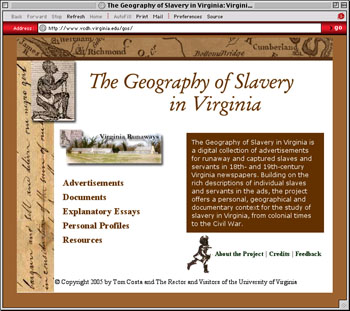
Fig.1. Virginia Center for Digital History and University of Virginia

The Geography of Slavery

Virginia Center for Digital History and University of Virginia, Wise
http://www.vcdh.virginia.edu/gos/

If you wanted to know how many enslaved women ran away while pregnant in the eighteenth century, you might visit “The Geography of Slavery” Website. With over 4000 advertisements culled from Maryland and Virginia newspapers from 1736-1795, this site offers several user-friendly tools that allow viewers to explore the experiences of runaway slaves and indentured servants. Entering the phrase “with child” in the site’s search engine, for example, generates a list of twenty-two advertisements, documenting the experiences of women in various stages of pregnancy. The first relates to Moll, an eighteen-year-old Virginia-born enslaved woman, “very big with Child,” who ran away from Hanover County in the fall of 1739. A transcription of the newspaper notice accompanies the facsimile reproduction. Age, gender, skills, places, and dates can also be used to identify and locate different groups. 

Other useful supplemental material includes transcriptions of relevant legislative records, with full texts of government documents and laws, as well as complete bibliographic information; papers from slaveholding families; and other newspaper articles pertaining to slaves and servants. 

Teachers might find the “Resources” section useful. It includes a glossary, clear teaching materials with K-12 objectives, and links to other valuable sources. In the future, a graphic locator and timeline of runaways will be added to the site, as will additional advertisements from the nineteenth century. Other site components currently in development include background essays and profiles of individuals. 

Support for the site comes from the National Endowment for the Humanities and the Virginia Foundation for the Humanities, with site sponsors at the University of Virginia including the Center for Technology and Teacher Education, the Electronic Text Center, and the Virginia Center for Digital History.

American Memory: Historical collections for the National Digital Library

Library of Congress, American Memory

Library of Congress, American Memory http://lcweb2.loc.gov/amhome.html

One of the most important archives of American history online, the American Memory project of the Library of Congress covers several centuries and includes immense quantities of material, with over one hundred major collections and nine million individual items related to the history of America. Particularly useful is the browse feature, which allows visitors to select collections by topic, such as “government” or “Native American history”; by time period, 1400-1699, for example, or 1800-1849; by kind of material, such as sound recordings, photographs, and manuscripts; and by place.


This article originally appeared in issue 5.4 (July, 2005).


Blogging in the Early Republic

Why bloggers belong in the history of reading

I.

Henry Clarke Wright was an antebellum American reformer whose eclectic interests ranged from antislavery to radical pacifism to health reform and beyond. Born in 1797 and educated as a minister, he later abandoned institutional religion and became a prolific writer and speaker. In countless lectures delivered across the American North and the British Isles—where he spent most of the 1840s—Wright inveighed against war, corporal punishment in the home, slavery, loveless marriage, church and state, traditional medicine, and much else.

Above all, Wright wrote. According to the count of his only biographer, he authored eleven books, numerous articles in reform newspapers like William Lloyd Garrison’s Liberator, and over two dozen tracts and pamphlets. The Irish abolitionist Richard D. Webb, who hosted Wright in his Dublin home in 1844, reported to a mutual friend in Boston that Henry was lately spending “the greater part of the day writing in his room. I suppose he thinks he is shaking the world, but I can perceive very little of the motion so far.”

As a writer with grand aspirations for shaking the world, Wright was also an inveterate journal keeper. For most of his adult life, he filled a steady stream of over one hundred diaries. In these, comments on world events and social reform jostle with reflections on the diarist’s loveless marriage and his struggle for faith. While private, the journals were also public. Wright mailed pages and even whole volumes to his friends or read them excerpts from the diaries, and many pages were later published in his numerous books. Thus, as his biographer Lewis Perry notes, in the case of Wright, “distinctions between private and public, between diaries and published writings, meant little.”

In Human Life: Illustrated in My Individual Experience as a Child, a Youth, and a Man (1845), one of his published writings in which diary entries were frequently excerpted, Wright confessed that “writing a journal does me good. I can let off my indignation at the wrongs I see and hear. I am far happier when I write a little every day. I take more note too, of passing events, and see more of what is going on around me. I live less in the past and future, and more in the present, when I journalize . . . It saves me from many dark hours to write down what I see and hear and feel daily. My soul would turn in upon and consume itself, if I did not thus let it out into my journal.”

Wright died in 1870, already a relatively forgotten reformer. Yet—and I speak from my own experience in 2005—his reflections on writing are eerily evocative of what it is like to blog. Wright shared several traits with the prototypical blogger—his eccentric range of interests, his resolution “to write down what I see and hear and feel daily,” his use of journals to “let off” rants of “indignation,” his utopian conviction that writing might change the world, and (not least) his practice of spending the “greater part of the day writing in his room.” Was Wright a blogger? Are not his journals the fossilized originals of a species?

II.

If you scoff at this suggestion, this is probably because you hold this truth to be self-evident: In the course of human events, blogging is the newest of newcomers.

After all, blogs—short for “Web logs”—are Web pages, which means that they cannot be older than the World Wide Web. Moreover, a blog refers to a kind of Web page that has only become widespread in the past five or six years. Blogs are frequently updated pages that list brief, time-stamped posts. These can contain text, links, images, or all of the above. Though seemingly ubiquitous today, the form itself is relatively new, even in the abbreviated history of cyberspace. The term “Web log” was never used until circa 1997, when it was coined to refer to a few dozen journals that were being published online by early Internet users, mainly as annotated lists of links to interesting Web pages.

As these early bloggers began to link extensively to other blogs, the “blogosphere” was born—about fourscore and seven months ago. That makes the career of the blogosphere only slightly older than that of Britney Spears—hardly a hoary age, and certainly not old enough for Henry Clarke Wright to be a blogger.

Yet as blogging has quickly become a cultural—and now political—phenomenon, speculations about the historical precursors to blogging have become matters of course. Tens of thousands of new blogs are now created every day, on subjects ranging from the highly personal to the political, from careers to crochet, from academia to art, from movies to “moblogs”—collections of photographs taken using mobile phones. Technorati, a special search engine that tracks links between blogs, now follows over ten million blogs. In the last few years, the dynamic growth and diversification of blogging has attracted attention from journalists, political pundits, and scholars, and many pixels are now being spilled about the political influence of blogs—as bellwethers of opinion, as sources of trenchant social criticism, as innovative forms of citizen journalism, or as tools for political organization.


Thomas Paine, blogger?

For every writer who says that blogging is beginning to shake the world, there is another who confesses that it is difficult to feel the motion. But it is worth noting that both the true believers in blogging and the skeptics are leavening their debates with allusions to history—along with suggestions that blogging is not as new as you think. Three years ago, in the New York Times, Emily Eakin called the blogger a “new breed of pamphleteer,” who would have pleased George Orwell, “if he had lived to surf the Internet.” The headline declared that the “ancient art of haranguing”—practiced so well by pamphleteers like Orwell and “master rhetoricians” like Daniel Defoe and Thomas Paine—”has moved to the Internet, belligerent as ever.”

For Eakin, blogs were both “new” and “ancient”—the same old whining in new wineskins. Yet on the whole, writers about blogging cannot seem to decide whether blogging is more continuous or discontinuous with the past. Bits of historical flotsam float, willy-nilly, through many discussions about blogs, available for use by boosters and critics alike. In 2002, for example, blogger Andrew Sullivan compared the invention of group blogs to the way that “reviews and magazines started out decades and centuries ago: a few like-minded souls collaborating on a literary-political project.” Sullivan mused that “perhaps blogs—and the technology that enables them—will take us back to the 18th century. I sure hope so.” Similarly, on his blog PressThink, media critic Jay Rosen has argued that if bloggers are the faces of journalism’s future, their faces are also turned toward the past. “The people who will invent the next press in America—and who are doing it now online—continue an experiment at least 250 years old.” Rosen admires TomPaine.com, a progressive Website for news and commentary, because it “leaves the arrow pointing backward to Paine the troublemaking democrat and political journalist, reviving his name for symbolic purpose in the present.” Fittingly enough, TomPaine.com has a blog.

Yet if some writers use history to compare blogging to some halcyon yesteryear, other writers use history to put a damper on the hype. A recent USA Today headline advised “blogophiles” to “chill,” admonishing them that “you’re not the first to do what you’re doing.” “Thomas Paine was basically a blogger—in 1776,” wrote technology columnist Kevin Maney, who also identified the works of Orwell and Martin Luther as “historical antecedents” for blogs. “The printing press gave Luther a way to distribute his thesis—an early version of blogging. Next thing, we had Protestants.” Blogs, said Maney, are just “another turn of history’s wheel, not a radical departure.”

Are blogs really just another turn of history’s wheel? Yes and no. Bloggers do have some historical antecedents in the eighteenth and nineteenth century. But the usual suspects in the examples above—Paine, Luther, Orwell—are in various ways misleading. Treating these highly influential writers as analogues for bloggers serves a particular understanding of blogging as primarily political. Moreover, it perpetuates a picture of the blogosphere that is skewed toward elite and highly visible blogs. The better analogues for bloggers may not be towering literary figures like Paine, but more forgotten writers like Wright. The arrow for blogging should be left pointing backwards, as Rosen suggests, but where it points is another question.

III.

Just five years ago, blogs were still a rarity, but since September 11, 2001, their numbers have skyrocketed. The growth has been especially staggering among “poliblogs” and “warblogs,” many of which model themselves on the punditry of sites like Glenn Reynolds’s Instapundit. By the 2004 election, prominent bloggers like Ana Marie Cox of Wonkette were being invited to the presidential nominating conventions of both parties, and mainstream news organizations have proclaimed polibloggers a force to be reckoned with. In 2002, Joshua Marshall, who blogs at Talking Points Memo, helped to discredit former Senate majority leader Trent Lott for his statements on racial segregation, which led to Lott’s eventual resignation. More recently, bloggers exposed forged memos used by CBS News for a story on President Bush’s military service during the Vietnam War.

This, at least, is the conventional history of blogging. But the story is a skewed one. Although famous poliblogs receive the lion’s share of attention from bloggers and journalists alike, most blogs go largely unnoticed by the mainstream media. Of the millions of blogs tracked by Technorati, the vast majority are not concerned primarily with political influence or alternative journalism. There are knitting blogs, book blogs, poetry blogs, academic blogs, cooking blogs, photo blogs, religion blogs, gossip blogs, teaching blogs, parenting blogs, and more.

The full history of blogging, then, cannot be told simply as a story of how the poliblogs rose into mainstream consciousness or acquired political influence, because that story fails to account for the size and heterogeneity of the blogosphere as a whole. Yet when historical analogies to blogging are offered, they usually reinforce the idea that blogging is mainly a political enterprise, dominated by a few leading figures. Consider the historical figures mentioned above as the progenitors of blogging—Paine, Luther, Orwell. Organizing a genealogy of blogging around such monumental writers only underlines the sense that prominent poliblogs are the endpoints in a teleological progression of popular political writing. Blogging analysts who focus on the elite poliblogs are likely to see their aspirations for influence as defining features of blogging itself, as if most blogs exist primarily to act as molders of public opinion.

Instead, I would like to suggest some analogues to blogging from antebellum America that contradict a history of blogging built on a long list of great writers. Those analogues can be found not primarily in the history of writing, but rather in the history of American reading.

Most historians agree that major transformations in printing and reading took place in the United States between 1750 and 1850—changes that seemed as phenomenal to contemporaries as blogging seems to many in our own time. At the beginning of this roughly hundred-year period, printed material was scarce, and the diffusion of information was severely limited in terms of time and space. In the seventeenth and early eighteenth centuries, colonial printers used their presses mainly to publish official proclamations, almanacs, commercial newsletters for merchants, and occasional sermons. But these materials were not produced in large quantities, and print was even scarcer in rural areas than in port cities. 

Yet by 1850, this scarcity of print had given way to a bewildering abundance—a rapid growth no less impressive in its own time than the exponential proliferation of blogs in the last few years. Newspapers began to crop up not just in major urban areas but in smaller towns, and as print became more abundant, it was also diffused more widely and rapidly, thanks to a transportation revolution fueled by steam, railroads, and internal improvements like roads, canals, and an expanding postal service. These changes were, of course, not unique to the United States, but even foreign travelers to the young nation were awed by its burgeoning print culture. Alexis de Tocqueville, after touring the United States in 1831, wrote, “[W]hen I compare the Greek and Roman republics to these republics of America, the manuscript libraries of the first . . . to the thousand newspapers that crisscross the second . . . I am tempted to burn my books so as to apply only new ideas to a social state so new.”

Tocqueville’s references to republicanism and a new social state were not coincidental, because social and political democratization was both a cause and effect of the print revolution. In the colonial period, print remained scarce partly because information was thought to be a privilege of the few. As historian Richard Brown has argued, those with power—political and religious elites, wealthy planters and merchants, white men all—controlled the flow of knowledge, and access to print and public information required deference to their power. The shift from a scarcity of print to abundance was therefore accompanied necessarily by a measure of increased democratization. Such, at least, was what Tocqueville concluded. In answer to Europeans who thought that reducing taxes on print would “increase newspapers indefinitely,” he argued that “newspapers multiply not only relative to their cheapness.” In addition, “the empire of newspapers” would grow “as men become equal.” 

The growth of the empire of newspapers had two related effects on the practices of American readers. First, the new surplus of print meant that there was more to read. Whereas readers in the colonial period had been intensive readers of selected texts like the Bible and devotional literature, by 1850 they were extensive readers, who could browse and choose from a staggering array of reading choices. Second, the shift from deference to democratization encouraged individual readers to indulge their own preferences for particular kinds of reading, preferences that were exploited and targeted by antebellum publishers. In short, readers had more printed materials to choose from, more freedom to choose, and more printed materials that were tailored to their choices.

These were prime conditions for the emergence of reading practices similar to blogging. For nineteenth-century Americans, unprecedented access to reading material “bred the feeling of independence,” argues Brown. “Instead of being obviously and directly dependent on public officials and social superiors for information,” readers could now “acquire information on their own in the marketplace, more or less on an equal basis.” But as readers became more extensive in their reading, they also had to develop principles for selection. What should one read, when there was so much to choose from? And now that information was not always mediated by the interpretations of colonial elites, how should one deal with the glut of information available? As Brown continues, “Selecting what information to acquire replaced access itself so as to emerge as a central challenge for people in varied social circumstances.”

One of the ways that readers met these challenges was to “journalize,” to borrow the word used by Henry Clarke Wright. Surrounded by ephemeral print, many began to make references in their journals to what they had been reading—the rough equivalent of what bloggers do by linking to a Web page. During the Revolution, for instance, Christopher Marshall, a Philadelphian radical and friend of Thomas Paine, peppered his journal with references to the papers, often with brief comments on the news. “Sundry pieces of news last night in the Evening Post, Numb. 147,” he jotted in December 1775. Earlier in the year, after recording the casualties at Bunker Hill, Marshall tipped his hat to “Evening Post, No. 74, and J. Humphrey’s Ledger, No. 25″ for the information. With more news available, diarists like Marshall began to construct their own networks of information, annotating the news to create a record of their reading.

Wright’s journals, written decades after Marshall’s in a period of even greater print abundance, similarly recorded his reading and punctuated that record with commentary. One typical Wright entry must have been written while reading the latest paper brought by the Atlantic packets that ran from Liverpool to Boston: “News from England. Queen Victoria has a daughter. Millions of dollars are being expended to celebrate the babe’s birth. This money comes from the mouths of the children of the poor who cry for bread . . . The British Army in India has been defeated by the Natives. What right has that robber Nation to hold Dominion over India? Only the Robber’s right. England is a Robber and a Pirate. Great excitement in England on the Woman Question.” Wright’s selection of news—mixed with his views—demonstrated the freedom with which antebellum readers interacted with printed news. 

Other readers skipped over copying from their papers and simply cut out articles to paste directly into scrapbooks, scribbling commentary in the margins around the clippings. In his book City Reading, historian David M. Henkin describes a multivolume journal by New Yorker Edward Neufville Tailer Jr., entitled “Journal of Some of the Events Which Have Occurred in My Life Time.” In the 1840s and 1850s, says Henkin, clippings from newspapers began to “dominate Tailer’s diary,” which became a “record of his daily reading habits.”

As individual readers freely made choices about what information to acquire, they also freely came together as groups of like-minded readers. In the more heavily urban Northern states, Americans began to join voluntary associations at remarkable rates—library clubs, lyceums for hearing speeches and discussing ideas, political parties, and religious and reform organizations. Each of these associations was also a reading community, which connected members by official publications and common reading habits. Within these groups, readers also found new opportunities to become writers, as many amateur writers now produced articles for reform papers or poems for religious magazines. Whereas private reading choices in the colonial period had governed vertical relationships between elites (who possessed information) and non-elites (who did not), reading choices in the early nineteenth century became public matters, defining horizontal relationships among individuals who met on a more equal footing. Tocqueville also noted this aspect of the print revolution when he observed in the United States “a necessary relation between [voluntary] associations and newspapers: newspapers make associations, and associations make newspapers.”

IV.

Perhaps there is a similar relationship between blogging and the print culture of the twenty-first century, a culture that now includes not only an abundance of printed pages, but also an abundance of Web pages. American readers at the turn of the nineteenth century found themselves afloat on a sea of print, whose tide had risen along with democratic ideas about the diffusion of information. They responded to these liberating circumstances by selecting what to read and interpreting the news according to individual preference. Privately, records of reading—and the writing they inspired—could be kept in journals and scrapbooks. But those private records also pushed readers outward into communities of like-minded readers. In these communities, readers also became writers.

The blogosphere as a whole represents a similar pattern in a different medium: confronted by an ever-growing number of Web pages and a massive amount of online information, bloggers use their blogs to mix quotidian reflections about life together with records of their reading. Like Christopher Marshall and Edward Tailer, they link these reflections back to the sources—”clipping” sites that interest them. But their interests and choices about what to read also connect them to small communities within the blogosphere, much as a reader-writer like Henry Clarke Wright was drawn into the circle of abolitionist and pacifist reformers by their common pathways through the abundant print culture of the antebellum North. The typical blog links not only to pages outside of the blogosphere, but also to other blogs, and these links often create small networks of like-minded bloggers. In addition, most blogs are equipped with technology that allows readers to leave comments on posts or to alert authors that they have replied to a post on their own blog. Through these interactive practices, associations of a certain kind are formed. To paraphrase Tocqueville, Web pages make blogging networks, and blogging networks in turn make their own Web pages.

This historical analogy, of course, represents my own highly individualized selection of readings from a huge abundance of writing both on the blogosphere and on early American print culture. But the fact that I can make a selective reading is a testament to the phenomenon of democratization and information growth that I am describing. Moreover, there are virtues to my selective reading. By comparing the rise of blogging to events in the history of reading rather than to epochal events in the history of political dissent, we can take into account a larger number and a wider range of blogs. Not all bloggers are would-be Thomas Paines. But almost all bloggers make their own small worlds by offering highly individualized collections of reading choices. Through these choices as readers, they also join virtual associations of other readers. The basic practice that underlies most blogging is therefore not unprecedented. Historically, when an abundance of public information is conjoined with democratized ideas about the flow of information, something like blogging usually results. 

Of course, for all the similarities I have outlined between bloggers and antebellum diarists like Henry Clarke Wright, there are probably as many differences between the two periods. You might point out, for instance, that if Wright had possessed access to a computer and a broadband Internet connection, he could have written even more than he did and reached even larger audiences. He could have. But the vast majority of bloggers, despite their considerable technological advantages over Wright’s paper and ink, have regular audiences and communities that may be even smaller than Wright’s circle of friends. And despite our differences from antebellum readers, the central challenge for us, as it was for them, is not how to gain access to an abundance of information, but how to decide what information to acquire and which associations to make. In real terms, bloggers do have access to more information than nineteenth-century readers did, but there is only so much information that any one reader can digest, so the problem for both still becomes what to read and how to read it.

Indeed, blogging demonstrates the persistence of a key truth in the history of reading, an insight as obvious to Tocqueville as it should be to most bloggers today. The insight is that readers, in a culture of abundant reading material, regularly seek out other readers, either by becoming writers themselves or by sharing their records of reading with others. That process, of course, requires cultural conditions that value democratic rather than deferential ideals of authority. But to explain how new habits of reading and writing develop, those cultural conditions matter as much—perhaps more—than economic or technological innovations. As Tocqueville knew, the explosion of newspapers in America was not just a result of their cheapness or their means of production, any more than the explosion of blogging is just a result of the fact that free and user-friendly software like Blogger is available. Perhaps, instead, blogging is the literate person’s new outlet for an old need. In Wright’s words, it is the need “to see more of what is going on around me.” And in print cultures where there is more to see, it takes reading, writing, and association in order to see more.

Further Reading:

Lewis Perry, Childhood, Marriage, and Reform: Henry Clarke Wright 1797-1870 (Chicago, 1980); Richard D. Brown, Knowledge is Power: The Diffusion of Information in Early America, 1700-1865 (New York, 1989); David Henkin, City Reading: Written Words and Public Spaces in Antebellum New York (New York, 1998); William Duane, ed., Extracts from the Diary of Christopher Marshall, 1774-1791 (reprint, New York, 1969); Alexis de Tocqueville, Democracy in America, ed. Harvey C. Mansfield and Delba Winthrop (Chicago, 2000), 172-80, 289, 493-95. Most of the journals of Henry Clarke Wright are located at the Boston Public Library and the Houghton Library at Harvard University.


This article originally appeared in issue 5.4 (July, 2005).


W. Caleb McDaniel is a graduate student in the department of history at The Johns Hopkins University. He is completing his dissertation on transnational dimensions of the American antislavery movement; he also blogs at Mode for Caleb and Cliopatria, a group blog for historians.


Mechanized Language and Class Formation

Stephen P. Rice, Minding the Machine: Languages of Class in Early Industrial America. Berkeley: University of California Press, 2004.

As Stephen P. Rice’s subtitle suggests, Minding the Machine investigates the role of language and the discourse of mechanization in the formation of class in antebellum America. Rather than exploring social conditions and the way that new types of machinery helped propel workers and managers toward particularized and often oppositional class consciousness, this creative study focuses on the role that popular discussions about the relationship between manual labor and mental labor played in fostering class. Through chapters on mechanics’ institutes, manual labor schools, popular health reforms, and the drive to prevent steam boiler explosions, Rice demonstrates how linguistic choices helped create a ripe environment for the conceptual side of middle-class formation.

Unlike other studies of mid-nineteenth class formation that give primacy to local or regional material conditions, Rice opens his purview to broad popular discourse that includes newspapers, pamphlets, and journals in cities from New Orleans and Cincinnati to Philadelphia and New York. Most of his sources, however, hail from a small number of northern industrial areas and the inclusion of a handful from the South do not really make a case for a true national dialogue on mechanization and class. Likewise, many of the mechanics’ institutes and manual labor schools detailed in the work seemed to be located in the Northeast and industrializing Midwest. 

Critical to Rice’s analysis is his belief that the “social experience of class” has both material and discursive components that constantly inform one another. However, instead of employing this understanding to demonstrate such an interplay in the way that mechanization affected class formation, Rice jettisons the material component almost completely. He explicitly writes little about the politics or social lives of those who created the national discourse that he interrogates and chooses not to investigate the individuals who read the newspapers and journals or “gathered to listen to lectures, attended mechanics’ fairs, or enlisted in health reform movements” (9). 

Instead, the study scrutinizes the two sets of intellectual relationships created by new steam- and water-powered machinery in the antebellum age: ones between “humans and production machines” and ones “between managers and mechanized workers” (14). If the advent of machinery tended to degrade the status of manual laborers or “hands” who no longer needed craft proficiency to perform their jobs, it also tended to elevate the position of managerial workers or “heads” who performed mental work to direct business operations. This division sowed the seeds of new class separation. 

However, Rice argues that those responsible for crafting middle-class authority “worked to mitigate class tensions by promoting a series of conceptual frameworks that effectively undermined oppositional notions of class” (146). Chapters 2 and 3 most effectively tease out these frameworks by focusing on how the movement to build mechanics’ institutes and manual-labor schools reflected an ongoing debate about the relationship between manual labor and mental labor. Taken together, such institutions showed the interdependence between “heads” and “hands” and provided a metaphorical guide for the relationship between workers and managers in the mechanical world.

The Mechanics’ Institute of the City of New-York and similar institutions helped at best to repair or attempted at worst to obfuscate the divisions between “hands” and “heads” by offering popular educational programs that provided mental content for manual workers. Lecture series on natural philosophy, chemistry, and mechanics and publications such as the Mechanics’ Magazine and Journal of the Franklin Institute helped reinforce the notion that an informed head should guide skilled hands. Such materials, Rice argues, also tried to reinforce an analogous and harmonious relationship between manual and mental labor. Similarly, manual labor schools such as Lafayette College trained a new managerial class by marrying “classical educations” with manual labor in “workshops, gardens, and farm fields” as a way of blunting the inevitable separation of “headwork” from “handwork” (70-72). By repeating the interdependence of mental health and physical health, such schools reinforced the harmonious relationship of “heads” and “hands.”

The issue of physical health and the body’s relationship to machinery informs chapter 4 of the book. Through figures like Sylvester Graham and William A. Alcott, Rice argues that contemporary debates about popular physiology utilized a metaphor that bodies acted as machines and therefore created the notion that all people were natural machine operators. Such a conceptualization also naturalized the ascendancy of the mind over the body and, by extension and analogy, the manager (head) over the worker (hands). However, it is in this discussion that Rice’s decision not to fully engage the social lives of those who used the machinery in question or explore the effects that machinery had on the lives of workers exposes the limitations of his study. The insistence on a completely discursive approach here prevents Rice from fully dealing with the relationship between the mind and the body. 

As part of his discussion on popular attempts to mute class tension, Rice cites Robert Dale Owen’s 1835 announcement to create a manual labor school in New Harmony, Indiana, and the school’s egalitarian potential to teach men from all walks of life to respect others’ occupations (72). However, he does not mention a prolonged debate Owen, as a leader of the New York Working Men’s Party, carried on five years earlier with William Jackson Jr., a leader of the Delaware Working Men’s Party, over the result of new machinery on the labor market and the subsequent relationship between labor-saving machinery, family size, and population growth. The debate eventually resulted in Owen’s publication of Moral Physiology, the first birth control tract in American history. Such an inclusion would provide much-needed social context for Rice’s discursive study.

As a whole, Rice’s study is not equal to the sum of its parts. While individual chapters offer engaging portraits of important and under-studied aspects of American society, like mechanics’ institutes and manual labor schools, the decision to focus solely on languages of class hampers the bigger argument about class formation. Without more context, we do not know whether these examples of popular discourse were merely peripheral aspects of class formation or particularly instrumental intellectual moments. These criticisms aside, Stephen P. Rice’s Minding the Machine: Languages of Class in Early Industrial America offers a well-written exploration of the public discussion about mental and manual work in the nineteenth century. 

Further Reading:

For other views on the antebellum debate between mental labor and manual labor see Jonathan A. Glickstein, Concepts of Free Labor in Antebellum America (New Haven, 1991); Norman Ware, The Industrial Worker, 1840-1860 (Chicago, 1990); Nicholas K. Bromell, By the Sweat of the Brow: Literature and Labor in Antebellum America (Chicago, 1993); and Paul G. Faler, Mechanics and Manufacturers in the Early Industrial Revolution: Lynn, Massachusetts, 1780-1860 (Albany Press, 1981). On antebellum technology see John F. Kasson, Civilizing the Machine: Technology and Republican Values in America, 1776-1900 (New York, 1976); David A. Zonderman, Aspirations and Anxieties: New England Workers and the Mechanized Factory System, 1815-1850 (New York, 1992); and Judith A. McGaw, Most Wonderful Machine: Mechanization and Social Change in Berkshire Paper Making, 1801-1885 (Princeton, 1987). For a discussion of class and language in England, see Gareth Stedmen Jones, Languages of Class: Studies in English Working Class History, 1832-1982 (Cambridge, 1983). For the debate between Robert Dale Owen and William Jackson Jr., see New York Free Enquirer, June 12 and September 25, 1830.


This article originally appeared in issue 5.4 (July, 2005).


Joshua R. Greenberg is assistant professor of history at Bridgewater State College. His book, Advocating the Man: Masculinity, Organized Labor, and the Household in New York, 1800-1840, will be published as part of the Gutenberg-e project at Columbia University Press in 2006.


Along the Beaten Path in Early Kentucky

Craig Thompson Friend, Along the Maysville Road: The Early American Republic in the Trans-Appalachian West. Knoxville: University of Tennessee Press, 2005.

Craig Thompson Friend has written a biography of the thoroughfare that provided passage from Maysville, Kentucky, on the Ohio River, south to Lexington in the heart of Bluegrass Country. It began as a buffalo trace before conflict between Native Americans and early settlers transformed it into a beaten path. As a commercial economy grew up along its length, later generations molded it into a true road. This corridor provides the perfect setting, Friend writes, for “a microhistory of social and cultural change in the Early American Republic” (4).

The first chapter details the early settlement of the five counties that became home to a wide variety of people in the late eighteenth century: Virginians, Pennsylvanians, New Englanders, African Americans, Scots, Scots-Irish, Germans, and other European immigrants. Friend labels the region “the Village West”—though not precisely urban, the region was not wholly rural. Small towns served as market centers with stores, taverns, mills, and churches. The second chapter focuses on the arrival of a gentry class who sought to impose order on the region, and the third describes the growth of a market economy. Friend adds a section that explains the impact of settlement and trade on the natural environment. The fourth chapter is entitled, “New Americans? Revising Identities and Communities.” Topics include the Second Great Awakening, militias and the War of 1812, and the development of Lexington as the Athens of the West. The final chapter, “Changing Landscapes: The Triumph of the Middle Class,” discusses the growth of class distinctions, the rage for refinement, the expansion of slavery, and the push for internal improvements. Other topics of interest include masculinity, femininity, ecology, material culture, architecture, and gentry ideals. The author poses excellent questions in his introduction, but one must read carefully to discern the path of the argument that he intends to make. Likewise the individual chapters need stronger signposts along the way to guide readers through. The book ends abruptly in 1835 when the Maysville Turnpike replaced the old road, and there is no conclusion to pull the book’s themes together into a strong statement about what we can learn about the early American republic by expanding our view to include Kentucky. 

Friend clearly sets out to engage in the debate over the transition to capitalism in early America. Historian Allan Kulikoff divided the scholars of the 1970s and 1980s who argued over this development into two camps: social historians and market historians. Both focused on the question of household production for use versus household production for exchange or market, with one side arguing that market forces intruded on long-settled, precapitalist communities in a destructive way, while the other side argued that capitalism and markets developed very early and most Americans were eager to participate in them. But while Friend uses the term “moral economy” freely throughout the book and cites almost every relevant study, he inexplicably overlooks Daniel Vickers’s seminal 1990 William & Mary Quarterly article that reframed the debate. I do not, of course, expect Friend to throw in his lot with Vickers and agree with his interpretation, but I do expect Friend to engage Vickers’s theoretical model—at least in his footnotes, if nowhere else. 

Friend and Vickers actually agree that farmers produced goods for both personal use and a wider market, doing whatever was needed to insure the independence of their families. But Vickers goes further. According to him, the moral economy of Great Britain that involved common people uniting in community rituals (and occasional riots) to force the propertied class to acknowledge their moral duty to provide for those dependent on them could never really take root in America because too many men had access to land of their own. Tenants always believed that land ownership lay just around the corner—often despite all evidence to the contrary. According to Vickers, familiar community rituals like harvests, quilting bees, and town meetings were meant to keep peace between competitive neighbors rather than cement class solidarity. Vickers theorized that in place of a European-style class system, Americans organized their economy around four “agencies of power”: credit, political privilege, paternal authority, and slavery. Friend misses a real opportunity to test Vickers’s model—Vickers could only consider the first three in relation to the New England family of his study; Friend could have added much to the debate by considering the evolution of all four in Kentucky. Friend makes it clear in his introduction that all are in fact central to his study, but he fails to deal with these themes in a systematic fashion that a reader can track from the beginning of the book to the end.

Vickers’s argument is made stronger by his interpretation of what the new backcountry history of the 1980s—studies of eighteenth-century violence on the frontier in the Carolinas, western Pennsylvania, Vermont, and Maine—had to offer the debate. According to Vickers, though these conflicts pitted have-nots against haves, they subsided once the lower and middling sorts gained access to the economic opportunities that those on the seaboard enjoyed. Of the trans-Appalachian West, Friend writes, “The historiography of early Kentucky seems to dwell on one question that has never been clearly enunciated by historians: Why did the settlement process not result in the violent social conflict typical of other contemporary backcountries?” (93). In fact, a historian who appears in the citations of every chapter of Friend’s book focuses on exactly this issue, and his point is similar to that of Vickers. In How the West Was Lost: The Transformation of Kentucky from Daniel Boone to Henry Clay, Stephen Aron writes, “[N]o rebellion erupted during the 1780s, because too many occupant-improvers had too much to lose from a general redistribution. For Kentucky pioneers in affairs of land, the tradition about what homesteaders needed to get by too often yielded to their ambition to get more” (194).

Considering how often rivers ran low or froze over, however, Craig Friend is really onto something by focusing on the Maysville Road, and his analysis is strongest when he concentrates his attention on the beaten path itself. The evolution of society can be clearly seen when laws requiring all men to participate in maintaining and improving it give way to laws allowing the gentry to send slaves instead. The author’s account of how a cholera epidemic forced residents to flee and hastened the end of the road in the early 1830s is truly harrowing. Along the Maysville Road is a readable account of the evolution of Kentucky in the decades that followed the American Revolution. Friend evokes the look and feel of the place quite clearly, and the author’s liberal use of quotations from letters, diaries, travelogues, and newspapers allows the voices of farmers, merchants, and planters to be heard. For those who have not remained current on the changing historiography of early Kentucky, this book is a very good place to start. Friend touches on important new topics, and readers can follow his footnotes to more specialized treatments of anything that piques their interest.

Further Reading:

For the best study of Kentucky as a backcountry, see Stephen Aron, How the West Was Lost: The Transformation of Kentucky from Daniel Boone to Henry Clay (Baltimore and London, 1996). Relevant critiques of the debate over the transition to capitalism in early America include Allan Kulikoff, “The Transition to Capitalism in Rural America,” William and Mary Quarterly, 3rd ser., 46 (January 1989): 120-44; Michael Merrill, “Putting ‘Capitalism’ in Its Place: A Review of Recent Literature,” William and Mary Quarterly, 3rd ser., 52 (April 1995): 315-26; and Daniel Vickers, “Competency and Competition: Economic Culture in Early America,” William and Mary Quarterly, 3rd ser., 47 (January 1990): 3-29.


This article originally appeared in issue 5.4 (July, 2005).


Kim M. Gruenwald is associate professor of history at Kent State University and author of River of Enterprise: The Commercial Origins of Regional Identity in the Ohio Valley, 1790-1850 (Bloomington & Indianapolis, 2002).


The Not-So-Unfamiliar Jefferson

Andrew Burstein, Jefferson’s Secrets: Death and Desire at Monticello. New York: Basic Books, 2005.

With his new book Jefferson’s Secrets: Death and Desire at Monticello, Andrew Burstein contributes another volume to the ever-growing genre of founding-generation biography. Most recently authors have focused their attention on Benjamin Franklin, but in fact few members of that revered group, the Founding Fathers, have escaped scholarly (and popular) analysis. Unlike many of his predecessors, though, Burstein is not interested in celebrating the virtues of his subject or attacking him as a hypocrite. Instead, he seeks to create a middle ground, a corrective for others to follow. The author aspires to present an examination of Thomas Jefferson on his own terms, as he would have seen himself, and ultimately, as a man few present-day readers would recognize. In other words, Burstein is “interested in the unfamiliar that was familiar to Jefferson” (2).

To accomplish this goal, Burstein redirects his reader’s attention away from the ever-popular portions of the third president’s long and distinguished political career and asks the audience to focus on Jefferson’s retirement years and the world of medical enlightenment he inhabited. It is in this time and amidst this context that Burstein claims to have discovered “a relatively uncensored Jefferson” and a rich language of eighteenth-century health science, which together finally reveal the “secrets [that] were hidden in plain view” (283).

Most readers recognize that Thomas Jefferson was a man of the Enlightenment. Like many of his contemporaries, he believed in the individual’s capacity to manipulate, control, regulate, and reform human society. He was constantly experimenting, searching for ways to improve the world he inhabited in practical and socially meaningful ways. Monticello embodied his spirit of improvement more than any other artifact of his life. For Burstein, though, the rational, enlightened Jefferson so familiar to most Americans is representative of only half the man. He declares that to understand the real Jefferson, Jefferson as he saw himself, readers need to understand his “imagination,” particularly as it was informed by the medical Enlightenment. Throughout his public career Jefferson described political contests and evaluated his political friends and enemies by employing the language of the body. As he promoted his own vision of an agrarian republic, for example, Jefferson characterized his opponents as “sickly, weakly, timid” men whose unrestrained pursuit of power and aristocratic tendencies were “thoroughly unhealthy” (57).

Why not, asks Burstein, explore how the third president’s medical ideas might have shaped his private world? Accordingly, Burstein frames his discussion of Jefferson’s retirement amidst his family in terms of his medical sensibility. He concludes that Jefferson’s determination to achieve a balance of felicity and tranquility, a supremely healthy home life, led him to cultivate and maintain strong affectionate and sentimental feelings for his family. Even though the public (and most often celebrated) Jefferson was an austere, rational man, he was consistently passionate about his family. His strong familial affections, however, had little impact on his view of women. As Burstein observes, “Jefferson . . . held fast to rather conventional notions of a woman’s role at home and in society,” a view that persisted even as his own daughter and granddaughter exhibited talents and imaginations that should have undermined his confidence in such a belief. As any scholar might predict, Burstein’s Jefferson “thought that a healthy republic was one in which every inherently passionate female was transformed into a dutiful wife and nurturing mother” (88). While most of what the reader learns in these two chapters is hardly surprising, Burstein enriches our understanding of the very private side of Jefferson by reframing the discussion within a context of his nineteenth-century physiological ideas.

Where Burstein seeks to gain the most from reconstructing Jefferson’s medical sensibility is by using it to explain how and why the Sage of Monticello cultivated a long-term relationship with Sally Hemings. According to Burstein, Jefferson’s understanding of medical theory would have led him to conclude that regular sexual activity was required to maintain his health. Additionally, these same medical ideas could have led Jefferson to determine that Sally Hemings, who was of mixed racial heritage and thought of as “nearly white” by her contemporaries, was more akin to a white servant than a black slave. When combined with his fascination with Greek society and culture, which accepted, even expected, men to enjoy the services of a concubine, Burstein claims that it would have been perfectly logical for Jefferson to maintain a relationship with one of his slaves. It is this collection of contextual evidence that allows the author to declare that “the most reasonable cultural explanation still appears to be that Jefferson found a healthy, fruitful female to bear children for him, whom he supported just as an ancient Greek man of honor . . . would have done. What in modern times appears as the selfish pursuit of physical gratification,” he reminds the reader, “was easily rationalized by the medical literature of Jefferson’s age” (182-86). 

Burstein’s attempt to explain the Jefferson-Hemings controversy is intriguing and innovative, but it is difficult to ignore that the author makes his claims without the benefit of direct evidence. While it is certainly true that Jefferson’s library contained several medical treatises, that many of his intimate friends and correspondents were medical doctors, and that he suffered from a variety of physical maladies that refocused his attention on his body during that last decades of his life, Jefferson never appears to have applied the ideas he absorbed, or discussed his personal sexual habits in the terms Burstein describes. Perhaps one way to address the absence of direct evidence would have been to situate Jefferson within a group of contemporaries who behaved and made the very decisions Burstein suggests. But that context is missing. Instead, the reader is presented with an emotional, feeling, affectionate man happily ensconced at Monticello, an image designed to replace the more conventional understanding of Jefferson as a rational and curious, but aloof, man isolated on a distant mountain top. In his defense, Burstein never claims to substitute context for evidence. He does caution the reader to approach this book with an open mind (4) and confesses that “we can do no more than speculate” given Jefferson’s silence on the issue (182). Still, the confidence with which Burstein moves beyond his own qualifications can be troubling.

While it is probably safe to conclude that he meant to keep the specifics of his relationship with the Hemings family a secret, Jefferson clearly possessed a strong desire to provide posterity with a clear understanding of his public life. According to Burstein, Jefferson’s pursuit of private tranquility and felicity constantly competed with his growing concern for, and even fear of, a Federalist resurgence in the 1820s. As they competed for power just before the emergence of the second party system, national politicians appropriated the legacy of the Revolution to legitimize their policies and their claim to authority. Even more frightening for Jefferson, though, was the unchallenged emergence of Federalists’ interpretations of the Revolution. Although he consistently professed a desire to remain aloof of political controversy, Jefferson increasingly felt compelled to enter the political fray by regulating the use of his own legacy. He attempted to do this by encouraging the publication of Republican histories. Initially, he sought to correct the historical record by soliciting authors and offering advice on content from behind the scenes. But as each person he approached rejected his call to public service, Jefferson concluded that only a “chronicle of his letters and other papers would” accurately “display his convictions . . . tell the truth and do the country good” (231). While Burstein’s Jefferson remained situated in his own private world at Monticello during the last decades of his life, his passionate regard for the nation’s political future constantly pulled him away from his private concerns. In the end, Jefferson could not restrain himself from engaging in historiographical battles designed to promote his own partisan agenda. 

Burstein is most provocative and imaginative, and the book is most intriguing, when he is exploring the “Jefferson-Hemings puzzle,” as he terms it (158). Here he creatively, if at times problematically, addresses the absence of any direct, or even inferential, evidence by reconstructing Jefferson’s medical understanding of sexuality. At the very least, his suggestions will provoke considerable debate both in and outside academic circles. Disappointingly, though, Burstein offers very little that is unfamiliar about Thomas Jefferson. His discussions of the Sage of Monticello’s views on women, race, history, and religion are eloquently presented, but not really ground breaking. Perhaps most ironically, Burstein aspires to place an emotional, imaginative, feeling, and, ultimately, private Jefferson next to the rational, aloof, and aggressive public politician that has dominated the nation’s memory of him. Yet, the sections most readers will remember insist that the Jefferson who maintained a long-standing relationship and fathered children with a enslaved woman could do so precisely because he was a distant, rational, dispassionate man more concerned with maintaining a regimen of physical health than revealing his innermost feelings and passions, even to the family he loved so strongly.


This article originally appeared in issue 5.4 (July, 2005).


Suzanne Cooper Guasco is an assistant professor at Queens University of Charlotte, where she teaches American history. She is currently revising for publication her study of Edward Coles and the problem of authority in the early republic


Of Spoons and Empires

The political uses of silver in provincial New York

The professional study of early America has created a host of subfields whose literatures often do not intersect. Nowhere is this more evident than in the relationship between those who study the period’s material culture and those who examine its politics. The distance between these subdisciplines often seems so great that it becomes difficult to remember that those living in the eighteenth century did not perceive themselves or their world in the way that we who study them do—as a series of disparate activities corresponding to our various scholarly rubrics. Instead, their reality was much like our own: values and beliefs learned and professed in one aspect of life seamlessly shaped behavior in all other realms of existence.

It is with this understanding that we should view a silver communion spoon, which is part of the New-York Historical Society’s collections. The specific structure of this spoon, presumably used in the mid-eighteenth century during communion services in the Church of England, reflects, I believe, a profound and previously ignored change in historical and political understanding that occurred in the period. The spoon bears two royal images: George II’s profile in the bowl (with national coats of arms of the four nations of the British Isles—England, Ireland, Scotland, and Wales—on the reverse) and James II’s profile in the handle. These royal images visually link the Stuart dynasty, the most reviled of English monarchs, to the Hanoverian dynasty that had assumed the British throne in 1714.


Courtesy of the Collection of the New-York Historical Society. Accession number 1926.6.

It is possible that this construction was incidental. The bowl and the handle were formed from coins that bore the respective monarchs’ images. But it seems more likely that either the silversmith, or the person who ordered the spoon, made a conscious decision of political imagination. The unknown artisan united two monarchs separated by decades and by the dynastic upheaval of the Glorious Revolution (1688-89) via a silver braid. There were all kinds of coins in circulation in the colonies whose silver might have been used for this sort of item, and the person or people who commissioned the spoon might have asked to have coins melted down and repoured in the desired form. But they did not. They fashioned the spoon in such a way that the images of the coins became integral to the object.

The choice of George II’s likeness for ceremonial use in provincial America is hardly surprising. He ruled over the empire for thirty-three years, headed the Church of England, and was, by the time of his death in October 1760, the only king a majority of colonials had any living memory of. Contemporary British politicians and subsequent generations of British historians have understood him as a boorish German who attempted to assert royal prerogative at the expense of Parliament, involved Great Britain in a series of continental wars to protect his Hanoverian possessions, and quarreled constantly with his popular son Fredrick, Prince of Wales. But colonials viewed him as a benevolent Protestant monarch who acted as the guardian of pan-European Protestantism and who had risked his life in combat against the hated French at the Battle of Dettigen in 1743. It is now difficult for us to imagine the intensity of their attachment to this distant monarch, but it was real and well remembered even after his death. As late as May 1776, the South Carolinian William Henry Drayton would declare during a public denunciation of George III that “the virtues of the second George are still revered among us—he was the father of his people.”

Less obvious is the reason for the linking of George II’s image to that of James II, the openly Catholic, Stuart king overthrown in the Glorious Revolution. In the eighteenth century, James II vied with Edward II for the title of most hated English ruler—ever! But again, placed within its specific historical and political context, the linkage of George II and James II makes sense. Beginning in a restrained way since the reign of William and Mary, Britain’s post-1688 rulers sought to connect themselves genealogically to the same Stuart kings whose politics and religion they had vilified. Even after James II’s overthrow in 1688, Britain’s subsequent rulers simply could not ignore the hereditary principles central to European society. Indeed, they went to great pains to establish the blood links between themselves and the Stuart kings. It thus became a central tenet of colonial political culture that the Hanoverian kings, whose claims to the British throne rested largely on their Protestantism, were of Stuart descent through one of James I’s daughters.

This political-genealogical linkage manifested itself in print as well as in religious cutlery during the so-called Z debate in Pennsylvania, which occurred at the time of the Zenger sedition crisis in New York. When Z, a writer for the Pennsylvania Gazette (probably John Webbe), attacked the Stuart family and asserted that sovereignty resided in the people, a number of writers rebuked him for his continued hostility to “that royal race.” “Must he be told,” one writer asked, “over and over again, that it borders on disloyalty to treat the Memory of our Present gracious Sovereign’s Ancestors, with so much Spite?” Were not such performances “designed to advance new Seditious Doctrines, and revive old ones, to the lessening of the Prerogative of the Crown, under pretence of maintaining the Rights and Liberties of the People?” The Stuarts “were in many things misled by corrupt Ministers . . . into errors and irregularities in their civil Administration.” But he insisted that they were not all papists and commended James I and Charles I for their loyalty and piety. “Our Present gracious Sovereign’s ancestors”—this was the political-genealogical orthodoxy that became a ligament holding together a far-flung empire personified in the Hanoverian kings.

While it might seem odd that a silver spoon would reflect an emergent imperial orthodoxy, in fact it’s not the only silver item from New York City in that period that has a political-religious theme connected to the empire. The Museum of the City of New York’s collections contain a silver beaker, originally imported from Europe, that was redesigned around 1750 to include political-religious images associated with the first British empire’s prevalent anti-Catholicism. The etchings, probably stylized renderings of the Pope’s Day processions (held on November 5 to mark the foiling of a Catholic plot against James I in 1605, now known as Guy Fawkes’s Day) were, like the spoon’s royal images, designed to convey the values of the prevalent imperial political culture. It may be that a particularly politicized silversmith was working in the city; one of the Joseph Leddels (a father and son of the same name had a silver business in the city) etched the beaker, but it is unknown who did the spoon. Or it may be that the intensifying conflict between France and Great Britain—which had led to King George’s War, the Seven Years’ War, and to the 1745 Jacobite rebellion in Scotland (led by James II’s descendent, Bonnie Prince Charlie)—influenced the decorative arts, just as those tensions shaped so much of what occurred in the first British Empire. Certainly, this same time period saw an imperialization of provincial homes in the major ports as print pictures of British royalty, stoneware and delftware carrying imperial arms, and other consumer goods emblazoned with distinctively Protestant and British themes came to be bought and sold in the port towns’ markets.

The design of the communion spoon and the silver beaker reflected the political values that held together the first British Empire. This political culture had at its core the mission of reinforcing the Hanoverian dynasty’s rule over the first British Empire. That imperative saturated colonial society, shaping its public rites, influencing religious life, insinuating itself into all levels of print culture, and ultimately, expressing itself in a spoon or a beaker. It was in this way that a spoon became more than a utensil and became instead a prop of empire.

Further Reading:

Linda Colley has probed the impact of this linking of the Hanoverian dynasty to the seventeenth-century Stuart kings in Britons: Forging the Nation, 1707-1837 (New Haven, 1992). I have taken up the overtly political and imperial character of consumption in my forthcoming book, The King’s Three Faces: The Rise and Fall of Royal America, 1688-1774 (Chapel Hill and Williamsburg, 2006). The Z debate was played out in the Pennsylvania papers in the summer of 1736.


This article originally appeared in issue 6.4 (July, 2006).


Brendan McConville is professor of history at Boston University and the author of The King’s Three Faces: The Rise and Fall of Royal America, 1688-1776 (2006).


Undisciplined Reading

Finding surprise in how we read

There are moments, usually late in the evening, when I can imagine a voluntary reading life. The bulk of my day is spent among memos; undergrad papers; endless, endless e-mail; committee reports; dissertations; course texts; grants; evaluations; that one, slightly annoying piece of e-mail that gradually and then obsessively overshadows every aspect of my institutional and personal life; lecture notes; petitions; quizzes; department updates; exams; job applications; and graduate student portfolios. Did I mention the e-mail? But late in the evening, I can finally read . . . what? I am equally scattershot at these moments, grazing among the magazines—The New YorkerThe New York Review of Books—and newspapers—the New York Times—to which I subscribe. Then there are the half-read books by Dave Eggers and Karen Armstrong, the dutiful, incomplete readings of Steven Pinker. Well, there’s always The New York Review for Pinker. And does anyone ever finish a book by Dave Eggers?

My hunch is I am describing habits of the tribe, reading practices familiar to academic readers of Common-place. The welter of reading we do within the profession seems at first glance chaotic but no doubt hails us into a larger disciplinary structure, one enshrining hierarchies of knowledge, competence, and validation, and shared by the other learned professions. The late-night moments might also be familiar. They, too, might be part of a discipline, patterned on the wonted behavior expected of enlightened intellectuals across the learned professions. Those organs of New York media are gatekeepers and tastemakers for the overeducated, mooting the latest in policy and aesthetics, science and religion. As to those books, well, substitute Richard Dawkins for Karen Armstrong, Natalie Angier for Steven Pinker, and you know what I mean. The discipline here is to forage across ranges of information, in a set of steps opening the reader up to worlds of knowledge that, at the sequence’s end, confirm, for the liberal obeisant, his or her worldliness.

My reading life isn’t always and hasn’t always been this way. Over a decade ago, I dropped the needle on a set of Bob Dylan biographies. When I became a parent, I suckled at the breast of a mommyblog. More recently, I’ve had my head turned by graphic novelist Chris Ware. But these metaphors of addiction, consumption, and fascination only describe reading in the conventional language of passionate absorption—what we’ve come to term being “lost in a book.” The norm for this kind of absorptive reading is that longish, self-contained, page-turning form passed down from nineteenth-century reading practices: the novel.

I read and teach novels regularly. But is the linear novel the only way one gets lost in a book? Consider those reference works that captivate you: a cookbook, a sports trivia volume, or a recordings guide. You open these books and escape into the pleasure of the cross-reference, the serendipitous, the transport to the known and the unknown. When I open David Thomson’s New Biographical Dictionary of Film, forty minutes later the hard-boiled eggs are hard and boiling over, the cats are draped over the sleeping three-year-old, the dishes are still in the sink. Other than in Thomson’s massaging, prickly prose, I know not where I am. The faint motion sickness I feel is from the cascade of ideas, memories, and anticipations, so different from the psychological and physiological response to channel- or Web-surfing, comparable fragmented modes of consumption. But reference-book reading of this sort assumes connoisseurship—that fancy word for heavy-panting, lighter-waving fandom—a habit of mind profoundly disciplinary.

I should feel shame about my disorderly reading, but I don’t. In fact, I’d like to defend it as a reading practice of depth, rather than superficiality. Disorderly reading mimics the mind’s generative activity of thought and discovery, those instances where you know something is happening but you don’t know what it is. We might better call it discontinuous or nonlinear reading and acknowledge its long history, a history that reveals the fact that nonlinear reading lends itself to routinized procedure as well.

Reading seems ineluctably bound up in discipline, in customary behavior that precedes and structures the significance of the reading. But how then does reading become a means to the new, the unknown, the undiscovered? If even messy reading falls into predictable patterns and outcomes, how might what we read, or rather how we read, surprise us?

My contention is that one might use discipline to escape discipline, that freeing the mind is achieved by entering into restrictive procedures that liberate thinking. Let’s begin by assessing that literary form most associated with the unknown, the undiscovered, or the novel—that is, the novel. Then we’ll turn to early modern disciplines, finding analogies in them for contemporary reading scenes. Our guide here will be that Other to the twenty-first-century secular intellectual: the seventeenth-century English devout, those bigoted regicides and colonial Malvolios known—not without controversy, now and then, now perhaps more than then—as “Puritans.”

Consider the novel. It is here that readers imagine the unimagined. An author invents a fictional world, and in this invention a different contract obtains between reader and text. Unlike the expectation of nonfiction—that it is tethered to reality, to history’s determinants—readers enter the novel as a zone unburdened by the documentary, as a product of artifice and design, a place of play and fate. In this imaginative escape, authors plot events that move readers relentlessly forward, seeking answers to the mysteries established, gratifications for the desires incited. No recent thinker has better captured the pleasures of novel reading than Sven Birkerts in his collection The Gutenberg Elegies. Plenty of digerati have lambasted these beautiful essays, but Birkerts finds language for the consciousness we inhabit when being “lost in a book.” For Birkerts, the novel provides a deep time unavailable to us in our moment-to-moment existence. In the novel, plotting, detail, character, and closure create an inevitable destiny, a fatedness missing from daily life. We are attracted to the novel for its linear design, a particular kind of escape that, with the godly language of “authorial design” and “fated destiny,” broaches the sacred.

The experiential world of novel reading Birkerts recreates is itself built on religious connotations. When an “author’s language [is] resonating in the self,” the self becomes “the soul” and the immersive, deep-time consciousness prompted by novel reading is patently meditative. Whether through Muslim tawil, Zen koan, or Christian closet, meditation requires training, a point Birkerts allows is true of the reading practice he describes as well. You don’t need The Gutenberg Elegies to understand that sustained attention to linear fiction requires discipline—try teaching long novels to undergrads these days. Page-turning absorption, so reverently evoked here as a trance world, is hardly a natural way to read.


The personal miscellanies of Benjamin Franklin's uncle are organized with navigational aids for discontinuous reading. They contain procedural works as well, such as a shaped poem akin to Herbert's "The Altar," the senior Franklin's psalm translations, and this double acrostic, diagonal verse prompted by his wife's name, Hannah Franklin. From "No Cross, No Crown," contained in Notebooks, 1666-1725 vol. I (ca. 1783). Thanks to Peter Stallybrass for the reference to this material. Courtesy of the Manuscripts Collection of the American Antiquarian Society.
The personal miscellanies of Benjamin Franklin’s uncle are organized with navigational aids for discontinuous reading. They contain procedural works as well, such as a shaped poem akin to Herbert’s “The Altar,” the senior Franklin’s psalm translations, and this double acrostic, diagonal verse prompted by his wife’s name, Hannah Franklin. From “No Cross, No Crown,” contained in Notebooks, 1666-1725 vol. I (ca. 1783). Thanks to Peter Stallybrass for the reference to this material. Courtesy of the Manuscripts Collection of the American Antiquarian Society.

As cultivated by the nineteenth-century novel, cover-to-cover escapism of this sort is an anomaly in the long history of reading. And, really, it is the legacy of the traditional novel that has given this anomaly sway, for nineteenth-century authors from Dickens to Stowe were read serially of course. Moreover, with its destinies of death and marriage, novel reading may feel predictable, where novelists ring the changes only to sound increasingly one-note. A more enduring practice and one equally generative of surprise might be called collative reading. Early New England clerics would collate passages from various tomes in their libraries to compose sermons. Yet it wasn’t only the learned who would follow such nonlinear reading methods. Typology, where readers traced Old Testament foreshadowings of New Testament events, is profoundly collative, and the comparing of Hebrew Bible and Christian Gospels was at the heart of practical piety. If you think those prescribed schedules that allowed the devout to complete the bible in a continuous read over the year were the norm, think again: Cotton Mather recommended in his 1683 almanac that readers spend each day discontinuously sorting through the Old Testament, the New Testament, and the Psalms. Commonplacing—the collection and transcription of discrete passages from one’s reading under alphabetical or topical heads within personal miscellanies—was as important to Reformation pietists as it was to Erasmian humanists. Each of these nonlinear methods was a source of fresh insight, which would help the reader create oratory, apply scripture, or deepen faith.

In our time, collative reading provides the foundation for the anxiety-inducing genre with which humanities academics are especially familiar: the monograph. A humanities monograph usually fails as a linear read, and not only because scholars tend to impose their own continuities on the material, from-to narratives that are especially clumsy in the hands of literary scholars. Instead, a monograph finds its utility as a nonlinear resource, with chapters or smaller units serving the user, a fellow researcher selectively mining the work for his or her own original integration of primary and secondary materials. In one of the best books I’ve read this year—I know, it’s not saying much—Rob Sheffield smartly parses Walter Benjamin on this topic. As Sheffield puts it, Benjamin argued, in 1923’s One Way Street, that “a book was an outdated means of communication between two boxes of index cards. One professor goes through books, looking for tasty bits he can copy onto index cards. Then he types his index cards up into a book, so other professors can go through it and copy tasty bits onto their own index cards. Benjamin’s joke was: Why not just sell the index cards?”

Put less dismissively, the intellectual historian James Burke explains collative reading in terms of the equation 1+1=3. For the active reader, two disparate pieces of information—found in separate items across the shelves of a library or even across the leaves of a single reference work—add up to a third, unknown category of thought. The real thrust of the Gutenberg revolution lies here rather than in movable type, mechanical reproduction, or standardized knowledge. The product of the printing press meant there were radically expanded opportunities for nonlinear access to written ideas. The revolution happened very slowly at first, in dribs and drabs. The navigational aids and organizational schemes of, say, word separation appeared roughly in the seventh century CE; concordances, in the thirteenth century; and tables of contents, in the fifteenth century. And then it happened all at once, beginning in 1450, with a multiplication of copies submitting to these aids and schemes. The intellectual consequence of the collative reading enabled by such systems of access is the 3, the sum of 1+1 equaling a newly arrived at truth or a practical synthesis just realized. Whether in these rarefied terms or in the collative life of the library rat, my graduate school training—when a discipline made me a disciple—was about learning these techniques.


An image of a prayer conventicle. The hounding "informer" in the tree recreates the sense of martyred embattlement felt by schismatic puritans. Joseph D. Sawyer, The Romantic and Fascinating Story of the Pilgrims and Puritans (New York, 1925). From the collection of the University of Iowa Libraries, Iowa City, Iowa.
An image of a prayer conventicle. The hounding “informer” in the tree recreates the sense of martyred embattlement felt by schismatic puritans. Joseph D. Sawyer, The Romantic and Fascinating Story of the Pilgrims and Puritans (New York, 1925). From the collection of the University of Iowa Libraries, Iowa City, Iowa.

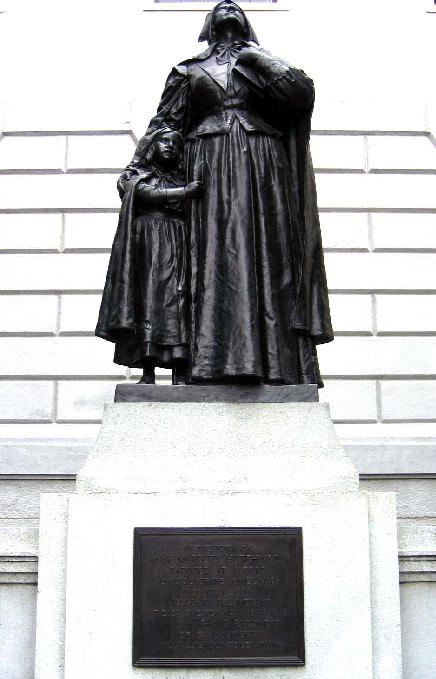
Another reading discipline of surprise derived from Puritan mores is the conventicle. Conventicles were extramural religious meetings of select congregants within a church, most famously practiced in early America by Anne Hutchinson during the Antinomian controversy. (A quiescent version of conventicling from contemporary church history is the cellular model of Rick Warren’s organization, the Saddleback megachurch.) Rooted in the idea that reading matter rather than institutional authority could be a source of spiritual sustenance, conventiclers absorbed scripture, repeated sermons, and sang psalms. Conventicling operated along a spectrum from conservative to separatist. And, like puritanconventicle was a rhetorically charged word that could mean devout private gathering or conspiratorial unlawful assembly, depending upon who did the labeling.

Pious or riotous, conventicling illuminates a classroom dynamic familiar to current undergraduate literature professors. My rough sense is that in research universities and non-elite colleges, a majority of the students in each course are cats we herd unsuccessfully, while a largish minority learn something in a rote way. The remnant is the conventicle, actual or virtual students who meet with their minds in class discussion, with each other outside of class, and with the professor after sessions. When I read Susannah Rowson or Herman Melville or Toni Morrison or Richard Powers for class preparation, I have the majority in mind, as I gather the three points I want to get across in the fifty minutes. Reaching and teaching this majority is one of the real pleasures of my professorial life. But, in the reading prep, I have the conventicle in mind, for that is where the surprise happens.

Such groups are true to the ambiguous history of the term. The classroom conventicle is both pious enough to submit to the syllabus, and fold the minister-teacher into the exchange, and heretical enough to be always in dissent from the preacher-pedagogue’s orthodox readings. (Professors, not always unwillingly, have cults gather round them, but with conventicling, I mean something other than this phenomenon.) The conventicle is often populated by a student demographic, the successful English major, that stays within its comfort zone. But fettered by teachers and foxed by peers, this demo can evade its complacency, and unanticipated knowledge can happen in the critical exchange. Overtly disciplinary, the effective conventicle outstrips its protocols to teach all anew.

Another means to the new in my reading has been attending to modes of writing that are almost absurdly mechanized, modes following restrictions and constraints, modes generating the unexpected by virtue of their combinatorial surprise. I refer here to that literary conventicle, full of library rats, circa Paris, 1960, or OULIPO—though Oulipians would be the first to tell you such procedural writing has a long history. A collaboration between artists and mathematicians, the OUrvoir de LItterature POtentielle (workshop of potential literature) objected to the romanticism that still lingered in the twentieth-century avant-garde, whether it be High Modernism, Dadaism, or Surrealism. OULIPO instituted rules for the production of literary work—very arbitrary rules, such as “write a novel without the letter ‘e'” or “compose a note using letters lacking tails and limbs” (that is, letterforms contained by the x-height of a typeface, namely aceimnorsuvwx, and z). It also acknowledged the precedents in literary history for its method, often creating new works from older source texts and fondly labeling Lewis Carroll and George Herbert “anticipatory plagiarists” of Oulipian art.

There was no lack of rule-bound literary expression in Renaissance culture, from sestinas to chronograms to sonnets, an Oulipian favorite. Other than Edward Taylor, however, we do not think of the Puritans in this vein. But anagrams saturated their poetry, and Psalm 119—the epitome of the psalms and essential devotional reading in its own right—was an abecedary, each of the twenty-two stanzas organized around its prescribed letter in alphabetic sequence. Anthony Somerby transcribed a Bible translation in verse that proceeds (dropping the jand the final five letters) as an alphabetic acrostic.

At first Jehovah with his word
     did make heaven earth and light
     the firmament, the moone and starres
     the glistering Sunne so bright.

By him the earth was fruitfull made . . .

Creation ended, God then rests, . . .

Dust of the ground was man made of . . .


The first page of Anthony Somerby's manuscript transcription of the Bible, adapted to the procedure of the alphabet, with each letter beginning a new four-line stanza. In The First Century of New England Verse (1943), Harold Jantz attributed the poem to Somerby, though the source is Simon Wastell's Microbiblion, or the Bible's Epitome: In Verse (1629). Courtesy of the American Antiquarian Society.
The first page of Anthony Somerby’s manuscript transcription of the Bible, adapted to the procedure of the alphabet, with each letter beginning a new four-line stanza. In The First Century of New England Verse (1943), Harold Jantz attributed the poem to Somerby, though the source is Simon Wastell’s Microbiblion, or the Bible’s Epitome: In Verse (1629). Courtesy of the American Antiquarian Society.

Drawn from Simon Wastell’s Microbiblion, or the Bible’s Epitome: In Verse, it continues in twenty-unit cycles of this sort for sixteen hundred lines before the manuscript breaks off at Psalms.

More fundamentally, ordinary New Englanders were repeatedly exposed to a deep structure of verbal expression that was radically procedural: the plain style sermon, with its schema of biblical Text, extrapolated Doctrine, and applied Use. Is it hard to imagine John Cotton at one of the monthly meetings of the OULIPO, reporting to Italo Calvino or Harry Matthews a constraint for literary production? Well, yes. Yet Puritan sermon dictates certainly sound Oulipian: “Take a fragment from a source work. Dramatize or contextualize it in five ways. Then develop three philosophical propositions from it. Then create three rules of behavior based on it. Do this every week for the rest of your life.”

The rules are designed as guidelines for authors, but both the Oulipians and the Puritans strove for authorlessness: the Oulipians through their rebuke of romantic avant-gardes and through their embrace of mathematics, the Puritans through their deference to the divine Author that should properly guide human expression. Oulipians and Puritans likewise shifted the burden of meaning to readers. Oulipian art makes its audience resourcefully aware of the prison house of language, of limitations that transform themselves into possibilities. Raymond Queneau’s definition of OULIPO—”Rats who construct the labyrinth from which they propose to escape”—applies as much to readers as to authors. I am one-third of the way through Georges Perec’s Life: A User’s Manual, and by the time this is published I may be two-thirds there. Reading Perec requires extraordinary discipline, but by now you know that, for me, that’s no excuse. With its minute descriptions of the persons and rooms within a Paris apartment house, Life: A User’s Manual is both a trance-like experience and limitless invitation to narrative, a giddy rejection of aesthetic transcendence and a textured reveling in things, as if its Oulipian constraint is the very gravity of the world.

The religious culture of the Reformation inherited by Puritans in New England similarly made readers the locus of meaning. The role of literacy in Protestantism’s self-definition; the doctrinal principle of sola scriptura; the inscrutability of God’s will for the probing devout; the semiotic power of portents and wonders as providential signs from God; the Uses at sermon’s end as behavior modification—all denote a Puritan society oriented to the audience. This larger ideological script was complemented by reading disciplines, by practical procedures. Along with the collative techniques mentioned above, there was the nonlinear collecting of sermon heads and scripture “evidences,” as well as the linear attention to biblical narrative and sermon series that likewise burdened readers with the creation of meaning.

Indeed, one comes to see devout Puritan readers as imaginative weavers of textual fragments, humble but hardly passive, caught within scriptural grids yet impelled by the voluntarism that supplied zealous Protestantism with its identity vis-à-vis the traditional church. If they were not rats in a maze, then they were perhaps the mice John Winthrop approvingly observed chewing at a composite, single-volume binding of religious works: the mice devoured the Book of Common Prayer, while leaving the Psalms and New Testament intact. We are unaccustomed to seeing these Puritan collative habits as an exercise of the imagination, but like most readers across the millennia, the New England devout reacted creatively to the labyrinth they found themselves within.

Might there be a lesson here for cultural historians? Our stories of the past default to human intention as a guarantor of meaning, as if intentionality were not vexed and mutable. Literary history is even more bound to author-based conceptions of meaning. Whatever literary theory might proclaim, a survey of monographs, journal articles, and syllabuses suggests that the author is alive and well. Reader-based approaches to cultural history have stepped into this vacuum, though not with the fecundity one might have expected twenty years ago. The only critics of reader-based approaches harsher than certain nonspecialists are, however, historians of reading themselves, who tend to be excessively skeptical of their own mission, doubting the status of the field’s evidence at every turn.

Why are scholars seemingly so hesitant to credit the discipline, and creativity, of past readers? This hesitancy emerges in part from its own kind of romantic investment: a desire to retain a notion of reading as mysterious and unknowable. If reading remains a mystery known only to the isolated individual, then we can continue to confirm familiar clichés about the emancipatory results that literacy nurtures, as well as the freedom we believe we bring to our readerly acts. But with an approach sufficiently grounded in cultural context—in ideological scripts, circulation data, and practical procedures—and in evidence of actual readers reading, might we reach plausible, indeed demonstrable, stories of the past organized around readers? The history of reading might even proudly call itself a discipline: one, like every good discipline, ever ready to kick away the ladder that brought it to its wonder.

Further Reading:

Mary F. Corey’s The World Through a Monocle (Cambridge, Mass., 1999) discusses readership of The New Yorker at midcentury in ways that suggest the problems behind a liberal, cosmopolitan reading practice. The Gutenberg Elegies: The Fate of Reading in the Electronic Age (Boston, 1994) is the ill-appreciated Sven Birkerts volume (though it made the careers of certain digital zealots). James O’Donnell’s Avatars of the Word: From Papyrus to Cyberspace (Cambridge, Mass., 1998) examines the role of the library as a site of collative, nonlinear reading. Rob Sheffield’s funny, moving, and endlessly wise book is Love is a Mixtape: Life and Loss, One Song at a Time (New York, 2007). Conventicles are, as David Como puts it, “highly resistant to historical voyeurism”; but Patrick Collinson’s “The English Conventicle” in Voluntary Religion (Oxford, 1986) is a good place to begin peeking. One can get one’s feet wet with OULIPO through the Oulipo Compendium (London, 1998); and one can plunge and sink happily in Georges Perec’s e-less novel A Void (London, 1994) or in his Life: A User’s Manual (Boston, 1987), each astoundingly translated for English readers by, respectively, Gilbert Adair and David Bellos.


This article originally appeared in issue 8.1 (October, 2007).


Matthew P. Brown is director of the University of Iowa Center for the Book, where he is also associate professor in the English department and the Center for the Book. His essays have appeared in American Quarterly, American Literary History, and PMLA. He is the author of The Pilgrim and the Bee: Reading Rituals and Book Culture in Early New England (Philadelphia, 2007).


Humble Assertions: The True Story of Anne Bradstreet’s Publication of The Tenth Muse

There are no extant portraits of Anne Bradstreet (1612-1672), the “first” American poet. But on the Web, when one Googles Bradstreet, a popular nineteenth-century painting pops up. An imaginary Bradstreet sits at a desk, wearing a white bonnet and a white apron, looking modest and soulful, exactly as the Victorians thought a Puritan woman should look. This image is replicated throughout the Web, appearing on the Poetry Foundation and Wikipedia pages for Anne Bradstreet, demonstrating modernity’s conception of Bradstreet as a pious pilgrim, unconcerned with worldly affairs.


A Victorian image of Anne Bradstreet. Frontispiece for An Account of Anne Bradstreet: The Puritan Poetess, and Kindred Topics, edited by Colonel Luther Caldwell (Boston, 1898). Courtesy of the American Antiquarian Society, Worcester, Massachusetts.

It is not that the Victorian artist was wrong. Bradstreet was indeed a devout Christian and her work reflects her life-long struggle with her faith. But she was far from being the humble bonnet-wearer that the Victorians wanted her to be. Bradstreet was deeply ambitious. She used the word “fame” thirteen times in her first three poems, reflecting her concern about her stature as a poet and her anxiety that as a woman she would not be allowed to take her place in the pantheon of great English poets. She wrote more than 7,000 lines of poetry, addressing topics that were considered far too complex for a mere woman, including the history of the world, the current state of the sciences, the political relationship between the old and new worlds, and the many religious conundrums of Puritanism.

How, then, did this Victorian image of Bradstreet come to dominate the airwaves? Perhaps the answer lies in the propaganda campaign that Bradstreet and her family launched after her book, The Tenth Muse, was published in England in 1650. According to Bradstreet, she was so averse to fame that she did not want her poetry published. In her poem, “The Author to her Book,” she declares that the manuscript was “stol’n” from her. The thief was her brother-in-law, John Woodbridge, a “friend more loving than true.” When Woodbridge found a publisher for Bradstreet’s work in England, he did this of his own accord, she implies, leading readers to believe that her book was published behind her back, without her knowledge. And so began the story that modern readers still believe today. Bradstreet’s words are reinforced by the prefatory material Woodbridge included in The Tenth Muse. He claims that Bradstreet’s poetry came second to her womanly duties. She went without sleep to write, he declares, and never scrimped on her chores. First and foremost, she was a wife and mother. The last thing she wanted was fame.

Unfortunately, readers have taken these claims at face value, overlooking Bradstreet’s sophistication as a poet, her skills as a disguise artist, and her youthful ambition. But if one reads Bradstreet’s poetry with close attention, one finds work that is replete with double meanings and ironies, self-deprecation and even self-condemnation—strategies she had learned in a culture that disparaged women for trespassing in realms that were considered male territory. This is not to say that Bradstreet’s self-deprecation was insincere. It would have been difficult for Bradstreet, or, for that matter, any seventeenth-century woman, to free herself from the prejudices of the time. The experts taught that women were weak, vulnerable, and foolish—criticisms that were internalized by Bradstreet, who had witnessed first-hand what happened to outspoken women. In 1638, just twelve years before the publication of The Tenth Muse, Bradstreet’s acquaintance Anne Hutchinson was banished from Massachusetts Bay for holding meetings in which she criticized the colony’s ministers and challenged male authorities.

As a result, Bradstreet had learned to couch her ambitions in terms that were acceptable to her time. In one early poem, the poet/narrator tries to scale Mount Olympus to beg help from the classical muses, but is driven off the mountain because she is a woman. However, instead of accepting her fate as a lesser poet, she declares that she is not cast down, as she will have a “better guide,” the Christian God, a muse infinitely superior to the pagan gods of classical antiquity. In the prologue to her long poem The Quarternions, Bradstreet writes that male poets deserve laurel wreaths for their work whereas she, a woman poet, will be content with a simple wreath of thyme. But of course “thyme” is a homonym for “time,” and so the careful reader can see that  Bradstreet’s apparent self-deprecation is actually a disguised proclamation of her ambition. Men’s achievements, she declares, may win them worldly fame, but she, as a woman poet, aspires to more than this—everlasting acclaim, eternality itself.

This dependence on indirect assertions and strategic twists makes Bradstreet’s work unusually complex—one of the reasons she is still read today. But her sophistication as a poet did not come easily. From the first, she was serious about her craft, studying the poets of previous generations to improve her skills. Her early poems are full of learned allusions and witty figures of speech. Over time, however, she changed her style to suit her deepening commitment to New World Puritanism, vowing to use “plain speech.” Thus, although she lamented that The Tenth Muse was made of homespun cloth rather than expensive silk (“The Author to her Book”), she was intent on developing a New England Puritan aesthetic that she believed  superior to Old World poetics. Not for her the elegance of Elizabethan versifiers. No more emulation of the past. Instead she would take her place as a New World woman poet, a pious Puritan who would use simple language to express her humble devotion to God. Again, although these pronouncements are intrinsically self-deprecatory, they are also statements of Christian ascendancy. For who goes to heaven first? The poor, the meek, the humble. Accordingly, Bradstreet’s declarations of humility were also declarations of superiority, at least in the Christian sense. Bradstreet had been taught to believe that when the end times came, she and other humble pilgrims would be raised above those who seemed more powerful during their time on earth. New England herself would be ascendant over Old England, because of New England’s superior piety.

But despite Bradstreet’s assertions of Christian ascendancy, it does not necessarily follow that she wanted her manuscript published, or that she had any advance knowledge of John Woodbridge’s publication scheme. It is in her poetry, which has always offered rewards to the careful reader, that she reveals that she was fully aware of Woodbridge’s endeavor. The clue lies in one of her least-read poems, “David’s Lamentation for Saul and Jonathan.” At first glance, this poem appears to be one of Bradstreet’s least interesting works. A simple reprisal of 2 Samuel 1, the biblical passage where the future King David mourns the death of his predecessor, King Saul, and his son Jonathan, Bradstreet seems to offer the reader no new insights into this familiar biblical story. The only distinctive aspect of the poem is that she uses the language of her time; for instance, replacing “daughters of Israel” with “Israel’s dames.” But other than Bradstreet’s deployment of seventeenth-century vernacular, the poem seems the most opaque and the least promising of all of her works. In fact, it seems downright dull, until one considers when it was written. And when it was published.


Title page of Anne Bradstreet’s The Tenth Muse (1650), the first book of New World poetry, published in England. Courtesy of the Beinecke Rare Book & Manuscript Library, Yale University, New Haven, Conn.

As other scholars have pointed out, it seems clear that Bradstreet wrote “David’s Lamentation” after hearing that Charles, the English king, had been executed by English Puritans. With this in mind, the poem instantly becomes far more than a simple translation of a biblical text. It becomes political verse, mourning the execution. However, Bradstreet disguised her point of view, because to offer a direct critique of the English puritans was dangerous. She did not want them to direct their wrath toward their New World counterparts. Furthermore, the timing of the poem indicates that Bradstreet, or at least someone from the New World, sent the poem overseas after John Woodbridge, the one who had purportedly “stol’n” her manuscript, had sailed to England in 1648, a year before the king’s execution in 1649. Indeed, Woodbridge had been sent over to help Cromwell negotiate with Charles in order to avoid the violent death of the king. Why does this matter? “David’s Lamentation” is included in The Tenth Muse, which means that Bradstreet, or one of her family members, must have made sure that Woodbridge had the poem so that it could appear in her book.

Although it is possible that someone other than Bradstreet sent Woodbridge “David’s Lamentation,” it is highly unlikely that Bradstreet would have been uninvolved. Vellum was expensive. It was difficult to make multiple copies of poems. Time was of the essence if “David’s Lamentation” was to be included in The Tenth Muse. A messenger, a reputable captain and a ship all had to be found. Bradstreet’s cooperation would have to be secured if she and her family wanted “David’s Lamentation” in the manuscript.

The evidence of Bradstreet’s active involvement in the publication of The Tenth Muse clears up a centuries-old misconception, revealing her to be a far more complicated figure than the popular Victorian image of her suggests. Yes, she was a devoted Puritan. But she was also ambitious, not precisely in the modern sense, as she was not interested in promoting her work to earn celebrity, but as both a Puritan and a New English writer, she was convinced that her poetry could help spread what she believed was a truer version of Christianity to the English-speaking world.

Motivated as she was by her faith and her commitment to the Puritan mission, one might think that this revelation about Bradstreet’s active role in publishing The Tenth Muse would be entirely uncontroversial; Bradstreet was not a seventeenth-century firebrand, interested in starting a feminist revolution. And yet, the idea that Bradstreet participated in the publication of her book still meets with angry resistance from those who would like to keep Bradstreet in her “place” as a submissive wife and mother. When I amended Bradstreet’s Wikipedia page to include the evidence that Bradstreet was aware of the publication of The Tenth Muse, one angry “editor” disputed this point, stating, “Bradstreet was not responsible for her writing becoming public. Bradstreet’s brother-in-law, John Woodbridge, sent her work off to be published. Bradstreet was a righteous woman and her poetry was not meant to bring attention to herself.”

Clearly, the idea of an assertive/agentic Bradstreet has hit a nerve among readers who would like to view Puritan women as subordinated private figures, even though these roles are largely a Victorian invention. In the seventeenth century, Puritans did not separate their religious obligations from their civic duties. The Victorian separation between public and private spheres did not yet exist. Instead, it was considered a theological and public obligation to raise children to be good Christians, and to adhere to one’s faith. The publication of a book of poetry that espoused Bradstreet’s commitment to Puritanism was certainly an unconventional act, but it could still be perceived as a fulfillment of Bradstreet’s roles as a good wife and mother. Certainly, this was the stance adopted by Woodbridge and the other writers of the prefatory material of The Tenth Muse. As for Bradstreet herself, she was undoubtedly aware that she would face criticism for writing poetry, and yet she did not let this stop her—an important point that is missed by those who cling to the Victorian image of Bradstreet. Far from shrinking from the public eye, Bradstreet took the courageous step of publishing her ideas, and so deserves to be remembered not only as one of the bravest pilgrims in American history, but in the Christian tradition.


This article originally appeared in issue 16.3 (Summer, 2016).


Charlotte Gordon’s latest book, the dual biography Romantic Outlaws: The Extraordinary Lives of Mary Wollstonecraft and Mary Shelley (2015), won the National Book Critics award. She has also published a biography of Anne Bradstreet, Mistress Bradstreet: The Untold Story of America’s First Poet (2005).


Publick Occurrences 2.0 June 2008

June 30, 2008

The Age of Analogies


One of Josh Marshall’s posts last week noted
the dismal failure of the Bush administration’s attempt at a Radio Free Europe for the Arab world, al-Hurra (”The Free One.”) Like most of the Shrub crew’s schemes, this one was doubly incompetent, both erroneously conceived and poorly implemented. It was dopey enough to think that the situation in the present Middle East resembles Eastern Europe during the Cold War at all. Al-Hurra competes with a brace of widely-watched Arabic-language satellite channels and web sites while Radio Free Europe supplied peoples who were starved for outside information by their Communist state media monopolies. Then the dopey idea could not even be executed properly. The men behind al-Hurra turn out to be the news geniuses responsible for Casey Kasem’s “American Top 40″ and other syndicated national radio programs. It seems that none of the managers knew Arabic or much of anything about the Arab news media, but the founder (Norman Pattiz) is, like Casey, a Lebanese-American, so people in D.C. must have assumed that was qualification enough.

This story crystallized for me something that is going to be an historical hallmark of the present era. In this Age of Analogies, with television chat shows defining the public sphere, we have American leaders not just using dumb historical analogies as cheap talking points, but actually trying to put the dumb analogies into practice, as the basis for policy. We can’t just compare a foreign leader we don’t like to Hitler, we have to take the approach toward the world’s “bad guys” we think we would have taken towards Hitler, if we were time-travelling nincompoops from the 21st-century with 20-20 hindsight supplied by Hollywood. That is very close to what most of our current national leaders and pundits really seem to think they are.

So we have the current debate over “appeasement,” a word rolled out anytime someone suggests there might be some other way of dealing with regimes and peoples we don’t like other than bombing, invading, and overthrowing them, not necessarily in that order. The appeasement concept was problematic even back in the Cold War when it was cultural gospel, taught at the deepest level possible, that every conflict was a case of handing Czechoslavakia and your manhood over to the Nazis, or standing up and fighting. Westerns, Star Trek, The Brady Bunch could all agree on that. Fight, or Hitler wins and millions die! Interestingly, the promise that Cold War popular culture often made was that if you stood up and showed you could fight, the Romulans or the bully or the outlaws would go away and leave you alone. In fact, when the Allies stood up to Hitler they had to fight history’s greatest war machine for years, and millions still died. And that would have been the case even if the standing took place in 1938 rather than later.

But how much dumber is “appeasement,” and the implicit Hitler-Chamberlain comparison, when there is no continent-sweeping dictator demanding that we let him have some defenseless country? Who would we appease even if we wanted to? How would we go about it? What could we give the Islamists that we haven’t already? Pakistan and Iran aren’t enough?

Of course, “appeasement” is raised to twist the debate, not advance it. In the Bush-Cheney worldview any solution not imposed by force on a weaker foe is inherently suspect; any other form of adjudication or discussion is idle chit-chat of a particularly dangerous kind. Making every enemy into Hitler, the guy we know for sure was a psychopath bent on world domination, stacks the deck in favor of the force-first point-of-view:

“Some seem to believe that we should negotiate with the terrorists and radicals, as if some ingenious argument will persuade them they have been wrong all along,” Mr. Bush said, in a speech otherwise devoted to spotlighting Israel’s friendship with the United States.

“We have an obligation,” he continued, “to call this what it is: the false comfort of appeasement, which has been repeatedly discredited by history.”

(Yes, thank God Ronald Reagan finally cut loose and let our military show those Soviets who was stronger, otherwise the Iron Curtain never would have fallen. Oh, wait. . . . ) At any rate, the “appeasement” concept resonates very well with conservative hatred of egalitarianism and its suspicion of legal processes, but its universal application to real life is just a little lacking, considering that 99.9% of real conflicts actually do not end with the total defeat and suicide of the Big Bad. Really pretty much just that one. Not sure how to score the Pacific theater.


Munich and World War II have loomed over U.S. policy minds since the end of that war, but there is something particularly goofy and post-modern about way the analogies work today, when so few of the top policymakers or journalists have any first-hand experience that goes back earlier than the Kennedy era. The historical analogies are taken sooo literally, regardless of whether they are remotely applicable. So I saw Newsweek wondering from the airport newsstand a couple of weeks ago, “What Would Winston Do?” The accompanying article actually does a pretty reasonable job distinguishing past from present and puncturing some of the Munich myth, but that cover says the opposite, much more powerfully. In any case, Evan Thomas’s article seems to be one of many belated efforts to catch up with reality by the sort of pop-history-writing journos (like Tom Brokaw and Evan Thomas, among many others) who have worked so hard to build up the power of the World War II analogies.

P.S. Based on the quite good and relatively even-handed new museum at the Churchill Memorial in Fulton, MO (the site of the Iron Curtain speech), what Winston would have done is attack something.

June 22, 2008

Popular Constitutionalism Illustrated

 
Readers of my book, The Tyranny of Printers: Newspaper Politics in the Early American Republic, may be interested in a much more lavishly illustrated rendition of some of the book’s points that has been just been published in the Historical Society of Pennsylvania’s magazine Pennsylvania Legacies. The article, “Popular Constitutionalism in Philadelphia: How Freedom of Expression Was Secured by Two Fearless Newspaper Editors,” is part of a special issue on “Defining Civil Liberties in Pennsylvania.” Naturally, the two editors are Benjamin Franklin Bache and William Duane of the Philadelphia Aurora. It looks like you have to join HSP to actually read the whole thing, but there is a preview available here.

(I love the cartoon of a lightning-swathed printing press that the HSP has posted with the preview, which I am borrowing for this post. It looks like it should be the chest emblem of a printing-themed superhero, if there ever were to be such a thing.)

As usual with small assignments covering old ground, I tortured myself to put something new into this piece, only to have most of the extra material not make it into the final version. In this case, I tried to go a little further than the book did with the idea of popular constitutionalism — constitutional interpretation as worked out and enforced in the arena of popular politics rather than the courts — as the driving force behind what Americans came to see their constitutional rights. In the case at hand, the expansive American version of press freedom was worked out in the political battle of 1798-1801. Constitutional law and elite political thought only caught up many decades later. At any rate, I have posted a “director’s cut” of the article here. (Having an outlet for my long versions was a good chunk for my motivation for starting a website in the first place.) It is still unfootnoted and pitched to a relatively popular audience, like the Pennsylvania Legacies version, but it will be a starting point for an argument I hope to be making at greater length and with more scholarly rigor in the future.

June 16, 2008

Jefferson Whitewashers for Clinton and McCain

Thanks to reader Ben Carp for pointing out the following item from The Politico that needed to be mentioned in this space:

Ben Smith’s Blog: From Jeffersons vs. Hemingses to McCain vs. Obama

A key organizer of John McCain’s meeting Saturday with former supporters of Hillary Clinton is best known for her role in another bitter American fight: The effort by some white descendants of Thomas Jefferson to keep his possible African-American descendants out of family gatherings.

Paula Abeles emailed Politico yesterday to complain that her group had gotten short shrift in a blog item, writing, “I initiated the teleconference with McCain on Saturday and was solely responsible for the guest list.” Another Clinton backer at the event, Will Bower, confirmed that she was “integral” to assembling the group.

But Abeles first made the news in 2003, when she and her husband, then-Monticello Association President Nat Abeles, led the fight to keep members of the Hemings family — descendants of Jefferson slave and, some historians believe, mistress Sally Hemmings — out of a gathering of the Monticello Association, which is made up of lineal descendants of the third president.

Abeles drew national attention for her role in an episode of online espionage.

The AP reported in May of 2003:

The wife of a Thomas Jefferson family association official said Friday that she masqueraded as a 67-year-old black woman on an Internet chat room in a bid to keep descendants of a reputed Jefferson mistress out of this weekend’s family reunion.

“It might have been somewhat unethical,” said Paulie Abeles of Washington, D.C., who participated for eight months in the Yahoo! message board created for relatives of Jefferson slave Sally Hemings.

“It might have been childish, but I really think I was working in the best interest of the majority of the family members to make the reunion a calm and civilized gathering,” she said.


The story goes on a bit from there. Many of The Politico’s commenters made the obvious point that this would seem to confirm what many Obama supporters have suspected about the racial views of some of Clinton’s more diehard supporters. Abeles and her ilk probably don’t think of themselves as racists, but their fury at the very idea of connecting African Americans with something they revere like the presidency or their own family heritage says it all.

Also, one correction to Smith’s post is in order: the “some historians” are on the other foot. Perhaps people are just keeping quiet about it, but my sense is that the vast majority of historians (especially under age 60 or 70) now accept that Thomas Jefferson fathered some or all of Sally Heming’s children. And not just scholars who are bent on trashing Jefferson.

The turning point for me personally was Annette Gordon-Reed’s 1997 case history Thomas Jefferson and Sally Hemings: An American Controversy. In a very even-handed work written before the DNA testing, Gordon-Reed reached their conclusions by sifting carefully and logically through the then-available written records and the various arguments that had been made over the years. The clincher for me was the fact that Sally Hemings never conceived a child when Jefferson was not living on the same premises, during the height of his political career when he was away from home, and Sally, much of the time. The DNA testing just confirmed what already seemed very, very likely. Even the modern-day custodians of the Jefferson legacy at Monticello basically accept the Jefferson-Hemings relationship, if that is the term. Why some white Jefferson descendants cannot accept it, and why they would switch parties to support McCain, I leave to the reader to decide.

June 10, 2008

Hamilton’s house on its way to Jeffersonian setting


I was amused by the  New York Times story last weekend about Alexander Hamilton’s country house, The Grange, getting moved “from its cramped site on Convent Avenue to an appropriately verdant new location a block away in St. Nicholas Park, facing West 141st Street.” Andy Robertson and I visited that lonely site (in terms of tourists) a few years ago. The house was indeed challenging to find, crammed in behind an Episcopal Church and surrounded by other buildings.  (In the picture above, you can see the portico of the Richardsonian-style church on the upper right.) We were the only people there except for one ranger, but we thought that the old site was actually rather appropriate. The Founder most devoted to economic development and high finance got his house completely overshadowed by the growth of exactly the sort of city he sought to foster, with all the sensitivity to the small, rural, and outmoded that such cities usually show. I am sure it is true that the new location will more closely replicate the house’s original setting, back when Harlem was a country village, but the old one sent a more accurate message about the what the historical figure stood for. Of course, the fact that Hamilton’s Monticello-like hilltop shrine will be created at public expense seems pretty Hamiltonian.

June 7, 2008

“Two Systems of Science” — Good one!

I did not work as a reporter for all that long, but I do remember the elation I felt when a “source” (as journalists like to call people they talk to on the phone) gave me a really awful, colorful quotation. The key was to find some exponent of a ridiculous or distasteful cause who liked to talk a little too much. I imagine the writer of the recent New York Timesstory on the latest evolutionary leap of the anti-evolution cause must have been pumping her fist in the air on the other end of the phone (or inwardly), when the head of the Texas state education board uncorked the following explanation of why it is perfectly appropriate to teach the evangelical Christian critique (a.k.a. “weaknesses”) of evolutionary theory in science classes:

Dr. [Don] McLeroy, the [Texas state education] board chairman, sees the debate as being between “two systems of science.”“You’ve got a creationist system and a naturalist system,” he said. . . .

Dr. McLeroy believes that Earth’s appearance is a recent geologic event — thousands of years old, not 4.5 billion. “I believe a lot of incredible things,” he said, “The most incredible thing I believe is the Christmas story. That little baby born in the manger was the god that created the universe.”


Believing incredible things – now that’s science. I imagine Dr. McLeroy is perfectly sincere about the “scientific” truth of his Christian beliefs. I have never been able to find a good book to read about this — please advise — but American fundamentalism does seem to have this strange scientistic streak. In literally interpreting the Bible, they believe one can find “the facts,” the objectively, universally true principles of all existence. They even tend to use scientistic, quasi-scholarly methods to get at the “real” meaning of the text.

At least this was how it was explained to me by a former graduate student who had attended a conservative Christian seminary. We were talking about the apparent contradiction between the belief in the transparent and complete inerrancy of the English-language biblical text and the requirement that students learn ancient languages in order to translate the originals. It seemed to me that anyone who had translated more than a few sentences of any foreign language, let alone ancient ones using a different alphabet, would twig to the gaps and multiple possibilities involved in the process. But if you think of translation as a quest for scientific fact, then perhaps that is less of a problem.

June 4, 2008

A Trip of Two Game-Show Hosts

Back to history (mostly), and back to blogging a little more regularly as I try to stay in the writing habit. Unfortunately, most of my bloggable thoughts are still back on the GeoBee trip.

Game-show hosts turned out to be one of the surprise sub-themes of the trip. We knew about Alex Trebek of Jeopardy! hosting the finals of the National Geographic Bee, but we were not expecting Isaac to get that far, nor that the finals would actually be a sort of game show, with a giant two-tiered set, desks with lights on the front, and the whole nine yards. From the looks of the set, I was worried that there might be buzzers and wrong answer sound effects, too, but luckily National Geographic did not take things quite that far. Alex Trebek seemed exactly like what you see on Jeopardy!, and very good with the kids. I haven’t watched his show since sometime in the 90s, but as TV personalities go Alex seems like a credit to the culture. Canadian culture, perhaps, but a credit, a figure who honors knowledge and intelligence and a modest pride in one’s accomplishments rather than exhibitionism, ruthlessness, and stupidity like 90% of the rest of TV.

The other game-show host came as more of a surprise. Karen and the boys had never been out to Presidential Shrine #1, a.k.a. Mount Vernon, so we spent the afternoon there on the way out to Karen’s uncle’s house out in suburbs. I had not been to Washington’s pad in quite a while, and the place was much changed. The house was the same, but there is now a glitzy complex of ancillary museums (The Ford Orientation Center and Donald W. Reynolds Museum and Education Center) that seem to be the result of a massive infusion of right-wing money, or at least money from rich people and corporations with quite conservative notions about patriotism and history.

In the new orientation center, visitors are ushered into a giant movie theater for a double-feature. First up, a cheery overview of the grounds featuring . . . Wheel of Fortune host Pat Sajak, in colonial costume! I must admit I did not see this coming. It is hard to imagine a less 18th-century or Washingtonian figure than Pat Sajak, especially when he takes off the tri-corner hat to reveal his trademark, blow-dried 1970s ‘do. Even some of the other tourists chuckled a bit at the incongruousness of starting off their visit to a national shrine with a few words from the the guy on Wheel of Fortune. Pat’s major qualification for the job would seem to be status as a token Hollywood conservative, as noted on this roster of “Patriotic Actors” from a conservative web site. Apparently Pat has contributed more than his hairdo and cheerful demeanor to the right-wing cause; on another conservative site, he enlightens us at some length on “The Disconnect Between Hollywood and America.”

Pat’s participation in conservative Hollywood-bashing is interesting considering that his Mount Vernon intro is followed by a very Hollywood-esque “action-adventure movie” on Washington called We Fight To Be Free. Written by token conservative screenwriter Lionel Chetwynd (author of the celebratory George W. Bush docudrama DC 9/11: Time of Crisis), the film turns Washington’s life into a collection of near-cover versions of scenes from recent popular historical dramas.  I suspect many non-historian visitors must get a little confused by the way preparations for the Battle of Trenton (complete with Washington giving a Bush-ian patriotic speech) are intercut with scenes from Braddock’s Defeat that seem to exist so that a Last of the Mohicans-style battle scene could be included, complete with scalpings and dramatic rescues. It was George Washington, King of the Wild Frontier.


This article originally appeared in issue 8.4 (July, 2008).


Jeffrey L. Pasley is associate professor of history at the University of Missouri and the author of “The Tyranny of Printers”: Newspaper Politics in the Early American Republic (2001), along with numerous articles and book chapters, most recently the entry on Philip Freneau in Greil Marcus’s forthcoming New Literary History of America. He is currently completing a book on the presidential election of 1796 for the University Press of Kansas and also writes the blog Publick Occurrences 2.0 for some Website called Common-place.


Voting Machines and the Voters They Represent

Technology and democratic intent

While the contested presidential election of 2000 famously offered Americans a five-week lesson in civics, it also provided a crash course in the metaphysics of representation. Political representation was at issue—one “man,” one vote—but a second form of representation proved at least as vexing: How do the television networks represent outcomes on election night? How did Palm Beach County’s “butterfly” ballot represent electoral choices to voters? And exactly what sort of punch mark or dimple in a ballot should represent a voter’s intent? The political importance (in a pretty narrow, partisan sense) of questions like these was obvious throughout the Bush/Gore controversy; however, such questions address representation not as a function of politics but as a function of media. American voters count on media (conventionally “the Media”) to represent the outcome of elections accurately and quickly. They similarly count on the media of voting—the materials of ballots and voting machines—to aid them in representing their individual electoral choices to the public at large. Though ballots and voting machines are less familiarly “media” than televisions, newspapers, or the Internet, their mediating role is at least as important to the democratic process.

As it turned out, the electoral controversy of November and December 2000 revealed a central tension that forever attends this second form of representation: Whether it means switching on the TV or stepping into a voting booth, media are deployed precisely because they are expected to efface themselves. The television and the punch-card ballot are supposed to answer questions about election returns, not to stir up thornier questions about televisions and ballots. Put another way, audiences expect to look through media, not at them. Yet in 2000 the American public was forced to reckon with the question of how the material properties of punch-card ballots and voting machines, far from effacing themselves, had helped to determine the outcome of the election.


Fig. 1. U.S. Patent 4,258,249. Courtesy of the U.S. Patent and Trademark Office.

The eight U.S. patents granted to John E. Ahmann in the 1980s together describe the kind of voting machine that greeted so many Floridians on Election Day 2000 (fig. 1). Voters using the VotoMatic type of punch-card machine step up to a voting booth, insert their ballot card into a frame, and then use a stylus to punch selections into the card. My Aunt Irene, who used to winter in Palm Beach County but who votes in Pennsylvania, jokingly disparaged her Florida neighbors for not voting “like normal people,” standing inside old lever-type voting machines as Pennsylvanians do. Unlike the lever machines with their Wizard of Oz-like curtains and internal tallying devices, the punch-card machines rely upon 1960s-era data processing technology to tally votes. Fully one in three Americans who voted in the 2000 election used punch-card machines, of which VotoMatic is the major brand. VotoMatic inventor John Ahmann is a former IBM engineer, who appeared after the 2000 election as a witness for the Bush campaign in Florida’s Leon County Circuit Court. Two of Ahmann’s voting-related patents are particularly noteworthy.

Ahmann’s 1981 patent on the “Punch Frame” for holding ballot cards is noteworthy in hindsight, given the closeness of the Florida election and the ensuing disputes over undercounts and recounts. Ahmann’s patent specifies that, “Precautions must be taken to insure that all of the chips punched from the card are expelled [from the device]…If chips are permitted to accumulate…this can interfere with the punching…Incompletely punched cards can cause serious errors to occur in data processing operations utilizing the cards.” This kind of precautionary statement is extremely rare in the text of any patent document, since patents are legal instruments that must claim novelty and usefulness, and thus must rhetorically vaunt the excellence of the specified invention over its predecessors. Ahmann and his patent lawyers were unusually cognizant of potential errors.

Ahmann’s patent on the “stylus” for punching ballot cards more typically presents his invention as a decisive improvement over existing technology (fig. 2). In earlier stylus devices there had been a tendency for the point to break off, Ahmann notes, “when improperly bent to one side with the tip portion” inserted into “a marking hole of the voting device.” Such mishandling of the stylus is cleverly made irrelevant by his new invention, because,

Embedded within the tapered portion 30 is an elongated tip member 32, which is adapted to be inserted…in order to perform the normal punch-out function…This tip member is made from a hard, durable material…An outer exposed portion of the tip member…has a smooth cylindrical portion 38 adjacent a short ribbed…section 40, and this outer end portion is preferably heat treated to increase hardness…Thus, in use, the ribbed end of the tip member will readily punch-out the precut area of a tabulating card and assure the removal of this punched out portion (or “chad”).


Fig. 2. U.S. Patent 4,445,731. Courtesy of the U.S. Patent and Trademark Office.

Presented in the notoriously dry and legalistic language of patenting, Ahmann’s stylus nonetheless accrues a certain salacious charge when described as a heat-hardened member with ribbed tip for insertion.

Though Ahmann’s stylus patent only cites four recent patents that his invention improved upon, the broadest features of his voting machine have a very long history. The first patented voting machine in America, a device its inventor Robert Monaghan dubbed “the vox populi” in 1848, worked through the action of tiny knives or “lancets” that perforated paper (fig. 3). This mechanized voice of the people relied upon perforated ballot sheets, its inventor claimed, because such perforations were “in the present connection a simple and at the same time indelible mode of recording the vote.” Ahmann’s stylus refigured Monaghan’s “lancets” as well as innumerable other means of perforating or punching paper. The varied terms by which such means were described hint at how many different ways Ahmann could have described his stylus. For instance, John McTammany, an especially prolific inventor of voting machines, in 1895 used what he termed a “hand punch,” which, like Ahmann’s stylus, came tethered to his voting machine (fig. 4). In 1897 the Supreme Court of Rhode Island decided in the context of McTammany’s machines that a puncture in a piece of paper is as much a record of voter intent as “a pencil mark thereon.” So performed absence got legally constructed as semiotic presence: ever since then, a hole is a readable mark, because both are intentional and both are lasting.

Even apart from the peculiarly (that is, the unnecessarily) gendered character of the ghostly, phallic voter whose fingers appear in the drawing of Ahmann’s stylus, what Ahmann’s patents help to suggest is that voting machines themselves represent a voter prone to error (or to scandalous bending of his inserted tip member) who can be redeemed by the right machine. Built into the machinery, in other words, are at least 1) an imperfect and abstract voter of dubious intent and 2) a dispersed and bureaucratized system prone to inefficiencies. By extension and precisely in proportion to these features are built in 3) an ideological commitment to the technological fix and 4) not a little anxiety that “normal” voting—the diction is Ahmann’s as well as my Aunt Irene’s—may be an elusive goal. Machines, by this light, are representations. They are not only representations, of course, but they are meaningful in part according to the order of things they represent.

I am making a strong claim. As critic Langdon Winner puts it, “There is no idea more provocative than the notion that technical things have political qualities.” And yet to identify voting machines as themselves representations, in addition to conduits for representation, is to suggest that they can possess an inherent politics, that “they can embody specific forms of power and authority.” During the Florida controversy, James Baker III flatly denied such a possibility when he remarked regarding machine recounts, “Machines are neither Republicans nor Democrats, and therefore can be neither consciously nor unconsciously biased.” To be sure, machines are neither registered Republicans nor registered Democrats, but by representing abstract voters, voting media are biased toward their inventors’ and adopters’ socially derived sense of what normal voting is. And normality in voting, like normality in so much else, is culturally and historically contingent: remember all of the years when it would not have seemed normal for Aunt Irene (or me) to vote at all. Put another way, like the layout of a newspaper and the layout of a ballot, the layout of a voting machine harbors implications about meaning, about what is and what is important, and therefore harbors politics in its broadest sense. The changing design of voting machines (where “design” means a literal organization of parts as well as a desire) offers one index of varying relationships between the American public and its constitutive private voting subjects.


Fig. 3. U.S. Patent 5,469. Courtesy of the U.S. Patent and Trademark Office.

Americans like Ahmann have dedicated themselves with amazing ingenuity to the invention of various voting machines. I made a cursory search and found more than four hundred U.S. patents that have been granted on the subject. Each of these inventions in effect expresses a theory of democracy, of what a voter is, and each theory is framed by the assumption that technology is appropriate to voting. Such a framing assumption forms the lifeblood of today’s technocratic society (where technology is appropriate to everything) but seems only to have emerged around the middle of the nineteenth century, when inventors like Monaghan made the first scattered efforts to connect voting to machines. Before and even while these men invented, the phrase “voting machine” was an oxymoron. Men voted, not machines. “It has been asserted,” the German-American statesman Carl Schurz wrote in his report on conditions in the South immediately after the Civil War, “that the Negro would be but a voting machine in the hand of his employer.” Likewise, a few years after the contested Hayes/Tilden election of 1876, The Atlantic Monthly looked ahead to reform, calling the electoral college system “out of gear” with contemporary politics and noting with contempt that “the electors are mere voting machines.” Comments like these suggest at once how paradoxical the addition of machinery to voting once seemed and just how deeply the pejorative semantics of “machine politics” run. Machinery was the categorical opposite of democracy, at least until Monaghan, McTammany, and the others got busy in their attempts to derail political machinery in its control of voters by providing those voters with literal machines.

Almost all of the earliest voting machines had to do, like Monaghan’s lancet device, with “taking the yeas and nays” or “ayes and noes” in legislative assemblies. Patents on these devices often picture an empty legislative chamber of some kind, making legislative space an arena of moving parts in which members of the legislature gather to serve as operators internal to the system. These inventions were less absolute theories of democracy than theories of legislative process. Particularly after the Civil War, when the government grew much more complicated in scope, members of Congress increasingly voted according to cue (by watching how others voted), were tutored by partisan social relations amid increasing party discipline, or were instructed by lobbyists. In their patents, inventors thus billed their devices as a way to bring honesty into politics. 

Among the most innovative legislative machines were gravity-activated devices, relying upon balls as ballots (thus acting on the derivation of the word ballot), which were dropped into pipes that went under the floorboards or dropped into automatic sorting and counting boxes. Some were mechanical devices, using what one inventor classed vaguely as “cords, wires, levers, pulleys, etc.,” to cast and display votes. Many more were electrical, designed as legislative telegraphs, one inventor explained, so that members could send in their votes from around the chamber. In their most ideal form, seldom realized, these voting machines did four things: they “took” votes, displayed them, counted them, and produced a lasting, tangible record of some sort. This quartet of functions possessed many different associations for the authors of patents. Different devices had parts that worked “like the keys of a piano,” like “bells [for service that] are hung in private houses or hotels,” like “hotel registers,” as well as like telegraphs, adding machines, and electrotype or other printing technology. The legislative chamber was like a fancy hotel, perhaps, at which visiting members conducted the business of state, or it was a nexus of communications, where far-flung members transmitted the will of their further-flung constituents. Thomas A. Edison’s first patent was for an electrographic vote-recorder of this sort. Invented in 1869, his device counted the number of votes “yea” and “nay” and then printed the names of voting members for and against in two different columns (fig. 5). The legislators themselves applied the current, which printed their names by ionizing chemically treated paper.


Fig. 4. U.S. Patent 550,053. Courtesy of the U.S. Patent and Trademark Office.

Few if any of these nineteenth-century voting machines, including Edison’s, appear to have been successfully used. But debate over the use of voting machines in Congress continued for decades. In 1914 members of the House minority observed a damning contradiction between voting and machinery: “Congress is and should be a deliberative body,” one Representative explained, “and electricity and mechanism are no more essential in grinding out legislation than a slot machine would be useful in dispensing justice.” Proponents for the devices meanwhile noted that machine voting was quick and (by that odd and yet widely accepted calculus) would therefore save money. Elements of the proposed system would be accurate, like adding machines, and unobtrusive, like drop-head sewing machines, which disappeared into the tables when not in use.

Nineteenth-century American inventors proposed only a handful of voting machines for balloting in general elections. But by the end of the century a new generation of voting machines was beginning to appear. These machines were aligned with broader reforms in the same period, which directly addressed what had been the great weakness of prior voting systems. In place of easily identified color-coded party tickets, voting reforms and the machines that followed them introduced ballots prepared by municipalities rather than parties (fig. 6). Every voter got a copy of the same printed ballot and could exercise his franchise without the intrusion or surveillance of party agents. Massachusetts adopted these new ballots in 1889, and the other states followed suit over the next two decades. It was a justly celebrated reform, though results were uneven. Voting methods continued to vary from state to state and even from county to county (as they still do). Voters in California and Louisiana marked their ballots with a rubber stamp, in West Virginia voters used ink, and in New York it had to be a black lead pencil. In many states voters made a mark to the right of the name of the candidate they wished to vote for, but in other states voters made a mark to the left. In Wisconsin marks had to be under the middle of the names. Other much more important variations remained in provisions for illiterate voters (e.g., different party symbols or various color coding methods), the layout of rows and columns (e.g., whether by party or office), and the ease or difficulty with which voters were permitted to vote a “straight” ticket or to “scratch” candidates and “split” tickets.

The most singular advantage of the new generation of voting machines was their ability “to guard against the failure of ‘the human element,’” particularly against the “enormous loss of votes resulting from defective, spoiled, and doubtful ballots” that were improperly marked by voters. One study had found, for example, that “more than 3000 persons in Maryland who qualify as voters regularly disenfranchise themselves in every election by incorrect markings,” most of them presumably accidental, but also “including drawings and comments on the city government.” Inventors and other reform-minded citizens agreed with politicians who amended the applicable voting laws: “The voting machine must prevent the voter from doing what he ought not to do.” Gone and forgotten was any sense that voters had to be protected from corrupt party hacks. Voters in the new century would need to be protected from themselves.


Fig. 5. U.S. Patent 90,646. Courtesy of the U.S. Patent and Trademark Office.

Voting machines and the patents that describe them render the voter an abstract, impersonal, or hypothetical citizen, available to drop, pull, press, stamp, puncture, or insert as directed. And the more complicated the gizmo, the more it risks derailing the process. A related worry about complicated ballots was evident in the last minute instructions that one election supervisor tried to relay to the polls in Palm Beach County in November 2000: “Please remind all voters,” Theresa LePore wrote, “that they are to vote for one (1) presidential candidate and that they are to punch the hole next to the arrow next to the number next to the candidate they wish to vote for.” The varied media of voting conspire to separate voters from candidates along a chain of signifiers—a name, a number, an arrow, a hole—that can be extended to include all manner of machinery—a pencil, a stylus, a lever, a knob, gear work, housing, wiring, hardware, software, and so on. The chain that separates voters and candidates—and that mediates between voters and the collective will or the vox populi—is an ongoing construction of law, since judicial decrees and state statutes, for instance, make a hole into a mark. But it is also an ad hoc construction, cobbled in part from the practices of local voting commissions, who decide when a dimple is like a hole that is a mark. And it is cobbled as well from the material conditions of voting, from the stuff that voters experience as part of their signifying acts.

If voting machines have rendered voters into an abstraction by generalizing the functions and—particularly—the pitfalls inherent in casting, collecting, and counting votes, they have also variously mystified the experience of voting, complicating it with machinery that few voters understand but all must operate. Running parallel to increasing technological complexity has been an attendant mystification of differently dematerialized ballots. Gone is the certainty of one “man,” one ballot, if in so many cases voters use machines that produce only a mechanical or an electrical tally, not a material record of individual voting acts. Confronted by more and more complicated things at the polling place, in other words, the voter loses any clear perspective on votes as things. Though punch-card voting and optical-scan or “bubble” ballots still offer an individual piece of paper to every voter, the old lever machines and the new direct recording electronic devices (DREs) do not. In one sense, these devices make literal the analogies to adding machines and cash registers that recur so often in the history of voting machines and that are notably reiterated in frequent identifications of DREs as versions of automatic teller machines (ATMs). The speculative equation of votes and money works, at least insofar as money has proved to be one thing (unlike population, for instance) that can be counted exactly, no matter how many millions are at stake. Nor is the equation of paper ballots and paper bills without weight, since both are particularly sacrosanct instances of representation, the individuated paper manifestations of voter choice and consumer confidence, those two sustaining abstractions of today’s liberal nation state.

Very few patented voting machines were ever built or used. Their inventors were truly theorists, theorizing in metal and other materials as they proposed and patented what they thought was a better democratic future, a better version of voting. Successive voting machines for the most part have harbored a reform, Mugwump, or Progressive ideology, with its generous helping of what might be termed technoblesse oblige: The right machine saves the voter from error and the state from confusion. In this sense, the built-in bias of voting machines is less politically partisan than it is culturally political, adapted to the contexts of “normal” voting in any historical moment. Machines represent the normal voter, and, if implemented, help that voter to represent her or his will.


Fig. 6. U.S. Patent 502,743. Courtesy of the U.S. Patent and Trademark Office.

It remains to note in conclusion that no theory remains unmoved by practice. Like all representations, voting machines are non-static; their meanings arise in part from their reception and use, not just from the authorial intentions of their patent-holding inventors and manufacturers. Thomas Edison may have meant one thing by his voting machine in 1869, for example, but today that same machine means something else. Likewise, John Ahmann’s invention represents a stylus-wielding, chad-punching voter. In retrospect, it also represents a voter who is a bit more likely to be African American than not, since those were the hands that held the stylus, according to a New York Times survey of Florida precincts and their equipment. James Baker III was correct; machines are neither Republicans nor Democrats, when they are invented by people like Ahmann or adopted by states like Florida. Only in use was the VotoMatic so emphatically a Republican machine, when its inventor testified for the Republicans in court and when its relatively high rate of residual votes or undercounts (combined with confusing ballot design in several counties) helped George W. Bush to win the 2000 election.

Further Reading:

Details of the Bush/Gore recount controversy, including comments by James Baker III and Theresa LePore may be found in 36 Days: The Complete Chronicle of the 2000 Presidential Election Crisis, by correspondents of the New York Times (New York, 2001). Langdon Winner asks, “Do Artifacts Have Politics?” in Daedalus 109 (Winter 1980): 121-136. Material on present-day voting machines is drawn from the Caltech/MIT Voting Technology Project’s report, “Residual Votes Attributable to Technology: An Assessment of the Reliability of Existing Voting Equipment,” by Stephen Ansolabehere, et al., Version 2 (March 30, 2001). Material on voting machines of the past may be found in T. David Zukerman, The Voting Machine: Report on the History, Use and Advantages of Mechanical Means for Casting and Counting Ballots (New York, 1925) as well as the government’s database of patents. (For a full list of patents referred to in this essay, please contact the author.) Material on the history of ballots in the United States comes from Spencer D. Albright, The American Ballot (Washington, 1942); in American Ballot Laws, 1888-1910, prepared by Arthur C. Ludington, University of the State of New York Education Department Bulletin 488 (February 1, 1911); Philip Loring Allen, “The Multifarious Australian Ballot” North American Review 191 (1910): 602-611; and particularly Philip Loring Allen, “Ballot Laws and Their Workings,” Political Science Quarterly 21 (1906): 38-58. Carl Schurz’s comment on voting machines may be found in Message of the President of the United States…Accompanied by a Report of Carl Schurz on the States of South Carolina, Georgia, Alabama, Mississippi, and Louisiana (Washington, D.C., 1865). Helpful works on political process include Margaret Susan Thompson, The “Spider Web”: Congress and Lobbying in the Age of Grant (Ithaca, N.Y., 1985) and David J. Rothman, Politics and Power: The United States Senate, 1869-1901 (Cambridge, Mass., 1966). See also Michael Schudson, The Good Citizen: A History of American Civic Life (New York, 1998).


This article originally appeared in issue 9.1 (October, 2008).


Lisa Gitelman is the author most recently of Always Already New: Media, History, and the Data of Culture (2006). During 2008-9 she is teaching history of technology at Harvard University.