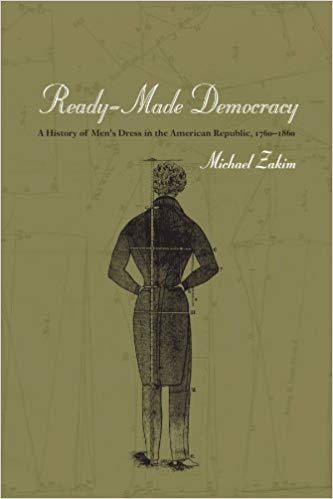
Michael Zakim, Ready-Made Democracy: A History of Men’s Dress in the American Republic, 1760-1860. Chicago: The University of Chicago Press, 2003. 296 pp.
“Clothes make the man.” In Ready-Made Democracy, Michael Zakim offers a new variation on this sartorial dictum: men’s dress comprises the social order, or at least it did in antebellum America. By his account, the advent of ready-made clothing represented not just a change in male fashion but the triumph of democratic capitalism over the republican ideals and patriarchal practices of the Founders. To be sure, in the 1850s boosters still celebrated the simplicity of American costume in proud opposition to the decadent extravagance of Europe. By then, however, American simplicity entailed the mass consumption of mass-produced commodities, not the virtuous self-abnegation of the Revolutionary generation. The ideological continuity of political discourse belied a fundamental restructuring of American society and culture.
Ready-Made Democracy: A History of Men’s Dress in the American Republic, 1760-1860
Zakim frames his study as an intervention in the longstanding debate among American historians over whether the United States was born liberal or, alternatively, became liberal after starting out as something else. Forty-five years ago Carl Degler wrote that “capitalism came [to America] in the first ships,” but since the late 1960s scholars associated with the republican synthesis have highlighted America’s premodern, precapitalist, and preliberal roots. Zakim finds their portrait of colonial America convincing. But he also suggests that too much emphasis on America’s preliberal past has diverted attention from the Big Story: the “great transformation” of the United States into a democratic capitalist society in the early nineteenth century. It is this Big Story that Zakim seeks to illuminate in Ready-Made Democracy. He succeeds brilliantly.
Zakim begins his narrative with the patriots’ embrace of homespun as a symbolic and practical weapon in the widening protests against imperial policy during the 1760s-70s. Americans, he suggests, were sufficiently enmeshed in the Atlantic market to make nonimportation of British goods a real test of American virtue at home and of American buying power abroad. Yet they were still sufficiently engaged in household production that they could pass such a test, at least in the short term. Meanwhile, the Revolutionary elite’s public commitment to homespun affirmed bonds of commonality with the people at large, producing what Zakim terms a “consciously leveling moment” that permanently transformed American society (21).
Washington’s well-publicized decision to wear a suit made of American cloth to his presidential inauguration in 1789 confirmed the association of domestic manufacture and republican independence. Yet Zakim observes that “domestic manufacture” took on new meaning as textile factories supplemented and then displaced the household production of cloth in the United States from the late eighteenth century forward. Whereas during the Revolutionary era wearing American-made clothes signified frugality and private sacrifice for the public good, by the mid-nineteenth century wearing American-made clothes signified prosperity and the rapid growth of the nation’s internal commerce and industrial capacity. To the extent that homespun still carried with it symbolic power in the antebellum era, it was as a nostalgic critique of increasingly dominant liberal values.
Zakim devotes the middle chapters of his book to changes in the organization of the men’s clothing industry in nineteenth-century America, especially New York City. He traces the rise of urban clothiers who organized networks of production and distribution that converted manufactured fabrics into a wide variety and large quantity of ready-made garments for sale to local consumers on a retail basis and to middlemen nationwide on a wholesale basis. Compared to entrepreneurs in many other industries, clothiers required relatively little start-up capital, but they had to respond deftly to market signals because they operated on very thin margins. For clothiers and customers alike, Zakim suggests, the market increasingly appeared as an autonomous source of power over which they had little personal control.
Alongside the clothier there emerged the custom tailor, commonly portrayed as the representative of craft tradition but in truth, according to Zakim, a capitalist par excellence. While custom tailors sold individually fitted suits and other personalized apparel, they increasingly rationalized the production process in order to reduce basic costs. The result was a series of strikes by journeymen tailors in the 1820s and 1830s and the subsequent introduction of standardized “drafting systems” to simplify the task of cutting patterns to the right size for a particular customer. “[I]n the new conditions of capitalism,” Zakim explains, “a personalized fit, one that started from measurements taken directly by a tailor, was no less based on the systemization of the buying public . . . than was the ready-made” (94).
The democratic implications of these “new conditions of capitalism” were manifested in the dress code of young male clerks in the mid-nineteenth-century metropolis. As “modestly waged market bureaucrats,” clerks did not actually produce anything of substance but they helped administer financial and commercial enterprises essential to an industrializing economy (110). Zakim views them as key pioneers of modernity, and he interprets the respectable uniformity of their business attire (three-piece suits complemented by shirts with replaceable white collars) as indicative of the bourgeois imperative to reconcile “ambition and self-control”–or alternatively, “individuation and standardization”–in service to capitalist growth and sober citizenship (123, 125).
While Zakim highlights the tendency of market dynamics to undermine traditional modes of hierarchical authority, he understands Marx too well to mistake democratic capitalism for a truly egalitarian social order. Surveying the collective experience of workers who made the clothes worn by clerks and other fashionable American men, he portrays a gendered process of proletarianization that encompassed both journeymen performing skilled labor in prestigious tailoring establishments and seamstresses doing mundane outwork in overcrowded tenement buildings. The “suffering seamstress became a symbol of the times,” he tells us, because employers and consumers felt deep ambivalence toward wage-earning women (162). To address the problem of female poverty, middle-class reformers advocated pity rather than better pay since a living wage would raise production costs and undermine the bourgeois ideal of separate spheres and dependent womanhood. The old patriarchy of household production had been dismantled, but a new form of capitalist patriarchy arose in its place. Zakim argues that the popular perception of seamstresses resorting to prostitution to make ends meet had profound implications: “This directed protest away from class to gender–or, as Nancy Armstrong has observed, the political problems inherent in industrial relations were turned into a sex scandal” (172).
Toward the end of Ready-Made Democracy, Zakim turns his attention to the contribution of men’s dress to the civic and political culture of antebellum America. Evaluating fashion’s role in transforming the social order, he writes, “Its ability to elicit voluntary compliance–to bring an individual to eagerly forfeit some of his hallowed independence in order to join the reigning mode–made fashion a form of governance: a system of majority rule for a polity that located sovereignty in the will of every citizen” (187-88). “[P]rivate behavior,” he adds, “could no longer be mandated by public decree since fashioning one’s self had since become a natural right, not to mention a condition of the ‘free’ market. The post-utopian commonwealth had consequently to be constructed on the principle of popular emulation” (190).
Tocqueville could not have said it better. Indeed, part of what makes Ready-Made Democracy so worth reading is Zakim’s beautiful, even elegant, prose. At least as important is his ability to marry Marxian analysis and Tocquevillian insights into a coherent and compelling interpretation of American history from the late eighteenth through the mid-nineteenth centuries. For Zakim, the Big Story is not only the rise of an industrial social order rooted in the capitalist exploitation of wage labor and the bourgeois fetishism of commodities. Nor is it simply the decline of deference to elite rule and the rise of individualism, majoritarianism, and equalitarianism. The Big Story is how all of these developments unfolded together without American society falling apart–except, of course, during the five years when clerks and millions of other Americans dispensed with their civilian clothes and donned military uniforms to fight the nation’s horrifically bloody Civil War.
This article originally appeared in issue 4.4 (July, 2004).
Gary J. Kornblith teaches American history at Oberlin College. His most recent publication is “Rethinking the Coming of the Civil War: A Counterfactual Exercise,” which appeared in the June 2003 issue of the Journal of American History.
Distress Signals
Lightning Man: The Accursed Life of Samuel F. B. Morse
What exactly was so “accursed” about the life of Samuel F. B. Morse? Here is a man whose invention of the telegraph brought him both fame and fortune. In the last years of his life, Morse was presented to Emperor Napoleon III, his image adorned the Capitol dome, and admirers from San Francisco to Bombay wired messages of tribute to a celebratory banquet attended by thousands. Just what kind of curse could this be?
Kenneth Silverman makes abundantly clear that the curse was very much of Morse’s own making. Morse did not bring about all his misfortunes–the death of his first wife, for example–but he was at least partly responsible for some of his deepest sorrows. He more or less abandoned the children of his first marriage to one relative or another, so that it is probably no surprise that they came to no good end. But if Silverman presents Morse’s life as accursed, it is less because Morse created his own calamities than because Morse himself, first as an artist, then as an inventor, and always as an American, interpreted his existence as a series of humiliations and horrors.
Before he turned his hand to invention, Morse made his living as an artist. This was not an easy path to follow. When he graduated from Yale in 1810, there was no suitable training in art available in America. Nor did Morse’s father, a prominent Massachusetts clergyman, have an artistic career in mind for his oldest son. But the father did relent and sent him to England to study painting. There Morse met with modest acclaim but on his return in 1815 faced the reality that, in America, there was little taste for high-minded history painting, only a market for society portraits. To make a living, Morse painted the worthies of New York and the planters of Charleston. He achieved national prominence as the founder and leader of the National Academy of Design. But that is not how Morse sized up his life as an artist. In his view, his career as a painter came to a mortifying close in 1836 when Congress passed over him in commissioning paintings for the Capitol rotunda.
By then, Morse had been experimenting with a telegraphic device for four years. He was no scientist, but he did have a central insight into the potential of an electromagnet to convey information through space. On his own, Morse could see his way to creating an apparatus that could transmit messages over a distance of forty feet. By 1837, with the help of chemist Leonard D. Gale, he was able to increase that distance to ten miles. From there, Morse could imagine how a series of relays might carry the information over vast distances–across continents, even under the oceans!–in ten-mile increments. There were others in the United States and Europe working on similar devices, but Morse worked persistently on his version, consulting, experimenting, perfecting, promoting. In the end, it was the Morse telegraph that was triumphant and Morse celebrated as the “Lightning Man.” Silverman outlines both the rapid expansion of the telegraphic network, from the first Baltimore-to-Washington line laid in 1844 (“What hath God wrought?”) to the transatlantic cable of 1866, and the giddy expectations of a new era that the invention generated.
But as with art, Morse experienced his life as an inventor as a tragedy. Periodically, collaborators and rivals challenged him for a share of the credit and the profits, some fairly, others unfairly. Morse gave little ground. Behind the decades of lawsuits and pamphlet wars lay his increasingly obsessive insistence that he be universally recognized as the sole inventor of the telegraph. Never mind the fact that he grew wealthy off the telegraph, that European governments awarded him 400,000 francs in recognition of his status as the inventor of the device, that honors were bestowed upon him from around the globe. For Morse, life was one smear campaign and betrayal after another.
Nowhere is the image of Morse less appealing than in the account of him as a nativist and anti-abolitionist. In the antebellum era, Morse authored such virulently anti-Catholic, anti-immigrant tracts as A Foreign Conspiracy against the Liberties of the United States (1835) and ran as a nativist candidate for mayor of New York and member of Congress. In the same years, Morse abhorred the abolitionists as not merely irresponsible and radical, but dead wrong. When the Civil War came, and especially when Lincoln issued the Emancipation Proclamation, Morse reacted with horror. He labored to get the Proclamation revoked, published a proslavery tract, and actively campaigned to defeat Lincoln. So alienated was he that this man who grew up literally in the shadow of Bunker Hill considered self-exile in Europe. While most Victorians celebrated the moral and material progress of America, Morse regarded the fortunes of his nation as–what else?–cursed.
Silverman allows Morse’s personality to emerge from his life story, much as he allows Morse’s evaluation of his life as accursed to predominate over the world’s adulation of him as “Lightning Man.” We get to know Morse as sanctimonious and vain, incapable of deep self-awareness, not because Silverman explicitly characterizes him as such, but because that is how he materializes in Silverman’s finely grained and scrupulously documented account. In one sense, then, we are left with an almost intuitive grasp of the man, but in another sense, we close the book in a state of bewilderment. What made the man tick? Why did he respond to his life the way he did? In these pages, Silverman has argued that biographers neither impose patterns of cause and effect on their subjects’ lives nor seek to draw meanings from those patterns. Rather, he insists, “[T]he biographer seeks what the subject’s life meant to the subject, how the subject’s experience registered on his or her consciousness, the satisfactions it supplied, dilemmas it produced. This inwardness is what distinguishes it from history.”
Silverman is as good as his word, but I wish he had not been. Separating biography from history removes the subject from his or her own life, creating a disembodied individual with little more than a characteristic modus operandi. We know how the experience of war and emancipation registered on Morse’s consciousness, for example, but we do not know why. It was not every New Englander, after all, who became a Copperhead. We have little sense of how circumstances and ideologies characteristic of his times shaped the way Morse experienced his life. Without such insights, we cannot really comprehend the ironies of his life and contradictions in his thought, his simultaneous embrace of republicanism and awe of European monarchy, for example, or his disdain for American money scrambling and his own persistence in peddling, first portraits, then telegraphs. As you and I go through our lives today, we cannot see how the ways in which we experience our existence are, as our teenage kids would say (with a roll of the eyes), just so 2004. But if we are lucky enough to have biographers one day, I hope they can.
This article originally appeared in issue 4.4 (July, 2004).
Tamara Plakins Thornton is professor of history at the State University of New York, Buffalo. Her books include Cultivating Gentlemen: The Meaning of Country Life among the Boston Elite, 1785-1860 (New Haven, 1989) and Handwriting in America: A Cultural History (New Haven, 1996). She is working on a biography of Nathaniel Bowditch.
Finding a Black Founder
“My brother restored Bethel Church and would love to tell you about it,” the man at the teashop said. “Did you know that he cleaned George Washington’s chimney,” two researchers at the National Parks Service told me. “He had some country property,” a distinguished historian said while we were working on another project.
Writing African American biography was supposed to be an exercise in scholarly ingenuity, if not futility. There simply are not enough records of early black leaders—much less non-elites—to detail colonial or Revolutionary-era African American lives in the definitive way that, say, David McCulloch could of John Adams. And so, before even writing a single word of my forthcoming biography of African American hero Richard Allen, a former slave, fabled black activist, and founder of Bethel AME Church in Philadelphia, I had my mantras ready: “perhaps he did this”; “the record fails to shed light on that”; “he may indeed have been there but we do not know.” Allen, who lived from 1760 to 1831, remains one of the best-known black leaders of the early republic, and he certainly left more than enough records for any would-be biographer. He penned pamphlets of protest, left his mark on Philadelphia’s most significant free black institutions, and produced a moving spiritual autobiography. Yet considerable roadblocks remained. “Where are Richard Allen’s papers,” people routinely ask? “There aren’t any,” I reply. Allen left no daily journal, no private correspondence, no family papers for scholars to mine. Indeed, even his autobiography has limitations. Not only did it end in 1816, with Bethel Church’s full independence from white Methodists, but it failed to discuss such key political themes as Allen’s initial interest in Paul Cuffee-style African colonization.
Thus when I undertook Black Founder: Richard Allen, African Americans and the Early Republic a few years ago, I planned to write a life-and-times book, filling any empty space about Allen’s personal life or political activism with copious references to new scholarly work about things going on around him: community building efforts in the emancipating North, the rise of black pamphleteers, the emergence of African American leaders. Allen would fade in and out of focus as the paper trail went dry.
Fig. 1. Allen purchased as much property around Bethel Church as he could, including a strip of land the width of a fence just north of the modern-day church. That strip of land would have been along the alley that appears in the left of this image. Courtesy of the author.
Thankfully, Allen proved me wrong. While he did not leave a voluminous paper trail, his incessant involvement in public and black community-building activities continues to provide details about his life and thought as perhaps the preeminent black leader of the early republic. Rather than too few sources, I soon found myself facing a mounting pile of evidence. On issue after issue, it seemed, there was an “Allen effect” pulling me to sources. The task has become not finding bits and pieces of evidence about Allen’s life but what to make of them.
One neat example of the Allen effect occurred earlier this year when I tried to uncover the intellectual roots of Allen’s first pamphlet, “A Narrative . . . of the Black People,” known off-handedly as the yellow fever pamphlet. Published in 1794 and co-authored with Absalom Jones, the pamphlet publicly rebuked the printer Matthew Carey for his racist depictions of African American activity during Philadelphia’s famous yellow fever epidemic. Carey claimed that many blacks had exploited the sickness to pilfer white homes; Allen and Jones parried the assertion by claiming that blacks had nobly served ailing white citizens. The document became the first copyrighted work by black authors in the United States. But because we have no manuscript original, or letters about the writing of it, there is no way to know definitively what sources Allen and Jones used. Phil Lapsansky, an archivist at the Library Company of Philadelphia, opened the door on this issue by giving me Absalom Jones’s will, which showed that Jones had a copy of the works of Josephus. An ancient Jewish scholar, Flavius Josephus had joined a rebellion against Roman authorities only to betray his fellow conspirators. Josephus subsequently became an important scholar in and about the Roman republic. A traitor and scoundrel to some, others viewed Josephus as an oracle—a man who captured the struggles of the Jewish people as few writers ever had. Some early commentators even believed that God had saved Josephus precisely so that he could relay the history of oppressed Jews. As the modern introduction to Josephus: The Complete Works notes, Josephus aimed at nothing less than the “exaltation the Jewish people in the eyes of the Greco-Roman world.”
Hmmm, I wondered, that sounded very much like Allen and Jones’s goal in the yellow fever pamphlet. Did Allen himself own this book? Sure enough he did. But did Allen and Jones have copies of Josephus when they wrote their famous document? “I’d double check that,” said Library Company librarian Jim Green, sounding doubtful. The Library Company had a beautiful 1795 edition, showing that Allen and Jones had indeed subscribed for a copy of Josephus and were probably familiar with it before securing the book! Allen and Jones, it appeared, had used Josephus as a model for writing history from the viewpoint of an oppressed but chosen people.
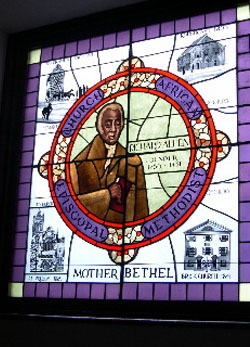
Fig. 2. This beautiful piece of Allen iconography—a stained glass window—is situated on the south side of Bethel church, on the stairway leading to the Richard Allen Museum. Courtesy of the author.
Another example of the Allen effect: I recently went back to Bethel Church to reexamine some records from the end of Allen’s life. Rather than go directly into the archives this time, I decided to hang out on “Richard Allen Avenue” at Sixth and Lombard and soak up the atmosphere. As tour buses passed by declaring Bethel a key stop on the Underground Railroad, I became part of two revealing exchanges about the place of Allen’s church in the lives of black and white Philadelphians of a certain age. First, a white woman who appeared to be in her mid-fifties passed by and, noticing my camera and consuming interest in Bethel, said that “white people aren’t allowed in there. Ever heard of Crow Jim?” Reverse discrimination at Bethel? No way. About ten minutes later, an African American man—a house painter, to judge by his splattered overalls—about the same age passed by on the other side of the church. Without breaking stride, he said, “That’s a beautiful church, isn’t it.” Two contemporary perspectives on Bethel Church, both from people of the civil-rights generation, and two perspectives that also provided historical insight. Even into the twentieth century, I learned, Bethel’s Independence struck a nerve for some in the white community, while in the black community it remained a fiercely prideful monument of black uplift.
Property deeds inside the church enhanced my appreciation of what Allen was trying to do at Bethel. On the one hand, these deeds from the 1790s and early 1800s told the tale of Richard Allen’s rapid economic ascension in bustling early national Philadelphia. As he bought property after property, Allen listed himself in a succession of new occupations, from dealer to master chimney sweep to African minister. In this sense, Allen became a relatively well-known man about town, a black man who not only inaugurated an African church but also owned his own home and several rental properties as well. On the other hand, the deeds illuminated Allen’s intense concern with protecting Bethel’s independence during and after his life. Allen’s tale of departing a segregated white church and starting his own congregation roughly a mile away is well known. But Allen was a shrewd and very practical man, and he made sure that he owned not only Bethel property itself but much of the land and rent-bearing dwellings around it. He even purchased a sliver of land, the width of a fence, next to Bethel! No one was going to pull a fast one on Allen and black churchgoers by selling neighboring property to white hecklers or malcontents. That urban morality play I had just witnessed—black pride and independence versus smoldering white resentment—resonated deep in Bethel archives.
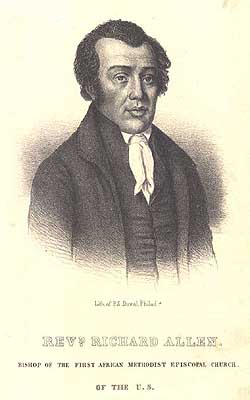
Fig. 3. Reverend Richard Allen, lithograph by P.S. Duval, Philadelphia, c. 1850. Courtesy of the American Antiquarian Society.
The church held even more treasures. Although I had been inside before, I had not met the remarkable woman who still provides weekly tours. Her name is Katherine Dockens and she is a lineal descendant of Richard Allen. “Has anyone ever said that you look like Richard Allen,” I asked. A regal, refined woman, she took the query in stride. “Oh, I get that sometimes.” Mrs. Dockens then guided me through Allen family lore, telling me, for instance, that Allen was remembered as a loving parent. Interestingly, she confided that there were things about Allen that even she did not know. It was with a great sense of pleasure, then, that I sent her a copy of Henry Highland Garnet’s description of meeting “Papa” Allen in the 1820s (so named by young children who would crowd around the great man on his visits to New York), a source generously given to me by John Stauffer of Harvard. “What a wonderful description,” she beamed. I visit Bethel every time I go back to Philadelphia to compare notes with Mrs. Dockens.
The Allen effect marches on. On research visits to Philadelphia, in conversations with colleagues and friends, I have continually encountered juicy tidbits about Allen’s life. “Weird Allen reference,” my girlfriend e-mailed one day, with a note from a Philadelphia physician’s journal about a broadside Allen posted in 1798 asking city residents to release pets left howling in city homes after yet another yellow fever epidemic. (Only a confident person, one growing into a community leader, would post such a note!) And so it goes, with ever-more references offering ever-more insights into, among other things, Allen’s leadership struggles near the end of his life, the socio-economic composition of AME church membership, literacy rates within Bethel church, and on and on. Perhaps this is what all biographers do—chase shreds of paper to the ends of the earth. “I was afraid of this,” my editor said when I explained my most recent Allen find and, well, the latest reason for delaying my manuscript just a few more months. But that so many shreds of paper even exist for Allen is an important testament to a black founder’s enduring presence in early national America.
Further Reading:
See Josephus: The Complete Works (Philadelphia, 1960); Absalom Jones and Richard Allen, “A Narrative of the Proceedings of the Black People during the Late Awful Calamity in Philadelphia” (Philadelphia, 1794), reprinted in Richard Newman, Patrick Rael, Phillip Lapsansky, eds. Pamphlets of Protest: An Anthology of African American Protest Literature, 1790-1860 (Routledge, 2001).
This article originally appeared in issue 5.4 (July, 2005).
Richard S. Newman teaches at the Rochester Institute of Technology and is soon to be finished with his next book, Black Founder: Richard Allen, African Americans and the Early Republic, from NYU Press.
A curious handbill circulated in Baltimore during September 1835. This “EARNEST AND DIRECT APPEAL” chastised city residents “who vainly claim to be considered Orderly.” Indeed, an afternoon stroll through town revealed shocking scenes of lawbreaking and moral apathy: merchants and storekeepers blocked sidewalks with crates and boxes, housekeepers dumped kitchen waste in the streets, and dog owners allowed their canines to bark all night at the expense of neighbors’ sleep. When upright citizens perpetrated or tolerated such behavior, outright anarchy could not be far behind. “To obtain that admiration which is due to the Monumental and Picturesque City,” the handbill’s author concluded, “nothing is wanting but more attention to–ORDER.”
A month earlier, the ruins of Baltimore’s finest homes were smoldering, an armed militia patrolled city streets, and a dozen men had been shot in three nights of rioting.Obstructed sidewalks and barking dogs were the least of Baltimore’s problems! As out-of-place as September’s handbill might seem, its author saw an obvious connection between littering and rioting: why would the “ignorant” respect the law if their social superiors flaunted it with impunity? Prohibiting men from riding their horses too rapidly along city streets and prohibiting the dispossessed from looting the homes of the rich–these were parts of the same project, a project common to the fastest growing cities of the early republic. Places like Baltimore strove to create bourgeois tranquility but faced deeper social disorder that no municipal traffic regulation could alleviate. Baltimore might gain the admiration of other cities for its refined public spaces and orderly streets, but it was just as likely that Baltimore would earn scorn as Mobtown.
Although the tension between order and disorder was not unique to the first decades of the nineteenth century, scholars have interpreted much of this era’s history around these poles. The democratization of electoral politics, the proliferation of competing religious sects, and a new boom-and-bust economy unmoored individuals, families, and communities from previous forms of hierarchy, gender structures, and class relations. Rapid economic development spurred social mobility and the growth of cities, where strangers brushed shoulders across lines of race, gender, ethnicity, and class. Rather than the foundations of good order, democracy and capitalism augured disorder and dislocation in the early republic. It fell to a new middle class to impose its own notions of order upon urban spaces and urban residents. This struggle pit women against men, whites against blacks, native-born against immigrants, the saved against the damned, democrats against aristocrats, and the economically ascendant against the downwardly mobile.
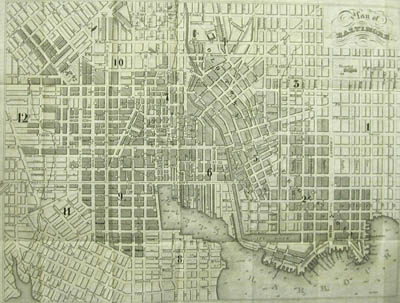
Fig. 1. Baltimore in 1832, from Fielding Lucas, Picture of Baltimore (Baltimore, 1832). Courtesy of the American Antiquarian Society.
There is no better city than Baltimore for watching this drama unfold, because unlike the other urban centers of the new nation (Boston, Philadelphia, New York, and Charleston), Baltimore had no meaningful colonial past to shape its institutions or people. By the time of the riots in 1835, Baltimore had little more than fifty years of existence as a city. Those five decades had provided enough time to build an urban infrastructure, to create functioning institutions, and even to erect the nation’s first monuments to the veterans of the War of 1812 and to George Washington. But it wasn’t close to enough time to anchor Baltimore against the forces of disorder endemic to the first decades of the nineteenth century.
Fig. 2. The Washington Monument, from Fielding Lucas, Picture of Baltimore. Baltimore’s other nickname was “The Monumental City” thanks to its tributes to George Washington and to the heroes of the 1814 defense of the city. Courtesy of the American Antiquarian Society.
The settlement on the Patapsco River began as Baltimore Town in 1729, but its next thirty years were marked primarily by “battle[s] with the frogs and mosquitoes whose proper territory it had invaded.” Although the population reached six thousand by the American Revolution, Baltimore’s strategic, economic, and political irrelevance saved it from British occupation or blockade. The 1780s and 1790s marked the crucial decades of Baltimore’s development. Situated inland near the mouth of the Susquehanna River, protected by the Chesapeake Bay, and within close sailing distance to the West Indies, Baltimore blossomed in tandem with the grain economy of Maryland and Pennsylvania. Baltimore’s millers and merchants linked backcountry farmers to an Atlantic market that showed an insatiable appetite for American produce. “Baltimore has the most rapid growth of any town in the U.S.,” ruled the future jurist James Kent when he passed through the city in 1793. Thanks to its “hot Bed growth,” Baltimore gained its municipal independence in 1797 and trailed only New York and Philadelphia in population. By 1820, the city’s population would stand at 63,000–more than twice as large as any other city below the Mason-Dixon line.
Fig. 3. Centre Market, from Fielding Lucas, Picture of Baltimore. Middle-class reformers feared the indiscriminate mixing of men, women, and children-free and enslaved-at Baltimore’s Centre Market. Courtesy of the American Antiquarian Society.
The leading chronicler of Baltimore’s rise was Hezekiah Niles, editor of the national newspaper of record, his Weekly Register. “There is not to be found, perhaps, in the history of any country, certainly not in that of the United States, an instance of such rapidity of growth and improvement as has been manifested in the city of Baltimore,” he exclaimed in 1812. In the years since the American Revolution, Niles continued, Baltimore had moved “from absolute insignificance, to a degree of commercial importance which has brought down upon it, the envy and jealousy of all the great cities of the union.” Niles reported that many city residents could recall when “cornfields and the native forests” stood downtown. Now, Niles noted at the end of the 1810s, “new streets, lanes, and alleys are opened, paved and built upon before one half of the people seem to know anything about them.”
Like other boosters, Niles described Baltimore’s growth in the passive voice: the number of houses built, the miles of track laid, the tally of barrels shipped. Of course, new roads and houses did not magically appear–and to some extent, that was the problem. The labor to create a commercial emporium required thousands of workers, who made Baltimore one of the new nation’s most diverse, plebeian–and in the eyes of some, disorderly–cities. Baltimore’s population nearly doubled with every census not because of a huge migration of merchants, but rather with the arrival of men and women whose digging and paving made streets passable, whose carting brought goods to the waterfront, whose caulking readied ships for Atlantic voyages, and whose sewing, scrubbing, and serving kept better-off households clothed and fed. Niles estimated that one-fifth of the city’s 1816 population had arrived within the previous twelve months. Perhaps only one in twenty of the city’s adult residents had been born there. “Our manners are not fixed, as in the elder cities,” Niles lamented. “There is little of that paternal or family influence, which, in older places constitutes a powerful bond of union, affection, and order,” observed another commentator in 1812.
The riots that gripped the city in the summer of 1812 offered a case in point. An attempt to punish an antiwar Federalist newspaper editor soon turned into the worst bloodbath seen in any city in the early republic. The defenders of the Federal Republican shot several of their attackers, before being lodged in the city jail for their own protection. The enraged crowd stormed the jail and killed Revolutionary War general James Lingan. General “Light Horse” Harry Lee was beaten and left for dead. Whereas the early stages of the riot conformed to what historian Paul Gilje has called the “Anglo-American mob tradition,” the jailhouse attack revealed the breakdown of the careful and scripted dance that usually took place between the crowd and civic officials. Rioters did not limit themselves to the destruction of property, nor did they deferentially accept the calming words of the mayor. Instead of burning their targets in effigy, the mob actually set one of its victims on fire. The militia eventually restored order, but Baltimore’s reputation had suffered serious damage. Massachusetts patrician Leverett Saltonstall fumed that his brother Nathaniel lived “in a place which is without government.” Editors in Philadelphia heaped abuse on Baltimore as “the headquarters of mobocracy” and “a new Sodom.” The Boston Repertory observed that Baltimore “contains a more various and mixed population than any other city in the U. States . . . made up of adventurers from other parts of this country, of foreigners, FUGITIVES OF JUSTICE, the OUTCASTS OF SOCIETY AND THE DISGRACE OF IT.”
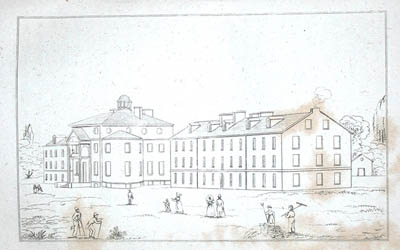
Fig. 4. Almshouse, from Fielding Lucas, Picture of Baltimore. The elderly and disabled inhabitants of the Baltimore almshouse were outnumbered by the able-bodied poor who performed compulsory labor at the institution. Courtesy of the American Antiquarian Society.
That might have been a little strong, but Baltimore’s diversity was nonetheless noteworthy. In 1820, Baltimore had the largest African American population of any city in the nation. With 4,357 slaves and 10,326 free blacks, more people of color resided in Baltimore than in New York, Philadelphia, Charleston, or New Orleans. Although African Americans comprised only one-quarter of Baltimore’s total population, their numbers constantly drew the attention of travelers coming from northern locales. The majority of black Baltimoreans were free, but Baltimore’s hybrid economy witnessed a large number of enslaved men and women living on their own, earning wages, or finishing a term of labor in exchange for a promise of manumission. While people of color had few opportunities to work outside manual labor or domestic service, most jobs in those sectors still fell to members of the city’s 75 percent white majority. With white skin offering no immunity from drudgework and with German redemptioners (indentured servants) arriving through the 1810s, the boundary of slavery and freedom blurred further. Baltimore’s workers–black and white, male and female, native born and immigrant, enslaved, indentured, and free–shared neighborhoods and meager material circumstances, but differences of race, status, ethnicity, and gender kept the city’s laboring population from developing a coherent class identity or political voice.
For Baltimore’s elected officials, prominent merchants, and moral reformers (who were often in fact the same people), the bad behavior of their working-class neighbors required much attention. Petitions to the city council complained of black women washing clothes too boisterously in a stream, Irish laborers singing too late into the evening, and unsupervised apprentices, servants, and slaves cursing and gambling in the marketplace. “Boys and Negroes” were frequently implicated together for throwing firecrackers, ripping up trees planted in new gentrified public squares, and although “verging to manhood,” bathing nude in Jones Falls. “We have often seen a fine, bright-eyed, intelligent little fellow belonging to this class,” noted the artist and lawyer John H. B. Latrobe, “with his cap set jauntily on one side of his head, his arms akimbo, his hands in his pockets, his feet apart, and, with a cigar in his mouth, bandying oaths and obscene jests with full-grown men, as though their equal in years and vice.”
By the end of the 1820s, Baltimore leaders had devised several means of stemming disorder. New ordinances banned boys from throwing rocks, female hucksters from selling food door-to-door, and people of color from assembling after curfew. Benevolent societies provided religious schooling to impoverished children, Bibles to their unchurched fathers, and sewing to their underemployed mothers. Groups advocating the colonization of free African Americans to Liberia, the regulation of drinking establishments, and the suppression of pauperism shared the goal of cleaning up the city.
Reformers in all cities of the early republic sought to stem vice. Where Baltimore truly distinguished itself was in its institutional response to crime and poverty. In 1822–while the city was still in the grips of an economic panic that started three years earlier– Baltimore’s poor relief officials terminated almost all cash aid to the needy, and instead required welfare recipients to perform mandatory labor in the almshouse. No other American city had discovered this secret recipe for lowering expenditures: if the poor could only gain relief in the almshouse, the threat of coerced labor would make them unlikely to do so. And those who did enter the almshouse would offset costs by growing food, sewing uniforms, and building cribs and coffins. As a committee of Philadelphia officials noted with admiration, Baltimore was able to “derive an income from that class who are always the greatest burthen.” Boston almshouse administrator Artemas Simonds concluded that “a rigid, uniform system toward paupers, like that of Baltimore, doubtless has the effect either of driving the idle, dissolute, vagrant class to other places, or of compelling them to reform their course of life.” Equally noteworthy was the Maryland penitentiary, where several hundred men convicted of property crimes funded the entire establishment with the proceeds of their compulsory weaving. By the end of the 1820s, this Baltimore institution was turning a $10,000 annual profit above its operating expenses.
Although the almshouse did not eliminate poverty any more than the penitentiary did crime, 1820s Baltimore attested to the optimism of a dynamic age. A massive parade celebrated the 1824 visit of Marquis de Lafayette, the French hero of the American Revolution. An even grander affair marked the 1828 groundbreaking of the Baltimore and Ohio Railroad–the city’s best hope for challenging New York’s commercial supremacy. A young newspaperman named William Lloyd Garrison honed his skills at Baltimore’s Genius of Universal Emancipation. A young slave named Frederick Bailey (but soon to be Frederick Douglass) learned to read by bribing Irish children with food on Baltimore’s waterfront. Henry Clay, Andrew Jackson, and William Wirt all garnered presidential nominations in Baltimore during the first national conventions in 1831 and 1832.
New possibilities always brought perils, however. Economic opportunities in the expanding city gave many working-class men and women enough money to become bank depositors. But the same opportunities gave financiers the chance to lose these deposits through reckless speculations. That is precisely what happened at the Bank of Maryland in 1834. Once it became known that the bank had issued fifty times more paper money than warranted by its holding in gold and silver, the savings of most small depositors instantly became worthless IOUs. Adding insult to injury, the bank’s directors used the collapse to enrich themselves further. In previous years, they had borrowed large sums from the bank. Those loans would come due as the bank attempted to climb out of insolvency. Buying up credit slips from desperate workers for cents on the dollar, the directors quickly accumulated enough paper to meet their obligations. The bank’s collapse prevented small depositors from reclaiming their money, but allowed the directors to repay their own loans with worthless paper. After waiting seventeen months for the directors to open their books, public outrage boiled over in August 1835.
In the name of defrauded workers and widows who had lost their life savings, a mob with “Judge Lynch at its head” targeted the unapologetic directors and defenders of the Bank of Maryland. The rioters championed a moral economy that placed community needs above the inviolability of the free market. After all, the banking scandal mocked the notion that the market could regulate itself in the best interest of all. “This is the most popular mob I have ever witnessed,” observed one city resident, “and I have seen several. Many of our most esteemed citizens wink at it–the poor have suffered, they could not get redress through the law, and so they have sought it in their own way, as ruinous as it may be to the interest of our city–the cries of widows and orphans are loud, and they will be answered.” The crowd demolished houses, burned furniture, and drove the mayor from office, but before the militia restored order, at least twelve rioters had been shot dead.
In the following months and years, order and disorder continued to vie for supremacy in Baltimore. As the 1835 riots had illustrated–and as the author of the ORDER handbill reminded readers–the misbehavior of the city’s best residents proved as threatening to Baltimore’s future as the uncontrolled rage of the crowd. The reminder fell on deaf ears. Property holders called for a militarized “City Guard” to “prevent riotous and tumultuous meetings of the lawless and unprincipled, too abundant in every large city.” Boys continued to throw rocks and to brawl at the scenes of fires. Enslaved men and women refused to stay put. The same railroad that augured Baltimore’s future prosperity carried one Frederick Bailey into freedom and the new last name of Douglass. Baltimore remained the nation’s third most populous city at the time of the Civil War, but as the Massachusetts and Pennsylvania soldiers passing through Baltimore to Washington D.C.’s defense in 1861 quickly realized, the epithet Mobtown still applied.
Further Reading:
A new anthology contains a number of interesting essays on Baltimore history: From Mobtown to Charm City: New Perspectives on Baltimore’s Past, edited by Jessica Elfenbein, John R. Breihan, and Thomas L. Hollowak (Baltimore, 2002). The best introduction to the city is Sherry Olson, Baltimore: The Building of an American City, second edition, (Baltimore, 1997). For the experiences of enslaved and free African Americans, see T. Stephen Whitman, The Price of Freedom: Slavery and Manumission in Baltimore and Early National Maryland (Lexington, 1997); and Christopher Phillips, Freedom’s Port: The African American Community of Baltimore, 1790-1860 (Urbana, 1997). Amy S. Greenberg’s Cause for Alarm: The Volunteer Fire Department in the Nineteenth-Century City (Princeton, 1998) devotes much attention to order and disorder in Baltimore, as does William R. Sutton’s Journeymen for Jesus: Evangelical Artisans Confront Capitalism in Jacksonian Baltimore (University Park, Pa., 1998). Frank Towers will soon publish an important study on 1850s Baltimore, tentatively titled The Coming of the Civil War in the Urban South: Baltimore and the Politics of Free Labor in the Slave States. Within the next few years, also look for the books emerging from the recent doctoral dissertations on Baltimore in the early republic by Richard Chew, Barbara Wallace, Joshua Civin, and Seth Rockman.
This article originally appeared in issue 3.4 (July, 2003).
Seth Rockman teaches at Occidental College in Los Angeles. He is the author of Welfare Reform in the Early Republic (Bedford, 2003) and is currently writing a book on race and labor in Baltimore in the early republic.
Tunebook: David and Ginger Hildebrand
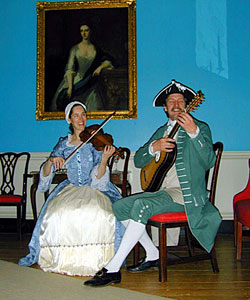
1. David and Ginger Hildebrand at the William Paca House in Annapolis, Maryland, c. 2004. A woman playing the violin contradicts the gender associations with instruments of the day, so we’re always careful to point that out in concert. Photograph courtesy of David and Ginger Hildebrand.
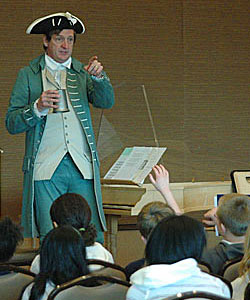
2. David Hildebrand with fifth graders at the Nevada History Center, Las Vegas, 2011. Thank goodness kids still know and are willing to sing “Yankee Doodle!” Photograph courtesy of David and Ginger Hildebrand.
David and Ginger Hildebrand co-founded the Colonial Music Institute, which conducts and promotes research and offers information and resource materials for students and fellow scholars, as well as helpful publications and online databases for researchers and teachers. CMI encourages primary research enlightened by interdisciplinary scholarship, and publishes sound recordings, CD-ROMs, sheet music, books (scholarly and performing editions), and online databases and other resources for researching American music and dance of the seventeenth through early nineteenth centuries. CMI’s online materials include essays, lists, indexes, and other useful information. We also offer consulting services for archivists, curators, film producers, and collectors.
We are simultaneously performers and educators in the field of early American music, broadly covering the period 1720-1820. Our mission is to teach American history through music that informs us about society, politics, heroes, and battles and through the varied voices of master and slave, Rebel and Tory, man and woman, and Southerner and New Englander. There is no single point of view in our repertoire.
3. After a concert, audience members get a closer look at a spinet at Anderson House, home of the Society of the Cincinnati, Washington, D.C., 2011. The spinet is a reproduction of an English model, c. 1720, from the shop of Thomas Hitchcock in London. Photograph courtesy of David and Ginger Hildebrand.
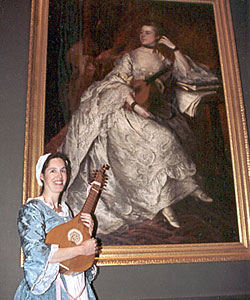
4. Ginger poses with a reproduction English guitar at the National Gallery of Art, Washington, D.C., 2010. The Thomas Gainsborough painting dates from 1760 and is of Anne Ford, a high-society amateur guitarist who assumed a rather risqué pose for her day. Photograph courtesy of David and Ginger Hildebrand.
We were initially drawn to early American music by our audiences. When we began performing together professionally in Annapolis in 1980, audience members would ask sometimes: “Do you do any colonial music?” We got curious, found plenty of interest and demand, and within several years narrowed in on this specialty. Thirty years, three graduate degrees, and seven CDs later, we’re still fascinated. After all, this music resonates with our classical training (piano, violin, guitar) and appreciation of European art music as well as our love of traditional American music. The beauty of appropriate instruments for music caught our attention, too. We normally bring quite a few of them to the concert stage: harpsichord, violin, English and German flutes, hammered dulcimer, baroque guitar, English guitar, and djembe. Every time we set them on stage they captivate the audience—not just through their sounds but through their appearance. Curious audience members always come up to the stage for a closer look after a program.
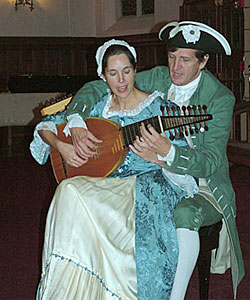
5. David and Ginger performing John Dowland’s “Come Again, Sweet Love,” as arranged for four hands on one lute, Summit, New Jersey, 2005. We are careful not to present the lute as a typical colonial instrument, since it wasn’t, but instead use it to contrast the earliest American musical forms with the elevated music of the English court in 1607, such as that heard in this madrigal. Photograph courtesy of David and Ginger Hildebrand.
Much of what we do depends on creating the context. Beyond the detailed program listings and notes, we talk to the audience about each piece, providing historical setting and things to listen for. We nearly always appear in period attire, colonial c. 1770 or 1812, depending upon the program. We don’t perform in character, but rather address the audience as intelligent people of the twenty-first century. Our appearance increases the audience’s ability to “get into” our music, and it helps us assume a natural presentation of music so different from that of today. David’s gentleman’s overcoat forces him to stand and sit with good posture, for instance, thus improving the delivery of upper-class theatre songs. Explaining the parts of clothing at the beginning of a children’s program really draws them in and clarifies the gender differences in musical practice that we’ll later demonstrate. Not surprisingly, we prefer to perform in small historic spaces with great acoustics! An intimate space, such as the auditorium at Mount Vernon, requires no amplification and allows for informality. But we do our best to project this sense in larger halls as well.
1. “Over the Hills and Far Away,” from The Beggar’s Opera. David Hildebrand, voice and guitar; Ginger Hildebrand, violin. Track taken from Over the Hills and Far Away, being a collection of music from 18th-century Annapolis (1990). Courtesy of David and Ginger Hildebrand.
2. “A Toast,” by Francis Hopkinson. David Hildebrand, voice and harpsichord; Ginger Hildebrand, voice and violin. Track taken from George Washington, music for the first president (1999). Courtesy of David and Ginger Hildebrand.
3. “Dieu d’Amour,” by Andre Gretry. Julianne Baird, voice; David Hildebrand, voice and guitar; Ginger Hildebrand, voice. Track taken from Music in the Life of Benjamin Franklin (2006). Courtesy of David and Ginger Hildebrand.
4. “The Rising Sun.” David Hildebrand, recorder; Ginger Hildebrand, hammered dulcimer and violin. Track taken from Music in the Life of Benjamin Franklin (2006). Courtesy of David and Ginger Hildebrand.
5. “Decatur and the Navy.” David and Ginger Hildebrand, voice. Track taken from the recording Music of the War of 1812 in America (2011). Courtesy of David and Ginger Hildebrand.
This article originally appeared in issue 13.2 (Winter, 2013).
CALL FOR EDITORS: New Editor(s) Sought for Common-Place
.
Common-place, the online quarterly magazine of early American history and culture hosted at the American Antiquarian Society, is seeking a new editor or editors to guide this unique online resource of accessible, lively scholarship.
The editor(s) of Common-place should have a record of writing and scholarly activity in a field consistent with the purview of Common-place (pre-1900 American history, literature, and culture as well as a PhD or equivalent). The editor should also possess strong organizational and editorial skills and be comfortable working collaboratively with an excellent group of column editors. Perhaps most importantly, the editor must possess an interest in presenting American history to a broad public, and an instinct for how to do so in a compelling way. In addition, the editor’s home institution would need to be understanding of the commitment involved in taking on the editorship, and be willing to support the editor in performing this work. We seek an institutional partner that is able to support the editor through release time from teaching; graduate research assistance; and other forms of support. Of particular interest is an institution with an interest in and capacity for work in public history and/or the digital humanities.
A partnership with Common-place would provide ideal opportunities to give students hands-on experience in working with an established online venue for high-level humanities scholarship. Interested candidates should contact James David Moran, vice president of Programs and Outreach, American Antiquarian Society, by phone at 508-471-2131 or by e-mail at jmoran@mwa.org.
This article originally appeared in issue 17.2 (Winter, 2017).
Anna Mae Duane (Associate Professor of English and American Studies, University of Connecticut) and Walter Woodward (Associate Professor of History, University of Connecticut) are co-editors of Common-place.
Publick Occurrences 2.0 July 2008
July 29, 2008
Tennessee church shooter targets conservative historical fiction
It appears that the angry white guy who shot up a children’s production of “Annie” at a Unitarian-Universalist church in Tennessee thought he was taking revenge on something that is largely a fictional creation of the conservative political media, the “liberal movement.” (As far as I can tell, the only historical group that ever actually called itself the “Liberal Movement” was a minor Australian political party from the 1970s).
KNOXVILLE, Tenn. – An out-of-work truck driver accused of opening fire at a Unitarian church, killing two people, left behind a note suggesting that he targeted the congregation out of hatred for its liberal policies, including its acceptance of gays, authorities said yesterday.A four-page letter found in Jim D. Adkisson’s small SUV indicated that he intentionally targeted the Tennessee Valley Unitarian-Universalist Church because, Police Chief Sterling Owen said, “he hated the liberal movement” and was upset with “liberals in general as well as gays.”
Adkisson, 58, a truck driver, had 76 rounds with him when he entered the church and pulled a shotgun from a guitar case during a children’s performance of the musical “Annie.”
Adkisson’s ex-wife once belonged to the church but hadn’t attended in years, said Ted Jones, the congregation’s president. Police investigators described Adkisson as a “stranger” to the congregation, and police spokesman Darrell DeBusk declined to comment on whether investigators think the ex-wife’s link was a factor in the attack.
Adkisson remained jailed yesterday on $1 million bond after being charged with one count of murder. More charges are expected. Four victims were hospitalized in critical condition.
“It appears that what brought him to this horrible event was his lack of being able to obtain a job, his frustration over that, and his stated hatred for the liberal movement,” Owen said.
Adkisson was a loner who hates “blacks, gays and anyone different from him,” longtime acquaintance Carol Smallwood, of Alice, Texas, told the Knoxville News Sentinel.
The term “liberal movement” (along with similar ones) is really just a convenient way for conservatives to package together some people’s uneasiness with a wide array of social changes and turn it into a sort of conspiracy theory that can be used against a variety of political opponents. Historically, of course, the radicals who promoted some social causes originating in the 60s and 70s often hated no one worse than the liberals who had helped foster some of the older rights movements. Moreover, as we have discovered in recent Democratic primary campaigns, even moderate politicians vaguely affiliated with rights movements for different groups of people do not form any sort of cohesive unit. If there was a powerful “liberal movement” that could pull itself together, we would not have spent quite so much of the past 40 years under real or virtual GOP rule. (Note that I am not even getting into the 18th-century meaning of “liberal.)
A CNN story makes it even clear that the shooter almost quoted right-wing media talking points when explaining his actions to the police:
According to the affidavit requesting to search Adkisson’s home, the suspect told investigators liberals should be killed because they were ruining the country. Adkisson also blamed Democrats for the country’s decline, according to the affidavit.
“He felt that the Democrats had tied his country’s hands in the war on terror and they had ruined every institution in America with the aid of major media outlets,” the affidavit said. “Because he could not get to the leaders of the liberal movement … he would then target those that had voted them into office.”
Killed in the shooting were Linda Kraeger, 61, and Greg McKendry, 60, police said. Witnesses said McKendry, an usher and board member at the church, tried to shield others when he was shot, according to The Associated Press.
I imagine these Tennessee Unitarians thought they were just trying to be tolerant and welcoming to all different kinds of people, being nice and polite we call it where I come from, rather than serving an all-powerful “movement” to oppress the likes of Jim D. Adkisson.
July 28, 2008
“Seems Like Old Times”: Panicky Bankers
It was real nice to learn in today’s New York Times that what I shall choose to call our financial services community, after years of fueling a speculative real estate bubble by handing out giant loans to anyone who could click a dancing Internet advertisement, has now decided to deepen the economic crash they helped cause by refusing loans to real businesses that might actually be able to sell products and pay them back:
Worried Banks Sharply Reduce Business Loans – NYTimes.com
“Before, they wouldn’t verify income and they were loose on the valuations of collateral,” said John W. Kiefer, chief executive of First Capital, a private commercial lender. “Now they’re tightening down on the ability to repay. They go off the reservation, and now they come back to basics. It’s preservation for many of them at this point. It’s survival.”
But if the newfound caution of American banks is prudent in the long run, the immediate impact is amplifying the troubles with the economy. The Federal Reserve has been lowering interest rates aggressively to make money flow more loosely and to spur economic activity.
The financial system is not going along: As banks hold on to their dollars, mortgage rates are climbing. So are borrowing costs for corporations.
Some suggest that the banks, spooked by enormous losses, have replaced a disastrously indiscriminate willingness to hand out money with an equally arbitrary aversion to lend — even on industries that continue to grow.
“There’s been a lot of disruption in the credit market, and a lot of traditional lenders have really tightened up,” said Gregory Goldstein, president of Macquarie Equipment Finance, which leases computer gear and other technology to companies. “Before, some of the standards they lent on were weak, but we think they have overshot and gone too far on the other end.”
Upon reading this article, two words immediately popped into my Early Republic-addled brain: “Langdon Cheves.” As I remembered the story, Cheves was the South Carolina lawyer who was put in charge of the Second Bank of the United States after the revived national bank nearly collapsed from the lax lending policies of its previous president, friendly Philadelphia merchant William Jones. (Much of that money also went into failed real estate speculations, in this case on the trans-Appalachian frontier.) Cheves came in and shut the credit spigot off, without much regard for any consequences but his institution’s own finances. While economic historians no longer buy the Jacksonian argument that the B.U.S. caused the catastrophic Panic of 1819, it does seem to be true that Cheves’s overreaction made the subsequent depression much longer and deeper than it could have been.
While the economy languished in the early stages of a recession, Cheves began accumulating a horde of specie, amounting to over $7 million by the end of 1820.10 At least $4 million of that total represented excess reserves, which could have been used to increase the nation’s supply of notes and deposits by up to 17 percent. If Cheves had acted aggressively, yet still prudently, he could have alleviated much hardship, prevented hundreds of failures and bankruptcies, and perhaps led the country out of the recession before it became a depression.
I don’t have a moral for this story, other than it seems we “free enterprise”-loving Americans have to learn every generation or two that private businesses really are only out for themselves after all, and cannot not be depended on to hold society together when the chips are really down. Of course, the moral that millions of Americans drew from the mismanagement of the Second Bank of the United States was that banks were evil, providing one critical ideological basis for a generation of Jacksonian Democratic rule.
July 27, 2008
And we’re back!!!
I really should announce these things in advance, but travel and some WordPress-related maintenance have kept me off here for the past two weeks. With any luck I will ramp the posting level up here as I slowly get out of summer mode. This is the down season for politics anyway, when even history-making presidential candidates and Shiite militias go on vacation. To be honest, things have been going so badly for McCain that I have been afraid to comment. Do you get the feeling that even after all these years of McCain sucking up to him, Shrub still hates his former primary opponent’s guts, for getting better press and being a real fighter pilot and stuff? I am not sure there has ever been anything quite like this past week’s spectacle of the GOP-installed regime in Iraq endorsing the Democratic position on withdrawing the troops and a Republican president changing a longstanding position nearly to suit, leaving only the Republican candidate twisting slowly, slowly in the wind (as the Nixonians used to say.) Given that Tuffness Against Terror had been pretty much McCain’s whole campaign, and his only real advantage over Obama as measured by polls, that had to hurt, at Teddy Roosevelt running against his own less popular former Vice President levels. Even ultra-loyalist Condi Rice won’t deny that she is voting for Obama.
July 14, 2008
New and Really Old Business
NEW: Congratulations to the Common-Place management team for recruiting University of Oklahoma’s Cathy Kelly as the new editor. I can’t think of a better choice and love the idea of a theoretically New England-based publication moving its editorial HQ even farther away than Florida. I am sure there will be more on the site about the coming regime change soon.
NEW, BUT ACTUALLY REALLY OLD: I learn from Ralph Luker at History News Network that I made some list of the “The Top 100 Liberal Arts Professor Blogs.” Excellent! Unfortunately, the rush to get that kudo on my c.v. screeched to a halt when the list in question turned one to be done by someone or something that did not even follow the links. The blog mentioned was my old one at HNN, last updated in 2003! Thanks to Ralph for flagging the mistake.
DEEP THOUGHT ON THE FOREGOING ITEM: Time and the Internet turn out to have a very complex relationship, up-to-the-second and rapidly changing on one hand, but weirdly timeless on the other. You have to check those dates and temporal clues very carefully. Decade-old items are already coming up on Google, often surrounded by a site’s present-day headlines and ads in a way that can be quite confusing. Of course, my old HNN blog is clearly labeled as “Inactive” but, as Ralph points out, the creator of the list just assumed that “Inactive Notes of a Left-Wing Cub Scout” was an extra-cute title.
July 13, 2008
My Folksinger Has a First Name, It’s O-S-C-A-R
One of the advantages (?) of having an Internet Presence is the ability to constantly maintain your past work, kind of like a worldwide electronic errata sheet. It so happens that I recently had to go back through my article on the Mammoth Cheese of Cheshire, Massachusetts and found an error I apparently persisted in making through multiple renditions of that piece. Citing the CD Presidential Campaign Songs, 1789-1996, I listed the recording artist as “Carl Brand” when in fact it was venerable folksinger Oscar Brand, whose work I subsequently became familiar enough with to regard that as a really stupid mistake. Oh well, at least I didn’t go with Max Brand or Neville Brand, though I might have noticed those.
By the way, the Oscar Brand links go to Emusic.com, a sight I highly recommend for anyone interested in unusual music. Historical Americana seems to be one of the service’s strong points, with a big chunk of the Smithsonian Folkways catalog available for download along with much much else. For fans of tunes that rocked the Early Republic, there are currently no less than eight different versions “Jefferson and Liberty” available, including the one from Janet Reno’s double-album of historic covers, Song of America. That sentence was a bit misleading, but definitely not a mistake.
July 10, 2008
Unwelcome Interventions
In honor of the detestable former Reaganaut and current McCain campaign co-chair Phil Gramm’s too-revealing remark about the country being only in a “mental recession” invented by a “nation of whiners,” I thought I would throw in some links to a couple of other disastrous presidential campaign interventions by political luminaries who had fallen a little out of touch. These are from the early American republic, of course, and come courtesy of Google Books:
1796: Thomas Paine, A Letter to George Washington, in which Paine, writing from Paris and having just published The Age of Reason, managed to cement the Federalist linkage of the Democratic-Republicans with the sort of atheistic French wankery that few Americans of any politics much liked. Criticizing George Washington for his foreign policy was edgy enough without bringing Paine’s notorious religious views into the mix.
1800:A Letter from Alexander Hamilton, in which the Federalists’ preeminent figure unloaded the full measure of his jealousy and arrogance on the head of a Federalist president (John Adams) battling for re-election, and helped put his two other worst enemies (Thomas Jefferson and Aaron Burr) in power.
Not that Phil Gramm deserves to be put on the same plane as Paine or Hamilton, except for being uncontrollable, associated with a former regime, and having a little too much to say. However, John McCain did not need any more public reminders of just how far GOP leaders’ real concerns are from those of suburban and rural voters whose lives are rapidly becoming unfeasible thanks to high gas prices and job losses. The media always needs reminders, however, so tell us more, Phil, tell us more.
Postscript on Google Books: On the one hand, as a lover of physically browseable libraries, I imagine I should not approve of Google Books. On the other hand, as a back pain sufferer and a resident of mid-Missouri, Google Books is life-changingly awesome. It especially tickles me that many of Google’s scanned volumes on the Early Republic come from the Harvard Libraries and thus were quite likely once lugged home in 25-pound bags — on the #77 bus — by yours truly. Don’t knock it until you have carried a pile of tomes such as Wharton’s State Trials of the United States Under the Administrations of Washington and Adams and Scharf and Westcott’s History of Philadelphia, 1609-1884 (in 3 elephantine volumes) up several flights of stairs yourself.
July 4, 2008
When Americans Really Knew How to Celebrate Liberty
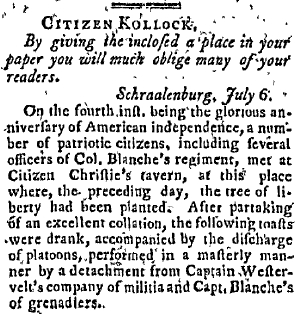
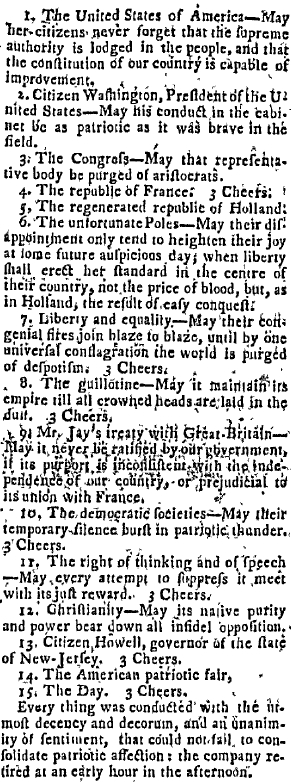
A new holiday tradition here on the blog — hard-hitting Fourth of July toasts from back in the days when Americans enjoyed detailed political expression along with their picnicking and partying. These are from the Elizabeth (then Elizabethtown) New-Jersey Journal, 15 July 1795. Remember that each one of these sentiments would have been followed by a stiff drink, and not of Bud Lite either. Be sure to check out number 8, saluting the guillotine. Good times!
July 3, 2008
Manchurian Candidates . . . for a job at Gitmo
You just can’t make this stuff up. I have long thought of the Iraq Wars and the GWOT as Cold War phantom pains, the result of Cold War institutions and Cold War thought carrying forward without an appropriate object like a competing superpower. (This is why the U.S. spends so much more time and effort going after “state sponsors of terror” than actual terrorists.) But now we discover that the military literally brought out the Cold War playbook, the Red Chinese Cold War playbook, for interrogating prisoners at Gitmo. From the New York Times:
WASHINGTON — The military trainers who came to Guantánamo Bay in December 2002 based an entire interrogation class on a chart showing the effects of “coercive management techniques” for possible use on prisoners, including “sleep deprivation,” “prolonged constraint,” and “exposure.”What the trainers did not say, and may not have known, was that their chart had been copied verbatim from a 1957 Air Force study of Chinese Communist techniques used during the Korean War to obtain confessions, many of them false, from American prisoners.
The recycled chart is the latest and most vivid evidence of the way Communist interrogation methods that the United States long described as torture became the basis for interrogations both by the military at the base at Guantánamo Bay, Cuba, and by the Central Intelligence Agency. [Read the rest]
While it was astonishingly moronic to deploy techniques designed to produce false confessions in an effort to ferret out real terrorist plots, the strategy was unfortunately quite consistent with the long-time predilections of the American Right and the U.S. government. There seems to be a part of the right-wing brain that is deeply attracted to the sort of “brutalitarian” (Joe McCarthy’s word) excesses it likes to detect and denounce in its enemies. During the Cold War, U.S. officials across the political spectrum repeatedly concluded that they needed to “fight fire with fire” and employ tactics as or nearly as harsh and devious as a Communist enemy that was seen as colossally evil. satanically ruthless, and unnaturally effective.
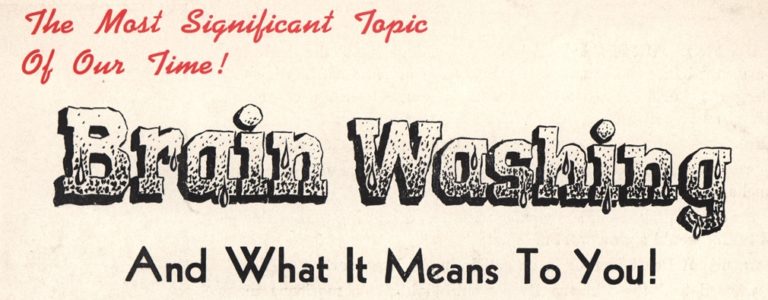
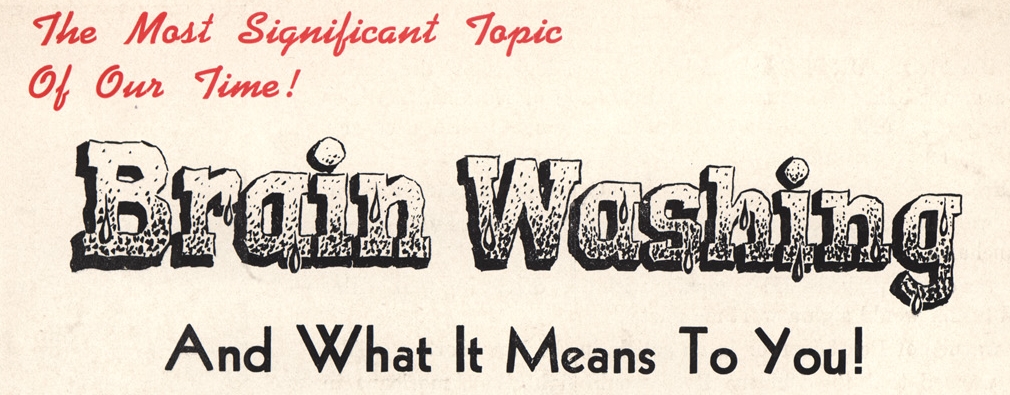
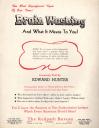
The article correctly relates the Air Force study to the “brainwashing” controversy of the 1950s, during which the government and the larger culture gave itself a panic attack over the apparent conversion of captive Korean War soldiers to Communism. In true fire with fire spirit, the CIA and other entities paid for both propaganda about the horrors of Communist brainwashing techniques and also for secret research that tried to duplicate those techniques for American use. The nature of the techniques was a subject regarding which a host of pulpy mind-control fantasies were spun and researched, involving hypnotism, telepathy, and most of all drugs. [Click the images at the bottom for an example of the propaganda. The brainwashing expert whose speeches are being advertised, Edward Hunter, worked for the CIA.] It was in pursuit of such a magic elixir that the CIA did things like try to corner the world market on LSD and then hand out supplies of it to secretly-funded university laboratories. You can read all about it in John Marks’s jaw-dropping book, The Search for the “Manchurian Candidate.” What I was most shocked by was how little actually came of the CIA’s mind-control research. According to Marks, they never figured out how to make anybody do anything other than by sheer coercion or blackmail. Truth serum and zombie-like sleeper agents and hypnotic programming are such well-developed concepts that people tend to believe there must be something to them that the movies just exaggerate, but it seems that vampires and werewolves might actually be on about the same level of factuality.
What the NYT article does not quite explain is that the Albert Biderman study the Gitmo trainers drew on came from a more level-headed social scientific approach to the “brainwashing” issue that essentially debunked it, explaining that the confessions and conversions that the Chinese and Soviets got were achieved not through drugs or hypnotism but good old-fashioned police brutality and bureaucratic manipulation. I guess this lesson must have hung around in some military intelligence and right-wing circles ever since. Biderman also may have supplied the idea that, while brutal and deplorable, the methods he described were used by Communist governments specifically as alternatives to more traditional forms of torture. So, when today’s lefties and libertarians complain about the Bush administration creating its own gulag, we now know that that it is almost literally true.
This article originally appeared in issue 8.4 (July, 2008).
Jeffrey L. Pasley is associate professor of history at the University of Missouri and the author of “The Tyranny of Printers”: Newspaper Politics in the Early American Republic (2001), along with numerous articles and book chapters, most recently the entry on Philip Freneau in Greil Marcus’s forthcoming New Literary History of America. He is currently completing a book on the presidential election of 1796 for the University Press of Kansas and also writes the blog Publick Occurrences 2.0 for some Website called Common-place.
Plagiarize This
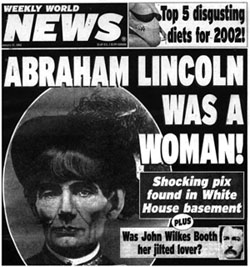
Did you miss it? Maybe you’ve been too busy, what with endlessly emailing Amazon.com, begging for a refund of your copy of Stephen Ambrose’s Wild Blue, and spending your evenings squinting at nine-point type, double-checking Doris Kearns Goodwin’s footnotes. But while you were off pursuing putative plagiarists, the Weekly World News broke the American history story of the century: Abraham Lincoln Was a Woman!
Fig. 1. The Weekly World News, January 22, 2002
Thanks to “maverick historian Jessica Durbeen,” we now know that Honest Abe was born Abigail Lincoln, a victim of Marfan’s syndrome, a genetic disorder that can cause disproportionate growth. As a young girl, she decided to dress as a man to work as a rail splitter and, thanks to some Log Cabin luck, found a male transvestite to marry (“‘Take a look at a photo of Mary Todd Lincoln and you’ll be convinced'”), by whom she gave birth to six children while, possibly–and here Durbeen can go no further than the evidence allows–carrying on a torrid affair with John Wilkes Booth.
In a year when one front-page revelation after another has led Americans to question historians’ credibility, perhaps you’re right to be skeptical. How does Durbeen know all this? And why haven’t we heard about “Babe-raham Lincoln” before? All is answered in the January 22, 2002 issue of the WWN: like any sex scandal worth its cigar, it begins with Bill and Hillary.
After the Clintons and their staff left Washington in January 2001, a secret cache of Mathew Brady photographs was discovered in the White House basement (under the sealed box containing all the missing W‘s from the West Wing’s computer keyboards?). In four Brady photographs, “reproduced” in a quite lovely spread in the WWN article by Mike Foster, Lincoln sports everything from a housedress to a hoop skirt. (Note to Scarlett: Back off.) Faked photographs, you say. Photoshop is easy, you say. But there’s more “striking evidence”: “A jar of glue, used by actors to apply fake beards, found among Lincoln’s personal effects at the Smithsonian Museum–along with a dozen sanitary napkins.”
Don’t get me started on the Maxi pads. What I want to know is, while the New York Times and the Boston Globe are gleefully covering Historygate, is anyone, besides the Weekly World News, talking about history?
It’s easy to think that the WWN works just like the Onion (whose historical essays include, “Newly Unearthed Time Capsule Just Full of Useless Old Crap“), but it doesn’t. The Weekly World News is not, or at least not entirely, spoof. The Onion sells ads for cell phones; the WWN advertises psychics. Rest assured that there are people who now believe that Lincoln was a woman. Not too many, but, to paraphrase Mark Twain, in such cases, one is aplenty.
Lincoln is, perhaps, a better candidate for tabloidization than those other famous Americans who populate our coins and bills. As cultural historian Tony Rotundo observes, “In the American pantheon, Lincoln plays Christ to Washington’s God.” Washington is austere, remote, and untouchable. Lincoln, because he suffered (from depression, a bad marriage, a rotten death) is vulnerable, and more recognizably human. Is that any reason to dress him as a woman? Of course not, but it does help explain Lincoln’s mutability.
When two-time Pulitzer Prize-winner David Herbert Donald toured the country promoting his 1995 biography of Lincoln, the first question audiences asked was, invariably, “Was Lincoln gay?” One elderly radio listener phoned a call-in program to assert that she had read, somewhere, that Lincoln was black. “She thought she knew this,” Donald recalls, sadly.
Americans are miserably ignorant of their nation’s history and, truth be told, they’re pretty darn gullible. Maybe “Americans are Gullible” isn’t as good a headline as the New YorkTimes’ Onion-ish “Writers Beware: History Is an Art, Not a Toaster” (February 28, 2002), but it’s surely at least as true. That Jessica Durbeen is nowhere to be found in the American Historical Association’s 2001-02 Directory of History Departments, Historical Organizations, and Historians isn’t likely to trouble the sleep of many readers of the Weekly World News, but it sure keeps me up at night. If journalists are going to lecture historians about accountability, maybe we could all take the time to think a bit harder about the past we’re trying to protect from would-be plagiarists.
Meanwhile, take comfort that Jessica Durbeen was herself once a doubter: when she initially came across the claim that Lincoln was a woman in “a tattered old Confederate pamphlet,” she found it preposterous: “At first, I thought it was just wartime propaganda, but then I took a closer look at a photo of Lincoln and realized the beard does look bogus.”
This article originally appeared in issue 2.3 (April, 2002).
Would John Adams have called John Winthrop a “Founding Father?”
Photo by Keegan L. Bremer, the author’s grandson
When a series of long discussions with my editor led to the title John Winthrop: America’s Forgotten Founding Father, I was initially concerned for two reasons. On the one hand, I certainly had not “forgotten” John Winthrop, and I doubt that his name would be unfamiliar to any readers of Common-Place, many of whom were first introduced to colonial New England by reading Edmund S. Morgan’s brilliant short biography of Winthrop, The Puritan Dilemma. But the more I had occasion to mention my book to friends and acquaintances, colleagues in other disciplines, and even historians with other specialties, I became truly surprised at how few people recognized Winthrop’s name. Members of my own family, of course, were an exception to this pattern, having been dragged to what they considered all too many historical sites in England, Ireland, and America connected with the career of the Massachusetts leader. Perhaps John Winthrop had indeed been forgotten.
But was he indeed a Founding Father? Or what, at any rate, did the Founders themselves think? The issue is more complex. There is little evidence that the great men of Virginia had ever heard of John Winthrop, far less given his career and significance any serious thought. But John Adams did recognize the importance of the early governor of the commonwealth, even to the point of using his name as a pseudonym for some of his writings in the 1760s.
Adams was very familiar with Winthrop’s story, and with the continuing role that Winthrop had played and continued to play in the history of Massachusetts. He had studied at Harvard under the Hollis Professor of Mathematics and Natural Philosophy, John Winthrop (1714-79), the distant descendant of “my” John Winthrop. In the decade after the Stamp Act in 1765, this later John Winthrop, a member of the colony’s provincial congress and then of the Revolutionary council, became noted for his opposition to British policies, and, in time, as a proponent of Independence. John Adams corresponded with his old professor and recommended Winthrop to George Washington as one of local men “whose judgment and integrity may be most relied on” when the latter departed to take command of the troops near Boston. But Adams was also well versed in the story of Professor Winthrop’s ancestor. Though the first publication of Winthrop’s journal from the 1630s and 1640s did not appear until Noah Webster’s edition in 1790, Adams would have been familiar with Winthrop’s contributions from reading Cotton Mather’s Magnalia Christi Americana (1702) and Thomas Prince’s Chronological History of New England (1736). Both of those authors had access to the Winthrop manuscripts and drew on them heavily in their accounts, and both presented the governor in highly favorable terms, Mather in particular extolling him as the “American Nehemiah.” Despite Governor Thomas Hutchinson’s support of British policies, his History of the Colony of Massachusetts Bay (1764) was another source for learning of the province’s founding generation.
Adams’s careful perusal of the records of the Bay Colony provided further insight into Winthrop’s contributions, and he drew on all this in his defense of American liberties. In 1767 he criticized the colony’s Governor Francis Bernard in two letters in the Boston Gazette presented as communications from “Governor Winthrop to Governor Bradford.” Clearly he felt that invoking the name of Winthrop on behalf of the patriot cause would reinforce the points he wished to make.
On the eve of the fighting in 1775, Adams again invoked Winthrop, this time in one of his Novanglus essays, reviewing the history of the Bay’s original charter and the determination of Winthrop and his fellow leaders to preserve their liberties. Seeking to dismiss the charge that those who opposed tyranny were rabble in an early age and rabble at the time he was writing, Adams stressed the fact that Isaac Johnson, Winthrop, and Thomas Dudley–all early leaders of the Massachusetts colonial experiment–were “not the rascally Rabble of Romulus, but Gentlemen of Family, Fortune, Education, and Figure.” In 1780 Adams again found cause to extol Winthrop and the other “first Planters of New England” as great men who struggled with the dangers of the wilderness to enjoy “superior liberty for themselves, and the prospect of it for their children.”
Adams identified “the Towns, Militia, Schools and Churches as the four Causes of the Growth and Defence of N. England” from which the “Virtues and Talents of the People are there formed,” and credited the founding generation of “Norton, Cotton, Wilson, Winthrop, Winslow, [and] Saltonstall” for establishing these institutions. Deflected from a career in the ministry by his distaste for the heated religious quarrels of his own day, Adams clearly emphasized the social and political accomplishments of Winthrop and his peers over their sectarian goals. Yet he was proud of Massachusetts and its history, and viewed Winthrop and his peers as the colony’s founding fathers. Of course, this was the view from Braintree. Beyond New England, Winthrop’s story was less well known. Only after the success of the Revolution, when New Englanders such as George Bancroft began to write histories of the new nation, did Americans outside Massachusetts learn that they too owed much to the Puritan founders.
If John Adams recognized Winthrop as a Founding Father, and was joined in that judgment by a growing number of Americans in the nineteenth century, how and when did we manage to forget Winthrop? That tale is part of the broader story of how the public came to reject the Puritan past. Beginning in the late nineteenth century and continuing into the twentieth, the writings of Hawthorne and his peers, historical studies such as those written by John Adams’s descendant Charles Francis Adams, and popular commentary by men such as H. L. Mencken highlighted (or exaggerated) negative aspects of the Puritans. The builders of the Bay Colony were redefined as bigots, prudes, and killjoys. The kindly Pilgrims and the noble dissidents who had challenged the Puritans–such as Anne Hutchinson and Roger Williams–replaced the Winthrops and Endecotts in public esteem. John Winthrop and his peers became skeletons in the national closet rather than figures to be given a place of honor. This was literally so in the case of Winthrop, whose statue in Boston’s Scollay Square was removed in 1904 during subway construction and relegated to a wandering existence until it finally resurfaced off the tourist path in front of the First and Second Church. Meanwhile, room was found for new statues of Anne Hutchinson and Mary Dyer in front of the Boston State House on Beacon Hill. Later, scholarly revisions of this overly negative image by Samuel Eliot Morison, Perry Miller, and Edmund Morgan never achieved the extensive readership needed to revise the popular cultural dismissal of the Puritans. They, along with many of those who created the unique regional cultures of seventeenth-century America, have remained neglected in favor of remembering those who shaped the nation.
John Adams was not so shortsighted. Acknowledging his own flaws, he did not expect perfection in others and was not put off by those aspects of the Puritan fathers which he found distasteful, giving them credit for the shaping of New England. Just as later generations would be inspired by Adams’s own story, he was inspired by the accomplishments of the first New Englanders. I don’t doubt for a minute that he would have been pleased to share the title of Founder with John Winthrop.
Further Reading:
John Adams’s essays signed “John Winthrop” are to be found in Charles Francis Adams, ed., The Works of John Adams (1856), vol. 3. Other examples of Adams’s references to Winthrop and use of the colonial governor’s name are to be found in modern, multivolume editions of theAdams papers. Valuable insight into how even historians of early America have focused on the eighteenth century as opposed to the first decades of colonization is to be found in Joyce Chaplin’s “Expansion and Exceptionalism in Early American History,” Journal of American History (March 2003). Though he is treated in other works, there have only been two earlier biographies of John Winthrop: Robert Charles Winthrop’s Life and Letters of John Winthrop (1864-67) and Edmund S. Morgan’s brief but insightful study, Puritan Dilemma, The Story of John Winthrop (Boston, 1958). The story in Winthrop’s own words can be found in the first three volumes of The Winthrop Papers published by the Massachusetts Historical Society (Boston, 1929, 1931, 1943) and the new edition of The Journal of John Winthrop, 1630-1649 (Cambridge, Mass., 1996), edited by Richard Dunn, James Savage, and Laetitia Yeandle.
This article first appeared in issue 4.3 (April, 2004).
Common-place asks Francis J. Bremer, professor of history at Millersville University and the author of John Winthrop: America’s Forgotten Founding Father (New York, 2003), whether John Adams would have called John Winthrop a Founding Father.
Telling Stories Out of School: Primary sources and the Internet
Recent issues of the Common School have spoken of the vibrancy of primary sources as a means of engaging students in the subject of history: making the student be a historian, not simply a hard drive. Their use teaches students to recognize authorship and point-of-view in interpretation, to understand that information about the past is fragmentary and sometimes contradictory, and to learn the steps of historical inquiry.
But there is something missing in the idea that primary sources alone are engaging, meaningful tools for learning. A short, true story:
The Minnesota Historical Society is home to thousands and thousands of documents, the State Archives, and tens of thousands of cubic feet of objects. These are all primary sources. Many (but by no means all) of these items are available online, which means that they are easily accessible without a trip to St. Paul and hours in the old card catalogs. These include a set of letters, scanned and also transcribed, from brothers fighting in the Civil War; and over 180,000 photographs in a searchable database. Still, the society received an exasperated e-mail from a parent trying to help their child with homework: “the Minnesota Historical Society [W]eb page . . . [has] nothing of substance to help with an assignment on the history of Minnesota.”
Why was this parent so frustrated when the site is full of primary sources? Because those sources too often had no context. I submit that primary sources are most valuable in learning if they have a personal meaning to the audience, either one they bring to the source or one that they gain through context and art, such as storytelling or interpretation. Hardly a radical concept, but when it comes to the Internet it seems to be all too much of a new idea.
Enter “Forests, Fields, and the Falls,” a primary-source-based story of Minnesota’s past that was created for school and informal audiences using the unique strengths of the Web. In it, the letters or reminiscences of four everyday people from the state’s earlier years are edited into sequential art (graphic-novel style) stories. In effect, each historic person is telling their own story to a modern audience; the four stories combined make a larger point about Minnesota, stated up front in an introductory movie.
A frame from “Farming,” including Mary Carpenter and her “leaky ten foot shanty.” Courtesy the Minnesota Historical Society.
In each story there are little icons indicating a second layer of information. If you are in the frame of the farming story showing the Carpenter family’s shack of a house with Mary Carpenter’s description of their “leaky ten foot shanty,” mouse over the boxy icon and see a caption indicating that if you click, you will be able to find more about the shanty. Click and you open a new window with a historic photo of just such a house plus a quotation from another settler describing his own shanty: two primary sources that reinforce the single idea from our main story. Click on the icons in other frames and you might get a document, a map, a recipe, an object, etc. In addition, you can access the complete transcripts of the sources from which each story is drawn.
Throughout the entire site there are probably less than five hundred words written by the curator (excepting photo credits and identifying captions). This is a story told by and through primary sources. And the collection of sources is put in context through the larger story. So the photo of a funny-looking machine makes more sense because we see it in the illustrated context of its use. In the mind of the visitor there is then a cubby hole created in which to place the information about the thresher, or the cork boot, or the log stamp; it is not just data from a collections database but detail for a factual narrative. And that makes it more intelligible, meaningful, and memorable.
Want to know more about shanties on the Minnesota prairie? Click the link within the narrative for primary sources like these. Courtesy the Minnesota Historical Society.
At least that’s the theory.
This site is an experiment. We know that most people currently use the Internet for information gathering. They do not expect to spend time being engaged in a story (unless they are gaming). For the information gatherers, they may prefer something more database-like because they know what they are after and want to just get it as quickly as possible. There is some research to suggest that our collection of TimePieces is just as successful as “Forests, Fields, and the Falls.”
That said, we have received a laudatory e-mail about our online comic book from someone at a marketing firm (a marketing firm!) titled, “Bravo!” He applauds the use of Flash and the site structure, blah, blah, blah. Most significantly, he concludes “I’m not from Minnesota, and to be honest, never thought twice about Minnesota’s history. Thanks for the education and the great [W]eb experience!” Clearly, he had no intention of getting hooked, but he was. And he believes that he learned something.
That glowing e-mail aside, until computers reside in the living room and people think of the Web as a source of learning and entertainment, our primary audience is necessarily in the classroom. When teachers tell their classes to explore the site, or when they assign a task around the site, students will take the time to use it. And here we have little information, though what we know suggests some success.
A professor of American history intends to use the site with her students mostly because of its collection of sources (the hundred-plus pages of Mary Carpenter’s letters, for instance, are an especially rich source but were not previously well known because they had not been transcribed). As an added bonus, she believes that it is easy to navigate, easy to read, and that her students will appreciate the illustrations. She also states, “I plan to direct people–students, other teachers of Minnesota history, Minnesota history buffs, Minnesotans–to the site, knowing that they will leave the site with a fuller, deeper, and more complex understanding of the state’s past.”
I have also talked with a fourth-grade teacher who used the site in his classroom. He noted that the kids loved the site, but that they did not seem to read the illustrated story. Instead, they spent their time with the pages of primary sources. I have to admit that I am a little disappointed the students are not absorbed by the narrative, but I am happily surprised that they are interested in the real meat of the matter: historic photos, quotes, and documents. This does not mean, however, that the story is irrelevant. An advantage of the comic-book style is that even if one does not read it, just scanning the illustrations to find the icons gives the visitor a sense of context.
The launch page for the site also links to ideas for classroom activities. Some of these activities take advantage of the illustrated story (e.g., a scavenger hunt or looking for hints of connections between the stories), some work off the main message (e.g., mapping or making connections), but others go straight to the issue of primary sources and our use of them. I am particularly interested in what students will find when they “Identify Point of View” of the main narrative sources or when they take the suggestion to read some of Mary Carpenter’s letters and edit them differently. These are challenging concepts for any student and a particular advantage of primary sources and the Web’s ability to layer from the abridged story to the unedited original source.
The question of success raises one of the difficulties for a Web-based informal educator. We can visit a few schools to see how the site is being used and we can receive kudos or slaps in the face by e-mail, but unless we build quizzes into the site (and since this is a museum site, where informal is a key word, quizzes are pretty much antithetical) we do not really know how it is being used or the meaning people are making. To a large extent we have to rely on what exhibit staff have learned over many years of trial and error, observation, and audience research. In particular: museums are about real things, primary sources. As such, people have a higher level of trust in the authenticity of something in and from a museum. Additionally, exhibits comprised of primary sources in static cases (with labels like “Shirt, 1873–donated by the Brown Family”) hold very little meaning for most people. Either visitors bring a context themselves or they need a context of some sort in which to put the object or document. If they bring a context, they can be said to be piecing together an understandable narrative in their head. When educators (whether exhibit curators, live docents, or teachers) supply the context, they are interpreting–telling a story.
For the most part, the Web has not yet learned this lesson. Sites are too often just advertising brochures or databases; throwbacks to the old days of boring exhibits. But the value of an artfully presented story (not necessarily one as linear as “Forests, Fields, and the Falls”) is as universal as the value of primary sources. Apart from each other, story and sources are weakened; together, they make history an engaging, active, and mind-altering endeavor.
Further Reading:
See Adam Bickford, “This Isn’t History, This Is My Life: The Minnesota Historical Society Focus Groups,” Minnesota Historical Society, 1996; John H. Falk and Lynn D. Dierking, Learning from Museums: Visitor Experiences and the Making of Meaning (Walnut Creek, Calif., 2000); and Roy Rozenzweig and David Thelen, The Presence of the Past: Popular Uses of History in American Life (New York, 1998). Special thanks to Maureen Otwell and Jennifer Lanning of the Minnesota Historical Society, who reviewed this article. If there is anything seriously wrong in it, it is their fault for not catching it. For everything that is correct, I accept full credit. “Forests, Fields, and the Falls” was developed by the Minnesota Historical Society with funding from the Institute for Museum and Library Services (IMLS). All engineering, illustration, and navigation by Invioni.
This article originally appeared in issue 4.3 (April, 2004).
Steve Boyd-Smith has developed interpretive exhibits for more than a decade and was project lead on “Forests, Fields, and the Falls” as curator of online interpretive projects at the Minnesota Historical Society. He encourages discussion on this topic at the Common-Place forum and welcomes e-mails at steve@itellstories.net.