One Thursday in July 1974, the year I turned twelve, my dad came home waving discounted plane tickets in the air. We were, he said, going to Jamaica on Saturday. Born and raised in Dallas, I had never been out of the country. For vacations, we’d always gone south to Galveston or Corpus or South Padre or north to Estes Park or Vail. This time, my dad whisked us in the car and drove ten hours to New Orleans to catch a plane to Montego Bay. No questions asked. No discussions. Just get the dog to Toothacre Farms and pack.
It would take the likes of Edward Said to do justice to this episode of Twelve-Year-Old White Girl Goes to Shangri-la. To me, Jamaica seemed romantically colonial. It was a place of geographical and cultural otherness light years away from the bland suburbs blanketing my prepubescent existence. Maybe I didn’t know about umbrella drinks yet, but I could tell on some level that I was entering an exotic world that played neatly into middle-class fantasies I had developed reading Austen and Conrad at the pool. We stayed four nights in Ocho Rios at a luxurious resort, fittingly named the Sans Souci, where every morning Ruby, a housekeeper with skin the color of polished ebony, made us breakfast in our own villa, squeezing us orange juice and fixing us toast. Sightseeing included a trip to Dunn’s River Falls, floating down the Martha Brae on bamboo rafts, touring a coconut plantation, and visiting Rose Hall, where we learned about plantation mistress Annie Palmer, the “White Witch,” whose murder put an end to her evil ways. After our stay at the Resort Without Cares, we drove back to a much less romantic Montego Bay and spent a few nights in a cheap motel across the street from a public beach. My mother led us through an old Jewish cemetery, and we got covered in bug bites. No fresh-squeezed juice at the motel, but at every meal I ordered something chocolate for dessert.
I barely remember the bug bites and can only vaguely recollect the chocolate. What has stayed with me most vividly is my mother’s discomfort with our whiteness and wealth in a world that, rather than being happily romantic, was completely infused with predictably sour colonial relations. This isn’t to say that Dallas in 1974 wasn’t itself a racial mess–the comparison of the Dallas of my childhood and Johannesburg is fruitful. What my mother had begun to question in Dallas she despised in Jamaica. I can still see the look on her face, complaining sotto voce, that she still hadn’t received the iced tea she’d ordered twenty minutes earlier. “It’ll come, it’ll come,” my father said, appeasingly. “Not until every single ice cube has melted!” she hissed, as suited black waiters stood silently at attention around the dining room, rivulets of sweat running into their starched, white collars. “They don’t want us here,” she sniped, “and furthermore, we shouldn’t be here.” In 1974, I didn’t have words to explain my mother’s ill ease, but I suspected, guiltily, that she was right. In my family, that was about as far as a conversation about class and race was going to go.
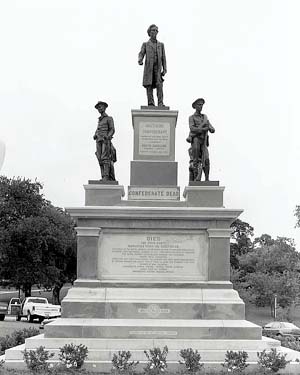
As a history teacher and mother of triplets, I try to make plenty of room for my kids to discuss the kinds of things that would have caused tension at the dinner table of my own childhood. We take trips, get bitten by bugs, and we eat chocolate. A generation away from the Sans Souci, we try to talk about what we see at museums, historic sites, and monuments. Two years ago, visiting my family in Texas, we toured the State Capitol Building in Austin with my sister. Eating pretzels and sipping juice on the front lawn before taking the official tour, the kids, then seven-and-a-half, began climbing on an array of cannons–smooth, shiny howitzers and rough, bronze field guns–some of which confederate troops had used in the Civil War. We ambled over to the Confederate War Memorial, granite blocks supporting statues of distinguished Southern military men, including, of course, at the top, Jefferson Davis.
Confederate War Memorial, Austin. Photo courtesy Texas State Preservation Board.
“DIED,” I read to the kids, “FOR STATE RIGHTS GUARANTEED UNDER THE CONSTITUTION. The people of the South, animated by the spirit of 1776, to preserve their rights, withdrew from the compact in 1861. The North resorted to coercion. The South, against overwhelming numbers and resources, fought until exhausted.” The kids knew what the Civil War was, but these terms were strange and new. State rights, Constitution, the spirit of ’76, the compact, coercion . . . all these big words and big ideas needed some big explaining. I drew a deep breath and did my best to be evenhanded, gently teasing out the contradictions inherent in these loaded choices of words.
Like most kids their age, Lily, Max, and Sam were thinking rather concretely and were grappling with the difference between time present and time past. All wanted to know, present tense, which side of the war we were on. How to explain that “we” hadn’t been born yet, that the ancestral “we” on my side of the family hadn’t yet left their Russian and Polish shtetls? “Yeah, yeah,” they said, impatiently, “but we were for the North, weren’t we? We didn’t own slaves.” I made one more pass through this one and then continued parsing the inscription. Max and Sam ran off to continue exploring the cannons. “Wait, wait, wait!” Lily interrupted, infused with her usual cut-to-the-chase canny. She whipped her head around and eyeballed her brothers, who were making gun noises and draping themselves over howitzers. “Isn’t having these cannons out here pretty much like celebrating slavery?”
Gulp. After my husband, my sister, and I had managed to put aside our astonishment at the connection Lily had made, we drew all three kids into a brief, pungent talk about the way the stuff we look at in public places tells stories that sometimes surprise us. Maybe the folks who had put up the Confederate War Memorial had wanted to honor the soldiers who’d died fighting for the South. To us, more than a century later, that seemed like honoring people who treated other people in inhumane ways. Besides having these monuments to climb on and read, we adults wondered, what did the kids think should be done with these slabs of marble and bright, shiny cannons? Bury them, said Lily, earnestly. Polish them, said Sam, reverently. Fire them off! shouted an enthusiastic Max.
I have thought quite a bit about this moment over the last year and a half. It reminds me of that long-ago trip to Jamaica and of my own growing awareness, as a child, of race and domination and the past. Too close to the Civil Rights movement of the ’60s and the desegregation struggles of the ’70s to give us kids room to come to our own conclusions, my mother told us what to think. It wasn’t OK to visit Jamaica and relax. White oppression of blacks was continuous, seamless, from colonial plantation times to the present. And my mother, for one, wasn’t going to sit quietly at the table of a place called the Sans Souci, wait for her iced tea, and act carefree. Thirty years later, and I feel, as a mother, that there’s more room to indulge in the illusion that my kids can evaluate the evidence and reach their own conclusions, hoping all the while that they will reach conclusions that parallel my own. And there they were, on the lawn of the Texas State Capitol, offering three different but passionate alternatives to the use of public history. What do we do with the stuff that troubles us? Some would say bury it, others would say respect it, and still others would have us relive and reenact. Not one “right” answer, but three engaged strategies, each spoken with conviction. As a historian and as a parent, I could not have hoped for more.
Confederate cannon. Photo by Richard Eisenhour, courtesy Texas State Preservation Board.
Thinking about the trips of my childhood and parenthood, I am deeply invested in questioning whether we can ever go anywhere without caring about the past. For those interested in history, is escape ever appropriate? Is it possible to have a pastime without thinking about past times? Our family outings, I hope, can strike a balance between being sans and avecsouci. I want my kids to be able to take breaks from the cares of their everyday lives, but I don’t ever want them to get to a point where they plainly and simply just don’t care.
This article originally appeared in issue 1.4 (July, 2001).
Assistant Professor of History at Harvard University, Cathy Corman is author of Reading, Writing, and Removal, forthcoming from University of California Press. When she isn’t teaching courses on early America, the American West, and the history of the book, she is scheming to find ways to travel with her family.
From Minnesota to Barbados, Jamaica, Virginia, and Alabama
It is embarrassing to recall how belatedly and almost accidentally I became interested in the history of slavery. I was born and raised in Minnesota when hardly any black people were living there, and though I grew up with a strongly liberal set of values and was outraged when I encountered segregated toilets and drinking fountains in Virginia and appalled when I found myself riding on a Jim Crow bus in Tennessee, I deliberately chose to study the romantically remote subject of seventeenth-century English history in college and graduate school. No courses were offered on the history of American slavery at Harvard in the late 1940s or at Princeton in the early 1950s, and if such courses had been offered I wouldn’t have taken them. In fact I didn’t take anycourses in American history when I was an undergraduate.
Eventually I drifted into American colonial history because I liked to work with Frank Craven, who taught at Princeton and was a specialist in the history of the seventeenth-century southern colonies. But at first I didn’t pick up on Craven’s strong interest in early American race relations. Instead I wrote my Princeton dissertation (1955) and my first book (1962) on the Winthrop family in seventeenth-century New England. And when I’d finished with the Winthrops, I chose to study the political relations between the Crown and the American colonies during the period 1675-1700 for my second project. So I spent a year in England at the Public Record Office surveying the Colonial Office records for both the mainland and island colonies, with the aim of writing a book that would be all about Anglo-American politics in the era of the Glorious Revolution, and not in the least about slavery.
I never did write my Glorious Revolution book, though nearly forty years later I returned to the subject in a chapter for the first volume of The Oxford History of the British Empire (New York,1998). Instead my research at the PRO in the early 1960s, combined with the rise of the Civil Rights movement in the United States, led me onto a new path: an inquiry into the social development of the slave-based English Caribbean colonies–Barbados, Jamaica, and the Leeward Islands–during the course of the seventeenth century. The sparse secondary literature told me almost nothing about how African slavery got started in the English Caribbean, so I wanted to learn more about the beginnings of the forced labor system in these colonies. And I became increasingly vexed by the formulaic dispatches that I found in the Colonial Office records from English officials in the Caribbean which concealed a lot more than they revealed about the emergence of a hugely profitable sugar industry powered by slave laborers in the islands. So I searched for alternate ways to find out what life was really like in the early sugar colonies.
When I came across the PRO’s manuscript Barbados census of 1680–a far more detailed and probing set of documents than any mainland census for the colonial period–I saw at once that here was the evidence I needed to analyze the social structure of this booming sugar colony. While the census didn’t tell me much about the slaves, it told me a lot about their masters. I found comprehensive lists of all the property holders in Barbados which showed that 175 big planters held more than half of the land and more than half of the thirty-nine thousand slaves. When I correlated these lists with a detailed map of the island (published in 1674) I could see that these big planters had also acquired the best acreage in Barbados for sugar cultivation. And when I surveyed the lists of office holders in the census, I discovered that the most prestigious and powerful posts were all occupied by the biggest planters. So I published an article on the Barbados census in the William and Mary Quarterly in 1969, and set to work on my bookSugar and Slaves, which came out in 1972.
The central theme of Sugar and Slaves is the rise of the big slave-owning sugar planters who completely dominated their island societies by the late seventeenth century. In writing about these people I was greatly influenced by the books and articles that were just beginning to appear around 1970 on social life in early New England: particularly A Little Commonwealth (New York, 1970) by John Demos and Four Generations (Ithaca, N.Y., 1970) by Philip Greven. When I asked the questions that Demos and Greven asked–questions about lifestyle and personal values and family relationships–I got almost antithetical answers, and hence I concluded that the Caribbean and New England planters were polar opposites who represented the outer limits of English social expression. And the biggest difference between the two social systems was slavery.
While I devoted considerable space to the early Caribbean slave system in my book, I saw that there was vastly more that could be done. So after I published Sugar and Slaves I decided to write a companion “history from below,” an examination of slave life in the Caribbean. But I was by no means the only historian with this ambition. In the 1970s a number of excellent books, using the same kinds of sources and responding to the same social movements in contemporary American society, began to open up the study of slave life in the British West Indies. The new literature on slave life in the thirteen mainland British colonies and in the antebellum South was even larger and livelier. Did I really have anything fresh to contribute?
I thought that I did. I wanted to compare two plantations with exceptionally full slave records–one in the Caribbean and the other on the mainland–in order to explore why the birth rate was so much lower and the death rate so much higher in the Caribbean than in the U.S. South, and what consequences this demographic difference had for the slaves who lived in the two regions. In the Bodleian Library at Oxford I found a voluminous set of records for Mesopotamia Estate in Jamaica (a plantation with nearly two recorded deaths for every birth) that enabled me to reconstruct the individual biographies of the 1,103 slaves who lived there between 1762 and 1833. Soon after, while researching in the Virginia Historical Society, I found an equally voluminous set of records for Mount Airy Plantation in Virginia (a plantation with nearly two recorded births for every death) that enabled me to reconstruct the lives of the 979 slaves who lived there between 1808 and 1865–and to follow 262 of them when they were sent to work on new cotton plantations in Alabama. For the past twenty-five years, interrupted for long periods of time by two big editorial projects–The Papers of William Penn in the 1980s and The Journal of John Winthrop in the 1990s–I have been working on my comparative study of Mesopotamia and Mount Airy.
My book, which I expect to publish in a couple of years, will be called The Peoples of Mesopotamia and Mount Airy: Slave Life in Jamaica and Virginia, 1762-1865. One of my two main objectives is to bring these two thousand people to life by punctuating my story wherever appropriate with extended biographical sketches of individual men and women. My second objective is to compare and contrast the two communities by showing that the slaves on both of these plantations were victimized, but in strikingly different ways.
The most startling feature of life at Mesopotamia was that nearly half the women were childless while those who bore children had small families. Almost all of the young females of prime childbearing age were forced into extraordinarily strenuous field labor, which contributed greatly to the numerous miscarriages and stillbirths on this estate. The owners of Mesopotamia were constantly importing new young slaves from Africa in the hope of sustaining a vigorous work force. But since many of the imported slaves died quickly after arrival, and since there were never many young estate-born slaves, the Mesopotamia population always contained a surprisingly large proportion of middle-aged and elderly people who had managed to survive years of brutal sugar labor but had become too feeble to do much work, or any work at all. Thus, whether judged on either economic or social terms, the Mesopotamia labor system was distressingly dysfunctional.
The situation at Mount Airy was almost the reverse. Here the slave women worked less hard, had a more nutritious diet, and were less exposed to debilitating disease–and they produced much larger families. A field hand named Sally, for example, had thirteen children, forty-two traceable grandchildren, and twenty-four traceable great-grandchildren. But there was a high price for fecundity. The owners of Mount Airy had more slaves than they needed, so they were constantly moving surplus laborers–especially early teenaged boys–to new work sites, and breaking up families in the process. Or they sold unwanted slaves–especially early teenaged girls–to new owners, which was even more destructive of family ties. Between 1833 and 1865 most of the ablest young workers were sent eight hundred miles away from Mount Airy to become cotton hands in Alabama. And this system of forced migration was difficult to challenge. While two dozen Mesopotamia slaves managed to escape from bondage between 1762 and 1833, only two Mount Airy slaves gained their freedom between 1808 and 1861.
When I first began to work on this project, cliometric quantifiers and mathematical modelers were the cutting-edge interpreters of slavery. I am happy to see that the cliometricians are less conspicuous and pugilistic now, and that the field is dominated instead by historians who celebrate slave rebelliousness and who champion the cultural, social, and political creativity of African Americans under duress.
But I have some reservations about the current emphasis upon slave agency. My book will show that while the peoples of Mesopotamia and Mount Airy often tried to resist oppression and sometimes turned into outright rebels, they more commonly chose not to rebel or run away even when they had the chance. I think it important to remember that these men and women were always living in a state of brutal subjugation and that they were given remarkably little opportunity for meaningful individual or collective enterprise. Hence the bottom line of my story is that these two thousand slaves–and all American slaves–were horribly trapped into one of the most degrading and dehumanizing systems ever devised. This is no news. But it should never be forgotten.
This article originally appeared in issue 1.4 (July, 2001).
Common-place asks Richard S. Dunn, professor of history emeritus at the University of Pennsylvania and the author of the classic Sugar and Slaves (Chapel Hill, 1972), how he got interested in writing about slavery more than three decades ago.
The Journey of Miles Brewton’s Bottle
What can a single artifact tell us about people of the distant past? Not enough, it usually seems. It’s a truism in this business: archaeologists are people who need a lot of data to say a little. Interpretations of historic sites are built gradually, from a myriad of silent sources: subtle layers of soil, sometimes tens of thousands of fragments of ceramics, glass, bone, bricks, and nails, or bags of dirt and rubble. In rare cases, however, we recover a single artifact that speaks volumes about people who lived on that site long ago.
Fig. 1. Detail of impressed monogram, “Mbrewton,” on the wine bottle ascribed to Miles Brewton. (Photo: Rick Rhodes for The Charleston Museum.)
Such was the case with a spectacular monogrammed wine bottle, the property of one “MBrewton,” that surfaced in the excavation of an elite Charleston-area townhouse dating to the turn of the nineteenth century (fig. 1). The tale of the bottle–who owned it, how it was used, and how it landed where it did–broadens and complicates our understanding of life under slavery in colonial Charleston. For it appears that somewhere in the course of the use-life of the artifact, Miles Brewton, a wealthy merchant and slave trader, lost possession of the bottle to his now-anonymous bondsmen. What’s more, the bottle’s retrieval by archaeologists on a site some distance from Brewton’s home has prompted a rethinking of the events that create archaeological deposits from living households.
Fig. 2. Map of 14 Legare Sreet and surrounding neighborhood, c. 1820. The layout of the property, as amended by George Edwards, is shown in purple. The adjoining Miles Brewton property is shown in red. (Map: Martha Zierden for The Charleston Museum.)
Charleston, long famous for its preserved colonial and antebellum architecture and its role in the Civil War, has become equally well known as a cradle of African American history and culture. The city was the port of entry for the majority of Africans forced from their homes during the eighteenth century to a life of bondage on American plantations. The Africans’ sheer numbers and their relative isolation on plantation tracts combined to create a dynamic creole culture that evolved through the centuries and remains a defining social force. Despite the richness of African American culture in the lowcountry, however, surviving material culture is sparse; there are not enough sweetgrass baskets, slave tags, examples of ironwork, or buildings to fill the almost daily requests from museum planners and documentary filmmakers.
Archaeological materials attributable to people of African descent are also few, despite the claims of the discipline that all people are equally reflected in the ground. Archaeologist Charles Fairbanks pioneered the excavations of Georgia Sea Island slave settlements in the 1960s, searching for “Africanisms,” those items unmistakably African in appearance and use; the results were disappointing. Archaeologists now take a broader approach, and expect that African and European people in colonial America may have used the same manufactured goods, but in different ways. Defining those “different ways” remains the task at hand. This is especially so on urban lots, where black and white residents lived together, but in separate worlds, as they did in Miles Brewton’s household.
The archaeological odyssey that resulted in the discovery of the bottle began on Legare Street (fig. 2). The lot was acquired by the Johns Island planter Francis Simmons in 1800. He built an imposing three-story brick single house, a kitchen/slave quarter, a carriage house, and a privy on the north side of the property, and rented out a modest complex already in existence (c. 1780) on the southern lot. The next owner, Beaufort planter George Edwards, acquired the property in 1818. After taking possession of both lots, he demolished the rental complex and built imposing walls, gates, and an L-shaped garden which covered the southern half of the property and the entire rear third of the lot. Excavations uncovered much on the life and work of the nineteenth-century household, but they also revealed great quantities of refuse deposited during the eighteenth century. It appears that Edwards later reused much of this debris in filling and leveling his garden, but the trash originated as a “dump” of ceramics, glass, colono wares, animal bone–and the bottle monogrammed “Mbrewton”–on the then-unoccupied 14 Legare lot.
Fig. 3. Outlines of deep creek or marsh areas, as indicated on the 1739 Roberts and Toms map of Charleston, are shown in green. The outline of the Miles Brewton house, to be constructed in 1769, is shown for perspective. The low-lying marsh discovered on the two archaeological sites is likely an extension of these creeks; such details are not shown on the 1739 map. (Map: Martha Zierden for The Charleston Museum; from “The Iconography of Charles-Town at High Water,” 1739, by B. Roberts and W. H. Toms, facsimile in 1884 Charleston City Yearbook, on file at The Charleston Museum.)
But whose refuse was this? Miles Brewton, a financially and socially successful merchant, built a grand house at 27 King Street, beside and behind 14 Legare, in 1769. Brewton and his family died at sea in 1775, and his house passed to his sister, Rebecca Brewton Motte. She and her family had barely taken possession when Charleston fell to the British during the Revolution, and the house was occupied by invading officers.
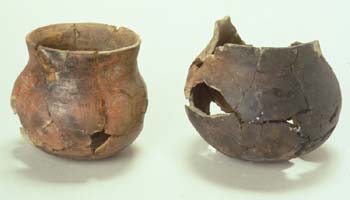
Fig. 4. Colono ware from 14 Legare Street, Charleston. The globular jars shown here are a traditional African form. (Photo: Rick Rhodes for The Charleston Museum.)
So how did Brewton’s wine bottle and, by association, his domestic refuse, wind up on the unoccupied lot the next street over? The thousands of artifacts, and even the soil itself, from the rear yards of both lots provide some clues about the possible route. At some point the common boundary between 27 King and 14 Legare was a swamp (fig. 3), rather than the present brick wall. Pollen and phytolith (plant cell) analyses suggest that a pre-occupation tree-covered swamp quickly became an open “bog” before it was filled and leveled in the early nineteenth century. Perhaps residents of the Brewton household crossed this unimproved, seemingly unclaimed strip on their way to dump refuse on some other, yet-undeveloped tract.
But who was hauling the trash from King Street to Legare Street? Not Miles Brewton. Brewton may have poured wine from his monogrammed bottle. But we can rest assured that he never touched the household trash. Even if the cleanup of Brewton’s trash occurred after the property changed hands in 1775, the slaver’s sister is equally unlikely to have attended to such matters herself. Almost certainly the people responsible for the archaeological event represented by the trash pile were black slaves, actors who too often remain invisible and silent, in archaeology as well as history.
The Brewton property housed about a dozen enslaved Africans in the eighteenth century, but none are known by name. These African bondsmen and women have also remained frustratingly anonymous in the archaeological record. On townhouses such as these, a half-dozen privileged white people and a dozen or more enslaved black people lived together–in separate social and physical spheres, but in close proximity, with the work yard the domain of the enslaved. But the refuse of all residents lies combined in the ground, making the possessions and activities of the materially poor nearly impossible to isolate.
ig. 5. Map of the 14 Legare and 27 King properties, prior to construction of the 14 Legare townhouse. The c. 1769 Brewton complex is shown in red. The buildings on the 12 Legare lot, as revealed through archaeology, are shown in blue; these architectural features are the ones filled with eighteenth-century refuse. The three adjoining blue squares indicated by an arrow on the 14 Legare lot (left side) are the original source of refuse. The area of low-lying swamp or marsh, as revealed through archaeology, is shown in brown. The excavation areas in which marsh soil was encountered are shown as square outlines. (Map: Martha Zierden for The Charleston Museum)
Brewton’s refuse contained a number of colono ware vessels that certainly originated with the African residents. Some exhibited European characteristics, such as crenellated rims and raised footrings, but most are in the styles commonly associated with African vessels–globular jars and shallow bowls (fig. 4). While these vessels point to an African presence among the European consumer wares, the elegant bottle provides the greatest source of speculation on the affairs and activities of the bondsmen who moved the trash.
For it is tempting to suggest that more than refuse disposal took place in the swampy land unclaimed by white owners. As several scholars have suggested, urban slaves who lived in such close proximity to their white owners came together in ways that were “seen but unseen” by the dominant culture. Perhaps the bottle traveled to the swamp full, part of a social gathering of African people, rather than empty, as part of a haul of refuse. The bottle could have been a pilfered item, or one reused after Brewton discarded it. The unlikely presence of the bottle led scholars on the site to revisit another anomalous archaeological deposit excavated ten years earlier on the Brewton lot (fig. 5). An oval pit of charcoal may be the remains of an outdoor hearth in the Brewton portion of the swamp. Filled with charcoal, tobacco pipes, wine bottle fragments, and a broken colono ware pot, it may be also evidence of social activity, rather than simply refuse disposal. Outdoor cooking and gathering around a central fire are documented cultural preferences of Africans brought to America.
Whether such activities were sanctioned, or simply tolerated, by the white population is unknown. There is increasing evidence to suggest that the growing African slave population was able to acquire and maintain some level of independence through sheer force of numbers and calculated negotiation. The city, in particular, provided bondsmen and women with opportunities to work “within the system.” Tolerated and negotiated activities included buying and selling goods, traveling and socializing, possessing firearms, and pilfering rations. Though a variety of measures were taken to curtail such activities, evidence that they flourished nonetheless may be found in the commentary surrounding the 1822 Denmark Vesey slave insurrection. The official testimony contains innumerable descriptions of meetings and discussions among trusted and seemingly loyal servants. The behavioral negotiations that culminated in the events of 1822 began a century earlier.
Groups of slaves sometimes met and socialized under the master’s watchful eye, but more often gathered in the physical corners and cracks of the slaveowner’s landscape: a street, alley, kitchen, shop of a slave “working out,” or perhaps a still-wooded tract. A yet-untamed swamp in the rear of a household that presented a well-ordered facade perhaps presented yet another opportunity. Permission to haul away trash may have evolved into an opportunity for clandestine gathering, long enough to be enjoyable or transact business, but short enough to avoid arousing the master’s concern. Perhaps the spot was used time after time.
There hardly seems a less likely candidate to reveal aspects of slave life than a British wine bottle made for America’s colonial elite. And the recovery of Miles Brewton’s wine bottle on a site other than Miles Brewton’s own clearly raises more questions than it answers. On a basic level, it serves as a warning to archaeologists inclined to equate all refuse recovered on an urban lot with the former residents of that lot only. The associated refuse deposit, when coupled with careful analysis of botanical data, has led to reconstruction of an urban environment that was, in the late eighteenth century at least, not yet completely ordered and defined. More significantly, the bottle has allowed us to speculate on the players–black and white–involved in the creation and manipulation of the urban environment to suit the needs of multiple residents.
Further Reading:
The newest and best summary of the archaeology of African Americans is edited by Theresa Singleton, “I, Too, Am America”: Archaeological Studies of African American Life (Charlottesville, 1999). Singleton’s introduction summarizes development of the field of study, from Charles Fairbanks’s search for “Africanisms” to the current emphasis on creolization. The most complete and accessible study of colono wares is Leland Ferguson’s Uncommon Ground: Archaeology and Early African America, 1650-1800 (Washington, D.C., 1992).
Two excellent texts guided the discussion of slave activities as “seen but unseen.” The concept is best articulated by Bernard Herman in his article “Slave and Servant Housing in Charleston, 1770-1820,” Historical Archaeology 33 (1999): 88-101. Theodore Rosengarten discusses this aspect of slave life in the plantation setting in Tombee: Portrait of a Cotton Planter (New York, 1986). Ira Berlin’s new text, Many Thousands Gone: The First Two Centuries of Slavery in North America (Cambridge, Mass., 1998), provides an insightful discussion of negotiated activities, as well as many other issues surrounding slavery in Carolina.
The best study of Charleston architecture is Jonathan Poston’s The Buildings of Charleston: A Guide to the City’s Architecture (Columbia, 1997). Poston discusses the contributions of African American craftsmen and the dwellings of African Americans throughout the text. The book also contains pertinent essays by Bernard Herman and John Vlach. Architecture and archaeology are discussed by Martha Zierden and Bernard Herman in “Charleston Townhouses: Archaeology, Architecture, and the Urban Landscape, 1750-1850” in Landscape Archaeology: Reading and Interpreting the American Historical Landscape, edited by Rebecca Yamin and Karen Metheny (Knoxville, 1996), 193-227.
The discussion of archaeological material culture is based on the path-breaking work of Ann Smart Martin. See her article “Material Things and Cultural Meanings: Notes on the Study of Early American Material Culture,” William and Mary Quarterly, 3rd Ser., 53 (January 1996): 5-12. The most comprehensive study of material culture in Charleston is by Maurie McInnis,The Politics of Taste: Classicism in Charleston, South Carolina, 1815-1840 (Ph.D. diss., Yale University, 1996).
The interaction of cultural groups as reflected in archaeological materials may be found in Martha Zierden, “A Trans-Atlantic Merchant’s House in Charleston: Archaeological Exploration of Refinement and Subsistence in an Urban Setting,” Historical Archaeology 33 (1999): 73-87. The best new interpretation of these same materials may be found in an essay by Ellen Shlasko, “Frenchmen and Africans in South Carolina: Cultural Interactions on the Eighteenth-Century Frontier,” in Another’s Country: Archaeological and Historical Perspectives on Cultural Interactions in the Southern Colonies, eds. Joe W. Joseph and Martha Zierden (Tuscaloosa, in press).
This article originally appeared in issue 1.4 (July, 2001).
Martha Zierden is Curator of Historical Archaeology at The Charleston Museum.
Searching for Identities in the New Orleans Slave Market
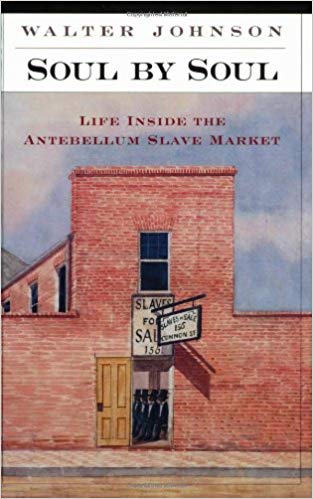
Walter Johnson’s cultural history, Soul by Soul: Life Inside the Antebellum Slave Market, paints perspective-shifting portraits of the buyers and sellers active in the trading of humans, without neglecting the persons sold as its central commodity. Throughout his text, Johnson emphasizes the remoteness of paternalism from this aspect of slavery, which turned on the central proposition that a person could always be bought or sold if the price was right. The evocative writing style pulls the reader into the book, creating word-pictures about the wharves of New Orleans, the slave pens where deals were struck, or the desperation of slave families confronted with the loss of loved ones, often forever. This forms a notable contrast to the work of Michael Tadman, whose Speculators and Slaves: Masters, Traders, and Slaves in the Old South (Madison, Wisc.,1989) is filled with graphs and charts to provide full statistics on the chattel trade of the Old South, but which ultimately does not read in as compelling fashion as Johnson’s work does. That is not to say that Johnson has given us the last word on the subject of the slave trade, however; while his book breaks new ground by examining closely the New Orleans slave market and considering the cultural ramifications of the purchase and sale of persons within the institution of slavery, Soul by Soulmay leave some readers with more questions than answers when they reach its conclusion.
Time Johnson’s period of emphasis is from 1820 to 1860, although he avoids a chronological arrangement of his chapters. Rather, Johnson organizes his material according to how the actors involved in purchase and sale first encountered one another: the acquisition of slaves by traders for resale (chap. 1), the business side of slave trading (chap. 2), the prospective purchaser’s dreams and desires to be met through the purchase of slaves (chap. 3), the preparation of slaves for the market (chap. 4), how purchasers inspected slaves at the market (chap. 5), how slaves and buyers interacted in the act of sale (chap. 6), the transition of both owner and owned from the market to new surroundings (chap. 7), and finally, the cultural meaning of the slave pens for abolitionists and as an exemplar of the institution of slavery (epilogue). Throughout the work, Johnson emphasizes that time ran differently for all participants (14). This is a sentiment the reader can easily understand when considering the slave’s perspective, since time doubtless seemed much longer for bondsmen newly separated from loved ones than it would have for traders, who thought in terms of seasons for purchase (summer and fall) and sale, or prospective buyers in the New Orleans market, who would have bought slaves primarily from November to April (49).
The reader might wonder whether the tone of New Orleans slave markets altered with the fluctuations of cotton prices or with the looming prospect of civil war, but these are contingencies Johnson mentions at the outset (5-7) and then does not return to. Apparently, a slave bought and sold in 1859 experienced much the same treatment and buyers approached the market with the same expectations as they would have in 1829. Rather than focus on separate periods or specific events, Johnson uses chapter 1 to remind the reader how quickly a slave could be converted from person to property–in the time it took to make a deal or exchange a piece of paper. At all times, slaves were used as living collateral for financial transactions, and owners calculated and recalculated their own wealth by mentally transforming bodies into dollars whenever they wished. As such, the divide between slavery and the market, Johnson argues, was artificial at best and a rationalization at worst (25). How long traders worked in the market for human flesh also passes with little explanation. Although some men worked as dabblers while others’ firms were well-established and traded in slaves for years, the longevity and methods of small-timers versus the Donald Trumps of that world appear to have varied only as a function of capital and manpower (46-48). Did these small-time traders wish to become stationary auctioneers or factors, or did they dream of an agrarian retreat from the world of flesh dealing? The reader must presume that the records do not answer this question.
Manner Much of the action in Soul by Soul turns upon the aspirations of would-be owners and attempts by slaves to control their own futures. Johnson describes in convincing fashion how the possibility of purchase allowed slave buyers to invent themselves by imagining the slaves they would purchase (78-87). While acknowledging that all owners thought about slaves and the market differently (79), Johnson focuses on a few of the more prevalent dreams that could be realized through slave buying: total control over another, or sexual escape and fantasy (81, 113). The process of building internal identities through slave purchase meant that slaveowners always dreamed of more from slave purchase than could be provided in reality. This dichotomy threatened the slave’s well-being, for once purchased and unable to meet the expectations of a new owner, the threat of punishment was all but assured. While internal identity creation might swing from fancy to fact, external identities also hinged on slave buying–the trader or buyer who purchased a slave only to discover that she was ill or dying might find himself labelled (for almost all purchasers were men) as having poor judgment in slave acquisitions (103-05). Those who sought to create external identities as slave breakers or tender-hearted paternalists (for “rescuing” a slave from the clutches of the trader) could also gain that neighborhood reputation by taking action in the slave market. Traders also sought to provide slaves with external reputations, by changing the physical appearance of the bondsmen through altered diets and better clothing. This created the illusion of slaves without pasts, whose prior identities had been obliterated and thus were free to be inscribed with new fantasies by the would-be purchaser. Slaves, however, were not pieces of furniture, but attempted to influence their sales to men who appeared more humane or who might provide better opportunities for escape (165, 171). In describing how identities (of buyers and those bought) were self-fashioned or manipulated, chapters 3, 4, and 6 of Johnson’s book are the most persuasive.
Walter Johnson, Soul by Soul: Life Inside the Antebellum Slave Market. Cambridge, Mass.: Harvard University Press, 1999. 283 pp., $15.95
Where the notion that identities could be shaped through slave purchase weakens, however, is when corporate entities and managers enter the picture. While the individual white male who bought female slaves might fantasize that he was Don Juan, what image, if any, did the church, the town, or the company seek to create when buying slaves? All of these groups owned slaves in the antebellum South, but we are left to wonder what perception they might have wanted to create in the minds of other Southerners when slaves were purchased. To suggest that these groups, disembodied as they were, uniformly sought to manufacture a particular opinion among others seems bizarre, for at best, it might be the perception that selected leaders (like modern-day corporate trustees) wanted to project about the company image. And what of absentee owners, whose holdings in land and slaves were vast? Did they approach the market with the same expectations as other slaveowners, or did they expect a factor or overseer to purchase and sell on their behalf? If so, did managers or overseers have the same ability to or desire to craft their identities through the purchase of slaves? Not all buyers acted alike. As for the slaves being sold, while traders might clothe their wares in uniform outfits to project erasable pasts, this ruse would fall apart when the slaves were purchased in lots from state penitentiaries (another corporation) for well-documented and very public crimes. Phil Schwarz described these individuals in Twice Condemned: Slaves and the Criminal Laws of Virginia, 1705-1865 (Baton Rouge,1988): slaves convicted of murder and other felonies by law were exported for sale beyond the boundaries of Virginia. While Johnson might argue that such slaves could still escape their past lives and fashion new identities (with the witting help of traders who might then gain a higher market price), the repeated practice of selling upper-South slaves with criminal backgrounds to the lower South was well known among white antebellum Southerners, and certainly would have affected the fantasies and choices of possible purchasers in New Orleans–an element not discussed in Soul by Soul.
Place Johnson utilizes extensive records preserved by the Supreme Court of Louisiana to explore in detail the slave sales made at the New Orleans market. One look at the footnotes convinces the reader he has plumbed them to considerable depth. Although he touches upon aspects of the slave trade outside of Louisiana–when he talks about traders acquiring slaves for resale in chapter 1, for example–this book is not about all antebellum slave markets (as the subtitle hints it may be), but almost entirely about New Orleans. Readers who want to know about slave trading in city versus country, or upper South versus lower South will not find their answers here. However, the data available from New Orleans, and its centrality as the destination for many upper South slaves sold to the deep South make it of great interest, and Johnson’s book examines it closely. Problems about New Orleans’s centrality persist, though. While the record base for New Orleans is very large, and nearly one hundred thousand slaves passed through the slave pens there, the peculiarities of slavery in that city need be not only acknowledged, but emphasized. New Orleans’s “fancy trade” in female slaves for concubinage and houses of prostitution was much greater than elsewhere in the South, and must therefore have had some effect upon the workings of the slave market there. Slave women considered a threat because of their ability to “pass” and thus possibly escape from slavery elsewhere were deliberately sent to New Orleans for sale. Similarly, extensive water traffic upon the Mississippi also affected the possibilities for escape that slaves could capitalize upon, providing options unavailable to them in other Gulf port cities where slave markets worked.
Having noted these limitations, Soul by Soul remains a well-crafted story, compelling the reader to keep turning the pages. A winner of two prizes from the OAH, Johnson’s book tells a good story that will give interested persons an introduction to the workings of New Orleans’s slave market. It remains for other scholars to flesh out Johnson’s lively cultural history with a fuller description of the workings of the slave trade throughout the antebellum South.
This article originally appeared in issue 1.4 (July, 2001).
Sally Hadden is assistant professor of history and law at Florida State University. She is the author of Slave Patrols: Law and Violence in Virginia and the Carolinas (Cambridge, Mass., 2001) and is at work on a study of legal cultures in colonial American cities.
Slaves You Have Never Seen
Uncle Tom. Mammy. Topsy. Prissy. Kunta Kinte. Fiddler. Chicken George. These characters shine as stars in the American cultural firmament of chattel slavery (with Little Eva, Simon Legree, Scarlett O’Hara, and Rhett Butler as their white cosmic counterparts). As literary characters–from Harriet Beecher Stowe’s Uncle Tom’s Cabin (1852), Margaret Mitchell’s Gone With the Wind (1936), and Alex Haley’s Roots (1976)–brought to life in film adaptations, they reinforce visually the relationship between slavery, region, culture, and history so central to their novelistic precursors. But what are the connections between written representation and filmic adaptation? For example, how does Mitchell’s character of Mammy compare to Hattie McDaniel’s Oscar-winning portrayal in the 1939 film? It is often difficult to discern where the power of narrative ends and the spectacle on the screen begins.
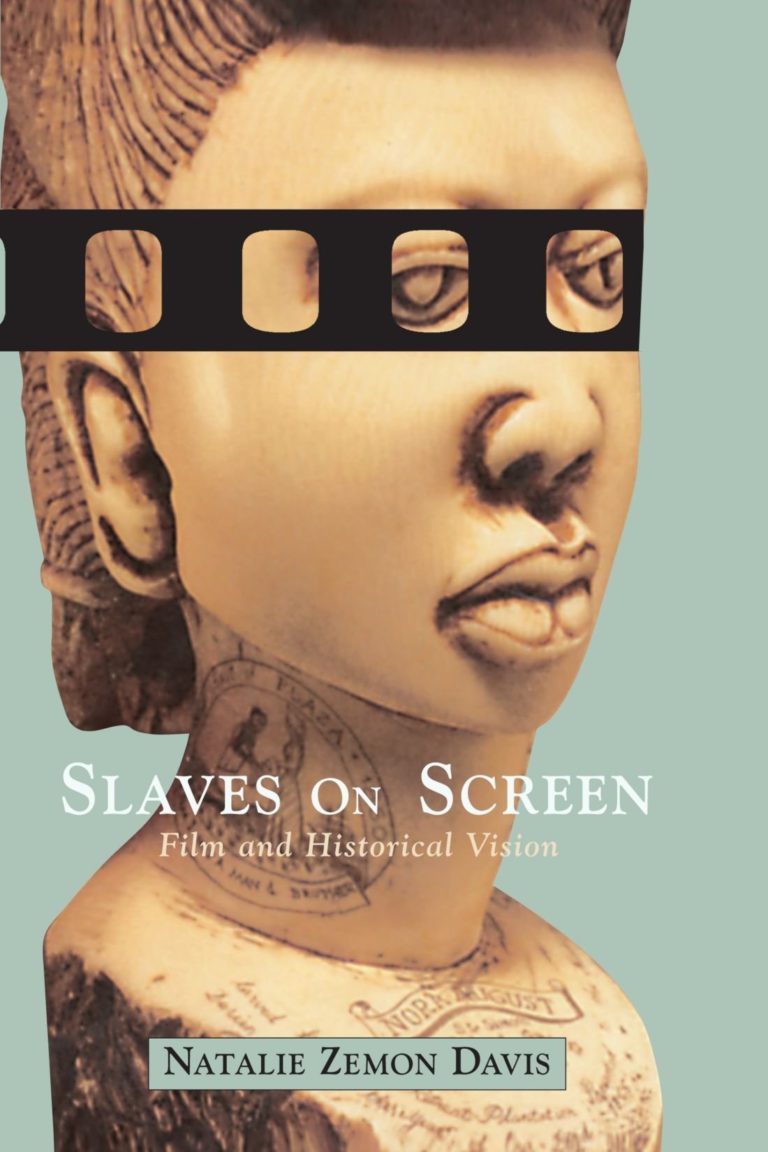
These types of questions are at the heart of Natalie Zemon Davis’s new book, Slaves on Screen: Film and Historical Vision, derived from her delivery of the 1999-2000 Barbara Frum Historical Lectures at the University of Toronto. Davis begins with a basic question: How can film best be used as a medium for presenting history? “Readers may well wonder whether we can arrive at a historical account faithful to the evidence if we leave the boundaries of professional prose for the sight, sound, and dramatic action of film” (3). Functioning, on the one hand, as a kind of “microhistory” and, on the other, as a “creature of invention,” the feature film wields an “historical power” that “stems from its multiple techniques and resources for narration” (5-7). It is precisely this play between fictiveness and fact so characteristic of feature film (in comparison to documentary film, docudrama, or cinema verite) which makes the genre intriguing to Davis. Although feature films have been described as having little “significant connection to the experienced world or the historical past,” this same genre also has the ability to “make cogent observations on historical events, relations and processes” (5). Davis, esteemed historian of early modern France and professor emeritus at Princeton, boasts impressive credentials to address the relation of history to film. In the early 1980s, she served as historical consultant on the French production of Le Retour de Martin Guerre(dir. D. Vigne) about a case of imposture in sixteenth-century France, wrote The Return of Martin Guerre (Cambridge, Mass., 1983), a traditional historical account of that case, and taught graduate seminars in the 1980s and 1990s on History and Film.
Natalie Zemon Davis, Slaves on Screen: Film and Historical Vision.Cambridge, Mass.: Harvard University Press, 2000. 164 pp. $22.95.
Davis addresses the relationship of film to history in four ways. First, she strategically chooses five films about slavery or, more particularly, about resistance to slavery that serve as case studies. They include Stanley Kubrick’s Spartacus (1960), Gillo Pontecorvo’s Burn! (1969), Tomas Guiterrez Alea’sThe Last Supper (1976), Steven Spielberg’s Amistad(1997), and Jonathan Demme’s Beloved (1998). These films represent a forty-year span of productions in the U.S., Cuba, and Italy. They are set in a range of locales in the Atlantic World, including the West Coast of Africa, the U.S., Cuba, and the imaginary island of Quiemada, and document a range of action, from slave rebellion on land, slave revolt aboard ship, and slave resistance on the plantation. Second, she maps the classical duality between history and poetry onto the dichotomy between historical prose and historical film. “The ancient contrast between poetry and history, and the crossover between them, anticipate the contrast and crossovers between historical film and historical prose. Poetry has not only been given the freedom to fictionalize but it brings a distinctive set oftechniques to its telling: verse forms, rhythms, elevated diction, startling leaps in language or metaphor. The conventions and tools of poetry can limit its use to convey some kinds of historical information, but they can also enhance its power for expressing certain features of the past” (4). Third, she offers a dual chronology of twentieth-century historiography on classical and New World slavery and of filmic representations of slavery in the same period. She sees “shifts in cinematic treatment of slave resistance over the decades [that] were parallel to or followed on similar changes in the work of historians” (123). Fourth, Davis reads these films against their broader social and cultural contexts.Spartacus is a film about internal Roman politics and the political and social revolt against Roman elites;Burn! and The Last Supper concern political economy and local cultural customs; Amistad focuses on political struggles and the claims of property; andBeloved explores the cultural and psycho-social trauma associated with slavery. She also harnesses the personal anecdotes of these films’ filmmakers, actors, and writers to flesh out their creative contexts.
Davis continues with a follow-up query to her initial question: “what do films about slavery tell us about the past?” (19). She reveals her dual faith in the medium of film and in the possibility of making films that are “both good cinema and good history” (xi). The films she analyzes give “her new eyes with which to look once again at the plantations, uprisings, and manumissions of Suriname” at the center of her current research (xi). “As long as we bear in mind the differences between film and professional prose, we can take film seriously as a source of valuable and even innovative historical vision. We can then ask questions of historical films that are parallel to those we ask of historical books. Rather than being poachers on the historian’s preserve, filmmakers can be artists for whom history matters” (15).
While Davis’s erstwhile contention about the potential symbiosis between history and film is one that most of us can share conceptually, the history of the documentation of slavery as a subject for film is a sad and sorry one (I have included a comprehensive, though not exhaustive, list of films at the end of this review). Any visual representation of slavery in a U.S. context depends for its signification upon a complex visual and discursive network of meanings about race, class, labor, gender, and region. In this sense, what films about slavery tell us about the past is that it is incredibly difficult to talk about or conjure up images of the institution fashioned by slavery. Put differently, the symbiosis between history and film means that film can get it just as wrong as history, with more long-lasting and visually explicit results (take the visual iconography of a shiny-faced, wisecracking Mammy in Gone With the Wind as one notable example). From the nascent silent classic ofUncle Tom’s Cabin in 1903 to the technically brilliant, yet reactionary Birth of a Nation in 1915, from the audaciously repellent Operation 13 (1930s bombshell Marion Davies as a Union spy during the Civil War ‘blacks up’ as a slave maid behind enemy lines), to the shadow-filled tableaux of Jezebel of 1938 in which slaves silently tend to Bette Davis cast as an overwrought southern belle, Hollywood’s attempts at depicting American slavery seem awkward at best and plain racist at worst. Instead, the only instance in which slavery can be discussed openly is in its classical form–Hollywood’s “ancient world” is almost entirely populated by Anglo actors. In this sense, white actors Charlton Heston in Ben-Hur and The Ten Commandments and Kirk Douglass in Spartacus decrying their bondage both sound and look fundamentally different from black actor Denzel Washington narrating the physical and psychic terrors of his chattel existence after joining the Fifty-fourth Massachusetts Regiment of the Union Army in the Civil War epic of Glory. By Hollywood standards, the “slavery” experienced by Jews and non-Romans in the classical era has nothing in common with the “slavery” borne by persons of African descent in the New World. Instead audiences encounter slavery in whiteface–white Hollywood stars sport burlap and chains and spout platitudes about freedom and justice.
Indeed, in this sense, Slaves on Screen is perhaps a misleading title. Readers may find the slaves on which Davis focuses–Spartacus, Jose Dolorés, Sebastián, Cinque, and Sethe–to be relative strangers in contrast to the familiar figures of Uncle Tom, Mammy, or Kunta. The slaves Davis has chosen have not been seen much at all. Only one of the five films, Spartacus, was a commercial success. BothBurn! and The Last Supper require the prodigious inventories of an art house video store just to screen them (and even here near Hollywood, I had difficulty locating them). Amistad and Beloved were box office failures–even Spielberg’s blockbuster auteur status and Oprah Winfrey’s formidable marketing power could not overcome the movie-going public’s ingrained reticence about and avoidance of the devilish details of chattel slavery.
The relative obscurity of these slave characters is reinforced by a telling omission in the broad social and cultural context drawn by Slaves on Screen. This volume would have benefited from even a cursory consideration of the efforts of black writers and filmmakers in the post-Civil Rights era to confront the history of slavery. There is little mention of Alex Haley’s Roots (Garden City, N.Y., 1976). The immensely popular television series (1977), based upon the best-selling text, has revolutionized the visual depiction of American slavery during the last twenty-five years and brought slave characters like Kunta Kinte, Kizzy, Fiddler, and Chicken George and the broad outlines of the practice of slavery into America’s living rooms. Other television movies likeThe Autobiography of Miss Jane Pittman (1974), based upon Ernest Gaines’s novel, and later independent productions, like Julie Dash’s Daughters of the Dust (1991) and Haile Gerima’s Sanfoka(1993), receive no mention.
Davis’s final case study pairing Amistad and Belovedreveals how the symbiosis between film and history can go astray when its subject is chattel slavery. In other words, what happens when the power of film to impart historical knowledge is muted by broader cultural silence about and evasion of the film’s subject? She herself offers an oblique reference to the anomalous place of these two films in her broader argument. “Unlike Spartacus, which was made amid the troubles of the Cold War and the Red Scare, or Burn! and The Last Supper, which were produced in the wake of national revolutions,Amistad and Beloved were composed under the shadow of Holocaust” (69-70). I might paraphrase this last idea. These two films were made under the shadow of films of the Nazi Holocaust, particularlySchindler’s List (dir. S. Spielberg, 1993). Although the original materials for both films predate Spielberg’s epic chronicle, the filmic representations of those materials seem indelibly marked by the 1993 film. Indeed, Davis quotes Oprah Winfrey’s declaration about the film adaptation of Beloved to her scriptwriter and fellow producer: “This is mySchindler’s List.” I would argue that Winfrey’s substitution of Schindler’s List for Belovedilluminates the absence of language with which to speak about the experience of slavery in the New World on its own terms. Similarly, Spielberg’s own contention that he made Schindler’s List for his white children and Amistad for his black (adopted) children reveals the degree to which contemporary movie making about slavery may have little to do with the past it sets out to recreate. As Davis cautions her readers, “historical films should let the past be the past. The play of imagination in picturing resistance to slavery can follow the rules of evidence when possible, and the spirit of evidence when details are lacking. Wishing away the harsh and strange spots in the past, softening or remodeling them like the familiar present, will only make it harder for us to conceive good wishes for the future” (136).
Ultimately, Slaves on Screen raises more questions than it answers: What are the ramifications of the choice of slavery as the subject of this meditation on history and film? How does the absence of slavery from popular cultural discourse in the U.S. impact an audience? Spielberg’s and Demme’s attempts to fashion film narratives that would appeal to popular audiences fell flat. Moreover, when questions of history and media are present, how important is the factor of audience, whether popular or critical? What are the shifting fates of these various films in the broader entertainment marketplace? Finally, Davis’s last question about what movies about slavery tell us about the past remains largely unanswered. But I will venture a reply: these films tell us how desperately we need an oral and a visual vocabulary with which to speak about a past that is still our present and will be our future.
Additional Viewing:
The following is a list of films that deal directly with issues and history of chattel slavery and slave trade. Unless otherwise noted, films were released as features.
Uncle Tom’s Cabin (silent film, dir. E. Porter), 1903.
Birth of A Nation (silent film, dir. D.W. Griffith), 1915.
Ben-Hur (silent film, dir. F. Niblo), 1926.
Operator 13 (dir. R. Boleslavsky), 1934.
Souls at Sea (dir. H. Hathaway), 1937.
Jezebel (dir. W. Wyler), 1938.
Gone With the Wind (dir. V. Fleming), 1939.
The Ten Commandments (dir. C. DeMille), 1956.
Raintree County (dir. E. Dmytryk), 1957.
Band of Angels (dir. R. Walsh), 1957.
Tamango (France, dir. J. Berry), 1957.
Ben-Hur (dir. W. Wyler), 1959.
Autobiography of Miss Jane Pittman (television movie), 1974.
Mandingo (dir. R. Fleischer), 1975.
Drum (dir. S. Carver), 1976.
Roots (television miniseries), 1977.
Uncle Tom’s Cabin (television movie), 1987.
Glory (dir. E. Zwick), 1989.
Daughters of the Dust (independent film, dir. J. Dash), 1993.
Sankofa (independent film, dir. H. Gerima), 1993.
Middle Passage (Martinique, independent film, dir. G. Deslauriers), 2000.
This article originally appeared in issue 1.4 (July, 2001).
Judith Jackson Fossett is an assistant professor of English and American studies & ethnicity at the University of Southern California. She is co-editor of Race Consciousness: African-American Studies for the New Century (New York, 1997), and is currently completing a manuscript entitled Illuminated Darkness: Slavery and its Shadows in 19th-century America.
A Nettlesome Classic Turns Twenty-Five
Re-reading by Walter Johnson
Would I still recommend reading Roll, Jordan, Roll twenty-five years after it was published?
Absolutely.
What? You thought I was going to say no? Of course, there’s a lot to get through: the usage of stories about black people who gave the author bad directions on Southern roads in the 1950s to illustrate a point about dissimulating slaves in the nineteenth century (116-17); the full-throated celebration of the devotion of the enslaving class to its “mammies” (343); the kooky exoticism of the supposed distinction in black culture between “bad” and “baaaad” Negroes (635); the strange, unforgettable declarative sentences like, “The slaveholders were heroes,” (97) that punctuate almost its every page. All of this makes Roll, Jordan, Roll seem a bit dated today, as does its (inevitable) failure to engage issues that have emerged as central themes in scholarship in the years since 1976: the role of African culture in American slave culture; the complex interrelation of racial domination and economic exploitation in New World slave societies; the salience of gender and sexuality to any real understanding of slavery and the South.
And yet there’s no getting around the categories.Roll, Jordan, Roll is the locus classicus for some of the most powerful and important ideas that have shaped the discussion of slavery for the last quarter century. Paternalism, hegemony, the distinction between individual and collective acts of resistance, the master-slave dialectic, the triangular stress and negotiation between overseers, planters, and slaves: all of these remain key terms in the historiography of slavery, terms that it is impossible to discuss without thinking of the world Eugene D. Genovese made. In thinking aloud about why I still read, teach, and argue with this book I want to concentrate on the two concepts–paternalism and hegemony–with which I think the book is most often identified, and to both clarify Genovese’s usage of the terms, and specify what I think that usage misunderstands, elides, and sometimes simply ignores.
Paternalism first. For Genovese, paternalism was an ideology rooted in the political economy of antebellum slavery, particularly in the efforts between 1831 and 1861 of a group of slaveholding “reformers” to stave off the growing antislavery movement in parts of the upper South and the nation at large. Through a set of managerial reforms and emotional transformations, Genovese argues, slaveholders attempted to “humanize” slavery while at the same time consolidating the institution’s political position. Genovese gives a number of examples of what he means by slaveholding paternalism. Slaveholders, he tells us, “almost with one voice . . . denounced cruelty” (71). They “boasted of the physical or intellectual prowess of one or more of [their] blacks, much as the strictest father might boast of the prowess of a favored child” (73). They thought of their obligation to feed, clothe, and take care of their slaves as “a duty and a burden” upon themselves even as they tried to make their slaves’ work “as festive as possible” (75, 60). They described their own children and their slaves as being part of a single “family black and white” (without any apparent ironic recognition of the degree to which this was often literally the case) (73). And they were genuinely shocked, dismayed, and devastated–“betrayed” is the word Genovese uses–when their erstwhile slaves took off in search of freedom at the end of the Civil War (97). At that historic moment (as well as at a host of local moments throughout the period of slavery), Genovese argues, it became clear that the slaveholders’ actually believed what they were saying, that they “desperately needed the gratitude of their slaves in order to define themselves as moral human beings” (146). Slaveholders were themselves living lives defined and limited by slavery.
The notion of slaveholders fabricating themselves for an audience of their own slaves in a kind of Hegelian dialectic is an extraordinarily powerful one, and it illuminates countless aspects of American slavery. It does not, however, quite capture the quicksilver slipperiness with which slaveholders could reformulate the nominally beneficent promises of paternalism into self-serving regrets, reactionary nostalgia, and flat-out threats. Can it be mere coincidence that so many examples of planters expressing ostensibly “paternalist” sentiments refer to slaves who have disappeared or are in the process of disappearing? Apart from the literature in slaveholder periodocals like DeBow’s Review and Southern Agriculturalist on hygiene, medicine, housing, and nutrition, which does indeed seem to emerge according to Genovese’s reformist timeline (although to be much more characterized by the evocation of “my workforce black and white” than by any genuinely paternalist language), the most common sources of evidence for slaveholders’ paternalism seem to me to be three: statements that slaves are not governed by the lash but by the threat of sale; effusions of heartfelt feelings of loss for slaves who have just died (usually recorded in letters to other slaveholders); and the forenoted statements of “betrayal” at the hands of former slaves who took off at the end of the war (also recorded in letters between whites and other whites).
Paternalism, it turns out, as often expressed a sort of nostalgia for dead slaves and the lost cause as it did the actively governing ideology of a ruling class. In many cases it seems more properly read as a sort of a pose that slaveholders put on for one another than as a praxis through which they governed their slaves. Except, of course, in relation to the slave trade. For it was the slave trade–the threat of sale–that allowed slaveholders to formulate a system of labor discipline that relied not on torture but on terror as its axis of power. “I govern them the same way your late brother did, without the whip by stating to them that I should sell them if they do not conduct themselves as I wish,” proudly stated one Southern “paternalist” in an 1838 letter to another. To judge by this statement at least, the historical predicate for the effusion of paternalist language between 1831 and 1861 might well be seen as the expansion of the interstate slave trade into a central feature of the political economy of slavery. The paternalist ideology of “my family black and white” depended, at least in part, upon the ability of the white part of that “family” to extract labor from the black part by threatening to destroy it through separation and sale. Another way of describing the relationship of slaveholders’ effusive paternalism to the threats of family separation through which they increasingly governed their slaves is this: the slaveholders were liars.
If Genovese’s concept of paternalism continues to provoke debate and demand refinement, his discussion of slaveholders’ hegemony is the most often misunderstood element of the argument of Roll, Jordan, Roll. It is commonly seen as a denial of slaves’ “agency” which, in the common counter argument to the book, is to be rectified by “giving” it back. The transitive verb “to give” encapsulates most of the problems with this reading. First, the slaves in question are dead; it might be possible to give them a better history, but giving them agency at this point seems out of the question. Second, this sense of the giving of human agency (even in a historical narrative) to a human subject conveys some of the absurdity (and residual racism) of a historical practice in which jobs can be gained, books published, and major prizes received by historians who frame their project around the argument that a group of human beings were (mirabile dictu!) human beings, or in the canonical formulation, that they “preserved their humanity,” as if it would have occurred to them to do that, or even to do otherwise. Third, in so doing, the critique that replaces Genovese’s hegemony with the agency granted by the latter-day historian formulates the role of the revisionist historian (the grantor of agency to the slaves) in the very paternalist terms that it ostensibly repudiates. So, enough of that.
In fact, the important question and the question that Genovese is seeking to answer with the concept of hegemony is predicated upon recognition of the agency of enslaved people. What, he asks, was the field of possibility in which they acted and what were the effects of their actions? In answering those questions, Genovese has something very powerful (though, I believe, ultimately very wrong) to say.
Properly understood, the Gramscian notion of cultural hegemony is a theory of the transformation of rule into consent. At certain moments in time, the Italian Marxist philosopher Antonio Gramsci argued, rule by a single class can be enforced not through violence, but through general, if unwitting, assent to a set of limiting definitions of the field of the politically possible. Gramsci’s own analysis and much of the like-minded thinking that has followed it, has been particularly concerned with the ability of capitalist ruling classes to make their own dominance seem as if it is predicated upon universal participation and directed toward the common good. Following this line of argument, in Roll, Jordan, Roll, Genovese claims that slaveholders were able, through their paternalist ideology, to refigure what was fundamentally a system of class exploitation as a set of more local relationships between slaves and slaveholders–personal, familial, communal. Genovese does not argue that slaveholders always lived up to the rosiest promises of their paternalism, though he certainly thinks they tried. Rather he argues that paternalism provided the ideological mechanism through which they could disguise their exploitation of their slaves. By reformulating the class relationships of slavery as a system of reciprocal duties and obligations–you hew the wood and draw the water and I’ll (have you) whitewash the slave quarter and clean out the latrine–slaveholders exerted hegemony over slaves, claiming that they ruled not in their own interested but in the interest of those they owned.
Eugene D. Genovese, Roll, Jordan, Roll. New York: Random House, 1976, 823 pp. $19.00.
According to Roll, Jordan, Roll this hegemonic sleight of hand was generally successful. For even when their slaves rejected this claim and resisted their masters (as Genovese freely admits they often did), their resistance generally took the form of localized challenges to their owners’ authority rather than large-scale, fully theorized collective revolts designed to overthrow slavery itself. In Genovese’s formulation, and this is the heart of the argument, slowing down, playing sick, mouthing off, burning down buildings, and, even, assaulting and murdering masters and overseers did not weaken the authority of the slaveholders, but actually strengthened it. This because, first, these types of resistance formulated the problem of slavery as a problem that occurred upon an individual plantation or farm and between a master or overseer and a slave–they localized, personalized, and naturalized what Genovese believes could only be properly understood as a hemispheric system of class exploitation. And, second, because they bled away resistance energy that might have otherwise gathered into the collective fury of revolution. Day-to-day resistance to slavery was, by this argument, at best a “prepolitical” or even “apolitical” form of “accommodation,” and at worst “pathetic nihilism.”(598, 659).
Whatever else this is, it is not an argument that denies enslaved people’s agency or the frequency of their daily resistance. It is, however, an argument that seems to me to be predicated upon (at least) three faulty premises: first, the idea that there was not a revolutionary aspiration among North American slaves; second, the notion that this alleged failure to revolt must somehow be explained in reference to the slaves’ own culture rather than the balance of force in the society–by reference, that is, to “hegemony” rather than simple “rule”; and, third, that there is a contradiction rather than a continuum between individual and collective acts of resistance.
The basic question out of which Roll, Jordan, Roll unfolds its discussion of hegemony is this: why didn’t North American slaves revolt more? And the analysis that follows is developed comparatively. The revolts associated with Gabriel (1800 in Richmond, Virginia), Denmark Vesey (1822 in Charleston, South Carolina), and Nat Turner (1831 in Southampton County, Virginia) do not, in Genovese’s view, compare favorably in their “size, frequency, intensity, or general historical significance” to revolts in the Caribbean and South America (588). And perhaps that is right.
But if we think a bit more broadly about what constitutes a slave revolt and what indexes historical importance, I think we’re led to a different conclusion about the “revolutionary tradition” among North American slaves. Part of the problem is that many of the North American revolts have been defined out of the mainstream narrative of American history. And I don’t just mean the 1811 revolt in Louisiana, which Genovese mentions, or the countless smaller uprisings like that aboard the slave ship Creole in 1841, which he ignores. I mean big, history-making military conflagrations: like the Seminole Wars, like the American Revolution, like the Civil War. These events have entered the nation’s historical record under different headings, but they were all profoundly (and at various turns decisively) shaped by the self-willed actions, both military and otherwise, of black slaves fighting for freedom, of slave rebels. It doesn’t seem a stretch to say that if we apply to the history of American slavery the terms that are conventionally applied to political and military history–that it is good politics and good strategy to take advantage of schisms in the structure of rule in order to advance a cause–then we’ve got to begin to think very differently about both the standard historical narrative of the United States and about the revolutionary tradition of American slaves.
I’d further argue that thinking about the military history of American slavery can clarify our thinking about hegemony. If the question driving the discussion is about the comparative absence of slave revolts in North America, accepting for a moment the terms in which Genovese defines a slave “revolt,” then doesn’t it make sense to look at the balance of forces on the ground before asserting a tradition of “nonrevolutionary self-assertion” among Southern slaves? Speaking strictly from a tactical standpoint, the balance of power between slaves and slaveholders in the United States was strikingly different from that which characterized the Caribbean and South America–the ratio of white to black was higher, holdings were smaller and more spread out, and the territorial sovereignty of the United States (a nation committed by a Constitutional clause drafted in the shadow of the Seminole Wars to the suppression of “domestic insurrections”) was almost unimaginably vast. Indeed, this balance of power was continually made clear to enslaved people through the periodic outbursts of vigilante and state terror that historians have labeled “slave revolt scares,” events that make the history of the antebellum slaveholding look like a counterinsurgency effort against a widespread, mobile, and, yes, vast enslaved conspiracy. Add to this episodic but continual military campaigning the daily violence through which slaveholders enforced their dominance over reluctant slaves, and it seems hard to argue that Southern slaveholders ever transformed rule into consent–that they ever, in the final instance, succeeded in ruling by anything other than force. It seems, indeed, hard to argue that they ever tried.
There is finally the question of the relationship of individual to collective acts of resistance–a question which has a much clearer formulation in Roll, Jordan, Roll than it has had in much subsequent discussion. It does seem to me to be desperately important to maintain this distinction and to think as hard about it as Genovese did. Breaking a hoe and being Nat Turner are not equivalent manifestations of human agency in either their causes or their consequences. Genovese formulates the relationship between these two types of resistance as being one of contradiction, thus missing the historical effect of day-to-day resistance in enabling collective resistance among American slaves. For it was through day-to-day resistance that enslaved people could come to know and trust one another–that they could figure out who to depend on and who to avoid as they talked about ideas and plans which could cost them their lives. Perhaps more importantly, it was through day-to-day resistance that they flushed the character of the slaveholders’ rule out into the open. All of the whips and chains and bits, all of the jails and smokehouses and slave pens, all of the threats and laws and passes: all of these were made necessary by the fact that slaveholders knew that they weren’t exercising hegemony but fighting something that sometimes looked a lot more like a war. By resisting slavery everyday, slaves, especially those who carried their own scars and stories to the North with them when they ran away, made visible the historical character of the institution, and made possible the formulation of the alliance that eventually brought about its (revolutionary) demise.
This article originally appeared in issue 1.4 (July, 2001).
Walter Johnson teaches history and American studies at New York University and is the author of Soul by Soul: Life Inside the Antebellum Slave Market (Cambridge, Mass., 2000). He is currently at work on a book about the Mississippi River in the nineteenth century.
Americans on the James
Re-reading by Kathleen Brown
I own three copies of Edmund Morgan’s American Slavery, American Freedom (New York, 1976), the legacy of a decade of teaching early American history. Although the pages of the oldest copy are no longer attached to the paperback binding, it still enjoys a prime spot on my bookshelf because of its extensive marginalia and sentimental value–this is the copy I read in graduate school, the copy that inspired my first book. I continue to assign Morgan’s classic study of British North America’s first slave society to my students, and they continue to read it with enthusiasm. Why, when so many other scholarly books can barely provide their authors with fifteen minutes of fame, has Morgan’s withstood twenty-five years of new research and changing scholarly fashion? How can we account for the persisting appeal of his narrative for students born long after it was written?
It takes the reader of American Slavery, American Freedom forty-five pages to get to the British North American mainland, with stops in Spanish Florida and the doomed colony at Roanoke. Morgan used these pages to sketch the genealogy of the Virginia Company’s plan for the North American mainland. Motivated by an intense imperial rivalry with Spain and a desire to bring glory to the English nation, early English explorers fantasized about liberating Indians oppressed by ruthless Spanish conquistadores. When they imagined their own colonies, they pictured submissive natives, laboring cheerfully to support their colonizers. English colonies would differ from those of the Spaniards because England itself was home to a particular brand of freedom, the product of the political conflicts of the sixteenth century and Parliament’s efforts to expand its autonomy. By the early seventeenth century, the concept of a distinctive English freedom had become a self-conscious feature of English national identity and permeated all of England’s efforts to become an imperial power. It also lay at the heart of English self-delusion in Virginia.
As rendered by Morgan, English-style freedom was naive, arrogant, and ethnocentric, qualities that readers in the post-Vietnam United States might have recognized with shame. Arrogance and ethnocentrism helped Morgan explain the rage with which English settlers on the mainland killed Indian men, women, and children and destroyed their cornfields, even though they depended on this corn to survive. To lash out at those who provided necessary food was suicidal, in Morgan’s view, and could only be explained by the unsustainability of English ideas of their own superiority: “[T]he Indians, keeping to themselves, laughed at your superior methods and lived from the land more abundantly and with less labor than you did. They even furnished you with the food that you somehow did not get around to growing enough of yourselves. To be thus condescended to by heathen savages was intolerable . . . So you killed the Indians, tortured them, burned their villages, burned their cornfields. It proved your superiority in spite of your failures” (90). Echoing the evening news reports of U.S. atrocities in Vietnam, Morgan found a germ of Americanness in the rage of English colonists towards the indigenous neighbors they both needed and despised.
In the tobacco mania that overtook the Virginia Company’s outpost, yielding profits to planters large and small, Morgan found yet another American pattern: the boom-town phenomenon. Investing all they had in tobacco production, planters scrambled for laborers, worked them to death, and grabbed new lands to replace those exhausted by the “stinking weed.” While the tobacco boom made the fortunes of many, it only increased the misery of indentured laborers who complained of being bought and sold like slaves. Following the 1622 Powhatan Indian attack upon English settlements, moreover, the English hatred of Indians was no longer held in check by naive visions of peaceful coexistence. Virginia’s successful entry into the global market in tobacco fanned the flames of class tension and coincided with this incipient form of racial contempt.
Seventeenth-century Virginia continued to be a deadly place for newcomers, with premature death combining with badly skewed sex ratios to disrupt family formation and traditional lines of inheritance. In a colony with a perennial shortage of white women, wealthy widows played an important role in early class formation, creating what Morgan described as a “widowarchy” (166), by transmitting wealth from the hands of one planter-husband after another. In counties where large numbers of male servants began their lives as free men, the chances of marrying, never mind marrying up, remained slim. Young, single, and poor, these freedmen were concentrated in counties near displaced Indians. The discontent of these young men, who had managed to survive years in the tobacco fields, was aggravated by the corruption of the colony’s elite men, who squeezed profits from their government offices.
In 1676, the cauldron of class antagonism boiled over, but with an important historical lesson for a colony that had yet to embrace slave labor. Nathaniel Bacon, a wealthy kinsman of then-governor William Berkeley, turned the class anger of these discontented men against the Indian scapegoats they were already prepared to hate. Although Morgan concluded that Bacon’s Rebellion resulted in little social change, this lesson in the venting of racial hatred was pivotal in his narrative. Only in the aftermath of the rebellion would Virginia’s white planters grasp the full significance of Bacon’s use of racism as political strategy.
Morgan’s analysis of slavery and its relationship to racism, populist politics, and republican ideals of freedom begins in the final hundred pages of his book. Before 1660, he argues, white servants and black slaves suffered under similarly oppressive work regimes, ate and slept together, made common cause in running away, and even engaged in sexual relations. Enslaved Africans initially shared with their white counterparts the stigma of poverty, including intimations of their “subhumanity” that resembled the way English people of means had always viewed their own poor (325). “In Virginia, too, before 1660,” Morgan concluded, “it might have been difficult to distinguish race prejudice from class prejudice.”
With slavery, Virginia’s white planters found a cost-effective solution to their perennial labor shortage and a means of capping the population of newly freed white men, whose discontent still threatened to shake the foundations of colonial society. Slavery also promised greater productivity; arriving after the decades of the highest mortality were over, slaves of both sexes lived longer than indentured servants and could be worked for their entire lives. But slavery alone did not solve the problem of white servants making common cause with their black counterparts. The potential for class antagonism between whites remained. “The answer to the problem, obvious if unspoken and only gradually recognized, was racism,” Morgan contended, “to separate dangerous free whites from dangerous slave blacks by a screen of racial contempt” (328). Having evinced racial hatred from their earliest interactions with Indians, English planters needed no prodding to generalize their contempt to Africans and eventually to the children of interracial unions.
Morgan’s definition of racism is complex and at times contradictory. He admits that some racial prejudice was doubtless present from the very beginning of the African presence in the colony. But he is agnostic about whether racism was a necessary condition for slavery to take hold. He states obliquely, “[I]f slavery might have come to Virginia without racism, it did not . . . and the new social order that Virginians created after they changed to slave labor was determined as much by race as by slavery” (315). For Morgan, the creation of that social order is best traced in the legal codes formulated to protect slave property, prevent rebellion, and reduce confusion about the different destinies for whites and blacks.
At other times Morgan describes racism as a tool that can be used instrumentally to achieve political ends. Of the colony’s lesser white men, who enjoyed rising fortunes by the beginning of the eighteenth century, he writes, “[I]nstead–and I believe partly because of slavery–they were allowed not only to prosper but also to acquire social, psychological, and political advantages that turned the thrust of exploitation away from them and aligned them with their exploiters (344).” Somewhat less instrumentally, racism allowed white men across the class divide “to perceive a common identity,” thus making it possible for patricians to “win in populist politics” (364).
By the 1720s, Morgan argues, the conditions of slavery, freedom, and white political solidarity were all in place. The only ingredient missing was a political ideology to hold it all together. Republican ideas, which had become popular in England during the Commonwealth period, gave white Virginians “a special appreciation of the freedom dear to republicans, because they saw every day what life without it could be like” (376). Virginia’s aristocrats could more “safely preach equality” than their northern counterparts, because slavery had allowed them to solve the social problem of poverty, to absorb “the fear and contempt” that well-heeled, educated Englishmen had always felt for the lower classes. Racism thus “became an essential, if unacknowledged, ingredient of the republican ideology that enabled Virginians to lead the nation” (386).
Lurking within Morgan’s study is a big question about what these various germs of Americanness–arrogance, contempt for the poor, racism, and the vociferous defense of liberty–found in colonial Virginia, can tell us about the contemporary United States. “Was the vision of a nation of equals flawed at the source by contempt for both the poor and the black? Is America still colonial Virginia writ large?” (387). It is this haunting question, following on the heels of 387 pages of elegant writing, that keeps bringing the readers back.
As one might expect, the passage of twenty-five years has led to new research and interpretations, many of which complicate or challenge Morgan’s formulation of the Anglo-Indian encounter, the rise of slavery, and the triumph of a racist popular politics. Take, for example, what Morgan portrayed as an essentially American contradiction, the links between slavery and freedom. Studies comparing slave societies throughout history have similarly found that slavery provided a crucial foil for definitions of personhood and citizenship. Although the precise meaning of enslavement varied across time and space, nearly every slave society viewed slaves as socially dead nonpersons who lacked the human ties generated by birth and kin group membership. None of this invalidates Morgan’s analysis of slavery and freedom in the early American context, but it undermines somewhat the notion that such contradictions made American slavery distinctive.
Edmund S. Morgan, American Slavery, American Freedom: The Ordeal of Colonial Virginia.Reprint, New York: W.W. Norton, 1995. 387 pp. Paper, $14.95.
Other studies call into question the causality and intent of Virginia planters’ turn to racial slavery. Research on the availability of white indentured servants in the second half of the seventeenth century concludes that Virginia planters did not initiate the turn away from indentured servants after Bacon’s Rebellion but were simply responding to a diminishing supply of English labor by 1680. Had white servant labor continued to be available, such studies suggest, Virginia planters would not have begun importing African slaves as quickly or in such great quantity. Morgan was aware of this, but he ranked this reason for Virginia’s “conversion” to slave labor as less important than the general decline in mortality, which made the purchase of slaves cost effective at century’s end, and the political utility of slavery for wealthy planters.
More recently, historians have emphasized colonial Virginia’s importance for antebellum Southern culture rather than for contemporary American culture. In Tobacco and Slaves (Chapel Hill,1986), for example, Allan Kulikoff finds the defining patterns of the antebellum South–paternalism, deference, and populism–in Virginia’s eighteenth-century plantation society. Whereas for Morgan, colonial Virginia provided the template for Americanness, for Kulikoff, Virginia was the seedbed of Southern culture. This may be why so many Southern historians still hold American Slavery, American Freedom in such high regard: it illustrates that the history of the South is the history of the United States and not merely some tangent to it.
When gender scholars like myself got their hands on early Virginia, with its unbalanced sex ratios, its laws regulating the sexual behavior and reproductive capacity of female laborers, and the boisterous culture of elections, horse races, and cock fights, Morgan’s work initially seemed less promising than that of Winthrop Jordan. Jordan’s White Over Black(New York,1968) analyzed the sexual content of early English descriptions of Africans and had been widely anthologized by feminist scholars. But Morgan’s ambitious effort to link English imperial ambitions, class conflict, and racial slavery proved irresistible, at least to me. One of the tantalizing questions left unanswered by American Slavery, American Freedom was how a culture of racism, which became a central means of social control over unruly white people, could become so thoroughly embedded in colonial society if it were merely a convenient political strategy of wealthy white planters. The stake of white women in racism and slavery helped to explain what Morgan’s argument could not. Only if white women actively promoted and reproduced the cultural values supporting slavery out of their own self-interest can we make sense of the deep and rapid proliferation of the racism.
Two and a half decades after Morgan’s book was published, scholars place less emphasis on racism as an institutionally sanctioned ideology than on the subtler mechanisms through which racial categories support relations of power. In a post-Foucauldian intellectual world, the power of race resides not only in laws and formal political uses, but in the way people in the past talked and wrote about difference in travelers’ accounts, scientific treatises, jokes, insults, and newspaper advertisements. Such an approach gives the idea of race a longer, deeper, and more powerful lineage and helps to explain why it resonated with so many white Virginians, thus enabling it to become a useful political tool for wealthy planters. Approached as a cultural category (race) rather than as the foundation for an ideology (racism), the ways that race evolved with and through class, rather than simply in opposition to it, have become more apparent.
Scholars will continue to quibble with Morgan, but only because they, like their students, continue to read his elegant book. Morgan’s effort to trace the genealogy of Vietnam-era American troubles to the cornfields and tobacco fields of colonial Virginia still makes for compelling reading. Indeed, one is hard pressed to think of a more poignant combination than a history of slavery seen through the lenses of Civil Rights struggles and anti-war activism. Few studies can boast the success of American Slavery, American Freedom, to write about the past so that readers rethink their present. We may no longer turn to Morgan for the definitive word on the history of slavery, racism, and freedom. But we do turn to him for his eloquent prose, his ability to link key concepts in American history, and his effort to bring the sensibilities of the post-Vietnam era to one of the central tragedies and ironies of American history.
This article originally appeared in issue 1.4 (July, 2001).
Kathleen Brown is associate professor of history at the University of Pennsylvania. She is the author of Good Wives, Nasty Wenches, and Anxious Patriarchs: Gender, Race, and Power in Colonial Virginia (Chapel Hill, 1996) and numerous articles.
Confronting Slavery Face-to-face: A twenty-first century interpreter’s perspective on eighteenth-century slavery
The challenge of representing eighteenth-century black chattel slavery is to strike a balance between being truthful and being tasteful. To be truthful means to relate enough of the story to be accurate without overloading the visitor with information. To be tasteful means presenting the information in a way that may unsettle, but does not offend the visitor. For the guest who gets offended might deny the existence of the truth. I try to paint a vivid picture of slave life, one that affects the audience’s emotional sensibilities–but not so vivid that they want to run for the nearest exit.
Striking this balance is difficult for any historical interpreter, but it is particularly hard when the subject is American slavery. Most of the visitors to Colonial Williamsburg are upper-middle-class whites. Many of them may be descendants of slave owners, people who had slaves in the family. However, if we confronted them with this truth, bluntly and publicly, most would probably deny it. To work as an interpreter of slavery is to be forever reminded of an uncomfortable fact of American life: people on both sides of the color line are unwilling to face the history of race in America. Even today, being black is still NOT OKAY in this country.
How, then, do we “role play” slavery, confront slavery, remember slavery? If American Jews have learned not to forget the Holocaust, African Americans, for the most part, still turn away from the history of slavery. For the most part, Jewish Americans have recovered financially from their World War II-era losses, have acknowledged that they were victims of Nazi brutality, and are actively working to heal their psychological wounds. In contrast, we as a people are still economically deprived, have bought into the myth that slavery is our own fault, and have very deep and in some cases unexamined psychological wounds.
Too often, what we learn in school compounds this collective denial. For most of the recorded history of the United States, African Americans and slavery were purposefully erased from grade school, high school, and even college level textbooks. You only heard about the achievements of African Americans during African American History Month (originally Black History Week). Even at Colonial Williamsburg, our reconstructed “Slave Quarter at Carter’s Grove,” now twelve years old, is still something of a secret. How often have I heard visitors to the Slave Quarter, both black and white, proclaim: “I’ve been here all week, and I’m just hearing about this. How come I never heard about this before?”
Slave Quarter at Carter’s Grove. Used by permission of Colonial Williamsburg.
With little to prepare them for what they learn at the Slave Quarter, visitors react to our presentations in a variety of ways. Some, especially older white women–I have never seen a man approach me in tears–apologize, weeping for being white, and for their ancestors’ role in the transatlantic slave trade. Other visitors–black as well as white–tell us they grew up in a house that looks like the ones at the Slave Quarter (with or without bathroom facilities). Even today, in the twenty-first century, that lifestyle is a reality for many people elsewhere in the world. Many people cry, and say they are thankful they do not have to live like that now. One of the oddest reactions of all comes from the African American university professors who visit the Slave Quarter and argue over semantics: about when it’s appropriate to use the word “slave” as opposed to “enslaved.”
Perhaps because they know no other way to express their pain, surprise, or anger upon learning about the reality of eighteenth-century slavery, some visitors simply act out. This seemed especially the case in 1999, when our annual theme, or storyline, was “Enslaving Virginia,” an examination of the institution of racial slavery in the colonial Chesapeake and the new nation, and of slavery’s pervasive influence on the lives, fortunes, and values of all Virginians. To help illustrate this point, we portrayed a free black, mixed-race family, living in town at the Tenant House. The wife, Lydia Cooper, was a mulatto. Her mother was white Irish, and while she was clearly of African descent, Lydia spoke with an Irish brogue and carried herself like a fine white lady, as her white Irish grandmother had raised her to do. She often told visitors this, and I have heard some say (even to her face) that she was “stuck up” or “uppity.” Some African American visitors commented, “Humph! She thinks she’s white.”
On occasion, Lydia’s older white cousin, Mary Delaney, would visit the family. By the way, Mary had a child with a black man. One day, when Mary was in the house alone, a white male visitor from Texas happened to visit the house, and remarked to Mary on leaving the building, “We hang ’em in Texas.” He was referring to the blacks on the site, and I do not think he knew that her character was a part of the mixed-race family. After the man left, the white interpreter who portrayed Mary burst into tears, unable to continue her work for the rest of the day. How can you be both truthful and tasteful when confronted with such comments?
I, too, have heard my share of uncomfortable responses to the uncomfortable truths we present. Last year my director passed along to me a letter from a visitor who had been infuriated by my interpretation. I highly offended her with the style of my delivery at the “Enslaving Virginia” lecture, a thirty-minute lecture/discussion forum where both interpreters and visitors can learn more about and openly discuss various aspects of slavery and its impact on us today. The woman wanted information about the slaves given in teeny, tiny bits, just a couple of little disembodied facts. She wanted facts given out of context without the meaning to the slaves or their owners. She was pleased with the interpretation she received on another tour from a white blond male on a previous trip, and from a white blond female she received on the same trip. Both apparently did that for her.
Of course, white visitors hold no monopoly on acting out. This past spring, an African American woman came to visit the “Slave Quarter at Carter’s Grove.” As she stepped across the bridge from the reception center and caught sight of the quarter, the woman began shouting to me: “Cousin Hattie! Cousin Hattie!” all the while doing the “step-and-fetch-it” walk. I was the only African American female interpreter in front of the Slave Quarter at the time, and I was standing in the middle of a group of several seated interpreters, which made me look like the elder of the group. As she approached, the woman continued shouting, “Cousin Hattie, Cousin Hattie! Don’t you remember me? I was yea high . . . I’m Susie Mae’s daughter from Indiana.” Finally, when she reached me, she said, “Cousin Hattie, now ain’t you gonna give your cousin a hug?”
What was I supposed to do? I thought to myself, “I do not know her, and nobody here seems to know her. She’s not being violent, and if I confront her with this behavior, she may become belligerent. So I will play along with her. Maybe that is what she needs to do to deal with being here.” So I hugged her, and I asked, “Now what is my cousin’s name?” The woman replied, “Carol.” She seemed happy and satisfied. From there Carol disappeared into the first slave quarter building, and we never heard another peep out of her. Perhaps she was having flashbacks to Hattie McDaniels in Gone with the Wind. Perhaps the reality of the setting was too much for her. Or, perhaps, like the white woman who wrote the letter, she could not handle this much reality at once! Was it again too truthful to be tasteful?
Some visitors, both African American and white, are surprised and even offended to see whites working at the Slave Quarters and leading Afrocentric tours and lectures, including the “Other Half” tour, the “Enslaving Virginia” tour, and the “Enslaving Virginia” lecture. A few have even gone so far as to refuse to listen to the white interpreter, preferring to either demand an African American tour guide, to wait until an African American tour guide was available, or to leave the lecture after making their feelings known. In cases like this, at the Slave Quarter, an African American interpreter usually comes forward to defend the white one, telling the visitor that none of us is in character, that the Foundation has trained all of us with the same information, and that the white person knows the subject matter.
And yet, for all that, I am still troubled by the issue: why was a white person teaching about black history? My personal answer to that question goes back to an expression I heard long ago. White people can do the watusi, but black people ARE THE WATUSI! No matter how much a white person reads about slavery in general, about the transatlantic slave trade, and about the African American experience today, those experiences are just words on a page. I am happy that America is finally discussing diversity, that many of our children do not see color, and are allowed (at least in some circles) to fully embrace their heritage. However, the danger is, if we forget our past we are doomed to repeat it.
Author’s note: The views represented here are strictly my own, and in no way reflect the official position of Colonial Williamsburg Foundation.
This article originally appeared in issue 1.4 (July, 2001).
Karen E. Sutton is a historical interpreter in the African-American Programs & History Department, Division of Historic Presentations, Colonial Williamsburg Foundation, where she has just completed a pilot project to identify descendants of the slaves from Carter’s Grove.
Seeing Slavery: How paintings make words look different
Straining to hear black voices in the records available to study slavery in early America, historians have rarely noted how difficult it is to see black faces. Even those figures who were written about relatively extensively at the time are more faceless than they are voiceless in surviving records. A case in point is Denmark Vesey, the leader in 1822 of the largest slave rebellion conspiracy in American history and arguably the most fully documented black person in the South prior to the explosive emergence of Nat Turner in 1831. More than a century and a half after the conspiracy was uncovered and its leaders executed, a number of black Charlestonians sought to memorialize Vesey’s leadership with a portrait. The artist, however, soon discovered that there was absolutely no indication in extant records of what he looked like. Unlike the leaders of the Haitian Revolution, Toussaint Louverture and Henri Christophe, there were no portraits of Vesey, which is somewhat ironic in that Vesey may have been born in Haiti and had planned to escape to that island nation as part of his plan of rebellion. The solution the artist settled on was to draw Vesey from behind as he spoke to a large audience from a raised platform.
As regrettable as dilemmas of this sort are we should not be surprised by them. Or should we? The images that have come down to us from the colonial era, particularly the colonial South, almost uniformly reflect a slave-owning perspective. Their ethnographic value is minimal at best, whether viewed in terms of what they illustrate about slavery or slave life, but especially the latter. Even when black figures appear in a painting or drawing, as when someone like Vesey appeared in the written record, we feel as though some important part of their person is missing. In fact, what is absent is any sense of their individuality. The subjective presence of blacks is so uniformly missing from the visual record created by (or for) the slave-owning community that its absence could not have been unintended. But why? Why is there not a more detailed visual record of slavery and even slave life in early America?
Generally speaking the visual record is not as barren in other New World slave societies. We have nothing comparable, for example, to the painting by Dirk Valkenburg, entitled Slave Play on Dombi Plantation (Suriname) .
For its time (1707), Dirk Valkenburg’s painting, Slave Play on Dombi Plantation, is unparalleled as an observation of slave life in the Americas. Although exceptional, its ethnographic value is not unique in the pictorial record that has survived from the first two centuries of widespread European colonization in the Caribbean, starting in the early seventeenth century. However, nothing even remotely comparable to it survives from colonial America. The closest approximation is The Old Plantation, a painting that is thematically similar to Valkenburg’s but crude in most respects by comparison.] Sensuous in its lighting–indeed, almost cinematic in its effect–the painting shows us a large group of mostly bare-breasted, African-born slaves preparing to participate in a wintidance. Away from the watchful eye of slave owners and overseers, the subjects of the painting are observed simply enjoying each other’s company. Such everyday pleasantries may seem unremarkable. Yet when compared to the pictorial record we have of the earliest century and a half of our slave past, it is nothing less than extraordinary.
Such regional disparatiesdisparities in the visual record of slavery pose more questions than they answer. Without trying to explain these variations I would like to explore why the pictoralpictorial record of colonial American slavery is so relatively barren and thus what the omissions tell us about the experience of being black in early America. I would then also like to suggest why the answer has eluded us, arguing, with the help of two very rare and anomalous paintings, that the reason has to do with how we have looked at the record and for what.
Typical of the images of slavery that have survived from colonial and early national America (primarily the eighteenth and early nineteenth centuries) is the portrait by John-Baptiste Paon of the marquis de Lafayette, a work that was drawn to commemorate the Siege of Yorktown (fig. 1).
Fig. 1. John-Baptiste Paon’s portrait of General Lafayette accompanied by his orderly James Armistead. Courtesy of the Lafayette College Museum, Easton, Pa.
This portrait by John-Bapiste Paon of the marquis de Lafayette to commemorate the Siege of Yorktown is typical of the portraiture that has come down to us from colonial America, especially the colonial South. Less well known than similar paintings of George Washington in which he is attended by his longtime body servant Billie Lee, the portrait of General Lafayette typifies the pictorial record of slavery in which black subjects are used as decorative objects to accentuate each painting’s main focus, an elite white male or members of his family.] In the portrait, a black man, James Armistead, attends Lafayette. Although both were Revolutionary heroes, Armistead was also the property of a Virginia planter named William Armistead. After the war Lafayette would praise his black orderly for his industrious and faithful service as a spy. “He perfectly acquitted himself,” according to Lafayette, “with . . . important commissions . . . [and was] entitled to every reward his situation [his owner and the American government willing] could admit of.” This testimony apparently helped in securing Armistead’s freedom after the war. No doubt that is why Armistead later added Lafayette to his name.
The marquis, naturally, is the central focus of Paon’s portrait. General of the Continental Army, he is dressed appropriately in the painting. Ralph Ellison, writing in 1974 for a bicentennial project, noted that “the young French aristocrat” is shown pointing “with enigmatic expression” toward Yorktown. He is seen standing “hatless, his powdered wig showing white against a cloudy sky in which a slight rift promises sunny days ahead.” Ellison’s description of how James Armistead is depicted in Paon’s portrait is worth quoting because it so clearly characterizes the pattern that can be found in most such portraits. As was customary, Paon, according to Ellison, “intensified the hierarchical, master-servant symbolism of his composition by rendering the black orderly’s features so abstract, stylized, and shadowy that the viewer’s attention is drawn not to the individuality of Armistead’s features but to the theatrical splendor of his costume.” While Armistead’s face remained a kind of blank, his overall appearance was rendered flamboyantly exotic. Indeed, according to Ellison, “the Florentine splendor of his garb” was such that it added “glamour and mystery even to Lafayette.”
Unlike poor whites, or non-elite whites in general, blacks frequently appear in the pictorial record that has survived from the colonial South, but only in the ornamental or decorative form described by Ellison: as objects whose function was not only to serve their owners, but to enhance their self-image. Similar images of blacks also survive in the much larger and more diverse written record left to history by the slave-owning community. Whether in plantation records, newspapers, court or legislative records, blacks appear almost exclusively as objects to be counted, contested, controlled, and in general kept track of. As rich as many of those sources are regarding slavery in Britain’s North American colonies, references to blacks as individuals in their own right occur only parenthetically as amused, exasperated, or condensing asides. Unless, of course, slaves managed to force their way into the records by rebelling or planning to or by some other equally threatening behavior.
Thus, like the portrait of Lafayette in which James Armistead appears, blacks are frequently present in surviving documents but almost always as objects of concern rather than as self-reflecting subjects. Portraits like Paon’s do not make blacks more visible as subjects. But they do illustrate for us a pattern of representation that is so ubiquitous in surviving written documents that it is easy to overlook. On its own, such an image merely suggests yet another example of slave-owning conceit or planter-class self-indulgence. However, when overlaid on the written record, portraits like Paon’s re-enact for us a critical feature of enslavement.
In order to survive in early America blacks had to accept the self-denying identity, Negro. Those who refused to do so did not survive. It was that simple and that terrifying. The process was often a brutal one, driven by physical violence and torture. Brutality was a means to an end, however, not the preferred way of achieving it. Slavery as an institution, representing the economic foundation upon which much of colonial antebellum America was grounded, could not be run as a prison camp, not day in, day out for more than two and a half centuries. Instead, physical violence was used to create a climate of terror in which the necessity of becoming a Negro, or at least convincingly pretending to do so, became a part of the slaves’ intuitive understanding of what it meant to survive, a, a self-perpetuating means of self-enslavement. The way blacks were visually portrayed, and the ways in which they were forced to project in daily life the same lack of subjectivity that comes through in these rare portraits, demonstrate this unrelenting assault on the slave’s sense of self. Unintentionally, portrait painters like Paon provided us with a glimpse of that process as it was experienced by a few survivors. The fact that Armistead, through his own initiative, was a privileged survivor only heightens the effect.
By striking contrast two very different paintings help reinforce our understanding of the process of self-enslavement by giving us a rare view of aspects of black life that are otherwise missing from the records kept by the slave-owning community. One of them suggests the terror that permeated slave life, while the other, a pale reflection of Valkenburg’s Slave Play, illustrates a scene from the private lives of a few black slaves. These two paintings reflect another pattern of representation that can be easily identified in the written record: the unique importance of non-American eyes and pens. Only visitors to the region left written descriptions of slavery and black life that could be termed ethnographically valuable. The same is true of the visual record that has survived. French architect and engineer Benjamin Henry Latrobe composed by far the most valuable collection of drawings of blacks in the American South up to the time of his visit during the late eighteenth and early nineteenth centuries. His sketches and watercolors give us glimpses of daily workaday or leisurely life in the region (primary the upper South) that are unparalleled, a sense of place that is only surpassed by the drawings of John White, who documented the flora and fauna and aspects of native life on North Carolina’s outer banks in the late sixteenth century. Latrobe’s sketches and watercolors, however, are not so much about blacks as they are about blacks as part of the social and material landscape he was attempting to record and about how that landscape was made distinctive by their presence.
We do not know if the two anomalous paintings that stand out so glaringly among the other visual images that have survived from the colonial South were painted by visitors to the region like Latrobe because both are surrounded in mystery. However, they clearly reflect the pattern of representation that Latrobe’s drawings serve so well to illustrate. In fact, they offer a much more concentrated view of blacks and their lives than Latrobe’s drawings offer. Both appear to date from the early national period–that liminal moment in American history that both links and divides its colonial beginnings to and from its national future. Though neither is dated or signed, the clothing worn by the subjects in the two paintings seems to reflect a colonial rather than an antebellum setting.
One of the two canvases captures, or attempts to capture, a social setting exclusive to black slaves. The other is divided into two scenes, one showing a white man kissing a black woman, apparently against her will, the other a white man whipping a black man (fig. 2).
Fig. 2. Virginian Luxuries. Courtesy of the Abby Aldrich Rockefeller Folk Art Center, Williamsburg, Va.
As if to mimic the tendency of most Americans, including the Founding Fathers, to say as little as possible about slavery, and either to deny or avoid discussing its brutality, the painting, Virginian Luxuries appears anonymously (undated and unsigned) on the back or unseen side of another painting.] This two-part picture is hidden on the back of another painting. Written in fairly large letters at the bottom of the painting is its title, Virginian Luxuries, suggesting the scene’s location as well as a critical perspective on slavery.
By contrast there is no hint of where the gathering depicted in the other painting takes place, nor is there any indication of what motivated the painting (fig. 3).
Fig. 3. The Old Plantation. Courtesy of the Abby Aldrich Rockefeller Folk Art Center, Williamsburg, Va.
Few colonists of early America or citizens of the nation’s early national period left descriptions of black life that could be termed ethnographically useful, even in those areas where it would have been impossible to avoid close contact with blacks. Only visitors to America left descriptions comparable to the painting,The Old Plantation, an undated and unsigned picture found in Columbia, South Carolina. The paper on which it was drawn can be dated between 1777 and 1794 by the watermark of the paper maker, which tends to confirm speculation by historians that it reflects a late eighteenth- or early nineteenth-century scene. The scene itself is believed to have been observed on a plantation somewhere between Charleston and Orangeburg, South Carolina.] Was it curiosity, contempt, amusement, sympathy? And unlike Virginian Luxuries no title originally appeared on the other mysterious painting when it was found. It was subsequently named The Old Plantation rather than something more specific to its content.
Both canvases are worth puzzling over because they are so rare. Both, in fact, are unique records of their kind, visually depicting experiences that invite the viewer to consider the self-reflective dimension of the life-worlds the artists attempted to portray. We can either lament that there are so few such paintings, reflecting a similar poverty in the written record, or we can learn from the perspective they reflect as much as from what they describe. Slavery was lived, not merely imposed and endured, accommodated and resisted. It was experienced, in ways these paintings (and the others I will briefly discuss below) compel us to explore. What was the nature of the slaves’ lived or felt experience? What forms did its expression take? What bases for self-affirmation were slaves able to establish and maintain, and how were they expressed? If they resisted becoming Negroes, as we know the vast majority of them did, what was their sense of themselves as individuals–or collectively as families and communities? And how, where and when, was this sense of self expressed?
Of course asking such questions is one thing, answering them is quite another. But as daunting as the challenge seems, it may not be beyond us. It is possible, for instance, to replicate Latrobe’s drawings of blacks, using the available written documents. It would require considerable effort but it could be done. It is even possible that we could use written sources to flesh out the quotidian world sketched by Latrobe–including the atmospherics that his drawings evoke–even more fully than he was able to do. But in order to do so historians would have to be willing to think of the past more in terms of its experiential content than solely in terms of its social and material structure.
Snapshots of black life can frequently be found in reports of events that are not directly related to blacks or slavery, events like natural disasters or other curious phenomena. These glimpses of slave life are rarely as detailed as in the two mysterious paintings but they are much more numerous and are occasionally susceptible to enlargement. Thus, if we look at the records that the slave-owning community kept (especially its parenthetical and inadvertent references) in the way that Latrobe and other visitors to the region observed the landscape they traveled through, perhaps we will begin to see more of what blacks experienced. Just as Vesey’s biography–his life not his face–has become more visible the more creatively and expansively writers have looked for it. Black subjects, even those that have been cast in shadow or objectified beyond recognition, can still be seen as subjects if we look closely and if we ask the questions that these paintings encourage us to pursue, even those that objectify the black presence.
Perhaps nowhere are such questions and the myriad issues related to them more urgently felt than when we look at the few portraits of blacks, including black Southerners, that begin to appear in late Revolutionary and early national America, during a time marked by the emergence of a transatlantic antislavery movement. These images are of two sorts, those that might be termed heroic by emphasizing the dignity or status of the subject, and those that are perhaps best described as character studies, regardless of their intent. When we look at the extremely rare number of paintings in the latter group–the studio study by John Singleton Copley of the anonymous black man featured in his masterpiece, Watson and the Shark (1778), or Charles Willson Peale’s portrait of the elderly, African-bornYarrow Mamout (1819)–we rarely think of either subject as an object in relation to others but rather as self-aware individuals. We strain to think what they are thinking and to know them better. We recognize that they are black and assume their association with slavery based on their color, but are quickly drawn beyond that recognition to an interest in their person, to the feelings and experiences that give character to their faces.
The heroic portraits include those by Joshua Johnson, the free black limner who was in great demand as a portrait artist in and around his native Baltimore during the early national period. Most of his portraits were of whites, including family portraits, but a handful were of free blacks. His African American subjects no less than his Anglo-American ones reflect an inner dignity as a natural characteristic, reducing their color to an incidental feature, not insignificant but not determinant either.
The same was true, according to Ellison, of the heroic portrait that was made of James Armistead Lafayette by John B. Martin in 1818 (fig. 4).
Fig. 4. John B. Martin’s portrait of James Armistead Lafayette, courtesy of the Valentine Museum/Richmond History Center
By contrast to paintings like Paon’s portrait of Lafayette, the portrait of James Armistead Lafayette by John B. Martin focuses in heroic terms on its black subject. Armistead Lafayette, shown in the background in Paon’s portrait, distinguished himself as a spy for the American cause during the war and was subsequently freed, on General Lafayette’s recommendation, for his service.] Ellison noted that Martin, who was born in Ireland and had only recently arrived in Virginia when his portrait of James Armistead Lafayette was completed, portrayed the black Lafayette as a proud and dignified person. He appears “with his highly individualized features forcefully drawn, a dark, ruggedly handsome man looking out at the viewer with quizzical expression.” No longer attired in the exotic livery that so marked his appearance in Paon’s portrait, Martin’s Lafayette is wearing his blue military coat, the buttons of which Ellison noted were embossed with American eagles. The portrait, Ellison concluded, portrayed a man “[a]sserting an individual identity.”
Of course it is not unusual for artists to search for telling details, a “quizzical expression” that can illuminate a subject or event. Yet it remains extremely rare to find historians of slavery in early America who look for those sorts of self-expressive or self-reflective attributes, or more generally who seek to study lived experience as such. It is possible that such an interest cannot be meaningfully realized, given the sources available to us, but how will we know until we try? And aren’t we obligated to make the effort? Otherwise, to paraphrase James Baldwin, how will we ever manage to get beyond “questions of color” in order to engage those “graver questions of self” that were so important to the survival of blacks in early America?
Further Reading:
For studies that discuss a number of the representational issues raised in the text see Albert Boime, The Art of Exclusion: Representing Blacks in the Nineteenth Century (Washington, D.C., 1990); Guy C. McElroy, Facing History: The Black Image in American Art 1710-1940 (San Francisco, 1990); Allison Blakely, Blacks in the Dutch World: The Evolution of Racial Imagery in a Modern Society (Bloomington, Ind., 1993); and Kim Hall, Things of Darkness: Economies of Race and Gender in Early Modern England (Ithaca, N.Y., 1995). My own study, The Punished Self: Surviving Slavery in the Colonial South (Ithaca, N.Y., 2001), is also relevant. The controversy surrounding the memorial to Vesey is discussed in David Robertson, Denmark Vesey: The Buried History of America’s Largest Slave Rebellion and the Man Who Led It (New York, 1999). Also see Douglas R. Egerton, He Shall Go Out Free: The Lives of Denmark Vesey (Madison, Wisc., 1999) for a related discussion. A brief description of Valkenburg’s painting can be found on the dust jacket of Robin Blackburn’s The Making of New World Slavery: From the Baroque to the Modern 1492-1800 (New York, 1997); see also the reproduction in Richard D. E. Burton, Afro-Creole: Power, Opposition, and Play in the Caribbean (Ithaca, N.Y., 1997). Ellison’s discussion of Paon’s portrait of Lafayette and Martin’s portrait of James Armistead Lafayette is in his essay, “James Armistead Lafayette,” in The Collected Essays of Ralph Ellison (New York, 1995), 399-403. On other images of James Armistead Lafayette, see Fritz Hirschfeld, George Washington and Slavery: A Documentary Portrayal (Columbia, Mo., 1997). On Martin, see L. Moody Simms Jr., “John Blennerhassett Martin, William Garl Brown, and Flavius James Fisher: Three Nineteenth-Century Virginia Portraitists,” in Virginia Cavalcade (Autumn 1975): 72-79. For a close analysis of The Old Plantation see Rhys Isaac, The Transformation of Virginia 1740-1790 (Chapel Hill, N.C., 1982). Virginia Luxuries is reproduced on the cover of Mechal Sobel, Teach Me Dreams: The Search for Self in the Revolutionary Era (Princeton, N.J., 2000) and in Kathleen M. Brown’s Good Wives, Nasty Wenches, and Anxious Patriarchs: Gender, Race, and Power in Colonial Virginia (Chapel Hill, 1996). The drawings made reference to in the text are reproduced in Edward C. Carter II, ed., The Papers of Benjamin Henry Latrobe, Series I, Journals: The Virginia Journals of Benjamin Henry Latrobe, 1795-1798 (New Haven, 1977). Reproductions of Joshua Johnson’s work can be found in Carolyn J. Weekley, Stiles Tuttle Colwill, with Leroy Graham and Mary Ellen Hayward, Joshua Johnson: Freeman and Early American Portrait Painter (Exhibition Catalog published by the Abby Aldrich Rockefeller Folk Art Center, the Colonial Williamsburg Foundation, the Maryland Historical Society, and the Museum and Library of Maryland History, 1987).
This article originally appeared in issue 1.4 (July, 2001).
Alex Bontemps teaches African American history at Dartmouth College. His book, The Punished Self: Surviving Slavery in the Colonial South (Ithaca, N.Y., 2001), was recently published by Cornell University Press.
Words and Chains
What are words worth in the face of a great evil, especially when the evil in question–American slavery–dwells in the distant past? Not much, Americans seem to believe. Although demands for a formal apology for slavery made headlines in 1997 and 1998, during then-President Clinton’s oft maligned “national conversation on race,” the pressure has since abated. And, despite an end-of-the-millennium global frenzy of what one pundit labeled “apologiamania”–by the Brits for the potato famine, by the Vatican for the Crusades and the Inquisition, by the Canadians and the Australians for long-ago crimes against indigenous peoples, by Clinton himself for so many, many things–no official repudiation of the legacy of slavery has been issued. Nor is one likely to be offered any time soon, in large measure because people spanning a political spectrum from Newt Gingrich to Jesse Jackson agree that words simply won’t do. Why?
The argument from the Right is predictable: such a national lamentation, conservatives hold, comes too late and risks too much. An apology, they argue, would revive ancient history–and misplace blame in the process. “I don’t know what place it has with our modern problems,” an Atlanta businessman told the Boston Globe. “Why are we responsible for what went on 200, 300 years ago? . . . I never owned a slave.”
From others, on both the Right and the Left, comes the worry that an apology would act as a proverbial camel’s nose peeking under some larger and costlier tent. Thinking more like defense lawyers than repentant sinners, those who gainsay sorry-saying fear that words of regret would amount to an admission of liability. Which, in turn, could become an obligation for payment. Thus President Clinton’s own tortured, passive-voiced, sue-proof statement on the subject: “Going back to the time before we were even a nation,” he told an audience in Uganda in March 1998, “European-Americans received the fruits of the slave trade and we were wrong in that.” Depends on what the meaning of “were” is.
Those on both sides of the political aisle who would stop short of a genuine apology concur, ironically, with African American activists, many of whom have moved past speech in their efforts to answer history. Indeed, conservatives who see an official repudiation of slavery as a flimsy pretext for a more tangible form of judgment are, in essence, correct. The cry for “apology,” no matter how heartfelt, sounds positively quaint against the hotter rhetoric today’s activists embrace: Restitution. Redress. And, especially, reparation.
As Randall Robinson, a leader in the apartheid disinvestment campaigns in the 1980s and a central figure in the growing reparations movement today, explained last year in his popular book, The Debt (New York, 2000), the legacy of slavery is monetary as well as moral: centuries of unpaid wages and lost property valued at between $700 billion and $4 trillion. The weapons needed to lay claim to such an inheritance are torts in courts, not apologies on bended knees. And so at least two organizations, the National Coalition of Blacks for Reparations in America (N’COBRA) and the Reparations Assessment Group, led by Johnnie Cochran and Harvard Law School’s Charles Ogletree, are readying massive class-action lawsuits against the United States on behalf of the descendants of slaves. Can mere words pay out such claims? Hardly, says Dorothy Lewis, co-chair of N’COBRA. “We’re not having a damn thing in lieu of reparations,” she told reporters. An instance, as a title of a recent collection of essays on the subject puts it, When Sorry Isn’t Enough (New York, 1999).
Hard to disagree. Yet it’s worth pointing out that such an understanding of the relative value of words and things is itself deeply historical, a product of our own place in time. In the seventeenth and eighteenth centuries–the very period that witnessed the twinned growth of European settlement and African slavery in the future United States–many plaintiffs would have preferred an apology to other forms of redress. Including money. In an age before markets were mature and widespread, cash didn’t buy much. But words–and the reputations they made and broke–counted for a great deal. Worth a thousand pictures, you might say, even if the pictures in question were portraits of kings and queens on currency. Not to mention the value of words on writs of manumission, forged passes, abolitionist lectures, and proclamations of emancipation.
Times have changed of course–often, though not always, for the better. Still, perhaps our forebears were onto something where the power of apology was concerned. Recent episodes remind us that even in these days of 24/7 multimedia chatter, words can still act like weapons. Even, or perhaps especially, words about slavery.
Figure 1. David Horowitz. “Why Reparations for Slavery is a Bad Idea–and Racist Too” (advertisement, 2001).
How else to understand the almost atavistic reaction to leftist-turned-rightist David Horowitz’s witless and inflammatory advertisement entitled “Ten Reasons Why Reparations for Slavery is a Bad Idea–and Racist Too“, which ran in nine college dailies last March? Too patently specious to merit serious rebuttal, Horowitz’s paid screed nonetheless prompted not just heated speech (op-ed writers on the Right and the Left had a field day with the episode), but swift action as well. At Brown University, outraged students destroyed a whole press run of the school’s Daily Herald and stormed the paper’s offices to demand further redress. Mere words, it seems, can still wound.
Figure 2. Alice Randall. The Wind Done Gone (Boston, 2001).
But can they still heal? Consider that one of the most common remedies in the Horowitz case was that age-old salve, the formal public apology, which several college newspapers offered in earnest. Meanwhile, the arguments that ultimately cleared the way for the publication of The Wind Done Gone (Boston, 2001), Alice Randall’s parody of the iconic Gone with the Wind, reveal at once the harmful power and redemptive potential of words. Gone with the Wind, Randall’s publisher explains, “has harmed generations of African Americans.” Randall’s own counter-novel, in contrast, “might help heal some of our culture’s oldest and deepest wounds.”
If words are still weapons, then, maybe they’re medicine, too. And if a formal government apology for slavery rings hollow, what about the words that make up history? The legal struggle to publish The Wind Done Gone, as Toni Morrison points out in her brief to the court, is a battle over nothing less than “who controls how history is imagined” and written–about “who gets to say what slavery was like for the slaves.” In this special slavery issue of Common-place, scholars, novelists, archivists, activists, and museum professionals all take their turns answering Morrison’s profound and difficult charge.
Who gets to say what slavery was like? Don’t be left speechless. Join the discussion on our Republic of Letters. Power for words, indeed.
This article originally appeared in issue 1.4 (July, 2001).