Material in this performance is based on several sources. In Builders of the Mass Bay Colony (Princeton, N.J., 1934), Samuel Eliot Morison was one of the first modern historians to attempt to paint a kinder, gentler picture of the Puritans. Percy A. Scholes’ thorough and persuasive book The Puritans and Music in England and NewEngland (London, 1934) remains invaluable. Music historians Barbara Lambert, Joy Van Kleef, and Kate Van Winkle Keller expand upon Scholes’ work with their lively and well researched contributions to the subject in the massive collection of articles in Music in Colonial Massachusetts 1630-1820, Vols. I and II (Boston, 1980). Also extremely useful is Bruce C. Daniels’ Puritans at Play-Leisure and Recreation in Colonial New England (New York, 1995). Also see William Wells Newell’s Games and Songs of AmericanChildren (New York, 1883). Lastly, I highly recommend J.A. Leo Lemay’s New England’s Annoyances-America’s First Folk Song (Newark, Delaware, 1985).
This article originally appeared in issue 13.2 (Winter, 2013).
Larry Young is a performer who has long been fascinated with the music of colonial America. He pursued music at Dartmouth College where he studied music history with Charles Hamm and violin with Andrew Jennings. He is passionate about bringing history to life with his costumed performances of period music, for which he has appeared on PBS. He has published two CDs, Lovely Nancy and Other Popular Musick of 18th Century America and Salem’s Musick: Songs and Dances of the Puritan. He maintains the website www.historicfiddler.com.
Spooky Streets
If you dare take the Ghost Talk, Ghost Walk in Savannah, Georgia, and are willing to fork out ten dollars for an evening’s entertainment, guide Chris Connelly will try to horrify you. Pointing to the placid Savannah River, he will paint a scene of frightened slaves disembarking their stinking ships, trudging in chains toward a tunnel, leading to a holding area where they will suffer the indignity of intimate examinations before being auctioned to labor-hungry Georgia planters. Connelly, an earnest young man with a soft Georgia accent, will tell you that even today people who stand on this spot hear the ca-tink, ca-tink of clanking chains and the moans of miserable slaves carried on the wind.
Few historians will be surprised to learn that slavery caused untold suffering in Savannah. After all, this was the town about which the African-born slave-turned-abolitionist Olaudah Equiano said, with considerable understatement, “I had not much reason to like the place.” Equiano had traveled the world from Africa to the Caribbean, from Turkey to Greenland, and perhaps in no place was he subjected to greater cruelty than Savannah. There he was beaten within an inch of his life in 1765, threatened with flogging in 1766, and, even as a free man in 1767, spent a night in a Savannah jail for no real cause.
What is surprising is that Connelly tells his horrible ghost story at all. Mainstream heritage tourism in Savannah shies away from slavery the way a Southern matron avoids the subject of money in polite conversation. Brochures and tourist offices would rather focus on Spanish moss hanging lazily from live oaks and the lovable oddballs of Midnight in the Garden of Good and Evil. If they venture into the world of early American history at all, Savannah’s mainstream tour guides are most likely to wax eloquent about the heartwarming friendship between Georgia founder James Oglethorpe and Creek leader Tomochichi.
This is the strange position of ghost tours in the U.S. and Canada today. Compared with most heritage tourism, ghost tours—by turns campy and didactic—offer visitors unblinking and, no doubt, at times unwelcome views of the skeletons in the closet of early American history: slave coffles, Indian massacres, debtors’ prisons, and the sundry other sad and sorry fates of people you might expect would want to haunt America’s cities.
Ghost tours are a relatively recent phenomenon in North America. Such tours have been around in England for as long as anyone involved in the trade can remember, but the first on this side of the Atlantic was Richard T. Crowe’s Chicago Supernatural Tours, which started in the mid-1970s. Crowe was well ahead of his time: the real boom in ghost tours began only a few years ago.
Today, it seems, every city with a vigorous tourist trade has ghost tours year-round (or nearly so). Savannah, Charleston, New Orleans, Boston, Philadelphia. Sure, all those make sense. But Orlando? Is there a less spooky city in America? Yet there in the town that Mickey built, a “professional, costumed guide” leads weekly, year-round tours. If you’re lucky the guide will tell you about the time spooks took over the controls at Walt Disney World’s Haunted Mansion and replaced the usual soundtrack of screams and moans with something even more horrifying: a never-ending loop of “It’s a Small World After All.”
And once October rolls around every even vaguely historic hamlet looks to cash in on the craze. In my own little corner of western New York, Halloween means hunting spooks in the sleepy Erie Canal town of Lockport, listening to ghost stories in Forest Lawn Cemetery, or summoning the courage to visit “Fortress Possessed” (or Old Fort Niagara as it’s known the rest of the year) to hear guides work through their psychological issues related to years of dealing with poltergeists within the fort’s dark stone confines.
Perhaps because of the remarkable growth of ghost tours in a short period of time, they follow a fairly standard format. You go to a designated location in the city of your choice: a haunted hotel, perhaps, or a landmark on the site of a grisly murder. Evening tours are most common but daytime tours are not unheard of. You pay your fee, in cash, usually ten to twenty dollars—kids under five free! The guide then tells you ghost stories while taking you on a short stroll. And I mean short in distance, not time: either in deference to Americans’ appalling lack of fitness, or because garrulous guides prefer talking to walking, ghost tours rarely cover much ground, even though they last two or even three hours.
Let me be frank: even for me, who confesses to a nearly bottomless fascination for history, ghost tours can be tedious. Guides vary widely in their historical knowledge and storytelling ability. And, because the tours follow geography rather than chronology, they offer a jumble of anecdotes covering several centuries with no particular connecting thread, except that the tales all relate to a single, small city neighborhood.
But, other than restless toddlers strapped into strollers, skeptical and disappointed paying customers seem to be in the minority on most tours. On ghost tours I’ve taken in the last few months, I’ve paraded through spooky streets with mostly contented customers. In San Francisco, a local mother and her ten-year-old son, celebrating the boy’s birthday, traded stories with the guide about ghosts they’d seen. In Toronto, a hulking Filipino-Canadian man named Raff insisted quite earnestly that he felt the presence of a spirit as we trudged through the cold rain past a haunted house in Chinatown. For those open to the possibilities of the paranormal, ghost tours offer a pleasant blend of haunts and history, not to mention a sense of community, as they can meet others similarly inclined to ascribe unusual feelings or events to the activity of ghosts.
If you ask guides why they think there has been such a proliferation of ghost tours, they sound more like sociologists than ghost hunters. Some point to the flowering of New Age beliefs in angels and spirit communication (what religious studies folks call a turn toward “spirituality” rather than “institutional religion”). Others mention the broader growth of heritage tourism, of which ghost tours are a relatively small part. In a postindustrial world, cities manufacture not transmissions and tires but images of their historic past.
Another reason there are so many ghost tours is that it requires very little capital to start a tour outfit. Jim McCabe, founder and chief storyteller of New England Ghost Tours, looks like a banker because he was one, until the Bank of New England went belly-up in the recession of the early 1990s. Rooting around for something more fulfilling than credits and debits, McCabe thought historical tours were a perfect match for his love of history and his Gaelic flair for spinning tales. Other tour outfits were similarly put together on a shoestring and have since grown into thriving operations. But many guides still aren’t about to give up their day jobs in museums and retail sales.
Students and salesmen: ghost tour guides are a more ordinary lot than you might have imagined. Indeed, most go to great lengths to distance themselves from the psychics of late-night TV that many tourists seem to expect. Chris Connelly of Savannah has the demeanor of a librarian (and a degree in architectural history to go with it). My tour guide in Washington, D.C., Elaine Flynn, has as much of the air of the paranormal as a suburban soccer mom. And the founder of Toronto’s A Taste of the World, Shirley Lum, wears dark-rimmed glasses and carries a three-ring binder and looks uncannily like a graduate student.
Fig. 1. Shirley Lum in Toronto’s Chinatown. Courtesy of Erik Seeman.
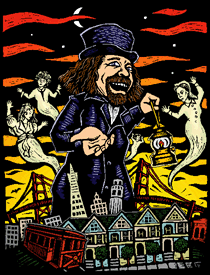
Ghost tour guides like to present themselves as historians. Even the kookiest tour guide I’ve encountered highlights his scholarly approach to research. Jim Fassbinder of the San Francisco Ghost Hunt dresses for his tours in an all-black outfit that conjures the image of a nineteenth-century itinerant preacher—or maybe a patent-medicine huckster. Fassbinder has a goatee and flowing locks, a tall top hat, a long leather Dickensian coat, and a black bag with the words “GHOST HUNT” in silver studs.
Fig. 2. Promotional graphic for the San Francisco Ghost Hunt depicting Jim Fassbinder
He gets plenty of attention in this garb, even in San Francisco. But once Fassbinder begins his tour, he adopts a scholarly demeanor. He starts by assuring us, “all the stories you hear are very well documented.” Later he re-emphasizes the thoroughness of his research: he knows a particular woman did not die in the Queen Anne Hotel because he “checked all the records.”
And like professional historians, ghost tour guides accuse one another of plagiarism. Jim McCabe of Boston is one of the most affable fellows you’re likely to meet, but his voice turns icy when he tells me about being ripped off by a rival tour outfit. According to McCabe, a more established tour group sent a representative to take his tour and, unbeknownst to McCabe, the man was a mole, complete with tape recorder. The rival group now runs a suspiciously similar tour—they even copied his promotions!
Like historians, ghost tour guides are also outsiders to mainstream heritage tourism. Even though they are part of the heritage tourism industry, they generally have no chamber of commerce connections and no particular incentives to put their cities in a favorable light. Indeed, their focus on the paranormal requires them to delve into the seamier side of history. This means not just unsolved murders and grisly suicides, but slave pens and violations of Indian burial grounds. I suspect that for many tourists the resulting picture of early American history is very different from what they received in high school. For some tour guides this educational purpose is not merely incidental. As Elaine Flynn of D.C. proudly told our group of twenty-two tourists, such subject matter “is not just politically correct but correcting political history.”
Consider the story told by Mike Brown of The Original Charleston Walks. Drawing on the lowcountry’s culture of Gullah—a creole language with African and English elements spoken by slaves and their descendants—Brown gives tourists chills with his description of boo hags. These freaky vampires without skin enter your house through a keyhole or crack, sit on your chest while you sleep, and suck your breath. If successful, the boo hag inhabits your skin and causes you to hunt for more victims.
The climax of Brown’s story is that the presence of boo hags is tied to Charleston’s long history of racial inequality. Much of Charleston today is built upon reused land, some of which was colonial-era slave graveyards. Boo hags are most often found, Brown insists, above these displaced burial grounds. Tourists come away with a striking metaphor for how Charleston’s past racial sins suck the life out of its present self-satisfied sense of heritage-based dignity.
Thirty-five miles west of Boston, Jim McCabe’s “Colonial and Native American Spirits” tour likewise connects past injustice with present pain. In the Scratch Flat section of Littleton (immortalized in John Hanson Mitchell’s 1984 environmentalist classic Ceremonial Time), McCabe weaves a tale grounded in millennia of Indian occupation. Many Indian spirits haunt the area, according to local residents. One reason for all this ghostly activity is the tragic history of Nashoba, a “Praying Town” of Christian Indians established by the Puritan missionary John Eliot. During King Philip’s War of 1675-76, many Puritans saw Christian Indians as a dangerous fifth column. So the entire village of Nashoba was rounded up and herded to Deer Island in Boston Harbor, the infamous prison isle where hundreds of Indians were interned and dozens of Indian corpses were interred. One Nashoba Indian in particular, Tom Dublet, is said to have cursed Nashoba—now Scratch Flat—because of the shabby treatment he received.
Ghosts linger above Scratch Flat, tormenting the locals and providing plenty of fodder for McCabe’s tales. One of his favorites is that the ghosts seem to have disrupted several development attempts, including a massive office park planned but never completed by Cisco Systems. McCabe and residents seem to believe the story of the antidevelopment spirits, but a spokesperson for Cisco is less impressed by the ghost of Tom Dublet. “We don’t have a policy,” she says, “regarding predictions from medicine men.”
Like Scrooge meeting Clio, Ghosts of History Past haunt these tours. In their quest for spooky stories, ghost tour guides mine sources overlooked by most other heritage tour operators. We could do worse than a ghost tour for a lesson in local history.
This cautiously celebratory reading of ghost tours must be tempered, however, by the recognition that such tours ultimately reproduce some of the most troubling facets of early American society. Euro-American colonists, like tour guides today, were fascinated by the deathways of Others they encountered in North America. Whites collected Indian ghost stories, drew pictures of slave funerals, and recorded the deathbed words of countless Indians. Sometimes this Euro-American interest was respectful and driven by a desire for cross-cultural understanding. Experience Mayhew, an eighteenth-century Christian missionary to the Indians of Martha’s Vineyard, immersed himself so fully in Indian society—spending his entire life on the island and speaking Wampanoag like a native—that he seems to have absorbed the Indian belief in ghosts’ presence at deathbeds and forgotten the orthodox Protestant skepticism toward the same. He recorded without comment the appearance of “two bright shining Persons, standing in white Raiment” at the deathbed of an elderly native woman named Ammapoo.
Sometimes, though, there were darker motives in Euro-Americans’ descriptions of nonwhites’ deathways. African American funeral practices were often Exhibit A when authors made the case for slaves’ alleged barbarity and lack of fitness for freedom. Such was the intent of British proslavery writer Bryan Edwards when he wrote about people of African descent in the West Indies in the late eighteenth century. According to Edwards “their funeral songs and ceremonies are commonly nothing more than the dissonance of savage barbarity and riot.” Even antislavery authors like Frederick Law Olmstead betrayed their racism when they described African American funerals. In 1861 Olmstead was impressed by what he viewed as the primitive simplicity of slave funerals: “I was deeply influenced myself by the unaffected feeling, in connection with the simplicity, natural, rude truthfulness, and absence of all attempt at formal decorum in the crowd.” Olmstead’s condescending attitude turned downright hostile when he discussed the slave preacher at this funeral: “I never in my life, however, heard such ludicrous language as was sometimes uttered by the speaker.”
In parallel fashion, Indian ghosts haunted early American literature, as Renée Bergland’s The National Uncanny (Hanover, N.H., 2000) has recently demonstrated. From the beginning of the colonial period, many whites equated the Indian inhabitants of North America with a satanic presence. As Cotton Mather wrote in 1692, witches “generally say [the Devil] resembles an Indian.” By the nineteenth century, dead and dying Indians—along with their spectral incarnations—helped perpetuate the tragic and romantic myth of the vanishing Indian. Many Euro-American colonists seemed most comfortable with Indians once they were dead; their very deaths seemed to prove Indians’ incompatibility with the march of Euro-American civilization. Fictional Indian characters were often rendered speechless as they died, as was Uncas in James Fenimore Cooper’s The Last of the Mohicans (1826) and Wind-Foot in Walt Whitman’s Franklin Evans; or, The Inebriate (1842). Granted no dying words by their white authors, Uncas and Wind-Foot were the epitome of the vanishing Indian.
Today, ghost tours aren’t so obviously implicated in these patterns. But they do tend to exoticize all things Indian and African, including their dead. That tour outfits profit from the grim history of interracial misunderstanding is still another disturbing legacy.
And there’s another, simpler reason ghost tours sometimes make my skin crawl. Despite the power of stories like the boo hag and the curse of Tom Dublet, tour guides feel the need to keep the patrons happy and the banter light. So they jump from deep reflections on the meaning of history to goofy jokes and magic tricks. History Dark, History Lite.
Sit some day in Warren Square, one of Savannah’s beloved little parks. Gaze across the street at the understated beauty of the early-federal-style John David Mongin House (1793). Admire its graceful entryway and its classic sense of proportion and symmetry. And then think of those in chains who toiled in the sticky heat to build this house, think of those who died in the fields at Bloody Point on Daufuskie Island to give the Mongin family its wealth, and try to keep the goose bumps from rising on your arms.
This article originally appeared in issue 3.1 (October, 2002).
Erik R. Seeman, associate professor of history at SUNY-Buffalo, is writing a book entitled Final Frontiers: Cross-Cultural Encounters with Death in Colonial North America.
Mount Vernon Makeovers
Poor George Washington. Life among the eighteenth-century Virginia gentry was hard enough, what with the strains of wilderness surveying, the challenges of managing (if not actually working) Mount Vernon’s eight thousand acres, and the hazards of fighting all those pesky colonial wars—not to mention the daily indignities of contending with his dreadful dentures. But the twenty-first century may be crueler still to the nation’s first president. Washington, it seems, just wasn’t man enough for our times. Or not, at least, the right kind of man. Lacking both the whiff of sexy scandal that trails Thomas Jefferson in the post-Hemmings era (think Bill Clinton), and the aura of hardscrabble virtue that accompanies John Adams in the post-McCullough era (think Harry Truman), Washington’s TVQ remains low (think Dwight Eisenhower). Grim-faced (the teeth!) and remote, Washington comes across as a stranger, an alien—almost, you might say, as a person from a radically different place and time, a past that’s a foreign country.
Fear not, Sons and Daughters of Cincinnati. Help is on the way. Lest our Founding Father remain shrouded in the mists of the time, a pair of unlikely allies is working diligently to drag Honest George, kicking and screaming, into the twenty-first century. The summer of 2002 witnessed two major Washington makeovers, one at the hands of the Mount Vernon Ladies’ Association of the Union, which has owned and maintained the first president’s Virginia home since 1858. The other makeover artist is Mary Higgins Clark.
That Mary Higgins Clark, you ask—America’s self-proclaimed “Queen of Suspense”? The very same. Clark, doyenne of the airport mystery, took last summer’s beach readers on a (very) little trip to the eighteenth century with Mount Vernon Love Story: A Novel of George and Martha Washington (a rerelease of her first-ever novel, Aspire to the Heavens, originally published in 1969). Dedicated to the proposition that all men are created red-blooded and sexy—that Washington was not “pedantic and humorless” but rather “a giant of a man in every way” (ahem)—Clark’s prefatory letter to her readers promises an intimate portrait of “two people I came to respect and love.”
Before you conjure visions of Fabio playing George Washington in the inevitable TV movie, be forewarned: Clark breaks this promise. What Mount Vernon Love Story offers are not steamy sex scenes, of which there’s nary a one (was it the teeth?), but countless moments spent in the throes of hot, throbbing interior decorating. This George Washington, content with chaste blushes and tender embraces in his romantic life, becomes “frantic with desire to see Mount Vernon.” Mount Vernon Love Story is shelter pornography. In the big-screen version, Clark’s Washington might best be played by Martha Stewart in drag.
Far from being pedantic and humorless, Clark’s Washington is henpecked and timorous, the son of an overbearing, whip-toting, Joan Crawford of a mother (First Mommy Dearest?), and the husband of an overprotective, child-toting, porcelain doll of a wife. “[H]eld down, checked, the object of his mother’s whims,” his “teeth [again with the teeth!] set on edge” by the “chaos” of her “grossly untidy” house, the young Washington takes refuge in tract mansion dreams befitting today’s soccer moms. He swears that one day, one dayby God, “his home would be warm and welcoming. It would have fine papers on the walls and a marble chimney, papier-mâché on the ceilings and neat mahogany tables . . . George spent much time envisioning that home.”
Luckily, time is one thing Clark’s Washington has plenty of. He doesn’t have to worry about working the land; his trusty and contented servants (almost never called “slaves”) do that. And, fiddle-de-dee, he doesn’t have to worry much about politics, either; some other book can do that. We hear vague murmurs about “troubled days” in the 1770s, or the odd “squabble between Congress and the cabinet” in the 1790s. But for the most part, Clark’s Washington gets to sweat the small stuff: “where flower beds would eventually grow,” the regrettably “hodgepodge effect of the décor at Mount Vernon,” the “dust in the corners” of his quarters in Cambridge. In sum, Clark’s Washington is a hero “suffering the agonies of a housewife”—which apparently include repeated bouts with hemorrhoids and a nervous stomach.
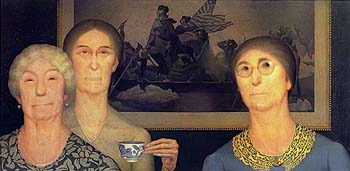
Fig. 1. Grant Wood, Daughters of Revolution, 1932
Where the Washington of Mount Vernon Love Story fluffs pillows, the Mount Vernon Ladies’ Association wants a Washington that busts heads. Last April, Mount Vernon announced an $85 million public awareness campaign “to close an alarming, growing information gap . . . about the nation’s greatest hero.” Concerned, much as Clark was in 1969, that today’s Americans have “lost touch with the real Washington,” Mount Vernon will soon break ground for a new orientation center that will wow the site’s 1.1 million annual visitors with “computer imaging, LED map displays, lifelike holograms, . . . surround-sound audio programs, ‘immersion’ videos, illusionist lighting effects, dramatic staging and touch-screen computer monitors.” At the beating heart of the new facility, two theaters will be devoted to continuous showings of a new “fast-paced 15-minute film.” Produced by Steven Spielberg and Dreamworks SKG, the movie “will provide an action-oriented insight into Washington’s life story.” (Saving Private Washington?) According to the New York Times, the film will be projected “in a theater equipped with seats that rumble and pipes that shoot battlefield smoke into the audience.” Not much room for politics here either, I’m afraid. Forget about the complex ideas Washington was fighting for, and zoom in on a tight shot of a musket.
Surely you’ve already guessed the target demographic for this action mini-epic: where Mary Higgins Clark limns a Washington for women of a certain age, the Mount Vernon Ladies’ Association is courting fourteen-year-old boys. As Jim Rees, the executive director of Mount Vernon, told the Times, the site needs “to reach not just the minds but also the hearts of eighth graders.” Combining the tools of the plastic surgeon and the forensic scientist with “the latest age-regression techniques,” Mount Vernon wants to restore not only life but youth to Washington. “Most Americans envisage George Washington as a stoic elder statesman,” notes Rees. “But Washington at age 23 was already the action hero of his times.” Who will play this eighteenth-century road warrior? Sly Stallone and Arnold Schwarzenegger are clearly too old for the job; even Keanu Reeves may be a little long in the wooden tooth. Will Vin Diesel be Spielberg’s Washington, or will Spielberg have theguts to cast Will Smith?
Washington as action hero, Washington as domestic goddess: will the American public buy this silliness? The verdict, so far, is mixed. Mount Vernon would do well to remember that The Patriot, the last major attempt to turn eighteenth-century revolutionaries into box-office gold, bombed with critics and eighth graders alike.
Mount Vernon Love Story may not fare much better. Despite a marketing barrage by Simon & Schuster (the publisher, not coincidentally, of John Adams as well as Clark’s entire oeuvre), Clark’s slim volume nudged its way onto bestseller lists for just a week last summer—mere spray across the bow of McCullough’s juggernaut. History buffs don’t seem to have touched it; a search on Amazon.com reveals that “customers who bought this book” favor the works of Danielle Steele and James Patterson, not those of Joseph Ellis and Gordon Wood. Yet diehard Clark fans hate it. “I have read all of the author’s books and found this one dull,” writes a reader in Cleveland. “Good thing it was small, or I might not have finished reading it.” Notes another “disappointed” fan from Flagstaff, “The only thing Washington truly showed any outward passion for was his home, Mount Vernon . . . he would definitely be in therapy if he was alive now.”
Maybe a session or two on the couch could help poor old George resolve his newfangled split personality. (Diesel or Martha? Martha or Diesel?) Or maybe he’d just beg his therapist for a tonic to relieve the rigors of time travel. Enough with the politics of character, I imagine him pleading. Give me the politics of politics. Put my life back in its times!
This article originally appeared in issue 3.1 (October, 2002).
Shooting Back
In November 1849 Dr. George Parkman, a physician and scion of one of Boston’s richest families, was allegedly beaten to death and dismembered by a Harvard professor of chemistry named John Webster. A week after Parkman’s disappearance, the janitor of the Harvard Medical School discovered body parts hidden in Webster’s laboratory. Webster was put on trial in a spectacle that drew tens of thousands of onlookers, as well as journalists from as far away as Europe. Webster was convicted and hanged. But his guilt is one of many uncertainties that have confounded those attempting to tell the story of the Parkman case for the past 150 years, including historian Simon Schama, who explored the case in his aptly named 1991 study, Dead Certainties (Unwarranted Speculations) (New York, 1991).
Parkman’s murder was nothing if not infamous. Edmund Pearson, the historian of homicide, called the Parkman case “America’s most celebrated murder.” Edward Everett, a president of Harvard from 1846 to 1849, said it was “the most painful event in our domestic history.” And when Charles Dickens visited Boston in 1867, one of his first requests was to see the room where Dr. Parkman was murdered. Even by today’s numbingly sensationalist standards, the grisly tale is shocking and disturbing.
One of the thousands of posters circulated by the Parkman family.
It’s a riveting story, but can it be a riveting documentary film? I hope so. For the past two years, my colleague Melissa Banta and I, along with Schama, have been developing a sixty-minute television documentary about the Parkman murder. (We are also designing an interactive Website, whose prototype is currently online.)
To our endless frustration, this most mysterious crime is made even more mysterious by a dearth of images: Parkman’s murder took place just a few years before the advent of popular photography. Fortunately, because the case was so celebrated, a number of woodcuts, maps, and other illustrations have survived. And some of the principal characters were illustrious enough to have had oil portraits painted of themselves. A search of the archives also yields a few later photos of some of the buildings–including the Harvard Medical School, where the crime took place.But a short stack of drawings, portraits, and photographs of buildings does not add up to a compelling film. Although I’ve produced documentary films for more than ten years, The Murder of Dr. Parkman is my first time tackling a subject that predates photography. And it’s led me to wonder: when the very building blocks of documentary film are images, is it even appropriate to make a documentary about a subject that has left behind only a tiny handful of visual traces?
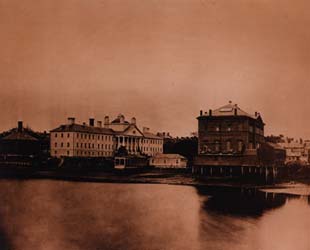
Harvard Medical College c. 1850 (right), next to Mass. General Hospital
Thinking about The Murder of Dr. Parkman has also led me to take another look at how other documentary filmmakers have approached the problems of portraying pre-photographic stories. In my admittedly cursory survey, I’ve looked particularly at historical documentaries that rely on “reenactments”–putting people in costume and having them act out an historical scene or event. While reenactments share important conventions, they range widely in quality–and credibility.
Documentary reenactments are almost always shot without dialogue, through fog or haze, or in a shadowy half-light. The camera often focuses only on close up details–a hand on a quill; feet running through the woods; a sword being buckled on–and almost never on an actor’s face. (The American Experience film, George Washington, the Man Who Wouldn’t Be King [1992], by David Sutherland, is a good example.) Or, conversely, the reenactments are shot so wide that we see only a distant figure on horseback wearing a three-corner hat–à la Ken Burns’s Thomas Jefferson (1996).
These visual cues send several important messages: that the reenactment is not fictional (if it were, there would be dialogue); that the reenactment is only a “suggestion” of what might have happened (signified by the ambiguous fog or haze); and that the actors are not portraying specific people so much as representing them (e.g., this pair of hands is not George Washington’s hands, but hands that represent his; the figure on horseback could be Jefferson). Each of these devices, it bears mentioning, also saves money. Speaking roles require skilled actors and directing; scenes that portray actual events require sound stages, expensive locations, props, and costumed extras.
The trouble with reenactments that rely on the camera slowly panning across interior spaces where something important once happened and hazy shots of quills, weapons, and detached body parts is that they leave viewers feeling distanced from the action instead of closer to it. Too often reenactments come across as just what they are–halfhearted attempts to make history come alive in a dramatic way without using the elements that make for dramatic storytelling: language, facial expression, bodies reacting in relation to one another. Burns’s Thomas Jefferson is in many ways a thoughtful essay on a fascinating man, but is it really a film? Do the endless slow-moving images of Monticello, the pans across portraits and drawings, the tilts down documents, and the occasional distant figure on horseback really add up to something that is driven by visual images which in turn are supported by spoken words? I think it’s the other way around–an illustrated lecture that could have worked equally well as a lavish magazine spread or coffee-table book.
The question of how to visualize the past–pre- or post-photographic–brings into sharp focus the central issue of putting history on film: is it entertainment or is it some form of serious inquiry?
Do reenactments ever work? Sometimes. For dramatic moments like the fatal confrontation between Aaron Burr and Alexander Hamilton in a recent American Experience documentary, The Duel (2000), reenactment works quite well because the filmmakers, Carl Byker and Mitch Wilson, actually break the PBS convention and let the camera dwell on the actors’ faces. Rather than watching decapitated stand-ins we get to see complete human beings we can come to think of as Burr and Hamilton, even though we know the duelists didn’t look quite like that. Some of the reluctance of documentary filmmakers to show actors’ faces comes from the fact that in a documentary–unlike a feature film–portraits are usually included, so viewers can’t help but notice the differences between the actors and the likenesses. But part of the fun of watching any film is suspending our disbelief long enough to be sucked into the story. After all, we know Elizabeth I looked nothing like Cate Blanchett, but is that the point?
A dramatic moment like the Burr-Hamilton shoot-out is so violent, passionate, and dramatic I could imagine it working as a reenactment in many different ways. But how can documentary filmmakers bring alive the important moments that are quiet and small but nonetheless crucial: for example, the inner struggle of a Revolutionary-era colonist deciding to become a patriot? In another departure from the increasingly hackneyed conventions of reenactments, Muffy Meyer and Ellen Hovde, co-directors of the public TV series Liberty, the American Revolution (1997), selected letters and diary or journal entries by well-known and not-so-well-known participants in the events, from Ben Franklin to Joseph Plumb Martin, then had actors perform the words of the journals and letters while looking directly into the camera. The use of letters and journals is certainly not new. But the usual convention is to have the letters read in voice-over, as Burns did, usually to great effect, in The Civil War (1991). Yet voice-over is always a trifle distancing, and particularly so when the language of the 1770s sounds so archaic to our ears today. Hearing Revolutionary-era letters in voice-over would have been simply a bore. But when a skillful actor is performing the reading, a smile or smirk, a pursed lip, a furrowed brow give the words flair and interpretation–in a word, drama! Although all depends on the actors (and there are some duds), overall it’s a successful device that brings some immediacy to the otherwise remote events surrounding the Revolution and stands out as a welcome breath of innovation.
Yet both reenactments and dramatic readings strike many people–some academic historians among them–as detracting from the seriousness of the material at hand and blurring the line between history and fiction. But where is that line, exactly? And more to the point, does it ever serve the purposes of historical inquiry to blur it–perhaps even to cross it altogether?
Prof. John White Webster, as depicted during his trial on murder charges.
This isn’t simply a matter of stylistic approach. The question of how to visualize the past–pre- or post-photographic–brings into sharp focus the central issue of putting history on film: is it entertainment or is it some form of serious inquiry? Can it ever be both?
In his book Visions of the Past: the Challenge of Film to Our Idea of History (Cambridge, Mass., 1995), historian Robert Rosenstone’s critical but friendly look at historical documentaries, he tells an anecdote from his experience as a collaborator on The Good Fight, the 1984 documentary about the Spanish Civil War. Part of the story he thought was critically important was left out of the film because the filmmakers had no visual materials with which to tell it. Drawing from his own experience, Rosenstone concluded that history on film can never be analytical, theoretical, or critical; it is instead “history as homage.”
He’s absolutely right. But had I been the filmmaker behind The Good Fight, I, too, would have asked Rosenstone, “OK, but what will we be seeing?” It’s a question that has become my mantra. Whenever I work with nonfilmmakers as collaborators I have to take time to get across the most obvious but not always appreciated fact of the medium: for every word uttered, there has to be footage on the screen. And not just any footage, but the right image. In fact, ideally it is the image that will drive the words (this is, after all, filmmaking–not an illustrated lecture).
Rosenstone attempted to convince the directors of The Good Fight to include material on terrorism among the Stalinist Left–a complicated twist in the already complex story on intra-Left battles. The filmmakers told him there was simply no visual material and that getting into the issue would lengthen the film and slow down the narrative. I’m inclined to agree. In my own experience making films about the American Left of the 1930s, I’ve found that it’s a big enough struggle first of all to convince viewers there ever was an American Left. Getting into the differences between the Communist Party, the Socialist Party, the Stalinists, and the Trotskyites is practically impossible. There are reels and reels of wonderfully evocative newsreel footage of the many street demonstrations of the 1930s, but, to modern viewers, whether the demonstrators are socialist or CP, Lovestonite faction or Browderites, it all looks the same.
Abstract points introduce even greater challenges. In a film I made about Jesse H. Jones, a little known financier who ran the New Deal’s Reconstruction Finance Corporation, we had to explain issues of financing and credit (boring no matter what–even with images); why banks were afraid to make loans during the Depression (showing somebody NOT doing something does not work on film); and Jones’s contradictory role as a staunch capitalist who also believed in activist government intervention in financial affairs (inherent contradictions are especially hard to convey on film–strong pictures do not often carry mixed messages). Abstract points again require “talking heads.” But of course talking heads are widely known to bore viewers. Sometimes, inevitably, the best decision–the decision the directors of The Good Fight made–will be to skip the point.
Dr. George Parkman, one of Boston’s richest men. known as The Pedestrian.
Rosenstone’s experience reminds us that, from the moment film is the format chosen for telling a piece of history, a huge act of selective storytelling has taken place. From that moment on, the process is a matter of jettisoning detail, nuance, and evidence in order to make the historical events fit the visual material available.
To an historian’s ears, “making the events fit the material” sounds like blasphemy, like doing history backwards. But I would argue that, on the contrary, the difficulties of making a satisfying hour or ninety minutes of history come alive on screen push filmmakers to find artful and inventive ways of presenting stories that–when they work well–rival the best written historical narratives (if not for completeness, at least for compelling storytelling).
One of the best examples of how well a mostly pre-photographic documentary can work is Ric Burns’s The Donner Party (1992). Though Burns uses the usual techniques–David McCullough’s narration, diaries and letters read in voice-over, maps, drawings and a few photos, and newly shot images of mountains and blizzards–the pieces come together into a riveting story that’s impossible to switch off.
But it is storytelling first and foremost. And while it could be argued that the story of the Donner Party is too atypical to be really useful in understanding the larger history of westward expansion, there’s no question that in its uniqueness it captures one small part of what drove people west and the price they paid to get there. Like so many historical documentaries The Donner Party can be accused of reducing history to a kind of ad hominem experience, or as Rosenstone says, history as homage. But film works best when it tells smaller stories about just a few people, and for that reason film or TV can never take the place of books and articles in serious history; the scale is usually too small and the tools are simply too blunt and imprecise for the job. Even when we’re lucky enough to have massive archives of photographs, newsreel, and film and video footage at hand, filmmakers start from a completely different premise than historians do. By choosing to use visual materials to convey information, the filmmaker is already jumping into history with one hand tied. Imagine writing a history book using only the most minimal one or two sentences of explication between the documentary selections. Tricky work, indeed, and probably a trickier read.
An imaginative version of the fatal encounter between John Webster and George Parkman from some years after the murder.
In making a film, it’s only one kind of document–those we can see–that carry the weight of presenting evidence; the brief explications only make connections or transitions between subjects. And the explications can themselves be a problem, largely because most take the form of the dominant convention in documentary filmmaking: narrative voice-over. In most historical documentaries, expert talking heads intercut with archival film and photos, all stitched together by the omniscient narrator who provides transitions and keeps the narrative humming along with the occasional reenactment added for dramatic effect. This is not a format that easily provides room for divergent points of view, for messily contradictory evidence, or indeed even for important aspects of the historical events at hand that may not have obvious visual images connected with them.
So why bother? Because, despite these obstacles, history on screen simply does some things better than history on the page. Reaching the millions, for one. What history on TV and film does best is entertain and engage while issuing an invitation to the viewer to learn more. What it lacks in depth it makes up for in reach. Few books or articles will ever have the sheer impact of The Civil War series, nor even the audience of millions that will watch a reasonably popular American Experience offering. If for no other reason than this, putting history on film will always be worthwhile.
But there is another reason. Screened history can have a different kind of impact than most written history does. It hits us in a different place: someplace deeper, more emotional, more visceral. We feel–and remember–images differently than we do words. Moving images, in short, are moving. I don’t think I ever truly understood the sheer cruelties of New World colonialism as well as I did after watching Black Robe, Bruce Beresford’s 1991 movie of Brian Moore’s historical novel about French missionaries in mid-seventeenth-century Canada. In this dark movie, the sun never shines on French Canada–all the events take place under oppressively leaden skies. Sure it’s hyperbole as metaphor, but it’s a potent example of what the power of images can achieve. After watching Black Robe I will forever associate the European conquest of the New World with chill gray drizzle, dampness, and death.
What story will we make visual in our documentary about the murder of Dr. George Parkman? One that, we hope, will be as riveting as the first accounts of it to hit Boston newspapers in 1849. We’re solving the footage problem by using actors in speaking roles–but we’re cheating: all the action takes place through the imagination of historian Simon Schama, who also appears on camera. Is it history or drama? Does the fact that it comes from the head of an historian make it history? Does the fact that he’s imagining make it fiction?
We’re not sure ourselves. We only hope that it will be entertaining enough to keep viewers from switching the channel and, if we really do our jobs, intriguing enough to send them to a library.
This article originally appeared in issue 1.3 (March, 2001).
Eric Stange is an award-winning independent documentary film producer, director, and writer who specializes in history and science subjects. His films include Zamir: Jewish Voices Return to Poland (2000), Brother, Can You Spare a Billion? (2000), Love in the Cold War (1992) and Children of the Left (1992).
Three Poems
Wallace Stevens once observed that “poetry is a scholar’s art.” I am interested in the ways that poetry and research might intersect and the ways that poetry can explore “voice” beyond the poet’s individual experience. My book of poetry, The Afflicted Girls, looks at what happened in Salem in 1692 from a variety of perspectives–the accusers’, the accused’s, bystanders’–those whose lives were forever changed by the accusations, trials, and executions.
The Afflicted Girls is composed of four different kinds of poems: poems that narrate the experience of the trials from the viewpoint of specific people (for example, a man who helped his wife escape from prison, a four-year-old girl accused of being a witch); poems that reference and incorporate colonial American verse and prose forms (including the sermon and the jeremiad); poems that pay tribute to the archival experience and explore the conception of the poet as archivist; and poems that investigate the lasting effects of the Salem witch trials on present-day America (poems that revisit the museums in Salem, for instance). Thus, the poems examine both the social structures contributing to the accusations as well as the relationships between people that were wounded or destroyed by the suspicions, convictions, and executions.
Testimony: He or His Apparition
About noon, at Salem, Giles Corey was press’d to death for standing Mute. — Samuel Sewall, Diary, September 19, 1692
The girls’ testimony is gravel scattered on the grass.
Ann Putnam: Giles Corey or his Apperance has most greviously afflected me by beating pinching and almost Choaking me to death
Inside the meetinghouse each afflicted girl repeats the next.
Mercy Lewis: I veryly beleve in my heart that Giles Cory is a dreadfull wizzard for sence he had ben in prison he or his Apperance has come and most greviously tormented me
The copier flattens the page, hammers down identical speech.
Sarah Bibber: I have ben most greviously affleted by giles Cory or his Appearance
But the man won’t speak to defend or plead. He sits still and silent in his pew.
Mary Warren: At the time of his examination I saw: s’d Cory or his appearition most: dredfully afflect: Mary Walcot An putnam. Mercy lewes & Sarah Vibber
The morning of his execution: the meetinghouse floods with light. Outside a circle rises around the punished man: the magistrates pile stone after stone on his ribs to crush him into speech.
Nobody can see the lesson: nothing can drive the voice out of the body.
The Mather Boys
Richard, Increase, Cotton
The one who starts it: who first crosses the cold lead ocean to settle in this land
The one who prays and fasts in secret for God to untie his tongue
The one who waits all day in his study for proof of Election or at least a Remedy
The one whose ship is driven against the white rocks at the edge of Isle of Shoals
The one with an Infirmity in his Speech, each word splitting open in his mouth
The one who leaves his study only for meals or Family Prayer
The one whose hand crosses the page again and again, practicing words he cannot say
The one who holds The Book of Martyrs on the ship’s slick deck as anchor cables snap, sails rip from masts
The one who explains that Strong affections bring strong afflictions and shuts his study door, his son standing alone outside
The son who dreams his grandfather’s voyage, who reads his father’s prayers, who will write the future down:
It is a world all over defiled with Sin, God will shortly burn it for a Witch
Witness, Recantation
For Elizabeth Reis
I enjoy, though in abundance of afflictions, being close confined here in a loathsome dungeon. — Margaret Jacobs, letter to her father from Salem prison, August 21, 1692
Honored Father, when I remember you
your eyes turn the color of a bruise. As soon as you speak to me you disappear, and I have to imagine the ocean that might lie between us,
then something breaks inside my body and everyone I’ve hurt returns: Grandfather, Mother, You, skin translucent like the oiled paper we stretched in place of glass between the window lead.
I see through your body. You never have to say it: Lying is a sin. What’s worse to you, false testimony or a wrong confession? Down here is all darkness, the only sound the slur of rain in the dirt, water rats scratching inside the walls. Grandfather is dead.
Mother locked in Boston Jail. You escaped. Lying is a sin. Just as any telling of this story is a lie,
just as in the future, years from now when you and I are dead, another woman will write this letter down in a room with sky-colored walls and electric candles under a water- color of the sea, waves capped in white like dress lace, a girl on the dock waving
goodbye to no one under the caption: Salem, Massachusetts, New England’s Maritime Paradise.
Poems reprinted by permission of author from The Afflicted Girls.
This article originally appeared in issue 1.3 (March, 2001).
Nicole Cooley is an assistant professor of English at Queens College–the City University of New York. Her first book of poetry, Resurrection (Baton Rouge, 1996), won the 1995 Walt Whitman Award from the Academy of American Poets. She has also written a novel, Judy Garland, Ginger Love (New York, 1998).
The Past Impaneled
The publication of the second volume of Maus: A Survivor’s Tale in 1991 marked more than the completion of Art Spiegelman’s painstakingly researched comic book account of his father’s Holocaust experience and survival. It also marked, at least for those readers who were either unaccustomed to the medium or had relinquished it somewhere during their adolescence, the intellectual legitimization of the comic book. While some of the pictorial conventions used by Spiegelman, particularly his depiction of his characters as animals, left some critics uneasy (misunderstanding the device’s goal of subverting the racist tenets of Nazism), Maus received acclaim as an original and indisputably serious work of history–both in the story it told and in the graphical and textual waysof its telling. (For more reviews and commentaries about Maus, see “Maus Resources on the Web.”)
Maus‘s accolades notwithstanding, a certain air of irrespectability still lingers about the comic book as a medium for serious work about the past. Cartoonists such as Larry Gonick, Raymond Briggs, and Joe Sacco have been recognized for the quality of their respective graphical histories, memoirs, and journalism, but the fervent sales and serious critical attention engendered by Maus have not been repeated. Last year, almost a decade after it published Maus, Pantheon released a group of new comic books packaged in formats seemingly designed to belie their actual status: so sumptuous-looking–and expensive–that they
might be construed as art instead of comic books.
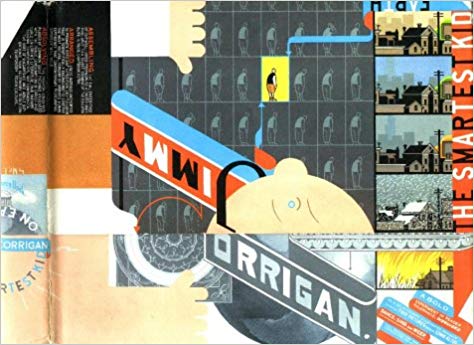
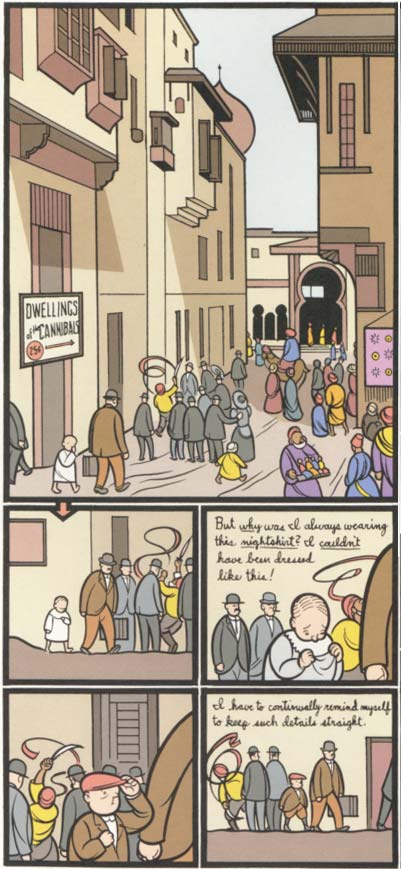
Chris Ware. Jimmy Corrigan: The Smartest Kid on Earth. New York: Pantheon, 2000. 380 pp., $27.50.
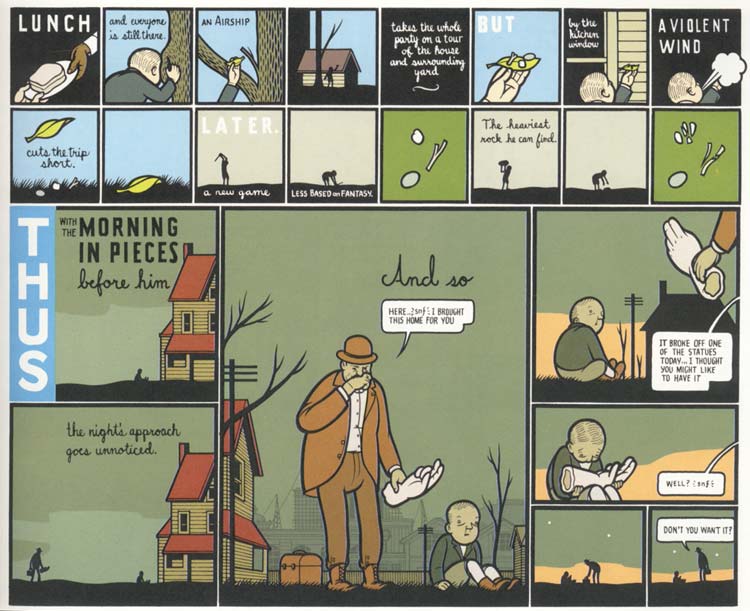
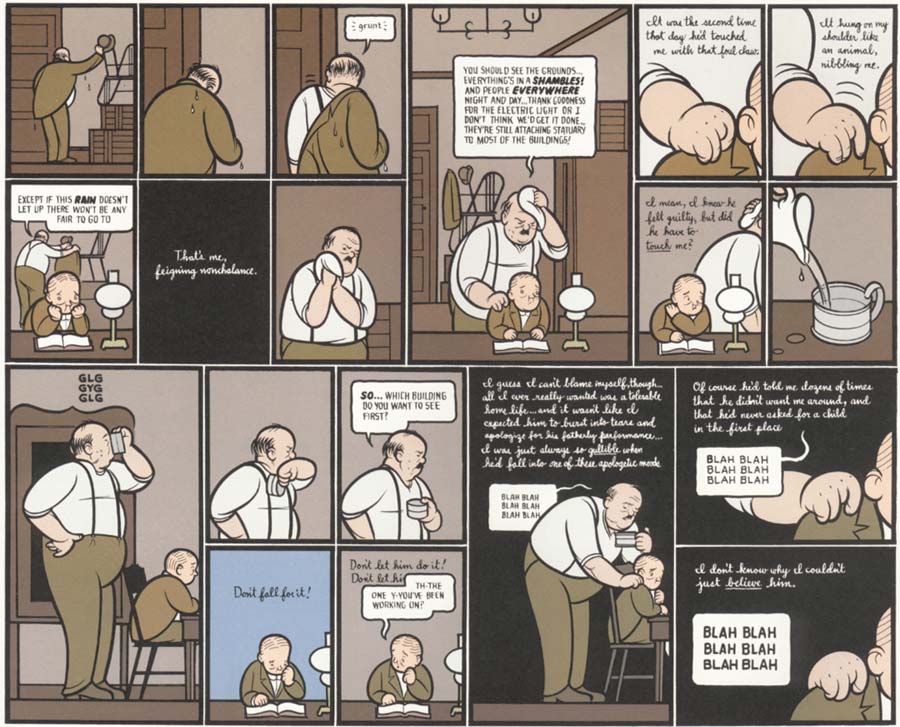
But, while two of these new books–Ben Katchor’s The Jew of New York and Chris Ware’s Jimmy Corrigan: The Smartest Boy on Earth–traffic in the past, unlike their predecessor they are works of graphic historical fiction. As such, their publication by a commercial American publisher might be construed as signaling a further maturation of the medium–at least in the sense that they have boldly relinquished the respectable trappings of scholarship, however crude that might at times end up being, in favor of exploring the past in more fantastical terms. But their status as fiction allows us to raise a useful question often overlooked when the pedantic and didactic virtues of “fact” are offered as the primary goal of a work: Why do history in the form of a comic book? Why use this particular medium as opposed to others? What can the comic book offer in the presentation of the past that is unique and compelling?
In the spirit of fantasy–or, at least, fiction–let’s step out of Common-place‘s ordinary mode and into, around, and through these works and their worlds.
This article originally appeared in issue 1.3 (March, 2001).
Joshua Brown is director of the American Social History Project at The Graduate Center, City University of New York. His Beyond the Lines: Pictorial Reporting, Everyday Life, and the Crises of Gilded Age America will be published by University of California Press in 2002.
Benson Misanthrope’s adventures looking for academic employment were chronicled in the Radical History Review from 1984 to 1989. He is currently dissociate professor of history at Malapropos University.
Synthetic Rewards
What’s a synthesis? Everyone knows the smart aleck answer: history without original research. This conviction fuels the disparaging shrug so many academics have given when encountering a book advertised as a “synthesis.” “It’s just based on secondary works.” “Oh, a textbook,” our voice trailing away.
I won’t defend writing synthetic histories on principle because I’ve recently done so in practice, by writing two: Becoming America: The Revolution Before 1776 (Cambridge, Mass., 2000) and Religion in Colonial America (New York, 2000), the second published for adolescent readers. Instead, I’d like to say something about my experience and what I learned in writing them.
In the first place, I learned that writing a synthesis is quite different than writing a textbook. A synthetic or synoptic history emphasizes several overarching interpretative themes that may be complementary or contradictory (or both) but share one common function: the themes guide almost all the material that appears in the book–events, people, and places.
This is quite different than textbooks, or at least different than many textbooks. Without impugning texts, anyone who has worked with them knows that they must accomplish another aim: cover everything, or almost everything. Textbooks are stuck with the Mount Everest problem–if it’s on the route, it has to be scaled.
A synthesis might indeed become a course text. Years ago, this happened with Carl Degler’s Out of Our Past: The Forces that Shaped Modern America (New York, 1959), although some faculty cribbed so many lectures from the book, they couldn’t assign it to students. Rather than “covering everything” as a textbook might do, however, a synthetic or synoptic history–like Degler’s–focuses on certain selected broad-scale themes. It distills elemental ideas about the evolution or development of a people or society. It explains things that its author chooses to place at the heart of matters. It assesses what’s purposeful, worthy, good, and bad.
Ultimately, then, a synthesis probably is moral in some general sense. It makes judgments about the past, about the merits of people and events, even about their relevance for the present and future. It separates better from worse, the significant from the merely obvious, Mount Everest from its neighbors.
Synthetic history isn’t for the weak at heart. In addition to elevating the historian to the (dubious) status of minor armchair moralist, it obviously requires a broad knowledge of the field. But I learned, often the hard way, that a complete command of the vast minutiae of the past was at least as important as a command of every modern historical field and all their latest interpretive and methodological twists. This proved true for two perhaps unexpected reasons.
First, a successful synthesis is filled with the tumult of the past, not bland abstractions. Of course, this is important in even the narrowest monograph. But the breadth of a synthesis can drown in its own dull abstractions. History moves through individuals and the lives they lead, the principle universalized, then expanded by a Talmudic teaching centuries ago: “If any man saves alive a single soul, Scripture imputes it to him as though he had saved alive a whole world.”
Human tumult and its minutiae can’t become mere antiquarianism, facts marshaled as their own ends. But they have to be present because real human beings and the lives they shape must stand at the heart of a successful synthesis.
It’s not sufficient to say that men and women worked hard, for example. One must convey precisely what particular men and women did and what their work meant and signified. In Becoming America, I tried to convey this at one point through the words of a Long Island woman named Mary Cooper. She not only described the exhaustion of her labor (in July 1769) but judged its meaning: “This day is forth years since I left my father’s house and come here, and here I have seene little ells but harde labour and sorrow. . . A fine clear cool day. I am un well.” What better words to convey a colonist’s disappointments, ambivalent feelings, dreams?
Ironically then, writing two books of synthesis made me scramble to replicate the intimacy of the small canvas seemingly more characteristic of the monograph. The author of every synthesis struggles to incorporate telling detail in only a few sentences and paragraphs, and the examples chosen must by necessity be particularly trenchant. We might know this from our most recent “historical” event. When millions of people told so many vivid office jokes about chads and politics in November 2000, they did so because their graphic humor conveyed the absurdity and urgency of the presidential election crisis better than blathering cable-TV pundits. It’s a point we historians shouldn’t miss.
Second, I learned that synthetic history isn’t homogenous. When the exteriors in a synoptic book appear smooth, they must, like Debussy’s La Mer, convey the possibility of immediate chaos and danger. A synthesis has to be complex, nuanced, and subtle–yet also clear. It must bear a suppleness that allows for variations, anomalies, crosscurrents, and exceptions.
To use an architectural metaphor, a successful synthesis usually looks more like buildings by Frank Gehry than structures by Philip Johnson, more like Gehry’s rambunctious Guggenheim Museum in Bilbao, Spain, than Johnson’s restrained Glass House in New Canaan, Connecticut. This is because no historical society ever coalesced into the cool symmetrical shapes Philip Johnson perfected. History is patterned, but unexpectedly, like Gehry’s impetuous yet disciplined museums, offices, and houses.
A successful synthesis must reflect these ambiguities. Interesting books on “Puritan” New England, “Quaker” Pennsylvania, or “Cavalier” Virginia comprehend the wholeness and intricacies of their societies by reveling in historical tensions and anomalies, not by assembling a reassuring but nonexistent homogeneity.
The demands inherent in writing a synthesis skirt disaster. The need to distill so much in so few sentences and use single facts to convey so many broad and complicated meanings can easily lead authors and readers astray if not well handled. In describing Thomas Paine’s Common Sense at the end of Becoming America, I wrote that colonists recognized Paine’s “compilation of sarcasm, wit, and satire through British politics and through their own political invective dating back to Robert Hunter’s 1714 scatological [New York] play Androboros. Now Paine used the same language,” I concluded. But my friend Jim Kloppenberg took me to task in hisCommon-place review because he believed I’d said that Common Sense succeeded because it appealed to the colonists’ “taste for ribaldry.” My compression, if not my cheekiness, surely had produced a monster.
I could have responded that one loose reference to a dirty play did not an interpretive paradigm make. But I wrote what I wrote, and it illustrates the care one must exercise in compacting so much into single paragraphs and sentences, if only to fend off witty reviewers!
Still, it isn’t as though writing a synthesis is a Monty Python exercise in “something completely different.” It’s what most every historian has done at the beginning and end of every chapter or the beginning and end of every book. It’s what we all do when we lecture. We connect our little monographic facts with the larger world. We tie some particular aspect of Puritan theology to the British Puritan movement, then to the continental Reformation. We link the task system on southern farms to colonial and British labor practices. If we’re ebullient, we link everything to capitalism.
In short, synthesis might better just be called teaching. Whether in speaking or writing, we’re describing and explaining, in little steps and big ones. And in both media, we know it involves real men and women, children and adults, organized and isolated, aware and unaware. And just as when we’re standing in front of a class or staring into a computer, we know that vivid personal examples count. They make our generalizations understandable because they explain their human consequences.
Of course, teaching and writing also involve learning. One learns so that one has something to say. But one also learns for fun. That’s what I liked best about writing two synthetic books: I learned a lot. The chapters I had the most fun writing concerned topics I knew least well–or even actively disliked. For Becoming America, they were material culture and economics. For Religion in Colonial America, my specialty, it was the Puritans, since I’ve written about almost every form of American religion except Puritanism and often have joked that the Jonathan Edwards manuscripts hissed when I walked near the Beinecke Rare Book and Manuscript Library at Yale. Put simply, reading on these topics–even on the Puritans–was pure pleasure.
Producing a synthesis can be nerve-wracking. All those generalizations will inevitably get an author into trouble with just about every possible reviewer, each of whom knows some part of the subject far better than you do. Then there are the mistakes! Trust me, like Santa, it pays to check your lists at least twice. And if the facts are straight, the “approach” is wrong. You should have covered more ground. You should have covered less ground. You should have covered different ground. You should have written the book the reviewer wanted to read, not the book you wanted to write.
Many of the complaints, if not quite all of them, are at least understandable. No matter. Even if writing broad-scale history takes far longer than one planned (my fault, no one else’s), you reap the satisfaction of putting Humpty Dumpty together again–and not just Humpty but the whole wall.
And in the end, there’s the reward that comes with every book: it’s there, it’s yours, and it’s finished. I’d write each book again in a heartbeat–but naturally differently, perfectly, making every reader see how each little part forms a matchless synthetic whole.
This article originally appeared in issue 1.3 (March, 2001).
Common-place asks Jon Butler, who teaches American religious history and early American history at Yale University, about the challenges he faced writing two books of historical synthesis.
Tell Me What You See
From the late 1950s until the mid-1980s, Edmund Morgan regularly taught a year-long graduate seminar at Yale that has become legendary among professional historians. Morgan, the author of more than a dozen books, including Inventing the People: The Rise of Popular Sovereignty in England and America (New York, 1988) and, most famously, American Slavery, American Freedom: The Ordeal of Colonial Virginia (New York, 1975), is a leading authority on early American history. Past president of the Organization of American Historians, a member of the American Academy of Arts and Sciences and the British Academy, Morgan recently received yet another honor–last year President Clinton awarded him a National Humanities Medal. But none of these accolades fully recognizes his contributions as a teacher.
In 1972-73, my second year of graduate school, I was fortunate enough to take Morgan’s famous graduate seminar. More than a quarter century later it is absolutely clear to me that it offered me my first grounding as an historian.
Morgan ran the seminar in his office, a room only slightly larger than those of other faculty, but with an oversized library table that took up most of the space and could accommodate about a dozen students. George Miles, now a curator at the Beinecke Rare Book Library at Yale, remembers that “the setting made everything seem intimate without being precious. It created a sense of a community of scholars in a way that a class-room never could.” Ed had a phone on his desk equipped with an oversized toggle switch that turned the ringer on and off. When he threw that switch, the seminar began.
It was a two-semester course, and at the first session Ed told us we would spend the first few weeks of the semester picking a topic. We would research during the winter and write in the spring. He wanted us to produce “publishable” papers. I quaked a little when I heard that, but he said it in such a casual, almost offhanded way, he made it seem possible. Joseph Ellis, who recently won the National Book Award for his biography of Jefferson, had something of the same experience when he took the seminar in 1965. “I had not even majored in history as an undergraduate, was wholly bereft of any mature sense of history as a profession, and therefore felt hopelessly behind classmates like John Blassingame and Tim Breen. I had read two of Morgan’s books, The Puritan Dilemma and The Gentle Puritans, and my chief attraction was to the elegant simplicity of Morgan’s style. I didn’t know much American history, but I did know that I wanted to write history like him.”
We would begin, Ed said, by looking for the answers to some questions in early American history that he was working on himself. I didn’t know it at the time, but in 1972 he was finishing up work on American Slavery, American Freedom, and many of the questions he posed to us related in one way or another to that project. At that first meeting two or three of us got assignments that we were to report on the following week. “Morgan’s method was as deceptively simple as his style,” says Ellis. “He didn’t quite assign topics, but tossed out little slices of a big historical question.” I had come to Yale to study the American West, so I grabbed his question about the meaning of the term frontier in seventeenth- and eighteenth-century America. “Where should I go to find evidence,” I asked. He suggested I take a look at the published records of the colonies, or the published papers of some prominent figures like Franklin and Washington–but first try the OED. What was that? I wondered, but didn’t have the gumption to ask. Over the next few days I looked at material I hadn’t known existed and fell in love with the Oxford English Dictionary. (Later that year I would join the Book-of-the-Month Club to get the compact edition offered as a signing bonus. That now ragged set still sits within reach of my desk chair.)
This was how it went for the first seven weeks. Ed sent us out to dig up what evidence we could find on a variety of questions, each extremely interesting in themselves, but especially valuable for introducing us to all corners of Yale’s extensive library collections, to the various bibliographic and reference tools available to early American historians, and to questions of evidence and interpretation. One week he focused on the Atlantic crossing. What was the length of the voyage from England to North America in the sixteenth and seventeenth centuries? What size were the ships and the crews? What American products were shipped to England before the founding of Jamestown? Another week he asked about English impressions of the Indians. What did the first published English accounts of America say about the political organization of Indian societies, about their religious beliefs and practices, their agricultural techniques? What was the meaning of the word cannibal in Spanish works translated into English before 1607? Another session was devoted to church organization in New England. How were ministers chosen? What were their salaries? Who owned the meeting house? What was the ratio of church membership to town population? Were there ever Negro or Indian members? What was the sex ratio of church membership? What was the age structure? How many church members were widows? “Of course these questions led inevitably to other questions,” remembers my Yale colleague Jay Gitlin, who took the course in 1974-75. “By the time class was over, I felt I knew a great deal, and knew it securely, in a very grounded way. And I knew how historians know things, and had many ideas about further questions to ask.”
For the last of these sessions Ed provided us with facsimiles of two seventeenth-century documents that we were to transcribe. At the meeting we compared our results, which were wildly variant. We talked about the styles of handwriting in early America, and he showed us how to make and sharpen a quill pen. It was unforgettable. “This was a very fun class,” Gitlin smiles. “I wrote to my parents and brother in a seventeenth-century hand for a week.”
Meanwhile we were working on our own topics, and for the remaining weeks of the semester each of us presented them to the seminar. I had done a report on widows in seventeenth-century New England churches during one of the early weeks, and now proposed a larger investigation of the elderly in a seventeenth-century Connecticut town. For our presentations we were to review the relevant secondary literature, demonstrate the way our historical questions grew out of that literature, and give some examples of the kinds of primary sources we planned to use as evidence. We were to provide full bibliographies for the seminar, but Ed insisted that we focus our presentation on trends and issues rather than a mere catalog of the literature. Those discussions were some of the most exciting of my entire graduate education. “Morgan tended to play intellectual pin-ball, shooting a question or opinion onto the table, then letting it rattle around until it lost momentum,” Ellis recalls. “The dominant message seemed to be that we were all in this together, the most intriguing questions were not susceptible to pat answers, and his only advantage was that he had been thinking about them longer than us.” He didn’t show much interest in the interpretive debate itself. The discussion was meant to lead us to questions of our own.
I researched my project over the holidays and into the second month of the new year. The seminar began meeting again in mid-February when we made preliminary reports on our research. At midterm we began with the first full presentations of our papers. “In my recollection some of those drafts were dreadfully boring–ecclesiastical history was not yet dead,” George Miles laughs. “But others were fascinating and ran the gamut from early seventeenth century right through my paper on the impact of western lands on the formation of American identity in the early republic.” What most sticks in Miles’s memory, however, is also indelible in mine–“the way that Ed took every paper seriously, and was a gentle but incisive critic.”
During these sessions Ed made a number of off-the-cuff remarks about doing history, little bits of wisdom that are fondly recalled by his students.
When you are doing your research, don’t dismiss the unexpected–pursue it; hone in on research findings that take you by surprise.
Never fear to work on a subject just because you know someone else, even a heavyweight in the field, is working on it; you have an original contribution to make.
As you begin writing, read the works of historians whose style you admire and would like to emulate.
Discard the methodological and theoretical scaffolding you constructed to do your research; too many monographs are all scaffolding and no building.
Assume your reader is intelligent but ignorant of your topic.
Don’t fret over beginnings; start writing where it feels easiest, and in the process you’ll discover your beginning.
Do not write an essay or book that stands or falls entirely on its thesis; offer something valuable even to those readers who will reject your central argument.
Ed taught us how historians do history, and it is startling to realize how much of what I say to my own students I first heard from him. This is a common experience for all Morgan alumni. “I live with my memories of Ed’s seminar on a near-daily basis,” says Karen Halttunen, “since I find myself quoting him all the time to my own grad students.”
“But perhaps the most important thing I learned in Ed’s seminar,” Halttunen continues, “was conveyed silently. From the model of scholarship and teaching he provided, I learned that the greatest of historians–such as himself–do not tolerate intellectual arrogance whether in others or in themselves. To me, this wasn’t simply a lesson in good academic manners; it was an important insight into what makes intellectual greatness like that of Morgan’s. Towards the end of his life, Isaac Newton captured this quality, by likening himself to a boy playing on the sea shore, occasionally finding a smoother pebble or shell than ordinary, ‘whilst the great ocean of truth lay all undiscovered before me.’ I think Ed conveyed to his students that we were all of us just like Newton’s boy on the beach. Most of us needed to hear this, and most of us, I suspect, have never forgotten it.”
Edmund Morgan is now retired. He splits his time between his home in New Haven and his cottage in New Hampshire, and is rarely spotted on the Yale campus. Always a man who enjoyed working with his hands, he is a woodturner, and makes beautiful bowls and other wooden vessels. Although he regularly contributes to the New York Review of Books, he claims to have written his last book. He may also have taught his last student. If my own experience is any guide, however, dozens of historians around the country teach their own students a version of the “Morgan method.” As Joseph Ellis puts it, Morgan taught us that “interpreting the past means laying your own eyes on the primary sources and seeing patterns there that no one else had seen before. Before there was the Nike ad there was the Morgan dictum: Stop telling me what other historians have said and tell me what you see.”
This article originally appeared in issue 1.3 (March, 2001).
John Mack Faragher teaches at Yale and, most recently, is the co-author with Robert V. Hine of The American West: A New Interpretive History (New Haven, Conn., 2000).
Lumpen-Proletarians of the Atlantic World, Unite!
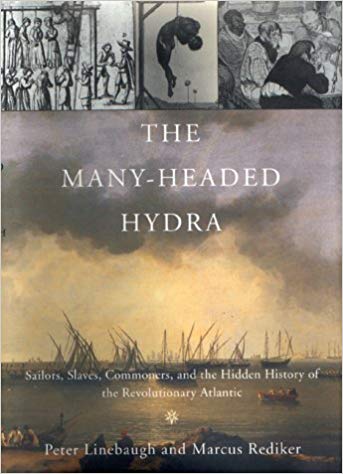
In their 1848 Communist Manifesto, Karl Marx and Frederich Engels derided the “‘dangerous classes,’ the social scum, that passively rotting mass thrown off by the lowest layers of the old society . . . [as] a bribed tool of reactionary intrigue.” They conceded that it could under certain conditions be “swept into the movement of a proletarian revolution,” but clearly doubted its potential. Marx and Engels never revised this contemptuous vision of the dispossessed. Never in their writings are expressed hopes for unity between the outcasts and enslaved Africans. Because of this lacuna, labor historians have generally neglected mariners, landless laborers, the unskilled, and the enslaved. Peter Linebaugh and Marcus Rediker, two of the better narrative historians around, allude to this problem late in their vigorous study by censuring labor history as giving too much emphasis on the “white, male, skilled, waged, nationalistic, propertied artisan/citizen or industrial worker.” This focus has “hidden the history of the Atlantic proletariat” (332) of the early modern period.
As the preeminent students of the late E. P. Thompson, Linebaugh and Rediker have, in their finely argued, wonderfully detailed resurrection of lost heroes, elevated the “social scum” into a preindustrial, interracial, cross-gendered, working class and enormously broadened and restructured the avenues of premodern social history. Employing an elastic version of Ira Berlin’s method of time and place in social formations, Linebaugh and Rediker navigate readers around the Atlantic basin between 1609 and roughly 1820. Each chapter, moving chronologically forward, focuses on specific individuals or movements, whose actions propel the authors’ thesis of the revolutionary struggles of the dispossessed against an emergent merchant capitalism. Chapter 1, for example, is about the saga of the wreck of the Sea-Venture off Bermuda in 1609. Bermuda was thought to be a devil’s island; instead the 150 marooned survivors established a primitive communism on the bucolic isle. This event is sacked for meaning as Linebaugh and Rediker create a genealogy of the members of this instant society by examination of the enclosure acts of seventeenth-century England. In addition to standard historical references, the writers borrow heavily from literature. As they note, Shakespeare described this event in The Tempest. Such literary references abound in the book, enabling Linebaugh and Rediker to connect their argument with the artistic and ideological perspectives of discreet epochs. An added benefit of course is the beauty of antique writing, which raises their own gleaming discourse. The Shakespeare quotes are part of the duo’s strategy of examining the etymology of the language of rebellion and oppression.
Peter Linebaugh and Marcus Rediker. The Many-Headed Hydra: Sailors, Slaves, Commoners, and the Hidden History of the Revolutionary Atlantic.
Chapter 2 is a thorough exhumation of the uses and meanings of the term “hewers of wood and drawers of water. ” By this, Linebaugh and Rediker contend, was meant those who undertook the labors of expropriation: building the ports and the ships, providing the seafarers for Atlantic commerce, and daily maintaining the households. Herein are described in close detail the actual work required for these massive tasks. Hewers of wood were male, drawers of water were female. Their labor was enforced by terror manifested by common hangings, torture, imprisonment, and transportation. Again, these are vividly described by careful quoting, a method which entices readers otherwise dulled by charts and tables in more traditional tales of the lumpen-proletariat.
A key goal of this book is to integrate early modern labor history racially. A third chapter excavating the story of “A Blackymore Maide Named Francis” at once details the toils of agricultural female domestics and then, uniquely, relates the saga of a black prophetess. Adjoining this narrative are instructive interpretations of Anne Hutchinson and fascinating alignments of witchcraft trials with the oppression of proletarian females. This adds political meaning to Richard Godbeer’s examination of controversies over magic and the suppression of witches in early modern Europe and New England. Even stronger a contention about the interracial nature of the Atlantic proletariat is the next chapter on the famous 1741 Negro Conspiracy in New York City. Their thesis already announced in their widely regarded 1990 article in theJournal of Historical Sociology, Linebaugh and Rediker’s evidence about the nature of the conspiracy vacillates between black revolt and the inclusion of white rebels. As in a later chapter about the mulatto Robert Wedderburn, an English radical of fifty years later, a key symbolic act is an interracial love affair between Caesar, a black rebel, and Peggy, an Irish woman.
At the very least Linebaugh and Rediker break the tradition of treating mixed-race love as purely exploitative and herein lift such a union into a brave act of defiance. I must admit that I remain unpersuaded about the degrees of interracial nature of working-class protest in this chapter, but do admire how Linebaugh and Rediker greatly advance historical discourse. The chapter oddly omits recognition of such recent studies of the event in Ira Berlin’s Many Thousands Gone and my own Root & Branch, which includes an argument parallel to the authors’. More familiar is Linebaugh and Rediker’s coverage of proletarian instigation and involvement in the American Revolution. Building on the seminal work of Jesse Lemisch on sailors and recent work by Sylvia Frey on black revolutionary soldiers, the authors add a third theme identifying the abolitionist exchange of Granville Sharpe and Olaudah Equiano. More original is the following chapter on the rebellious plans of Edward and Catherine Despard, a mixed-race couple intent on seizing power and declaring London a republic in 1802. This spectacular event, they claim, inspired similar actions in Ireland, America, and in Jamaica, Nicaragua, and Belize. This is one of several forays by the authors outside of an argument bound by the British Empire. I think they would concede that there was room for more, but other scholars may follow their substantial leads.
Next they illuminate the narrative of the before-mentioned Robert Wedderburn. Linebaugh and Rediker substantiate the evangelical underpinnings of proletarian revolts seen briefly before in the story of Francis, the Pentecostal maid. In the final chapter, Linebaugh and Rediker’s keen ability to locate traditions of rebellion is most fully found in their resurrection of the political artistry of Thomas Hardy, Equiano, François de Volney, and William Blake. Any minor misgivings I might have toward this bulging narrative are overcome by my appreciation of their mastery of literary sources and artful synthesis of interpretation. A major new interpretation of premodern labor history, the book is a terrific read which touches upon many significant questions and genres found in the forgotten lives the authors invite us to revisit.
Further Reading:
For the quote from Marx see Hal Draper, ed., The Annotated Communist Manifesto (Berkeley, 1984), 15. For witches see Richard Godbeer, The Devil’s Dominion: Magic and Religion in Early New England(Cambridge, 1992). The previously published article is Marcus Rediker and Peter Linebaugh, “‘The Many-Headed Hydra’: Sailors, Slaves, and the Atlantic Working Class in the Eighteenth Century,” in Journal of Historical Sociology 3 (1990): 225-82. For recent interpretations of the 1741 Negro Conspiracy see Ira Berlin, Many Thousands Gone: The First Two Centuries of African American Slavery, (Cambridge, Mass., 1998) and Graham Russell Hodges, Root & Branch: African Americans in New York and East Jersey, 1613-1863 (Chapel Hill, 1999), chapters 3 and 5 on the racial character of the American Revolution.
This article originally appeared in issue 1.3 (March, 2001).
Graham Russell Hodges is professor of history at Colgate University and is author of Root & Branch: African Americans in New York and East Jersey, 1613-1863 (Chapel Hill, 1999). He is presently finishing a biography of David Ruggles, the black abolitionist.
A Gothic Tale of Revolutionary Amerika
Even during the war, the debates, and the internal conflicts that created the United States, creative artists were wrestling with the interpretive problems their era presented. Perhaps the best-known, and still best-regarded, achievements took form on canvas, in the history paintings and portraiture of Benjamin West, John Singleton Copley, Charles Willson Peale, John Trumbull, and Gilbert Stuart, to name only the top echelon. But as Kenneth Silverman shows in his Cultural History of the American Revolution (New York, 1976), the American Revolutionary era interested men and women who worked in many other media and genres. These included chamber music, vernacular song, poetry, drama, and the novel.
Despite Washington Irving’s tongue-in-cheek suggestion in “Rip Van Winkle” that the whole era was one big yawn, the subject has continued to be compelling, a point noted by Michael Kammen in A Season of Youth (New York, 1978). Yet the achievement remains spotty in comparison to what the French Revolution generated. There is no concert-hall music to compare with the Berlioz version of la Marseillaise or Tchaikovsky’s 1812 Overture, let alone Beethoven’s third symphony, the Eroica. Unless we count the musical 1776, there is no American Revolution opera at all, which stands in contrast to productions as diverse as The Marriage of Figaro, Dialogues des Carmelites, and most recently The Ghosts of Versailles.
Feature film being a historically American form, it ought to have done better. The American Civil War era has inspired major achievements, from Birth of a Nation (1915) through Gone with the Wind (1939) toGlory (1990). The Revolution has given us John Ford’s Drums Along the Mohawk (1939), which turned Walter D. Edmonds’ well-researched and politically nuanced novel of the same title into a film about race and sexuality. Ford’s Drums has its points of interest, especially for the development of the director’s extended work in the western genre. Hugh Hudson’sRevolution (1986) has no interest at all, except in how not to make a historical film. Most recently Roland Emerich’s The Patriot realizes its central character fully, shows the problems he faces of indecision and family division, and gets at the sheer brutality of the southern phase of the Revolutionary War. But despite its setting in South Carolina, it fails completely on the problem of slavery, on which the Revolution had a great achievement–by helping to turn it from a given into a problem–and its greatest, obvious failure–by not abolishing it.
Patrick McGrath. Martha Peake: A Novel of the Revolution. New York: Random House, 2000, 367pp. $24.95.
Novelists have done no better. To me, Edmonds’Drums remains the best. But from James Fenimore Cooper’s The Spy to the present there is nothing to match the power of Charles Dickens’ Tale of Two Cities. Now Patrick McGrath, a highly regarded writer who was born in Britain and who lives both in London and in New York City, has tried again. McGrath’s skill in shaping characters and crafting prose is not to be denied. Whether he has transcended previous fictional attempts to make some sense of the American Revolution is another matter.
Unlike The Spy or Drums, or Kenneth Roberts’Northwest Passage (1937), Martha Peake has no basis in events that historians can try to reconstruct and interpret. On the contrary, much of the story is presented as latter-day speculation by a first-person narrator who is anything but omniscient. Unlike the central characters in Hudson’s failed film and in Emerich’s partially successful one, McGrath’s central character seems to stand for little beyond her own sorry self. Edmonds did deep research; Hudson ought to have. McGrath seems to have done none. In some passages his prose seems close to Franz Kafka’s inAmerika: marvelously inventive but having little to do with its ostensible subject.
Much of Martha Peake takes place in and around London in the early 1770s. Its setting in time and one character’s sympathy for the American cause provide the only link to the Revolution. The narrative shifts to America in 1774 when Martha flees first to Boston and then to a New England fishing village to find refuge with relatives. She finds love as well, but she also finds trouble. One trouble is that she has fled because she is pregnant by her own father, who has raped her in England. Some of the villagers do realize that the child she is carrying was not sired by her gullible Massachusetts beau. The other trouble is that a British officer whom she meets immediately upon her arrival encounters her again. He knows something of her story, which has become moderately famous in England, and he pressures her into betraying an American secret.
As this bare sketch hints, this book is as much gothic as historical. In the English portion it is explicitly gothic, with dreary swamps, a forbidding mansion inhabited by an evil aristocratic surgeon who dissects “interesting” cadavers, and London life that is straight out of Hogarth. That is not to mention the quasi-incestuous father/daughter relationship, which becomes overtly so in very explicit terms in a graveyard where she has come to aid him in a time of his great danger. Need I add that the father bears a hideous deformity, which has resulted from a botched smuggling venture in Cornwall, that his good life with his devoted daughter falls victim to his relapse from hard-gained sobriety into alcoholism, and that the child whom his daughter conceives is born with the same deformity? It is not overstatement to say that McGrath trots out virtually every genre cliché that a nineteenth-century writer might have used in earnest.
Perhaps that is part of the point. The gothic elements in Martha Peake may stand to what Poe, or even Dickens, might have produced, as Prokofiev’s first symphony, the “classical,” does to Haydn or Mozart: an admiring commentary upon a dead artistic form. Supporting that interpretation, it may be that even within the novel none of the supposed action happened at all. We know from the start, of course, that the book is a fiction. We learn that Martha’s whole story is no more than the internal narrator’s attempt to make sense of a few pieces of evidence that have crossed back to England. He finds them in the same dreary country house whose family cemetery was, or might have been, the scene of Martha’s misfortune. Martha’s story is made up not just once, by McGrath as novelist, but twice.
As I noted, McGrath certainly knows how to write.Martha Peake has a page-turner quality. But only to a very small extent is it a novel of the American Revolution. Perhaps I am missing McGrath’s point. Perhaps he did write a deliberate anachronism, in the spirit of Prokofiev, replete with postmodernist knowingness. Perhaps, in this sense, the whole point of this book is no more than the book itself. Perhaps a mere historian, who envies but who cannot emulate the craft of writing fiction, ought not to be commenting.
But it did seem to me that in the end Martha Peake is not a “novel of the Revolution” in the sense that Cooper, Edmonds, and Roberts attempted. At best it is a knowing, fun read. At worst it is little more than silly.
This article originally appeared in issue 1.3 (March, 2001).
Edward Countryman teaches in the Clements Department of History at Southern Methodist University. His most recent book, with Evonne von Heussen-Countryman, is Shane in the British Film Institute “Film Classics” series.