Disarming Early American History
Editors’ note: as many readers may be aware, Professor Bellesiles’s research methods and scholarly standards have become the subject of considerable debate since Common-place first published this essay in September 2000, the same month that Arming America appeared in print. In October 2002, Bellesiles resigned his faculty position at Emory University. Both the Final Report of the independent investigative committee whose findings led to his resignation, and Bellesiles’s response are available online.
From Michael Bellesiles, Arming America: The Origins of a National Gun Culture (New York: Knopf, 2000). Permission of Alfred A. Knopf, Inc.
There is a powerful and pervasive myth that America has always had a gun culture. This perception of the past informs works of scholarship, art and literature, film and television, and contemporary political debate. Few people question that frequent Indian wars and regular gun battles in the streets of every western town inured Americans to the necessity of violence. Many if not most Americans seem resigned to–indeed, even find comfort in–the notion that violence is immutable, the product of a deeply imbedded historical experience rooted in our frontier heritage. That frontiers elsewhere did not replicate America’s violent culture is thought irrelevant. Any questioning of this imagined past can bring harsh denunciations from defenders of the traditional vision, apparently because they find political capital in a vision of American history littered with guns. Even historians without a political objective accept this formulation of an America universally armed from the first days of European settlement. As one historian began her study of popular uprisings in early America, “Since the first adventurers waded ashore at Jamestown, Americans of all persuasions let their guns be heard when their voices in protest were ignored.” 1

The startling truth is that very little research has been undertaken into the history of America’s gun culture. Statements that eighteenth-century America was the most heavily armed society in the world are presented as logically obvious, sociological equivalents of Thomas Jefferson’s self-evident truths. Yet an examination of the social practices and cultural customs prevalent in early America suggest that we have it all backwards. Gun ownership was exceptional in the seventeenth, eighteenth and early nineteenth centuries, even on the frontier, and guns became a common commodity only with the industrialization of the mid-nineteenth century, after which gun ownership became concentrated in urban areas. America’s gun culture grew with its gun industry. That industry, in turn, relied on the government for capital development and for the support and enhancement of its markets. From its inception, the United States government worked to arm its citizens; it scrambled to find sources of weapons to fulfill the mandate of the Second Amendment. From 1775 until the 1840s the government largely failed in this task, but the industrialization of the arms industry allowed the government to move toward its goal with ever-increasing speed, in spite of public indifference and even resistance to gun ownership.
The myth of universal gun ownership in early America is a perfect example of post hoc, ergo propter hoc. There is an assumption that what is must have been. It is nearly impossible to believe that the current advanced civilization of the United States could be so violent unless its more primitive predecessor had been even more enamored of guns. Such a perspective is, of course, profoundly unhistorical. But more importantly, it occurs in the absence of evidence; it is supported only by rational deductive logic: early Americans must have needed guns, therefore they must have had them. Often, the lack of evidence to support this argument is simply explained away: early Americans did not talk about their guns because they all had guns; probate records contain few firearms because the heirs looted the estate before the inventory. When confronted with evidence that the vast majority of young men in seventeenth-, eighteenth-, and early nineteenth-century America had no idea how to use a gun, advocates of an eternal, universal American gun culture look the other way. Best to ignore such information and retain the myth, for otherwise it just might be conceivable that we are responsible for our own culture.
The modern United States, even after the various efforts to tighten restrictions on Federal Firearms Licenses with the 1994 Crime Bill, has more than 140,000 authorized sellers of firearms. There are far fewer bookstores and schools than gun shops, a situation that would have shocked the toughest resident of the early American frontier. For the modern U.S., guns are determinative; for early America, they served a limited function. It is possible, of course, to extract a few ripe quotations here and there which argue otherwise. But the aggregate, the normal experience of ordinary Americans, matters. In tracing that experience, the Civil War is critical; it is the moment when a large proportion of the country tried to replace elections with guns, and when millions of Americans first learned the art of war–and how to use a gun. An exact historic coincidence of increased productivity and demand occurred during the Civil War. American armsmakers took advantage of the latest technological breakthroughs to mass produce firearms, reaching levels of production which for the first time matched those in Europe. From that precise historical moment emerged a distinctive American gun culture, by which is meant not only a shared and widespread culture idolizing firearms, but also a fascination distinct from the popular attitude toward guns in all other cultures with which the U.S. shares basic values.
All historical investigation is tentative; this work is no exception. Historians build upon one another’s research, and test sources against generalizations. History, Gordon Wood reminds us, is “an accumulative science, gradually gathering truth through the steady and plodding efforts of countless practitioners turning out countless monographs.” It is my firm conviction that this precise accumulation of knowledge imparts at least one valuable lesson: that nothing in history is immutable.
Nowhere is the contradiction between fact and fancy more glaring than in the study of gun ownership in colonial America. Despite our popular perceptions of armed militiamen, gun-toting rebels, and firing Indian fighters, firearm usage was strictly limited for most of the colonial period. The ownership and use of firearms were constrained not merely by the law but also as a consequence of minimal availability and cultural attitudes. There were no gun manufactories in North America in the colonial period. None. All American firearms–with a very few exceptions–came from Europe. France, England, and the Netherlands led the world in gun production, with the lion’s share of that production going to their armies. But in England, at least, that production was far from sufficient even for military purposes. The disappointment of Charles I with the unarmed state of his volunteers during the Civil War was palpable. It is no wonder that Queen Henrietta rushed off to the Netherlands to trade her jewels for arms of all kinds. 2
Those firearms made for private use tended to be works of great beauty, the product of skilled European craftsmen creating luxury goods for the rich. Few of these guns found their way to North America in the seventeenth century. The vast majority of firearms crossing the Atlantic were sent by the government for military use. It was not until the end of the colonial period that any sort of market existed to justify the regular importation of firearms by merchants, or their production by the few gunsmiths scattered through North America. It is not surprising then that guns rarely saw use outside of warfare. 3
This is not to say that colonial America was a nonviolent society. It is to say that the vast majority of violence was state sanctioned, as demanded by contemporary political and cultural attitudes, and that individuals rarely used guns in their personal quarrels. Just as a close examination of seventeenth-century battles undermines the notion that guns were the decisive weapon, so court records and contemporary accounts of crowd actions are notable for the absence of firearms. It is important here to distinguish between violence and aggression. The first is a commission of physical harm upon another person, while the second is a posturing intended to frighten or intimidate without actual physical conflict. 4 Crowds in America were like those in Europe, relying primarily on intimidation to effect their ends, on the aggressive display of social power rather than on destructive injury. When they employed weapons, American crowds, like their European counterparts, wielded stones, clubs, and farm implements–not guns.
Whites rarely assaulted other whites and almost never killed each other. This attitude toward violence was no different from that in England, except in that urban hothouse of London. Crime rates in England remained very low through the eighteenth century, and it was not until 1829 that the English created their first police force. 5 Colonial court records offer very few cases of violence. There were 559 criminal actions in North Carolina between 1663 and 1740, forty-three of which (7.7%) were murders, an average of one homicide every two years. A study of eighteen years of Virginia’s seventeenth-century court records discovered twenty-three murder trials resulting in eleven homicide and four manslaughter convictions, or less than one murder a year. In the four years of 1736 to 1739, there were ten murders in Virginia, a notable increase to 2.5 murders per year. Only one murder is mentioned in the records of New Haven Colony, while in forty-six years Plymouth Colony’s courts heard five cases of assault, and not a single homicide. More common was Edward Jenkins’s charge that Morris Truant threatened to “break his scythe.” William Byrd exaggerated, but not much, when he wrote in 1726 that “We have neither publick Robbers nor private, which Your Ldsp will think very strange, when we have often needy Governors and pilfering Convicts sent among us.” 6
Until the 1760s, expressions of popular resistance to government authority remained localized, collapsing almost immediately and without violence in the face of a concerted display of force. Such a pattern was set early on. In the 1620s, the notorious “Lord of Misrule,” Thomas Morton, made himself obnoxious to the leaders of Plymouth Plantation by enjoying himself with drunken parties and trading guns and powder to the local Indians in violation of James I’s proclamation of 1622 (which was re-issued in 1630 at the request of the government of Massachusetts). Morton, who mocked the religiosity of the Pilgrims, refused to limit his trade or his festivals in any way. With evident reluctance, Plymouth sent a force of militia under Miles Standish to arrest Morton at his trading post at Merrymount. Morton and his followers vowed to defend their right to bear and trade arms, warning Standish that their muskets were loaded. According to William Bradford, it was fortunate that most of the muskets were not in fact properly loaded, for the people of Merrymount “were so steeled with drink as their pieces were too heavy for them.” No one was hurt, “save that one was so drunk that he ran his own nose upon the point of a sword . . . but he lost but a little of his hot blood.” And thus ended the story of free trade in firearms in colonial America. From that date forth, the gun trade would be regulated by the colonial legislatures and by the crown. 7
Probably the first civic uprising of any kind came in Virginia in 1635. Dr. John Pott, the man who had poisoned Powhatan in 1623, led a number of the local elite in opposing the governor, Sir John Harvey. When Harvey charged most of his council with treason, Pott called in a band of forty armed men led by Captain William Pierce. No one was injured, or even threatened, and the assembly approved these actions by Pott and Pierce. Harvey agreed to resign and returned to England, where he acknowledged to the Commissioners for Foreign Plantations that Virginia’s government lacked the force to maintain its authority, “nor had I the means or power to raise any force to suppress this meeting.” He returned to Virginia in January 1637, with his powers clearly spelled out in his royal orders, and arrested and dispossessed the leaders of the uprising without resistance. In this, as in every succeeding conflict other than Bacon’s Rebellion in which the province acted, its success was total and courts of law settled the issue. 8
When Leonard Calvert, governor of Maryland, purchased land from the Yaocomicoe Indians, he found that they were far more interested in such metal goods as axes, hatchets, and rakes than in firearms. Calvert appreciated the advantages of the state’s maintaining a monopoly on firearms, and not merely in the event of a possible Indian threat. In December 1636, he moved against the upstart William Claiborne on Kent’s Island with a group of musketeers, kicking Claiborne out of the colony. Claiborne remained a thorn in the side of the Calverts for two decades, but whenever the state moved against him and his supporters with force, Claiborne gave way without violence. 9
In times of unrest in North America, competing sides jostled for control of public arms to supplement the few in private hands. During the English Civil War of the 1640s, for instance, American adherents and opponents of King Charles never actually did battle, but they certainly maneuvered a great deal. While the English were busily hacking away at each other, most Americans waited and hoped for the best. But just in case, a few activists tried to prepare for the future by hoarding firearms. In Maryland in 1643 the acting governor, Giles Brent, seized a cargo of arms from the ship Reformation, captained by Richard Ingle, a known supporter of Parliament. Ingle managed to get his ship back and returned two years later to seize control of the colony from the Catholic Calvert family. A year later, Leonard Calvert gained the help of Virginia’s governor, William Berkeley, and had no trouble reclaiming control of the government. These actions occurred without loss of life. But in 1651 Parliament decided that Governors Berkeley and Calvert remained emotionally attached to monarchy and sent four commissioners and five hundred soldiers to the Chesapeake to reorganize government. The Virginia burgesses agreed with the governor that they should resist this force, especially in the face of the new Navigation Act that eliminated all foreign trade with the North American colonies. Despite this incentive and the legislature’s pledge, the entire colony, which boasted a militia of nearly seven thousand troops, collapsed before a small military force. Again, the government met no resistance, armed or otherwise. 10
Maryland proved even easier to subdue, abandoning all resistance when faced with a force of two commissioners. The proprietor, Lord Baltimore, was charged with selling arms to the Indians and confiscating the arms of Protestants, and Governor William Stone was cast out of office. Oddly, in January 1655, Oliver Cromwell declared that the commissioners had gone too far in upsetting Baltimore’s government. There followed a “petty civil war,” as Stone seized the public arms in the name of Lord Baltimore and moved against the “Puritans” led by Captain William Fuller. On March 25, the two forces met at the “battle of the Severn.” Stone was able to arm his roughly two hundred followers with the supplies he had seized from the provincial armory, but that did not make them effective soldiers. When confronted by a force of 120 well trained troops from a Commonwealth ship, Stone’s forces opened fire, killing the standard bearer with their volley. Fuller’s troops fired a single volley and then charged, most of the royalists throwing down their guns and fleeing or begging for quarter. Forty men were killed, only a few by gunshot, and several executed on Fuller’s orders after the battle. The supporters of the Commonwealth controlled the colony for the next five years, and then this government also collapsed without a fight upon the restoration of Charles II. 11
The pattern was little different in Dutch New Netherlands. There, in 1653, John Underhill tried to rouse the English settlers on Long Island into rebellion. But there were few guns and no violence, and a Dutch official ordered Underhill to leave Long Island, which he did. This was one of three such rebellions on Long Island between 1653 and 1657, none of which exhibited any violence. In 1663 John Scott of Connecticut tried to seize the island for his province. He arrived with two hundred followers who waved their swords around a great deal and looted freely. As was almost always the case, the locals did not rise in self-defense. Their militia units did not rush onto the field to protect family and home. Instead, negotiations terminated this effort, with Governor John Winthrop Jr., of Connecticut arresting Scott and seizing the island with a body of troops. The whole farce came to an end in 1664 when Colonel Richard Nicholls arrived at Manhattan with four hundred regulars. Stuyvesant surrendered when his militia refused to fight, and Dutch rule ended. The English confiscated what arms there were and looted the city.12
In 1669 the Dutch in New York attempted to reverse their fate with a rebellion, but the insurrection was quelled simply by arresting the leaders. 13 All of these uprisings–except the one in Maryland–were thus short-lived, and in each the near uselessness of the militia comes across clearly. The militia’s performance was equally unimpressive whether the enemy was internal or external. When the Dutch attacked the coast of Virginia in 1667 and seized several ships of the valuable tobacco fleet, they met no resistance from the militia, though Governor Berkeley did raise a force that waited for the Dutch to come to it. Seven years later the Dutch returned and again raided the coast unhindered by local forces; only “the timely appearance of the royal navy saved the day.” 14
At the time of this latter crisis, in 1673, the governor ordered all arms and ammunition in the colony seized for use by the militia. But there was just not enough to go around; a “diligent search and inquiry” discovered that few Virginians owned serviceable arms. In desperation, the government offered to pay for the repair of all “unserviceable armes,” and, for the first time since the 1630s, spent public funds to purchase weapons. But it was a slow process. Two years later they discovered that four companies of one regiment needed two hundred muskets and swords for their 280 men. Several other companies reported similar shortages, with three-quarters of their men owning no firearms. The guns purchased in England were stored in a communal center, generally the home of one of the local “great men.” While these weapons arrived too late to do much good against the Dutch, they did serve to arm most of the followers of Nathaniel Bacon. 15
Virginia enjoyed a long peace with the Indians from the end of the final Powhatan war until 1675. As the royal commissioners reported in 1677, “Few or none had bin the Damages sustained by the English from the Indians, other than occasionally had happen’d sometimes upon private quarells and provocations, untill in July, 1675, certain Doegs and Susquahanok Indians on Maryland side, stealing some Hoggs,” from a settler named Matthews who had cheated them, “were pursued by the English . . . beaten or kill’d and the hoggs retaken.” 16 In retaliation, some Doeg Indians killed two of Matthews’s servants and his son. The Virginians responded by attacking an Indian village. The whites surprised the peaceful village with a volley and then moved in to slice and hack at the Indians with their axes and swords. Only later did they discover that this was not a Doeg but a Susquehanna village. Maryland’s government was furious and Virginia’s prepared for the expansion of the war, offering a coat to every Indian who brought in a scalp from a hostile Indian and calling on the King for help, appealing for arms and ammunition based on “their inability to furnish the same themselves.” These actions by the settlers were an astounding case of projection. As Robert Beverley wrote, the Indians, “observing an unusual Uneasiness in the English, and being terrified of their rough Usage, immediately suspected some wicked Design against their Lives, and so fled to their remoter Habitations. This confirm’d the English in the Belief, that they had been the Murderers, till at last they provoked them to be so in Earnest.” 17
It was to combat these enemies they had just created that so many Virginians turned to the leadership of “that Imposture,” Nathaniel Bacon. Bacon organized his followers around a demand for more guns and a more belligerent Indian policy, insisting that the government had failed to adequately arm its subjects–and he never suggested that they should arm themselves. Governor Berkeley should have arrested Bacon immediately, but he liked the young man, had appointed him to the council, and hated to admit such a lapse in judgment. Berkeley also hoped that Bacon might prove useful in channeling the passions of the lower orders, especially those on the frontier that were begging for arms. As Beverley wrote a few years later, the settlers, their “Minds already full of Discontent” because of the collapse of tobacco prices, were “ready to vent all their resentment against the poor Indians.” Bacon led a large force against the Susquehanna, but the vast majority of his troops had little interest in any military activity beyond the alcohol which accompanied their musters. So Bacon hired the Occaneechee to attack the Susquehanna, who fled before this onslaught. Bacon and his followers then attacked the Occaneechee, probably to avoid paying them. The whites set fire to the Indian village and cut down everyone who fled the burning huts. 18
Flushed with victory, Bacon marched on Williamsburg with six hundred followers to intimidate the burgesses. Fearful of “having their throats cut by Bacon,” as Thomas Ludwell put it, the legislature and Governor Berkeley submitted. Bacon followed this success with a looting expedition, his troops seizing all the guns they could find. Berkeley responded by secretly taking the arms and ammunition out of Tindall Fort on the York River, leaving it defenseless. But Berkeley did not move yet, nor did he intervene when Bacon sent a force into Dragon Swamp in pursuit of hostile Indians–and thanks to Bacon and his followers, there were only hostiles. Bacon’s followers succeeded in hacking some women and children to death. A frustrated Bacon turned his attention on the peaceful Pamunkey, until recently allies of Virginia who, as the royal commissioners wrote, “had [never] at any time betray’d or injuryed the English.” Even though they met no resistance, their queen having ordered “that they should neither fire a gun nor draw an arrow,” the whites attacked viciously, killing or taking prisoner the entire tribe. 19
Berkeley finally confronted Bacon at Jamestown with a force of unenthusiastic militiamen. Each side sat behind their defenses until the governor launched the only battle of the rebellion. The militia attacked “like scholers goeing to schoole . . . with hevie harts, but returnd hom with light heeles.” Bacon’s forces fired a single volley and Berkeley’s men threw down their guns and ran, suffering about a dozen casualties. Bacon then set the capital on fire and fled as well. He died of disease shortly thereafter, his rebellion collapsing within days. Berkeley moved with alacrity to punish the Baconites, charging Sarah Grendon with high treason as the chief “encourager” of the rebellion for having supplied the rebels with gun powder. 20
In February 1677, twelve hundred English regulars under the command of Colonel Herbert Jeffreys arrived to clean up the mess left by the rebellion. Jeffreys brought with him the largest arsenal the British had yet carried into North America: one thousand muskets, seven hundred carbines, one hundred barrels of gunpowder, and even a crate of hand grenades. England was taking this uprising very seriously. Not that it mattered much. Governor Berkeley was now creating the most problems, denying Jeffreys’ authority, seeking to punish all those who had supported Bacon, and refusing to return home as ordered by the King. But a quick show of force by Jeffreys settled the matter. Berkeley left for England and Jeffreys became acting governor.21
There was an unusual last act to Bacon’s Rebellion. The uprising had begun in a debate over the lack of arms for colonial defense. In 1678 Jeffreys reduced the pay of his forces since the Rebellion had been crushed and they were no longer on active duty. The troops began to mutter ominously. To forestall a mutiny, Jeffreys sent most of his forces home, leaving only a few hundred in Virginia until 1682. But he sent his troops home without their guns, distributing most of the seventeen hundred firearms he had brought with his force to the militia of Virginia. This act doubled the number of guns in the hands of the Virginians, who built two new armories for their storage. 22
The militia almost had an opportunity to use these guns the same year they became available. In 1682 a number of planters threatened to revive the memory of Bacon by calling for a moratorium on the tobacco harvest as a way of raising its price. Those who did not go along with the “plant-cutters’ rebellion” found their fields attacked by angry neighbors. Acting Governor Sir Henry Chicheley responded to this “strange Insurrection” by calling on the militia rather than the regulars still in Virginia, but only “soe many of them as may, in this juncture, bee admitted to arms.” The plant-cutters dispersed whenever the militia appeared but took to destroying crops at night. Despite the presence of the militia, two hundred plantations lost their tobacco crop in Gloucester County, and then the movement spread to Middlesex, York, and New Kent Counties. The movement just faded out after that with no violence, much like any of the contemporary fence-destroying movements in England. 23
Though it came closer than any colony to civil war in the first 160 years of English settlement, Virginia itself suffered little from Bacon’s Rebellion. With the exception of the one encounter at Jamestown, whites did not kill whites. They threatened and terrorized one another, but they reserved their murderous rage for the Indians. And the rebellion ended even before the arrival of English regulars. In the 1630s the English had learned the danger of allowing firearms to fall into the hands of Indians; in 1676 they discovered that it was equally dangerous to let poor whites have access to guns. Yet battling the one seemed to necessitate the arming of the other. Unable to resolve this paradox, colonial governments began every new crisis by begging the crown for guns and troops, and ended it by frantically trying to recover those guns and get rid of the troops. The result, according to a careful student of the colonial Virginia militia, was that the militia never recovered from Bacon’s Rebellion but instead sank into insignificance. 24
Roughly the same pattern was evident in the response of the New England colonies to the reign of James II (1685-88). James effectively overturned the entire system of government and social relations in New England by his creation of the Dominion of New England, and further alterations were promised. His officials were harsh and arrogant, their lack of respect for the Puritan way of life callous and offensive. The people of New England received every provocation, and yet they were unwilling to break out of the traditional modes of complaint via petition and noncompliance until they received word that William had invaded England in the name of Protestantism. It was in his name that many New Englanders finally acted, and then only to arrest James’s officials and appeal to William of Orange for the restoration of their charter. There is little evidence here of a tradition of an armed people defending their rights. Their resistance was expressed with words not guns, and no shots were fired. 25
The people of New York also put up with what was widely seen as arbitrary government until after William’s invasion of England. In fact it was not until May 1689 that the public responded in any way to the perceived tyranny. Lieutenant Governor Francis Nicholson shocked the city by pulling a pistol on a militia lieutenant with whom he was arguing. Such an action alone was without precedent; but Nicholson compounded public anger by threatening to burn the city to the ground. A militia captain named Jacob Leisler led four hundred militiamen in a peaceful invasion of Fort James, a disappointing exercise. They had hoped for a stockpile of English guns, but found instead, as Leisler reported, only fifteen usable cannon and one barrel of powder “fit to sling a bullet halfway [to] the river.” 26
Leisler’s forces then took over the city. They disarmed the Catholics, finding only four guns, and seized the arms of political opponents as well as gunpowder in private hands. One of his enemies wrote that “Capt. Leysler with a party of Men in Arms, and Drink, fell upon [the new customs officers] at the Custom-House, and with Naked Swords beat them thence, endeavouring to Massacree some of them, which was Rescued by Providence.” These “arms” were swords and clubs, and no one was actually hurt, despite the effort “to Massacree some of them.” 27
When Albany refused to go along with the New York junto, Leisler sent some militia under the command of his son-in-law, Jacob Milbourne. Milbourne spent a great deal of time talking with the leaders of Albany but was persuaded to return to New York by the presence of a group of Mohawks who promised to intervene on behalf of the people of Albany, with whom “they were in a firm Covenant chain.” There were no casualties. 28
The “rebellion” began to take on comic form. Desiring an end to the whole charade, a group of thirty-six prominent New Yorkers appealed to William and Mary to terminate this rule “by the sword.” A group of thirty men confronted Leisler and some companions. Leisler was almost felled by a blow from a cooper’s adz, but ducked just in time. Waving his sword before him, Leisler made good his escape–again no one was seriously hurt. It is surprising that none of these men, all of whom supposedly owned guns, thought to bring one with them. 29
The only confrontation between these competing forces occurred in late 1690. Major Thomas Willett, a veteran of the assault with the adz, organized a march of 150 Long Island militiamen on New York City. They were confronted by three hundred militiamen under Jacob Milbourne’s command. The two sides began shoving one another, Milbourne using his musket as a club to knock down a militia captain. Suddenly, Milbourne’s troops fired, an unheard of action. Firing at point-blank range, roughly one hundred militia men killed one of their opponents. The rest ran before Milbourne’s troops could reload.30
This violent encounter was the last straw. Unwilling to fight Leisler themselves, his opponents called in English regulars. On January 31, 1691, two companies of English soldiers under the command of Major Richard Ingoldesby arrived at New York. Leisler called out the militia to defend the government in the name of William and Mary. For six weeks there was no confrontation between the militia and regulars, but they did exchange proclamations. The soldiers were quartered in city hall, three hundred militia in Fort James. On March 16, for no apparent reason, Leisler’s militia began firing its cannon at the city. A few civilians were killed, nine British regulars wounded, and several of Leisler’s followers killed when one of their misloaded cannon exploded. On March 19 the new governor, Sir Henry Sloughter, arrived. He immediately threatened to attack Fort James if the militia did not surrender. When Leisler hesitated, his forces threw down their guns and surrendered. And so Leisler’s Rebellion came to an end, not with a battle, but with a pathetic whimper as bystanders spat on Leisler as he was marched off to jail. 31
Bacon’s and Leisler’s Rebellions were the only colonial uprisings in which whites fired on whites. More typical were the brief little insurrections like those in Maryland in the last quarter of the seventeenth century. In June 1676, a group of sixty men in the Patuxent region took advantage of the recent departure of Governor Charles Calvert to London to petition against taxes. When the governor’s council rejected their petition, the group marched on St. Mary’s, threatening to battle any militia called out. But no militia was called out. The council declared the group in rebellion but offered a pardon to those who went home. They all went home, except the two leaders, who were hanged. 32
In 1681 former governor Josias Fendall of Maryland attempted to follow Nathaniel Bacon’s example, using fear of Indian attacks and the failure of the proprietary government to supply arms to the settlers as a route to power. His effort never came anywhere near success. Fendall joined with the eternal gadfly John Coode to attack the proprietor as an arbitrary governor who imposed excessive taxes and had failed to build the local arsenals required by law. Fendall and Coode apparently organized a large following along both banks of the Potomac, recruiting, as Calvert wrote, “most of the rascals” in the region. But the insurrection evaporated with the arrest of the two leaders. 33
When news of William’s invasion of England reached the Chesapeake in early 1689, the Maryland government ordered the recall of all arms which had been distributed to the militia. The council announced that the guns were just being brought in for routine maintenance and would be returned, but they intended to hold on to the firearms until they discerned which way the wind was blowing. Maryland had still not built the county arsenals ordered by the legislature more than a decade earlier, so these recalled guns were brought to the central armory in St. Mary’s, under the watchful eyes of the council. 34
In July, John Coode, whom the government kept mistakenly freeing, organized a protest demanding the return of the “public arms” to the militia. In the name of the new monarchs, William and Mary, he marched on St. Mary’s with several hundred men armed with clubs, axes, hoes, and such. In response, the council called out the St. Mary’s militia, arming them with the recalled guns, and declared the insurgents in rebellion. On July 27 the four hundred militiamen occupying Fort St. Mary announced that they would not fire upon their fellow citizens and turned the fort over to Coode’s followers. 35
With the fort, and the state’s guns, now in Coode’s hands, the council immediately reached a deal. All Catholics left office, and Coode took effective control of the new papist-free government. He immediately ordered the confiscation of all guns in Catholic hands. In July 1691, Maryland became a royal colony. The first royal governor arrived the following year and expelled Coode from power. Coode continued to complain for another fifteen years, but no force rose in opposition to this heavy-handed exercise of arbitrary authority. 36
With the exception of Bacon’s Rebellion, most encounters between dissidents and governors in that colonial period were nonevents. In the 1660s a group of sword-waving opponents threatened but did not attack Governor Samuel Stephens of North Carolina. The only political uprising in the colony’s first hundred years came in 1677 when the customs collector seized the ship Carolina for nonpayment of plantation duties. Aboard the ship was a small consignment of swords, guns, and ammunition intended for the colony. The sailors of the Carolina seized the collector and distributed the arms to the public. 37 The new governor died of a fever within days of his arrival, and the next governor was, amazingly, captured by Algerian pirates while on his way to America. The colonial proprietors chose to ignore the whole affair, afraid that if word got out that they had lost control of North Carolina, the king would take the colony for himself. No one was hurt, and not a single shot was fired in what historians call “Culpeper’s Rebellion.” For two years the assembly ran the colony until a temporary governor arrived. It was as though the uprising had never occurred. 38
What one mostly sees in colonial America is calm and peace punctuated by some rather nasty Indian wars. Most settlers were too focused on the prosperity of their families and the health of their souls to bother about political and social issues. In January 1683, New Hampshire’s governor, Edward Cranfield, arbitrarily prorogued the assembly, a unique act in New England. One member of the assembly, Edward Gove, tried to start an uprising with the cry of “liberty and reformation.” Traveling from town to town, Gove raised a force of sixteen men, half of whom ran away at the first sign of trouble. The governor arrested the remainder and charged them with treason. Thus ended that rebellion. 39
Another insurrection started the following year, as Governor Cranfield ignored the tradition of assemblies’ voting taxes and ordered a series of new “fees,” hoping the name change would baffle the public. There were a few sporadic attacks around the colony, and a great deal of noncompliance. In December a club-wielding crowd in Exeter chased off the sheriff attempting to collect the fees. In Hampton another crowd actually beat a sheriff. The militia was called out in Hampton, but no one showed up since the militia was the crowd. The deputy governor lost a tooth in a fight with an assemblyman, the chancellor of the colony was pushed into a fireplace, and a sheriff who entered a religious meeting in Dover to collect a fee was knocked flat by a woman wielding her Bible. There were no further casualties, and no guns in evidence during any of these battles. The governor resigned his position, and another rebellion reached a peaceful conclusion. 40
These colonial insurrections were conservative in nature. The sovereignty of Great Britain was never questioned, the goal of uprisings generally a return to some real or imagined traditional relation, or, more often, a dispute among factions over who would enjoy the perquisites of power, each side claiming to act in the interests of the monarch. As long as white Americans had difficulty acquiring firearms and ammunition, there would be little chance of a real threat to England’s colonial rule. As Gary Nash has written, the American lower class was “far more moderate in their proposals and far less violent” than the contemporary London crowd. 41
And yet one historian of colonial uprisings concluded, “The heavily armed adults of the provinces were far different from the domesticated residents of England. In Britain, guns and shot were reserved only for gentlemen, but in the colonies arms were the everyday tools of all citizens. Provincial men and women were well versed in fighting techniques and not to be trifled with.” 42 Where were the guns? Where the evidence that they were used in any circumstances other than war? At some level the image of the armed settler appears a grand mythology intended to formulate a portrait of Americans as many would like to see them: people not to be trifled with, not willing to put up with ill treatment, and very violent. 43 The history of the first 150 years of settlement in America is of a people fairly hesitant to act, and then usually in a nonviolent manner, except, tragically, when race was involved.
The colonial militia and its guns
One searches in vain through the colonial period for evidence of Americans armed with guns rising to defend their liberties, whether in organized militia units or unorganized crowds. There were some insurrections, the first act of which was generally an effort to lay hands on English muskets. But these uprisings peaked in the period from Bacon’s Rebellion through the Glorious Revolution, and there would not be another major domestic upheaval until the Stamp Act Crisis in 1765.

White Americans would, however, rise up to defend slavery. Colonial governments were willing to distribute, use, and even give away their valuable firearms in support of slavery. Virginia was typical in its offer of a gun and two blankets to any Indian who returned a runaway slave to bondage; South Carolina offered two guns or four blankets. 44 Faced with the slightest threat to their system of slavery, white Americans did not hesitate to battle and kill black Americans. But then, suppressing slave rebellions was the primary function of the militia in several colonies.45
In New York in 1712, a group of slaves spent weeks stockpiling weapons for an uprising against tyranny. But ironically, it was the very fact that the blacks had guns that doomed the effort. Their strategy was to set a fire and then kill whites rushing to put out the blaze, a tactic which initially worked, as the slaves killed or wounded with knives and axes the first fourteen whites who rushed to the scene. But they had a gun, and a fatal shot fired by that weapon gave away the ambush. Governor Robert Hunter acted very quickly in calling out the militia and crushing the rebellion. Tellingly, when faced with a slave uprising, militia units from other communities rushed to the scene to help the New Yorkers, an unusual event. 46
The Stono Rebellion of 1739 tested the militia’s ability to respond to domestic insurrection. The rebels began with a successful attack on a militia arsenal, and then, well armed with guns and ammunition, the slaves set off for Florida and freedom. But the blacks were completely unfamiliar with firearms, and their defense crumbled before Lieutenant Governor William Bull’s first charge. A dozen insurgents were quickly killed and most of the rest taken prisoner. The colony spared no expense in pouring the militia onto the roads and into the swamps of South Carolina in search of escaped rebels, and even hired local Indians to help put down the uprising. Such sustained efforts contrast dramatically with the feeble earlier responses to local white insurrections. Slavery touched the way most whites lived in a manner that politics never could. 47
In 1740 a second slave uprising was discovered. Rather than fleeing south to Florida, these insurgents, numbering between one and two hundred, planned to seize the Charleston arsenal and then take over the government of the colony. An informant gave away the plan and the government hanged fifty rebels. 48
That same year a similar conspiracy was broken up in Prince George County, Maryland. Here again the initial target was the arsenal, this one at Annapolis. Whites understood that firearms had their uses, but could also pose a major threat if not carefully controlled and protected, leading southern colonies to keep regular guards at their armories. 49
Jumping ahead a bit, a final indication of the basic racism inherent in the use of violence by colonial whites can be found in the notorious Paxton Boys. In 1763 this group of frontier thugs did not hesitate to kill dozens of friendly Christian Indians, for they were easier to get at than the hostiles who would put up a fight. The Paxton Boys mostly beat their victims to death, though they did not scruple at using axes. Yet when they marched on Philadelphia to press their claims for more funding and arms for a war against the Indians, they were met by an armed militia, and their forces melted away. Only some 250 Paxton Boys remained, and they were intellectually outnumbered by Benjamin Franklin, who offered these “white savages” a face-saving out. The western insurgents presented a pro-murder petition to the legislature, an amazing exercise in projection that argued that Indians should be killed because they were prone to massacre innocents. The point is, again, that these white rebels contented themselves with a petition and then went home. The legislature ignored their drivel. 50 In brief, then, personal violence in colonial America appears to have been reserved for despised races.
And yet, it would appear that a great number of these settlers took seriously the injunctions of Christianity against killing, for they showed little interest in owning, maintaining, or even holding firearms. 51 One consequence was a long crisis in the maintenance of the militia system, which entered a period of decrepitude in the 1690s from which it would not emerge until the onset of the Seven Years’ War in 1756.
Efforts by colonial governments to correct the problems in the militia by arming and training them met one frustration after another. On the one hand was a seemingly widespread public indifference, as when the New Hampshire assembly flatly refused to vote funds to arm the militia. On the other hand, the insufficiency of supply played a role as well. Part of the latter concern may have been the product of corruption. A prime complaint of Bacon and his followers was that the government of Virginia was not spending the money allotted to buy arms for the militia but was instead diverting funds to individual use. Even the established garrisons along the coast had insufficient arms. But of far greater importance was the unavailability of guns in the colonies. In the 1670s the Virginia legislature appropriated funds for the purchase of firearms but had little success in acquiring them in England, while it was nearly impossible to purchase more than one or two guns at a time in North America. 52
Virginia was the richest colony. Poorer colonies, such as North Carolina, had few militia and fewer firearms. The settlers complained often that the proprietors had not supplied them with arms and ammunition for self-defense, or offense, against the Indians, leaving them to rely on blades and axes. In 1672 the council sent Governor Peter Carteret to England to request arms, but he was rebuffed by the Privy Council. Fortunately for these settlers, the Indians seemed uninterested in waging war. 53
Opponents of Sir Edmund Andros, governor of the Dominion of New England, accused him of deliberately supplying the New England troops marching against Indians in Maine with bullets so malformed that they could not be used. It emerged, however, that these bullets were fairly standard in their inconsistency of shape, just as the powder available in America tended to be weak or damaged. Andros himself had observed the shocking inferiority of Massachusetts’s few usable guns and had written directly to the crown begging for new muskets and ammunition. The Lords of Trade ignored his request.54
Andros detected what most contemporaries noted but historians have missed: the shortage of firearms in the possession of the American militia. Unless these men were hiding their guns, it would seem that at no point in the colonial period after the 1630s, when the population began its steady rise, did the American militia units own sufficient firearms. This paucity should not be too surprising, for nearly every single gun had to cross the Atlantic from Europe. Through the entire seventeenth century and first half of the eighteenth, the English government reserved the majority of firearms production for its own army. As noted earlier, the American colonies tended to receive small shipments of the older, generally damaged military firearms, except in times of crisis, when the crown would send over a few hundred usable muskets for the militia. These guns–numbering, according to government figures, some eleven thousand firearms in the seventeenth century–formed the bulk of guns available in the American colonies in 1700. Yet more than that many men were eligible to serve in the Virginia militia alone. Any additional arms were independently purchased by the richer planters and merchants directly from Europe. 55
The reason for this misunderstanding on the part of historians seems to arise from a too casual reading of the word “arms.” Thus an historian can read of people rushing to battle with their “arms” or “rising up in arms” in England as evidence that most people had guns in the mid-seventeenth century. But “arms” and “guns” are not exact synonyms. Thus slaves were often reported as “rising up in arms” despite the fact that they did not have a single gun. 56 Arms can be pikes, swords, hoes, and clubs, as well as firearms; thus the need for scholars to look very closely at the source documents for the militia. Those who have done so with care, military historians, have long reported that it was well known in the colonial period that few firearms were available and militia units generally practiced with pikes, as they were required to in England. 57
All military service was ordained by the state, not by individuals. It was illegal in the British empire for groups of men to form themselves into military units without state sanction. Such an effort would be officially proclaimed a riot. As the first militia law in Plymouth stated, every adult male settler was “subject to such military order for trayning and exercise of armes as shall be thought meet, agreed on, and prescribed by the Governor and Assistants.” 58 The government determined whether the colony had a militia or not, where it would meet, how often, who should belong, and what it should do. In practice, colonial militias tended to meet in peacetime once a year for a parade, a counting and inspection of arms, and to drink.
Maryland was not unusual in starting with high ambitions for its militia, aspirations quickly abandoned. The proprietors ordered the first governor to organize the militia with musters weekly or monthly. In 1639 the legislature considered and rejected a militia bill following this standard, instead delegating authority for provincial defense to local captains. The next act in 1654 compounded this loose organization with an equally obscure charge that all eligible men would be provided with arms, but with no reference as to where those arms should come from. The first detailed militia act did not pass until 1661, yet even after that event, the governor called for volunteers when they were needed, with the towns to provide arms to each of these rangers. From that point on, Maryland kept a provincial armory with commissioners appointed to impress arms and men from the counties as needed, the government mostly drafting indentured servants, with their masters responsible for supplying arms. In 1675 Maryland abandoned the pretense of a militia and shifted to reliance on paid rangers, though they rarely called upon them. From time to time the legislature would request the proprietor or the crown to supply arms for the militia, but the militia itself remained a spectral presence, not even existing on paper. Maryland tried to preserve its militia’s arms by employing an armorer, Isaac Miller, who also served as an arms dealer, purchasing guns in England for several colonies. In 1690 Lord Baltimore “thought fitt to call in all arms held by the Publick to fixe and make them fitt for Service & upon Occasion to Distribute the same until such Hands as shall faithfully serve the King.” Yet when the legislature ordered a census of arms at the end of the seventeenth century, they found 20 muskets, 38 carbines, 16 bayonets, 16 swords, 56 fusees, 16 horse pistols, and 78 barrels of powder accumulated over the previous twenty-five years but never used. Not a formidable array of weapons. 59
When a colonial government made the militia a high priority, improvement was noticeable. Thus in 1632, Governor John Winthrop issued an alarm to test the readiness of the Massachusetts militia. He reported that this practice revealed “the weakness of our people, who, like men amazed, knew not how to behave themselves, so as the officers could not draw them into any order.” Over the next decade the government exerted every effort to arm and train these men, so that by 1641 Winthrop could report with some pride that “about 1200 men were exercised in most sorts of land service; yet it was observed that there was no man drunk, though there was plenty of wine and strong beer in the town, not an oath sworn, no quarrel, nor any hurt done.” 60
Massachusetts enjoyed a qualified success with its militia by expending money and energy on the effort. Other colonial governments demonstrated less interest and produced lesser results. Francis Howard, Baron of Effingham and governor of Virginia in the 1680s, came up with an obvious solution to the problem of the militia. In 1672, according to muster reports, only one-tenth of those eligible for militia service owned guns. By 1680 the colony had purchased or been given by the crown enough guns for one-half of the 8,500 men in the Virginia militia. Effingham, observing that most Virginians “cannot afford to equip themselves,” reversed the logic; rather than trying to arm the entire militia, he limited the militia to those who bore arms, either their own or the province’s. In 1689 the militia consisted of 4,300 men, all of whom held guns. Thus, out of a population of fifty thousand, 8.6% possessed guns, or 28.7% of the adult white males who should have been serving in the militia; and this number was reached only because England had just given more than one thousand muskets to Virginia. As William Shea has written, this “exclusionary trend” in the Virginia militia produced “an English-style ‘bourgeois militia.'”61 In 1688 William Fitzhugh observed that such a completely armed force “with a Soldier like appearance, is far more suitable & commendable, than a far greater number presenting themselves in the field with Clubs & staves, rather like a Rabble Rout than a well disciplin’d Militia.” It is ironic that Fitzhugh did not include himself in that number. Though he owned thousands of acres, fifty-one slaves, and two stores, and was a colonel of militia, Fitzhugh’s role was entirely administrative. He did not own a gun himself. 62
And yet, when Sir Francis Nicholson arrived as Effingham’s successor in 1689, he was appalled at the condition of the militia, even in its supposedly more efficient form. With King William’s War now in progress, Effingham called on the crown to send over thousands of arms for the use even of the “poore and Indigent” who should also serve in the militia but could not afford to buy a gun even if the law did require such. The local elite, and the crown, thought this idea bordered on insanity, and proposed instead the creation of a specialized force of rangers who would hunt down their enemies, without the need to arm the potentially dangerous poor. Nicholson found these efforts inadequate and worried that only a major infusion of arms from England could possibly save the militia, the vast majority of whose members remained unfamiliar with the use of firearms. He was ignored, and the “militia naturally began to atrophy.” By 1702, Robert Quary could report that the militia is “so undisciplined and unskillful and in such great Want of arms and ammunition proper and fit for action, that not one fourth of the militia is fit to oppose an Enemy.” And this in the midst of Queen Anne’s War. The crown was so concerned over the lack of military readiness in Virginia that it sent a gift of 1,400 swords, 1,000 muskets, and 400 pistols in 1702 for use by the militia. The government attempted to sell the arms and ammunition to the militia members, but found few takers. Somehow this new weaponry failed to excite the Virginians with a proper willingness to fight and die for queen and empire. 63
The 1710 panic in Virginia over the approach of a French fleet, as reported in William Byrd’s diary, indicates the failure of previous efforts to reform the province’s militia. On August 15, Governor Alexander Spotswood ordered Byrd, commander of the militia in two counties, to call out his troops. Byrd sent directions to his captains and then went about his business for the next week, largely ignoring two further expresses from the governor about the crisis. Byrd talked with some of his captains but, by his own account, did nothing else until August 23, when the governor warned him that the French fleet was present on the James River. The next day Byrd “sent for my guns and ammunition from Appomattox,” where the militia’s arms were stored. Two days later he received a request from the falls for powder, as the settlers feared an Indian attack. Byrd sent off a pound of powder, but saw no cause for concern. Twelve days after the alarm was sounded, Byrd finally met with all his officers, having received orders from Spotswood to march to Williamsburg. Unable to delay the matter further, Byrd called out the militia. The next day Byrd learned that the ships were English. “This was just as I suspected,” he wrote, and ordered the militia not to bother to appear. Thus ended the crisis. 64
In the aftermath of this nonevent, the governor ordered more inspections, and Byrd dutifully went around to the militia companies under his command and reviewed them. The first of these musters, Byrd reported, went very well. The officers were all “drunk and fighting all the evening, but without much mischief.” Byrd found another company “in as good condition as might be expected,” while at a third he “found several without arms.” More dramatic was a review postponed because of poor attendance, leading Byrd and Captain Thomas Jefferson to spend a great deal of time drinking together. Finally, “I caused the troops to be exercised by each captain and they performed but indifferently for which I reproved them.” Shockingly, one of the soldiers “was drunk and rude to his captain, for which I broke his head in two places.” At several musters the troops held contests, running and wrestling but not shooting. After one such muster, many of the whites watched some Indians shoot for prizes, but did not do the same themselves. 65
In the last half of the seventeenth century all the European powers figured out that the settlers themselves were hardly capable of holding onto their colonies. Contingents of regulars which would have been considered insignificant by European standards, but which appeared as overwhelming demonstrations of power, arrived in North America. In 1665 the French sent twelve hundred veterans under General Alexandre de Prouville, all armed with the new flintlocks, to Quebec, immediately making them the largest and best armed military force in North America. 66 England had no desire to follow suit, preferring to keep its expenses down by sending troops over only as a last resort. Unfortunately for the budget, that last resort arrived on many occasions.
The biggest problem with the militia was that they tended not to want to fight. In the winter of 1666, a starving French company stumbled into Schenectady and ransacked some houses. Thirty Mohawk attacked the French and drove them into retreat. At this point, in the classic formulation, the militia should have rushed to battle; but instead, the mayor told the French commander that his town was undefended and offered to surrender. The French officer gratefully declined this offer, as he did not realize that the colony was now English, bought some provisions, and left. Neither side knew that England and France had been at war for a month. But with or without a declaration of war, Schenectady’s militia had shown itself completely unwilling to defend the town against hostile forces. 67
England’s second problem was that when the militia showed a willingness to fight, they did not always have guns. Since only a limited number of any given militia company ever went on a military campaign, the governments generally requesting one or two soldiers from each company, this gun shortage was not too significant as a gun could simply be loaned to the draftee. Thus when a member of the militia company in Salisbury, Massachusetts, was pressed into service for a winter campaign to Canada in 1706, Captain Henry True saw that the man “was fitted out by myself with a gunn flints bullits and a paire of good Snow shoose which he ingaged to returne to me againe and or to pay for them.” But in a general crisis, as in New England in 1746, it would turn out that the majority of volunteers did not possess arms, while almost all of those conscripted did not have a gun. There was no consistent pattern in this regard, though Providence and Hartford had the highest percentage of ownership. Individual volunteer companies in these towns reported those entirely unarmed to number between 16% and 54%. And again, the majority of those men with arms carried government guns. The New England colonies therefore had to spend hundreds of pounds to purchase arms for the unarmed militiamen. 68
Even when armed, the militia showed an unfamiliarity with guns. At their greatest victory, the 1745 capture of Louisbourg, the New England troops, all paid volunteers, earned the contempt of their commander, William Pepperrell, who complained that his troops were entirely unfamiliar with any aspect of warfare and that “the unaccountable irregular behaviour of these fellows . . . is the greatest fatigue I meet with.” When the New Hampshire troops arrived, Pepperrell found it necessary that they all be “Taught How to Use the firelock.” At that first training, when one of them fired his musket by accident, “the Bullet went thro a mans Cap on his head.” In fact, half of the casualties came from accidents with guns and artillery, and the New Englanders initially refused to attack Louisbourg. The victory itself was aided by the capture of the French munitions bound for the fortress, with which Pepperrell was able to arm his forces. 69
Efforts by colonial governments to correct the problems in the militia by arming and training them met one frustration after another. On the one hand was a seemingly widespread public indifference, as when the New Hampshire assembly flatly refused to vote funds to arm the militia.
Clearly some companies were better supplied than others, even within the same colony. It was the captain’s responsibility to find weapons for those who lacked them. For many, that meant passing out pikes, which were in great supply. Other captains simply took note of the unarmed. At one muster in 1689 the clerk reported that he “did Acordingly go through the company and found the souldiers most of them furnished acording to Law with arms and amunition and thos that were not so furnished I gave acount of in writeing to the Leftenant.” Another officer inspecting a Massachusetts company in 1744 reported that most of the soldiers had “arms yet I find several of them was borrowed.” Both officers reported that nearly all of these guns were government issued military muskets. 70
Drills occurred at these musters, but the real importance of the militia lay in maintaining social connections. “The Foot-Companies, after having perform’d their Exercise, were discharged by their several Captains, but the Gentlemen Troopers with their officers return’d to the Bowling Green, where they and the Officers of the Foot Companies were regaled with a handsome dinner.” Most musters demonstrated a predilection toward merriment. As the South Carolina Gazette reported in 1735, “four Companies mustered on Tuesday last, heads of Companies read their Commissions, and Concluded the Day in regaling and Merriment.” One observer concluded that the militia drill was a “burlesque of everything military.” 71
By the start of the eighteenth century, the militia was the subject of some popular contempt. The author of a captivity narrative in 1748 changed the words of Dryden’s popular “Cymon and Iphigenia” from “And raw in Fields the rude Militia swarms,” to “And raw in Arms, the rude Melitia Swarms.” At this time it became very common for great numbers of men to attempt to avoid militia duty, often bargaining their way out. Thus Samuel Carter convinced the Salisbury, Massachusetts, militia company to “free him from paying any fins for Neglecting to trayn provided he give them a barrell of Sider yerely and to bring it” to where they were training so that “they may Conveniently drinke it.” Even those who stayed in the militia came to treat it with a certain lack of respect. In July 1668, Governor Nicholls was so upset with the performance of the Flushing militia that he ordered it disarmed on the spot. Or as Samuel Sewall wrote in his diary, “Exercise Regimentally in the Afternoon; when concluded, Mr. Mather prayd.” Sewall’s next entry records his resignation as captain. 72
Hunters and gunsmiths
The records of the colonial militia, and the story of their generally abysmal showing in early American wars, may seem counter-intuitive. Surely there must have been more guns hiding someplace? After all, one of the most popular and persistent visions of the American past is that every settler owned a gun in order to hunt, “to put meat on the table,” in the oft repeated phrase. This is a very strange perception. Hunting is and always has been a time-consuming and inefficient way of putting food on the table. People settling a new territory have little time for leisure activities, and hunting was broadly understood in the European context to be an upper-class leisure activity. One of the most significant advantages that European settlers enjoyed over their Indian competitors for the land of North America was their mastery of domesticated animals. 73 If a settler wanted meat, he did not pull his trusty and rusty musket, inaccurate beyond twenty yards, off the hook above the door and spend the day cleaning and preparing it. Nor did he then hike miles to the nearest trading post to trade farm produce for powder and shot. To head off into the woods for two days in order to drag the carcass of a deer back to his family, assuming that he was lucky enough to find one (not to mention kill it), would have struck any American of the colonial period as supreme lunacy. Far easier to sharpen the ax and chop off the head of a chicken or, as they all did in regular communal get-togethers, slaughter one of their enormous hogs, salting down enough meat to last months. Colonial Americans were famously well fed, based on their farming, not their hunting. 74
There were restrictions on who could and could not hunt in America, just as in England. But in America the privileged group was much larger and there were few restrictions on when and where one could hunt. For instance, most colonies banned hunting at night because it led to the death of too many cows and horses. In England only the wealthy were allowed to trap game. In the American colonies nearly everyone could trap, and most free white landowners could hunt with firearms. Nonetheless, not many people did so. When John Lawson came to the Carolinas in 1701 to explore and hunt, one of his first observations was that “the meanest Planter” in America could enjoy hunting. Even “A poor Labourer, that is Master of his Gun” might hunt under the law. Yet Lawson also noticed that these settlers all worked hard on their land and devoted little or no time to hunting, leaving that pleasure to the Indians. When Lawson went exploring with two settlers, he discovered that his was the only gun: “We had but one Gun amongst us [with] one Load of Ammunition.” “Relying wholly on Providence,” the three men, like so many others in early America, traveled among and with many different Indians for the next few weeks without mishap. 75 Lawson concluded that journey by noting that the local Indians were mostly friendly and “hunt and fowl for us at seasonable rates.” He thought no place “so free from Blood-shed, as Carolina,” though he warned his readers that they would have to bring their own arms and ammunition with them to America. 76

Account books, which offer very complete portraits of local economies, demonstrate that throughout the American colonies most merchants carried little gun powder and shot–and almost never had a gun for sale–and few of their customers purchased either in times of peace. Outside of the few colonial cities, merchants faced the danger of seeing their gunpowder rot, as it had a short shelf life, especially in moist or humid climates. But very few people appear in these account books as regular purchasers of gunpowder, buying an ounce or two every six months. With the vast majority of people never bothering to buy powder, it seems safe to say that they may have trapped animals, but they rarely hunted them. 77
Hunters were specialists. Individuals like Ethan Allen made their living by learning the routines of the forest and the best places to lay their traps, following the old Indian trails, and often, as in Allen’s case, getting to know the local Indians and learning from them. Professional hunters relied on their traps, not their guns. Traps were reliable and required little time; one set them up and then checked them from time to time. Hunters like Allen were not out to put meat on their table, though they might do that as well. It was hides they were after. Every account of hunters prior to the nineteenth century speaks of their heading off on long journeys, generally of several weeks, checking their traps, trading with the Indians for furs and hides, seeking new areas that had not yet been developed, carrying their musket or rifle, but almost never using it. Again, it was not the most efficient way to kill an animal, and these were very practical people. 78
But white hunters were the exceptions. Given the abundance of animals along the coast in the early eighteenth century, John Phillip Reid has pointed out, “it might be thought that the British settlers could have hunted them on their own.” Yet the Indians did almost all the hunting, not only because they alone had the numbers and time to do so, but also because they were better at it and, as Reid says, only they “were willing to work for beads, guns, . . . blankets, and rum” (which is to say, for peanuts). In 1707 the Cherokee traded at the rate of thirty-five deerskins for a gun, thirty for a coat. 79 Given the wide availability of land and the demand for labor in the towns and cities, few free men could afford hunting as a livelihood, and those few generally did not succeed. Ethan Allen, for instance, gave up hunting in his early thirties and settled down to farming. And that, after all, is what most European Americans did: farmed. Historians have found that nearly 95% of the non-Indian population of colonial America farmed, either by choice or through coercion as indentured servants and slaves. These farmers often had to deal with varmints, and laid traps, then as now, as the most efficient way of addressing that problem. Occasionally a pest eluded their traps, or they had a particularly bad bird problem. On those occasions they would certainly use a gun, if they had one. If not, they would borrow a musket or a fowling piece from a neighbor, often entering the exchange in their account books, noting that they owed that neighbor a return of some sort. But they certainly did not keep a gun to put meat on their tables. They kept knives and axes for that purpose. 80
And the other five percent of the population? They were mostly urban artisans. To put meat on their tables they behaved like their European contemporaries: they went to the market to purchase food. 81
It was not easy to acquire a firearm, should an individual want one for some reason. The simplest route was to become an active member of the militia, and be supplied with one by the government from its stores, or the next time the crown sent over a shipment. But these guns were supposed to be used only at musters and during emergencies. To purchase a gun was a more difficult and expensive matter. In an age when £3 a month was considered a very good income for any trade, skilled artisan or prosperous farmer, and the average wage for a worker was £18 a year, a flintlock cost £4 to £5. In addition, the American colonies were cash poor, and most merchants insisted on payment in cash for firearms, which were among the most expensive single items they could carry. For the average free American in the colonial period, who devoted half of his income to diet alone, a gun represented the equivalent of two months wages and could easily claim all his currency.82
“Account books, which offer very complete portraits of local economies, demonstrate that throughout the American colonies most merchants carried little gun powder and shot–and almost never had a gun for sale–and few of their customers purchased either in times of peace.”
Adding to the difficulty of purchasing a firearm was the fact that almost every single one had to cross the Atlantic from Europe. There were only a handful of gunsmiths in America in its first century and a half of settlement. Most of their labor was devoted to making and repairing other forms of metal work. These men were more smiths than gunsmiths, and in fact most labeled themselves blacksmiths. 83 Those few guns that were made in the British colonies were largely assembled from parts purchased in Europe. But then it was extremely rare to find a gunmaker who made an entire gun himself; it generally took three or four working together. Most European shops had one gunsmith specializing in locks, another in the stock, and a third in the barrel, while a fourth generally assembled and finished the gun. 84 No one in America could make the key part of the gun, its lock, until the Revolutionary era, and even tools had to be imported. 85 A very few gunsmiths did craft their own barrels, most notably for the famous Pennsylvania rifles, but their most common repair was stocking, putting new wood stocks on old firearms.86 Simply finding someone to repair a gun required a major effort, as every colonial government discovered at the beginning of every war.
For instance, there was only a single gunsmith in South Carolina’s first quarter century of European settlement. Thomas Archcraft understood his value to the colony as the only one capable of repairing its weapons and he extorted preferential treatment from the government. Archcraft soon discovered that the real profit was not in weapons repair but in the manufacture of Indian hatchets, and the council received many complaints that he was not repairing guns that had been “lying along time in [his] hands,” but devoted his time instead to making axes. The council ordered Archcraft to stop making Indian hatchets until the necessary repairs were completed, and then tried to set repair rates–another edict ignored by Archcraft. When the threat of imprisonment evoked no response, the council ordered Archcraft into custody, to finish his repairs in jail. But Archcraft went on strike, refusing to repair any firearms, so the council ordered his release and tried other forms of persuasion, none of which worked. It finally took away his tools. The amazing aspect of this story is that the government found Archcraft a terrible gunsmith. The council reported that he either “altogether neglects the mending of [guns], or else returnes them as ill, sometimes worse than when he received them.” But it had no choice, as there was no one else in South Carolina with training as a gunsmith. 87
Study after study reveals a surprisingly low number of gunsmiths in early America. There were a few German gunsmiths who emigrated to Pennsylvania and continued in the trade over many decades; the Henry family becoming something of a dynasty in this regard. But Lancaster County, Pennsylvania, was the great exception. No other area in North America could boast even half as many gunsmiths. 88 Harold B. Gill’s exhaustive search of Virginia’s records found three, possibly four, gunsmiths in the years from 1607 to 1676, with two additional artisans who performed the task of gunsmiths. In the following six decades, 1677 through 1739, there were seven gunsmiths and seven, possibly eight, artisans working on guns. And it was one of these men, Charles Parkes, who was the first known to have made a gun in Virginia, though he probably only stocked parts made in England. The thirty years from 1740 through 1770 witnessed a jump to seven gunsmiths and seventeen artisans in a colony with a population of 447,000 in 1770 (259,000 white), including the first, the Geddy brothers, able to rifle gun barrels. In other words, no more than eighteen gunsmiths served Virginia in its first 150 years. Gill’s study further revealed that the major task of these gunsmiths was cleaning guns, which was seen by the government as a task requiring the services of a professional. 89
Likewise, studies in other colonies reveal a rather muted enthusiasm for guns at best. In the fifty years from 1726 to 1776, only two gunsmiths advertised their services in New York City’s fifteen newspapers. Guns were occasionally offered for sale in shops dealing in other goods, though never in a large number. The jeweler John Richardson advertised that he had some guns and a brace of pistols for sale. Similarly, repairs were undertaken by people in a variety of other trades. Thus James Yeomen and John Collins, watchmakers, advertised their ability to repair guns for “Gentlemen.” All the advertisements targeted gentlemen and promised guns “as neat as in England.” 90 This desire to link their goods to English quality appears in the advertisement of one of the two gunsmiths in the city, Edward Annely. He did not have a shop, but operated at the “fly market,” selling guns and pistols “all Tower proof” (meeting the standards of the Tower of London) and “Cheap.” He also “makes Guns and Pistols as any Gentleman shall like, and does all Things belonging to the Gun-Smith’s Trade; and engraves Coats of Arms on Plate.”91 A similar examination of three Boston newspapers from 1704 to 1775 reveals just four gunsmiths, two of whom advertised as importers of guns, and a third who did not have a shop. 92 And, most amazingly, Alfred C. Prime’s examination of twenty-two Philadelphia newspapers during the colonial period produced not a single gunsmith or ad for gun repairs.93
Unlike in Europe, there was no guild system in America to impose quality control over gun production. In England, each journeyman was rigorously examined, as was each gun, which required a government proof mark before it could be sold. In America anyone could claim to be a gunsmith, and any gun which could find a customer could be sold. Every American gun was thus not only different, but often very different, with bullet molds made to suit the individual gun and each repair specific to the gun–there was no standardization of any kind. It was little wonder that Americans often complained, as of Thomas Archcraft, that the gunsmith’s work worsened the problem. Becoming a good gunsmith required years of study with a master of the craft and there were few to study with in the colonies. It could also be a dangerous task, as the Virginia gunsmith John Brush made evident in 1723 when he petitioned the government for support after “his misfortune in being blown up and hurt in firing the Guns on his Majtys Birthday.” 94
But then, not many Americans demonstrated much interest in becoming gunsmiths. In fact, the opposite: keeping the few gunsmiths at their work troubled the colonial legislatures. Most gunsmiths who came to America found it more profitable to enter other lines of work. In 1633 the Virginia assembly ordered that gunsmiths and other artisans “be compelled to worke at theire trades and [be] not suffered to plant tobacco or corne or doe any other worke in the ground.” In 1662 the assembly tried incentives instead, exempting smiths from paying taxes if they followed their trade. But such extraordinary legislation did not prove sufficient, and in 1672 the legislature fined any smith who failed to “lay aside all other worke” and devote himself to the repair of firearms. Twenty years later the legislature had to repeat this expropriation of labor in ordering that every smith in Virginia “fix all Armes . . . brought them by any of the Souldiers of this Countrey.” In 1705 the assembly granted all militia officers the authority to “impress any smith . . . or other artificer, whatsoever, which shall be thought useful for the fixing of arms.” 95
One revealing aspect of this legislation is the way in which the assembly lumped all smiths together as competent and needed to handle gun repair. Repeatedly through the colonial period governments turned to artisans in other trades for assistance with their firearms. 96 These artisans cleaned and repaired guns; they did not make them. In 1692 the Virginia council reported that no guns were “to be had but from England,” and they worried that this supply was erratic. In 1699 the council reported that they had only three “good muskets” in the Jamestown armory and begged for more guns. The crown indicated little sympathy for Virginia’s plight. 97
Gunsmiths sought income elsewhere, it appears, because there was just not a sufficient market for their services in colonial North America. 98 As the probate records of the period evidence, gun ownership was far less widespread than is generally assumed. It is vital to emphasize that these probate inventories scrupulously recorded every item in an estate, from broken glasses to speculative land titles to which the deceased claimed title, including those which had already been passed on as bequests before death. 99 It is a bit difficult to discover complete runs of these inventories and wills (which would record any items given up until that time) for the period prior to the 1760s. But gun ownership in those complete probate inventories which do exist run the range from 7% in Maryland to, curiously, 48% in Providence, Rhode Island. Apparently gun ownership was linked to prosperity, not to the frontier.
The Providence records serve well to indicate the nature of gun ownership in colonial America. These 186 probate inventories from 1680 to 1730 are all for property-owning adult males, or the top quarter of Providence society. Ninety of them mention some form of gun, from pistols to “a peice of a Gun Barrill.” More than half of these guns are evaluated as old and of poor quality. Two-thirds of those inventories containing guns fall into the last twenty years of this fifty-year period, after the distribution of firearms by the British government to the New England militia in Queen Anne’s War. A great many inventories explicitly list “one of ye Queens armes,” which officially still belonged to the government. The inventories also note when a gun was on loan, such as “A Gun at Henry Mores.” Fifty-one of these ninety men owned one gun of some kind, twenty-five owned two, nine held three, three owned four guns, and two owned five guns. Four of the five men holding four or five guns were militia officers. If one could imagine these 186 men as a militia company, half would be unarmed and a third armed with guns which were broken or too old for service. And yet they would have been one of the best armed forces of their time.100
There is a traditional belief that gun owners were emotionally attached to their favorite weapon, passing them on to their eldest sons in moving manhood ceremonies. There is no contemporary evidence for such rites of passage in the colonial period. It is hard to imagine that Epenetus Olney felt a strong attachment to his only gun, “an old short Gunn without a lock,” or John Whipple to his only weapon, a “pistol without a lock.” Nor could William Ashley give his “Queenes Arm” to his son, since it officially remained government property. Just two of the 186 wills accompanying these probate files specifically mention guns: Captain Joseph Jenckes left his only gun to his son; and William Vincent, who owned two guns, left “my shortest Gunn” to William Jr. The other wills are all silent on the distribution of guns.
It is difficult, therefore, to credit the unsupported statements of historians that “the callused hand of the pioneering settler cradled a musket as easily as a pitchfork, and military training of a sort was nearly as much a part of his diet as salt pork.” 101 Contrary to the popular perception which imagines all settlers as hunters as well as farmers, the vast majority of those living in the British North American colonies had no use for firearms, which were costly, difficult to locate and maintain, and expensive to use. For those few Americans who did own guns–and the evidence from the militia records is very compelling on this point–a gun was an object which sat gathering rust.
Notes
1. Sally Smith Booth, Seeds of Anger: Revolts in America, 1607-1771 (New York, 1977), ix. One gets the feeling that Booth did not read her own introduction, for nearly every conflict she describes ends “through peaceful, not violent means” (39).
2. Peter Young and Wilfred Emberton, The Cavalier Army: Its Organization and Everyday Life (London, 1974), 31-38; Quentine Bone, Henrietta Maria: Queen of the Cavaliers (Urbana, Ill., 1972), 143-44.
3. Board of Trade, Plantations, Colonial Office 323/4, Public Records Office; Wallace B. Gusler and James D. Lavin, Decorated Firearms, 1540-1870 (Williamsburg, Va., 1977).
4. Dave Grossman, On Killing: The Psychological Cost of Learning to Kill in War and Society (Boston, 1995); Konrad Lorenz, On Aggression (New York, 1963).
5. J. A. Sharpe, Crime in Early Modern England, 1550-1750 (London, 1984), 143-67; Clive Emsley, Crime and Society in England, 1750-1900 (London, 1996), 21-85; J. M. Beattie, Crime and the Courts in England, 1660-1800 (Princeton, N.J., 1986), 74-198; D. Rumbelow, I Spy Blue: The Police and Crime in the City of London from Elizabeth I to Victoria (London, 1971). For a completely different perspective, see Joyce Lee Malcolm, To Keep and Bear Arms: The Origins of an Anglo-American Right (Cambridge, Mass., 1994), 79-91.
6. Donna J. Spindel and Stuart W. Thomas Jr., “Crime and Society in North Carolina, 1663-1740,” Eric H. Monkkonen, ed., Crime and Justice in American History: The Colonies and Early Republic (2 vols. Westport, Conn., 1991) 2: 699-720; Arthur P. Scott,Criminal Law in Colonial Virginia (Chicago, 1930), 314-19, Byrd quoted p. 321; Hugh F. Rankin, Criminal Trial Proceedings in the General Court of Colonial Virginia (Williamsburg, Va., 1965), 204-15; Charles Hoadly, ed., Records of the Colony and Plantation of New-Haven, from 1638 to 1649 (Hartford, Conn., 1857), 22; Cornelia Hughes Dayton, Women Before the Bar: Gender, Law, and Society in Connecticut, 1639-1789 (Chapel Hill, N.C. , 1995), 8n, 144; Nathaniel B. Shurtleff and David Pulsifer, eds., Records of the Colony of New Plymouth in New England (12 vols. Boston, 1855-61) 7: 6, 35, 56, 58, 116. Carl Bridenbaugh insists that “crimes of violence” were on the rise throughout American cities in the 1730s. He offers no statistics, only one amazing event, in which a “Troop of young Ladies” set upon a man walking across the Boston Neck and “strip’t down his Breaches and whip’t him most unmercifully.” A compelling story, though hardly compelling evidence. Carl Bridenbaugh, Cities in the Wilderness: The First Century of Urban Life in America, 1625-1742 (New York, 1955), 382, quoting the New York Journal November 8, 1736.

7. William Bradford, Of Plymouth Plantation, 1620-1647, ed. by Samuel Eliot Morison (New York, 1952), 210; Nathaniel B. Shurtleff, ed., Records of the Governor and Company of the Massachusetts Bay in New England (5 vols. Boston, 1853-61) 1: 48; Charles F. Adams, Three Episodes of Massachusetts History (2 vols. Boston, 1893), 194-208; Charles M. Andrews, The Colonial Period of American History (4 vols. New Haven, Conn., 1937) 1: 332-34, 362-63.
8. J. Mills Thornton III, “The Thrusting Out of Governor Harvey: A Seventeenth Century Rebellion,”Virginia Magazine of History and Biography 76 (1968): 11-26; Sir John Harvey, “The Mutiny in Virginia, 1635,” Pennsylvania Magazine of History and Biography 1 (1893): 416-30; Thomas J. Wertenbaker, Virginia under the Stuarts, 1607-1688(Princeton, N.J., 1914), 60-84; Richard L. Morton, Colonial Virginia (2 vols. Chapel Hill, N.C., 1960) 1: 82, 137-46. Oddly, Thornton, who labels this “America’s first rebellion against royal authority,” and considers it a “triumph” (12), fails to mention Harvey’s return to power. Harvey was removed from office by the Privy Council in 1639.
9. Clayton Colman Hall, ed. Narratives of Early Maryland, 1633-1684 (New York, 1910) 73, 107-08, 150-54, 158-59.
10. William L. Shea, The Virginia Militia in the Seventeenth Century (Baton Rouge, La., 1983) 73-77; Edmond S. Morgan, American Freedom, American Slavery: The Ordeal of Colonial Virginia (New York, 1975) 147-48, 400-04; Wertenbaker, Virginia under the Stuarts, 99-101; Morton, Colonial Virginia 1: 171-73.
11. Andrews, The Colonial Period 2: 319; Browne, B. Bernard, “The Battle of the Severn: Its Antecedents and Consequences, 1651-1655,” Maryland Historical Magazine 14 (1919): 154-71; Matthew Page Andrews, History of Maryland: Province and State (Hatboro, Pa., 1965), 117-29; Hall, ed., Narratives of Early Maryland, 235-44, 256-67.
12. Alexander C. Flick, ed., History of the State of New York (10 vols. New York, 1933-1937) 1: 310-13, 315-17, 2: 56-57, 75-80; E. B. O’Callaghan and B. Fernow, eds., Documents Relative to the Colonial History of the State of New York (15 vols. Albany, 1856-87) 1: 550-55, 14: 213, 231-32, 237-40, 544-48, 551-59; Allen W. Trelease, Indian Affairs in Colonial New York: The Seventeenth Century (Ithaca, N.Y., 1960), 107-08.
13. Flick, ed., History of New York, 2: 92-95.
14. Shea, Virginia Militia, 89-94.
15. Shea, Virginia Militia, 75, 92-93; Morgan, American Slavery, American Freedom, 244-48. South Carolina found itself in a similar position at the beginning of an Indian war in 1671. The council voted that “it is thought unsafe” to keep all its twelve barrels of powder–barely enough for a month’s campaigning–in one central location, so it sent several barrels for safekeeping to two militia officers. Alexander S. Salley Jr., ed., Journal of the Grand Council of South Carolina (2 vols. Columbia, S.C., 1907) 1: 9-10.
16. Charles M. Andrews, ed. Narratives of the Insurrections, 1675-1690 (New York, 1943), 105.
17. Robert Beverley, The History and Present State of Virginia, ed. by Louis B. Wright (Chapel Hill, N.C., 1947) 77; Andrews, ed. Narratives of the Insurrections, 16-19, 105-07; W. L. Grant and James Munro, eds., Acts of the Privy Council of England, Colonial Series, 1613-1680 (6 vols. Hereford, 1908-1912) 1: 593; Morgan, American Slavery, American Freedom, 250-59; Shea, Virginia Militia, 97-99.
18. Beverley, History of Virginia, 78; Andrews, ed. Narratives of the Insurrections, 20-22, 108-12, 123-24; Morgan, American Slavery, American Freedom, 259-62; Shea, Virginia Militia, 100-04.
19. Andrews, ed. Narratives of the Insurrections, 22-27, 121-28; Morgan, American Slavery, American Freedom, 262-69; Shea, Virginia Militia, 104-11.
20. Andrews, ed. Narratives of the Insurrections, 27-39, 66-71, 128-40; Morgan, American Slavery, American Freedom, 269-70; Shea, Virginia Militia, 111-18.
21. Andrews, ed. Narratives of the Insurrections, 39-40; Beverley, History of Virginia, 85-86; Morgan, American Slavery, American Freedom, 271-79; Wertenbaker, Virginia under the Stuarts, 196-201, 207-11; Morton, Colonial Virginia 1: 278-80, 288-90.
22. CO 5/1355: 68-75, 5/1371: 48, PRO; “Virginia in 1682,” Virginia Magazine of History and Biography 28 (1920): 227-28; Shea, Virginia Militia, 118-20.
23. “Virginia in 1682,” Virginia Magazine of History and Biography 28 (1920): 117-27, 229-33; Beverley, History of Virginia, 92; Morgan, American Slavery, American Freedom, 286-88; Shea, Virginia Militia, 125-26.
24. Shea, Virginia Militia, 120-21; W. Noel Sainsbury, et al., eds., Records in the British Public Record Office Relating to South Carolina, 1663-1782 (36 vols. Columbia, S.C., and Atlanta, Ga., 1928-1947) 5: 109-111.
25. David S. Lovejoy, The Glorious Revolution in America (New York, 1972), 122-59, 235-50.
26. E. B. O’Callaghan, ed., Documentary History of the State of New-York (4 vols. Albany, N.Y., 1849-1851) 2: 3-4, 14-15; Andrews, ed. Narratives of the Insurrections, 362-63; Lovejoy, Glorious Revolution, 106-14, 251-57.
27. Andrews, ed. Narratives of the Insurrections, 364; O’Callaghan, ed., Documentary History 2: 6, 68, 185.
28. Flick, ed., History of New York 2: 109-16; O’Callaghan, ed., Documentary History 2: 40, 106-108, 113-14, 120-32; Andrews, ed. Narratives of the Insurrections, 338; Lovejoy, Glorious Revolution, 313-14.
29. O’Callaghan, ed., Documentary History 2: 263, 268-69; Lovejoy, Glorious Revolution, 312-24, 330-31.
30. O’Callaghan, ed., Documentary History 2: 309-10; Lovejoy, Glorious Revolution, 322-23.
31. O’Callaghan, ed., Documentary History 2: 320-30, 340-46, 358-64; Andrews, ed. Narratives of the Insurrections, 368-70, 390-93; Lovejoy, Glorious Revolution, 337-40. For a more sympathetic treatment of Leisler’s Rebellion, see Gary B. Nash, The Urban Crucible: Social Change, Political Consciousness, and the Origins of the American Revolution (Cambridge, Mass., 1979), 44-49, 88-93.
32. Andrews, The Colonial Period 2: 343-44; Aubrey C. Land, Colonial Maryland: A History (Millwood, N.Y., 1981), 79.
33. William H. Browne, et al., eds., Archives of Maryland (72 vols. Baltimore, 1883-1972) 5: 312-34; Andrews, The Colonial Period 2: 347-51; Lovejoy, Glorious Revolution, 84-87; Land, Colonial Maryland, 79-80, 83-84.
34. Browne, et al., eds., Archives of Maryland 8: 56-57, 65-67; Lovejoy, Glorious Revolution, 257-60; Lois G. Carr and David W. Jordan, Maryland’s Revolution of Government, 1689-1692 (Ithaca, N.Y., 1974), 17, 41, 46-48.
35. Browne, et al., eds., Archives of Maryland 8: 100-12; Lovejoy, Glorious Revolution, 265-66; Andrews, ed. Narratives of the Insurrections, 311-13; Land, Colonial Maryland, 86-93; Carr and Jordan, Maryland’s Revolution, 53-61.
36. Browne, et al., eds., Archives of Maryland 8: 134-38, 147-56, 181-204, 211-28, 263-70; Carr and Jordan, Maryland’s Revolution, 74-83, 158-63, 201-16; Lovejoy, Glorious Revolution, 267-68, 302-307, 364-67.
37. Hugh F. Rankin, Upheaval in Albemarle: The Story of Culpeper’s Rebellion, 1675-1689 (Raleigh, N.C., 1962) 16-17, 27-30, 36-39.
39. Gove was the only one tried. Convicted and sentenced to death, he was pardoned by the Privy Council and set free. Jere R. Daniell, Colonial New Hampshire: A History (Millwood, N.Y., 1981), 90-95.
40. Jeremy Belknap, The History of New-Hampshire (2 vols. Dover, N.H., 1831) 1: 98-100.
41. Nash, Urban Crucible, 43. There have been a number of studies of crowd action in colonial America, most focusing on the Revolutionary period. Those studying the years prior to the Stamp Act crisis in 1765 have found surprisingly few incidences compared with contemporary Europe, only a handful involving violence. In addition to those crowd actions mentioned here, there were three nonviolent mobs in Boston in 1689, 1710, and 1736 protesting economic issues; and some election crowds in Philadelphia in 1727-1729 and 1742; a bloodless anti-impressment riot in Boston in 1747, to which the militia refused to respond; a small nonviolent protest against the overevaluation of pennies in New York in 1753; a minor anti-impressment demonstration in New York in 1758, and another in 1759 concerning a food shortage; an anti-inoculation riot in Marblehead, 1730; and two attacks on houses of prostitution in Boston, 1734 and 1737. Nash, Urban Crucible, 38-44, 76-80, 132-33, 152-54, 222-23, 228-31, 266; Bridenbaugh, Cities in the Wilderness, 70-71, 383-84, 388-89; Christine L. Heyrman, Commerce and Culture: The Maritime Communities of Colonial Massachusetts, 1690-1750 (New York, 1984), 304-313. Bridenbaugh, who has a much looser definition of “riot,” locates several more: officials attacked in the streets of Boston, 1701 and 1741, and New York, 1705; the governor’s coach damaged in Boston, 1725; “vile Miscreants” tore up the Mayor’s plants and sailors stole a city pump in Philadelphia, 1729 and 1741; a “rabble” drinking confiscated claret in front of the customs officers in Newport, 1719; and a crowd of women who threw chamber pots at returning soldiers in 1707. Cities in the Wilderness, 223-24, 382-83. Only one of these riots may have involved a gun. Nash identifies a Boston riot in 1713 in which the lieutenant governor was shot; Bridenbaugh says he was wounded. Nash, Urban Crucible, 77; Bridenbaugh, Cities in the Wilderness, 196. Their source, Samuel Sewall’s diary, says only that a riot “Wounded the Lt. Govr. and Mr. Newton’s Son.” There is no reference to a gun or gunshot. Samuel Sewall, Diary of Samuel Sewall, 1674-1729, vols. 5 and 6 of Collections of the Massachusetts History Society, 5th ser. (Boston, 1878-1888). I can locate no contemporary account of what must have been a very dramatic event that surely would have evoked a royal response. On colonial and revolutionary traditions of crowd action see Pauline Maier, From Resistance to Revolution: Colonial Radicals and the Development of American Opposition to Britain, 1756-1776 (New York, 1972); Dirk Hoerder, Crowd Action in Revolutionary Massachusetts, 1765-1780 (New York, 1977); Edward Countryman, A People in Revolution: The American Revolution and Political Society in New York, 1760-1790 (Baltimore, 1981); Michael A. Bellesiles, Revolutionary Outlaws: Ethan Allen and the Struggle for Independence on the Early American Frontier (Charlotesville, Va., 1993); Alan Taylor, Liberty Men and Great Proprietors: The Revolutionary Settlement on the Maine Frontier, 1760-1820 (Chapel Hill, N.C., 1990).
42. Booth, Seeds of Anger, 150.
43. Michael A. Bellesiles, “Guns Don’t Kill, Movies Kill: The Media’s Promotion of Frontier Violence,” Western Historical Quarterly (Fall, 2000).
44. Alexander S. Salley Jr., ed. Journals of the Commons House of Assembly (21 vols. Columbia, S.C., 1907-1946) 1736-39: 110; Wood, Black Majority, 53, 260-62.
45. Sally E. Hadden, “Colonial and Revolutionary Era Slave Patrols,” in Bellesiles, ed., Lethal Imagination, 69-85.
46. There was a hysterical terror of a slave uprising in New York in 1741, which led to the official torture and execution of 35 people. Nash, Urban Crucible, 108-11; Kenneth Scott, “The Slave Insurrection in New York in 1712,” New-York Historical Society Quarterly 45 (1961): 43-74; Farenc M. Szasz, “The New York Slave Revolt of 1741: A Re-Examination,”New York History 48 (1967): 215-30; Herbert Aptheker, American Negro Slave Revolts (New York, 1983), 168-73, 192-96.
47. Wood, Black Majority, 308-23.
48. Ibid., 321-23; Herbert Aptheker, American Negro Slave Revolts (New York, 1983), 187-91.
49. Browne, et al., eds., Archives of Maryland 28: 188-90; Aptheker, American Negro Slave Revolts, 191-92.
50. Albert Henry Smyth, ed., The Writings of Benjamin Franklin (10 vols. New York, 1905-1907) 4: 289-314.
51. For example, Massachusetts Historical Society, “Instructions from the Church of Natick to William and Anthony,” Collections of the Massachusetts Historical Society 1st ser., 6 (1799): 201-03; Charles H. Lincoln, ed., Narratives of the Indian Wars, 1675-1699 (New York, 1913) 5, 8-17; Shurtleff and Pulsifer, eds., Records of New Plymouth 10: 439-40; Edward Wharton, New-England’s Present Suffering under Their Cruel Neighboring Indians (London, 1675), 4-6; William Hubbard, The Happiness of a People (Boston, 1676), 46. Colonial Americans seem to have lacked a coherent justification for war. Jill Lepore, The Name of War: King Philip’s War and the Origins of American Identity (New York, 1988) 97-121.
52. Daniell, Colonial New Hampshire, 91-92; Andrews, ed. Narratives of the Insurrections, 21-25; Morgan, American Slavery, American Freedom, 253-57; Collections of the Connecticut Historical Society 13: 247-48, 257-58.
53. Rankin, Upheaval in Albemarle, 12-13, 20-22; Alexander S. Salley Jr., ed. Narratives of Early North Carolina, 1650-1708 (New York, 1911), 328-29.
54. Lovejoy, Glorious Revolution, 218; Andrews, ed., Narratives of the Insurrections, 196-97; Sir Edmond Andros to William Blathwayt, April 4, October 4, 1688, William Blathwayt Papers, Colonial Williamsburg.
55. Board of Trade, Plantations, CO 323/4, PRO; Beverley, History of Virginia, 269; Grant and Munro, eds., Acts of the Privy Council 1: 422-23; Morgan, American Slavery, American Freedom, 252. Another problem was that all the gunpowder came from Europe as well. Gunpowder was thus expensive, difficult to transport, and just simply dangerous to handle or store. And it was essentially useless if shaken into a dust form or if it got wet. There were drying areas in European powder mills; but that was considered the single most dangerous part of the mill, and none existed in America. Jenny West, Gunpowder, Government and War in the Mid-Eighteenth Century (London, 1991), 7-22.
56. Joyce Lee Malcolm, To Keep and Bear Arms: The Origins of an Anglo-American Right (Cambridge, Mass., 1994) 20-21.
57. Military historians who have looked at militia records: Shea, Virginia Militia, 87-96, 127-34; Harold E. Selesky, War and Society in Colonial Connecticut (New Haven, Conn., 1990) 3, 13-14; James Titus, The Old Dominion at War: Society, Politics, and Warfare in Late Colonial Virginia (Columbia, S.C., 1991), 1-23; Don Higginbotham, “The Military Insitutions of Colonial America: The Rhetoric and the Reality,” in Higginbotham, War and Society in Revolutionary America: The Wider Dimensions of Conflict (Columbia, S.C., 1988), 19-41.
58. Shurtleff and Pulsifer, eds., Records of New Plymouth 1: 22.
59. Browne, et al., eds., Archives of Maryland 1: 77-78, 84, 347, 406-08, 410-13, 2: 475-76, 3: 107-08, 130-34, 344-51, 411, 502, 5: 21, 7: 53-63, 8: 223 (quote), 15: 47-49, 97-99, 124-27, 142-44, 20: 186, 313, 315, 317. Some other colonies were even more lax in maintaining militia musters, their legislatures struggling for decades to keep their militia alive in the face of public indifference. In 1677, for instance, the Rhode Island legislature informed the crown that the colonial militia was defunct and the colony “at this time is in effect wholly destitute of the military forces for the preservation of itself.” John Russell Bartlett, ed., Records of the Colony of Rhode Island and Providence Plantations, in New England (10 vols. Providence, R.I., 1856-1865) 2: 567-58. See also ibid., 1: 153-55, 218, 381, 2: 51-52, 114-18, 190, 211-12, 215-19, 3: 15, 4: 149, 155, 173, 211; Aaron Leaming and Jacob Spicer, eds., The Grants, Concessions, and Original Constitutions of the Province of New-Jersey (Philadelphia, 1758), 17-19, 85, 94, 135, 277, 331, 348, 424; State of New York,The Colonial Laws of New York from the Year 1664 to the Revolution (5 vols. Albany, 1894) 1: 49-55, 161-62, 219-20, 231-36, 454-55, 500-07, 546-48, 611-12, 675, 706-07, 745, 778-79, 781-82, 868, 885-88, 917, 1001; Thomas Cooper and David S. McCord, eds.The Statutes at Large of South Carolina (10 vols. Columbia, S.C., 1836-41) 1: 22-40, 48-49, 135, 148; 2: 9-12, 15, 20-21, 25, 44-50, 254-55, 623-24, 691; 3: 23, 108-11, 183, 255-57, 272, 301, 362, 395-98, 465-66, 568-73, 577, 595-96; 4: 104-06, 113-28, 144-48; 7: 1-12, 22-27, 33, 49-56, 346-49, 417-19; 9: 617-24, 638-57, 664-65, 682-88; Hoadly, ed.,Records of the Colony and Plantation, 1: 131-32, 202-205; Charles J. Hoadly, ed., Records of the Colony or Jurisdiction of New-Haven, from May 1653, to the Union, (Hartford, Conn., 1858) 173-75, 603-604.
60. John Winthrop, Winthrop’s Journal “History of New England,”1630-1649, ed. by J. K Hosmer (2 vols. New York, 1908) 1: 91-92, 2: 42.
61. Fifteen thousand men were eligible for service in the militia in 1690. Chicheley to Privy Council, July 16, 1672, Winder Transcripts, Virginia State Library, 1: 277; Lord Effingham to the Lords for Trade, May 28, 1689, CO 5/1358: 1, PRO; Effingham to the Lords for Trade, May 12, 1691 in W. Noel Sainsbury, et al., eds., Calendar of State Papers, Colonial Series, America and the West Indies (44 vols., London, 1860-1969) 1689-1692, 434-35; Henry Chicheley to Thomas Chicheley, July 16, 1673, CO 1/30, PRO; Shea, Virginia Militia, 130; Morgan, American Slavery, American Freedom, 252, 395-410; Fredrick Stokes Aldridge, “Organization and Administration of the Militia System of Colonial Virginia” (PhD diss., American University, 1964) 66, 211.
62. Richard B. Davis, ed., William Fitzhugh and His Chesapeake World, 1676-1701 (Chapel Hill, N.C., 1963), 238. Fitzhugh’s will and probate carefully record every bequest, right down to which son gets which waistcoat and his favorite chocolate pot, as well as every detail of his personal possessions; but there is no reference to a gun. See ibid., 38-39, 373-85.
63. Sir Francis Nicholson to Lords of Trade, August 20, November 4, 1690; January 26, 1691; February 26, July 16, 1692; December 2, 1701, CO 5/1305, 1306, 1358, 1360, PRO; Abstract of Militia Lists, October 1701, CO 5/1312, PRO; Query to Commissioners for Trade, March 1702, and to Lords of Trade, March 17, 1702, CO 5/1312, CO 5/1360, PRO; Gov. Edward Nott to Lords of Trade, 1705, CO 5/1315: 26-29, PRO; H. R. McIlwaine, et al., eds.,Executive Journals of the Council of Colonial Virginia, 1680-1754 (6 vols., Richmond, Va., 1925-1926) 1: 111-14, 117-21, 132-34, 141-42, 2: 333-34; William P. Palmer, et al., eds., Calendar of Virginia State Papers and Other Manuscripts (11 vols. Richmond, Va., 1875-1893) 1: 80-81; Morgan, American Slavery, American Freedom, 351-54; Aldridge, “Organization and Administration,” 92-104; Richard L. Morton, Struggle Against Tyranny (Williamsburg, Va., 1957) 50. Nicholson’s successor as governor, Edmund Andros, shared the view that the militia was “very Indifferently Armed,” and “unsuiteably (and not well) Armed” but concentrated on coastal defenses. Andros to Commissioners for Trade, 22 July 1693, CO 5/1308, PRO; Shea, Virginia Militia, 131-34.
64. William Byrd, The Secret Diary of William Byrd of Westover, 1709-1712, ed. by Louis B. Wright and Marion Tinling (Richmond, Va., 1941), 389-96.
65. Ibid., 234, 399, 403, 405, 414-17, 424.
66. Jack Verney, The Good Regiment: The Carignan-Salieres Regiment in Canada, 1665-1688 (Montreal, 1991), 37-40.
67. Ibid., 45-53; W. J. Eccles, Canada under Louis XIV, 1663-1701 (London, 1964) 39-41. For a different reading of these events, see Trelease, Indian Affairs, 242-43.
68. Henry True, Memorandum and Account Book, 1696-1719, New York Public Library [Mss. Room]; Connecticut Historical Society, Collections of the Connecticut Historical Society (31 vols., Hartford, Conn., 1860-1967) 13: 83-85, 269-76, 15: 133-36, 191.
69. Robert E. Wall, “Louisbourg, 1745,” New England Quarterly 37 (1964): 64-83; Louis Effingham De Forest, ed., Louisbourg Journals, 1745 (New York, 1932), 5-6 (quote), 10-28, 174-76; G. A. Rawlyk, Yankees at Louisboug (Orono, Me., 1967), 98-117.
70. Thomas Proctor to Samuel Waldo, May 26, 1744, Samuel Waldo Papers, John Marshall Diary, Massachusetts Historical Society.
71. South Carolina Gazette for November 8, 1735, March 6, 1736 (in reverse order); H. Telfer Mook, “Training Day in New England,” New England Quarterly 11 (1938): 681; John W. Shy, Toward Lexington: The Role of the British Army in the Coming of the American Revolution (Princeton, N.J., 1965), 6; Ronald L. Boucher, “The Colonial Militia as a Social Institution: Salem, Massachusetts, 1764-1775,”Military Affairs 37 (1973): 125-30; Morison Sharp, “Leadership and Democracy in the Early New England System of Defense,” American Historical Review 50 (1945): 252; Louis Morton, “The Origins of American Military Policy,” Military Affairs 22 (1958): 75-82; Walter Millis, Arms and Men: A Study in American Military History (New York, 1956), 22-23.
72. Isabel M. Calder, ed., Colonial Captitivies, Marches and Journeys (New York, 1935) 36, 56; Henry True, Memorandum and Account Book, 1696-1719, NY Public Library [Mss Room]; O’Callaghan, and Fernow, eds., Documents Relative to the Colonial History 14: 597-609; Samuel Sewall, Diary of Samuel Sewall, 1674-1729 5: 350.
73. On the mythology of hunting, see Matt Cartmill, A View to a Death in the Morning: Hunting and Nature Through History (Cambridge, Mass., 1993).
74. Percy Wells Bidwell and John I. Falconer, History of Agriculture in the Northern United States, 1620-1860 (Washington, D.C., 1925); Bettye H. Pruitt, “Self-Sufficiency and the Agricultural Economy of Eighteenth-Century Massachusetts,” William and Mary Quarterly 41 (1984): 333-64.
75. John Lawson, A New Voyage to Carolina (London, 1709), 14-42; Lawrence J. Burpee, ed., “Journal of Matthew Cocking, From York Factory to the Blackfeet Country, 1772-73,” Proceedings and Transactions of the Royal Society of Canada, 3d ser., 2 (1908): 89-119; Kathryn E. Holland Braund, Deerskins & Duffels: The Creek Indian Trade with Anglo-America, 1685-1815 (Lincoln, Ne., 1993), 66. For other legal limitations on hunting, see for example, State of New York, Colonial Laws, 1: 585-86, 618-20, 888, 2: 323-24; Stephen Aron, How the West was Lost: The Transformation of Kentucky from Daniel Boone to Henry Clay (Baltimore, Md., 1996), 15-17.
76. Lawson, A New Voyage to Carolina, 86, 88.
77. See, for instance, the account books of William Heywood, Stephen Peabody, Thomas Vail, Elijah Washburn, American Antiquarian Society (Worcester, Mass.); Jonas Fay, Isaac Greene, Nathan Stone, Samuel Thrall, Vermont Historical Society (Montpelier, Vt.); the Brownson family, David Mallory, Arlington Library (Arlington, Vt.); Stephen Fay, Bennington Historical Museum (Bennington, Vt.); Stephen Fay, Ambros Hubbert, Bennington Probate Records; Asa Sanger, Keene Public Library (Keene, N.H.); Harold B. Gill Jr., The Gunsmith in Colonial Virginia (Williamsburg, Va., 1974), 63-68.
78. Indians also relied heavily on traps for hunting. Very little research has been done on hunting in colonial America. The topic is better developed in the nineteenth century. Michael A. Bellesiles, “The Autobiography of Levi Allen,” Vermont History 60 (1992), 85-87; Beverley, History of Virginia, 309-10; Thomas E. Norton, The Fur Trade in Colonial New York, 1686-1776 (Madison, Wi., 1974), 60-120; Colin G. Calloway, The Western Abenakis of Vermont, 1600-1800: War, Migration, and the Survival of an Indian People (Norman, Ok., 1990), 132-42; Calloway, ed., Dawnland Encounters: Indians and Europeans in Northern New England (Hanover, N.H., 1991), 193-211; Paul C. Phillips, The Fur Trade (2 vols. Norman, Ok., 1961) 1: 377-403; Burpee, ed., “Journal of Matthew Cocking, 106-107; Braund, Deerskins & Duffels, 66-73.
79. John Phillip Reid, A Better Kind of Hatchet: Law, Trade, and Diplomacy in the Cherokee Nation during the Early Years of European Contact (University Park, Pa., 1976), 34-36; Braund, Deerskins & Duffels, 61- 66; Daniel K. Richter, The Ordeal of the Longhouse: The Peoples of the Iroquois League in the Era of European Colonization (Chapel Hill, N.C., 1992), 90-91; Trelease, Indian Affairs in Colonial New York, 215-25. Rhode Island employed Indians as hunters; Bartlett, ed., Records of Rhode Island 1: 125-26. Maryland attempted in 1650 to outlaw the practice of employing Indians as hunters for white settlers. Nothing came of this effort. Browne, et al., eds.,Archives of Maryland 3: 260.
80. Michael A. Bellesiles, Revolutionary Outlaws: Ethan Allen and the Struggle for Independence on the Early American Frontier (Charlottesville, Va., 1993), 27; Jackson T. Main, The Social Structure of Revolutionary America (Princeton, N.J., 1965), 18-27, 50-54, 104-13; Walter Nugent, Structures of American Social History (Bloomington, In., 1981), 39-53.
81. Main, Social Structure, 34-44, 67, 75-83, 112-13, 132-35; Carole Shammas, The Pre-Industrial Consumer in England and America (New York, 1990) 121-88.
82. Main estimates the average annual income of a skilled artisan at £25 to £30. Main, Social Structure, 68-114; Shammas, The Pre-Industrial Consumer, 123-33. On the paucity of currency in British North America, see John J. McCusker, Money And Exchange In Europe And America, 1600-1775: A Handbook (Chapel Hill, N.C., 1978), 125-31; John J. McCusker and Russell R. Menard, The Economy of British America, 1607-1789 (Chapel Hill, N.C., 1985), 337-41.
83. Gill Jr., The Gunsmith in Colonial Virginia, 22-32, 63-68; James Whisker, The Gunsmith’s Trade (Lewiston, N.Y., 1992), 144-63.
84. S. James Gooding, The Canadian Gunsmiths, 1608 to 1900 (West Hill, Ont., 1962), 31-32. The first gun known to be made in Canada was in the early nineteenth century though some forty smiths and armorers, mostly employed by the Hudson’s Bay Company, repaired and maintained firearms in the eighteenth century. Ibid., 34, 59-185.
85. James Blair, president of the Virginia Council, wrote in 1768 that “We do not make a saw, auger, gimlett, file, or nails, nor steel; and most tools in the Country are imported from Britain.” Quoted in Gill,The Gunsmith in Colonial Virginia, 45. The few surviving gunsmith account books from the eighteenth century, such as those of James Anderson of Williamsburg which cover the years 1778 to 1799 (Research Department, Colonial Williamsburg), indicates that he repaired but did not make guns. And colonial assemblies regularly paid smiths to repair arms, but almost never purchased guns from these smiths.
86. Gill, The Gunsmith in Colonial Virginia, 21-32; Whisker, The Gunsmith’s Trade, 47-66. The Jager rifle, an ornamental German gun with a short barrel and large bore, came to Pennsylvania in the early eighteenth century. Those few gunsmiths making rifles in America reduced the caliber to conserve powder and lead, and lengthened the barrel. Felix Reichman, “The Pennsylvania Rifle: A Social Interpretation of Changing Military Techniques,”Pennsylvania Magazine of History and Biography 69 (1945): 8-9.
87. Salley Jr., ed., Journal of the Grand Council, 1: 7-8, 39-40, 46, 51-52, 62; Theodore Jabbs, “The South Carolina Colonial Militia, 1663-1733” (PhD diss., University of North Carolina, 1973) 96-97. There is a smith named John Dandy who appears in the Maryland records of the 1640s. In 1644 he may have made or assembled the first gun in the American colonies–the parts were surely imported. On at least one occasion Dandy stocked a gun, and in 1647 he claimed to have made a gunlock eight years earlier, though that must have been in England, if true, since he arrived in Maryland in 1642. Dandy was charged with murdering an Indian boy in 1644, but found innocent. In 1650 he beat an indentured servant to death and was hanged. Browne, et al., eds., Archives of Maryland 4: 122, 247, 254-55, 284, 10: 283.
88. Reichman, “The Pennsylvania Rifle,” 9-10; James B. Whisker, Arms Makers of Colonial America (Selingsgrove, Pa., 1992), 102-104, 129-30; M. L. Brown, Firearms in Colonial America: The Impact on History and Technology, 1492-1792 (Washington, D.C., 1980), 256-59, 264.
89. Gill, The Gunsmith in Colonial Virginia, 6-7, 27-29, 69-108. On David and William Geddy’s ability to rifle barrels, see the Virginia Gazette August 8 1751.
90. Rita S. Gottesman, comp., The Arts and Crafts in New York, 1726-1776, vol. 69 of Collections of the New York Historical Society (New York, 1938), 82, 165, quoting New-York Gazette September 18 1769, November 7, 1774 (in reverse order). On other artisans repairing guns, see also ibid., 197, 201, for a brass founder (Rivington’s New York Gazetteer May 18, 1775) and a cutler (The New-York Gazette April 6, 1767). As Rita S. Gottesman writes in the introduction, “The early New York artisan had apparently not yet won the confidence of his community, for most articles offered for sale in New York were imported. Even repairs were made abroad” (xiii).
91. Ibid., 304; quoting New-York Gazette August 1 1748.
92. George F. Dow, comp., The Arts and Crafts in New England, 1704-1775 (Topsfield, Mass., 1927), 264-65.
93. At the very least one can safely say that gunsmiths saw no advantage in advertising their services. Alfred C. Prime, comp., The Arts and Crafts in Philadelphia, Maryland, and South Carolina, 1721-1785 (Philadelphia, 1929). During the Revolution, fifty artisans from trades as diverse as clockmaker to tinsmith cleaned and repaired firearms for Pennsylvania, not one of them was a gunsmith. Whisker, The Gunsmith’s Trade, 88; Roy Chandler, et al., Arms Makers of Eastern Pennsylvania (Bedford, Pa., 1984).
94. H. R. McIlwaine, ed., Legislative Journals of the Council of Colonial Virginia, 1680-1774 (3 vols. Richmond, Va., 1918) 2: 695; Whisker, The Gunsmith’s Trade, 68-73.
95. William W. Hening, ed., The Statutes at Large, Being a Collection of all the Laws of Virginia (13 vols. Richmond, Va., 1809-1823) 1: 208, 2: 85, 294, 3: 363; McIlwaine, ed., Executive Journals of the Council 1: 215. Other colonies also expropriated the labor of gunsmiths, often in similar wording. In 1661, for instance, the Maryland council ordered “That all Smiths which have tooles be forced to fixe armes for the Soldiers.” Four years later Connecticut’s assembly proclaimed that no smith could do any other work until all the militia’s arms were properly repaired. Browne, et al., eds., Archives of Maryland 3: 531, 4: 46, 19: 586; J. Hammond Trumbull, et al., eds., The Public Records of the Colony of Connecticut (15 vols., Hartford, Conn., 1850-1890) 2: 19-20.
96. Gill, The Gunsmith in Colonial Virginia, 17-18, 33-44. Though many different artisans were involved in gun repair and maintenance, it is unclear how often they conducted such work. For instance, Jonathan Haight, a rural New York blacksmith, kept an account book between 1771 and 1789. His 5,200 transactions involving 350 customers included only one minor gun repair. Jonathan Haight account book, American Antiquarian Society, Worcester, Mass.
97. McIlwaine, ed., Executive Journals of the Council1: 215; The Council to the Board of Trade, CO 5/1309: 223-24, CO 5/1358: 29-33, 41-45, PRO. See also CO 323/4, PRO.
98. Gill, The Gunsmith in Colonial Virginia , 21-31. There are a few instances of gunsmiths coming to America as indentured servants and finding themselves with little opportunity to use their skills, eventually turning to other lines of employment. See for instance John Austin and John Spencer of Maryland and Henry Hawkins of Pennsylvania; American Weekly Mercury November 28 1728; Maryland Gazette July 31, 1755; Whisker, The Gunsmith’s Trade, 96.
99. One critic explained the paucity of firearms in probate inventories by stating that “it is well known that the inventory of a estate is what is left after family members pick over the items.” Maybe that is the way people behave in his family, but it was and remains highly illegal to ransack an estate before a court-appointed executor can conduct an inventory. Anyone who works with the probate court records from this early, perhaps more honest, period, knows that exact reference was made to every item, no matter how trivial, that had been passed on to a friend or family member before the death of the testator. The courts are packed with suits between family members arguing over who gets the sheets, plow, and family Bible. Mike Brown, “Constitution Framers backed the right to bear arms,” St. Louis Post-Dispatch December 5, 1998.
100. This data is drawn from Horatio Rogers, et al., eds., The Early Records of the Town of Providence (21 vols. Providence, R.I., 1892-1915), vols. 6, 7, and 16.
101. Douglas E. Leach, Arms for Empire: A Military History of the British Colonies in North America, 1607-1763 (New York, 1973) 12. Incredibly, Leach demonstrates this assertion with a fictional account of a militia muster (24-38).
This article originally appeared in issue 1.1 (September, 2000).
Michael Bellesiles, who taught at Emory University, is the recipient of the Louis Pelzer and Binkley-Stephenson Awards (1986 and 1996). He is the author of Revolutionary Outlaws: Ethan Allen and the Struggle for Independence on the Early American Frontier (Charlottesville, 1993).




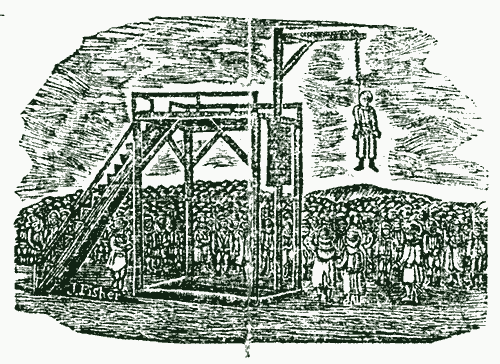


![Report of the committee on the pardon appeal of Ephraim Wheeler, n.d. [February 5, 1806], Massachusetts Archives, Boston.](http://commonplacenew.wpengine.com/wp-content/uploads/2016/01/tales-2.gif)