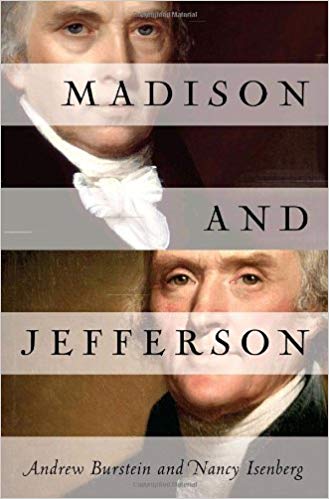
Andrew Burstein and Nancy Isenberg have written a monumental work, detailing the lives of two men—James Madison and Thomas Jefferson—whose careers are inextricably intertwined with one another and with the birth of the American Republic. Madison and Jefferson analyzes the separate experiences and achievements of both its subjects as well as the personal and political partnership the two maintained throughout their long and fruitful lives. Mildly revisionist, the book reminds readers that Madison and Jefferson were not the revered icons that history has too often made of them. They were politicians, flesh and blood men who fought to turn their vision of the new nation into a reality. Indeed, neither would have recognized themselves in the pages of either their most admiring hagiographers or their most vicious debunkers. Jefferson was not hailed as the author of the Declaration of Independence for decades. When he did begin to emphasize his authorship of the document, nearly a quarter of a century after he wrote it, he did so for political reasons. Madison was not, as most people—even historians—assume, the diminutive second fiddle to the eloquent Jefferson. Nor was he merely “the father of the Constitution” or the author of the “brilliant” Federalist papers. Indeed, he would often flee from the implications of both documents.
Burstein and Isenberg are determined to give Madison his due, to bring him out of the shadows where he has largely remained over the years.
We first meet Madison and Jefferson as provincial men on a provincial stage. They were both talented to be sure—but at the time they seemed to be no more talented than many of their friends and neighbors. They were “prominent but not heralded” (6). After all, Virginia had more than its share of bright and ambitious men who would lend their pens, their tongues, and occasionally their bodies, to the cause of American independence.
We encounter them, as well, before they knew each other. Even when they finally did meet, when Jefferson was governor of Virginia and Madison was one of his most influential advisors, neither “could have predicted that their intimacy … would have long-lasting implications” (63). Still, from the beginning, the two worked well together. Both were thinkers; both were practical politicians. If Jefferson was more inclined to abstractions, he was also a shrewd political animal. If Madison was more inclined to search for practical solutions to practical problems without trying to fit those solutions into a pre-conceived category, he was as much a child of the Enlightenment as Jefferson.
Burstein and Isenberg are determined to give Madison his due, to bring him out of the shadows where he has largely remained over the years. They point out that as late as 1789 Madison had a greater national reputation than Jefferson, and until 1800, Madison, not Jefferson, was at the center of national politics, a “one man political force” and the leader of the opposition to the Federalist agenda (291). It was Madison who talked Jefferson out of retirement in 1800. Often as not, Madison acted as Jefferson’s “campaign manager” (350) and his “handler” (319). Even after Jefferson’s death, Madison continued to shape his friend’s legacy, somewhat disingenuously claiming, for instance, that Jefferson would have abhorred John C. Calhoun’s “nullification” policy and that the Kentucky Resolutions were designed to keep the union together rather than to destroy it.
Nevertheless, the authors concede that even in these two men’s own lifetimes, Jefferson seemed to attract more attention, more personal loyalty, and more enemies than Madison. Early on in Madison’s presidency, most observers assumed that “the retired president was still calling the shots.” They did not seem to recognize that “Madison scripted Jefferson’s political ascendancy in the 1780s and 1790s.” But they did know that it was Jefferson who operated on a grander scale. It was he, more than Madison, “who conceived and built the Virginia Dynasty of presidents” (478).
Madison and Jefferson is a big—but never tedious—book, chock full of fascinating insights. While it is impossible to do justice to its authors’ mastery of the details, a few points stand out. Especially important is the commitment that both men shared to their native state; they always “acted out of an attachment to Virginia as much as a desire to defend the Union” (620). If both men eventually played their role on a national stage, neither shed the provincialism they had imbibed in their youth. Indeed, the entire book seems to call into question any notion that the “united” States existed at this time. Jefferson, in particular, found that his “Virginia interest prevailed over the unifying interest” (371). But Madison also saw national affairs through a provincial lens. He attended the Constitutional Convention “as a Virginia partisan” and his arguments there and for the rest of his life never strayed far from a perspective that Virginians would find acceptable (165).
If Madison and Jefferson were both loyal to the land of their birth, they were also zealous proponents of American empire. They saw westward expansion as essential to national greatness, and as a way to fend off British meddling in American affairs. Above all, they saw it as a way to extend and reflect Virginia’s interests and character, as they acted upon their “southern-directed lust for land” (442). Theirs would be a nation whose power and material well-being rested on an agrarian culture. It would, moreover, be a slave-based society. The Louisiana Purchase was obviously a central component of the Jefferson-Madison vision. But their ambitions were much more far flung. Jefferson championed a “manly” defense of American honor in Tripoli. Both men set their eyes, not only on Canada and Louisiana, but on Cuba and the Floridas. Clearly, “manifest destiny” was not a product of the mid-nineteenth century.
Finally, Burstein and Isenberg do a fine job of tracing Jefferson and Madison’s changing views of the Constitution. Neither—but especially Jefferson—was quite comfortable with the Constitution and thus neither was a proponent of “original intent.” Far from being the document’s author, Madison left Philadelphia as a “frustrated composer whose grand symphony has been left unfinished” (150). And he, more than Jefferson, constantly altered his interpretation of the Constitution. Both men’s views were hardened by their opposition to Alexander Hamilton. Indeed, Hamilton’s views moved the two closer together, making their own differences seem less important. Their distrust of England and their sense that the Treasury Secretary was creating an economy based on the British model, serving the interests of bankers and merchants, fed their fears. Moreover, they were convinced that Hamilton was tipping the balance of power toward an executive whose influence might lead to the creation of an American monarchy.
The value of this book is obvious. Its lucid prose will be easy for the non-specialist to appreciate, yet it has plenty to attract professional historians. Its command of the intricacies of the new nation’s economy and its foreign policy is formidable. Organized as a straightforward, chronological narrative, it often hops from one subject to another and back again. In the middle of an analysis of the challenges Madison faced as a war time president, for instance, comes a seemingly unrelated discussion of Jefferson’s and Madison’s views on race. And then we return to a discussion of the war (532-536).
But while it is occasionally disconcerting, this approach helps readers see events unfold as Madison and Jefferson might have experienced them. These men were living in the moment; they were wrestling with a wide array of practical issues that arose on a daily basis. Although their response to those issues might be shaped by an overall perspective, in the real world they had to deal with problems as they happened. This book discusses the past as people actually encountered it, reminding us that for contemporaries, the world appeared to be little more than a series of contingencies.
Some readers will be disappointed by the short shrift this book gives to Jefferson’s relationship with Sally Hemings. We actually hear more about Maria Cosway than we do about Hemings. This omission is due in part to the fact that the book is completely source-driven, and for obvious reasons Jefferson did not discuss his relationship with his slave. Moreover, Winthrop Jordan and Annette Gordon-Reed have already provided brilliant analyses of Jefferson’s relationship with Hemings. Still, the authors’ astute observations about Jefferson’s views of race and gender do beg for some analysis, or at least an acknowledgement of the contradictions with which Jefferson lived.
Generally speaking, Burstein and Isenberg are remarkably even-handed, striving not to favor one man over the other. Still, it is hard to shake the feeling that Madison often emerges as the better of the two men, the more sympathetic, the more open minded, especially where matters of race are an issue. On occasion, the authors appear to adopt the prejudices of their own subjects. Thus, Hamilton was a self-aggrandizing meddler who was not a “team player” and “did not understand boundaries” (267). Patrick Henry was a “militant” and a “sensation-causing oracle” whose intellect was superficial at best (15).
This is a book about two men—at times it seems as though these are parallel biographies of men whose lives periodically intersected. It is also a “life and times” book, and on more than one occasion the “lives” seem to take a back seat to the “times.” Above all, it is the story of a partnership, one that stood the test of time, one that both Jefferson and Madison deeply valued. Neither man, Burstein and Isenberg argue, would have been the same without the other.
Of Food and Space
This book has many virtues. A chronological look at the architectural implications of food preparation and consumption in America from the seventeenth century to the present, it draws on an extensive secondary literature to tell the history of what the author calls the “food axis” in America. This term embraces the spaces beyond the household kitchen—including dining rooms, patios, orchards, summer kitchens, milkhouses and smoke houses—that were used in provisioning the household. Understanding the kitchen as but one part of a larger, spatial food system is an important aspect of the book’s ambition and achievement. It is a building-type study with a difference.
The author intends to remediate the “conventional history of residential architecture” with its emphasis on grand structures and moments of origin by focusing on one aspect of the plan and by interjecting greater attention to issues such as gender, class, and linguistic terminology, and by using information on more modest structures and “downstream” histories of adapted structures.
The secondary literature the author favors is that written by the members of the Vernacular Architectural Forum, a respected sub-group of architectural historians who focus on the built environment in North America and who are particularly enthusiastic about hands-on diligent study of extant pre-modern structures. Cromley’s book draws together aspects of the fieldwork and archival research of these scholars to create a narrative about the architectural facets of food use over the past four centuries in parts of what is now the United States, an important and useful project.
Written in straightforward prose, The Food Axis is neither jargoned nor poetic. It reads very much like a collection of lectures to undergraduates, and I anticipate that that will be the book’s primary audience. It is, above all, descriptive. One thing happens after another; the evidence proffered takes the form of small vignettes of individual houses at the particularized level of the plan.
The author intends to remediate the “conventional history of residential architecture” with its emphasis on grand structures and moments of origin by focusing on one aspect of the plan and by interjecting greater attention to issues such as gender, class, and linguistic terminology, and by using information on more modest structures and “downstream” histories of adapted structures (5). The “conventional history” of domestic space invoked here is a rather artificial straw man, or perhaps a remembered one of the generation of our grandfathers. Certainly it is difficult to think of a recently published target for her critique and correction. That being said, it is also true that no recent work specifically addresses the spaces associated with food, and in this, The Food Axis is original in concept and execution.
The Food Axis describes multiple homes drawn from studies of mostly East Coast structures. The thesis that threads through the book is straightforward: in the seventeenth century, food production, preparation, and consumption was informal, taking place in multi-function spaces; in the eighteenth century, more specialization occurs, with the advent of “refinement” or “gentility” (92); in the nineteenth century, more formality occurs; in the early twentieth century, efficiency occurs; and in the late twentieth century, salutary informality reemerges. There is nothing surprising about this overarching argument. The author presumes that function is the key element in the food axis, that form (as in the plan) is its most visible expression, and that foodways express social relations and technological developments in a direct manner. Similarly the motives for human action are straightforward (for instance, “to impress guests” [42]). Because of these presumptions about function and motivation, we particularly miss the kinds of multi-dimensional thinking that occur in the paradigm-breaking article by folklorist Robert St. George, “To Set Thine House in Order,” from the exhibition catalogue, New England Begins, and in the work of anthropologists who attend to food, especially Mary Douglas. For these scholars, foodways and food spaces express complicated and interesting cultural presumptions about important non-food issues. Similarly, The Food Axis does not give us the rich material-based social history we find concerning the history of textiles in America in historian Laurel Thatcher Ulrich’s Age of Homespun, for instance, a perspective that would pique the interest of historians in this dimension of material culture. For undergraduates in architectural history, however, the overall message of change from informal (simple) to formal (complex) to informal (simple with the help of complex technology) is probably a useful armature. Many scholars reading for themselves, however, will hope for something more. As one might expect from such an overall argument, the conclusions of each chapter and of the book as a whole are very terse.
In a few instances, smart broad statements draw us out of the microcosm-sequence of the developmental argument. For instance, the author remarks, “The smaller the house, the larger percent of interior space an interior kitchen occupied” (54). This point is not pursued here but it may prompt others to test and expand on this provocative observation in terms of various social classes in various eras.
The sixth chapter, which brings the study up to the present, seems much more informal than its predecessors. Drawn in a rather ad hoc way from popular culture sources, this chapter is much less fieldwork- and archive-based than the earlier chapters that consolidate studies of other architectural historians. This is not to say this chapter is less authoritative, just that it is based more on the prescriptive-descriptive world of journalism than the others. It therefore seems to present the middle class (and middle class aspirations) as normative.
Overall, this is a solid book, one that tells a narrative not easily found elsewhere. The Food Axis is both an innovative departure in the field of architectural history and a timely offering in the growing academic field of food studies.
Experiments with God
Once upon a time, we used to be religious. We existed within a world intentionally created and remotely ruled by a God shrouded in mystery. However concealed, divinity dictated the terms of a human experience wholly realized within a religious plot of being. We lived for the God who imparted our creation, and approached that creation as a representation of divine agency we could only ever partially hope to understand.
And then, as this story goes and for reasons the story has struggled to tell, we woke up—we grew up, according to Kant. The world of God and religion became the playthings of modernity’s immaturity, discarded with the ruthless finality of a bicycle’s training wheels. The West became consumed with its own inventions: bourgeois subjectivity; public democracy; a reasonable world; knowledge gained by experience rather than by revelation. Et cetera. It was a heady time, that Enlightenment. Religion retreated into the enclaves of modern irrelevance: the increasingly empty meeting-houses; the terrains of the desperate and dispossessed; the private and often feminine spaces of contemplation. The modern West no longer needed to argue with religion, so much as simply ignore it. God himself became an object of human academic inquiry and so, rather distressingly, another opportunity for the production of irrelevance.
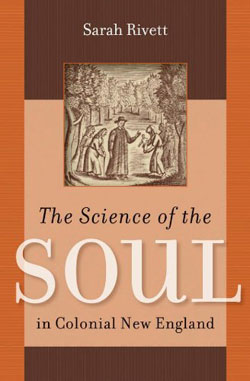
Sarah Rivett, The Science of the Soul in Colonial New England. Chapel Hill, N.C.: Omohundro Institute for the UNC Press, 2011. 348 pp., $45.
In more recent times, the “God debate” seems to have returned in the form of increasingly shrill and disrespectful bromides perched atop bestseller lists or shouted into radio phone-in shows. What links many of these efforts is a commitment to embattlement: both pro- and anti-God forces claim their real or impending victimization at the hands of the other as a motivating and even legitimizing cause. Whatever else might be said about all of this, we might all agree that the debate depends on the secularization narrative remaining largely intact, even if only as caricature. The “Pro-God” forces need secularism to have been a success in order to claim the trauma of religion’s dispossession. The “Pro-Secular” forces depend on secularism’s triumph in order to maintain a hard line against the continued fabrications on behalf of the God-artefact.
Whether or not Americanists ever really ignored the religious dimensions of American culture is a debatable question. It is probably fair to say that many academic studies, including some of the more famous ones, have assumed some version of the secularization narrative as a point of departure, if not a specific methodological vista. Perry Miller’s jeremiad told a story of religion’s “decline” no less secular than Sacvan Bercovitch’s revision to the errand, in which a theology of a pre-modern settler culture became a rhetoric of the bourgeois nation. If a decade ago some folks were wondering why we had stopped taking religion seriously as a legitimate academic topic, today many are taking religion seriously enough to be willing to tip one of the sacred cows of Enlightenment modernity itself: that cow being, of course, secularism’s sense of its total victory.
In her first book, The Science of the Soul in Colonial New England, Sarah Rivett tips something like a herd, and does so with a confident modesty I found almost as compelling as the close argumentation that characterizes this book as a whole. Her study “shows that the story of the Fall is integral to Puritanism and the new science alike and that it in fact generated a continuing of shared methods and goals between the two” (3). A bit later, her always accessible and relaxed prose refines this idea further: “Protestantism and natural philosophy did not simply go from a relationship of compatibility to one of opposition with different epistemological goals. Rather, their modern versions emerged through an intricate process of borrowing and differentiating one from the other…” (11). Because both religion and the new science depended on the idea that “certainty is a condition of human knowledge” (22), claims of epistemic breaks and radical disarticulations of religious from secularist discourse require modification.
Another way to put this is to say that The Science of the Soul demonstrates some of the ways by which the condition of ignorance secures the pursuit of both spiritual fulfillment and worldly knowledge. The discourse of “science” we associate with the modern episteme emerged in relation to a discourse of “spirit” we locate in the early modern past. Rivett invites us to consider what she calls a “spiritual science for discerning, authenticating, collecting and recording invisible knowledge of God as it becomes manifest in the human soul” (5). At the heart of this study, so to speak, is science. The experimental methods of Francis Bacon and Robert Boyle become the new helpmates of “knowledge revealed by God” (30), as an emerging dialectic of faith and sensation together produced the credibility of the modern soul. “Ministers and members of the elect,” Rivett offers, “acted as curators of experiments of grace, imposing uniformity on the conversion experience through the regulatory frame borrowed from the empirical science increasingly standardized by the Royal Society and the broader suffusion of the Baconian method” (31). Ignorance, to put it differently, becomes the problem shared by religious and scientific method just as certainly as doubt serves as the foundation for assessing both religious and scientific knowledge claims, be they states of grace or states of electricity.
In considering the Salem witch trials as an outbreak of the “radical enlightenment,” Rivett observes that the trials exemplified an Enlightenment struggle between “those who wished to eliminate the epistemological relevance of the devil and those who wished to make the devil more epistemologically relevant.” In doing so, she shows that what links these two projects is a “mutual struggle to reconcile the condition of unknowable knowledge” (239). Kant’s sublime, that point at which human understanding reaches by recognizing its limits, starts to sound a little bit like Mather’s confessing witches, whose recognition of the limits of representational credibility becomes foundational to both legal and religious testimonial regimes. The cultural politics of religion enter into the book’s ambit as well, as Rivett presents a startling analysis of ethnographical and funereal texts, arguing that in the wake of the new experimentalism, “the words of dying Indians and the prayer closet devotions of little damsels were rapidly coming to replace the congregational membership testimony as a primary site of empirical investigation into the invisible world” (178). The history of new world settlement weaves itself into this book’s revision to the secularization narrative, as Rivett observes a “remarkable early modern convergence between theology and natural philosophy that taught Baconians and Calvinists alike to seek new locales and new experiences to expand the scope of experimental discovery” (122). Such deft joining of intellectual, religious, colonial, and settler history is only one of many examples of the conceptual dexterity that characterizes this study as a whole.
After sketching the broad terms of her argument in an introductory chapter, Rivett turns to a rich discussion of Calvin and Francis Bacon, arguing that “experimental religion and experimental philosophy” (28) together produced a new testimonial ethic that sought to probe and make sensible the affairs of the visible world. Chapter two considers the gendered contours of an emergent soul science, arguing that the new “scientific techniques of discernment … engendered a new form of social invisibility that comes across in the testimonial records as a gender inflicted form of religious affect” (74). A chapter on “Praying Towns” finds that the “new philosophical standards of knowledge and testimonial reliability” made possible a new ethnology of grace in “subordinate human populations” (170). Chapter four concerns itself with the deathbed testimonial, an increasingly populist vernacular space of confession and analysis that both affirmed and challenged clerical authority over the public meaning of death. A fifth chapter turns to the familiar terrains of Salem witchcraft, which she describes as something of a misapplication of soul science that might “threaten the existence of God” (227) rather than augment a rational understanding of him. A final substantive chapter adds a “particular New England history of soul science” to the well-known historiography of transatlantic evangelicism, arguing that an “Evangelical Enlightenment” (277) emerges from this conjoinment.
Although this is mostly a seventeenth-century study of matters more or less familiar and specific to early American studies, The Science of the Soul makes claims that extend beyond the terrains most readers of Common-place claim as “ours.” Rivett is interested in and makes interest of a seventeenth-century notion like “holy empiricism,” a concept we are perhaps more familiar with in the context of Jonathan Edwards, but which the Science of the Soul locates in the conjoinment of “the enigma of grace and Baconian procedures of the natural science such that a holy empiricism of sorts became a hallmark of Puritan practices of faith” (128). We need no longer wait until Edwards points out a divinely supernatural light to see how the Enlightenment can be discerned in productive rather than combative relation to religion, which is to say we need no longer surrender to the fulsome demands of a historically and philosophically disarticulated Enlightenment modernity. By the eighteenth century, “[e]nlightenment rationalism,” Rivett observes in a characteristically confident and erudite moment, “blended more seamlessly with Calvinism than in years past, restructuring the anxiety produced by the unknowable soul into increased confidence in the rational order of the universe and the human place within that order” (274). Rivett’s blurring of these distinctions may be unsettling to those who prefer the epistemic comforts of the secularization narrative to the foggy uncertainties of that narrative’s revision. The Science of the Soul is a demanding book that is an example of the complexities it studies so well.
This article originally appeared in issue 12.4 (July, 2012).
Bryce Traister is an associate professor of English at Western University in London, Canada. He has completed work on a draft manuscript on the role of female piety in the production of seventeenth-century American Puritanism.
Deist Holy War?
I wanted to like this book. I really did. But Jortner lost me pretty early on. The premise appeared promising. He would show how two religious cultures—Indian nativism and Anglo-American deism—clashed and led to the dramatic battle at Tippecanoe, where the nativist Shawnee Prophet (Tenskwatawa) and his brother Tecumseh faced off against deist William Henry Harrison, who later became our nation’s oldest (until Reagan) and shortest-serving president. My initial misgivings—prompted by the “holy war” in the title—soon grew into more serious reservations.
The Gods of Prophetstown promises an important scholarly contribution: Jortner challenges the reader to un-know what she already knows, for, he suggests, the United States’ victory over Indian peoples was not a foregone conclusion (10). It is a perfect opportunity to build on the excellent scholarship of recent decades with new primary research woven together into a sensitive dual biography that explores the intersection of religion, politics, and race. Unfortunately, what we are left with instead are caricatures. The problems fall into several categories: conceptual, tonal, and factual, all of which might have been resolved with a bit more care in the revision process.
Adam Jortner, The Gods of Prophetstown: The Battle of Tippecanoe and the Holy War for the American Frontier. New York: Oxford University Press, 2012. 320 pp., $27.95.
Pairing Tenskwatawa and Harrison is a potentially brilliant—and extremely challenging—comparison to make as the men and the relevant sources are like apples and oranges. Part of the problem may simply be that Harrison does not make a very colorful subject for a biography. And the Shawnee Prophet, like all prophets, poses distinct challenges to a biographer—if anything, he is too colorful. Jortner implies provocatively that the two men, and their gods, met at the battle of Tippecanoe, “for it was the gods, as well as the people, of Prophetstown who created the American frontier, in all its terror and glory” (13). This sentence, like too many others, is designed more to shock than to explain. With some deft theorizing and careful laying of the groundwork, this odd coupling could yield new analytical insights. The comparison would have been much easier, perhaps, had Harrison represented evangelical, rather than rationalist, religion, and then Harrison’s expansionist impulses might be more readily cast as a holy war. That is not to say there is no relationship between American expansionism and religion, but Harrison’s actions appear to have been rationalized by the cool calculus of conquest rather than fueled by a fervent desire to fulfill God’s direct command. Perhaps the difference doesn’t matter, but I would like to see Jortner theorize holy war more thoroughly to justify what seems to be an expansion of the term beyond its common usage.
To do this, Jortner needs a clearer presentation of Harrison’s religion, and on this, the sources seem to be quite thin, leaving him to fill in the gaps in often strange and unpersuasive ways. Jortner’s claim of a holy war rests mostly on the idea that Harrison believed in a deist Providence that guided American expansion across the continent. Yet in explicating this understanding of Providence, he draws on New England Congregational divines like Thomas Prince, hardly a deist. Jortner misinterprets a 1727 sermon on earthquakes by Prince to be saying that “nature ran on its own,” when in fact he believed, as most Puritans did, that God was a pre-eminent micro-manager. Similarly, he misreads Boston minister Jacob Cushing as affirming the deist view of Providence (43). In the same sermon quoted by Jortner, Cushing preached in 1778: “God is the sovereign of the world, and disposes all things in the best manner. All blessings and calamities, of a public nature, and the revolutions of kingdoms and states, are to be viewed as under the special direction of heaven.” This is hardly the watchmaker God. Jortner later undermines his own reasoning when he notes that New Englanders were less eager for war in 1811, because “the deist strain of Christianity had foundered against longstanding Congregationalist piety” (207).
The confusion continues in Jortner’s final analysis of the religious significance of the war when he argues that the conflict cleared the way for the rise of evangelical religion and the Second Great Awakening. He writes that “if the War of 1812 can be read as a struggle between the clockmaker god and the Master of Life, then both may have become too exhausted by the fighting to establish their empire. A new religion took their place” (224). Again, he’s misrepresenting the deist God, and over-simplifying a tremendously complex religious landscape as if it were a chess board.
Jortner further sacrifices the utility of the comparison of Tenskwatawa and Harrison by choosing to see their respective religions through different academic lenses, thus resorting to the same sort of dualistic thinking that he so condemns in Harrison and his ilk. But now the tables are turned, and Tenskwatawa is a priest of the true religion, and white Americans are so many deluded idolaters. Jortner wants to atone for past ills against Indian religions, and this leads him to warn his readers that accepting naturalistic explanations for the eclipse of 1806 (rather than Tenskwatawa’s supernatural intervention) “implies that Native American belief systems were merely the trickery and superstition that men such as Harrison assumed them to be” (9). One could easily take an intermediate position to emphasize that the Prophet and his followers believed he blocked the sun and that that belief had real consequences, while remaining agnostic about the reality of Tenskwatawa’s powers. Jortner briefly embraces this possibility, but it seems to get trampled under his desire to give real agency to “the gods of Prophetstown.” Jortner’s position that Indian religions are authentic and noble while white religion can only be self-interested leads him to some strange places: the Prophet’s witch-hunts become a necessary purging of heretics, which were “remarkably successful” at dismantling “tribal divisions and craft[ing] a new basis for pan-Indian resistance” (118). He then backs away from this endorsement by cataloging equally strange or repulsive religious ideas—like vampirism—that flourished among white communities at the same time, as if to excuse the Prophet’s actions because white Christians were doing some crazy stuff too (112-15).
I am not trying to suggest that Harrison was morally unimpeachable or that his expansionist views ought to be defended—far from it. However, for a convincing biography, I’d like to see greater effort to understand him as a living, breathing human being, which means I’d like some explanation for or insight into his moral turpitude. Unfortunately, there are too many moments that resemble character assassination more than character analysis, as when Jortner posits: “perhaps to take his mind off his frustrations with the Prophet, Harrison redoubled his efforts to root out traitors among the whites and extinguish freedom among the blacks” (141). I don’t question Jortner’s claims about “extinguishing freedom,” but I imagine these things were done for deeper reasons than simply to distract himself.
If Jortner’s point is to regain the contingency, and peel away the sense of inevitability of American expansion, he leaves the reader with no real explanation for the course of events. If, as he says, the Prophet was divinely inspired and capable of miracles, and a masterful diplomat who led his united followers in a noble cause, while Harrison and other Americans were bumbling and inept, why then did the United States prevail? One is left to conclude that perhaps there was a certain demographic inevitability to American conquest. Jortner gives scant attention to the native peoples behind (and opposed to) the Prophet, focusing exclusively on Tenskwatawa as a powerful, charismatic, divinely inspired revolutionary. Jortner is thus at a loss to explain the failure of the movement, opposition to the movement by other native peoples, dissent within the movement, or troubling aspects of the Prophet’s program such as shutting down the women’s councils or conducting witch hunts.
A host of unnecessary asides and jarring descriptions often turn the text into a polemic, thus undermining Jortner’s analysis. For example, he suggests that Johannes Gutenberg’s moveable type press was “a small improvement on a Chinese technology” (19). While it may or may not have been, such a statement has little relevance here. Other passages seem more for effect than analysis, like his claim that western movement depended on extinguishing Indian titles, “a task at which the early American government was proving singularly incompetent” (48); in fact, the government proved devastatingly competent at this task, through multiple means. The dualistic portrayal of Indians and whites pervades the book, in subtle and not so subtle ways. While phrases like “worked assiduously” (193), “offered a diplomatic masterstroke” (138), and “eloquent and memorable speeches” (183) describe Tenskwatawa, Harrison and his associates are “ham-handed” (138) “apparatchiks” (88), and “saber-rattlers” (153), who were “a little slow on the uptake” (158) and who “dithered” (62), “wangled” (84), “vented his spleen” (184). Such language serves only to undermine Jortner’s more substantive and defensible claims.
I suspect The Gods of Prophetstown was rushed to production for the 200h anniversary of the famed Battle of Tippecanoe. A bit more time might have eliminated some of the simple factual errors. The ones I noticed relate to my own research, but it makes me wonder whether the problem is broader. For example, Jortner locates the 1782 massacre of Moravian Indians both wrongly at Gnadenhütten, Pennsylvania (47), and rightly at Gnadenhütten, Ohio (55). The Moravian mission and the Delaware village Woapicamikunk on the White River are alternately listed as being in Ohio (100, 107), on the shores of Lake Erie (112), and finally where they belong, in Indiana (118). Joshua, one of the Indians killed in the Prophet’s witch hunt, is described as “an enthusiastic young convert,” when in fact he was born and raised within a Mohican-Moravian community and was in his mid-sixties at the time of his death (110).
Jortner, I believe, would feel most comfortable taking up his battle position in the company of Francis Jennings, taking aim at the heroes of American exceptionalism and manifest destiny while attempting to restore the voice of the oppressed. But, at least in the academy, that battle has long been won. The better path to challenging defenders of American exceptionalism would be to humanize all players, rather than reversing the casting. Reflecting a newer wave of scholarship, Jortner could have done more to reveal the debates within the Indian and white communities behind Tenskwatawa and Harrison. Such a focus would effectively restore a sense of contingency and nuance to his portrait of a hugely complex religious, political, and racial landscape.
This article originally appeared in issue 12.4 (July, 2012).
Rachel Wheeler is associate professor of Religious Studies at Indiana University-Purdue University at Indianapolis and is Senior Fulbright Scholar in American Studies at the Universities of Mainz and Heidelberg during the 2011-12 year. She is the author of To Live upon Hope: Mohicans and Missionaries in the Eighteenth-Century Northeast (2008).
Our Capitalistic Founder
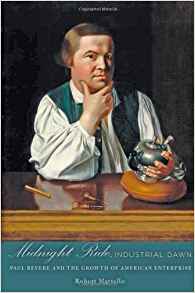
Paul Revere was the only major patriot who was also a founder—literally. He started a successful iron foundry in 1788, and remains the patriot most associated with industrial capitalism and free enterprise. Yet with one important exception, the midnight rider has been overlooked in the recent mania for the founders, an omission that Midnight Ride, Industrial Dawn seeks to remedy.
Robert Martello’s well-researched and interesting new study focuses on Revere’s business and technological practices, mostly eschewing his wartime experiences. His portrait of Revere nicely harmonizes with the one drawn by David Hackett Fischer in his classic Paul Revere’s Ride, a book that Martello almost entirely ignores. Still, despite his focus on Revere’s post-Revolutionary business ventures, Martello could easily have begun his book just as Fischer did with the Texas adage describing Paul Revere as “the yankee who had to go for help.”
Revere, like European proto-industrialists, represents a transitional phase between the world of the artisan and industrial capitalism.
Fischer used this epigram to emphasize that Revere was not a lone ranger by any stretch of the imagination, but was instead just one important part of a large community of patriots. Martello makes a parallel argument about Revere the entrepreneur, placing him within an “allied network of innovators, politicians, and influential people who worked together to pool their expertise and solve common problems” (62).
The first third of this book, dealing with Revere’s early life and career, drags a bit. Based mostly on secondary sources, it covers well worn ground. Like Fischer, Martello focuses on Revere’s status anxieties as a successful artisan craving acceptance from upper class merchant founding fathers and on his uncanny ability to forge personal connections that contributed to his wartime and business successes.
Martello’s account really comes alive when he begins relying more heavily on the extensive Revere Family Papers for the period beginning around 1790. Despite never achieving the level of social respectability he longed for, Revere became very rich as a bell and cannon founder and the first American to produce copper sheeting for ships during his post-war career.
Martello uses the concept of proto-industrialization as his theoretical framework for discussing Revere’s career, arguing that Revere, like European proto-industrialists, represents a transitional phase between the world of the artisan and industrial capitalism. However, this is proto-industrialism with a twist. Martello argues that American proto-industrialism occurred not in agricultural settings (as in Europe) but within the “early manufacturing community” (8), which included artisans, capitalists, hewers of raw materials, consumers, and government officials. As Martello examines Revere’s career, he focuses on changes in capital production, technology, labor, and the environment.
As an artisan, Revere never had the sort of access to capital that was available to early manufacturers who came from more mercantile backgrounds. His solution was to use the social capital he built up during the war years to secure government contracts. It is astounding how Revere was able to capitalize on his connections throughout his career by landing government contracts for cannon and copper sheeting, procuring a loan from the naval department to help him develop his copper rolling mill, convincing government officials to help him collect used copper, and pushing (unsuccessfully) for tariff protection. Indeed, while Revere may well be a founding father of modern capitalism, some free enterprise promoters would, no doubt, be troubled by such frequent reliance on government largesse.
Revere also adopted modern techniques and technologies, everything from double-entry bookkeeping to mechanical copper rolling, although he never quite attained the industrialists’ goal of full standardization. In the case of copper rolling, he became a bold technological pirate who sent his son to England to memorize the state-of-the art equipment employed there. Usually, though, Revere’s activities were less dramatic. He was a supreme networker who shared ideas with a broad circle of techies, ranging from fellow manufacturers to government officials to important scientists. Martello suggests that his connections with one such British scientist helped to feed his continual desire for social status. This propensity to share information resembles the behavior of machinists recently described by David R. Meyer in Networked Machinists and, as Martello points out, it seems far removed from Revere’s artisan heritage in which practitioners sought to protect the secrets and mystery of their craft.
Revere’s use of labor clearly fit the proto-industrial framework. Having moved away from the formal apprenticeships and journeyman labor of the artisan shop, Revere’s operation nevertheless remained relatively small scale (with perhaps 10 to 20 employees at most) and workers maintained close personal ties to their boss. Martello’s discussion of the environmental effects of Revere’s business is suggestive, if a bit thin, focusing on riparian disputes and on fuel procurement. He concludes that Revere “increasingly acted in a capitalist-industrialist manner, treating the environment as a commodity and limitation” (151).
For all its divergences from traditional accounts of the founders, like most other founding father biographies, this one ultimately casts its subject in a heroic mold. Martello resists portraying Revere as a modern-day self-interested capitalist working his government connections for all they are worth, preferring to accept Revere’s more patriotic self image. Martello’s Revere saw himself as an industrial hero for bringing English copper rolling technology to America, fulfilling in that process his earlier ambitions to be venerated as a social leader. Revere “could accurately consider himself the founder of what we now call a national industry as others followed in his footsteps, sought his advice, built upon his achievements, and continued his work” (343).
While Martello occasionally intimates that Revere was typical of artisan-manufacturers of his age, he provides little evidence, and Revere’s remarkable career seems to belie such suggestions. Nevertheless, whether Revere was representative or sui generis in his technological adventurousness, his hard-headed business savvy, his gregarious social networking, and his knack for getting government support make for fascinating reading, and Martello’s account of Revere’s life is a welcome addition to the literature on American industry and on the founding fathers.
What we talk about when we talk about letters
“We Used to Wait,” the second single from Arcade Fire’s TheSuburbs (2010), begins like most of the songs on the record—with a lamentation. The speaker distills his experience of suburban or exurban disaffection into a considerably less abstract set of images: “I used to write / I used to write letters / I used to sign my name / I used to sleep at night / Before the flashing light settled deep in my brain.” The line between the better past and the bitter present registers as an epistolary problem: before, there were letters and signatures—markers of an active self recording its own presence, leaving material traces of social relations—now, without the writing of letters, there is only sleeplessness and impotence. The flashing light is imperial, too much for the speaker to handle: the space of the suburb (in all of its ideological complexity) has separated him from the life he had and the future he had imagined. As the song progresses, though, there’s a critical shift. In spite of the helplessness, the “wilderness downtown,” the structural impossibility of living in the post-modern age, the speaker finds defiance: “I’m gonna write / A letter to my true love / I’m gonna sign my name / Like a patient on a table / I wanna walk again / Gonna move through the pain.” Letter writing becomes the first stage of a larger awakening—the speaker’s recuperation of his will, of his sense that the external forces aligned against him (here rendered as injury or disease) may be countered effectively. As a concrete assertion of the self and its relations to others—the “I” and the “true love”—the logic of the letter works against the logic of social and cultural alienation.
Ultimately, [Dierks] argues that the production and circulation of letters become a way of articulating individual agency against a backdrop of massive social change.
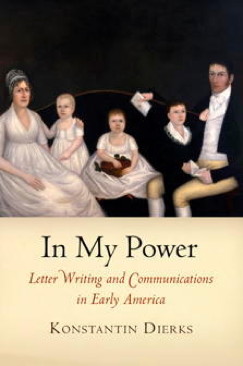
As it happens, this relationship between the letter and the empowered self that Arcade Fire describes has a long history. In his closely argued, deeply researched, and unfailingly engaging In My Power, Konstantin Dierks takes on the personal side of the burgeoning documentary culture of the seventeenth- and eighteenth-century anglophone Atlantic. Amassing and interpreting a remarkably broad archive of correspondence (by merchants and diplomats, housewives and frontiersmen, children and generals) Dierks finds in the material and rhetorical practices of letter writing new ways of understanding the relationship between Enlightenment-era Britons and the ideologies that structured their lives. Ultimately, he argues that the production and circulation of letters become a way of articulating individual agency against a backdrop of massive social change.
Dierks opens with the question of empire in the seventeenth century. At a moment in which instantaneous communication across long distances was unimaginable, letters form critical links between far-flung possessions and the metropole. From the colonies comes news of geographical exploration, territorial expansion, and intercultural relations; from the mother country come statements about governmental policy, commercial practice, and the disposition of resources. Even beyond the flows of information that such letters contain, Dierks argues, the mere fact that these pieces of marked paper could be conveyed over such long distances and through so many stages argued for imperial plausibility; without a communications infrastructure (including paper mills, post-roads, packet boats, and postmasters) and a steady flow of letters through it, the “fantastic leap of the imagination” (51) required to see diverse colonies as part of an integrating whole would have been impossible. In other words, letters and the cultural systems developed to produce and distribute them are critical to the consolidation and maintenance of Britain’s imperial ambitions. They are also signally important to the psychology of individual empire-builders—receiving and bearing letters from the imperial center, those on the expansionary front-lines are invested with the power of the mother country; receiving and bearing letters from the expansionary front-lines, those in the mother country are empowered by proofs of their ability to promote nationalist action at a distance.
This empowerment-by-letter works for mercantile concerns and migrating families as well. In his second, third, and fourth chapters, Dierks shows how letters construct business and social relations among the scattering peoples of the Atlantic world. For the merchant, letters contain critical data—about orders to place, prices to be asked and paid, new markets to consider, competitors to watch, and so forth—but also make reputations. Reliability and regularity in writing correlate neatly with trustworthiness in everything else: a good correspondent is a good man to do to business with. Dierks persuasively links this epistolary meritocracy with new ideas about the self; the routinization and standardization of business writing practice allows for an opening of the middle class—a route to material success for the modestly born. Manuals like Daniel Defoe’s The Complete English Tradesman (second ed., 1727) make the tricks of trade (including the composition of proper commercial correspondence) available even to those without prior connections; young men who might have previously been destined for localized manual labor could learn the adaptable and remunerative skills necessary for global business and earn something like an independence. With this potential for advancement, though, comes anxiety about failure. What Dierks calls the “fraught imperatives of personal agency” in a documentary culture—”the tasks of investment, discipline, internalization, duty, and complaisance” (143)—in turn help to explain what we have come to think of as the “consumer revolution” of the eighteenth century. The more fluid the class dynamic, the more important the purchase and deployment of the material trappings of comfort become—the rise of letter writing and the rise of conspicuous consumption go hand in hand.
Class mobility and geographic mobility, of course, are two sides of the same coin: with the expansion of territory and the expansion of commercial interests to serve (and exploit) that territory comes emigration and the fracturing of kin groups. Sons and daughters leave home to seek their fortunes, then write back with news—about health, about letters received and sent, about everyday affairs. Again, the actual content of the correspondence is less important than the system that supports and conveys it: as proof of continuing personal relationships and identifications (as a Briton, as a member of a family), the regular exchange of letters posits stability in an unstable world. (Arcade Fire registers this too: “It may seem strange / How we used to wait for letters to arrive / But what’s stranger still / Is how something so small can keep you alive.”) More than this: as Dierks puts it, letter writing was also a form of existential order-making; it allowed an expressive medium for “description, explanation, desire, and aspiration—every intangible realm of meaning that underlay the taking of goal-oriented action in the world, whether felling trees, harvesting crops, stitching shoes, selling fabrics, whipping a slave, or killing an ‘Indian.’ Letter-writing helped turn all those actions into a struggle to make meaning out of the confusion of circumstance and change, dislocation and determination” (115).
An essential part of the colonizing process, correspondence is also instrumental in empowering the anti-colonial resistance of the second half of the eighteenth century. In the American Revolution, Dierks argues, “[l]etters did not cause anything in a reductive sense, but they were part of everything” (191). For the pre-Revolutionary moment, that means the interception and publication of Loyalist communiqués, the formation of Committees of Correspondence (in charge of orchestrating anti-government protests across geographical space), the building of a pro-colonial postal system to carry their messages. After Lexington and Concord, “part of everything” indicates the importance of sustained efforts to disrupt the British military post and the building of elaborate systems of messengers and cut-outs to convey written orders from Washington to his commanders in the field. Dierks is also admirably attentive to those disempowered by revolution—loyalists, foot soldiers and their spouses—and to the ways that their own correspondence affirms some manner of personal control over and against the situations in which they found themselves.
The final chapter of In My Power takes the problem of disempowerment even further, comparing the “universalist” rhetoric of middle-class agency (in which success is open, “without social limit” [236], to anyone who can acquire certain standardized literacy skills) with the exclusionary realities of eighteenth-century America. It charts what Dierks calls an “epistolary divide” between the haves and have-nots: as “writing literacy and letter writing became a baseline skill for participating in a modern commercial economy,” those people who remain largely unlettered—whites of the lower sort, Indians, free and enslaved blacks—are deemed unfit for anything other than menial labor. This in turn “silently and effectively compromised what was understood as a rising political impulse to democracy” in the post-Revolutionary period; “[t]he formal structures of government may have been given the appearance of egalitarianism, but the informal mechanisms of governance remained fundamentally elitist” (237). Such marginalized people work to subvert and exploit these cultural assumptions whenever and wherever they can—literate slaves would forge travel passes, for example; Phillis Wheatley writes epistolary protest poems addressed to colonial officials—but the epistolary divide is an essential (and lasting) barrier to full citizenship. Put another way, the unstated corollary to white middle-class literary empowerment is a race- and class-based disempowerment; the “universalist” possibility of personal agency is in many ways a useful cover for an increasingly asymmetrical power dynamic in the culture.
With this acknowledgment of the ways in which the textually mediated fantasy of liberal subjectivity fails—or papers over socially unethical behavior—Dierks’s conclusion moves usefully beyond history into polemic. The book’s final rhetorical questions—”What…if evil comes not only from the logic of racism and violence, but also from myopia and foreclosure, a failure to recognize the power embedded in material structures and the divide entrenched in cultural imaginaries, and a failure to imagine any human connection across that divide?”—are both spot-on and utterly deserving of non-rhetorical answers. Not coincidentally, the end of “We Used to Wait” provides one response worth considering. The last lines perform the joy of collective, connective action; they move beyond the subject empowered by writing to conjure a subject empowered by an ecstatic merge with a democratic crowd. “We used to wait for [those letters to arrive] / Now we scream and sing the chorus again / We used to wait for it / Now we scream and sing the chorus again.” Screaming and singing together is certainly not enough to undo the problems of what Dierks calls the “dark side of history”—but it could well be a start.
For the Want of a Good Hat
At the heart of Commerce by a Frozen Sea is the beaver hat, which by the seventeenth century had become an essential part of European men’s fashion. With a high content of beaver “wool,” a wet hat would hold its shape. Wet or dry, it was stronger, warmer and more lightweight than its cloth counterpart. Initially, all beaver hats available on the European market were made from European beaver by Russian hatters who had created the complicated felting technique to separate the wool hair from the longer guard hairs on the pelt. When England and France finally developed their own hatters by the early seventeenth century, they relied heavily on North American beaver, which came initially in two types: parchment (sundried skins) and coat (which had been used as clothing by Indians for about a year before being traded). The latter was preferred by hatters since the normal wear process caused the guard hairs to fall out naturally, requiring less work to harvest the wool. When combined, parchment and coat beaver created a high-end hat. (Hudson Bay region beavers produced particularly exceptional pelts due to the subarctic winters.) The ensuing demand for beaver motivated both the French and the English to devote considerable resources to trading with Indians for the pelt.
Prior to the arrival of the Europeans, Indians had neither the tools nor the desire to overhunt beaver, which only served as a food source during times of hardship or feasts.
Economists Ann Carlos and Frank Lewis use this demand for beaver to examine trade between the Cree and Assiniboin Indians who resided in what is now Canada and Britain’s Hudson Bay Company (which covers much of present-day Manitoba, Saskatchewan, and Alberta). Focusing on the Hudson Bay region reveals a different fur trade than the one described by other scholars. As Carlos and Lewis observe, due to the “great distance involved, France, England, and Indian peoples in the Bay region interacted to a large extent outside the political forces that played out in the lower thirteen colonies and New France” (3). Because Indians were the sole purveyors of pelts in Hudson Bay, trading beaver for a host of consumer goods, Carlos and Lewis illuminate natives not just as producers but also as consumers.
The authors draw their evidence from the rich collection of letters, post journals, and account books between the post managers on the Hudson Bay and the firm’s head office in London. Post managers exchanged directly with Indians, set prices, and made copious notes on Indian consumption preferences of European goods which they reported in turn to London. Carlos and Lewis found ten to twenty types of furs provided by Indians and sixty to seventy types of consumer goods sold by the company in these records. Company employees worked from the “official standard,” which was the company price list with all goods valued by the region’s monetary unit: “made beaver.” This facilitated trade during the busy season and gave post employees a base value to work from. There was some leeway as company trading posts closer to French posts had to keep their prices competitive, although any deviation had to be explained to London in the post manager’s yearly report.
Like earlier scholars, including Calvin Martin (Keepers of the Game: Indian-Animal Relationships and the Fur Trade ) and Shepard Krech III (The Ecological Indian: Myth and History ), Carlos and Lewis ask why Indians, who were in sole control of the beaver population, chose to overhunt beaver despite the fact that this limited their access to consumer goods in the long run. Carlos and Lewis conclude that prior to the arrival of the Europeans, Indians had neither the tools (such as ice chisels and twine) nor the desire to overhunt beaver, which only served as a food source during times of hardship or feasts (the tail was a delicacy). But once they had access to luxury goods such as tobacco, beads, lace, jewelry and vermillion, the Indians took advantage of high fur prices to purchase these items, which raised their standard of living. This self-defeating desire to consume was one major reason for the decline in the beaver population.
Nonetheless, as long as there were beaver pelts to trade, Indians had a significant degree of leverage as consumers. With both France and England in the region, Indians could play the two powers off one another, and trade goods had to be satisfactory. Post managers tried with various levels of success to make officials in London understand what goods met Indian demands. For example, knives and guns turned brittle and broke in the subarctic climate if the metal was even slightly flawed. Post correspondence shows that Indians were so attuned to the quality of the metal goods they traded for, rather than what color the handles were, that London company officials eventually sent gunsmiths to the posts to repair faulty guns rather than shipping the broken ones back.
Consumer goods fell into distinct categories. “Guns were the highest-priced item,” report Carlos and Lewis, and “accounted for seventy to eighty percent of [Indian] expenditure on producer goods” (86). Household goods such as kettles, blankets, knives and awls accounted for ten percent (falling to just over five percent over the course of their study). Luxury goods, which Carson and Lewis divide into three categories, made up the rest: “tobacco and related goods; alcohol and related goods; and other luxuries, including beads, cloth, lace, jewelry, and vermillion among many others” (87). By far the most frequently purchased luxury item was tobacco, which Carlos and Lewis note has been grossly overlooked by other scholars. In contrast, the primary product Indians consumed was never alcohol. At the height of alcohol consumption, around 1760, Bay records show that Indians were still drinking far less than European colonists and Continentals: “at most four two-ounce drinks per person for the entire year” at a time when colonists were drinking 279 two-ounce drinks (93). As fur prices rose, household and producer goods remained steady but Indian purchases of luxury goods increased.
But the penchant for luxury goods cannot entirely explain the decline of the beaver population. Overhunting, Carlos and Lewis argue, was also a function of the fact that beaver were a “common-pool resource,” meaning that it was impossible to prevent others from trapping the beaver. Tribes did not control the beaver population. Moreover, in hard times, Indians would hunt the beaver for food because of their desire to feed those in need. Still, most ended up being traded to the Europeans, and between 1700 and 1763, 2.75 million beaver pelts were received at Hudson Bay Company posts alone—in addition to those received at other British colonial or French posts.
An examination of the consumer goods in Indian homes allows Carson and Lewis to compare Indian and European standards of living and consumption practices. Their findings are striking: “The commodities—beads, combs, magnifying glasses, looking glasses or mirrors, sashes, scissors, thimbles, and shoes—mirror the inventories of both European and colonial households” (105). The authors conclude that mid-eighteenth century Indians were materially equal to low-income English households, although their comparison shows that Indians had better diet and clothing than Europeans, but that Europeans had better housing (due in large part to its durability) and consumed more luxury goods, especially alcohol. In their behavior as consumers and laborers they were not that unlike industrious workers in Europe—ultimately enticed to work harder to purchase luxury goods.
The economic focus of this work is at once its greatest strength and greatest weakness. On the one hand, Commerce by a Frozen Sea allows us to see the fur trade in a new light with Indians as active and vocal consumers at its center. By making use of the company’s account books and extrapolating data based on those figures, it provides a detailed look at the fur trade that is absent from social and cultural views of the fur trade (such as Jennifer Brown’s Strangers in Blood: Fur Trade Company Families in Indian Country and Sylvia Van Kirk’s Many Tender Ties: Women in Fur Trade Society, 1670-1870). It provides new explanations for overhunting beaver which challenge the notion of Indians as better ecological managers than Europeans, and gives concrete figures to prove alcohol was not the dominant European good Indians consumed. The detailed look at the types of commodities and their values, and the comparisons to European households, make this a valuable resource as historians continue to make sense of this period. However, it is also truly an economic history, which can make for a cumbersome read. While the authors usually explain jargon, the many formulas and charts scattered throughout the chapters would probably daunt undergraduates. The lack of narrative tends to make the people disappear, which is odd given that this work is fundamentally about human agency. The authors are right that the isolation of the Hudson Bay region allows us to see Euro-Indian interaction in a way that is normally hidden by politics, violence and middlemen. However, such isolation also means that the Bay is likely the exception to the rule rather than representative of the fur trade as a whole. They leave it to the reader to do additional reading to compare the experiences in the Bay to posts elsewhere. However, since this work joins a rich literature on the fur trade, such a comparison is not difficult.
Speaking and Listening
The Marquis de Lafayette visited Lexington, Kentucky, in May 1825 as part of his triumphal tour of the United States, during which the American people expressed a massive outpouring of love and gratitude for the old hero and his sacrifices in the American Revolution. While in Lexington, Lafayette paid a visit to the Lafayette Female Academy, recently renamed in his honor, where a committee of the academy’s pupils greeted him in front of a large crowd. Mary McIntosh and Maria Brown Duncan each delivered an oration to the crowd and to Lafayette to welcome him on behalf of “Kentucky’s band of PATRIOT DAUGHTERS.” Brown Duncan assured the crowd that, even though young women were “incapacitated from engaging in the active concerns of the government,” they were more than able to perform the civic duty of paying tribute to the visiting hero. After the ceremony, the girls gave Lafayette beautifully hand-written copies of their speeches, which were later published as a pamphlet.
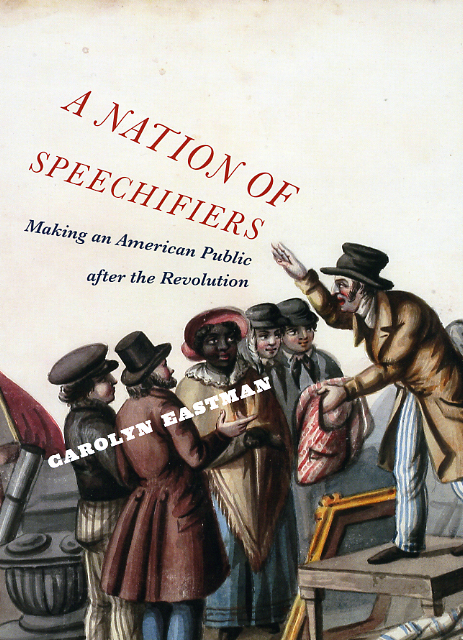
Eastman brings new attention to the role of oratory, and the interaction between speechmaking and print culture, in the building of the American public between the 1790s and the 1830s.
This extraordinary occasion highlights important points about oratory and speech-making in the late eighteenth and early nineteenth centuries. McIntosh and Brown Duncan were exceptional in being chosen to deliver speeches to the distinguished hero, Lafayette. But their speeches also followed in an established tradition of young women speaking at academic exhibitions in the early republic. The number of girls who spoke at public occasions was declining by the 1820s, but McIntosh and Brown Duncan’s presentations to Lafayette illustrate that his traveling companion, the British author Frances Wright, was certainly not the first woman to declaim publicly in the United States when she was attacked for her own controversial speaking tour in 1828 and 1829.
Carolyn Eastman underplays ceremonial occasions such as Lafayette’s tour in her new book, but her scholarship offers a number of thought-provoking insights that can help us to understand the importance of such oratory in the early republic. Recently, many scholars have probed how “the public” constituted itself in the United States in the decades following the Revolution by participating in festive culture, reading books and newspapers, commemorating the Revolutionary War, attending religious revivals, admiring portraits of esteemed leaders, and taking part in partisan political organizations and rituals. Eastman brings new attention to the role of oratory, and the interaction between speechmaking and print culture, in the building of the American public between the 1790s and the 1830s.
Eastman seeks to use the history of popular oratory to show how “nonelites” used speeches and print to include themselves in a collective public that defined American national identity in the early republic. She wants “to demonstrate the broad political import of speeches and writings by ordinary people within the context of constructing an American public,” by which she means not only the “public sphere” as defined by Jürgen Habermas, but also some more specific forms of collective self-understanding (5). Race, class, and especially gender play important roles in Eastman’s analysis of the ways that giving, listening to, and printing speeches helped people who were outside of power define themselves as part of “a public and eventually to identify as national citizens” (4).
Eastman takes a creative approach to her topic. In the first half of the book, she examines how elocutionary education underwent a shift toward more nationalistic themes after 1810; how the “rise and fall” of girls’ public oratory first created and then destroyed a possible female “counterpublic”; and how the frequent repetition of Indian speeches created nationalist, white identities in school children and helped to generate the trope of the “vanishing Indian” in American culture and politics. In the second half, Eastman examines case studies that she sets up as representative of important debates over definitions of “the public” in the early republic. She uncovers how print and oratory sometimes reinforced one another and sometimes clashed as she examines the magazine writings of the New York Calliopean Society, the speeches and publications of protesting journeymen printers, and the clashes between Frances Wright and newspaper publishers in the late 1820s.
Along the way, Eastman makes several significant points. Her examination of schoolbooks is thought-provoking, and she juxtaposes insights about school curricula with the contents of popular instructional speeches in a clever way to demonstrate how “during the second half of the early republic, oratory and print media reimagined the public order—evoking schoolchildren who uncritically admired their leaders, girls who embraced their domestic and nonpolitical roles, and Indians worthy primarily of pity” (111). The chapter on Frances Wright offers an extremely important corrective to historiography that claims Wright was a trailblazer because women were prohibited from speaking in public, especially to “mixed audiences,” before her 1820s speaking tour.
Eastman creatively shows how speaking, listening, publishing, and reading were intertwined, and her readers will come away with a new appreciation for the auditory dimensions of identity formation. While the majority of her evidence comes from the northeast, Eastman’s approach to analyzing oratory does offer a significant addition to the study of national identity. Many scholars have focused on speeches by famous Americans and their audiences, but Eastman provides the tools to think about those audiences giving speeches of their own.
Eastman argues that “rather than focusing on canonical texts or prominent authors, A Nation of Speechifiers examines a profusion of oratory and writing by nonelites and their active uses of the media” (5). Eastman does not do enough to convince the reader that the category of “nonelites” can apply equally to all of her subjects. Surely all students at girls academies were disenfranchised by their sex, but many came from resolutely wealthy “elite” families and would go on to exercise a large measure of societal influence. It is not clear what interests the middle-class clerks and businessmen who joined the Calliopean Society shared with the struggling journeymen printers—especially since the rising market economy offered each group opposing opportunities for upward mobility. Frances Wright positioned herself outside mainstream culture as a radical utopian reformer and female activist, but was she truly “nonelite?” Eastman never discusses Wright’s association with Lafayette, her visit to the U.S. Congress, or her discourse with many prominent authors and politicians. Eastman does helpfully point us to how all of her examined groups and individuals used oratory to position themselves, but she does not convince us that they necessarily shared a common or “nonelite” sense of identity.
Eastman’s book, and her claim that various groups used oratory and print to think of themselves as citizens, would be strengthened by more attention to how these groups interacted with elites, even if she wants to hold on to the idea that her subjects were all firmly outside that category themselves. More discussion of how printers’ speeches and toasts resonated with Jeffersonian themes or how girls’ speeches stood apart from politicians’ prescriptions for gendered behavior would probably strengthen Eastman’s claim for the importance of these group’s self-perceptions. The ceremony with the Lafayette Female Academy students and the Marquis de Lafayette was certainly not the only occasion when young women such as those studied by Eastman interacted with powerful men in real and symbolic ways that must have influenced their own sense of politics and citizenship.
Eastman offers her voice to the growing number of scholars who helpfully urge us to recognize how those who were outside of power helped to construct public culture and define the issues of the day during the early republic. But her work also reminds us that perhaps a history that includes both elites and “nonelites” will ultimately offer the fullest picture of “the public.” In the meantime, readers will happily finish Eastman’s book with a renewed appreciation for oratory in the early republic.
Measuring Literature: Digital Humanities, Behavioral Economics, and the Problem of Data in Thomas Piketty’s Capital in the Twenty-first Century
It was common in the enthusiastic reactions to the English translation of Thomas Piketty’s Capital in the Twenty-first Century to mention his use of literature. David Harvey thought Piketty “spiced up” his data about the history of income equality “with neat literary allusions to Jane Austen and Balzac.” Larry Summers notes that Capital is “littered with asides referencing Jane Austen and the works of Balzac.” Paul Krugman thrilled that Piketty’s book was “a work that melds grand historical sweep with painstaking data analysis,” asking, “When was the last time you heard an economist invoke Jane Austen and Balzac?” Stephen Marche argues that Piketty’s Capital could be “reasonably mistaken for a work of literary criticism” and imagined future economic historians using the “socialist realist novels” of 2008’s Great Recession in the same way that Piketty uses Austen and Balzac.
As a literary scholar, I think we need to reevaluate such enthusiasm about Piketty’s use of literature as data. In particular, I believe literary critics need to assess the consequences of the feeling, shared among these reviewers, that literature can provide facile and transparent access to the economic realities of the nineteenth century. In this essay, I challenge this assumption by examining the complex ways in which Piketty deploys literature to undergird his assertions about the economic past of Europe. Then, I demonstrate how Piketty’s use of literature, while considered and reflective, originates in the attitudes of behavioral economics, despite his concerted attempts to avoid it. Finally, I turn to the analysis of literary scholars who examine Piketty’s use of literature using the techniques of “big data.” Their techniques show how the use of literature in Piketty’s Capital points to more fundamental differences about what qualifies as evidence in cultural study.
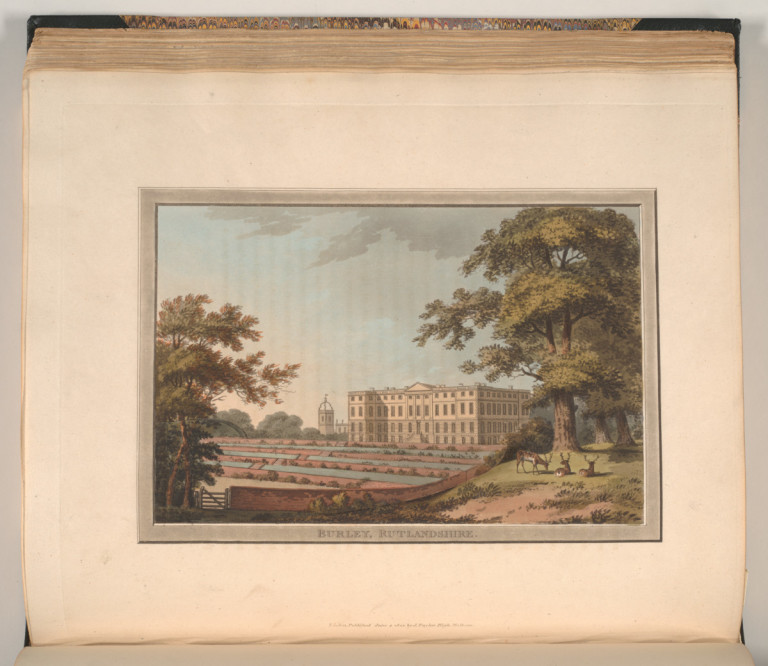
1. An engraving of Humphry Repton’s “Burley on the Hill” from Observations on the Theory and Practice of Landscape Gardening, including Some Remarks on Grecian and Gothic Architecture (London, 1803), p. 132. Repton was a successful landscape architect who used the country house at Burley as an example of how to preserve the natural gifts of scenery by compromising between “ancient and modern gardening, between art and nature.” Courtesy of Special Collections, D.H. Hill Library, North Carolina State University.
In Capital, Piketty uses literature in two ways that contrast quite strongly with those identified by his laudatory reviewers. First, he uses literary characters to personalize his arguments, making them more accessible to readers and portable for other criticism. He calls the insight that inheritance makes individuals richer than their income ever could “Vautrin’s Lesson.” He names the problem of inherited wealth dominating those who gain money from income “Rastignac’s Dilemma.” Both of these phrases draw on figures from the novels of Balzac and both of these literary episodes help structure Piketty’s book by serving as section titles. These titles reveal that some of Piketty’s thinking about historical economics originated in literature. He said in a 2014 interview that he initially became interested in questions of wealth accumulation by wondering whether Rastignac’s anxieties about becoming rich were widely shared in nineteenth-century France or were unique to Balzac who, Piketty notes, was “obsessed with his own debt.”
In addition to personalizing larger economic forces, Piketty uses literature to illustrate the effects of historical economic realities and, more controversially, he sometimes uses literary references themselves as the evidence for that empirical reality. For example, what Piketty calls the “classical patrimonial society” of late eighteenth-century and early nineteenth-century Europe is also named “the world of Balzac and Austen.” This world is typified by the sort of gentry country estate depicted in the works of the era’s most famous landscaper, architect Humphry Repton, and by the manners of its inhabitants, represented in the novels of Austen.
The contrast to these lavish country estates that Repton helped create and that Austen described was the impoverished nineteenth-century world of urban France often found in Balzac’s novels, whose moments are so frightening because, Piketty claims, they “[contain] such precise figures” itemizing its penury.
2. Frontispiece, Pride and Prejudice, by Jane Austen (London and New York, ca. 1890). Courtesy of the American Antiquarian Society, Worcester, Massachusetts. Austen’s novels provide Piketty with an example of what he describes as “classical patrimonial society” and the social manners of its country gentry.
Piketty is well aware of the difficulty of economists’ confidence that their specific models best represent economic realities. He offers that the “verisimilitude and evocative power” of novelists like Austen and Balzac is one “no statistical or theoretical analysis can match.” “Film and literature, nineteenth-century novels especially,” he enthuses, are “full of detailed information about the relative wealth and living standards of different social groups.” Because the “physical reality of inequality” also possesses a “fundamentally subjective and psychological dimension,” Piketty believes there will always be a value in the way art and literature capture income inequality. The artistic reveals otherwise rarefied econometrics and presents critical rhetorical strategies for popularizing the abstruse findings of economics.
The question that Piketty never resolves—perhaps cannot be expected to resolve—is the consequence of seeing literature not just as “verisimilitude” but also as “detailed information,” as potentially another form of those distribution tables and income indexes that make up his ample and publicly available datasets. He insists, for example, that among Austen, Balzac, and their readers, “money had the same meaning.” The shared meaning of money resulted from the stability of monetary values and the consistent wealth accumulation that occurred as nations used taxes to pay off the public debts to its creditors. “Hence,” Piketty writes, “it is no surprise that wealth is ubiquitous [omniprésent] in Jane Austen’s novels: traditional landlords were joined by unprecedented numbers of governmental bondholders.” Piketty immediately continues: “(These were the same people, if literary sources count as reliable historical sources).” (In the French, he writes this assertion as: “…en grande partie les mêmes personnes, si l’on en croit les récits littéraires comme les sources historiques…”)
The language of this parenthetical phrase explicitly considers whether literary sources “count” (“can be believed” or “can be trusted”) as reliable historical sources of economic data. Despite the seeming uncertainty introduced by Piketty’s language, his analysis seems to indicate that he believes that literature does count—in every sense of that term—as reliable information. He argues, for example, that Germinal or Oliver Twist “did not spring from the imaginations of their authors, any more than did the laws limiting child labor.” Instead, he seems to propose that they arose from historical circumstances for which their authors are a kind of conduit. Balzac may have been obsessed with his debt, but it was the economic realities that propelled his writing and created the shared understandings among Austen’s readers.
From one vantage, this is not an especially controversial way to read literature; for decades, literary critics have evaluated how empirical reality is differentially represented in imaginative writing. But Piketty’s confidence in the ways literature can capture the empirical realities of the economic past shares much with the ideologies of behavioral economists like Dan Ariely and Tyler Cowen, who explain life events as disparate as house purchases, poetry readings, and food selection as decisions of taste and preference reducible to quantifiable forces of supply, demand, and price.
The tendency to explain social phenomena through economic models and quantification is not new, arguably dating back to Gary Becker, an innovator in the field of the economics of human behavior. As Becker writes in his 1975 paper on money and marriage, economists can use “economic theory … to explain behavior outside of the monetary market sector, and increasing numbers of noneconomists have been following their examples.” Becker describes marriage, for example, as a “scarce resource” in a market economy. Such scarcity has consequences for social organization, reproduction, and population growth, leading him to conclude that the marriage market demonstrates “compelling additional evidence on the unifying power of economic analysis.” Personal and socio-cultural choices have underlying economic dynamics, Becker concludes, whether individuals are aware of it or not.
Michel Foucault recognized the gravity of this shift toward economic analysis as a “unifying power.” Foucault referred explicitly to Becker in his 1970s lectures at the Collège de France as an origin of neoliberalism. He noted that the economic human being described in Becker’s research “appears precisely as someone manageable, someone who responds systematically to systematic modifications artificially introduced” so that he is “the correlate of a governmentality.” (Becker humorously responded to Foucault’s critique in 2012, claiming he “like[d] most of it and did not disagree with much.”)
Becker’s sense that economic analysis can be modified to evaluate any human behavior is a powerful methodology with consequences for how we think about art and literature. Consider this account from Dan Ariely, who, in an effort to prove that “we are all economists” who “hold the basic beliefs about human nature on which economics is built,” recalls an experiment he devised about the concept of price anchoring. Price anchoring is a notion that humans overly rely on an initial price when they determine the value of a good or service. Ariely describes how he begins his experiment by reading from Walt Whitman’s Leaves of Grass to a group of students. He then asks one group of students whether they would pay him $10 to have him read poetry; he asks a separate group of students whether they would listen to him read poetry if he paid them $10. Afterward, he solicited bids for his poetry reading services from all of the students. He found that those asked if they would pay him offered more money for poetry reading than those whom he offered to pay. The initial “anchor”—whether Ariely seemed ready to pay or be paid to read poetry—altered their monetary valuation of the same experience.
Of course, Ariely conflates this monetary valuation with the “pleasure” or “pain” of an aesthetic experience. He concludes that in his experiment he is like Tom Sawyer, for “[m]uch like Tom Sawyer, I was able to take an ambiguous experience [poetry reading] … and arbitrarily make it into a pleasurable or painful experience” depending on the price—that is, depending on whether students thought they were getting a “good” price to hear Ariely read.
This example is meant to be partly humorous, as Ariely speaks with self-deprecation about his poor skill at reading poetry. But the intermixture of price anchoring with the performance of Whitman’s poetry and the economic interpretation of Twain are linked directly to the methodological confidence of a figure like Becker. The primary assumption is that cultural experiences, like encountering Whitman’s poetry, fundamentally depend on price; art, like iron ore, is a “scarce resource” whose quality can be quantified.
It is within this context that Piketty’s arguments about the reliability of literature as an archive of historical economic data become so crucial. As literature becomes a dataset for econometrics, whether it is pursued by the methods of Piketty or Ariely, we are increasingly forced to ask ourselves what kind of data literature provides.
One answer might be offered by the new forms of literary criticism developing at the intersection of big data, digital humanities, and distant reading. Using these techniques, Ted Underwood, Hoyt Long, and Richard Jean So examined one of Piketty’s assertions about literature and economics: the supposedly precipitous decline in novelistic references to money in the twentieth century. For Piketty, this amounts to the dissolution of money as possessing a shared meaning as it did in the “age of Austen and Balzac.” Underwood, Long, and So disagree, concluding that while readers should “trust” Piketty on the significance of income inequality, they should “ignore what he says about literature.” Piketty’s account of literary history is “wrong,” they claim; in fact, “it’s exactly the reverse of Piketty’s story about the disappearance of money” with references to “specific units” of currency in English-language literature nearly doubling (from 2 instances to 4 instances per 10,000 words of text) between 1800 and 1950, the period during which Piketty maintains it declines.
They reach these conclusions by identifying references to monetary values in 7,700 novels published between 1750 and 1950 found in HathiTrust Digital Library. However, as with most criticism, the dilemma of computational analysis is determining what qualifies as data to be put into the model. For digital humanists—and for literary critics especially—these decisions about data are provoked in part by the excursions of social scientists, especially economists, into the literary.
Is it significant, either culturally or formally, that the number of references to money nearly double between 1800 and 1950 in 7,700 novels? It’s unclear whether the mathematics tell us that it is or isn’t. As Underwood, Long, and So themselves suggest, such results might be explained by the changing audience of novels over these two centuries. Typically, these questions of significance have been resolved by matching measurable data—for example about changing patterns of literacy in the Anglo-American world—to assertions about how individual literary works are constructed and used by readers. For me, the literary text is the bedrock unit of analysis, and examining how it is constructed and influenced by historical and political forces is the basis of my professional analysis. I make an argument in concert with a corpus of primary and secondary texts to support the significance of my observations.
The quantitative analysis of the kind Underwood, Long, and So apply to Piketty’s assertions might compel a reexamination of this model by forcing literary scholars to use other measures of significance. It might be that these quantitative measures of literature reveal underlying patterns of significance that can only be viewed from extremely large gatherings of texts. Or perhaps, as with the analysis of the paragraph by Mark Algee-Hewitt, Ryan Heuser, and Franco Moretti, it is an attempt to sensitize us to overlooked (and undervalued) structures of literature. Much of the unease about the scholarship of digital humanities results from the way big data and digital humanities have inventively altered the form, especially the visual form, of literary criticism by populating it with graphs, tables, charts, and numerical figures about word frequency, word proximity, and topic modeling.
3. A page from “On Paragraphs: Scale, Themes, and Narrative Form” by Mark Algee-Hewitt, Ryan Heuser, and Franco Moretti (Stanford Literary Lab Pamphlet 10, October 2015) that demonstrates the enormous graphical diversity involved in literary criticism associated with digital humanities. Courtesy of the Stanford Literary Lab and the Stanford University Libraries.
For a literary criticism that has been dominated by a single form—continuous prose occasionally interrupted and accented by representational images—these changes in form are substantial and should not be overlooked. They require literary critics to read arguments in ways that are largely alien to their training.
Still, as the techniques of digital humanities expand and become more commonly known and as they become more firmly integrated into institutions of higher education, with their own economy of prestige and reputation, digital humanists will be called on again to explain the aim of expanding the scope of factual knowledge about literature that can be collected and analyzed with its methods (to adapt an insight from Barbara Herrnstein Smith). In the process, digital humanities may need to distinguish its procedures from those Foucault associates with the neoliberalism of behavioral economics. One answer might be that measuring literature in these ways is an intervention in the ongoing contest over what counts as data and how data becomes evidence in the analysis of culture. In some sense, the appeal to measurement and quantification by literary scholars may be a response, decades later, to the assertions of scholars like Becker that economic analysis can sufficiently explain the production of all cultural phenomena, including literature. Rather than see literature as economics in another form, literary criticism’s use of measurable, quantifiable data offers a rejoinder to behavioral economics by asserting that literature possesses its own arithmetic, its own data that can be analyzed using tools adapted to its uniqueness.
Further Reading
References to Thomas Piketty are to Capital in the Twenty-first Century translated by Arthur Goldhammer (Cambridge, 2014). References to the French edition are to Le capital au XXIe siècle (Paris, 2013).
David Harvey’s review of Piketty is “Afterthoughts on Piketty’s Capital.” For Larry Summers’s comments, see “The Inequality Puzzle” in The Democracy Journal (Summer 2014): 92. For Paul Krugman’s comments and review of Piketty’s Capital, see “Why We’re in a New Gilded Age,”New York Review of Books (May 8, 2014).
Stephen Marche’s assessment of Piketty as a new kind of literary criticism can be read at “The Literature of the Second Gilded Age,”Los Angeles Review of Books (June 16, 2014).
Piketty made his remarks about Balzac’s obsession with his debt originating his interest in the economic realities of wealth accumulation and inequality in an interview hosted by BBC’s Business Daily.
For representative recent works related to behavioral economics, see Dan Ariely’s Predictably Irrational: The Hidden Forces that Shape our Decisions (New York, 2010) and Tyler Cowen’s Discover Your Inner Economist: Use Incentives to Fall in Love, Survive your Next Meeting, and Motivate your Dentist (New York, 2007) and An Economist Gets Lunch: New Rules for Everyday Foodies (New York, 2013).
Piketty is not the only economist who has recently appealed to literature and to Austen specifically to make arguments about economic models. See Branko Milanovic, The Haves and the Have-Nots: A Brief and Idiosyncratic History of Global Inequality (New York, 2010).
To read more about Gary Becker’s ideas on marriage and how it relates to his other work on behavioral economics, see “A Theory of Marriage” in The Economic Approach to Human Behavior (Chicago, 1976).
Foucault’s comments about Becker and neoliberalism are transcribed in The Birth of Biopolitics: Lectures at the Collège de France, 1978-1979, edited by Michel Senellart and translated by Graham Burchell (New York, 2008).
Becker’s reply to Foucault, and other thoughts on behavioral economics, were made in 2012. A recording of the interview and its transcript can be found at “Becker on Ewald on Foucault on Becker” interview, May 9, 2012.
For literary critics’ response to Piketty’s mode of literary analysis, see Ted Underwood, Hoyt Long, and Richard Jean So, “Cents and Sensibility” (2014) in Slate.
Barbara Herrnstein Smith wonders about the aim of factual data in digital humanities in her talk “Scientizing the Humanities: Shifts, Collisions, Negotiations,” forthcoming in Common Knowledge.
This article originally appeared in issue 16.3 (Summer, 2016).
James Mulholland is an associate professor of English at North Carolina State University and the author of Sounding Imperial: Poetic Voice and the Politics of Empire, 1730-1820 (2013).
Introducing the Life of an Early Native Writer to a Wider Audience
Historians have successfully cultivated a knack that literary scholars by and large have not: disseminating their scholarly discoveries to the general reading public through books marketed by major publishing houses. Though the literature of early America reveals countless riveting and moving narratives that resonate with current events and concerns, practitioners of literary history in the academy have mostly remained content to build their careers writing for narrower scholarly audiences. Not so Philip F. Gura. The William S. Newman Distinguished Professor of American Literature and Culture at the University of North Carolina at Chapel Hill, Gura has devoted his writing energies in recent years to telling the stories of American literature to the reading public outside of academe, as in the National Book Award-nominated American Transcendentalism: A History (2007) and Truth’s Ragged Edge: The Rise of the American Novel (2014). Reviewers in the popular press have praised the newness of his vision of American literary culture, though to academics that vision seems perhaps not so new and is the result of several decades of hard work and revisionary thinking carried out by many, many scholars.
Philip F. Gura, The Life of William Apess, Pequot. Chapel Hill: University of North Carolina Press, 2015. 216 pp., $26.
Gura’s own claim to originality in his most recent book, The Life of William Apess, Pequot, is modest. He acknowledges the work of scholars in the last several decades who have “exhaustively studied” Apess’s body of writing, yet he also distinguishes himself from them: “they have too often aimed such works at scholarly communities rather than at the larger public, which needs a straightforward account of Apess’s life and times” (xvi). With this goal, Gura in some sense resembles his subject, who throughout his career directed his startlingly “straightforward” message defending the rights of people of color and indicting racism to “the larger public” through sermons, lectures, and publications. Apess represents to Gura “an extraordinary man” who “deserves a larger audience” today (xvi), a hearing Gura seeks to grant him through this book.
The life and career that Gura’s biography chronicles are indeed extraordinary, on many levels. The discovery that an American Indian man who possessed only rudimentary levels of formal education and experienced economic instability and racial prejudice throughout his life published a significant body of work, perhaps the largest published oeuvre produced by a Native person in the nineteenth century, was enough to galvanize the study of early Native writers in the early 1990s, when Barry O’Connell published the first complete edition of Apess’s writings, On Our Own Ground: The Complete Writings of William Apess. Like many others, I found the spur to new directions in my own fledgling research as I pored over O’Connell’s provocative introduction and read the powerful words of a seemingly fearless Native Methodist preacher echoing across centuries. In the more than twenty years since I first encountered William Apess, I have taught his writings in many university and graduate-level courses, introducing his impassioned critique and rhetorical prowess to student readers.
But until Gura’s publication of The Life of William Apess, Pequot, there was no full-length study of Apess’s life. In Writing Indian Nations: Native Intellectuals and the Politics of Historiography, 1827-1863, Maureen Konkle brilliantly filled in some of the gaps that existed in our knowledge of his biography following O’Connell’s work, but other questions persisted. Among them, importantly, was an understanding of how and why, precisely, Apess moved from a focus on Native rights to a full-blown critique of the way people of color had their potential to contribute as full citizens of the United States stymied by its white citizens’ racial prejudice. By reading Apess’s career and writings through the framework offered by the abolition movement, Gura contributes something genuinely new to our understanding of Apess.
Apess’s early life is recounted in his Son of the Forest, which has the distinction of being the first full-length autobiography written by a Native person in the United States. In telling this part of Apess’s life, Gura hews quite closely to the record Apess provided. Born in 1798 in Colrain, Massachusetts, Apess’s infancy and early childhood were marked by abandonment and abuse. Soon deserted by his parents, he lived with his grandparents until physical abuse—especially one beating by his grandmother that Apess describes in painful detail—placed him under the care of the town’s overseers of the poor. Indentured to a local white family who agreed to provide food and shelter in exchange for his labor, he experienced a degree of stability and received six years of primary education. During this period he received his first exposure to Christianity and began the spiritual seeking that would characterize his life. Raised by whites, he felt alienated from his Native identity and community. Soon his rebellious behavior, which included an alcohol addiction with which he would struggle until his death, led to a rupture with his master and the sale of his indenture to a series of others. In his early teens, Apess ran away, making his way through New England by foot and eventually enlisting in the U.S. Army as a drummer and later serving as a soldier on the Canadian front in the War of 1812. Disillusioned by his war experiences, he deserted, returned to Massachusetts, and there reconnected with his family and Native communities living in the region.
Apess’s developing religious identity centered the next years of his life, leading him to baptism, exhortation, and eventually ministry in the Methodist church. Along with marriage and establishment of a family, this period also saw his initial forays as an author and increasing investment in issues related to Native rights and racial discrimination. Apess published his autobiography in 1829 and revised and reprinted it in 1831; a sermon entitled The Increase in the Kingdom of Christ in 1831; and Experiences of the Five Christian Indians; or, a Looking-Glass for the White Man in 1833. He gained public recognition and stature for his important role in what came to be called the “Mashpee Revolt” on Cape Cod in 1833-34. That controversy would land him in jail, place him in front of the Massachusetts legislature, and lead to his coverage in various newspapers. He detailed his role in this crisis in IndianNullification of the Unconstitutional Laws of Massachusetts (1835) and ended his publishing career with Eulogy on King Philip (1836). Throughout this time he also presented public lectures and traveled up and down the eastern seaboard as a circuit preacher and bookseller. At some point in the 1830s, he remarried (the fate of his first wife is unknown) and moved to New York City, where he battled alcoholism and debt, and eventually died of what was diagnosed as “apoplexy” in 1839 at the age of forty-one.
Readers of Apess’s writings know these facts about his life, and Konkle had earlier uncovered the circumstances of his death. Gura delineates instead the various contexts that shaped Apess’s life and are thus vital to understanding the experiences he recounts. These contexts include: soldiers’ conditions in battles with the British in the War of 1812, splits within American Methodism, descriptions of the venues where Apess lectured, and exhibitions of western indigenous people in the cities where Apess resided, for example. Gura also includes some remarkable archival finds, such as an inventory of Apess’s possessions and library in 1836.
But perhaps the most important contribution Gura makes in this book is how he recounts the ways Apess’s career intersected with abolitionist reform efforts. One striking facet of Apess’s writings is the connection of his arguments defending Native rights with the broader struggle for rights of African Americans taking place in the cities where he lectured and lived. Gura interprets Apess’s life through the abolition movement to understand some of the most radical elements of Apess’s message. This choice is a somewhat surprising one. It may have been expected that Gura would situate Apess, his life, and his writings in relation to Native and indigenous studies, a dynamic field that has revealed many insights into how Native people in New England negotiated a precarious existence in the early nineteenth century. But relatively little of this exciting work made its way into the book. Gura provides instead a rather conventional telling of Native history, missing opportunities to investigate the presence and experiences of Native communities and people in New England at this time or Apess’s connections to other Native intellectuals or reformers. While he notes, for example, Apess’s frequent references to Cherokees’ struggles to maintain their homeland in the face of Andrew Jackson’s Indian removal policies and even describes Apess’s appearance on the same speaking stage with Cherokee editor and political figure Elias Boudinot, Gura doesn’t investigate in detail the resemblances or differences between the Cherokees’ and the Mashpees’ situations, how Boudinot’s rhetoric may have overlapped with Apess’s, or in what ways the publication of the Cherokee Phoenix, the first American Indian newspaper (edited by Boudinot), may have shaped the publication and reception of Apess’s own writings.
The story Gura does tell, and tells very well, is of the abolitionist work of reformers in Providence, Rhode Island, Boston, and New York City and how they were or may have been connected to Apess. Gura conjectures that living in Providence may have introduced Apess to a “growing consciousness among people of color of the injustice” of racial discrimination and an ecumenical Christianity modeled by the African Union Church there (37). He concludes that Apess must have been aware of the “debates over colonization and abolition” that characterized Boston in the 1830s, given voice by David Walker and Maria W. Stewart in publications contemporaneous with Apess’s own. Gura speculates that Apess’s network of personal relations during his last years in New York City may have provided him entry into the reform community there. From this provocative angle, Gura helps readers understand the intersections of forms of racial prejudice, discrimination, and oppression in early America and demonstrates how looking for connections between various reform movements, rather than examining them as distinct entities, can reveal surprising convergences. In this Gura has something to teach the scholarly community as well as the general reading public he explicitly addresses in this book.
This article originally appeared in issue 16.3 (Summer, 2016).
Theresa Strouth Gaul is a professor of English and director of Women and Gender Studies at Texas Christian University. She has published widely on early Native writers, including the award-winning Cherokee Sister: The Collected Writings of Catharine Brown, 1818-1823 and To Marry An Indian: The Marriage in Letters of Harriett Gold and Elias Boudinot, 1823-1839.