For Liberty and Empire

3. A revised plaque placed in 2002 near the Colorado Civil War Memorial. Photograph courtesy of the author.

Remembering Sand Creek, Rethinking the Civil War

The runners were exhausted. Mostly young people from the Northern and Southern Cheyenne and Arapaho Tribes, they dripped with sweat and nibbled on energy bars. They talked and sipped from bottles of water, striking odd poses to stretch their road-weary hamstrings. They had just finished a relay of roughly 200 miles, a “healing run” intended to protect them from the ravages of drugs and alcohol, violence and deprivation, boredom and sorrow—just some of the maladies that stalked them on the reservations where they lived.

Early that morning and throughout the previous day, Thanksgiving, they ran past stores gearing up for sales, past families crammed into cars speeding toward holiday gatherings, and past mile after mile of empty prairie landscapes. At impromptu rituals along their route, they reacquainted themselves with venerated tribal traditions and with land that had once belonged to their ancestors. Having finally arrived at their destination, the state capitol building in Denver, they were ready to complete their journey. They stopped to catch their breath and to commemorate a painful tragedy from their collective past. The date was November 29, 2002, the 138th anniversary of the Sand Creek massacre.

They gathered around the plinth of a Civil War memorial atop the capitol steps, which seemed to some of the Cheyennes and Arapahos like an odd classroom in which to study tribal history. A teenager wearing Nike gear—from her hat all the way down to her fluorescent pink shoes—had traveled from Concho, Oklahoma, to participate in the healing run. She looked up at the statue and said, “I don’t get it.” A uniformed federal soldier, seemingly only a few years older than the athlete standing by his feet, gazed westward into the middle distance, across Denver’s Civic Center Park and toward the Rocky Mountains (fig 1). He carried his rifle in two hands and thrust one leg in front of the other, ready to meet the enemy or Colorado’s bright future, whichever crossed his path first. The runner asked, of nobody in particular, “Will someone tell me why we’re here? What does this Civil War guy have to do with us? With Indians? With Sand Creek?”

Americans … often recall their history as one of steady progress punctuated by the occasional righteous war. In this view, the nation fought the Civil War only because of slavery and to expand freedom.

She did not have to wait long for answers. Drum beats and the opening strains of Chief White Antelope’s death song signaled the start of a ceremony to reinterpret a plaque affixed to the north-facing side of the Civil War memorial (fig. 2). That marker first related the state’s early history and then boasted of its citizens’ patriotism—it reported that nearly 5,000 Coloradans had volunteered to serve the Union during the Civil War, “the highest average of any state or territory and with no draft or bounty”—before listing in neat columns the names of all of the “battles and engagements” in which those soldiers had fought, including, at the bottom right, a bloodletting typically labeled “a massacre”: Sand Creek.

Although that episode may have seemed out of place on what otherwise appeared to be an honor roll, the story of Sand Creek’s inclusion on that list suggests that as the United States continues its Civil War sesquicentennial celebration, taking a moment to study the intersection of Native and national histories, as well as the collision of the past and the present, may help to reshape popular conceptions of the Civil War’s causes and consequences in the American West. Confronting Sand Creek’s place as part of the Civil War forces onlookers to reckon with the fact that a conflict most often recalled only as a war of liberation should more properly be remembered as a war of empire as well.

Such an understanding may be foreign or uncomfortable for Americans, who often recall their history as one of steady progress punctuated by the occasional righteous war. In this view, the nation fought the Civil War only because of slavery and to expand freedom. Even the best scholarship can inadvertently contribute to such misconceptions. James McPherson’s Battle Cry of Freedom, for instance, the most influential study of the war written in recent decades, begins in the far West. McPherson suggests that the conflict grew out of struggles between North and South over territory acquired from Mexico—struggles, in short, over the shape of an emerging American empire. By book’s end, though, McPherson largely drops the issue, focusing instead on the fate of the newly freed people, on struggles over definitions of citizenship, and on the growth of the federal government in the postbellum years. In other words, Battle Cry locates the roots of the war in the West, but then, with the return of peace, largely forgets the region.


1. Colorado Civil War Memorial, Denver. Unveiled in 1909, the statue is sited on the west side of the state capitol building. It faces the city's Civic Center Park. Photograph courtesy of History Colorado (Subject file collection, Scan #10037235), Denver, Colorado.
1. Colorado Civil War Memorial, Denver. Unveiled in 1909, the statue is sited on the west side of the state capitol building. It faces the city’s Civic Center Park. Photograph courtesy of History Colorado (Subject file collection, Scan #10037235), Denver, Colorado.

Popular culture, much more even than scholarship, now typically frames the Civil War exclusively as a war of liberation. The recent film Lincoln, for example, might best be understood as answering a question Stephen Spielberg posed at the end of another of his war epics, Saving Private Ryan. Painting the earlier film’s final scene against a perfect commemorative canvas, the Normandy American Cemetery and Memorial, Spielberg places an aging James Ryan amidst a forest of gleaming white crosses. After kneeling before the gravesite of the man who saved his life during the war, Ryan, a synecdoche for citizen soldiers, asks his wife if he has led a good life and if he is a good man. She replies that he has and that he is. With that, Spielberg, as close to a national narrator as the United States has, reassures moviegoers that World War II was a good war. The music rises, Ryan salutes his fallen comrade, the scene fades to a backlit American flag stiff in the breeze, and then to black.

Lincoln recapitulates the same queries and repurposes similar tropes. Forgetting that the war exploded not just out of the sectional conflict over slavery, but also out of the fight between the North and the South to control a growing Anglo-American empire in the West, Spielberg ignores that region and also the war itself, confining himself to a detailed recounting of the Thirteenth Amendment’s passage. In doing so, he suggests that President Lincoln died so that the United States might live and that the nation, because it destroyed the institution of slavery during the war, redeemed itself in blood. Lincoln provides an object lesson in catharsis through suffering, as Spielberg transfigures tragedy, the death of more than 600,000 soldiers, into triumph, and violence into virtue. Was the Civil War a good war? Has the United States lived a good life in the years since? Yes and yes, the filmmaker reassures his vast audience. And so, by viewing the war through a narrow lens and a crimped regional perspective, Spielberg shades collective memory into teleology. With Lincoln, he reads the past backward, obscuring as much as he reveals.

But no matter how it is portrayed in cinema, cast in monographs, or understood in the popular consciousness, the Civil War was rooted, from its beginning to its end, in the far West. Long after Robert E. Lee surrendered to Ulysses S. Grant at Appomattox, long after President Lincoln’s assassination, long after the Thirteenth Amendment’s ratification, the nation continued to focus on how best to settle the land beyond the 100th meridian, on how best to secure an empire that stretched from the Atlantic coast to the shores of the Pacific and beyond. And even after the war boasted a moment of redemption, a day of jubilee, for many Americans, it also featured episodes of terrible subjugation, days of dispossession, for others. Which is to say, even after the Civil War evolved into a war of liberation, it remained one of empire. For people who hope to understand this disjuncture, the experiences of Native Americans during the war, including at Sand Creek in 1864, may help.

Returning to November 29, 2002. As participants gathered around the memorial, state, municipal, and tribal officials spoke about Colorado’s early Anglo and Native histories. Then Laird Cometsevah, a Southern Cheyenne chief and leader of a Sand Creek descendants’ organization, recounted the details of the massacre. Cometsevah’s version of the Sand Creek story served as an official narrative for many Northern and Southern Cheyenne people. He explained that after a gold strike in 1859 triggered a rush to the mountains near Denver, his ancestors endured years of escalating violence with settlers on the plains to the east. Cometsevah’s forebears, weary of bloodshed and chaos by 1864, sought a truce with white authorities in Colorado. Late in September of that year, a group of peace chiefs, including Black Kettle, traveled to Denver, where they met with Governor John Evans and Colonel John Chivington. After Evans placed the negotiations in the hands of the region’s military leaders, Chivington suggested to the Native emissaries that if they wanted to keep their bands safe, they should travel immediately to Fort Lyon, a federal installation in southeastern Colorado. The Cheyennes and Arapahos did as they were directed. The fort’s commander told them to camp along the banks of Sand Creek. Then Colonel Chivington betrayed their trust.

Before daybreak on November 29, 1864, Cometsevah continued, 700 soldiers, men from the First and Third Colorado Regiments, “attacked that camp of peaceful Indians.” By day’s end, the Colorado volunteers had “slaughtered more than one hundred and fifty Indians,” most of whom were women, children, and the elderly. Cometsevah pressed on: “The white soldiers had no mercy. They desecrated their victims’ bodies, cutting open the belly of a pregnant woman, murdering children, and slicing the genitals from the corpses lying on the ground.” He concluded: “Our people still haven’t recovered from that treachery.”

As the assembled dignitaries and runners contemplated Cometsevah’s words, Bob Martinez, a Colorado state senator, stood next to a freshly cast plaque shrouded in sweetgrass. After Arapaho and Cheyenne singers performed an honor song, Martinez unveiled a bronze plaque, narrating the politics of memory surrounding Sand Creek’s placement on the nearby memorial (fig. 3). The text noted, “The controversy surrounding this Civil War monument has become a symbol of Coloradans’ struggle to understand and take responsibility for our past.” It then recounted the Sand Creek story before returning to the topic of the contingent and contested nature of public memory: “Though some civilians and military personnel immediately denounced the attack as a massacre, others claimed the [Cheyenne and Arapaho] village was a legitimate target.” The sponsors of the Civil War memorial, for their part, had “mischaracterized the actual events” when they “designated Sand Creek a battle.” In contrast, the plaque concluded by pointing to the “widespread recognition of the tragedy as the Sand Creek Massacre.” The ceremony complete, Martinez posed for pictures with the Cheyenne and Arapaho runners.

For some onlookers, Senator Martinez’s participation in the ceremony might have seemed incongruous. Four years earlier, rather than seeking to reinterpret elements of the monument, Martinez had tried to erase them. He had sponsored a bill in the state legislature to delete Sand Creek from the list of battles and engagements on the statue’s base. Congress had just authorized the National Park Service to commemorate Sand Creek at a new historic site located near the killing field, thrusting the massacre back into the spotlight in Colorado. Martinez found himself shocked when he walked by the statue on his way to work in the capitol.

It seemed to Martinez that Sand Creek, “a horrible atrocity,” in his view, had no place on this list of “battles.” After all, he believed the massacre “had nothing to do with the Civil War,” a conflict best remembered, he believed, for preserving the Union and ending slavery. Sand Creek’s inclusion on the memorial, Martinez suggested, insulted the tragedy’s Native American victims and diminished the sacrifices of the “Colorado Civil War veterans who fought and died in the actual Civil War battles that are listed.” Martinez’s colleagues in the state legislature agreed. On May 5, 1998, they passed a joint resolution reading, “Sand Creek was not, in fact,” part of the Civil War. Nor, the document continued, was it “a battle.” Instead, it was “a massacre,” and therefore it would have to “be removed from the memorial.”

A bit less than a century before that vote took place, Coloradans likely would have been shocked to learn that Sand Creek would someday be severed from its Civil War context. On July 24, 1909, the Pioneers Association, a heritage organization that celebrated Colorado’s earliest settlers, participated in a national commemorative project by unveiling the state’s Civil War memorial. With veterans of the war nearing the end of their lives around the country, archives throughout the United States acquired vast document collections, authors published stacks of regimental histories, and cities unveiled monuments designed to shape how future generations would remember the war.

As David Blight, Michael Kammen, Edward Linenthal, and other scholars have argued in recent years, this upsurge of memorialization embodied a reconciliationist impulse. A heroic narrative of the war emerged around the turn of the century, a glorious martial story in which Union and Confederate soldiers fought bravely, well, and in service of virtuous goals. The war’s root causes—struggles over the fate of slavery, over competing definitions of federal authority and citizenship, and over the right to shape an emerging American empire in the West—could be set aside in service of an amicable reunion between the North and the South.


2. A plaque affixed to the base of the Colorado Civil War Memorial. Sand Creek is included, at the bottom right, among the list of "Battles and Engagements" in which Coloradans fought during the war. Photograph courtesy of the author.
2. A plaque affixed to the base of the Colorado Civil War Memorial. Sand Creek is included, at the bottom right, among the list of “Battles and Engagements” in which Coloradans fought during the war. Photograph courtesy of the author.

At the dedication of Colorado’s Civil War memorial in 1909, event organizers stitched together national unity and regional pride, seamlessly integrating visions of empire and liberty. Robert Steele, chief justice of the state supreme court, oversaw the event. The statue’s designer, John Howland, had served in the First Colorado Regiment, and he, along with a crowd of other veterans, participated in the ceremony. A huge audience gathered to celebrate the heroic Colorado volunteers who had helped save the Union, and, at Sand Creek, cleared the way for the nation to realize its Manifest Destiny—projects that would have been inseparable for most onlookers.

A phalanx of riflemen fired a twenty-one-gun salute as Chief Justice Steele pulled back an American flag, unveiling the bronze foot soldier. A military band then broke the “hush of patriotic awe,” balancing the emancipationist spirit of “Marching Through Georgia” (“Hurrah! Hurrah! We bring the jubilee! Hurrah! Hurrah! The flag that makes you free!”) with the Lost Cause nostalgia of “Dixie” (“I wish I was in the land of Cotton, Old times they are not forgotten”). As he rose to speak, Thomas Patterson, a former U.S. Senator and owner of Denver’s Rocky Mountain News, invoked the spirit of reconciliation, declaring that, “we are all Americans today, and we all glory in one flag and one country.” General Irving Hale, who a decade earlier had gained fame during the Spanish-American War as a proud imperialist and who later had helped to found the Veterans of Foreign Wars, followed Patterson to the dais, celebrating the Civil War “for making freedom universal for all Americans.” Hale’s remarks ignored the conflict’s effect on Native peoples, including the Cheyennes and Arapahos, but captured the spirit of the day. Nether Hale nor anyone else at the event seem to have given a moment’s notice to the fact that Sand Creek enjoyed pride of place on the monument.

That Sand Creek would be depicted on the statehouse steps both as a battle and as a chapter in Colorado’s Civil War story culminated nearly half a century’s wrangling over memories of the violence. John Chivington, for instance, worked from November 1864 until his death three decades later to shape public perceptions of Sand Creek. He always insisted that the engagement had been a legitimate part of the fight to preserve the Union and to spread civilization into the West. Late in 1864, when he first bragged about Sand Creek, the bloodshed’s status as part of the Civil War seemed like a foregone conclusion. Two years earlier, Chivington had secured his reputation for courage, fighting for the Union in New Mexico at the Battle of Glorieta Pass. Chivington recognized Sand Creek and the Civil War as having been catalyzed by the nation’s struggle over the future of the West. An abolitionist and Methodist minister, he had ridden the circuit in Kansas in the 1850s, hoping to ensure that territory’s future as free soil. He had experienced the 1860 election as a national referendum on competing visions of expansion: the Republican Party’s free soil campaign, kin to Thomas Jefferson’s promised “empire for liberty” in the West, versus the Democrats’ insistence that slavery should be allowed to root itself in land acquired during the U.S.-Mexican War.

The Republicans carried the day in the 1860 election and then, after most Southern members of Congress absented themselves, passed legislation (the Morrill Act, the Pacific Railroad Act, and the Homestead Act) and created new pieces of the federal apparatus (including the Department of Agriculture) to ensure that the conquest and settlement of the West would proceed according to the party’s plans. Chivington knew that many of his men in 1864 had volunteered to fight for the Union because they believed that the Lincoln administration had promised them the West as fair recompense for their service. In this vision, Native peoples would have to make way for onrushing white civilization—or, as in the case of the Arapahos and Cheyennes at Sand Creek, be crushed by the gears of war.

In spring of 1865, Chivington fine-tuned his Sand Creek story for the first of many times. In the months since the massacre, two things had happened to force changes in his recollections. First, despite his concerted public relations efforts, several of his former subordinates, haunted by memories of the carnage, had begun suggesting that Sand Creek had been a massacre, convincing federal authorities to launch inquiries into the violence. And second, the Civil War had ended, leaving the nation struggling to understand what had caused such a terrible paroxysm of violence. Chivington was determined that as this triage of national memories took place, Sand Creek would be bathed in the reflected glory of the war.

In April 1865, Chivington provided federal investigators with a lengthy account of Sand Creek, including lessons about the relationship between the Civil War, the nascent Indian Wars, and the future of the West. For several years prior to Sand Creek, Chivington claimed, he had “been in possession of the most conclusive evidence of an alliance, for the purposes of hostility against the whites, of the Sioux, Cheyennes, Arapahos, Comanche river, and Apache Indians.” Ignoring diplomatic barriers and the bloody history separating those Native nations, Chivington insisted that the allied tribes had represented an existential threat both to white settlers in Colorado Territory and to the Republican vision for control of the Plains, the Rocky Mountains, and beyond. Without Colorado, without Sand Creek, he noted, the party of Lincoln and liberty would have lost its surest toehold in the West.

Chivington placed the horror of Sand Creek against a backdrop of Confederate intrigue. “Rebel emissaries,” he revealed, “were long since sent among the Indians to incite them against the whites.” George Bent, son of a borderlands trade tycoon and former federal Indian agent named William Bent and his Cheyenne wife, Owl Woman, had supposedly served as the South’s agent. Bent, Chivington claimed, had promised the Plains tribes that with “the Great Father at Washington having all he could do to fight his children at the south, they could now regain this country.” In other words, Chivington suggested, with federal authorities distracted by fighting the Civil War back east, Native peoples could push white settlers out of the West, retaking land they had steadily lost since the beginning of the rush to Colorado. The specter of such carnage seemed terrifying in context. With memories of the Dakota uprising in Minnesota in 1862 and the Cherokees’ decision to side with the Confederacy still fresh, Chivington insisted that Sand Creek should properly be understood as part of the successful struggle to preserve the Union.

Federal investigators were unmoved by Chivington’s claims. Each of the investigations into Sand Creek damned Chivington and the violence he wrought, with none doing so more stridently than the Joint Committee on the Conduct of the War (JCCW). Founded in 1861, the JCCW inquired into a vast array of controversial topics, including the causes of Union losses, the treatment of wounded and imprisoned soldiers, and the use of so-called colored troops in the North’s armies. Its report in 1865, for example, covered the debacles the previous year at the Crater outside Petersburg, the infamous massacre of African American soldiers at Fort Pillow in Tennessee, and Sand Creek, among other contentious issues.

Pulling no punches, the JCCW recommended that Governor Evans be sacked and that Chivington—who, the committee concluded, had committed “murder”—be cashiered and court martialed. At once acknowledging Sand Creek’s place within the Civil War and also attempting to segregate the massacre from the struggle to crush the rebellion, the report’s authors raged, “It is difficult to believe that beings in the form of men and disgracing the uniform of the United States, soldiers and officers, could commit or countenance such acts of cruelty and barbarity.” Chivington, they noted, had “deliberately planned and executed a foul and dastardly massacre which would have disgraced the veriest savages among those who were the victims of his cruelty.” Sand Creek so threatened the honor of the Union cause that the JCCW hoped its perpetrators would be regarded not as federal soldiers but as frontier rogues, less civilized even than the Indians they had killed.

Westerners, and Coloradans especially, did not accept that verdict. After the JCCW issued its findings, the Rocky Mountain News lauded Chivington and defended Sand Creek as a necessary part of taming the savage West. And years later, William Byers, the News‘s editor at the time of Sand Creek, began a print war with Indian reformer Helen Hunt Jackson, who had recently used Sand Creek as an example of the federal government’s malice toward Native peoples. In his attacks on Jackson, Byers hewed to the line drawn by Chivington, insisting that the Colorado volunteers had been loyal Union men who had killed hostile Indians. Although federal troops were still grappling with Native nations during the Indian Wars when Byers attacked Jackson, he nevertheless claimed that Chivington and his men had pacified rather than inflamed the Plains tribes. He concluded that Sand Creek had “saved Colorado and taught the Indians the most salutary lesson they ever learned.”

Jackson scoffed at the idea that Sand Creek had quieted the region’s tribes, rebutting Byers’s claims by waving the bloody shirt. The Indian Wars that the massacre had precipitated had cost federal authorities millions of dollars, she explained, requiring that some 8,000 troops be “withdrawn from the effective forces engaged with the Rebellion.” Not only had the massacre been an atrocity, she argued, it had also detracted from the Union war effort. Two years later, when Jackson published Century of Dishonor, she expanded her argument, suggesting that Sand Creek had been a predictable outgrowth of longstanding federal Indian policy. The Republican Party’s vision of empire, of a white man’s republic in the West, had helped set the nation on the path to the Civil War and the Indian Wars.

Around the turn of the twentieth century, with men like William Byers still trying to shape public memory of Sand Creek, George Bent decided that he had to weigh in on the massacre’s history. Anthropologists were arguing at the time that Native Americans were a vanishing race, historians were lamenting the closing of the frontier, and the public was consuming mountains of dime novels. The West, in popular culture and public policy, stood at the center of discussions about the nation’s future. Bent worried that Indians had no voice in those conversations. He began collecting tribal history and lore for James Mooney, a renowned Smithsonian ethnographer, and George Bird Grinnell, a founder of the discipline of anthropology. After the two scholars disappointed him (Mooney because he would not listen, Grinnell because he withheld proper credit), Bent sought out another collaborator. He began working with George Hyde, a relatively obscure historian. In 1906, the two men placed six articles in a magazine called The Frontier.

Those essays, published under Bent’s name, inverted Chivington’s Sand Creek stories. Although Bent acknowledged that he had fought for the South—he had served in General Sterling Price’s First Missouri Cavalry—he mocked the “men in Colorado [who] talked about Rebel plots” to ally with the region’s Indian peoples. Pointing to the constraints of Native diplomacy, he noted that the Kiowas and Comanches were “inveterate foes of Texas,” and suggested that the Cheyennes and Arapahos, though hardly staunch Unionists, likewise had no incentive to join with the Confederacy. Turning to the massacre itself, Bent, who survived a wound he received there, related details of Chivington’s betrayal of the Cheyenne and Arapaho peace chiefs; of Black Kettle’s decision to raise a white flag over his lodge, signaling that his people were friendly; and of the Colorado troops’ butchery. (In 2002, Laird Cometsevah would draw on Bent’s Sand Creek stories when, speaking on the steps of Colorado’s capitol building, he recounted the history of the massacre.)

For the lion’s share of his articles, though, Bent moved beyond the massacre’s particulars, instead considering the implications of the violence. He understood the Civil War as a war of imperialism rather than liberation, a conflict that, after it ended, left the Plains tribes and white Westerners awash in blood. Unlike Chivington and Byers, who maintained that Sand Creek had brought peace to the region, Bent believed that the fighting begat more fighting. The massacre touched off a period of violence that only ended with the subjugation of his people during the dawning Reservation Era. Sand Creek, in Bent’s telling, was part of the rotten foundation upon which the federal government constructed an empire in the West.

Chivington’s loyalists did not allow Bent’s charges to stand unchallenged. With most veterans of the First and Third Colorado Regiments well into their golden years, Jacob Downing read Bent’s essays in the Frontier as an attack on the memory of his own and his comrades’ honorable Civil War service. A retired major who, prior to Sand Creek, had distinguished himself fighting Confederates—at Apache Canyon, Glorieta Pass, and several other engagements in the conflict’s far western theater—Downing had in the years after the war become one of Denver’s most prominent citizens, a businessman and philanthropist devoted to various municipal causes. In 1906, he remained active in several local heritage organizations, including the Colorado chapter of the Grand Army of the Republic.
As a steward of the state’s early history and Civil War memory, Downing tried to uphold the status quo by attacking the Bent family. Outraged that an Indian had dared to label the actions of white men “savage,” in the pages of the Denver Times he called William Bent a “squaw man” and George Bent “a halfbreed.” Sand Creek, Downing continued, should be recalled as Chivington had always suggested: a righteous battle fought against hostile Indians determined to slow the march of progress in Colorado, and also as a critical part of the Union war effort in the West.

Before Downing died the next year, he helped to influence early planning for Colorado’s Civil War memorial, the statue that would sit atop the state capitol steps. After 1909, that monument would carve Chivington’s Sand Creek story into stone, lending an aura of permanence to what had been a contested narrative.

Less than a century later, in 1998, Senator Martinez decided to recast that story, a reminder of the contingent nature of public commemoration. After Martinez’s resolution passed the state legislature, the Capitol Building Advisory Committee hired a local metal worker. The artisan would remove the plaque from the statue’s base, grind the words “Sand Creek” away, burnish the remaining twenty-one “battles and engagements” to match their original color, and then reattach the nameplate to the memorial. The horror of the past could be erased for just $1,000.

Or not. When David Halaas, chief historian at the Colorado Historical Society, heard about Martinez’s resolution, he thought “it was a well-intentioned but lousy plan.” Halaas worked at the time with Cheyenne representatives on other efforts to memorialize the massacre, including the Park Service’s national historic site. He contacted Laird Cometsevah and Steve Brady, head of the Northern Cheyenne Sand Creek descendants committee. Cometsevah thought “that Sand Creek should not be a battle,” but he did not want to see it “erased” from the Civil War memorial. Brady agreed: “Sand Creek was part of the Civil War, though not as a battle.” He elaborated: “There were more than a few Indian massacres that happened during the Civil War, though white people tend to forget those stories.”

As word spread that the legislature had not consulted with the Sand Creek descendants, opposition to Martinez’s well-intentioned revisionism surfaced in Denver. Tom Noel, a historian and public intellectual known as “Dr. Colorado,” entered the fray, writing an opinion piece in the Denver Post just after Independence Day 1998. Noel argued that Coloradans should grapple with their history, warts and all, rather than forget it. He suggested that the state’s Civil War memorial should remain untouched and that “the story of Sand Creek, with all of its various interpretations, needs to be left open for public discussion and reflection.”

Some of Chivington’s latter-day defenders, including Mike Koury, an author, editor, and member of a national heritage organization known as the Order of the Indian Wars, agreed with Noel that the plaque should be left alone. “Taking [Sand Creek] off a statue,” Koury pointed out, “is not going to make it disappear. You gain nothing by hiding it under a blanket.” Unlike Noel, though, Koury advocated a conservative course not out of respect for the complexity of ever-shifting collective memories, but because he thought “politically correct” meddling would “dishonor people who fought in the Civil War.” Duane Smith, an American historian on the faculty at Fort Lewis College in Durango, Colorado, piled on. Annoyed by bureaucrats and activists doing violence to the past, Smith sneered that it would be “absolutely stupid” to alter the statue to suit the politics of the day. He concluded, “Sand Creek was a tremendously important Civil War battle,” suggesting that the volunteer soldiers under Chivington should still be honored for their patriotism.


3. A revised plaque placed in 2002 near the Colorado Civil War Memorial. Photograph courtesy of the author.

Finally, on July 31, 1998, Cometsevah and Halaas testified before Colorado’s legislature. They explained that Sand Creek had been part of the Civil War. Halaas noted that details about the slaughter could be found in The War of the Rebellion: A Compilation of the Official Records of the Union and Confederate Armies (otherwise known as theOR), the go-to source for historians researching military aspects of the war; that the men of the First and Third Colorado Regiments had mustered into the Union army; and that Evans and Chivington had believed that the Native people at Sand Creek had likely forged an alliance with the Confederacy. Cometsevah and Halaas then offered the legislators a compromise. Rather than “removing Sand Creek,” the state should provide the memorial’s visitors with context, “inform[ing] the public about the massacre through historical markers.” Within a few months, the legislature adopted the suggestion.

Close to four years passed before the new interpretative plaque could be unveiled, four years filled with committee meetings and public outreach events, four years spent trying to spin a single narrative thread that would explain Sand Creek’s relationship to the Civil War while also satisfying descendants of the massacre’s victims and contemporary Coloradans fiercely proud of their state’s heritage. In the end, 138 years after Colonel Chivington and his Colorado volunteers descended on the Native Americans camped along Sand Creek, the plaque was ready.

After the unveiling ceremony, the Cheyenne and Arapaho leaders and the young runners from their tribes prepared to leave Colorado’s capitol, to make their long drives back to Oklahoma, Montana, and Wyoming. Laird Cometsevah asked the teenage girl wearing Nike gear if she had an answer to her question, if she understood what she was doing there, what Sand Creek had to do with the Civil War, and what the Civil War had to do with Indians. She replied, “I think so.”

Cometsevah later regretted that he did not press her to elaborate. “I hope she realized that white people were fighting over who would control Colorado and the West at that time,” he said, “and I hope she and other people who see the statue understand that Sand Creek happened during the Civil War, but that it wasn’t in any way, shape, or form a battle. Chivington and his men were Civil War soldiers, but it was a massacre.” With a sigh, Cometsevah concluded, “I hope that young lady understood all of that. But it’s always hard to know what people do and don’t understand. All we can do at these sorts of things [the healing run and the reinterpretation of the Civil War memorial] is the very best we can.”

In the ten years since the state of Colorado rededicated its Civil War memorial, hundreds of thousands of people have visited the capitol steps in Denver. Since 2007, tens of thousands more have traveled to the southeastern part of the state, where they have climbed a small rise overlooking the Sand Creek killing field, located within the National Park Service’s historic site. And now, with the Civil War sesquicentennial celebrations ongoing and the sesquicentennial of Sand Creek upcoming, the University of Denver and Northwestern University are grappling with John Evans’s role in the founding of their institutions, the Park Service is set to release an interpretive film about the relationship between Sand Creek and the Civil War, and the Cheyenne and Arapaho peoples are planning more healing runs to mark the 150th anniversary of the massacre.

But even amid this uptick in memorial activity, it remains difficult, as Laird Cometsevah suggested, to know for certain what onlookers will make of their experiences, of the history and repercussions of Sand Creek, and of the massacre’s relationship to the Civil War—or even if they will make anything at all of that relationship. Most Americans, after all, prompted by popular culture and scholarship, still remember the Civil War only as a war of emancipation, a good war.

But viewed from Indian Country—from the gibbets of Mankato, Minnesota, in 1862, where thirty-eight Dakota Sioux were hanged; from the Bosque Redondo in New Mexico in 1864, where Navajos staggered to the end of their Long Walk; and from the banks of Sand Creek, where peaceful Arapahos and Cheyennes fell before John Chivington’s men—the Civil War looked different. It looked like a war of empire. Perhaps visitors to Colorado’s state capitol, when confronted with a reinterpreted statue of a Union soldier, will learn that the Civil War could actually be both of those things at once. Perhaps they will learn that the nation’s history is often shot through with such painful ironies and that the act of memorializing the past is fraught with unexpected lessons.

Further Reading

John M. Carroll, Sand Creek Massacre, a Documentary History (New York, 1973); Jerome A. Greene and Douglas D. Scott, Finding Sand Creek: History, Archeology, and the 1864 Massacre Site (Norman, Okla., 2006), David F. Halaas and Andrew E. Masich, Halfbreed: The Remarkable True Story of George Bent—Caught Between the World of the Indian and the White Man (New York, 2005); Stan Hoig, The Sand Creek Massacre (Norman, Okla., 1974); George E. Hyde (author) and Savoie Lottinville (editor), Life of George Bent: Written from His Letters (Norman, Okla., 1968); Ari Kelman, A Misplaced Massacre: Struggling Over the Memory of Sand Creek (Cambridge, Mass., 2013); Gary Leland Roberts, “Sand Creek: Tragedy and Symbol” (PhD dissertation, University of Oklahoma, 1984); Elliott West, The Contested Plains: Indians, Goldseekers & the Rush to Colorado (Lawrence, Kansas, 1998).


This article originally appeared in issue 14.2 (Winter, 2014).


Ari Kelman is a professor of history at the University of California-Davis. He is the author, most recently, of A Misplaced Massacre: Struggling Over the Memory of Sand Creek (2013) and is currently completing, with Jonathan Fetter Vorm, Battle Lines: A Graphic History of the Civil War (Farrar, Straus and Giroux, 2014).


What’s in a Name

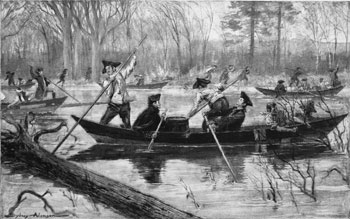
"Working Against Flood on Dead River," illustration by Sydney Adamson from The Century Magazine (1903). Courtesy of the Library of Congress, image USZ62-108233, Washington, D.C.

How Durben in Glasgow Became Dearborn in Quebec

I discovered a Revolutionary-era journal written by a Captain Durben—from an unexpected source—in 2009 while researching Benedict Arnold’s expedition to Quebec, a disastrous 1775 attempt to invade Canada and capture the city for the American cause. One of my primary purposes at that time was to compile a comprehensive bibliography of all printings of every journal written about the Arnold expedition, which seems to have generated more journals than any Revolutionary War battle.

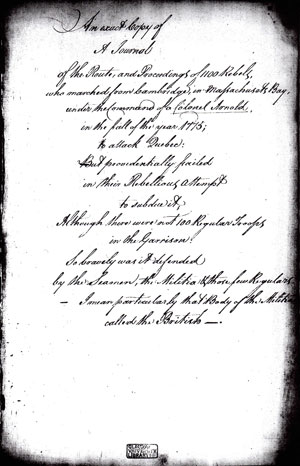
One of many Google searches took me to a surprising entry, featured in an online Americana exhibit created by the Special Collections Section of the University of Glasgow Library, which was devoted to eighteenth-century books and manuscripts. On the fourth page, I found a description of a manuscript titled, “A Journal of the Rebel Expedition,” written by a Captain Durben, along with an image of the journal’s first page. The subtitle stated that this was “An exact copy of a Journal of the Route and Proceedings of 1100 Rebels, who marched from Cambridge, in Massachusetts Bay, under the Command of General Arnold, in the fall of the year 1775; to attack Quebec.” I was immediately intrigued—this document purported to be a manuscript journal of the Arnold expedition that had previously been entirely unknown to me.

Upon reflection, I was astonished that an unknown journal of an important Revolutionary War event had been residing in a university library in Scotland for over 225 years and had never been mentioned in any scholarship on the Revolutionary War. At the same time, I was also skeptical. How did a manuscript journal written by an American officer end up in Scotland? Moreover, I had done enough research on the Quebec expedition to know that there was no American officer involved named Durben. The more I thought about the online exhibit, the more I was convinced that, when I researched it further, the manuscript would turn out to be a disappointment because it would prove not to be an original journal of the expedition to Quebec.

I was immediately intrigued—this document purported to be a manuscript journal of the Arnold expedition that had previously been entirely unknown to me.

The Durben manuscript was contained in a bound volume entitled “Manuscripts from the Library of William Hunter.” Dr. Hunter was a Scottish physician and private book and manuscript collector so active in his era that he was a competitor of the British Library. At his death in 1783, he bequeathed his collection, including the Durben journal, to the Library of the University of Glasgow.

I wrote to the Special Collection librarians there, requesting a photocopy of the manuscript journal. They readily copied the entire file and sent it to me. The package included the Durben journal plus two other, shorter journals of the expedition. No author is identified by name for either of these shorter journals.


Front page of Captain Durben's journal. By permission of the University of Glasgow Library, Glasgow, Scotland (Special Collections-Sp. Coll. MS. Hunter 608).
Front page of Captain Durben’s journal. By permission of the University of Glasgow Library, Glasgow, Scotland (Special Collections-Sp. Coll. MS. Hunter 608).
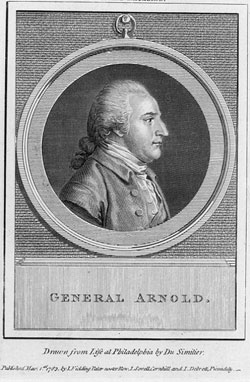
"Portrait of Benedict Arnold," from The European Magazine and London Review, March 1, 1783. Photograph courtesy of the author. Click to enlarge in a new window.
“Portrait of Benedict Arnold,” from The European Magazine and London Review, March 1, 1783. Photograph courtesy of the author. Click to enlarge in a new window.


After closely examining the Durben manuscript, I concluded that it was a period copy of a previously unknown journal originally authored by Captain Henry Dearborn (1751-1829) of New Hampshire, probably one of the best-known officers on the expedition other than Arnold himself. Dearborn was captured in the assault on Quebec on December 31, 1775, and was imprisoned in Quebec until he was released on parole early in May 1776. The journal entries cover the period September 13, 1775, through May 18, 1776. These entries were written contemporaneously as events occurred, as the author went along on the expedition and then, during the winter of 1775-1776, when he was imprisoned in Quebec. The transcription was evidently penned sometime thereafter, by Dr. Robert Robertson (1742-1829), a Scottish surgeon serving with the Royal Navy in Quebec in 1776. In what follows I’ll discuss the evidence that led me to these conclusions.

The name “Durben” at first threw me because, as mentioned above, there was no officer in the Arnold expedition with that name. Looking at names that might sound like Durben, I tentatively concluded that the author might be Captain Henry Dearborn. No other officer had a name that sounds anything like Durben, and no other officer’s name begins with the letter “D.”

Two entries in the journal provided additional evidence supporting Dearborn’s authorship. The author mentions two of his officers by name, both of whom were in Captain Dearborn’s company. The first is Joseph Thomas, who was appointed as Dearborn’s Ensign, according to the daily entry for September 18. The author also refers in an entry on November 2 to a Lieutenant Hutchins being in his company. Both Joseph Thomas and Nathaniel Hutchins were officers in Dearborn’s company, and both are listed in New Hampshire Troops in the Quebec Expedition, published by the state of New Hampshire in 1885.

The Durben journal concludes with entries for the days of May 17 and 18, 1776, which describe the author leaving on a boat with Major Return J. Meigs. The early exit from Quebec by the two officers, Meigs and Dearborn, is verified by other expedition journals, providing compelling supportive evidence that the author of the Durben journal was Henry Dearborn. In Private James Melvin’s journal, the entry on May 18, 1776, reads: “Pleasant weather; hear that Major Meigs and Captain Dearborn are gone home.” There are also two entries in Captain Simeon Thayer’s journal: “May 17 … Major Meigs had the liberty to walk the town until 4 o’clock. Mr. Laveris came and informed Capt. Dearborn that he had obtained liberty for him to go home on his parole … May 18. About ten o’clock they [Meigs and Dearborn] set sail for Halifax.” It is clear from these entries that it was well known by the men in prison in Quebec that Meigs and Dearborn went home together.

A note located at the end of the “Captia” portion of the Durben manuscript describes how the journal came into the hands of its transcriber. Here, the writer recounts that Meigs and Dearborn went on board the schooner that was to take them to Halifax on May 17, but it did not make it out of the harbor and had to return. It ended up sailing again the next day, but in the intervening period the journal was stolen from Dearborn. “By some accident or another, the Schooner that they sailed in was obliged to return to Quebec; and a person on board of her stole the originals from the author, & gave it to one of his own friends a shore, who was so obliging as to lend it to me to take a copy of it—at least this is the history which I got from that gentleman, of it.” It is clear from this information that Dearborn wrote this journal prior to May 17, 1776.

At the bottom of page 1, Dr. Hunter writes that the journal was given to him by a Mr. Robertson, whom he describes as a surgeon on HMS Juno. Documents held at the University of Glasgow identify the Juno as a “32-gun ship launched in 1757” and “a fifth rate shipping frigate which was burnt on 7 August 1778.” Entries in Naval Documents of the American Revolution confirm that Dr. Robertson was on board the Juno. The frigate arrived in Quebec on June 4, 1776, five months after the assault on Quebec and two weeks after Meigs and Dearborn left Quebec aboard the HMS Niger. Thus, Dearborn was long gone from Quebec when the journal made its way to Robertson via an unknown third party who had stolen it from its original author.

A little over two years later, on August 7, 1778, the Juno was burned in Providence Harbor to prevent its capture by American forces. Since Robertson was not listed as a surgeon on any other ship after 1778, it is reasonable to conclude that he was not on the Juno when it was destroyed, or else he would have been transferred to another ship. I believe it is likely that Robertson transcribed Dearborn’s original manuscript journal while he was on board the Juno, between the time it left Quebec in September 1776 and August 13, 1777, the last known date he was on board.


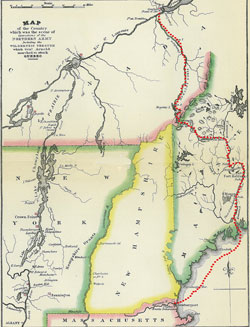
"Map of the Country which was the Scene of Operations of the Northern Army..." from the atlas included in The Life of Washington by John Marshall (1805). The image was republished in a subsequent edition of The Life of Washington by the Walton Book Company in 1930. The red dotted lines were added by David Picton in 2010 to show the route of the expedition. Map courtesy of the author.
“Map of the Country which was the Scene of Operations of the Northern Army…” from the atlas included in The Life of Washington by John Marshall (1805). The image was republished in a subsequent edition of The Life of Washington by the Walton Book Company in 1930. The red dotted lines were added by David Picton in 2010 to show the route of the expedition. Map courtesy of the author.
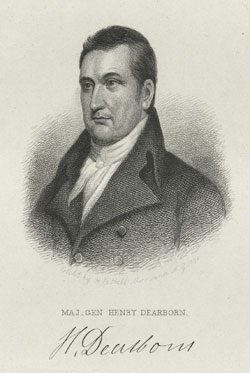
"Portrait of Maj. Gen. Henry Dearborn," etching by Henry Bryan Hall, 1872. Courtesy of the New York Public Library, New York, N.Y.
“Portrait of Maj. Gen. Henry Dearborn,” etching by Henry Bryan Hall, 1872. Courtesy of the New York Public Library, New York, N.Y.

Dr. William Hunter, the subsequent recipient of the manuscript, died on March 30, 1783, and from his signed notation in the journal we know that it was in his hands before he died. Thus, sometime between 1777 and 1783 Robertson apparently gave his transcribed copy of the journal to Hunter. It has been in the Hunter manuscript collection since that time, and at the time I discovered it had never before been published.

What we have, then, is a journal dating back to 1775, written originally by Henry Dearborn. This original journal was subsequently stolen from its author, transcribed and edited by Robertson, and then given to Hunter. The original manuscript in Dearborn’s handwriting has long since disappeared, or at least its whereabouts are unknown.

After the Quebec experience, Dearborn went on to an impressive military career during the Revolution, participating in the battles of Saratoga, Monmouth, Sullivan’s campaign, and Yorktown, ending as a lieutenant colonel. After the war, Dearborn was appointed a major general in the Maine state militia, a United States marshal in Maine, and was elected to Congress. In 1801, President Thomas Jefferson named Dearborn Secretary of War, and during the War of 1812 James Madison appointed him Senior Major General in the Army, in command of the northeast sector. From 1822 to 1824, he served as Minister Plenipotentiary to Portugal, and he died in Roxbury, Massachusetts, in 1829.

Henry Dearborn is known to have written five other journals of his Revolutionary War experiences, all of which survive in manuscript form. Four of these are in Dearborn’s handwriting. The last discovered journal, covering the march to Quebec, survives at the Boston Public Library (BPL) and was published in the Proceedings of the Massachusetts Historical Society in 1886. According to John Wingate Thornton, a nineteenth-century antiquarian and an expert on handwriting, this last journal held at the BPL is not in Dearborn’s handwriting, although he did make some corrections to the manuscript in his hand. In order to better compare the two journals, I spent a day reviewing the manuscript in Boston.

Comparing the Glasgow journal with the one published by the Massachusetts Historical Society, it is easy to see that many of the entries and the events that are covered are similar. However, the Glasgow journal is shorter and more succinct in its entries, which lends credibility to the conclusion that it was written during the events discussed. It is much more likely that someone writing during a significant army field maneuver would not have time for the more extensive and flowery descriptions that are found in the later journal.

An example of the differences in the two journals can be found in the entries for September 22, 1775. The Durben journal entry reads:

22nd. We got up where the Bateaux were built; from thence we carried thirty three men of each Company in the Bateaux up to Fort Western; That is about forty miles up from the mouth of the River; and at night all our men had mostly got up to the Fort.

The MHS journal entry expands the account:


"Working Against Flood on Dead River," illustration by Sydney Adamson from The Century Magazine (1903). Courtesy of the Library of Congress, image USZ62-108233, Washington, D.C.
“Working Against Flood on Dead River,” illustration by Sydney Adamson from The Century Magazine (1903). Courtesy of the Library of Congress, image USZ62-108233, Washington, D.C.

Septemr 22d. Proceeded up the River. We pass’d Fort Richmond at 11: O clock where there are but few Settlements at Present, this afternoon we pass’d Pownalborough, Where there is a Courthouse and Gaol—and some very good Settlements, This day at 4 O Clock we arrived at the place where our Batteaus were Built.


Graphic illustration of the march to Quebec, courtesy of the author. Click to enlarge in a new window.

We were order’d to Leave one Sergeant, one Corporal and Thirteen men here to take a Long the Batteau’s, they embarked on Board the Batteaus, and we proceeded up the River to Cabisaconty, or Gardners Town, Where Doctor Gardner of Boston owns a Large Tract of Land and some Mills, & a Number of very good dwelling Houses, where we Stayed Last night, on Shore.

Another even more significant variation is found in the comparable entries for October 4, although it is not clear if the same events for that day are being described in the two accounts.

The Durben journal entry records: “4th. We haled [hauled] up our Bateaux at the Portage, and dried them.”

The MHS entry states: “4 Our Course in general from the mouth of the river to this place has been from North, to North East, from here we Steer N.:W. to Norrigwalk, which is Twelve miles to where we arrived to night, the River here is not very rapid. Except Two bad falls, the Land on the North side of the river is very good, where there are 2 or 3 families settled, at Norrigwalk, is to be seen the ruins of an Indian Town, also a fort, a Chapel, and a Large Tract of Clear Land but not very good, there is but one family here at present Half a Mile above this old fort, is a Great fall, where there is a Carrying place of one Mile and a Quarter.”

The missing Quebec expedition journal in Dearborn’s own handwriting is an obvious omission in the personal accounts of his Revolutionary War experiences. Until now, it was thought that the original manuscript journal written at the time by Dearborn was the one published by the Massachusetts Historical Society in 1886—although not in his handwriting. Now, however, we know better, because we have that original journal, or at least a sanitized version of it, from the late eighteenth century.

Finding Henry Dearborn’s original journal has been exciting and rewarding in ways I could not have predicted. I am convinced that had I not followed through on tedious Google searches, this journal would have never been discovered and made public. As Revolutionary War manuscripts go, this one is not earth-shattering, nor does it contain any momentous revelations that will change the history of the invasion of Canada. But in its own right it is a significant finding that clarifies the history of one participant’s own narratives of the war, and presents the original version of an account that has been known only through later revisions.
After Benedict Arnold himself, Henry Dearborn was the most famous military man on the expedition to Quebec, and he was one of only a handful of American officers to write a journal covering the entire period of the Revolutionary War. Moreover, Dearborn’s subsequent career was unmatched by any other participant in the expedition. By virtue of his appointment as Senior Major General during the War of 1812, he rose to a higher military rank, and as congressman and Secretary of War, he attained a higher civilian position than any other expedition alumnus except for Vice President Aaron Burr. Discovery of the Dearborn journal also reveals a fascinating story about how an American manuscript made its way to from Quebec to Scotland, where it has been unknowingly preserved for over 200 years.

To date, I have succeeded in identifying thirty-three extant journals of the Quebec expedition, including the three found in the University of Glasgow Library. When I started this journey, I did not expect to find any previously unknown and unpublished journals, particularly in Scotland. Much to my surprise, there are still unknown manuscripts to be found in the unlikeliest of places. I now know that research that starts out in one direction can lead to surprising and unexpected results that are more rewarding than the original objective.

Further Reading:

The complete transcribed Dearborn journal, as well as the two smaller journals, and notes by Robertson and Hunter, can be found in Stephen Darley, Voices from a Wilderness Expedition: The Journals and Men of Benedict Arnold’s Expedition to Quebec in 1775 (Bloomington, Ind., 2011).

To read other journals of the Quebec expedition, see the compilation of thirteen journals by Kenneth Roberts, March to Quebec: Journals of the Members of Arnold’s Expedition (New York, 1946). The best histories of the Arnold expedition are Justin H. Smith, Arnold’s March from Cambridge to Quebec (New York, 1903); John Codman, Arnold’s Expedition to Quebec (New York, 1901), and Thomas A. Desjardin, Through a Howling Wilderness: Benedict Arnold’s March to Quebec in 1775 (New York, 2006).

There are numerous publications of individual Revolutionary War journals from a variety of battles and campaigns. Two compilations of journals from the war are John C. Dann, ed., The Revolution Remembered: Eyewitness Accounts of the War for American Independence (Chicago, 1980) and George C. Scheer and Hugh Rankin, Rebels and Redcoats (New York, 1957).

For background on Benedict Arnold, the most thoroughly researched biography is James Kirby Martin, Benedict Arnold, Revolutionary Hero: An American Warrior Reconsidered (New York, 1997).


This article originally appeared in issue 14.3 (Spring, 2014).


Stephen Darley is a retired attorney and independent scholar based in North Haven, Conn. He has been conducting research on the Revolutionary War in general, and Benedict Arnold in particular, for over forty years.


Republicans and Abolitionists on the Road to “Jubilee”

"The (Fort) Monroe Doctrine." Anonymous, political cartoon (1861). Courtesy of the Political Cartoon Collection, American Antiquarian Society, Worcester, Massachusetts.


It’s rare for a single work of scholarship to fundamentally change the way I teach a topic in U.S. history, but historian James Oakes’ latest work has done just that. Oakes has thoroughly persuaded me that the Republicans came into the Civil War ready to carry out much of the abolitionist agenda, meaning that they were willing from the beginning to destroy what Francis Lieber called the “poisonous root” of slavery. In his Lincoln Prize-winning book, Freedom National: The Destruction of Slavery in the United States, 1861-1865 (2012), Oakes argues that as early as 1861, congressional Republicans, along with the president and his cabinet, and generals in the field, “insisted that slavery was the cause of the rebellion and emancipation an appropriate and ultimately indispensable means of suppressing it.” The Republicans were moving in lock-step with the abolitionists. As one widely circulated 1861 antislavery petition declared, Congress needed to utilize its “war-power” to destroy the “system of chattel slavery,” which the author of the petition labeled as the “root and nourishment” of the Confederacy.

Until recently, I have followed the trajectory of most textbooks and covered the abolitionist movement from the publication of David Walker’s Appeal to the Colored Citizens of the World in 1829 to John Brown’s raid on the federal arsenal at Harpers Ferry thirty years later. Over the course of several weeks, we examine a selection of broadsides, pamphlets, images, and letters that have been scanned by the Historical Society of Pennsylvania, the Massachusetts Historical Society, the Library of Congress, the National Humanities Center and the Boston Public Library. We also discuss how these documents fit in with the PBS documentaries (Africans in America and The Abolitionists) that students watched and responded to online the night before.

After covering the attack on Fort Sumter, I left the abolitionists behind and focused on the Republican Party. The narrative I presented painted the Republicans as reluctant emancipators, a party that had neither the support nor the encouragement of most abolitionists. The trajectory of the war shifted only over the course of several years from a struggle for the restoration of the Union to a no-holds-barred war against human bondage.

I often ask my students whether they think the Confiscation Act would have been issued if hundreds of refugees had not shown up at Fortress Monroe weeks before. They often conclude that the slaves themselves were partly responsible for pushing the legislative agenda in Washington.

Oakes’ scholarship, however, has forced me to ask an obvious but important question: How did the abolitionists succeed in achieving their ultimate goal? In this, Oakes challenges historian Manisha Sinha’s argument that abolitionist precepts were not represented within the ranks of mainstream congressional Republicans and that President Abraham Lincoln “gave short shrift to the abolitionist agenda” in the early years of the war. Though Frederick Douglass was often frustrated with the Republican Party, Oakes argues that Lincoln and the Republicans were committed to achieving what Douglass called for in May 1861: put “an end to the savage and desolating war” being “waged by the slaveholders” by striking “down slavery itself.”

My students have responded enthusiastically to a multi-day lesson utilizing the Visualizing Emancipation Website. This ground-breaking digital history project allows students to map emancipation over the course of the war. Students view the unfolding of emancipation by tracking the movement of slaves toward the Union Army’s lines and the actions of soldiers and generals in the field. The Website can be used alongside the Freedmen and Southern Society Project and the Valley of the Shadow Project.

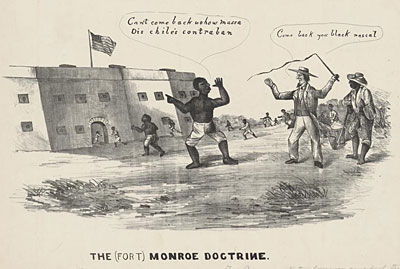
In the classroom, I use the students’ blog posts as a way to start a discussion. During their exploration of Visualizing Emancipation, many students picked up on the number of slaves that flooded Union lines in coastal Virginia not long after the firing on Fort Sumter. During the discussion we focused heavily on the role of General Benjamin Butler. On May 27, 1861, Butler, a conservative Democrat who opposed Stephen Douglas at the party’s 1860 convention, wrote to the Commander of the U.S. Armed Services General Winfield Scott asking him what he should do with the fugitives entering his lines at Fortress Monroe. “As a military question it would seem to be a measure of necessity to deprive their masters of their services … As a political question and a question of humanity can I receive the services of a Father and a Mother and not take the children?” asked Butler. “Of the humanitarian aspect I have no doubt.” What Butler needed was clarification on the political side of the equation. He decided to label the escaping bondmen “contrabands” under the rules of war and refused to turn them over. On May 30, Secretary of War Simon Cameron approved Butler’s decision not to return the “contrabands.” As Adam Goodheart has noted, slavery’s “iron curtain began falling all across the South.”

On August 8, 1861, two days after Lincoln signed the First Confiscation Act, which stated that Confederates who used slave labor to engage in rebellious acts would “forfeit” their claim to such “labor,” Secretary of War Simon Cameron issued instructions for slaves to be “discharged.” With his use of the word “discharged,” Cameron restored language used by Illinois Senator Lyman Trumbull in an earlier version of Section 4 of the First Confiscation Act. Whereas Article 4, Section 2 of the 1787 Constitution prevented a “person held to labor or service” from being “discharged” if they escaped to a free state or territory, Trumbull’s amendment called for the military to emancipate or “discharge” enslaved people who reached Union lines. By treating the “contrabands” not as property, but as persons “held to labor,” the confiscation bill lined up with the long-standing view of antislavery Republicans. Cameron’s instructions also answered a question posed by Butler in a letter dated July 30, 1861: “Are these men, women, and children, slaves? Are they free?”


Frederick Douglass, carte-de-visite taken from Bowman's New Gallery, Ottawa, Illinois (date unknown). Courtesy of the Carte-de-visite Collection (Box 1), American Antiquarian Society, Worcester, Massachusetts.
Frederick Douglass, carte-de-visite taken from Bowman’s New Gallery, Ottawa, Illinois (date unknown). Courtesy of the Carte-de-visite Collection (Box 1), American Antiquarian Society, Worcester, Massachusetts.

Lincoln never said a word in opposition to Cameron’s far-reaching order, which settled the status of those caught up under the terms of the First Confiscation Act on the side of freedom. There would be no further legal proceedings to debate the question. “Strictly speaking,” the act “freed only slaves used to support the rebellion,” writes Oakes. But “under the War Department’s instruction, all slaves voluntarily coming to Union lines from disloyal states were emancipated.” Indeed, in his December 1861 message to Congress, Lincoln used the word “liberated” when referring to slaves caught up under the provisions of the bill. I often ask my students whether they think the Confiscation Act would have been issued if hundreds of refugees had not shown up at Fortress Monroe weeks before. They often conclude that the slaves themselves were partly responsible for pushing the legislative agenda in Washington. As Steven Hahn has argued, black flight “began to reshape Union policy.”

Oakes tackles the long-standing assumption that the “purpose of the war shifted” from one designed to protect the Union to one that promoted emancipation. This is the conventional narrative found in numerous textbooks or classics like Allan Nevins’ multi-volume Ordeal for the Union (1947-1970). Take, for example, the traditional rendering of Lincoln’s battle with General John Frémont in the summer of 1861 and General David Hunter in the spring of 1862. Historians have typically used the clash with Frémont and Hunter to demonstrate Lincoln’s reluctance to embrace emancipation. As Oakes noted in his 2007 book on Lincoln and Frederick Douglass, Lincoln merely ordered Frémont and Hunter to conform to the wording of Section 4 of the First Confiscation Act, which empowered officers to confiscate slaves that were being used against the Army or Navy, along with the subsequent War Department orders. Frémont had gone a step too far in his proclamation, emancipating slaves of all rebels in Missouri; Hunter declared the abolition of slavery in three entire states (South Carolina, Georgia, and Florida) not yet under Union control. Allan Nevins actually called Frémont’s order the first act for emancipation, ignoring the role of General Butler and Secretary of War Cameron.

Frémont and Hunter, in Lincoln’s analysis, had turned themselves into dictators. Lincoln told his friend Orville Browning on September 22, 1861, that he could not allow “this reckless position” to stand. Lincoln did not disagree with the agenda of freeing slaves; he simply wanted it done in a manner that followed what Congress had prescribed. In his order revoking Hunter’s emancipation edict, Lincoln reminded the public that he was still holding out hope that rebellious states would adopt a “gradual” emancipation plan. As Oakes noted in his book on Lincoln and Frederick Douglass, the president wanted to make clear that he was being pushed by the actions of slaveholders; they were the ones who “lit the fuse.” The bomb exploded in 1862.

Virginia slaves continued to escape to freedom as the Army of the Potomac moved south in the spring of 1862. In mid-March, General Ambrose Burnside captured New Bern, North Carolina. Nearly 7,500 blacks from the eastern portions of the state quickly made their way to the city. As one slaveholder declared at the time, the idea of “the ‘faithful slave’ is about played out.” Burnside carried on the same policies Butler had enacted. According to Oakes, a “tacit alliance between escaping slaves and the Union army” was “created with the approval of officials in Washington.” In July 1862, Congress authorized the president to enlist black men. The Second Confiscation Act empowered the president to “employ … persons of African descent … for the suppression of the rebellion.” In November 1862, the prominent abolitionist Thomas Wentworth Higginson took command of the First South Carolina Volunteers, a regiment composed of freed slaves. “No officer in this regiment now doubts that the key to the successful prosecution of this war lies in the unlimited employment of black troops,” wrote Higginson. “Instead of leaving their homes and families to fight, they are fighting for their homes and families, and they show the resolution and sagacity which a personal purpose gives.” One month later, Attorney General Edward Bates demolished Chief Justice Roger Taney’s racist ruling in Dred Scott v. Sanford (1857) and declared in an official opinion that African Americans were full citizens of the United States.

In addition to the Visualizing Emancipation Website, another exercise that allows students to explore the ideas James Oakes raises in Freedom Nationalis to search the text of the Congressional Globe. I found it useful this past term to have my students access the Globeonline, particularly the debate over the First Confiscation Act, via the Library of Congress’ Website. Massachusetts Senator Henry Wilson declared: “Our purpose is to save this Government and to save this country … and if traitors use bondmen to destroy this country, the Government should at once convert those bondmen into men” so they could not “be used to destroy our country.” For Wilson, along with many of his colleagues, especially Senator Trumbull, freedom and the war effort went hand in hand.


"The (Fort) Monroe Doctrine." Anonymous, political cartoon (1861). Courtesy of the Political Cartoon Collection, American Antiquarian Society, Worcester, Massachusetts.
“The (Fort) Monroe Doctrine.” Anonymous, political cartoon (1861). Courtesy of the Political Cartoon Collection, American Antiquarian Society, Worcester, Massachusetts.
"Come back here, you black rascal! … " illustration taken from a Civil War envelope preserved in a scrapbook of Civil War memorabilia, s.n. (1861-1865). Courtesy of the American Broadsides and Ephemera Collection, American Antiquarian Society, Worcester, Massachusetts.
“Come back here, you black rascal! … ” illustration taken from a Civil War envelope preserved in a scrapbook of Civil War memorabilia, s.n. (1861-1865). Courtesy of the American Broadsides and Ephemera Collection, American Antiquarian Society, Worcester, Massachusetts.

By focusing on political history, Oakes reminds us of the astounding legislative record of the 37th Congress. Congressional leaders pushed through bills strengthening efforts to prohibit the international slave trade, granted diplomatic recognition to Haiti, and abolished slavery in Washington, D.C. On the military front, thousands of slaves sought refuge behind Union lines after the U.S. Army and Navy took control of the coastal regions of the Carolinas and portions of the Tennessee Valley.

As “emancipation events,” to borrow a phrase from the editors of Visualizing Emancipation, became more prevalent, discussion of colonization also intensified. In the Second Confiscation Act, Congress attached an appropriation for voluntary emigration and authorized the president to implement it. Section 12 of the act reads: “The President of the United States is hereby authorized to make provision for the transportation, colonization, and settlement, in some tropical country beyond the limits of the United States.” In his second annual message to Congress in December 1862, Lincoln went so far as to call for a constitutional amendment authorizing funding for voluntary emigration.

For a long time, Lincoln held fast to the idea of voluntarily removing blacks, though there was only one tiny, privately organized experiment in voluntary exile. The businessman Bernard Kock asked Lincoln to help subsidize a project to send blacks to Île à Vache, a Caribbean island off of the coast of Haiti. Lincoln granted funding, signing off on the ill-conceived scheme on December 31, 1862. At this very moment Lincoln was also putting the finishing touches on the Emancipation Proclamation—something that my students often find shocking. Lincoln personally shut down the disastrous Île à Vache project within a year.

Michael Vorenberg’s research on colonization schemes during the Civil War has helped my students understand Lincoln’s writings concerning the removal of African Americans from the United States. I often use the September 1862 edition of Douglass’ Monthly to demonstrate the profound opposition to colonization within the black community. Douglass was responding to Lincoln’s August 14, 1862 disastrous meeting with a black delegation in Washington, D.C. The president urged the leaders to think about the possibility of mass emigration. “Taking advantage of his position and of the prevailing prejudice against them [African Americans] he affirms that their presence in the country is the real first cause of the war, and logically enough, if the premises were sound, assumes the necessity of their removal,” declared Douglass in response. However, as historian Kate Masur reminds us in a recent article, we need also to keep in mind that since so many “white Americans rejected the idea of a multiracial nation … many black Americans, recognizing the implications of that rejection, took steps to build their lives elsewhere.”


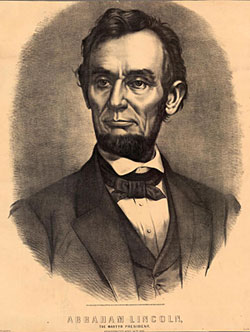
"Abraham Lincoln, The Martyr President," lithograph by Currier & Ives (1865). Courtesy of the American Antiquarian Society, Worcester, Massachusetts.
“Abraham Lincoln, The Martyr President,” lithograph by Currier & Ives (1865). Courtesy of the American Antiquarian Society, Worcester, Massachusetts.


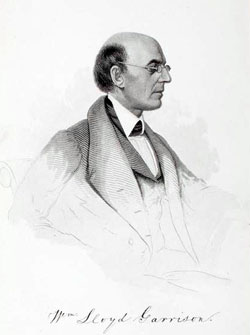
Another question history classes should explore is how mainstream abolitionists fit into this new narrative about the destruction of slavery that focuses heavily on the Republicans, a party of which many abolitionists were leery of trusting. I have found it useful to present my students with copies of William Lloyd Garrison’s The Liberator from July 12, 1861 (accessed via the Early American Newspaper Project) in order to demonstrate the parallel tracks of Republican Party policy and abolitionist doctrine.


"William Lloyd Garrison," engraving (image and text 11.5 x 10 cm.). Frontispiece in Liberty Bell, Boston (1846). Courtesy of the American Antiquarian Society, Worcester, Massachusetts.
“William Lloyd Garrison,” engraving (image and text 11.5 x 10 cm.). Frontispiece in Liberty Bell, Boston (1846). Courtesy of the American Antiquarian Society, Worcester, Massachusetts.


That edition recounts that on a warm and sunny July 4th afternoon in 1861 at Framingham, Massachusetts, a large town just west of Boston, more than 2,000 people gathered to listen to abolitionists lecture about the meaning of the war. In his inaugural address as the new president of the Massachusetts Anti-Slavery Society, Edmund Quincy declared that there was never such an occasion as the one upon them to be “thankful.” The war had created a situation in which slavery could be destroyed. Quincy was greeted with laughter and applause when he told the crowd in Framingham: “The American Anti-Slavery Society has for its Office Agent—who? Abraham Lincoln … and it has for its General Agent in the field—General [Winfield] Scott.” Secretary of Treasury Salmon P. Chase and Postmaster General Montgomery Blair had “not the heart nor the wish to put back into the hell of Virginia slavery one single contraband article in Fortress Monroe.”

During his turn at the podium, Garrison reminded the crowd that Lincoln’s cause was their cause. Both he and Lincoln would be given “a coat of tar and feathers” by the white South, proclaimed Garrison. The Boston editor went on to talk about how the war powers could be used to destroy slavery. The abolitionist editor had long given up on the notion that “moral suasion” could bring an end to the Slave Power. In 1837, he admitted to the British abolitionist Elizabeth Pease that American antislavery advocates were not making nor were they going to make an “impression” upon slaveholders. “I have relinquished the expectation that they [slaveholders] will ever, by mere moral suasion, consent to emancipate their victims. I believe that nothing but the exterminating judgment of heaven can shatter the chains of the slave.” That judgment arrived in 1861 in the form of Lincoln and congressional Republicans.

However, not everyone in the all-star line-up of speakers at Framingham had confidence in the Lincoln administration. Stephen Foster, for example, did not want abolitionists to commit to supporting Lincoln until an emancipation edict had been issued. In Foster’s analysis, the president was not up to the task. Foster declared that the administration was “undeniably the most thoroughly subservient to slavery of any which has disgraced the country.” In the eyes of Sallie Holley, a close friend of Foster’s wife, Abby, Lincoln was a “sinner at the head of a nation of sinners.”

The Fosters, along with the New Hampshire radical abolitionist Parker Pillsbury, quickly found themselves in the minority. For the Garrisonians, the war was going to bring revolutionary changes in the political system that could not be accomplished through moral suasion. Beginning in the summer of 1861, David Lee Child wrote a series of wide-ranging articles in The Liberator on the war powers. The “slave, once freed by the war power, would be free for ever,” declared Child, who drew heavily from an 1836 speech by the venerable John Quincy Adams.

A “defeat, bloody and cruel” was needed in order to “anger” the North into “emancipation,” said Wendell Phillips during his remarks at the Framingham rally. The prominent antislavery attorney and orator got his wish a few weeks later. On July 29, Child wrote to Garrison offering his view on the Battle of Bull Run. According to Child, the massive Union defeat had “done more than a dozen victories” in terms of convincing politicians that using the war powers was absolutely necessary. Former Rhode Island Congressman Elisha Potter Jr. agreed: “We may commence the war without meaning to interfere with slavery; but let us have one or two battles, and get our blood excited, and we shall not only not restore any more slaves, but shall proclaim freedom wherever we go.”

In early August 1861, Congress responded by passing the First Confiscation Act. A month later, Garrison, Phillips, and other Bay State abolitionists organized the Emancipation League, with the purpose being to educate the North on how central the issue of slavery was to the successful prosecution of the war. As historian Stacey Robertson has argued, the League “tried to stimulate abolitionist sentiment by insisting that emancipation would help the North to win the war.”


From 1846 to 1865, the Massachusetts Anti-Slavery Society celebrated the Fourth of July with a picnic and rally at Harmony Grove. "View of Harmony Grove, Framingham, Massachusetts," illustration, p. 384 from Gleason's Pictorial Drawing-room Companion, June 12, 1852, Vol. 2 Issue 24, published by Gleason (1852). Courtesy of the American Antiquarian Society, Worcester, Massachusetts.
From 1846 to 1865, the Massachusetts Anti-Slavery Society celebrated the Fourth of July with a picnic and rally at Harmony Grove. “View of Harmony Grove, Framingham, Massachusetts,” illustration, p. 384 from Gleason’s Pictorial Drawing-room Companion, June 12, 1852, Vol. 2 Issue 24, published by Gleason (1852). Courtesy of the American Antiquarian Society, Worcester, Massachusetts.

In January 1862, Garrison gave a number of addresses to huge crowds in Philadelphia and New York. Speaking about the origins of the bitter and bloody conflict the nation found itself embroiled in, Garrison proclaimed:

There is war because there was a Republican Party. There was a Republican Party because there was an Abolition Party. There was an Abolition Party because there was Slavery. Now, to charge the war upon Republicanism is merely to blame the lamb that stood in the brook. To charge it upon Abolitionism is merely to blame the sheep for being the lamb’s mother. But to charge it upon Slavery is to lay the crime flat at the door of the wolf, where it belongs. To end the trouble, kill the wolf. I belong to the party of wolf-killers.

Garrison, who was undoubtedly reveling in the applause from the crowds that came to hear him speak, crowds that would have likely pelted him with rotten apples (or worse) only a year before, also spoke about the war powers: “What the people have provided” to “save their Government, is not despotism.” It “is as much a Constitutional act, therefore, for the President of the United States, Gen. McClellan, or Congress, to declare Slavery at an end in our country.”

Lincoln made this a reality on January 1, 1863, when he issued the Emancipation Proclamation. Too often, teachers criticize the Proclamation because it is couched in legalistic, military language, lacking the moral force of a radical antislavery address. However, as Oakes rightly observes, “most Americans at the time associated military emancipation with antislavery radicalism.” Lincoln was moving in lockstep with antislavery constitutionalism. Even Stephen Foster, who never hid his hatred for Lincoln, argued that “emancipation proclaimed by the national government and enforced by the Army” would “effectively destroy the slave power.” Critics might speculate as to Lincoln’s motives, but one important fact remains: no slave was ever returned to bondage. The Emancipation Proclamation also encouraged the enlistment of black freemen. As historian Douglas Egerton has recently argued, black abolitionists “were as anxious to destroy slavery” as “they were to establish a bid for citizenship.”

Shortly after Lincoln was re-nominated at the 1864 Republican Party convention in Baltimore, Garrison traveled to Washington. “There is no mistake about it in regard to Mr. Lincoln’s desire” to “uproot slavery, and give fair play to the emancipated,” wrote Garrison to his wife, Helen. What helped to draw the prominent abolitionist editor even closer to Lincoln in 1864 was the administration’s abandonment of colonization. Abolitionists, according to Sallie Holley, had to work to “explode utterly all ideas of colonization as not only a cruel insult to the colored people, but a miserable national policy.” In this they succeeded. Lincoln made no mention of colonization in the 1863 Emancipation Proclamation.

In 1864, Garrison risked losing many of his devoted followers when he entered into a battle with his long-time friend Wendell Phillips, who was incensed over Lincoln’s announced reconstruction policy. As historian W. Caleb McDaniel argues in his engaging new book on democratic theory and slavery, Garrison—though unhappy about Lincoln’s unwillingness to commit to political rights for black Americans—still believed that the president deserved another term. In a September 1864 letter to Samuel May, in which he discussed the dangers of voting for John Frémont, the candidate of the Radical Democracy Party, Garrison declared that the “best thing” that the abolitionists could do is “join the mass of loyal men in sustaining Mr. Lincoln and thus save the country from the shame and calamity of a copperhead [Democratic] triumph.” Garrison was pleased with the Republican platform and its call for a constitutional amendment ending slavery. After the votes were tallied, Garrison, the man who had openly despised the American political system for decades, declared that Lincoln’s “re-election” was the “death-warrant of the whole slave system” and indicated that the country was “very near the day of jubilee.” In the final analysis, Republicans and abolitionists surely had their differences when it came to how slavery should be destroyed, but the historic significance lies not in what was different. What mattered most is what Republicans and abolitionists agreed on from the outset.


"Stephen S. Foster," photomechanical print (ca. 1870). Courtesy of the Portraits and Prints Collection, American Antiquarian Society, Worcester, Massachusetts.
“Stephen S. Foster,” photomechanical print (ca. 1870). Courtesy of the Portraits and Prints Collection, American Antiquarian Society, Worcester, Massachusetts.

The author dedicates this article to Lawrenceville History Master Kristina Schulte.

Further Reading

Everyone interested in the destruction of American slavery should begin with Ira Berlin, Barbara Fields, Steven Miller, Joseph Reidy, Leslie Rowland, eds., Free at Last: A Documentary History of Slavery, Freedom, and the Civil War (New York, 1993). The best overview of the abolitionist movement remains James Brewer Stewart’s Holy Warriors (New York, rev. 1996). Students of the 19th century have been waiting anxiously for Manisha Sinha’s forthcoming, The Slave’s Cause: Abolition and the Origins of America’s Interracial Democracy. In addition to Freedom National: The Destruction of Slavery in the United States, 1861-1865 (New York, 2013), see also Oakes’ The Radical and the Republican: Frederick Douglass, Abraham Lincoln, and the Triumph of Antislavery Politics (New York, 2007). Henry Mayer’s All on Fire (New York, 1998) remains the best biography of William Lloyd Garrison. No student of Abraham Lincoln and the Civil War can be without a copy of Eric Foner’s The Fiery Trial: Abraham Lincoln and American Slavery (New York, 2010). Silvana R. Siddali’s From Property to Person: Slavery and the Confiscation Acts, 1861-1862 (Baton Rouge, 2005) is a detailed treatment of these landmark pieces of legislation.Michael Vorenberg’s Final Freedom (New York, 2001) is the definitive account of the Thirteenth Amendment. Kate Masur’s An Example for All the Land: Emancipation and the Struggle over Equality in Washington, D.C. (Chapel Hill, 2010) details how the nation’s capital became a laboratory for Republican racial policy during and after the Civil War. Janette Thomas Greenwood’s First Fruits of Freedom (Chapel Hill, 2009) chronicles the creation of a network between Massachusetts and the eastern shore of North Carolina after Union troops from Worcester County took control of the area in 1862. For more on Garrison and Phillips in 1864 see W. Caleb McDaniel’s The Problem of Democracy in the Age of Slavery (Baton Rouge, 2013). Douglas R. Egerton’s The Wars of Reconstruction: The Brief, Violent History of America’s Most Progressive Era (New York, 2014) brilliantly chronicles what Frederick Douglass meant when he argued in December 1863 that “the old Union, whose canonized bones we so quietly inurned under the shattered walls of [Fort] Sumter, can never come to life again … We are fighting for something incomparably better than the old Union.”


This article originally appeared in issue 14.3 (September, 2013).


Erik J. Chaput is a History Master at the Lawrenceville School, a college preparatory boarding school in New Jersey. He is the author of The People’s Martyr: Thomas Wilson Dorr and His 1842 Rhode Island Rebellion (2013) and the co-editor with Russell J. DeSimone of the Letters of Thomas Wilson Dorr and the Letters of John Brown Francis (forthcoming summer 2014), which can be found on the Dorr Rebellion Project Site hosted by Providence College.


Welcome Speech: Chef Kevin Mitchell imagining the words of Chef Nat Fuller

Hello, I’m Chef Kevin Mitchell of the Culinary Institute of Charleston. I am spokesman for the team of chefs who prepared tonight’s banquet for you, and I’m also appointed to stand as representative of our culinary forefather Nat Fuller. As you know, all of the dishes you will taste tonight come from his menus and are served in the style true to his banquets 150 years ago.


1. Aged duck, served at the Nat Fuller Feast. Photo by Jonathan Boncek, courtesy of the Nat Fuller committee.

I’ve wondered what Nat Fuller would have said to the company assembled at the Bachelor’s Retreat at the end of the Civil War. I think he may have said something like this:

“All things are ready, come to the feast!
Come, for the table now is spread;
Ye famishing, ye weary, come
And thou shalt be richly fed.”

Welcome, friends and guests. I am sure many of you are looking around this table and seeing new and unexpected faces. But I remember that the Lord says that many who sit down at the banquet table in heaven will be the Father’s unexpected guests. We can do no better than to follow his example when it comes to hospitality.

These have not been hospitable times. Strife and sorrow have held the upper hand. For a long season, people have expressed themselves through violence.

War has never been my work.

My study has always been how to make people enjoy the times they share together. It is ancient custom that once people at the same table share bread and salt, they shall do no harm to one another. It is a matter of some pride to me that my work has always been to supply the bread and salt that makes peace break out.

I do more than that. I prepare dishes whose deliciousness makes pleasure go around the table. Tonight there is a particular pleasure, a particular taste that’s featured—the taste of liberty. I suspect that some here at this table have not tasted in their lives a food that was not produced by people in bondage. Everything here, however, was produced by free persons who received just compensation for their toils. I don’t know about you—for me, it just makes the food taste somehow better.


2. Daven Coad, putting finishing touches on a course at the Nat Fuller Feast. Photo by Jonathan Boncek, courtesy of the Nat Fuller committee.

Friends, I’m not here to give a lecture or to teach you how to talk with one another. We have had lessons. Now is the time to talk with your neighbor, make a new friend, or hear someone tell his or her story. Of course at the end of the evening, when we bring dessert there will be toasts. Anyone then is free to stand and speak a sentence from the heart.

My mentor, my teacher Eliza Seymour Lee could not be present. But her great-great-granddaughter Robin Lee Griffith is here. Would you come and receive my hand in gratitude?

Tonight you shall taste the most celebrated dishes from my repertoire. I could not have offered them to you without the support of my colleagues, Chef Sean Brock, Chef B. J. Dennis, Chef Michael Carmel, and Chef Forrest Parker, and the faculty and students of the Culinary Institute of Charleston.


3. Chefs Sean Brock and Kevin Mitchell preparing the food at the feast. Photo by Jonathan Boncek, courtesy of the Nat Fuller committee.

I have pressing work in the kitchen. I will return when it is time to issue the toasts. Until that time let me speak a benediction.

Dear Father, bless the people in this room, both guests and servers. Give the diners here health and pleasure from the food we serve. Give them appreciation of the peace of this time and place.

Keep the pains and evils of the world distant from us here.

Give us kindness, hope, and wisdom.

May peace, grace, and love be your portion until we enjoy your hospitality in heaven.

Amen.

Bon appetit.


This article originally appeared in issue 15.4 (Summer, 2015).


Kevin E. Mitchell, CEC, CFSE, ACE chef instructor, Culinary Institute of Charleston studies the history of African American chefs and southern foodways. He oversaw the recreation of the famed African American chef Nat Fuller’s reconciliation dinner held in Charleston in 1865.


One Mississippi: Coloney & Fairchild’s Ribbon Map of the Father of Waters (1866)

1. Ribbon Map of the Father of Waters, by Coloney & Fairchild (St. Louis, 1866). Mounted on original wooden scroll and lined on linen. Courtesy of the American Antiquarian Society, Worcester, Massachusetts.

To look at the Ribbon Map of the Father of Waters on a computer screen is to see all 2,600 miles of the Mississippi River at once (fig. 1). It begins as a barely perceptible stream in the upper left of the image, eventually taking shape as a hand-colored blue line winding its way through ten different states (the boundaries of which are indicated by block letters that parallel the river on either side). Seeing the river in this way conveys the fluctuating nature of the river’s course, from the bulbous expansion of Lake Pepin between Minnesota and Wisconsin to the looping cutoffs below Natchez, Mississippi, and offers a visual contrast between the sparsely populated upper river and the more densely settled lower portion. The user can zoom in at any point to read the names of towns, landings, and tributaries in amazing clarity, and then toggle back to the comprehensive view, controlling his or her own experience of the map.

In this image the map has been segmented into eight pieces, but the actual Ribbon Map of the Father of Waters is one continuous strip that measures nearly eleven feet long and a little over two inches wide. When encountering it in person, the river only gradually comes into view over time, making the experience of using the map more like traveling on the river itself. The digital image serves as a solution to a representational problem: namely, how a map of such an unusual size and shape can be made to conform to a rectangular screen. This twenty-first century challenge seems remote from the context of the post-Civil War era to which this map dates, but it mirrors difficulties that nineteenth-century Americans faced in translating their ideas and experiences of the river into visual representations. Published in 1866 by St. Louis-based entrepreneurs Myron Coloney and Sidney B. Fairchild, the ribbon map’s singular focus on the river and its exaggerated dimensions assert the enduring relevance of the Mississippi River after the Civil War, both to the nation’s identity and to its commercial future.


2. Ribbon Map of the Father of Waters, by Coloney & Fairchild, in Edwards’ Mississippi River Gazetteer & Directory (St. Louis, 1866). Courtesy of the American Antiquarian Society, Worcester, Massachusetts.

The map is a hand-colored lithograph that was initially printed on one sheet of paper (fig. 2). One version of it appeared in the 1866 edition of Edwards’ Descriptive Gazetteer and Commercial Directory of the Mississippi River, where the Ribbon Map of the Father of Waters can be found between an advertisement for Barnum’s Hotel in St. Louis and an account of the Mississippi’s “discovery” by Europeans in the sixteenth and seventeenth centuries. In this context, the map helps to fold the river into popular contemporary narratives of U.S. history while also signaling that it was intended for use by travelers.


3. Traveller’s Guide: A Map of the Ohio and Mississippi Rivers. Extending from Pittsburgh to the Gulf of Mexico, by Joseph Duff (Cincinnati, 1840). Courtesy of the American Antiquarian Society, Worcester, Massachusetts.

As a single, foldout sheet, the map was similar to maps and guides produced for a growing tourist and transportation industry. By the mid-1830s, examples such as J. Duff’s Traveller’s Guide were available for sale on western steamboats (fig. 3). They typically indicated the general shape of the river channel, gave the location of towns and cities, listed distances between landings, and sometimes included a range of steamboat fares. As might be expected, they almost always focused on the portion of the river system that was actually navigable by steamers. If one were to depart from the main stem of the river to embark on an overland journey, a river map would have been useless because it usually did not give information about the broader region or network of transportation options. By 1866, however, it was imperative to represent the host of railroad tracks increasingly extending from large and small cities alike. Bold black lines extend from various points along the Mississippi and testify to the centrality of the river’s location between western and eastern markets.


4. Detail of title and scroll, Ribbon Map of the Father of Waters by Coloney & Fairchild (1866). Courtesy of the David Rumsey Historic Map Collection.

Coloney and Fairchild’s patented apparatus required that the single sheet be cut into strips, attached end-to-end, mounted on linen, and then rolled inside a wooden, metal, or paper spool (fig. 4). The resulting portability of the map was crucial because, as advertisements indicated, it was intended for business travelers, steamboat navigators, and tourists. Of this form, the Newberry Library and the Minnesota Historical Society Library hold what seems to be a first edition, while nearly a dozen archives around the U.S. hold an updated second version. With the addition of hundreds of towns, mile markers, islands, landings, landowner and plantation names, and significant Civil War locations, the Lower Mississippi appears to be a settled and thriving commercial space.


5. John Banvard’s panorama apparatus, published in Scientific American, Vol. 4, No. 13 (Dec. 16, 1848).
5. John Banvard’s panorama apparatus, published in Scientific American, Vol. 4, No. 13 (Dec. 16, 1848). Courtesy of the American Periodical Series Online.

In the scroll form, the map’s user pulls the bottom tab to travel upriver from the Head of Passes, where the river empties into the Gulf of Mexico. The seamless and gradual way one would have encountered the river led the New York Sun to christen the Coloney and Fairchild map “[t]he latest style of panorama,” recalling the moving panorama craze of the late 1840s and early 1850s (fig. 5). These gigantic scrolling paintings were presented to seated audiences in darkened rooms and accompanied by narration and music. Moving panoramas presented the river as a comprehensible succession of picturesque landmarks, burgeoning towns, western metropolises, and notable historical sites, simulating an imaginary steamboat journey. Scholars have asserted the central role that these popular spectacles had in supporting the ideology of Manifest Destiny, as the imagery naturalized a continuous and conflict-free progression through the American continent. The Ribbon Map of the Father of Waters capitalizes on this well-known visual form but allows users to enact their own imaginative travel up the length of the Mississippi. At the same time, since the ribbon map lacks a second spool around which to wrap the already viewed portion, the object had the potential to be as unruly and excessive as the river itself was during periods of high water (fig. 6).
 

6. Author’s hand holding the ribbon map, August 2009. Photo by the author.

Certain locales would have had particular resonance to the map’s postbellum viewers (fig. 7). The portion of the Mississippi that had been Confederate territory was the focus of a number of strip maps during the war. In January and May of 1862, Harper’s Weekly published depictions of the river between Cairo and New Orleans to orient readers in anticipation of military action in the region. The same year, advertisements for J.T. Lloyd’s Map of the Lower Mississippi from St. Louis to the Gulf of Mexico asserted that Union commanders requested his version for use in the field.


7. Detail of Vicksburg, Mississippi, from Ribbon Map of the Father of Waters, Coloney & Fairchild (1866). Courtesy of the American Antiquarian Society, Worcester, Massachusetts.

Just one year after the end of the Civil War, Coloney and Fairchild incorporated significant battle sites on and along the river into their ribbon map. The location of batteries, Jefferson Davis’s plantation, and even “Grant’s Cutoff”—an attempt to bypass the Confederate-controlled section of the river at Vicksburg that was ultimately abandoned—are all included. These new landmarks form elements of a newly unified river’s historical landscape and reinforce the notion that the Mississippi was national terrain.


8. Detail of Alton, Illinois, to St. Louis, Missouri, from Ribbon Map of the Father of Waters, Coloney & Fairchild (1866). Courtesy of the American Antiquarian Society, Worcester, Massachusetts.

Part of the reunification effort, as far as St. Louis businessmen like Coloney and Edwards were concerned, was the reestablishment of St. Louis as the preeminent commercial center of the West (fig. 8). Momentum had shifted away from St. Louis and the Lower Mississippi to Chicago and its rail networks by the end of the 1850s. Yet even in 1866, St. Louis boosters did not view Chicago’s permanent ascendance as inevitable. They put their stock in their city’s geographic position near the confluence of both the Missouri and the Ohio rivers. They continued to push for navigation improvements and strengthened their connection to the port at New Orleans. Additionally, in his position as commercial editor of the Missouri Democrat, Coloney was a vocal advocate for updating the city’s waterfront by adding grain elevators and using barges to transport grain in bulk. Although some railroad maps tried to shear St. Louis from the region, the Ribbon Map of the Father of Waters pictures St. Louis as the natural repository for the agricultural bounty of the Upper Mississippi.


9. Detail of headwaters to Crow Wing River, Minnesota, from Ribbon Map of the Father of Waters, Coloney & Fairchild (1866). Courtesy of the American Antiquarian Society, Worcester, Massachusetts.

In the uppermost 470 miles of the Ribbon Map of the Father of Waters—from St. Anthony Falls to the river’s headwaters—the Mississippi flows mostly west to east, though that is not made evident by the consistent linearity of the map (fig. 9). Despite the fact that others had shown this to be quite a watery area, only a few patches and lines of blue disrupt the relatively vacant space of the map. The two named lakes inscribe the river with national significance as the monikers refer to expeditions by territorial governor Lewis Cass and Henry Rowe Schoolcraft to locate the source of the great river in 1820 and 1832, respectively. To reinforce the authenticity of his findings, Schoolcraft renamed what had been known as Elk Lake or Lac La Biche to the indigenous and French inhabitants of the area as “Itasca,” the composite of parts of two Latin words: veritas (true) and caput (head).

This uppermost portion—nearly one-sixth of the map’s total length—would have been unnecessary information for a steamboat traveler in 1866, as it is far beyond the head of navigation and there was no touristic infrastructure in the area. Its presence serves other ideological purposes, naturalizing the boundaries of the nation and emphasizing the connectivity provided by a unified river.

The completely unfurled map extends beyond the limits of the user’s reach, wondrously embodying the scope of the river in the time it took to unroll it and in the eleven feet of space it now occupies. At the same time, the care required to wind the strip back into Coloney and Fairchild’s patented spool apparatus reiterates the precariousness of human control—either representational or environmental—over the mercurial Mississippi. While digitization has immense value for the preservation of historical objects and for making archival collections more accessible, in this case, the opportunity to experience the map on its own material terms opens up layers of meaning that a digital interface obscures.

Further Reading

For a multifaceted discussion of the history of maps, see James R. Akerman and Robert W. Karrow Jr., eds., Maps: Finding Our Place in the World (Chicago, 2007). Martin Brückner has written about maps as mobile objects in “The Ambulatory Map: Commodity, Mobility, and Visualcy in Eighteenth-Century Colonial America,” Winterthur Portfolio (2011): 141-160. Recent attempts to relate the experience of nineteenth-century travel to its representation are Anne Baker, Heartless Immensity: Literature, Culture, and Geography in Antebellum America (Ann Arbor, 2006) and Alison Byerly, Are We There Yet? Virtual Travel and Victorian Realism (Ann Arbor, 2013). Louis C. Hunter’s Steamboats on the Western Rivers: An Economic and Technological History (Cambridge, Mass., 1949) is a classic introduction to the steamboat age. On the Vicksburg campaign and the battle for the Mississippi River during the Civil War, see Lisa M. Brady, War upon the Land: Military Strategy and the Transformation of Southern Landscapes during the American Civil War (Athens, Ga., 2012) and William L. Shea and Terrence J. Winschel, Vicksburg Is the Key: The Struggle for the Mississippi River (Lincoln, Neb., 2003). William Cronon tells the story of Chicago’s rise to prominence over St. Louis in Nature’s Metropolis: Chicago and the Great West (New York, 1991), while Adam Arenson details the perspective of St. Louisans in The Great Heart of the Republic: St. Louis and the Cultural Civil War (Cambridge, Mass., 2011). On the ways that the search for the river’s “true source” is related to claims about knowledge and authority, see Rich Heyman, “Locating the Mississippi: Landscape, Nature, and National Territoriality at the Mississippi Headwaters,” American Quarterly 62:2 (June 2010): 303-333.


This article originally appeared in issue 15.4 (Summer, 2015).


Nenette Luarca-Shoaf was the 2014-15 Sawyer Seminar Postdoctoral Fellow at the Institute for Advanced Study, University of Minnesota. She is working on a book about the role of nineteenth-century visual culture in shaping the identity of the Mississippi River.


Tom Paine’s Bridge

Or, building a better world with iron

Several years ago, while teaching one of those history surveys that gallops across great events as if they were pebbles at Belmont, I asked my students to name a revolutionary. I had in mind Tom Paine—whose Common Sense we had just read—or perhaps Marx. I should not have been surprised by the answer I got: Bill Gates.

A revolutionary? Yes, my students told me. After all, Gates had changed everything. And he did not do this by accident. He even wrote a book, The Road Ahead (New York, 1996)whose first chapter bears the very Trotskyite title “A Revolution Begins.” In that chapter, Gates reflected upon his achievements, the revolutionary looking back on the revolution. What did they know, he and Paul Allen, a couple of school kids tinkering with some funky machine at little old Lakeside School? Well, “We caused a kind of revolution—peaceful, mainly—and now the computer has taken up residence in our offices and in our homes.” 

My students agreed. The PC had changed the world. For them, it was clear: things made history. It was a curious, if partly semantic, problem. Would this make Eli Whitney and James Watt more radical than Thomas Jefferson or John Brown? 

I had not given the problem much thought until I recently started doing some research on Tom Paine. What drew me to Paine was his peripatetic life. I had finished a project about a traveler who was a contemporary of Paine’s and who led a similarly transatlantic existence. This phenomenon was something I wanted to explore further and Paine seemed the ultimate exemplar of the mobile eighteenth century. 

As I started reading Paine, I found myself drawn in an unexpected direction, albeit one that in a weird way validated what those undergrads were telling me some years ago. Paine spent most of the final twenty years of his life pursuing answers to an extraordinary technological problem. The problem was simply this: how do you create a reliable, sturdy, weather-resistant bridge that can span rivers without impeding water traffic? What a mundane problem to occupy the author of The Rights of Man

And yet the problem was anything but mundane. Paine’s world was a water world. Everything traveled more quickly and more cheaply by water. Where there were no rivers or seas there was little of anything else. What farmers and trappers and miners and other producers could bring to market depended on ready access to water transport. We do not generally think of the Connecticut River or the Schuylkill River or the James River as hugely important commercial arteries. But in the eighteenth century they were. If you stood on their banks in the right season, you would see logs bound together as huge rafts, fifty and sixty foot dugout canoes loaded with deerskins or dried fish, and small sailing craft carrying grain, livestock, or tobacco. 

If you lived, say, in the far northwestern corner of Connecticut—hardly a remote place—you may as well have lived in Siberia. (Actually, you might have been better off in Siberia. The Russians had developed an enormous and well-traveled network of post roads—maintained by state-owned serfs—stretching from Lake Baikal in Siberia to St. Petersburg. Interestingly, these were more efficient arteries during the long winters when horse pulled sledges could glide across what would otherwise be wet, boggy terrain.). Getting anything to market—you would probably head to the river town of Hartford—would have involved a treacherous journey across barely maintained trails, usually unable to accommodate any kind of cart or carriage and all but impassible in the winter months. If, heaven forbid, you should stumble upon the swollen Housatonic or Farmington Rivers, you would hope to find a ferryman nearby and you would hope he knew and liked you and was happy to take a few pounds of grain or a few deer skins for his services. You would also hope the weather cooperated. Storms and spring ice made river crossings a deadly business.

Imagine a world without these problems. Imagine simply being able to carry your goods across a bridge. Sure, you might have to pay a toll, but you could travel when you wished, unimpeded by the comings and goings of ferrymen and foul weather. And you could expect, with a nice bridge across the Housatonic for instance, that others would be following you to market, perhaps now carrying large loads of corn and rye. And with those others now happily farming in northwest Connecticut, more people would be more dependent on roads and thus more inclined to band together to maintain them. Above all, if you could make rivers easy to cross you could open once remote tracts to European-style farming and if you could do that you could, in theory anyway, make more land available to more people. You could, to put it simply, help the cause of liberty.

This would all have been very agreeable to Tom Paine. He believed in property and he believed in the “projecting spirit,” that spirit of invention that seemed to inhere in the breasts of all men (this was, as far as I know, understood to be a distinctly masculine quality). He thus advocated the creation of a national system of copyright so that authors could, in effect, claim proprietary interests in their work. Not only would this afford fair remuneration, it would also—so Paine believed—spur creativity. Why create if you cannot serve yourself in the process?


Fig. 1. Applying principles advocated by Paine, the designers of the first iron arch bridge in the United States created a structure that is still in service. Historic American Engineering Record, National Park Service, delineated by Christopher H. Marston, 1992. Library of Congress.

Bridge technology was obviously not a new thing in Tom Paine’s America. The Romans had created great stone ones and Europeans continued to build stone bridges using what was basically a modified Roman design. In the new United States, small wooden bridges were most common. They required little specialized knowledge and far less labor than stone bridges. But above all, wood was far more abundant in North America than in Europe. 

Wooden bridges had a number of problems though. One was simply that they decayed. Moisture softens all but the rarest hardwoods, exposing load-bearing timbers to wood-boring organisms that can, in a matter of months, turn them into sawdust. The problem is especially acute on the flat road surface where pounding wagon wheels and horse hooves combine with accumulated rainwater, snow, or ice to speed decay. By the early nineteenth century, American bridge builders had devised a solution to this problem in the form of the covered bridge, but other problems with wood remained.

One was that building a wooden bridge long enough to span more than ten or fifteen feet was extremely difficult. With a growing scarcity of long, hard timbers, bridge builders had to rely on supporting piers. Aside from inhibiting river traffic, these were extremely difficult to build. They usually required temporary parapets, built midriver, within which stone foundations could be constructed. But even the most robust piers were vulnerable to forceful flood waters and spring ice.

Paine was among a small group of tinkerers who recognized that the solution to these problems lay in an old material put to a new use. That material was, of course, iron. In the short term, iron lost no strength when wet, and it could be easily fashioned into light, readily transported arches, western architecture’s strongest element. The strength of the arch allowed bridge builders to span waterways without costly piers that inhibited river traffic. But above all, Paine and his fellow inventors saw few limits to the potential span of iron bridges. As long as the basic design was sound, the scale was limited only by the ironworkers’ capacity to fashion the arches. 
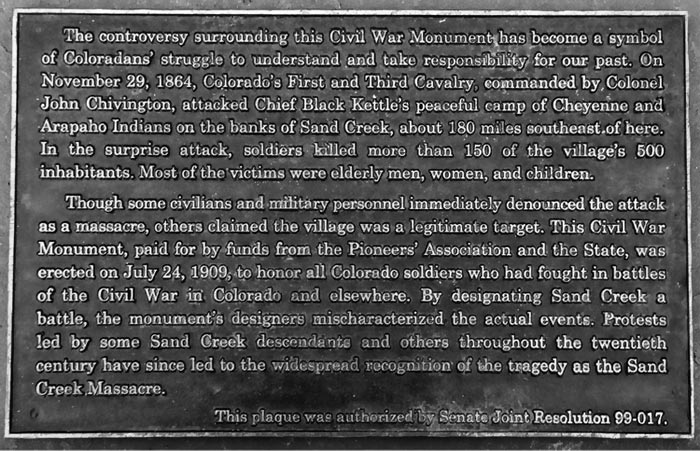
The material’s first real trial came in 1779 when an ironmaster named Abraham Darby III completed the world’s first iron bridge over the Severn River Gorge near the town of Coalbrookdale in England. It was a spectacular achievement. The one hundred-foot arch eased the movement of labor, manufactured goods, and raw materials fueling the region’s booming industrial economy. 

Great though the Coalbrookdale Bridge was, Paine recognized several drawbacks. The first was that it was made from a vast, semicircular arch, whose height made the design feasible only for rivers running through deep gorges—or for bridges with costly embankment towers. And second, it remained largely the work of a single, creative mind. There were no plans or instructions on how similar structures might be erected elsewhere. If more such bridges were to be built, they would have to be built by Darby. This is one reason it took a decade and a half for Britain’s next full-scale iron bridge to appear.

Paine’s ambition was to solve both of these problems. He believed the same basic design principles could be applied to a much shallower arch, fashioned from a “small segment of a large circle.” Such a shallow arch could span more than a hundred feet and required no more than five feet of vertical clearance. An arch was an arch. The same principles that applied to large segments of smaller circles applied to smaller segments of giant circles.

But perhaps even more innovative was Paine’s approach to the design and construction process. Instead of crafting a bridge in the way a joiner might a house or a wheelwright a wagon wheel—relying on experience and individual knowledge passed from one craftsperson to the next—he would begin with a design. And that design would be carefully tested, codified, and disseminated. Though he was a great advocate of individual patents, he would not seek one for his iron bridge. It was to become part of the public domain, accessible to all much like the uncannily crisp prose of his most famous pamphlet, Common Sense.

It was all very democratic and very much contrary to the closed and carefully guarded practices of the artisans and trade guilds in which Paine had once found his most loyal political constituency.


Fig. 2. Thomas Paine, engraved by William Sharp from a George Romney Portrait. From the Library of Congress, Prints and Photographs Division.

This story, like much else in Paine’s life, ends in failure. Paine’s design never made it beyond a prototype exhibited near London. Paine eventually tried to persuade the American Congress to invest in an ambitious version, but to no avail. Nobody in the new American polity—an increasingly Christian polity—wanted to pay the price of associating with such an unapologetic skeptic. It would not be for another thirty years, long after Paine’s passing, that an actual iron bridge would be built in the United States. 

Paine blamed the initial collapse of the project on the French Revolution. It was that event that prompted his former friend, Edmund Burke, to publish a popular defense of hereditary rule. The greatest political pamphleteer of the time could not sit idly by. He abandoned the iron bridge project to compose The Rights of Man, a searing rejoinder to Burke. “The publication of this work of Mr. Burke,” he later wrote, “drew me from my bridge operations, and my time became employed in defending a system [of representative government] then established and operating in America and which I wished to see peaceably adopted in Europe.” 

We do not often think of Paine as a revolutionary inventor. But in a very real sense, that is what he believed himself to be. Paine saw in bridge design a handmaiden of social and political change. In encouraging freedom of movement, bridges could free individuals to better themselves. They could free farmers and merchants and craftspeople to move freely through the countryside, and in doing this, they could free them to prosper and become true citizens with a vested interest in the political nation. 

Further Reading:

Paine discussed his iron bridge activities in several letters but he said most about the project in his 1803 petition to Congress, reprinted in Eric Foner, ed., Paine: Collected Writings (New York, 1995). Paine’s remarks on copyright appear in a 1782 letter to the Abbé Raynal, reprinted in volume 2 of Philip S. Foner, ed. The Complete Writings of Thomas Paine (New York, 1945). The most recent and most complete treatment of Paine and his iron bridge appears in chapter 9 of John Keane’s Tom Paine: A Political Life (New York, 1995).


This article originally appeared in issue 5.4 (July, 2005).


Edward Gray is the Editor of Common-place and associate professor of history at Florida State University.


The Lion’s Den: Teaching about slavery

He delivered Daniel from de lion’s den,
Jonah from de belly ob de whale
And de Hebrew children from de fiery furnace,
And why not every man?

Frederick Douglass claimed that African American spirituals like “Oh Canaan, sweet Canaan. / I am bound for the land of Canaan,” symbolized something more than the hope of reaching heaven. To Douglass, these spirituals carried a powerful message about the North and potential freedom. And scholars agree that there was a latent and symbolic element of protest in the slave’s religious songs, which frequently became overt and explicit. Even Harriet Tubman, “the Moses of Her People,” sang “Sweet Low, Sweet Chariot,” to signal her presence and willingness to lead men, women, and children escaping along the Underground Railroad.


Frederick Douglass, autograph letter signed, dated 17 November 1870, to T. B. Pugh. In this letter Douglass refuses to speak at the Philadelphia Academy of Music because of its discriminatory policies towards blacks. Courtesy of the Gilder Lehrman Collection, on deposit at the Pierpont Morgan Library.


Analyzing slave spirituals is an integral part of the study of the pre-Civil War era in my Advanced Placement United States History classes at Half Hollow Hills High School East in Dix Hills, New York. As part of an overall discussion on how slavery affected African Americans, my students closely read these spirituals for both their religious and secular meanings.

Half Hollow Hills High School East, while situated in a mainly middle-class community, is ethnically and economically diverse and is part of a high achieving district on suburban Long Island. The Advanced Placement U.S. History classes include enthusiastic juniors and seniors who reason at different levels, but are looking for the challenge of a college-level course in the high-school environment. Tasks like the analysis of slave spirituals give them an opportunity to hone their critical thinking skills.

One way I introduce the analysis of slave spirituals is through John Lovell Jr.’s book Black Song, the Forge and the Flame (New York, 1972). Lovell suggests that spirituals reflected the values and concerns of blacks in the antebellum South in the five ways: by providing the community with a true, valid, and useful song; by keeping the community invigorated; by enabling the group to face its problems; by helping to stir each member to personal solutions and to a sense of belonging in the midst of a terrifying world; and by providing a code language for emergency use.

The five meanings suggested by Lovell guide my class’s close reading of spirituals like “Joshua, Fit de Battle of Jericho”; “Didn’t My Lord Deliver Daniel”; and “Steal Away.” We listen to recordings and read lyrics, and I ask my students to use these songs to assess the validity of Stanley Elkins’s view of slavery as a “closed system of dehumanization,” destructive of community.

Initially, the students tend to dwell on the explicit message of the spirituals. They assert that the spirituals focus on another world and encourage slaves to passively accept their fate. They perceive slave spirituals as a coping method: “They are talking about heaven,” students are likely to say. Or, “They are using God in a passive way,” or, “They are using the song to connect them to the master and his religion, thereby isolating them from one another.”

Gradually, the classroom dialogue shifts to the implicit messages. One student indicates that the language of flight is predominant: there is mention of transportation, places to go, and signals to decipher. Other students begin to see expressions of joy in the activities that are shared. Some students skilled in music often hear the rhythms and begin to explain work movements. The music is seen as proof of slaves saving themselves from dehumanization. Working together creates community, offers one student. “Go Down, Moses,” believes another, has references to Canaan, the wilderness, and means of travel. These all become signals of flight.

By the end of our discussion, many students have become suspicious of Elkins’s theory; others still support it. “You are reading too much into it. Look at what it says: ‘This world’s a wilderness of woe, O’let my people go.'” After analyzing the implicit and explicit messages of the slave spirituals, I direct my students to visual sources like the painting of a slave scene, The Old Plantation. The Old Plantation shows slaves gathered together celebrating with music. The musical instruments include hollowed-out gourds and reveal the continuity of African heritage. The colored kerchiefs of the women are in the style of the Yoruba of Nigeria.


The Old Plantation. Abby Aldrich Rockefeller Folk Art Museum, Williamsburg, Va.


Students employ the details of The Old Plantation to draw conclusions about the nature of community, the retaining of the African culture, and religious ceremonies. Which details help to explain community? Religious ceremony? What evidence does the painting provide to assess Elkins’s thesis?

I also occasionally use other paintings that can be read for suggestions about African heritage and religious ceremony including John Antrobus’s A Plantation Burial (1830) in the Historic New Orleans Collection; Henry Latrobe’s Enslaved Women Cultivate Tobacco on a Virginia Plantation (1798); George Washington and His Family (1800-01) in the National Gallery of Art; and J. S. Copley’s Watson and the Shark (1778) in the Corcoran Gallery of Art.

To conclude our discussion of slavery, I distribute excerpts from Stanley Elkins’s book Slavery (Chicago, 1959) in which he connects the institution to the concentration camps of Nazi Germany. Students are asked to note the similarities and differences between antebellum American slavery and Nazi camps and to evaluate Elkins’s thesis. They draw upon the evidence from the slave spirituals, paintings, stories, slave narratives, and the textbook discussion of slavery. Observations about the heroism of surviving slavery, the nature of community, a symbiotic religious culture that emerges, and the meaning of open and closed institutions are generated in this concluding dialogue.

Viewing the array of evidence, students tend to argue that while the concentration camp was what Elkins calls a “total closed system” focused on extermination, the slave system was not closed since it afforded access to other places and often used spirituals to provide signals. As one student noted during our recent classroom discussion, “The goal of the system is not death but production and prosperity. It benefits the owner to create warmth and community. Washington included a slave in his family painting.”

The study of American slavery is a valuable opportunity to expand the traditional collection of text-based primary documents to incorporate music and art–important windows into the impact of America’s “peculiar institution.”


Selected spirituals’ lyrics

“Joshua Fit de Battle of Jericho”

Refrain:
Joshua fit de battle of Jericho
Jericho, Jericho,
Joshua fit de battle of Jericho,
And de walls come tumblin’ down.

Stanzas:
You may talk about yo’ king ob Gideon;
You may talk about yo’ man ob Saul;
Dere’s none like good ole Joshua
At de battle of Jericho.

Up to de walls ob Jericho
He marched with sper in han’.
“Go blow dem ram horns,” Joshua cried,
“Kase de battle am in my han’.”

Den de ram sheep horns being to blow:
Trupets begin to sound.
Joshua commanded de chillen to shout,
An’ the walls come tumblin’ down.


“Steal Away”

Refrain:
Steal away, steal away,
Steal away to Jesus!
Steal away, steal away home,
I ain’t got long to stay here.

Stanza:
My Lord calls me,
He calls me by the thunder;
The trumpet sounds within my soul,
I ain’t got long to stay here.


“Git on Board, Little Chillen'”

Refrain:
Git on board, little chillen,
Dere’s room for many a mo’.

Stanza:
De gospel train’s a-comin’,
I hear it jus’ at han’;
I hear de car wheels movin’
An’ rumblin’ thro do lan’.


“Didn’t My Lord Deliver Daniel”

Refrain:
Didn’t my Lord deliver Daniel,
Deliver Daniel, deliver Daniel,
Didn’t my Lord deliver Daniel,
An’ why not every man?

Stanza:
He delivered Daniel f’om de lion’s den,
Jonah f’om de belly of de wale,
An’ de Hebrew chillen f’om de fiery furnace,
An’ why not every man?


“Deep River”

Refrain:
Deep river,
My home is over Jordan,
Deep river, Lord,
I want to cross over into campground.


Excerpt from Stanley Elkins, Slavery
(Elkins’s footnotes have been omitted.)

Historians have debated the evils of slavery for generations. James Ford Rhodes (1893) described it as a curse to both masters and slave. Ulrich B. Phillips (1918) countered that the evils of slavery were wildly exaggerated. He emphasized the humane friendship between kind-hearted master and contented, faithful, and childlike slaves. Kenneth Stampp (1956) reasserted the traditional view, showing the harshness and cruelty of the system. My interpretation makes a fresh examination of slavery through the lens of social psychology to provide a new perspective to the old debate on the evils of slavery, and it provides insights into the behavior of slaves and masters.

Basically, slavery in the United States was much worse than slavery in other countries and had a much more severe effect on the slaves. American slavery was comparable in many ways to a concentration camp. It took away personal initiative from slaves and destroyed their personalities.

Unlike slavery elsewhere, slavery in the United States had no institutions, such as the church or government, to either oppose the slave owners, or to control slavery for the benefit of the slaves. Slave owners had complete dominance over their slaves. In contrast to relatively “open” systems of slavery in other countries, slavery in the United States was a “closed” system. This contrast can be illustrated by comparing the slave systems in Latin America and the United States.

In Latin America slavery was a relatively “open” system. Slaves there had certain rights and some possibilities to develop themselves personally. The Catholic Church and the mercantile governments of the European Powers ruling the Latin American countries intervened frequently in the slave system. The slave owner had to be conscious of the clergy and government officials in his dealings with his slaves. As a result, the harshness of slavery was softened considerably.

Slaves in Latin America were not automatically slaves forever; they could purchase their own freedom. Slaves were thought to have immortal souls and, as such, were to be legally married and received the sacraments. Masters’ disciplinary power over slaves was limited by the laws of the government. Masters were liable for the murder of their slaves. Although the law was violated, and owners were sometimes cruel to their slaves, the laws were not as widely violated as they were under the English or in the United States. Government officials and priests regularly checked to see if slaves had been mistreated. Slaves could also own property. Lastly, slaves in Latin America regularly had contact with the rest of society. One of the results of this was a much higher rate of intermarriage than in the United States.

By contrast, slavery in the United States was a “closed” system. Slaves had almost no rights and were totally dependent upon their master for nearly everything. The term of servitude in the United States was for life; slaves couldn’t buy their freedom. There was no recognition of marriage or the family. Slaves were to be sold to the highest bidder even if it meant breaking up the family. Conversion to Christianity meant no difference in status or treatment as slaves. Slaves as property took precedence over slaves as human beings. They had no civil rights, right to own property, or any other rights. Slaves were limited to the plantation–they had little contact with the rest of society. They were isolated on the plantation under the absolute control of their owners, to whom they were to give complete obedience. The masters exercised such extensive power because there were no governmental restrictions on them.

The result of the closed system of slavery in the United States was to destroy the personality of the slave; that is, to reduce his behavior to that of a child. Historians have long noticed the passive personality among slaves. Many slaves were docile, irresponsible people, perpetual children incapable of mature behavior. Slaves passively did whatever they were told. They had no initiative, and offered no resistance to slavery. Some people have contended that this is just another white stereotype of blacks, yet abundant evidence proves that the passive personality type did exist in the United States.

Since there is no evidence of the passive personality in slavery in Latin America, one is left with the conclusion that the passive personality must be the result of the authoritarian nature of American slavery. The absolute power of the slave owners over their slaves, but not necessarily the cruelty of the masters, was enough to produce passive slaves.

Many of the blacks brought from Africa to the United States as slaves had been warriors or had held high position in their advanced civilizations. They were transformed into passive people as a result of their enslavement. There was the shock of being caught and enslaved, and the several-week march to the coast. The next shock was their sale to the Europeans. They were put into pens and branded. Blacks rejected as slaves were left to starve. The cruelest step was the middle passage on slave ships across the Atlantic Ocean. Slaves were packed in and chained down in the hold of the ships for two months, where they remained amidst their own vomit and excrement. If they survived this ordeal they were introduced to severe masters and conditions in the West Indies. Then they were transported and sold to owners in the United States. By this time two-thirds of the slaves had died.

After all these shocks to their personalities, slaves could not be expected to exhibit aggressive behavior. They had to look for new cues for the type of behavior expected of them in America. Since the master had complete control and authority, the only person the slave could look to was the master. The master became like a father. The result was the child-like personality dependent upon the master.

With this dependent personality of slaves in full-scale wars, there were very few in the United States. Moreover, the few revolts in the United States were led by non-slaves. This phenomenon supports the view that slaves in Latin America retained much of their personalities, including their will to resist.

The striking aspect of slavery in the United States, and especially the passive personality, is its similarity to personality changes in concentration camps under Hitler’s Germany. Like the slave owners, the guards (called SS) had absolute power over the inmates. Even though they were brutal, the SS became father figures to the prisoners, since they were the only figures of authority. Inmates accepted the values of the SS, and most inmates did not hate the SS when they were released–they showed no emotion.

Brutalities were so great in concentration camps that inmates soon felt that the brutalities were not happening to them. They testified years later that they had felt separate from their bodies. The tortures were happening to their bodies, but not to them. It was like watching someone else being tortured. The unreal self became the real self. There were few cases of resistance to the guards or revolts in concentration camps, even when they were being herded into gas chambers! There were few cases of suicide–the inmates had completely passive personalities.

It is obvious that there are striking parallels between personality traits exhibited in concentration camps and in slavery in the United States. The effects of slavery in the United States on blacks were profound. Their personalities were destroyed, and, as such, their ability to form meaningful relationships and families was destroyed. Since these awful consequences did not exist in slavery elsewhere, the conclusion is inescapable that it was the unchecked and complete power of the slave owners, the closed nature of the system in the United States, which led to the childlike


This article originally appeared in issue 1.4 (July, 2001).


Gloria Sesso teaches American history at Half Hollow Hills High School East in Dix Hills, New York


Poetic Order in Sarah Kemble Knight’s Journal

Upon her return to Boston, Madam Sarah Kemble Knight wrote in her 1704 journal that her “Kind relations and friends flock[ed] in to welcome mee and hear the story of my transactions and travails.”  Knight’s account merits such “flocking”—her journal chronicling her departure and return from Boston to New York along post roads is one of the first written accounts of such travel by a woman. However, her “travails” are not only noteworthy because of the physical exertion such a journey required. Rather, Knight’s use of poetry to contain and resolve potential threats along her travels demonstrates the integral role her mental trials assume in navigating such encounters.

Knight turns to original verse at five moments in her journal, moments marked by fear and discomfort. During her nighttime travels in the woods, she addresses the moon as her guide in one poem and then turns to considering the imposing trees in another, refiguring them as steeples and castles.  After arriving at an inn, she cannot sleep because of loud patrons, leading to a plea that they rest. As a result, she crafts verses warning future travelers of the lodgings. Lastly, upon witnessing an impoverished family, Knight reflects on her own, more comfortable condition.

By positing these moments of verse narration alongside a summary of each day, Knight presents an alternative mental framework to each physical moment. Fittingly, she describes these moments as “divirting thot’s,” entities that structurally divert from the prose narration and redirect her daily account. In the first instance, after fording a river and entering woods, “Yet swelling fears surprise; all dark appears— / Nothing but Light can disipate those fears.” After addressing the moon, though, “The Boistero’s Trees now Lend a Passage Free, / And pleasant prospects thou giv’st light to see.”  While her poems may merely be a space for thoughts, by presenting such musings in verse, Knight privileges their capabilities. Only in this space can she properly address the moon, which in turn opens safe passage. Imagining a response from the moon enacts its calm, allowing Knight to write herself and her surroundings into resolution. By liberating her thoughts from the space of prose and her account from the limitations of physicality, Knight can transform the landscape through her narration, using poetry to “divert” and contain the threat of the unfamiliar.

The poems’ structures mirror this conceptual goal: throughout the five interludes, Knight writes in iambic pentameter or tetrameter, organizing her verse in combinations of triplets and couplets. In contrast to the free form of her prose, in which the episodes of each day shape her narrative, these poems instead organize each moment into a dictated form, literally aligning each incident into order.

Consequently, Knight’s strategy of containment expands outside the wilderness. In each poetic instance, she not only presents an alternative approach to the present (recasting trees as steeples and castles, for instance) but also indicates the arrival of a desired future. During her stay at the inn, Knight, frustrated by the clamor of her fellow guests, implores, “I ask thy Aid, O Potent Rum! / To Charm these wrangling Topers Dum /…/ Intoxicate them with thy fumes: / O still their Tongues till morning comes!” In one of the many comedic moments of the text, Knight uses an apostrophe to inhabit the imperative voice, demanding quiet. Miraculously, the commotion soon ends, Knight explaining, “I know not but my wishes took effect.” Pointing to her “wishes,” Knight implies that the act of composing the poem resulted in this effect; the imperative becomes the declarative. By harkening to rum, Knight takes on its power, eliminating the threat, or at the very least the nuisance, of the drunken men she could not physically confront. While structurally Knight’s thoughts remain isolated from an account of the previous day, the resolution that verse’s imagination activates expands into the physical world of her prose. Through accounting what she hopes will occur, Knight actually narrates its occurrence, using verse to write such diversions into her journal’s reality.

In a work by the rare woman traveling these roads, poetry enacts resolution for Knight. The prose of Knight’s journal recounts her daily progress, communicating her past to her reader. In contrast, her verse gestures to a future that can only be conceived outside of physical endeavors. Knight’s mental travails ensure her physical progress, crafting and structuring both her narrative and her journey.


Further Reading

Sarah Kemble Knight, The private journal of a journey from Boston to New York in the year 1704, edited by William Law Learned (Albany, N.Y., 1865).

Susan Clair Imbarrato, Traveling Women (Athens, Ohio, 2006).


This article originally appeared in issue 17.3 (Spring, 2017).


Kimberly Takahata is a doctoral candidate in the Department of English and Comparative Literature at Columbia University, where she studies the intersection of narrative, temporality, and ontology.


The Mind of the North in Pictures

Currier and Ives’s Civil War

The April 2007 issue of Common-place was devoted to graphics in nineteenth-century America. It was titled, “Revolution in Print.” As the authors of that issue’s introduction wrote, “Technological innovations—from the invention of photography to the development of a variety of mechanized processes for reproducing images on a scale never before imagined—coupled with expanding transportation and communications networks, engendered a veritable avalanche of pictorial publications and products.” No one contributed more to that “revolution in print” than Nathaniel Currier and James Ives. In this article, I will focus on Currier and Ives’s Civil War. But first, let me provide a brief introduction to Currier and Ives and why an article on them is an appropriate addition to those essays published two years ago.

Printmakers to the American People

Those with only a passing knowledge of Currier and Ives usually identify them as the creators of “things Americana.” That was certainly true, but they did much more. Currier and Ives called themselves “Printmakers to the American People” and their company “the Grand Central Depot for Cheap and Popular Prints.” They advertised their company as “the best, cheapest, and most popular firm in a democratic country,” and they lived up to that billing. Over the course of a half century, Currier and Ives produced more than seven thousand prints that sold in the millions of copies, at one point accounting for 95 percent of all lithographs in circulation in the United States.

When Nathaniel Currier started his business in the 1830s, lithography was still a relatively new technology—less than forty years old. The Bavarian, Alois Senefelder, invented lithography while searching for an inexpensive way of printing his plays in multiple copies. Literally translated as “writing on stone,” the process involved using a grease crayon to create an image on stone. Ink was then applied to the surface and a mirror image of the drawing produced by pressing paper to it. The chief advantages of lithography over engraving and etching were its lower-cost materials and much speedier production. Within a few years European printers began issuing lithographic prints by local artists, but that idea was slow to catch on in the United States.

In 1834, after serving six years as an apprentice with lithographers William and John Pendleton in Boston, Nathaniel Currier started his own company in New York City, which would become the center of lithography in nineteenth-century America. Like those from whom he learned the trade, Currier began work as a job printer. He used lithography to duplicate whatever a customer needed—labels, letterheads, handbills, and architectural plans—in as many copies as requested at only pennies a copy. 

In 1840 Currier produced the first of his famous “disaster prints,” picturing the sinking of the steamboat Lexington in Long Island Sound, which took the lives of over one hundred people. When the print was reproduced in the New York Sun, Nathaniel Currier became known nationally, and disaster prints and others depicting the news events of the day became his staples. In the 1850s, James Merritt Ives, who married into the Currier extended family and whom Currier hired as a “bookkeeper,” came up with the idea of marketing prints that “presented the plain daily experiences and pleasures of American life”—those prints with which Currier and Ives are most closely associated today.


Fig. 1. Breaking That Backbone (1862). Currier and Ives. Courtesy of the Library of Congress. Click to enlarge in a new window.
Fig. 1. Breaking That Backbone (1862). Currier and Ives. Courtesy of the Library of Congress.

Currier and Ives never intended to produce prints of great value. They sold their products for as little as fifteen cents and no more than three dollars. Rather than aspiring to have their work exhibited in the nation’s fine-art museums and galleries, they sought to have it hung on the walls of America’s homes, stores, barbershops, firehouses, barrooms, and barns.

Currier and Ives’s Civil War

The pictorial record of the Civil War was far greater than that of any previous war. The new art of photography, however, even in the hands of Mathew Brady, was still comparatively rudimentary. The shutter’s slow speed, for example, limited the photographer’s subject matter to that which stood still. As a result, the artist’s sketchpad continued to dominate the market. As one critic put it, “for the picture industry, the war was a blessing,” and Currier and Ives made the most of it.

Currier and Ives produced more than two hundred prints of the American Civil War—the vast majority of which purported to illustrate the great battles of the war. Insofar as the proprietors had any direct experience with the war, it was quite limited. Ives served during the war as a captain in the New York State National Guard, but he saw action only briefly when Lee invaded Pennsylvania. Otherwise, he worked to promote Union enlistments in the New York City area. Neither Currier nor anyone else highly placed in the company—as far as I could find—participated in, or even witnessed, a battle. Further, their exact position on the war is difficult to gauge for lack of any significant personal correspondence or other documentation. What is clear is that the printers freely exploited the conflict for commercial gain. And that meant, above all, tracking the attitudes of Northern middle-class consumers. One finds little moral ambiguity in the prints from this period; on the whole, the Civil War prints of Currier and Ives plainly reflect the ideals of the North, the Republican Party, and its leader, Abraham Lincoln.


Fig. 2. Running the Machine (1864). Currier and Ives. Courtesy of the Library of Congress. Click to enlarge in a new window.
Fig. 2. Running the Machine (1864). Currier and Ives. Courtesy of the Library of Congress.

The War

In stark contrast to the reality that appeared through the lens of photographers like Mathew Brady and in the pages of illustrated weeklies like Frank Leslie’s Illustrated Newspaper and Harper’s Weekly, Currier and Ives produced a long list of patriotic prints that portrayed the sacrifices made by Union soldiers and their families—like The Union Volunteer (1861), The Flag of Our Union (1861), The Spirit of 61/God, Our Country and Liberty (1861), The Soldier’s Dream of Home (1862) and The Brave Wife (undated). To these they added a steady flow of romanticized battle scenes beginning with Bombardment of Fort Sumter (1861), which shows the Union installation under attack and the American flag flying high above the fray and smoke—reminiscent of the scene at Fort McHenry in 1814 recalled in “The Star Spangled Banner.”

Northern news weeklies’ loyalty to the Union complemented their hatred of the South. Continually assailing slaveholders and Confederate political and military leaders as treasonous in politics and barbarous in war, they freely blamed the seceding states for all the nation’s troubles. Lest their images disrupt the peaceable sanctuary of the middle-class parlor, Currier and Ives tended to emphasize Northern righteousness rather than Southern depravation. 

In the first few months of the war, Currier and Ives produced The Hercules of the Union, Slaying the Great Dragon of Secession (1861). It shows Union General Winfield Scott wielding a club labeled “Liberty and Union” in the face of a Confederate serpent with seven heads—one for each of the seven original seceding Southern states. As the title suggests, Scott acts with some dispatch.


Fig. 3. Abraham's Dream: "Coming Events Cast Their Shadows Before" (1864). Currier and Ives. Courtesy of the Library of Congress.
Fig. 3. Abraham’s Dream: “Coming Events Cast Their Shadows Before” (1864). Currier and Ives. Courtesy of the Library of Congress.

This is not to say that Currier and Ives prints were incapable of nuance or dissent. Breaking That Backbone (1862) (fig. 1), for example, pictured the various Union plans to subdue the South, none of which has succeeded in breaking the back of the “Great southern Gyascutis.” Generals Halleck and McClellan wield sledgehammers labeled “Skill” and “Strategy.” Secretary of War Stanton holds a hammer labeled “Draft,” while Lincoln holds an axe labeled “Emancipation Proclamation.” In the background sits a man, head in hand, despondently holding a small hammer labeled “Compromise.”

Two years later the even more critical Running the Machine (1864) (fig. 2) appeared, wherein various members of the Lincoln administration are attacked for corruption and failed policies. Secretary of the Treasury Fessenden is shown directing the manufacture of a flood of greenbacks, complaining of the greed of his fellow Union leaders, while contractors demand more funds. Seward is shown suspending habeas corpus and planning arbitrary arrests, and Lincoln—known, but not always appreciated, for his sense of humor—leans back and exclaims that all of this reminded him of a “capital joke.”

During the early months of the election year of 1864, compromise still was an issue. Things were not going well for the North, and the Democratic candidate George McClellan posed a serious challenge for the incumbent. Although Currier and Ives had been critical of McClellan early in the war for his failed military efforts, they nevertheless gave him equal time as an alternative to Lincoln. One plank in the Democratic Party platform of that year read, “after four years of failure to restore the Union by the experiment of war,” immediate efforts should be taken to reach a “cessation of hostilities” through negotiation.

Currier and Ives made reference to the “Chicago platform” in The True Peace Commission (1864), which appeared in 1864. It shows Jefferson Davis and Robert E. Lee, back to back, surrounded by Union Generals Philip Sheridan, Ulysses Grant, and William Tecumseh Sherman and Admiral David Farragut. They demand unconditional Confederate surrender, but Sherman adds the conciliatory, “We don’t want your Negroes or anything you have; but we do want and will have a just obedience to the laws of the United States.” Lee responds to the demand of unconditional surrender by proclaiming that he will not surrender but that he is willing to consider an armistice and suspension of hostilities “through the Chicago platform.”


Fig. 4. Freedom to the Slaves (undated). Currier and Ives. Courtesy of the Library of Congress. Click to enlarge in a new window.
Fig. 4. Freedom to the Slaves (undated). Currier and Ives. Courtesy of the Library of Congress.

In The True Issue or That’s What’s the Matter (1864), Currier and Ives picture Lincoln and Jefferson Davis having a tug-of-war over a map of the United States. Lincoln proclaims, “No peace without abolition.” Davis responds with, “No peace without separation,” while McClellen stands between them, holding each by the lapel and preventing their further tearing the map. McClellan proclaims, “The Union must be preserved at all hazards.”

By the end of 1864, however, the Union victory at Gettysburg and the siege of Petersburg, as well as Sherman’s March through the South, turned the tide of popular opinion in Lincoln’s favor, and Currier and Ives returned once again to largely pro-Lincoln cartoons. In Desperate Peace Man (1864), Peace Democrat George Pendleton offers Lady Liberty and a slave to Confederate President Jefferson Davis, if only Davis would give him peace in return. McClellan watches approvingly from a distance; a devil-like figure stands behind Davis urging him not to accept the offer but rather to fight on to victory.

Emancipation remained a divisive issue for the duration of the war, especially in Currier and Ives’s New York City, where news of the proclamation and the draft ignited riots during the summer of 1863. That it remained a campaign issue the next year is seen in Currier and Ives’s Abraham’s Dream: “Coming Events Cast Their Shadows Before” (1864) (fig. 3). In what might be better titled, “Lincoln’s nightmare,” the president is shown sleeping on a bare mattress under a starred sheet, dreaming that he has been defeated in the 1864 election. The figure of Columbia, goddess of liberty and symbol of the nation, stands in the doorway of the White House, brandishing the severed head of a black man, kicking Lincoln out. The disguised Lincoln carries a suitcase and the Emancipation Proclamation and exclaims, “This don’t remind me of any joke,” another reference to Lincoln’s tendency to make untimely jokes. George McClellan, suitcase in hand, climbs the steps to the White House.

But gradually, especially after Lincoln’s victory in 1864, the successful conclusion to the war a year later, and, of course, his assassination soon thereafter, Currier and Ives pictured the Emancipation Proclamation in a more positive light. Representative are President Lincoln and Secretary Seward Signing the Proclamation of Freedom: January 1st, 1863 (1865) and Freedom to the Slaves (undated) (fig. 4). The latter print is undated. It may have been done as early as 1863, but more likely it appeared after Lincoln’s assassination two years later—or both, as Currier and Ives commonly reissued their more successful prints. Pictured is a slave made free by Lincoln’s proclamation. Hat in hand, he kneels before the Great Emancipator kissing his hand, shackles broken and lying at their feet, while the president gestures for him to rise—perhaps signaling that emancipation was God’s will. The freedman’s wife stands nearby with their two children, one still a babe in arms. The print reads, “Freedom to the Slaves. Proclaimed January 1st, 1863, by Abraham Lincoln, President of the United States. ‘Proclaim liberty throughout all the land unto all the inhabitants therefore.’ Lev. xxv. 10.”


Fig. 5. The Old Plantation Home (1872). Currier and Ives. Courtesy of the Library of Congress.

Lee’s surrender to Grant at Appomattox Court House on April 9, 1865, prompted yet another surge of Union pride. A few prints, The Last Ditch of the Chivalry, or a President in Petticoats , for example, ridiculed Confederate President Jefferson Davis for trying to escape capture dressed in women’s clothing. But once again, Currier and Ives chose not to subject the South to the criticism and demeaning coverage seen in the penny press. Instead, they focused on Lincoln’s assassination and subsequent apotheosis, commonly picturing him coupled with George Washington—one as founder of the nation, the other as its savior.

The portrait Abraham Lincoln: The Nation’s Martyr (1865) was so successful that it was reissued nine times. But nearly as popular were The Assassination of President Lincoln at Ford’s Theatre (1865) and The Death Bed of the Martyr President Abraham Lincoln (1865), wherein family, friends, and figures of note gather at the slain president’s bedside.

The Aftermath

After the Civil War, Currier and Ives followed the mood of the nation once again, gradually distancing themselves from emancipation and the Radical Republican plan to “reconstruct” the South. In the years immediately following the war, the company issued prints critical of Southern resistance. By way of example, in Reconstruction, or A White Man’s Government (1868), a white Southerner being swept along in a river toward a waterfall refuses the rescuing hand of a black freedman, saying, “Do you think I’ll let an infernal nigger take me by the hand? No sirree, this is a white man’s government.”

But even at that point, Currier and Ives were increasingly criticizing the Republicans for their Southern policy. In an undated print, likely done in 1868, Fate of the Radical Party, a train powered by a caricatured African American and engineered by Republican leaders Ulysses Grant and Thaddeus Stevens speeds down a track toward a ditch, while President Andrew Johnson frantically tries to fill the hole. The company even began to issue, as it had before the war, idyllic plantation scenes like A Home on the Mississippi (1871) and The Old Plantation Home (1872) (fig. 5). The first shows contented, even carefree, blacks still working the cotton fields. The second pictures them outside their picturesque plantation cabin, cavorting and dancing to the songs played on the banjo. But perhaps the most glaring “change of heart” occurred in 1872, when the company issued The Lost Cause (1872) (fig. 6)an unsigned print wherein a Confederate soldier is shown weeping at a gravesite, a dilapidated cottage standing in the background.


Fig. 6. The Lost Cause (1872). Currier and Ives. Courtesy of the Library of Congress.

Once again, echoing Northern sentiment, Currier and Ives seemed to forget just why the Civil War was fought and followed the nation toward the era of Jim Crow. From the mid-1870s into the 1890s, the company issued what might well have been its most successful series of prints ever—its Darktown series—which constituted some of the most vicious “race prints” of that or any day. Employing much of the language used at the time, this series consisted of over one hundred individual “comics,” which the company insisted were intended as humor. In these comics, Currier and Ives, as historian William Fletcher Thompson later wrote, “reinforced the widely accepted stereotype that pictured the African American as a kinky-haired, thick-lipped, wide-eyed, simian creature and satirized his or her every attempt to act in a civilized manner.”

Postscript

Currier and Ives succumbed to advances in the technology of reproduction, as well as to changes in American taste, and closed its doors in 1907. Its last prints were issued in 1898 offering scenes from the Spanish American War. The company’s works were soon forgotten—discarded like yesterday’s newspaper, one person put it—only to be rediscovered some thirty years later and valued for very different reasons than those for which they were produced.

Further Reading:

Much of what has been included in this article has been drawn from research done for my book Currier and Ives: America Imagined (Washington, D.C., 2001). The most complete collection of information on Currier and Ives prints is Bernard F. Reilly Jr.’s Currier and Ives: A Catalogue Raisonne (Detroit, 1984). Other useful publications include: Russell Crouse, Mr. Currier and Mr. Ives (Garden City, N.Y., 1936); Harry Peters, Currier & Ives: Printmakers to the American People (Garden City, N.Y., 1929-31); Walton Rawls, The Great Book of Currier & Ives’ America (New York, 1979); and Colin Simkin, Currier and Ives’ America (New York 1952).


This article originally appeared in issue 9.2 (January, 2009).


Bryan F. Le Beau, vice president for academic affairs at the University of Saint Mary, is the author of Currier and Ives: America Imagined, published by Smithsonian Institution Press in 2001.


Closing the Books

Traversing the electronic textbook frontier isn’t easy, but it’s probably logistically—and pedagogically—necessary

It’s taken about a year, but I’ve finally concluded that it’s time for me—and, fellow teachers of U.S. history surveys, probably time for you—to do something that doesn’t come naturally: give up on printed and bound textbooks. While teachers are not unique in our attachment to hard-copy publishing and cannot singlehandedly be the solution to the problems that plague the textbook industry, we are situated at a critical nexus in the chain, and it strikes me that, as a matter of social and educational responsibility, we ought to face the question of textbooks’ future directly. Electronic books (a.k.a., e-books) are no panacea and have some clear drawbacks in terms of their readability (which I’ll get to presently). However, we’ve reached a point where they merit a closer look.

This unintended conclusion is the result of an intended act, which began last summer when I revisited the question of what U.S. survey textbook all teachers of the course in my department should use. In the eight years I’ve been at the school, we’ve been using America: Past and Present, by Robert Divine et al. (one of a number of texts published by Pearson Longman, a large international conglomerate). In the last couple of years, we’ve been working with the two-volume brief edition, which is lighter, cheaper (at least when students buy single volumes rather than the set, which costs more than the traditional textbook), and helpfully segments American history into thirty-three chapters of about fifteen pages rather than the customary thirty pages. There’s a consensus among my colleagues that there’s nothing really wrong with “Divine”—the custom in the textbook industry is to identify titles by the lead author—but nothing particularly compelling about it either. It does not, for example, stake any particular thematic ground, the way John Faragher et al. give their text, Out of Many: A History of the American People, a multicultural focus. So I requested desk copies of a bunch of these other titles, which arrived in short order.

There’s a lot to say about the contents of these books—that, in fact, was the original intention of the column you’re now reading—but the dominant, even overpowering, impression I got from having a heap of them in my office was their sheer size. Many of them are massive. Considered solely as a matter of commerce, the textbook trade strikes me as colossally wasteful at best and a futile treadmill at worst. Because they take so long and are so expensive to produce—textbooks are not “written,” but rather “developed” by whole teams of specialists, of whom writers are only the tip of a publishing iceberg—their prices are high. They now routinely cost in excess of one hundred dollars, making them three to four times as expensive as a hardcover trade book one would buy at a retail bookstore. Because even the avowedly “brief” editions are so large, academically ephemeral, and sold to captive audiences with little emotional attachment to them, there is a huge and growing used-textbook market serving students who understandably want to spend as little as possible. This means that publishers are effectively competing against themselves, and to do so, they are not only regularly releasing new editions but stuffing them with extras—Websites, downloads, CD-ROMs, and other ancillary materials—to make their new wares more attractive, if not indispensable. This in turn drives prices up still more, intensifying the problem.

Since the people in this business are not idiots, I imagine this is all still worth their while—and with public school systems, some on a statewide level, creating huge captive markets, the profits must be sizable enough to keep the big companies in the game. Still, you don’t need to be a marketing genius to start thinking about the sheer cost savings of an online business model: the huge reduction in production costs! The elimination of warehousing expenses! The ease of updates! The relative reliability of a subscription-based retail model! And, in fact, virtually every major textbook publisher now offers an e-book as part of their product line, both bundled with the text and as a stand-alone.

In theory at least, the appeal of this model extends beyond the publishers. One can readily understand the ongoing resistance to e-book readers like the Kindle or Sony’s electronic reading device. Printed books are not only a marvelous technology in their own right but are rich with lifelong emotional and sensory associations as well. But here we’re talking about trade books. Textbooks are another story. Even in printed—and narrative—form, they’re rarely regarded as anything other than databases. To be sure, they have a certain reader-friendliness; indeed many are positively lush with illustrations and arresting typography. But if nothing else, the cost-efficiency of e-books alone should be enough of an incentive to get purchasers to happily make the switch.

And yet this hasn’t happened. No one I talked with at the book exhibits at last spring’s Organization of American Historians conference in Seattle could (or would) give me hard figures, but it’s clear that the e-book market is miniscule. It is increasing; two different publishing representatives cited a move from 1 percent to 5 percent of the overall market in the last year. Relatively speaking, that’s a big jump. But it’s surprising, even shocking, that there hasn’t been more of a transition on this front.


Title page from William H. McGuffey, The Eclectic Third Reader; Containing Selections in Prose and Poetry, from the Best American and English Writers … (Cincinnati, 1838). Courtesy of the American Antiquarian Society, Worcester, Massachusetts.

Actually, I think publishers themselves are partly to blame for this. Given the enormous cost-savings, the prices of these books still seem too high; the going rate in the business is roughly half the price of a printed/e-book package. No doubt an economy of scale would help lower the price point. But it’s hard to see why electronic versions of books should cost as much as fifty dollars; they should be a fraction of that.

Still, if publishers are the egg in this equation, teachers are the chicken. Educators are to the publishing industry what doctors are to pharmaceuticals: both are positioned at the nexus between producers and consumers. They (or their administrative superiors) are the ones who make adoption decisions, and generationally speaking, they are, as a group, digitally conservative. They’re also procedurally conservative; as with many things in life, it often just seems easier to stick with what you know, whether that knowledge is understood in terms of form or content. If enough of us decided to make the switch, prices would probably come down.


"'Ode from the 19th Psalm'—Addison: with Questions, Errors, Spell and Define Sections," page 115 from William H. McGuffey, The Eclectic Third Reader; Containing Selections in Prose and Poetry, from the Best American and English Writers … (Cincinnati, 1838). Courtesy of the American Antiquarian Society, Worcester, Massachusetts.
“‘Ode from the 19th Psalm’—Addison: with Questions, Errors, Spell and Define Sections,” page 115 from William H. McGuffey, The Eclectic Third Reader; Containing Selections in Prose and Poetry, from the Best American and English Writers … (Cincinnati, 1838). Courtesy of the American Antiquarian Society, Worcester, Massachusetts.

We would also get better value for the money. E-books have some bona fide advantages over bound books. A good example is Norton’s electronic version of Eric Foner’s Give Me Liberty! (Because my curriculum has long been thematically framed around the concept of freedom, thanks to Foner’s 1998 book The Story of American Freedom, this is the one that will be getting my vote this fall. Froner’s is a rare case of a single-author textbook by a true master.) In addition to all the features of the book, the electronic version features brief podcasts and mini-lectures by Foner, along with other tools that books can’t match. While such bells and whistles often amount to sensory overload, at least some of these features, like map exercises, could actually work rather well on a Smart Board in a classroom setting, which would serve to actually integrate the textbook directly into the curriculum.

Such considerations are clearly on the minds of developers at Bedford/St. Martin’s, which this summer will launch HistoryClass, what it calls “an online course space.” “HistoryClass,” which is built around a number of the company’s textbooks, is based on the “Angel” course-management system widely used in many school districts and universities around the country. It includes grading software and other course-management tools. Though technically not a subscription-based model because the product is not continuously updated, “HistoryClass” users will pay a fee for access for a set period of time. Products like these pose a significant challenge for textbook retailers, whether of the virtual or brick-and-mortar variety. Simply put, such retailers are in danger of becoming obsolete.

The potential buyers of these products, however, will focus on other objections, objections which students themselves are as likely to cite as their less tech-savvy teachers. Many students with whom I’ve chatted in recent months make clear that they find electronic texts extremely flexible: they can carry multiple e-books for different courses on the same laptop or hand-held device; they can highlight, take notes, and organize material easily; they don’t have to worry as much about whether they have what they need at home or school. Yet for every student who makes these arguments, there are at least as many who note that online texts are harder to read, that they feel forced to print out lots of documents and segments, that books are much more user-friendly when it comes to writing an essay at home or trying to do homework on a bus or in a car. Clearly, the costs of using e-books are not solely financial.

But sooner or later, any debate between formats will likely come down to price. I have little doubt that what many of these students or their school districts would do if they had a choice between a hundred-dollar textbook and a twenty-five-dollar e-book (indeed, some districts appear to be moving in this direction already). Of course, those who actually pay for books themselves should have a choice. But my guess is that the logic of the marketplace or the school district will exert itself eventually. Printed textbooks will probably become a luxury, no matter what happens. Indeed, many college and independent-school students admit, though not directly to their teachers, that textbooks are already a luxury that they don’t actually purchase.

And this brings us to what I regard as the heart of the issue: U.S. history textbooks are, at best, a crutch anyway. Truly effective teaching should draw at least as much on primary sources as a text, and this is one area in which e-books—which bundle primary sources without bulk—have a decisive advantage. Of course, one could argue that many historical sources are widely available in the public domain. But you could still make a case—again, if the cost was low enough—that a well-edited, consistently packaged collection via e-book or online subscription would be worth paying for, particularly for teachers who lack the time or autonomy to assemble their own curriculum.

It might be objected that textbooks are at least as important for teachers as students, as they create a curricular foundation for new teachers or ones pressed into service on unfamiliar terrain. One product worth mentioning—not, in fact, a textbook—is the online database CICERO, which carries the tagline “History Beyond the Textbook.” It is published by the American Institute for History Education, a moniker which makes a thoroughly commercial operation sound higher-minded than it probably is, though its promoters shrewdly tap the well of the highly regarded U.S. Department of Education’s Teaching American History program for much of its content. Though the actual pricing depends on a series of variables like the size and length of a subscription, it appears that CICERO is one of the more cost-effective options available in the marketplace. While it lacks the narrative account that’s typically the centerpiece of an e-book, CICERO is chock full of the usual resources you can find in an e-book, including lesson plans, along with unique features like short videos of historical reenactors who bring the past alive for younger students.

The increasing use of video in education generally and in these educational tools in particular points to an uncomfortable truth: history, at least at the primary and secondary level, is less and less about reading. Actually, this reality confronted me at the start of this inquiry when I began sifting through print textbooks, all of which bear the unmistakable marks of a post-MTV generation. They’re all just so damn busy—open up to a random page, and you’ll see a map here, an illustration there, information in the margins, headers, subheads, captions, tables. The tables of contents alone, in long and short versions, go on page after page after page. Students tell me such features are appealing to them. Having lots of illustrations in particular makes the individual pages, often flowing in two columns of text, seem less dismaying. I get that. But as someone who likes and is serious about reading, I find all this activity distracting and am always surprised at just how hard it is for me to stay focused on those occasions where I decide I’m really going to read the textbook. My mind wanders, I doze off, I get bored. Nothing terribly unusual there; this happens to me, and my students, all the time. But the tendency is particularly pronounced any time I get near a survey textbook. The problem is even worse when I try to read a traditional textbook in e-book form, since most e-books simply mimetically reproduce the print book without making much effort to present the material in a computer-screen friendly manner. That, I think, has to change.

We can decry these realities; we can fight these realities; and we probably should do both. But if in fact we want students to be serious about reading, we probably shouldn’t be using a textbook in the first place. Our job should be organizing and presenting a series of carefully chosen and compelling stories about our shared past—and then asking our students to reflect, analyze, question, and interpret those stories as a prelude to making a case for the joy of reading. In an age of information, our role is one of promoting productive conversation, in the broadest sense of that term. You can’t do that very well if you’re buried in a textbook, electronic or otherwise.


This article originally appeared in issue 9.4 (July, 2009).


Jim Cullen teaches at the Ethical Culture Fieldston School in New York. His most recent book is Essaying the Past: How to Read, Write and Think about History (2009). He blogs at American History Now.