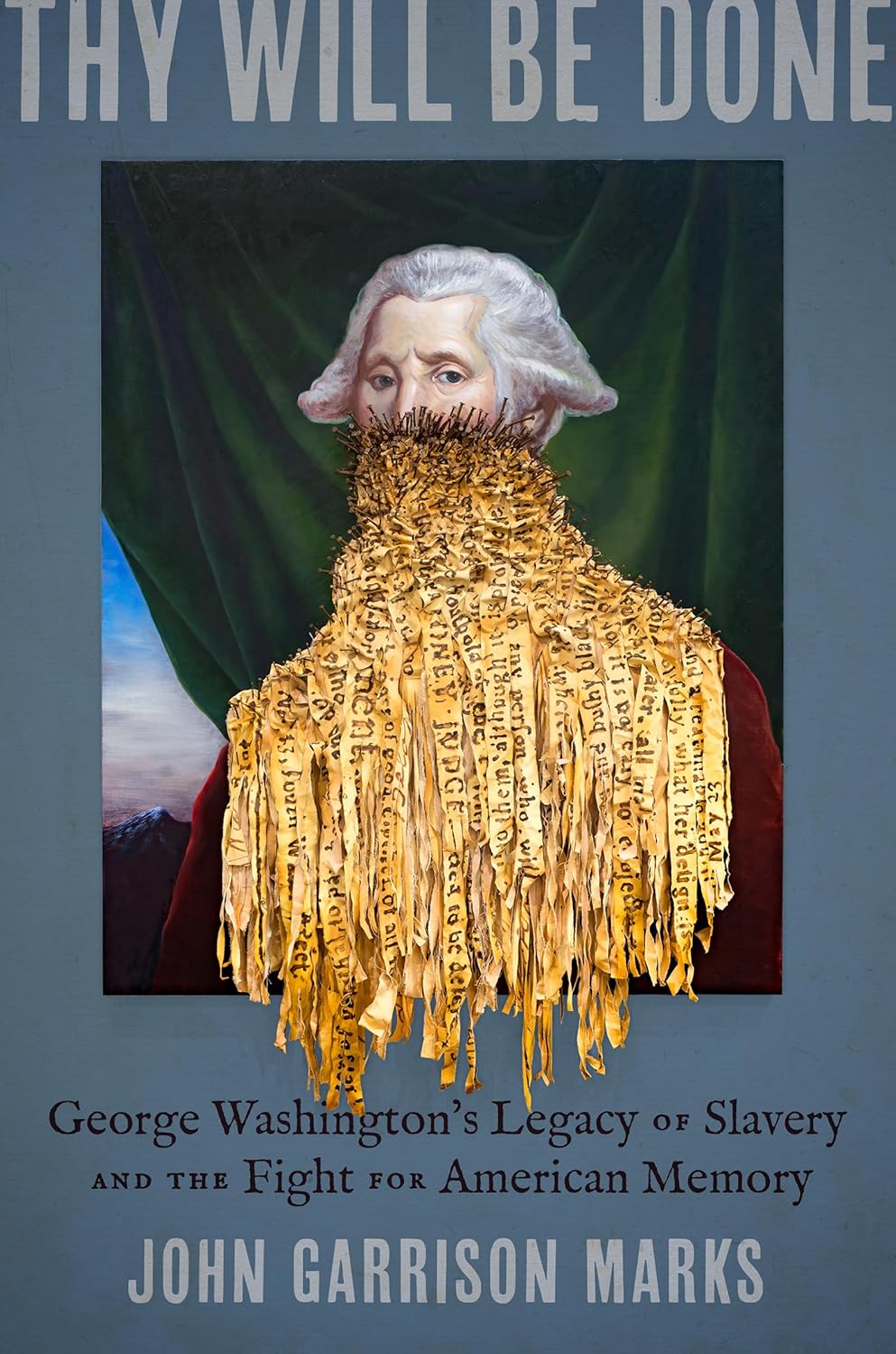
Read More Books: John Garrison Marks, Thy Will Be Done: George Washington’s Legacy of Slavery and the Fight for American Memory (UNC Press, 2026)
Could there ever be enough venues for discussing and digesting books? Absolutely not. And while no one is taking away your capacity to organize a book group in your home, at your local library, or in a local coffee shop, or your ability to check out the voluminous online locations for book chat (BookTok, IG and YouTube bookfluencers, GoodReads), plenty of traditional locations are slowing or shuttering. The last gasp of the Washington Post’s Book World felt like such a blow, though honestly recently I hadn’t read it much either. I still love best the longer review venues in both academic (as in the William and Mary Quarterly and Reviews in American History) and public spaces (Public Books, New York Review of Books, LA Review of Books). Those substantive reflections offer the opportunity for what reads to me like (and what I try to write as when I’m the reviewer) a conversation between the reviewer and reviewed, a meditation more than a quick report.
So why do something so brief as a five questions format here on Commonplace? It’s something of an experiment. I love to read, I love to think about what I’ve read, I love to hear what others, including authors, think about what they wrote. So I’m glad for the opportunity to do this regularly, with the forbearance of the Editor and editorial board.
The structure of “Read More Books” is straightforward. A couple of “why this book” paragraphs, followed by five similar but not always the same questions, and then just a few suggestions of “what else to read.”
Here goes.
______
Why this book?
If there are two rules about early American history, one is that, no matter how vast, George Washington will always be instructive. As anyone reading this will likely know, and as John Marks notes below, a remarkable volume of important research detailing George Washington’s (and Martha Dandridge Custis Washington’s, and their family’s) investment in slavery has been published over the last two decades. In conjunction with critical work on other “founders,” namely Thomas Jefferson, this work has helped usher in a shift in public perspective that has been greeted with angst by those who either didn’t know or don’t want to know about the foundational role of slavery at the founding, but also by relief among the many who did and do.
This book is different. It takes up the question of how this very specific issue about the first president – his role as an enslaver– was debated over centuries. In other words, this was not a phenomenon that leapt upon a settled historical narrative unbidden from the culture wars or the specific spate of racial violence that called forth the Black Lives Matter movement. For me, there was another dimension. As soon as I heard about John’s project some time ago, I was intrigued in part because at one point I checked out a number of copies of Washington’s will printed in the 19th and 20th centuries. Why, I wondered, were so many people keen to have to hand a copy of what Washington willed? In part it has to do with the vexed issue of manumission. John shows, in this book that helps us to see historical memory in motion, Washington and slavery have always been particularly instructive.