Smuggler Lawrence Kelly on the Salish Sea

In the half-century that spanned the end of the U.S. Civil War and the first rumblings of the Great War, the inland waterways of the Salish Sea were less a sleepy backwater than a busy highway that attracted legal commerce and crooked opportunists. Schooners and steamers moved lumber, fish, coal, and people between the growing ports of Victoria, Bellingham, Seattle, Tacoma, and Olympia. But beneath this lawful traffic flowed a darker undercurrent that accommodated the smuggling of opium, liquor, and grimmer human cargo. Few sailors became as caught up in that shadow trade as Lawrence Kelly, a man who evolved in legends that variously characterize him as scruffy seadog, smuggler, varlet, desperado, and thief.

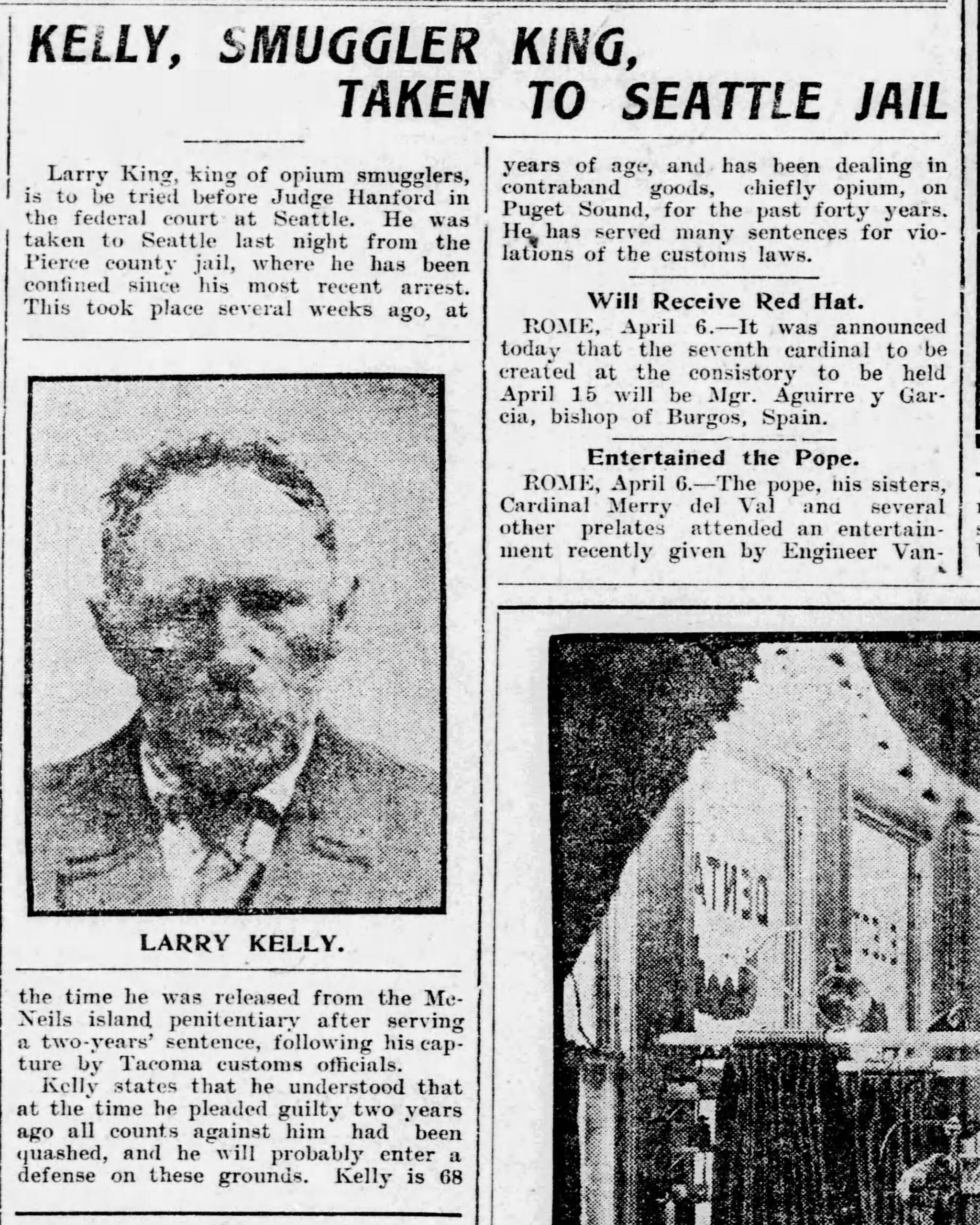
Figure 1: Photo of Larry Kelly from an article about his being moved to Seattle jail. “Kelly, Smuggler King, Taken to Seattle Jail,” Tacoma Daily Ledger, April 7, 1907.

From roughly 1872 until his compulsory retirement from crime some forty years later, Kelly cut a swath through the maritime underworld of the Pacific Northwest. Local lore has it that he knew every inlet and back channel between Olympia, Washington, and Vancouver Island. Accounts pair him with the equally infamous Ben Ure, who is alleged to have combined cunning seamanship with outright brutality. Kelly’s story intersects also with the turbulent transformation of the region. That transformation contributed to the displacement of Indigenous peoples, the boomtown rise of Seattle, the tightening web of U.S. and Canadian law enforcement, and the cross-border networks of Chinese labor migration and the narcotics trade.

Separating fact from folklore in Kelly’s life is no easy task. Secondhand reminiscences and nautical gossip layer much of the available information. Aged and sensational newspaper accounts deepen the difficulty. Records are so sketchy that one can’t be sure whether he served two sentences in federal prison or seven. Nor is the historical record clear about whether he kept the Chinese people safe when smuggling them or tossed them overboard if Customs officials threatened. Sifting the verifiable from the embellished is therefore all but impossible. What I aim to do is share the claims and evidence that others have presented and let readers here decide.

His story is worth rehearsing for its relevance today. A trade war that was ongoing at that time continues. The Chinese Exclusion Act of 1882 made the Canadian border as porous as Mexico’s presently is. The U.S. was assessing duties on Canadian goods. To avoid paying them to his government, Kelly often dodged legal obligation to share his ship manifests. His story is pertinent also with the tariffs on Canada by the current U.S. presidential administration and the detainment and deportation of immigrants to the U.S. whom the government deems to be illegal. As in Kelly’s time, too, immigrants still face perceptions that they rob jobs and strip resources. Yet another point of convergence is fentanyl today and opium then, both substances opioids and both deriving from China, though the deadly fentanyl derives from precursor products in China.

Hazy Origins

Born in Britain in 1845, according to his genealogy in Family Search, Kelly served in the British Army, after which he sailed the high seas and gained the skills he deployed in his future work. It is said he landed in New Orleans during the Civil War on September 2, 1861, and joined an infantry named the Louisiana Tigers. If so, he was only sixteen. Both his names were common enough among Irish immigrants that mistaken identities are likely. Angry after the South lost the Civil War, he vowed that he would “never earn an honest living under the stars and stripes.” And so, he smuggled what goods he could. Products from Canada were being assessed steep customs duties, much like U.S. tariffs in 2025, and there Kelly saw an opportunity. Arrested in 1872 while smuggling silk from Canada and fined, he readily paid it to jump back in the game. The Tacoma Times and other newspapers place his birthdate between 1837 and 1839.

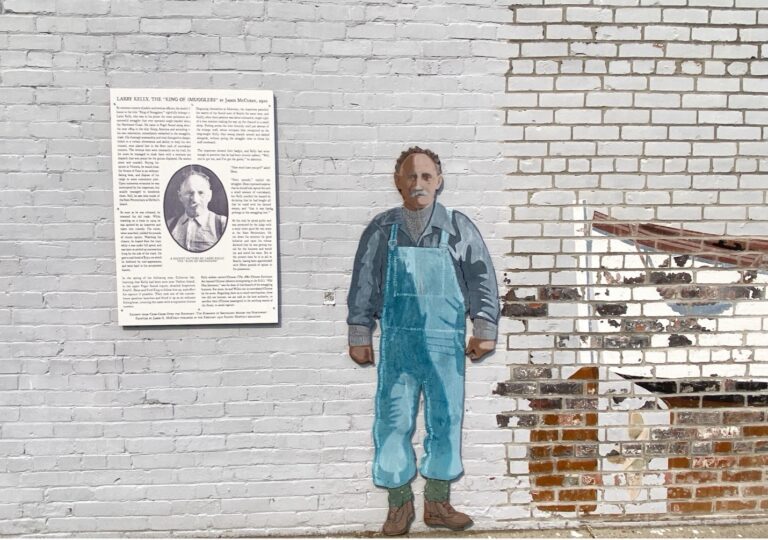
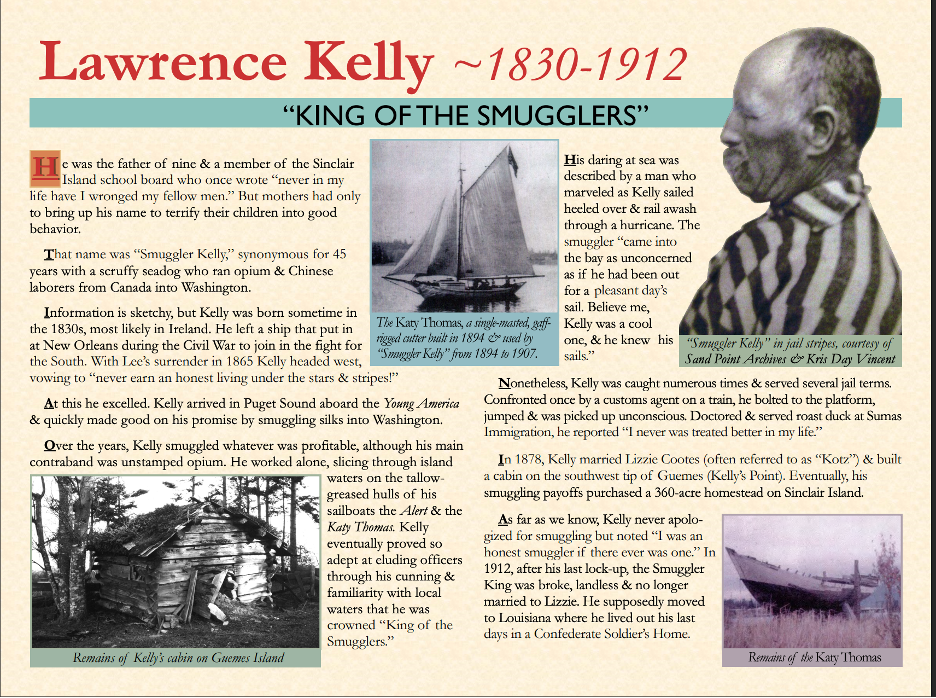
Physically he was 5’5,” his great-great-grandson Tom Day tells me, and he likely died in Los Angeles, not Louisiana. His dark hair receded in the decades that he plied the Salish Sea. Some fellow residents viewed him as “a tough customer. He had a round head, thick brown hair, tousled and uncombed, and a bushy beard grown up high on his cheek bones, so stiff and wiry it thrust forward at a truculent angle from his chin.” Bowlegged when these words were written, he also had bloodshot eyes and “wore a thin shirt and overalls—both dirty—and apparently nothing else. His feet were bare and so browned that evidently this was their usual state.” Those overalls became a signature. A mural in Anacortes, Washington, displays his image in overalls today.

Figure 2: “Smuggler Kelly and his Legend” mural by Bill Mitchell, mounted at 420 Commercial Ave., on the 5th Street wall and part of the Anacortes Mural Project. Photo by Laurie Higman.

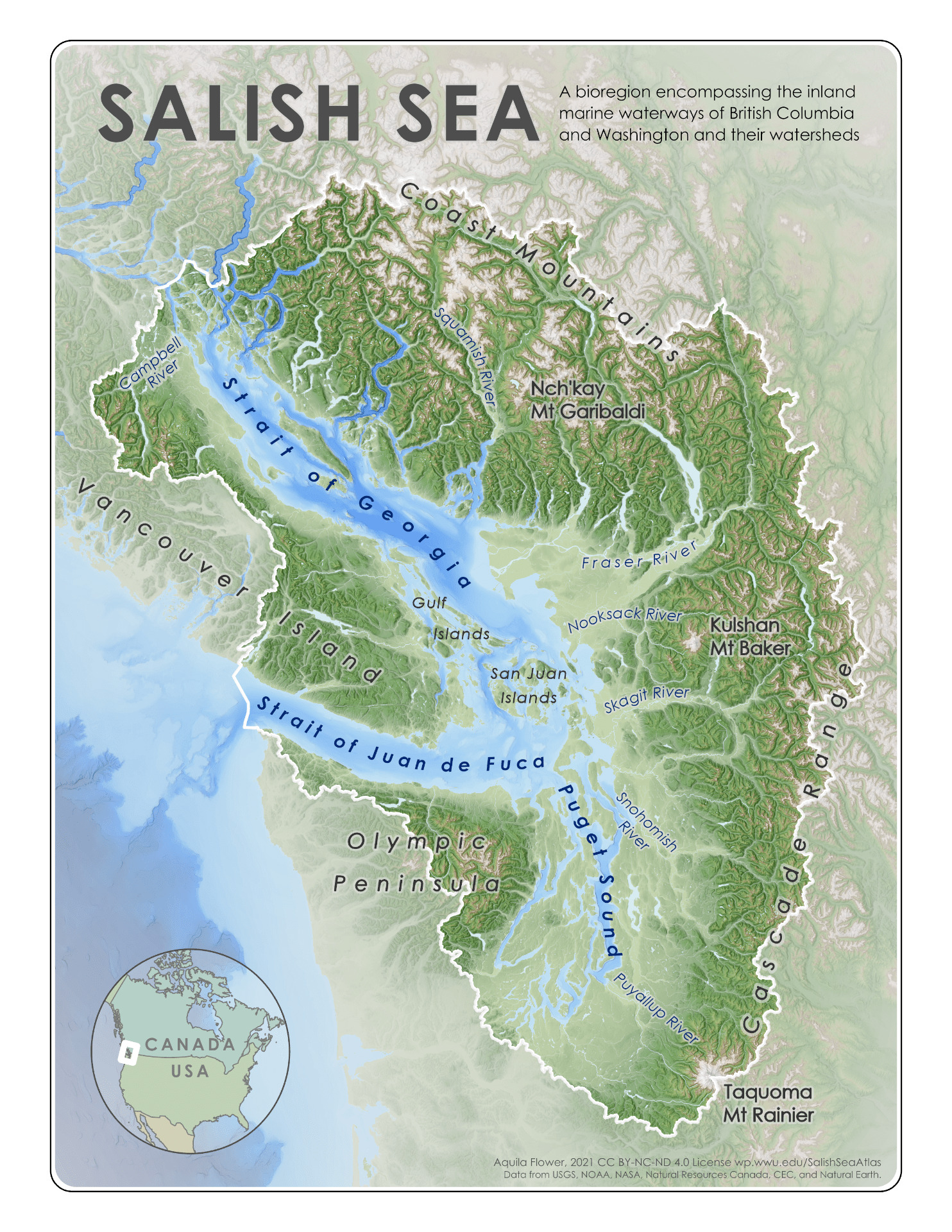
Later photos show him shaven and shorn for appearances in court or—when he failed to offer legal alibi for his behavior—clad in prison stripes. His biggest boats were the Alert and the Katy Thomas, the Katy a 38-foot sloop that sported four sails, a steering wheel, and a broad beam of 12 feet. His sailing skills tilted that big boat over to its gunwale in rough seas. Built in 1894 on Waldron Island, it served him well till 1907. The Salish Sea, as the map here shows, is an inland water body shared by British Columbia and Washington state. Arrested innumerable times, Kelly paid thousands of dollars in fines. He lost a Whitehall rowboat and the Alert to confiscation, and he wore prison garb for many years in the McNeil Island Federal Penitentiary. By some accounts he served seven terms in that prison and was in his seventies when he emerged the final time.

Figure 3: Lawrence Kelly lived and worked on the water and inland islands of the Salish Sea. “Reference Map for the Salish Sea Bioregion, Aquila Flowers, 2020.”

His domestic life was equally chaotic. “He married Lizzie Kotz in 1877 when she was sixteen and he was thirty-two. They had nine children in quick succession,” McDonald wrote, though Family Search gives their marriage date as 1878. Lizzie was an Indigenous woman of the Musqueam Tribe in British Columbia; Tom Day told me. In 1878, the Musqueam (xʷməθkʷəy̓əm) people were a Coast Salish nation living primarily at the mouth of the Fraser River in what is now Vancouver, maintaining deep cultural ties to their traditional lands while facing increasing displacement and restriction following British colonial land seizures and the Indian Act. A Canadian federal statute passed in 1876 by the Parliament of Canada, formally titled “An Act to amend and consolidate the laws respecting Indians,” the Indian Act governed (and still governs, in amended form) the legal status and the rights of First Nations peoples in Canada.

The couple built a cabin on the southwest corner of Guemes Island, a site thereafter dubbed Kelly’s Point. In time, they bought a 360-acre parcel on Sinclair Island, whose title was placed in her name to thwart confiscation because of his crimes. That title transfer confirms he never planned to earn his living within the limits of the law. One son drowned by tumbling down a well on the Sinclair property, leaving them eight kids to raise. Kelly was so often arrested and incarcerated that he depleted Lizzie’s patience and the funds his illicit pursuits had accrued. In October 1883, their Guemes Island property was auctioned publicly, “to satisfy the judgment against said defendant.” Unable to maintain the home and kids, Lizzie sold parts of that property first in 1884 and again in 1886 to discharge legal judgements. The Skagit Land Trust now owns the Kelly’s Point Conservation Area, a 27-acre property that includes 2,100 feet of shoreline.

Asian Trade

In the late 19th century, Chinese immigrants were benefiting the U.S. economy. Many communities in the West welcomed them, regardless of their legal status. They provided labor for agriculture, logging, mining, and manufacturing; dug quarries by hand and helped build the transcontinental railroad; and contributed to the growth of towns and cities through service industries such as laundries and restaurants. At the same time, Chinese immigrants were forced to endure discrimination and lower wages than their white counterparts. They faced hostility and prejudice due to the perception that they robbed locals of jobs. Fueled by economic anxieties and racial prejudice in the 1880s, white agricultural laborers in present-day Issaquah, Washington, murdered Chinese laborers. The perpetrators, brought to trial, were acquitted of their charges.

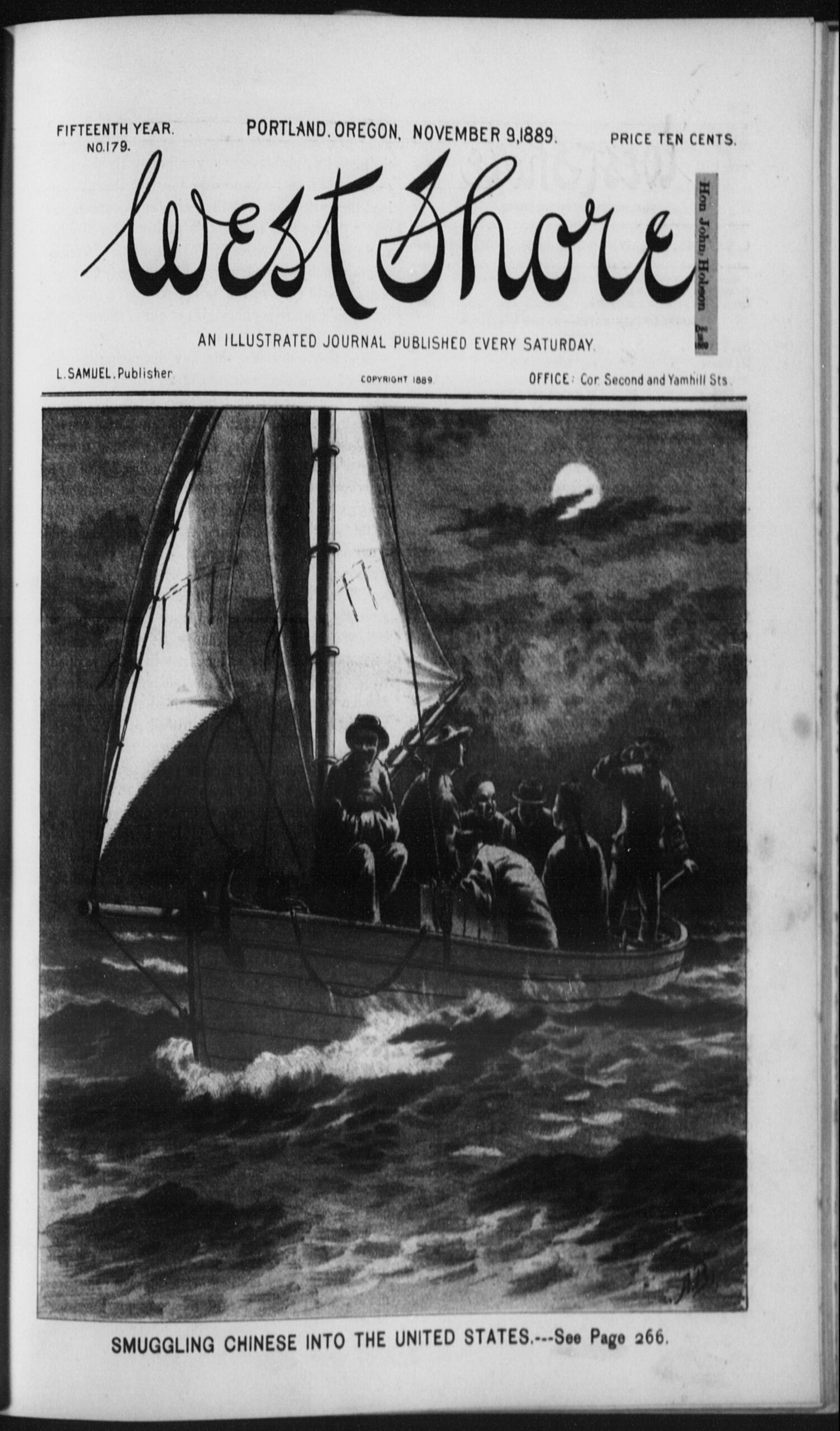
Lawrence Kelly capitalized on the Asian exchange. “The Vancouver–Puget Sound area was widely known as a ‘smugglers’ paradise’ in the opium trade, and Chinese and their American or Canadian guides used the same boats and routes to make the journey to the United States.” Men like Kelly, already active in the cross-border smuggling of products such as opium and wool, found a lucrative new niche by smuggling Chinese people, following the Chinese Exclusion Act of 1882, which curtailed lawful Chinese immigration to the U.S. (British Columbia would later impose the same curtailment.) Victoria became a hub for such immigrants, who could arrive legally in Canada in pursuit of job opportunities. Some chose to pay contract smugglers who conducted them across the U.S. border. Kelly and a cohort trafficked Chinese expats by weaving throughout the San Juan islands into safe and secret harbors on U.S. shores.

Figure 4: “Smuggling Chinese into the United States,” West Shore 179 (November 9, 1889).

His sometime-partner Ben Ure, like Kelly, married an Indigenous woman. Ure lived at the north end of Whidbey Island on an eleven-acre island that took his name. There the couple ran a dance hall and saloon. Ure’s wife aided his hide-and-seek smuggling operation. Local lore says he camped her on nearby Strawberry Island in Deception Pass, for its view to the west, to deploy a signal fire after dark to bring ashore the Chinese that the men had loaded in Victoria. The same lore claims Ure devised the nasty practice of tying up the Chinese in weighted burlap bags. If Customs agents approached, the story goes, he flung them overboard. Immigrants had to be reckless and desperate to agree to be bagged up like corpses at the outset of their trip to the promised land.         

Another telling story with compelling detail has come down. An acquaintance conversing with Kelly, after seeing his sloop at Square Bay on the corner of Guemes Island, reported, “The two men chatted awhile, then Kelly shouted, ‘Come out, John, he’s O.K,’ whereupon the tall grass erupted Chinese. One seemed to have been hiding behind every bush around the bay.” “John” was a generic nickname imposed by white Americans. In newspapers, court records, and police logs of the time, Chinese men were often referred to generically as “John Chinaman” or simply “John,” regardless of their actual names. The name became a kind of racial shorthand, like “Pat” for Irish immigrants or “Ike” for Jewish immigrants. They paid Kelly to connect them with other Chinese. Whether Kelly succeeded always in uniting them with comrades is unknown, likewise whether he always saw to their safety after he had conducted them across the international line. Certainly, though, he needed to have some respectable intercultural communication skills to pacify his customers and to stymie potential mutinies en route.

Kelly was a coyote and a trickster. In immigrant circles, principally on the U.S.-Mexico border today, a coyote smuggles immigrants for a fee. A loanword from Mexican Spanish, it refers obliquely to the wild canine known for its cunning nature. This dual meaning reflects the perception of human coyotes as tricksters, as people who know how to navigate border landscapes and authorities with resourcefulness. Kelly admitted he sometimes lied to his human cargo and dumped them back on Vancouver Island if or when “officials threatened.”

Payment for passage could be substantial. “The cost of a border crossing along this route ranged from twenty-three to sixty dollars in the 1890s. One decade later, entry through Washington State could cost up to three hundred dollars.” That $300 equates to $10,000 in 2025 purchasing power. Multiply it by a boatload of Chinese people, all of them looking for a new life in the U.S., and it’s no wonder Kelly was willing to flout fines, jail, and prison time.

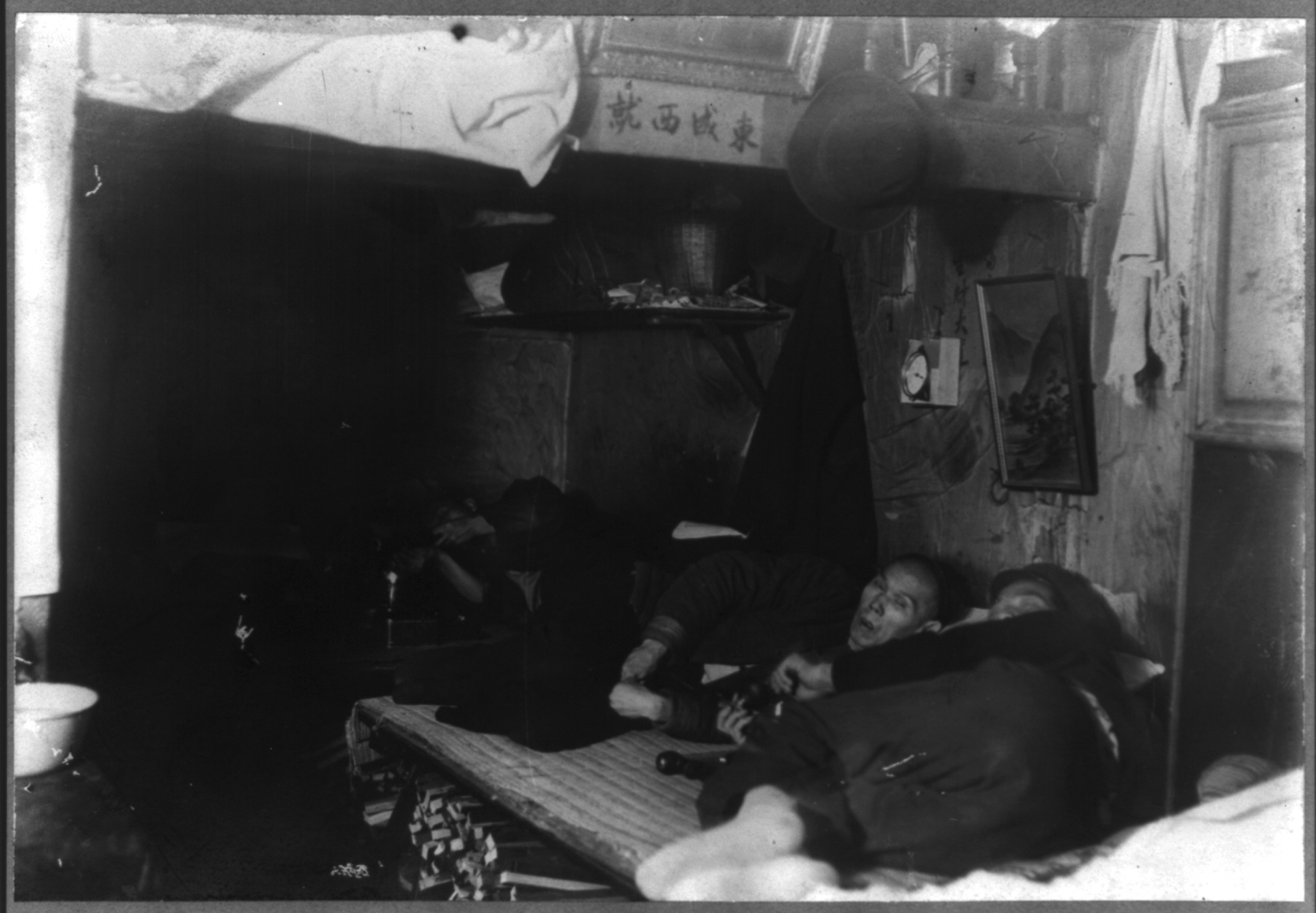
The depressant opium had close ties to Chinese immigration. That product derives from the same species of poppy used today to make codeine, morphine, and heroin. Even before the Exclusion Act, opium was heavily taxed in the U.S., arriving from Canada in inexpensive and plentiful quantities. Chinese immigrant communities in Seattle, Tacoma, and Portland smoked a lot of it. Many Anglos— stereotypically sailors, laborers, and gamblers—indulged in opium as well. Kelly could transport the stuff from Victoria into towns in Puget Sound at a high markup, often right alongside compatible human cargo. Chinese wine and silks also often made the trip.

Figure 5: Chinese men smoking opium in Oregon, ca. 1905. Herbert C. Forbes, Chinese Opium Joint, ca. 1905. Photograph. Courtesy of the Library of Congress.

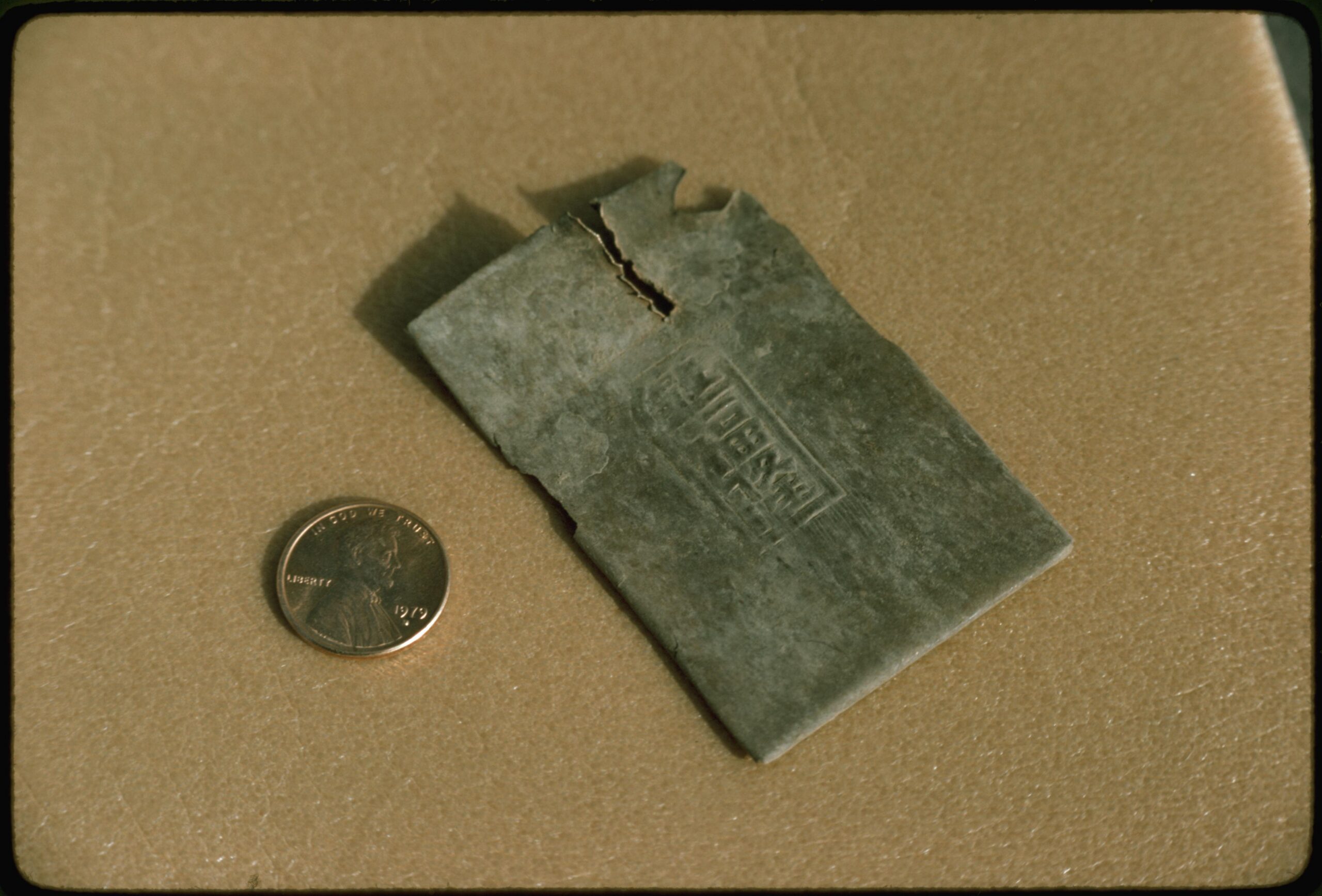
Little is known about the exact economics of his operations, but he might have leveraged legal cover to conduct his business. Smugglers like him sometimes operated fishing boats or freight schooners as disguises. His skills with sail and oar were so adept that Kelly could outrun slower steam-powered Customs boats in his sloops. His work also necessitated firearms. Kelly’s sloop the Alert held an arsenal. That boat was confiscated along with a load of opium, after which U.S. marshals sold it for $3,221.83. In other crimes he also chose to brandish weapons.

Figure 6: The lid to a Chinese opium tin. Carl Fleischhauer, Chinese Opium Tin, 1979. October. Photograph. Courtesy of the Library of Congress.

Opium smuggling at that time is comparable to fentanyl smuggling today. Both sedatives are made from raw materials manufactured in China and exported to U.S. markets. The British East India Company first grew opium in Bengal and sent it to China to address a trade imbalance. The British were buying large quantities of Chinese goods—porcelain, silk, and tea—but Britain sold too little stuff to China. Such an imbalance led to Britain using opium as a trade commodity with China to balance the national books, eventually causing widespread addiction.

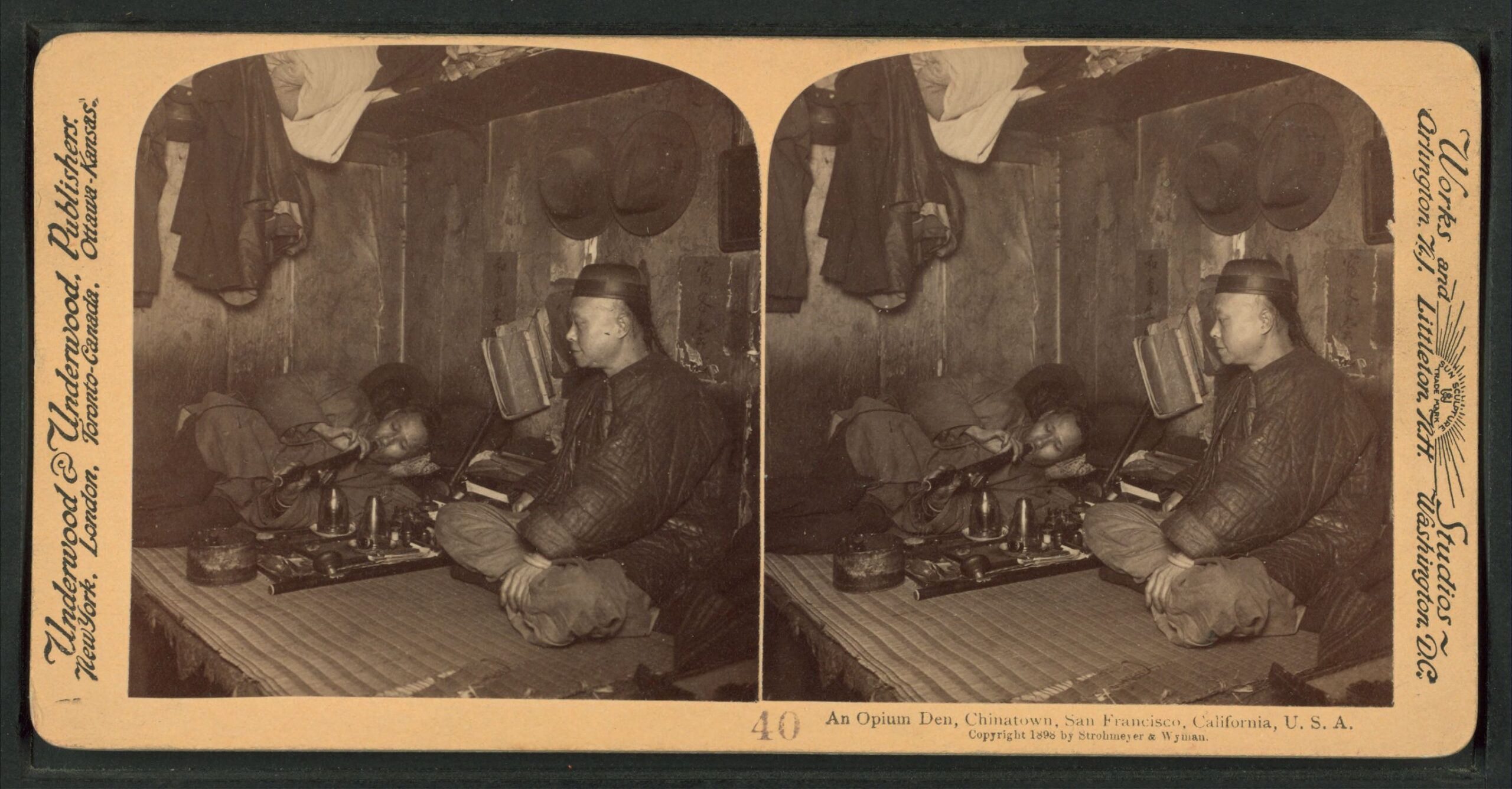
Lawrence Kelly scored his opium from Chinese factories in Victoria. “Crude opium from India and China was cooked and made into round chunks as big as a bowling ball,” Calkins wrote in 1952. Chinese cooks simmered the gum and sap of the poppy over a charcoal fire, stirring and skimming as it simmered. The Ly Yuen factory in Victoria provided a steady supply, as did a half-dozen other thriving factories on Vancouver Island. It made its way to U.S. markets both as a smoking-grade and a pharmaceutical-grade product. Some 100,000 of the Chinese immigrants in the western U.S. used it. Many of them were addicted. White smokers also were known to have frequented opium dens in Seattle. Middle-class Americans ingested opium in the tincture called laudanum and in patent medicines that required no prescription. Benjamin Franklin and Alexander Hamilton used opium orally to treat their ills. Edgar Allan Poe and Louisa May Alcott were reportedly addicted.

Figure 7: “An opium den, Chinatown, San Francisco, California.” (1898) The Miriam and Ira D. Wallach Division of Art, Prints, and Photographs: Photography Collection, New York Public Library Digital Collections. Accessed January 6, 2026.

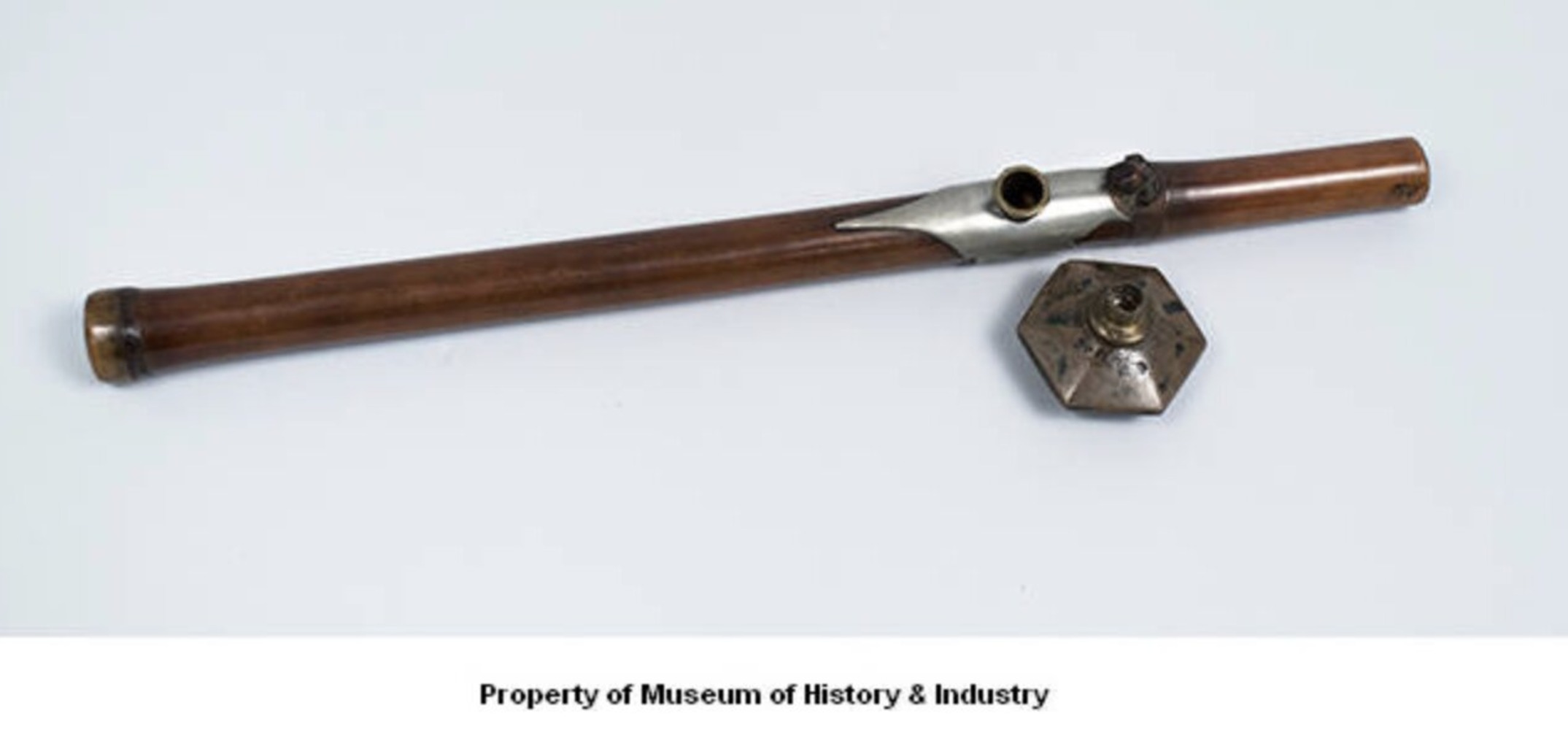
Opium for smoking was packed in small tins, each weighing about half a pound. To avoid the U.S. tariffs and inspections imposed in the 1880s, some tins were left unstamped—that is, missing the adhesive seal that showed the duty had been paid. “One of the more macabre methods was to send opium across the border in coffins.” Kelly sometimes hid the weighted opium tins by tying a line to an underwater ringbolt on his hull and dragging them, as if trolling for fish. On land the tins were toted in satchels or in greatcoats with yawning inner pockets. He also sometimes squirrelled the tins on beaches for retrieval later, a process known as relaying.

Like rumrunners a short time later, Kelly would have called himself an honest man and denounced the laws as wrong. Opium laws were never overturned like Prohibition was, though. Kelly paid his debts, raised a family, and served on the Sinclair Island school board. In 1886 in Tacoma, Washington, he was arrested with a load of “567 tins of opium, equivalent to 364 pounds. He was held on a bail of $3,000. In the end, he was fined only $100, but the seizure of his boat threatened to end his career.” Worse, he was sentenced to another term at the McNeil Island Federal Penitentiary. At that point in their marriage, Lizzie had to sell the last of their Sinclair Island acreage. Twenty-three years later, in 1909, the Opium Exclusion Act in Canada barred the export of opium, putting even more clamps on Kelly’s illicit career. By then, too, his legal and domestic failures had begun to grind him down.

Figure 8: Bamboo opium pipe confiscated in a police raid in Seattle’s Chinatown, ca. 1900. Museum of History & Industry, Seattle, 1969.5072.74.

His brutality is broadly alleged. “When danger threatened and his boat was trying to outrun the law, he is said to have bound his passengers and dumped them overboard to drown.” Moreover, “Dead Man’s Bay off San Juan Island came by its name because the tide often washed the bodies ashore at that location.” Others say he disguised the Chinese as vegetables in wool or burlap sacks. So certain was R.H. Calkins that the Chinese were thrown overboard in the heat of pursuit that he illustrated the practice in his 1952 book, captioning it “Evidence of Smuggling Destroyed.” Recent research also shows that some Chinese immigrant women and girls brought to the U.S. in the late nineteenth century were trafficked and forced into prostitution. Historians and other scholars today characterize their condition as a form of sexual slavery.

Illustrious scuffles

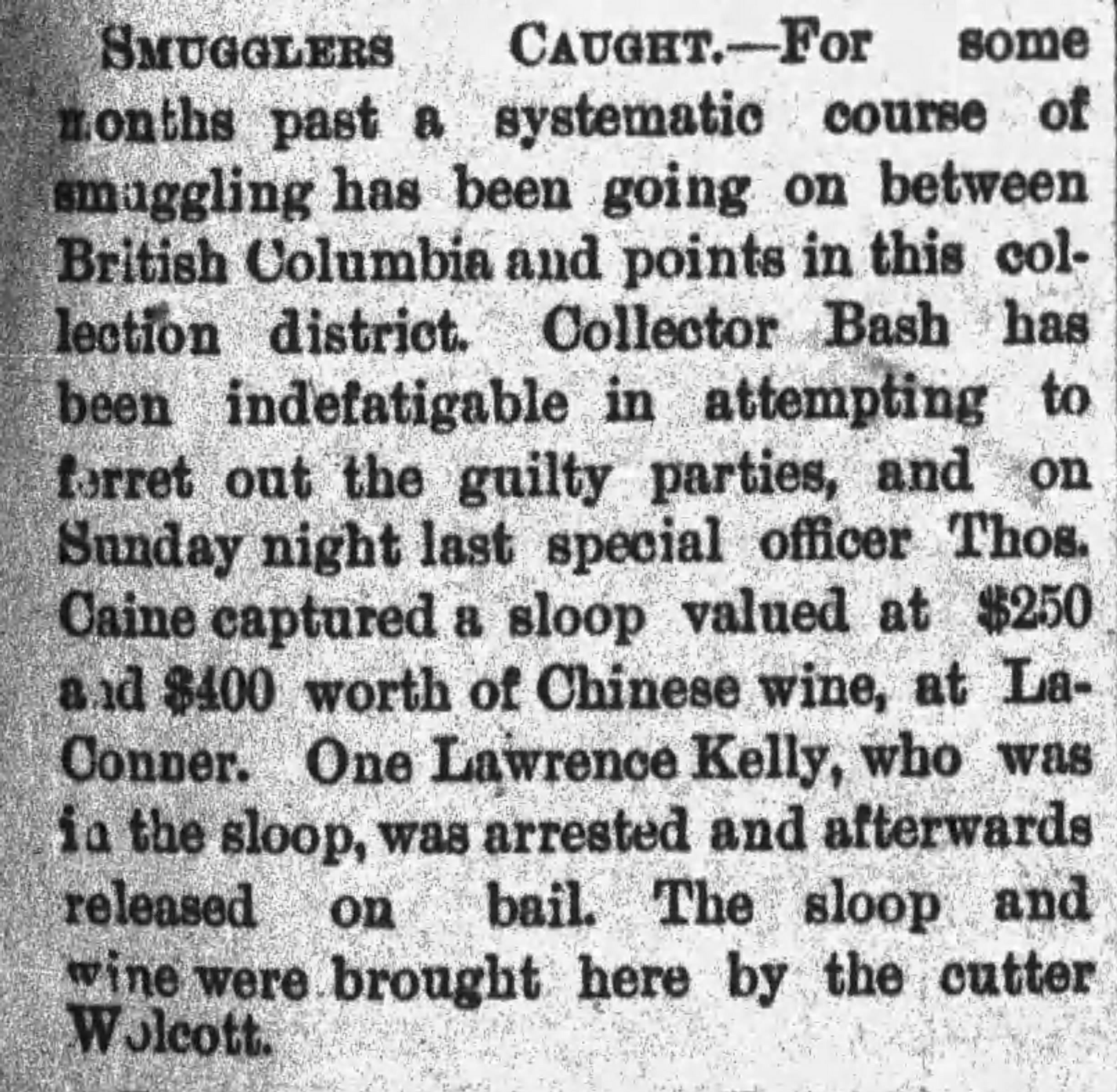
Figure 9: Lawrence Kelly Arrested for smuggling Chinese wine. “Smugglers Caught,” Puget Sound Weekly Argus, December 22, 1882.

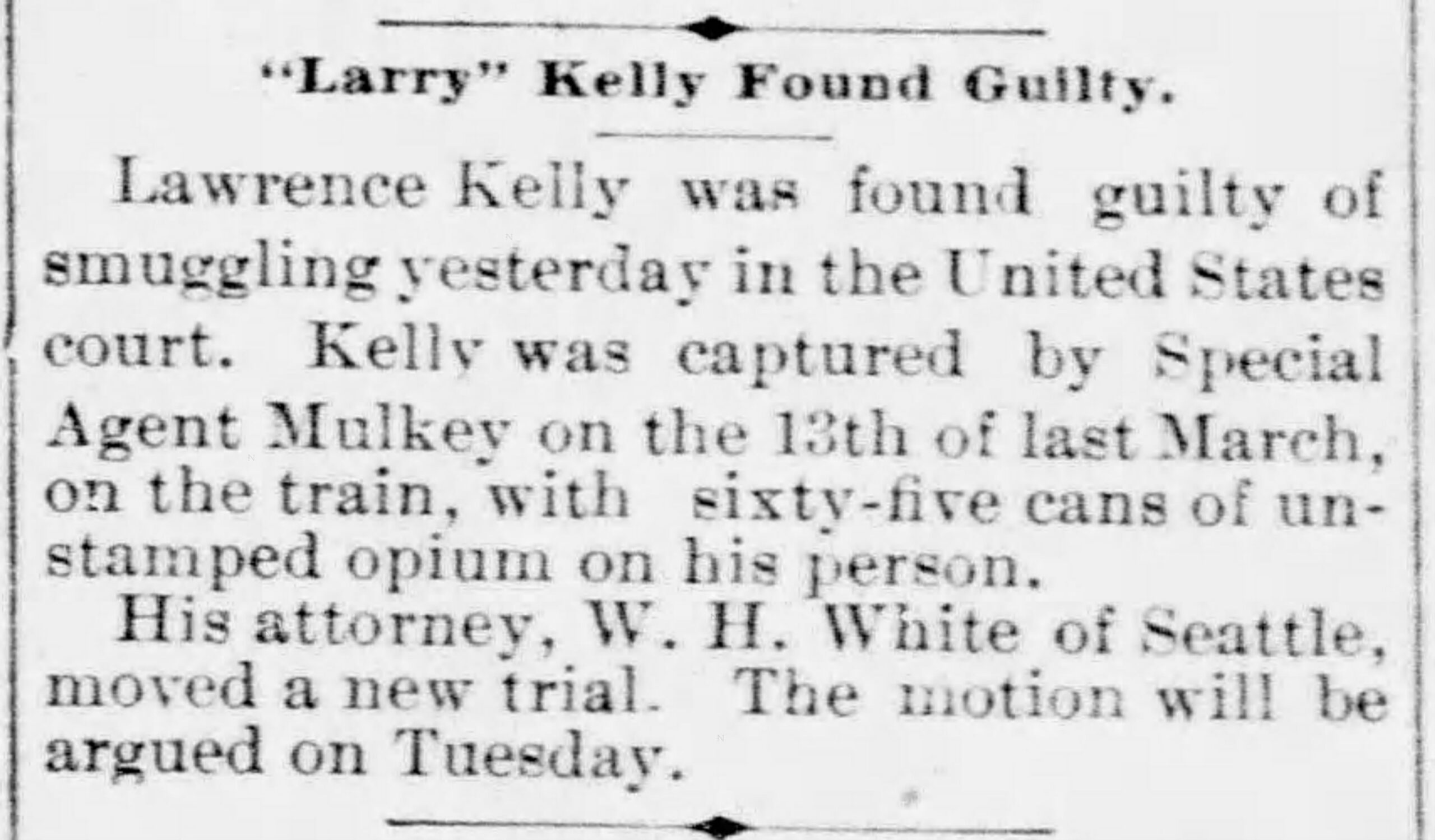
Another anecdote finds Kelly in Olympia, the capital of Washington state, in 1891. Docking and walking the fifteen miles from the water to Tenino, he boarded a southbound train carrying a satchel that held sixty-five half-pound tins of opium. Whether his movements had been tracked beforehand, or agent Charles Mulkey of Tacoma just happened to identify Kelly on the spot, he seized the satchel, discovered its contents, and arrested him. Mulkey then demanded that a witness on the train accompany the pair back to court in Tacoma. How Kelly emerged from that scuffle is not known, but he often paid his fine to keep his business active. Kelly would have had to offer up real estate as surety in lieu of a bondsman, which explains why Lizzie had to sell off the Sinclair Island property on his behalf in 1884 and 1886.

As the most active singlehanded smuggler on the Salish Sea, Kelly “pursued his chosen occupation with an obstinacy that seems almost admirable” Richardson wrote. In January 1904, agent Fred F. Strickling boarded a train in Sumas, Washington, and had Kelly dead to rights. Ordered to open his fresh new valise, Kelly resisted and fled down the aisle. He “leaped from the train, while it was moving at full speed, to escape capture.” Inside the valise that Kelly had abandoned, Strickling found sixty-five tins of unstamped opium. He pulled the emergency cord, the train backed up, and Kelly was found barely conscious, wounded badly from the tumble, wearing a pistol. In Bellingham he was arraigned, posted bail, and disappeared, making him a fugitive of the law. Kelly’s trades were small compared to competing commercial steamers, which could transport up to 3,000 pounds of unstamped opium in a single outing.

Figure 10: Larry Kelly found guilty for smuggling Chinese opium. “‘Larry’ Kelly Found Guilty,” Tacoma Daily Ledger, July 19, 1891.

Busted smuggling alcohol, furs, opium, woolens, and humans, Kelly spent as much time in the calaboose as running contraband. He was also a thief. He grew desperate late in life, no longer able to support a family or afford a mortgage. In 1896 he swiped a toolbox a carpenter left on an Anacortes wharf. A search party, discovering him asleep in a cabin, clapped him into cuffs. “While their boat was docked, Kelly jumped overboard and disappeared into the water. He somehow swam away, even though he was handcuffed.” The thefts continued. “Because Kelly was known to be in debt due to his fines, he was suspected of the thefts, but no proof of his guilt ever surfaced.” Mothers and their children trembled at mere mention of his name. By this time, Lizzie was pulling far and fast away from her deadbeat husband.

A smuggler and a thief, Kelly also became a desperado as his fortunes declined. Afraid of risking prison once again, he buried opium on islands as stash. He treated his red-hot contraband like cash, awaiting a future that might be safer to distribute it. Islanders reported seeing him grubbing about for tins whose exact locations he had forgotten. He maintained a gruff interest in the Sinclair Island acreage after Lizzie had to sell it off. He threatened the new owners when they cleared a patch of ground above a spot where he had cached the drugs. Burnt and demolished tins that once contained the opium were discovered on the same site later.

His desperation reached a fever peak in 1898 when Lizzie moved to Anacortes and took away the kids. She moved there for a paid job as housekeeper for a man whose wife lay in the hospital. Furious that she was cohabiting with another man—no matter that his crimes had made her destitute—Kelly showed up drunk at the house armed with a pistol and threatened to murder her. She fled to a neighbor’s house. He dodged the marshal and came again the next day, whereupon Lizzie filed a formal complaint against him to protect herself and the children. In 1884 he had been charged with a deadly-weapon assault, unspecified “crimes against the laws of nature,” and “charges that would show him to be a brutal wretch in his own home.” In other words, he turned his desperation and his anger on his family and physically abused them.

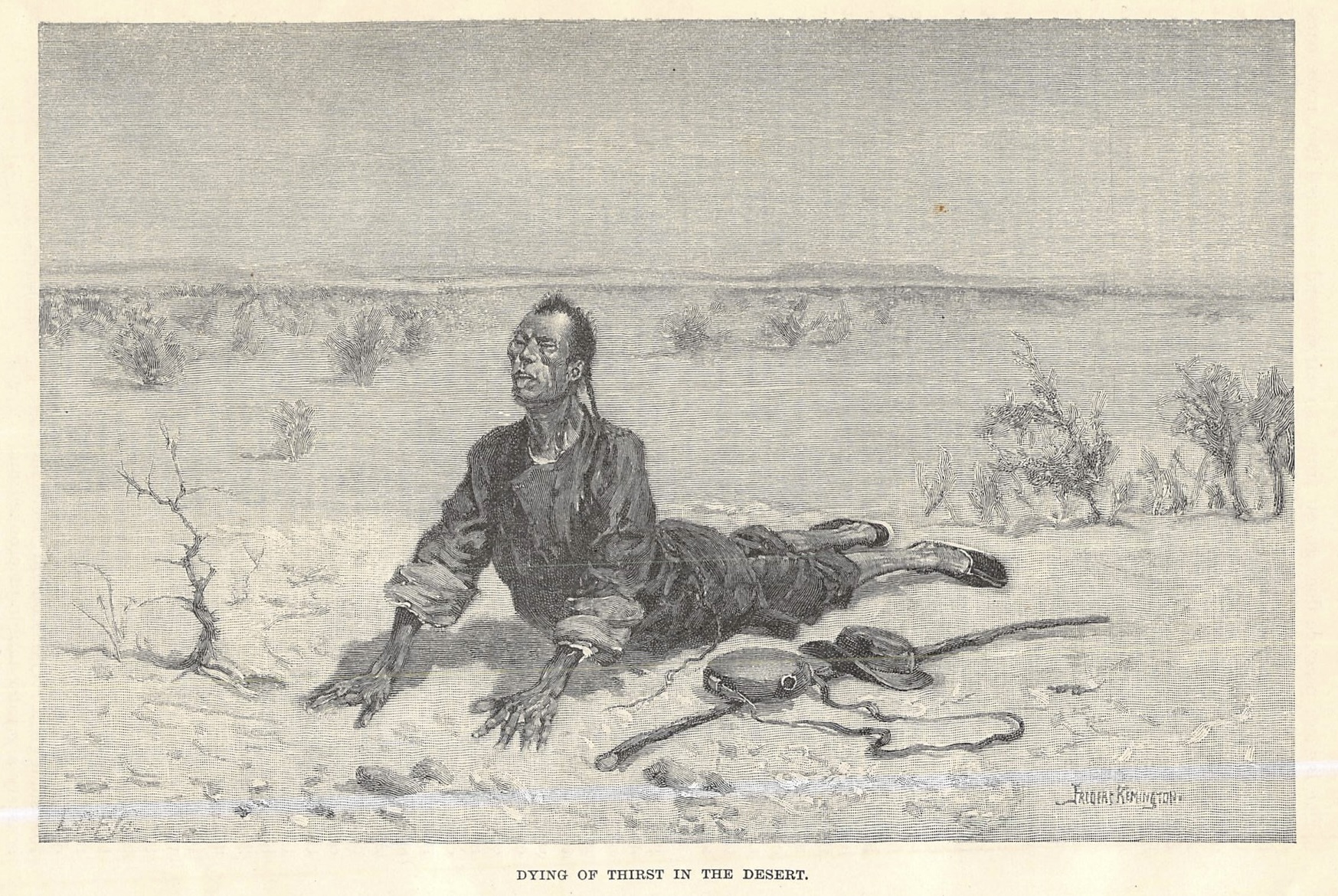
Kelly has a reputation as a colorful character, despite all his grave misbehavior. That reputation traces to “a certain romantic aura connected with the intrepid smuggler who plied rough waters in an open craft, cached merchandise on secluded beaches, transmitted coded messages by lantern light, and rendezvoused with compatriots late at night—all the while remaining beyond the dogged pursuit of ‘revenuers,’” Moore wrote in 2014. The Frederic Remington painting Dying of Thirst in the Desert captures that period more realistically. Issued in Harper’s Monthly for March 1891, it shows a Chinese man abandoned by his smuggler. In the Salish Sea, islands stood in for barren desert sand. A group of Chinese people, deserted when a customs boat drew near, survived only by eating clams they dug by hand. Eventually a minister rescued them from “China Rock.” The grimmer details of his smuggling operation, impossible to confirm, have perhaps been calculatingly expunged from the historical record by his admirers.

Figure 11: Frederic Remington, “Dying of Thirst in the Desert,” Harper’s Monthly (March, 1891), 522.

Summing up
By the time he was in his seventies, Kelly found odds stacked high against him. His wife was gone, his property sold off, his rocky legal record tough to overcome. Then, too, “the customs office obtained better boats with more skilled crew including, in 1903, the 85-foot revenue cutter Arcata, a converted steam tug equipped with powerful searchlights, machine guns, and even a one-pound cannon accurate to 500 yards (and a captain eager to use it).” James McCurdy could already foresee Kelly’s end, when he wrote in 1910 that “the picturesque contraband ferry-man of the Northwest seems fated to soon become extinct.” The reports of Kelly’s final years disagree about his eventual end. Many claim he contacted the Louisiana chapter of Daughters of the Confederacy and went to a soldiers’ home to spend his final years, though Family Search reports him dying in Los Angeles at an unspecified time, which is also where his third child, daughter Patricia, lived with her husband, according to his great-great-grandson Tom Day.

Figure 12: Anacortes Museum. Colorful Characters and Local Lore. Anacortes, WA: Anacortes Museum, 2008. Accessed August 27, 2025.

Lawrence Kelly’s life straddled the blurred line between folklore and fact, between cunning seafarer and ruthless criminal. He was at once a family man and a fugitive, a neighbor on Guemes and Sinclair Islands and a menace to the authorities who dogged him. His story, pieced together from rumor, court records, and sensational newsprint, needs to be invented anew. He was a species of phantom. Smuggling linked him to global trade wars, immigrant struggles, and narcotics routes that foreshadow today’s debates over tariffs and borders. Similar struggles devastate U.S. families today. Whether Kelly is remembered as a “picturesque contraband ferry-man” or a brutal desperado, he embodied the contradictions of a region and an era in transition, his career fading with the age of sail and the tightening grasp of modern law enforcement.

Further Reading:

R.H. Calkins, High Tide, Marine Digest Publishing, 1952; Helen Troy Elmore, This Isle of Guemes, Caxton Printers, 1973; David Richardson, Pig War Islands, Eastsound, WA, 1990; Lucille McDonald, Making History: The People Who Shaped the San Juan Islands, Harbor Press, 1990; Erika Lee, At America’s Gates: Chinese Immigration during the Exclusion Era, 1882-1943, University of North Carolina Press, 2003; Priscilla Long, “White and Native American Hop Pickers Attack Chinese Workers in Squak (Issaquah) on September 7, 1885, HistoryLink, July 1, 2000, https://www.historylink.org/File/2746. Stephen T. Moore, Bootleggers and Borders: The Paradox of Prohibition on a Canada-U.S. Borderland, University of Nebraska Press, 2014; Farris, Megan S. North of Gold Mountain: Chinese Women in the Pacific Northwest During the Exclusion Era. Master’s thesis, Western Washington University, 2025. Western CEDAR. https://cedar.wwu.edu/wwuet/2420. David Lai, “Chinese Opium Trade and Manufacture in British Columbia, 1858-1908, Journal of the West 38, no. 3 (1999): 21-26; Lynn Weber-Roochvarg, “San Juan Islands: Smugglers’ Haven,” HistoryLink, June 7, 2025, https://www.historylink.org/File/23319; Elizabeth Gibson, Outlaw Tales of Washington, TwoDot Books, 2011. “Colorful Characters and Local Lore,” Smuggler Kelly and his legend. Mural no. 041 in Bill Mitchell Mural Project. Anacortes, WA. “Smuggler Kelly and his legend,” Colorful Characters and Local Lore exhibit, Anacortes Museum, 2008. Accessed August 27, 2025. https://www.billmitchellmuralproject.org/murals/041; “Execution Sale of Real Estate,” Puget Sound Mail, 11.11 (Sept. 8, 1883), p. 2; “At 73, ‘Larry the Dope Smuggler’ After 7 Times in Prison, Is Free,” Tacoma Times 7.106 (April 22, 1910), p. 6; “County News,” Northwest Enterprise, 1.43 (Jan. 13, 1883), p. 3; “Smuggler Kelly’s Troubles,” Anacortes American, 4.36 (Jan. 18, 1884), p. 1; James G. McCurdy, “Criss-Cross Over the Boundary: The Romance of Smuggling Across the Northwest Frontier,” Pacific Monthly, 23.2 (Feb. 1910): 182-93; Marge Davenport, Afloat and Awash in the Old Northwest, Paddlewheel Press, 1988; Holden, Brad. 2023. “Seattle’s First War on Drugs (1880–1925).” HistoryLink.org Essay 22666. https://www.historylink.org/File/22666; John Nowels, “Cartel-fueled Fentanyl Crisis Flooding Washington through Northern Border.” Spokesman-Review, August 10, 2025, 3; “At 73, ‘Larry the Dope Smuggler’ After 7 Times in Prison, Is Free,” Tacoma Times, April 22, 1910, 6; “History of Smuggling in the American San Juan Islands.” Heroes, Heroines, and History, February 20, 2019, accessed August 27, 2025. https://www.hhhistory.com/2019/02/history-of-smuggling-san-juan-islands.html; Karen L. Borell, Bowman Bay, Deception Pass State Park: A Cascadia Marine Trail Site History. WWTWA, June 21, 2017, accessed August 27, 2025; https://www.wwta.org/wp-content/uploads/2017/03/BowmanBDecPass_KarenBorel6_21_17.pdf;  “FamilySearch Person Profile, ID K262-3YC,” FamilySearch, accessed August 27, 2025. https://www.familysearch.org/en/tree/person/about/K262-3YC; Tom Day, telephone interview, Sept. 3, 2025; Dying of Thirst in the Desert. ca. 1890. Catalogue number 01144. In Remington Catalogue, Buffalo Bill Center of the West. Accessed August 27, 2025. https://centerofthewest.org/catalogs/remington/?view_id=1156.


This article originally appeared in February 2026


Paul Lindholdt received his PhD from Penn State and has collaborated on or authored ten books. This article is part of his book-in-progress with the working title “Rogues and Renegades in the Evergreen State.” Find his professional website here.