Vital Records: Karin Wulf’s Lineage and the New New Family History

Following his famed road trip of 1831, Alexis de Tocqueville observed that Americans fancied themselves individualistic democrats who somehow also yearned for a hallowed lineage. “You hardly meet an American who does not want to be connected a bit by his birth to the first settlers of the colonies” he reported. And “as for branches of the great families of England, America seems to be totally covered by them.”

This same paradox is familiar to historians of genealogy: the American Revolution as an ideological rupture that nevertheless unlocked interest in origin stories. As François Weil described in Family Trees, “The first generation of Americans questioned the compatibility of genealogy and republicanism.” This tension “could be resolved, but only if Americans imagined acceptable forms and contexts for displaying their genealogical interest.” By the 1790s, genealogy became a site of entrepreneurialism with new printed-in-America Bibles and fill-in-the-blank genealogical registers available for purchase. By the nineteenth century, burgeoning historical and genealogical societies published select family biographies to share within communities.

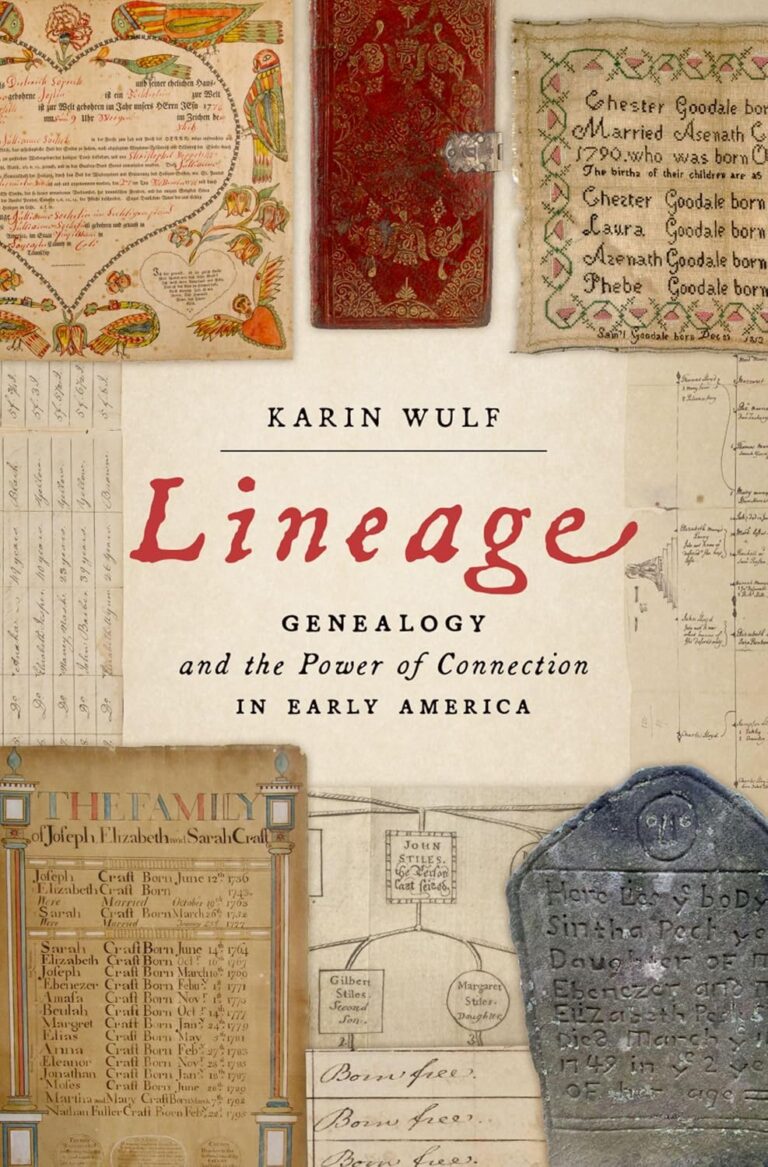
Karin Wulf’s much-anticipated Lineage: Genealogy and the Power of Connection in Early America does not dispute the reticence of the founding generation, certainly not their ambivalence toward anything that smacked of aristocracy, but she does show that early Americans’ notorious disdain for lineage was less than sincere. 

Figure 1: Karin Wulf, Lineage: Genealogy and the Power of Connection in Early America (Oxford University Press, 2025).

In a letter to Sir Isaac Heard, Garter King of Arms at the College of Arms in London, George Washington shrugged off interest in his family’s coat of arms, explaining that the nascent United States had little use for pedigree. Wulf corrects: “The president dissembled. Washington had long been interested in the history of his family, and deeply invested in the symbols of his paternal lineage” (243-44). Not only was the family coat of arms already familiar to him, but Washington had previously commissioned a silver service etched with the familial shield for Mount Vernon (244). The men and women of the Revolutionary generation were ambivalent, because they were reworking existing cultural forms to meet the exigencies of their moment. Washington rejected calls to make membership into the Society of Cincinnatus inheritable. And yet, Wulf quips, Washington “still fussed about the way his coat of arms would appear on his carriage in 1790, wanting to be sure it was just so” (247).

Figure 2: George Washington’s Coat-of-Arms on a bookplate, MVLA, photo by Mark Finkenstaedt, Mount Vernon.

In this duality, Wulf counters the narrative of rupture and instead points to a “critical continuity” between the genealogical culture of British America and the new nation (284). “For diverse people across British America, the expectation of patrilineal family structures did not always or even often fit their experience,” Wulf argues, “but because it so saturated institutions of power, they could identify the benefits of shaping their family—or representing their family—to fit it” (5). Genealogy was not inert; to the contrary, it proved astoundingly adaptable and resilient.

Lineage tackles this core genealogical consciousness (to borrow again from Weil) of British America to the United States in an under-appreciated era: the long eighteenth century. Over the course of eight chapters, Wulf unpacks the relationship between genealogy and power in a wealth of spaces–religious and political texts, material objects, death customs and inheritance, birth and labor law, chroniclers, kinship networks and trade, state formation–to genealogy as foundational knowledge that tethered individuals into the new nation.

Lineage’s scholarly contributions are immense. But I would note that part of the book’s vibrancy derives from its engagements with the rich innovations in family history that emerged out of the histories of women, gender, and sexuality of the past few decades—a new “New Family History.” Wulf has been instrumental to this scholarship, and it shows.

“Accounting for family—genealogy—
was at the heart of an empire, and then a nation” (9).

First, Lineage stakes a claim for family’s centrality to early American history, from the intimate to the imperial. Frankly, as anyone who teaches or writes on the topic of family can testify, the concept is notoriously difficult to define. Genealogy is similarly complex, but Wulf adeptly demonstrates just how useful it is, methodologically. While genealogy can be personal, to understand its power requires reckoning with the evolution of publicly defined vital records. As Wulf argues, “How individuals or families feel about their relationships is important, but the structures within which those relationships confer resources are a crucial historical development” (282). In centering “power and connection,” the book demonstrates how a particular model of genealogy structured institutions and identities in profound ways throughout the eighteenth century that continue to shape our lives.

Unpacking that model yields considerable rewards.

Chapter 1 revisits themes from her 2012 Early American Studies article on “Bible, King, and Common Law” as overlapping bedrocks of British genealogical authority (47). The familiar language and iconography of royal, religious, and patriarchal authority intertwined through public displays of genealogical lexicons and iconographies. The King James Bible, first published in 1611, included Biblical family trees illustrated by John Speed. Even Puritan ministers read the King James Bible aloud from the pulpit. John Eliot translated his King James for New England Indigenous populations, a text that was sufficiently popular for demanded reprintings (29).

Figure 3: John Speed, “The Genealogies Recorded in the Sacred Scriptures,” (1611). Eebahgum, CC BY-SA 4.0, via Wikimedia Commons.

Faiths, denominations, cultures, and blended families all produced varying traditions within the colonies, but that still required legibility within the British Empire. Parish registers began recording marriages in the 1530s with Thomas Cromwell, but interest in marital legitimacy and record keeping surged in the eighteenth century with the Hardwick Act of 1755 (34-35). Who could marry, inherit, lay claim to kinship? William Blackstone’s Commentaries included tables of consanguinity to visually instruct readers on appropriate patterns of lineal descent (43). Quakers recorded genealogical news for monthly, quarterly, and again for annual meetings to bolster kinship claims because, as dissenters, they feared legal challenges (173, 211).

Figure 4: A Table of Consanguinity in William Blackstone, Law Tracts, in Two Volumes, volume 1 (Oxford: Clarendon Press, 1762), 10. Internet Archive.

Chapter 4 turns to the record keepers themselves. Churches, justices of the peace, town clerks, and kin connected the local with the imperial in their efforts to track kinship and community and intertwining the two (132). Recording marriages “marked the official endorsement of a model that prohibited or discouraged any marriages except those between ‘white’ men and women” (145). The chroniclers of genealogy were not neutral. And being visibly counted had tangible effects in accessing rights. Scholars of empire point to the biopolitics at the heart of colonial authority, the “genealogies of the intimate” (to borrow from Ann Stoler), drawing lines of which marriages, births, and relationships counted, and what they counted as. Wulf herself argued in 2010, “Like species with the same ancestral root, family records and the state’s gathering and instrumental use of genealogical information proceeded from the common belief that descent was deeply, profoundly important.”

“Genealogies are palimpsests, only faintly revealing
the work that lies behind and beneath them” (80).

Second, Lineage pushes the boundaries of genealogical sourcing. In the years before the book’s publication, Wulf posted gorgeous photographs to her website and social media: cross-stitch samplers and embroidery, ornate family trees, notebooks filled with looping eighteenth-century script, multi-generational Bibles, hope chests, and gravestones. Chapter 2 centers on Wulf’s concept of “vernacular genealogy,” or how material culture provides a window into semiotics of lineage as lived experience.

Figure 5: Laura Goodale, Sampler of Chester Goodale, ca. 1809, Department of Veterans Affairs, Case Files of Pension and Bounty-Land Warrant Applications Based on Revolutionary War Service, Application File of Chester Goodale of Connecticut, National Archives and Records Administration.

As Zara Anishanslan recently remarked, while the field of material culture studies has its own imperial heritage, as a historical methodology it creates opportunities to interrogate silences and glean hidden stories. My favorite examples include namesake cabinets, graveyard maps, and account books. Wulf incorporates Laurel Thatcher Ulrich’s analysis of Hannah Barnard’s cupboard within a larger narrative of constructed genealogy. This is not King James’s immaculate patrilineal “begats.” Instead, the personalty more commonly inherited by women included furniture, clothing, and books as keepsakes for chosen genealogies. Hannah Barnard’s cupboard passed through the line of Hannahs provide an alternate, poignant feminine lineage (94). Prudence Stoddard bequeathed the teapot with the Stoddard coat of arms not down the Stoddard line, but down the line of Prudences, thus linking the female line in two lineages: those of Prudences and Stoddards. Funeral maps delineated who would be buried together, including heartbreaking spaces for children and negotiations about the family circle, servants, and slaves (114, 126).

Before the “family Bible” became popular in the 1790s, colonists used almanacs, notebooks, and especially account books to record births, marriages, deaths, and snippets of family stories (61, 71-77). Out of these cherished records came a larger praxis requiring a level of shared genealogical literacy. But these sources raise more questions than answers. Why use account books other than that they were there and likely to be preserved? Were there shifts in the “keepers of the patrimony” connected to where records were kept? Did the medium shape how those records were kept? For example, in one sphere, they certainly did: account books as common sources for slave records laid bare the intersection of economics and genealogy. In the words of Jennifer Morgan, “racialized maternity” was “entirely synchronous with commodity.” This raises questions for scholars following in the footsteps of historians analyzing the social meanings of account books, Stephanie Smallwood, Caitlin Rosenthal, Tamara Thornton, and others.

“The twin functions of genealogy, the intimate and meaningful
alongside the instrumental and powerful, were never as obvious
as when a family’s history was kept for the purpose of enriching others” (231).

Third, a core premise of the book is that genealogy is not timeliness or universal, but “a historically specific cultural production” (12). In chapters 6 and 8 especially, Wulf analyzes race as more than a social and historical construct, but as explicit genealogical fiction. While this relationship is evident in historical language of “quadroon” or “octoroon” or “one drop,” Wulf explicitly lays out how genealogical choices enmeshed in law and culture developed to protect privileges of whiteness, especially property and status.

Chapter 6 draws on pathbreaking work from Kathleen Brown to Jennifer Morgan on the rise of partus sequitur ventrum, the legal doctrine by which status followed the status of the mother (the womb). Genealogy was more than lineage; it was the construction of “whose lineage mattered” (198). Patriarchy demanded patrilineality, but “lineages were born in women’s bodies” (197). Wulf demonstrates the stakes through gripping court cases. William Devan sued for freedom in Maryland by virtue of documentary links to his white grandmother (199). In 1715, Rose Davis sued for freedom with familiar Biblical records, testimony, baptismal details and Rose, by contrast, was refused her liberty (215-16). Why? Her own great grandchildren were able to emancipate themselves using the same documentation. Wulf leaves this as an open question, but the contrast between the Davis family’s genealogical literacy and their lack of access to legal remedies gets at an important dimension of genealogy as a set of claims. At the heart of genealogy is the power of connection, but also the power to mobilize connections drives much of society, from claims to property, citizenship, and rights.

Figure 6: “The Montgomery Pedigree”, Manuscript and Archives Division, The New York Public Library Digital Collections. 1863.

Early Americans explicitly used the same tools to draw lines of illegitimate families and exploitation. In chapter 8, Wulf turns to “Lineage in a New Nation,” including William Hening’s digests of colonial Virginia law in attempt to clarify how descent shaped rights. The ability to travel, testify in court, marry, to bestow legitimacy on children, and racial identity itself were all constructed through genealogical laws of descent (272-73). Freedom suits, emancipation laws, inheritance, all frequently turned on the ability to prove vital records of birth, marriage, and ancestry.

Figure 7: Table of Descents in Parcenary in Virginia from volume two of St. George Tucker, Blackstone’s Commentaries: With Notes of Reference, to the Constitution and Laws, of the Federal Government of the United States and the Commonwealth of Virginia (Philadelphia: William Young Birch, 1803), plate iv. William & Mary Law Library.

Why Genealogy?

Genealogy and family history have never been simple sentimental journeys of who begat whom, who cared for whom. In 2022, Kendra Field wrote an article for the American Historical Review referring to “the privilege of writing family history.” Whose stories, whose families, are deemed noteworthy? The myth of objectivity in historical writing has obscured possibilities of African American genealogy. “These works often reveal the lie, or perhaps the secret, at the heart of many family trees and genealogies—that is, the lie of race,” Field writes. Because genealogy and family history “illuminate the historical construction of categories.”

Figure 8: A family tree from William Henry Jones, History of the Jones Family (Boston: s.n., 1834). Courtesy, American Antiquarian Society.

Wulf urges us to see past the historicization of genealogy as the purview of private wealthy families, with history rooted in narratives of individualized citizenship, to see why these claims mattered. “Genealogy was not about aspirations for middling families, or for elites with acute Anglophilia, though sometimes it was that, too,” Wulf writes, “genealogy was about setting the foundational knowledge on which a family could rely” (278). Across British America, colonists framed familial relationships in recognizable lexicons and iconographiesthey experienced these touchstones in local and personal contexts. Core institutions of the British empire were built and buttressed through genealogical claims, but they also “fed and informed” the early United States (150).

Lineage demonstrates the ways that genealogical practices – informal as well as formal – forged legible pathways of relationships and rights in the eighteenth century (211). And the genealogical stories of the Pleasants, whose freedom suit Pleasant v. Pleasant was inscribed in a pamphlet published in 1798, were no less foundational to United States history than George Washington’s coat of arms. Both were emblematic of their historical moment and shaped what followed.

Figure 9: Pleasants vs Pleasants from Daniel Call, Reports of Cases Argued and Adjudged in the Court of Appeals of Virginia, volume 2 (Richmond: Thomas Nicolson, 1802), 319. Google Books.

In researching this project, Wulf describes being told there was little to find (282). In finishing the book, the opposite is clear. There is too much.


For Further Reading

On varying models of genealogy, from canonical, to legal models, to anthropological, see Elizabeth Shown Mills, “The Kinship Maze: Navigating it with Professional Precision,” Association of Professional Genealogists Quarterly 20 (2) (2005). For histories of genealogy, see François Weil, Family Trees: A History of Genealogy in America (Harvard, 2013); Jerome de Groot, “On Genealogy,” The Public Historian 37 (3) (August 2015): 102-127 and responses on the National Council on Public History website: https://ncph.org/history-at-work/tag/jerome-de-groot-on-genealogy/ accessed August 20, 2026; Francesca Morgan, A Nation of Descendants (University of North Carolina, 2021). To be clear, Weil argues that genealogy has never had a single coherent meaning but instead had successive dominant meanings. He and Wulf both emphasize genealogy’s adaptability. Weil’s Chapter 2, however, is entitled “The Rise of American Genealogy,” emphasizing the nineteenth-century as a new era of American genealogy.

“New” New Family History is in contrast to the “New Family History” of the “New Social History” as synthesized by Steven Mintz and Susan Kellogg, Domestic Revolutions: A Social History of American Family Life (The Free Press, 1988); Mary Ryan, “The Explosion of Family History,” Reviews in American History 10 (4) (1982): 181-195. On early genealogical history, see also Tamara Haraven, “The Search for Generational Memory: Tribal Rites in Industrial Society,” Daedalus 107 (4) (1978): 137-149. For essays on the more recent family history historiographies, see, for example, Jen Manion, “Historic Heteroessentialism and Other Orderings in Early America,” Signs 34 (4) (2009): 981-1003; Julie Hardwick, Sarah M.S. Pearsall, and Karin Wulf, “Introduction: Centering Families in Atlantic Histories,” William and Mary Quarterly 70 (2) (2013): 205-224; Kendra Field, “The Privilege of Family History,” American Historical Review 127 (2) (2022): 600-633; Honor Sachs, “It’s All Relative: Finding Connection and Continuity Through Family History,” The William and Mary Quarterly (2024): 83-92. Karin Wulf, Not All Wives: Women of Colonial Philadelphia (Cornell University, 2000); “Women and Families in Early (North) America and the Wider (Atlantic) World.” History Compass 8 (3) (2010): 238-247; “United States of Data: Genealogy and Technologies of Intimate Information in Modern America,” Reviews in American History 52 (1) (2024): 1-10.

On the power of naturalizing of genealogy as origin stories or self-evident forms of kinship, see for example Sylvia Yanagisako and Carole Delaney, eds., Naturalizing Power: Essays in Feminist Cultural Analysis (Routledge, 1995). On “genealogies of the intimate,” see Ann Laura Stoler, Carnal Knowledge and Imperial Power: Race and the Intimate in Colonial Rule (University of California, 2002); on biopolitics see Kathleen Wilson, “Rethinking the Colonial State: Family, Gender, and Governmentality in Eighteenth-Century British Frontiers,” The American Historical Review 116 (5) (2011): 1294-1322. The question of critical continuities of colonial institutions is a growing topic. See especially Ann Stoler, Haunted by Empire: Geographies of Intimacy in North American History (Duke University, 2006); Anne Hyde, Empires, Nations, and Families: A History of the North America West, 1800-1860 (University of Nebraska, 2011).

On Material Culture Studies, see Zara Anishanslin, “Here’s the Thing: Material Culture Studies and Vast Early American History,” William and Mary Quarterly 82 (1) (2025), 94-95. Tiya Miles writes of the “second death” of peoples overlooked by traditional historical sources. We owe it to them to examine “the means we have at our disposal for recalling and acknowledging the assembled wisdom of ancestral women.” Tiya Miles, All That She Carried: The Journey of Ashley’s Sack, a Black Family Keepsake (Random House, 2021), 21. On Hannah Barnard’s cupboard see Laurel Thatcher Ulrich, Age of Homespun: Objects and Stories in the Creation of an American Myth (Knopf Doubleday, 2009).

On genealogy, race, and slavery, see Kathleen Brown, Good Wives, Nasty Wenches, and Anxious Patriarchs: Gender, Race, and Power in Colonial Virginia (Omohundro and University of North Carolina, 1996); Jennifer Morgan, Laboring Women: Reproduction and Gender in New World Slavery (University of Pennsylvania, 2004); Jennifer Morgan, Reckoning with Slavery: Gender, Kinship, and Capitalism in the Early Black Atlantic (Duke University, 2021); Diana Raimey Berry and Leslie Maria Harris, eds. Sexuality and Slavery: Reclaiming Intimate Histories in the Americas (University of Georgia, 2018).


This article originally appeared in November 2026.


Rachel Tamar Van is a professor of Early American History at Cal Poly Pomona in southern California. She has articles on family history in the recent Melancholy Borders: Mobility, Migration, and Exclusion in Global History (CUP, 2026), Management and Organizational History, and in the Pacific Historical Review.