Where’s the Pirate? Or, why I wrote a history of rum with only a few pirates in it

On August 6, 1718, a sloop carrying seven pirates, an “Englishman,” and one mixed-race man anchored off the coast of Rhode Island. The pirates had heard reports that any wayward men willing to abandon their careers as freebooters before September 5 could seek a pardon for their crimes. Hoping to satisfy the terms of the amnesty, they told a story of “being forced out of Merchants Service by Capt. Teach,” more famously remembered as Blackbeard. Moreover, they claimed they had already reformed their ways since parting company with “Capt. Edward a Pirate” almost three weeks earlier. Suspicious of their story, however, Governor Samuel Cranston ordered the men to be held until he could confer with the two non-pirates.

Figure 1: “Blackbeard the Pirate” from A General History of the Pyrates by Captain Charles Johnson (1724), Rare Book Division, The New York Public Library Digital Collections. Accessed August 28, 2025.

The innocents in their midst told another story. Since boarding Thomas Downing’s sloop near Virginia, the crew darted up the North American coast with a few final scores in mind. They plundered three sloops: “one from Virginia, one from North Carolina to New-York and one from Barbados to Philadelphia.” According to the August 11 issue of the Boston News-Letter, the pirates “took a cable and anchor and 4 hogsheads of rum and other things out of the Philadelphia Sloop.”

Rum was an integral part of the world inhabited by pirates. Produced from the wastes left over after boiling and curing sugar on Caribbean plantations, the upstart commodity added even more value to one of the most lucrative colonial systems that the world had ever seen. Treasure pooled in the form of slave-produced sugar and rum in the English Caribbean and in North American port cities alike. The emergence of rum—eminently desirable, fencible, and valuable—supported many different forms of profiteering during Atlantic piracy’s “golden age” in the seventeenth and eighteenth centuries.

Figure 2: Interior of a Distillery. From William Clark, Ten Views in the Island of Antigua (1823), William Clark, CC0, via Wikimedia Commons.

You won’t find this story of pillaged rum in my forthcoming book though. I am more concerned with how the rum was made and under what circumstances it circulated when not snatched by pirates. Nonetheless, pirates—and privateers skirting the edges of legal plundering—make several appearances. Maritime raiders certainly understood the cultural and economic possibilities of rum. The privateer-turned-lieutenant governor of Jamaica Henry Morgan’s drunken antics in 1680s Port Royal show how colonists in one port city responded to the recent profusion of rum production in Jamaica. Alternatively, a brief report from a century later of how several enslaved men (including an expert distiller named Jeffery) were “taken off the island opposite the works by the crew of a Pickaroon about Midnight” offers a powerful reminder that pirates engaged in the kidnapping and sale of human cargoes.

Nonetheless, people listening to me speak on my research often ask why pirates do not factor more prominently in my work. And they are not alone. In some of the most generous feedback that I received on my book manuscript, one mentor questioned the decision “to avoid talking about pirates” with back-to-back-to-back question marks!

My journey as a scholar and teacher makes pirates’ limited cameos even more surprising. Like many history students of my generation, I was entirely taken with Marcus Rediker’s ability to bring pirates to life in Villains of All Nations. Intent on building on this work, I wondered how historians might connect the experiences of 1,000 or 2,000 freebooters whom Rediker portrayed as outsiders to the broader society that they in some ways rejected. I made my earliest forays into archival research in London a couple of years later as I conducted research for a senior thesis examining the tavern culture of Port Royal, Jamaica. This project tested what could be learned about shadowy pirates by focusing on the spaces where they rubbed shoulders with colonial society writ large. Over time, the history of what was consumed in those taverns became more interesting to me than a rather limited subset of drinkers.

Figure 3: Figure 3: Pirate Captain Bartholomew Roberts from A General History of the Pyrates by Captain Charles Johnson (1724), Engraved by Benjamin Cole, Public domain, via Wikimedia Commons.

Even as piracy has become less central to my research, though, I have sought to pass on the excitement that I experienced as an undergraduate learning about pirates in a history class for the first time. Each fall, I teach a first-year seminar at Widener University on the history and memory of Atlantic piracy. First-year seminars at Widener are expected to build on the expertise of faculty members, but the expectation is that they will introduce students to a subject in ways that transcend the conventional methods by which individual disciplines approach a topic of general interest.

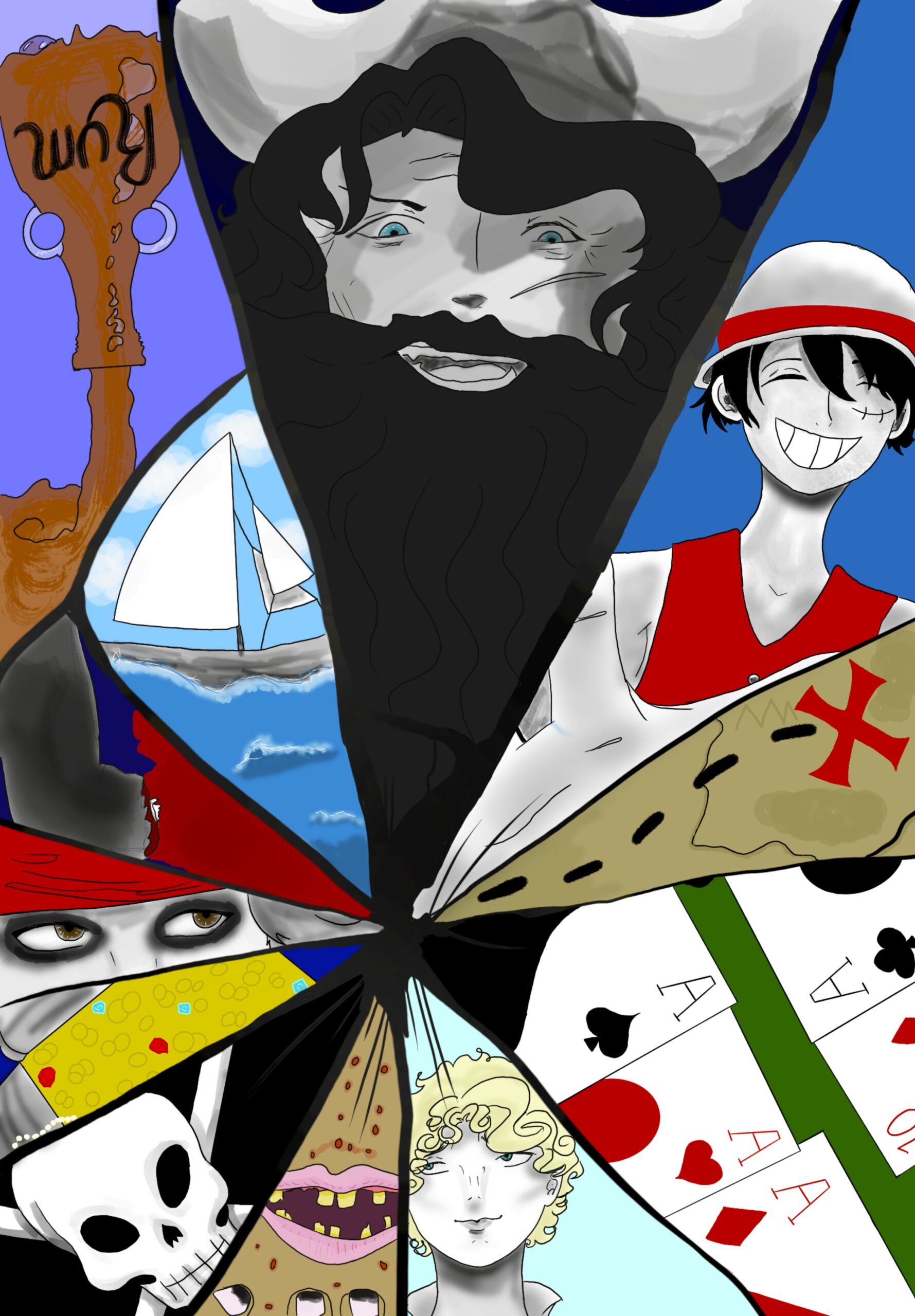
My class responds to this imperative by pairing learning about the history of piracy with inquiries into how these real-life figures and events have been memorialized in novels, popular film, and even a festival near campus. It offers what I hope is an exciting way to probe the discrepancies between history and how it is invoked in popular culture. This class is also where my clearest argument for why pirates must remain ancillary characters in a history of rum took shape.

Figure 4a: Student Interpretations of Piracy in History and Memory. Drawing by Samuel Flood (2023).
Figure 4b: Student Interpretations of Piracy in History and Memory. Drawing by Tori Socha (2024).

One of my favorite parts of teaching this course is that I get to regularly reread and rethink Robert Louis Stevenson’s Treasure Island. Besides forming my most vivid memory from being in seventh grade, the book is simply inseparable from modern stereotypes of pirates. As literary scholar John Sutherland writes in the introduction to the critical edition that I read with my students, Treasure Island “has become folkloric and part of the stuff of popular entertainment.” Almost one hundred and fifty years after the novel’s release, the most indelible twenty-first century invocation of pirates—the Pirates of the Caribbean franchise— “is, of course, pure Treasure Island, as filtered through Peter Pan’s Captain Hook.” More than anybody else who came before him, Stevenson left his readers with enduring images of pirates reading treasure maps, walking on pegged legs, and training parrot companions. As my students wrestle with each fall, he too linked pirates to a seaman’s brogue that Jim Hawkins’ allies spoke without.

Figure 5: Cover of Treasure Island Illustrated by N.C. Wyeth. From Robert Louis Stevenson, Treasure Island (Scribner, 1911), N. C. Wyeth, Public domain, via Wikimedia Commons.

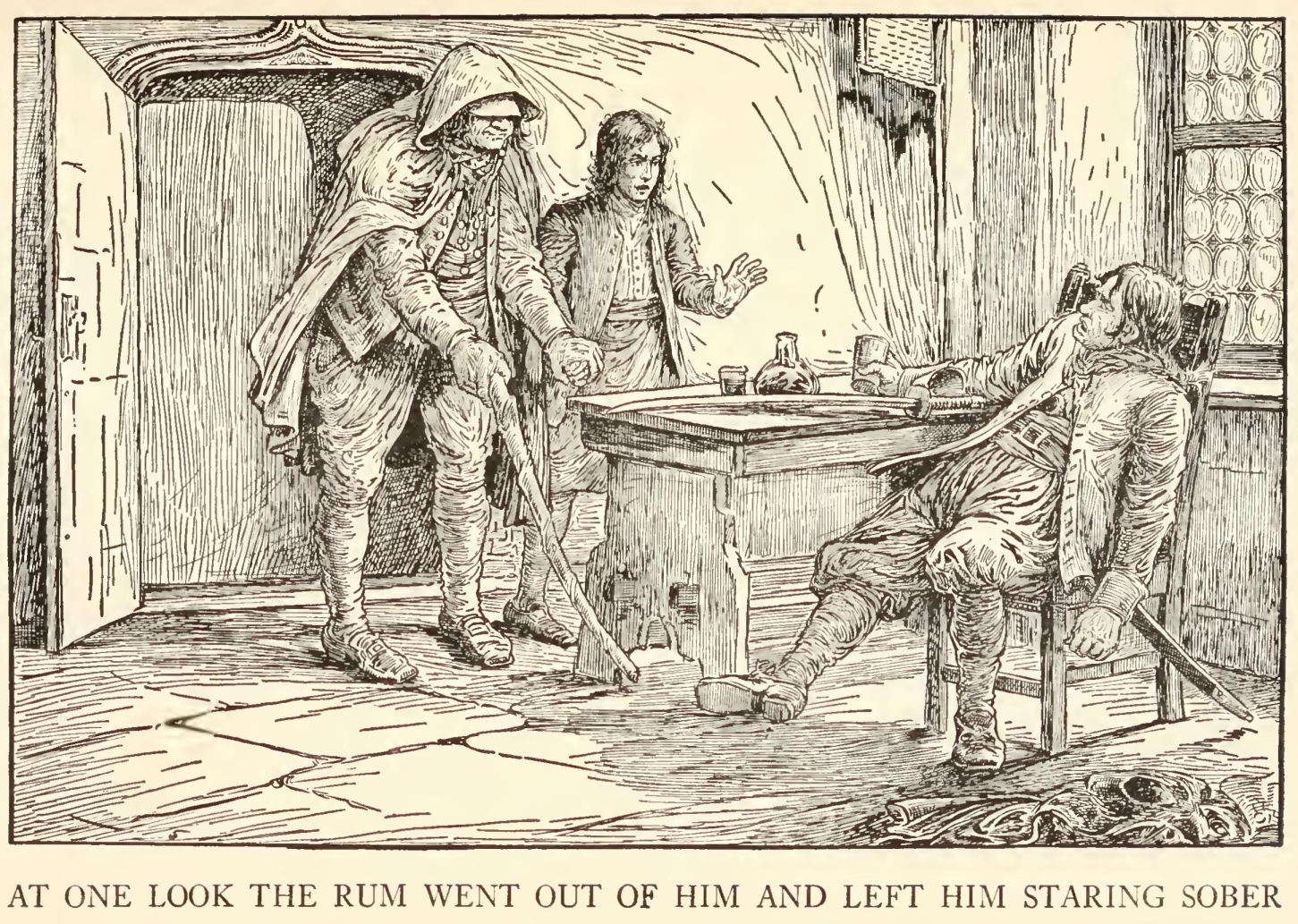
Stevenson also lashed together rum and piracy. The pirates’ anthem, which appears to have been this author’s invention, begins, “Fifteen Men on a Dead Man’s Chest, yo ho ho and a bottle of rum.” The mysterious Billy Bones cannot stop drinking rum in the Admiral Benbow Inn. An early premonition that the voyage for treasure is blowing off course comes in Jim Hawkins’ observation that “double grog was going on the least excuse.” And when facing a seemingly insurmountable numerical disadvantage upon reaching the island, Jim and his compatriots’ only hope rests in “two able allies—rum and the climate.” Such references are difficult for a scholar of rum to ignore!

Figure 6: Louis Rhead’s depiction of a drunk Billy Bones encountering Blind Pew. From Robert Louis Stevenson, Treasure Island (Harper and Brothers, 1915), Project Gutenberg.

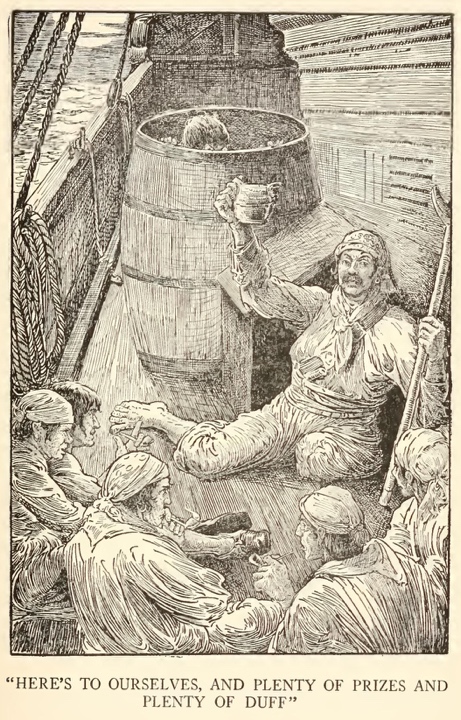
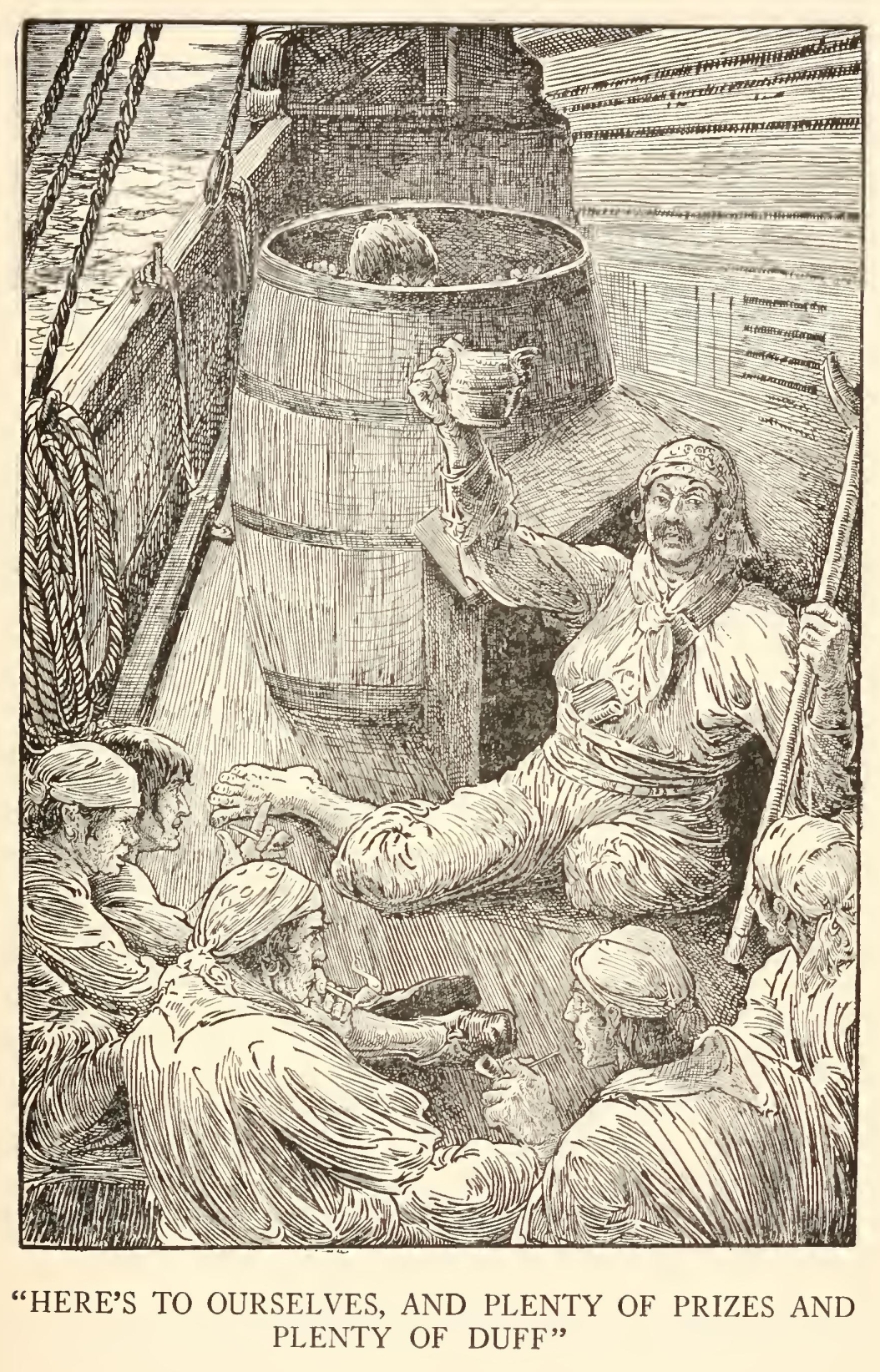
The consumption of different alcohols also differentiates good and bad in Treasure Island. Squire Trelawney and Doctor Livesey strategize over a quart of ale. Later aboard ship, the captain, doctor, and squire pour Jim a glass of Spanish wine. Long John Silver, the story’s most complicated character who is both a leader of the pirates and occasional friend to Jim, oscillates between “the drunken folly of the pirates” and moments of restraint. But other pirates’ preferences for strong liquor (in this case brandy) over other alcoholic beverages are so absolute that Jim immediately knows that Israel Hands’ request for a bottle of wine is merely a pretext to send him out of sight. For Stevenson, a thirst for rum—or at least the apparent inability of pirates to drink only a little bit of it—is as clear a sign as the Jolly Roger.

Figure 7: Rhead’s Illustration of Long John Silver Proposing a Toast. From Robert Louis Stevenson, Treasure Island (Harper and Brothers, 1915), Project Gutenberg.

Hierarchies of more and less healthful alcohols—often locating rum toward the bottom of the scale—were nothing new when Stevenson wrote in the nineteenth century. In Scotland in the mid-1680s, defenders of a nascent domestic rum industry fought vigorously to prove that their rum was every bit as wholesome as brandy. More famously, Benjamin Rush first published his “Moral and Physical Thermometer” in 1784. Wine and beer consumed in reasonable quantities and at appropriate times promoted “cheerfulness, strength, and nourishment.” Even a weak punch could have positive effects. But the stronger concoctions of rum—and most of all “pepper in rum”—sent consumers on a path toward “suicide,” “death,” or the “gallows.” In this regard, Stevenson picked up on a trend dating back to rum and piracy’s heyday.

Figure 8: Benjamin Rush’s Moral and Physical Thermometer. From Benjamin Rush, An Inquiry into the Effects of Spiritous Liquors on the Human Body. To Which is Added, A Moral and Physical Thermometer (Boston: Thomas and Andrews, 1790), Internet Archive.

But Treasure Island was very much a product of the late nineteenth century. First printed as part of a serial titled Young Folks in 1881 and 1882, it was designed to impart moral lessons to youthful readers. One central lesson to those readers was that “demon” rum posed a unique harm to its drinkers because of its potency, affordability, and its addictiveness. As Doctor Livesey—who shared a surname with one of the most prominent British temperance campaigners of the nineteenth century—told Billy Bones early in the book, “one glass of rum won’t kill you, but if you take one you’ll take another and another,” ultimately hastening death.

Figure 9: Cover of Young Folks Paper, the Serial that First Printed Treasure Island, in the 1880s. Young Folks Paper 28:808 (22 May 1886), Irvin Department of Rare Books and Special Collections, University of South Carolina.

The concept of drinkers being unable to control their impulses to consume more rum, and the advice to quit drinking in the first place, were not common medical advice in the era when pirates sailed. Instead, eighteenth-century writers generally held that overconsumption was an individual failing that could be overcome with personal discipline. By the late nineteenth century, however, rum’s looming threat became a common trope in temperance campaigns. Teetotalling was one response to this threat that Stevenson personally experimented with, as evidenced by a short-lived attempt in 1884 to quit “grog forever.”

Figure 10: The Victim of Ardent Spirits (Boston: Whipple & Damrell, between 1837 and 1841), Courtesy, American Antiquarian Society.

Treasure Island formed a transatlantic cultural touchstone linking the depredations of pirates to the compulsive drinking of rum. It permanently shifted how we imagine the history of both piracy and rum. The story largely foreclosed the possibility that pirates might seek out other alcoholic beverages preferred by the upper echelons of society. Here, the archival record suggests otherwise. One of the most striking descriptions of freebooters behaving badly in Jamaica was centered around wine rather than rum. The Barbadian writer, Charles Leslie, shared a story of “desperadoes” cracking open a pipe of wine, forcing passersby to drink from it, and spraying it in the air “to wet the Ladies Clothes as they went along and forc[ing] them to run from the Showers of that Liquor.” The absence of rum in these pirates’ ritual of limitless debauchery is quite telling. One of the chief draws of rum in the seventeenth- and eighteenth-century Atlantic was its ubiquity and affordability. When flush with coin, however, these freebooters passed over the most affordable path to intoxication in favor of the very excesses of the consumer society that they lived within.

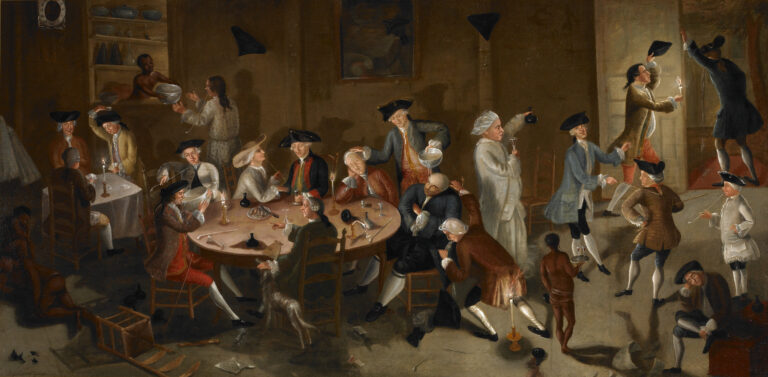
Figure 11: A Boisterous Eighteenth-Century Tavern Scene. Sea Captains Carousing in Suriname by John Greenwood (c. 1755-58), Saint Louis Art Museum.

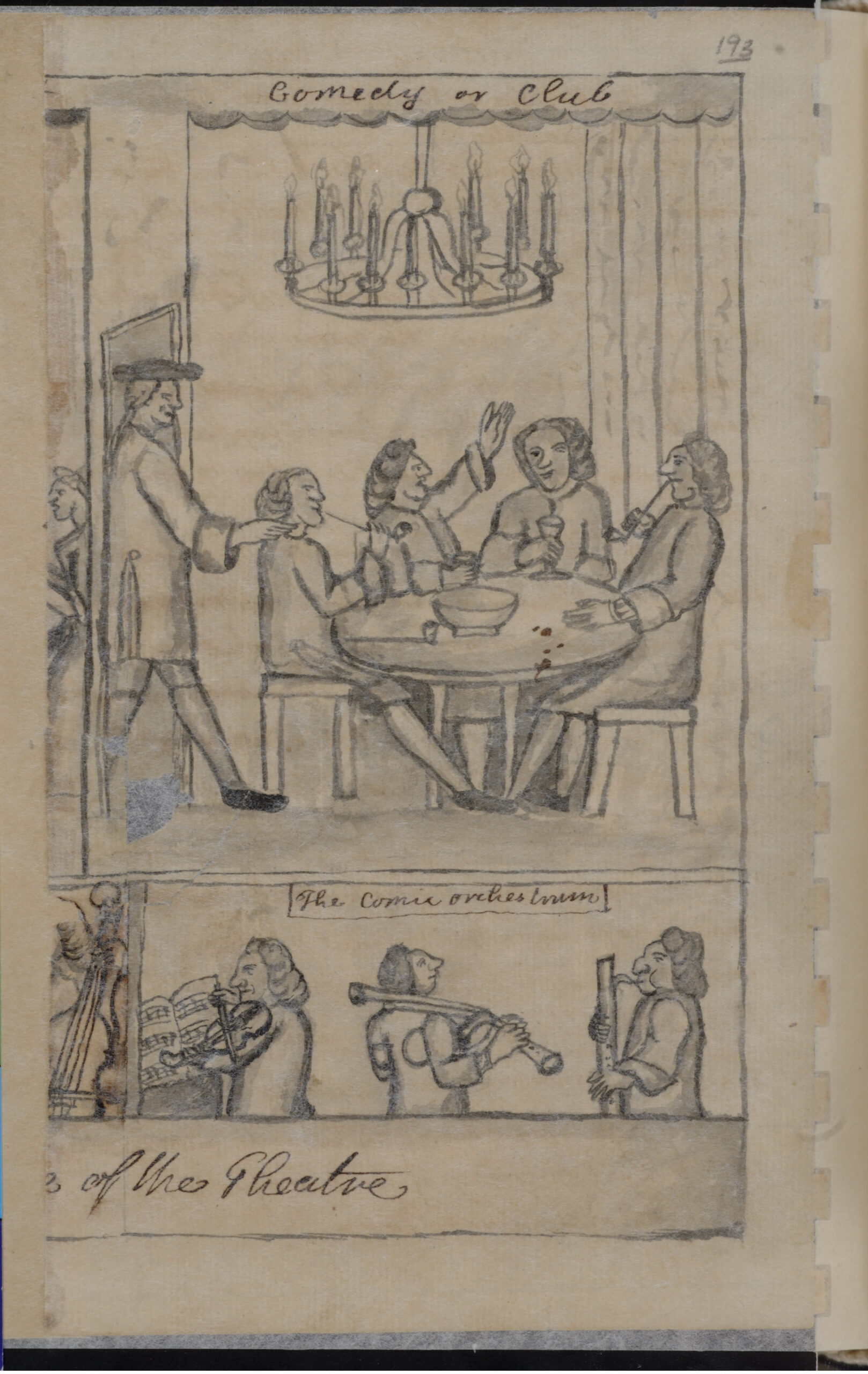
Pirates certainly filled their bellies with rum on many other occasions, though, including the seven pirates’ final days before seeking amnesty in Rhode Island. Yet Treasure Island gives the mistaken impression that noblemen, doctors, ship captains, and upstanding young men did not imbibe in the same way. The reality is that almost everybody drank rum in Britain’s Atlantic world, and often to excess. The Jamaica Council memorably sought to address “lawyers and readers, not seldom coming drunk into the Court,” while a late seventeenth-century visitor to the island wrote of a former priest famous for “preaching ‘ore a lusty bowl of rum punch.” A century later, George Washington described a hogshead of rum purchased for his enslaved and hired farm workers as a requisite expense for the harvest. And, alarmed by the “flood of rum” rising in Boston, Cotton Mather implored “people of the better quality” to resist the bottle. The puritan minister sounded the alarm regarding the ill-effects of its widespread use but was generally resigned to the fact that the spirit was unlikely to simply disappear: Rum had already become too ingrained in colonial society.

Figure 12: Gentlemen Congregated Around a Bowl of Rum Punch. From Alexander Hamilton, The History of the Ancient and Honorable Tuesday Club: From the Earliest Ages Down to this Present Year (c. 1755), John Work Garrett Library, Special Collections at Johns Hopkins University, Flickr.


Further Reading:

Each example from the seventeenth and eighteenth century, other than the opening vignette, is drawn from my forthcoming book, The Invention of Rum: Creating the Quintessential Atlantic Commodity (University of Pennsylvania Press, 2025). The sources quoted or directly referenced in this essay are: Boston News-Letter, 11 August 1718; Pinnock Diary 1758-1794, British Library, Add MS 33316; “Information from the masters of the manufactorie of the sugar workes of Glasgow,” Edinburgh University Library, Laing MSS, 2, 566.1; Benjamin Rush, An Inquiry into the Effects of Spirituous Liquors on the Human Body. To Which is Added, A Moral and Physical Thermometer (Boston: Thomas and Andrews, 1790); Charles Leslie, New and Exact Account of Jamaica, 3d ed. (Edinburgh, 1740); Minutes of Jamaica Council, 28 June 1668, CO 140/1/177, The National Archives, Kew; Taylor Manuscript, MS 105, National Library of Jamaica; George Washington to Anthony Whitting, 26 May 1793, Papers of George Washington Digital Edition; Cotton Mather, Sober Considerations, on a growing Flood of Iniquity (Boston, 1708). 
Foundational texts in my Atlantic piracy course at Widener include: Marcus Rediker, Villains of All Nations: Atlantic Pirates in the Golden Age (Beacon Press, 2004); Arne Bialuschewski, “Black People under the Black Flag: Piracy and the Slave Trade on the West Coast of Africa, 1718-1723,” Slavery and Abolition 29: 4 (Dec. 2008): 461-75; Robert Louis Stevenson, Treasure Island, ed. John Sutherland (Broadview Editions, 2012); Matthew Bahar, “People of the Dawn, People of the Door: Indian Pirates and the Violent Theft of an Atlantic World,” Journal of American History 101:2 (Jan. 2014), 401-26; Mark G. Hanna, Pirate Nests and the Rise of the British Empire, 1570-1740 (University of North Carolina Press for the Omohundro Institute of Early American History and Culture, 2015); David Lester and Marcus Rediker, Under the Banner of King Death: Pirates of the Atlantic, A Graphic Novel (Beacon, 2023).

While I was unable to find any extended analysis of temperance themes in Treasure Island, other scholars have noted these themes in Stevenson’s Strange Case of Dr. Jekyll and Mr. Hyde. See Thomas L. Reed, Jr., The Transforming Draught: Jekyll and Hyde, Robert Louis Stevenson and the Victorian Alcohol Debate (McFarland and Company, 2006); Patricia Comitini, “The Strange Case of Addiction in Robert Louis Stevenson’s Strange Case of Dr. Jekyll and Mr. Hyde,” Victorian Review 38:1 (Spring 2012): 113-31. Jennifer Poulos Nesbitt has also included Treasure Island in her broader analysis of rum’s function in nineteenth- and twentieth-century literature; Nesbitt, Rum Histories: Drinking in Atlantic Literature and Culture (University of Virginia Press, 2022).

On how conceptions of excessive alcohol consumption changed from the eighteenth century to the nineteenth century see W.J. Rorabaugh, The Alcoholic Republic: An American Tradition (Oxford University Press, 1979); Roy Porter, “The Drinking Man’s Disease: The ‘Pre-History’ of Alcoholism in Georgian Britain,” Addiction 80: 4 (Dec. 1985): 385-96; James Nicholls, The Politics of Alcohol: A History of the Drink Question in England (Manchester University Press, 2011); Matthew Warner Osborn, Rum Maniacs: Alcoholic Insanity in the Early Republic (University of Chicago Press, 2014); David Korostyshevsky, “An Artificial Appetite: The Nineteenth-Century Struggle to Define Habitual Drunkenness,” Bulletin of the History of Science 98:2 (2024): 175-204.


This article originally appeared in September 2025.


Jordan B. Smith is an associate professor of history at Widener University. He is the author of The Invention of Rum: Creating the Quintessential Atlantic Commodity (University of Pennsylvania Press, 2025).