This is an important book that will be of great interest to architectural historians, legal historians, and historians of the professions. It is also a major contribution to the study of the history of the material culture of law and law practice in the United States, a subject that has attracted too little attention from legal historians.
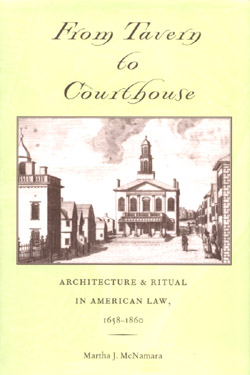
From Tavern to Courthouse: Architecture & Ritual in American Law, 1685-1860.
Professor McNamara provides a detailed analysis of the development of professional buildings, especially courthouses, in Massachusetts, primarily from the late seventeenth century until the early nineteenth century. In so doing she illuminates a chapter in the history of the professionalization of lawyers and of architects in the U.S. during this period. Her text is especially rich in her discussions of the ways in which changing architectural styles were able to play into the growing rituals of the law and the courts, rituals that themselves were adopted in order to move lawyers from the general body of the mercantile class into the category of professionals. As Perry Miller pointed out in his masterly The Life of the Mind in America (New York, 1965), it was precisely during this period that American lawyers made a concerted effort to define themselves as a learned profession much as the clergy had done earlier. Professor McNamara adds to and confirms Miller’s thesis by bringing the evidence of courthouse architecture to the attention of historians.
Although American legal history has become something of a growth industry during the past several decades, little work has been done on the material context within which lawyers and judges operated during the antebellum period. We know a great deal about the literature of the law, but a good bit less about how lawyers obtained the books that transmitted this literature. We know a fair amount about theories of trial procedure, but scarcely anything about the courtrooms in which lawyers and judges practiced. Indeed, we know very little about the lives of lawyers and judges themselves, other than of those who achieved contemporary fame like Marshall, Story, or Kent and, thereby, merited a biography. In this short book Professor McNamara demonstrates how much we lose by not knowing these things and how much we can gain by learning about them. An example drawn from this work illustrates this point.
In 1786 Isaac Coombs, a Native American, was tried at Ipswich for the murder of his wife. Coombs was found guilty by the jury. Although we cannot now reconstruct many of the details of this trial, one thing stands out as Professor McNamara so ably shows. Coombs’s defense lawyer challenged the jury verdict on the grounds that the jury “did separate and go at large without being attended by the proper officer . . . and did converse with diverse persons concerning the verdict” (55)
In and of itself this is an interesting bit of information. But put into the context of the architecture of the Ipswich Townhouse, where trials were held, it is very revealing. As Professor McNamara notes, the Ipswich courthouse, like its contemporaries, did not have a separate room in which juries could deliberate after hearing the evidence in a trial. Instead, the jury gathered in a nearby tavern and walked freely among the other patrons while doing so. Although Coombs’s appeal was denied and he was hanged, the fact that his lawyer could object to the nonsequestration of the jury during deliberations points out that by this period lawyers were beginning to see the prejudicial consequences of such lack of privacy. Indeed, McNamara shows that soon after Coombs’s trial, new courthouses, designed by judges and lawyers, included separate spaces for jury deliberations. By 1805 the Town of Newburyport built a new courthouse with three rooms in the basement for jury deliberations.
It is through examples such as these that Professor McNamara educates her readers on the important interplay between the practice of law and the design of legal spaces in the antebellum period. The book is filled with such rich insights and is a delight to read.
If one were forced to come up with criticisms of this book, they would be two. First, although the title indicates that the book is both national in scope and that the period it covers extends to 1860, in fact the book is almost exclusively focused on the Massachusetts experience with legal architecture. Second, there is virtually no consideration of the legal architecture even of Massachusetts past the first quarter of the nineteenth century. But these are both quibbles. Indeed, the book gains from its narrow geographic and temporal focus, for by being so focused the author is able to examine her subject in great detail. On the other hand, one may well hope that Professor McNamara extends her researches both outside Massachusetts and further in time. By so doing she will both fill gaps in our knowledge that still exist and also extend her work to its logical ends. Professor McNamara’s opinions on the architecture of frontier courthouses and other legal spaces would be especially welcome.
A second item I would put on my wish list of things for Professor McNamara to consider is the development of lawyers’ offices and their relationship to the professionalization of the bar. Professor McNamara touches on office architecture several times, especially when she speaks of Melville’s “Bartleby,” but there is much more that she could do. We have drawings and, after the invention of photography, photographs of lawyers’ offices. We may only hope that Professor McNamara will turn her considerable analytic and historical skills to a consideration of these.
In sum, Professor McNamara’s work is one that no historian of the law or architecture can ignore. It is well written, well reasoned, and breaks important new ground. I, for one, shall be very glad when she publishes her next work.
This article originally appeared in issue 5.3 (April, 2005).
Michael Hoeflich is the Kane Professor of Law and Courtesy Professor of History at the University of Kansas.
Childhood Then and Now
What is the meaning of childhood, who is a child, and who decides? Does childhood have a history? And, if so, what does that history have to tell us? These are a few of the questions that drive the comprehensive and skillfully written Huck’s Raft, a new synthesis of the history of American childhood from the colonial era to the twenty-first century by one of the premier historians in the fields of children’s and family history. Steven Mintz has managed a very difficult task with grace and aplomb. Huck’s Raft is a book for many occasions, one that deserves a wide readership among students, history scholars, and child advocates.
Huck’s Raft: A History of American Childhood
The title sets the tone for this book. Mark Twain’s rambunctious lad symbolizes for many the innocence of past childhoods. This nostalgic belief that American youngsters once upon a time had a carefree life is, Mintz argues, one of the myths Americans hold about the history of childhood. A better metaphor for the history of children and youth is the perilousness of Huck’s journey on the raft. Or, as Mintz puts it, “There has never been a time when the overwhelming majority of American children were well cared for and their experiences idyllic. Nor has childhood ever been an age of innocence, at least not for most children” (vii).
Mintz deftly tells the stories of both groups of children, those well cared for as well as the majority who were not. Indeed, the stories reveal that there were many different childhoods in the past, and they draw attention to the familiar inequities of race and gender, as well as ethnic and regional divisions. In Huck’s Raft, childhood is “not an unchanging biological stage of life but is, rather, a social and cultural construct that has changed radically over time” (viii). The biological facts of child development provide continuity to the history of childhood, but in every era, as Mintz shows by marshalling the works of myriad historians, biology has been “modified by history and mediated by culture” (4). Children, like their parents, lived lives constrained by the social, political, and economic context.
Of all the perils children have encountered on the metaphorical raft, however, Mintz believes that class differences have had the greatest impact on the meanings and the experiences of childhood. Different socioeconomic settings led parents to different views on the nature of childhood and the place of children in the family. By determining a child’s educational opportunities, playtime activities, and participation in the work force, class differences shaped different paths to adulthood.
Despite the fundamental role he attributes to broad social and economic forces, Mintz also wants us to recognize that children have helped to make our history. Historians are not accustomed to thinking of children as historical actors, yet this perspective has been one of the principal contributions to the discipline from those who study past childhoods. By mining the existing literature, Mintz is able to mark the times when the beliefs and actions of young people helped to make history.
In Huck’s Raft, the history of childhood is periodized as three broad and overlapping chronological eras. The eras of premodern, modern, and postmodern childhood correspond loosely to the colonial years, the mid-eighteenth century through most of twentieth, and the 1980s to the present. As the author says, each period is “characterized by strikingly different and diverse childhoods” (3). Within each era, however, Mintz takes middle-class childhood as a norm against which other (read: poor, dependent, or racial) childhoods are measured and evaluated.
Readers of Common-place will be most interested, perhaps, in Mintz’s account of colonial, or premodern childhood, in part because Mintz believes the relationships between colonial youths and their elders have much to tell us about the problems facing young people today. Colonial historians have determined that Puritan colonists conceptualized their children as adults in training, with deficiencies of skill and character that proper child rearing would overcome. Adults assumed they had much to teach young people and they hurried the integration of children into adult society through formal apprenticeship and domestic chores. For all the attention to the young, Puritans did not sentimentalize childhood. Rather, the religious sect believed that children were “riddled with corruption” (11), that it was the duty of adults to reform the child, and that the moral development of children was a responsibility of the entire community, not just the parents (a belief that led to support, in theory if not always in fact, for public education).
In discussing the premodern era, Mintz shows how gender, race, and regional differences resulted in different childhood experiences for colonial youths. Boys and girls were trained for the separate duties and tasks required in the gendered world of their day. White children found that childhood among the Indians was often much freer and less filled with drudgery (attested to by the stories of captured children who refused to return to their parents). English children in the Chesapeake colonies grew to adulthood (if they did not die young) along a different path than the one followed in Puritan communities. In part, the disparity emerged because the Chesapeake was a less religious culture (leading parents in this region to place less emphasis on shaping a child’s conscience). Perhaps a more significant contrast was the frequency with which children became orphans in the southern colonies, because these areas experienced a much higher overall death rate than New England.
Regional dissimilarities point to the importance of demography and the role of birthrates, disease, and death in the history of children and youth, issues Mintz returns to and develops in his discussions of other groups and other historical eras. Throughout the book, Mintz underscores the difficulty historians have reconstructing the past of a seemingly voiceless and powerless group, and he makes note of the creative sources used by the historians of childhood. Accounts of antebellum slave childhood, for example, rely on evidence of physical health to gauge the horrors of slavery for the young. Here, as Mintz reports, historians have made use of mortality tables, nutrition studies, and evidence collected from graveyard remains to document the poor physical condition of slave children.
Historians of antebellum middle-class childhood, in contrast, are more likely to examine their subject using psychological determinants. Mintz does not neglect the devastating effects of disease on infant and child mortality rates among all groups throughout the nineteenth century. However, he is more interested in the new emotionality characteristic of the early-nineteenth-century middle-class family. These families, Mintz explains, “invented” modern childhood as one that was sentimentalized and sheltered (76).
The antebellum creators of modern childhood drew on the antiauthoritarian ideals of the American Revolution that encouraged youthful autonomy, on Enlightenment ideas about the malleability of the child’s character, and on Romantic and religious notions of childhood innocence. It was, however, the falling birth rate and the economic comfort of the middle class that in the end allowed for the emergence of the emotionally intense family in which mothers assumed responsibility for child rearing. In this environment, childhood was supposed to be a period of freedom from labor and a time of extended formal education.
It is ironic, as Mintz points out, that this sentimental view of a sheltered childhood that “freed middle-class children from work and allowed them to devote their childhood years to education also made the labor of poor children more essential to their family’s well-being than in the past, and greatly increased the exploitation these children suffered” (92). It took over a century, or until the 1950s, before most children in the United States could be considered living a modern childhood, and even then, when baby boomers remember their innocent and carefree childhoods, their nostalgia bears little resemblance to reality. As individual chapters in the book demonstrate, the lag was due to slavery and racism, to immigration, and to the exigencies of industrial capitalism.
Yet, the same ideas that made it difficult for many families to adopt the trappings of modern childhood also spurred reformers to try to “save” dependent, delinquent, and destitute youngsters. Mintz shows how the invention of the modern child generated an awareness of child abuse, a demand for compulsory education, an end to child labor, and the need for economic assistance for children living in poverty. Clearly the history of childhood has much to contribute to our understanding of the growth of institutional bureaucracy and the rise of the welfare state. The invention of the modern child also resulted in the development of the many child sciences, for the clinical and experimental study and treatment of youth, and as a consequence, the relinquishing of a degree of parental authority to these experts.
Another irony of modern childhood is the youthful autonomy fostered by the intense adult interest in providing a sheltered childhood. Segregated in their own spaces‚from special nurseries at home to age-graded classrooms at school‚and provided with age-appropriate activities, young people developed their own culture, separate from that of adults and seemingly outside their control. The consumer economy of the twentieth century contributed to this autonomy. This, however, is a tale with more irony; the sellers who found a lucrative market among independent youths also provided a degree of informal regulation as their products constrained autonomous decisions and fueled conformity.
Mintz devotes most of the book’s chapters to the history of the modern child. As he moves the discussion on to the postmodern child, past the “youthquake” of the 1960s, the children’s rights revolution of the 1970s, and the moral panics of the 1980s and 1990s (over, for example, stranger abductions and abuse at day care centers), he shifts the focus from historical narrative to social commentary. Mintz wants to challenge today’s adults to create a childhood that reflects the realities of our children’s lives, and he draws his message directly from the history of children and youth. “Superficially,” Mintz writes, “postmodern childhood resembles premodern childhood” (4). Today’s children are in many ways “little adults.” Physiologically mature at an earlier age and initiated earlier into consumer culture, sexual experimentation, and the “realities of the adult world” (4), today’s children are forced to make adultlike decisions. Yet, thanks to the inventors of modern childhood, we postmodern adults continue to think of the young as fundamentally different from us, so we have not provided our young with the skills they need for the process. Instead, we have institutionalized childhood in schools, in after-school jobs, and in opportunities for recreation, and as a consequence, our children spend much more of their time with people of the same age. Ours is a society, Mintz explains, that isolates and juvenilizes young people more than ever before; they spend much less time with adults who can model and explain the “realities” to them. “Our challenge,” he concludes, “is to reverse the process of age segmentation” (383). “Since we cannot insulate children from all malign influences, it is essential that we prepare them to deal responsibly with the pressures and choices they face,” and that means they need knowledge, not sheltering (382). A post-postmodern childhood must address this need; the history of premodern childhood provides a guide. It shows us that when children face adultlike realities, child rearing must involve the community as a whole; it must not be left up to individual parents.
This is a big book, making it easy to quibble about what has been included and what has been slighted. Stanley Fish has just recently informed us that religion will be the next category of analysis to shape historical research, and it would be interesting to see a comprehensive history of childhood that stressed this difference along with class, race, and gender. Then too, in his emphasis on the social construction of childhood, one wonders if, perhaps, Mintz has swung the pendulum too far, dismissed too often the biological continuities in the history of childhood as he highlights the significant differences grounded in time and place. However, these are minor quibbles when set against the powerful argument supported throughout the book. The message of Huck’s Raft is one postmodern parents, child advocates, and historians would be wise to take under advisement.
Further Reading:
For Stanley Fish’s argument about religion, see “One University, Under God?” Chronicle of Higher Education 51:18 (January 7, 2005), C1.
This article originally appeared in issue 5.3 (April, 2005).
Kathleen W. Jones is an associate professor of history at Virginia Tech and author of Taming the Troublesome Child: American Families, Child Guidance, and the Limits of Psychiatric Authority (Cambridge, Mass., 1999).
Money of Moderate Size
Playing tricks on the dollar in Ecuador
[Editor’s Note: This essay was originally written in response to Mark Peterson’s “Big Money Comes to Boston: The Curious History of the Pine Tree Shilling,” (which also appears in this issue of Common-place). Readers might want to begin with Peterson’s article. The essays were first presented at the conference “Object Relations in Early North America,” sponsored by the Omohundro Institute of Early American History and Culture and held at the Huntington Library, San Marino, California, May 21-22, 2004.]
All of sudden it seemed like Brer Wolf had all the luck and Brer Rabbit didn’t have a lick. Brer Wolf got fat and Brer Rabbit got lean . . . Brer Wolf felt healthy and Brer Rabbit felt sick all the time. After a month or so Brer Rabbit knew there was only one thing to do. He had to talk to Aunt Mammy-Bammy Big-Money.
—The Tales of Uncle Remus: the Adventures of Brer Rabbit,
as told by Julius Lester
“Big Money Comes to Boston” follows a surprisingly modern plot. These days we would call it currency reform. Wampum had entered a sustained devaluation due to loose fiscal policy and declining productivity in a regional economy. Corruption had knocked the value from the pieces of eight and shaken markets in the West Indies. And cowries, while recovered off of South Asia, traded on exchanges in London and Amsterdam, and demanded on the eastern rim of the Atlantic economy, had no place in Boston. All these moneys had too little oomph for the colony. With economic growth at risk and political ambitions hanging in the balance, the General Court contracted with John Hull to create a more stable instrument for Massachusetts and its commercial interests. Hope rested in a big-money solution.
“Currency reform” jars, though. The words carry the baggage of central bankers and economists and a host of modern financial institutions. Reform also suggests a limited repair, addressing a functional failure. It confines itself to what economists describe as the four capacities of general purpose money: 1) a means of exchange, 2) a measure of value, 3) a store of value, or 4) a mode of payment to the state. To be sure, citizens of Boston desired money with most of these capacities. The city needed coins that could facilitate exchange between backwoods extractive industries and oceangoing enterprise. As commerce grew, its gains needed to be safeguarded in something more than beads crafted from clamshells. But for Bostonians, the new money’s political task broke two ways. The General Court needed to solidify Boston’s preeminence within New England’s economy, but it also needed to avoid rattling the Crown—the chief arbiter of English money—and attracting too much speculative interest from opportunistic merchants. In an effort to profit from trade in the new money, the latter could defeat the entire purpose of the enterprise by shrinking the money supply. Less an act of reform, the creation of Massachusetts’s money was thus an act of invention, pushing the boundaries of New England’s expansion without jeopardizing it.
Interestingly, while Massachusetts had big-money needs, it arrived at a money-of-moderate-size solution. John Hull’s coin matched the alloy of English sterling but shrunk its dimensions to dampen its circulation abroad. It matched the shape of serious money but lacked the human images favored by serious monarchs. When pressured by the crown, the Massachusetts government defended its mint not with coins but with corn and cod and cranberries. Supplemented by symbolic tribute payment, the Pine Tree Shilling showed itself to be less-than-big money. But it held its ground at home, sustained Boston’s expansive moment, and accommodated itself to the claims of truly big money.
Zoila Arias with son Fabian on her back tending to her corn. Photo courtesy of the author.
Sacajawea dollar. Courtesy of the United States Mint Website.
Peterson’s account of the birth and stabilization of Massachusetts’s money suggests to me a crucial capacity of all-purpose money that is often overlooked. In addition to the ability to measure, store, exchange, and affiliate, big money must achieve the active and ongoing displacement of other currencies. While I have not researched it, I suspect that no currency has ever emerged in virgin territory. The conditions fostering commodity exchange—product diversification, competition, and wide trade networks that exceed any single polity—also multiply potential objects that facilitate exchange as well as measure and store value. The cowry, for example, spread tenaciously in West African trade in the face of many currencies, including gold dust, silver coins, salt bars, and brass rods.
Money’s power of displacement need not rest on state backing. In twentieth-century China, for instance, the future success of the revolutionaries could be read from the growing strength of guerilla currencies. Originally issued in the 1920s, the revolutionary bills allowed armies to pay peasants and extract resources without technically looting them. In central zones, though, people grew to accept the Red Army. Peasants there insisted on guerilla currency and rejected national bills. The currencies launched by the state, by revolutionary armies, and even by colonial banks in the first half of the twentieth century created ties that could “dissolve and bind.” Amid competing currencies, the use of a particular kind of money marked—and shifted—socioeconomic and political boundaries.
With its capacity to displace, money adds a negative power to its positive ones. It achieves effectiveness by stymieing contending currencies and the merchants and tax agents empowered by them. Like the vessels of their trading fleets, the heft of rival Atlantic currencies can be measured in the magnitude of their displacement. And as with ships, a failure of money to maintain the power to displace is nothing short of catastrophic, a point I will turn to below in a modern American case.
The idea of displacement leads me back to the problem of Boston’s autonomy. Peterson lays it out: “Their desire as a Puritan colony for autonomy and brotherly interdependence would be severely tested by the incessant reach of empires and by the corrosive power of trade to measure all values in cash.” Boston’s Puritans stand out here as desiring agents, seekers of self-determination to achieve a collective brotherly and spiritual good. Trade, in this view, laid Boston’s values low with its base leveling of all nonmaterial goods. Yet after the creation of the Pine Tree Shilling, Boston seems less bent on preserving the freedomto be Puritan, than on achieving the freedomfrom Imperial powers. That is, autonomy itself is a form of displacement, a “negative liberty” in Isaiah Berlin’s famous term, signifying both the freedom from constraints and the necessity of choice.
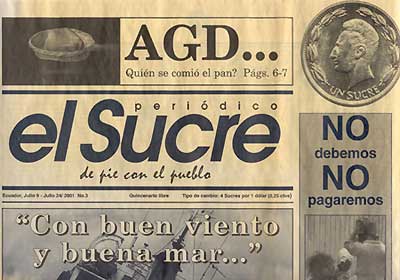
El Sucre, a newspaper edited by leaders of the indigenous movement in the wake of the dollarization. Photo courtesy of the author.
So now to replay these ideas of money, autonomy, and displacement in a modern case. Here I shift to an instance when money no longer could displace its rival and sank. The case involves the recent dollarization of the Ecuadorian economy and the demise of its national currency, the sucre. Despite its state-sponsored status, the sucre fits the little-money bill. In today’s global economy, little money comes from southern nations and is adorned with exotica like helmeted anticolonial generals and blue-footed boobies. Little money fluctuates widely in value, has lots of zeroes, is carried between the breasts of market women, and smells of overripe fruit, diesel smoke, sweat, and flesh. Big money, on the other hand, flashes around the world 24/7 on computer screens, comes with instructions in a hundred different languages on how to recognize the genuine article, and literally finds a home in any backwater.
In 1998, Ecuador’s largest private bank unraveled through mismanagement, corruption, and a run by depositors. In a cascade of negative effects involving additional banking failures, a national freeze on all bank accounts, and the failure of the federal deposit insurance program, the sucre lost half of its value in six months. Government paralysis gave way to unwarranted boldness as the administration of President Mahuad voiced plans to abandon the currency altogether and adopt the U.S. dollar in the fall of 1999. Mass popular protest followed. In January 2000, leaders of the national indigenous movement organized weeks of street demonstrations against the dollarization program. Their efforts culminated in an unprecedented alliance between Indians and a faction of dissident army colonels and a coup that removed President Mahuad from power on January 20. In an abrupt about-face, the military switched sides twelve hours later and restored the vice president to power. Within months the dollarization plan was implemented. With revenue from oil exports, the Ecuadorian state began to pay seigniorial fees to the United States government. In return, plane loads of pennies, nickels, dimes, and quarters began to arrive at Quito’s Mariscal Sucre airport.
A year later, I embarked upon research into the economic consequences of the dollarization, by interviewing indigenous small factory owners and handicraft exporters about their experiences. For most artisans “dollarization” signified the harsh new condition of their market, involving three elements: falling sales, the new high costs of material and energy, and price stability. As one sweater maker said, ” . . . with the dollarization things have increased a lot. They say, outside the country, one can’t vary the prices much. Before the dollarization, it was crazy; the prices went up each month, each week. It was crazy. Well with the dollarization the prices have more or less stabilized.” For another producer, this new price stability was, in fact, part of the trouble with the dollarization. As he explained, “The problem is totally the dollarization . . . Before, when it was sucres, I did not complain. When it was sucres, costs could rise and we could still earn. It is not like that anymore. This whole country is damaged.” If these comments were explicitly economic, they also captured a collective feeling of what it means to succumb to someone else’s big money. In the wake of home-grown fiscal chaos, a Pax dollarizada prevailed. Stability came twinned with subordination—less earnings, fewer opportunities, and the end of trickster economics. Ecuadorians could no longer coax surprising windfalls from little money’s misalignments with big money. My respondents did not dwell so much on having to live according to others’ (monetary) values, though, as on the lost ability to live by their own. They were “damaged” lesser people within the emerging global order.
Throughout the dollarization and its immediate aftermath, it was the Indian defense of the national currency that surprised me the most. The Ecuadorian indigenous movement had scored victory after victory in the 1990s. Beginning with a national uprising in 1990 and culminating with constitutional reforms in 1998, the movement had won formal recognition for native cultures and legal traditions. They rejected the idea of a single unified Ecuadorian nation and made progress towards pluriculturalism, based in regimes of autonomy for indigenous communities in the Amazon, the Andes, and the Pacific coastal region. But then, when the nation’s elite, the descendents of Mariscal Sucre and his class of Creole nationalists, formulated plans to abandon the national currency, indigenous peoples led the popular movement to preserve this core symbol of national sovereignty.
This fight for the sucre underscores a crucial dimension of native autonomy as it is coming to be in Ecuador. When indigenous leaders advocate for territorial autonomy, they insist they do not want a system of reservations like the one that has prevailed in the United States. Rejecting isolation, indigenous communities seek connection to and influence within the national government. Concretely, this has meant forming a broad electoral movement, supporting the inclusion of Indians in the cabinet and even taking positions within the foreign ministry. With deep concerns about the national debt, international trade, and treaties concerning intellectual property, indigenous leaders require a powerful national vehicle to protect their less-than-national communities. The stronger Ecuador’s international self-determination, the more meaningful local indigenous autonomy will be.
Internally, a different call for national cohesion crops up. Even as the Achuar, Shuar, Hoarani, Quichua, and other Ecuadorian indigenous peoples gain independent legal standing, they strive to preserve the pan-Indian connections that gave the mass mobilizations of the 1990s such force. No group has wanted to have its authority stay entirely local or restrict its circulation across “narrowly confined geographical areas,” to borrow language from Peterson’s description of little money. That is, no modern indigenous people (some in Ecuador number in the millions) want the political or economic equivalent of “little money.” Their political, cultural, and economic fortunes lie somewhere between some small coin of local community and the big money of global interaction. And if the sucre seems little money in the world of international capitalism, it was usefully sized for Ecuador’s long subordinated but newly powerful indigenous people. It was a money of moderate size that displaced North American markets and free trade ideologies and contributed to indigenous people’s expansive moment in the 1990s.
And so now to the tales of Uncle Remus. When Brer Rabbit no longer trusted his luck, he turned to Big-Money. She, on the other hand was wary of him. So Aunt Mammy-Bammy Big-Money set two tasks as conditions for her aid. In these, Brer Rabbit succeeded: he fooled a squirrel into a bag and lassoed a rattlesnake. Then he went home without asking anything of Big-Money. He had decided he could depend again on the currency of his own tricks. This is where Peterson’s account of Boston’s money leaves me, thinking of the tricks to be played on Big-Money. Pine Tree Shillings, cowries, and sucres, when managed with cunning, can keep in play a diversity of rivalrous goods—imperial values of outward looking peoples, commercial acumen, community loyalty, and opposition to empire. Moderate-size money holds open some of the most adventurous cultural and political ground where the magnitudes of these values are rethought and courses of actions are pursued and disputed. On the face of it, these currencies fare poorly against big money. But they are not without tricks of their own. The sucre disappeared but not before undermining the value of the dollar in Ecuador at a time when the greenback was appreciating throughout the world. Between 1900 and 1960, French Colonial authorities banned the cowry and pushed the franc. Yet during the same time, the cowry appreciated and the Franc lost its value seven hundred and fifty times over. Massachusetts eventually yielded its shilling to the crown. Yet, the lessons learned from its management informed Bostonians about making their own way in the Atlantic world.
Further Reading:
Julius Lester, The Tales of Uncle Remus: The Adventures of Brer Rabbit (New York, 1997) offers lots of other trickster tales, along with “Aunt Mammy-Bammy Big-Money.” For two discussions of tricksters and forms of exchange, both by Lewis Hyde, see The Gift: Imagination and the Erotic Life of Property (New York, 1983) and Trickster Makes This World: Mischief, Myth, and Art (New York, 1998). My definition of the four capacities of general purpose money comes from Jonathan Parry and Maurice Bloch, eds., Money and the Morality of Exchange (New York, 1989). On cowrie shells’ shifting value in modern Africa, see Saul Mahir, “The Dominance of the Cowrie Relative to the Franc in West Africa,” in C. Werner and D. Bell, eds., Values and Valuable: From Sacred to Symbolic (Walnut Creek, Calif., 2003). In this same collection, see Beth Notar’s “Ties that Dissolve and Bind: Competing Currencies, Prestige, and Politics in Early 20th-Century China” for a discussion of revolutionary currency’s displacement of official money. Isaiah Berlin’s concept of “negative liberty” can be found in Four Essays on Liberty (New York, 1969).
This article originally appeared in issue 6.3 (April, 2006).
Rudi Colloredo-Mansfeld, associate professor of anthropology at the University of Iowa, is the author of The Native Leisure Class: Consumption and Cultural Creativity in the Andes (Chicago, 1999). He is currently in Ecuador, doing research for his next book on the concept of a cultural “commons” and economic growth in the Andes.
Making the Irregular Regular
I would like to begin this column with a brief quiz: Please identify the source of the following quotes:
Note this down [Satan]: I have sh*t in the pants, and you can hang them around your neck and wipe your mouth with it.
A slanderer does nothing but ruminate the filth of others with his own teeth and wallow like a pig with his nose in the dirt. That is also why his droppings stink most, surpassed only by the Devil’s . . . And though man drops his excrements in private, the slanderer does not respect this privacy. He gluts on the pleasure of wallowing in it, and he does not deserve better according to God’s righteous judgment. When the slanderer whispers: Look how he has sh*t on himself, the best answer is: You go eat it.
Give up? That would be none other than Martin Luther, the father of Protestantism and one of history’s great theologians. To some it will come as no news to learn that Luther was also one of history’s great scatologists. He was obsessed with things fecal, to the point where his own intestinal habits consumed him, perhaps even killed him. Through much of his adult life, Luther suffered a terrible combination of depression, anxiety, and constipation (“My arse has gone bad,” he once said). The man was, in a word, a wreck. As his psychobiographer Erik Erikson put it,
Luther’s suffering began with cardiac symptoms accompanied by severe anxiety. “Mein herz zappelt,” he said: “My heart quivers.” He broke out in severe sweats (his old ‘devil’s bath’) and into severe fits of crying. He was sure that death was impending and felt, in such fateful moments, without faith and justification. Above all, or below it all, he was depressed and deprived of all self esteem . . . even when he was free from these acute attacks, he suffered from indigestion, constipation, and hemorrhoids; from kidney stones which caused him severe pain; and from an annoying . . . buzzing in the ears.
Luther’s problems aren’t all that surprising. There is something we call “stress” that happens to a person who takes on an institution as powerful and pervasive as the sixteenth-century Catholic Church. And stress does strange things to the body. It slows the digestion, tires the circulatory system, lightens the head, and dulls the senses. These are biological facts. For Luther, of course, there was no such biological connection between mind and body. The connection was entirely spiritual. Physical suffering was the price paid for failure of conscience.
What is interesting about Luther’s views on the mind and body is that, unlike many modern enlightened and secular figures, he understood them to be related. A misalignment of the humors was never just that. It was the result of a misalignment of conscience, and a misalignment of conscience would, of necessity, produce physical suffering and mental anguish. It might even produce constipation, which in turn, could become a metaphor for the suffering of self and society. Erikson describes one particular moment of despair when Luther observed, “I am like ripe sh*t and the world is a gigantic a** hole. We probably will let go of each other soon.”
Fig.1
Few of history’s famous neurotics and melancholics—Newton, Lincoln, Whitman, and my personal American favorite Meriwether Lewis—were as forthright about their suffering and its physical manifestations as was Luther. And the consequences of this have been much handwringing—now mostly discredited—about just what did happen behind the carefully choreographed public performances of these notables. Actually, that’s a bit of a misstatement. The reality is, for the past twenty or so years, there’s been very little handwringing of this sort. The inner life of historical figures—very different from their private lives, which, qua Alexander Hamilton or Bill Clinton, are usually quite public—has generated little interest. And much of the reason for this, it seems, is entwined with the fate of what must be among the history profession’s most troubled methodological adventures: the application of psychoanalytic techniques to the psyches of the long dead. The collapse of “psychohistory” and “psychobiography” appears to have been nearly total. Even the much assailed cliometrics—the interpretation of historical data through mathematical modeling—escaped the fate of history’s Freudian step-child, the latter almost entirely relegated to the dust heap of discredited pseudo sciences.
There are many reasons for the demise of psychohistory. Among the earliest problems was its failure to convince the liberal establishment that it was something other than an Orwellian tool for mind games: “You don’t want to be psychoanalyzed? Well, perhaps we should look at that . . . ” The circularity of psychoanalytic logic is best described by Freud himself who said that lacking the self-knowledge derived from analysis, his critics could not possibly evaluate the therapeutic and scientific integrity of psychoanalytic methods. This logic, not surprisingly, struck Freud’s critics as enormously self-serving and disingenuous. In his fire-breathing 1980 Shrinking History, the historian David E. Stannard condemned Freud’s modern disciples for perpetuating the “fatuous” claim that “psychoanalytic theory is so subtle, so complex, and so sophisticated that none of the tools of evaluation yet devised by the best of human minds is capable of testing it. This, like the other common ad hominem complaint that critics of psychoanalysis are only displaying their neuroses, is a reply worthy of a mystic or an intellectual charlatan.”
Or, for another more emblematic burst of venom, we might turn to Vladimir Nabokov, who in a characteristic anti-Freudian passage said of the “Viennese Quack” who started it all,
I think he’s crude, I think he’s medieval, and I don’t want an elderly gentleman from Vienna with an umbrella inflicting his dreams upon me. I don’t have the dreams that he discusses in his books. I don’t see umbrellas in my dreams. Or balloons.
History would judge Freud, and it would judge him and his theories harshly. “Our grandsons no doubt will regard today’s psychoanalysts with the same amused contempt we do astrology and phrenology.” So, pronounced Nabokov in 1964. And one has to say the pronouncement has more or less held true, certainly among historians.
To these general denunciations have been added a long list of highly specialized studies whose conclusions about Freud’s system, succinctly summarized by the noted anti-Freudian Frederick Crews, converge on the simple point “that there is literally nothing to be said, scientifically or therapeutically, to the advantage of the entire Freudian system or any of its component parts.”
It is hard to imagine even the most vociferous free marketer saying the same of Marx and Marxism. They would at least acknowledge fundamental agreement that, say, states can shape markets, though they might disagree about whether this was for good or ill. Indeed, to my relatively young and naïve ears the vitriol directed toward the bespectacled man and his umbrella seems, if I may, a bit obsessive, perhaps even neurotic. While I am aware of Freud’s failures as a clinician (he fudged his findings, often to the profound detriment of his own patients, not to mention subsequent generations of patients whose treatment was guided by fraudulent Freudian claims), I wonder if his virtues as philosopher of mind and narrator of inner turmoil aren’t ripe for return. And I wonder if that comeback will mean that psychohistory has not breathed its final breath. My reasoning rests on two phenomena, one observable and the other conjectural: the first is, despite its unbelievably precipitous fall from grace, psychohistory has survived—albeit with a barely discernable pulse—at the center of the history-writing enterprise.
Take for instance Mechal Sobel’s 2000 book Teach Me Dreams: The Search for Self in the Revolutionary Era, a work whose primary concern is the emergence of a modern individual identity toward the end of the eighteenth century. At the center of that story, as she sees it, are dreams—widely reported in contemporary autobiography—because in their dreaming lives her subjects reflected the unique socio-economic pressures of their fast-changing age. And those pressures had much to do with the way individuals began to define themselves. One could argue, as I think Sobel would, that there is no necessary connection to Freud or psychoanalysis here: Freud would have had little use for the idea that dreams reflected social reality. For him, they were scientific facts—rather like gravity or photosynthesis—rather than historical facts. Insofar as they varied, they did so not through time but according to the distinct pathologies of individuals. Nonetheless, the very persistence of interest in the subconscious, in the dreaming life of the long dead, suggests that at the very least the interests that animated psychohistory continue to animate some practitioners of the historical craft.
Now for the purely conjectural: psychoanalysis is getting popular again. Consider television’s vanguard, HBO. There is of course the case of Tony Soprano and his shrink Dr. Jennifer Melfi, but there are more recent developments, notably the airing of the new series In Treatment. Anybody who’s had their own encounters with the psychoanalytic world, or just plain “therapy,” will view the show with that same combination of pain, shame, and comforting routine that comes with visits to the shrink. In each episode, the psychoanalyst and his patient or patients (Dr. Paul Weston does couples work too) engage in an often excruciating pas de deux that seems made for TV (e.g., what patient who sleeps with other patient, after inadvertently encountering said patient in between sessions is trying to tell therapist, whom she’s in love with) and yet chillingly real (clogged toilet produces serious, disruptive patient-therapist tension).
But what is most compelling about the show is the psychoanalyst himself. Here is no omnipotent guide to the subconscious, a secular priest for the modern age. But a flawed, confused, cowering, obsessive, and endlessly endearing character, the sort of father figure classical Freudians never really grasped but modern Americans will find all too familiar. Dr. Paul Weston is much closer to Martin Luther (bathroom issues and all) than the bespectacled man with the umbrella (there’s even a bit of Humbert Humbert in Weston). It’s impossible to imagine anybody ascribing to this person the tyrannical tendencies once thought inherent in the psychoanalytic system.
One has to wonder whether or not Dr. Weston and his patients will strike a chord. Will Americans find in the fumblings and foibles of these people reassurance not only that psychoanalysis can be entertaining but also that it can be oddly therapeutic? The ratings for the show actually haven’t been that great. But it has a history of popularity in places embroiled in wars against terror and constitutional struggles with entrenched religious minorities. In Treatment is based on the wildly popular and critically acclaimed Israeli TV series Be’ Tipul. Perhaps there is something in the intimate exchanges between therapist and patient that appeals to citizens of nations whose policies so often seem at odds with the way rational, self-aware people see the world. And perhaps, if in fact psychoanalysis has lost its menacing airs, writers of history will once again find worthy subject matter in the inner lives of their subjects.
In Treatment may well be more than a symptom of a psychoanalytic resurgence. It may also feed that resurgence by reminding us that Freud was a master storyteller. As the New York Times television critic Virginia Heffernan put it in a piece about In Treatment, “Freud’s elegant theories of repression, family romance and erotic transference may seem dated or irrelevant to contemporary American audiences, but they also offer intense narrative pleasures, like those of well-composed science fiction.” Now may not be a time for science fiction; but it is surely a time for narrative pleasure.
Further Reading:
Erik Erikson’s biography of Martin Luther is Young Man Luther: A Study in Psychoanalysis and History (New York, 1958). Nabokov’s anti-Freudian quips can be found in the New York Times and in Vladimir Nabokov, Strong Opinions (1973). Frederick Crews’s remark can be found in his “The Verdict on Freud,” Psychological Science 7:2 (March, 1996). Also see Crews’s “The Unknown Freud,” New York Review of Books 40:19 (November 18, 1993). The historian Peter Gay has been a vocal defender of Freud if not, strictly speaking, psychohistory. See his Freud for Historians (New York, 1985). On the broader assault on psychoanalysis, see Paul Robinson’s balanced Freud and His Critics (Berkeley, 1993). In terms of history that uses Freudian insights, mention should be made of Lynn Hunt, The Family Romance and the French Revolution (Berkeley, 1992). Virginia Haffernan’s observation appears in “The Rerun of the Repressed: The Secret Life of HBO’s ‘In Treatment,'” New York Times Magazine (March 9, 2008).
This article originally appeared in issue 8.3 (April, 2008).
Edward Gray is professor of history at Florida State University and editor of Common-place.
CSI (1849)
The professor reached up to readjust his owlish tortoise shell glasses, only realizing midgesture that they were no longer there. How many years had he been wearing his lightweight Dior frames? Certainly as far back as when he’d shaved off his beard. A different look for a different medium, he thought, squinting in the glare of the lights that illuminated the usually dim library setting. He had worked on the book in this room back in his Harvard days–back when his look was more effete–before he had broken into television. Sensing the first pang of a migraine, no doubt brought on by the bright lights, Schama shifted his gaze from the camera lens and, only vaguely aware of his rising annoyance, tried to scan the cue card held at an awkward angle by a sincere but hopelessly inept intern.
In a similar manner and voice–albeit with access to a more dependable archival source–Simon Schama in his study Dead Certainties (Unwarranted Speculations) (New York, 1991) turned to literary techniques that, in his words, “deliberately dislocated the conventions by which histories establish coherence and persuasiveness.” Schama bored into the heads of his protagonists to extrapolate thoughts not necessarily conveyed in the historical record, broke up the chronology of events, invented patches of dialogue, and abruptly shifted perspectives in an effort to escape from what he characterized as the historians’ curse: to be “left forever chasing shadows, painfully aware of their inability ever to reconstruct a dead world in its completeness, however thorough or revealing their documentation.”
The focus of Schama’s experiment (after a brief foray into the 1759 Battle of Quebec and the death of General James Wolfe) was a notorious nineteenth-century case involving the murder and dismemberment of a prominent Boston resident on the grounds of the Harvard Medical College by a member of the faculty. In November 1849, John Webster, an ambitious chemistry professor living far beyond his means, killed his creditor George Parkman, a humanitarian turned landlord and real estate speculator, during a confrontation over long unpaid loans. Webster’s efforts to hide his crime were thwarted by Ephraim Littlefield, the college’s janitor and part-time “resurrectionist” (essentially, the middleman between the college doctors and the grave robbers who supplied them with cadavers). Littlefield proved to be more diligent than the obsequious police investigators and uncovered Parkman’s butchered remains underneath Webster’s laboratory privy. After a sensational trial, during which a perpetual line of spectators moved in and out of the courtroom in ten-minute shifts, Webster was found guilty in one of the first instances where forensic evidence was used to identify a victim. Webster confessed to the crime before being executed in August 1850. The case stirred long simmering popular resentments and fears in Boston toward the Harvard Medical College as a symbol of the abuse of elite power, both in its inability to stave off cholera and in its nefarious traffic in the bodies of the poor.
But it was neither the book’s findings, such as they were (Schama did not come up with a new solution to the case), nor the “mystery” plot that Schama skillfully recounted (although there was no surprise at the end of the tale), but instead his much-hyped approach that at least momentarily brought Dead Certainties to the attention of the historical profession and the reading public. Published at the height of the postmodern critique of historical certainty and skepticism toward the efficacy of narrative, Dead Certainties was not so much a salvo in that conflict as an intellectual romp by a noted and best-selling scholar with a nose for the promotional. Nonetheless, crossing back and forth between conventions of history and fiction, Schama’s lubriciously written if not particularly revealing “historical novella” raised hackles with its seeming endorsement (couched in circumlocutions in the book’s afterword) to “dissolve the certainties of events into the multiple possibilities of alternative narrations.”
A decade or so after the flurry around Dead Certainties, Eric Stange and Melissa Banta had the inspired idea of making a film on Schama’s approach to historical inquiry. While following the book’s account of the Webster-Parkman murder case, the film would foreground Schama’s transgression of method to create a sort of documentary meditation on metanarrative. Their film, Murder at Harvard, to be broadcast on July 14, 2003, as part of PBS’s American Experience, is a welcome break from that series’ dogged reliance on disembodied narrators, droning-head scholars, postcard landscapes, repetitive photographs, and impressionistic reenactments (running feet, swinging lanterns, silhouetted figures, etc.). Exuding gravitas, Schama serves as a sort of confessor-host to a story within a story, intertwining the whodunnit of the Webster-Parkman case with the how-it-was-done of his book. The self-disclosure is perhaps overly steeped in melodrama (in tones reminiscent of Colin Clive’s Dr. Frankenstein, Schama describes when he realized that he couldn’t follow a straightforward narrative to adequately delineate the murder case: “I crossed a line I wasn’t supposed to cross. I’d be tempted to go beyond conventional history and write in a way I’d never dared before!”). But the film’s structure succeeds in pulling the viewer into a dual investigation of the ways historians know and don’t know what happened in the past.
Several parallel tracks provide a range of perspectives on both the plot of the gruesome mid-nineteenth-century murder and the late-twentieth-century reconstruction of the case. Schama’s self-described struggle to wrest historical truth from the incomplete record of the archives, filmed in Boston and Cambridge locations, alternates with reenactments of significant moments in the investigation, trial, and in real and imagined testimony of protagonists (for the most part shot in a harsh black and white). The story of the teller and of his tale is, in turn, accompanied by a chorus of Harvard doctors, a descendant of the murder victim, and noted historians (including Natalie Zemon Davis, James Goodman, Karen Halttunen, Pauline Maier, and Ronald Story) who provide supplementary opinions and information about the main characters and Boston society as well as endorsements and admonitions about Schama’s approach and the role of imagination in historical inquiry.
The eclectic mix of elements in the film may sound a bit cluttered, but it works–at least in so far as Murder at Harvard is a film attempting to recount, however self-importantly, the story behind Dead Certainties. Indeed, the film makes explicit what is only implicit in the book by clearly declaring what Schama found in the archives versus what he imagined. For example, in an early reenactment, the action is “rewound” so that Schama can momentarily reflect on screen about what he could and couldn’t know about that incident. In this way, Murder at Harvard avoids repeating the frustration that many readers of Dead Certainties experienced, unable to differentiate between fact and fiction and thus ultimately unable to trust the reliability of the author and his book.
But while the creators of Murder at Harvard display unusual sensitivity to issues of narrative, evidence, representation, and interpretation in historical scholarship, they are surprisingly oblivious to the fact that by making a film the nature of their inquiry drastically changed. Once they translated Schama’s book into film a whole new set of problems arose that are peculiar to a visual and audio medium with its own conventions of storytelling and narrative techniques. Murder at Harvard contends with Dead Certainties but fails to consider that its own performances, dialogue, production design, costumes, lighting, and camera angles constitute another type of historical intervention affecting the perception of the past and requiring an equally self-conscious reflection.
The reenactments that run through and, in the end, dominate the film portray the Webster-Parkman principals and events through a gothic lens that does not so much resurrect the past as relinquish it to ways of seeing and telling adopted from Hollywood movies and stylish television. Embracing this vision without in turn signaling their representational choices, the filmmakers allow their reenactments–the illusory certainty of performance–to hijack Murder at Harvard’s critical stance. This is most evident in the climactic re-creation of the murder in Webster’s college laboratory. In Dead Certainties, the circumstances of the crime were finally revealed in Webster’s “death row” confession, from which Schama quoted at some length. An emotionally evocative description of the confrontation that escalated into an unpremeditated murder (if we are to believe Webster), it is nonetheless short on the details of what transpired. Of necessity, the filmmakers had to fill in the performative blanks to portray, in Schama’s formulation, “the most probable way” that the crime occurred. But the crime we witness on-screen–its scripting, blocking, lighting, camerawork, editing, and pacing–is all too familiar; it is less an attempt to imagine what happened than a chance to mimic the ubiquitous style of crime-drama television: a nineteenth-century CSI.
Whatever the verdict on Schama’s slipping back and forth between fact and fantasy, Dead Certainties is an elegantly written book in which the author’s ventriloquist act is hard to discern from the authentic voices. In contrast, the words that Murder at Harvard puts in its characters’ mouths (Stange, Banta, and Schama share writing credit) are so burdened by exposition that they ring false. Moreover, they make risible Schama’s repeated claim in the film, when faced with the elliptical record, to have done enough research and uncovered enough evidence “to put words in these characters’ mouths.” “Now,” he proclaims at one point, “their conversation came to me loud and clear.”
Failing to measure up to Natalie Zemon Davis’s admonition to filmmakers to respect the pastness of the past in representing history, Murder at Harvard’s performances are never unfamiliar. Mannered, exaggerated, their repertoire limited–Tim Sawyer’s John Webster telegraphs guilt in his furtive looks, his skulking walk, his hunched posture; Sean McGuirk’s George Parkman is simply an ill-tempered prig–they are types, not individuals, refugees from a misplaced Dickens tale. They also bear only a superficial physical resemblance to their nineteenth-century counterparts (fig. 1).
Fig. 1. Separated at birth? John Webster as portrayed by Tim Sawyer in Murder at Harvard versus a contemporary portrait published in Trial of Professor John W. Webster for the Murder of Doctor George Parkman. Reported Exclusively for the N.Y. Daily Globe (New York, 1850).
Some of these representational issues are most likely matters of directorial and authorial choice and I expect many viewers will evaluate the reenactments differently than I. But Murder at Harvard made a wrong turn once it chose to be only a documentary about metanarrative and not a metadocumentary. The analytical distance it succeeded in achieving in its contemplation of written history could have used a Brechtian equivalent in its visual imagining of the past
Further Reading:
Gordon S. Wood, “Novel History,” New York Review of Books (June 27, 1991) provides a critical view of Schama’s book in the context of the latter’s larger scholarship and the debate over the efficacy of historical narrative. Eric Stange, the director of Murder at Harvard, published a meditation on historical documentaries in Common-place in 2001.
This article originally appeared in issue 3.4 (July, 2003).
Joshua Brown is executive director of the American Social History Project at The Graduate Center, City University of New York. He is the author of Beyond the Lines: Pictorial Reporting, Everyday Life, and the Crisis of Gilded Age America (Berkeley, 2002).
A Journey over the Mountains
In the two centuries since George Washington’s death, his papers have slowly made their way into the government’s hands and ultimately into the Library of Congress. In 1964 the Library made them available outside its reading rooms by having the entire collection microfilmed. Today, those papers, some 65,000 documents, are available online at the Library’s Website, American Memory: Historical Collections for the National Digital Library. The years I spent coordinating the digitization of Washington’s Papers sometimes reminded me of his spring 1748 journey into the wilderness of Virginia and Maryland surveying uncharted territory. The project was the first at the Library of Congress in which digital images were created from microfilm, and the database was derived from a published index, which itself had been created using keypunch cards from a much earlier computer technology.
Fig. 1. The George Washington Papers at the Library of Congress
Reading the Washington Papers online is much easier than traveling to Washington and meeting requirements to use the Library’s reading rooms, which include obtaining a Library identification card, being at least eighteen years of age, and, if an undergraduate, providing a letter of introduction from one’s academic advisor. And, using the Website is probably still less burdensome than finding a library that holds the microfilm or can obtain it through interlibrary loan. Scholarly research continues to be done in the new electronic medium. The George Washington Papers documentary edition project at the University of Virginia now uses the Library’s George Washington Papers online for their research. Their series, The Diaries of George Washington, 6 vols. (Charlottesville, 1976-79), is available on the Website, accompanying the Library’s manuscript diary volumes. This combination of images of the original manuscript documents and searchable annotated transcriptions makes the Washington Papers a rich resource for research in almost every aspect of colonial and early American history, from the American Revolution to gardening and agriculture, from slavery to the eighteenth-century concept of the gentleman, from the Constitutional Convention to genealogy and local and regional history. But also possible now are activities for which most reading rooms do not have the luxury of space and staff—at least not for a lot of people all at once. People can come to the Washington Papers Website to page through his letterbooks or diaries, letting curiosity lead the way. Or, they might visit the site to find out what a manuscript collection is, exactly. A teacher might search for and download an item to illustrate the contents of a lesson plan. Encountering so many different kinds of primary sources in varying formats in American Memory‘s historical collections generally, such a lifelong learner might then venture further, not just to other Websites but to related historical resources, such as museums and historical sites, or perhaps seek out published documentary editions, biographies, or histories listed in Related Resources and bibliography pages, or to the library or repository the next town or county over, of which they had previously known little or nothing.
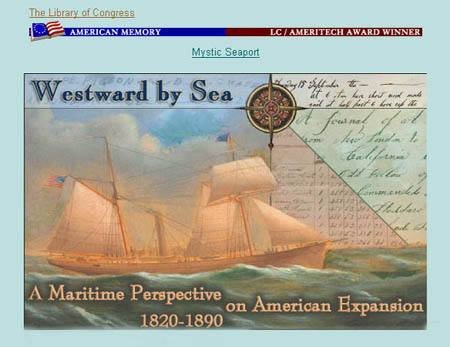
Fig. 2. Collection homepage of Westward by Sea: A Maritime Perspective on American Expansion, 1820-1890. The collection from Mystic Seaport Maritime Museum and G. W. Blunt White Library in southeastern Connecticut presents pictorial and textual materials covering topics such as whaling life, shipping, native populations, the California Gold Rush, and immigrant experiences.
It’s now possible to explore topics across multiple collections and discover a range of substantively different sources. For example, if you were to search across American Memory collections on the phrase “Shays’ Rebellion”—the insurgency of western Massachusetts farmers that took place in late 1786 through early 1787—you would find in the Washington Papers correspondence between George Washington and Benjamin Lincoln, who commanded the Massachusetts militia sent against Shay and his men, and Massachusetts governor James Bowdoin and his successor John Hancock, and a February 7, 1787, letter from Ezra Stiles with a sketch of the area of Shays’ operations. In The First American West: The Ohio River Valley, 1750-1820 you would find a lengthy letter from John Marshall to James Wilkinson outlining all the “contradictory accounts of the motives & views of the insurgents” that were circulating at the time. An American Time Capsule: Three Centuries of Broadsides and Other Printed Ephemera would turn up several contemporary broadsides issued to the populace by Boston selectmen and by John Hancock, and The Century of Lawmaking for a New Nation would yield documentation in the Journals of the Continental Congress, 1774-1789. But you would also be able to do a little historiographical research into Shays’ Rebellion, as both the Atlantic Monthly and Harper’s New Monthly Magazine from The Nineteenth Century in Print: Periodicals offer some nineteenth-century essays interpreting Shays’ Rebellion. Of course, researchers will want to consult resources beyond those offered by American Memory. What American Memory offers are unique historical collections not otherwise accessible or well known to teachers, students, and those interested in history.
We know a good deal about how many people visit the American Memorysite, from a record of “hits” that anyone can view. We’d like to know more about how they use the material they find here. Reference questions submitted electronically through our “error report” and “question/comment” forms accessible on the FAQ page give us some idea. They are statistically incomplete since many people use the collections without ever communicating with the Library. But they help us gain a broad sense of how things may or may not have changed in the world of historical interests and research with the advent of the World Wide Web.
Reference queries tell us that people have several inaccurate expectations about American Memory. Many of these are understandable. People expect to find in American Memory every kind of historical documentation possible on every aspect of American history, and they communicate their surprise at discovering otherwise. This is a popular expectation of the Internet—that it is easy to put “stuff” online, that everything is or will be soon be there, and that the Internet can therefore stand alone as a universal information resource, which, of course, for historical research is not the case.
Others approach the site as a kind of encyclopedia where you can look things up and are, again, surprised that this is not the case. In a related manner, people think of American Memory as the Website of the nation’s library and a place to pose all kinds of questions from the historical to the practical. This concept of the Library is not new, although e-mail and the Internet make it easier to pose questions from every geographical area of the nation and beyond. Everyone has a favorite reference question, and mine is from a Pacific island resident, who was dependent on a very early model refrigerator that was icing up. He needed information on its original design so he could attempt repairs. His question was referred to the Science, Technology, and Business Division, which if it did not have the information, knew where it could be found.
Whatever the medium, reference specialists want to teach people how to use the Library and find resources, which is as important an educational goal as understanding a particular historical question. As in the “pre-Internet” age, students have difficulty coming up with the proper research term or concept that will get them to the resources they need. How do I find out the differences between my home today and one in the 1800s? Are there any histories of black cowboys in the nineteenth century? How I can find them? What is a definition of political corruption? Where would I find examples from the past? How can false arguments or sources from the past still be of use to historians?
A high-school student is writing a report on the practice of colonial crafts and trades. She should start with some general book or encyclopedia sources on the history of work or of the colonial household where so much of it took place. For online resources, the digital reference specialist suggests she start with the Website of Colonial Williamsburg, which offers texts and resources focused on the history of colonial trades and material culture. Once the student has done her research, the reference specialist suggests she then return to the American Memory Website and search through America’s First Look into the Camera: Daguerreotype Portraits and Views, 1839-1864, which has a number of occupational portraits. She might then challenge her skills by looking at these portraits to see if she can find visual evidence of how some occupations may or may not have changed from the eighteenth to the early nineteenth century. There are lessons on American Memory‘s Learning Page on different kinds of primary sources and how to research them.
Naturally, we see American Memory as a flow of historical collections from the Library of Congress to American citizens everywhere. Unanticipated is the flow of content and information back to the Library of Congress from people who have local history, genealogical, or other specialized information to offer for correcting and enhancing descriptions of items in the institution’s collections. They are seeing these collections for the first time.
Here is a representative sample of the kinds of information users offer. A resident of Tennessee compares a photograph from Selected Civil War Photographs to those available in a local historical society. A view of the “Environs of Knoxville seen from south bank of the Holston River . . . ” is actually from that of the Tennessee River. Another Tennessee resident identifies a Depression-era photograph of a Greenville courthouse as being in Greene not Davidson County, which the user remarks may have had a Greenville too, but he knows the former and can correctly identify the courthouse’s true location. He would like to make sure the photograph is “properly attributed.” A user informs the Library that a photograph in America from the Great Depression to World War II is actually Freedom rather than Conway, Pennsylvania. The buildings in the foreground are still standing, while the first story of a factory in the background survives. She also offers to send photographs to document the information. People recognize members of previous generations of family or local figures as well as regions, counties, and hometowns. A daguerreotype of “Three unidentified men,” 1853-55, from Mathew Brady’s studio in America’s First Look into the Camera: Daguerreotype Portraits and Views, 1839-1864 is actually of someone’s great grandfather, his cousin, and a great uncle. While the lack of information is understandable, members of this family are disconcerted to see their forebears described online as unidentified when they are so well known to them.
Understandably, many corrections or additions to bibliographical information are for visual materials: daguerreotypes, photographs, and even film (especially those of early New York). For photographs, the primary source of information for cataloging these has been the original caption supplied by the creator or photographer on the item or in a caption logbook. But the majority of resulting corrections are actually made in a notes field of the bibliographical record displayed online with the item. This preserves the original caption, which is a primary source text itself. Identifying less notable people or places requires extensive research, and the necessary documentation is difficult to find. But now these are more widely available to users with knowledge of people and places. They will sometimes offer documentation, or if not, Library staff now have a name or other detailed information that can be specifically researched. If the outcome is ambiguous, the Library will sometimes add a note to the bibliographical description that there is conflicting information.
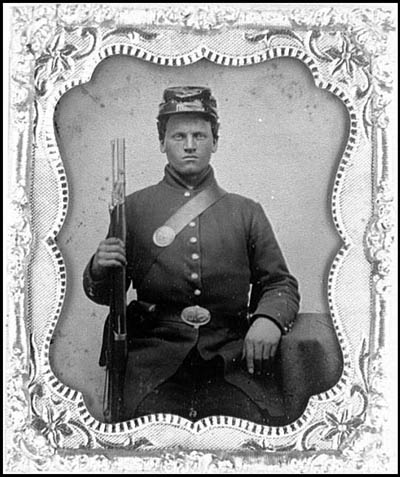
Fig. 3. From the collection, Selected Civil War Photographs, 1861-1865. The supplied title in the bibliographical record for this portrait was changed in response to information provided by an online researcher.
People also have specialized knowledge to offer. In the Selected Civil War Photographs, 1861-1865 collection, for example, a photograph has the supplied title “[Portrait of a Federal Soldier]” in the bibliographical record because of the general appearance of his uniform (see fig. 3). However, a user e-mails, Check his belt buckle. Soldiers recycled enemy uniforms and articles of clothing from battlefield victims. But to avoid being misidentified themselves, a Confederate soldier, for example, would turn a recycled Union soldier’s belt buckle upside down, which the user believes appears to be the case in this portrait. He also offers clues related to the rifle the subject is holding. The supplied title is changed to “[Portrait of a Soldier]” until these clues can be researched further.
American Memory‘s Today in History page also generates responses from sharp-eyed users. This page features events keyed to each day in the calendar, offering a short essay and links to related collections. It functions as a handy introduction to the collections in American Memory. The items featured are a mix of familiar “blockbuster” and lesser-known events, and perhaps this latter is what makes the page so interesting to users. The patenting of the first cable car in 1871 shares the date January 13 with the birth of Benjamin Franklin in 1706. Alongside the ratification of the Treaty of Paris in 1784, formally establishing the United States as an independent and sovereign nation, are the birth of novelist, folklorist, dramatist, and anthropologist Zora Neale Hurston and the opening of the New York Stock Exchange’s first permanent headquarters at 10-12 Broad near Wall Street in New York City. The essays branch off into related topics, providing links along the way to collections online that illustrate or extend the subject matter.
A user notes, correctly, that a paragraph in a Today in History feature for February 8 on Jules Verne refers incorrectly to Civil War “hot air balloons,” since hydrogen gas, derived in a complex process described by the user, was used to fuel these balloons, not hot air. Another asks, would it be more accurate to say that Henry Wadsworth Longfellow was born in Portland, Massachusetts, on February 27, 1807, since Maine was not yet a state? Anne Hutchinson did not move to Long Island but to what is now Westchester County, a user writes, also noting today’s Hutchinson River Parkway which passes near where she lived. Surely the sun does not “move north across the celestial equator,” a user e-mails about a March 20 Today in History feature on the vernal equinox, but rather it appears to move. In another Today in History feature, two different Maryland residents catch an incorrect reference to Ellicot City as Endicott City.
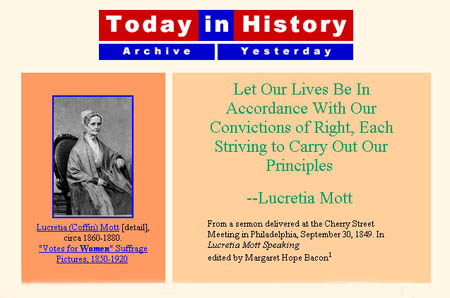
Fig. 4. A Today in History entry celebrates the birth on January 3, 1793, of feminist and political and social reformer Lucretia Coffin Mott. The page contains links to the “Votes for Women” Suffrage collection and other related collection homepages. Errors have not been found in this entry by sharp-eyed users . . . yet.
And, of course, people raise issues of interpretation. The film collection Spanish American War in Motion Pictures, for example, generated a number of e-mails from users on how better to characterize the war in the Philippines in 1899, which had been subsumed under the 1898 Spanish-American War on the Website. The subject specialists who wrote the special presentation for the Website had used the Library of Congress subject heading term “insurrection” to describe the war in the Philippines. Although the term had been employed in many reputable sources, those who e-mailed thought it was outdated. After discussions among staff, the term “insurrection” was changed to “revolution” on the homepage and in the special presentation. But the two events remained grouped together since they had been organized and programmed on the server as one collection. Such comments are almost always offered in a spirit of historical inquiry and raise questions that might not otherwise be addressed if these collections had not gone online. The questions are discussed via the in-house e-mail reference list, but also in informal conversation and sometimes in meetings.
Who are these people who send queries, comments, corrections, and bibliographical information? We know something far more important about them than any demographic information might provide. They are attentive, reading, thinking users of online historical content. Even e-mail reports of typos and minor discrepancies are, after all, the byproduct of close attention to items in the collections. One cannot help but be struck by the contrast between this and popular expressions of concern about the deleterious impact of the Internet as a whole on our attention span and on thinking itself.
For many people the Library of Congress has long been a remote institution. That is certainly less the case now as a broader community of researchers learns about its reading rooms and custodial divisions, browses, researches, and moves about in its collections. How will it all turn out? We are still in the middle of the history of the Internet, so it is difficult to say. Perhaps, for now, we might be guided by George Washington’s account of his 1748 journey over the mountains. He tersely closed his diary with the observation that he had returned home safe. But we know, of course, he did not stay there for long. And neither will we.
This article originally appeared in issue 3.2 (January, 2003).
Laura Graham received a Ph.D. in history from the University of Rochester in 1993. She has worked at the Adams Family Papers, Massachusetts Historical Society; the Henry Laurens Papers, University of South Carolina; and currently is at the Library of Congress.
Comments
Professor Birgit Brander Rasmussen’s comments from this panel will appear, in a fuller form, in her review of Seasons of Misery, forthcoming in American Literary History in early 2015.
This article originally appeared in issue 15.2 (Winter, 2015).
Publick Occurrences 2.0 October 2008
October 31, 2008
“Seems Like Old Times”: Democracy = No God
Roughly 208 years ago this month you could open many a Federalist newspaper — the mainstream commercial press of the time – and find the following notice regarding that year’s hotly contested presidential election:
This was the first case of a U.S. party in power trying to save itself by juicing up the atavistic fears of Christian voters. In 1800, it was the supporters of John Adams who tried to paint challenger Thomas Jefferson as an alien infidel out to destroy traditional values and shut down the churches, even though there were almost no federal policy issues related to religion or the sanctity of the family being debated. (Jefferson was also accused of palling around with terrorists, in the Reign of Terror sense anyway.)
Democratic vice presidential candidate Joe Biden on Monday cast White House hopeful Barack Obama with presidential giants, likening attacks against his running mate to criticisms lobbed against Thomas Jefferson’s Christianity, Abraham Lincoln’s commitment to individual rights and John F. Kennedy, for being a “dangerous choice in difficult times.”
“Sound familiar?” Biden asked the crowd. “The defenders of the status quo have always tried to tear down those who would change our nation for the better.”
That comparison seemed a trifle strained (only a trifle) when Biden uttered it, but apparently the Elizabeth Dole campaign down in North Carolina looked up the 1800 race and decided that the Federalists’ “No God” line needed to be echoed even more literally:
The Trail – washingtonpost.com
North Carolina’s U.S. Senate race erupted this week after Sen. Elizabeth Dole (R-N.C.) launched an ad accusing her Democratic challenger of supporting the agenda of a political committee devoted to atheists.
State Sen. Kay Hagan (D), who polls show is narrowly leading Dole, filed suit in a North Carolina court Thursday accusing the incumbent of defaming her in the advertisement, which ends with an image of Hagan on the screen and a female voice saying, “There is no God.”
Here’s the commercial itself, for the comparative record:
October 29, 2008
Cotton Mather to Edmund Ruffin, the Musical Journey
I am trying to be a serious person in these serious times, but permit me to take moment to follow up on the Early American History Band Names thread from a while back. Mention was made of the 90s power pop outfit Cotton Mather, out of Austin, TX.
I have just learned that Cotton Mather leader Robert Harrison’s new band, Future Clouds and Radar, has a new album coming out next week, and that the American history references continue, albeit to a later period. Song #2 on Peoria is something called “Old Edmund Ruffin.” The rumor is that FC&R is doing a little tour through my environs (Columbia, Chicago, St. Louis & Louisville) week after next, so I look forward to asking Harrison how he came to name pop bands and songs after Puritan theologians and hyper-secessionist editors.
Future Clouds and Radar’s eponymous debut album from last year is also very much worth seeking out. An epic two-CD set, the best song on that collection (video below) also has some geek value. It’s “Build Havana” and appears to use Fidel Castro’s capital city as a metaphor for the sort of relationship that the singer would like to have: “Our love’s in currency that I can’t hold.” I think this metaphor might qualify Robert Harrison as a socialist under current rules, so John McCain might want to look into that. Most struggling indie rock bands do stand in need of some wealth-spreading.
This is a guest post, the fifth in our new series, running in honor of Philip Lampi and in conjunction with the Common-Place politics issue. See the introduction for an explanation. Click the logo below to see all of the posts.
WERE EARLY AMERICAN ELECTIONS FOR WHITE MEN ONLY?
[BLOGITORIAL NOTE: I asked Prof. Rosemarie Zagarri, author of Revolutionary Backlash: Women and Politics in the Early American Republic (Philadelphia: University of Pennsylvania Press, 2007), to post on a myth that she and a number of other scholars have already dispelled. The answer to the question posed above is still “mostly,” but there were wider forms of participation in the celebratory politics of the Early Republic and direct participation for some wealthier women and African Americans because of property requirements for suffrage rights. New Jersey is the famous case of this. Zagarri’s post indirectly answers my question, but goes it one better by also drawing an up-to-the-minute parallel between the politics of Jefferson-era New Jersey and the current election cycle. In both cases, the prospect of new or unusual numbers of voters led to charges of voter fraud.– JLP]
October 26, 2008
Erin Burr, Rogue Veep
The story is careful to cite campaign tensions between other running mates, but I can’t say I remember reading anything like this before. If the election ends up going to the House — which I am not predicting — McCain should be glad the 12th Amendment is in place, because he might have an Aaron Burr problem on his hands. I don’t see our Sarah voluntarily refusing the presidency.
Palin’s ‘going rogue,’ McCain aide says – CNN.com
“She is a diva. She takes no advice from anyone,” said this McCain adviser. “She does not have any relationships of trust with any of us, her family or anyone else.
“Also, she is playing for her own future and sees herself as the next leader of the party. Remember: Divas trust only unto themselves, as they see themselves as the beginning and end of all wisdom.”
I certainly hope these nonplussed McCain aides are the same ones who thought that picking a vice-presidential candidate the way you might choose an actor for a TV commercial would be an awesome “maverick type of move” back in August. Said one of them in the NYT Magazine story today: “’The sense you immediately get is how tough-minded and self-assured she is,’ [McCain speechwriter Mark Salter] recalled three weeks after meeting her. ‘She makes that impression in like 30 seconds.’ ” Possibly they are thinking now they should have thought 30 seconds longer.
In this fourth guest post in our new series, Prof. Matthew Mason gives a personal perspective on political historians’ long-standing habit of ignoring slavery as a major political issue before the traditional survey course opening of the “Sectional Crisis,” with the Missouri Compromise. Mason’s research on the so-called “Era of Good Feeling” showed that actually reading through the press of the time gives a very different impression.
See the introduction for an explanation of the “Lost Atlantis” series. Click the logo below to see all of the posts.
WAS SLAVERY REALLY NOT A MAJOR ISSUE IN AMERICAN POLITICS BEFORE THE MISSOURI CRISIS?
Debunking the Myth Without the Aid of a Method or an Online Database
At my dissertation prospectus defense, one of the committee members posed a question that vexed me even more than the others faced that day. “What,” he inquired, “is the method to your madness here?” He noted that I had listed a whole series of sources but proposed no research method other than to “just read these newspapers and sermons and congressional debates.” I stammered out some half-baked reply, he urged me to find a method, and we moved on. At some point after this defense, I surely became a more efficient researcher. But I’m not sure I’ve found a better method than “just reading” the sources with an eye to the research question at hand.
If I had actually obeyed the injunction to find some more selective or systematic approach to the sources, I may not have written this particular dissertation and book, Slavery and Politics in the Early American Republic, in the first place. This because I quite literally began this research by just sitting down and reading the newspaper: Niles’ Weekly Register, one of the very few truly national publications of the early nineteenth century.
My question was whether slavery really disappeared from national politics between the abolition of the slave trade in 1808 and the Missouri Crisis beginning in 1819. The common wisdom was that the partisan and international fury surrounding Jefferson’s Embargo on foreign trade and the War of 1812 took slavery off the table in national politics. I thought this national newspaper in particular would be a good place to inquire as to the truth of that historiographical consensus.
Hezekiah Niles published his Weekly Register in volumes and bound them with an index, but fortunately I did not discover that right away. The lack of index entries for such terms as “slavery” or “negroes” would have confirmed the traditional take on this era, as would a glance at the headlines and topic headings on each page. But here’s where just reading the thing paid off: I found slavery everywhere in Niles’s coverage of those headline events and issues, even though none of them had anything overtly to do with slavery. Here was a prowar (Democratic-)Republican comparing the Royal Navy’s impressment of American sailors to Algerian or West Indian or even southern slavery. There was a Federalist campaign to abolish the Constitution’s three-fifths clause – which they commonly branded “slave representation” – in response to a wicked war the “Virginia dynasty” ruling in Washington had brought on the country. There in turn was Niles and other Republican editors casting about for good replies to this Federalist attack on the power of slaveholders. Yet none of these tactics in the larger partisan struggle showed up in the index, which was quite naturally devoted to the main subjects at hand, like the war.
I found the same thing whether I sat down to “just read” fiery sermons from New England Congregationalist divines, antiwar or prowar pamphlets, or the Annals of Congress. Indeed, ignoring the inadequate index and page headings to the congressional debates paid the same dividends as doing the same for Niles’ Weekly Register. In the course of their diatribes against the war, for instance, various congressmen warned the southern warmongers that slave insurrection would be a natural and just consequence of their leaving their plantations to invade Canada. One of the great moments came as I waded through an 1813 debate over expanding the army – yes, there was a bitter partisan dispute over such a radical notion in time of war – when I encountered Josiah Quincy of Massachusetts charging that the expanded army would march north to drag the administration’s political enemies into slavery, yoking them in with the black slaves over which the Virginia despots ruled. And on and on it went in much this same fashion, as I encountered slavery everywhere in debates that should have borne no direct relationship with slavery whatsoever. It became clear that the subject of slavery was never truly absent from American public life.
It also became quite clear why so many previous scholars had argued that slavery had subsided as an issue in these years. The 1810s were manifestly not the 1850s, when slavery was the headline issue around which everything else revolved. The whole exercise showed that unearthing new documents is not always the Holy Grail of historical scholarship. In this case, as with so many others, examining old familiar sources with a new question in mind generated surprising conclusions.
While a blog post may be a strange place to air this particular moral to the story, the whole experience makes me tremble just a little for my profession as I see the proliferation of online databases make such sources as early American newspapers more widely available. This development has undeniable payoffs, which even my (strong) inner Luddite is not inclined to dispute. But researchers doing only word searches will miss not only context, but also what might lurk just beneath the headlines.
Matthew Mason
Brigham Young University
October 24, 2008
Back in the saddle, and (intellectually) gunning for Greenspan
Clearly I should not have promised new “Lost Atlantis” posts every 3-5 days and then run off to the land of uncertain Internet access that Italy turned out to be. My apologies. At any rate, I restarted the series Wednesday, almost as soon as I walked back in the door, with Andrew Shankman’s post on Jeffersonian charges of monarchism, below. (I seem to have figured out how to make footnotes work on the blog on this one occasion, so enjoy.) Matthew Mason’s and Rosemarie Zagarri’s posts will be coming soon after that, and more are looming on the horizon. I am also happy to report that new contributors have volunteered, so the series will be continuing for a while.
As to the blog itself, I will be posting my own comments, but I must say that I am feeling pretty inhibited about commenting on the presidential election right now because of my strict no-gloating and no pre-hatched-chicken-counting rules.
As to Alan Greenspan, in his case, I think we early American historians are entitled to gloat, given that he went up to Capitol Hill and admitted that his and most other economists’ ideology of the market and “private enterprise” as infallible, self-policing mechanisms is wrong, wrong, wrong:
Greenspan called this “a flaw in the model that I perceived is the critical functioning structure that defines how the world works.”
This is a guest post, the third in our new series, running in honor of Philip Lampi and in conjunction with the Common-Place politics issue. See the introduction for an explanation. Click the logo below to see all of the posts.
WERE JEFFERSONIAN CHARGES OF MONARCHISM REALLY JUST SLEAZY, HYSTERICAL SMEARS?
by Andrew Shankman
Rutgers University, Camden Campus
October 17, 2008
Suspending my campaign
Technical difficulties here at the Publick Occurrences roving command center have prevented any posts this week. “Myths of the Lost Atlantis° and more will be back next week when my Internet access becomes reliable again, on approximately Tuesday, the 21st.
This is a guest post, the second in our new series, running in honor of Philip Lampi and in conjunction with the Common-Place politics issue. See the introduction for an explanation. Click the logo below to see all of the posts.
WAS ANDREW JACKSON REALLY THE PEOPLE’S CHOICE IN 1824?
by Donald J. Ratcliffe
Rothermere American Institute, University of Oxford
WASHINGTON — Having tried without success to unlock frozen credit markets, the Treasury Department is considering taking ownership stakes in many United States banks to try to restore confidence in the financial system, according to government officials.
Treasury officials say the just-passed $700 billion bailout bill gives them the authority to inject cash directly into banks that request it. Such a move would quickly strengthen banks’ balance sheets and, officials hope, persuade them to resume lending. In return, the law gives the Treasury the right to take ownership positions in banks, including healthy ones. . . .
Thus it seems more obvious than ever that historians and history readers ignore the role of government institutions at their peril. While putting U.S. taxpayers into the insurance business, the mortgage business, and soon the investment management business contradicts the ideology of both present-day political parties, even the George W. Bush administration finally had to admit what has always been true: that government is the ultimate guarantor of the national weal. No matter how privatized basic public functions (such as shielding citizens from financial risk) appear to be, it is government that has to take responsibility when the chips are down and basic stability is at stake. Actually government has always had that ultimate responsibility, but in recent times American leaders found it more politic and seemingly more efficient to handle such tasks through institutions defined as private businesses. Now we know better. Any notion of political history with even the slightest pretensions to accuracy and comprehensiveness cannot afford to leave the “American state” out of the picture.
This article originally appeared in issue 9.1 (October, 2008).
Jeffrey L. Pasley is associate professor of history at the University of Missouri and the author of “The Tyranny of Printers”: Newspaper Politics in the Early American Republic (2001), along with numerous articles and book chapters, most recently the entry on Philip Freneau in Greil Marcus’s forthcoming New Literary History of America. He is currently completing a book on the presidential election of 1796 for the University Press of Kansas and also writes the blog Publick Occurrences 2.0 for some Website called Common-place.
American Originals
Part I
Drive up Main Street in Chester, Vermont, and you will see all the staple ingredients of a small New England town, and then some. Its four churches tell a tale of waves of growth and change: a white clapboard Congregational, a red brick Baptist, a pale gray and blue Victorian Episcopal, and the Scots-influenced old stone. From the Romanesque library to the Pollyanna-esque Country Girl Diner, the town is dense with the various sizes, shapes, and periods of New England’s past.
Fig. 1. The front of NewsBank’s Chester, Vermont, production facility, where Evans Early American Imprints, Series I, once took form and Evans Digital Edition is now coming to life. (The entire NewsBank facility is actually much larger.) All photographs and screen shots of Evans for this article were made by Katherine Stebbins McCaffrey.
The Main Street production facility of NewsBank, Inc., seems right at home in these surroundings: the company resides in a white clapboard building that, long ago, was the Adams Funeral Home. Out back, the printing shop runs off color copies and other small orders for local customers. Yet, inside, among a generic assemblage of office cubes, a couple dozen people and a handful of computers labor at a decidedly nonlocal project: ushering the Readex Microprint Corporation’s microform collection of Early American Imprints, Series I, 1639-1800 into the Digital Age. Here, photographic copies of thirty-six thousand plus of the nation’s oldest printed documents are dissolving steadily into ones and zeroes that will dramatically reshape the study of early American history and life.
Fig. 2. Kelly Lauren monitors input from the Mekel scanner after feeding fiche through the clear plastic portal on the left. The green square on the right represents the entire microfiche, and the larger image shown on the left is one page scanned from it.
NewsBank began the fascinating process of creating the Evans Digital Edition (as this new incarnation is called) in July 2002, and the project is scheduled to be in production through July 2004. Yet, the creation of Evans Digital encompasses another history that lies between the immediate one of digitization and the distant one of the founding of the American nation. Three men, in particular, toiled in that middle ground, and their grand plans still dot the landscape of scholarly inquiry today, as well as profoundly shape the structure of the Evans Digital Edition.
Librarian and longtime cataloger Charles Evans laid one foundation in 1902, when he aimed to compilea “chronological dictionary of all books, pamphlets, and periodical publications printed in the United States of America from the Genesis of printing in 1639 down to and including the year 1820, with bibliographical and biographical notes” (as his advertisement trumpeted). Supporting himself and his family almost entirely on subscriptions to the American Bibliography, the aging Evans obsessively went after his quarry armed with pencils and corset boxes bursting with note cards, working alternately out of his home in Chicago and numerous East Coast archives. He died in 1935 after tracking down 35,854 imprints and publishing twelve volumes, but before he could complete the listing of publications for the year 1799.
Fig. 3. Cindy Tufts scrutinizes a page of sheet music scanned by the Mekel. Each page lights up as a smaller green square as it scans (far right), until the entire fiche becomes green, signaling the last page
As Evans’s astonishing and extraordinary work gained prominence, he found himself torn between the archivists who sent lists of errata for and oversights in early volumes and the librarians who excitedly pressed him for the next volumes in the series. During this period, one fellow librarian consoled Evans, “No one has ever prepared the perfect bibliography and no one ever will.” Happily, though, someone kept trying.
That someone was Clifford Kenyon Shipton, the early American scholar and head librarian at the American Antiquarian Society in Worcester, Massachusetts, who, in 1954, built a new level on Evans’s base. Shipton completed the catalog of imprints for 1799 and 1800 and initiated the AAS’s publication of the Evans volumes in a series of indexed books. He also contracted with Readex Microprint Corporation to shrink all the books in the Evans series down onto Microprint in an ambitious effort to begin carefully correcting the bibliography and widely disseminating the film for every extant imprint listed. As if all that were not time consuming enough, he created “target cards” (each with the basic bibliographic information about a document) for every title.
Fig. 4. Standing solo in another room, the computer running the OCR software “reads” and translates text at a rate of ten seconds per page. The rectangles with large black characters show close-ups of pages while the rectangles with smaller gray characters next to them display the ASCII text as it is generated.
In choosing Readex, Shipton tapped another man who knew something of fantastically large, impossibly idealistic projects: Albert Boni, founder of the Modern Library. Boni had let Vermont’s granite ledges and millstreams lure him from the New York publishing world to Chester in 1945. There, while Luther Evans and Verner Clapp experimented with space-saving methods for converting hundreds of thousands of titles to microfilm at the Library of Congress in Washington D.C., Boni tinkered away trying to solve what he understood to be the problem at the heart of microreproduction: microfilm itself.
From the start, Boni’s objectives for his technology ran counter to the vein unearthed by Nicholson Baker in Double Fold (Random House, 2001). Boni neither rejected paper as a storage device nor crusaded for clearing library shelves. He actually hoped to convince librarians to buy more titles printed on more paper, albeit in the modest form of six-by nine-inch cards, each of which could hold one hundred pages of a standard book. The problem with microfilm, Boni thought, was that it was inordinately expensive. Miniscule reproductions on special quality paper would be much more affordable both to produce and to acquire, and could last up to two hundred years, according to one U.S. Bureau of Standards’ estimate. Moreover, Boni did not seek to replace titles, but to induce librarians to supplement their collections with cabinets full of some of the world’s greatest and rarest works—and, of course, the patented machines necessary to read them.
Fig. 5. Debbie Swisher compares printed copies of eighteenth-century North Carolina law with the microfiche version, adjusting the computer image for maximum quality and tagging the file with “metadata,” including cross-references.
As a collector, Boni had plenty of curiosity about photographic processes but little experience with them. Attempts to read early versions of Microprint with existing magnifying lenses and lamps only produced micropiles of ashes because of the enormous amount of light (and thus heat) required. But the fifty-three-year-old innovator could not be deterred by illegibility and incineration, and by his fifty-eighth year he had perfected his process and machine: pages reduced on microfilm were printed and reprinted like so many copies of a photograph onto emulsion-coated cards at the Chester printing shop and then read with a cheap lens that filtered out heat and a lamp with the intensity and power of an automobile headlight.
In June 1950, Boni opened the doors to Readex and began work on the entire series of British House of Commons Sessional Papers under the sponsorship of the American Historical Association. Soon the company was filming and printing the New York Times for the New York Public Library, as well as the Annual Subject Catalog for the Library of Congress and the declassified papers of the Atomic Energy Commission. Five years later, when Clifford Shipton contacted him regarding Evans’s Imprints, Boni must have relished the opportunity to erect not only a monument to America’s past and Evans’s effort, but to the usefulness of his own invention. Readex promptly rented space in the basement of the AAS, and began issuing the Microprint versions of Early American Imprints. It finished the first series of Early American Imprints in 1968, the year after Shipton retired from the AAS.
Fig. 6. Data Conversion Manager Korrie Heiden checks several pages in a document and links them together electronically. Boxes of forty-year-old microfiche—the source material for this project—sit on the desk to the lower left of the picture.
Part II
It took thirteen years to create Evans’s Early American Imprints, but it took only a decade for Boni’s Microprint technology to fall out of favor with librarians and their patrons. Although Microprint remains indispensable to historical research today (despite the fact that machines that can read the cards are now few and far between and nearly impossible to repair), by the 1980s institutions favored microfiche and microfilm, which were read on relatively easy-to-use machines that also offered printing capabilities. In answer to the demands of the market, Readex switched to making archival quality duplicates of the original film used for producing Microprint cards, and in 1983, when Connecticut-based NewsBank, which specialized in archiving and filming newspapers, purchased Readex, the company simply expanded Boni’s old printing shop in Chester.
Newsbank still occupies space in the basement of the AAS, in a dimly lit room crammed with file cabinets, a precariously overstacked desk, and—the very heart of the operation—a gigantic, Recordak (Kodak) microfilm camera. This is where, for the past forty years, Stanley Shapiro, who bears a remarkable resemblance to a trim St. Nick, has run the microform operation, carrying on the work started by Evans, Shipton, and Boni.
Fig. 7. Evans Digital Edition’s stylish main page. Patrons may search in a variety of ways—this page requests all materials authored by Benjamin Franklin.
Today, Shapiro and his staff still follow the same basic procedure in filming the twelve hundred AAS imprints to be added to Evans Digital. Whatever is to be filmed—from pamphlets to schoolbooks to broadsides—is positioned carefully in a large, jointed cradle under a wide pane of glass. Gently the item is pushed upward with the help of a bicycle chain and a crank until it is pressed flat against the bottom of the glass, at which point the operator photographs it with a camera situated about three feet above. But the film created now is only a master copy to be sent to Chester to be digitized.
Naturally, the architecture of Evans Digital Edition resembles in some respects its predecessors’. To begin with, NewsBank’s technicians in Chester have chosen to use the non-archival microfiche “originals” from the 1950s and 1960s as source material, since they yield better quality scans, though at a slower rate, than the archival copies made in the 1980s. To effect the transformation to sleek, modern binary code, staff members feed each carefully cleaned fiche into a high-quality Mekel scanner. The Mekel looks like an unassuming beige plastic rectangle attached to a fairly ordinary Dell desktop. Upon loading, a small green replica of the fiche appears on the monitor allowing operators to track each page as the computer scans the image at 400 dots per inch (dpi). The resolution of 400 dpi seems modest, below what consumer scanners offer now, until one considers that, on fiche, each page measures about seven-eighths (or less) of an inch wide. To achieve a final, enlarged resolution of 400 dpi, the scanner is acquiring an astonishingly dense 6,400 dpi, all while separating documents page by page, converting them to grayscale, and tagging them with a unique file name that will help trace their every step toward inclusion in the Evans Digital database.
Fig. 8. Franklin—as a bookseller—can be located in the “History of Printing” section of the site.
Because each page is independent in the system, in the next phase of production, a computer running optical character recognition (OCR) software can pluck multiple scans from a holding computer’s memory to generate ASCII text. To “read” a scanned page, the OCR machine runs a ten-second automated sequence that makes the image high contrast, adjusts the angle of the page, transcribes the text, and reconverts the image to grayscale. If left running day and night, the machine would probably finish perusing the thirty-six thousand books in Evans’s Imprints in about nine months.
Even at the highly technical OCR stage, though, a tension between present and past technologies exists. Colonial American documents present a particular problem for OCR because of the quality of originals (many have broken type or show the effects of uneven hits on the press), variations in typefaces (such as the old style s that looks like an f to twenty-first century eyes), abrupt and inconsistent abbreviations (like Quest. for question or play’d and playd for played), and orthography (consider republick or rejoyce or booke). Therefore, before a page travels back to storage, filters “clean” the text with a series of algorithms designed to find and fix errors. While NewsBank places fierce pride in these filters, real limits to the abilities of OCR to master the impressions made by seventeenth- and eighteenth-century metal type remain, evidence of which lies in the Help Section of the Evans Digital portal. There, patrons are instructed to abandon formatting their searches with the character s and instead insert a wildcard character like ?—as in Ma??achu?ett? for Massachusetts.
Fig. 9. A screen showing multiple matches for the author search for “Franklin, Benjamin.”
After being machine read and cleaned, the page image again rests in storage, where it awaits a quality control review and the addition of “metadata,” which includes bibliographic data and cross-references. In the final stages of production, staff members call up a fiche’s worth of pages looking for Shipton’s target cards, which were also filmed and positioned on the fiche at the beginning of each document. Early on, using Evans’s American Bibliography as a strict guide, the editorial staff for Evans Digital compiled categories for the information; in addition to creating a structure for the archive’s digital portal, these classifications have become part of the metadata that organizes the database. Here, a page from the Bay Psalm Book, for example, would be marked with not only its page number but also the fact that it belongs with the other pages of The Whole Book of Psalmes, a Psalter printed in 1640 by Matthew and Stephen Day of Cambridge, Massachusetts, and electronically filed under cross-references like “Music in Churches” and “Psalmody.” (Since every title in Evans Digital Edition is indexed to the AAS’s catalog, they are all also keyed to subject headings.)
At this point, too, other staff members review pages, comparing them to the microfiche versions and manually adjusting the image for maximum readability. Staffers may reject pages marred by cutoffs, bad skews, or light or broken text. In each case, a rejection means staff will pull the microfiche again and try to improve the scan.
Fig. 10. An example of the citation page for Franklin’s “The Way to Wealth.” Patrons can also opt to see individual pages or look through the table of contents.
So far, each month, NewsBank’s staff has captured about a terabyte—that’s over one trillion bytes—of colonial thought—more information than can be stored on ten ordinary desktops. When the project is finished, seven drawers of fiche will need to be digitally stored on the equivalent of over three hundred desktops. But don’t go to Chester hoping to see armies of computers assembled to deploy America’s founding documents; NewsBank built from scratch several high-end computers for storing the ever-growing Evans, which is also backed up on at least $16,000 worth of digital tape. While on the material level, the digitization of Evans means the shifting of information from one type of plastic to other types of plastic (and some metal), on the experiential level, the change effected is nothing short of enchanting.
The interface for Evans Digital Edition, developed with the assistance of a panel of librarians, looks like commercial Websites, with stylish lettering, a tasteful palette, and an uncluttered layout. Screens offer browsing and searching capacities coupled handily together on one page, guided by a comfortingly familiar row of browsing tabs. If an institution decides to invest in the expanded cataloging software developed by the AAS—offered, like access to Evans Digital, at different pricing levels to match the sizes and missions of various purchasers—any hit on an Evans reference in a library catalog would produce a direct link to the electronic image and text of the document. Once a patron locates an item, she can look at full citations, move through the book page-by-page, choose from two different formats for printing, use the “Table of Contents” feature to skip around or locate pages that matched her search criterion, and scale the images up to 300 percent or down to 25 percent in Alice-in-Wonderland fashion. Future improvements in searching and printing designed to assist teachers and researchers may also be integrated. In addition, NewsBank recently announced a text-creation partnership with the University of Michigan whereby the text of six thousand imprints, selected by the AAS, will be hand-keyed into another database (available separately, directly from the University of Michigan)—an initiative that will produce as close to 100 percent accurate searchable text as is humanly possible for some of the period’s most widely used or historically significant documents.
Fig. 11. The title page for “The Way to Wealth.” Users can scale this image (shown at 50%) down to 25% and up to 300%, as well as choose from two different formats (TIFF or PDF) for printing.
As Newsbank staff members readily admit, the construction of Evans Digital Edition means the market for Evans’s Early American Imprintson microfiche has been demolished. Already fifty-one institutions, large (Columbia, Ohio State, and the University of California system) and small (Williams, Hanover, and Calvin), are on board, and NewsBank has halted fiche duplication. Libraries that own Evans Imprints and that subsequently opt for Evans Digital must face a difficult decision: what to do with all these little plastic artifacts of twentieth-century Americana and the file cabinets that house them? Inevitably, some libraries will simply discard the fiche and print, as machines available to read them fall into disrepair and users voice their preference for the digital edition’s seductive searchability. Still, perhaps some librarians will take a cue from NewsBank’s Chester surroundings and let the past accumulate organically in all its forms—books, Microprint, microfiche, and terabytes—cheek by jowl, like so many churches in a small New England town.
Further Reading:
Those interested in the history of microreproduction may consult Nicholson Baker’s Double Fold: Libraries and the Assault on Paper (New York, 2001), but should keep in mind that Evans’s Imprints and similar initiatives had a profoundly different set of objectives than did the projects Baker chronicles. In addition, the Association of Research Libraries has collected many responses to Double Fold‘s assertions. Although a few links are now broken or expired, this remains an excellent source for a broader picture of the debate surrounding microreproduction, digitization, and the multiple missions of libraries in the twenty-first century. Edward G. Holley wrote a truly fascinating biography of Charles Evans entitled Charles Evans: American Bibliographer (Champaign, Ill., 1963)–despite its age, it is still a terrific read and has a lot of interesting information about Evans’s project and the creation of Readex’s Imprints, Series I. Those interested in Albert Boni’s early career should refer to Jay Satterfield, The World’s Best Books: Taste, Culture, and the Modern Library (Amherst, 2002). The Whiting Library, in Chester, Vermont, maintains a Vermont Room, which is also an outstanding source for articles about the history of Chester and the Readex Microprint Corporation (many thanks to the librarians for their assistance). Readers interested in the history of the American Antiquarian Society and its librarians should click here or consult Under Its Generous Dome: The Collections and Programs of the American Antiquarian Society, 2nd edition (Worcester, 1992). Many thanks to NewsBank staff members Ken Dufort, Georgia Frederick, Kelly Lauren, Steve Osterland, Caroline Reyes, Stanley Shapiro, Debbie Swisher, Cindy Tufts, and Mike Walker for taking time out of their busy schedules to show me Evans Digital Edition; special thanks to Vicky Gardner, Korrie Heiden, and Jim Hornstra for making time on many occasions to answer my repeated queries. Thanks, too, to the librarians who helped give me a sense of how this product will be used, and to Crowley Micrographics for information about the Mekel scanner.
This article originally appeared in issue 3.3 (April, 2003).
Katherine Stebbins McCaffrey was born in Vermont, teaches at Boston University, and is at work on a history of spectacle use in America.
Can This Museum Be Saved?
With roughly six million visitors per year flocking to see everything from George Washington’s sword to Judy Garland’s ruby slippers, the National Museum of American History in Washington would seem to be a going concern. Yet in the past two and a half years, the country’s only truly national museum of American history has gained a reputation as the sick man of the Smithsonian, the mammoth museum and research complex that is, in the words of its current leader, “the guardian of America’s greatest cultural, scientific and historic treasures.” An often fevered public debate about the museum, one that began to rage in the spring of 2001 and is just now beginning to cool down, has raised the same question posed by the ancient medical practice of bloodletting: Which is worse, the disease or the cure?
In the version that has attained the widest circulation to date, the villain of the story and the truly sick man of the Smithsonian is its bloody-minded chief executive, Secretary Lawrence M. Small, aided by, or indentured to, big-time donors. The facts behind the fierce controversy that has arisen around Small’s stewardship of the Smithsonian in general and the National Museum of American History (NMAH) in particular are complex, occasionally murky, and, of course, subject to differing interpretations on the two sides of a divide that it has opened up inside and around the museum.
In most versions, the plot begins with Small’s arrival at the Smithsonian in January 2000 after a thirty-five-year career as a financial services executive, first at Citicorp/Citibank and then at Fannie Mae. As the first nonscholar to run the Smithsonian since its creation in 1846 (an event that followed a long debate in Congress about, among other things, the propriety of accepting the bequest from English scientist James Smithson that led to its founding and naming), Small was controversial from the start. He also brought a distinctly top-down, damn-the-torpedoes, management-by-objectives approach that was probably bound to clash with the culture of a place that is much more like a university than a corporation. While acknowledging that the organization he had inherited had already achieved an “impressive” degree of public engagement, Small quickly proclaimed that the Smithsonian could—and now would have to—do much better. To attract bigger audiences, particularly among the young, the Smithsonian’s sixteen museums (seventeen counting the National Zoo) needed “modernization.” To modernize in the thoroughgoing way that Small had in mind (for example, he said that many permanent exhibitions “should be completely reimagined and redone for today’s audiences”), the Smithsonian would need buckets of money.
Illustrations by John McCoy
Since the Smithsonian (which is legally a “trust instrumentality of the United States,” independent of the government) receives only 70 percent of its budget from the federal government, Small’s vision for the institution entails a heavy reliance on private funding. According to an article last winter by Washington Post reporter Bob Thompson, one of Small’s first significant actions as secretary was to steer one of the Smithsonian’s largest existing donors, real estate baron Kenneth Behring, in the direction of NMAH. Behring’s subsequent gift of $80 million, announced in September 2000, was the biggest ever by an individual to the Smithsonian. Although most of the relevant details would not become known even to museum staff for months afterwards, Behring’s donation turned out to have gained him several substantial privileges—including an advisory role on two new exhibits on subjects of his choosing—beyond the most visible one: the attachment of the name “Behring Center” to the museum’s official moniker.
Then in May 2001, before most of the specifics of Small’s gift agreement with Behring had leaked out, the Smithsonian announced a $38 million donation to NMAH from Catherine B. Reynolds, a Virginia philanthropist who had risen from modest origins to make a fortune in the private student-loan business, and who shared Small’s interest in making the museum compelling to young people. Reynolds’ gift—intended to create a ten-thousand-square-foot space in the museum for an exhibit celebrating American “achievers,” possibly including living individuals who could just as accurately be termed “celebrities”—quickly set off alarms both within and beyond the walls of NMAH. It was bad enough, critics charged, that all negotiations with the donor had again been handled by “the Castle” (Smithsonian headquarters, located in the gothic-revival Smithsonian Building on the National Mall), leaving NMAH’s professional staff out of the loop entirely. The larger implication of these complaints was that Small was allowing a particularly vulgar parvenu with no idea of what NMAH was about to create her own personal shrine to the rich and famous.
In the vehemence of the outcry that followed, the critics missed a couple of important nuances. Still, the aggregate facts of the Reynolds and Behring cases (especially in the context of other actions Small had already attempted around the Smithsonian) appeared damning enough to warrant strong action.
On May 23 of last year, the NMAH branch of the Smithsonian’s Congress of Scholars sent a memo to the Board of Regents (the institution’s governing body) charging Small with forging donor relationships that breached “established standards of museum practice and professional ethics.” Groups including the American Historical Association, the Organization of American Historians, and the National Council on Public History soon followed suit. Some of the most strident protests among the many that followed in the next few months came from groups such as Ralph Nader’s Commercial Alert, which now attacked Small for offering General Motors naming rights to a refurbished NMAH transportation hall in exchange for $10 million to support a new exhibit there. That Small, by this point, had given his critics several megatons of ammunition (notably by actions that appeared to attack the whole research function of the Smithsonian) lent credence to the view that he was trying to drain NMAH of its institutional lifeblood and turn it into a zombie controlled by donors.
In January 2002, a group of 170 scholars and writers sent an open letter to Chief Justice William Rehnquist (the chancellor of the Smithsonian Board of Regents) citing a litany of Small’s transgressions. A few days later, Bob Thompson’s long piece about NMAH in the Washington Post Magazine portrayed an institution that had completely lost its way (albeit over a period extending back beyond Small’s arrival at the Castle), and presented the Small-Behring-Reynolds triad as a kind of tacky, vaguely right-wing cabal. Two weeks after Thompson’s article appeared, Catherine Reynolds withdrew all but the $1.5 million of her $38 million gift that the museum already had in hand, despite months of effort to reach a compromise (which historian Patricia Nelson Limerick, who was part of that effort, believes to have been achievable) between her vision and the views of NMAH and outside historians. It was—and is—a depressing tale, and today it is by no means over.
What, if anything, can be said in defense of Lawrence Small, the demon barber of the Castle on the Mall? At least a couple of things, it turns out—starting with the fact that NMAH actually does need “modernization and money.”
Small’s critics seem to fear that his vision of modernization entails dumbing history down or, at the very least, moving what is now NMAH away from its tradition of collecting, presenting, and interpreting real physical objects and propelling it into the weightless world of virtuality. In their book Legacies: Collecting America’s History at the Smithsonian (Washington and London, 2001), NMAH scholars Steven Lubar and Kathleen M. Kendrick affirm their stance “on the side of the artifact” and against certain intellectual successors of a late-nineteenth-century Smithsonian curator who said that a modern museum should not be a “cemetery of bric-a-brac.” Even so, there seems to be widespread agreement that today’s NMAH, for all the richness of its collections, must think more carefully about the needs and tastes of contemporary audiences in presenting them to the public. In particular, it is said, the museum is cluttered, poorly lit, difficult to navigate, and virtually impossible for a visitor to take in as any kind of physically or thematically coherent environment. Its exhibits also neglect many subjects and themes that one would expect to find treated in a place such as NMAH, including such fundamental ones as freedom, democracy, and equal opportunity.
Given these circumstances, NMAH’s need for money is real, as is the probable necessity, in the new era of gaping federal budget deficits, of seeking it from private donors. (It should be noted that the Bush administration was relatively generous to the Smithsonian in its first proposed federal budget last winter.) To be sure, there are purists such as the progressive journalists Russell Mokhiber and Robert Weissman, who have stated (apropos of Smithsonian “partnerships” with corporate sponsors) that “there should be a stark dividing line between public and private institutions in America.” Yet Small is on solid historical ground in pointing out—as he has in his own defense—that the Smithsonian itself is the product of a private bequest with a stipulation of naming rights, and an institution that has long benefited from the munificence of private donors with names such as Freer, Sackler, and Hirshhorn. Given its unique origins and historical identity, the Smithsonian would seem to deserve protection not just from private exploitation but also from the rigid ideological prescriptions of some of its would-be defenders.
Of course the main argument these days is not about the necessity of raising private funds for NMAH but only about the terms on which it is done. One stubborn reality here is what is sometimes called the “new philanthropy,” the tendency of today’s many aggressively hands-on individual donors to proclaim, as Catherine Reynolds has, “You don’t just write a check and say, ‘That solves the problem.'” Another is that corporations—admittedly with the encouragement of museums increasingly desperate for their support—are now more and more likely to insist on terms for corporate sponsorships that effectively turn museums into advertisers and marketers for companies and their products. Although, under such circumstances, it is clearly an institution’s responsibility to keep its donors in check, Small and his handful of reputed loyalists within NMAH maintain that they have been doing just that.
One of these dissenters from the prevailing climate of dissent within the museum is curator Steven Lubar, a polite, soft-spoken fellow who seems to arouse strong feelings in some who disagree with him (and whom Washington Post reporter Thompson obliquely compares to Rasputin). Speaking, for example, of the controversial transportation show “America on the Move” (slated to open in November 2003), with which he has been involved, Lubar maintains flatly that GM has had no influence, direct or indirect, over the content of the exhibit, which is being underwritten by a variety of donors. “It’s not just GM that is supporting the transportation show,” Lubar points out. “The federal Department of Transportation, the American Public Transportation Association, and AAA are also supporting it.” The resulting exhibit, he adds, will represent a vast improvement over what passes for a transportation exhibit at NMAH today, which Lubar calls a mere “celebration of technological progress.” If GM garners some favorable publicity in the process, Lubar finds this a matter of no concern.
Time will tell whether the transportation show (along with a planned new introductory exhibit for the museum and a new show on the American military, both being underwritten by some of Kenneth Behring’s $80 million) vindicates those who have denied all along that NMAH has sold out to pushy donors. Meanwhile, for anyone who cares about the future of NMAH and of its custodianship of the nation’s past, there are bigger issues to consider. As Lubar and Kendrick’s book makes clear, NMAH and its predecessor institutions within the Smithsonian have always been, among other things, a forum in which Americans have fought over such bedrock issues as the nature of American identity and ideals. Since the passions aroused by the recent controversy at NMAH may have obscured as much as they have clarified what is at stake in this particular argument, it is worth stepping back from the fray to try to understand just that.
This means, first of all, sorting through differing explanations of what has appeared to some as an attempted barbarian takeover of the Smithsonian. In one version of this scenario, the villains are political conservatives trying to correct the left-wing historical bias that the Smithsonian has allegedly shown in the past (as in the infamous Enola Gay exhibit at the National Air and Space Museum in 1995-98) and that supposedly dominates contemporary historical scholarship. In another, Small and his allies are interested not so much in silencing errant historians as in stifling civic discourse generally. NMAH curator Barbara Clark Smith (who has been a vocal critic of Small throughout the recent imbroglio) opines, for example, that the secretary’s ultimate goal is to turn the Smithsonian into a “privatized public sphere” sustained by tax dollars that amount to corporate welfare. “To some degree,” says Smith, “when Small says ‘modernization,’ what he has in mind is making the Smithsonian more anti-intellectual, more conservative, more private, more responsive to corporate America.”
While critics such as Smith see a broadly political trend behind recent events at NMAH, others take the position that Small and a donor such as Reynolds are simply philistines who can’t tell the difference between history and entertainment. This view, it must be said, is based largely on speculation about exhibits that no one has actually seen. Yet cultural columnist Michael Kilian of the Chicago Tribune cited better evidence when he commented just as the Reynolds controversy was about to explode: “[Small’s] tenure has shown that his chief interests are donations and the financial bottom line and attendance. And my point would be that these are the same values of, say, Disneyland or Six Flags over Georgia, and the Smithsonian is quite a different place.” Indeed, one might add, not only is the Smithsonian a “different place” but NMAH itself has different responsibilities than, say, the National Museum of Air and Space when it comes to upholding values other than those of the box office.
These overlapping political and cultural theses have an obvious appeal, for they satisfy our natural desire (one to which even historians can fall prey) to reduce complex, ambiguous events to thematically vivid narratives focused on dastardly or heroic individuals. Yet a more realistic explanation for the events that have recently unfolded at NMAH may be that the Smithsonian—like other large institutions in America today—faces imperatives for certain kinds of change to which its organizational structure, culture, and history offer strong resistance. In hiring Small, moreover, the regents may well have succumbed to a simplistic illusion that afflicts Americans from the voting booth to the corporate boardroom these days: that the way to effect change in an organization is to bring in a take-charge, iconoclastic outsider to lead it. And while he may or may not be a capitalist apparatchik and/or a cultural troglodyte, it seems clear that Lawrence Small is a babe in the woods as a nonprofit and public manager.
To frame the problem in terms of organizational and managerial dysfunction is not to deny, however, that there are important cultural issues at stake in the way that the Smithsonian and NMAH are managed. The issue of commercialism, for example, involves more than just the question of whether a corporate sponsor such as GM exercises influence, acknowledged or not, over the content of exhibits. As corporate logos become increasingly visible at NMAH (companies including the History Channel and Ralph Lauren already command attention in prominent locations there), the danger is that the museum will come to resemble those American campuses today where ubiquitous commercial messages create an atmosphere subtly at odds with teaching and learning the disciplines of citizenship. In such an environment, will anyone notice if—as Barbara Clark Smith expresses the fear shared by many—NMAH becomes a place where there is “no room for honest work” by historians?
The good news amid such gloom and doom is that a group of prominent citizens in a position to help appears to have taken these dangers seriously. In June 2001, as Small was being pilloried in the national press for allegedly putting the nation’s heritage up for sale, the Smithsonian’s Board of Regents announced the appointment of a blue ribbon commission to advise it on “the most timely and relevant themes and methods of presentation for [NMAH] in the 21st century.” Underwritten by Kenneth Behring, chaired by NMAH board member Richard Darman, and with a membership including such eminent historians as David Herbert Donald, Eric Foner, and Laurel Thatcher Ulrich (a member of this journal’s editorial board), the commission took this charge as an invitation to address the most serious accusations made by Lawrence Small’s many outspoken critics.
Issued last May, the report of the Blue Ribbon Commission on the National Museum of American History starts from the encouraging premise that “because NMAH holds a very special place in American culture, there is a special obligation—and duty of care—to be attended to by those who would attempt to help shape its future.” The report’s sections on donor relations amount to a tacit rebuke of Small for his seeming overeagerness to please funders, while the document elsewhere warns against “succumbing to the general societal tendency to indulge excessive commercialism.” The commission’s recommendations for the future development of exhibit themes and content are prefaced by the statement that NMAH “must assure that its process of developing themes and topics is perceived as having legitimacy.” Attempts to resolve “issues of balance” in exhibits, the report goes on to affirm, must “meet the highest standards of scholarship.” And without presuming to tackle the problem, it also notes that perceived assaults on such fundamental principles have significantly undermined morale among NMAH’s professional staff.
As people connected with the museum point out, how effectively the Blue Ribbon Commission’s recommendations are acted upon will depend greatly on who NMAH’s new director turns out to be—the museum’s former director, Spencer Crew, having resigned in September 2001, making him the fifth of what are now six Smithsonian directors to have quit under Small’s regime. (A search to replace Crew was still under way as of this writing.) Undoubtedly the new director’s greatest initial challenges will be to carve out some degree of independence from Small, and to heal the wounds from what appears to have been a long and bitter struggle among a factionalized NMAH staff. Meanwhile, now that the temperature of the public debate about the museum has dropped enough to afford an opportunity for calm reflection, a lesson from the historical trade may be in order for those of us on the outside looking in.
That lesson concerns the obstinate tendency of groups, institutions, and the actions of those who play their parts in them to be less rational and perspicuous than we would like—and the need to recognize this when interpreting events such as those that have recently transpired at NMAH. While Catherine Reynolds (who declined, through a spokesman, to be interviewed for this article) has offered conflicting explanations of why she withdrew her gift to NMAH, a museum staffer who worked on her proposed exhibit ventures a reasonable-sounding guess as to what caused her to walk away in discouragement. “The Smithsonian was a difficult place to read throughout this,” says NMAH historian Peter Liebhold, noting that the Castle, NMAH management, and disgruntled museum staffers were sending what must have seemed like inconsistent and confusing messages to someone unacquainted with the internal struggles that, in Liebhold’s view, got stirred into the public debate about the Reynolds gift. Moreover, Reynolds is surely not the only person involved in the fundraising controversies at NMAH to have made the mistake of misreading the environment. As the study of history teaches us, such errors and confusions—as much as the purposeful pursuit of deliberate ends—are the very stuff of human conflict, and we pay a price in more than just understanding when we insist on having the simple, clear, emotionally satisfying version.
Now that the fever gripping NMAH these many months has broken, with the prognosis still unclear, we as interested citizens should now require from ourselves what we want for our nation’s museum of American history: balance, judiciousness, and a respect for the complexity of facts along with a determined defense of what we find most worth preserving.
Further Reading: See Bob Thompson, “History for $ale,” Washington Post Magazine, January 20, 2002. The Smithsonian relates its own history in the online exhibition “From Smithson to Smithsonian.” Lawrence Small described his vision for the Smithsonian in his talk “A Smithsonian for the 21st Century,” delivered in 2000 to the Cosmos Club in Washington. Sources of information on the debate about NMAH and the Smithsonian generally, other than those already cited, include the newsletter NCC Washington Updates, available on the Website of the National Coordinating Committee for the Promotion of Historyand the Websites of the advocacy groups Commercial Alert and Common Dreams. For Patricia Nelson Limerick’s views on the Reynolds affair, see her article “How Reporters Missed ‘The Spirit of America,'” Chronicle of Higher Education, May 24, 2002. The report of the Blue Ribbon Commission on the National Museum of American History can be found here.
This article originally appeared in issue 3.1 (October, 2002).
Daniel Penrice, a freelance writer and editor specializing in management theory and practice, has also worked as a development writer for universities and other nonprofits since receiving his Ph.D. in American literature from Harvard in 1984.