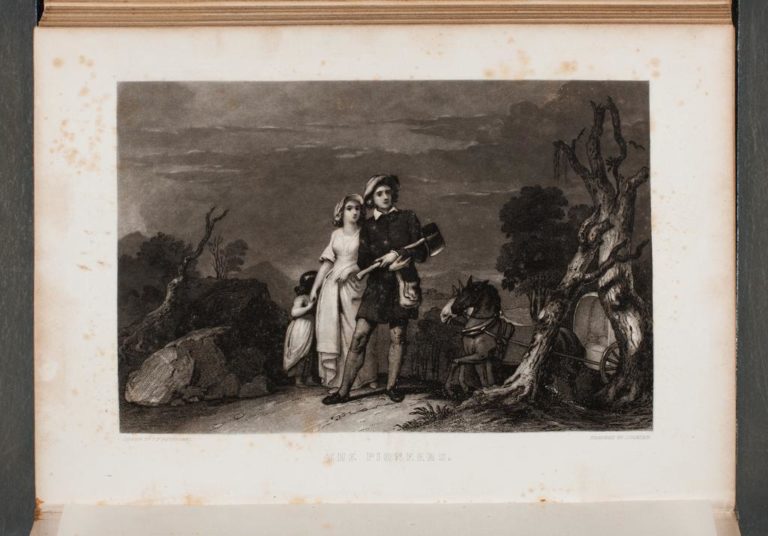
In 1893 Frederick Jackson Turner argued that the American frontier, while it lasted, defined American life. More than a century later, Turner’s “frontier thesis” still tops every AP history student’s cheat sheet, but historians have begun to wonder whether anything can be salvaged from a theory that defines the frontier as a boundary between “savagery and civilization.” Turner’s thesis is now routinely dismissed as outdated at best and racist at worst. In fancier, post-colonialist circles, “frontier” has become the new F word.
And now, just when you thought the frontier was dead, comes Frontier House, a new six-part PBS series chronicling the experiences of three ordinary modern American families sent to the frontier to endure the rigors of life as 1880s homesteaders. Co-produced by Channel 13/WNET in New York and Britain’s Wall to Wall Television (producers of the BBC’s 1900 House), Frontier House won’t be aired until 2002. But the filming begins this spring, when the Frontier House families will start their six-month stint in rural Montana. Each family will be given 160 acres of land and a wagonful of seeds, axes, and cookbooks. Like all homesteaders, they’ll begin by building houses, “relying exclusively on the tools, techniques, technology, and resources they would have had in the 1880s.” No Home Depot, no spackle, no Tyvek wrap. Little House on the Prairie meets Temptation Island?
A mere four hundred British families applied to live for three months in London’s retrofitted 1900 House (see Talk of the Past, September 2000), but nearly ten times as many Americans are seeking to live for twice as long in the far more physically grueling Frontier House. Why? Consider the home lives of some of the thirty-six hundred American families eager to participate. As part of the application process, each was asked, “What’s the most challenging thing you and your family have ever experienced?” Among the responses (posted at the show’s Website): a Florida man who was “fatally shot” but miraculously survived, a New York teenager whose mother and sister were attacked by a neighbor’s pit bull (“not too badly, but still”), and a Mississippi family “held hostage at 4 a.m. by a crazed gunman.” Yikes. No wonder these people want to go back in time.
Frontier House families will be in grave danger of accidentally amputating fingers with scythes and herniating disks while pushing plows, but they probably won’t have to worry about muggers, pit bulls, and crazed gunmen. None of the applicants seem to have any idea what they’re getting into (and how could they?), but, like actual homesteaders, they do appear to believe they’ll find a better life–a particular kind of better life, a touchy-feely, New Age of good old days. Asked what they hope to get out of the experience, a California family answered that they expected to “really get in touch with each other and ourselves without all the noise of the modern world.” One man from Washington confessed, “I need a direction in my life.” (How ’bout West?) And a couple from California philosophized, “A great challenge brings a person great personal power.”
Time travel as an opportunity for personal growth? Series producer Simon Shaw seems to agree with this sense of the past. “Frontier House is as much about personal discovery as it is historical,” he explains. “The experience will undoubtedly provide our pioneers with an opportunity to contemplate much of what gets lost in the blur of life in modern society: values, relationships, emotions, priorities.”
The frontier of Frontier House is not a boundary between savagery and civilization. It’s the boundary between an emotionally shabby, technologically bountiful now and an emotionally vital, technologically impoverished then. “I have been looking for this kind of opportunity to be a catalyst for a new trajectory to my life, propelling me in new directions like a comet around a star,” writes one New York applicant. Frontier House families don’t need Frederick Jackson Turner; they need Robert Bly. The last frontier? The endless frontier of the self.
This article originally appeared in issue 1.3 (March, 2001).
Exposed to Air after Fifty Years!
In 1998, the National Archives and Records Administration embarked on a project to re-encase the United States Constitution, the Declaration of Independence, and the Bill of Rights, collectively known as the Charters of Freedom. This decision led to a multiyear collaborative project involving National Archives staff as well as scientists and technical experts from the National Institute of Science and Technology and other agencies and organizations. Our tale is a trip through time, starting with the critical moment of opening the encasement, then thinking back two hundred years to the creation of the document, and moving forward again to reflect on the conservation and scientific bases for deciding to re-encase the Charters of Freedom after fifty years.
Fig. 1. Page 1 of the Constitution in its 1950s-era NBS encasement. The six slits across the top edge were originally laced with silk ribbon to hold the pages of the Constitution and the Transmittal Page together. Note the leak detector extending from the bottom edge of the encasement. Photograph by Earl McDonald, courtesy of the National Archives and Records Administration.
A Moment of Action: Wielding the Knife
The moment had arrived. The vault was quiet, the conservators wore gloves and lab coats, and the camera was ready to roll. A small sharp blade probed the pinprick hole in the lead to enlarge it and permit insertion of a larger tool. This simple task normally would not give us pause. But this time we were on the verge of opening the encasement created almost a half century ago to house the Transmittal Page of the United States Constitution, the parchment letter of conveyance signed by George Washington as president of the Constitutional Convention. Successfully opening this encasement would permit us to test and confirm our procedures and to gain confidence before moving on to the encasements containing the remaining four pages of the Constitution, the Declaration of Independence, and the Bill of Rights.
The time had come to liberate the parchment after fifty years, a step fraught with uncertainties and concerns. We were breaking new ground, but at the same time, undoing beautiful craftsmanship that had achieved hermetically sealed encasements in 1951. The encasement design was elegantly simple: two sheets of glass with metallic copper flashed on the edges, joined with solder to a lead ribbon that sealed the three-eighths-inch gap between the glass. Between the glass sheets the historic parchment lay on handmade paper, surrounded by a brass collar or spacer, with a second loose piece of glass resting on the parchment surface.
We knew the structure of the encasement and–theoretically–the path to its opening, but had neither written instructions nor a training film to guide us. We had to learn by doing. While all the calculations and tests on surrogates that preceded this moment indicated that breaking the seal would not result in damage or catastrophic change, we couldn’t help but wonder: Would the glass crack? Would the encasement implode? Would the parchment stick to the glass? Though such speculation was not scientifically based, it was understandable in the circumstances. It was a moment that few conservators had experienced, a moment long anticipated and flavored with a dash of uncertainty and a bit of nervousness, as befitted the responsibility and honor of working with one of the most significant documents in U.S. history.
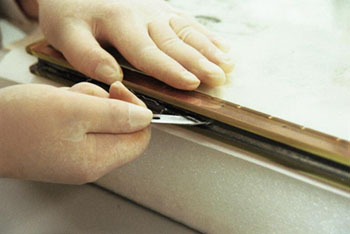
We inserted a tool with a curved end, handmade of hardened metal, into the breech in the lead strip joining the top and bottom glass of the encasement. We had wondered how readily it would open, but the cutting was easy. With a rocking motion, the blade sliced the lead cleanly, sometimes leaving long curling flourishes of lead in its wake. Only in areas of excess solder surrounding the leak detector was the process difficult and time consuming. A variety of small blades were used carefully to break through the seal, and finally the deed was done: the sheets of glass that had covered the parchment for fifty years could be lifted away. It was a momentous if quiet success, with no resulting alteration to the parchment.
Fig. 2. Gloved hands slowly work the blade back and forth, through the lead seal that holds the top and bottom sheets of encasement glass together. Photograph by Earl McDonald, courtesy of the National Archives and Records Administration.
A Moment of Action: Wielding the Pen
Jacob Shallus dipped his quill pen in ink and placed it onto a bare sheet of parchment lined with pale brown crayon guidelines to begin to write out the formal copy of the new nation’s Constitution, to be approved by the Constitutional Convention on Monday, September 17, 1787. The clerk’s job was demanding. He had little time to take the corrected draft and write out a “fair” or final legible copy over the course of a weekend in Philadelphia. Corrections were difficult to make since parchment was such an unforgiving medium. Words were scraped away with a penknife or inserted carefully in the lines of text, and then listed in an errata paragraph to attest that the approved document was unaltered.
Shallus could never have imagined that two centuries later conservators would peer through a binocular microscope to examine his pen strokes. Shallus was a clerk trained to create a fine handwritten text. In his work, he wrote a very legible script with titles that were engrossed, that is, made larger and darker. His tools were quill pens cut from large feathers, and ink made from oak galls, iron, and gum arabic, often with a colorant such as logwood added to the initially pale ink. Following English practice, Shallus wrote important legal documents on parchment, animal skin that was specially treated with lime and stretched. It was expensive, generally imported from Great Britain, but could be expected to last a very long time.
More than two hundred years later, conservators in the no-longer-young nation examined his handiwork to determine its condition. The parchment, sensitive to changes in humidity, now undulated in many cockles or “hills and valleys.” While the text remained very legible, we could see under the microscope that many small flakes of ink had disappeared and other lifted flakes were tenuously attached. In the past insects had nibbled the parchment, leaving lacey, vulnerable edges on some sheets. The treatment we devised to address these conditions was conservative, designed to stabilize and preserve the legibility of the text. We adhered insecure ink flakes with parchment size (a gelatin made by cooking small parchment scraps), using the fine tip of a 0000 watercolor brush to apply drops of size no larger than a period at the end of a sentence.
Fig. 3. A conservator carefully examines the text under the microscope–letter by letter, word by word–looking for any flakes of ink that need to be secured. Using a fine-tipped brush, she applies a very small amount of warm parchment size that wicks under flakes to adhere lifting ink back into position. Photograph by Earl McDonald, courtesy of the National Archives and Records Administration.
We also carefully cleaned dirt and grime in bare areas of the parchment–taking special care to avoid disturbing Jacob Shallus’s rule lines–and removed old adhesive on the reverse which distorted the parchment sheet. As a final step, the parchment, humidified to fully relax it, was dried under tension to return it to a flat plane. The challenge was to make the parchment limp without softening the ink so that it could be realigned to remove the distortions of fifty years or more.
Science in the Support of History
Opening the encasement was a step in a process that began almost twenty years earlier with questions raised about the safety and stability of the Charters’ encasements. In 1982, the National Archives invited a panel of respected scientists and preservation professionals to assess the preservation needs of the Charters of Freedom. They advised comparing images of the Charters made at intervals over time, to look for changes that might raise concerns. The National Archives turned to the Imaging Processing Lab at the Jet Propulsion Laboratory (JPL) to assist in this effort. Borrowing NASA technology, the JPL developed an imaging system like that used in space exploration. The resulting Charters Monitoring System (CMS) created digital image files by scanning one-inch squares on each document. During imaging, the encased document lay on a tabletop with legs that floated on nitrogen in cylinders, which acted as shock absorbers to eliminate vibration. An overhead charged-couple device “camera” captured the relative brightness of 1028 lines of 1028 pixels in each patch through glass layers, using precise positioning to allow return to the exact spot in future scans.
The National Archives received the Charters Monitoring System in 1987. Our staff made baseline measurements for patches on the pages of the Constitution. In following years, patches were re-scanned and compared pixel by pixel to the baseline image, to show physical changes. In 1996, after more than 125 scans, staff reported the findings. The CMS did not reveal feared changes in ink intensity or loss of ink. In all the scans on the seven encased documents, just one insecure flake of ink was noted on a raised ridge of parchment on the Transmittal Page of the Constitution. Jacob Shallus might have been befuddled by the technology, but he surely would have been pleased that his text had survived so well.
But if the ink of 1787 was holding its own, the encasements of 1951 were not. The CMS space-age technology ultimately confirmed findings made in 1987 with the microscope: minute crystals and microdroplets of liquid on surfaces of the two glass sheets over each document. The scans confirmed that these changes in the glass progressed between 1987 and 1995. Conservators using a binocular microscope could focus to see crystals and liquid droplets on the glass surfaces. These signs of glass deterioration were a clue to the relative humidity inside the encasements. Glass deteriorates at a relative humidity over 40 percent. But the encasement helium had been carefully humidified to 30 percent. This low humidity was to minimize parchment hydrolysis, a chemical term that means “water cutting.” Evidence emerged of progressive glass deterioration and raised concerns of possible parchment deterioration by hydrolysis.
What was going on inside the sealed encasements in the 1980s could only be learned indirectly. Conservation staff peered through a glass window looking for clues about whether moisture was excessive and whether any helium remained. A few simple techniques gave some answers. An ice cube placed briefly on the outer glass made water condense on the inner glass. Measuring the resulting dew point temperature confirmed a relative humidity higher than 30 percent. To see if helium remained, we relied on an encasement with an odd visual effect that indicated a tight seal. The encasement for the Transmittal Page had a faint pattern of concentric rings at its center. These so-called Newton’s rings result when a very narrow space diffracts light. In this encasement, the narrow gap was between the surfaces of the two glass sheets pressed closely together by atmospheric pressure. The rings indicated the container was sealed but at a partial vacuum. After fifty years helium may have escaped, but the seal was intact.
The rings were intriguing, but did helium remain inside or was there a vacuum? Were the other encasements without Newton’s rings still sealed? And what was inside them: air, helium, a mixture, or a vacuum? Helium is so small a molecule that it escapes slowly through some types of glass and very readily through the smallest hole. The leak detectors indicated that air had not infiltrated. But would the leak detectors work in a vacuum if the helium had escaped?
So the question persisted whether helium was still in any of the encasements. We wanted an answer before breaking the seal, to permit sampling the interior gas for analysis before it dissipated. We contacted a NASA scientist who had attempted to sample “old” air in sealed colonial lead coffins. But we needed answers without penetrating the encasement seal. His NASA team worked to measure gasses in the upper atmosphere by aiming a laser beam out an airplane window to the wing tip. In the Charters’ encasements, the laser beam would traverse a millimeter gap between the glass layers. Amazingly, the NASA laser beam study showed the absorption pattern of helium in each encasement they studied. Helium–some helium at least–remained. Knowing this led to developing special procedures to sample the gas inside of each encasement before it was opened and lost forever.
A Moment of Contemplation: Looking to the Future
As the vault door closes, we think of the work accomplished and what lies ahead. The Constitution has now been examined, documented, and treated–and sealed in elegant and technologically advanced encasements. Two sapphire window ports in the side of each encasement permit a light beam to traverse the inner atmosphere below the document platform allowing conservators to monitor the conditions within. Changes–such as the presence of oxygen–that could have a detrimental effect on the documents will let future caretakers know that it is time to act. Intervention could be simple–replenishing the inner atmosphere with argon or, more complex, unbolting the encasement lid to break the seal designed to hold for one hundred years or more and again exposing the Constitution to air. We can’t help but wonder how long this work will hold and what new tools will be available to preserve this document in the future.
Could any of the Framers of the Constitution have ever imagined the steps that future caretakers would take–and the amazing space-age tools and technologies that would be brought to bear–to ensure the preservation of their words written on parchment in 1787? While some might argue that the Constitution is merely a musty document–old ink on old parchment–the ideas it contains continue to be argued and brought to bear on every aspect of American life. The concepts remain fresh and pertinent to the latest-breaking news–to events that the Framers could not have imagined.
Fig. 4. Page 4 of the Constitution after removal from the 1950s-era NBS encasement. It was signed on Monday, September 17, 1787. Note the somewhat grimy bottom edge, a result of that section being exposed while the parchment was rolled at various times in the past. Photograph by Earl McDonald, courtesy of the National Archives and Records Administration.
The Constitution, Bill of Rights, and Declaration of Independence will be back on public view in the Rotunda of the National Archives Building in the fall of 2003. For further information on the Charters Re-encasement Project, click here.
This article originally appeared in issue 2.4 (July, 2002).
Mary Lynn Ritzenthaler and Catherine Nicholson are senior staff members in the Document Conservation Laboratory, Preservation Programs, National Archives and Records Administration.
#RememberTheLadies: Teaching the Correspondence of John and Abigail Adams in the Age of Social Media
“She wrote me a letter and she wrote it so kind She put down in writing what was in her mind.” Bob Dylan, “Not Dark Yet”
Designed by Kenna Meyers, Southern Utah University student.
Abigail Adams often complained that her husband, John, did not write her enough. When he did write, his letters were too short and didn’t adequately convey his sentiments. “I have to acknowledg the Recept of a very few lines dated the 12 of April,” Abigail reported to John in 1776, but “you make no mention of the whole sheets I have wrote to you,” she chided him. This complaint resonated with my students in Gender in Early American History. A few of my students designed a meme to capture Abigail’s protest. The meme depicted a skeleton with folded arms sitting at a desk. It was captioned: “Me waiting for your letters.” One simple image and a few words translated Abigail’s words into a contemporary media form. I had not even asked students to design memes. I had only asked them to compose a series of Facebook posts or tweets for an assignment in which they “translated” eighteenth-century correspondence into contemporary social media. Far ahead of me on social media trends, my students surpassed my instructions and expectations. Their enthusiasm illustrated to me the possibilities of engaging them in the world of eighteenth-century letters through their own use of social media.
Literary critics and historians such as Konstantin Dierks, Eve Tavor Bannet, and Lindsay O’Neill have recently expanded our understanding of the letter-writing practices and correspondence networks that connected people in eighteenth-century America and the Atlantic world. Letters enabled them not only to communicate with each other across great distances, but also to build relationships, develop associations and movements, and advance themselves socially, politically, and economically. During the eighteenth century, letter-writing manuals circulated widely on both sides of the Atlantic. Middle-class men and women turned to these manuals to learn the proper conventions of correspondence. The epistolary form shaped other media too. Pamphlets sometimes took the form of letters, and newspapers frequently published letters to the editor. Early novels such Samuel Richardson’s Clarissa, or, The History of a Young Lady appeared as series of fictive letters that revealed the complexities of the characters’ (especially women’s) inner lives.
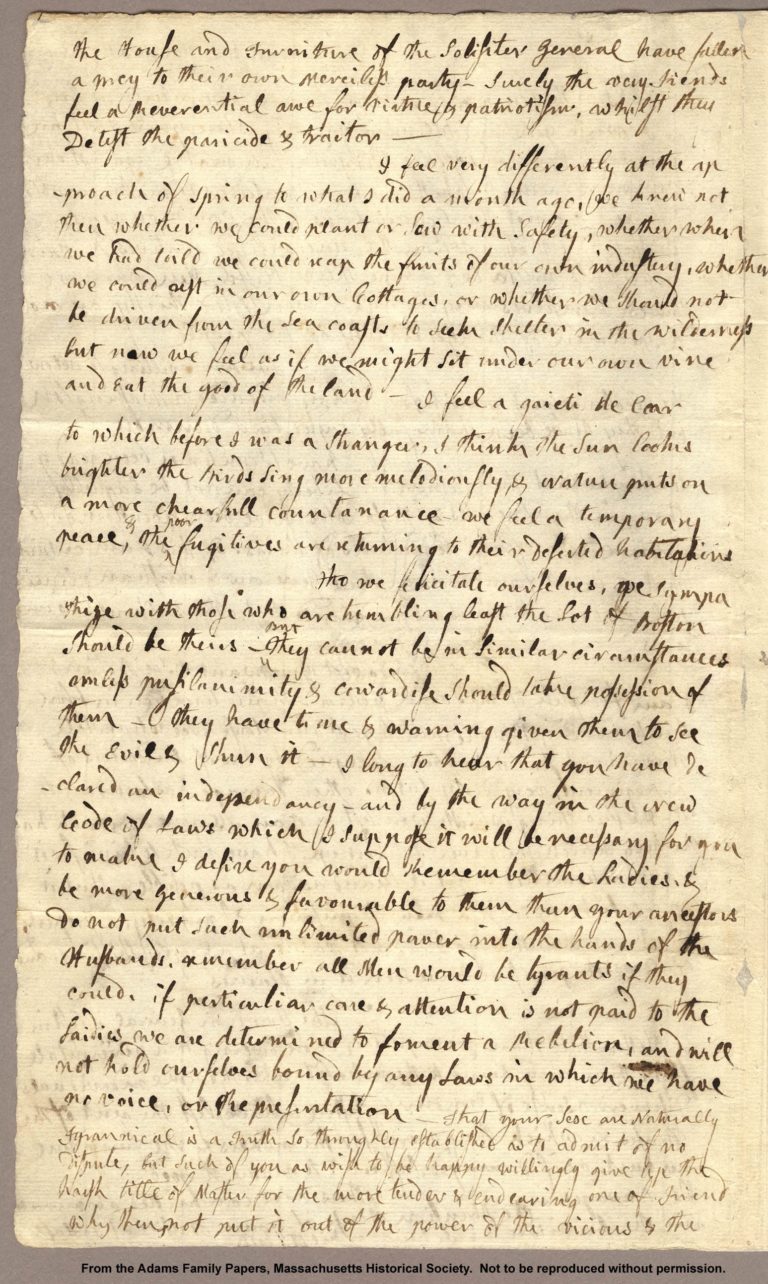
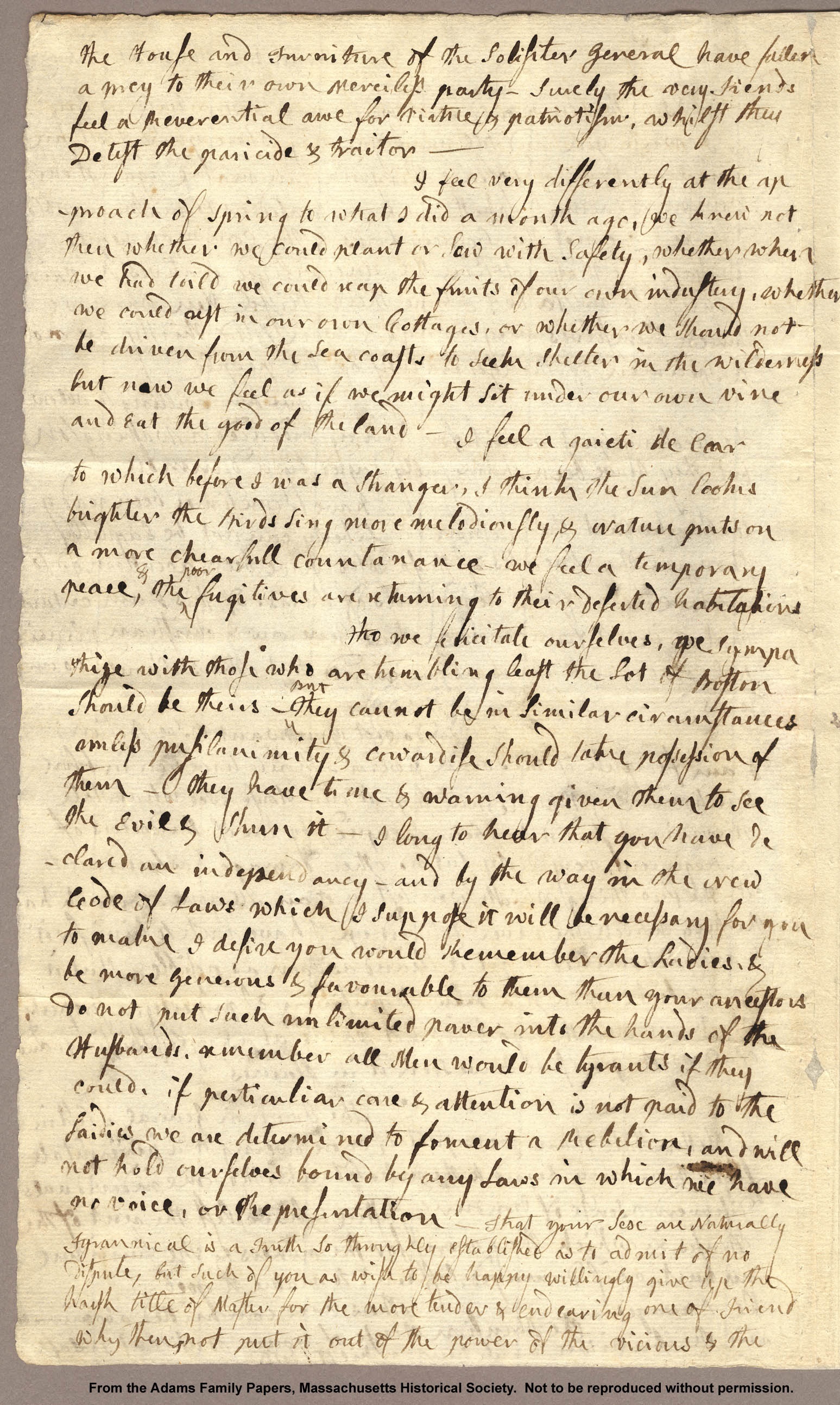
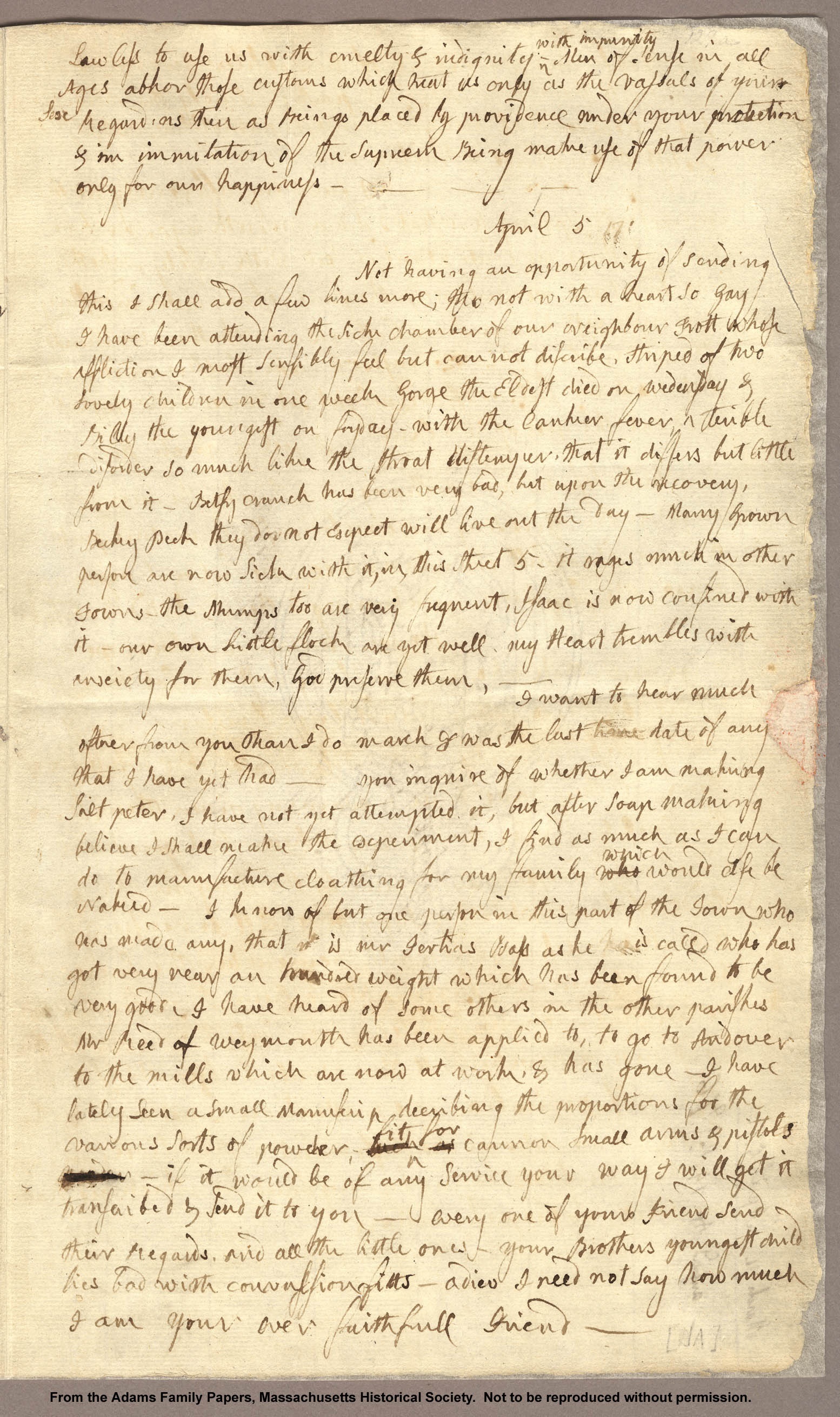
Abigail Adams’s well-known letter to John in which she implored him to “Remember the Ladies.” Abigail Adams to John Adams, Letter, 31 March -5 April 1776. Collection of the Massachusetts Historical Society.
Letters were even made public sometimes. For instance, Benjamin Franklin intercepted the correspondence of the royal governor of Massachusetts, Thomas Hutchinson, and leaked it to the press. The published correspondence mobilized the colonial opposition to Crown officials. Indeed, letters made revolutions. In the years before 1776, the Committees of Correspondence organized inter-colonial resistance to British imperial authority. British Corresponding Societies, United Irishmen, French Jacobin clubs, and American Democratic-Republican Societies expanded this practice of revolutionary correspondence to the rest of the Atlantic world in the 1790s. Letters mattered in the eighteenth century in the same way that the explosion of new media forms such as Facebook, Twitter, Snapchat, memes, gifs, and Instagram have reshaped communication and politics in our own time—yet twenty-first-century students sometimes struggle to relate to the old-fashioned medium of letters.
Consequently, I have used these new media forms to teach about old media in an upper division course for the past three years, each time revising and expanding the activity because of its popularity with students. Students form groups of three to five members, and I assign a different set of six to ten letters for each group to read before class. Students spend two class periods working on the “translation,” writing a minimum of twenty social media posts based on that correspondence. They also usually collaborate outside of class to finalize their posts. Each group then presents its work to the rest of the class. During these discussions, students’ newfound enthusiasm for eighteenth-century letters is often palpable. In the process, students sharpen their reading and writing skills and their understanding of how correspondence works.
The correspondence of John and Abigail Adams—one of the most famous in early America—encompasses over 1,000 letters written between 1762 and 1801. Of course, John and Abigail wrote to each other only when they were apart, but they were frequently separated during their fifty-four years of marriage. Their correspondence began during their courtship, and included letters written when John was being inoculated against smallpox and was so contagious that he could not meet with Abigail. After their marriage, they were often separated when John worked as a lawyer in the Massachusetts county court circuit, as a delegate to the Continental Congress in Philadelphia, as a diplomat in Europe during the Revolutionary War, and as vice president and then president during the 1790s. John and Abigail’s correspondence continued the conversation of their marriage throughout those years of absence.
Abigail Adams’s well-known letter to John in which she implored him to “Remember the Ladies.” Abigail Adams to John Adams, Letter, 31 March -5 April 1776. Collection of the Massachusetts Historical Society.
Their letters are widely accessible in several edited compilations, in the documentary edition of The Papers of John Adams, and in The Adams Family Papers: An Electronic Archive, a digital archive of the Massachusetts Historical Society. Searchable both by keyword and by date, this archive offers links to digital images of the original letters and transcriptions. When I selected letters for this assignment, I highlighted the conversational nature of the correspondence by choosing examples from the Revolutionary War in which John and Abigail were responding to each other’s comments and queries. The digital archive made this easy to do since the transcribed letters feature convenient hyperlinks to the other letters mentioned in the correspondence.
In class, I lectured briefly on the historical context of eighteenth-century letters and on John and Abigail’s relationship, then advised students to begin the assignment by brainstorming in their small groups the issues, events, and topics that John and Abigail discussed in their correspondence and pinpointing which sentiments would make good social media posts. They immediately observed that the correspondence addressed a wide variety of topics, jumbled and sometimes incongruent. A single letter might refer to political news as well as medical issues, family concerns, and neighborhood gossip, a diversity, they noted, that parallels the range of topics that appear in people’s social media feeds today.
Students imitated John and Abigail’s flow of ideas, composing posts that reflected this mix of subjects, personal and political. For example, students learned about how Abigail struggled with a smallpox pandemic in Boston, while John argued for Independence in the Continental Congress in Philadelphia. The current controversies over vaccination made many students especially curious about the letters in which Abigail discussed her decision to inoculate herself and her three children against smallpox, a decision that was simultaneously personal, familial, and political. “Hope the necessity [of inoculation] is now fully seen,” Abigail commented in July 1776. Accordingly, a group of students had Abigail tweet: “Got the kids inoculated,” adding in pro-vaccination hashtags like #vaccinateyourkids and #vaxwithme to reflect Abigail’s endorsement.
Meanwhile, John wrote to Abigail on July 3, 1776: “Yesterday the greatest Question was decided, which ever was debated in America, and a greater perhaps, never was or will be decided among Men. A Resolution was passed without one dissenting Colony.” Students had John Adams post this news as:
“So excited about the things getting done here with congress. Great choices being made that even Delaware and South Carolina agreed on #freeandindependentstates #spoilers #declaration.”
Page 3 of Abigail Adams’s well-known letter to John in which she implored him to “Remember the Ladies.” Abigail Adams to John Adams, Letter, 31 March -5 April 1776. Collection of the Massachusetts Historical Society.
Yet, students recognized that John’s letters did not solely discuss politics. They created posts based on quotidian matters too. “Yesterday I dined with Captain Richards,” John wrote to Abigail on June 2, 1776, “We had Cherries, Strawberries, and Green Peas in Plenty.” Students noted that John’s remarks on food would have been worthy of sharing on Instagram, where users frequently post photographs of their meals and they added #somuchpeasandberries to their post.
This intermingling of the personal and the political humanized John and Abigail Adams for my students. “These historical figures,” one student remarked, “can be made out to be larger than life,” but the social media assignment made them more “relatable for students today.” In learning that the Revolutionary War did not stop John and Abigail from worrying about their children’s education and health or relishing what they ate for dinner, students saw the overlap between political and social histories.
They also began to understand the American Revolution not just as a fight over abstract concepts such as “taxation without representation,” but as a lived experience. In her letter of March 2, 1776, Abigail confessed that “I have been kept in a continual state of anxiety and expectation ever since you left me.” Written during the Siege of Boston, the letter related the terrifying sound of the cannon fire, which interrupted Abigail’s writing several times: “but hark! the House this instant shakes with the roar of Cannon,” she wrote. Students dramatized this letter as a tweet:
Cannon fire is preventing any worthwhile sleep. #NoSleep #The Struggle Continues
Like the letter, the post conveyed Abigail’s fears and anxieties in wartime and the uncertainties that the Adams family faced during the Revolution. “We live, my dear Soul, in an Age of Tryal,” John wrote to Abigail on May 12, 1774. “What will be the Consequence I know not.” Translating these letters into social media familiar to their own generation turned out to be an excellent way to make students understand the uncertainty and contingency of the slowly unfolding struggle for American independence.
At the same time, “translating” the correspondence made students probe John and Abigail’s personalities and the dynamics of their relationship. Generally, students agreed that John would have embraced Twitter as a means of broadcasting his political opinions to the public, while his personal communications on Facebook would have been more limited. One student remarked that Abigail would have posted and commented on her husband’s page, while John’s interactions on his wife’s page would have been fewer and less emotional. On April 14, 1776, John wrote to Abigail: “You justly complain of my short Letters, but the critical State of Things and the Multiplicity of Avocations must plead my Excuse,” which students translated into this post: “My dear Abby complains too much of my letter writings. There IS a war going on you know.”
Nonetheless, many students sympathized with Abigail’s frustrations. “I want to hear much oftener from you than I do,” Abigail wrote to John on April 5, 1776, adding “You inquire of whether I am making Salt peter. I have not yet attempted it, but after Soap making believe I shall make the experiment.” One group imaginatively translated this line into Abigail telling John: “I want to hear more from you and all you can ask me is if I am making Salt peter?” They added #men to the post, putting a modern spin on the correspondence. Drawing on another letter of Abigail’s from August 14, 1776, one group had Abigail tweet:
“If we mean to have Heroes, Statesmen and Philosophers, we should have learned women.” #micdrop #protofeminist.
Though the tweet derived from Abigail’s letter, the hashtags added a contemporary touch. Interpreting eighteenth-century letters requires close reading, a task with which some students struggled. One student admitted that “understanding Revolutionary Era speech was the most challenging part [of the assignment],” but her group read through the sources multiple times, trying “to break down their correspondence into 140 characters or less.” Another student added that the activity was useful because they “had to translate the meaning of [the] letters into the terminology of how we speak today,” which enhanced their comprehension of the primary sources. Distilling eighteenth-century letters into their own language helped students to build their reading and analytical skills. As I listened to the conversations among the students, I overheard students asking each other questions about the meaning of words, the historical context of events mentioned in the letters, and the motivations of their authors. Grappling with the meaning of these sources, my students were doing history.
Their intensive and intuitive reading of the correspondence generated new insights into the history of everyday life during the American Revolution. The students got to know John and Abigail through their letters: Abigail’s pragmatic efficiency in running her household during wartime and her occasional sauciness; John’s vanity, his brusque and impolitic manner, and his exasperation when other people, including Abigail, did not see the world the way he saw it. The correspondence opened up for my students the intimate and emotional dimensions of history that are too often lost in the imposing political and military narratives of the American Revolution that we teach to students.
Translating John and Abigail’s correspondence into contemporary social media posts further prompted students to look outward and consider the continuities and discontinuities between past and present social media. The assignment helped them reflect on their own social media use. In a time of rapidly changing communication technologies, my students connected with an older media form. They found common ground with John and Abigail Adams, as students recognized their own struggles to communicate with loved ones in the correspondence of that extraordinary eighteenth-century couple. Perhaps a sign of the assignment’s success was that a student wrote a thank-you letter to me at the end of the semester. The letter was written on a sheet of paper, folded into an envelope, and delivered to my departmental mailbox.
Further Reading
On correspondence, see Konstantin Dierks, In My Power: Letter Writing and Communications in Early America (Philadelphia, 2009); Lindsay O’Neill, The Opened Letter: Networking in the Early Modern British World (Philadelphia, 2015); and Eve Tavor Bannet, Empire of Letters: Letter Manuals and Transatlantic Correspondence, 1680-1820 (Cambridge, 2005). Russ Castronovo has made some insightful comparisons between old and new media in Propaganda 1776: Secrets, Leaks, and Revolutionary Communications in Early America (Oxford 2014).
The biographical literature on John and Abigail Adams is extensive. See especially Woody Holton, Abigail Adams (New York, 2010) and Edith B. Gelles, Abigail and John: Portrait of a Marriage (New York, 2009), and Gelles, Abigail Adams: A Writing Life (New York, 2002).
Frank Shuffleton edited a volume of their Revolutionary War correspondence: The Letters of John and Abigail Adams (New York, 2004), while Gelles edited a volume of Abigail’s correspondence: Abigail Adams: Letters (New York, 2016). The Adams Family Papers: An Electronic Archive, organized by the Massachusetts Historical Society, is an invaluable resource for research and teaching. All quotations in this article are from that electronic archive.
This article originally appeared in issue 18.1 (Winter, 2018).
Michelle Orihel is associate professor of history at Southern Utah University. Her research focuses on politics and the print media in early American and Atlantic history. She is writing a book about the Democratic-Republican Societies and opposition politics in the trans-Appalachian West during the 1790s. She has published articles in The Historian, The New England Quarterly, and The Register of the Kentucky Historical Society. Her essay on pamphlets in early America is forthcoming in United States Popular Print Culture to 1860, the fifth volume in The Oxford History of Popular Print Culture, published by Oxford University Press.
Editors’ Introduction
This roundtable is another installment in an ongoing series devoted to “First Person” experiences with early American culture. We envision “First Person” features as an exploration of what it means to inhabit history in extraordinary ways. What alchemy occurs when we set sail on a whaling ship, put on period clothing, perform the words and deeds of an earlier life? In short, what happens when we put our bodies in the very spaces we’ve spent so much time reading about? Of course, we all know that we can’t really feel what our subjects felt, but this feature thinks critically about our desire to do just that.
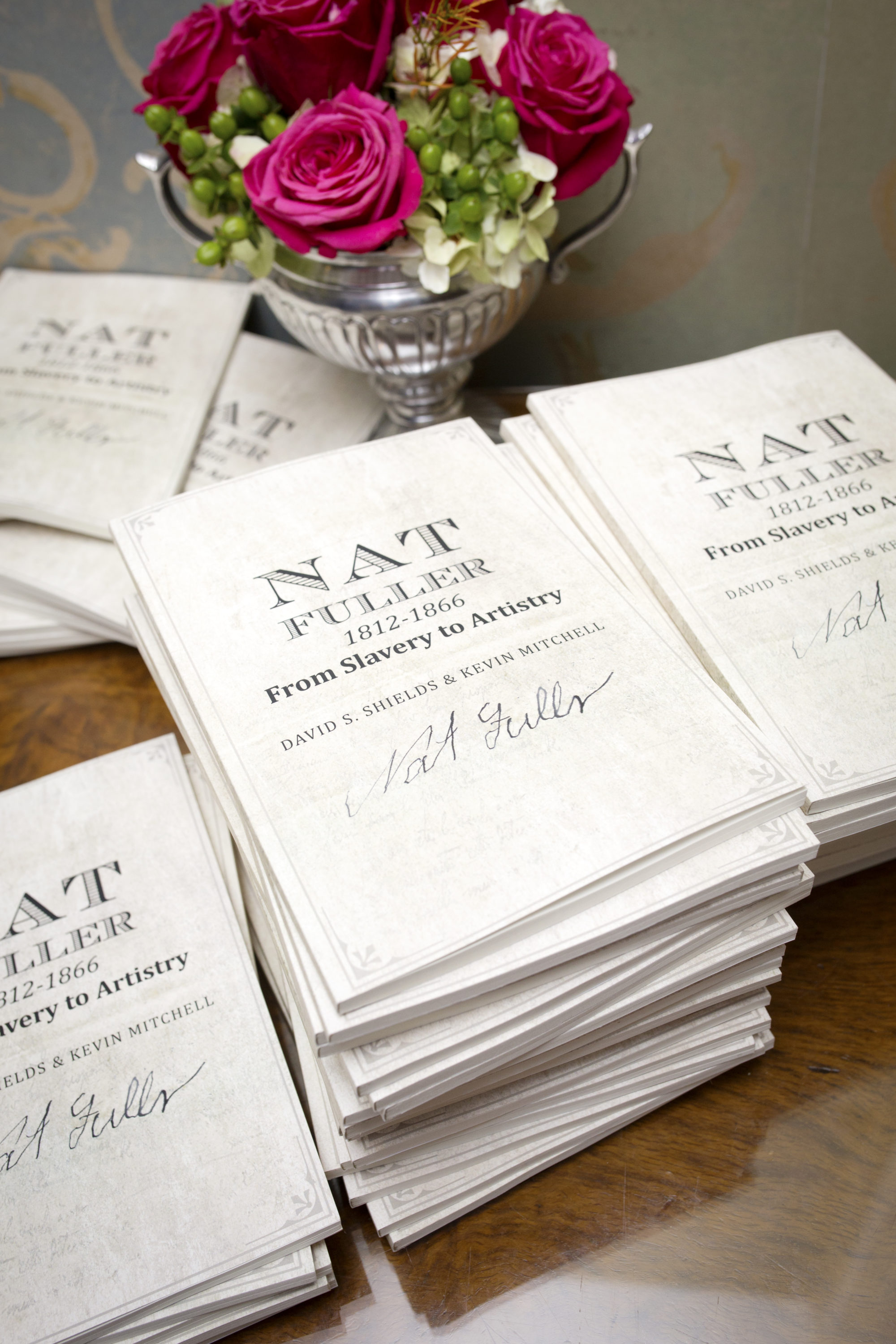
This issue’s First Person feature focuses on reenactments of Charleston’s 1865 Reconciliation Banquet, a sumptuous feast hosted by Nat Fuller, a formerly enslaved man who was one of Charleston’s most famous chefs. Fuller invited black and white residents in Charleston, S.C., to sit down and enjoy a meal, even as the city reeled from the destruction of the Civil War. This roundtable features the voices of the guests, of the culinary scholar who helped put the event together, and of the chef who stood in Nat Fuller’s place as he cooked the food and welcomed the diners.
Nat Fuller’s generous invitation to the residents of Charleston to find a space to talk, to give, and to find common ground has taken on a particularly powerful resonance in the wake of the tragic events of June 17, 2015. On that day, a man who identified strongly with symbols of the Confederacy murdered congregants of Emanuel A.M.E. Church in Fuller’s beloved Charleston, forcing us to realize, yet again, the power that past hatred continues to exert in our present moment. Nat Fuller’s banquet—both in its original and present-day manifestations—reminds us of the urgent need to inhabit the past in ways that not only acknowledge wrenching violence and loss, but also offer the hope of inclusion, of nourishment, and, perhaps, Nat Fuller would urge us to hope, even reconciliation.
This article originally appeared in issue 15.4 (Summer, 2015).
Pacific Travelers: The islanders who voyaged with Cook
We are used to hearing stories of Captain Cook, Captain Bligh, and the other big names of Pacific exploration. Their adventures have captivated countless readers since the middle of the eighteenth century. There was another set of explorers, though, who were travelling alongside these Europeans. And their stories are no less dramatic or remarkable.
As Greg Dening observes elsewhere in this issue, Pacific Islanders have always been adept travelers. Their history is filled with long-distance sea navigations, far migrations, inter-island trade, and inter-island battles. When European ships started anchoring by Tahiti, New Zealand, Hawai’i, or the islands of Micronesia, there were islanders who found the prospect of a new type of voyaging appealing. They decided to join some of the onward journeys. Ahutoru, a Tahitian, left with Louis Antoine de Bougainville and in 1769 became the first Pacific Islander to visit Europe. He enjoyed the charms of Paris for a year before boarding a ship that would have, had he not caught smallpox on the way, returned him to his island. Another well-known figure is Mai (Omai), visitor to Britain and one of the few among these travelers to survive the trip and return home. Less familiar are the names of Tupaia, Taiato, or Hitihiti; men who went exploring with Cook, and whose stories are included here.
The attractions of a trip with a British or French crew were sufficient to inspire many young men to present themselves as willing navigators, translators, or sailors. It was primarily young men who asked to go. (One woman stowed away on Cook’s ship Resolution before it left Tahiti to catch a lift to nearby Ra’iatea but she was an exception.) The reasons the young island men had for embarking varied, but there were social advantages in associating with exotic foreigners and in acquiring European goods and firearms. There was also the tantalizing opportunity to extend their horizons.
What follows is a simple telling of some of these men’s stories, short reductions of great yarns. But we must tell these tales: doing so offers some insurance that these dynamic, colorful strands are not omitted from the weave of Pacific history.
Tupaia: navigator and translator
When Captain Cook anchored in a bay on the northern coast of Tahiti for the first time in April 1769, he met Purea, the most powerful woman on the island. He also met her collaborator, a priest from the island of Ra’iatea named Tupaia. They were working towards a monopolization of the island’s sacred and political power. Tupaia was a respected figure in the Society Islands and something of a virtuoso. A member of the elite arioi society of travelers and performers for the god ‘Oro, he was a ritual specialist, skillful navigator, and negotiator. He had also witnessed in 1767 the extraordinary visit of the first ship from beyond the Pacific: Samuel Wallis’s Dolphin. He knew something of what to expect from these visitors. He established a friendship with the naturalist Joseph Banks, helped Cook in relations with chiefs and learned from the ship’s artists how to draw in European style. Near the end of the Endeavour’s stay he announced he was going to accompany them to England. Cook and Banks, on the lookout for a guide, felt he “was the likeliest person to answer our purpose.”
After leaving Tahiti, the Endeavour made several stops among the Society Island archipelago. In each place Tupaia used the correct ceremonial forms when greeting the chiefs, easing some of the tensions of these early meetings across cultural divides. In August they departed, as Banks said, “in search of what chance and Tupaia might direct us to.”
They steered southward towards New Zealand, to try to determine if it was the northern tip of a great southern continent. Tupaia drew maps and read the currents, weather, and sky. On reaching New Zealand, Tupaia helped establish working relationships between the Maori people and the European visitors. He was able to translate, as the language of the Society Islands was the original basis of the language of the Maori. His lineage was important: he was from the Maori’s ancestral homeland, Hawaiki (Ra’iatea), and was seen to hold substantial spiritual power (mana). There were still violent clashes and misunderstandings. Tupaia, though, created a lasting impression on Maori communities and it was the great priest, rather than Cook or Banks, who was most persistently asked after when voyagers stopped by.
After establishing that the two islands of New Zealand were not the bountiful continent they sought, Cook and his men departed for the east coast of Australia. In April 1770, Cook tried to land with a few officers, the naturalist Sir Joseph Banks, and Tupaia in a bay that would later form part of Sydney. Two men (of the Gweagal or Eora people) met them with shouts and spears. Tupaia tried in vain to find any words in common and Cook offered gifts, but the visitors only managed to get ashore after firing on the men. Without the ability to obtain food and information from the locals, Cook had to continue on up the coast. Tupaia was of help in northern Australia, when he was able to establish a trusting relationship with the Guugu-Yimithirr people.
From Australia, the voyagers made their way to Dutch Batavia (present-day Jakarta). There, in December 1770, Tupaia and his servant Taiata fell ill. Dismayed at ever having left Tahiti, Tupaia died a few days after Taiata.
Mai meets George III
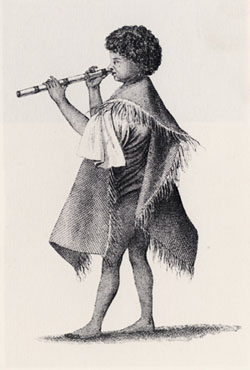
The most well-known Pacific traveler of the Age of Enlightenment is Mai (fig.2), a Ra’iatean who joined Cook’s second voyage at the Island of Huahine. Mai was born around 1753 into the ra’atira, a land-owning class. Like Tupaia, he had been exiled from his home island by the warriors of Bora Bora. He had also lost his father to them and remained bent on revenge. In September 1773 when Cook’s two vessels arrived, Mai saw an opportunity. He struck up some friendships with the men on the Adventure and, as he bragged to his compatriots, decided to travel to England and get the weapons he needed to avenge his father’s death.
Mai did not have the linguistic experience of the better-travelled Tupaia, but during the voyage he―and his fellow Society Islander, Hitihiti―helped the ship’s two naturalists, Johann and George Forster (father and son) with a vocabulary of the Tahitian language as well as with the ship’s relations in Tonga and New Zealand. Things did not run happily with the Maori they met, a rash of offenses being made against each side. After one incident in Queen Charlotte Sound on the south island, Mai went with one of the officers to look for a party of ten who had gone missing while collecting greens. They found them, cut up and being roasted. The Adventure had by this time lost company with Cook’s Resolution. Shocked and disheartened, Mai and the crew left New Zealand. Captain Tobias Furneaux, Cook’s second in command, directed their course back to England, eastward through empty, freezing latitudes, erasing hope of finding a southern continent.
In England Mai met the crème of English society, including the king and queen. Those at the royal reception applauded his grace, good humor, and charming manners, and extended a shower of dinner invitations. Mai’s chaperone, Sir Joseph Banks, was happy to promote his protégé, introducing him to the foremost figures of science, art, politics, and literature, and taking him on tours of cities and country estates. Mai learned to dance in the English manner, to shoot, to play chess, to ice-skate, and to read and write English. Philosophic debates in Europe on the nature of civilization were given extra fuel by observations of Omai’s “natural” civility, and the education he was receiving (containing so little Christian instruction) became a matter of public controversy. As interesting as his English experiences might have been, Mai retained his desire to return to Ra’iatea.
King George III had already promised a ship to return Mai to the Society Islands and the Admiralty Board was eager to find the coveted Northwest Passage, a theorized northern water route connecting the Atlantic and Pacific Oceans. Cook was the natural choice for the voyage and in the summer of 1776, just as the Americans were declaring their independence, he set sail on his third and final Pacific expedition.
On reaching the Society Islands in August 1777, the voyagers spent time in Tahiti and Moorea, then established Mai in Huahine (near Ra’iatea) on a piece of land where the crew assembled a prefabricated house for him. Mai’s English possessions ranged from pistols, ammunition, a suit of armor, cutlasses, a pair of horses and a monkey, model buildings, toy soldiers, an organ, a jack-in-a-box, and an electrical apparatus. He was not as careful as he should have been in distributing his gifts, but retained enough weapons and supporters within Huahine to achieve his desired military victory over the Bora Borans. He did not have long to celebrate. He died of a fever only two and a half years later.
Hitihiti’s Polynesian and Antarctic adventures
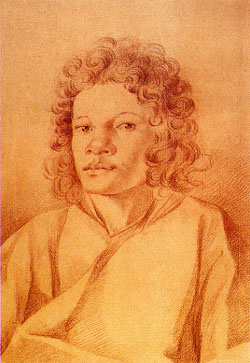
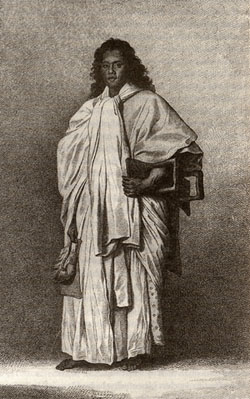
Hitihiti was as much an adventurer as Mai (fig. 3). He was of higher rank, being linked to the Puni chiefly line of Bora Bora, the most westerly of the Society Islands and home of Mai’s enemies. While Mai was negotiating to travel on Captain Furneaux’s Adventure, Hitihiti was volunteering for a place on Cook’s Resolution.Like many islanders, Hitihiti (also known by his former name, Mahine), had a workable command of English, was judged to be personable, and was accepted as a crewmate by the British mariners.
During the ships’ next stop, in Tonga, Hitihiti and Mai found that red feathers, a potent and sacred item in Polynesia, were abundantly available. They bartered for what they could of the feather-decorated clothes and lengths of cloth made of beaten bark (tapa). Hitihiti advised Cook to do the same; he knew how valuable they would be as trade items back in Tahiti. This advice was to prove important: at several points along the journey the islanders they were meeting would only give up pigs and other provisions in return for some of these feathers.
In March 1774, after spending over a hundred days at sea and desperately in need of food, the Resolution’s crewfinally sighted the coast of Rapa Nui (Easter Island). The first islander to come on board was bombarded with questions; Hitihiti tried to make some headway but was constantly interrupted. He went ashore with the officers and although the island was bare, hot, and parched, some food was available for trade. Hitihiti’s eye was caught by the peoples’ carvings of human figures, feather headdresses, and a carved wooden hand. He managed to barter his lengths of tapa, a valuable commodity in Rapa Nui, for some of these items. He later gave the wooden hand to the Forsters, who in turn donated it to the British Museum, where it can be seen today.
Fig. 3. “Oedidee, Otaheite” (Hitihiti / Mahine, Tahiti), drawing in red chalk by William Hodges, c. 1775. Pic.2717036. By permission of the National Library of Australia.
Leaving Rapa Nui, Hitihiti’s verdict was “a bad land, a good people.” He was more pleased by the Marquesas, similar in so many ways to his own island home. He was also delighted with his visit to Takaroa, of the Tuamotu Archipelago, where he was able to secure some dogs with white, long hair of the sort valued for warriors’ ornaments in Tahiti. Returning to the Society Islands, though, was Hitihiti’s greatest moment of triumph. As the ship anchored in Matavai Bay in Tahiti, the people were amazed to see him there on deck, in European clothes, with an unsurpassed collection of exotic objects and red feathers. He was an instant celebrity. People flocked to hear his stories, women flocked to his bed, and people of ambition scrambled for his support.
Hitihiti decided to remain within the Society Islands rather than travel on to Europe. His fortunes waxed and waned, but he was still able to retain some of the advantages of his experiences. He also retained his role as friend of the British. In 1777 Cook met up with him and presented gifts from the British Admiralty and a personal gift of a chest of tools. William Bligh dined with him in 1788 during the Bounty expedition and, on returning in 1792, heard that Hitihiti had gone with Captain Edwards of the Pandora in search of the Bounty mutineers. His appetite for adventure seems to have been undimmed.
New Horizons
There were others; the Maori chief’s son Te Weherua and his friend Koa who went with Cook to Tahiti; Lebuu, son of the Palauan Ibedul, who traveled to Canton and England. The risk they all took in embarking with Europeans was that they would never return home. Like Ahutoru, Tupaia, and Taiata, the aspirations of the Maori and Palauan boys were defeated by European disease.
From the late eighteenth century an increasing number of European ships made stops at the islands of the western as well as the eastern Pacific, opening up more opportunities for travel. Islanders started to accompany missionary ships from the late 1790s as they took on the role of “native teachers” to help in the work of Christianizing the Pacific. In the decades that followed, increasing numbers of islanders would take to the sea aboard the many trading, whaling, missionary, and settler ships arriving in the region. Although some of this traffic represented the grim lurch of the colonial labor trade, islanders continued to employ the ships to their own ends.
Further Reading:
The cross-cultural histories of the Cook voyage are explored most effectively and enjoyably by Ann Salmond, The Trial of the Cannibal Dog (London, 2004) and Nicholas Thomas, Discoveries: The Voyages of Captain Cook (London, 2003). Cook’s shipboard journals have been edited by J.C. Beaglehole, The Journals of Captain James Cook, 4 vols. (Cambridge, 1955-67). For more on each of the islanders, see Salmond and Thomas as above, and also, for Tupaia: Greg Dening’s Performances (Chicago, 1996) and chapters in M. Lincoln, ed. Science and Exploration in the Pacific (Suffolk, 1998). Tupaia’s watercolors are in the British Library. For more on Mai, see E.H. McCormick, Omai: Pacific Envoy (Auckland, 1977) and Francesca Rendle-Short, ed. Cook and Omai: The Cult of the South Seas (Canberra, 2001). On Hitihiti, see Nicholas Thomas and Oliver Berghof, eds. A Voyage Round the World by George Forster (Honolulu, 1999). On Li Buu (Lee Boo): K. Nero and N. Thomas, eds., An Account of the Pelew Islands (London: 2001).
This article originally appeared in issue 5.2 (January, 2005).
Jenny Newell is a curator (Polynesia) in the Department of Africa, Oceania, and the Americas, British Museum. She is writing a doctoral thesis on cross-cultural exchanges and ecology in eighteenth-century Tahiti.
Pint-Sized Historians at the Revolutionary Town Meeting
Presenting multiple perspectives, growing ideas
“We are about to embark on a journey! We are going to stand in the shoes of the men and women who made America!”
The call to participate in the Revolutionary Town Meeting rang out! Working closely, Dinah Cohen and I challenged the fourth graders to “become living replicas” of the significant historical figures of Revolutionary America. It was early in April, and the study of the American Revolution provided a perfect backdrop for the notion that all history is a story—usually a story told with a particular angle. Twenty-seven nine-year-olds traveled with us as we taught them to appreciate multiple perspectives, to reconstruct divergent points of view on independence, and to defend differing positions. The plan called for these young revolutionaries to deliver speeches, to engage in debate, and to share differing interpretations of the decision to sign the Declaration of Independence.
Developing the Content: Historical Context
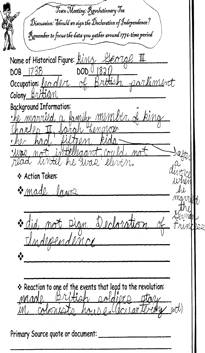
Dinah Cohen was convinced from the first day that if we want children to write passionately, we must provide opportunities that allow them to step into those events. She wanted them to see “the gravity and the magnitude” of the times and “to live it!” First, she immersed the children in the historical context of the late 1700s. In addition to delving into biographical and background information, students investigated their figures’ actions and their figures’ reactions to events that led to the Revolution. Carefully checking for source reliability and validity, students examined primary and secondary sources from textbooks, trade books, and various Internet sites. Figure 1 details the way that Joe concisely summarized the expectations (“Joe” and other student names below are pseudonyms).
Plans for Data-Based Research
Database for Revolutionary Tea
Building on the students’ systematic research skills, we designed scaffolds aimed at teaching these young historians the tools of the trade. We hoped to move children beyond knowing what to do towards knowing how to do it. We needed to teach children that if they really wanted to understand and reconstruct multiple points of view, they would need to actively “do history.”
Immersed in this rich historical content from texts, trade books, picture books, and children’s magazines, the children easily drew on a virtual toolbox of reading and writing structures. Multiple configurations of conversations erupted constantly: peer conferences, small group talks, whole-class conversations. Sometimes listening, sometimes coaching, Mrs. Cohen and I witnessed a myriad of conversational moves. These fourth graders expected their peers to substantiate conversation with content: names, dates, places, and events. Students challenged each other’s claims, asking for clarification or probing with new questions. Often simultaneously, these young historians were scattered across the classroom developing timelines or charts, jotting notes, and writing reflectively in response to a primary quote. Sitting silently in creviced corners or collaboratively paired at a table, children developed (and supported) theories about revolutionary independence using an impressive range of writing-to-learn strategies. Notebook pages were littered with marginal notes, Venn diagrams, questions, quick writes, and double entries coupled with conclusions.
Growing Interpretations: Constructing Meaning
Two weeks later, a quick scan of this fourth-grade classroom revealed pint-sized historians engrossed in content research. Collectively, these young Abigails and Thomases accumulated an inspiring arsenal of textbook and trade book chronicles. Eavesdropping on their conversations and peeking into notebooks convinced us that these children could fluently spout multiple authors’ perspectives on independence. Clearly, our historians were ready for a bend in the road, and it was time to teach children how to reconstruct divergent viewpoints, searching for the meaning of independence for themselves! In a simple, yet significant teaching move, we taught the students to hold onto and extend the connections that they were making among the different document sources in two key ways: “writing-to-learn strategies” and “social studies talk.” A look into Matthew’s work provides a window into this approach.
Focused on a single page of text, Matthew thought out loud: “So Thomas wrote a book, Common Sense. He thought it’d change people’s minds.” Almost immediately, Matthew narrowed his search, ready to find evidence to support his idea that Paine valued independence. Matthew moved from text to text; read, then reread; and then focused on pictures on the side panels. Throughout the process, Matthew chronicled the events of Thomas Paine’s life in his notebook, citing sources and liberally using marginal notes to agree, and then disagree, with varying authors’ presentations. In a conference with his teacher, Matthew compared his process of putting together different pieces of information as he developed his ideas about Thomas Paine to collecting the pieces of a pie: “one piece, two . . . until I get the whole story.” Matthew began his notebook entry,
Fig. 3.
Evaluation: Living the Mantra
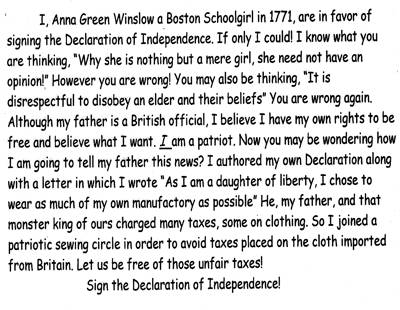
In a deliberate three-stage series of lessons, we implemented the second planned and purposeful teaching move. We taught the children to defend differing positions. First, we taught them to replicate (in dress and action) the designated historical figure “who changed the world.” Next, Mrs. Cohen and I taught the fourth graders revision strategies that focused on first-person narration weaving direct quotes with thinking. Finally, we taught our historians to “have a conversation” with their listeners. A close look at Jenny’s progress through her final preparations for her role as Anna Green Winslow in the Revolutionary Town Meeting shows the effects of this teaching on her ability to construct and defend her decision to sign the Declaration of Independence.
Jenny used the final days before the meeting to become a living document, authentically replicating twelve-year-old Anna. She designed her costume to include layered petticoats covered with a simple, hand-sewn, buttoned dress, capped by a matching bonnet. In her left hand she carried a basket with cloth and an array of needles. Tucked into her basket were original diary entries, marked with the words: Spinning for Liberty. In a conversation with Jenny, the fourth grader filled us in on her research to date: “So, I wrote a page about Anna . . . she joined a patriot sewing circle and helped the cause of Liberty.” Jenny elaborated, “They were sewing to protest British taxes by making their own clothes so they wouldn’t have to pay for it from England.”
At first, Jenny read and reread Anna’s diary, listing evidence that supported a patriot stance. With guidance, Jenny revised her first ideas. After underlining the fragment, “I might have told you that notwithstanding the stir about the Proclamaiten, we had an agreeable Thanksgiven,” Jenny almost automatically combined the two skills at her fingertips. First, Jenny’s prior examination of the Proclamation of 1764 allowed her to make sense of this statement, and more importantly, her prior knowledge helped her recognize its potential to support her angled position. Jenny worked through the statement, taking precise one-word notes in the margins of the diary: “annoyed,” “disturbed,” and “bothered.” She concluded, “maybe Anna was annoyed or bothered by the stir of the proclamation.” In this entry, Jenny not only added new content details but also began to incorporate her thinking.
Those last sessions before the Revolutionary Town Meeting were sprinkled with revision conferences. Mrs. Cohen taught the speechwriters deliberate grammar choices that allowed them to incorporate passion into their conversation with the listener. Jenny opted to speak directly to her audience. She began, “You must be thinking . . . ” Furthermore, Jenny learned that she could couple her systematic use of the present tense with judicious control over the exclamation point, e.g., “If only I could!” These moves added specificity, credibility, and power to the final version.
Fig.4.
Conclusion
The spiraling effect of Mrs. Cohen’s direct, angled teaching was simple, yet significant. These children actively constructed versions of the call to independence in 1776. This active participation resulted in students who made informed decisions, developed reasoned arguments, and engaged in problem solving.
The Revolutionary Town Meeting proved to be an enormous success. Mrs. Cohen managed to teach her fourth-grade students how to “get the person in their heads.” Early one June morning, twenty-seven nine-year-old historians took the stage and passionately proclaimed the ideals of 1776, advancing the mantra: “These were people who changed the world!”
This article originally appeared in issue 7.2 (January, 2007).
Paula S. Marron is the assistant principal at Chatsworth Avenue School in the Mamaroneck School District. She conducted research on writing as the thread for higher level thinking in social studies in elementary classrooms on Long Island and in New York City.
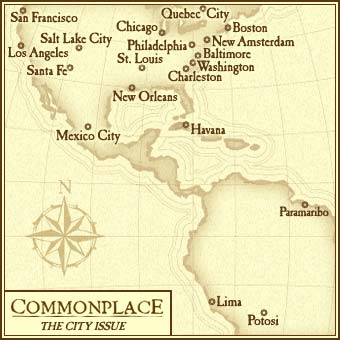
This special issue of Common-place on the early cities of the Americas offers several opportunities. First, the nineteen individual essays invite Common-place readers to make comparisons about the character of life in the early years of cities spread throughout the Americas–south to north, from Lima, Peru, to Quebec City, Canada; and east to west from Boston to Los Angeles. By adopting an Americas-wide approach, we hope to stimulate your thinking about comparisons among Spanish, English, Dutch, and French cities. Almost one third of the featured cities were Spanish (two of which, Los Angeles and Santa Fe, are now American cities). Three of these cities were French at the time of their founding (two of them, St. Louis and New Orleans, are now American cities). Two were Dutch (New Amsterdam is now New York). It will surprise many readers that two of these Spanish cities–Potosi and Tenochtitlan/Mexico City–attained populations of 150,000 or more, a scale that put them near the top of a list of the world’s most populous cities of the sixteenth and seventeenth centuries. Some others, such as Lima, were larger in the mid-sixteenth century than Boston and Philadelphia in the age of Jefferson. None of North America’s urban villages would reach the population levels of the major cities of Spanish America until well into the nineteenth century.
Second, though these nineteen cities were founded, variously, over a very long period of time–from about 1500 to 1860–they were each very young cities at the point where our authors examine them. Some of the adolescent cities our authors look at were very small indeed; Boston, New Amsterdam, Quebec, St. Louis, Havana, Paramaribo, and Washington, D.C., were really only overgrown villages, not even attaining populations of ten thousand, at the point we paint their portrait. Our attempt is to look at the dynamics of urban life when these cities were in their second generation or so from founding: a moment when they were by no means fully formed; yet a point by which they had acquired characteristics that continued to shape them for a long time.
Third, our authors have consciously adopted an untraditional approach to urban history, illustrating the social, legal, and political workings of these young urban societies by writing about a particular incident, a place, an encounter, a person, or a group of urban people. Think of these essays as worm’s eye views: moments in the early history of each city that convey the feel what it was like to live in these places hundreds of years ago. For example, Claudia L. Bushman and Richard Lyman Bushman ask readers to stand in the cemetery in Salt Lake City where Dick Bushman’s grandparents are buried. Joyce D. Goodfriend introduces us to New Amsterdam with the story of an African father who is bringing his newborn twins to the Dutch Reformed Church in 1647 to be baptized. In another case, Christine Hunefeldt shows us Lima, Peru, as María Dolores Quispilloc and her husband Antonio Martínez entered the city on a mule in the early 1760s. And Billy G. Smith has the indentured servant William Moraley take us on a tour of Philadelphia in 1729, when the city founded by Quakers in the 1680s had attained a population of about seven thousand. In all the essays, vignettes of this sort lead us into considerations of the dynamics of urban political life, of cities’ economic workings, their cultural efflorescence, and, especially, the social relations that city life fostered between man and woman, master and slave, parent and child, employer and worker, priest and parishioner, plaintiff and defendant.
It needs remembering that these early cities were all founded in overwhelmingly agricultural societies where the hoe and horse, the field and the farmhouse, and the rhythms of life followed sidereal rather than clock time. Yet cities were the cutting edge of change in the early Americas. It was there that almost all the alterations associated with the advent of modern society first occurred and then slowly radiated outward to the small farming communities of the hinterland. In the early cities of the Americas, people first made the transition from a predominantly oral to a largely written culture, from a medieval economy where most transactions were regulated with an eye to the public good to a market economy where entrepreneurial freedom privileged the individual over the group, from a social order where status assigned at birth was displaced by a competitive scramble for rank, from a community-centered to an individual-centered orientation, from a hierarchical and deferential polity to a participatory and contentious civic life, from a deeply religious to a more secularized outlook.
Readers will learn about several elements of early urban life in the Americas that were ever present: violence, racial fluidity, and disease. As we worry about SARS and the possible reappearance of smallpox as killer epidemics, ravaging diseases that have always flourished in urban settings because of population density, we can put our concerns in historical perspective and see how modern medicine has mitigated, if not eliminated, one of the most lethal aspects of early urban life in the Americas. And of course today, we worry about urban violence, and rightly so. But reading these essays cannot but help readers gain some historical perspective on this modern condition. By seeing how violent were the early cities, where no such thing as the modern police force existed to dampen urban vice, we can quickly set aside romantic notions of a simpler and more placid quality of life.
Finally, as several of the essays show, racial slavery was a major part of urban violence in the Western hemisphere, and vice versa. Richard Price’s chilling description of what he calls “a veritable theater of terror” in early Paramaribo, Suriname, is another reminder of how brutal life was in the early modern era. In other essays, including those on New Amsterdam, Tenochtitlan, Potosi, New Orleans, Los Angeles, and St. Louis, readers will get vivid portraits of the mingling of peoples from Africa, Europe, and the Americas at a time when the concept of “race” was still forming (and indeed when the main use of the word was to describe contests of speed). It is much to our benefit, in a day of rapidly rising interracial marriage, to revisit early cities when this was not unusual or thought improper.
As readers will discern, life experiences in the early cities of the Americas varied widely depending on climate, religion, racial composition, and other factors. Life in early Lima and early Boston, for example, was not the same. A Spanish Catholic and Indian mountain mining town such as Potosi and a river-oriented, Quaker-dominated commercial town such as Philadelphia were worlds apart. Readers are invited to make contrasts and comparisons. In the “strange new world,” as Europeans often described the Americas they reached in the late fifteenth century, urban societies developed along a variety of trajectories that these essays begin to explore.
This article originally appeared in issue 3.4 (July, 2003).
Gary B. Nash, guest editor of this special issue, has taught history at UCLA for the last thirty-seven years, and directs the National Center for History in the Schools. He has published many books and articles on the history of colonial and Revolutionary America.
North American Monetary Union?
A mid-nineteenth-century prelude
The introduction of the Canada-U.S. Free Trade Agreement in 1989 has ushered in an era of much closer economic relations in North America. Could this relationship soon extend to the creation of a monetary union? The birth of the euro in 1999 has generated new interest in this question. Although few expect the U.S. government to embrace a new supranational North American currency any time soon, a number of analysts have speculated that Canada might create a monetary union by simply adopting the U.S. dollar in the coming years.
Would Canadians really ever agree to transform their monetary system in such a dramatic way? Little attention has so far been paid in the contemporary debate to an interesting historical precedent. At the time of the last comprehensive free-trade agreement between the two countries during the 1850s and 1860s, Canadian politicians did indeed embrace a new “dollarized” monetary system that was modeled on that of the United States. What lessons can be learned from this neglected episode in North American monetary history?
The First Era of North American Free Trade and Monetary Reform
The idea of an integrated free-trade zone between the United States and Canada was first born in the wake of Britain’s decisions to abolish its Corn Laws in 1846 and reduce timber preferences throughout the 1840s. These moves sent economic shockwaves through the Canadian colonies by ending their protected export market in Britain. Many Canadian businesses quickly turned to the United States as their best alternative market, and cross-border trade expanded rapidly. Indeed, at one point, many prominent Montreal merchants even called for annexation with the United States. To forestall annexationist sentiments and to facilitate trade with the United States, the Canadian authorities successfully pressed for a free-trade deal with the United States, the Reciprocity Treaty of 1854-66.
Then as now, intensifying North American economic integration prompted new interest in the idea of closer monetary ties between Canada and the United States. At the time, the bulk of the money supply in the Canadian colonies consisted of a motley collection of foreign coins whose value was rated according to the local sterling standards using the familiar terms of pounds, shillings, and pence. Each colony valued foreign coins slightly differently than the others, and in all cases, the official exchange rate between the two dominant coins in circulation—British and U.S. coins—contrasted with that existing in the United States at the time. The contrast was particularly large in the colony whose trade was growing most rapidly with the United States: the Province of Canada (which had been formed by merging Upper and Lower Canada in 1841). The British pound was rated at US$4 in the province, whereas its value was US$4.86⅔ within the United States. This difference in monetary standards, as well as that between the decimal-based dollar system and the sterling system, was a source of frustration to merchants involved in the growing cross-border commerce. These differences increased the costs merchants incurred in exchanging money, making cross-border price comparisons, and conducting basic accounting operations.
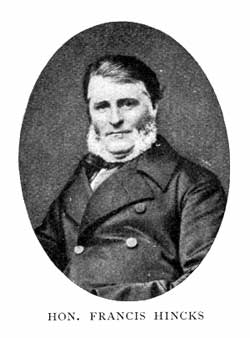
In the early 1850s, politicians in the Province of Canada made clear their determination to reform their monetary system. Particularly keen was Francis Hincks who held the post of inspector general from 1848-51 and that of prime minister from 1851-54. He had been a strong supporter of the political reforms that created the first elected Legislative Assembly in 1841, and he believed strongly that the province should be allowed to address its monetary problems without British interference. To this end, he proposed in 1850 that Canada issue its own silver and gold coins for the first time.
The Honorable Francis Hincks, from Public Men and Public Life in Canada, by James Young, 1902. Courtesy of the American Antiquarian Society.
These coins, he argued, would be a source of pride to Canadians and allow the government to provide a more homogeneous and well-managed coinage by ending the colony’s reliance on foreign coins. But an equally important goal of the initiative was to facilitate trade with the United States. As early as 1841, when he had overseen the creation of a unified monetary standard for the new Province of Canada, Hincks had called for the adoption of a decimal-based dollar standard in order to simplify and foster cross-border trade. British authorities had opposed his idea then on the grounds that it would strengthen the colony’s ties to the United States and encourage annexationist sentiments. They had insisted instead on the introduction of the local sterling standard whose value was not determined by a U.S. dollar standard.
By 1850, Hincks was much more intent on implementing his proposal to reform the Canadian monetary system along U.S. lines. Though a leading opponent of the annexation movement, he still believed strongly in the need to expand trade with the United States, and he was closely involved in the early negotiations that led to the Reciprocity Treaty. In this era of rapidly expanding U.S.-Canada commerce, he found much more domestic support for his initiative to introduce a dollar-based monetary system. While under half of local businesses polled in the early 1840s had supported this option, a full 100 percent of those surveyed a decade later backed the idea.
British Resistance and the Birth of the Canadian Dollar
To minimize British resistance, Hincks initially proposed in 1850 that the province retain a sterling standard but simply alter its value to emulate that of the United States (i.e., to make one pound equal US $4.86⅔). But the British government would not accept this proposal and suggested instead the adoption of the British sterling standard and British coin (at least until a common coin for the colonies could be agreed upon). British authorities argued that this reform would ensure that the colony’s monetary system facilitated “the adjustment of Trade with the Mother Country.” They also objected that Hincks’s proposed coin issue would infringe on the royal prerogative.
When the British government disallowed Hincks’s act (despite its approval by the provincial legislature and local governor-general), Hincks submitted a new bill. In it, he accepted that Queen’s approval would be necessary for any coin issue by the province and even suggested that a separate coinage was not absolutely necessary. “That was more a matter of national pride than anything else,” he argued. While conceding this point, he became more provocative in arguing that a U.S.-style decimal-based dollar standard was now necessary for the province. His reasoning was as follows: “With the people of the United States . . . Canadians are brought into constant daily intercourse. They travel on the same Steamers and Railroad Cars—lodge at one another’s Hotels and carry on a most extensive Commercial intercourse with each other. To have an entirely different Currency . . . would be an intolerable inconvenience.”
Hincks’s new proposal was greeted enthusiastically in the province. One member of Parliament even “congratulated the House on the fact that people can now talk of dollars and cents without imputations of disloyalty.” Recognizing the political mood, the British government now backed down and agreed that the province could not only issue its own gold and silver coin (subject to the Queen’s approval) but even introduce the standard of value that Hincks suggested. In return, the British authorities asked Hincks to consider naming the new standard the pound and the new coins royals, half-crowns, and shillings. Discussing this request, one contemporary writer suggested that the British “may have considered it [the proposal for a dollar-based standard] to have too Americanizing a tendency, and been afraid that it might prove ‘the insertion of the thin end of the wedge.’”
Showing some flexibility, Hincks suggested that coin names were “of little consequence,” and he proposed the issuance of coins named royals, shillings, and marks, which would be based on a decimal accounting system (there would be one hundred marks in a royal and ten marks in a shilling). But other politicians in the provincial legislature were much less inclined to compromise on this point. Arguing that dollars and cents were “universally understood,” they favored a dollar-based system. So too did many outside the legislature. As Canadian monetary historian Adam Shortt has put it, “the very general opinion of the press was fairly expressed by the Toronto Leader in the statement, that in a country like Canada, situated on the borders of the United States and with more than one-half of its trade carried on with that country, it is necessary to adopt the system in force there.”
Responding to these sentiments, the legislature passed an act in 1853 that allowed for the issue of silver coin and legalized the use of a dollar standard. Although the government initially allowed the use of either the dollar-based standard or the old sterling-based one, the former quickly prevailed. By 1855, one government document reported, “[the adoption of the dollar standard] has taken place already in many parts of Canada; merchants keep their books, railway boards transact their business, hotel-keepers and traders make out their bills, in dollars and cents; bankers place their dollar on their notes as a regulating unit; the reciprocity treaty will greatly increase our trade with the United States, and our people are daily becoming more familiar with the decimal system in use there. The County Council of Lambton has recently ordered that dollars and cents shall be adopted as the system for keeping the county accounts, levying rates, etc.” The provincial government finally declared the dollar standard to be the exclusive standard of the province in 1857, and it issued the first silver coins denominated in this standard the next year.
The Province of Canada was not the only colony to introduce a decimal-based dollar standard in this period. New Brunswick adopted an identical one on an optional basis in 1852 and soon made it compulsory in 1860 when the colony first issued its own coins. Nova Scotia also embraced a decimal-based dollar standard in 1860, although it chose to value the dollar standard in a slightly different way to facilitate its maritime trade with the British West Indies. After Nova Scotia joined New Brunswick and the Province of Canada to form the new federation of Canada in 1867, Hincks (who had reappeared as finance minister in 1869) took the lead in eliminating that province’s distinctive valuation system, arguing once again that it was “necessary to assimilate the Currency with that of the United States.” Before they too joined Canada, the colonies of British Columbia, Manitoba, and Prince Edward Island (PEI) had also already chosen to embrace decimal-based dollar standards in 1865, 1870, and 1871, respectively, with values identical or very close to that of the United States.
Back to the Future?
The fact that Canada, still to this day, bases its monetary system on a decimal-based “dollar” standard (although one whose value is no longer identical to that of the United States) is thus a product of the last era of North American free trade. As we have seen, the Canadian dollar’s birth was the product of a desire to deepen North American economic integration in the mid-nineteenth century through the adoption of a monetary system based on the U.S. model. As we find ourselves in a new era of North American free trade, will history repeat itself? Will the desire for closer monetary ties this time around encourage Canadian policymakers to go one step further and fully embrace the U.S. dollar?
Some contemporary developments are indeed reminiscent of the mid-nineteenth-century period. A number of prominent Canadian business leaders and policy analysts have highlighted how the adoption of the U.S. dollar would help to facilitate cross-border economic transactions by reducing currency-related transaction costs. They also argue that the case for monetary union is strengthened by the fact that economic integration is encouraging some unofficial “dollarization” within Canada. Similar arguments were made by Hincks and others in the mid-nineteenth century.
At the same time, it is clear that contemporary Canadian supporters of North American monetary integration are encountering fiercer opposition than did their nineteenth-century counterparts. In the mid-nineteenth century, few policymakers took seriously the idea that a floating exchange rate could be used to bolster monetary autonomy by helping to insulate the national monetary system from external influences and constraints. They also did not consider that governments might use exchange-rate movements to encourage or discourage exports and imports in ways that fostered adjustments to balance of payments disequilibria. Both of these lines of thought would have been anathema to the gold-standard orthodoxy of the time. Since the 1930s, however, Canadian policymakers have been strongly wedded to a floating exchange rate for precisely these reasons. Indeed, so strong has this commitment been that they have been willing to accept a fixed exchange rate for only two brief periods: 1939-50 and 1962-70. In this context, the case for dollarization encounters stronger opposition on economic grounds.
Proposals to adopt the U.S. dollar also provoke significant nationalist opposition in Canada today. Here, the contrast with the mid-nineteenth-century period is stark. In that earlier era, the project of dollarization was in fact supported by a kind of nascent nationalism in the Canadian colonies. This was because it was associated with demands for self-government and the rejection of an inadequate colonially imposed monetary order. Today, instead of creating a national currency for the first time, Canadians are being asked to give up their national currency. And to make matters worse, they are being asked to adopt a currency issued by the country that has emerged since the nineteenth century as the dominant power in North America. No wonder then that dollarization now appears to many Canadians as a kind of quasi-colonial idea that could undermine their country’s sovereignty and identity.
Further Reading:
The sources for quotations in this article can be found in Eric Helleiner, Towards North American Monetary Union? (Montreal, 2006). For additional readings, see Adam Shortt, History of Canadian Currency and Banking, 1600-1880 (Toronto, 1986) and D.C. Masters, “The Establishment of the Decimal Currency in Canada,” Canadian Historical Review 33 (2) (1952): 129-47.
This article originally appeared in issue 6.3 (April, 2006).
Eric Helleiner is CIGI Chair in International Governance and associate professor in the Department of Political Science, University of Waterloo, Canada. He is author of Towards North American Monetary Union? (Montreal, 2006), The Making of National Money (Ithaca, N.Y., 2003), and States and the Reemergence of Global Finance (Ithaca, N.Y., 1994) as well as coeditor of Economic Nationalism in a Globalizing World (Ithaca, N.Y., 2005) and Nation-States and Money: The Past, Present and Future of National Currencies (New York, 1999). He is currently coeditor of the book series Cornell Studies in Money and the journal Review of International Political Economy.
The Souls of African American Children: New Amsterdam
On March 31, 1647, an African father brought his newborn twins to be baptized by a Dutch minister in New Amsterdam’s Reformed Church. With other members of the city’s sizeable African community serving as godparents, the boy and girl were baptized with the names Adam and Eva. “Emanuel Neger,” as he was called in the baptismal register, had chosen to cast his family’s lot with the city’s Protestant Christians. Though most likely a slave of the Dutch West India Company, Emanuel must have nurtured the hope that he soon would join the ranks of the score of Africans who, after laboring for the company in New Amsterdam for nearly two decades, had recently been granted conditional freedom.
New Amsterdam had begun its history in 1626 as a frontier settlement under the control of the West India Company, a Dutch commercial enterprise whose ventures included slave-trading posts in Africa and colonies in Brazil and New Netherland. Occupying the tip of Manhattan Island, New Amsterdam was strategically located, with a harbor that was ideal for ocean-going commerce. Though it had languished during its early years, despite the profits of the fur trade with the natives, by the late 1640s New Amsterdam had taken on the shape of a settled community. Fort Amsterdam, the Reformed Church, and the Stadt Herberg, a tavern that was later converted into the city hall, were surrounded by farms, windmills, warehouses, and private dwellings. Still sparsely populated, it already was distinguished by its diverse array of residents from Europe and Africa.
Fig. 1. Fort Amsterdam
African men and women formed an essential component of the local labor force, though their status as slaves had never been defined with precision or codified in law. Emanuel, along with his fellow Africans in New Amsterdam, had concluded that Christianization would be a potent weapon in their struggle to emerge from enslavement. They turned to Dutch religious rituals to sanctify their marriages and to validate their babies as Christians to enhance their chances for emancipation. Adam and Eva were just two of the more than sixty infants of African origin who were baptized in the city’s Dutch church between 1639 and 1655.
Why would clergymen of the Reformed Church use their office to baptize the offspring of men and women claimed as property by the Dutch West India Company, the premier slave-trading company of the seventeenth century? One might expect a Dutch minister stranded in a colonial outpost to exhibit an attitude toward slaves resembling that of Jonas Michaelius, New Amsterdam’s first minister, who in 1628 described the Angola slave women he encountered as “thieving, lazy and useless trash.” Everardus Bogardus, who was sent to New Amsterdam as a minister in 1633, had earlier served as a ziekentrooster(comforter of the sick) on the Guinea coast. While there, he apparently developed a genuine concern for the spiritual condition of Africans that carried over into his dealings with the tiny city’s West Africans. In 1636, Bogardus pleaded for a schoolmaster to be sent from Holland “to teach and train the youth of both Dutch and blacks in the knowledge of Jesus Christ.” By 1641, he was convinced that “good hopes exist for the conversion of the Negroes,” a judgment corroborated by the elders and deacons who reported that “the negroes living among the colonists come nearer [to the right knowledge of God]” than the Indians. Most important, Bogardus acted on his convictions. During his tenure as New Amsterdam’s minister, he routinely married African men and women and baptized their children, and once served as a godparent for an African infant. From October 1639, when the extant church records commence, until August 1647, when he departed for the Netherlands, he baptized thirty-nine children of African descent. Bogardus took pains to welcome Africans into New Amsterdam’s Reformed Protestant Church, most likely because he suspected that people with surnames like Angola, Congo, and Portugies had been exposed to Catholic doctrines in the course of their travels in the Atlantic world. He saw it as his duty to counteract these erroneous teachings and adverse influences.
Yet no matter how much credit we assign Domine Bogardus for promoting the Christianization of New Amsterdam’s Africans, his actions alone cannot explain the flood of African baptisms in New Amsterdam’s church. Over the first few decades of Dutch rule, a procession of fathers (mothers only occasionally were present), accompanied by other Africans who stood as godparents, willingly stepped before a Dutch man of God to cement the good standing of their children in the eyes of the European majority. Certifying their children’s membership in the Christian community was a matter of vital concern to the city’s adult Africans, who, in essence, were engaged in a tug of war with the Dutch West India Company for control of their numerous children. From the outset, the company had condoned the formation of families by captured Africans, and by 1644, company officials acknowledged that their African slaves “are burdened with many children.” As the city’s forced laborers wrestled with the tribulations of life in a society that defined them as slaves, they fixed their hopes on the next generation. They aimed to supply their boys and girls with armament to protect themselves from people determined to exact as much as they could from them. Tendering these children for baptism in the Dutch Reformed Church was the central strategy in a multipronged effort to achieve a secure niche for the African American children of this North American Dutch city.
Their primary adversary was the Dutch West India Company, whose officers envisioned Africans born in New Amsterdam as a fresh and continuously available source of labor. Such children would make especially desirable slaves, since they would be acculturated and would have roots in the city. With their kinfolk nearby, they would not pose a risk of flight. Company administrators did not hesitate to exert their authority over these youngsters.
The beneficiaries of the 1644 law that gave conditional freedom to the company’s longest serving male slaves and their wives were confronted with an excruciating dilemma. Though placed “on the same footing as other Free people . . . in New Netherland,” and granted plots of land on the outskirts of the city that enabled them to become productive agriculturalists who could easily pay the mandatory annual tribute of wheat, maize, peas, or beans, and a fat hog to the company, they were compelled to honor the law’s proviso that their children “at present born or yet to be born shall be bound and obligated to serve the Honorable West India Company.” The motives of the company officers who crafted the law were transparent. They sought to relieve themselves of the burden of supporting aging slaves, yet wished to reserve the right to command the labor of young and vigorous African youth. But the African parents, whose dreams for their baptized sons and daughters had rested on the indeterminacy of their status, could not reconcile themselves to a principle they regarded as illegitimate.
Fig. 2. Map of New Amsterdam
Their hopes may have been raised in 1649, when critics of the provincial administration, in the course of a lengthy Remonstrance to the Directors of the Dutch West India Company, complained that the children of the emancipated Africans “have remained slaves, though it is contrary to the laws of every people that any one born of a free Christian mother should be a slave and be compelled to remain in servitude.” The response from Amsterdam was anything but comforting. Company officials minimized the impact of the law–they boasted that only three children currently were in the service of the company and emphasized that these slave children were treated as Christians. More importantly, they implicitly upheld the principle of commandeering the labor of the children of the former company slaves, even as they condoned the release of more laborers from bondage in succeeding years. New Amsterdam’s free Africans had no alternative but to try and capitalize on the liberties they had gained to weaken the power of Europeans over them and their progeny. Their task was made more difficult by the influx of immigrants from Europe and the emergence of a consensus that slavery was the appropriate status for people of African origin.
In the 1650s, as the second generation reached maturity, New Amsterdam attained both stability and prosperity. Regulations on subjects ranging from sanitation and fire prevention to observance of the Sabbath were imposed by Director-General Petrus Stuyvesant, bringing order to the burgeoning community, while improving the conditions of everyday life. Commercial opportunities expanded as local merchants engaged in trade along the North American coast, in the Caribbean, and over the ocean to Europe and Africa. A merchant elite emerged and, with the backing of small traders and artisans, successfully pressed for a city government that would promote local interests and temper the authoritarianism of company rule.
New Amsterdam’s incorporation as a municipality in 1653 accelerated its transformation into a city consciously modeled on Dutch prototypes. Its houses with the gable end turned toward the street and tiled roofs were only the most visible manifestation of the cultural heritage that was selectively reproduced in the colonial city. Once installed, New Amsterdam’s Burgomasters and Schepens, as representatives of the merchants and artisans, set about implementing their conception of Dutch urban life. The streets were surveyed, canals were dug, a weigh house built, and court procedures elaborated. Most important, city leaders gained Stuyvesant’s approval to institute the Burgher Right, which restricted the privilege of conducting business to local property owners. The civic customs of Amsterdam, modified to suit local conditions, had taken root in what municipal leaders deliberately called the City of Amsterdam in New Netherland.
The enhancement of the power of Euro-Americans under burgher government did not bode well for New Amsterdam’s Africans. Now, not only company officials but also individual slaveholders and city officials were in a position to make decisions that would shape the course of young Africans’ lives. African parents did not wish to yield control over their children’s lives to Europeans, but, as one mother learned in 1661, her little girl was vulnerable and she lacked any means to protect her. Ten-year-old Lysbet Anthony admitted to the Burgomasters of New Amsterdam that she had been stealing from her mistress, the wife of Domine Drisius. Given the option of chastising her own child or having a public servant do it, Lysbet’s mother, Mary, chose to do it, and, with the assistance of another African woman, “severely punished and whipped her daughter with rods in [the] presence of the [city] Magistrates.” To inflict physical harm on her daughter while Dutch officials looked on with satisfaction must have been unbearable for this mother, who could not shield her child from the pain and public humiliation.
Well aware of the unpredictability that shadowed the lives of non-Europeans in the Dutch city, free Africans attempted to safeguard their children through labor contracts, such as the one made by Maria Portugies for her daughter to be a household servant, and apprenticeships. Susanna Anthony Roberts, a free African acting as guardian of her minor brother, negotiated an apprenticeship agreement for him that mandated that he be taught reading and writing. Unable to write herself, she yearned to equip her brother with the tools of literacy.
Having managed to extricate themselves from slavery, the members of New Amsterdam’s free African community kept a watchful eye on the enslaved children still embedded in the interstices of the society, and, at opportune moments, contrived ways to liberate them from the control of Euro-Americans. Anthony Matysen, a free African, had made a contract with ferry master Egbert Van Borsum to rear “his negro’s child,” which involved Matysen’s wife nursing the baby. The deal had been consummated by Van Borsum’s wife, who had “bargained with [Matysen’s] wife for the child for one year at least, and has not refused her payment of what she promised her in the presence of other negroes.” Matysen went before the city court in March 1655, claimed that he had not been paid by Van Borsum, and “request[ed], therefore, that the child be declared free, when [sic] he promises to rear the same at his own expense.” Anthony Matysen was the father of four children baptized in the Reformed Church between 1651 and 1655, but it was not just parental affection for the infant entrusted to him and his wife that explains why they invented a pretext for adopting the baby and raising it as a free person. Their commitment to the future of the city’s African community played a major part as well.
Though the court ruled against Anthony Matysen, they did take his suit seriously. Perhaps the fact that Matysen had baptized his twin sons with the Old Testament names Abraham and Isaac elevated his standing among New Amsterdam’s Christians. By the time Matysen brought his case against Van Borsum, free Africans were certain that the best way to narrow the distance between themselves and the city’s Europeans was to identify themselves as Christians. Two separate petitions composed in the 1660s by free Africans who wished to secure the freedom of a boy and a girl, each on the verge of adulthood, made a point of identifying the parties as Christians. When Domingo Angola requested the manumission of Christina Emanuels, a company slave, he mentioned that she was the baptized orphan daughter of Manuel Trumpeter and Anthonya his wife. Emmanuel Pietersen and Dorothe Angola, a free couple who wished to adopt Dorothe’s godson, also framed their petition in a way that established their credentials as Christians. They noted that Dorothe had stood “godmother or witness at the Christian baptism of a little son of Kleyn Anthony of Angola, begotten by his wife Louwize [both free Negroes]” and that after the boy’s parents died, she had, “out of Christian affection,” adopted and reared him as her own child.
Claiming ties to the Christian community gave Africans leverage as they pressed for greater control over the lives of the city’s African children. Skeptical of the Dutch West India Company’s rationalization for holding the children of Christian mothers in bondage, they sensed that the enslavement of baptized individuals rested on a flimsy foundation. With good reason, they had come to believe that the path to freedom ran through the baptismal font of the Reformed Church. Anxious to perpetuate the practice of baptizing Africans initiated by Everardus Bogardus, they found that, after 1655, access to the ritual that had emboldened them was foreclosed to their offspring. New Netherland’s Reformed ministers, following church dictates, had inaugurated a policy of restricting baptism to people knowledgeable in the faith. This clerical decision may well have been influenced by the growing aversion of the burghers to participating in a biracial religious community.
Yet African parents continued to seek baptism for their infants. In the 1660s, the forty enslaved workers who resided at Director-General Stuyvesant’s bowery north of the city at times importuned Domine Henricus Selyns, who had been hired by the devout Stuyvesant to preach at his chapel every Sunday night, to baptize their children. Selyns’s refusal to do so was grounded in church policy–the “negroes . . . lack of knowledge and faith”–but the minister felt impelled to impugn their motives, stressing “the material and wrong aim on the part of [these Negroes] who sought nothing else by it than the freeing of their children from material slavery, without pursuing piety and Christian virtues.” Discovering the mainspring of their actions did not deter Selyns from spreading Christian gospel among these people “whose country of origin is the Negro-Coast.” He engaged in private and public catechizing, which, he claimed “bore little fruit among the old people, who do not understand, but gave more hope with regard to the young, who have improved reasonably well.” The old people, he neglected to mention, had managed to grasp the centrality of baptism to the prospects of freedom.
Selyns’s injunctions against baptizing slave infants did not prevent Judith Stuyvesant, the director’s wife, from proceeding with the baptism of African children in her own household. But the imperatives of slavery as an economic institution trumped the pious designs of Mrs. Stuyvesant. An official on Curacao, the great slave-trading entrepôt of the Dutch West India Company, apologetically wrote Petrus Stuyvesant of the “serious mistake that has been committed here in the sale of your Slaves; especially of the little children, since with great forethought on the part of Madam Stuyvesant . . . they were presented at the baptismal Font.”
Should the sad fate of Judith Stuyvesant’s baptized slave children stand as the symbolic end of the contest over the souls of New Amsterdam’s African American children? Only if we believe that the African men and women who were shrewd enough to name their babies after figures from the Old Testament would stop searching for ways to deliver their heirs from slavery.
Further Reading:
On African Americans in New Amsterdam, see Graham Russell Hodges, Root and Branch: African Americans in New York and East Jersey 1613-1863 (Chapel Hill and London, 1999); Ira Berlin, “From Creole to African: Atlantic Creoles and the Origins of African-American Society in Mainland North America,” William and Mary Quarterly, 3d series, 53 (1996): 251-88; and Joyce D. Goodfriend, “Burghers and Blacks: The Evolution of a Slave Society at New Amsterdam,” New York History, 59 (1978): 125-44. For background on New Amsterdam, see Oliver A. Rink, Holland on the Hudson: An Economic and Social History of Dutch New York (Ithaca and London, 1986).
This article originally appeared in issue 3.4 (July, 2003).
Joyce D. Goodfriend, professor of history at the University of Denver, is the author of Before the Melting Pot: Society and Culture in Colonial New York City, 1664-1730 (Princeton, 1992) and editor of New World Dutch Studies forthcoming from Brill.
Miniature Worlds
Fig. 1. Dr. Robert Hazard, dressed miniature. Courtesy the Connecticut Historical Society, Hartford, Connecticut.
Fig. 2. Betsey Way Champlain, unidentified portrait. Courtesy of R. MacMullen.
Fig. 3. Eliza Way Champlain, Iris. Courtesy of R. MacMullen.
Look closely at these images. However large they appear on your computer screen, in reality they are tiny indeed. The first, a dressed miniature portrait, probably depicting Dr. Robert Hazard, measures just under six inches from the top of the frame to the bottom; it was created by Mary Way around 1800. Hazard’s head is painted, his torso assembled from bits of cloth and lace. The second portrait, watercolor on ivory, is about half the size of Hazard’s portrait. The history of this unfinished painting of an unidentified woman isn’t clear. Perhaps it was rejected by the sitter. Perhaps it was rejected by the artist, Mary Way’s sister, Betsey Way Champlain. The final image, the allegorical Iris, measures only 1 1/2 inches in diameter—small enough to fit inside the case of an early-nineteenth-century pocket watch. Although we don’t know whose watch Iris once decorated, we do know that it was painted by Betsey Champlain’s daughter, Eliza.
Small. Quaint. Curious. And a far cry from that era’s most familiar paintings—the magisterial portraits of Founding Fathers and republican gentry that have long decorated history textbooks and the flat likenesses of rural New Englanders that have acquired new cachet as the relics of a lost “folk” culture. Consider that these images were created by women, a family of women, and they become both more and less peculiar. While it might surprise you to discover two sisters and a daughter trying to support themselves as miniaturists in the early republic, you might decide that the obscurity of the artists serves to explain the oddness of their work: after all, marginal painters can be expected to produce marginal paintings.
At least, that was the conclusion that Betsey Champlain’s son William reached in 1825. William was proud of his mother, who had worked as a miniaturist in Connecticut since the 1790s. Still, to his eye, Betsey’s best work signified only wasted potential. After watching her laboriously copying a portrait by celebrated New York City miniaturist Nathaniel Rogers, William wrote, “I wish it had been in her power to be instructed by some person like Rogers . . . But she labors under a thousand difficulties to prevent her progress in the art which others have not.” With better instruction for her eye, her hand, and her taste, he imagined, Betsey might have claimed a place among the nation’s most fashionable painters, gaining artistic and perhaps financial independence. Although he confined his remarks to his mother, he might just as well have extended his remarks to include his aunt and sister, who also attempted to fashion careers as painters in the early republic. Emphasizing his mother’s distance from cosmopolitan techniques and aesthetics and the material success that might reward them, William’s comments anticipated contemporary perspectives on women who painted for pleasure and profit in the eighteenth and nineteenth centuries. A focus on the painting exposes second-rate art; a focus on the artist reveals a second-class citizen. But this emphasis on insufficiency and exclusion obscures a more interesting story about the painters, their work, and their world.
Sisters Mary Way and Elizabeth Way (Champlain) were born into a New London, Connecticut, mercantile family just before the Revolution. By the 1790s, when they reached their early twenties, both were painting miniature portraits of neighbors and relatives. Betsey continued to paint miniatures and teach painting after her marriage to George Champlain in 1794, perhaps because his volatile fortunes as a ship captain often left the family in straitened circumstances. Between her husband’s retirement in the 1810s and his death in 1820, Betsey’s painting played a critical role in the family’s support. As a widow, she lived largely on her earnings as a painter, supplemented by irregular contributions from her sons. Over the course of her thirty-year career, Champlain attracted commissions from local notables as well as distinguished visitors, including Universalist minister John Murray in 1799 and the brother of Commodore Perry in 1822. But the flux of demand in a town like New London required her to hone her entrepreneurial talents along with her artistic ones. In the 1820s, Champlain expanded her business by capitalizing on the popularity of mourning tokens. It paid to take likenesses from corpses for, as she explained, “[Y]ou can ask what you please” from the bereaved.
Betsey Way’s sister, Mary Way, the best known of the three women, abandoned Connecticut for New York City in 1811 at the age of forty-two. There she quickly worked her way into the fringes of a coterie of successful painters including John Jarvis, Joseph Wood, and Anson Dickinson, who critiqued her style and loaned her paintings to copy. By 1818, Mary Way had attracted a significant clientele, drawing both from parishioners at her Universalist church and older New London connections; she advertised a “ladies drawing academy” in the New York papers and she had two miniatures on ivory included in the annual exhibition of the American Academy of Fine Arts. Mary Way was never a star in the city’s art scene. And she never attained financial security. Still, when blindness ended her career in 1820, the Academy sponsored a benefit to raise money on her behalf.
Not surprisingly, Eliza Way Champlain (Betsey’s daughter and Mary’s niece) benefited from an early introduction to art. As a teenager, she painted watch papers and copied engravings, graduating to ivory miniatures and teaching by the time she reached her twenties. She learned painting from her mother and especially her aunt, whose tireless criticism continued unabated long after the older woman had gone blind. Mary Way worked especially hard to position Eliza for a career as a painter. Over the course of several extended visits to New York City between 1815 and 1820, Eliza studied painting with her aunt, met many of Way’s artist-friends, and attended Academy exhibitions and art auctions to view examples of fine art. In the 1820s, she made a series of half-hearted attempts to support herself in New York City by giving art lessons to young ladies and painting portraits, allegorical “fancy-pieces,” and watch papers. But she found that she lacked the survival skills necessary to compete in an art market saturated with European émigrés and other women painter-cum-teachers. After her marriage in 1826 she painted sporadically before the demands of childcare and her own indifferent health induced her to “abandon [it] entirely.”
Like most other eighteenth- and early nineteenth-century American painters, the Way-Champlain women found their careers shaped partly by their distance from the protocols that dominated European, and especially English, academic painting. Anglo-American artists found their commissions confined largely to portraits rather than more prestigious historical or allegorical subjects. The majority found themselves executing those portraits with less—and less sophisticated—training than their English counterparts boasted. The general problems that confronted American painters were only compounded for women artists, much as William Champlain had remarked. Access to formal studio training was all but nonexistent, with the notable exception of James Peale’s daughters, who enjoyed lengthy apprenticeships under their famous father’s tutelage. Even after a woman mastered painting’s technical skills and the theory that stood behind them, she encountered the nagging problem of publicity. A successful artist had to exhibit and advertise. She necessarily exposed herself to strangers as she drummed up a clientele and again when she sat down to capture their likenesses. The training needed to transform raw talent into polished style was beyond most women’s reach just as the demands of professional painting were at odds with the standards of feminine decorum.
If the Way-Champlain women were perforce excluded from the nation’s most rarified artistic circles, neither can they be subsumed within the ranks of artisan-painters who scoured the countryside recording the likenesses of provincial New Englanders. None of the three women conformedto the pattern of accidental vocation and ad hoc itinerancy that marked the careers of men like James Guild or Chester Harding, who stumbled into careers as painters and developed both skills and reputation while traveling through rural America. Consider too the women’s chosen medium: Portrait miniatures on ivory demanded a high level of technical skill to ensure that the thin washes of color adhered to the surface; they also required a considerable investment in materials. Neither cosmopolitan elites nor artisanal itinerants, the Way-Champlain women followed a different path, one that owed less to the various strategies pursued by male painters than to the expansion and transformation of women’s education.
In the decades immediately preceding and following the Revolution, scores of newly opened academies and seminaries afforded young women unprecedented instruction in rhetoric, history, geography, philosophy, and the natural sciences. Most of these schools also offered training in the “accomplishments”: drawing, painting, embroidery, music, and dancing. Although parents paid extra for this genteel instruction, it proved enormously popular. In fact, it was the income generated from these classes that kept many schools afloat. The accomplishments were neither frivolous distractions from the serious business of education nor the distant forerunners of modern day home economics classes, preparing girls for careers as wives and mothers. Instead, accomplishments and book learning were imagined as complementary parts of a single, unified project. Both were calculated to inculcate and demonstrate the virtuousness of American women, to provide proof of their sensibility. As an ideal, sensibility married order and harmony, reason and feeling, and enshrined taste both as a register of virtue and a delineator of class. The interior qualities that comprised sensibility manifested themselves externally in graceful bearing, transparent coloring, and expressive eye. They acquired a social dimension through sympathetic conversation, through belles lettres, and especially for women, through the accomplishments. Far more than a collection of desirable personal characteristics, sensibility carried broad political significance: it was both the precondition for virtuous citizenry and the best evidence of it.
While no evidence survives to explain exactly how or when the Way sisters learned to paint, it seems probable that they encountered some sort of art instruction during stints at one of Connecticut’s many female academies. The titles of Mary Way’s early decorative pieces—Friendship and Amabilité, for example—were popular subjects both for school girls’ needlework pictures and for the “improving” prose and verse that filled their commonplace books. Or consider Way’s unique dressed miniatures, her earliest surviving work. Like the portraits of Dr. Hazard and Mrs. Smith (below), these portraits positioned tiny watercolor profiles, carefully cut out of paper, atop busts fashioned from cloth, braid, lace, and other trimmings. The combination of delicately painted faces, applique, embroidery, and fine decorative sewing recalls the elaborate needlework pictures that young ladies produced at the culmination of their schooling.
Fig. 4. Mrs. Smith Sarah Raymond Smith, dressed miniature. Courtesy the Connecticut Historical Society, Hartford, Connecticut.
Regardless of whether female academies provided Mary and Betsey with their earliest training, the public’s appetite for accomplishment provided all three Way-Champlain women with a market for their skills. Each woman periodically accepted individual students and Mary and Eliza both operated formal schools or drawing academies that offered instruction to groups of young ladies. Mary and Eliza also accepted assignments to create images that could be incorporated into other women’s badges of accomplishment. Teenaged Eliza, for example, copied an engraving of the Marquis de Salvo for inclusion in a New London women’s school; her painting would have educated students in the rudiments of taste and provided a model for their own paintings and needlework pictures. And Mary Way once accepted a commission to copy an “eligant engraving” of Christ Healing the Blind onto a piece of silk stretching more than half a yard “for a young lady to embroider.”
If the paintings and careers of all three Way-Champlain women reveal the broad influence of the culture of female accomplishment, so too do they mark changes within in it. Surviving portraits and literary evidence suggest that neither Mary Way nor Betsey Way Champlain paid much attention to the stylistic innovations that transformed portrait miniatures in the late 1810s and early 1820s: the use of larger, rectangular—rather than oval—ivories; a palette that included more and brighter colors; and the inclusion of the detailed backgrounds, elaborate props, and drapery swags that had long distinguished oil portraits. Instead, the older women relied upon oval and round ivories and soft, monochromatic color schemes, positioning their sitters’ heads high on the ivory. They marshaled their understanding of color theory and their technical skills to exploit ivory’s special qualities, using its translucence to create the luminous skin their sitters desired. In other words, they continued to rely upon the pictorial conventions that dominated miniature portraiture during the Federal Period, conventions that had given physical form to the abstractions of sensibility.
In their depiction of women, for example, the sisters adhered to the visual standards of virtuous sensibility, republican style—striving for “due proportion, symmetry, ease and grace.” Way’s portrayal of allegorical figures apparently recapitulated the conventions that shaped countless images of Liberty and Columbia. Critiquing an early version of the allegorical Fancy, painted by her niece, Mary Way observed that the figure’s stiffness did “not accord” with her “ideas of ease and elegance.” Instead, the form should be “light and airy, in a loose flowing robe . . . at least, not look like a stick with corsets on and a frock tied round it.” Similar conventions governed both sisters’ depiction of real women. Unornamented clothing and hair signaled a woman’s virtue, delicate coloring suggested her sensitivity, graceful posture embodied her gentility, and a plain background drew attention to the countenance that revealed her character. The final effect was one of “softness and harmony,” “simplicity and elegance.” According to Eliza Champlain, these portraits rivaled the work of “the ancients” in their unadorned beauty. Drawing both on the culture of female accomplishment and the visual conventions of virtue, the older women’s portraits captured and constructed the sensibility of their sitters.
Like her mother and her aunt, Eliza Champlain’s progress as an artist was mediated by the culture of female accomplishment. But by the 1820s, the meanings and aesthetics of accomplishment had shifted. Eliza’s work marked a sharp departure from the standards of “simplicity and elegance” endorsed by her aunt and mother. She described dressing her female sitters in an abundance of color, pattern, and drapery; she situated them in rooms, against landscapes, and clutching volumes of Byron’s poetry. The stylistic differences are yet more pronounced on the watch papers and “fancy pieces” that Champlain produced for sale and as gifts for her patrons and that made up the bulk of her work. In these tiny images, ornamental flowers saturated with color crowd in on women whose heart-shaped faces and enormous eyes deviate from the neoclassical ideal. In short, these paintings owe far less to the sensibility of the eighteenth century than the sentimentality of the nineteenth. At the same time, the culture of female accomplishment had become less accomplished and more female. The flowers and the allegorical “cupids and flying females” that were Eliza Champlain’s favorite subjects had become the special province of young women’s amateur art.
Fig. 5. Eliza Way Champlain, Fancy. Courtesy of R. MacMullen.
During Champlain’s short-lived career as a teacher, her pupils learned to paint by copying her own versions of floral wreaths, Fancy, and Cupid. These themes were deemed especially appropriate for women during a period when the art training available to upper- and especially middle-class women was rapidly expanding. By the early decades of the nineteenth century, this visual vocabulary, produced and reproduced by young women in an extraordinarily wide variety of media, spelled amateurism and female amateurism at that. Even Mary Way criticized her niece’s work as “chaste, labour’d, [and] mincing”—terms that cast the young woman not simply as a mediocre artist but a mediocre female artist. Champlain’s subjects, style, to say nothing of her metier—the watercolor miniature—served to underscore her artistic and economic dependence on a derivative amateurism while exaggerating the difference between her own paintings and the magisterial canvases that gave her such pleasure at exhibitions and auctions. Like her mother and her aunt, Eliza Champlain could claim that her brush was inspired by Fancy, but she did so in a culture that was increasingly preoccupied with genius.
Mary Way, Betsey Way Champlain, and Eliza Champlain never attained wealth or fame. All three scrambled to make ends meet, relying on the generosity of kin and friends to make up the difference when they fell short. Most of their work has long since disappeared, surviving only as references in their letters. Even Mary Way, the most successful of the three and the one best known in her day and ours, survives as a funky footnote, her place in American art history secured with her earliest work, the dressed miniatures. But the Way-Champlain women compel us to think about women’s role in arts, in America’s emerging culture industry. Their extensive correspondence and their scattered paintings can illuminate the efforts of ordinary women and men to claim the mantle of sensibility for themselves. Just as important, they can help us to understand how that culture of sensibility gave way to the nineteenth-century culture of sentimentality and the gains and losses that shift spelled for women artists.
Scroll back up to the top of this story and look closely at those three images. Small? Very. Quaint? Maybe. Curious? Absolutely. But perhaps your curiosity now extends beyond the images to include their makers and their world, a world we have yet to recover.
Further Reading: The Way-Champlain family papers, which include letters, poetry, and imaginative writings, are deposited at the American Antiquarian Society. They may be accessed on the Web by entering a search for “Way-Champlain” into the AAS’s online catalog. Ramsay MacMullen has edited a splendid collection of the family’s letters, Sisters of the Brush: Their Family, Art, Lives, and Letters, 1797-1833 (New Haven, Conn., 1997). American miniature portraits get their fullest treatment to date in Robin Jaffee Frank’s Love and Loss: American Portrait and Mourning Miniatures (New Haven, Conn., 2000), a book whose distinctive size and design comes close to recapturing the charm of the paintings themselves. Mary Way’s early work is described in William Lamson Warren, “Mary Way’s Dressed Miniatures,” The Magazine Antiques (October 1992): 540-49. The shifting significance of miniature portraiture is traced by Anne Verplanck in “The Social Meanings of Portrait Miniatures in Philadelphia, 1760-1820,” in Ann Smart Martin and J. Ritchie Garrison, eds., American Material Culture: The Shape of the Field (Winterthur, Del., 1997). On the social barriers confronting women painters in the early republic, see Anne Sue Hirshorn, “Anna Claypoole, Margaretta, and Sarah Miriam Peale: Modes of Accomplishment and Fortune,” in Lillian B. Miller, ed., The Peale Family: Creation of a Legacy, 1770-1870 (Washington, D.C., 1996). David Lubin’s fine “Lily Martin Spencer’s Domestic Genre Painting in Antebellum America,” in David C. Miller, ed., American Iconology: New Approaches to Nineteenth-Century Art and Literature (New Haven, Conn., 1993) is an exemplary analysis of one woman’s career and painting. Ann Bermingham’s Learning to Draw: Studies in the Cultural History of a Polite and Useful Art (New Haven, Conn., 2000) includes a useful analysis of British women’s drawing and painting. Anonymous Was a Woman (New York, 1979) by Mirra Bank, offers an accessible survey of women painters in eighteenth- and nineteenth-century America. For general descriptions of the culture of accomplishment at academies and seminaries, see Lynne Templeton Brickley’s dissertation, “Sarah Pierce’s Litchfield Female Academy, 1792-1833” (Harvard University, 1985). Emily Noyes Vanderpoel, Chronicles of a Pioneer School: The Litchfield Female Academy, Litchfield, Connecticut, 1792-1833 (Cambridge, Mass., 1902), and William C. Reichel, A History of the Rise, Progress, and Present Condition of the Bethlehem Female Seminary with a Catalogue of Its Pupils, 1785-1858 (Philadelphia, 1858), offer extracts from commonplace books and describe students’ artwork. Betty Ring’s definitive studies of ornamental needlework, including Let Virtue be a Guide to Thee: Needlework in the Education of Rhode Island Women (Providence, R.I., 1983) and Girlhood Embroidery: American Samplers and Pictorial Needlework, 1690-1850 (New York, 1993), vols. 1-2, locate “schoolgirl art” in national and transatlantic literary and visual cultures. Catherine Keene Fields and Lisa C. Knightlinger, eds., “To Ornament Their Minds:” Sarah Pierce’s Litchfield Academy, 1792-1833 (Litchfield Conn., 1993) and Suzanne L. Flynt, Ornamental and Useful Accomplishments: Schoolgirl Education and Deerfield Academy, 1800-1830 (Deerfield, Mass., 1988) explore students’ work at two academies. The careers of early American portrait artists who have attained canonical status have been creatively explored by Margaretta Lovell in several essays, especially “Painters and Their Customers: Aspects of Art and Money in Eighteenth-Century America” in Cary Carson, et al., eds., Consuming Interests: The Style of Life in the Eighteenth Century (Charlottesville, Va., 1994) and “Bodies of Illusion: Portraits, People, and the Construction of Memory,” in Robert Blair St. George, ed., Possible Pasts: Becoming Colonial in Early America (Ithaca, 2000). Philadelphia’s famous Peale family has attracted the most attention from art historians, museum curators, and historians. The Peale Family: Creation of a Legacy, 1770-1870 provides an especially wide-ranging and beautifully illustrated overview of the Peales and their world. Of course, not all painters found themselves in the canon. For a discussions of the artisanal itinerants who produced “folk” or “primitive” portraits, see David Jaffee’s “One of the Primitive Sort: Portrait Makers of the Rural North, 1760-1860” in Hahn and Prude, eds., The Countryside in the Age of Capitalist Transformation (Chapel Hill, 1985): 103-38. Ellen Hickey Grayson’s work shifts our attention away from the artists to the aesthetics of the paintings themselves; see for example “Toward a New Understanding of the Aesthetics of ‘Folk’ Portraits,” in Peter Benes, ed., Painting and Portrait Making in the American Northeast (Boston, 1995): 217-34. David Jaffee, et al., eds., Meet Your Neighbors: New England Portraits, Painters, & Society, 1790-1850 (Sturbridge, Mass., 1992) provides an extensive description of New England’s itinerant artists and their clientele. On the broad connections between aesthetics, politics, and culture in the eighteenth and nineteenth centuries, see Jay Fleigelman, Declaring Independence: Jefferson, Natural Language, and the Culture of Performance (Stanford, Calif., 1993) and David S. Shields, Civil Tongues and Polite Letters in British America (Chapel Hill, 1997); these books also map the landscape of sensibility. David Waldstreicher’s In the Midst of Perpetual Fêtes: The Making of American Nationalism, 1760-1820 (Chapel Hill, 1997) makes clear the role of sentiment and sensibility in early national political culture while David Steinberg’s essay “Charles Willson Peale Portrays the Body Politic,” in The Peale Family, analyzes the pictorial conventions of republican virtue, including female virtue. Neil Harris explores the connections between the social history of early American art and emergent nationalism in The Artist in American Society: The Formative Years (New York, 1966).
This article originally appeared in issue 3.2 (January, 2003).
Catherine Kelly teaches history at the University of Oklahoma. The author of In the New England Fashion: Reshaping Women’s Lives in the Early Nineteenth Century (Ithaca, N.Y., 1999), she is currently working on a study of gender and visual culture in the early republic.