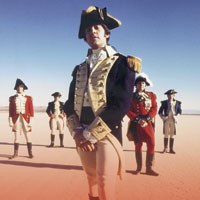
In answer to Ben’s comment, of course Sir Lord Baltimore counts, and who could forget Paul Revere and the Raiders, who actually performed in quasi-colonial outfits? (Actually they are still performing in them, in Branson!) To my surprise, it seems that the gimmicky, studio-buffed Raiders have enjoyed something of a critical renaissance in recent years. Kicks do just keep getting harder to find.
But if we are going all colonial, what about Cotton Mather (out of Austin, Texas), perhaps the greatest power-pop band ever? I have no idea why Robert Harrison and company decided to name themselves after a witch-unfriendly Puritan divine, but their band was really, really good. They had a taste of success in the late 1990s but got washed away in the implosion of the “commercial alternative” music scene around the same time. I remember hearing their terrific single “My Before and After” on the radio a couple of times in Tallahassee, but I only truly discovered them ex post facto, thanks to a wandering conversation (and subsequent CD-burning) with a University of Chicago Press editor at an OAH booth a few years ago. I kid you not. (Sadly, Cotton Mather never named an album “Wonders of the Invisible World,” a ready-made album title if I ever saw one, at least if you had to choose among Puritan religious writings.) The video below is not my favorite of their songs, but it was the only one I could find on YouTube. Other songs can be heard here.
This article originally appeared in issue 9.1 (October, 2008).
Jeffrey L. Pasley is associate professor of history at the University of Missouri and the author of “The Tyranny of Printers”: Newspaper Politics in the Early American Republic (2001), along with numerous articles and book chapters, most recently the entry on Philip Freneau in Greil Marcus’s forthcoming New Literary History of America. He is currently completing a book on the presidential election of 1796 for the University Press of Kansas and also writes the blog Publick Occurrences 2.0 for some Website called Common-place.
On the Road Again
I learned many things about doing historical research in graduate school: how to formulate a workable project, how to find and analyze primary sources, how to build on the preceding secondary literature. There were no sessions devoted to “aura,” and there still aren’t, within my ken. Yet “aura” has, for me, turned out to be an essential element of my research and writing strategy, as I am sure it is for many historians. When in the grip of a compelling project, as I eagerly search out documentary evidence relating to my characters and their events, I feel an urge to visit the places they lived and traverse the roads they took, as much as possible. In part, I travel to soak up atmosphere, to get a feel for a place that will enable me to write about it with more authenticity and credibility. In part, I travel because there are always useful local records in libraries and courthouses that can provide some missing clue. But there is something else, too, that I find hard to articulate, that I gain from these pilgrimages.
Let me rush to say that it takes a lot of advance library work to make these site visits valuable. I’ve made visits underprepared, and the payoff is usually small. A decade ago, when I first came across the crime pamphlets relating to Helen Jewett, a New York City prostitute murdered in her brothel in 1836, I was immediately grabbed by the mystery surrounding not only her death but her life. The big-city newspapers reported on three different versions of her Maine origins, and the pamphlet literature added another three or four variants. Based on armchair sleuthing in Maine county history books and census schedules, I pinned her down to Augusta. I was living in Massachusetts that year, and I proposed to my family a weekend trip up to Maine. Advice: try, if possible, not to take children along on aura-seeking trips. It’s the rare child who has the patience to watch you wander down seemingly nondescript blocks of houses or main streets that look remarkably like the houses and main streets in other towns. On that first trip, we saw the coast of Maine, beautiful lakes, Acadia National Park, and Augusta–the latter for all of a half hour, I’d say. We parked the car near the 1830 Kennebec County Courthouse while I strolled around a few neighboring blocks, admiring the many 1830s residences. But I couldn’t get a mental fix on anything; I hadn’t done my homework. We even missed the wonderful historical site specifically set up to transport tourists back to the earliest Augusta history–Fort Western, built during the French and Indian War.
Fig. 1. Helen Jewett. A lithograph made in 1848 to illustrate the National Police Gazette’s serialization of her murder story. Courtesy of the American Antiquarian Society.
I made two subsequent trips to Augusta in the next several years and spent days, not hours. Part of my time was devoted to standard archival research: studying maps and local newspapers at the Fort Western Museum, town vital records and papers at the Maine State Archives, and the huge dusty tomes of land conveyance records in the basement of the courthouse. But equally important was my imagination’s soak time, achieved by walking the streets, peering around buildings, and staring the placid Kennebec River back into a rushing torrent by mentally removing the 1838 dam. By now I knew that Helen Jewett had been a servant in the family of Judge Nathan Weston, the first judge to preside over the courtroom in the courthouse, where I found his picture hanging on the wall. Now I also had an 1838 map of the town, an exceptionally detailed, large map that showed the footprint of every house in town. (It had been made on a blueprint copier machine at the Fort Western Museum for historian Laurel Thatcher Ulrich when she was working on A Midwife’s Tale, and she spontaneously handed it to me in one of those generous gestures for which she is famous.) Armed with that map, and an early-twentieth-century book I found in the Augusta public library that listed the successive owners of many of the older houses in town, I could go stand in front of the very houses where my Augusta cast of characters lived.
Perhaps because these were all still private residences, I was too chicken to knock on any doors. But in Newburyport, Massachusetts, I located the large Federal-style house where George P. Marston grew up; it had become a funeral parlor. Young George was a clerk in New York City in 1836, a lover of Helen Jewett and a man lucky to escape the finger of suspicion in the murder case. His father had been a judge and shipowner in this Massachusetts port town, and proud descendents in the early twentieth century had published a book of family reminiscences (stripped clean of any allusions to prostitution and murder, naturally) that included a photograph circa 1900 of the Marston family home. As I stood gazing at it, doing my aura thing, trying to imagine the George I knew from his letters and trial testimony actually bounding out of the house before me, an employee of the funeral parlor emerged to ask if I needed help. When I explained my mission, he invited me in and gave me a tour of the place–all but the kitchen, where the corpses were kept.
And so it went. I traipsed the brothel blocks of 1830s Portland, Maine, now lined with mostly late-nineteenth-century residences, and the graveyards of Temple, Maine, a village of about eight hundred persons where Helen Jewett had been born in 1813. In New York City, I spent many hours reconstructing the succession of lots and property owners on the block where Jewett was murdered in her brothel. I had first assumed that the house at 41 Thomas Street was at the end of the block, since there was no house with a larger odd number according to the 1836 city directory. But the conveyance records clearly mapped it in the center of the short block. (Deep lots facing around the corner on Hudson Street accounted for the apparent discrepancy.) I examined fire insurance maps to learn about the brothel’s basic structure–brick, with two skylights in the roof–and also to learn about when the current commercial building on the lot replaced it. And I visited the site, perhaps seven or eight times, over the decade that I worked on the project. The street looks completely different today, of course. But its spatial configuration is the same–the narrow width of the street, the thirty-three-foot frontage of the brothel and now of the commercial building that took its place around 1869). As I stood alone in the middle of Thomas, I conjured up the crowds that milled there in the weeks after the murder, hoping for a sight of the much-rumored Helen Jewett’s ghost. I didn’t see her ghost, but I could–almost–sense the crowd.
Fig. 2. Richard P. Robinson. A profile made in 1848 by the National Police Gazette to illustrate a re-publication of the entire trial report from 1836. Courtesy of the American Antiquarian Society.
I don’t believe in ghosts, and I never actually “see” my characters on these trips. A waiter in a dark western bar in Nacogdoches, Texas, the town where Jewett’s acquitted murderer, Richard Robinson, fled to in 1836, told me there was a tale that the bar was haunted. I smiled gratefully; I was in fact eating there precisely because I knew the bar was on the site of Robinson’s saloon of the late 1830s. I’d read Robinson’s business account book, knew he had gaming tables and sold whiskey by the glass–details recovered by patient sifting through maps, deeds, and old photographs at the East Texas Research Center at the Stephen F. Austin State University.
The Jewett book is behind me now, and I am on the road again, this time seeking to channel the spirits of Thomas Low Nichols and his wife Mary Gove Nichols, two health and sex reformers of the 1840s-50s. They became serious Spiritualists, which at least raises the possibility that when I go around to their old haunts, they might indeed try to speak back. I have had the feeling from the beginning that I was fated to write about them. Thomas Nichols’s name kept popping up in my research on another project, a study of the “flash” press of New York City in the 1840s, a set of weekly papers that functioned like trade journals for the brothel world. (The AAS has a superb collection of these scurrilous sheets.) Editors of these papers made “thomas l. nichols” a running joke, portraying him as an arrogant jerk and an absurdly inappropriate ladies’ man among the frail sisterhood. Finally his name clicked with me, as I realized that this was the Thomas Nichols I already knew as the respectable doctor-husband of the water-cure advocate and physiology lecturer, Mary Gove. From that moment, it was a foregone conclusion that I would sleuth out these two. They shared a notorious career as Free Lovers in the 1850s and kicked up quite a storm, before they ditched it all for Catholicism and exile in England.
This fall I spent a weekend in Nichols’s hometown, a lovely New Hampshire village named Orford along the Connecticut River. (I’ve moved up in the world too: I now spring for the historic bed-and-breakfast inn over the thirty-six-dollar-per-night motel that was my operations base in Augusta.) Thomas Nichols described this village in fond detail in two of his books, but he omitted–deliberately obscured, really–his parentage and siblings. My goal was to root him in a family in that town, and to figure out how such a talented, learned, but also cocky fellow could be the product of this rural village. Orford’s tiny main street is entirely preserved as a historic district, so no doughnut shop or gas station mars my effort to envision the past. Around me I see one general store (in an 1802 building in continuous use as a store), one social library, several churches, and about a dozen very fine old homes circa 1800-30. My time-travel effort actually requires me to jazz the place up; in 1830 the township population was more than double what it is now, and these quiet blocks supported eleven taverns and a three-story hotel.
Fig. 3. House with date “1818” affixed over the porch, along the river road in Orford, New Hampshire, in the approximate location of a lot (no. 22) that figures in land transactions by various Nicholses from 1819 to 1827. I don’t know (yet) whether Thomas Nichols (b. 1815) ever lived here, but in the meantime, the picture is tacked on my wall behind my computer to stimulate my imagination.
Two hours in the county court’s land conveyance records yield pay dirt: I now have a fix on land owned by everyone named Nichols in Orford and surrounding townships. A plus: the deed entries show the webs of financial connections between property in this town and a wealthy Nichols family in Salem, Massachusetts. A lot map shows me the slice of land along the river owned by one Nichols in the 1810s, and happily for me, there is a house on that lot now, with the date 1818 over the door. My photograph of it will be pinned on the wall over my computer, to stimulate my imagination as I write. There is one existing building I know for certain my quarry spent important time in: the academy in Haverhill, ten miles up the river, and from the exterior, it appears to be little changed from 1830. And my trip to Orford yielded the clue I needed to locate Thomas Nichols in his family, found in church records kept in the social library. My roué and reformer was the son of a Baptist clergyman.
Successive weekends this year will be devoted to trips to Goffstown and Weare, New Hampshire, and to Lynn, Massachusetts, places where Mary Gove lived. Already I am collecting the advance-trip data I will need, from town histories, city directories, ads in old newspapers, maps, and items gleaned from Ancestry.com and tourist-based Websites. (This last source of information has been invaluable, especially for pictures of historically important structures.) When I go, I’ll know where her house was, where the lyceum was, where the Universalist church was where she lectured on Associationism.
Fig. 4. Mary Gove Nichols, as drawn by her artist-daughter Elma Gove to illustrate an entry on Gove Nichols in an 1853 encyclopedia of “distinguished women” of the ages edited by Sarah Josepha Hale. Courtesy of the American Antiquarian Society.
What does all this aura seeking gain me? I think there is no doubt that it helps me fill in missing spaces between the written words of documents on which historians mainly rely. Without a landscape, words on paper can just be–words on paper. In our movie-laden world, readers are made happy by getting a visual feel for the space historical figures inhabited. After the Jewett book came out, I got inquiries from newspaper reporters as to whether Jewett’s brothel still stood in Manhattan. It does not, of course, but there are 1830s buildings here and there in the Fifth Ward that I had sought out, and I was able to take a New York Daily News columnist and photographer on a tour of those sites. I was invited to lecture in Augusta, Maine, by the Kennebec Historical Society, courtesy of avid localist Anthony Douin, who also arranged for Judge Weston’s house to be open for a public tour–a special delight for me, of course. Where once I had been a lurker around these old buildings, now I was a welcomed guest, introduced by the mayor of the city and credited with adding Helen Jewett’s name to the Augusta roster of famous past figures.
What I am drawn to, clearly, is the hope that I can get to know my characters more fully and get them as close to three dimensions as possible. Writing history requires acts of historical imagination that are, I am convinced, extremely different from what novelists do. I could not write a work of short fiction if my life depended on it, but if I have enough written evidence about my historical characters, and if I can walk where they lived and walked, then I feel pretty sure of my ability to render them in some more fully-rounded way. At some point, they become nearly real people to me, in a way that makes me feel I would know them if I suddenly somehow encountered them.
Not as ghosts, however. Instead, I confess that I occasionally troll on eBay in spare moments, looking over the several scores of unidentified portrait miniatures for sale there. Jewett and her killer Robinson exchanged pictures, but they disappeared from the district attorney’s indictment records in New York where they were last known to be in 1836. If they do yet exist and ever make it to eBay, I’ll find them. I feel sure I would recognize them both.
This article originally appeared in issue 2.2 (January, 2002).
Patricia Cline Cohen, a professor of history at the University of California at Santa Barbara, is the author of The Murder of Helen Jewett: The Life and Death of a Prostitute in 19th-century New York (New York, 1998). She is the Mellon Distinguished Scholar at the American Antiquarian Society for 2001-2002.
How I Met and Dated Miss Emily Dickinson: An Adventure on eBay
This correction was sent to us as of June 19, 2009.
The fifth paragraph from the end of this essay (beginning, “Habegger and I posit…”) gives a misleading account of Professor Habegger’s position on the photograph as worked out in his biography of Dickinson, My Wars Are Laid Away in Books, and I would like to set the record straight. The impetus to do so comes from the tentative release of George Gleason’s report, prepared for the Emily Dickinson International Society, which repeats the mistake and develops it.
Professor Habegger did not say and does not believe that Dickinson had her photo taken in Philadelphia, let alone that she already felt affection for Charles Wadsworth and wished to commemorate it. He clearly states his position on p. 330 of his biography: “Although the sequence of events will no doubt always be obscure, it is thought that Dickinson was taken to the Arch Street Presbyterian Church to hear [this minister], and that he made such an impression on her that she later solicited his counsel and thus initiated one of her most vital friendships.”
I first prepared this piece for an invited oral presentation, at a time when I was working on someone other than Dickinson. Thinking back to when Professor Habegger and I were excited by the possibility that the photo was of Dickinson, in this lecture I incorrectly assumed that his view was the same as mine. Clearly, until further evidence surfaces, his position is the most sensible to assume.
This is the story of how I stumbled on something rare almost beyond comprehension. On April 12, 2000, I purchased in an eBay online auction what may be the second known photograph of Emily Dickinson. In the last ten seconds of the eBay auction I placed a very high maximum bid on what was called a “Vintage Emily Dickinson Albumen Photo” and won the item far below that amount. But the story had only begun. Over the next six months I experienced what it really meant to possess, and be possessed by, a picture that may show Emily Dickinson at the height of her creative powers.
You probably have a minds-eye picture of Emily Dickinson. Even people who do not read Dickinson’s verse recognize her as the diminutive woman in white who in the last decade of her life never left her yard nor greeted any visitors to her family’s home, and who at her death left a trunk filled with manuscript poems that changed America’s literary landscape. But a chief part of her mystery involves the fact that very few images of her survive. There is a painting of Dickinson and her two siblings done by A. O. Bullard in 1840, and a silhouette by Charles Temple in 1845. And even though she lived when the new invention of photography was changing the ways people thought about themselves, there is only one known photographic likeness of her, taken by William C. North. It was made between December 1846 and March 1847, and shows a thin teenager suffering from what her family took as the first symptoms of tuberculosis.
A second photograph of Dickinson has long been the Holy Grail of artifacts for scholars in my field, but it certainly was not on my mind the night that I first saw the image on eBay. I was browsing through the descriptions of albumen photographs, in search of images of stringed instrument players and of twins, two categories in which I collect. When I saw “Vintage Emily Dickinson Albumen Photo,” I laughed: another unenlightened dealer who didn’t realize that there were no albumen photos of the poet.
Fig. 1. eBay auction description of Dickinson photograph
There was, after all, only the famous daguerreotype. For a kick I clicked on the description and viewed the item. I couldn’t believe it. The woman in the image, though a bit older than Dickinson as she sits in the daguerreotype of 1846-1847, bore an uncanny resemblance to the poet’s younger self.
Fig. 2. eBay auction photograph of the Dickinson image
The description was minimal and indicated that the seller–who had an on-screen cognomen, “dontmissthis2000″–had no clue that there was only one extant image of Dickinson. “NO RESERVE Rare 4 X 5 5/8in. original albumen photograph of Emily Dickinson. I’ve never seen this view of her. This is your chance to own this rare image with no reserve. Image is light. Please see illustration.” The minimum bid was a paltry $24.00, and the item was listed for ten days, a time that soon seemed interminable.
Over those ten days I returned to the image dozens of times. I wrote the seller to ask how she knew it was Dickinson, and she replied that the person was so identified by writing in pencil on the back. This was important, for it meant that the seller hadn’t just made up the description without any evidence, something that happens frequently on eBay with, say, purported photos of Lincoln or John Brown. Days passed. No one bid on the photo. I didn’t know what to do. I thought, on the one hand, that the item was simply and patently a fake, or, on the other, that it was going unnoticed as collectors chased more spectacular, and probable, pieces.
Then, on the second to the last day, someone bid, and I recognized the screen name as that of the late Robert Lucas, a well-known dealer in Dickinsoniana. This pushed me into deciding to purchase it, for I figured that if he, with a good nose for rarities, was in on this, there was a good chance that the photograph was real. But Lucas’s entry into the game also complicated matters immensely, for I knew that he might bid a substantial sum. Early in the evening on the night that the auction closed, I decided what amount I would risk. With ten seconds left I entered the bid, and the final price shot up to $481.00, $5.00 above Bob Lucas’ maximum bid. I had won! Within seconds he graciously emailed to congratulate me. He said that he thought it looked like her but was not willing to take a bigger risk.
The wait for the item seemed endless, but I finally received it nine days later. It looked good. From the type of paper and the quality of the image, I could tell that it was an unmounted albumen photo, clearly not a facsimile.
Fig. 3. New Emily Dickinson photograph. Courtesy of collection of Philip F. Gura.
On the back was written: “Emily Dickinson / Died / D[?]ec. 1886” and below that there was a large number, “4.”
Fig. 4. Reverse of new Emily Dickinson photograph. Courtesy of collection of Philip F. Gura.
Now the work began in earnest. Consulting with Lucas, Polly Longsworth (a Dickinson biographer who early on believed that the photograph might be Dickinson), and other people who had seen the image after I posted it on my Website, I focused on three things to investigate. First, I sought to identify the handwriting on the back, for if I could show that it belonged to someone who knew Dickinson, it would offer strong circumstantial evidence. Second, I would try to trace the distinctive Gothic chair in the photo to some photographer’s studio and then find out if Dickinson had ever visited the area in which the person worked. Finally, I would enlist a forensic anthropologist to compare the features of the woman in my image to those of Dickinson in the famous daguerreotype.
Soon enough, however, I learned how skeptical many scholars were that my picture could be genuine. One email sums up what I encountered. “To the naked eye,” the individual wrote, “it is indeed a persuasive portrait, and one which I personally would love to see authenticated as a portrait of ED.” “As an aside, though,” he continued, “if it could be authenticated . . . I’d predict that many, many people might react with irrational denial, vituperation, or both. The daguerreotype has become such an icon, an object of near veneration, for so long, that a ‘new’ image of ED might take some time for people to get used to.” For a century, Dickinson’s admirers had treasured the one extant daguerreotype and raised it to iconic status. Most would not readily accept the possibility that, after all these years, another image had surfaced.
Soon the nature of the game changed radically, though, because, alerted by members of the Emily Dickinson International Society, more and more people began to view the picture. Then I got a call from a stringer for the New York Times who wanted to write up my picture for the “Circuits” section of that paper. And the next day I got this message by email: “Dear Mr. Gura, I am David Remnick, editor of The New Yorker magazine, and Bob Faggen from Claremont has told me about the fascinating Dickinson picture. I was wondering if we could talk: I am interested in publishing it here first, if at all possible. Please let me know if I am dreaming or if there is a chance.” I jumped at the chance to have the image appear in so important a publication. Faggen teaches American literature at Claremont. Alerted via the Dickinson Society Listserv, he had seen the image on my site and called his old friend Remnick. When I returned Remnick’s message I told him that the Times had called, too; and he said that he was only interested in publishing the photo if he could be the first to do so. So I called the Times stringer and asked her what her plans were. She was not going to do the piece for the next weekly “Circuits” but for the installment ten days hence.
Remnick pounced. He put staff writer Rebecca Mead on the assignment. This was a Wednesday. She said we had to wrap up the story the next day because the magazine went to press on the weekend, to be on the stands the following Monday. And she did it, talking to me several times, calling several other people, including the seller, Janos Novomeszky, whom she tracked down in Budapest, where he had gone for his father’s funeral; and Steve White, a California dealer who had let the photo slip through his hands into Novomeszky’s. Mead’s piece, in the May 22, 2000, “Talk of the Town,” was called “Annals of eBay: A New Kodak Moment with Emily Dickinson,” and ran with my new photo next to the Amherst College daguerreotype.
Fig. 5. Daguerreotype of Emily Dickinson, c. 1846-47. Courtesy of the Amherst College Archives and Special Collections and by the permission of the trustees of Amherst College and the Dickinson Homestead.
This opened the gates to national publicity. Within days I was interviewed by NPR affiliates and newspapers in the Amherst area. Stories about Emily and me popped up in many papers, including the online magazine Slate and London Observer, attention that increased when the New York Times piece appeared a week later. I had hundreds of hits on my Website and many unsolicited emails, in which people asked for more information and often confessed their various passions, scholarly and otherwise, for Dickinson.
As weeks passed, though, the photograph became an albatross around my neck. Everywhere I went people asked how I was getting along with my verification work. And I wasn’t getting anywhere. Most troubling was the matter of the forensic analysis, in which many scholars placed much stock because in the 1970s a photo also presumed to be Dickinson proved spurious, a bookseller’s scam. And that was before the Digital Age, which made copies and originals all but indistinguishable. Some cognoscenti were very skeptical of my image. They wanted the photograph compared to the Amherst daguerreotype.
And so I proceeded, from literature to journalism to science. I first contacted the scientist who had analyzed the spurious photo from the 1970s; but she said that she no longer was doing that kind of work. She referred me to someone in Texas who initially seemed very interested in the project and said that, after she returned from giving a two-week seminar to law-enforcement personnel in Arizona she would take up the task. But when I wrote to her after the seminar had ended, she never answered any more of my emails and calls. A month or so had passed. I called Grant Romer, the curator at the George Eastman House. He said that he had just the man for me, a forensic anthropologist at the University of Illinois at Chicago. I contacted this individual, and he said that he could have a report for me after the Fourth of July weekend, when I was due to travel to New England and wanted to share his results with people who would be interested. But he, too, never again responded to any emails or phone messages! What was it about this project that had frightened them off? And what was I going to do about the analysis, particularly since my research inquiries about the chair had brought nothing to light, and my attempts at identifying the handwriting showed that it belonged to no one in Dickinson’s immediate circle?
Not everything went badly, though. Over the summer I had established that my photograph in fact was a copy of a daguerreotype made years earlier. In retrospect, I should have seen what was obvious; but I did not realize it until Joan Severa, a historian of costume, analyzed the sitter’s clothes and concluded that they dated to the late 1840s or early 1850s, not to the period of cabinet cards. Another historian of costume dated the piece even more precisely. Nancy Rexford observed that the sitter’s jacket-style bodice was very common in the early 1850s. Similarly, the collar of the woman’s chemisette is typical of the period 1848-52, as are the narrow undersleeves. Finally, the bodice sleeves appear to form a narrow bell or funnel; after 1853 they became more expansive. In Rexford’s opinion, the original photograph was a daguerreotype taken around 1850-52, and perhaps as late as 1853. Putting Rexford’s opinion alongside Severa’s, and considering that some individuals wear clothing even after it is out of fashion (something that we might expect of Dickinson) the evidence from costume suggests that this person sat for her photograph sometime between 1848 and 1853.
I had, then, a photograph made after the mid-1860s (when the albumen process was common) but also patently a copy of an earlier image, a daguerreotype, a medium used primarily between 1839 and 1857. This is also signaled by the washed out appearance near the extremities of the image, a result, as one photohistorian puts it, “of glare from the silvered mirror surface” of the daguerreotype being copied. Also, the photograph has small spots or bubbles characteristic of the deterioration to which daguerreotypes are prone from decomposition of chemicals on the surface of the polished silver plates on which they are made. Most tellingly, the sitter’s right hand appears to have two index fingers, a visual effect that would have been recorded in a daguerreotype if a sitter moved her hand in some way over the exposure time of a few seconds demanded by the process.
With the development of the albumen process, photographers had begun to advertise their services as copiers of earlier, unique images like the daguerreotype and ambrotype. Thus, the unusual number “4” on the verso may indicate that whoever made this image produced at least that number of copies from the original daguerreotype. Further, on the verso there are remains of glue, which suggests that the original photograph was mounted, probably on cardstock known as “photographer’s board.” In this mounted state the albumen photograph would have been called a “cabinet card,” for its dimensions are precisely those of this format, introduced in this country around the middle-1860s and reaching a height of popularity in the 1880s and 1890s. Inexpensive and of a larger size than cartes de visites, cabinet card-sized photographs, easily reproduced from negatives, comprised some of the most common mementos in Victorian America.
There matters lay through most of the summer and early fall, when I was contacted by Georgie Strickland, editor of the EDIS Newsletter, who wanted to write up the story for her journal and asked if I had made any progress on the forensic analysis. When I described my woes, she called Joe Nickell, the author of Camera Clues: A Handbook for Photographic Investigation. Through his contacts I obtained the names of two scholars at the Forensic Anthropology Center at the University of Tennessee, where the woman who had analyzed the previous, spurious photo had worked. One of them, Professor Richard Jantz, wrote back and said that he had a student who was particularly interested in such work and, yes, please send the files, for the two of them would do it together.
I had gotten to this point twice before and held my breath. I knew what I might expect and how the scientists’ language would be couched. Such forensic analysis proceeds by mathematical comparisons of anatomical landmarks on the authenticated image and the image in question. While such methods cannot establish absolutely that two images portray the same person, a comparison to a known image of one that is unknown can go a long way toward establishing a strong case that the two images are or are not congruent. In this case Dr. Jantz identified several key points–centers of eyes, nostrils, corners of mouth, for example, and overlaid and adjusted the images to a common size.
Fig. 6. Forensic anthropologist’s comparison of the two Dickinson images. Courtesy of collection of Philip F. Gura.
I got his email on October 13, six months to the day since I had bought the photo, and on Friday the Thirteenth! In this case, he wrote, “[T]he fit is quite good” and thus, to use the language of scientists, the new photo “could not be excluded” from consideration as that of Dickinson. He continued, “[T]he fit is actually pretty impressive and perhaps makes the case [for their being of the same person] well enough.” In a subsequent interview, he went even further. “If it’s not Emily, it’s a person with a very similar morphology,” he said. “I think the case will always be circumstantial, but a strong circumstantial case is a strong case.” This was great news, for it finally enabled me to say that, taking into account circumstantial evidence–i.e., the handwritten identification as well as this report (for what would the chances be that someone could find a photo to forge that lined up precisely this way with the well-known daguerreotype?)–there was strong reason to think that this might indeed be the second known photograph of Dickinson. The full report followed, and it was indeed positive, as were follow-up conversations with Dr. Jantz initiated by news agencies. The publicity buzz was on again as the story got picked up on October 25 by the Associated Press and salon.com, and then in U.S.News and World Report.
With the aid of Professor Alfred Habegger, soon to publish a new biography of Dickinson, I also pieced together some biographical data that spoke to the possible relationship between the two images. In the Amherst daguerreotype, Dickinson’s face appears much thinner than that of the woman in the albumen. We know, however, that through the late 1840s, when that image was made, Dickinson’s health had been fragile; her persistent cough may have been a consumptive condition that also made her family worry about her weight loss. Through the summer of 1851 her letters to her brother Austin, teaching school in Boston, mention family illness, and as late as July 1851 she lamented that she could not make a long-anticipated trip to see him.
By September, however, the family had consulted with the eminent Boston physician, Dr. James Jackson, who prescribed doses of glycerin to control the cough; and within a month Dickinson, though not fully recovered, evidently was feeling better. In a note that her sister Lavinia included with a letter from Emily to her brother, she observed that “Emily is very much improved.” Indeed, she continued, “she has really grown quite fat, if youll believe it.” “I am very strict with her,” Lavinia added, and “I shouldn’t wonder if she should come out bright some time after all.” If the Amherst college daguerreotype represents a Dickinson whose health worried her family, the original of the albumen, taken in the early 1850s, shows a woman whose appearance is congruent with someone whose health had indeed improved and who had become a little “fat.” I also returned to an enigmatic passage in Dickinson’s famous 1862 letter to Thomas Wentworth Higginson, editor of the Atlantic Monthly and a confidant of the poet, which some scholars read as proof that she had no other photographic image of herself. As she put it,
Could you believe me–without? I had no portrait, now, but am small, like the Wren, and my Hair is bold, like the Chestnut Bur–and my Eyes, like the Sherry in the Glass, that the guest leaves–Would this do just as well?
It often alarms Father–He says Death might occur, and he has Molds of all the rest–but has no Mold of me, but I noticed the Quick wore off those things, in a few days, and forestall the dishonor–You will think no caprice of me.
Dickinson’s declaration, “I had no portrait, now,” is ambiguous at best. For one thing, if she meant that she never had one, she might have simply replied, “I never have had one, not before, not now.” But if she meant to say, “I have no portrait, now,” she could mean that she once had an image but no longer did, either because it was given away or it did not represent her as she was “now.” In any case, as it stands, the line does not necessarily imply that she never had had a portrait taken. Indeed, we know that at least once she did, in 1846-1847 when an itinerant daguerreotypist made the image now owned by Amherst College. At the least, Dickinson’s enigmatic reply to Higginson refers to a time when she did have a portrait, which for some reason she no longer had. It could have been the 1846-1847 image, or even the original of the one in the albumen photograph.
If we grant this possibility, who might have had the original daguerreotype, and who made the paper copy and why? I returned to the handwriting. Attempts to identify it had ruled out individuals in Dickinson’s circle of family and friends in the Springfield-Northampton-Amherst area. This is congruent with Elizabeth Bernhard’s observation that, as Dickinson’s fame increased in the 1890s, family and friends in the Amherst area went to great lengths to find another photograph of her, suitable as a frontispiece to her forthcoming Letters. They found none save the now-famous Amherst College daguerreotype that had been given to Dickinson’s housekeeper, Margaret Maher, an image they did not like. Quite likely, then, the albumen photograph (and the daguerreotype from which it was made, as well as any other copies) lay outside the Springfield-Amherst-Northampton axis, perhaps given to a friend who had moved from the area long before Dickinson became famous.
Habegger and I posit the following scenario, outlined in detail in an appendix to his biography. The supposition involves Charles Wadsworth, the charismatic clergyman whom Dickinson met in Philadelphia in 1855 and who many think may have been the recipient of her famous letters to her mysterious “Master,” as she called him. The original of the image could have been made for him on Dickinson’s visit to his city. We know, for example, that the invention of photography provided new, very personal tokens of friendship and affection to a culture awash in varieties of such expression. It is plausible that a young woman might visit one of the city’s prominent daguerreian studios to memorialize her feelings for a man who we know remained central to her emotional life as long as she lived.
Wadsworth died in 1882, but his wife lived until 1891. Before his death he may have sent the photograph to James D. Clark. James and his brother Charles were Northampton natives and contemporaries of Dickinson who began to correspond with her in the early 1880s. James had operated a private school in Brooklyn but by the 1870s had moved back to Northampton. His younger brother remained in Brooklyn and throughout his life was involved in business there. Dickinson had first met James in Amherst around 1859, but it was not until 1882 that she began to write to him and then, after his death in 1883, to Charles. When Dickinson heard from James in 1882, he was again in Brooklyn, getting help for failing health. He had initiated the correspondence by sending Dickinson a volume of sermons by Wadsworth, his close friend. In the early 1880s, as Wadsworth took stock of his life, he may have copied a daguerreotype Dickinson had given him years earlier and shared it with his friend. In an alternate scenario, after Dickinson’s death Wadsworth’s survivors may have forwarded the print to Charles (which he received in “Dec 1886,” as the pencil markings on the reverse of my photograph note), knowing of his and his brother’s relationship to her.
The question arises why, as Dickinson’s fame increased in the 1890s, when family and friends searched for a photograph, Charles (or someone in his family) did not offer his. But the Dickinsons had no reason to think that he would have had one, so recently had he begun his correspondence with the poet. Further, as James grew more ill, he may have enjoined Charles to silence on the matter, just as James may have been so enjoined by Wadsworth. From all we know, Wadsworth’s marriage was satisfactory. Neither he nor his family (if they knew of Dickinson’s strange attraction to him) would have wanted to have the infatuation known. Dickinson clearly meant enough to Wadsworth that he visited her, to see her for the third and last time, as late as 1880, after a twenty-year hiatus. Surely, James Clark was a close enough friend to keep his secret and thus to receive a copy of an image of the woman who had, whether or not Wadsworth wanted it, become a part of his life. Comparing the inscription on the photo to the one extant letter of Charles Clark reveals congruence among some letter forms, so much so that several people indeed believe it to be his hand. I myself am not yet fully convinced, for I see an important difference in one of the capital letters the two samples share. But if the handwriting is not Charles’s, it may be that of someone in his circle who upon Dickinson’s death in 1886 wrote the identification on the back of the photograph that had passed into his or her hands. A final possibility is that the daguerreotype was among Wadsworth’s keepsakes, and his wife or daughter Edith made copies and distributed them to friends or confidants who could be trusted to keep the family secret.
I (and many others) continue to believe that the image genuinely is of Dickinson, and my state of mind regarding it was beautifully summed up in an editorial about the image in the (Durham)Herald-Sun. “Although the forensic analysis of Gura’s photo strongly suggests the woman is ED,” the author noted, “no one can say for sure. By the same token, no one apparently can say that the woman is NOT Dickinson. Thus is Philip Gura caught in neutral buoyancy between belief and hope. Or, maybe that’s the way ED wanted.”
This expressly captures how I think about this photograph. I know it is she, even if I cannot yet absolutely prove it. If the image proves genuine beyond a doubt, I realize that I will have to find a home for it in some institution, for it then would belong in a new way to all people who love Dickinson’s poetry. Right now, however, I can look at this image every day and thus perhaps get as “close” to this elusive woman as anyone can. It is a delightful feeling.
Further Reading: See Mary Elizabeth Kromer Bernhard, “Lost and Found: Emily Dickinson’s Unknown Daguerrotypist,” New England Quarterly 72 (December 1999): 594-601; Alfred Habegger, My Wars Are Laid Away in Books: The Life of Emily Dickinson (New York, 2001); Jay Leyda, The Years and Hours of Emily Dickinson 2 vols. (New Haven, 1960); Rebecca Mead, “Annal of eBay: A New Kodak Moment with Emily Dickinson,” The New Yorker, 22 May 2000; Joe Nickell, “A Likeness of Emily?: The Investigation of a Questioned Photograph,” Emily Dickinson International Society Bulletin 5 (November/December 1993), 1-3, 15; Richard B. Sewall, The Life of Emily Dickinson (New York, 1974).
This article originally appeared in issue 4.2 (January, 2004).
Philip F. Gura is the William S. Newman Distinguished Professor of American Literature and Culture at the University of North Carolina at Chapel Hill. He has published widely in American studies, including, most recently, Buried from the World: Inside the Massachusetts State Prison, 1829-1831 (Boston, 2001) and C. F. Martin and His Guitars, 1796-1873 (Chapel Hill, 2003). A collector of early photography, he is a member of the Daguerreian Society.
Peale’s Mastodon: The Skeleton in our Closet.
In 1806, when Meriwether Lewis and William Clark returned from their historic expedition, the greatest curiosity on display in the new republic was the eleven-foot-tall skeleton of the American incognitum, or “mammoth.” The animal’s bones were a prize attraction at the Philadelphia Museum owned by the portrait artist and polymath Charles Willson Peale. Peale’s American incognitum was famous throughout the land thanks to newspaper reports, museum exhibits, and President Thomas Jefferson´s well-publicized efforts to acquire its bones.
Fig. 1. Édouard de Montulé’s drawing of Peale’s mastodon skeleton, 1816
Excavated by Peale from a farm in the Hudson River Valley in 1801, the skeleton belonged then to an unknown species, later identified as the mastodon. In an era when there was little awareness of extinction or the prehuman past, the animal’s identity had been a subject of vigorous debate for nearly a century in both Europe and America. Naturalists on both sides of the Atlantic had puzzled over the bones ever since the first discovery of a giant tooth on the banks of the Hudson River in the early eighteenth century. What was this enormous animal for which no living counterpart could be found? Was it a harmless herbivore or a ferocious carnivore? Were its descendants still living in the unexplored parts of the American West? Or did its remains belong to an extinct species whose disappearance was God’s blessing upon the new nation?
The skeleton preoccupied American patriots for another reason less scientific in nature–one which helps to explain why its bones were eagerly sought after by the Founding Fathers during and after the Revolutionary War. For many Americans, the great beast had become a symbol of the new nation’s own conquering spirit–an emblem of overwhelming power in a psychologically insecure society. For them the animal’s symbolic meaning far outweighed its scientific significance as evidence of extinct species or a prehuman past. While the mastodon did not compete with the bald eagle as the nation’s official emblem, this majestic Ice Age creature did become an informal icon of national identity for citizens of the new republic.
Indeed, while Lewis and Clark were exploring the western wilderness, Peale had remounted his skeleton with its tusks pointing downward to magnify its ferocity (fig. 1). Many patrons of his museum imagined the unknown creature to be a ferocious carnivore, an elephant with claws that devoured buffalo, deer, and elk. Unfortunately, this image of the skeleton with its downturned tusks has become an obscure footnote in the abundant literature now available on Charles Willson Peale and his remarkable family. Historians seem to regard it as an embarrassing lapse in the enlightened rationality of the Peales, not to mention the Founding Fathers who helped to create the myth of the mastodon. As a result, few people today are aware that the mastodon was the nation’s first prehistoric monster, or that the Founding Fathers made this animal a symbol of dominance in the first decades of the new republic.
Rather than dismissing the wrongly mounted tusks as quack science, we need to delve deeper into the hidden meaning of this misbegotten monster. The story of Peale’s skeleton demonstrates why such curiosities should not be dismissed as Barnumesque aberrations. In many respects, Peale’s American monster embodied a natural history myth that still exists today: the belief that monstrous carnivores actually “ruled” prehistoric nature, as if they were ruthless tyrants. Newscasters, novelists, filmmakers, and scientists alike routinely tell us that dinosaurs “ruled” the earth for 150 million years, even though the metaphor of ruling species has no scientific basis. Evidently, we have a powerful desire to portray fearsome beasts of prey as rulers of prehistoric nature. Fortunately, Peale’s skeleton provides us with valuable insights into the historical roots of this extravagant metaphor and the paradigm of dominance that the myth of the mastodon helped to create. As early-nineteenth-century Americans set out to conquer the western wilderness, this mythical creature helped them imagine themselves as new rulers of the natural world.
Before Meriwether Lewis left for the West in 1803, President Jefferson sent him to Philadelphia to receive advice from the nation’s leading naturalists about scientific aspects of his expedition. While in the city Lewis almost certainly visited Peale’s Museum and viewed the skeleton of the incognitum. An avid collector of its bones, Jefferson no doubt informed Lewis of his own belief the animal was not extinct. Historical record reveals that he instructed Lewis to look not only for bones, but for living “mammoths” in the unexplored western territories.
No one was sure what living mammoths would be like, but many citizens believed they could be dangerous carnivores. In Philadelphia, Dr. Caspar Wistar, the nation’s foremost anatomist, showed Lewis the animal’s giant grinders (fig. 2). The knobby protrusions on the molars differed from the flat grinding surface on the molars of living elephants and of Siberian mammoths. The teeth raised questions about the animal’s identity and its possible extinction, but they were also the center of a lively debate over its diet and demeanor.
Fig. 2. Eighteenth-century drawing of a mastodon tooth from Big Bone Lick
Thirty-five years earlier, the distinctive shape of the animal’s tooth had led England’s foremost surgeon and anatomist, Dr. William Hunter, to declare that the American incognitum was not only an extinct species, but a carnivore as well. “If this animal is indeed carnivorous,” he wrote, “though we may as philosophers regret it, as men we cannot but thank Heaven that its whole generation is probably extinct.” On the eve of the American Revolution, Dr. Hunter gave the Founding Fathers a rationale for making the great beast a symbol of the new nation. If the American monster was a ferocious carnivore, it was convincing evidence of American superiority, an enormous quadruped that could surely best the British lion, the emblem of Britain’s imperial power.
Passages in Thomas Jefferson’s Notes on the State of Virginia, first drafted during the Revolutionary War, helped to make the unknown creature a national symbol. “To whatever animal we ascribe these remains,” he wrote, “it is certain that such a one has existed in America, and that it has been the largest of all terrestrial beings.” For Jefferson, the animal’s existence refuted the humiliating theory of American degeneracy propounded by the famous French naturalist George Louis Leclerc de Buffon, who claimed that all species in America, including the humans, were smaller, weaker, and generally inferior to those of the Old World.
Other American writers joined in celebrating the animal’s existence, adding to its mythical stature after the Revolutionary War. Big Bone Lick in the Ohio River Valley, the principal source of the animal’s bones, figured prominently in John Filson’s The Discovery, Settlement and Present State of Kentucke (1784), the country’s first best seller. Readers picked up Filson’s book to learn the story of the frontier hero Daniel Boone, but along the way they encountered the American monster.
Filson depicted the Kentucky frontier as a howling wilderness inhabited by wild beasts and uncivilized savages. The myth of wild nature, a common feature of frontier literature, bolstered Filson’s view of the American monster as “the tyrant of the forests, perhaps the devourer of man!” Ironically, this early view of the mastodon as a ruling species proved useful in solving a problem posed by the discovery of a prehuman past. The first perceptions of prehistoric nature revealed the existence of a vast realm of natural history where, owing to the absence of humans, there was no dominant species. “What was this primitive earth? What was this nature that was not subject to man’s dominion?” asked the French anatomist Georges Cuvier. Viewing the American monster as a ruling species helped preserve the idea of a hierarchy in the natural world–an idea essential to Christian civilization’s view of God’s nature.
Fig. 3. Alexander Anderson’s drawing of the “New York Mammoth,” ca. 1802
George Washington’s inauguration as the nation’s first president in 1789 unleashed a new wave of patriotic fervor that spurred the search for a complete mammoth skeleton or, better yet, a living specimen. Washington himself had collected a giant molar from the Ohio Country before the Revolutionary War. During the hostilities he viewed similar bones discovered on a farm near his headquarters in the Hudson River Valley.
In the 1790’s the search for bones became an obsession for many American patriots. “The vast Mahmot, is perhaps yet stalking through the western wilderness,” Reverend Nicholas Collin told members of the American Philosophical Society. “But if he is no more, let us carefully gather his remains, and even try to find a whole skeleton of this giant, to whom the elephant was but a calf.” Journal articles and pamphlets appeared celebrating the animal’s awesome size and appetite. A romanticized version of a Native American legend first mentioned in Jefferson’s Notes was typical of the hyperbole American patriots used to describe the animal: “Forests were laid waste at a meal, the groans of expiring animals were everywhere heard; and whole villages, inhabited by men, were destroyed in a moment.” According to this anonymous author, the great beast was not extinct, but rather reigned as “the uncontrolled Monarch of the Wilderness” somewhere in the unexplored north country. In 1795, the New York physician Dr. Samuel Latham Mitchill conjured up another terrifying image of the American monster in a speech he delivered to the Tammany Society, describing the legendary chief Tammany’s battles with “alarming droves of mammoths, carnivorous animals, especially loving to feed upon human flesh.”
Educated Americans often augmented the great beast’s ferocity as they sought to solve the riddle of the animal’s identity. In a paper presented to the American Philosophical Society in 1797, Judge George Turner imagined the unknown animal to be an elephant-like creature armed with small claws: “With the agility and ferocity of the tiger, with [a] body of unequaled magnitude and strength, it is possible the Mammoth may have been at once the terror of the forest and of man!” Like many citizens of the new republic, Judge Turner believed the American monster to be carnivorous. After all, Jefferson had cited Native American legends to this effect to support his belief the animal was not extinct:“Their tradition is that it was carnivorous and still exists in the northern parts of America,” he wrote. Not surprisingly, when Peale finally excavated the first complete skeleton in the Hudson River Valley, there were expressions of awe at what viewers believed to be evidence of the animal’s voracious appetite. “Gracious God, what a jaw! how many animals have been crushed by it?” exclaimed Peale’s son Rembrandt as workmen unearthed a massive jawbone.
As their preliminary drawings indicate, when the Peales first mounted the skeleton, they inserted the tusks pointing upward like those of plant eating elephants, although the broadside advertising the exhibit emphasized the unknown animal’s carnivorous nature. Even though the question of the animal’s diet was a subject of debate, Peale regaled his museum patrons with tales of a race of animals “huge as the frowning precipice, cruel as the bloody panther, swift as the descending eagle, and terrible as the Angel of Night.” Myth and metaphor mingled with scientific fact in Peale’s characterization of the beast. In New York, where a second skeleton was exhibited during the summer of 1802, his son Rembrandt identified the creature as “the Behemoth or Mammoth, an animal with teeth of the carnivorous kind.” One of the first public images of the skeleton, a drawing by Alexander Anderson, the nation’s leading woodcut artist, showed The Mammoth of New York mounted with its tusks pointing upward (fig. 3).
When Meriwether Lewis first visited Peale’s Philadelphia Museum in 1803, the skeleton still had its tusks mounted like an elephant’s. The idea to remount the tusks so they pointed downward like a killer carnivore came from Rembrandt Peale, who was then in London exhibiting the second skeleton. In a pamphlet published there in the fall of 1802, he expressed for the first time doubts about the mounting of the animal’s tusks: “It is the opinion of many, that these tusks might have been reversed in the living animal, with their points downwards,” he wrote. “But as we know not the kind of enemy it had to fear, we judged only by analogy in giving them the direction of the elephant.” Within a few months, Rembrandt had remounted the tusks of the London skeleton. “In the inverted position of the tusks he could have torn an animal to pieces held beneath his foot,” he wrote. Drawings by Rembrandt Peale comparing the heads of an elephant and the “Mammoth” appeared in London’s Philosophical Magazine, to illustrate an article explaining his reversal of the tusks (fig. 4). Very likely, upon his return to Philadelphia in the fall of 1803, Rembrandt convinced his father to reverse the tusks on the skeleton in the Philadelphia Museum.
Fig. 4. Drawing of mammoth and elephant skulls from Rembrandt Peale, “On the differences which exits between the Herds of the Mammoth and ‘Elephant,'” Philosophical Magazine 14 (1803). Courtesy of the American Philosophical Society.
Displayed in gilt frames in the Mammoth Room alongside the skeleton, Rembrandt’s London pamphlet also brought to the attention of museum patrons the disturbing idea of the animal’s extinction. “We are forced to submit to concurring facts as the voice of God,” Rembrandt wrote; “the bones exist, the animals do not!” Even as Lewis and Clark were searching the western wilderness for signs of the living monster, many Americans were coming to accept the animal’s extinction. They may not have been ready to accept the fossilized remains as evidence of a prehuman world, but as they came to see the monster as a symbol of dominance, they accepted its disappearance as yet another of God’s blessings on the new nation.
Even after it became evident the monster was neither a meat eater nor living, the myth of the mastodon continued to flourish. Much to Jefferson’s dismay, Lewis and Clark returned to Washington in 1806 without either reports of living mammoths, or any of the dead animal’s bones. That same year the French anatomist Georges Cuvier resolved the mystery of the animal’s identity by declaring the creature to be an extinct species and naming it the mastodon. Although Cuvier clearly designated the animal as an herbivore, the skeleton at Peale’s Museum remained mounted with its tusks pointing downward for at least another decade. In December 1816, Édouard de Montulé, a French traveler, visited Philadelphia and made a drawing of the skeleton with its menacing tusks, an image published several years later in the travelogue of his trip (fig. 1).
In 1822, Charles Willson Peale created another monumental image of this icon of American identity. In his self-portrait The Artist in His Museum, painted when he was eighty-six, the mounted skeleton is visible in the shadows. By leaving the position of its tusks in doubt, Peale preserved the creature’s symbolic significance. In the foreground at Peale’s feet lay the giant molar that had prompted many to believe the beast was a carnivore. Four years later, John Godman, a young Philadelphia physician, testified to the animal’s enduring symbolism as a ruling species in his drawings and description of Peale’s skeleton: “The emotions experienced, when for the first time we behold the giant relics of this great animal, are those of unmingled awe,” he exclaimed, while noting that “the mastodon strode along in supreme dominion over every other tenant of the wilderness.”
The mastodon continued to have a mythic status even after its diet was defined as herbivorous and its tusks remounted pointing upward. In 1839, the New York author Cornelius Mathews published a short novel entitled The Behemoth in which the mastodon was portrayed as a monster that had destroyed cities erected by the continent’s ancient mound builders. “The whole wilderness presented an appearance as if it had been recently trampled by some angry and barbaric puissance, that had swept it from end to end like a storm,” he wrote. In the summer of 1845, the discovery of another well-preserved mastodon skeleton in the Hudson River Valley stirred similar thoughts in the mind of Samuel Eager, a local historian. “Contemplating these remains as exhumed from their resting place for unknown ages, we instinctively think of his great and lordly mastery over the beasts,” he wrote. “The mind quails beneath the oppressive grandeur of the thought, and we feel as if driven by the violence of a tornado.”
For many Americans, the mastodon continued to be a symbol of dominance, a “ruling species” that was a forerunner of the prehistoric monsters to come in the ensuing age of Darwin and the dinosaurs. Long before the publication of Darwin’s Origin of Species (1859), the myth of the mastodon led Americans to envision a prehuman past where violent conquest and domination were believed to be natural. For American patriots, the savagery of prehistoric nature both mirrored their view of the western wilderness and their desire to conquer this vast unexplored territory. In many ways, the idea that helped to give birth to this paradigm of dominance was the myth of wild nature, a view of the natural world that served to justify both the colonization of the New World and the conquest of the American West.
Ironically, a few years later Peale’s Philadelphia Museum went bankrupt and the mastodon’s skeleton was sold to European collectors to pay off creditors. For over a century, the skeleton disappeared from American history, until it was rediscovered in the 1950’s in the Hessisches Landesmuseum in Darmstadt, Germany, where it can be seen today. Because of the beast’s disappearance, few people now are aware that the myth of the mastodon set the stage for our own view of prehistoric nature. Long before we told children tales of Tyrannosaurus rex,American patriots created a natural history myth that still shapes the way we portray such creatures: the myth of ruling species in prehistoric nature. Perhaps the current popularity of monstrous predators in science and popular culture, a fantasy of absolute power for children and adults alike, will prompt us to take this curious skeleton in our closet more seriously and to question our own casual acceptance of the paradigm of dominance. Such myths and metaphors often express our most basic values and beliefs. They are the mental constructs that need to be reinvented if we are to give cultural life to values other than those of violent conquest and domination.
Further Reading: Aside from the titles cited in the text, this essay is drawn from a wide variety of eighteenth and early-nineteenth-century primary sources ranging from broadsides, pamphlets, and correspondence to novels, scientific treatises, and journal articles. Rembrandt Peale’s Disquisition on the Mammoth, or, Great American Incognitum (London, 1803) provides a firsthand account of the excavation of Peale’s mastodon, along with elements of the mythmaking that accompanied its discovery. The Collected Papers of Charles Willson Peale and His Family, a microform compilation edited by Lillian B. Miller, contains a vast amount of hard to find information about Charles Willson Peale’s career. For less ambitious readers, the cream of this collection has been published in a four volume set entitled The Selected Papers of Charles Willson Peale and His Family (New Haven, 1993-96). Mr. Peale’s Museum (New York, 1980) by Charles Coleman Sellers has a readable chapter devoted entirely to the discovery and display of Peale’s American incognitum. John Godman’s American Natural History (Philadelphia, 1826) offers an early scientific description of the skeleton, along with drawings of the bones. Thomas Jefferson’s Notes on the State of Virginia (London, 1785) is an indispensable source of information about the emergence of the mastodon as a national symbol. Details pertaining to Lewis and Clark are drawn mainly from the correspondence of Jefferson, Meriwether Lewis, and William Clark. Other evidence of the Founding Fathers’ fascination with the bones comes from their correspondence as well as published commentaries by contemporary figures on the various discoveries made prior to Peale’s excavation. Anyone wishing to explore the paradigm of dominance in contemporary culture should consult W. J. T. Mitchell’s The Last Dinosaur Book, a delightful and profound examination of our current obsession with dinosaurs. For the full story of the myth of the mastodon and a complete bibliography of sources see Paul Semonin’s American Monster: How the Nation’s First Prehistoric Creature Became a Symbol of National Identity (New York, 2000) and also Paul Semonin’s Website: www.americanmonster.net.
This article originally appeared in issue 4.2 (January, 2004).
Paul Semonin is author of American Monster: How the Nation’s First Prehistoric Creature Became a Symbol of National Identity (New York, 2000). His articles on natural history and American nationalism have appeared in Leonardo and the Northwest Review. He is currently working on a video documentary based upon his book.
Pacific Overtures
The Spanish Lake and the global economy, 1500-1800
Almost five hundred years after Balboa, American historians have themselves discovered the Pacific. Who would have thought that a body of water comprising one third of the earth’s surface—twice as much as the Atlantic—could have remained hidden in plain sight for so long? Whatever the reason—the dynamism of Asia today, the formidable challenge posed by the new field of global history, the innovative work of a few inspired researchers—this discovery (sea change?) is welcome indeed. As a result, scholars have begun to take seriously, really for the first time, historical actors, actions, and processes both on the ocean itself and around and along the entire Pacific Rim. Many of the historical parties and topics being treated are interesting and important in their own right, of course, but in some cases they also shed much-needed light upon actors, actions, and processes further east.
This little essay was largely written while on a research trip to a place called Los Baños, about forty miles outside of Manila in the Philippines. Given my geographic situation and this issue’s theme, I thought it might be instructive to employ the Philippines as a scholarly platform upon which to address several questions relating to the Pacific, broadly conceived, during the sixteenth, seventeenth, and eighteenth centuries. More specifically, I decided to focus a bit of attention on that old saw horse of Latin American history, the Manila Galleon, in the hope that such attention might jumpstart a discussion about the process by which both the Philippines specifically and the Pacific generally came to play prominent roles in global economic history.
The Philippines do not show up very much on the radar screens of Americans today. Indeed, but for occasional reports of Islamic terrorist activity on the southern island of Mindiñao—a Muslim stronghold well before any Europeans had ventured into the area—we have not heard much from the Philippines since the 1980s when “people power” and Imelda Marcos’s shoes were all the rage. It is surprising in some ways, then, that the Philippine island group figured so prominently during earlier periods of world history. For example, in 1521 the legendary Portuguese explorer Ferñao de Magalhães (Ferdinand Magellan) was killed in a battle against indigenous tribesmen on the (Philippine) island of Mactan, while leading the Spanish-sponsored expedition that went on to become the first successful circumnavigation of the globe. More germane to our purposes here, however, was an expression, later in the sixteenth century, of the institutionalization of Spanish power in the Philippines and the Pacific more generally: the establishment of the so-called Manila Galleon trade.
This trade connected the vice royalty of New Spain (present-day Mexico) with the Philippines, which a fleet commanded by Lopéz de Legaspi, a Basque, had finally taken for Spain in 1565. Legaspi’s first beachhead in the Philippines was on the island of Cebu, but in 1571 the Spanish shifted their attention—and the seat of government—to the site of an old Moro (Muslim tribesmen) settlement on the island of Luzon in Manila Bay.
Fernand Magellan, Foreign Portraits. Courtesy of the American Antiquarian Society
On the surface, the Manila Galleon trade was a simple shuttle trade running back and forth yearly between the Philippines (first Cebu, then Manila) and Acapulco. The number of galleons involved in each crossing varied from one to as many as four, and, after considerable trial and error and at much human and material cost (many vessels were lost at sea during the history of the trade) both the eastward and westward Pacific routes became relatively standardized.
What of the galleons themselves? They were state-of-the-art vessels when the Manila-Acapulco trade commenced. Developed by naval architects around 1550, galleons were three or four-masted, high-forecastle-and-poop vessels that could run to over two-thousand-tons cargo capacity, although most were somewhat smaller, often running in the seven-hundred to one-thousand-ton range. Because of their great size and commanding appearance, and because they were typically heavily armed, galleons seem to have inspired the same feeling among contemporaries as they have among doting naval historians: shock and awe.
If these huge ships plied the Pacific in an increasingly methodical, point-to-point way, their cargoes originated not at either shipping point but in other areas. And here lies the trade’s importance. Indeed, contemporaries often referred to the galleons as the China ships (naos de China) because the trade, for all intents and purposes, revolved around the exchange of silk and other Chinoiserie for Spanish silver mined in the Americas. In actuality, then, the Manila-Acapulco trade was not a shuttle trade at all, and Manila in particular was little more than a way station and transshipment point for Spanish silver on its way to China.
The Manila Galleon has long been the subject of scholarly study by Latin American historians and by students of the Spanish Empire, but until recently the trade was viewed, by and large, as a kind of colorful curio or, at best, a sideshow to the main business at hand: the establishment and growth of Spanish colonies in the Americas, whether in the West Indies or on the mainland. This view has begun to change of late, particularly as a result of the provocative revisionist work of two collaborating scholars, Dennis O. Flynn and Arturo Giráldez.
To these two scholars, the Manila Galleon, rather than being a curio or sideshow, represented one of the turning points in history, for with its establishment we find for the first time “substantial and continuous trade across the Pacific Ocean.” Furthermore, the catalyst for this trade, according to Flynn and Giráldez, was a powerful China, whose nearly insatiable demand for silver shaped and conditioned the entire world economy during the age of sail.
Although there are many component parts to their overall argument, its burden is to suggest that the real economic engineduring the sixteenth, seventeenth, and eighteenth centuries was Asia, particularly China and India. This is a striking challenge to the old chestnut that Europe and the Atlantic basin have been the center of the global economy since the middle ages. Along with a number of other economists and historians, Flynn and Giráldez are thus attempting to “re-Orient” conventional views regarding not only economic power and geopolitics, but also what might be called metageography, our overall sense of spatial organization and global economic power.
Obviously, Flynn and Giráldez are putting a lot on the table here, more than this author has appetite for biting into in a piece of this length. Nonetheless, it does seem fair (fare?) to chew on the implications of one morsel of their larger argument: the need to revaluate goings on in the Pacific after the Manila Galleon began sailing in 1565. For simplicity’s sake, we will stick mainly to the English goings on, with occasional nods to the Dutch and the French. (Also for simplicity’s sake, I will at times refer to England even though after the Act of Union in 1707 England became part of Great Britain.)
Let us start with a basic, but often overlooked or at least noncontextualized point: the Manila Galleon trade was big business. By the early seventeenth century, the value of trade between Manila and Acapulco exceeded the value of the Atlantic trade between Spain and its colonies in the Western Hemisphere. This same point can be made in another way. According to Flynn and Giráldez, throughout the seventeenth century the China ships carried on average “two million pesos in silver annually (i.e., more than fifty tons) from Acapulco to Manila,” which silver, as we have seen, quickly found its way to China. This figure was equal to the annual value of American silver shipped from Europe to Asia by both the Portuguese and the Dutch and the English East India companies combined during the seventeenth century. When one also takes into account the value of the silks, the cottons, the spices, the porcelain, etc., shipped from China through Manila and back to Acapulco (thence to be redistributed to other parts of Spanish America) one can readily understand why the galleons attracted, shall we say, the avid attention of various and sundry freebooters, pirates, privateers, and ultimately state navies. For, like Willie Sutton, who, when asked why he robbed banks, famously responded, “[T]hat’s where the money was,” these parties too had noses for pesos.
Maritime attackers affiliated informally, semiformally, or formally with England succeeded in taking Manila Galleons on four separate occasions before 1800: in 1587, 1709, 1743, and 1762. The Spanish fended off English assailants on other occasions, as well as a number of attacks by the Dutch (particularly in the seventeenth century).
Time does not permit detailed discussion of the successful English attacks on the Manila Galleon. Suffice it to say here that the first two successes—the taking of the Santa Ana by Thomas Cavendish in 1587 and Woodes Rogers’s taking of the Encarnación in 1709—differed fundamentally from the successes later in the eighteenth century. Although both Cavendish and Rogers held commissions of sorts to move against the Spanish, they were acting at most in semi- or quasi-official capacities, rather like their notorious predecessors Francis Drake and John Hawkins. Certainly, the status of all four of these men contrasted sharply with that of Royal Navy commander George Anson who took the Covadonga off the east coast of the Philippines in May 1743 and, even more, with Vice Admiral Samuel Cornish who in 1762 took the gargantuan Santísima Trinidad, the largest ship of the age. As their titles suggest, both Anson and Cornish were naval officers acting directly under the authority of the Crown, which was becoming increasingly enamored with, and aggressively involved in, Asia and the Pacific as the eighteenth century progressed. It is worth noting as well that Anson’s expedition emanated from Macao and Cornish’s from Madras.
Now, no matter how one spins the numbers, four successful missions against the Manila Galleon does not constitute fearsome predation. Vessels were taken in four out of the 250 years the trade existed, or in only 1.6 percent of the years in which vessels were at risk. Given the fact that the yearly Manila Galleon often included more than one vessel traveling in each direction, the risk of loss to predation seems more acceptable still. But numbers alone do not mean that the English, along with the Dutch and the French, should be considered a mere phantom menace. For attacks on the galleons represented but one type of threat. Other classes of Spanish vessels were often subject to attack, and Spanish settlements on both sides of the Pacific were victimized periodically by raids from elements affiliated, nominally or formally, with one or another European power. Manila, for example, was the target of frequent raids by the Dutch—emanating from Dutch strongholds in the East Indies—until the middle of the seventeenth century, and Spanish coastal settlements from Peru through New Spain always had to be on the ready because of foreign marauders. Regarding the latter, one need only recall the English buccaneer Henry Morgan whose famous raids between 1665 and 1671 included Granada, Portobelo, and of course Panama City.
Other types of foreign incursions into the Pacific were ultimately to prove more important, however. Beginning in the sixteenth century and becoming increasingly ominous over time were attempts by the Dutch, the French, and particularly the English to breach the Spanish monopoly of the Pacific through voyages of exploration. Ever since the signing of the Treaty of Tordesillas in 1494, the Spanish had considered the Pacific Ocean to be their private preserve. According to this treaty, negotiated under the auspices of the papacy during the reign of Pope Alexander VI, the Portuguese and the Spanish agreed to a demarcation line, 370 leagues west of the Cape Verde islands, dividing up the world into two respective spheres of exploration and conquest. As a result, the Spanish received exclusive rights to that half of the globe west of the demarcation line, including the Pacific. In the legal parlance of the day, this ocean thus became a mare clausem or closed sea, somewhat akin to a “Spanish Lake.” Almost from the beginning, though, this “lake” was penetrated by discoverers, explorers, and expectant conquerors under the sponsorship of other European powers.
In the sixteenth century, for example, the Portuguese explorer Pedro Fernandes de Quirós “discovered” Vanuatu, and in the seventeenth century a number of Dutch explorers—Jakob Le Maire, Willem Corneliszoon, Franz Jacobszoon Visscher, and his rather more celebrated captain Abel Janszoon Tasman among them—made their way through various parts of the southwest Pacific, including the northern Tuamotus, islands in the Tonga and Fiji groups, islands in the Bismarck Archipelago, and, most importantly in the long run, New Zealand.
Reflecting European power politics, French and especially British explorers were increasingly preeminent in the eighteenth-century Pacific. Jean-François de Galaup de Lapérouse and Louis Antoine de Bougainville—eponym of the showy flower—explored much of the southwest Pacific, including Tahiti, Samoa, New Guinea, and the Solomon Islands, and a number of British nationals explored the same general area. Any list of notable eighteenth-century Pacific explorers would perforce include Britons John Byron, Samuel Wallis, and Philip Carteret. Of course that list would also include the most notable explorer of them all, James Cook, whose three voyages (1768-79) led to the mapping and charting of vast stretches of the Pacific, and to the exploration of various islands and island groups, including New Caledonia, Easter Island, and the Hawaiian Islands.
Not surprisingly, the French and the British were not content merely to discover, map, and chart. Trade and territory in the Pacific were increasingly central to each, and many of the lands they explored soon fell under their formal or informal control. Indeed, during the Seven Years’ War (1756-63), the British, mounting a naval campaign from Madras, seized control of Manila and held the city for two years before returning it to Spain. In light of this move and in light of the broader British imperial push into the subcontinent, maybe we really should refer to this global conflict as the French and Indian War after all. In any case, both its seizure of Manila and the intensification of its interest in India should be seen as early manifestations of Britain’s emerging imperial redesign. That design aimed among other things at transforming the Spanish Lake from a mare clausem into what the seventeenth-century legal theorist Hugo Grotius had famously labeled a liberum mare: a free or open sea.
During the latter third of the eighteenth century British statesmen—people such as Pitt the Younger, the earl of Shelburne, Henry Dundas, and William Grenville—formulated a relatively systematic strategic plan that over time succeeded in doing just that. The “opening” of the Pacific was, as historian Alan Frost has demonstrated, related to a broader goal as well, however: the creation of a truly global trading scheme involving regularized and routinized commerce between and among Europe, the Americas, and Asia—commerce organized and controlled by the British and operating via the premises of free trade.
Such a global economy, begun with Magalhaes’s circumnavigation and fed by silver and silk and the Manila Galleon trade, actually became a reality in the second half of the nineteenth century when Britain’s “Eastern” strategy reached its apex. Moreover, in shifting its imperial presence to Asia or rather to “the extended Pacific”—that is, the Pacific Ocean, the Indian Ocean, and the South China Sea—the British were foreshadowing in some ways the West’s fixation on the Pacific Rim today. And, as we have seen, this all began with Europe’s Pacific overtures in the sixteenth century—Magalhaes, the Manila Galleon, and all that—unless, of course, it actually began, as Gavin Menzies contends, with the Chinese “discovery” of America in the early fifteenth century. But that is a story for another day.
Further Reading:
William Lyttle Schurz’s study The Manila Galleon (New York, 1939) remains the standard work on the subject. Dennis O. Flynn and Arturo Giráldez’s basic argument can be found in two articles: “Born with a ‘Silver Spoon’: The Origin of World Trade in 1571,” Journal ofWorld History 6 (Fall 1995): 201-21; “Cycles of Silver: Global Economic Unity through the Mid-Eighteenth Century,” Journal of World History 13 (Fall 2002): 391-427. On British activity in the Pacific in the late eighteenth century, see Alan Frost, The Global Reach of Empire: Britain’s Maritime Expansion in the Indianand Pacific Oceans, 1764-1815 (Carlton, Vic., 2003). Gavin Menzies’s controversial thesis is laid out in 1421: The Year China Discovered America (New York, 2003). Finally, for a pioneering attempt to bring the Pacific into the early American narrative, see Alan Taylor, American Colonies (New York, 2001).
This article originally appeared in issue 5.2 (January, 2005).
Peter A. Coclanis is associate provost for international affairs and Albert R. Newsome Professor of History at the University of North Carolina, Chapel Hill. He is the author of many works in economic history, including (with David L. Carlton) The South, the Nation, and the World: Perspectives on Southern Economic Development (Charlottesville, 2003).
Traveling to Eldorado
When young readers select fiction for themselves—after Harry Potter—their choices begin with humor and run through genres including ghost stories, sports stories, science fiction, fantasy, and romance. Historical fiction is nudged out of last place by such spellbinders as Jennifer and Amber Learn the Joys of Flossing.
Historical fiction is an odd category that includes time travel, fantasy, and even bodice-rippers. It probably seems to some that writers of historical fiction gather cupfuls of history and sprinkle them through a story. As an author of juvenile historical fiction, I know better. Good historical fiction for young readers grows from particular times and places. Those of us who write historical fiction don’t use history as a surface embellishment. Instead, we find ways to make history shape character and drive plot.
I had all this in the back of my mind as I noodled around a cemetery near my home in Pinos Altos, New Mexico, a mining district that boomed from the 1870s through the 1890s. I noticed that men lured to these mountains by gold fever had the earliest headstones. Then came markers for women and children. Many children. This made me think that following the gold bug may have been exciting for men, but I suspected that for children such as Maggie McDonald (born 1876 and died 1887), a mining camp must have been hell. This spark of an idea lit my travel into the past and suggested the kind of historical information I would need to create the juvenile novel that became Leaving Eldorado.
Fig. 2. Main Street, courtesy of Joann Mazzio, Pinos Altos, N.M.
As I expanded my idea, I kept one eye on the story and another fixed on the phalanx of adults standing between me and my readers. I needed to write a story that editors, librarians, teachers, parents, and grandmothers (bless them) would choose and then buy. Thinking of Maggie McDonald’s tombstone, I decided that the best way to milk the dramatic conflicts inherent in a dreary, male-dominated, late-nineteenth-century mining camp was to cast my main character as a girl old enough to act in her own behalf. Kids will not voluntarily read books with a protagonist younger than they are. My heroine, Maude, would be unencumbered by parents and at fourteen would appeal to readers aged nine through fourteen. Though reviewers have deemed Leaving Eldorado “feminist,” I did not consciously slant it toward girls. That said, I won’t deny that I knew more girls than boys read fiction. Nor was I unaware that many recently successful historical novels had girls as protagonists.
Fig. 3. Headstone, courtesy of Joann Mazzio, Pinos Altos, N.M.
Even though I thought about practicalities such as marketing, my aim, first and foremost, was to write a good mining camp tale that would keep kids asking, What happened next? I also wanted to tell a story that could have happened. Young readers travel into the world of books with little or no luggage. They generally don’t have prior knowledge of the times. Out of obligation to them, I wanted to be historically accurate. I would draw on the details of stamp mills running day and night, girls marrying at thirteen and fourteen, hogs scavenging in camps, woodcutters recklessly denuding mountains for fuel and forage, and fires racing through mining camps. To make my tale believable, I began to jigger history. What better way to get rid of a no-good father than to send him to the 1897 Klondike gold strike in the Yukon? For Maude to be fourteen in 1897, her date of birth would have to have been 1883. Was it probable that she could, through determination, have shaken the mud of a mining camp from her shoes, the dust of conventional attitudes from her eyes, and, literally, have left the mining camp that I came to call “Eldorado”? I found that a woman born in 1887—not too long after 1883—in equally gritty circumstances had done just that. Her name was Georgia O’Keefe. Maude, I decided, would be an artist, a girl set on recognizing and resisting the aesthetic and personal ugliness of her surroundings.
But how would Maude, mired in mining muck, know that it was possible for women to achieve publicly as artists at the end of the end of the nineteenth century? History again came to my aid. I learned that in Pinos Altos, Mrs. Phoebe Hearst (yes, from that family) used her leverage to insist the Methodists attach a reading room to their new church, or else she would withhold her donation. They accepted her stipulations along with her donation, but they refused to allow women and children entrance to the reading room. I decided Maude would clean the church to gain access to this reading room. There I would have her find back issues of the New York Times heralding the 1895 exhibit in New York of American impressionist painter Mary Cassatt. Once Maude’s mother was dead and her father Yukon-bound, she was on her own. She would find work in a boarding house, writing down her experiences in the form of letters to her dead mother. What I didn’t hear from tombstones, rocks, museums, and local histories was Maude’s voice. The Bible and Shakespeare furnished her flights of high-flown phrasing. For her kitchen voice, I dug deeper. I found that voice in taped oral histories and collections of pioneer women’s writings compiled by historians.
Maude came to life for me, becoming a character I could not fully have imagined at that moment when I gazed at Maggie McDonald’s tombstone in the Pinos Altos cemetery. She and her story are rooted in the circumstances and attitudes of a nineteenth-century mining camp. Maude is not and never was a twenty-first-century girl with a cupful of history sprinkled over her.
Further Reading: For more information about ranking juvenile fiction, see Jane Fitz-Randolph, Writing for the Juvenile and Teenage Market (New York, 1969); Joan Aiken, The Way to Write for Children (New York, 1982); and Amy Alessio, “A Librarian Looks at Trends in Teen Reading,” SCBWI Bulletin (Nov.-Dec., 2000): 22-23. References useful in finding Maude’s voice included Lillian Schlissel, et al., eds., Far from Home: Families of the Westward Journey (New York, 1989) and Hamilton Holt, ed., The Life Stories of {Undistinguished} Americans as Told by Themselves (New York, 1990).
This article originally appeared in issue 3.1 (October, 2002).
Joann Mazzio has published two young adult novels, The One Who Came Back (Boston, 1992), nominated for the Mystery Writers of America Edgar Award, and Leaving Eldorado (Boston, 1993), which the Western Writers of America gave a 1993 Spur Award for juvenile fiction. In 2000, she was the Charlotte and Robert Baron Fellow at the American Antiquarian Society. Her most recent short story, “The Bogeys of Old Lucky Mine,” appeared in the October issue of SPIDER magazine.
Publick Occurrences 2.0 August 2008
August 29, 2008
Vice Grip
. . . on the media’s imagination, blogosphere included.
Finally, we come to the sense-shattering climax of Veepstakes 2008. It does give the TV & blog people something to talk about, at least until the hurricanes hit. I don’t mean to be a killjoy. I have long been a fan of Joe Biden, despite his serial hopeless presidential candidacies, and choosing him was a nice, low-key way to address Obama’s East Coast Catholic and foreign policy flanks. And with this Sarah Palin pick, we finally have our 49th & 50th states represented on a national ticket (if we count Obama for Hawaii). Of course, I have not looked to check that North Dakota, Idaho, Rhode Island, and such have been covered, but we now can rest assured that Delaware and Alaska are in the bag.
Yet I would lose my political historian’s license if I did not emphasize just how little vice-presidential picks matter, electorally speaking. Voters vote for president, the top, nation-embodying office, and always have, even back in 1796 when only local electors were actually running.
Now, the fact that the Veep might have to assume the main office, we should take seriously. [Something McCain, apparently, does not take seriously.] The Whigs wished they could have had a do-over on that John Tyler pick, and the Radical Republicans nearly succeeded in doing Andrew Johnson over. Yet electorally, and barring presidential death, it has almost never been a big thing. Lyndon Johnson and John Nance Garner brought some Texas-style political muscle to their respective tickets, yeee-haawww, but Texas was still a Democratic state back then.
The example that seems to hang over the veep-stakes in recent times has been Missouri’s own Tom Eagleton from 1972. While the Democrats’ craven handling of that episode certainly did not help McGovern in November, the idea that a 49-state, 23-point pulping like 1972 could truly hinge on a momentary running mate snafu is the kind of thing that only a pundit could actually believe. Let’s just say there were some larger forces at work.
In most other presidential elections, even objectively disastrous picks have just not mattered. Dan Quayle, anyone? Take Dukakis running mate Lloyd Bentsen’s celebrated pantsing of Dan Quayle in 1988.
It became “one of the most famous moments in US political history” (per the YouTube caption) and entered the permanent cultural lexicon, all the way to getting referenced in children’s Christmas specials. Yet it hardly saved the Dukakis-Bentsen ticket, or even made any difference at all as far as I can tell. Perhaps a non-Quayle would have helped Bush père a bit more in 1992, but I am really just saying that to be nice.
1992 may only be the second-best example of why running mates don’t matter very much. The best one is probably 1836. Martin Van Buren’s controversial veep pick was Richard Mentor Johnson of Kentucky, a national hero in some circles for allegedly killing Tecumseh and fighting to keep the post offices open on Sunday. Suffice it to say that Johnson turned out to have some serious negatives. In a country where only white men could vote, and where questioning racism in any way drew vilification and mob violence, Johnson was exposed as having lived openly with an African-American woman named Julia Chinn and the couple’s two mixed-race daughters, whom Johnson educated and married off to white men. The Whig press, really still just proto-Whig at this point, heavily publicized Johnson’s private life and clucked that such race-mixing was the inevitable result of Democratic slumming and demagoguery. The U.S. would be seen as a “national of mulattoes” if Van Buren and Johnson were elected, one newspaper warned. A racist political cartoon was published depicting the Johnson family at home. [For an excellent article on the incident, see Thomas Brown, “The Miscegenation of Richard Mentor Johnson As an Issue in the National Election Campaign of 1835-1836,” Civil War History 39 (1993): 5-30.]
Old Kinderhook’s problematic image down south was not improved by the controversy, but he won the election anyway, carrying Mississippi, Alabama, Arkansas, Virginia, and other states not known for their open-mindedness on racial matters. Looking at the map, Johnson’s unorthodox living arrangements may have hurt Van Buren as much with northern bluenoses, also usually racists, as it did with southerners. At any rate, Van Buren was hardly doomed even by such a catastrophic pick as Johnson.
Sarah Palin is the inexperienced woman Sen. John McCain has chosen as his running mate, hoping that she will attract the vital female vote. It’s the worst kind of affirmative action, choosing a person he barely knows, who is completely unprepared to assume any national office. It’s like nominating Clarence Thomas for the Supreme Court.
You might even say it is the Republican version of affirmative action, where any member of the underrepresented group will do as along as they espouse GOP orthodoxy.
McCain’s “bold” move would also seem to be based on a fairly puerile piece of political analysis, as well: that disgruntled female Hillary supporters are so disgruntled they would now vote for any woman, even if she was only second place on the ticket and agreed with them on no issues. This seems based on typical old white guy assumptions about the narrow, shallow motivations of women and minorities seeking equality in votes and jobs.
August 28, 2008
He had me at Kansas
Obama’s speech was the only part of the convention my first-week-of-classes self could manage to watch live. It was not quite what I expected, but probably better. Democratic candidates since JFK and RFK have had a tendency to go for the soaring Ted Sorensen rhetoric that never seems to sound right coming out of non-Kennedy-accented, educated-after-the-1940s mouths. Unsurprisingly, most of these Kennedy wannabees did not pan out as national candidates. In a high-flown speech, Obama could never have matched the expectations for ultra-eloquence he has engendered, and he would have fed into the “show horse” meme pushed by the Clinton and McCain forces and the Baby Boomer-dominated media. Instead he came across as very direct and grounded, making the Rovian semi-smears and coded slurs of the past month seem as stupid and counter-productive as they were.
Once again, I found my response to Obama was very personal. His name may not be common in Kansas, but he does sound like a guy from there, and seems to represent the best aspects of the state where I grew up. Perhaps it will not come as a surprise that I tend to identify more with the Free State side of the Kansas tradition — the anti-slavery, pro-education, progressive side — rather than the anti-evolution, homophobic, paleo-Christian side that has been more on display in recent years. Then there’s the generational aspect: my Mom had an early 70s young mother dress just like the one Barack’s mom wears in one of the pictures in the biographical video that was shown; watching the moon landing as a small boy was one of my strong early memories, too; and one of his best lines against McCain was a crappy 70s TV reference. On a more serious level, we finally get a candidate whose outlook was not shaped by the whole coonskin cap to Woodstock to Weather Underground arc that we are all so very tired of hearing about.
I could live without the tax cut bidding war aspect of Obama’s economic plans, featured in the speech and heavily featured in the commercials that have been running during the Cardinals games lately. Yet, as typically New Democrat centrist as the speech was in some ways, it was, as Andrew Sullivan writes, “unashamedly liberal” in others. Obama actually spoke contemptuously of the idea that the market would solve all problems. He copped to the belief that corporations could not necessarily be trusted to work for the good of all without the government placing some limits on their behavior. And now that I think about it, that middle-class tax cut, combined with other proposals, sounds suspiciously like what they used to call a “transfer payment,” down the economic scale for once. Go transfer payments!
August 26, 2008
Conventionalities
This is the first week of classes here, so I hope this will cover up the fact that I really don’t care to watch the national party conventions. I loved them as a kid; it interrupted the reruns and even as late as 1980, unexpected stuff still occasionally happened at the conventions. Or it seemed to. It was kind of a “no Santa Claus” moment for this young politics fan to realize how empty of real decisions or actual information the conventions are. The media finally cottoned on to it, too, only to make matters worse by turning themselves into the political equivalent of Olympic judges — the floor exercises, I guess — minutely but mechanically critiquing the performance of each predetermined movement. (For the record, I gave up the Olympics around 1980, too.) Also, the Democratic Convention coverage suffers from an even worse case of Never-Ending-Sixties & Seventies-itis than John McCain’s foreign policy. Basically the media waits around for something that happened before to happen again: Mayor Daley, Abbie Hoffman, Tom Eagleton, Liberal Avenger Ted Kennedy, anything.
I will catch up with the online videos of some speeches later, but for now let’s recall an actually suspenseful Democratic Convention of 1844, with They Might Be Giants:
Thanks to the earlier commenter who reminded me of this song. It’s not a bad account except for the line about Martin Van Buren being an abolitionist, probably the most positive publicity the Used-Up Man has had in 150 years. The lyrics appear below for the use of other historical rock critics.
They Might Be Giants,
“James K. Polk”
In 1844, the Democrats were split
The three nominees for the presidential candidate
Were Martin Van Buren, a former president and an abolitionist
James Buchanan, a moderate
Lewis Cass, a general and expansionist
From Nashville came a dark horse riding up
He was James K. Polk, Napoleon of the Stump
Austere, severe, he held few people dear
His oratory filled his foes with fear
The factions soon agreed
“He’s just the man we need
To bring about victory
Fulfill our manifest destiny
And annex the land the Mexicans command”
And when the poll was cast, the winner was
Mister James K. Polk, Napoleon of the Stump
In four short years he met his every goal
He seized the whole southwest from Mexico
Made sure the tariffs fell
And made the English sell the Oregon territory
He built an independent treasury
Having done all this he sought no second term
But precious few have mourned the passing of
Mister James K. Polk, our eleventh president
Young Hickory, Napoleon of the Stump
August 22, 2008
The Regal Splendor of the Would-Be Presidential Palaces
TPM and other center-to-left blogs are having a wonderful time with the story that has spun out of John McCain’s inability to remember just how many houses he and his wife own. (Start here and read up from there.) It has become a humorous way to highlight both the Republican candidate’s age and just how super-wealthy he and his wife actually are, to a degree that will surprise many voters who only know McCain from his maverick-esque talk show appearances. The count appears to be up at least eight luxury homes, but many more if you count separate dwelling units, and many many more if you use the spaces that most middle-class American families live in as your units.
Miraculously, the mainstream media (AP and CNN and ABC) are joining the story some, showing just a touch of shame for the DC press corps’ slavering promotion of McCain over the years. We can also hope that even some of the TV-star media types who have lavish lifestyle issues themselves may want to show their common touch by expressing some shock at the McCains’ wealth or even feel a twinge of jealousy that even they, nightly guests in every American living room, are not quite this rich. (The New York Times, however, continues to search for false equivalences. To paraphrase Steely Dan, the things that pass for objectivity I can’t understand.) What Obama really needs is for the late night comedians to pick this up.
Here is Obama hitting the theme cautiously, but reasonably well:
On to historical context: There is, of course, a long tradition in American presidential politics of attacking an opponent’s lavish lifestyle, especially in times of economic hardship. It will be interesting to see how badly this hurts McCain. In the past, the tactic has been most successfully used against incumbent presidents, often by opponents who were wealthier or represented wealthier interests than the candidate who was being attacked. So the forces supporting rich planter, slave dealer, and land speculator Andrew Jackson raked John Quincy Adams over his billiard table.
The most successful example from the Early Republic was the well-funded 1840 Whig campaign defining tavern-keeper’s son Martin Van Buren as a pampered aristocrat, while the country suffered through the depression following the Panic of 1837. The key document was a massive speech-turned-pamphlet about the furnishings and operating expenses of the White House, published under the title “The Regal Splendor of the President’s Palace.” Here is a little explanation from Common-Place’s sturdy old precursor, American Heritage:
THE TIME MACHINE
1840 One Hundred and Fifty Sixty-Eight Years Ago
. . . On April 14 the Whig congressman Charles Ogle of Pennsylvania addressed the House of Representatives on the subject of Van Buren’s White House. The President had asked Congress for $4,675 to renovate the Executive Mansion, and Ogle greeted the request with a three-day tirade in which he mercilessly vilified Martin Van Buren. The packed galleries laughed and cheered as the congressman described a plumed and perfumed dandy “strutting by the hour before golden-framed mirrors, NINE FEET HIGH and FOUR FEET and a HALF WIDE,” in a “PALACE as splendid as that of the Caesars, and as richly adorned as the proudest Asiatic mansion.” Van Buren was too vain to eat “those old and unfashionable dishes, ‘hog and hominy,’ ‘fried meat and gravy,’ … [and] a mug of ‘hard cider,’ ” Ogle said. On the presidential table instead were gold utensils and “Fanny Kemble Green finger cups,” into which the President dipped his “pretty tapering soft, white lily fingers, after dining on fricandaus de veau and omlette souffle.”
The only response from the White House was a simple certification that “no gold knives or forks or spoons of any description have been purchased for the President’s house since Mr. Van Buren became the Chief Magistrate of the Nation.” Ogle published his “gold spoon oration” at his own expense, and copies that circulated throughout the country made him famous. Ogle had set the tone for the Whig campaign that was to propel Gen. William Henry Harrison, the “hard-cider man” and war hero, to an overwhelming victory in November.
The American Heritage site also has an excerpt from Ogle’s speech, in fact more of a mini-edition of it. I am getting together a pdf of the whole thing, or perhaps we can convince the AAS to do that. Compare Ogle’s lovingly detailed descriptions of “the magnificent decorations of the Presidential palace”and its grounds matching “the style and fashion of some of the most celebrated royal gardens In England” to TPM’s post “Lifestyles of the Rich and Mavericky,” which includes a realtor’s listing of the McCains’ quite regal Phoenix mansion describing its “Finest entertaining backyard in the Valley – 3 ramadas (2 w/full bar set-up), BBQ, play house, cantera stone decking, pavillion, spa, and large lap/play pool.” Another parallel is that Ogle got the information he did not make up from a proud description of the White House from the pro-Van Buren Washington Globe and an administration appropriations request. Among the sources for McCain’s detractors are a spread in Architectural Digest about one of his pads and adoring video tours of the others from Fox News and McCain’s own campaign website.
McCain’s attacks on Obama as a celebrity, including an ad that jibed “Life in the Spotlight Must Be Grand,” would be more typical of the inversionist faux-populism that has worked in past campaigns. But it’s now looking (tentatively) like it may have backfired. People who live in eight glass houses shouldn’t throw stones, I guess.
This appears to be my 100th post on this blog, so I’m glad it was accidentally a double-size special issue.
August 21, 2008
American Indian History Rocks [UPDATED]
This is in response to a post on the H-AMINDIAN discussion list, where I have lurked for many years because of a course I teach. I have only written to that list once or twice, but Paul Rosier of Villanova’s post was too deep in my wheelhouse to ignore. He wrote:
In a no doubt losing effort to stay current with my students, as well as to use a variety of sources in the classroom, I’m compiling a soundtrack for my Fall semester Native American history course. I welcome suggestions of songs written/performed by Native bands or songs in popular culture that can be analyzed in class. I play the songs to get the students going but also to illustrate how Native artists engage music as a medium. I’ll use a Johnny Cash song that deals with the Kinzua Dam crisis. I’d also use Buffy Sainte Marie’s song about Alcatraz to start a Red Power discussion. Widespread Panic has a song call Hatfield which talks about “Indians don’t like us much…” Robbie Robertson cut an album called Music for the Native Americans some time ago. Suggestions for bands/artists other than Indigenous or songs about American Indians?
Well, yes, I do have some. In fact as part of my obsessive thematic playlist-making, referenced here last week, I made myself exactly such a soundtrack several years ago. It was more for myself than to play in class, though every once in while I will burn a CD for a student who wants to do a term paper on “Native Americans in U.S. popular culture,” or some such topic. The current edition of the playlist appears below, with just a few notes for now. Readers should remember that though some of these numbers contain sharp satire or trenchant social commentary, this playlist is chiefly a study in white stereotypes and cultural tropes about American Indians, reflecting the ignorance and projections of the right and the left, East and West, then and now, the well-intentioned and the not so much. The management does not endorse many of the sentiments and images in these songs, but they do make a nice musical companion or extension to such works as Robert Berkhofer’s The White Man’s Indian (1979), Philip Deloria’s Playing Indian (1998), and Brian Dippie’s The Vanishing American: White Attitudes and U.S. Indian Policy (1982). We do not endorse the musical stylings of Cher either, though the song mentioned is inextricably linked with certain 1970s Midwestern childhoods that could be mentioned.
NORTH AMERICAN INDIANS IN U.S. ROCK, POP, AND COUNTRY MUSIC PLAYLIST
1. Waco Brothers – Geronimo (2:31)
2. Bob Wills – Cherokee Maiden (2:56) — introduces to this list the sexually-available “Indian maiden” theme and “tribal” drumming/chanting that recurs throughout this genre; the kids can dance to it!
3. BR5-49 – Cherokee Boogie (2:31)
4. The Dandy Warhols – Big Indian (3:34) – unclear what sort of Indian is referred to here, but I like the song 5. The Nazz – Christopher Columbus (3:23) – earlier, more awesome Todd Rundgren
6. Brad Jones – The Blunderbuss (3:13) – This song is only available on out-of-print & very hard-to-find CDs. I got it from the 1995 power pop compilation Yellow Pills, Volume 3. With apologies (and also compliments) to Mr. Jones, I have uploaded an mp3 of the song for the delectation and edification of that select set of people fascinated with those few occasions when indie pop-rock collides with American history.
7. Neil Young and Crazy Horse – Pocahontas (3:02)
8. Randy Newman – The Great Nations Of Europe (3:25)
9. Too Much Joy – Gramatan (5:28) – 90s alt-rock also-rans; we saw them give a crazed free show on the Esplanade in Boston back during grad school, when free was a crucial advantage for a band; check out the video below
10. 1910 Fruitgum Co. – Indian Giver (2:42) – a bubble-gum chestnut, to be sure, but a remarkably apt introduction this European stereotype derived (I think) from early misunderstandings of native ideas and practices concerning land ownership; listen while reading the chapter in William Cronon’s Changes in the Land
11. Squirrel Nut Zippers – Indian Giver (3:37) – ditto, but also a Christmas song: “Oh, Santa, don’t tell me you’re an Indian giver, too?”
12. Raiders – Indian Reservation (2:52) – blew my mind in the 1st grade carpool
13. The Dillards – Lonesome Indian (1:48)
14. Johnny Preston – Running Bear (2:38)
15. The Black Lips – Navajo (2:38) — this is almost brand-new, but identical in sentiment to Johnny Preston or Bob Wills from the 1950s; it does include a whole list of tribal names besides Cherokee, so that may be some kind of advance 16. Dean Martin – Not Enough Indians (3:28) — so offensive on so many levels
17. Cher – Half-Breed (2:44) – flashbacks to 5th grade trips to the roller rink 18. Buffalo Springfield – Broken Arrow (6:14) – more Neil Young
19. Sufjan Stevens – The Black Hawk War, or, How to Demolish an Entire Civilization and Still Feel Good About Yourself In the Morning, or, We Apologize for the Inconvenience But You’re Going to Have to Leave Now, or, “I Have Fought the Big Knives…” (2:14)
20. Treat Her Right – Trail of Tears (3:41)
21. Widespread Panic – Blue Indian (4:54)
22. John Anderson – Seminole Wind (3:57)
23. John Hiatt – Seven Little Indians (4:08)
24. Last of the Mohicans soundtrack (Trevor Jones) – Main Title (1:44)
25. Cotton Mather – Last Of The Mohicans (2:14)
26. Neil Young – Cortez The Killer (7:30)
27. Buddy Miller – With God on Our Side (9:12) — a Bob Dylan song, of course
The sequence is based on what sounds best to this listener. Lyrics can usually be found by Googling the artist and song title and “lyrics,” but you takes your chances choosing which of the many squirrelly lyrics sites out there to use. The song times are given because that’s how WinAmp generates playlists. Sources will be provided on request in the comments.
I will add more links later, but for now, here’s Too Much Joy with one of their few semi-serious numbers, “Gramatan”:
August 19, 2008
Cold War ghost pains flaring up
I would look a lot more prescient if I had written more extensively about this over the last few years, but I have the link to prove that “Cold War ghost pains” have long been my favorite theory about the inexplicable rise of the regime-changing, occupying-for-decades U.S. monomania toward Iraq. That is to say, it was largely a matter of Cold War institutions, Cold War personnel, and Cold War thought patterns suddenly losing their raison d’etre just as they were reaching peak productivity and influence. Through most of the 1980s, Cold War: The Next Generation — the cartoonish resurgence of aggressive anticommunism under Ronald “Evil Empire” Reagan — gathered strength. So-called neoconservatives controlled the foreign policy apparatus, dominated the public discourse, and a thousand proxy wars and weapon systems bloomed. Then, when the full-time anticommunists least expected it, no matter what they claim today, the whole thing ended almost overnight, with the fall of the Iron Curtain and the collapse of the Soviet Union. There was a whole political culture devoted to warning America about The Threat that no longer had anything to warn us about.
Sure, conservatives neo- and otherwise quickly forgot their recent dire predictions and celebrated “victory” in the Cold War as bombastically as they once told us we were losing. It was the “End of History” and all that. In their secret hearts, though, the neocons found the end of history kind of depressing; they and the politicians they advised wanted to be actors in history, and the only history they really understood, or thought they did, was the post-WWII kind, with some hazy homiletic extensions back to 1938. At any rate, all the piously malicious energy and well-worn tropes about standing firm and sending signals and twilight struggling and Leading the Free World cried for some outlet, and it didn’t take long to find one. I continue to be struck by this passage from a 2002 Frances Fitzgerald piece, where we find Dick Cheney having his epiphany about where the guns could be turned now, because after all we had already paid for them:
On one occasion during the campaign, Bush junior confessed that he really didn’t know who the enemy was. ‘When I was coming up, with what was a dangerous world,’ he said, ‘we knew exactly who the they were. It was us versus them, and it was clear who the them were. Today we’re not so sure who the they are, but we know they’re there.’ In a speech to the Council on Foreign Relations this February, Cheney admitted that before September 11 he had been similarly puzzled. ‘When America’s great enemy suddenly disappeared,’ he said, ‘many wondered what new direction our foreign policy would take. We spoke, as always, of long-term problems and regional crises throughout the world, but there was no single, immediate, global threat that any roomful of experts could agree upon.’ He added, ‘All of that changed five months ago. The threat is known and our role is clear now.’
What Cheney was saying, in a slightly more articulate fashion, was that the main purpose of American foreign policy was to confront an enemy—and that a worthy successor to the Soviet Union had finally emerged, in the form of international terrorism.
I bring this back up, because this past week we have found out where neocon passions really lie. As you should see at left or above, history is back, baby, along with such blasts from the past as missile launchers and other weapons systems being moved into countries neighboring Russian territory. It even seems that BushCo has been following a Cold War-ish policy of encouraging Georgia to conduct itself as an anti-Russian U.S. client that happened to be right on Russia’s borders, despite the fact we were not enemies with Russia anymore. Not-as-cuddly-as-the-U.S.-wants-him-to-seem Georgian president Mikheil Saakashvili clearly likes to play Fidel Castro to Russia’s U.S., the provocative neighborhood gadfly who thinks he is protected enough to get away with it. Our bad.
In fact, there are not all that many Cold War similarities in the actual situation the U.S. (and the Georgians) face in Georgia, but we should have guessed at how excited the neocons and their fellow travellers (McCain) would be if a chance to confront the old archvillain, or some semblance thereof, even hinted at presenting itself. Josh Marshall was quite funny the other day, writing about:
the bankrupt posturing of the neocons, jumping at the hopes of a new Cold War with the Russians, despite the lack of the ideological underpinnings on which we fought the first and any Russian global ambitions or capacity to fight it.
But I think in our own lives we all know the type who heads off into some new and exciting scheme, with high hopes and little forethought. And when things don’t pan out or come crashing down at their feet, rather than take stock of the situation or reevaluate their own shiftless practices, they’re off to some new ambitious plan or get-rich-quick scheme as if the last gambit had never happened.
And it’s hard not to recognize that sad figure in the Max Boots and John McCains and Bill Bennetts and all the rest with their sustaining roots planted firmly at AEI HQ. After all, what happened to the long twilight struggle against radical Islam? So yesterday, I guess.
There is an old-fashioned term for people like this, and that is “warmongers.” If we can ever get our heads out of the WWII nostalgia-space long enough to admit that wars can actually be bad even if U.S. soldiers fight in them, we should consider using that word again, and bring the moral opprobrium as well.
Recovering historian that he is, Josh complained trenchantly in another post of the “grandiosity” that afflicts D.C. denizens when they deal with foreign policy, and points to the way that such grandiosity is built into the culture of the modern media and policy-making system:
One of the great threats we face is the personal sense of grandiosity of the lead foreign hands who shape the course of our role in the world. Not national grandiosity, but personal grandiosity. Because if you’re a foreign policy hand or political leader your own quest for greatness is constrained by whether or not you live in times of grand historical events.
There’s a lot of this nonsense floating around today by pampered commentators who want to find a new world historical conflict to write bracing commentary about before we’re done with the one from last week.
Amen. I think the media effect here is huge, but probably even broader. Endless repetition and stylization of the post-WWII historical narrative of world politics has boiled everything down to a few images and phrases and feelings that can easily sketched and reapplied to new situations. 24-hour cable news and the Internet provide an insatiable market for instant “historic” moments that no one will be able to escape for the next two days or remember in six months’ time. Technology and lots of practice make it almost absurdly easy to provide such historic moments, at least in terms of generating “compelling” footage of some would-be statesman saying appropriately steely things. In effect, they all want to be the star of their own cable “history” documentary, and they probably will be.
August 14, 2008
Russia as Great Power Redux [UPDATED]
Here is some support for my friend the Trotskyist’s Great Power thesis (regarding recent Russian behavior — see previous post), from the Los Angeles Times:
For years, Moscow could do little but fume as NATO courted and enrolled Russia’s former Soviet allies as members. But now, with its economy resurgent because of high oil and gas prices, and NATO and the United States preoccupied with Iraq and Afghanistan, Russia’s relative power in the region has grown.
“For 3 1/2 centuries, Russia has dominated its neighborhood,” said Angela Stent, director of the Center for Eurasian, Russian and East European Studies at Georgetown University. Russia is “throwing a gantlet down, saying that there isn’t going to be any more NATO enlargement.”
So far, the North Atlantic Treaty Organization has granted membership to the three former Soviet Baltic republics: Estonia, Latvia, and Lithuania. Former Warsaw bloc countries from Poland in the north to Bulgaria in the south also have become members.
Georgia and Ukraine had been hoping to gain candidate status at a NATO meeting in December. But recent events in Georgia may make NATO members and even the two countries themselves think twice.
“The Russian argument is: ‘We are a great power. This is our sphere of influence. Just because the Soviet Union collapsed does not mean that NATO can expand on our border,’ ” Stent said.
The thing is, Putin may be a thug, but he is probably much less so than a lot of “pro-Western” leaders the U.S. has propped up in the past, especially in Latin America. Furthermore, the U.S. has been taking the proprietary attitude Russia has toward the Caucasus these days over a much wider area, since the time John Quincy Adams and Andrew Jackson were spearheading (or gunpointing) foreign policy for President Monroe — at least that long — and often taking more extreme actions. The entire western hemisphere has been our “sphere of influence,” and the U.S. government has shown few compunctions about overthrowing and undermining and sometime invading countries, in our neighborhood and out of it, where a government does something we don’t like. No need to even mention Iraq, or the multiple attempts to “liberate” Canada: Spanish Florida, Nicaragua, Chile, Guatemala, Cuba, Grenada, the list of successful and mostly unavenged U.S. interventions goes on. We also conquered Mexico, but gave most of it back, excepting the southwest 1/4 of our present land area, of course. Returning to now, what would we do if Putin tried to establish a military alliance with Mexico or the Dominican Republic? That’s the equivalent of what Georgia joining NATO would mean to Russians.
You know what’s funny? Looking up historical parallels, I was reminded of which Great Power tried to rescue the U.S. diplomatically during the War of 1812: Tsar Alexander I’s Russia. The Russians weren’t too happy about the Monroe Doctrine later, but as far I know they never tried to adopt a Latin American country as their protégé, either. [NOTE: I am referring to Tsarist Russia here, during the 19th century, not the Soviet Union in the 20th.]
August 11, 2008
Life Without Great Powers Not Seeming So Great in Georgia
On the way to a ballgame this weekend, listening to an NPR report on the recent Georgian conflict, my friend the Trotskyist commented that the world seemed to be returning to the pre-WWI Great Power system, with empires gobbling up territory at the expense of smaller, weaker states that needed to find a Great Power protector or become one themselves if they expected to survive. Or at least Russia was returning to that model.
I didn’t have a coherent response in the car, but one of today’s New York Times stories on the conflict makes it sound like the Georgians believed they were operating in a Great Power system. How else to explain why the Georgians thought this would be an opportune moment to deal with their own breakaway regions, which were under Russian protection, the kind involving real troops. The Georgians seem to have thought that Shrub’s cheerleading for their fledgling democracy meant they were under our protection in that old-fashioned sense of our being bound to protect them in case of invasion by another Great Power:
All along the road was grief. Old men pushed wheelbarrows loaded with bags or led cows by tethers. They drove tractors and rickety Ladas packed with suitcases and televisions.
As a column of soldiers passed through Gori, a black-robed priest came out of his church and made the sign of the cross again and again.
One soldier, his face a mask of exhaustion, cradled a Kalashnikov.
“We killed as many of them as we could,” he said. “But where are our friends?”
It was the question of the day. As Russian forces massed Sunday on two fronts, Georgians were heading south with whatever they could carry. When they met Western journalists, they all said the same thing: Where is the United States? When is NATO coming?
Since the conflict began, Western leaders have worked frantically to broker a cease-fire. But for Georgians — so boisterously pro-American that Tbilisi, the capital, has a George W. Bush Street — diplomacy fell far short of what they expected.
Of course, as Shrub’s friend Vlad Putin knows, the U.S. has spent the last five years in Iraq demonstrating just how limited our power is on that side of the world, and precluding any further major interventions anywhere, let alone battling Russia on its near-home turf. If this were the pre-WWI system, we might have declared war on Russia immediately and attacked one of her allies somewhere else or sent troops across the Bering Strait (just as in Risk) or used the Navy to cut off the Black Sea or sink Russian ships in the Pacific. Iran would be in big, big trouble. And World War However Many would have been ready to rumble. You have to feel for the Georgians; they are finding out the hardest way possible how little U.S. neo-imperialists can really be trusted.
August 8, 2008
Rocking the Colonial Period
In answer to Ben’s comment, of course Sir Lord Baltimore counts, and who could forget Paul Revere and the Raiders, who actually performed in quasi-colonial outfits? (Actually they are still performing in them, in Branson!) To my surprise, it seems that the gimmicky, studio-buffed Raiders have enjoyed something of a critical renaissance in recent years. Kicks do just keep getting harder to find.
But if we are going all colonial, what about Cotton Mather (out of Austin, Texas), perhaps the greatest power-pop band ever? I have no idea why Robert Harrison and company decided to name themselves after a witch-unfriendly Puritan divine, but their band was really, really good. They had a taste of success in the late 1990s but got washed away in the implosion of the “commercial alternative” music scene around the same time. I remember hearing their terrific single “My Before and After” on the radio a couple of times in Tallahassee, but I only truly discovered them ex post facto, thanks to a wandering conversation (and subsequent CD-burning) with a University of Chicago Press editor at an OAH booth a few years ago. I kid you not. (Sadly, Cotton Mather never named an album “Wonders of the Invisible World,” a ready-made album title if I ever saw one, at least if you had to choose among Puritan religious writings.) The video below is not my favorite of their songs, but it was the only one I could find on YouTube. Other songs can be heard here.
August 7, 2008
Early Republic-themed band names
Thomas Jefferson Slave Apartments, Andrew Jackson Jihad, and The Henry Clay People (for partisan balance): who knew that early American politicians were still such a hit with kids two centuries later? Though relatively recent news to me, it may or may not be a trend. TJSA was apparently an 80s band that I missed out on at the old college radio station. The other two are currently active and very, very young, judging from their web pages. Quick, someone book a double-bill for SHEAR next year. I am sure the profane, folk-punk stylings of the Jihad would go over really well at the banquet. Old Hickory must be very proud that bearded kids from Phoenix want to name themselves after him. Watch this space for more history-themed musical fun.
This article originally appeared in issue 9.1 (October, 2008).
Jeffrey L. Pasley is associate professor of history at the University of Missouri and the author of “The Tyranny of Printers”: Newspaper Politics in the Early American Republic (2001), along with numerous articles and book chapters, most recently the entry on Philip Freneau in Greil Marcus’s forthcoming New Literary History of America. He is currently completing a book on the presidential election of 1796 for the University Press of Kansas and also writes the blog Publick Occurrences 2.0 for some Website called Common-place.
The street is a stage; watch the actors strut! The lifeblood of the town flows through its streets. What you learn in the street you unlearn in the parlor. The street has its own loud language. Lost in the street, found in the street. Streets are for seeing. Sin stands boldly in the street, but so does sanctity.
Buildings rise and fall. The oldest structures vanish, the oldest bounds, signs, walls, markets, wells pass away with a speed that sometimes makes the lives of the residents seem long. But the streets, the oldest footprint of the town, remain in so many American cities with surprising obduracy. What story do they tell?
Street: a paved thoroughfare within a town or city lined or intended to be lined with two ranks of houses and of a regular, comparatively broad width, and often possessing a coping or paved footpath. Like the road, the street was a free and public way. To it was fixed a right of common enjoyment and a duty of public maintenance. Yet the street was not a road. A road was a line of travel extending from one town or place to another, a strip of land appropriated for transportation and communication between towns or important sites. A road possessed a right-of-way secured by contract or convention, permitting anyone to cross over lands in private or public hands. Nor was the street an alley, a pathway created to accommodate a private dwelling or structure. Usually an alley was an access path wide enough to permit passage of a large barrow or cart from a lot in the interior of a block to a street. When projectors planned the towns that would serve as the metropolises of the American colonies, there was invariably one road, leading from the coastal town to the interior; there was an array of streets. There were never alleys.
Charleston, like the other colonial centers–Portsmouth, Boston, Newport, New York City, Philadelphia, Newcastle, St. Mary’s City, Annapolis, Jamestown, Savannah, Bridgetown–asserted an ambition to consolidate civic order on relatively unsettled regions. After a decade of troubled habitation on the south side of the Ashley River, the Carolina proprietors in 1680 relocated the center of population of their colony to the peninsula between the Ashley and Cooper Rivers. To direct development, they supplied a Grand Model of urban settlement for Charles Town. It projected a town comprised of 337 numbered lots arranged about a rough grid of unnamed streets.
Crisp Map of Charleston and environs, from the Collections of the South Carolina Historical Society
Colonial projectors throughout English America shared a conviction that erecting a port town was the sine qua non of internal improvement. The success of the Spanish in the erection of their American empire was understood to lay in their founding of a network of towns connected to trading ports on the Atlantic and Pacific. But just as those trading towns stood vulnerable to the depredations of sea-faring adventurers (the Sir Francis Drakes and Antony Sherlys of the world), so the American port cities required protection. As the southernmost city of English America in 1680, Charles Towne stood closest to the Spanish in La Florida who reckoned Carolina to be their province of Guale. Built in 1680 on the Cooper River side of the peninsula, it was a walled city.
Oddly, the fort and the street plan didn’t work together. Unlike the fortified cities of northern Ireland, Charles Towne’s streets fail to connect the bastions and redoubts rimming the town. Only the thoroughfare fronting the Cooper River–”The Bay”–and the street connecting the back entrance of town with the front–”Broad Street”–linked important features of the fortification. The fort seems to have been conceived independently, on site, and a four-street by three-street chunk of the Grand Model’s plan superimposed upon it. This arrangement suggests its temporary nature. Looking at the strong outlines in the early city plats and plans, we too readily imagine Charleston girded with a stone (or at least tabby) citadel. But the South Carolina laws tell a different story. The 1704 Statute #234, “An ACT to prevent the breaking down and defacing the Fortifications in Charleston,” clearly visualizes the fort as an entrenchment, an earthen bulwark and a ditch on the inland sides of the city. Subsequent Acts (#235 and 278) outlawed the free range of cattle in the city because they “damnif[ied]” the fortification. Only along the Cooper Riverside (and perhaps the bastions) was the perimeter constructed of more durable material–a brick wall six bricks thick at the base and three at the top. Give the planned obsolescence of Charleston’s fortification, one can readily understand why colony officials began dismantling it after the defeat of the Yamasees in 1717. Governor Nicholson’s expansion plans in the early 1720s led to the leveling of the works and the filling of the ditches. In official documents thereafter, the city’s fortification came to mean the coastal defensive wall.
Charleston was not a chartered city until after the American Revolution. It had no city government, so its improvement depended upon the colony executive and legislature. When strong leaders with a penchant for civic design (Governor Nicholson had already renovated the streetscapes of Annapolis and Williamsburg) took charge, things happened. When the legislature was occupied with other matters, the inattention permitted a kind of anarchy. Nowhere is the fluidity more apparent than in the naming of streets. In the absence of official names, whim and a variety of local practices ruled. Alteration of street names was not unusual, in part because there were no official designations until the 1720s. Street names don’t appear on the earliest plans and maps: on the Grand Model; the 1704 Crisp Map; John Herbert’s 1721 plat of the city; or Governor Francis Nicholson’s redrawn Grand Model, the 1724 “A Platt of Charles Town. Maps noted significant sites and buildings in the town instead of street names. (Crisp even includes the location of Carolina’s first rice patch, south of the inland city wall.) They captured an older sort of mental topography in which a citizen did not orient herself by the street grid, but by proximity to a generally recognized place: a tall church, a popular tavern with a conspicuous sign, a well, a hall. One can easily operate with this sort of mental topography so long as the scale of city is sufficiently intimate that a citizen knows all the principal sites.
A law invoking a site rather than street mentality: An Act for appointing a publick Vendue Master (#298): “Be it further Enacted by the Authority aforesaid, That at least four Days before any Sale is to be made by him the said Vendue Master at publick Out-Cry–he shall fix and put up at the most noted and the usual Places in Charles-town several Notes and Papers, thereby to certify that on such a Day such Goods and Merchandizes or others . . . are to be sold . . . and immediately before such Sale begins, the said Vendue Master shall cause publick Notice to be given by Ringing of a Hand Bell through the most usual and frequented Streets in Charles-Town.”
When street names finally gained enough currency in Charleston that they could be used in legislation, they often derived from some landmark. This did not result in clarity. The moving of St. Philip’s Episcopal congregation, for instance, led to there being two Church Streets during the period from 1724-60: Old Church Street (now Meeting) and New Church Street (now Church). Sometimes, when a street had no single landmark, it had separate names for each block, with some blocks having more than one name. During the 1720s and ’30s, Elliott Street was called Callibeauf’s Lane from The Bay to Bedon’s Alley, or Middle Street from The Bay to Church Street; or, if you were a drinking man, Poinsette’s Alley, after Poinsette’s Tavern. By the 1730s, the indeterminacy of the streets had become such a problem that the colonial legislature began to impose order, declaring in 1734, “That the said Street formerly known by the Name of Dock-street, shall for ever hereafter be call’d and known by the Name of Queen-street.” This action signaled a new will on the part of the government to impose order on the cityscape.
Why was the legislature moved to speak to the streets? Because neglect permitted residents to extend lots into the street and riddle the streetscape with private alleys. “The Uncertainty and Irregularity thereof, by Means whereof great Mischiefs, Law-Suits and Contentions are likely to arise, to the great Detriment of the said Inhabitants; and the said Street so being irregular, the ancient Plan, Model or Form of the said Town is hereby rendered not uniform, or agreeable to the Meetings, Butings and Boundings laid down in and by the said Model or Plan.” Reform and extension of the streetscape would for the next fifty years mean the regularization of a laissez-faire landscape. Commissioners were impanelled to oversee the improvements. Improvements, however, would not mean paving the streets.
The lack of paving on Charleston’s streets during the eighteenth century was one of the more remarkable characteristics of the cityscape. Timothy Ford, when moving from Philadelphia to Charleston late in the century, found the quiet of the city uncanny. The usual sound of urban America–the rattle of carriage wheels on paving stones and cobbles–was missing. Pelatiah Webster in 1765 wrote, “The streets of this city run N. and S. and E. and W., intersecting each other at right angles; they are not paved except the footways within the post, abt 6 feet wide, which are paved with brick in the principle streets.” Captain Martin, caricaturing Charleston in a contemporary verse, noted,
Houses built on barren land No lamps or lights, but streets of sand Pleasant walks if you can find ’em Scandalous tongues, if any mind ’em.
Why didn’t Charleston pave its streets until 1800? Because sand could be cleaned easily and it drained water quickly. Charleston is cursed with water. Paving slows its evacuation. The downside to unpaved streets? When sand was saturated, vehicles with narrow wheels would mire. Carters forced Charleston’s newly impaneled municipal government in the wake of Revolution to pave the streets that served commerce.
Sand streets drained easily and cleaned up easily. Commissioners using labor from the jails (often drunken sailors rounded up from one of two notorious alehouses in the city) scoured the streets periodically. In addition to regular flooding from rains and freak tides, the city experienced numbers of disasters requiring the clearing of the public ways: hurricanes in 1700, 1713, 1728, 1752, and 1804; major fires in 1740, 1776, and 1796. The damage done at these times could be extraordinary.
The South Carolina Gazette, September 13, 1752, “The hurricane of 1752”:
All the wharfs and bridges were ruined, and every house, store, &c. upon them, beaten down, and carried away (with all the goods, &c. therein), as were also many houses in the town; and abundance of roofs, chimneys, &c almost all the tiled or slated houses, were uncovered; and great quantities of merchandize, &c in the stores on the Bay-street, damaged, by their doors being burst open: The town was likewise overflowed, the tide or sea having rose upwards of Ten feet above the high-water mark at spring tides, and nothing was now to be seen but ruins of houses, canows, wreck of pittaguas and boats, masts, yards, incredible quantities of all sorts of timber, barrels, staves, shingles, household and other goods, floating and drive, with great violence, thro the streets, and round about the town.
The Greatest Street in the City: Bay Street, which ran above the Cooper River wall, was the commercial heart of the city. Shortly before the 1752 hurricane, Governor Glen made an estimate of the wealth of Carolina for White Hall. In it he detailed only one street in the colony, The Bay. He supplied a full register of its properties including occupations of the tenants and rental values of every building. There were one hundred lots. Forty-nine were designated “merchants,” six were taverns, two lodgings, one dram shop. There were seventeen vacant lots. Three properties were occupied by widows, one of whom was designated a “lady.” A barber, a milliner, a dancing school, a druggist, two goldsmiths, a physician, three attorneys, the customs collectors’ clerk, two ship carpenters, a blacksmith, and a bricklayer made up the rest of the street. There were two warehouses. Four properties were simply designed by the owners’ names. The annual rental revenue was estimated to be £32,624, with the eastern half of the street (the portion that now makes up Rainbow Row) valued substantially higher on average than the western half of the street. Merchants accounted for £21,450 of the rent on The Bay. Governor Glen did not include any calculation of the value of the wharves and dock projecting waterward from The Bay. These were crowded with one-story crane houses maintained by the merchants, also privies, used by everyone. In the dead center of The Bay was Half Moon Battery, surmounted by the custom’s office, the most public place in town, where visiting ships presented documentation, where pirates were hung, where official proclamations from London and from the Carolina legislature were posted.
The Bay was the most masculine street in town–the haunt of sailors, merchant wholesalers, and the tavern set. As early as 1734, young ladies invaded this masculine zone choosing it as their chief promenade in the city. They abandoned the orange grove and the greens at the town’s western edge. By this, women asserted their right of common enjoyment, that liberty of access and exercise extended to all free citizens on a public street. When the male censors of the Meddlers’ Club rebuked Charleston’s women for the fondness for The Bay, they did not dispute women’s right to be there. Rather, they questioned the honorableness and tastefulness of such recreation:
It is a Custom that will never resound to the Honour of Carolina, and tends to promote Vice and Irreligion in many Degrees. And tho’ it may be objected that the Heat of the Climate will not permit them to walk in the Day, and it can’t but conduce to their Health to walk and take the air; yet I think there are many more fitting places to walk on than the Bay; For have we not many fine Greens near the Town much better accommodated for Air, than a Place which continually has all the nauseous Smells of Tarr, Pitch, Brimstone, &c. and what not, and where every Jack Tarr has the Liberty to view & remark the most celebrated Beauties of Charles-Town, and where besides (if any Air is) there’s such a continual Dust, that I should think it were enough to deter any Lady from appearing, least her Organs of perspiration should be stopt, and she be suffocated.
What particularly irked the Meddlers was the visual access that common seamen had to the most refined beauties in town. Streets were for seeing. Yet ladies, when they went into the streets, had methods for dealing with the public gaze. In 1754 a young man addressed the city tea tables in an open letter to the South Carolina Gazette, expressing his wish “to see the Ladies of Charles-Town walking the Streets, without concealing the Charms of a fine Countenance under a sable Mask. However, should Fashion, a Fear of being thought singular, or any other Motive induce a Lady to appear with a Mask, let it rather serve to adorn her Hand than to conceal the Beauties of her Face.”
The Theater of Manners: Visual promiscuity threatened the privileges of class and the practice of deference. For this reason manners and laws had to be asserted there with particular force. The Meddlers’ letter suggests the difficulty of policing manners. The laws were policed by the watch.
A constable could spot a malefactor more easily in 1730 than he could today, for pale fences rather than brick walls bounded yards. Even the churchyards were not walled until the 1750s. Trees proved less of a visual barrier then than now, for they tended to be cleared from urban lots until the 1770s. The density of building in the old city, too, precluded herbage. For most of the century there was little in the way of visual shelter except the buildings themselves. Once one was outside, one became subject to public attention. This conspicuousness suited a culture that depended upon a bound labor force. The runaway servant and the rebellious slave were two creatures much on the mind of the propertied classes. Attempts were made throughout the century to devise a visual system for marking slaves from freed African Americans. Clothing–pants and dresses made of homespun “negro cloth”–was one way of identifying the laboring portion of the slave population; so were liveries.
One place in the city bore particular scrutiny, the large alehouse on the corner of Meeting and Beresford Alley (now Chalmers Street). The South Carolina Historical Society now occupies what once was the favorite haunt of apprentices, low-life laborers, and sailors who visited the brothels located in the alley. Curiously, the public center of the beau monde was just around the corner on Church Street, where the Court Room of the city’s greatest tavern, the brick theater, and Pike’s Dancing Academy were located.
The streets of Charleston juxtaposed high life with low, fashion with squalor. In 1730-70, the streetscape of Charleston, except for The Bay, did not segregate public places from private dwellings, commercial life from home life, wealthy from poor, freeman from slave. All were mixed together. In this visual welter one asserted one’s place by visual signs–the degree of ornamentation on one’s house, the sword one wore on one’s belt, the fineness of one’s silk mantle. Their proximity to the plain façade, the artisan’s tool-laden belt, the shop girl’s homespun shawl defined one’s place. To the extent that spatial segregation of persons by social hierarchy and function occurred in mid-eighteenth-century Charleston, it happened in the interior of buildings and in yards.
In the street Charleston was a spectacle of variety. Differences of function and style were not arrayed so much by space as by a mental code which allowed one to locate oneself in a social hierarchy. While the order of the city was policed by the agents of the propertied classes, it was preserved as much by manners and indoctrination. Strangers to the city, whether new residents or slaves brought in by force, were compelled to learn the rules of place. By place, they did not then mean one’s geographical location on the streets of Charleston.
This article originally appeared in issue 3.4 (July, 2003).
David S. Shields is McClintock Professor of Southern Letters at the University of South Carolina and the author of Civil Tongues & Polite Letters in British America (Chapel Hill, 1997).
If a walk across the Brooklyn Bridge is the recommended introduction to New York City, a visit to the cemetery on the mountain side at Fourth Avenue and N Street is a good starting point for Salt Lake City. The cemetery began when one George Wallace, little known to history, buried his daughter Mary there in 1847, the first year the Mormons were in the valley. Two years later, Wallace joined Daniel Wells and Joseph Heywood in selecting twenty acres at the same site as the burying ground for the city. As a boy Richard ran about the cemetery when he visited his grandparents Willard and Hildegarde Lyman who lived just two blocks away. The grandparents are buried in the cemetery, and a few years ago, we received two plots as a Christmas gift. When the time comes, we will take our places high on the cemetery’s slopes.
If the inhabitants of the cemetery could see, they would look south over the Salt Lake Valley. Great Basin cemeteries favor places with grand prospects of land and sky, however desolate otherwise. From the cemetery, the Salt Lake Valley spreads out for fifteen miles between the mountains on the east and west and stretches twenty miles to the south. To the east, the first canyon piercing the wall of the Wasatch Mountains is Emigration. At the mouth, the “This is the Place” monument memorializes Brigham Young’s pronouncement when he came through in his wagon on July 24, 1847. By the end of that year, there were over fifteen hundred people planting homesteads in the desert.
Young was right; it was the place. The pioneers chose the best location for hundreds of miles in all directions. The Wasatch Front is a favored place in the Great Basin deserts. Here the sudden rise of a high range milks the clouds floating in from the Pacific. The runoff from the snow pack keeps water in the streams year around. Even so, like the Great Migration of the Puritans in the seventeenth century, the migrants to the valley in the nineteenth century were far more numerous than the natural attractions warranted. Had the Mormons not been seeking a refuge from the society that treated them so badly, the pioneers would have passed right on through to California or Oregon. Their religion not only brought them there, it enabled them to survive. Only a highly organized group could have cooperated in building the irrigation system that made farming possible. Many died lonely deaths along the trail. The lucky ones survived to end their earthly existences in the Salt Lake burial ground.
Fig. 1. From the Salt Lake City Cemetery, downtown Salt Lake buildings can be dimly seen in the background and the Oquirrh Mountains beyond.
Far to the south of the cemetery, through the haze of smog that afflicts this cupped space when an inversion hangs over it, is the Point of the Mountain, where Salt Lake Valley blends into the next natural unit, Utah Valley. A wide opening at the point leaves room for the Jordan River to flow north from Utah Lake to its final destination in the Great Salt Lake. The three bodies of water are Utah’s equivalent of Galilee, Jordan, and the Dead Sea, except the direction of the Jordan’s flow is north rather than south. The name Jordan came naturally to the first settlers who thought of themselves as a restored Israel. To the west are the Oquirrh Mountains, bounding the western edge of the valley, and at their northern point is the silver streak that is the lake itself, a briny western sea with no outlet. To the north, the spur of the Wasatch Mountains on which the cemetery sits completes the cup that holds the city. Though it cannot be seen from the cemetery, the Utah State House modeled after the United States Capitol presides over the city from a promontory of the same spur, looking down on the temple and the headquarters of the Church of Jesus Christ of Latter-day Saints, its onetime rival and recurring source of irritation. When the cemetery’s dead rise at resurrection, they will see a geography implanted with the state’s early history spread before their eyes.
The cemetery looks down on the flat bed of what was once the huge inland sea known at Lake Bonneville, the valley floor where the original city was platted. The orderliness of the city becomes evident from this perspective. The exactly square, ten-acre blocks separated by streets wide enough for one to turn an ox team around without backing up are evidence of a practiced rationality. Salt Lake City is actually the fifth in the series of Mormon-planned cities that began with the “City of Zion” mapped out by Joseph Smith in 1833 for Independence, Missouri, followed by similar plats for Kirtland, Ohio; Far West, Missouri; and Nauvoo, Illinois. All the plats had perfectly square blocks and wide streets with central squares for a temple. Everyone was to live in the city on one-and-a-quarter-acre plots and go to their farms each day. In the Salt Lake Valley, Brigham Young copied Smith’s plan and then replicated it in Mormon villages up and down the Great Basin Kingdom from Idaho to Arizona.
The cemetery is situated in the section known today as “the Avenues,” a set of streets that climb up the steep mountain slope to the north of the city. On the Avenues everything is a little different. On the flat, a peculiar and highly rational street numbering system provides an exact reading of every site’s location on the ten-acre blocks. Early in the twentieth-century, a city engineer named Richard Lyman (yes, a relative) devised a baffling, but foolproof system for locating addresses on the valley floor. An address like 90 North 400 West seems to have too many elements, but these are exact coordinates, ninety units north of one meridian and four hundred west of another. The meridian lines in Salt Lake City are State Street (running north and south from the capitol) and South Temple Street (running east and west along the southern edge of Temple Square). That symbolic pair—Temple and State—embodies the entire history of the city.
The Avenues depart from this system (as do the jumble of suburban developments to the south of the city in an abandonment of its glorious rationalist legacy). In the Avenues, the houses climb up the slope like the dwellings on San Francisco’s hilly streets, or they sit on the “beaches” that mark the various levels of old Lake Bonneville. The streets running perpendicular up the mountain are alphabetized rather than numbered. The blocks are smaller and the precise measurements that worked on the floor of the valley do not apply. Avenue houses were not intended to have large gardens like the houses on the flat. Opened up mainly in the last quarter of the nineteenth century, the Avenues were a real estate development for city residents, a departure from the original concept of urban farmers in the City of Zion. Streets were carved out of the mountainside by developers and individual lots flattened into stair steps marching up the hill.
When Richard’s grandparents moved into the house at 319 L Street above Sixth Avenue in 1901, Willard sold shoes on the road. A boy who came from the village of Scipio with seventy-five cents in his pocket was now in commerce rather than agriculture. The Lymans planted a cherry tree in the backyard but no orchard. The Avenues were an urban residential district, a sign that Salt Lake City was evolving into a modern city.
Salt Lake City’s cemetery was laid out when the garden cemetery movement was getting started nationwide, but for the first half century the cemetery could not have been much more than a bare, sun-baked, southern slope of the mountain, with nothing but a magnificent view. It blossomed only after 1900 when an irrigation system brought water from nearby City Creek Canyon. The Mormons had begun irrigation much earlier—on the first day in the valley. On the flat, water ran in all the gutters and property owners took their “turns” by inserting gates and diverting the water into their gardens. But for a long time the network of canals and ditches did not bring water to the Avenues’ slope, where the land was too steep for farming. Not until the real estate became valuable for city residences did the water engineers tap into City Creek high up on its course and bring the water along the mountainside to the houses and the cemetery. The water brought life to the slope—and sometimes death. Hildegarde Lyman saw a baby fall into an open ditch and drown right in front of her house. She ran out with bedding to dam the stream so that the body would not float on down the canal.
Fig. 2. A modern stone has replaced the original at the grave of William Wine Phelps.
The cemetery holds over 115,000 residents, each one briefly telling his or her story on a stone. The marker of William Wines Phelps, a well-known name in Mormondom, rises in the southwest corner. Phelps, generally known as W.W., was one of a small number of educated people attracted to Joseph Smith. Joseph put him to work editing the Evening and Morning Star, the church newspaper published in the first City of Zion in Independence. Phelps helped Joseph’s wife Emma compile the church’s first book of hymns and wrote twenty-nine of them himself. One of them sung at the dedication of the first Mormon temple in Kirtland, “The Spirit of God Like a Fire is Burning,” has become a Mormon classic, the most popular of Mormon hymns along with William Clayton’s “Come, Come Ye Saints.” Clayton’s was a pioneer trek song; Phelps’s celebrated the spiritual triumph of temple completion. Engraved in the stone of his grave marker are the words of another of his hymns, “If You Could Hie to Kolob.” Kolob, in Mormon scripture, is the star closest to the throne of God. One of the verses (out of many in the original poem) on the tomb goes:
There is no end to glory; There is no end to love. There is no end to being; There is no death above.
The poem gives a hint of the mystery running through the Salt Lake streets like the water in the ditches.
Next to Phelps’s marker is the stone of Sally Phelps, his wife. According to the engravings, they were married for eternity in the Nauvoo temple on January 15, 1846, two of the thousands who went through the temple rites in the final months before the Mormons were forced to evacuate the city. After arrival in the Salt Lake Valley, one of Brigham Young’s first acts was to strike the ground with his cane and proclaim, “[H]ere we will build a temple to our God.” The great six-spired granite temple, which the Saints took forty years to erect, attracted converts from across the globe. Mormon scriptures turned the world into a great funnel drawing believers out of the world to Zion. The temple at the vortex was the magnet. The temple gave the Saints a vision of existence, as Phelps put it in another verse of his poem, with no end to matter, no end to space, and no end to spirit.
Making the temple square the meridian for the city was entirely fitting, but the cemetery tells another story. Not far from Phelps’s plot is the Catholic section of the cemetery and nearby are areas for the Jewish congregations B’Nai Israel and Montefiore. Another section holds people who died en route to the California gold fields, and there are places for the Japanese and the Chinese associations. The Mormon attempt to monopolize the history of the city is disrupted by these plots. They are a reminder that Catholic priests were the first Europeans to explore the Salt Lake Valley, and that the Mormons might not have survived if the Gold Rush pioneers had not paid high prices for produce to sustain them on their last leg of the California trek. Later the Chinese made the westward journey of Mormon converts infinitely more convenient by building the transcontinental railway.
Surprisingly, the arrival of diverse ethnicities and faiths did not roil the waters. The Mormons were hospitable to other denominations. When mines and railroad construction drew thousands of workers from all over Europe to the state, church leaders welcomed the religious congregations that sprang up. These laboring groups created their own centers—in Price for the miners and Ogden for the railroad workers—but many came to Salt Lake City. The large Roman Catholic Cathedral of the Magdalene rises on South Temple Street just a few blocks east of the Mormon temple on property Brigham Young helped the Catholics obtain in 1866. Although Latter-day Saints lay exclusive claims to being the one true church, they have been tolerant in practice. In Nauvoo, the city council, under Joseph Smith’s direction, passed a religious toleration statute, giving “Catholics, Presbyterians, Methodists, Baptists, Latter-day Saints, Quakers, Episcopals, Universalists, Unitarians, Mohammedans, and all other religious sects and denominations whatever” equal privileges. Young continued the policy in Salt Lake.
He was less sympathetic to evangelical missionaries who came to convert Mormons to Christianity, but the harshest conflicts came over politics and commerce. When the railroad was completed in 1869 at Promontory Point in Northern Utah, Brigham Young foresaw an influx of “gentile” merchants dominating trade and draining the Mormon settlements of scarce currency. There was a fear that extravagant living, especially in Salt Lake City, would corrupt Mormon virtue. In anticipation of the problem, Young advocated “retrenchment,” meaning conservative and inexpensive dress and less dependence on imported luxuries. After the railroad arrived, he organized a commercial operation, the Zion’s Cooperative Mercantile Institution, to keep the profits of trade in Utah. Willard Lyman was packing shoes for ZCMI when he met Hildegarde who was making overalls in the ZCMI factory. Young wanted to create a church economy inside of the larger national economy. This strategy, though fitting for his purposes, brought on endless disputes about Mormon monopolies. When national antipolygamy forces picked up steam, they had a ready-made band of allies within Salt Lake City.
Antipolygamists and opponents of theocratic government brought legislative pressure against Mormon marriage practices beginning with the 1862 Morrill antibigamy law. The church evaded enforcement of successive antipolygamy laws for two decades through cleverly devised court cases that defined plural “sealings” in the temple as something other than bigamy. But by the mid-1880s, as the legislative noose tightened, the Mormons ran out of arguments. Federal officers began to enforce laws against cohabitation. Polygamist fathers went into hiding, and their second families, sure evidence of plural marriage, had to be concealed. Hildegarde Lyman was taken out of school to hide with her baby brother Victor in an upper room. “I learned to love him dearly,” she later wrote. When her father was arrested for cohabitation anyway, she went to stand on the prison wall and look down at him in the prison yard dressed in a striped suit.
In 1890, the church president, Wilford Woodruff, announced that he was not authorizing further plural marriages. It took twenty years or more for the Mormons to extricate themselves from polygamy, but they finally did. It was a major step in bringing Salt Lake City into the larger economy and national politics. But it was only one step. The groundwork had been laid earlier. The ethnic and religious diversities in the cemetery suggest that by the end of the century Salt Lake was becoming a modern variegated metropolis, not just the “City of the Saints.” Construction on the surrounding Avenues made homes for modern city dwellers, not the urban farmers of the City of Zion. The strict rationality of Joseph Smith’s original plat was adapted to the demand for inexpensive city residences on small lots. The cemetery itself benefited from the water brought along the mountainside for the real estate development. With its grass and trees, the cemetery became a suitable resting place for middle-class Americans.
Further Reading:
The masterwork on Utah society and economy in the nineteenth-century is Leonard L. Arringon, Great Basin Kingdom: An Economic History of the Latter-day Saints, 1830-1900 (Cambridge, 1958). For a modern, bright history of the city see Thomas G. Alexander and James B. Allen, Mormons and Gentiles: A History of Salt Lake City (Boulder, Co., 1984). A more detailed view of the neighborhood is found in Karl T. Haglund and Philip F. Notarianni, The Avenues of Salt Lake City (Salt Lake City, 1980). Salt Lake City life is preserved in hundreds of diaries and reminiscences like the Lyman histories quoted here: “Willard H. Lyman: History and Life Sketches,” 1961, typescript, and “History and Reminiscences of Hildegarde Sophia Schoenfeld Lyman,” 1961, typescript, both edited by Cherry Bushman and in the authors’ possession.
This article originally appeared in issue 3.4 (July, 2003).
Claudia Bushman teaches American studies as an adjunct professor at Columbia University and is the author of In Old Virginia: Slavery, Farming, and Society in the Journal of John Walker (Baltimore, 2002). She is working on a study of Mormonism in America in the last quarter century for Columbia University Press.
Richard Lyman Bushman is Gouverneur Morris Professor of History emeritus at Columbia University. His most recent book is The Refinement of America: Persons, Houses, Cities (New York, 1992). Born in Salt Lake City, he is working on a biography of Joseph Smith.
Music and Meaning In Early America: Resources for Further Reading and Listening
Databases
Early American Secular Music and Its European Sources, 1589-1839: An Index
The Center for American Music, University of Pittsburgh. Holdings at the center include the Foster Hall Collection relating to Stephen Collins Foster http://www.pitt.edu/~amerimus/cam1.htm
The Center for Black Music Research, Columbia College, Chicago http://www.cbmr.org/
The Center for Popular Music, Middle Tennessee State University, Murfreesboro http://popmusic.mtsu.edu/
The Joseph Downs Collection of Manuscripts and Printed Ephemera, Winterthur, Delaware. Holdings at the center include the Edward Deming Andrews Memorial Shaker Collection; illuminated manuscripts from the Ephrata Cloister, a German Protestant monastic community in east Pennsylvania; and other sacred music copybooks. http://www.winterthur.org/?p=435
Moravian Music Foundation, an independent archive, library, and performing center dedicated to music of the Unitas Fratum or Moravian Church in Winston-Salem, North Carolina http://www.moravianmusic.org/
The Sousa Archives and Center for American Music, University of Illinois at Urbana-Champaign. Center devoted to John Philip Sousa and his associates and American band music of the 19th and early 20th century http://www.library.illinois.edu/sousa/
Wisconsin Music Archives, University of Wisconsin-Madison. Holdings include Wisconsin themed and composed sheet music and recordings from the 1850s to the present. http://music.library.wisc.edu/wma/
Alabama Sheet Music, University of Alabama, Tuscaloosa. Collection of sheet music by Alabamians, about Alabama, and/or published in the state of Alabama http://acumen.lib.ua.edu/u0004_0000003
Confederate Imprints Collection: Sheet Music, University of Alabama, Tuscaloosa. Sheet music issued from Confederate music publishers http://acumen.lib.ua.edu/u0004_0000001
IN Harmony: Sheet Music from Indiana, a virtual library that features Indiana-related sheet music—sheet music by Indiana composers, arrangers, lyricists or publishers as well as sheet music about the state http://webapp1.dlib.indiana.edu/inharmony/welcome.do
International Music Score Library Project: Petrucci Music Library, Internet site for the posting of sheet music from Europe, Asia, and America from the Medieval era through the 21st century http://imslp.org/wiki/Main_Page
The Lester S. Levy Collection of Sheet Music, Special Collections at the Sheridan Libraries of The Johns Hopkins University, digital library of American music spanning the 18th through the 20th centuries http://levysheetmusic.mse.jhu.edu/
Wade Hall Collection of Southern History and Culture: Sheet Music, University of Alabama, Tuscaloosa. Collection of Southern and Southern-themed sheet music of the 19th and early 20th centuries http://acumen.lib.ua.edu/u0004_0000002
Websites Relating to Various Aspects of American Music
Blackface Minstrelsy. A popular form of entertainment in the nineteenth and early twentieth centuries that caricatured urban and rural African Americans. Although its roots extend to eighteenth-century Great Britain, the first blackface minstrel troupe, The Virginia Minstrels, formed in New York City. This genre of music was very influential in early country music of the twentieth century. http://black-face.com/
Shape-Note Singing. Social sacred music singing from The Sacred Harp, a Southern evangelical religious collection of music published originally by two Georgia Baptists, Benjamin Franklin White and Elisha J. King in 1844. Website devoted to Sacred Harp singing as it is currently practiced throughout the United States and abroad. http://fasola.org/
This article originally appeared in issue 13.2 (Winter, 2013).