The Lewis and Clark expedition did not matter two centuries ago. The explorers were not the first to make the transcontinental journey, as they well knew, having been preceded in both travels and publication by the Canadian Alexander Mackenzie. They followed Cook, Vancouver, and dozens of trading ships that made landfall on the West Coast and had ongoing contacts with Indians in the Northwest, just as French and Anglo-Canadian fur traders had already engaged Indians east of the Rockies.
And if Lewis and Clark didn’t get there first, neither did they achieve any of the major goals of their expedition: they did not find a water route to the Pacific, a Lost Tribe of Israel, or Welsh Indians. During the return leg of their journey, they met up with traders who had believed them dead and were proceeding west nonetheless. The explorers’ survival and the information they brought back with them were irrelevant to the westward course of American empire. They did not publish their journals in a timely fashion and eventually did so, after Lewis’s death, in an abridgement that achieved limited circulation. Quickly, the explorers and their achievements faded from public memory.
Lewis and Clark were rediscovered after the passing of the American frontier. Celebration of them is a twentieth-, now twenty-first-century phenomenon that reflects more on the creation of a national origins myth than it does the historical significance of the expedition in its own time. Politics, local pride, and the integration of western states into our patriotic myth making account for the outpouring of histories, novels, films, journals, conferences, Websites, civic clubs, and vacation packages associated with the expedition. Lewis and Clark matter, then, because our nation needs their contribution to the multicultural and ecologically sensitive stories that we now tell about ourselves. They are central characters in the superficial “feel-good” brand of American history that catapults books to the top of nonfiction bestseller lists.
Lewis and Clark also matter because they and four other men associated with the expedition kept journals. Editors of the most recent edition, which is a monumental editorial accomplishment, estimate that the journals run to 1.5 million words. Such documentation for any event from the early nineteenth century is extremely significant. These are rich sources, in addition to being voluminous. They present an opportunity for exploring multiple perspectives–of the explorers and the people they met–which can be supplemented by other artifacts of the past. What the journals provide, then, is access to any number of subjects–gender, race, exploration, the self, humans and nature–for which they have been only lightly used. The journals are potentially of inestimable value to historians who approach them from a literary critic’s or microhistorian’s perspective rather than the narrative historian’s heroic angle from which they have been traditionally viewed.
Given their extraordinary potential to tell such stories, it’s all the more regrettable that the journals are generally a misunderstood source. They are not, for example, “original” in the common meaning of that word. We know from internal evidence that the neat notebooks held by the American Philosophical Society in Philadelphia are second, third, sometimes fourth generation sources: transcriptions of transcriptions. So-called “field notes” are largely lost, but there are entries that can be traced through multiple rewritings. Such survivals provide opportunities for gauging the journalists’ literary ambitions, the goals towards which they rewrote, and what they wanted to share and tried to hide from readers as they moved from earlier reactions to polished texts.
The journals are not best used or most creatively understood as fonts of chronologically ordered fact. The entries were often, perhaps usually, not made on the dates assigned them. Indeed, the expeditions’ chroniclers wrote as much as six months after the recorded dates and used the present tense to hide the passage of time. They copied from entries dated later than theirs. Clark, for example, took his text for November 7, 1805, from one drafted by Lewis on March 22, 1806. Such patterns are fascinating and significant to the postmodern reader in ways that the traditional heroic narratives of the expedition miss or misconstrue. As literary sources bearing upon the interior lives of the writers, the journals of the Lewis and Clark expedition matter greatly and in ways that historians have only begun to tap. James P. Ronda’s Finding the West (Albuquerque, 2001), Albert Furtwangler’s Acts of Discovery (Urbana, Ill., 1993), and John Logan Allen’s Passage Through the Garden(Urbana, Ill., 1975), are examples of more creative approaches to the journals. Ronda, Furtwangler, and Allen are not duped by heroic assumptions about the writers or the apparent transparency of the texts. They each approach the sources critically, engaging the explorers’ perspectives as contestable terrain and the journals as texts that reveal as much or more about the writers of the journals as what the journalists wrote about.
With this sense of the explorers as limited by their perspectives, the journals can be approached anew. For all the hundreds of books, thousands of articles, and multimedia extravaganzas devoted to Lewis and Clark, few people have actually considered them as men or as explorers, within historical contexts that make them significant for those of us who do not share Ken Burns’s romantic image of the expedition or the late Stephen Ambrose’s heroic vision of Meriwether Lewis. We can begin to look at Lewis and Clark as culturally emblematic rather than fabricating a historical significance for them. We can situate the task of journal writing within the history of exploration, which will deepen our understanding of explorers and what they did. We can question the role of hunting in the articulation of masculine identity. We can consider cross-racial sexuality, the influence of myth on exploration, and the role of fear, violence, and personal ambition in early American cultures. We can address spirituality, possession (of objects and of the soul), dreams, authority, discipline, and race relations.
There is much to learn about our nation’s origins and the natures of texts, and many ways in which Lewis and Clark can contribute significantly to the understanding of our pasts and the presents that they gave and received. The journals of the Lewis and Clark expedition can do all of this for us. In return, we can do a better job of sorting out the human from the heroic, history from mythology, patriotic pabulum from more satiating analysis, even–dare we try?–the past from the present.
This article originally appeared in issue 4.1 (October, 2003).
Common-place asks Thomas P. Slaughter, professor of history at the University of Notre Dame and the author of Exploring Lewis and Clark: Reflections on Men and Wilderness (New York, 2003), why, on the two hundredth anniversary of the Lewis and Clark expedition, their journey matters.
Research as Relationship
Anyone who has engaged in archival research knows the drill. You arrive at the repository in the morning and move through a security checkpoint where you are asked to divide your belongings between what is suitable for the reading room and what is not. The latter you stow in a locker similar to the one you used in junior-high gym class. You then find a seat and begin to fill out call slips so that a hopefully friendly employee can retrieve the material you wish to examine. You return quietly to your chair, wait patiently for your materials to be delivered, and spend the rest of the day in splendid intellectual dialogue with your sources. You break only to eat lunch, to fill out new call slips, or to briefly (and subtly) inquire as to the nature of the research being conducted by the person sitting across the table, just to make sure that no one is mining your scholarly field.
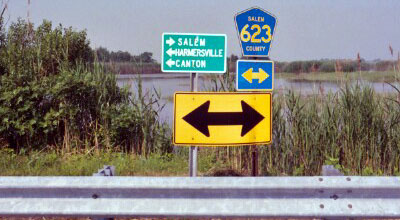
Fig. 1. County Route 623 in Salem County, New Jersey
While most early American historians tend to do their work at large research facilities where the experience is similar to what I have described, some of us are engaged in projects that require visits to local historical societies and other out of the way repositories. We do not enjoy the creature comforts afforded to those who happily labor in temperature-controlled facilities with welcoming staffs. Work in local research libraries places unique demands on the historian. It requires learning a whole new set of skills that one does not normally pick up in graduate school. For example, I do not remember my mentor telling me how to deal with an eager genealogist who is unwilling to surrender the only microfilm reader in the building. Nor do I recall a lecture about what to do after driving sixty miles into the countryside only to find out that the local librarian went home sick for the day and had to close the shop. I must have been absent on the day my historical methods seminar focused on how to manage the frustration that comes when the research room at the town library changes its hours, without telling you, from Tuesday and Thursday mornings to Monday and Wednesday afternoons.
Fig. 2. Approaching a one-lane bridge somewhere in Salem County, New Jersey
In addition to cultivating the virtues of patience and endurance, the historian doing this sort of research must learn how to build relationships and earn the trust of people–usually historical society volunteers–who might be skeptical of outsiders and inclined to protect their cherished local history from professional revisionists intent on rewriting it. This kind of relationship building can reap immeasurable benefits for the early Americanist, but it also demands a reorientation of how we think about research productivity and the use of our time.
Fig 3. Turtle Crossing Sign on Route 49 in Salem County, New Jersey
Much of my experience with this type of research came in 1997 when I was beginning a dissertation on the impact of Protestantism and the Enlightenment in the eighteenth-century Philadelphia hinterland of southern New Jersey. The manuscript collections I needed to use were housed in a dozen or so local and county historical societies in what colonial-era Philadelphia travelers often referred to as the “wilds” of New Jersey. I was intrigued by this prospect, thrilled about the possibility of uncovering manuscript resources that had never been examined by professional historians or appreciated by their local guardians. Now this seemed to be real research. This was why I had always wanted to be a historian. My vocation was renewed further when I won a grant that would enable me to rent a car for the summer and travel through the New Jersey countryside in search of a dissertation. I gathered my legal pads, packed my laptop, bought a road map, and set off to do what real historians do. The first stop on my journey was a visit with Bill (not his real name), the interim director of a local South Jersey historical society, with whom I had been exchanging long e-mails about the region’s eighteenth-century resources. Bill is an expert on South Jersey history–he made it clear that he is not interested in the history of any other region–and he uses his knowledge to make a decent living as an historical consultant. I was a bit apprehensive as my midsize Chevy Cavalier pulled up to the curb in front of Bill’s house; we had never spoken face to face. When I approached the door, a quiet but friendly man welcomed me, introduced me to his mother and then asked if I wouldn’t mind taking a quick drive so he could get some lunch. It was becoming clear to me that the day would unfold on Bill’s terms, not mine, so I decided to climb in his van and make the best of it.
Fig. 4. Produce Stand on Route 49 in Salem County, New Jersey
After we left the drive-through (he treated!) we returned to Bill’s house where he escorted me to a basement library complete with a computer station, a long seminar table, and the largest collection of books about the history of southern New Jersey I had ever seen. We spent the day chatting about his books, how my work intersected with some of his own interests, and the primary sources that would be available to me in this region. Throughout the course of the conversation the topic of how my project might fit into the literature of my discipline never came up. As I left, Bill offered me the use of his library whenever I needed it, lunch included. As I drove away from Bill’s house, I felt glad to have met him but also disappointed that I had not made any headway into serious archival research. The next day, however, I would travel to a county historical society where I knew there were some manuscripts I could consult. I found a cheap hotel and arose early, ready for action. The Smith County Historical Library (not its real name) is tucked away in a remote corner of the Garden State. The reading room consists of two tables, a card catalog of 3 x 5″ index cards with family names handwritten on them, some old microfilm readers, and a collection of pamphlets and books on local history. When I arrived, some genealogists–all around retirement age and clearly regulars–were already hard at work. Their notes and charts covered most of the space at the tables. It was clear from the looks I received when I entered the room that I was a stranger in these parts. I introduced myself to the director of the library–who was expecting me–and then managed to stake out the last seat left at one of the tables.
Fig. 5. Field adjacent to the Cohansey River in Cumberland County, New Jersey
I quickly realized that the Smith County Historical Library is more than just a historical society. It doubles as the village’s community center. Each morning, a steady stream of residents wander into the reading room, coffee in hand, to chat about the weather, converse about local happenings, and complain about everything else. This daily ritual was certainly not conducive to my serious research, but I quickly got used it. After a few days I found myself joining in, explaining to my new friends that I was not there to uncover my family lineage, but to do research for a doctoral thesis on the early history of the area. They seemed intrigued, but the topic of conversation changed quickly to auto repair or the menu at the local restaurant. After several weeks at the library I too was becoming a “regular.” I was given unlimited access to a host of valuable (at least to me) eighteenth-century letters, diaries, and other manuscript sources and had even received a few “historical tours” of the region organized around places the characters in my research had walked and slept. I was also put to work. I helped move a filing cabinet, reorganized an attic full of old account books, and even minded the library while one of the volunteers went out to get the mail. This was not the National Archives, but I left the Smith County Historical Library feeling a bit more human than when I arrived.
Fig. 6. Hay field somewhere in Salem County, New Jersey
My final stop on this initial leg of my research journey was a small Protestant church that possessed some old records that I thought might be of use to my project. As I approached the tiny stone structure, built in the early 1800s, I was greeted by a herd of screaming children pouring out of its doors, searching frantically for their parents who were waiting to pick them up from vacation bible school. When I finally found an adult in the crowd, she directed me to Susan, the clerk of the church “session.” Susan had spent her entire life in this small South Jersey town; she was baptized in this church and had just recently become its most important lay leader. I followed Susan to the balcony of the church, which was used as a storage area. She dusted off an old, rusty, filing cabinet and opened one of the drawers to reveal a set of original church records–session minutes, membership lists, disciplinary records, and even some sermon manuscripts–dating back to the mid-eighteenth century. I looked at the records with mixed emotions. I was glad to have made such a find, but, I asked, wouldn’t the church feel better about donating these documents to a repository–such as the denominational historical society in Philadelphia–that had the resources to preserve them properly? The answer to my question was an unqualified “no.” These were “our records” Susan informed me, and they would never be turned over to an archive where they would not be appreciated. Once I realized that there was no convincing Susan on the archive issue, I asked if I could spend a few hours examining these documents. She took them and me to a classroom that still bore the remnants of a morning of vacation bible school. There I was, a budding historian, sitting at a table filled with half-drunk plastic cups of fruit punch and partially eaten cookies, reading original eighteenth-century sermons and trying to link their content to trends in early modern Scottish moral philosophy. Warner Sallman’s portrait of Jesus was looking over one of my shoulders, and a stuffed animal of some sort glancing over the other! Somehow this was not what I had in mind when I thought, romantically, about the things historians do.
Fig. 7. Eighteenth-century house in Cumberland County, New Jersey
After a summer of roaming the South Jersey countryside, I spent the next year based in Philadelphia where I enjoyed access to some of the country’s finest archival facilities and a community of young scholars willing to dialogue with me about my work. This was research Nirvana, but I missed the unpredictability and sense of adventure that life in the local historical communities of South Jersey had afforded me. Every now and then I get an e-mail from one of my acquaintances in South Jersey asking me when the book based on my dissertation will be published. They ask not because they want to keep track of my professional development, but because they are actually looking forward to reading my book and learning more about the history of the place that they and their families have called home for generations. As I stare at my computer screen and continue my musings about “rural Enlightenments,” “moral philosophies of everyday life,” and “communities of benevolent criticism,” I think about these people and hope my finished project will not disappoint them.
This article originally appeared in issue 4.1 (October, 2003).
John Fea is assistant professor of American history at Messiah College in Grantham, Penn. His most recent article is “The Way of Improvement Leads Home: Philip Vickers Fithian’s Rural Enlightenment,” Journal of American History (September 2003).
Liten up
“The history means a lot to me–it really does,” says a California woman on the edge of tears. One of public television’s “history detectives” has just told her that the box of John Brown’s letters passed down through generations of her family “connects you to the moments when we talk about standing up for people’s rights.” While the soundtrack swells with Pete Seeger’s “Battle Hymn of the Republic,” the intrepid researcher and the letters’ owner share a hug. Fade to black.
Television–particularly since the saturation of shock talk shows and reality TV–has so cheapened emotion that it’s hard to tell when we’re seeing the real thing. This moment feels quite genuine. The fact that it was triggered by musty letters and the discovery of their chain of ownership reminds us just how touching the past can be.
If it does nothing else, the new PBS series History Detectivesproves over and over what Roy Rosenzweig and David Thelen express so well in their surveys of Americans’ attitudes toward history: many Americans connect most directly to the past through their own family stories. If you and I met at a cocktail party, I might tell you about my early-nineteenth-century ancestor, a Norwegian seaman, who was one of only a few to make it onto a lifeboat when his whaling ship sank in the Arctic Sea. As the survivors floated in the chilly waters waiting for rescue–the story goes–it became clear that the sailors who would make it home would be those who were willing to eat the captain. What we know for sure is that my ancestor went on to live a long life and prospered as a caterer.
Fig. 1. Antiques Roadshow meets CSI in History Detectives. Photographed by Don Perdue.
But do I have the guts to track the story down and verify it? No, I’d rather be able to tell it to strangers at dinner parties (maybe after dinner is better) and say with honest ignorance that it really happened.
Fortunately for History Detectives, plenty of other people arewilling to put their family legends to the test of empirical research. The result is ten one-hour episodes during which a mod squad of highly energetic researchers investigates stories, events, artifacts, and myths that have been passed down in the families of ordinary Americans for generations. In the blitz of an expensive advertising campaign waged by PBS in advance of the series’ premiere last July, History Detectives was promoted as somehow both glossy and homey, both sexy and cozy: History Detectives, the marketers promised, is “Antiques Roadshow meets CSI.”
Whether PBS has realized its market-share goal is uncertain, but the series is undoubtedly worthwhile. Not only is History Detectives a refreshing change from the generally predictable PBS history line-up, but it’s a far more useful way of learning about history than most documentary offerings on public TV or the cable channels. I say about history because what makes History Detectives so interesting and valuable is not so much the history a viewer can learn (though some of it is fascinating). The value of this TV series is what it conveys about the excitement, frustration, high emotion, and sheer fun that can be had by anyone who chooses to follow a trail into the past. So while the show is so history lite that it occasionally threatens to blow away altogether, it also promotes the idea of public history far better than anything I’ve seen on television. By repeatedly showing the rich and surprising treasures to be found in public libraries, local historical societies, museums, and newspaper archives, History Detectives proves beyond a doubt that indeed everyone can be his or her own historian.
What the program lacks is, not surprisingly, much discussion of the ambiguities, contradictions, and complexities that professional historians know so well. But after all, this is TV. So when one of the researchers declares to a woman who’s brought in a particularly thorny case, “This is the moment–I have all the answers!” the inescapable fact that television demands black and white solutions is brought home all too vividly. This is not to say, however, that the research is always made to look easy. On the contrary, History Detectives does an admirable job of portraying the dead ends, overlooked details, and inevitable disappointments encountered in any investigation.
The formula for the show sounds almost goofy. Take four telegenic characters and show them striding down a street music-video style while the Elvis Costello song “Watching the Detectives” booms behind them, then set them loose on a mystery from American history that holds an important outcome for somebody (not necessarily everybody). The four sleuths are Wes Cowan, an auctioneer and appraiser (also an anthropologist); Gwen Wright, a professor of architecture; Tukufu Zuberi, a sociologist; and Elyse Luray, an appraiser with training in art history.
Wait a minute! What’s wrong with this picture? There’s not a single historian among the “history detectives”! The producers must have their reasons. Two of the gang, Cowan and Luray, also appear on the PBS series Antiques Roadshow so they were known quantities. The other two are new to the genre. Of the four, it’s Zuberi, a sociologist at the University of Pennsylvania, who appears to have the most typically academic background. It’s also Zuberi who is often the most analytical of the team. He searches for the meanings behind the discoveries, and is articulate and passionate in relating to family members the larger context of their story or artifact. The mysteries the quartet sets out to solve run the gamut, but for the most part they involve a myth or artifact. Did the family-owned San Antonio printing company really print the paper money that helped finance the Mexican Revolution, as the current owner has heard rumored? Is the salty old New Englander right when he says that the whaling ship his grandfather skippered out of New Bedford sheltered escaped slaves among its crew? Was the pearl-handled dirk handed down in a Louisiana family really bestowed by Napoleon to commend an ancestor’s battlefield bravery? The stories are not always domestic. One uncovers how a ball field in Atlantic City came to be named for a Negro League player when the city was still segregated. In another, a Texas railroad buff is convinced that a little wooden station house tucked deep in the Dallas rail yards was actually the settlement’s first rail station–the kernel of the system that would eventually make Dallas a thriving city.
Fig. 2. The History Detectives: Gwendolyn Wright, Tukufu Zuberi, Elyse Luray, and Wesley Cowan. Photographed by Don Perdue.
But here’s the problem the producers of History Detectives are up against. The key to the success of Antiques Roadshow is the gee-whiz moment at the end of each segment when the expert/appraiser lets the owner know just how much that dented up cuspidor or the ugly watercolor bought at a yard sale will fetch. “Wow! I had no idea it was worth that much!” says the shocked and delighted owner, visions of a new motorboat dancing in his head.
Information from the past just doesn’t arouse the same cupidity. So how can the producers make viewers stick out the investigative part of the story and stay around for the pay-off of truth? Someone has to have something big at stake, and the producers sometimes work too hard to ratchet up the suspense. The Dallas station house is a case in point; not only is the outcome undramatic either way, but the process of digging out the facts feels stretched beyond credibility in order to fill the segment’s seventeen screen minutes. Tracking down the location and a description of Dallas’s first station surely can’t be that difficult.
But many of the segments do succeed in being both dramatic and enlightening–sometimes even moving. A particularly strong story unfolds when a Chinese-American woman asks the team to determine whether any of the hundreds of poems carved into the walls of California’s Angel Island barracks by incarcerated Chinese immigrants in the early 1900s might have been written by one of her ancestors. The question seems impossible to answer, particularly because, like many immigrant families, the current generations have virtually no information about their forebears. In the end, a definite answer eludes the researchers, but the two history detectives who take it on get far closer than seems conceivable. Along the way we learn a great deal about Chinese immigration and the miserable conditions under which thousands of newcomers had to live before being admitted or turned away. When the detectives unearth a photo of the woman’s great-grandfather from the immigration records, along with the information that he died on the island while appealing his denial to enter the U.S., it seems perfectly natural to see the family members moved to tears.
In an effort to provide some deeper history without bogging down the pace, the producers also incorporate brief informational segments to generalize the specific stories. With MTV editing, zooming graphics, sound effects, and subject-appropriate pop songs, one of the hosts will present a two-or-three minute essay on the history of paper money, or free African-Americans in the antebellum South, or the crucial role of railroads in the development of Texas. The wider context is welcome indeed, and serves the important purpose of pointing out to viewers how it’s so often the small stories that are the individual threads of our collective larger history. At the same time–and I never thought I’d say this about a PBS show–the interstitial segments are just too rock-and-roll!
Does PBS have a hit on its hands? So far, according to Oregon Public Broadcasting (the co-producer of the series with Britain’s Lion Television), the ratings are getting better with each episode. The series’ well-trafficked Website is full of how-to tips for amateur researchers, as well as background on the stories. The Web has also proved a boon in soliciting story ideas from the public, and the producers say they’ve now got a far richer mine of material to choose from than they had for the first go-around. PBS has commissioned ten new episodes for next season despite the fact that the show hasn’t yet secured a corporate sponsor (as of August 2003).
There is some danger that History Detectives could prove so successful that PBS would repeat the formula endlessly–as its cable and network cousins would–at the cost of its serious history programs. I doubt it, but it’s worth pondering. Now, while I have your attention, did I ever tell you about my great-great-grandmother the mountain climber?
Note: History Detectives is a co-production between Lion Television and Oregon Public Broadcasting. The series producer is Tony Tackaberry; the OPB executive producer is David Davis. For broadcast times see local PBS schedules.
This article originally appeared in issue 4.1 (October, 2003).
Eric Stange is a filmmaker based in Arlington, Massachusetts. Most recently, he directed “Murder At Harvard,” a historical whodunit with Simon Schama broadcast on PBS’s American Experience. His current project is a four-hour public TV series about the French and Indian War. In 2002-03 he was a fellow at the Charles Warren Center for Studies in American History, Harvard University.
Terms of Dismemberment
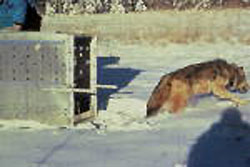
On April 24, 1995, Chad McKittrick, an underemployed lover of guns, beer, and bear hunting, shot an animal he hoped was a wolf outside of Red Lodge, Montana. McKittrick and his associate, Dusty Steinmasel, walked to the canid sprawled in the mud. The scene–two hunters standing over a beast leaking from a high-caliber wound–qualified as a cliché in this part of the American West. Montanans had been pumping bullets into wild things for over a century. This killing, however, elicited none of the customary reactions. McKittrick and Steinmasel stared with anxiety, not victory, at the two red United States Department of Fish and Wildlife tags dangled from the wolf’s ears. The black alpha male labeled R-10 (r for red) belonged to the “experimental-nonessential population” of eight Canadian wolves released in Yellowstone National Park in January 1995. R-10 had wandered out of the preserve with his mate, R-9, in search of a denning site. The fight over reintroducing wolves into Yellowstone had raged for years, and the communities around the park buzzed with wolf talk. McKittrick and Steinmasal knew the red tags signaled trouble, and Stienmasal nearly convinced McKittrick that they might avoid thousands of dollars in fines and jail time if they reported the incident immediately to a Fish and Wildlife agent. This was good advice. The “experimental-nonessential” designation voided the harshest penalties of the 1969 Endangered Species Act, giving hunters and livestock owners a pass if they killed a wolf by accident or in the act of slaughtering a domestic animal. All McKittrick had to do was notify the proper authorities within twenty-four hours, say the shooting was an accident, and he could have escaped without punishment. But he had other plans.
He wanted a trophy and would risk federal prosecution to keep the wolf’s skull and hide. The men hauled the cadaver into the woods. They strung the body up with bailing twine, sliced off the skin, and lopped off the head. The choice remains of R-10 traveled to McKittrick’s cabin in a garbage bag. Steinmasal took charge of the animal’s radio collar, tossing the device into a road culvert near his home. The still-transmitting collar (broadcasting in “mortality mode” since the wolf stopped moving) led the Fish and Wildlife officials to Steinmasal. He led them to McKittrick. The killer of R-10 received a six-month jail sentence and a ten thousand dollar fine. He also won a prominent place in Red Lodge’s Fourth of July parade, waving to the crowd on horseback attired in a t-shirt that declared his allegiance to the “Northern Rockies Wolf Reduction Project.”
Fig. 1
Severing the head of a predator trucked across an international boundary to satisfy an endangered species law signed by Richard Nixon may seem a peculiarly modern transgression, but wolf reintroduction linked the past and the present in ways that help illuminate over three centuries of American colonial history. McKittrick extended a historical relationship when he destroyed and took possession of R-10’s skull.
Colonial Rhode Islanders, who displayed their victims’ heads in public after collecting the cash bounties offered by the town, would have understood Chad McKittrick’s decision to keep incriminating body parts. A jobless construction worker in a Montana town wracked by the fickle economies of ranching and tourism, he collected mementos of power. R-10’s skull entered a stockpile of masculine totems–guns, skins, and antlers–that helped a small man feel big.
In colonial Providence, wolf heads set on a fencepost near the settlement’s meetinghouse stood for the community’s resolve to punish livestock thieves and control their environment. They were tokens of power. But wolf heads are unsteady symbols. Would-be conquerors might hold up animal brain cases as signs of their authority, but other observers interpreted the disembodied icons according to their own assumptions about power. Over the course of American history, livestock owners, Native Americans, bounty hunters, animal rights activists, and wilderness enthusiasts have disputed and revised the meaning of wolf skulls. Instead of telling a tale of absolute dominion, the heads embody the ambiguity of the North American conquest.
In seventeenth-century Middleboro, Massachusetts, John and James Soule farmed side-by-side in the shadow of Wolf-Trap Hill. A family folktale explained the mound’s name. At dawn each day, one of the brothers hiked the hill to check the pit trap they had dug to catch wolves. One morning, the inspector peered into the trench and discovered a wolf balled up at one end and an Indian shivering at the other; both had crashed through the boughs that covered the ditch in the night. The farmer killed the wolf, and “after an examination he found that the Indian was on his way from Nemasket to Plymouth upon legitimate business, so he was released and allowed to continue his journey.” The promontory overlooking the Soule’s neighborhood swallowed a thieving canine and a suspicious human in one gulp.
Wolf killing in colonial New England created landscapes of frustration and distrust. English colonists imported domestic beasts that ranged beyond the humans’ ability to safeguard them, and, to prevent wolves from gutting their investments, they dug traps, offered bounties, erected fences, and experimented with exotic technologies like mackerel hooks and “wolf bullets with adder’s tongues.” Towns urged residents to purchase hounds and mastiffs and train them to hunt wolves. Governments asked and, when they could, forced Native Americans to help slaughter them. All these efforts failed to eliminate the menace at a pace satisfactory to livestock owners. Wolves continued to eat property and farmers continued to kill wolves well into the eighteenth century. European colonists did not march across New England from east to west driving wolves before them. Instead, humans and wolves co-existed belligerently for over a hundred years in a patchwork landscape of agricultural strongholds and feral interstices.
The region’s wolf place names documented this landscape. English colonists affixed wolf names to fields, meadows, brooks, swamps, and forests. In Hopkinton, New Hampshire, there was a local spot called Wolf Meadow, for “the frequency with which wolves were once observed in the vicinity.” Colonists fashioned wolf landmarks to notify each other of the location of their pit traps. Indians might survive in a hole with a wolf, but no farmer wanted to see if his neighbor’s daughter could survive overnight with a ravenous beast. Place names like Wolf-Pitt Brook and Wolf Pit Neck Plain served as seventeenth- and eighteenth-century versions of flashing yellow construction lights.
Wolf traps lined the border between the wild and the pastoral, danger and safety, loss and profit. The trenches marked a cultural divide as well. The conflict between wolves and livestock gave New England’s humans the chance to unite as a species against an ecological rival. The Algonquians destroyed wolves and exchanged black wolf skins as ceremonial gifts, and the English seemed prepared to enter and expand this trade, offering native hunters cloth, corn, and ammunition in return for wolf heads. But in the end, predator eradication drove the humans apart rather than together. The Algonquians saw the heads as symbols of equality, while the English understood them as tokens of submission. As the Soule episode demonstrated, suspicion and wolves strode the woods of New England together. The Indian who fell into the pit on Wolf-Trap Hill had to prove his legitimacy in order to continue his journey. Unsure of their Indian neighbors’ true loyalties, the English tried to make wolf heads icons of certainty and reassurance. Instead, the detached craniums became mementoes of the humans’ failure to understand and trust one another.
Instead of uniting New England’s humans, predator eradication exposed the fault lines that separated them. The animals’ heads became symbols in the colonists’ and Indians’ struggle over land and political ascendancy. During the seventeenth and eighteenth centuries, New England Algonquians and English colonists fought several major wars and engaged in a series of raids and skirmishes. The violence sometimes plunged the bipeds into the basements of hell. Many of the instances of colonists labeling Algonquians animals came from these periods of intense conflict. John Underhill, an English captain who watched Indian men, women, and children burn at Mystic Fort during the Pequot War, compared his enemies to “roaring lions.” William Hubbard called Metacom a den-dwelling “beast” after King Philip’s War. A war hostage in the same conflict, Mary Rowlandson likened her Narragansett captors to “hell-hounds,” “ravenous bears,” and “wolves,” while, a few weeks before French, Abaneki, and Canadian Indian fighters raided his town, killing fifty residents and carrying a hundred into captivity, Solomon Stoddard of Deerfield wrote that Indians “act like wolves and are to be dealt withal as wolves.”
Violence and heartbreak led English writers to question their Indian adversaries’ humanity, but the actual lines of cultural division in wartime were never as clearly drawn as their animal metaphors implied. War generated cross-cultural alliances as well as inhuman violence. The English, for instance, fought the Pequots with the assistance of Narragansett warriors. Later, during King Philip’s War, the colonists battled the Narragansetts with the aid of Mohegan fighters. Wolf symbols and metaphors signaled the cultural distance between warring peoples; they also helped span this gap through military alliances.
Fig. 2
Severed wolf heads stood at the juncture of peace and war in colonial New England. Nailed to the side of a meetinghouse or set atop a post in a public space, the heads symbolized the colonists’ desire to punish outlaw animals and bring order to a rambunctious natural environment. In England, criminals and traitors received similar treatment. Displayed in public, the human skulls served as warnings to would-be thieves and rebels. Of course, no human signal however vivid could prompt a hungry wolf to mull the consequence of biting a lamb, and the predators’ inability to read the messages disgruntled colonists were sending them makes the public display of wolf heads a puzzling activity. They were signs, but signs for whom?
In 1671, Metacom, known to the English as King Philip, negotiated a treaty with the Plymouth Colony, and this document illustrated the multiple signals lopped off heads sent in Colonial New England. The Wampanoag Sachem agreed to abide by Plymouth’s laws, to pay a fine of one hundred pounds for past “misdemeanors,” to “not make war without approbation,” to allow the court at Plymouth to settle future disputes, and to submit to a ban on selling Wampanoag land without the approval of the court. He also promised to send five wolves’ heads to the governor every year as a “token of his fealty.” Later that year, Metacom escorted Takamunna, Sachem of the Saconet, to the Plymouth Court. Takamunna signed a similar treaty and pledged one wolf’s head a year. The wolf head tributes the Plymouth Colony extracted from Metacom and Takamunna represented the colonists’ attempt to fashion a symbol that communicated their right to control the demarcation, transference, and ownership of territory. Metacom contested this right. Four years after signing the treaty, he led an uprising against the English. Many skulls rolled during King Philip’s War, but only one ended up rotting on a pole in Plymouth town–Metacom’s.
Propped up for display like a wolf’s head, King Philip’s skull was a symbol of English ascendancy. The colonists tried to use human skulls as tokens of power from the earliest years of settlement. In 1623, Myles Standish decapitated Wituwamat, a Massachusett Indian accused of conspiring to destroy the English settlements, and stuck his head on a pole outside of Plymouth’s fort. The colonists received Wituwamat’s head “with joy;” it signaled their ability to defend themselves and punish their enemies. This was hubris. In 1623, the Plymouth Colony could barely feed itself much less fend off a coordinated Indian attack. Wituwamat’s head symbolized the colonists’ yearning for power, domination, and control, aspirations thwarted by the continued presence of human rivals who interpreted skulls differently. Miles Standish seized physical command of an Indian body when he chopped off Wituwamat’s head, but the English never acquired the cultural authority to determine the skull’s meaning.
During the Pequot War, the colonists’ Narragansett and Mohegan allies offered Pequot heads as gifts. For the Indians, the gifts re-enforced their equal partnership with the English. The colonists, however, saw the skulls as tokens of not only the Pequots’ subordination but the Mohegans’ and Narragansetts’ as well. The heads represented the Indians’ “service” and “fidelity.” In 1637, Roger Williams indulged in the ultimate power fantasy. In a letter to the governor of the Massachusetts Bay Colony, John Winthrop, he suggested that the conquered Pequots be dispersed throughout the colonies. They would live in small, isolated groups and send an annual tribute of wolves’ heads to the governor: “as once Edgar the Peacable did with the Welsh in North Wales, a tribute of wolves heads be imposed on them . . . which I conceave an incomparable way to Save much Cattell alive in the land.”
Williams’s plan linked the conquests of wolves and Indians through communication and territory. The vanquished Pequots would destroy wolves to communicate their fidelity to and compliance with English authority. In the process, they would make the wilderness safe for the colonists’ meandering property. Williams imagined a line of communication that worked like a chain of command. Indians would subordinate wolves in order to collect the emblems of their own subordination. The plan, however, contained a glaring weakness. Controlling the symbolism of wolves’ heads was beyond the colonists’ power.
The Algonquians exchanged both human and animal body parts for their own reasons. They traded black wolves’ skins to heal alliances and restore reciprocity. Wolf killing was a byproduct of seasonal deer trapping in Southern New England. Indian trappers destroyed the wolves that robbed their deer snares, and every so often they caught an exceptional thief, a trespasser with all black pelage (most wolves are gray in forest habitats). Repairing the damage done by the crime rather than punishing the criminal was a core idea of Algonquian justice. Trappers did not punish wolves as much as exact restitution comparable to the animal’s offense. A wolf skin signified atonement. That was why black wolves’ skins worked so well as peace offerings. They were rare gifts that signaled the giver’s desire to expiate past misdeeds.
It is hard to tell what wolves’ heads, as opposed to pelts, meant to Indians, but the events leading up to King Philip’s War hold a few clues. Metacom’s revolt in 1675 makes more sense if he understood the wolves’ heads he committed to give in 1671 as symbols of restored equality instead of imposed fealty. The skulls may have hastened the war by convincing both the English and the Wampanoags that each broke promises neither made.
The conquest of New England teaches many lessons, but three stand out in regard to wolf heads. First, the eradication of wolves involved a tangled cast of species and cultures. Second, wolves died for their role as ambiguous symbols in human conflicts as well as for their predation of livestock. Finally, wolf heads remained potent icons because wolves survived in southern New England for over a century despite the colonists’ best efforts to destroy them. Evasion–a maneuver that grew ever harder to perform as English colonists drained swamps and converted forests into fields–was the key to animals’ endurance.
In New England, wolves, colonists, and Native Americans never assembled the elements necessary to share an ecological niche. Rival predators need space, calories, and clear lines of communication to live together in peace. Colonists imported a food supply (cows, pigs, sheep) that invaded their neighboring predators’ territories. Unable to impress upon their niche-mates the importance of not eating property, the colonists offered rewards to one rival (Native Americans) to hunt the other (wolves).
Fig. 3
Wolf killing gave the human predators a set of symbols that helped mitigate their communication difficulties, but the bipeds’ alliance shattered on the ground beneath their feet. Unlike wolves, the Algonquians inhabited landscapes–cleared fields and villages–colonists adored. The English bought, stole, and negotiated for Indian land, yet they struggled to convince the Algonquians to respect and adhere to their notions of property. The human predators fought over plots of land as well as the rules for creating, maintaining, and transferring territory. Each tried to invent symbols of power that signaled their control over cultural definitions as well as physical resources. Wolf heads represented one such token. The Algonquians and the English wrestled over the heads’ interpretation, one predator insisting the craniums embodied fealty and submission, the other equality and reciprocity. In colonial New England, language, land, and domestic beasts trapped three top predators in a pit of violence and misunderstanding and only one escaped to continue its journey. As folkloric beasts and enthusiastic molesters of private property, wolves loped through the breadth of American history. They provide a historical bridge far more sturdy than the concepts scholars lay down to span the gaps in the past. Cobbled together ethnic identities like Euro-American or abstract processes like colonization often fail to make the linkages they imply. Were the ranchers who settled Montana’s grasslands engaged in the same conquest as the farmers who plowed rocks in Connecticut? Does the term Euro-American mean anything when people as diverse as John Winthrop and Chad McKittrick fall into the category? Historians work to come up with synthetic concepts that sew together vast time periods and address the continent’s past as a whole. The prime lesson of wolf history is this: life and history create their own connections. Genes bind generations; folktales cross thousands of miles; and wolves integrate the American past through the synthesis of biological, folkloric, and historical time. Wolves can help Americans understand and integrate their past by bringing together divergent people and places across the reaches of space and time. And historians might be able to assist wolves in return. The best reason for letting wolves repopulate the United States may be historic rather than ecological. Wolves may heal ecosystems overrun with herbivores; they may bring a sense of wildness to national parks; their presence may even brighten the human soul. But wolf reintroduction will most certainly preserve a species that unites Americans through a long, brutal, and vital colonial past. Americans spend millions of dollars to safeguard historic treasures and monuments. Tax dollars, foundation grants, and visitor donations safeguard the Constitution, polish the Vietnam Memorial, and keep Richard Nixon’s birthplace from crumbling to the ground. Wolves tell a story longer than any nation’s, larger than any war’s, and more significant than any president’s. They push history beyond the confines of humanity to include the creatures and biological processes that shaped the past. Wolves are living reminders of the legacies of colonization, and, when the likes of Chad McKittrick shoot the animals to possess their skulls, the rituals and symbols of colonization thunder back from the distant past to enliven wildlife debates in postmodern America. The predators continue to fire imaginations, ignite controversies, and illicit savage behavior, and their grip on American culture remains fierce. They embody an unbroken history of conquest worth pondering and protecting.
Further Reading: R-10’s death is recounted in Thomas McNamee, The Return of the Wolf to Yellowstone (New York, 1997). For the public display of wolf heads see The Early Records of the Town of Providence,vol. 9 (Providence, 1893); Joshua Coffin, A Sketch of the History of Newburry, Newburryport, and West Newburry (Boston, 1845). For the naming of Wolf-Trap Hill see Thomas Weston, History of the Town of Middleboro Massachusetts (Boston, 1906). Examples of colonists calling Indians animals can be found in John Underhill, Newes From America (London, 1638); Letter from Reverend Solomon Stoddard to Governor Joseph Dudley, October 22, 1703, in New England Historical and Genealogical Register, XXIV, 269-270. For the display and meaning of human skulls in wartime New England see James Drake, King Philip’s War: Civil War in New England, 1675-1676 (Amherst, 1999); Jill Lepore, The Name of War: King Philip’s War and the Origins of American Identity (New York, 1998). See Roger Williams, A Key into the Language of America (London, 1643) for an account of Algonquian wolf trapping. For wolf head tributes see Edward Winslow, “Winslow’s Relation,” in Alexander Young, Chronicles of the Pilgrim Fathers of the Colony of Plymouth from 1602 to 1625 (Boston, 1841); Glenn W. LaFantasie, ed., The Correspondence of Roger Williams, vol. 1 (Hanover, N.H., 1988).
This article originally appeared in issue 4.1 (October, 2003).
An adjunct assistant professor at Indiana University at Indianapolis, Jon T. Coleman is the author of Vicious: Wolves and American History, forthcoming from Yale University Press.
Coffee and the Baroque Noir Novel
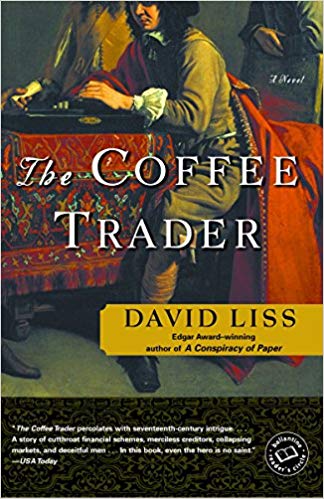
The Coffee Trader: A Novel
Commenting on the process through which he came to write his first novel, David Liss wrote: “After years in the archives, reading pamphlets, poems, plays, periodical essays, and long-forgotten novels, I failed to find the source that told me precisely what I wanted to know about the new finance [of the early eighteenth century]. So I wrote one.” The result was A Conspiracy of Paper, a novel of financial intrigue set in London on the cusp of the bursting of the South Sea Bubble in 1720. Liss returns to this sort of historical fiction with his second novel, The Coffee Trader. He sets the tale in mid-seventeenth-century Amsterdam, apparently around the year 1659, when the Dutch Republic had secured its independence from Spain and was enjoying the height of its own golden age. Along with recent novels by Iain Pears and Ross King, Liss has contributed to the development of a minor new subfield in recent fiction writing that one might be tempted to call Baroque Noir. The mystery novel, with its intricate plotting and themes of deceit and manipulation, has found a comfortable backdrop in the world of early modern Europe, a period itself rich in intrigue and colorful characters.
For Liss, the appeal of the Baroque milieu seems to be the opportunity it offers to present a look at the mental world of financial capitalism at a time in which its major practices and institutions were still very new. National banks, international trading conglomerates such as the Dutch East India Company, the stock market, futures trading, and financial journalism were all innovations of the era and they were greeted with even more suspicion at their inception than they are in the current climate of financial scandals associated with names like Enron, WorldCom, and Martha Stewart. The Coffee Trader introduces its readers to this world through a variety of different players in the early modern Dutch financial markets. The protagonist, a Portuguese Jew named Miguel Lienzo, attempts to maintain his financial security in the Dutch Exchange and his social standing in the Amsterdam Sephardic Jewish community. In doing so, he encounters a number of different characters from both inside and outside of the Jewish community. As with any good mystery, the reader is kept guessing as to who Miguel’s true friends and enemies are until all is revealed in what amounts to a rather bittersweet conclusion.
As straightforward fiction, the novel is a compelling tale filled with the interesting twists and turns of fortune that one might expect from the genre. But it is as a work of historical fiction that the novel really excels. Liss has a keen ear for dialogue and while he spares his readers the excesses of the Baroque vocabulary and speech styles, he does well to capture the religious, class, and gendered prejudices that structured the early modern mind. Observant readers will catch clever references to the great culture heroes of the Dutch golden age, such as the painter Rembrandt van Rijn, who is identified as “that curious fellow who had lived in the Vlooyenburg and was in the habit of paying poor Jews to model for him” (308). While one might quibble with one of the major plot devices, an historically implausible attempt by Miguel Lienzo and his business partner to achieve a general European monopoly in the coffee market, the novel is generally filled with clever insights into the workings of the multicultural society of early modern Amsterdam. It captures effectively the personal face of the early modern financial marketplace. In doing so, Liss offers a fictional counterpart to the story that social and economic historians have begun telling us in their studies of the importance of systems of credit, notions of credibility, and the social networks of trust and reliability that were the necessary foundations for the functioning of an international commodities market.
As with his first novel, Liss is particularly concerned to detail the predicament that the communities of the post-Inquisition Jewish diaspora found themselves in after their expulsion from the Iberian peninsula. Miguel Lienzo was born in Lisbon to a converso or “New Christian” family that subsequently moved to Amsterdam after their father fell victim to the Inquisition. In the new Dutch Republic, the Portuguese Jewish community found a receptive home in which they could practice their religion with relative freedom. They also found an opportunity to exploit their international kinship and religious networks, stretching from the Levant to London and the North Sea, in the service of international trade, especially the commerce with the Iberian Americas, such as the Brazilian sugar trade and the Curaçao chocolate trade. Liss places his Miguel Lienzo in the midst of this world and presents the character with the opportunity to strike up a trade in what was still in the mid-seventeenth century a relatively unknown commodity–coffee.
The early history of the coffee trade is much less researched than the economic role of the Sephardim in the Dutch golden age, but the picture Liss presents in his novel is plausible, if not yet documented by historians. There is no evidence for a significant Jewish presence in the early coffee trade in England, and a recent study of the history of coffee in the Netherlands has concluded that although the coffeehouses of the Dutch Republic were often kept by Jews, Armenians, Greeks, or Italians, the major coffee merchants were of Dutch extraction. But the Sephardic community was indeed entrenched and influential in the Dutch commodities market. By the late seventeenth century, chocolate dominated Sephardic trading activities on the Amsterdam Exchange. Had Liss followed up on his initial plan to write about Jewish involvement in the chocolate trade, he might have been able to construct a story closer to the heart of the economic life of the Amsterdam Sephardim. He chose coffee instead because he claims “coffee and business go together so naturally that the switch was inevitable” (386). There is another story to be told here. Why do coffee and business seem to go together so naturally?
We do not get much of an answer to this question in Liss’s novel aside from the customary association between the stimulative properties of caffeine and the need for businessmen to remain sober and alert in all of their transactions. This sort of functionalist argument might make sense to us today, but it was less clear to seventeenth-century people who were confronted with a new commodity whose psychotropic properties had yet to be fully socialized. By the dawn of the eighteenth century, coffee and commerce did indeed fit together rather well, so well in fact that it has come to be seen as “natural.” In the meantime, there was quite a lot of persuasive work to be done in order to make coffee seem like a sober and rational drink rather than a foreign and threatening one.
Historians will continue to want to dig around in the archives, read long-forgotten pamphlets and treatises and think about the history of coffee in order to understand how it became so widely accepted in early modern Europe. In the meantime, The Coffee Trader offers an entertaining entrée into the cultural world of Sephardic Jewry in mid-seventeenth-century Amsterdam. For those who wish to continue to read further, the book includes a judicious bibliography of some of the best works in English on Dutch and Sephardic culture in the golden age.
Further Reading: The opening quote is found in David Liss, A Conspiracy of Paper: A Novel (New York, 2000), 438; other examples of ‘Baroque noir’ novels include: Iain Pears, An Instance of the Fingerpost (London, 1997) and Ross King, Ex-Libris (New York, 2001). Two excellent recent examples of the history of credit and credibility are Nuala Zehediah, “Making Mercantilism Work,” Transactions of the Royal Historical Society 9 (1999): 143-58, and Craig Muldrew, The Economy of Obligation: The Culture of Credit and Social Relations in Early Modern England (London, 1998). The standard work on the history of Dutch coffee is Pim Reinders and Thera Wijsenbeek, eds., Koffie in Nederland: Vier Eeuwen Cultuurgeschiedenis (Delft, 1994). The Sephardic dominance of the chocolate trade is revealed in Jonathan Israel, Empires and Entrepots: The Dutch, the Spanish Monarchy and the Jews 1585-1713 (London, 1990), 440. The legitimation of coffee and coffeehouses in the British Isles will be the major theme of my forthcoming book: The Social Life of Coffee: Curiosity, Commerce and Civil Society in Early Modern Britain.
This article originally appeared in issue 4.1 (October, 2003).
Brian Cowan is assistant professor of history at Yale University and the author of The Social Life of Coffee: Curiosity, Commerce and Civil Society in Early Modern Britain (New Haven and London, forthcoming).
Alcoholic License
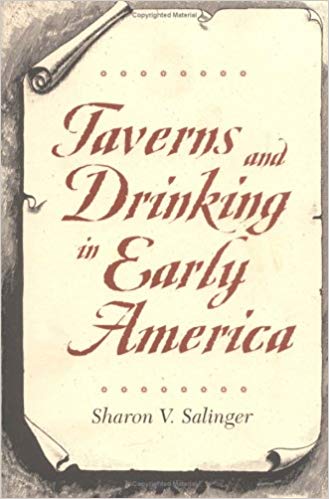
Taverns and Drinking in Early America
In early America people slept and ate as well as drank in taverns, and they drank alcoholic beverages in places other than taverns. But this book is about drinking in taverns. Its evidence comes from a wide range of sources from the seventeenth- and eighteenth-century Anglo-American colonies in North America (a.k.a. “early America”): laws, account books, newspapers, criminal court records, diaries, administrative records, secondary literature on urban and legal history. It is mercifully light on didactic literature but uses it to hilarious effect, as when Increase Mather denounced “gynecandrical dancing or that which is commonly called mixt or promiscuous dancing, of men and women” (32; see also John Adams’s description of a tavern, 234).
The book’s designers used the same decorative figure thirteen times–a hearty bearded publican admiring a frothy glass while standing beside a barrel framed by a grapevine. Everything is wrong with this illustration. People came to taverns to drink booze: distilled liquors, especially rum. They drank them primarily to get drunk, not to expand their gustatory horizons. People drank promiscuously: while in Philadelphia to negotiate for Virginia with the Iroquois, a William Black recorded drinking Champagne, Madeira, claret, cider, lime punch, rum, brandy, port, and sherry. The culture of gentility thrived alongside drunkenness. There were clubs within taverns for conspicuous consumption of exotic drinks, and some taverns catered to a refined clientele. But most of the time most men drank similarly regardless of respectability: that is why we have such self-congratulatory diaries of refinement as Dr. Alexander Hamilton’s Itinerarium.
English culture accepted and encouraged the consumption of alcohol. People drank with every meal, while at work, and at every social and public gathering (ok, not church). Ale had been a household manufacture–hence “alewife”–since the medieval development of towns. This traditional industry became more highly capitalized and masculine in the sixteenth century as brewhouses increasingly sold to commercial establishments. Such establishments also sold distilled beverages, one of those new items–such as tobacco, tea, coffee, chocolate, and sugar–that early modern Europeans kept adding to their consumption schedules until they were mass luxuries. Brandy established the market in the sixteenth century; thereafter rum, gin, and whiskey developed as substitutes. Comparative data are not readily available, but colonists seem exceptional among Europeans in the social extent and amount of their drinking distilled beverages.
There were plenty of taverns in which to drink them. Taverns were far more numerous than any other type of architectural space besides dwellings. Taverns required licenses, but that was so authorities could issue them to make money, not to control drinking. The tendency was to compromise custom if it constrained drinking. Women were not even supposed to be in taverns, but in several colonial port towns nearly half the license-holders were women. The nominal social imperative for taverns was to accommodate travelers, but most of their occupants were locals. The American tavern fulfilled the contradictory functions of the English tavern (transitory accommodation) and alehouse (promiscuous drinking). The ratio of licenses to population was seldom fewer than one for every one hundred inhabitants; by the middle of the eighteenth century this was true of country towns as well as ports. That works out to roughly one vendor of alcohol for every two dozen males over sixteen.
Anglo-American colonial governments waged legislative war on inappropriate drinking. There needed to be taverns to accommodate travelers, but local access was a privilege denied to many groups by law. Sailors (!), apprentices, servants, African-Americans, slaves, and “Indians” were not supposed to be there. As with most such regulatory wars against drugs–think of the Volstead Act or the War on Drugs–these efforts largely failed, though not for want of legislative persistence. In 1712 Massachusetts, for example, prohibited selling rum in taverns. (Conversely, real wars to promote drug trades often succeed–think of the Opium War or Iran-Contra.) Prosecutions for alcohol violations per se were practically nil–one or two per year at most in almost any jurisdiction. Quaker meetings were the major exception in seriously addressing alcoholic behavior: during their first ninety years Pennsylvania Friends cited each other for drunkenness over one thousand times.
Drinking as behavior has not done well by the historiography of the American phase of the early modern consumer revolution, nor by demotic social and cultural history. It is telling, and troubling, that the best book on the culture of alcohol in early America, Peter C. Mancall’s Deadly Medicine: Indians and Alcohol in Early America (Ithaca, 1995), should be titled as a study of pathology among marginalized groups, when it actually treats its topic with anthropological respect. The William and Mary Quarterly reviewed Mancall’s book, but not W. J. Rorabaugh’s respectable The Alcoholic Republic: An American Tradition (New York, 1979). The WMQ has indexed “alcohol,” “cider,” “drinking,” “rum,” and “wine” collectively fewer than ten times in the past sixty years, and only two or three references focus on drinking rather than on production, trade, or regulation. It has indexed “whiskey” but only in reference to the Whiskey Rebellion. Histories of that rebellion usually take the consumption of whiskey for granted rather than analyze it as a crucially new form of alcoholic consumption in the early republic.The rum trade has been analyzed for what it can say about currency equivalencies and the volume of puncheons, but not for people’s actually drinking it. Compare that neglect with all the precious discussions of tea drinking.
The recent appearance of three non-antiquarian books on taverns reverses that neglect. Besides the book under review, they are David W. Conroy, In Public Houses: Drink and the Revolution of Authority in Colonial Massachusetts (Chapel Hill, 1995) and Peter Thompson, Rum Punch and Revolution: Taverngoing and Public Life in Eighteenth-Century Philadelphia (Philadelphia, 1999). As their titles indicate, the latter authors lack confidence that drinking itself is a respectable topic, but they have valuable discussions about its culture and behavior. The virtue of Sharon Salinger’s Taverns and Drinking is to center the story on drinking tout court. Early American historians still need to learn about studying this activity from English and French historians who have focused on it as a profound social and cultural fact, such as Thomas Brennan, Public Drinking and Popular Culture in Eighteenth-Century Paris (Princeton, 1988) and Peter Clark, The English Alehouse: A Social History, 1200-1830 (London, 1983). As David Hancock has shown so effectively in “Commerce and Conversation in the Eighteenth-Century Atlantic: The Invention of Madeira Wine,” Journal of Interdisciplinary History 29:2 (Autumn 1998): 197-219, the Atlantic turn in early American historiography requires a broader and more creative perspective on drinking as on all other topics. There is a vast social science literature on the consumption of alcohol. Historians’ increasing commitment to multidisciplinarity should make them thirst for it.
This article originally appeared in issue 4.1 (October, 2003).
John E. Crowley, George Munro Professor of History at Dalhousie University, Halifax, Nova Scotia, is the author of The Invention of Comfort: Sensibilities and Design in Early Modern Britain and Early America (Baltimore, 2001). His current research explores the creation of a global landscape in British visual culture c. 1750-1820.
Getting Beyond “Who Done It”
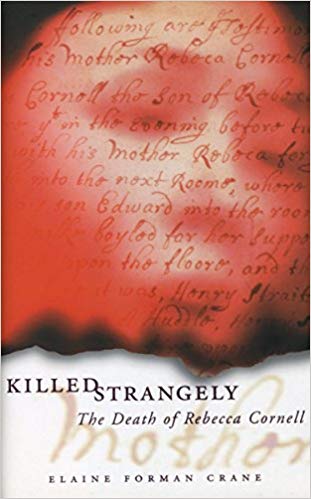
Killed Strangely: The Death of Rebecca Cornell
“Rebecka Cornell widdow was killed Strangely at Portsmouth in her own Dwelling House”: so reads the cryptic entry for February 8, 1673, in the Quaker records of Rhode Island, recording the death of a seventy-three-year old matriarch. When Elaine Crane stumbled across the paper trail that Widow Cornell’s death generated–two inquests, a post-mortem, a capital trial with twenty-four surviving depositions–she was hooked. Seventeenth-century Rhode Islanders did not use the verb “kill” frequently or lightly; yet in modifying it with the adverb “strangely,” the Quaker scribe encapsulated the messiness, the lack of certainty, that characterized Rhode Islanders’ attempts to solve the mystery of Rebecca’s death. The strength of Crane’s microhistorical study of the case is that she preserves the messiness, both by recapturing the interpretive quandaries shared by Rebecca’s colonist neighbors and by offering perspectives from our own era.
What was strange about Widow Cornell’s death? In the evening, Rebecca’s body was found badly burned, lying some distance away from the hearth in the downstairs room she inhabited in the Cornell family’s large, clapboard homestead. Her married son Thomas, his wife, teenage sons, and boarders had been eating supper in an adjacent room, on the other side of a closed door, apparently oblivious to the catastrophe. The next morning a twelve-man inquest was convened, as was done in the cases of all suspicious or sudden deaths. The panel returned a verdict that Rebecca “was brought to her untimely death by an Unhappie Accident of fire as Shee satt in her Rome [sic]” (17). But two days later, the dead woman’s brother-in-law, John Briggs, was visited at night by Rebecca’s ghost who “Twice sayd, see how I was Burnt with fire.” Here was a dilemma posed to the Portsmouth community: Rebecca’s ghost failed to accuse a specific person, yet, as Crane explains, seventeenth-century Protestants believed that the spirit of a dead person might appear in order to draw attention to “an injustice that might not be detected by other means” (20). By enabling the spirit’s appearance, God was ensuring that a murderer would be exposed.
Briggs’s dream, when reported to authorities, triggered the convening of a second inquest along with the exhumation of the body. After watching two physicians conduct an autopsy and discover near Rebecca’s heart a hole that might have been made with a long, narrow, iron spindle, the inquest jurors concluded that the widow had died not just from fire but also from a “Suspitious wound” (28). This turn of events, along with now-circulating rumors that Rebecca had recently complained of ill treatment by her son Thomas, and with the fact that Thomas had been “the last man in her company” (51), spending more than an hour alone with his mother before supper on the evening she died, led to Thomas Cornell’s arrest and indictment for murder.
If strangeness and uncertainty inflected the scenario of Widow Cornell’s death, there were also strange aspects of the legal proceedings that followed. Just as she did in her essay, “In Praise of Hearsay,” in this journal, Crane nicely explicates the differences between trials of the 1670s and those of today, and concludes that Thomas received a fair trial in the context of his era. What was strange was the outcome, given that “the odds” were in Thomas’s favor (49): homicide convictions were rare, the evidence against him was entirely circumstantial, and the defendant’s high status as a frequent town officeholder and former legislator made him a likely candidate for clemency, if convicted. Yet after the trial jury brought in a verdict of guilty and the judges pronounced a sentence of death, Thomas (all the while protesting his innocence) declined to petition either the legislature or the crown for clemency. Hence the forty-six-year-old swung from the gallows on May 23, watched by a crowd of a thousand.
And yet the legal actions did not end there. One year later, Wickopash, an Indian who had been a servant in the Cornell household in 1673, was indicted for abetting the murder. We know only the bare bones of the proceeding: He pleaded not guilty and was acquitted by a jury of nine English settlers and three Native Americans. In late 1675, one of Thomas Cornell’s brothers, suspicious that Thomas’s wife Sarah had had a hand in their mother’s death, initiated a highly unusual private prosecution against her but then failed to bring witnesses or make good the charge when the time of trial arrived. Sarah herself had already publicly declared her own verdict in her husband’s case: when she gave birth to Thomas’s posthumous daughter, Sarah named the child Innocent.
Crane insists that answering the question of whether or not Thomas Cornell killed his mother need not be the point of a book-length exploration of the case. Rather than solve the mystery definitively, Crane’s twin goals are to explain the surprising verdict that sent Thomas to the gallows and to use the case as a window onto late seventeenth-century Rhode Island society and culture, especially family dynamics.
If we are to believe a string of women friends of Widow Cornell who testified at Thomas’s trial, then Crane argues that we find “an uncanny resemblance” between what we know today about elder abuse and the pattern between Thomas and his mother (163-64). For months and even years before her death, Rebecca had evidently complained tearfully to female agemates and selected kin that while sharing the house with Thomas and his family, she “was much neglected,” “forced in the winter season . . . to goe to her Bed unmade, and unwarmed” (41), forced to fetch firewood by herself, and in general, “disregarded” and disrespected by her son and grandsons (40, 44).
Add to this the fact that Rebecca Cornell fits the profile of those unusual colonial women whom we identify as “inheriting women” (a phrase coined and developed brilliantly in Carol Karlsen’s analysis of New England women who were the target of witchcraft accusations). Rebecca’s husband, Thomas Sr., had died in 1656, stipulating in his will that Rebecca receive all his property to distribute as she saw fit. In the ensuing years, Thomas Jr. watched while Rebecca deeded various tracts of land to his siblings but not to him. When she finally did sign over their shared homestead to him, the transfer of title was to take effect only at Rebecca’s death–and then conditionally on Thomas’s paying legacies to his siblings. Moreover, Rebecca apparently made Thomas pledge verbally that he would pay the taxes, submit yearly rent to her, and provide her with a maid during her remaining years. Witnesses recounted that Thomas, angry over these demands, refused to fulfill them. Rebecca told her confidantes that he accused her of being “A Cruell Mother to hime” and that he behaved “soe High and soe Crose [cross]” as to be a “Terror to Her” (45). At times she even considered suicide, but her Quaker piety stayed her hand.
If we honor the hearsay testimony, then there were indeed unusual aspects to the family tensions in the Cornell household that elevate this “grim episode” to probable candidacy as “the only fully recorded case of matricide in colonial America” (4). First, “the mother’s reluctance to give preferential treatment to her eldest son (or even treat him on equitable terms with his siblings)” departed dramatically from norms of property transmission (86). Rebecca had much landed wealth to distribute and yet she deliberately denied Thomas the role as independent head of household, thus putting his “masculinity and social standing . . . at stake” (9). Second, rather than show his widowed mother the filial respect that were her due according to Protestant beliefs, Thomas had been an unusually angry and abusive son, thus incurring a reputation for “bad character” which Crane believes persuaded the trial jurors to convict him. (If Thomas abused his mother, it was psychological not physical abuse, since Rebecca never charged her son with striking her.) This framing of the trial evidence gives Thomas a profile that recent studies posit can explain the abuse of elders: here, the middle-aged son emerges as a caregiver deeply dependent on his elder mother (164).
Crane builds this psychological interpretation in different chapters of the book, and it sits rather uneasily with the best part of chap. 4, which is cleverly entitled “Doubting Thomas: Or, Considering the Alternatives.” Here, the author, taking inspiration from Akira Kurosawa’s classic film Rashomon, presents various scenarios that could have led to Widow Cornell’s death. She effectively builds suspense, first, by laying out the ways in which Thomas had “motive, means, and opportunity,” and then (for the first time in the book) by seriously questioning the logic of this version. Why would Thomas risk burning the whole house down? Why was no stained clothing or a murder weapon ever produced? Could the tensions between son and mother over inheritance have been enough to drive him to violence? And if Thomas had killed in a rage, contemporary studies tell us to expect multiple stab wounds. Crane might have structured her study around the alternative causes of death, but instead, after treating them briefly–suicide, accident, an (Indian?) intruder–the author reverts to the implication that matricide took place. Excited by her discovery that three brutal murders in the nineteenth-century Northeast (including the Lizzie Borden case) involved persons born with the surname Cornell, Crane jumps to the dubious conclusion that these seemingly unstable individuals shared Thomas Cornell’s “gene pool” (135). Reading backwards from this shaky tableau, Crane seems to think that at the very least the violent murder of his wife by Alvin Cornell in Vermont in 1843 when linked to Rebecca Cornell’s violent death gives “credence” to researchers who argue for “the heritability of a tendency toward aggression,” putting certain families at greater risk (133, 143).
Killed Strangely is an engaging read that will entrance and inform readers who are at once murder mystery and history buffs. However, with a final chapter that fails to wrap up with éclat, and with an ongoing tension between playful “what ifs” and muddy, often contradictory argumentation, the book doesn’t attain the standard of a classic in the genre. Some of this may be due to the spare nature of seventeenth-century records; North Americanists who focus on events that occurred in the Revolutionary period or after typically have much richer biographical and literary materials at hand. Some of it may also be due to roads not taken: unlike John Demos’s much lauded Unredeemed Captive (New York, 1994), Crane forfeits the opportunity to examine the Cornell family crisis and the Portsmouth area from the perspective of local Indians like Wickopash. The best microhistories aim to tell us something new about the culture placed under the author’s magnifying glass. Crane’s book disappoints here, trotting out tired teleology in arguing that Thomas Cornell and his contemporaries were caught between the values of a traditional society and those of a modern, commercializing one.
What format should an author choose for a particular, book-length microhistory? Cornell University Press has produced Crane’s study as an attractive small, easily held book, its 190 pages of text containing a smattering of helpful maps, diagrams, and photographs. Of greater value to teachers, students, researchers, and general readers might have been a somewhat shorter exposition by Crane (say, one hundred pages), accompanied by transcripts of the original documents.
Further Reading: Trial-based microhistories include Irene Quenzler Brown and Richard D. Brown, The Hanging of Ephraim Wheeler: A Story of Rape, Incest, and Justice in Early America (Cambridge, Mass., 2003); Cynthia B. Herrup, A House in Gross Disorder: Sex, Law, and the Second Earl of Castlehaven (New York, 1999); and Deborah Navas, Murdered by His Wife: A History with Documentation of the Joshua Spooner Murder and Execution of his Wife, Bathsheba, Who Was Hanged in Worcester, Massachusetts, 2 July 1778 (Amherst, Mass., 1999). A good introduction to the Italian roots of microhistory as a genre is Edward Muir and Guido Ruggiero, eds., Microhistory and the Lost Peoples of Europe (Baltimore, Md., 1991). Murder at Harvard (Spy Pond Productions), a film application of the Rashomon approach to the 1849 Parkman murder case, based on Simon Schama’s essay in Dead Certainties, Unwarranted Speculations (New York, 1991), aired in the American Experience series on PBS on July 14, 2003; see the producer Eric Stange’s essay in this journal and the up-to-date American Experience website. See also Carol F. Karlsen, The Devil in the Shape of a Woman: Witchcraft in Colonial New England (New York, 1987), and Patricia E. Rubertone, Grave Undertakings: Roger Williams and the Narragansett Indians (Washington, D.C., 2001).
This article originally appeared in issue 4.1 (October, 2003).
Cornelia Hughes Dayton is a member of the history department at the University of Connecticut and is the author of Women Before the Bar: Gender, Law, and Society in Connecticut, 1639-1789 (Chapel Hill, N.C., 1995) and an article-length microhistory, “Taking the Trade: Abortion and Gender Relations in an Eighteenth-Century New England Village,” The William and Mary Quarterly 3d ser., 48 (Jan. 1991), 19-49.
The Enduring Emerson
Emerson
Ralph Waldo Emerson marks his two hundredth birthday this year. He remains one of the most widely read American writers, or at least most widely assigned to undergraduates (and high school students on an academic track). Few educated Americans, I would hope, have never heard of him. In this book Lawrence Buell shows us why Emerson remains worth reading in our own time. If Emerson seems to some readers stuffy, bloodless, hypocritical, or an apologist for irresponsible individualism, that is because of the superficiality with which he is too often read, Buell argues. Buell is probably the most distinguished living authority on Emerson’s literary circle, the American Transcendentalists–which is a high academic eminence, given that the experts include such superb scholars as Charles Capper, Barbara Packer, and Robert D. Richardson Jr. What Buell has to say here about Emerson is not only persuasive but also consistently interesting, surprisingly original (given all that has been said about Emerson already), and, best of all, written in straightforward, lucid language. (Only once, on 53-54, did I catch him lapse into the impenetrable jargon of literary criticism.) Buell’s discussion of the relationship between Emerson and his prize pupil, Henry David Thoreau, is brilliant.
Buell corrects several common misunderstandings of Emerson; for example, the Sage of Concord was not so much an American nationalist as a cosmopolite eager to redeem Americans from intellectual provincialism; not a recluse but a popular and commercially successful lecturer; not only a poetic symbolist but also a social critic. The strongest chapters in the book are the first and sixth, in which Buell presents the evidence for regarding Emerson as a “public intellectual”–that is, an original thinker who also manages to reach a large audience and address the critical public issues of the day. Following the lead of Albert J. von Frank, Buell shows that Emerson played a more important part in the crusade against slavery than many readers today realize.
In making his case for Emerson’s twenty-first-century relevance, Buell emphasizes certain aspects of his subject’s life and plays down others. He has much to say about Emerson’s later career as a lyceum lecturer, little about his early career as a Unitarian minister. Indeed, he apologizes for having to treat religion at all (159-61) and then mostly addresses the great man’s fascination with Hinduism. Emerson’s relationships to such religious issues as the decline of Calvinism and the rise of biblical criticism are virtually ignored. Presumably these belong to the nineteenth century, and Buell wants to showcase the Emerson who speaks to the twenty-first. However, given the rise of evangelical fundamentalism, it is not at all clear that the Miracles Controversy in which Emerson played so prominent a part is now irrelevant. Perry Miller’s classic 1950 anthology, The Transcendentalists, which makes the debate over biblical miracles central to its story, has been usefully supplemented but not “superseded,” as Buell claims, by Joel Myerson’s superb anthology, Transcendentalism: A Reader (New York, 2000).(Myerson himself declares the earlier volume “still valuable.”) Maybe Buell’s experience differs, but I have found both undergraduates and graduate students can still be engaged by the question of whether Christian theism is validated by reported miracles–most recently in discussing the Miller anthology with fifteen Yale graduate students in the spring semester of 2001.
Buell’s least interesting chapter (to me) was “Emersonian poetics,” a somewhat in-group discussion intended to salvage Emerson’s reputation from the attacks of politically correct literary critics. Buell shows that even if one accepts such standards of judgment, Emerson can survive their application. Although laboring under the disadvantage of being a white male, Emerson is saved because the African American activist Charlotte Forten admired him, not only for his opposition to slavery but also for his essays (147-48). No possible defense of Emerson’s relevance goes unmentioned. Buell offers–clearly in all seriousness–evidence of Emerson’s continued importance from the quotation of his aphorisms on Websites like inspirationpeak.com and giftofwisdom.com (319).
The irony at the heart of Buell’s enterprise, of course, is that Emerson celebrated the creative originality of each new generation and warned his readers and listeners against undue reverence for “the sepulchers of the fathers.” It is an irony of which Buell takes full cognizance, and which he exploits to advantage. May this wonderfully persuasive book defend not only Emerson, but the whole literary canon and indeed the very act of reading, from the Philistines and barbarians at the gates.
This article originally appeared in issue 4.1 (October, 2003).
Daniel W. Howe is Rhodes Professor of American History emeritus at Oxford University in England, and professor of history emeritus at UCLA. His writings have dealt chiefly with the intellectual and cultural history of antebellum America. His many publications include Making the American Self (Cambridge, Mass., 1997), and, most recently, “Church, State, and Education in the Young American Republic,” Journal of the Early Republic, 22 (Spring 2002), 1-25. He is presently writing What Hath God Wrought: The United States, 1815-1848, a volume in The Oxford History of the United States.
A Story So Immense
A Wilderness So Immense: The Louisiana Purchase and the Destiny of America
It is reassuring, in this first of many years of Lewis and Clark bicentennial hoopla, to see that the far more significant event of 1803, the Louisiana Purchase, has not gone entirely unmarked. Jon Kukla’s A Wilderness So Immense joins at least five other narratives, an encyclopedia, a collection of essays, and a collection of documents in an outpouring of recent work on the purchase. The Lewis and Clark bicentennial, like some of the other recent commemorations, has brought a scholarly reassessment of its subject. The Louisiana Purchase bicentennial has not seen the same level of scholarly engagement, at least not so far. And the subject is ripe for it.
The best popular histories–and, in many respects, Kukla’s ranks in that class–can capture the complex interplay of events and personalities that culminated in the Louisiana Purchase. In order to do so, the narrative must shift between Washington and New Orleans, Paris, Madrid, and London, the French Caribbean, the American West, and Spanish North America. It must follow a small army of heads of state, cabinet members, diplomats, military men, legislators, local functionaries, and private citizens. For the most part, Kukla handles this immense drama, with its many scenes and actors, well. His account is broadly international, richly populated, and deeply engaging. Except for a few infelicitous expressions and a tendency toward repetitiveness, A Wilderness So Immense provides a very satisfying and highly readable account of the purchase.
Like most popular histories, it knits together a series of pocket biographies–Jefferson, Napoleon, Carlos III, Livingston, Talleyrand, Godoy, and others–with set-piece narratives–the New Orleans fire of 1788, Napoleon in his bath at St. Cloud, and Barbé-Marbois in Livingston’s garden in Paris. Like most popular histories, it relies heavily on secondary works and the most easily accessible primary sources, though Kukla has done more manuscript research than most. And, like most popular histories, it suggests rather than asserts arguments. Kukla’s analysis appears primarily in his choices about what to include and exclude, as well as in an epilogue that bears little relationship to the preceding story.
Kukla’s choices form one of the real strengths of the book. Too often, popular, and even scholarly, accounts of the purchase begin in the early eighteenth century with the French settlement of Louisiana. As a result, the eventual American acquisition of the vast province beyond the Mississippi River in 1803 seems narratively, if not historically, predetermined. But American policymakers did not want any territory beyond the Mississippi until Napoleon shocked them with his decision to sell the whole of Louisiana. Kukla begins, instead, in the 1780s as Americans, particularly Jefferson, and Spaniards, particularly those on the ground in New Orleans, thought about the future destinies of the entire Mississippi Valley, east and west of the river. In his hands, the Louisiana Purchase remains what it was–an unexpected solution to a crisis that had far more to do with the trans-Appalachian than the trans-Mississippi West.
A Wilderness So Immense is nearly two-thirds complete before Kukla reaches what might reasonably be considered the event that precipitated this crisis, the retrocession of Louisiana from Spain to France in the fall of 1800. The preceding pages explain not only Spain’s decision to return the province to France, but also the conditions within the United States that made this event so threatening. Long discussions of the Jay-Gardoqui negotiations over the future of the Mississippi in the mid-1780s and of the planned Genet-Clark assault on New Orleans in the early 1790s highlight the tensions between East and West, North and South, over the use and control of the river. By telling these stories, Kukla situates the purchase in the context of a fragile American union, impetuous western settlers, and calculating New England politicians.
Unfortunately, having established this context, Kukla gives the retrocession crisis itself short shrift. He never clearly explains that Jefferson and his advisors viewed French control over the Mississippi as a threat to the union of East and West. He barely suggests why the administration remained indifferent about Louisiana itself, even as it scrambled to secure control over the river by purchasing New Orleans and the Floridas. The source of this failure is curious. Kukla recognizes that both Livingston and Monroe went to Paris only after long conversations with Jefferson and Madison about the administration’s concerns, intentions, and goals. Their written instructions did not, and could not, include all that was discussed in these meetings. For Kukla, this fact apparently justifies ignoring them. Madison’s lengthy March 2, 1803, instructions to Livingston and Monroe–the clearest statement of the administration’s hopes and fears–never appears in the chapters on the retrocession and the purchase. As in many popular histories, the opportunity to assess the thinking behind an event is passed over in the rush to get to the action itself, in this case the dramatic conversations between Barbé-Marbois and Livingston in Paris that resulted in a treaty.
Kukla also disappoints with his failure to consider fully the response to the unexpected purchase in the United States. He does well with Federalist opposition to the vast acquisition. His earlier discussion of New England opposition to the rapid settlement of the trans-Appalachian West in the mid-1780s sets him up perfectly to retell the often forgotten story of the so-called Northern Confederacy. And these disunionist plottings by a handful of New York and New England Federalists make for a captivating tale. But the more significant story surely concerns the struggles of leading Republicans, particularly Jefferson, to find ways to make the surprising outcome of Livingston and Monroe’s negotiations safe for the American union. While not ignoring them entirely, Kukla could certainly have done more with the administration’s efforts to prevent new settlement in most of the purchase and to establish a new government for the rest. Having begun the book with an account of Jefferson’s expansionist thought in the mid-1780s, Kukla could easily have ended with such a discussion.
A Wilderness So Immense offers a fascinating tale. In many ways, it gets closer to the story that needs to be told in order to understand the retrocession crisis and the Louisiana Purchase than almost any other account, popular or scholarly. But, at a couple of crucial points, Kukla chooses to emphasize the dramatic incident over the reflective moment. He clearly understands the administration’s thinking, its hopes and fears. It is a pity that he did not develop them more fully for the wide audience that this book will surely, and deservedly, reach.
This article originally appeared in issue 4.1 (October, 2003).
James E. Lewis Jr. teaches history at Kalamazoo College. He is the author of The American Union and the Problem of Neighborhood: The United States and the Collapse of the Spanish Empire, 1783-1829 (Chapel Hill, 1998) and John Quincy Adams: Policymaker for the Union (Wilmington, Del., 2001). His The Louisiana Purchase: Jefferson’s “Noble Bargain”? will be published this fall. He is currently working on a history of the Burr Conspiracy.
Talk of the Future
This issue marks our last as the editors of Common-place. We founded the magazine five years ago in an effort to create a common place for historians, curators, archivists, journalists, and history buffs to share what they know about early America, and to teach each other to ask new questions. In that spirit, we’ve been proud to publish some exciting new voices, along with unusual contributions from luminaries in the field.
We know that the community of readers and writers that has coalesced around Common-place will thrive under the leadership of our successor editor, Edward G. Gray. Gray, a wonderfully creative historian of early American history and culture, is associate professor of history at Florida State University. And he has been a vital part of this publication since its inception, serving as an editorial board member and a column editor. From the very first issue his energy and creativity have made our Reviews section run and read smoothly. Now he’ll bring those same talents to bear at the top of the masthead. Our next issue, a special themed number on the early Pacific that will appear in January, will mark Ed’s debut (along with guest editor Alan Taylor).
This new editorial leadership at Common-place comes with other exciting changes as well. The Gilder Lehrman Institute of American History, a longtime patron of the publication, has withdrawn from the governance of Common-place but will contribute financially to the journal during this transition year. Florida State University, Ed Gray’s home institution, will now join the American Antiquarian Society as a nongoverning partner for the next four years, coincident with Ed’s term as editor. FSU will contribute important things to our enterprise, including course release time for the editor, graduate assistantships devoted to the publication, and technical support. The AAS, of course, will maintain its financial support as well.
Thanks to all of you, it’s been a joy to see Common-place grow and prosper over the last half decade. Now we look forward to joining you as readers in this common place.
This article originally appeared in issue 5.1 (October, 2004).