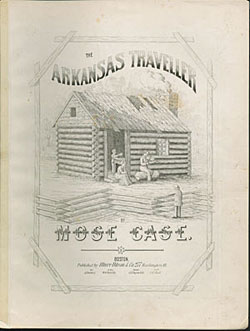
1. “The Arkansas Traveller,” title page of sheet music by Mose Case (Boston, Massachusetts). Courtesy of the Lester S. Levy Collection of Sheet Music, Special Collections at the Sheridan Libraries of the Johns Hopkins University, Baltimore, Maryland.
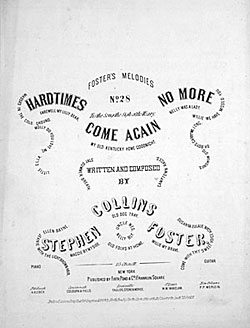
2. “Hard Times Come Again No More,” title page of sheet music by Stephen Collins Foster (New York). Courtesy of the Library of Congress, Washington, D.C.
The Newberry Consort presents historically informed programs of early music, often drawn from the collections at the Newberry Library, through an annual concert series in Chicago, national and international touring, residencies at colleges and universities, and recordings. The Newberry Consort was founded in 1986 to present public concerts of music from the collections at the Newberry Library and has offered an annual concert series continuously since 1988.
As part of our ongoing commitment to excellence in programming, we expand the usual definition of “early music” (Western European medieval, Renaissance and Baroque) to include historically informed performances of other genres, such as Polish Renaissance music and Mexican colonial Baroque music. When we began work on this program, we were astonished at the Newberry’s holdings of late nineteenth-century books and music. Then we remembered that this wealth of material came from the time when Walter Loomis Newberry and his industrialist friends were first assembling the collection. It made sense that their personal libraries would include many items from their recent history. In 1968, the Newberry Library added substantially to its holdings of Americana by acquiring the Driscoll Collection of American Sheet Music, amassed by James Francis Driscoll (1875-1959). One of the largest and most representative collections of its kind, the Driscoll Collection includes 80,000 pieces of sheet music and related materials. Driscoll was by profession a civil engineer, but music was always his passion—for many years he was the organist and choir director at Boston’s Sacred Heart Cathedral—and having a great interest in American history and music, he began collecting. As early as the 1890s, he was well on his way to amassing one of the largest collections of American sheet music.
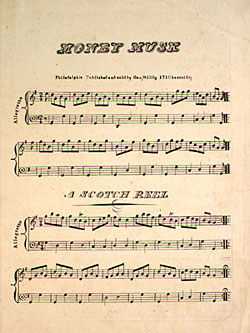
3. “Money Musk,” sheet music published and sold by Geo. Willig (Philadelphia, Pennsylvania). Courtesy of the Lester S. Levy Collection of Sheet Music, Special Collections at the Sheridan Libraries of the Johns Hopkins University, Baltimore, Maryland.
So much of our time as an early music ensemble is spent exploring European cultures that it was a welcome diversion to explore the early music of our own county. Music from late nineteenth-century America reflects the panoply of styles of the country’s vast melting pot of cultures and classes (much as it remains today). But the music also reflects the huge, untamed wilderness at the doorstep of the urban centers that fueled the imagination of performers and composers. Stories of life and death experiences rubbed shoulders with the centuries-old traditions of European cultures. As a result, our program presents an array of musical entertainments, from the fireside recreations of pioneers and sod farmers to the concert hall performances and parlor soirees of high society. We spent the same care finding old instruments or reconstructions of old instruments to play this music as we do to play Renaissance or medieval music. Nineteenth-century pianos and violins are easy to find, but a gut-strung fretless banjo from the 1860s was another challenge. We are lucky to have in our city one of the world’s experts in historical banjo, Michael Miles.
While our audience was surprised when we first presented this program on our series, they loved it, and audiences who have heard early American music only through the lens of folk traditions are surprised at the elegance and complexity in the music of Foster, Gottschalk, and others when played in a historically informed manner.
This article originally appeared in issue 13.2 (Winter, 2013).
In Search of American Music: Introduction to Common-place 13:2
What makes American music American? Is there a distinctive American music? What is the relationship between American music and music that is performed in America, that is, musical practices transplanted from other parts of the globe? These questions have commanded the attention of American music historians ranging from George Hood in the nineteenth and John Tasker Howard in the earlier part of the twentieth century, to Charles Hamm and Richard Crawford today. The essays collected in this issue on American music before 1900 provide a range of approaches and answers to persistent questions about the Americanness of American music.
Two scholars (Jeanne Eller McDougall and Nara Newcomer) explore the performance of European musical styles in their original form in North America. Both concern Europeans who travelled and settled in the coastal south during the colonial and early national periods. Other contributors (Myron Gray and Glenda Goodman) are more concerned with hybridity in American music culture. Their essays focus on how musical practices rooted in other places and eras change as a result of the unique musical and political climate of the United States. As essays by Christine DeLucia and me suggest, music could and did reflect political transformations, serving as a form of memory that shaped how composers, musicians, and listeners understood their past.
Finally, two other contributors (April Masten and Carol Medlicott) detail more idiosyncratic forms of American hybridity: Their essays explore jigs based on Irish and African American performance traditions and Shaker music, rooted in their distinctive concepts of family, society, and gender, as well as the special role they created for sacred music.
Rather than trying to define American music according to a narrow understanding and definition, the contributors to this special issue of Common-place explore the multivalent world of British North America and the United States for its first three centuries of existence. They reveal uniquely American trends in music performance, composition, and the climate for musicking, especially in the period predating recorded sound as well as the replication of European practice in the Western Hemisphere and its resonance and use in its new environment. Together, their essays explore the many ways in which music existed in the United States. The result reveals how disparate and quirky American music was in that period. For me, this issue musically captures the sentiment of E pluribus unum so central to our national character.
This article originally appeared in issue 13.2 (Winter, 2013).
Nikos Pappas, an assistant professor of musicology at the University of Alabama, is actively engaged as a scholar and performer of American music from the colonial, early nationalist, and antebellum periods. A recognized Kentucky master traditional musician, he is currently preparing a database of Southern and Western sacred music from 1750 to 1870. His research has received support from the Andrew W. Mellon Foundation, American Council of Learned Societies, the American Musicological Society, the Bibliographic Society of America, Music Library Association, and the American Antiquarian Society.
The Civil War at 150: Memory and Meaning – Special Issue of Commonplace
The making of Civil War memory did not begin only after the war ended. Americans began shaping their memories of the war in camps, on battlefields, and in homes across the nation as early as the spring of 1861. Officers wrote battle reports and soldiers jotted down diary entries, describing their experiences and shaping the war’s many histories. They picked up cotton bolls and shards of trees, bullets and buttons, and sent these souvenirs home as records of what they lived through during the war. After 1865, veterans and their families pondered these relics and thought about their wartime experiences, telling stories and sharing memories of those who had fallen in battle.
In the 1880s and 1890s, the war generation began to publish memoirs, letter collections, and other accounts while both Union and Confederate veterans’ groups erected monuments on town greens and in cemeteries across the nation, creating the war’s public histories. These texts and objects offered competing versions of the war’s events and ideologies: the North’s won cause, with its assertion of the perpetuity of the Union and the moral victory of emancipation; and the South’s lost cause, with its twin themes of defeated valor and noble sacrifice in defense of states’ rights. In the first decades of the twentieth century, white northerners and southerners began to reconcile their war memories and craft a shared narrative of white, martial manhood that ignored the contributions of black soldiers and denied the centrality of slavery and emancipation to the conflict. This new narrative of reconciliation and reunion was not uncontested, but it was strong, and it endured.
We find ourselves at a critical moment; at the sesquicentennial’s midpoint, we can assess how Americans have remembered the war, and how we might commemorate it in the future.
Fifty years ago Americans commemorated and celebrated the centennial of the American Civil War. On the surface, the centennial reflected a broad consensus among white Americans that had changed little since the turn of the twentieth century. The war was remembered through battle reenactments and in museum exhibits as a gallant struggle between soldiers who fought for their respective — and equally legitimate—causes. The war’s consequences were minimized and often ignored entirely. Below the surface, however, cracks appeared and widened. The civil rights movement, gaining ground in the late 1950s and early 1960s, transformed the nation politically and socially. African Americans challenged the nation’s collective Civil War memory by drawing its attention to the war’s legacy of emancipation and Reconstruction.
As Americans have marked the Civil War’s sesquicentennial over the past few years, the cultural impact of the civil rights movement on the dominant narrative has been clear. The anniversary’s events have emphasized the story of slavery, emancipation, the service of black Union soldiers to the war effort, and to the cause of freedom. Although this is the most salient shift in how Americans are currently remembering and commemorating the war, it is far from the only one.
A range of historical topics that take us beyond the traditional narrative of battles and leaders can now be found in public events, museum exhibits, and classrooms from Georgia to Massachusetts to California. The scholarly output on the Civil War has burgeoned, while Civil War enthusiasts of all stripes are making use of social media tools such as Facebook, Twitter and YouTube to share perspectives that do not easily fit into the standard narrative of Civil War memory.
We find ourselves at a critical moment; at the sesquicentennial’s midpoint, we can assess how Americans have remembered the war, and how we might commemorate it in the future. To this end we have assembled essays for this special issue of Common-place that examine war memory produced from the 1860s to the present, in unexpected places and with surprising results. While each essay focuses on a specific “site” of memory—battlefield parks, for example, or the published memoirs of abolitionists—what brings them together is a shared interest in challenging ingrained assumptions and established dichotomies. Like recent sesquicentennial events, they emphasize the important roles that race, slavery, and emancipation played in the war and its memory, but they also reveal that this narrative has been and continues to be contested. The essays also suggest that the war and its memory-making did not only occur only in the “North” and “South,” but also in Kentucky and Missouri, in Wisconsin and Colorado. And it not only occurred in the pages of published letters, diaries, and memoirs, but also at veterans’ events and memorial dedications. The future of Civil War memory is currently being shaped in classrooms and movie theaters, in government agencies and cultural institutions, and by individuals across the nation.
With this special issue of Common-place, we hope to illuminate the myriad ways that Americans have wrestled with our Civil War past and why we continue to return to it to bring meaning to our own lives.
This article originally appeared in issue 14.2 (Winter, 2014).
Kevin M. Levin teaches history at Gann Academy in Waltham, Mass. He is the author of Remembering the Battle of the Crater: War as Murder (2012) and blogs at Civil War Memory.
Megan Kate Nelson is visiting assistant professor at Brown University. She is a cultural and environmental historian of warfare and the author of Ruin Nation: Destruction and the American Civil War (2012).
Religion, Revolution, and the Early Republic Revisited
Religion is one of the usual suspects that gets rounded up to explain the American Revolution. It looms large for historians mainly because between about 1730 and about 1840—as British North America morphed into the early republic—the same evangelical tsunami that swept parts of the continent of Europe and the British Isles also washed over American shores. Whether Americans went with the flow and welcomed it or tried to fight what looked to them like a reactionary rip-tide has long been subject to debate, but somehow, in some way, everyone got wet. So our suspicions are well-placed that religion—and this surge of evangelical Protestantism in particular—must have shaped the American Revolution.
Efforts to explore this relationship prospered in the late twentieth century. Wonderful studies appeared showing, among other things, how the whig elite borrowed evangelical rituals to drum up support for the resistance to Britain. And how evangelicals earned their chops to defy imperial authority by defying the authority of church establishments, and even their own ministers. And how millennial beliefs in God’s special redemptive designs for the future of America shaped the rebels’ understanding of the war.
But that once so promising analysis of the relationship between religion and the Revolution seems to have sputtered to a halt. I blame—almost entirely—the over-reaching of Jonathan Clark, for whom religion explains everything worth knowing about the long eighteenth century in general and about the American Revolution in particular. To Clark what drove that conflict was “a language of liberty”—a political outlook rooted primarily in the English dissenting tradition—that mobilized colonial sentiment against England and delivered in the American Revolution what he called “the last great war of religion in the western world.” To almost everyone else, that claim was just too super-sized and unsubstantiated to swallow. Maybe that’s what spooked Jon Butler to the point of pronouncing that the American Revolution was “a profoundly secular event.”
But hey: tell that to Tom Paine, who shrewdly cast his electrifying pamphlet Common Sense as a kind of secular sermon. Tell that to the Continental Army officers headed for an assault on British Canada who stopped at a church in Newburyport, Massachusetts, descended to its basement, opened the crypt holding the corpse of the great evangelist George Whitefield, and then cut the cuffs and bands from his rotting clerical garments into little pieces which they took away as talismans. But don’t try telling that to Kate Carté Engel and Ned Landsman, because they’re trying to get our understanding of religion and the Revolution back on track.
Both Kate and Ned draw our attention to the role of the so-called “bishop controversy,” which John Adams believed “contributed as much as any cause, to arouse the attention … of the common people” against British rule. For Ned, it figures as the final battle in “an extended debate about the status of the English church in British provinces,” a vexed question first raised by the union between England and Scotland and one that paralleled and even prefigured some of the political concerns of those who could envision America as the future seat of the British Empire. Here we have a far better supported application of Jonathan Clark’s view that the contention over political and religious subjects was frequently the same conflict carried on at two different levels. Kate comes at the bishop controversy from another angle, viewing it as a crisis that revealed the actual weakness of transatlantic religious networks. Both New Englanders and English dissenters talked the talk of Protestant internationalism and unity, but when the conflict between Britain and the American colonies escalated, they did not walk the walk. Instead, that controversy cleaved that transatlantic community, disabling it from doing much of anything to quell the mounting colonial opposition to the British Empire. Hats off to Kate for an ingeniously perverse argument: in this instance, religion becomes important to the American resistance not because of what it did, but because of what it failed to do.
What I like about both approaches is that they show us that the transatlantic perspective provides an indispensable context for understanding how religion shaped the path to resistance and revolution. Looking at religion on both sides of the Atlantic also raises a question that so far no one has asked: Why did the Revolution make so little difference in terms of the trajectory of the early republic’s religious development?
Now, I know what you’re thinking: No one has asked that question because it’s so dumb. After all, what about the separation of church and state, with its commitment to full religious liberty replacing mere religious toleration? And what about those Calvinist theologians tweaking their doctrine to bring it more into line with republicanism? Well, sure. But if we look beyond constitutions and theology to the religious identities and loyalties of most people and the ways that both were trending, the early republic looks a lot like England. Let me mention only two of the most important similarities.
First, even though a very long revolutionary war interrupted that tsunami of evangelical expansion in the new United States, it welled right up again, more powerful than ever, in the decades following the Revolution. That meant that in the early republic, as in England during the same period, the most rapidly growing religious groups were evangelical in their orientation, and the most successful were populist in their appeal. On both sides of the Atlantic, it was the upstart Methodists who grew by leaps and bounds, and the stunner is that in the United States they even managed to recover from their leaders siding with the Loyalists in the American Revolution. Recent work by Emily Conroy Krutz and Ashley Moreshead also sets forth the many ways that, within those evangelical ranks, the vision of Protestant union endured. Despite the Revolution, even despite the War of 1812, evangelicals, like Kate’s eighteenth-century dissenters, continued to build those “personal, institutional, and textual networks” that bridged the Atlantic. Religious nationalism was growing, but not—at least not yet—at the expense of Protestant internationalism. Second, both England and the United States exhibited an anti-Catholicism even more rabid than its earlier incarnations, and for exactly the same reasons—a combination of immigration from Ireland and the remolding of Protestantism by an evangelical movement that made the animus against Catholics essential to its identity.
These fundamental similarities in the Anglo-American experience raise the question of how much difference, if any, the Revolution actually made in terms of the character of religious life in the early republic. Crucial as religion might be to understanding the resistance and the Revolution, it may well be that the impact of the Revolution on the United States’ subsequent religious development has been overrated—that it’s the dog that doesn’t bark or the gun placed on the mantle during the first act that doesn’t go off at the end of the play. I raise this possibility, at least in part, to match Kate’s perversity, so I would welcome anyone who disagrees to shout Woof! or Bang!
This article originally appeared in issue 14.3 (Spring, 2014).
Christine Leigh Heyrman is the Robert W. and Shirley P. Grimble Professor of American History at the University of Delaware.
Literacy Then and Now
“Why are you in school?”
I posed this question to Michael Haynes’s and Diana Maloziec’s fifth-grade classes at Heninger Elementary School in Santa Ana, California. The ensuing discussions revealed that the students wanted to be in school. They felt that education would help them get good jobs and realize their ambitions. I pointed out that they were legally required to attend school until age sixteen. (Actually, I later learned, the legal age in California is eighteen.)
“So I can leave school when I turn sixteen?” asked a boy in Michael Haynes’s class.
This was not my intended message. I was leading teams of college students into the portable classrooms in the yard at Heninger, a structurally small school that has over 1,100 students cycling through on a year-round schedule. We were all participants in Humanities Out There (HOT), an outreach program of the School of Humanities at the University of California, Irvine, and we hoped to help the two classes of fifth-graders develop the skills and inspiration to go on to college, particularly through exposure to the humanities. We were piloting a fifth-grade U.S. history curriculum that I am developing through a research assistantship; this was the second of five weekly visits to Heninger during fall 2001. HOT works exclusively with public schools in Santa Ana, which was described in a recent New York Times article as “among the poorest districts in the nation” and has a correspondingly low rate of college enrollment. In other words, these fifth-graders are statistically unlikely to achieve the material goals they seem to feel education should make attainable.
“Why do you think children went to school in early New England?”
The students imagined that early American children went to school for the same reasons they did, but I pointed to an early precedent for contemporary compulsory education laws: the so-called “Old Deluder Act” of 1647. The Massachusetts General Court called for every town to establish a grammar school in order to thwart “one chief project of that old deluder, Satan, to keep men from knowledge of Scriptures . . .” I wrote this quote on the board, explaining the unfamiliar words. The “Old Deluder Act” suggests a different set of expectations of education and a vastly different curriculum.
I asked the students what kinds of seventeenth- and eighteenth-century sources we might look at to learn more about education in early America. A few, demonstrating a good understanding of the concept of primary research, suggested letters and journals. No one mentioned textbooks, but when I proposed to look at one they agreed it would be a good idea. At this point, we distributed excerpts from a 1727 edition of the New England Primer and broke up the thirty-plus students in each class into six groups. Each group was accompanied by an adult, either a UCI student or a classroom teacher.
The New England Primer was the ubiquitous schoolbook in eighteenth-century America, not only in New England but in the mid-Atlantic as well. The earliest extant edition is from 1727, but its origins, attributed to a zealous Protestant printer, Benjamin Harris, are in the late seventeenth century.
Our excerpt included the famous pictorial alphabet and the subsequent section, “The Dutiful Child’s Promises.” The twenty-four-letter alphabet (I and V are omitted) is illustrated with woodcut pictures and rhyming verses, beginning:
Fig. 1. A from the New England Primer, 1727. Courtesy American Antiquarian Society.
A may stand for the fall from grace, but the initial letter of the alphabet is also the first signpost on the road to redemption, to be gained by reading God’s word:
Fig. 2. B from the New England Primer, 1727. Courtesy American Antiquarian Society.
Diana Maloziec was excited by this literacy theme; she said it accorded perfectly with the historical novel she had been reading to her students, The Diary of Remember Patience Whipple, about a fictitious twelve-year-old passenger on the Mayflower.
It was difficult to avoid getting caught up explicating all the biblical allusions in the alphabet. The students are mostly immigrants from Mexico or the children of immigrants; most are Catholic, some of them churchgoers. While they were unfamiliar with the doctrine of original sin, they knew who Adam and Eve were. Zacheus, however, was a complete stranger (and the s‘s that look like f‘s confused everyone).
Fig. 3. Z from the New England Primer, 1727. Courtesy American Antiquarian Society.
“Is it true,” asked Rocio, “that the Devil used to be an Angel?”
“Yes,” I said, “according to the Bible.” She laughed, because I was qualifying nearly every statement with “according to the Bible.” I felt uncomfortable talking about Bible stories in a public-school classroom (just as it had felt quite odd, in writing the “Old Deluder” quote on the board, to spell out S-A-T-A-N). Yet the incongruity of this material was precisely what I hoped to bring out, to illustrate the radical difference between the experience of a ten-year old in eighteenth-century New England and one in twenty-first-century California.
As the literary scholar David Watters points out, the course from Adam‘s fall to Zacheus‘s climb is ultimately redemptive and hopeful. The stations in between, however, are sufficiently stern and morbid. From F, the students could infer that the Puritan schoolmasters were hardly indulgent.
Fig. 4. F from the New England Primer, 1727. Courtesy American Antiquarian Society.
G, R, T, X, and Y are all reminders of imminent death. Y, with the specter’s arrow pointing to a little girl, is particularly haunting. The New England Primer emerged from, in David E. Stannard’s phrase, “a world in which the presence of early death was everywhere.” The progress toward conversion could be construed as a race against time.
Fig. 5. Y from the New England Primer, 1727. Courtesy American Antiquarian Society.
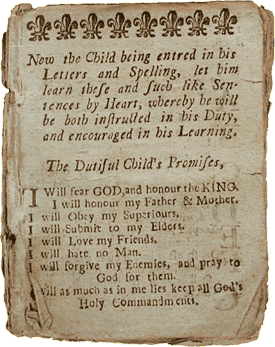
“The Dutiful Child’s Promises” offer a glimpse of eighteenth-century pedagogy, with its emphasis on rote learning. It illustrates a culture in which a child’s guiding principle was obedience:
Fig. 6. “The Dutiful Child’s Promises” from the New England Primer, 1727. Courtesy American Antiquarian Society.
We concluded the hour-long lesson by having the students work on their own alphabet, with verses and pencil drawings in the style of woodcuts. The Santa Ana Primer would be as revealing about the present-day as the New England Primer is of the eighteenth century.
It proved to be a difficult assignment. I had to relinquish my idea of having each group produce a section of the alphabet, so as to have a complete alphabet from each class; instead I let the students choose their own single letters. As it was, they had some difficulty coming up with verses. “What values are important to us today?” I asked. “Who are your heroes?”
Fig. 7 Student Image
Fig. 8 student image
Several students drew pictures of flags and wrote verses about freedom. Others echoed the New England Primer’s emphasis on literacy:
Fig. 9. H from the New England Primer, 1727. Courtesy American Antiquarian Society.
Fig. 10. Student image
The original readers of the New England Primer began their studies with the prospect of heaven ahead and hellfire behind and on both sides. The creators of the Santa Ana Primer wouldn’t define the stakes so dramatically, but they are nonetheless invested in their education.
Fig. 11. Student image
Fig. 12. Student image
Further Reading: The New York Times citation is from Jacques Steinberg, “Economy Puts Schools in Tough Position,” 26 November 2001. The groundbreaking study on the Primer is Paul Leicester Ford’s The New England Primer: A History of its Origin and Development (New York, 1962), which includes a facsimile of the New York Public Library’s 1727 edition. Ford’s introduction would be especially useful for teachers interested in showing the fascinating and historically significant changes in the alphabet poem over the publication history of the Primer. See also Gillian Avery’s “Origins and English Predecessors of the New England Primer,” Proceedings of the American Antiquarian Society 108:1 (1998) 33-61. The images used here are from the other existing 1727 edition of the Primer, owned by the American Antiquarian Society; see Marcus A. McCorison, “American Bibliographical Notes: The New England Primer Enlarged,” Proceedings of the American Antiquarian Society 108:1 (1998) 63-66. David H. Watters presents an intriguing literary reading in “‘I Spake as a Child’: Authority, Metaphor and The New-England Primer,” Early American Literature 20:3 (winter 1985-86) 193-213. The citation from David E. Stannard is from his “Death and the Puritan Child,” American Quarterly 26:5 (December 1974) 456-76. The Diary of Remember Patience Whipple is written by Kathryn Lasky (New York, 1996).
An online facsimile of an 1805 Primer is available on Colonial America Resources run by Timothy Shannon of Gettysburg College. For information on Humanities Out There, please visit their Website.
This article originally appeared in issue 2.3 (April, 2002).
Andrew Newman specializes in early American literature as a Ph.D. student in the Department of English and Comparative Literature at the University of California, Irvine. He holds a 2001-02 research assistantship with Humanities Out There, an outreach program of the UCI School of Humanities.
Crossing Frontiers: Early American and Native American histories
Joshua Piker
Early Americanists seeking to write effective Native American history have two cultural frontiers about which to worry. The first, and most obvious, is the one separating a twenty-first-century scholar (particularly one of non-Native descent) from the colonial-era people s/he writes about; the second is the one that divided Natives and non-Natives in early America and that continues to segregate our narratives about this period. Ignoring either does a disservice to both the people we write about and the broader project of understanding early American history. My book focuses on a particular Indian community and on its connections to its non-Native neighbors. I hoped to write a distinctly Native history that was also recognizably American. Or, to put it another way, I wanted to suggest a way to cross both frontiers.
The frontier separating modern-day Americans from the Native inhabitants of early America is a daunting one. Distance distorts; difference confuses. How do we write about people who are so distant from us in time and different in culture? Contemporary politics and the “ownership of history” aside, the answer implicit in my book is simple: take Native culture seriously. This is not, I hasten to add, just another call for treating Indian culture with respect. The need—both moral and intellectual—to do so is widely accepted; whatever the shortcomings of modern scholarship, reputable historians no longer write about Indians as primitive savages. Nor do I mean only to suggest that historians should acquire a broad understanding of the beliefs and practices of the people they study. Again, we know that such knowledge is necessary. By “take Native culture seriously,” I mean that we must treat the culture of the Native people under consideration as something with its own structure, logic, and power. Doing so means accepting some uncomfortable truths. The categories we in twenty-first-century America are conditioned to use may not make sense in eighteenth-century Native society; the values that we assume are natural may have seemed anything but to early America’s Native peoples. And, most disconcertingly, the Natives’ categories and values—their culture’s structure and logic—had the power to shape Native life into forms that we do not expect. Our histories must reflect all of this. Taking Native culture seriously requires that we abandon the attempt to put Native wine into European bottles. Whatever else my book may accomplish, it demonstrates that coming to terms with a Native culture’s structure, acknowledging the logic that such a structure imparted to a group of people, and tracing the impact this logic had on their beliefs and behaviors allows us to write a new sort of Native history.
My book focuses on the Creeks and is built around the central structural tenet of eighteenth-century Creek social life: the world was made up of communities. Creek country contained somewhere between fifty and sixty communities. Whether the Creeks who lived in them were Upper or Lower Creeks, deer or wind clan, they were first and foremost townspeople from Tuckabatchee or Coweta, Cusseta or Okchai. Moreover, Creeks assumed that their neighbors organized the world in similar ways. So, logically enough, they dealt with Chota or Tellico (not with the Cherokees) and with Charleston or Savannah (not with the British). Did the Creeks recognize that larger-scale sociopolitical units existed? Of course, but they knew that towns were the basis of larger polities, not vice versa. This was the world in which they moved; this was the structure and logic that guided their actions. Their history began with the community.
My book does the same. It is not a history of the Creeks. It is, instead, a history of eighteenth-century Okfuskee, one of the most important Creek towns located in what is now eastern Alabama. The book begins with the Okfuskees’ actions outside of town and, in particular, with their evolving relationship with Charleston. Tracing this cross-cultural dialogue allows us access to the Okfuskees’ geopolitical worldview—their understandings of the options available in a particular present, their stories about the past, and their visions of the future. I then turn to a consideration of how the Okfuskees’ shifting worldview affected their hunting patterns and their relations with Euro-Americans who lived in the backcountry. With these sections in place, I have the framework necessary to discuss life within Okfuskee. I devote separate chapters to the townspeople’s efforts to find a balance between traditional agricultural practices and the imperatives of a new herding economy, to their relations with British traders and their engagement with transatlantic markets, and finally to the Okfuskees’ most personal relationships—those between young and old, male and female. The end result is a unique discussion of both colonialism’s impact on an Indian community and that community’s place in national and international relations. Even more than that, though, I hope the final product is a distinctly Native history, a history that shows that crossing the cultural frontier separating modern-day Euro-Americans from colonial-era Natives Americans is both possible and revealing.
And what of that other cultural frontier? What of the frontier that set eighteenth-century Natives apart from their Euro-American contemporaries and that continues to divide our histories of early America? Perhaps the best way to think about this particular frontier is to see it as real and important but also as artificial and limited. Its reality divided early America into cultural zones whose importance is attested to by the discomfort people felt when moving from one zone to another. And yet that very movement of people—to say nothing of the goods and ideas that accompanied them—suggests that tracing frontiers is an artificial exercise, that the ability of individuals and groups to remain both socially isolated and culturally distinct was profoundly limited. Our task, then, is to strike the right balance. Early Americans crossed frontiers repeatedly—many did so on a daily basis—but they did not lose track of the frontiers’ existence. As we seek to understand their world, we should follow their lead. Of course, that is easier said than done.
My effort to cross this particular frontier involved tracing out “peculiar connections,” a term I borrowed from a Georgia governor who wrote that the Creeks “are peculiarly connected with this Province.” The phrase reminds us that frontiers could be crossed, that connections could be formed between Natives and colonists. So, in Okfuskee, I trace out the Okfuskees’ experiences with developmental processes that crossed cultural frontiers. Thus, for example, Okfuskees who traded freely with Euro-Americans incurred intangible costs that would have been familiar to those same Euro-Americans: living standards rose but so did dependence on imported goods; new avenues for personal expression such as exotic clothes and unfamiliar beverages became available, but with these came new ways for strangers to influence Okfuskees; and goods such as firearms and metal tools eased certain aspects of Okfuskee life but did so at the expense of older methods of sustenance and defense. If these are recognizably American processes, and I believe they are, then Okfuskee was in some sense a American town. But only to a point. Native Americans did not become colonists; they remained “peculiar.” Part of this peculiarity, of course, stemmed from real cultural differences and the effects such differences had on each people’s experience with, for example, trade. But, in trading relations as with other aspects of Okfuskee life, part of the peculiarity was manufactured, the fallout from (to quote the historian Michael Merrill) “the politics in political economies.”
For the Okfuskees found themselves facing an unlevel economic playing field, one characterized by restricted markets, a European belief that debts incurred by individual townspeople were the Creek nation’s responsibility, and a credit system predicated on a degree of social legitimacy that Indians were not permitted to attain. These were peculiarly Native problems, and they grew more onerous over time. Okfuskee argues, in fact, that Native peculiarity was to some extent produced during the colonial era; the book demonstrates how, in an Indian people’s relations with their Euro-American neighbors, peculiarity came to override connections, producing Native difference out of broadly American experience. The phrase “peculiar connections” thus allows us to cross a cultural frontier while also suggesting how that frontier became ever more impenetrable over time. In doing so, we move closer to writing histories that are—as I hope Okfuskee is—at once Native and American.
This article originally appeared in issue 5.3 (April, 2005).
Common-place asks Joshua Piker, assistant professor of history, University of Oklahoma, and author of Okfuskee: A Creek Indian Town in Colonial America (Cambridge, Mass., 2004), how can an early Americanist cross the cultural frontiers present when writing about Native Americans?
Puritan Spectacle
Three poems
In God’s Altar: The Word and Flesh in Puritan Poetry (Berkeley, 1978), the literary critic Richard Daly writes that, for the earliest New England colonists, “symbolic correspondences occur . . . at the level of perception.” I am interested in the way language, perception, and existence are central to the difficult lives of these American Puritans. My poems explore this phenomenon as the source of distinctly American expression.
They work specifically with the requirement for publicly delivered conversion narratives, sometimes called professions of saving grace, that were a prerequisite for full church membership in the seventeenth-century Massachusetts Bay Colony. [Examples of these narratives can be seen in God’s Plot: Puritan Spirituality in Thomas Shepard’s Cambridge (Amherst, 1994), edited by the historian Michael McGiffert.]
My poem “The 88 Hearts of Wm. Adams” is written around an early conversion narrative I transcribed from the Massachusetts Historical Society archives. The title of the poem is derived from the overwhelming number of times Adams mentions a motion of his heart in the course of his twelve-page narrative.
“Visible” takes its title from Edmund S. Morgan’s classic study Visible Saints: The History of a Puritan Idea (Ithaca, 1965) and the saints’ central dilemma of making oneself an outward, visible sign of an inner, unknowable, and unconditional election to grace. The tortuous tautology of “I must show what cannot be shown” yields much difficult beauty in Puritan expression and, I believe, continues to resonate in American poetry. “Visible” suggests that this beauty exists only where those inner truths and outer impossibilities collide: on the skin, in the eyes, in breath.
Brought into the Puritan fold by the missionary work of John Eliot and joined to their own congregations by full professions of saving grace, the “Praying Indians” of the Massachusetts Bay Colony faced the deep contradictions of visibility during King Philip’s War. They found themselves exiled to Deer Isle in Boston Harbor for the duration of the war where many starved to death. “A Bold Plea for the Easement of Suffering of these Professed and Reading Red Saints” is a voicing of the pleas, not only by the minister Eliot on behalf of fellow Christians, but also by a literary man for the protection of his best linguists and translators—the Christianized Indians.
The poems presented here explore an array of formal structures and expressive modes; I choose this strategy in allegiance with those colonists—be they antinomians, shy public performers, or native Algonquian speakers—who struggled against the predetermined and mediated structure of a required profession to communicate their experience of God’s saving grace. These poems pay tribute to those who faced the impossible task the Puritans required of themselves above and beyond mere physical survival: describing in words what they insisted was beyond language, what they insisted was the nigh-perceivable evidence of their relationship to God.
The 88 Hearts of Wm. Adams
d. 1659, Ipswich
Hollowed by shadow or shone forth By sometimes more Than ordinary stirrings Against the awful ways
Occasion offers, I will tell you The incision in my chest, Let the mouth confess up What the heart congests:
Pull aside my shirt, my Addiction is stitched, stripped Of circumstance, stripped of habit, Confined to four chambers & their flagellation.
Pour black powder below The smooth balls of shot Set in each chamber. Make fire by focusing, take flight
In the off-beat between Each flutter—such like thoughts Do much take me up— It’s said this almost endless
Muscle is our weapon, in & out It goes without meaning or sense Being lost—limited Only by half-life in a body
That diverts blood away From less important humors To keep an extra beat From tripping the flintlock.
Armed, quitting earth For the church turret I saw a bird Change energy at higher elevations & Clear out the thunderclouds
Like a topsail to loose itself In the sky—my dull lusts Let go as a fistful of dead petals Flew round my feet & the war
Of good discord went off In my chest. I fell with fatigue Of breathing in thankfulness For this new frame.
Limping home, The storm seemed to go over. I slacked my pace & was overwhelmed in rain.
Will I falter like faith or Will I falter like fear? Things fall From the sky we see
With our eyes. This spring A swan did move easy In the river’s shifting ice-splinters As my flint failed, its neck motionless
As if stitched To the white heart of a bird Not beating her wings & not falling.
Visible
waterproof with metaphor more than encasing heaven eyes make every move, each window, wet lightning hits the lights out, all us at last see each other only like souls again walking this hard, electrified land in sight not deeper than skin thin shallows poured upon like milk muddied upward toward out in the air between us, groaning bones to cleave to as tongues to significance, to hot, to (I am my map of) when the church burned down some got charred, repainted the hall and parlor for appearance, for appearance degenerates into personality, personality a vain plaything—
[they armor as the congregation fronting the wreckage framed in fading light, a quarter faithful, porcelain features pre-disposed to being ill-treated, little ink edges under the skin rose pink: reverse if seen from the inside or thin pond-surface]
it’s encased intention attached to the small safety of saying attacked to the danger of appearing over and over every day you might lovingly release the touch you’ve taken too extremely to such outsides disappear into ideas, a whole body fed by eyes only feel beauty then to be misleading
A Bold Plea for the Easement of Suffering of these Confessed and Reading Red Saints
Rev. John Eliot King Philip’s War Massachusetts, 1675
The sermon of the day is: physicians, books, the lost tribe of knowledge is forecast to unmanifest its fatal arrows: operate in this drastic forest of articulate sounds, please send bread and fish: starving guttural sounds aspirate at back the throat (where we shy from letting our own thoughts go even so deep: the way we think Devil where Oak and Fir cloak their universal sense and church, their not having words and we have nothing to carry them outside our own tongues: For he that speaketh in an unkown tongue speaketh not unto man, but unto God). Sirs, four hundred saved red souls starve on Deer Isle, selecting stones, as other sermons run to prophecies and fort defense: daily we drown in discovering loose heads strewn on the highway, as in the Bible: we must translate this universal nourishment to all tongues: every instrument set to work does press for pay, and in this desert the sermon of the day prays the biggest boats closer, waves the marked arm rising off Death Isle, says bring budgets and bring butter and that best Word: the least generous omniscience of our own utter limit unto death (or coming into sight) of those yet tasting what charity and what, already, we are capable of having done. What? came the word of God out from you? or did it come to you only? The press needs also twelve pounds each of fresh k’s and l ’s to conform this ancient Hebraic language to the rules of our alphabet.
This article originally appeared in issue 5.3 (April, 2005).
Robert Strong is a poet and independent scholar living north of the Adirondack Park. His manuscript Puritan Spectacle, from which this work is drawn, was selected as a finalist for the Beatrice Hawley Award from Alice James Books and the Wick Prize from Kent State University Press. He completed this collection of poems with the generous help of a Mellon short-term research fellowship at the Massachusetts Historical Society. He is currently preparing a scholarly introduction and contextualization of William Adams’s conversion narrative.
Family Values: Lessons in material culture
Give me the death of those
Who for their country die;
And, O! be mine like their repose,
When cold and low they lie!
In kind embrace our mother earth
Enshrines the fallen brave;
In her sweet lap, who gave them birth,
They find a tranquil grave.
A Soldier
—From John J. P. Blinn, “The Citizen Soldier,” Wabash Monthly (1860)
I.
As a research librarian for the past twenty years, I have often envied the scholar who made a serendipitous discovery in the stacks—a stash of historic letters tucked inside a book, an adventurer’s lost diary, a rare book shelved alongside the ordinary. Little did I imagine that a chain of such discoveries would occur in my own life when six months after my mother’s death I traveled from my home in New Haven, Connecticut, back to Chagrin Falls, Ohio, to spend a week with my father organizing family memorabilia.
My father—approaching his eightieth birthday—was eager to put grief behind him and start anew. Feeling blessed by the prospect of good health and new friendships, he wanted to disencumber himself of the family possessions that my mother had carefully shepherded back and forth across the country as the family trailed my father in the corporate chain of transfers. With the seventh move and the addition of my deceased grandmother’s “treasures,” my parents settled for their last twenty years in a historic residence—an enlarged country schoolhouse situated on the edge of the Cat’s Den, a small grotto that according to local legend was the haunt of wild cats. While my father looked to the future, I delved into the past.
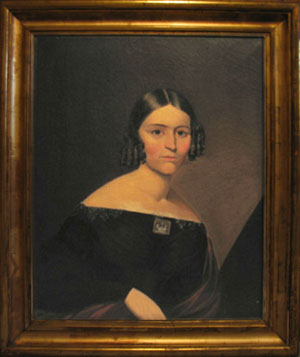
Starting in the dining room, I stared blankly at the large gold-framed portrait of a young woman. Although I had walked past her a hundred times, I had never stopped to ask, “Who is she, the woman with knotted braids gracing her rose-tinted cheeks?” She had hung there since my grandmother’s death twenty years ago, and perhaps I had been told who she was, but I never paid any attention. “She may not have been a relative,” my father observed. “I don’t think Nancy even knew for sure.” Of course she did know, having inherited the painting from her mother, but now I would have to make that discovery on my own.
Fig. 1. Dorothea Froment Blinn (1812-90), unsigned oil on canvas, c. 1837. Thirty-by-twenty-five-inch image; four-inch, gold-leaf frame. Photograph courtesy of the author, original in private family collection.
After several days of cleaning and sorting, I came across a box of my grandmother’s photographs. There I discovered a small black-and-white image of an oil portrait of a young man, posed and framed to match that of the woman hanging in our dining room. Turning it over, I found penned on the back: “Portrait Horace Blinn, over piano in L.R.” If this was Horace Blinn (1801-60)—my great-great-great-grandfather—then the woman in question surely must be his wife, but which one? He married three times. What had happened to his portrait and why had the two been separated? I tucked the black-and-white photo into the edge of the framed portrait in the dining room as an inspiration to keep searching.
With the help of books about silver, furniture, and porcelain checked out from the local public library, I tried to identify items of value and mark them for family members. Toward the end of the fifth day, I decided to empty out a kitchen cupboard, expecting to find stuff that would be easy to throw away. At the bottom of the heap was an old spiral-bound notebook. Aimlessly flipping through it, I found the unexpected: “Inventory August 22, 1977,” amended, “January 14, 1978—Helen Blinn Johnston.” Here were the clues that I needed: my mother’s notes about her mother’s furnishings, listing items room by room. Dining room: “Portrait—Dorothea Froment Blinn—HBJ’s Great-grandfather’s 3rd wife—Terre Haute—She came from New York, circa 1825; Insured for $500; Jim B. has husband over his mantle.”
So now I knew: the subjects were a couple, and the portraits a matched pair split up when my grandmother, Helen Blinn Johnston, acquired Dorothea and her brother acquired Horace. I had thought that the Blinn family migrated from Wethersfield, Connecticut, to Cincinnati, Ohio; what then was the reference to Terre Haute? I had just returned from living in Bloomington for five years, a short distance from Terre Haute, and no one had ever mentioned family connections in Indiana to me.
Fig. 2. Horace Blinn (1801-60), c. 1837. Photograph of oil portrait, original in private family collection.
My father was elated at the news and, eager to rid himself of the “hideous portrait,” he emailed my mother’s cousin, who had inherited the mate. Perhaps, he suggested, it was time for the pair to be reunited.
Following the advice of a family friend, I insisted that we get the portrait appraised before deciding what do with it. My father complied, reluctantly loading the portrait into the car for a trip to a fine arts gallery in Cleveland. After taking a photograph, the appraiser returned her to us, and the painting went back on the dining room wall. It would take a few weeks to get the report.
In the meantime, I could return to the arduous task of separating the valuable from the invaluable. My mother’s annotated inventory was of great help:
glass plate—”Give us this day . . .” belonged to Grandmother Blinn’s family—Terre Haute probably
The week came to an end and it was time for my flight back to New Haven. Armed with copious notes, inventories, and piles of receipts, I promised to put my findings in a spreadsheet to share with my father, sisters, and brother. Congratulating myself on finishing the most difficult task, I planned to return to Chagrin Falls in late May to dispense with the family letters and photographs. In truth, I had no interest in becoming the family’s historian and left the papers until the end, rather dreading the thankless task.
Meanwhile back in New Haven, I began looking for a suitable home for the portrait of Dorothea Froment Blinn. I first contacted the Vigo County Historical Society in Terre Haute about the painting. The director’s response was enthusiastic: indeed, they would be very interested. The director told me that Dorothea was the wife of a pioneer settler, Horace Blinn, and the mother of a Civil War hero—Captain John J. P. Blinn—whose uniform, sword, and other military memorabilia were on display at the museum. The historical society also had a family scrapbook about him and several autograph letters, including one he wrote to his mother in September 1862 that, according to the director, always brought tears to her eyes. “On the eve of a great battle,” it begins, “I have sat down upon the ground, and with my saddle for a table, to write a few words to the loved ones at home.” What makes this letter especially poignant is that John survived this battle, Antietam, only to be mortally wounded at Gettysburg the following July. Dorothea, the director told me, would travel from Terre Haute to the battlefield hospital in Gettysburg to nurse him, only to arrive a few days before he died on July 14, 1863. He was only twenty-two years old, an extraordinary young man.
Fig. 3. John J. P. Blinn’s dress uniform, gilded sword, and epaulettes on display with his photo at the Vigo County Historical Society, Terre Haute, as photographed by the author in September 2004.
I agreed to keep in touch while the family awaited the appraisal of the portrait. It was unfortunate, I thought, that my mother never knew about Captain John Blinn. She would have loved that letter from the battlefield in Maryland and, of course, would have enjoyed sharing it with me. I remembered the proud moment in sixth grade when I won a school competition to recite the Gettysburg Address at the annual Memorial Day ceremony at the cemetery in Chagrin Falls. I recall so clearly standing in our driveway at the crest of the hill and practicing with my mother who patiently coached me from the “audience” in our backyard. What if we had known that one of our kin had given, in Lincoln’s immortal words, his “last full measure of devotion?”
As I widened my search for information about my newly found uncle, my father called to say that the gallery had assigned the portrait an insurance value of ten thousand dollars. “Can you believe it?” he asked. Actually, yes, I could. I had seen an episode of Antiques Roadshow when a young girl brought an early American portrait her mother had rescued from “the dump.” Unsigned, without provenance, in need of repair and without a frame, it was appraised at an auction value of $2,000 – $3,000. And now, unbeknownst to the appraiser, our portrait was connected to a man who had given his life to preserve the union.
I uncovered more information by searching “Blinn” at the Vigo County Historical Society’s Website where the young captain was featured in several profiles. I found a signed photograph of him in his military uniform at the Indiana State Library’s Website, Civil War Soldier Photograph Exhibit, where he was mislabeled as “Blim.” I read other accounts of Blinn and located an early biographical sketch about his father, Horace Blinn, transcribed as part of the Vigo County Indiana Biographies Project. Later, I would find among our family papers two typed transcripts of this extract—one, annotated with corrections by my great-grandfather and the other, written by his brother, who added a couple of paragraphs about Horace based on family stories.
As my knowledge about the family’s past grew, I emailed a few relatives with news of my findings, but no one really shared my enthusiasm. I heard back only from two of my mother’s cousins. They felt it was important to keep the portrait of Dorothea in the family for the benefit of future generations and they wanted to make us an offer for the painting: how much would we be asking? “She is not for sale,” I thought. She belongs in Indiana, reunited with her son, John, the Civil War patriot who grew up in Terre Haute, began his military career at Wabash College in Crawfordsville, and was among the first soldiers from his native city to volunteer for service, soon after the fall of Fort Sumter in April 1861.
II.
I finally finished the spreadsheet describing the more than two hundred household items my mother had collected. The immediate family laid claim to their favorites—the Victorian bedroom set, the Quimper china, the coin silver spoons, the pendulum clocks. We agreed the family would keep those things—chipped, tarnished, and scarred though they are—that had been passed down through multiple generations. The rest would be sold at the estate sale.
As planned, I returned to Ohio in late May, white gloves and husband in tow, with only a few days to organize the family letters and photographs. I looked forward to finishing the task quickly. However, it would soon become obvious that my real work had only begun: tucked among dozens of unidentified daguerreotypes and scores of letters, I found firsthand evidence of the soldier himself.
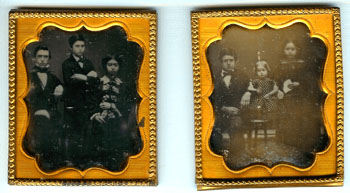
Wrapped carefully in a handkerchief, lying face to face, were two daguerreotype group portraits of John J. P. Blinn and his siblings, three children in each one, their images partially obscured by deterioration. A scrap of paper with their names fell out: Amory, the eldest son, and the only surviving child of Horace’s second wife, sits by Horace Jr., arms crossed, in the middle, and Charlotte to the right. In the companion photo, John, a young adolescent, is next to Sarah, a toddler, who sits like a china doll atop the stool, with Julia to the far right.
Among the scores of letters—far too many to sort through—a small booklet with a dark navy cover and gold lettering stood out:
GREGORY’S EXPRESS
POCKET LETTER BOOK,
DESIGNED
TO FACILITATE CORRESPONDENCE BETWEEN CITIES AND
TOWNS, AND THE MINING DISTRICTS IN CALIFORNIA,
AND ALL PARTS OF THE UNITED STATES.
Fig. 4. Daguerreotypes (left to right): Amory, Horace, & Charlotte; John, Sarah, & Julia, c. 1855, from the author’s collection.
It was a letter from the children’s father, Horace, written on April 16, 1851, to Charlotte while prospecting for gold with his son Amory in California—another piece of my family’s history that was unknown to me. My mother had started to transcribe it a few years before her death, but stopped about half-way through. “It is a kind of Lottery business to get anything handsome,” Horace writes from Owsley’s Bar on the Yuba River. “The great majority do not realize a Fortune. It is hard work to get Gold here even in small amounts—”; Still, he continues: “We think we can make more here than we can at home— Indeed we ought—for the Miner’s Life is a miserable one—If it’s not our fortune to strike any Rich Diggins—we will try to make the poor ones afford enough to take us Home.” So John’s father, who was the son of a sea captain born on Independence Day, 1776, in Wethersfield, Connecticut, had not only pioneered to the West in 1825, settling in Terre Haute, but also on the eve of his fiftieth birthday had traveled overland to California.
Rifling through the last plastic bin of papers as the second day drew to a close, I came upon a handful of letters beautifully preserved, written in a flowing script, by John J. P. Blinn himself. Here, at last, among the miscellaneous accumulation of the family’s past, I struck gold. There were ten letters in all, written to his younger sister, Julia, and to a family friend, Charles Hosford, from various encampments in Virginia and Maryland in 1861 and 1862. My husband set about reading them, finding John’s elegant hand easy to decipher and his thoughts remarkably sensitive.
As I sorted through the papers and photos, he would read me a choice passage. John is encouraging his younger sister to get a “liberal education.” And, in one poignant and intriguing passage, he tells Charles that he especially cherishes his “warm-heartedness and true friendship” because Charles was there with John’s father, “when the unfortunate accident occurred which ended his life.” What was this “unfortunate accident” that took Horace’s life? In other letters, John describes various battles, telling his sister how he is sickened at heart after his regiment’s losses at Antietam. Like a good many officers in the Civil War, he complains about the “system” for promotion that often rewarded soldiers for their political connections rather than their accomplishments in the field. “Rank is nothing in this service, and is only desirable for its pay,” he writes Julia. “It cannot be respected as long as so many incompetent officers occupy prominent positions.”
Impressed with John’s candor and eloquence, my husband and I agreed that these invaluable papers and photographs should accompany us back to New Haven. I would delay any decisions about where or how to disperse them until I had given everything more careful consideration.
Had I continued as associate dean of libraries at Indiana University, I never would have had the time to discover John J. P. Blinn. Instead, I would have taken a couple of days off to attend my mother’s memorial service, claimed a few family heirlooms without knowing their provenance, and returned to work, never giving a second thought to the fate of family letters. I was accustomed to keeping my professional and personal lives separate. At work, I was concerned with preserving resources for future generations of scholars; at home, it never occurred to me that I might advise my mother about the proper care and dispensation of family papers. While evaluating the database, Archives USA, for the library, I never thought of searching it for collections relating to my own family. When I announced the acquisition of an electronic collection of American Civil War letters and diaries, I never imagined that I would later use it to learn about my family’s past.
III.
Almost a year has gone by since my original discoveries. My father has remarried and is preparing to move into a condominium in the village. The house at the Cat’s Den is empty and on the market—its contents either distributed among family members or sold.
Meanwhile, I am reconstructing my family’s history. I have transcribed more than two dozen of John’s letters gathered from six repositories nationwide; read his essays in the Wabash Monthly, at the Robert T. Ramsay, Jr. Archival Center of Wabash College; obtained his compiled military service file and pension records; examined his scrapbook and military affects at the Vigo County Historical Society; located the correspondence of fellow soldiers in the Fourteenth Regiment; identified relevant citations in the U.S. War Department’s massive War of the Rebellion: A Compilation of the Official Records of the Union and Confederate Armies; and read scores of letters at the Cincinnati Historical Society.
I have learned that it was my great-grandfather and his brother who donated John’s military affects, which eventually found their way to the Vigo County Historical Society from the G.A.R. Morton Relief Corps No. 11 in Terre Haute. My grand-aunt gave them his scrapbook, letters, epaulettes, and lieutenant’s bars. Thanks to a gift from the estate of my great-grand-uncle, Charles Amory Blinn, given by his daughter in 1955, the Cincinnati Historical Society Library received more than twenty-seven hundred letters, constituting “The Blinn Papers,” dating from 1787 to 1948. The curator’s preface to the inventory advises, “The Blinn Papers have a limited value. Most of the correspondence concerns strictly personal matters with only occasional reference to public life and activity,” noting that “all letters and items written by prominent persons have been extracted and placed in the Society’s manuscript file.”
Among the miscellaneous papers, the society’s inventory lists Horace Blinn’s diary, dutifully kept during his perilous five-month expedition from Terre Haute to the California gold fields in 1850, offering context and substance for the 1851 letter book my mother had kept. On a scrap of paper so trifling that I am amazed it survived, Horace scribbled the addresses of his relatives in Manhattan; Williamsburgh (Brooklyn); New Britain, Connecticut; and Chester and Cleveland, Ohio—giving me new clues about when and where the family dispersed in the mid-1800s. Later, I would use historic New York City directories to find where John’s mother grew up.
At the society, I also located a half dozen more of John’s letters, including one written to Amory on November 16, 1860, describing the circumstances of their father’s death. “With a sad heart,” John explains that Horace had been on a turkey-hunting expedition in Illinois with four friends. “Father was standing up in the wagon drawing the charges of small shot from his gun and reloading with larger,” John writes, “when it is supposed that the wagon’s crossing some rough place caused him to stagger and strike his gun against the bead causing it to explode. A charge of buck shot passed through his brain killing him almost instantly.”
Within a few years, Dorothea, the unfortunate widow, would have to write Amory “with a hand bleeding to the very core” about John’s death. Vividly describing her arduous journey to Gettysburg—made “almost impossible” because the “Rebels had destroyed the rails & bridges”—she recounts her great difficulty in finding John once she arrived, his jubilation upon seeing her, his progressive lapses into a state of delirium, and his final blessings to friends and family.
Fig. 5. Gold eagle, five by ten inches, framed with shard of broken glass, from private family collection. Photograph courtesy of Dean Johnston.
When I returned to New Haven, I called my cousin, whom I knew shared my interest in family history. “Oh,” he replied, “Yes, Captain Blinn. I know about him.” In 1968 when Dean attained the rank of Eagle Scout & Order of the Arrow, our grandmother had given him a gold eagle that once belonged to the young officer. Her inscription reads, “This emblem was found among the gear of Captain John Blinn of Terre Haute, Indiana who died of wounds at the Battle of Gettysburg. He was your great, great, great uncle. May it ever remind you of your fine American Heritage. Helen Blinn Johnston.”
I now realized what I had denied before, that my mother must have also known about Captain Blinn. Why neither she nor my grandmother nor my grand-aunt ever told me about him, I will never know. I would question my own faulty memory—perhaps I did not pay attention—but none of my siblings or my father recollects ever having heard about him.
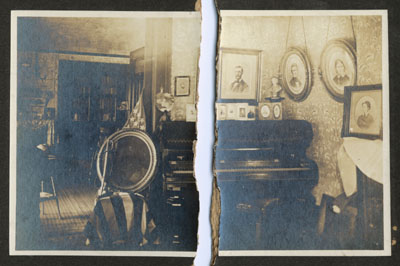
It has taken me months to be able to interpret the letters and artifacts that I brought to New Haven from Chagrin Falls. However, now when I look at the broken photograph of the interior of a heavily furnished Victorian home, I have concluded that it must be John’s sister, Charlotte’s living room. Horace and Dorothea hang on the wall to the right—my grandmother replaced their pictures with mirrors, retaining the oval gilded frames, one of which I now have. Amory’s portrait is above the piano and Julia’s is to the far right. And to the left, there is a flag-covered shrine Charlotte kept in tribute to her lost brother.
Fig. 6. Photograph, presumably of Charlotte Blinn’s living room in Terre Haute, c. 1920, from the author’s private collection.
Among the newspaper clippings preserved at the Vigo County Historical Society, I copied an interview by Ruth Agnes Abeling that appeared in the Terre Haute Post around 1920, in which Charlotte explains her dedication to John’s memory. “You see,” she says, “I never married and I have no family for which to think of the future, so I live in the past.” Abeling explains, “And to her the past is her brave brother, Captain John Blinn, from the time he was a newsboy, carrying the ‘Prairie City’ to the day he was buried in Woodlawn cemetery after his death at the field hospital at Gettysburg, Pa.”
During this interview, Charlotte recalls the vibrant young man inside the uniform: “Everybody loved John,” she remembers, “and oh, the parties they gave when he came home from Wabash college! He was such a handsome boy and how he could dance!” Turning to an oil painting on the wall, she says proudly, “That is his picture.” According to the reporter, Charlotte’s eyes sparkle as she gestures toward it. “It was painted,” she says, “from just a few sittings he had while here a few days awaiting replies for orders he was carrying for General Lew Wallace—just a boy of 21 he was, but with the keen eyes and determined mouth of men of many more years.”
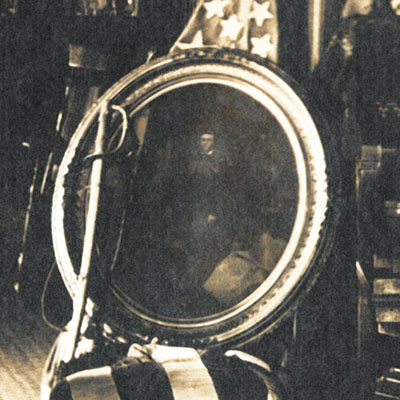
The portrait was a gift from John to his mother—a surprise birthday present. I had read about it in a letter at the Cincinnati Historical Society. As one cousin wrote another, his mother “knew nothing of it until she opened the Parlor door & found it hanging before her.” In the photograph that remains, propped up against the flag next to the sword, stands the oval framed picture that I now know to be John. Who painted it, I wonder, and where has it gone? Could it possibly have been an early work of James Farrington Gookins, a close Terre Haute friend and fellow college classmate, who joined the Eleventh Indiana Zouaves under Colonel Lew Wallace, but soon became a correspondent artist for Harper’s Weekly, sketching Indiana Civil War soldiers among others? Was it the portrait given by my great-grandfather and his brother along with John’s military equipment to the G.A.R. post all those years ago? Did it suffer the fate of other relics left behind in Terre Haute’s Memorial Hall—unclaimed, abandoned, looted—according to local lore? Who was the young man in the portrait, really? How are we ever to know his complete story? John’s obituary, appearing in the Terre Haute Express on July 21, 1863, looks forward to the day when “some able pen will write his biography in full,” trusting “that it may constitute a part of the history of this War for the Union & a justice to his memory & splendid deeds.”
Fig. 7. Digitally enhanced photograph of the missing oil painting of Captain John J. P. Blinn (1841-63). Technical work by John Pelverts, Photoland, New Haven, Connecticut.
Though, ironically, my quest began in a village named Chagrin Falls, these objects of material culture now hold much more than sentimental, aesthetic, and monetary value for me. Knowing their provenance has given me a deeper connection to my family’s past along with stories of hope and hardship to pass along to my sons. After a peripatetic childhood, I better understand where I am from and now see the larger pattern of our family’s geographic dispersal over time. My immediate family extends from Connecticut to California and from Minnesota to New Orleans with Ohio and Illinois in the heartland. And now the artifacts of our collective past are scattered ever more widely. No wonder family memories fade and disappear.
But beyond its family value, the combination of heirlooms, photographs, and letters form the basis of a projected wider exploration into a hundred-year period of American history. The story has a natural coherence more compelling than any narrative structure that I might impose—beginning with the birth of John’s grandfather, Hosea Blinn, on the Fourth of July 1776, in Wethersfield, Connecticut, and concluding with John’s death on July 14, 1863, at Gettysburg. Horace Blinn straddles the generations, actively taking part in westward expansion from Connecticut to Indiana to the gold mines of California. From the modest archive contained within my parent’s home, my research has expanded to include materials as far afield as Washington D.C., Maryland, Pennsylvania, North Carolina, Connecticut, New York, Vermont, Maine, Ohio, Illinois, Indiana, Kansas, Minnesota, Texas, and California. I imagine how new media might illuminate the past, bringing these resources together in a digital archive for the first time.
Certain mysteries remain. What happened to John’s Civil War diary, last owned by his nephew in Kansas in the 1920s? What would it reveal about his participation in battle and his relations with fellow officers? Will I find among Governor Morton’s official correspondence the answer to a central and vexing question: if John was so brave and proficient, why was he repeatedly overlooked for promotion? Was John correct to attribute his frustration to rivals with better political connections? I reserve decisions about how to present my findings and where to donate the collection until I have fuller answers to such questions. But about one thing I am certain: the two worlds I used to inhabit—the world of libraries and archives and the world of family—are not so far apart after all.
Further Reading:
James Insley Osborne and Theodore Gregory Gronert’s history, Wabash College: The First Hundred Years, 1832-1932 (Crawfordsville, Ind., 1932), includes a chapter on “Wabash in the Civil War” with a discussion of prewar interest in voluntary military companies and John Blinn’s founding of the College Cadet Company in 1858.
Indiana in the Civil War era: 1850-1880, by Emma Lou Thornbrough, vol. 3 of The History of Indiana published by the Indiana Historical Society and the Indiana Historical Bureau (Indianapolis, 1965), offers a well-documented history and concludes with a bibliographic essay of primary and secondary sources.
John M. Glen and others provide a more recent survey of primary materials held by archives, libraries, and historical societies pertaining to “Indiana in the Civil War Era,” Indiana Magazine of History 92 (September 1996): 254-73.
Roland R. Maust describes the field hospital conditions in Gettysburg for the division to which John Blinn was attached: “The Union Second Corps Hospital at Gettysburg, July 2 to August 8, 1863,” Gettysburg Magazine 10 (January 1, 1994): 53-101. Meanwhile, for a personal account of hospital relations between Blinn and a fellow soldier, see: A. H. Nickerson, “Personal Recollections of Two Visits to Gettysburg,” Scribner’s Magazine 14 (July 1893): 19-28. Scribner’s Magazine may be accessed online via Cornell University Library’s “Making of America” Website.
James Farrington Gookins’s eulogy to John Blinn, “Pro Patria Mortuus,” appeared in the Wabash Monthly (February 1864): 112-13. Gookins is profiled by J. Seymour Currey in Chicago: Its History and Its Builders, a Century of Marvelous Growth (Chicago, 1912). The Website of the Swope Art Museum (Terre Haute) features a biographical sketch and a painting. Gookins is also the subject of a “Wabash Valley Profile” by local historian, Mike McCormick, originally appearing in the Terre Haute Star Tribune.
From the battlefield hospital, John Blinn dictated his few last lines to “My Darling Cora,” telling her not to mourn for him, “but forget & be happy with some other man’s love.” Although the identity of John’s beloved is unknown, it is interesting to speculate if she was the Terre Haute native, Cora Donnelly, whom Gookins married in 1870.
This article originally appeared in issue 5.3 (April, 2005).
Martha L. Brogan is a research librarian with two decades of professional experience at the University of Minnesota, Yale University, and Indiana University. Since 2003 she has worked as an independent library consultant, residing in New Haven, Connecticut. She hopes to publish more about the life of Captain John J. P. Blinn (1841-63), based on family letters.
The Atlantic World Turned Upside Down
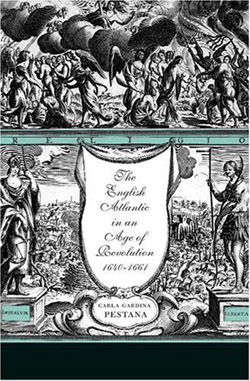
Carla Gardina Pestana’s The English Atlantic in an Age of Revolution, 1640-1661 fills a surprising gap in the scholarly literature. The English civil wars and interregnum have inspired a truly massive historiography attesting to the importance of this period to British history. England’s American colonies also changed profoundly over these years: some established slave societies, others forged new commercial relationships, and all grappled with new religious and political ideas. Surprisingly few scholars have tried to link the two, to tie events in the Americas to the revolution in England, and this is the overarching goal Pestana sets out to achieve.
The English Atlantic in an Age of Revolution, 1640-1661
Carla Gardina Pestana’s The English Atlantic in an Age of Revolution, 1640-1661 fills a surprising gap in the scholarly literature. The English civil wars and interregnum have inspired a truly massive historiography attesting to the importance of this period to British history. England’s American colonies also changed profoundly over these years: some established slave societies, others forged new commercial relationships, and all grappled with new religious and political ideas. Surprisingly few scholars have tried to link the two, to tie events in the Americas to the revolution in England, and this is the overarching goal Pestana sets out to achieve.
Rooted in the New British History and Atlantic historiography, Pestana’s book shows that the political, religious, intellectual, and economic forces that transformed Britain during these years also “gave shape to the English Atlantic” (1). Pestana includes examples from well-known colonies (Massachusetts, Maryland, Barbados) and less-studied places (Eleuthera, Antigua, Newfoundland) to capture the diversity of English settlements. Despite their differences, each English colony experienced similar strains and faced the same difficult choices during this relatively brief period. Pestana clearly shows that when studied as a whole, the English Atlantic world followed the same trajectory between 1640 and 1661. At the beginning of this period, the English Atlantic was “a world dominated by powerful nonresident men, peopled by recent English migrants, tied by commerce and affinity to England, with a fairly homogeneous faith” (15). When the monarchy was restored, Charles II took possession of a new kind of empire, one that was “[c]ommercial, diverse, inegalitarian, and prickly about its rights” (2).
For its scope and complexity, Pestana’s argument is brief, lucid, and persuasive. In six chapters that draw on an impressive range of research in manuscript and printed sources, she discusses some of the period’s most important themes, including religion, political ideas, and commercial integration. The chapters move chronologically, tying these themes to key events like the Westminster Assembly, the regicide, and Oliver Cromwell’s Western Design. By structuring her argument this way, Pestana ties the development of ideas to specific events and their reception in the English Atlantic. The Atlantic world described here is a world of connections, migrations, and ideas that flowed back and forth across the ocean. Although events in England dominate her narrative, Pestana is careful to point as well to the “modest ways the colonies influenced the changes overtaking their homeland” (4). This nuanced vision of Atlantic history places imperial and metropolitan actors at the center of the narrative (and rightly so) while stressing the diversity of the English Atlantic and the importance of local circumstances to the history of empire.
At the beginning of the 1640s, the unpredictable course of events in Britain and the unreliability (or unavailability) of news from home posed a challenge to the Atlantic colonies: which side to choose? Pestana argues convincingly that the policies pursued by each English settlement were based in a pragmatic appraisal of local circumstances and interests, which were best served by neutrality in the early 1640s. Neutrality was a “gesture of self-defense, even self-preservation” (30) that in most cases was effective in maintaining social stability and profitable trade.
New England colonists refused to intervene in the conflict directly but were hardly neutral on the subject of religion. Massachusetts in particular presented itself as a model for England, and between 1641 and 1649 an extensive pamphlet literature debated the virtues of New England’s religious establishment (Pestana provides a list of these pamphlets as an appendix). But as England became more diverse and balkanized in its religious life, Massachusetts’s refusal to tolerate unorthodox views alienated supporters. After 1644, Pestana shows, interest in the region as a model for England waned. Although Native Americans do not play a large role in Pestana’s argument overall, one of Massachusetts’s responses to these criticisms was to stress its efforts at converting Native Americans.
De facto control of the overseas settlements by Parliament had forged a rough consensus based on neutrality or tepid support for Parliament. The execution of Charles I in 1649 shattered this consensus and marked a decisive turning point in the role of the English state in colonial affairs. Some colonies, including Virginia and Barbados, responded to the regicide with open rebellion. With particular attention to Barbados, Pestana shows that this decision like so many others was influenced by local concerns. The Commonwealth, fighting wars in Scotland and Ireland, developed an interventionist and centralized style of imperial rule in response to such challenges. In 1650, the Council of State declared first an embargo of Barbados and then Parliament’s power to regulate trade, which “inaugurated a new era, creating for the first time the prospect of a centralized administration of all colonies” (100). Backing up its claims with warships, the Commonwealth brought first Barbados, then Virginia, to heel, beginning a policy that would reshape the Atlantic world: “Trade and imperial policies that imposed economic restrictions and military demands on New World settlements pointed the way toward the imperial future of commercial oversight and regular military contributions from often resistant settlers” (157).
In response to these demands, colonists developed a new language of rights and liberties based in what Pestana calls their “shared Englishness”: colonial elites described themselves as equal members of a society that derived status from land ownership. As part of this self-definition, colonial elites demanded “participation in local government, local control over a variety of decisions, and protection of property rights. In these concerns they were quite similar to county-level leaders in England itself” (166). Colonial elites, especially those in the Caribbean, used this language of Englishness to defend their trade rights in an Atlantic economy largely of their own creation, an economy built on free trade and unfree labor. The linkages between the “language of liberties” and African slavery was clear: planters’ “right to continued access to slave labor” was rooted in “the rights of freeborn English men” (191).
By the time the monarchy was restored, the English Atlantic world had changed profoundly: “The world of these colonists had literally been created during the years of revolution: their economic transactions, political activities, social milieu, and religious culture had all taken shape in the previous two decades” (213). And despite the provenance of these dramatic alterations in the Atlantic empire, the Restoration government did not try to roll them back. A standing committee oversaw the foreign plantations, the Crown did not reinstate proprietors, and Jamaica remained an English possession. Bowing to the “language of liberties,” the Crown kept local elites in power and confirmed their landholdings and legislative assemblies. “The Atlantic world had been transformed by its experience of revolution, and the king largely accepted those transformations” (220).
This article originally appeared in issue 5.3 (April, 2005).
Michael LaCombe is a visiting assistant professor of history at Adelphi University. He is finishing his dissertation, “Food and Authority in the English Atlantic World, 1570-1640,” at NYU.
Looking for Politics in All the Right Places
In 1802, Baptists from a small community in Massachusetts delivered Thomas Jefferson a “mammoth cheese,” four feet across, eighteen inches tall, and weighing twelve hundred pounds, to demonstrate their support. In the same period, thousands of Americans identified with political parties via an expanding partisan press and such local events as parades and banquets. African Americans and women, while formally excluded from the political realm, made their interests known by the clothes they wore, by forming associations, by participating in public events, and by publishing their opinions in newspapers and pamphlets. In the 1830s, farmers dressed up as Indians to challenge the hegemony of their New York landlords. By conversing, joining, dressing up, and publishing, Americans of all types participated in politics. All these activities, some highly memorable and many more ephemeral, constituted political life in the early republic.
Beyond the Founders: New Approaches to the Political History of the Early American Republic
Beyond the Founders is a tour de force on behalf of a specific historiographical claim: the politics of the early American republic was shaped by the activities and ideas of both elite and ordinary persons from all backgrounds, often through processes of contestation and accommodation. There is a difference, the authors make clear, between saying that politics is everywhere and that everything is politics. They draw a line between the contemporary claim that “the personal is the political” in order to focus on those activities that were intended to affect how Americans influenced and made political decisions. In the early republic, the sites of political activity were diverse and, perhaps more than one would expect, egalitarian. These authors argue for the centrality of politics broadly defined to understanding the postrevolutionary and early national eras.
Judging from the essays in this collection, the state of early American political history is strong. Political historians have lamented the death of political history since the 1960s and 1970s onslaught of social and cultural historians. In a 1999 article, Joel H. Silbey blamed social and cultural history for marginalizing political history. Joseph Ellis, in Founding Brothers (New York, 2000), posed a stark choice between social history without politics or politics without social history. It may come as a surprise, then, that the vitality of political history has been made possible thanks in large part to methodological and normative questions asked by social and cultural historians. Beyond the Founders disproves Ellis’s contention that social-cultural history and political history are opposed to each other. Instead, the authors argue for an approach that draws on the strengths of both. They expand our definition of the political into topics that had once been the preserve of social and cultural historians, including public events and festivals, material culture, private spaces, and marginalized groups such as laborers, women, and African Americans.
The authors seek not only to reintegrate social and cultural history to political history but also to move beyond the Founders. They are responding to a recent wave of books focusing exclusively on the role of the Founding Fathers in shaping early American politics. There are two reasons why many historians are upset about what has been dubbed Founders Chic. The first reason is the simple fact that it refocuses attention on elite politicians and largely ignores two generations of work that aims not only to debunk the status of the Founders—as by exposing their complicity with slavery—but also to show that the world of ordinary people is both ethically and historically equally worthy of study. A less discussed point, but one equally important, is that some of the new books on the Founders exploit the theoretical apparatus of social and cultural historians. As David Waldstreicher argues in a 2002 review essay in Radical History Review, “the ‘ethno-historical’ or cultural perspective, which once signaled a desire to understand what historical changes meant to the ordinary people who lived through them, or to probe the changing modes of popular politics, is instead made to relegitimate the validity of the Washington beltway vision of how politics work.” The issue here is not one of historical merit but whether tools intended to give voice to the voiceless should be used on elites whose immense paper trails allow them to speak.
Beyond the Founders is divided into four sections. Each section moves beyond the Founders in a different way. In the first section, “Democracy and Other Practices,” Jeffrey L. Pasley, Andrew W. Robertson, and David Waldstreicher urge historians to look beyond political parties in order to connect popular activities with high politics. In the second section, “Gender, Race, and Other Identities,” Rosemarie Zagarri, Nancy Isenberg, Albrecht Koshnik, and Richard Newman explore how politics shaped identity and vice versa. Koschnik, for example, examines the private realm of voluntary associations to explore how supposedly private activities in fact constitute public—and partisan—identity. In the third section, “Norms and Forms,” John L. Brooke, Saul Cornell, and Seth Cotlar discuss how ideological contests shaped constitutional and political development. In the final section, “Interests, Spaces, and Other Structures,” Andrew R. L. Cayton, Richard R. John, and Reeve Hutson seek out new frontiers. Cayton literally looks to the frontier in his examination of Texas annexation by integrating the activities and perspectives of Mexico and the Cherokee Nation. John focuses on how public opinion relates to institutional development. Hutson suggests that we must examine how ordinary people appropriated the new forms of partisan politics in combination with their own inherited popular traditions. The final section demonstrates that moving beyond the Founders is not just a vertical move but one that can be quite imaginative. In his concluding essay, William G. Shade evaluates the authors’ claims honestly and with some skepticism.
Reviewing essay collections is always a challenge since it is impossible to discuss every work. This was particularly difficult with this collection because each essay is engaging and moves the book’s argument forward. John L. Brooke’s essay deserves special mention, however, because he provides a theoretical framework to make sense of the collection’s larger argument. Brooke argues that, despite all the disagreements and debates between old and new political historians, and between political and social-cultural historians, they are all “engaged in a remarkably similar project” (210). Brooke draws on Jürgen Habermas’s conception of the public sphere to uphold this bold assertion. Each historical camp, Brooke writes, is ultimately concerned with how consent is generated in a democracy. Each is interested in who shapes political decisions and the role of power in affecting outcomes. By bringing civil society and its public sphere into the picture, we can create a new political synthesis that includes formal political institutions as well as the activities of ordinary people out of doors. In civil society and the public sphere, myriad groups interact and seek to influence each other. At some point, however, these interactions must be boiled down to the actual doings of politicians in state houses. It is here where the new meets the old. While anybody can seek to persuade voters and leaders, actual policy decisions are made by politicians and judges in formal settings. Bringing this all together will be no easy task, but Brooke has provided an important framework for how it might be possible. He also reminds historians that we are engaged in a common enterprise and should be open to each other’s contributions.
One of the major critiques of the newest political history is that it so expands the realm of the political as to ignore the stuff of formal politics—elections, court decisions, legislative debates, public policies, and institutions. (In another recent effort to provide a research template for political historians, The Democratic Experiment: New Directions in American Political History, edited by Meg Jacobs, William Novak, and Julian Zelizer, the authors combine a new institutional approach with social history’s focus on ordinary people and cultural history’s emphasis on ideology. The result is more attention to institutions and policies.) Although Brooke suggests that the realms of formal and informal politics are connected, most of the essays in this collection tell us little about how. An important exception is Cornell’s examination of the right to bear arms. Cornell states that historians of constitutionalism must “unite the traditional top-down perspective of constitutional history with the bottom-up perspective of social and cultural history” (253). His essay demonstrates that different social groups had distinctive understandings of their right to bear arms. The only others to deal with specific policy or legal questions are John, on debates over government regulation of the postal service and the telegraph, and Cotlar, on the context and effect of the Alien and Sedition Acts. These essays, along with Brooke’s theoretical framework, point toward a research agenda that will combine the broad approach of Beyond the Founderswith the more traditional questions asked by students of political development and public policy.
Beyond the Founders offers an interpretation of early national politics premised on the interplay between formal and informal politics, elite and ordinary people, ideology and practice, and public and private spaces. The original purpose of social and cultural history was to undermine the metanarrative of the rise of political democracy. These essays, despite their focus on conflict and pluralism, return to the older story, a point made by Shade. Instead of being marginalized, it turns out that the subjects of social and cultural history exerted real influence over politics. Like Founders Chic, this new volume uses radical tools to tell a traditional story. The story told is more sophisticated and less Whiggish than its earlier iterations; nonetheless, in Pasley’s words, early national political culture may have been “the most participatory and transformative that the United States has ever experienced” (46). Whereas revisionist historians once pointed to the ways in which the early national era was elitist and exclusive, the authors of this volume have used the same methodology to reclaim the early republic as a time when participatory democracy gave all Americans a role in politics.
Further Reading:
For a critique of the influence of social and cultural history on political history, one should read Joel H. Silbey’s “The State and Practice of American Political History at the Millennium: The Nineteenth Century as Test Case,” Journal of Policy History 11 (1999): 1-30. For other discussions about the future direction of American political history, see Meg Jacobs, William J. Novak, and Julian E. Zelizer, eds., The Democratic Experiment: New Directions in American Political History (Princeton, 2003), and the articles by Richard R. John, Joanne B. Freeman, and Julian E. Zelizer in the Journal of Policy History 16 (2004). The most successful application of social-cultural methods to elite politics is Joanne B. Freeman, Affairs of Honor: National Politics in the Early Republic (New Haven, 2001). For David Waldstreicher’s critique, see “Founders Chic as Culture War,” Radical History Review 84 (fall 2002). The most eloquent synthesis on the emergence of democracy in post-revolutionary America is Gordon S. Wood, Radicalism of the American Revolution (New York, 1991). For a critique of the democratization thesis, see Glenn C. Altschuler and Stuart M. Blumin, Rude Republic: Americans and Their Politics in the Nineteenth Century (Princeton, 2000). A discussion of Altschuler and Blumin’s argument can be found in a forum of the Journal of American History 84 (Dec. 1997).
This article originally appeared in issue 5.3 (April, 2005).
Johann N. Neem, assistant professor of history at Western Washington University, is revising his manuscript, “Creating a Nation of Joiners,” on the political origins of civil society in early national America.