Let me be candid. I couldn’t stand watching Frontier House, the recent PBS series that chronicles the attempts of three families to survive five months of 1880s-style homesteading in Montana. Heavily edited, overly emotional, the show seemed to pander to the basest elements of reality TV. And it was hard to take its “reality” seriously when it began with ads (yes, even on PBS) like this Madison Avenue gem: “Life on the frontier would have been different with GP brands like Quilted Northern Bath Tissue.”
The show attempts to recreate the experience of families who moved to the American frontier in the late nineteenth century to stake a claim on 160 acres of land in Montana. The three families who volunteered for this experiment agreed to give up modern conveniences and to spend several months, from early spring to early fall, building cabins, cooking on wood stoves, milking cows and trading at Hop Sin Yin’s 1880s-style general store. The goal for the summer months was to lay in enough supplies and create a sound enough plan to convince a panel of independent historians and experts in domestic life, animal husbandry, and historic buildings that they would successfully survive the Montana winter. Nate and Karen Brooks are a young East Coast couple who married on camera (Nate’s father Rudy started the project, but left after the wedding), Adrienne and Gordon Clune head a well-to-do California family. They came with their three children and teenaged niece. Karen and Mark Glenn from Tennessee homesteaded with Karen’s two children. As the series began, we met each of these families in turn and watched them start to negotiate their familial and neighborly relations.
The going was rarely smooth. Early on, the scandal broke: Meatgate. The Clune family, those nefarious neighbors, those moonshining malcontents, reviled for whinin’ and wranglin’ and all around wickedness, had crossed the lines, left their homestead, and traded baked goods for venison, exotic out-of-season potatoes, and a few minutes of MTV. Their fellow frontiersmen and women reacted badly. They were shocked, shocked to find that there were historically inauthentic activities going on, or so they told their camera crew.
But what is authentic about Frontier House? Homesteader Karen Glenn figured her approach to this experiment was the real deal, contrasting her honest work as a laundress to the offsite trading of the Clunes: “We have done everything authentic.” The concept was bandied about on the show, used by the folkway experts who tutored the neohomesteaders on everything from chopping wood to birth control and by the families before, during, and after their tenure in Montana, but none of the characters seemed to find a universally satisfying definition. What was authentic about the on-air wedding of Kristen McLeod and Nate Brooks? The maroon and pink wedding dress, a perfect replica of 1880s finery that was such a disappointment to the bride, or her happiness when she saw the white gown sent by her fiancé? What was more authentic, the beans-and-cornmeal diet the characters enjoyed, or the wild game that Gordon Clune wanted so desperately to hunt with his sons? (He had to wait until his return to California, where he and his sons gunned down “Malibu rabbit” for their freezer.) Why this quest for authenticity? Why this judgment about whether or not the participants really lived the life of 1883 homesteaders? Is the experiment a success if they feel as though they were homesteading or only if they convince the experts that they’d worked hard enough to survive the winter?
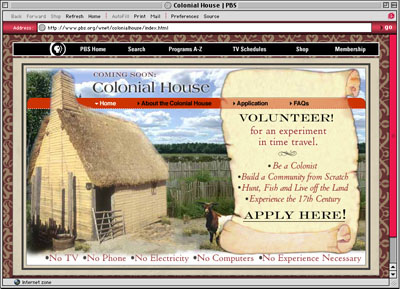
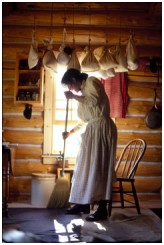
Fig. 1. Promotional still for PBS’s Frontier House
These questions are similar to those posed to advocates of living history museums. They dog any effort to institutionalize what historians Roy Rosenzweig and David Thelen call “popular historymaking,”the ways that “Americans take an active role in using and understanding the past” so that “they’re not just passive consumers of histories constructed by others.” Rather, we seize on aspects of the past that get under the skin, seem pertinent, even instrumental to our own lives.
But the dangers of the living-history approach are obvious. Do television producers (or museums) ignore the issues or situations that wouldn’t attract or might even offend viewers? Frontier House spends a lot of time dealing with personal hygiene issues (love that slow pan of the inside of an outhouse), but largely ignores the incredible racism and hardship that African Americans faced on the frontier. Although the narration talks about the problems a mixed-race couple such as the Brooks would face “back east,” it suggests that homesteaders might have found safer spaces in Montana. But Frontier House is set in 1883, the same year that the U.S. Supreme Court ruled the Civil Rights Act of 1875 unconstitutional, thus legalizing racial discrimination in the shops, inns, and other places that serviced (or refused to service) western settlers. We get only a glimpse of race prejudice in the brief discussion of whether the community is willing to pay for its own school, where future Brooks children would be welcome, or whether the two white families would rather save their money and exclude them. (There really isn’t any “discussion”—the community easily and immediately does the right thing.)
Living history museums have struggled with problems of representing these most difficult elements of the U.S. past to their patrons—witness the recent inclusion of slaves’ experiences at Colonial Williamsburg. By contrast, Frontier House participants worked without benefit of the academic and professional debates that have helped museum directors and docents introduce issues of slavery, racism, and genocide—and of course, Frontier House participants weren’t in character. They were doing what countless press releases called “hands-on history.” We certainly wouldn’t have wanted to view scenes of, say, wife beating, no matter how authentic domestic violence was for an isolated, stressed frontier family.
Which brings me back to the element of the series I find most valuable. It was telling in the last episode, when the homesteaders were making ready to leave, that each male “head of the homestead” expressed regret—with tears—at leaving. The men felt a sense of ownership, of pride at what they had accomplished. But the adult women were ready to go. All three at some time or other had talked about their unhappiness in this experience. Adrienne Clune compared her life in Montana to a “labor camp” and felt as though her departure meant “freedom, freedom, freedom.” Kristen Brooks stood in front of her kitchen area and noted that whenever the camera crew showed up, she could be found in that space, working as “support” for her man, and when Karen Glenn and her husband were struggling in their relationship, she talked about the frustration of having no way out.
In each of the families, the adult couples had accepted and occupied conventional gender roles, seemingly with no debate. Working outside, the men had lost weight, gained muscle, and laid in memories that would become touchstones in their later lives. The women, tied mostly to their cabins, felt ugly, frustrated, and exhausted by menial, repetitive drudgery. Now this reaction was authentic. Caroline Kirkland described the lot of such women in her 1839 book A New Home, Who’ll Follow?, a memoir of her own experiences in frontier Michigan. While a man goes out to work and “returns to his home with the sun, strong in heart and full of self-gratulation on the favourable change in his lot,” his wife has spent a “long, solitary, wordless day.” “Women are the grumblers in Michigan,” she writes, “and they have some apology. Many of them have made sacrifices for which they were not at all prepared, and which detract largely from their every day stores of comfort.”
If PBS ever runs a Frontier House II (and there’s scope for a sequel; incredibly, there were five thousand applicants for this first go-around), I’ll be sure to send the participants each a copy of Kirkland’s book. For women in 1839, as she writes, “the conviction of good accruing on a large scale does not prevent the wearing sense of minor deprivations.” Women were the grumblers on Frontier House, too, and not without cause. But perhaps they’re enjoying some kind of recompense for their five months of minor deprivations. Maybe they were sent home with a lifetime’s worth of Quilted Northern Bath Tissue.
Further Reading: See Caroline Kirkland, A New Home, Who’ll Follow? or, Glimpses of Western Life, ed. Sandra A. Zagarell (New Brunswick, 1999); Roy Rosenzweig and David Thelen, The Presence of the Past: Popular Uses of History in American Life (New York, 1998). See also the Frontier House Website. See also Jill Lepore, “Playing Dress Up,” Commonplace (Sept. 2000).
This article originally appeared in issue 3.1 (October, 2002).
Kristina Bross is an assistant professor of English and a member of the American studies program faculty at Purdue University. Her work has appeared in Early American Literature and books on American religious history, cultural studies, and postcolonialism. Her book manuscript, Dry Bones and Indian Sermons, examines the transatlantic production of the “Praying Indian” in seventeenth-century Puritan writings.
Not-So-Distant Relations?
Victoria Freeman
When I was growing up, the history of my ancestors’ involvement with Native Americans had been almost completely obliterated from my family’s memory. I assumed that my forebears bore no direct responsibility for the transformation of indigenous inhabitants into despised outsiders in their own land. I thought my ancestors had come to North America in the 1840s during the Irish potato famine and that the dirty work of dispossession and colonization had been accomplished long before. Yet I felt an amorphous sense of guilt towards native people, which I sensed many others shared, but which was never talked about.
Over the course of my research for Distant Relations, I learned that some branches of my family had in fact arrived in New England in the 1630s, and that, far from being a single event in the past, colonization and dispossession were processes in which my family had been involved for many generations, through wars, diplomacy, dubious land transactions, and missionary activities. In the seventeenth century, for example, Thomas Stanton, my ancestor of ten generations’ remove, was directly involved in the attempted genocide of the Pequots and in the Atherton Company’s land scam to dispossess the Narragansetts; in the eighteenth century, my Ranney and Janes ancestors moved onto unceded land in Vermont; in the nineteenth and twentieth centuries, my Harris and Freeman relations were busy trying to “civilize” and Christianize the Ojibwa in Ontario. As a descendant of these colonizers, the question of responsibility became very personal.
It was easy to attribute ignorance to my forbears or say that they were simply sharing the attitudes of the day, but it was much harder for me to acknowledge the self-interest in their blindness. They stood to profit if they didn’t recognize the full humanity of indigenous peoples. Unfortunately, this dynamic is still true today—for me and for other non-native North Americans.
Do I feel guilty? Once I began to understand the context for my ancestors’ actions, what I felt was not so much guilt as grief. I needed to mourn the human cost of it all, the collective losses that came from my ancestors’ shortsighted self-interest and lack of understanding of other cultures. I also came to see that colonization and dispossession were not the work of a few “bad” or misguided leaders, but rather were processes involving choices and actions by countless ordinary people—the “good” well-meaning people like my socially progressive grandfather who was involved in an Indian residential school in Ontario, as well as those who were greedy and selfish or simply hated Indians. Most of my ancestors were acting within the norms of their culture, but within the norms of a culture, decent people can do indecent things.
“I don’t see myself as personally responsible for the actions of my predecessors, but I recognize that I have inherited their legacy.”
I don’t see myself as personally responsible for the actions of my predecessors, but I recognize that I have inherited their legacy. Because my family has been involved in the oppression of aboriginal people for hundreds of years (whatever the intentions of individual family members), and because this oppression still continues—and because I continue to benefit personally from this oppression—I feel a responsibility to address the wrong that has been done. I believe it is the responsibility of nonnative North Americans to actively change the relationship between our peoples, and to return to Native Americans the resources and power needed to live their lives on their own terms. As Ojibwa playwright Drew Hayden Taylor said, “I don’t expect you to feel guilty for what your ancestors have done. However, if things haven’t changed in twenty years, then I expect you to feel guilty!”
The issue of responsibility is therefore not limited to people like me who have a blood relationship to the early colonizers. All nonnatives are the beneficiaries of the colonizing process initiated in the early 1600s. All who came here willingly or whose ancestors came here willingly are descendants of the early settlers in this sense; they have inherited their material and cultural legacy and are now enmeshed in a colonial relationship with the continent’s first peoples.
Indeed, much as we might wish it were otherwise, “colonization” is not over, either for the colonized or the colonizers. Whether I like it or not, my house in Toronto sits on land that was acquired by the British Crown under questionable circumstances in the 1790s, and that is now subject to a land claim by the Mississaugas of New Credit. Even recent immigrants become implicated because they too partake of the benefits of past injustices. Many aspects of colonialism—the inadequate land and resource base left to Native Americans, the imposition of foreign systems of government, the lack of recognition of the native right to self-determination—persist. Colonialism’s two key assumptions—that Native Americans have fewer rights to their land because they do not use it as Euro-Americans do, and that they need Euro-American direction to live their lives—are still very much with us today.
So what can we do? I believe we have a collective responsibility to unsettle the settler stories that are usually taught in schools, related in local histories, or passed down in families. Too often, these settler narratives are essentially creation myths—highly selective accounts of national or familial origins that are meant to instill pride and a sense of purpose. The stories most children learn speak of “settlers” and discovery and Puritan forefathers; they obliterate or minimize the ways that the Europeans pushed out the original people of this land. Let’s be honest about what our people did: not just the political leaders or the government or the army, but also what ordinary settlers did or condoned.
Unfortunately, history is full of examples of nations lying to themselves about how they have treated certain groups and creating a deformed national identity as a result. By and large, we avoid facing the fact that our effect on aboriginal people has been catastrophic. We do not want to acknowledge our relationship to desperate poverty, internalized racism, and epidemics of teenage suicide. Such knowledge disrupts not only our understanding of ourselves but our sense of the very legitimacy of the Canadian and American states. Avoiding the truth is a lot easier, precisely because acknowledging wrongdoing brings up the question of responsibility.
Certainly, in Canada at least, many school teachers and even some historians still erase native history from the general history of the country, or relegate that history to a sidebar to the main story. But to ignore the fact that relations between indigenous and nonindigenous peoples are a foundational and continuing dynamic in both Canadian and American history is to participate, however unwittingly, in the process of cultural genocide—the destruction of a people through the obliteration of their history and identity. Recognizing the mere presence of Native Americans in “our” history is not sufficient; we need to incorporate contemporary Abenaki, Mohegan, Narragansett, and Pequot perspectives and interpretations into a shared history of New England, for example, giving up our role as exclusive arbiters of what that history is.
One thing I’ve learned from indigenous peoples is that history is alive. The stories we tell, especially those about where we come from, no matter how heavily footnoted they are, carry “spirit” from one generation to the next—the spirit of a people, of a family, or just of vibrant life. There can be “good medicine” in stories, especially when they don’t shy away from complex truths. Our history, like other forms of story, has a potential for healing, for restoration, for clues as to how to right this very wronged relationship between our peoples.
In my view, such education and truth telling are the necessary preconditions for our other responsibility: effective action. Transforming a relationship from one based on domination to one characterized by balance, fairness, and mutual respect is a huge challenge. Yet, if colonization has been the product of the attitudes and actions of millions of people, it can also be undone through many small changes and actions. Each one of us in North America is part of this relationship and can do something to make it right. Further Reading: See Erna Paris, Long Shadows: Truth, Lies and History (New York, 2001); and Drew Hayden Taylor, “Reflections on the White Man’s Burden,” Toronto Star, October 7, 1998, sec. A, p. 27. See also Sylvia Van Kirk, “Competing Visions: Integrating Aboriginal/Non-Aboriginal Relations into Canadian History,” at “Turning Point: Native Peoples and Newcomers On-Line.”
This article originally appeared in issue 3.1 (October, 2002).
Common-place asks Victoria Freeman, author of Distant Relations: How My Ancestors Colonized North America (South Royalton, Vt., forthcoming November 2002), what kinds of responsibility do descendants of dispossessors have to history and to native peoples today?
National Domesticity in the Early Republic: Washington, D.C.
On November 20, 1791, Major Pierre L’Enfant, planner of the new capital city, ordered the demolition of a house against its owner’s will that stood in the way of what was to be New Jersey Avenue. The home’s owner, Daniel Carroll, belonged to one of the most prominent families who owned the land on which the capital was to be built. This showdown between private property and national government was not at all what the capital’s planners had envisioned. Indeed, L’Enfant and George Washington had hoped that the capital would help create the missing, personal relationship between the far-flung citizenry and the new nation. L’Enfant predicted that a beautiful capital would attract citizens to buy lots and settle there, making the nation’s capital their home. The capital would thus tie citizens emotionally and psychologically to the national government by giving them the chance to invest financially in its future.
Fig. 1. Map of the City of Washington, D.C. (Drawn by F.C. DeKrafft for City Survey). John Brannon Publishers, 1828. Courtesy of American Antiquarian Society.
An early plan of Washington promoted the city’s real estate. It shows the capital’s two most famous features–the Capitol and the president’s house–as well as L’Enfant’s dynamic network of avenues (fig. 1). But just as importantly it shows the lots that citizens could buy; it was the development of these lots with fine homes and businesses that was to be as crucial to the success of the new capital as the splendor of its official buildings. George Washington had hoped that the capital would be a real city, a center of business and trade with many private citizens for residents, and not merely a government company town. An engraving of the city made in 1822 shows, through the dominating swell of the Potomac River, the optimism that the capital city would become the major water route inland (fig. 2). In George Washington’s mind, because the Potomac was “the center of the Union,” it would, due to “its extensive course through a rich and populous country become, in time, the grand Emporium of North America.” Attempts to make the river, which was cursed by shallows and shoals, into a viable trade route ultimately failed; politics and not trade was to be the city’s core.
The new capital did in fact inspire patriotic settlers. In 1799, John Tayloe III and his wife Anne Ogle bought land near the president’s house–Lot 8 on Square 170, bordered by New York Avenue and Eighteenth St., N.W. There they built an odd-shaped house to fit on their odd-shaped lot, one of the many such created by L’Enfant’s diagonal avenues. The Tayloe’s Octagon House, which still stands today, modeled the marriage of domestic and national life envisioned by Washington and L’Enfant. The Tayloes were one of Virginia’s most prominent families and Tayloe had run, unsuccessfully, for Congress. Their choice of the capital for their in-town winter residence signaled their support of the national government. They hired the architect of the Capitol, William Thornton, to build their private home. There they entertained members of official Washington, including Thornton and his wife, and their friend Harrison Otis Gray, congressman from Massachusetts. The Tayloes even fulfilled L’Enfant’s dream by making the capital their first, and not second, home, when some of the family eventually chose to live there year round. Best of all, the Tayloe home seems to have encouraged others to invest, as L’Enfant had hoped. By 1800 six houses stood on Square 170, three built of brick and three of wood.
The Tayloe’s model of national domesticity relied upon slavery, as did the development of the capital itself. Their home was supported by profits made on their large tobacco plantation, Mt. Airy, in Richmond County and on their other estates. They owned close to fifteen thousand acres of land and one thousand slaves. Each fall they brought as many as twelve slaves with them to Washington to serve their large family (which eventually included fifteen children) for the four months they remained in town. The house itself was built in part by slave labor, hired from local slaveholders. This was a common practice in the new capital; slaves provided the bulk of the labor to build the Capitol and other buildings, to clear the city’s avenues and streets, and to rebuild the city after its destruction during the War of 1812. While slave trading was relatively rare during the city’s first decade, by 1812 the capital was an important junction in the slave trade. It was not uncommon to see slaves in chains as they walked toward one of the holding pens in the city, or toward its docks to be shipped farther South. President James Madison’s secretary complained in 1809 of the “revolting sight” such “gangs of Negroes” presented in the streets of the capital of a nation that prided itself on its democracy and freedom.
Despite early successes in the development of the city, progress was frustratingly slow. Although there were periods of great building activity, such as after the War of 1812, by 1820 the government was still left with many of its lots unsold. The city’s population in 1820 was listed at 13,117, up from only 3,201 in 1800. In 1820 the city had 9,376 white residents, 1,796 free black residents, and 2,330 slaves. In 1800, slaves outnumbered free black residents five to one. The city’s growth remained tied to the growth of the national government. Artisans came to build the new city; lawyers, doctors, and storekeepers to attend to its community’s needs; servants and slaves to serve in its hotels, boardinghouses, and private homes.
The fact that everyone in the city helped to build or run the new government led to a new kind of domesticity that was literally shaped by national politics, although in ways L’Enfant and Washington could not have foreseen. The Supreme Court justices, for example, not only deliberated together, they lived together in boardinghouses, as did the members of Congress. The private homes of Washington’s official and nonofficial community naturally fostered a conversation about national politics and an accelerated schedule of entertainments and social calls that made the Washington home noticeably different than homes in other American cities. This national domesticity was crucial to the city and national government’s success. As historian Catherine Allgor has shown in her wonderful study of Washington’s “parlor politics,” it was one thing to draw up a Constitution with a set of laws by which the government would function, it was quite another to evolve a national political culture of manners and negotiating practices that would make that government work. The “inside the Beltway” mentality that we are now so familiar with did not exist; on the contrary, elected representatives were wary about wheeling and dealing on the national level. The more informal setting of the home became the site where such a culture could most naturally and even innocently evolve. We know that national policy is as often brokered around the Washington dinner table as it is in the House or Senate chamber. The logic of that custom was already becoming evident in the parlors and dining rooms of early Washington, D.C.
Fig. 2. H.C. Carey & I. Lea, “Geographical, statistical, and historical map of the District of Columbia,” engraved by Young & Delleker. (Philadelphia : H.C. Carey & I. Lea, 1822). Library of Congress.
The ability of this national domesticity to foster political unity was demonstrated by the Supreme Court, whose members lived together in one boarding house until as late as 1845. Chief Justice John Marshall felt it was crucial the justices live together, without their wives, in order to promote a collegiality that he predicted would lead to unanimous decisions. Unanimity would secure the Court’s authority, Marshall believed; divided opinions would make its decisions appear arbitrary. The Marshall Court succeeded in handing down one unanimous decision after another, a feat that historians trace to the fraternity created by their “communal life.” Justice Joseph Story described the harmony he enjoyed with his “brethren”: “[We] live in the most frank and unaffected intimacy . . . united as one, with a mutual esteem which makes even the labors of jurisprudence light . . . we moot every question as we proceed, and familiar conferences at our lodgings often come to a very quick and, I trust, a very accurate opinion, in a few hours.” In this way, the Supreme Court’s all-male home helped to establish the authority of the new national government.
Because Congress, like the Supreme Court, only met during the winter months, congressmen also lived in boarding houses rather than rent or build a house of their own. Congressmen tended to live with others from their region, and while this nurtured political unity on the regional level, James Sterling Young has shown how, on the national level, it nearly broke the nation apart. The boardinghouse communities became the congressmen’s “family.” Some houses included the wives of congressmen, but several were, aside from the wives, daughters, and servants who helped run them, all male. Daniel Webster described congressional life in early Washington as one of “unvarying masculinity.” Members not only ate together but even senators “slept two to a room.” They lived and dined like “scholars in a college, or monks in a monastery.” For some, such arrangements offered a pleasant change from home life with women: According to one congressman, “Members ‘threw off their coats and removed their shoes at pleasure. The formalities and observances of society were not only disregarded, but condemned as interferences with the liberty of person and freedom of speech and action.’” This fraternity continued onto the House and Senate chambers’ floors, so that during the first four administrations in Washington, congressmen tended to vote not according to their party but their boarding house. When one congressman failed to vote with his messmates another congressman complained, “We let him . . . sit at the same table with us, but we do not speak to him . . . He has betrayed those with whom he broke bread.” James Sterling Young attributes this startling herd mentality to the antipower culture of the era, an era still colored by the hatred of monarchy that fueled the American and French Revolutions. That such feelings infused boarding house culture is suggested by the fact that Vice President Thomas Jefferson not only refused to take the place of honor closest to the fire at his Capitol Hill boarding house, but instead took the seat furthest away. Congressmen insisted they served reluctantly, from a sense of duty. They feared being accused of acting independently and not according to their constituents’ will. The whole idea of an individual man or group vying for leadership to organize votes was distasteful. Congressional fraternities offered a refuge where they could cope with decision making on a national level. The boarding house system continued, even after political parties gained much more influence, up until the Civil War.
The fledgling quality of a national political network was registered in the residential patterns of the early capital and even in its very streets. The city’s neighborhoods were formed not according to economic class or race, but branches of the government. Congressional boardinghouses clustered around the Capitol, while the individual residences of the executive community, and all the workers and servants associated with it, clustered around the president’s house. There was not much visiting between the two neighborhoods since the legislature and the executive still tended to eye each other suspiciously. Pennsylvania Avenue, the main thoroughfare which connected these two communities, registered and enforced their estrangement. Pennsylvania Avenue was a terrible road: carriages turned over and their wheels got stuck in its mud. Congress could have voted more funds to improve the avenue, but didn’t, which suggests congressional ambivalence not simply toward the nation, but toward its capital city, too. The avenue remained a dirt road until 1832.
Stymied by such political antipathy, it was left to Washington women to show the men the importance of circulation. The paying and receiving of social calls was one of the main jobs of affluent women and it was only a matter of time before political negotiations found a more natural place in the drawing rooms and parlors of Washington’s boarding houses and private residences. Women such as Louisa Catherine Adams, Dolley Madison, Hannah Gallatin, and Floride Calhoun all used their “female network” of influence toward political ends, whether it be to support a particular piece of legislation, secure a government post for a relative or friend, or to improve the city through the creation of a hospital or orphanage. Indeed, Catherine Allgor credits Margaret Bayard Smith with being the very first “Washington insider.”
Smith, wife of the editor of the newspaper the National Intelligencer, established a particularly powerful circle of influence. Through it she secured a government position for the son-in-law of Martha Jefferson Randolph, only living daughter of Thomas Jefferson, whose family by 1828 was nearly impoverished. Smith had been a staunch supporter of Jefferson and thus her lobbying on his daughter’s behalf was not only a compassionate but a political act. It was this fuzziness between the personal and the political that gave women a wider scope than men. Just as the national culture was still antipower, it was also antipatronage, but women were able to avoid this charge. Since women weren’t “in” politics, they could claim to work from purer motives of affection and compassion, and this gave them leverage and innocence that men might lack. Another attempt by Smith to help her brother-in-law become a Supreme Court justice shows how this “parlor politics” worked. Smith tells in a letter how she called upon the wife of a man whose influence Smith needed to court. Her friend, “with her usual kindness immediately asked me to stay to dinner, which invitation I accepted, having found gentlemen more good humored and accessible at the dinner table than when alone.” On another occasion Smith managed to get a young Mr. Ward a spot on the sofa next to Representative Henry Clay. The two men enjoyed their conversation, a correspondence ensued, and Mr. Ward had a valuable ally in Washington. Through their social rituals, Washington’s women created a trust and informality that forged the personal networks so crucial to government. As the capital’s first and largest group of lobbyists, Washington women helped pave the way for the rise of first the patronage and then the party system, organizations which would make it less necessary, and hence less common, for women to play such an active political role.
In addition to being more engaged in political debate, white affluent women enjoyed a greater degree of personal freedom in Washington than in other American cities. It was more acceptable for women to go about the city unaccompanied by men. They went to the Capitol in order to watch Congress or the Supreme Court in session (three hundred women crammed into the galleries, and even onto the Senate floor, to hear the Webster-Hayne debates). Washington parties were often very crowded and women had to stand. For Margaret Bayard Smith this simple fact gave women more social mobility, since they did not have to sit, as was the custom, and wait for men to come to them. While Washington society was still structured rather rigidly according to class, a “respectable” woman could take advantage of the fact that in Washington one could be “decently aggressive” and push her case. The fact that the president’s house was still the people’s house made Washington’s official and nonofficial homes more open than those of other American cities.
Little is known about daily life for Washington’s black population. African Americans did enjoy a slightly greater degree of freedom in the nation’s capital. They could visit the monumental buildings and the men could watch the congressional debates. Their behavior was restricted, as in other southern cities, but less severely. The capital had a black code that set fines or jail sentences for any person found loitering after curfew, attending a meeting, gambling, drinking, or caught without a certificate with the name of their master or proof they were free. These fines and laws became more stringent by 1820.
On the whole, Washington’s black and white communities lived side by side, intertwined yet separate. At the Tayloe’s Octagon House, a servants’ stair helped keep servants close at hand and yet out of sight; the butler had a closet by the front door where he could hide until someone came to the house. Washington’s slaves tended to live in a service wing at the back of the house, or in a free-standing structure at the back of the yard. Thus a spectrum of Washington society might live on any one block: the block’s outer perimeter would include a mixture of fine and modest homes, some owned by prosperous free blacks, while its interior contained slave quarters. One of Washington’s most prominent black families itself encompassed this social spectrum. William Syphax, a free man, lived with his wife and daughters, whose freedom he purchased, in their own house on the corner of Seventeenth and P Streets, N.W., while his son was a slave living in the quarters at Arlington House, home of Martha Washington’s grandson, George Washington Parke Custis. Custis’s only child, Mary, would inherit the house, where she would live with her future husband, Robert E. Lee.
The confrontation between L’Enfant and Daniel Carroll came in large part because L’Enfant was out of step with the political culture in America, a culture that did not share L’Enfant’s grand vision for the national government and could not tolerate his autocratic style. L’Enfant’s decision to raze Carroll’s house, with its insistence upon national circulation over local sovereignty, was only one, if perhaps the most egregious, of the acts that led to his dismissal. He haunted the capital after that, badgering Congress for the money he believed he was still owed for the planning of the capital. In the last years of his life, he was all but destitute; he lived the final year of his life, ironically, at the home of Daniel Carroll’s daughter, Eleanor Carroll Digges. Brought at last into Washington’s domestic fold, he died in her house in 1825 and was buried in the Carroll-Digges family plot. In 1909 his remains were moved to the Arlington National Cemetery to a grave site overlooking the capital–a city whose streets he had planned, but whose domestic life had evolved along its own political paths.
Indeed Arlington National Cemetery was created during the Civil War on the grounds of Arlington House. Mary Custis and Robert E. Lee’s abandoned home was thus surrounded by the graves of soldiers who died in the war. There, on the estate, the federal government also established a freedman’s village, a model community where freedmen could farm and live on their own land as an inspiration to the national community. As such Arlington House offers perhaps only an extreme example of the strange tangle of domesticity and national politics so central to the history of Washington, D.C.
Further Reading:
I am indebted to the following studies of Washington’s early history. Here, I list specific pages from each work that I have quoted or paraphrased above. Catherine Allgor, Parlor Politics: In Which the Ladies of Washington Help Build a City and a Government (Charlottesville, Va., 2000), 118, 136-38; H. Paul Caemmerer, The Life of Pierre Charles L’Enfant (New York, 1970), 268-69, 288; Barbara Carson, Ambitious Appetites: Dining, Behavior, and Patterns of Consumption in Federal Washington (Washington, D.C., 1990), 165-66; Sandra Fitzpatrick and Maria R. Goodwin, The Guide to BlackWashington (New York, 1990), 239-41; Constance McLaughlin Green, The Secret City: A History of Race Relations in the National Capitol (Princeton, N.J., 1967), 15-33; George McCue , The Octagon: Being an Account of a Famous Washington Residence: Its Great Years, Decline & Restoration (Washington, D.C., 1976), 23-26, 41, 57; John W. Reps, Washington on View (Chapel Hill, N.C., 1991), 54; Orlando Ridout V, Building the Octagon (Washington, D.C., 1989), 84, 98, 110; Jean Edward Smith, John Marshall: Definer of a Nation (New York, 1996), 286-87; John Michael Vlach, “Evidence of Slave Housing in Washington,” Washington History (Fall/Winter 1993-94): 64-74; George Washington, The Writings of George Washington, ed. by John C. Fitzpatrick (Washington, D.C., 1939), 31:438; James Sterling Young, The Washington Community, 1800-1828 (New York, 1966), 101, 105, 122-24, 250.
This article originally appeared in issue 3.4 (July, 2003).
Sarah Luria is an assistant professor in the English department at the College of the Holy Cross. She is currently completing a book manuscript entitled Capital Letters and Spaces: How Writers Helped Build Washington, D.C.
No More Kings
On the Fourth of July, 1975, just before I turned nine, I marched in my town’s bicentennial parade wearing a hand-sewn, Girl-Scout-badge-earning, yellow calico dress and a puffy white bonnet trimmed with lace. My mother took pictures of me on the front lawn, posed with my brother Jack–in knickers, a tricorn hat, and a leather vest that would later double as part of his Halloween hippie costume–pointing a plastic musket at my head. Bang, click.
Figure 1: King George III from “No More Kings.” Copyright 1975 ABC.
I’m sure Jack and I learned a lot from dressing the parts, but most of what we learned about the Revolution that year came from watching Schoolhouse Rock, whose American history animated shorts debuted on ABC’s Saturday morning lineup in 1975. Even today, I can remember the Preamble to the Constitution only by singing it, and when I lecture about manifest destiny I’m still haunted by “Elbow Room” (“Oh, elbow room / elbow room / Got to, got to get us some elbow room. / It’s the West or bust / in God we trust / There’s a new land out there . . . “).
What did Watergate-era nine-year-olds need to know about the American Revolution? Watching Schoolhouse Rock I learned who wrote the Declaration of Independence, the names of battles and generals, and the nastiness of George III. Given how much television I watched on Saturday mornings, eating Kellogg’s Frosted Flakes in my pajamas, I actually did learn these things. I memorized every song. And, at a time when I wasn’t allowed to watch the nightly news because my parents didn’t want me to see pictures from Vietnam, what I learned about the American Revolution in between episodes of Scooby Doo and The Land of the Lost didn’t give them much to worry about. For all its whimsicality, Schoolhouse Rock was, in the end, fairly traditional political history, stories of great men and great deeds. (It has also generated a cottage industry of Web pages, including some where the nostalgic can sing along.)
Next spring, a new generation of nine-year-olds will have a chance to watch the Revolution as a televised cartoon. What they’ll learn will be altogether different. On Memorial Day 2002, PBS will launch Liberty’s Kids, a forty-part animated children’s series set in revolutionary Philadelphia. The storyline, which begins in 1773 and ends in 1787, follows the adventures of James and Sarah, two young teens working as apprentices in Ben Franklin’s print shop, along with Moses, a free black artisan, and Henri, a young French orphan. Walter Cronkite–best known to Americans of my generation as the host of CBS’ Saturday morning kids’ news spots, In the News (which inspired Schoolhouse Rock)–will star as the voice of Franklin.
Liberty’s Kids is the brainchild of Kevin O’Donnell, a well-known animation producer, and Andy Heyward, chairman and CEO of DIC Entertainment, a children’s entertainment company (and former Disney subsidiary) that owns Inspector Gadget, Madeline, Sonic the Hedgehog, Captain Planet, and Where on Earth is Carmen Sandiego? O’Donnell, who admits to a skimpy knowledge of American history, first began to think about an animated American history series after Heyward, just back from a family trip to Washington, D.C., gave out copies of the Declaration of Independence and the Constitution as party favors at a lavish birthday party. Handling the fake parchment documents, O’Donnell found himself inspired, and soon the idea for an American history program, originally titled Poor Richard’s Almanac, was pitched to PBS.
It’s easy to be cynical about Liberty’s Kids. The scripts, not to mention the premise, are peppered with anachronisms. And the “comprehensive Publishing, Home Entertainment and Merchandising program” promised in DIC’s press release raises the specter of Founding Fathers Pokemon cards. (Okay, maybe that wouldn’t be so bad.) But there’s also something deeply appealing about the series. Stanford historian Jack Rakove, who serves as consultant, confesses, “If you ask from a historian’s vantage point, how does this correspond to contemporary scholarship? Well, probably, not that well. But if you ask, what is it that students of this age ought to be introduced to so that they have a rough idea of the Revolution, it’s actually pretty good.”
Like Schoolhouse Rock, Liberty’s Kids is as much about citizenship as it is about history. O’Donnell wants viewers “to understand that America is an ideal, and that they are as central to its success as anyone else.” PBS’ John F. Wilson thinks “Liberty’s Kids will bring history and civics alive.” Stretching over forty episodes and, inspired by two decades’ worth of social history, the series also goes far beyond Schoolhouse Rocks’ self-congratulatory celebration of the American Revolution. Kids watching Liberty’s Kids will meet not only George Washington and John Adams, they’ll also meet Phyllis Wheatley, the African American poet. As O’Donnell puts it, viewers of Liberty’s Kids will be asked not only to admire what courageous American revolutionaries accomplished, but also to “confront the scars of the nation.”
In one early episode, Moses’s brother, Cato, is sold at an auction in Virginia and Moses himself is captured by a plantation foreman. Both Cato and Moses eventually escape, but Cato refuses to return with Moses to Philadelphia; instead, he takes up an offer by Virginia’s royal governor, Lord Dunmore, granting freedom to slaves who take up arms against the colonists. “If I can win my freedom by helping the British, so be it,” a bitter Cato tells Moses. “At least I will be the master of my own fate.” Meanwhile, James and Sarah visit the House of Burgesses where they listen to Patrick Henry deliver his famous speech: “Is life so dear, or peace so sweet, as to be purchased at the price of chains and slavery? Forbid it, Almighty God! I know not what course others may take; but as for me, give me liberty or give me death!” In a final scene, as Moses, James, and Sarah travel back to Philadelphia, James reads Henry’s speech aloud. To James, the speech is brilliant; to Sarah it’s hogwash. “All that talk of freedom and liberty? Look what happened to Moses!” But Moses has the last word: “I believe, someday, all my people will drink from the cup of liberty, just like Patrick Henry said.”
A Schoolhouse Rock short about Virginia in 1775 would have taught 1970s American schoolchildren to memorize Patrick Henry’s “Give me liberty or give me death!” speech in much the same way that we absorbed the Oscar Mayer weiner jingle (Schoolhouse Rock, not surprisingly, was the product of a New York advertising agency, McCaffrey & McCall). Liberty’s Kids wants today’s young viewers to think harder about what Henry had to say, to really wrestle with the paradox of slaveowners complaining about being enslaved by the British. No doubt it’s a richer story, and better history. But, especially at a time when we are all turning off the nightly news to shield our own children from new horrors, the part of me that still wants to eat Frosted Flakes in my pajamas sometimes wishes I could sing Patrick Henry’s speech instead.
This article originally appeared in issue 2.1 (October, 2001).
Dancing across the Color Line
I. Few events generated more excitement in antebellum New York City than the arrival of Charles Dickens. In the weeks leading up to his visit, all of the city’s newspapers carried daily stories on the impending ceremonies. “The whole community,” one editor punned, “is getting as crazy as the very dickens. The Boz fever now reigns to an incredible extent . . . madness will reign paramount for a week or two at least.” The climactic moment came on February 14, 1842, when civic leaders hosted a massive ball in Dickens’s honor at the Park Theater. It was a remarkable affair that included over three thousand guests, officers in dress uniforms, decorations in the style of the Old Curiosity Shop, and tableaux vivant of all the early novels. Dickens, we are told, happily danced a half dozen quadrilles and thanked his hosts for their “affectionate” greeting. But he also expressed a desire to see something more of the city: “I have resolved to take up my staff . . . and for the future, to shake hands with Americans, not at parties but at home.”
Much to the chagrin of the Gotham elite, Dickens did not even mention the “Boz Ball” in American Notes, his widely anticipated travelogue from later that fall. Rather, the New York chapter begins with a promenade northward along Broadway, where Dickens notes a number of fine oyster houses and lecture rooms, but no fully satisfying amusements. “How quiet the streets are,” he complains: “[A]re there no Punches, Fantoccinis, Dancing-dogs, Jugglers, Conjurers, Orchestrinas, or even Barrel-organs? No, not one. Yes, I remember one. One barrel-organ and a dancing-monkey–sportive by nature, but fast fading into a dull, lumpish Monkey, of the Utilitarian school. Beyond that, nothing lively; no, not so much as a white mouse in a twirling cage.” Over the next few paragraphs of American Notes, Dickens becomes increasingly impatient. Finally, he decides to quit Broadway above City Hall, “plunging” himself into an east-side neighborhood known for amusement of another sort–the infamous Five Points.
Fig. 1. A contemporary illustration of the Five Points. From D.T. Valentine, Manual of the Corporation of the City of New York for 1855. Courtesy of the American Antiquarian Society.
Those familiar with Martin Scorsese’s recent film, Gangs of New York, will recognize the Points as one of the poorest neighborhoods in antebellum America. But its reputation as the era’s most notorious “slum” was never simply a function of economics. This status reflected a complex chain of events: the arrival of thousands of Irish immigrants, whose settlement patterns intersected one of the nation’s largest communities of newly emancipated slaves; a wave of anti-abolitionist rioting, which sometimes targeted the neighborhood’s most successful minority businesses; a burgeoning vice trade, which catered to white men of all classes; the complicity of affluent landlords, who discovered that vice pays reliable rents; and the rapid proliferation of “penny” and “flash” papers, which (quite unlike the city’s elite press) treated the cultural spaces of Five Points as newsworthy. Dickens himself helped to launch this last trend during the 1830s, when he featured London’s Seven Dials neighborhood in Sketches by Boz. One suspects, in fact, that he had this sketch squarely in mind as he ventured into what he called the “Seven Dials of America”–escorted, we are told, by “two heads of the police.”
The central episode in Dickens’s account of the Points begins with a long “descent” from the street–through darkness, mud, and growing anxiety–when suddenly, he finds himself in a dance cellar known as Almack’s. His description covers three long paragraphs. The most famous passage begins with an audience request:
What will we please to call for? A dance? It shall be done directly, sir: ‘a regular break-down’ . . . Five or six couples come upon the floor, marshaled by a lively young negro, who is the wit of the assembly, and the greatest dancer known…. [T]he sport begins to languish, when suddenly the lively hero dashes in to the rescue. Instantly the fiddler grins, and goes at it tooth and nail; there is new energy in the tambourine; new laughter in the dancers; new smiles in the landlady; new confidence in the landlord; new brightness in the very candles. Single shuffle, double shuffle, cut and cross-cut; snapping his fingers, rolling his eyes, turning in his knees, presenting the backs of his legs in front, spinning about on his toes and heels like nothing but the man’s fingers on the tambourine. Dancing with two left legs, two right legs, two wooded legs, two wire legs, two spring legs–all sorts of legs and no legs–what is this to him? And in what walk of life, or dance of life does man ever get such stimulating applause as thunders about him, when, having danced his partner off her feet, and himself too, he finishes by leaping gloriously on the bar-counter, and calling for something to drink, with the chuckle of a million of counterfeit Jim Crows, in one inimitable sound!
This passage made quite an impression on contemporary readers. The New York Herald issued four separate attacks on American Notes the week it was published, singling out the “vulgarity” of the Almack’s scene for particular scorn. By contrast, the prominent reformer, Lydia Maria Child, celebrated the scene as a clever tactic to focus bourgeois eyes on dreadful living conditions. Modern scholars have shown a different sort of interest. It is the last sentence–Dickens’s reference to a million counterfeit Jim Crows–that has received the bulk of attention because it marked a new cultural fault line. On the one hand, the phrase pointed to the emerging blackface industry, whose racial caricatures were fast becoming the nation’s most profitable entertainment commodity. On the other, it acknowledged the vitality of an interracial dance culture both distinct from blackface minstrelsy and typically invisible beyond poor neighborhoods like the Five Points.
But what of the hall itself? In the lines leading up to the dance performance, Dickens’s portrait is dominated by socio-economic misery. We glimpse “squalid streets,” “wretched beds,” “fevered brains,” and “heaps of negro women,” who force the “rats to move away in search of better lodgings.” Once inside Almack’s, however, the mode of description changes abruptly. Dickens notes a welcoming mulatto “landlady” with “sparkling eyes” and a “daintily ornamented” handkerchief. The “landlord,” he suggests, was similarly impressive in his “finery,” with a “smart blue jacket” and a gleaming gold “watchguard.” By the end of the passage, the poverty of the Five Points is a fading memory. With each dazzling spin of the “lively hero,” the initial “wretchedness” is supplanted by energy, confidence, even glory.
This rhetorical shift points to perhaps the most important issue in Dickens’s text: the very fact that a prosperous, interracial cultural institution like Almack’s existed in 1842. Yet its presence begs a more basic question. Although Dickens was a relative newcomer to Manhattan, he seems to have had little trouble finding Almack’s. Why, then, have such interracial spaces been so rare in the pages of U.S. history?
II. Part of the answer involves the chronic poverty and prejudice that made the Points such a difficult place to live in the 1840s. Today, in other words, it is hard to see what Dickens saw precisely because antebellum rioters pushed many minority-run venues underground or out of business; or because the early architects of minstrelsy supplanted less jaundiced images of black dancing with an entire industry of racial caricatures; or because limited economic resources made it virtually impossible for most Five Points performers to achieve more than a localized audience. Karl Marx was among the first to note this relationship between social subjugation and historical invisibility. “The poor,” he argued, “cannot represent themselves, they must be represented.” Marx’s point is even truer when race and vice are part of the equation. Most antebellum writers chose not to honor an institution like Almack’s with any published commentary. And the descriptions that have survived were usually written by social elites who viewed dancing, drinking, and interracial mixing as self-evident “abominations.”
But the blindness is ours, too. The scene Dickens describes seems so singular, at least in part, because of the kinds of questions modern scholars have brought to the table. The vast historical literature on abolitionism is a good case in point. For all of its many virtues, this literature has generally privileged issues of rights and citizenship over commerce and sociability. Thus, we have many fine intellectual and political histories of the antislavery crusade, but relatively little sense of how ordinary blacks and whites came together beyond the convention hall. Recent histories of the New York artisanry, by contrast, have focused almost exclusively on market capitalism’s role in fostering racial segregation. These studies help us to understand how and why early industrial workers came to differentiate themselves as “white.” Yet this line of questioning makes it virtually impossible to explain the interracial traffic of bodies, cultures, and dollars observed by Dickens.
I do not mean to suggest that the traffic took place on equal terms. One need only think of Dickens’s thoroughly odd position at Almack’s–with lots of money in his pocket, two policemen in tow, and the circumatlantic publishing industry at his disposal–to appreciate how much social position mattered in the Five Points. Nevertheless, our sensitivity to the inequities of power should not prevent us from acknowledging that this was, in fact, a dynamic cultural space shaped by a wide range of historical agents: black and white, male and female, wealthy and poor, tourist and resident.
The patterns become clearer in some of the commentary that followed in Dickens’s wake. Consider the following quip from The Weekly Rake, one of the new flash papers from the early 1840s: “[Boz] fell far short of the people’s expectations . . . He compares the Five Points to the Seven Dials. This we don’t like–we can’t bear to hear our favorite retreat abused.” This little bit of underground sarcasm helps to explain why the mainstream press found the description of Almack’s so offensive. The problem was not merely that an English author had given visibility to black cultural forms. It was also a function of what Almack’s represented in the larger urban landscape–a “retreat” for white men from other parts of the city. James Gordon Bennett, the Herald’s chief editor, made the distinction clear by caricaturing Dickens as a vulgar consumer: “This account of the Nigger Ball at the Five Points is one of the most singular passages in the book. Boz and his committee appear to have been . . . in their very element–enjoying themselves to the brimful.” Here, of course, the reference was entirely pejorative: this was Bennett’s racialized attempt to settle accounts on the Boz Ball. Still, it presumed a familiarity with one of the city’s worst-kept secrets. Large numbers of white men did indeed make places like Almack’s “their very element.”
But who, exactly, were these shadowy figures? Moral reformers were among the first to recognize that the rise of the modern vice economy stemmed in large part from the massive migration of young single men who came to the city in search of work during the 1820s and 1830s. Almost overnight, lower Manhattan’s boarding houses and cheap hotels had become home to a veritable army of young clerks, secretaries, and bookkeepers with money in their pockets and few breaks on their spending habits. And despite the evangelical warnings about “drunken hells” and “horrifying dissipation,” many of the new arrivals quickly made their way over to the Points.
The editors of Freedom’s Journal, the nation’s first African American newspaper, provided a different perspective on the same process. Annoyed by the journalistic convention of blaming recently emancipated blacks for the city’s vice trade, they decided in 1827 to fire back at Major Mordecai Noah, editor of the New-York Enquirer: “Our streets and places of public amusement are nightly crowded with [such] characters, of the Major’s own complexion. We wonder the bachelor has never seen them. However disgraceful to our city it may be, it is a fact, that respectable ladies cannot walk our public promenades alone, after dark, without being disgusted or insulted by the rude conduct of base females and their paramours.”
Black elites, in other words, were no less disgusted than white reformers by the proliferation of interracial vice. But they wanted editors like Noah to acknowledge that the “rude conduct” visible in African American neighborhoods was in large part instigated by white visitors.
A few years later, George Washington Dixon, a minstrel dancer intimately familiar with such “rudeness,” offered more extensive commentary in his short-lived serial, Polyanthos and Fire Department Album: “There is in this city coteries of young men, many in respectable and fashionable society, whose whole leisure time is employed in licentiousness, seduction, and demoralization. These coteries are not confined to any particular class. They pervade the commercial, financial, medical, and even the clerical classes.” On one level, Dixon’s list of professional categories was designed to convey heterogeneity, the surprising variety of men in the “coteries.” His larger point, however, was to trace the problem back to a common source–the new urban world of white-collar work.
Those responsible for the “licentiousness,” in other words, were not the usual suspects: the rowdy mechanics of the Bowery, or East River sailors, out on a spree. Rather, the primary culprits in this case were what contemporary commentators often described as “sporting men.” This sobriquet contained a wide range of literal and figurative meanings. Sporting men did in fact spend much of their free time at athletic events. By the 1820s, though, the adjective also conjured nonathletic activities such as gambling, drinking, whoring, fire fighting, or simply loafing. And quite unlike the typical “swell” or “flaneur” (two figures of European origin similarly famous for their perambulations across socio-economic thresholds), the “sports” of New York generally did not observe the lower depths from a distance. Theirs was a voyeurism that routinely included active participation and intimate mixing.
This trail of sin is often hard to see in the mainstream press because of its liminal position: at once within the white-collar professions and gleefully defiant of their moral strictures. Pious and licentious, sunshine and shadow, innocent and vulgar, high and low–antebellum sporting culture took root between and across the binary distinctions represented by middle-class conduct manuals as natural and fixed. In this way, sporting men put themselves in close proximity to the “rougher” social worlds of the emerging urban proletariat, and even identified with some of its causes. But the milieux were never simply equivalent. More accurately, they overlapped and intersected–temporarily–in particular urban sites: brothels, saloons, boxing arenas, cockpits, gambling dens, theaters, and dance halls–places, in short, like Almack’s.
III. Much of our ability to map this antebellum underground owes to the rediscovery of a fugitive source–the so-called flash press. Following much the same sarcastic, gossipy, sexually charged format initiated by London’s John Bull and The Town, the New York flash industry reached its high-water mark right around the time of Dickens’s visit. The new publications went by a variety of colorful names, including The Flash, The Libertine, The Weekly Rake, and The New York Sporting Whip. Most were short lived, not least because of their willingness to flout the boundaries of antebellum libel and obscenity law. Still, the scattered issues that have survived demonstrate a number of important things.
Fig. 2. A cover sheet from one of the underground flash papers: the New York Sporting Whip. Courtesy of the American Antiquarian Society.
First, they show that the athletic and nonathletic meanings of “sporting” were two sides of the same cultural coin. Reports on the ring and the turf routinely appeared side-by-side with articles about brothels, saloons, and gambling (a pattern largely invisible in less illicit athletic journals such as the Spirit of the Times or American Turf Register).These underground sheets also reveal a distinctly northern code of masculine honor that fused the ritual challenges of the rural gentry with the new conditions of urban-industrial life. Many issues featured some sort of “trial of skill” (sprinting, sparring, cockfighting, clog dancing, and the like), usually with a public wager to heighten the stakes. The cultural rituals themselves were descended from common eighteenth-century pastimes, yet after the Second Great Awakening their social status declined precipitously. The flash press thus provided something relatively unique in the era’s urban journalism: an alternative public sphere for white-collar men who rejected the values, tastes, and lifestyles of middle-class moralists.
Beyond its descriptions of physical contests and friendly wagers, the flash press hints at deeper socio-economic tensions. These tensions surface most clearly in a litany of complaints about the excessive rowdiness of the east side “soaplocks” and “jack tars” with whom white-collar sporting men routinely rubbed elbows. Flash readers, in other words, seem to have been happy to enjoy a drink with the locals, perhaps even mimic some of their fashion trends, slang, and dance moves. But the very same columns that make this interclass mutualism visible also demonstrate that the vice economy produced its fair share of resentment and snobbery.
Above all, the sheer scope of the flash industry suggests that antebellum sporting culture was a relatively pervasive phenomenon. There were well over a dozen New York based publications during the 1840s. And the large numbers of gossip items and letters-to-the-editor attest to a population of self-identified sports from as far away as New Jersey, Long Island, Massachusetts, Pennsylvania, Maryland, Louisiana, and California. The evangelicals, it seems, were quite right to worry.
Such entertainments, they realized, threatened the gender norms upon which middle-class self-definition depended. For its male habitués, sporting culture offered a kind of counteraction against the disciplines of market capitalism, a network of illicit spaces in which unfettered sexuality, physical prowess, and homosocial camaraderie could be pursued away from the drudgery of office work. Middle-class women, by contrast, perceived sporting culture as an obvious threat to the foundations of home, family, and equitable marriage. Significantly, it was female evangelicals who most aggressively pursued moral reform in the Five Points, founding three different missions within about one hundred yards of Almack’s. The women who actually worked in the vice trade faced a different set of challenges. Between about 1820 and 1860, when women managed many of the dance halls, brothels, and boarding houses, the cash generated by sporting men supported an unusual degree of female independence. But the proliferation of consumers did not produce greater autonomy. Rather, it led to the emergence of a new profession–the pimp–and an increasingly male-controlled sex industry.
What’s missing here, of course, is race, and more specifically, the question of minority agency. Somewhat paradoxically (but not surprisingly), the “lowest” forms of white literature provide the largest number of clues. Consider E.Z.C. Judson’s The Mysteries and Miseries of New York (1848), probably the best-known pulp novel before the Civil War. Like Dickens, Judson describes an evening tour of the Points, with a lengthy stop at an interracial venue and ecstatic descriptions of black dancing. And here again, the story points to white-collar patronage. Judson’s fictional guide is a young male secretary by the name of Frank Hennock, whom we soon discover has an intimate knowledge of Five Points dance halls. When the party arrives at Almack’s, Hennock suddenly breaks into first-name familiarity with the doorman: “[Y]ou know me, Sam, I’m on the cross!”
Unlike Dickens, however, Judson (who wrote under the name of Ned Buntline) had himself spent a good deal of time in the Points, and this experience generated a much finer grain of detail on the page. We discover in Mysteries, for example, that the “landlord” of Almack’s was an African American man by the name of Pete Williams; that his dance hall was located on Orange Street and cost a shilling to enter; that it held almost two hundred customers of various classes and complexions; that the star of Williams’s floor show was known as a juba dancer; and that his dances included “flings, reels, hornpipes, double shuffles, and heel-and-toe tappers.”
Fig. 3. Detail from an 1831 map of New York City by William Hooker (Peabody and Co.). The Five Points neighborhood is visible within the city’s sixth ward, outlined here in blue. Pete Williams’s dance hall was on Orange Street above Cross. Courtesy of the American Antiquarian Society.
Mysteries further suggests that Williams’s hall was ransacked on at least one occasion by William Poole (the real-life “Bill the Butcher”) and a gang of nativist toughs. It is not at all clear whether this actually happened. Court documents from the late 1840s show no record of an attack, which may indicate that Judson simply invented the scene as a sensational plot twist. Or the antebellum courts may have chosen to ignore the property rights of a minority businessman victimized by a local powerbroker. Either way, though, this scene points to one of the central dilemmas of black entrepreneurship following emancipation. It was at this very moment that African American dance hall owners began to advertise their products more aggressively across the color line. But this policy was always double-edged in its effects. While advertising brought in growing numbers of Frank Hennocks, it also made these “amalgamated” spaces occasional targets for vandalism and violence.
Two years later, Almack’s resurfaced in George Foster’s New York by Gas-light, the era’s best-selling city guide. By 1850, the hall was known as “Dickens’s Place” (due to the popularity of American Notes) and had been forced to relocate because of a fire. Foster presents the performance space as a large underground room with white-washed walls, wooden benches, and an orchestra platform occupied by fiddle, trumpet, and bass drum. He also notes an interior apartment where patrons gambled, purchased cold cuts, chewed tobacco, smoked cigars, and drank homemade champagne. “Three quarters of the women,” according to Foster, “were negresses, of various shades and colors,” although he mentions a “less tidy and presentable” group of white women, too. His taxonomy of men was more elaborate, ranging from thieves, loafers, Bowery b’hoys, and rowdies to firemen, greenhorns, and “honest, hard working people.”
Foster’s most intriguing comments focused on Pete Williams. Above all, he emphasized that Williams “made an enormous amount of money,” a somewhat nebulous claim to be sure, but one which at least hinted at the possibility of minority success within the vice trade. Foster also suggested that Williams used his profits to attend a wide range of New York theaters–including the city’s most elite venue, the Astor Place Opera House–and may have even written anonymous reviews for the newspapers. Scholars have generally assumed that blacks were confined to the upper gallery of antebellum theaters, or banned altogether. But Foster presents Williams as a regular figure in the pit, calling out for sporting favorites such as Edwin Forrest and Charlotte Cushman. He even compliments Williams for his theatrical acumen, describing him as a “first-rate” critic.
It is worth pausing for a moment to consider the complexity of these claims. Both Judson and Foster clearly knew Williams’s club from first-hand experience. But the texts in which their claims appeared were mass-circulated commodities intended for a variety of market segments. Thus, the ideological registers and racial attitudes can often seem wildly inconsistent. At some moments, Judson and Foster express the transgressive tastes and bawdy humor of white-collar sports; at others, they gasp on behalf of affronted middle-class moralists; at still others, they champion the politics and prejudices of the urban artisanry. The boundaries between the voices, values, and bigotries are not always clear. It is important, therefore, to follow a number of angles of approach into this underground cultural terrain.
City directories make it clear that there was an African American businessman named Pete Williams living and working in the Five Points. The first listing is from 1830, and describes Williams as the “colored” owner of a “boardinghouse” at 41 Orange Street. Over the next sixteen years, he surfaces four more times: at 36.5 Orange in 1836 and 1837, and at 67 Orange in 1843 and 1846. These entries quietly confirm that Williams was an exceptional figure in New York’s economic landscape. During the 1830s and 40s, city directories rarely included blacks at all. And those who were included tended to be more elite figures such as church pastors; or barbers, shoemakers, and restaurateurs, who provided useful services for white businessmen (the directories’ primary readership). The inclusion of Williams was thus exceptional in terms of race, but also consistent with the market-driven logic of the directories. No other black impresario appeared in these listings. But the fact that Williams did appear suggests that he was unusually successful, and probably counted more than a few white merchants among his customers.
If directories confirm Williams’s existence, an 1845 article from the New York Tribune helps to clarify Foster’s claim that the dance hall was forced to relocate “some three or four years ago”:
About 8 o’clock last evening a fire broke out in a small stable in the rear of McBride’s Grocery, on Orange Street near Leonard. The loft was filled with hay, and the adjoining building was the large carpenter’s shop of Baldwin and Mills . . . Besides the two buildings mentioned, the cooper’s shop of Mr. Lynch was destroyed, and Nos. 43, 45, 47, 49, 51 and 53 on Orange Street, all more or less damaged. In the basement of the carpenter’s shop of Baldwin and Mills was the notorious den of Pete Williams, known since the visit to our shores of a distinguished London author as “Dickens Place,” which was completely cleaned out–a process that nothing short of fire could have accomplished. In the rear of the buildings on Orange Street were some twenty or thirty small shanties, occupied by a family in every apartment, numbering perhaps a hundred families in all. These were swept clear, and their occupants–a motley and wretched looking crew whose like exists nowhere in the world–turned into the street. It was impossible to obtain anything like a correct list of the sufferers . . . every cellar vomited forth monstrous masses of reeling wretches disturbed in their disgusting orgies.
At first glance, this article merely underscores the challenges of seeing the local population as three-dimensional historical subjects. It is only because of a random tragedy that the Five Points “masses” became newsworthy. And even in this context, the reporter seems to have been more concerned with denigrating the “wretches” than getting “a correct list of the sufferers.” Still, the fire served to illuminate a number of patterns more commonly suppressed in the antebellum press. We learn, for example, that Williams’s venue was physically connected to at least three white businesses–one above it and two on either side–as well as an interracial shanty colony in the back. This latter fact may explain why Williams was sometimes listed in the directories as a “boardinghouse keeper.”
The architecture itself also complicates the extreme divisions of “high” and “low” that structured the narratives of Judson, Foster, and Dickens. For the first time, we see that this heterogeneous space included artisanal labor (a carpenter, a cooper) as well as white-collar consumption, cottage industries as well as drinking and dancing. If we follow the addresses in the Tribune back to contemporary street directories, the picture becomes even more complex. The white folks on this stretch of Orange Street, it turns out, had Irish, Jewish, and perhaps even Italian names: Hugh McBride, Pat Hart, Eliza Mendlesome, and Philip Costello. And contrary to the stereotypes about a brothel in every Five Points building, Mendlesome was listed as a shoemaker with her own business.
IV. These intriguing wrinkles in the social fabric complicate our conventional portrait of a strictly segregated city emerging by the 1850s. The more pressing question, in fact, seems to be not whether, but how certain interracial spaces managed to survive within the racial caste system. My point here is not to argue against recent studies that have emphasized a symbiotic relationship between class anxiety and racial segregation. Clearly, the rise of market capitalism had an enormous impact on how the post-emancipation color line was defined and regulated. And in many cases, the ground-level results (segregated workshops, mob violence, minstrel stereotypes) point to a pattern of increasingly rigid racial differentiation. Yet this should not be the end of the story, nor our only story. The most fundamental lesson from Orange Street may be that the market revolution pushed the color line in multiple directions. We might imagine the east side of Manhattan as a kind of cultural crossroads during these years: one trail of consumers pointing to the Bowery Theater to view white men in blackface; another trail leading to the more heterogeneous milieu of Pete Williams’s dance hall.
But what, exactly, did they find there? Above all, they found a space structured by commerce, a world where everything was for sale. Williams, it is important to remember, first encountered Dickens, Judson, and Foster as cash-carrying customers. These customers, in turn, seem to have been drawn to a commodity perceived as unique: a “regular breakdown” in a market saturated with “counterfeit Jim Crows.” In many ways, this was a seminal moment in the history of American bohemianism. Precisely because Williams’s offerings werenot minstrelsy, they had to be confined to the lowest substrata of the cultural economy. The process was complicated, though, because it simultaneously generated small pockets of black capital and transformed white customers into underground nonconformists. The U.S. Census of 1850 provides our clearest measure of the sporting migration’s material effects. Eight years after Dickens’s visit, Williams declared five thousand dollars of property–a remarkably high figure for a resident of New York’s notoriously poor sixth ward.
Outsiders often denounced this market-driven race and class mixing as a horrifying erasure of social difference. An 1857 description by a local Protestant missionary was typical. Williams’s hall, he wrote, was a place where “the distinction of wealth, position, and character die as by enchantment. The white-gloved aristocrat, the buckram pimp of fashionable life, so far loses his drawing-room tastes, as to join hands with the greasy fingered negress.” In actual fact, though, this hall generated its own particular forms of hierarchy and privilege. White men generally occupied the positions of consumers and literary chroniclers. A pair of exceptional black men played the roles of impresario and star. Poor women of both races acted as dance partners and sexual commodities. Policemen served as bodyguards and tour guides. And a much larger number of local residents occupied shanties behind the dance hall, far more concerned with day-to-day survival, one suspects, than Williams’s floor show.
We have already noted one important exception: Dickens’s initial encounter with the “landlady of Almack’s,” a reference that may suggest that Williams had a wife and/or female colleague who helped him run the business. Dickens also mentions a dance partner swept “off her feet” by the male lead. Still, the sheer rarity of women observed in positions of artistic prominence and independent consumption serves to differentiate this venue from similar urban spaces five or six decades later. As one recent historian of American bohemianism has observed, it was only during the early twentieth century that white women found it possible to move into the front ranks of boundary crossers.
But here again, this should not be the end of the story. Indeed, what makes Williams’s hall particularly noteworthy are the frequent slippages in the hierarchies, the unintended consequences of the commerce. The most far-reaching of these involves the male virtuoso who first inspired Dickens’s to write. We now know a good deal more: that his real name was William Henry Lane, although he generally performed as Juba or Master Juba; that he was born in Providence, Rhode Island, during the late 1820s, part of the first generation of African Americans to come of age following emancipation; that soon after Dickens’s visit he became the first black man to break the color line in the minstrel industry; that he participated in a series of “match dances” against Master John Diamond, the leading Irish American minstrel dancer of the day; and that he used his growing fame to forge a more lasting and successful career in Britain, where he eventually performed for Queen Victoria.
Most scholars have assumed that American Notes represented the starting point for Lane’s public career. But an anonymous letter to one of the flash papers offers a more complex history. An up-and-coming showman by the name of P.T. Barnum, it turns out, had recently managed a young black dancer known as Juba at New York’s Vauxhall Gardens. The letter also suggests that Barnum deceived the sporting fraternity in two ways. In 1840, he presented Lane as part of a conventional minstrel show, without informing his patrons that the man behind the burnt cork was black. In 1841, he took the deceit a step further, promoting the young African American virtuoso as John Diamond. Barnum even staged bogus “trials of skill” as part of the act, with wagers on Lane-as-Diamond to win!
For evidence of the hopelessly mixed racial origins of U.S. popular culture, this is about as good as it gets. What the letter demonstrates is not simply that Irish immigrants like Diamond imitated black dance moves performed in interracial contact zones, but that one of the first, putatively white imitators was in fact a black man who performed in blackface. For our purposes, though, the more crucial issue is how the accuser made his case. This is what the indignant correspondent wrote to the Sunday Flash:
The boy is fifteen or sixteen years of age; his name is “Juba;” and to do him justice, he is a very fair dancer. He is of harmless and inoffensive disposition, and is not, I sincerely believe, aware of the meanness and audacity of the swindler to which he is presently a party. As to the wagers which the bills daily blazon forth, they are like the rest of his business–all a cheat. Not one dollar is ever bet or staked, and the pretended judges who aid in the farce, are mere blowers.
The principal offense, in other words, had little to do with the display of non-simulated black talent (that much sporting men could see in the Points every Saturday night). Rather, the problem was that Barnum had “swindled” a group of men who prized fair wagers and authentic trials of skill far more than racial segregation.
One suspects that this scandal in the sporting underground was what drew Dickens to the Points six months later. Perhaps he had heard rumors about Barnum’s youthful prodigy, who could perfectly imitate Diamond’s imitations. And perhaps it was these very transactions that Dickens had in mind when he portrayed Lane “leaping gloriously” onto Williams’s counter and laughing “with the chuckle of a million . . . counterfeit Jim Crows!” Given his recent misrepresentations at Vauxhall, it is hard to imagine that Lane did not relish the opportunity to perform as himself for the era’s most famous author–no burnt cork involved. More certain is the fact that he soon capitalized on Dickens’s publicity, discarded Barnum’s bogus personas, and launched a public career that extended well beyond the Five Points.
Lane was part of at least three major dance contests against Diamond during the mid-1840s, all in east-side theaters patronized by sporting men. An ad in the Herald suggests the specific format:
GREAT PUBLIC CONTEST Between the two most renowned Dancers in the world, the Original JOHN DIAMOND, and the Colored Boy JUBA, for a Wager of $300 . . . at the BOWERY AMPHITHEATER, which building has been expressly hired from the Proprietor . . . The fame of these Two Celebrated Breakdown Dancers has already spread over the Union, and the numerous friends of each claim the Championship for their favorite, and . . . have seriously wished for a Public Trial between them . . . [to] know which is to bear the Title of the Champion Dancer of the World. The time to decide that has come, and the friends of Juba have challenged the world to produce his superior in this Art . . . That challenge has been accepted by the friends of Diamond, and on Monday Evening they meet, and [will] Dance Three Jigs, Two Reels, and the Camptown Hornpipe.
Unfortunately, there seems to be no surviving record of how the contest played out. But the evidence we do have suggests that Lane garnered significant white support. One indicator is the lack of coverage in the Herald the following week. While Bennett had been eager to promote the contest, he was surprisingly silent about the results. Also noteworthy are the unapologetic references to the “friends of Juba,” and the use of the term “art” to describe Lane’s dancing. Modern skeptics might argue that such friendship was a far cry from genuine respect; or that the white convention of locating black artistry in vernacular dance forms (as opposed to more intellectual pursuits) was itself a form of condescension. The particular context of these claims, however, points to a different conclusion. Publicly arguing for the superiority of black talent–especially against an Irish American champion, especially in a neighborhood known for its segregationist labor practices and Democratic politics–was no small gesture in 1844. And within less than a year, Lane was out on the road, headlining an interracial minstrel troupe of his own.
An 1845 playbill from Portland provides a sense of how Lane marketed himself:
THE WONDER OF THE WORLD JUBA Acknowledged to be the Greatest Dancer in the World. Having danced with John Diamond at the Chatham Theatre for $500, and at the Bowery Amphitheater for the same amount, and established himself as the KING OF ALL DANCERS!!
Diamond, not surprisingly, ran similar ads with opposing claims. Diamond and Lane may have even conceived of the original contest together–as a money-making gimmick to benefit both parties. The flash press is full of similar scandals during the 1840s. Yet these possibilities do little to alter the larger significance of Lane’s playbill. At the very moment when minstrelsy was becoming an international industry, a black man from the Five Points was talking trash at the expense of the era’s leading white dancer. What’s more, he was using this talk to poke holes in the color line, not from some marginal site of underground struggle, but through market mechanisms generated by commercial minstrelsy itself.
This brings us to Lane’s “Imitation Dance,” a kind of one-man cutting contest that served as the finale for most of his recorded performances during the mid-1840s. Another playbill from the same tour provides a typical description:
The entertainment to conclude with the Imitation Dance, by Mast. Juba, In which he will give correct Imitation Dances of all the principal Ethiopian Dancers in the United States. After which he will give an imitation of himself–and then you will see the vast difference between those that have heretofore attempted dancing and this WONDERFUL YOUNG MAN. Names of the Persons Imitated:
Mr. Richard Pelham, New York,
Mr. Francis Brower, New York,
Mr. John Daniels, Buffalo,
Mr. John Smith, Albany,
Mr. James Sanford, Philadelphia,
Mr. Frank Diamond, Troy,
Mast. John Diamond, New York.
Recent scholarship has rightly pointed to the deep irony (and cruelty) of a commercial industry that forced Lane to imitate “himself.” What also needs to be acknowledged, though, is the enormous market savvy expressed through these stylistic reversals. Lane did not simply claim superiority to the leading white dancers. More ambitiously, he made the blackface industry itself an artistic subject, the very focus of his signature performance. And in this sense, the Imitation Dance served as a powerful act of defiance from someone who, more typically, would have lacked any means of broader representational control. Each night Lane cleared the stage and publicly named his leading competitors. He then closed the show by demonstrating–move for move, gesture for gesture–the “vast difference” between his own art and “those that have heretofore attempted dancing.”
V. Ultimately, there are at least two very different ways to assess the broader significance of this interracial history. The first would stress the built-in limits of the transgressions: the fact that they were generally confined to an impoverished vice district; and that no legal and political structures existed to support them. The same context of illegality that made this space a site for social experimentation and subaltern mobility, in other words, also made it enormously unpredictable and dangerous. This interpretation would also emphasize the obvious inequality of the rewards. Men fared much better than women. And the black men who succeeded most were clearly exceptional figures. Most American cities had similar vice districts and underground venues before the Civil War. Yet no other minority impresario or star rose to similar prominence–a pattern which may suggest that the professional trajectories of Williams and Lane actually required a mass-circulated paean from Dickens to become possible. Significantly, when Lane made his London debut in 1848, the playbills announced him as “Boz’s Juba.”
Fig. 4. A portrait of “Boz’s Juba” from an 1848 London playbill. Courtesy of the Harvard Theatre Collection, Houghton Library.
From another perspective, though, the critical issue is not so much the origin, fairness, or frequency of the opportunities, but what one does with them when they arrive. And in this sense, the story of Pete Williams’s dance hall demonstrates a truth long understood by workers in the vice trade: namely, that capitalism is slippery as well as unfair. Just as one market begins to shore up a social boundary, another takes root in its cracks. This line of interpretation would also caution against imposing elite standards of resistance on historical subjects whose lives were very different from the antislavery vanguard. Williams and Lane, it is true, did little to further the community-based, philanthropic causes championed by New York’s leading black activists. Yet this should not lead us to dismiss their historical significance out of hand. One might argue, in fact, that these long-forgotten cultural figures initiated a second model of post-emancipation struggle that continues today. What they began to seize upon was a basic paradox at the very heart of the modern circumatlantic economy. One market can never completely control what another chooses to desire.
Further Reading:
In recent years, the Five Points has generated lots of first-rate work. The studies I have found most helpful include Carroll Smith-Rosenberg, Disorderly Conduct (New York, 1985), Christine Stansell, City of Women (Urbana, 1987), Elizabeth Blackmar, Manhattan for Rent (Ithaca, 1989), Patricia Cline Cohen, The Murder of Helen Jewett (New York, 1998), Tyler Anbinder, Five Points (New York, 2001), and Leslie Harris, In the Shadow of Slavery (Chicago, 2003). On antebellum sporting culture, see especially, Elliot Gorn, The Manly Art(Ithaca, 1986), Stephen Riess, City Games (Urbana, 1989), Timothy Gilfoyle, City of Eros (New York, 1992), Helen Lefkowitz Horowitz, Rereading Sex (New York, 2002), and Jackson Lears, Something for Nothing (New York, 2003). The pioneering histories of racial divisions within the antebellum artisanry are Alexander Saxton, The Rise and Fall of the White Republic (Berkeley, 1990), David Roediger, The Wages of Whiteness (New York, 1991), and Noel Ignatiev, How the Irish Became White (New York, 1994). For studies that complicate the story, see Eric Lott, Love and Theft (New York, 1993), Dale Cockrell, Demons of Disorder (London, 1997), W.T. Lhamon Jr., Raising Cain(Cambridge, 1998), and Shane White, Stories of Freedom in Black New York (Cambridge, 2003). On bohemianism, see Stansell, American Moderns (New York, 2000). Finally, all current research on William Henry Lane owes a major debt to Marian Hannah Winter, who opened the door for further exploration with her 1947 article, “Juba and American Minstrelsy,” reprinted in Moving History/Dancing Cultures, ed. by Ann Dils and Ann Cooper Albright (Middletown, Conn., 2001).
This article originally appeared in issue 4.1 (October, 2003).
James W. Cook teaches U.S. history at the University of Michigan. His publications include The Arts of Deception: Playing With Fraud in the Age of Barnum (Cambridge, Mass., 2001) and P.T. Barnum: A Reader on the Early American Culture Industry (forthcoming). Cook’s current project explores the peripatetic careers of William Henry Lane and John Diamond, two of the leading “breakdown” dancers of the 1840s.
The Sandbox of Iwo Jima
My two little boys love the kids’ sections of megabookstores, so a trip to Borders to get out of the heat seemed in order during our annual Fourth of July visit to their grandparents. Naturally there was a table full of patriotic books for children, and what should there be in the middle of the display but the latest opus by our Second Lady and longtime professional culture warrior, Lynne Cheney. It’s called America: A Patriotic Primer (New York, 2001), and it signals its intentions with its cover art: a rainbow coalition of kids hoisting a flag in the style of the Iwo Jima monument. What Cheney offers up here is good old-fashioned Cold War mythology repackaged for today’s youth.
Lynne Cheney, An American Primer
One’s expectations cannot help but be low. The author, after all, is a woman who has made a career out of savaging some of America’s most vulnerable institutions–from the NEH to public universities–for cheap political points. Her response to 9/11 was to whip up hatred of pinko professors by sponsoring a collection of rhetoric bites (under the title, Defending Civilization: How Our Universities Are Failing America) purporting to show that higher education hated America because some teachers and students actually exercised the rights we are defending and did something other than sing hosannas to El Presidente. The basic procedure was to set poll results and quotations showing the monolithically ecstatic response to the war on terrorism from all other quarters–“Fifty Million George W. Bush Fans Can’t Be Wrong!”–against critical but often not especially incendiary remarks coming out of college classrooms and teach-ins. As she has in the past, Cheney was waging war on the very thing that makes academia most valuable to our society: its ability to provide dissenting or speculative voices at the times when they are most needed. But so what? Lynne Cheney was only following the Dick Cheney administration playbook in using one of the worst tragedies in American history to advance her preexisting agenda.
Not content simply to target universities, though, Defending Civilization also signaled Cheney’s intention to go after our kids–and our history: “At a time of national crisis . . . [o]ur children and grandchildren–indeed, all of us–need to know the ideas and ideals on which our nation has been built. We need to understand how fortunate we are to live in freedom.” Fine sentiments on their face, if Cheney had any respect for histories that told of times when the U.S. had to be forced to live up to its own values or even change them.
What version of American history does Cheney serve up with her ABC’s? As the Cheney oeuvre goes, the Patriotic Primer is a fair-minded and moderate production. A bland Bushian multiculturalism is in evidence throughout–indeed, the same tokenistic kind displayed by culture-war bêtes noire such as mainstream television and children’s books. If nobody has two mommies, wheelchairs in crowd scenes and black female judges are featured, and nary a glowering white Dick Cheneyesque visage can be found. The letter “R” doesn’t stand for Franklin Roosevelt, but it doesn’t go to Ronald Reagan either. (In fact, Ronnie is only mentioned once as far as I can see, though he does get the last word.)
Of course, mindless patriotism and hero worship abound: “A is for America, the land that we love,” “B is for the Birthday of this nation of ours,” “F is for Freedom and the Flag that we fly,” “H is for Heroes,” “P is for Patriotism that fills our hearts with pride,” “Q is for America’s Quest for the new, the far, and the very best,” “V is for Valor.” J, L, M, and W go to the appropriate presidents, and great leaders are emphasized throughout.
On the other hand, various American values that the current administration does not seem to have uppermost in mind also get letters, including Constitution, Rights, Equality, and Tolerance. There is even the occasional flicker of unintentional humor, such as the moment in Cheney’s introduction where she paints a picture of herself and her husband home-schooling the grandkids, presumably at an undisclosed, secure location: “I want my granddaughters . . . to love this country. Their parents want this for them too, and so what they do, and what the Vice President and I do, is teach them about the United States, about its geography and its people and its history.” I would definitely pay to see Dick Cheney snarling his way through George Washington and the cherry tree. Or maybe in Dick’s version, Washington’s dad would congratulate him for having the courage to consume a natural resource?
In sum, the reactionary message of the Patriotic Primer is much subtler than it might have been. But it is still there, both in things left out and in those misplaced. K does go to Martin Luther King Jr., and S does go to women’s suffrage. Beyond that, there is almost nothing here to suggest to children that American citizens themselves have or should play much of a role in protecting Freedom other than chanting the alphabet, waving the flag, and serving in the military. D is not for democracy. And though I is for Ideals, most of the pictures evoke great men and militarism: Mount Rushmore, the Alamo, and the Tomb of the Unknowns. The most mischievous image in the “I” section is a little drawing of the Vietnam Veterans Memorial, whose featureless black slabs were clearly designed to overwhelm the visitor with the horror of so many dying for so little. Indeed, that was why conservatives attacked the memorial when its design was first publicized.
Similarly, “C is for the Constitution” is illustrated not to evoke constitutional provisions or principles, but with pictures of the document’s shrine in the National Archives and other Washington, D.C., monuments. In this way, the Constitution gets converted from a set of rules limiting government power to a sacred relic validating whatever “America” might decide to do.
Cheney has systematically avoided historical situations where fundamental criticisms of American society and government were made, or where mass movements or violence were involved in fighting some American evil. I is not for internment, nor is S for slavery or A for abolitionism. In fact, slavery appears only on the “L” page, where Lincoln is credited with the Emancipation Proclamation, and in a tiny “Equality Time Line” on the E-F pages that references the Thirteenth Amendment (though not the thornier Fourteenth). Significantly, the time line is literally engulfed by a wraparound feature on showing proper respect for the flag. “U” does not stand for unions, the existence of which children will never suspect after reading this book. I guess those presidents and corporate directors just woke up one morning and decided to shorten the working day and week on their own! Oh, and pay people enough to live in nice suburban houses and spend seventeen bucks on a children’s book.
The Patriotic Primer‘s overall philosophy is the soporific one that things have gotten progressively better over the centuries without ordinary Americans doing anything other than going to work, following orders, and rallying around their leaders. “Over the years, more and more of us have been able to enjoy these rights equally,” explains Cheney on the “E is for Equality” page, dropping out the parts where her ideological forebears worked against the changes that made the happy multicultural scenes in her book possible. As long as we are good little boys and girls, and do what the authority figures say, she coos, we will all get just as much freedom as we deserve. OK, I agree with that part.
Nevertheless, our boys got a picture book on the Declaration of Independence instead; it actually explains what one of those holy relics says, and even touches on some of the evils from which the Founders wanted to be free. Look, guys, a funny cartoon on civilian control of the military! Of course, they were more interested in playing with the store’s train set than in being propagandized by Thomas Jefferson, Lynne Cheney, or me.
Further Reading:
For additional, late-breaking comments on this and other historical-political topics, see “Publick Occurrences Extra.”
The book we bought is The Declaration of Independence by Sam Fink (New York, 2002), which I find cute, informative, and not remotely agenda driven. It breaks down the Declaration phrase by phrase, illustrating the meaning of each with a sometimes comically literal drawing. There is also a chronology of the Revolution up through July 1776 and a glossary of terms.
The origins of the Iwo Jima flag-raising image, and its cultural history as a commemorative motif, are analyzed by Karal Ann Marling and John Wetenhall in Iwo Jima: Monuments, Memories, and the American Hero (Cambridge, Mass., 1991). They described the book’s culture-war tour of duty in a 1993 article. The controversy revolved around an exaggeration of their claim that the famous photograph captured a restaging of the flag raising done specifically for the cameras.
Lynne Cheney is hardly the only conservative to parlay cultural politics into children’s merchandise. William Bennett has been hawking “Book of Virtues” products for years, including the original book and an animated television series that seems to be packaged for educational use. The culture war itself sometimes seems to be at least half a marketing pitch for “alternative” educational materials and entertainment, with the alleged demoralization wrought by public schooling and children’s television standing in for halitosis as the invented social ill to be alleviated by the offered nostrum. No doubt years of conservative attacks on liberal bias at PBS had some influence on a Bennett-inspired show making the PBS schedule.
This article originally appeared in issue 2.4 (July, 2002).
The Politics Issue Cometh
Things have not been as active as they might have been around here because we are busy are completing what I think has turned out to be one of the biggest projects in the history of Common–Place, the special Politics Issue. Some server problems have delayed the full release until early next week, so I thought I would offer a preview here on the blog, because the blog is going to be heavily involved. That’s right: in addition to a very full slate of regular Common-Place articles, there will be ongoing, between-issue content, provided in many cases by writers other than myself. And there will be comment pages here for each article. Change you will believe in!
As to the aforementioned preview: you should see some links at the top of the sidebar on the right. These include a beta release (as we say here in the world of retro-high tech) of my introduction and the full edition of a special bonus article by University of New Mexico legal historian Christian G. Fritz, “America’s Unknown Constitutional World.” You should also see the comment page and an early snippet of Ray Raphael’s “Instructions: The People’s Voice in Revolutionary America.” Together these two pieces form a mini-package on a topic I find myself increasingly absorbed by, popular constitutionalism.
Look for the rest of the Politics Issue very soon.
This article originally appeared in issue 9.1 (October, 2008).
Jeffrey L. Pasley is associate professor of history at the University of Missouri and the author of “The Tyranny of Printers”: Newspaper Politics in the Early American Republic (2001), along with numerous articles and book chapters, most recently the entry on Philip Freneau in Greil Marcus’s forthcoming New Literary History of America. He is currently completing a book on the presidential election of 1796 for the University Press of Kansas and also writes the blog Publick Occurrences 2.0 for some Website called Common-place.
Narrative Style and Indian Actors in the Seven Years’ War
Frantic graduate students and overcommitted academics may well despair when they begin Fred Anderson’s new book, Crucible of War. Length is not the problem, exactly. The trouble is that it is long and utterly readable, compelling, and impervious to skimming. Sadly, serious history books are not supposed to be this much fun nowadays, and readers might experience a bit of guilt for spending the extra time on such a good story. If it is any consolation, Crucible of War has nearly as much to teach about form and style as it does about the Seven Years’ War.
Fred Anderson has been a vocal advocate of lucid prose and narrative style through example and exhortation. In a coauthored essay, Anderson and Andrew R. L. Cayton suggest that the multivalent perspectives that emerged with the ascendancy of social history made narrative a dangerous form to work with. Professional historians still love grand stories, the authors argue, but they do not trust them to convey the exhilarating complexities social history has revealed. So what is a conscientious storyteller to do? “If some of us fear that we are wandering in an epistemological wilderness, our best hope of finding a way out may lie in recognizing the enduring relationship between form and content and, through literary craft, seeking authorial voices and rhetorical strategies consistent with the points we wish to make.” [1] Crucible of War illuminates both the potentials and the difficulties of harmonizing form and content through a particular narrative strategy. This essay will briefly consider the consistency of the book’s particular narrative style with three major goals its author establishes in the introduction. First, Anderson hopes this book will appeal to both academic and general audiences. Second, in substance as well as style he intends to emphasize contingency, whether it be the uncertainty of individual encounters or battles, the ultimate outcome of the war, or even the eventual outbreak of the Anglo-American, French, and Spanish-American Revolutions. Finally, the introduction tells us that “the story that follows depicts the Seven Years’ War above all as a theatre of intercultural interaction,” where Indians are anything but incidental to the tale.
The narrative strategy of Crucible of War is perfectly suited to the first two goals. It is a deeply learned book that will appeal to anyone who enjoys expert storytelling, and readers will leave with a healthy appreciation for the contingent nature of events surrounding the Seven Years’ War. Anderson relies on two broad narrative strategies to tell such a readable, compelling, and contingent story: an emphasis on the significance of individual characters, and a disciplined adherence to chronology. The pleasures of the book are in large part consequences of his skillful revival of these two narrative strategies, both hallmarks of a much older historiography. At the same time, Crucible of War‘s insistence on character and chronology diminishes the presence and significance of Indians relative to Europeans and Euro-Americans, and compromises its third goal of fully integrating native peoples into the narrative. The book therefore raises an important problem for historians who want to do what Anderson has done–write about Indians not in an isolated, nearly anthropological sense, but rather through telling stories in which they take an indispensable and organic part.
Throughout Crucible of War, Anderson makes important and compelling arguments for the power of culture in shaping historical outcomes. But every chapter features individuals within cultures profoundly and uniquely influencing events, large and small. Insofar as this book is about people we come to know, it often reads like a good novel. The narrative dedicates much energy to cultivating certain personalities so that it might show us, rather than tell us, how they mattered. Within the British metropolitan military culture, for example, we meet a range of figures. Major General Edward Braddock sets the tone early on when he manages to alienate all of the Ohio Indian chiefs whom the trader George Croghan could find, and then marches his lily-white troops into a slaughter on the Monongahela River. On the opposite extreme we come to sympathize with the long-suffering General John Forbes, who uses much of his last remaining energies to secure a treaty with the Ohio Indians and even on his deathbed implores Jeffrey Amherst to respect his indispensable Indian allies. Colonel John Bradstreet seems sadly familiar when in his ignorance and arrogance he destroys a wampum belt sent by Pontiac and in so doing annihilates his own credibility.
We meet dozens more Europeans and Euro-Americans. Rather than simply listing these individuals and detailing their most significant deeds, Anderson endeavors to reveal them as characters, and he succeeds in such a way that we can often predict how they will act based on their personalities. This deeply personal narrative strategy provokes an unusual sympathy and investment from the reader and emphasizes the notion that even events of global significance are contingent upon individual acts. Yet while Indian communities are clearly essential to this story, prominent individual Indians are comparatively few in number; in part, it seems, for want of sources. Anderson did have primary and secondary material enough to paint complex pictures of three high-profile Indians: Tanaghrisson, Teedyuscung, and Pontiac. But they are lonely exceptions in this big book. By spending such time on the inner workings of individual Europeans, and so little on the personalities of native figures, without explaining why, the narrative inevitably implies that while culture and personality mattered for Europeans, only culture mattered for Indians. Consequently, Indian actors in this book often seem too rational, or, more exactly, only rational–even mechanical. This is particularly true in regard to alliances. Perceptive Europeans, like Forbes, realized that securing Indian alliances was perhaps the most critical endeavor in the North American theater. We might expect, then, that the decisions of Indian communities to aid or not to aid one side or the other would require thorough explanations that account for their individual and local situations. Because the sources make this difficult or impossible in most cases, Anderson either skips such explanations or resorts to what he imagines would be the most reasonable response to European actions. Decisive factors within Indian communities are rarely discussed. One possible way to compensate for this imbalance would have been to be explicit within the text about the source problems, about what we cannot know, and about why that matters. But the narrative’s adherence to chronology effectively trumps this possibility.
Crucible of War is strictly chronological in a way few books are anymore. Again, instead of simply pointing out how contingent certain things were, Anderson shows us by keeping us tied to chronology. We are allowed a kind of geographical omniscience in the midst of this far-flung conflict, but temporally we are bound to experience the progress of the war in much the same way its witnesses did. To understand what happened in any of the major campaigns, we read month by month as the drama unfolds. Each individual chapter has a date as a subheading, and the book as a whole is carefully designed to steadily escort us forward through time. Stopping periodically to discuss source problems, or to speculate about Indian motivations through the use of upstreaming or analogy to other events out of time or place, would have distracted the reader from the carefully contingent and strictly chronological narrative that helps make this book such a pleasure to read. There are exceptions of course: places in the text where chronology is suspended for an analytic purpose. For example, in a chapter on the event that triggered the war (chapter 5), Anderson resists the urge to tell a fantastic story with maximum drama and instead discusses it as a source problem. The event in question was a skirmish between a French party and a small Virginian force, led by George Washington and guided by a party of Iroquois warriors. After the fight, the Seneca chief Tanaghrisson addressed the French commander, saying something like, “You are not dead yet my father,” then, shattering his skull with a hatchet, Tanaghrisson “washed his hands in Jumonville’s brain.” Several accounts of the event have survived, and we are introduced to them in turn as Anderson makes a case for what most likely happened and why. The section helps us understand Washington’s character, Tanaghrisson’s motivations, and the trouble with source material in a way that a strictly chronological narrative could not. But this type of telling is just not as good of a story. (And stories are, after all, what this book loves, so it should be no surprise that its author could not resist narrating Jumonville’s demise in full storyteller mode for a preface added shortly before publication.) Readers will find other examples of an overtly analytic mode in Crucible of War, but not many. The steady, contingent story Anderson so carefully prepared would not have survived regular digression out of chronology. Beyond being a guilty pleasure and a thorough education on the Seven Years’ War, this book raises an important problem about craft. What kind of narrative strategies can we create to help us incorporate Indians into our histories in satisfying ways, and still tell stories half as well as Fred Anderson does in Crucible of War? Through what it does and does not accomplish, this fine book challenges us to dedicate more energy and imagination to communicating argument through form.
1. Fred Anderson and Andrew R. L. Cayton, “The Problem of Fragmentation and the Prospects for Synthesis in Early American Social History,” William and Mary Quarterly, 3d. ser., 50 (1993): 305.
This article originally appeared in issue 1.1 (September, 2000).
Brian DeLay is a PhD candidate at Harvard University studying Indian power in the American southwest, 1821-1848.
Author’s Response
First let me say thanks to all four of you. I had hardly dared hope that Crucible of War would get a close reading on such comparatively short notice, but I’ve just heard four extremely thoughtful responses, each one of which engaged the form, content, and argument of the book with care and insight. I’m deeply grateful to you all for taking my work so seriously–and even for pointing out the ways in which I could have written a better book.
So what were those ways? Let me try to summarize what each of the panelists, in turn, wanted that I didn’t give them, and why; then I’ll try to figure out something to say in reply. As I understood him, Brian wants more Indians in the story, on more equal terms with the white actors–that is, Indians acting as individuals, not just as members of cultural groups; Paul would like more attention paid to Spain as a factor in the origins of the conflict, and as an influence on the war itself; Lige would have more systematic notice taken of British political culture and of the complexity of the British empire as a multicultural entity; and David wants me to expand the scope of the narrative to take in, well, the world–or at least to give more equal treatment to the parts of this globe-encircling war that my account pushes into the background.
Why do they want all this from me? Because, of course, Crucible of War is both imperfect in form, and incomplete–with respect to the scholarship it seeks to synthesize, no less than to the immensity of the event it tries to capture. This comes as no surprise, least of all to me. Hard as I tried to write a book that would be both comprehensive and accessible, I knew from very early on that it would fall short. Now, looking back, it’s interesting to think about the specifics of its shortcomings, and to speculate on their significance. Let me take them in order.
Brian’s objections cannot be answered by the old authorial ruse of maintaining that “that wasn’t the book I wanted to write,” because–as he clearly saw–I did intend to make the Indians’ story central to the larger narrative, and wanted to treat the actions of Indian characters as coequal in consequence to the actions of Europeans and Euro-Americans. He’s absolutely right as to the reasons why, in the end, individual Indians do not appear as the equals of European and Euro-American actors: with only a couple of exceptions, I didn’t have the material at hand to make the same kinds of three-dimensional portraits of Indian characters that I did of Washington or Pitt or Loudoun. But there’s more to it than that. I found it harder to perform the necessary imaginative exercise of placing myself in the Indians’ world; indeed, it was all but impossible for me, for example, to imagine the mental state of Tanaghrisson at the moment he plunged his hands into Ensign Jumonville’s brain. In contrast, while I found it difficult to put myself in the position of George Washington as he witnessed the act, it was quite possible for me to imagine his desperation as he tried to explain what happened without making himself look like an incompetent, or an accessory to murder. This is no more than to confess the biases and limits of my imagination; but it wasn’t for the want of trying that I failed to transcend those limits. Let me make that more concrete with an example.
Perhaps the one figure I most nearly rendered fully among the Indian actors was Teedyuscung, a man who seemed to me an utterly compelling, admirable, deeply flawed figure. I could do that because I had Anthony Wallace’s wonderful book, King of the Delawares, to guide me. Whatever the limits of this pioneering effort at cross-cultural psychobiography, Wallace made Teedyuscung immediate to the reader, and I hope I was able to convey some of that immediacy and complexity to my own readers. I could not have done it without Wallace’s book. So it was not just, as Brian rightly suspects, that I was a captive of my narrative strategy, but rather that I was also captive to the synthesizer’s dilemma, which is to be bound by the biographies and monographs that made up the bricks and mortar of the narrative structure.
To do what Brian wants, in effect, I would have had to wait for another scholarly generation to come to maturity–Brian’s generation, the one that will build on the works of Jim Merrell, Dan Richter, Greg Dowd, Tom Hatley, Richard White, and the rest–and finally write biographical accounts of Indians that are as fully realized as those of European figures. I hope to be around to see that day, but even if I am I probably won’t be able to incorporate those accounts into some future edition, because those still-to-be written studies will require more than cosmetic changes in a narrative conceived, ultimately, within the limits of a European worldview. When that day comes, some new synthesizer will be able to write a far better, more inclusive book than Crucible of War, because she or he will begin with real Indian people, imagining Europeans and Euro- Americans from their perspective, rather than the other way around. But that will be a different book, constructed in another way, according to a different set of narrative principles.
The views of the other three respondents are in some ways easier to reply to, because what they address has less to do with the imperfect quality of the narrative than with its incompleteness; that is, it would in principle be possible to incorporate all their suggestions by adding to, rather than fundamentally reconceptualizing or restructuring, the narrative. The practical problems of adding any words at all to a 320,000-word book, of course, make it unlikely that I will be doing much expanding in anticipation of a second edition. Despite David’s kind suggestion (exceeding Dr. Johnson’s appreciation of Milton’s limitations in its charitableness toward my own) that he might have been willing to wish for an even longer book, it would be a monstrous act to add a single word, without making some compensatory cut elsewhere.
That said, I must confess that it would give me pleasure to incorporate all their suggestions, if I could. Should there ever be a future edition, I will in fact do everything I can to incorporate Paul’s insights about Spain and its significance, because that would greatly enrich the account of Spain’s belated entry into the war, and would add a dimension I had not imagined to the significance of the double conquest of Havana and Manila in 1762. Of course, in order for me to have that pleasure Paul will first have to finish his doctoral dissertation, because he is the only person who has dug through the French and Spanish diplomatic correspondence carefully enough to put that part of the picture together. If he does, I solemnly swear that I will do whatever is necessary to make that addition–even if it means finding something, somewhere, to cut.
But while Lige’s and David’s criticisms are equally valuable, and would also make this hypothetical second-edition revision a more comprehensive book than the present one, I’m not sure I would be equally able to incorporate them. Unlike the addition of the perspective on Spain, which might be integrated into the existing framework in a few pages, following either Lige’s and David’s suggestions would shift the center of narrative gravity outside of North America–where, for better or worse, Crucible of War must remain anchored. This doubtlessly reflects of my own provincialism–I am an Americanist, after all, not a historian of Britain or (heaven forfend) the world–but it is not solely a function of that. Rather it has to do with the scale I chose in writing the book, and my belated understanding of what that choice would mean to the shape of the narrative.
Now by “scale” I merely mean the human dimension of the story I hoped to tell, by analogy to the scale of a map. As everyone knows, a one-meter-interval topographical map will disclose much more information about a given location than a 1:100,000 scale rendering, but only the large-scale map can show where the locality sits with respect to everything else in the region. To pursue the analogy, it’s clear that I could have chosen a larger scale, and that had I done so groups and institutions and impersonal forces would have taken center stage in the narrative, not people. In that case I might have zoomed in from time to time to sketch individuals or take some account of their actions, but they would have effectively disappeared as actors (along with the problems of character and volition and intention they pose), becoming instead emblems or illustrations of larger factors and forces. That would have answered Brian’s objection, because the Indians and the Europeans would have appeared on exactly the same footing; it would also have made the story less contingent, more abstract, and (as I think of it) less surprising than it is. I might be able to answer Lige’s and David’s concerns by doing this; but if I did, that would make it a very different book–a book about the character of the British empire and its interactions with the rest of the European and non-European world, rather than a book about colonists and Europeans and Indians in eastern North America and what I call the “fate” of empire (i.e., the consequences of imperial warfare and a decisive victory) in that setting.
Why I wrote at the scale I did–one in which the actions of individuals carry the action forward within a frame of possibility governed by large social, economic, and strategic factors–had less to do with a conscious decision than with an instinct that the story worked better that way. In part it was sheer accident. I knew, for example, that the argument I wanted to make would require me to explain in some detail what happened at Jumonville’s Glen in 1754, but I did not realize until much later that the role George Washington played in that account in effect secured for him a privileged part in the narrative as a whole. Indeed, Washington ultimately surprised me more than any other character, especially insofar as he affected the emotional quality of the story whenever he appeared at center stage. But then again, many of the characters surprised me, and took places I had not anticipated when I first introduced them into the story. Teedyuscung, as I have said, became quite real to me; and so, through the varying quality of their interactions with him, did Sir William Johnson, John Forbes, Christian Frederick Post, Pisquetomen, and Israel Pemberton. A variety of secondary figures also became more significant to me (thus to the story’s shape) than I would have thought possible at the outset. George Croghan, for example, introduced an element of surprise and an antic quality I could not have anticipated; so, in their ways, did Cadwallader Colden and Rufus Putnam and John Bradstreet.
Sometimes, indeed, it seemed to me that by having chosen the starting point that I did, and the scale that I did, I had surrendered more control over the story and its characters than a prudent author would have chosen to do. For in fact the limits–the start and end points of the story–also changed over the course of the writing, and with them the nature of the story itself. Initially (before I had come to understand what the choice of scale would mean) I had thought my story would encompass the whole period from 1754 through 1794. Thus composed it would have been a tale that would run from empire through war to imperial dissolution, and from a renewal of war through revolution and the reestablishment of an imperial order on new terms. It was probably only after I had written seven hundred pages that I understood I would either have to go back and rewrite it all at a different level of generalization, or split up the narrative and write it as what I imagined would be a two-volume work, with the first volume ending as Washington assumed command of the Continental Army. That would have been a story of another sort, incorporating essentially half of the larger narrative I had initially intended to write. [1]
By the time I hit twelve hundred pages and had only reached the eve of the Boston Massacre, I knew that even this first half of the whole story would be impossible to complete; for every new page I wrote, I would have to cut an equivalent amount from the previous text. At that point, unable to think of another ending for my story, I found I could write no more. I was not precisely blocked, because I could still write (indeed, it was all too easy to write), but rather frozen, because I knew that to continue would require me to alter the scale, and thus change the fundamental character of the narrative. Luckily for me, my editor, Jane Garrett, was able to see what I could not. She suggested that the story of the Seven Years’ War and its aftermath might stop with the end of Pontiac’s War and the resolution of the Stamp Act crisis, and that such a narrative would still, while long, be publishable.
Only then, after a decade of work, did I come to see that if I adopted another endpoint, there was in fact a book lurking within that dispiriting heap of manuscript pages. Instead of a story of how one empire led to the creation of another (as in my first understanding) or how empire led to revolution (as in my second), this one described how a great war and a phenomenal victory had created what I now could see as a “hollow” yet potentially durable imperium, based on voluntary allegiance. However seemingly fragile, that imperial structure could only be seriously threatened by metropolitan efforts to exert direct rule over colonists. In this way it finally became possible for me to understand the impact of the war on colonists whose experiences had encouraged them to think of themselves as partners in, rather than subjects of, the empire; on metropolitan authorities desperate to solve the problems of finance and control that were, in their minds, inescapable consequences of William Pitt’s prodigal victory; and on the native peoples who had been crucial to its outcome, and who would, in turn, prove critical to the empire’s survival.
In this entirely unsystematic way I came to understand narrative history as a form with great potential to serve the purposes of scholarly synthesis, and also with strict limits. Its limitations can be understood, as I have said, as functions of the scale and the chronological dimensions of the story; but they also seem, in a hard-to-describe way, to be controlled by the very actors who come to populate the tale. Having chosen my story’s beginning, I found that its characters had as much to say about its ending as I did; that while I could have told the story more comprehensively, to change the argument in any way beyond mere elaboration would have been to create a different story, with another plot, and a different ending.
And since every comment, like every story, must end at some point, I would seem to have found an excuse to end this one, with thanks to you all for listening to me with so much courtesy and attention, and with particular gratitude to Professor Ulrich and the Charles Warren Center for making this occasion possible.
Notes
1. I actually wrote the conclusion to that book at the point I decided to make the larger project a two-volume work with its breaking point at 1775. I thought, somehow, that the process of writing might be a more disciplined one if I were in effect filling in a long blank between between where I was then (at the end of the fighting in North America, in 1760) and the outbreak of the War of Independence. Of course I was wrong. Eventually, however, I did manage to publish a somewhat elaborated version of that supposed-to-be final chapter on its own, as “The Hinge of Revolution: George Washington Confronts a People’s Army, July 3, 1775,” Massachusetts Historical Review, 1 (1999): 20-48.
This article originally appeared in issue 1.1 (September, 2000).
Fred Anderson is Associate Professor of History at the University of Colorado, Boulder. He is the author of A People’s Army: Massachusetts Soldiers and Society in the Seven Years’ War (1984), as well as articles, essays, and reviews.
The success of the conference was beyond what we as organizers ever imagined. HISTORY came to the conference and produced ten short videos for its Website. The University of Pennsylvania Press and the McNeil Center will publish an anthology of the essays. And, as you are about to read, Common-place is hosting an online symposium on the conference, which includes the essays written by our commentators and new video from HISTORY. Before you get to these essays and videos, however, we would like to take a moment to tell you about the conference’s origins and its innovative design, something that we believe is distilled in the format in which we have decided to present these essays on Common-place.
Left to our own devices, neither one of us would ever have thought of helping to put together these essays or of organizing the conference from which they arise. All we ever meant to do was honor our friendship with Frank Fox.
To galvanize new thinking about the Revolution, we had to have more than just fresh perspectives. We had to have an audience engaged enough to notice them.
Frank came into our lives relatively late in his. He’d been a musician and then, improbably, a publisher of textbooks. Hardly anyone gets rich blowing a horn, and he certainly didn’t. But he had a good career selling books. And after he was done with that journey, he decided to embark on a new one. He would write books of his own. History books.
Frank began with his own family’s past. But his genealogical pursuits soon led him to ask larger questions, questions about Pennsylvania’s past and the country’s founding. Soon, he was writing a brilliantly quirky book, Sweet Land of Liberty, on Northampton County, Pennsylvania, in the years of the American Revolution. Then he set his sights on a more formidable target: the financing of the fighting in revolutionary Pennsylvania more largely. He became so immersed in his projects that he moved from Boston to Philadelphia so he could be closer to the relevant archives and to the community of the McNeil Center.
As Frank plunged into the past, he became more involved in the profession, attending conferences and McNeil Center seminars, even writing pieces for scholarly journals. He was enthralled. And we grew ever more enthralled with him. We prized his comradeship. We thrilled to keep him company as he found a true calling in this third act of his life. But as time wore on, he became more and more aware that the scholarly world was paying less and less attention to the event that fired his passion and consumed his interest, the American Revolution. Convinced that he could not, himself, reverse this drift, he turned to us and offered a challenge: a start-up gift to organize a conference that would re-energize the study of the Revolution. We couldn’t say no to him.
So we set about to create a conference that would renew a field that seemed to have grown stale and, at bottom, tired of itself. For decades, the interpretation of the Revolution had been losing its verve and, worse, its center. Even among the diminishing number who continued to want to work in the era of Independence, many were taking up topics ever further from the political rebellion itself. As we began thinking about the conference, we were clear only that we meant to take up Frank’s challenge to revivify the study of the Revolution.
As good academics, we began by assembling an advisory committee. At that point, one of us was just finishing his Ph.D., the other just turning emeritus. So we sought others from the rest of the career range, to maximize our access to fresh ideas across the scholarly generations. We asked six to join us: Kathleen DuVal, Woody Holton, Benjamin Irvin, Brendan McConville, Andrew O’Shaughnessy, and Rosemarie Zagarri. When we brought them together for the first time, we were relieved to find that they shared not only our conviction that the study of the Revolution had been too long in thrall to concepts and controversies now half a century old but also our hope that together we could design a conference that might create a new paradigm for the field.
We spent the better part of our first meeting with our advisory committee crystallizing four themes upon which to organize the conference. We wanted themes that could at once draw on emergent work in the existing scholarship and spur new approaches. We settled on violence, civil war, power, and religion. Then we put out a call for proposals and waited for those proposals to arrive. When they did, we were surprised to discover that we had remarkably few proposals on religion and several stronger ones that saw the Revolution and its legacies in an international context. We all agreed to abandon the sessions we’d envisioned on religion and to add sessions on global perspectives, though we all continue to believe—and the conversations at the conference supported our belief—that religion and the Revolution is a subject ripe for future study.
As much as we worried over the content of the conference, we worried every bit as much about its form. None of us relished the prospect of another meeting in which one perfectly fine historian after another read one perfectly fine paper after another, leaving scant time for comments and questions from the audience. To galvanize new thinking about the Revolution, we had to have more than just fresh perspectives. We had to have an audience engaged enough to notice them, an audience that was not drifting off as one recitation blurred into another, an audience that actually participated in the production of those fresh perspectives.
It took months to figure out that new format for an academic meeting. Rather than have presenters read or pre-circulate the extended essays that we would later edit for book publication, we would ask them to prepare before the conference a ten-page version of their work that would convey its argument and offer a fair flavor of its evidence. This condensed version would be posted on the conference Website, to be read ahead of time by those attending. All the papers together would require just 140 pages of reading. Presenters could then assume that the audience had done its homework and that they were free to do something other than summarize their longer papers at the conference itself. We could then ask presenters to do whatever they did at the conference in no more than eight minutes. With three or four presentations in each paper session, there would be half an hour of presentations and a full hour for responses from the audience. No one would fall asleep.
Of course, you were not at the conference, and you are not now about to read those conference papers. No matter.
What you are about to read is what followed those paper panels. We decided that each theme should have a commentary session in which leading scholars would respond to the previous session, speak about the theme, or do whatever they thought most urgent to do. This, we hoped, would encourage the type of conversation that might spur even more scholarship. Indeed, these sessions proved dynamic and engaging, as we think you will soon see for yourselves. In preparing them for this special issue of Common-place, we have tried to recapture the spirit of passionate and even unruly exchange which characterized the conference.
The transformative terms of the paper sessions enabled us to reconceive the terms of the commentary sessions too. Just as the new format liberated our paper-presenters to presume on and depart from the papers they had posted on the Website, so it freed our commentators from the obligations of commentary on the papers they had nominally been assigned. Since those papers had already had an hour of audience response, we could invite the commentators—who also had just eight minutes each, so as to leave the preponderance of their sessions for audience response as well—to bypass the papers if they pleased and to offer their own largest thoughts on the theme at hand.
We felt free to allow our commentators such liberties because we’d chosen them for their flair for thinking large thoughts. We encouraged them to take such liberties because, in most cases, we’d chosen them because they hadn’t thought their large thoughts about the Revolution before. They were historians of the era who had never written consequentially about the Revolution itself. Or historians of other periods and places. Or historians of the Revolution who were not American. Or scholars who were not historians. In short, we’d sought voices that hadn’t been heard before, even by the speakers themselves. We wanted analyses that our commentators might be formulating for the first time, because no one had ever asked them what they thought before.
You will see at once that we have not rounded up the usual suspects. Our contributors come from Australia, China, and the U.K., from departments of art history and English as well as history. Very few of them are specialists in the American Revolution. The rest—even the ones among them who are historians based in the United States—are variously historians of England, of American religion, of international labor, and of the environment. You are about to find out what they said and what the audience thought.
We think you will find that they have dazzling and distinctive things to say, things that they have rarely if ever said in public before. They are not at the pinnacles of their professions for nothing. If they do not concur in pointing toward a new paradigm—the fondest of our fantasies when we first conceived the conference—they do diverge in tantalizing ways.
We have also tried to convey the tone and feel of the conference in the way we present these essays to you. We wanted our meeting to be as much about conversation as it was about formal presentations. Digital technology now allows us to give the world a taste of the discussion that coursed through the conference and to engage with it remotely. Thanks to HISTORY, we have video of all the Friday and Saturday sessions. Thanks to Peter Kotowski, a graduate student at Loyola University Chicago, we have identified some of the most probing questions from the audience at the conference and included them as videos in each essay. We invite readers to read the essay, watch the video, and continue the discussion that began in Philadelphia in the open comment sections that follow each video.
We hope you see in this symposium what we do: a beginning of the renewal of the study of the American Revolution. We thank Frank Fox for his vision.
This article originally appeared in issue 14.3 (Spring, 2014).
Michael Zuckerman began teaching history at the University of Pennsylvania in 1965. Although he is now professor of history emeritus, he still teaches courses at Penn.
Patrick Spero is an assistant professor of History and Leadership Studies at Williams College. He co-organized “The American Revolution Reborn” with Michael Zuckerman.