learn

The NorthEast Corner: Rediscovering the Final Resting Place of Concord’s Black Community

Ultimately, the search for Concord’s lost graves is not solely about stones and names; it is about restoring individuals to history, one clue at a time.

image_pdfSave to PDFimage_printPrint

Across the United States, communities are actively working to uncover and honor the histories of individuals long excluded from traditional narratives centered on white land-owning males. Such efforts within the Black community have resulted in the rediscovery of African American burial sites. Some were discovered due to construction work, such as the “Negroes Buriel Ground” in New York City. However, in Concord, Massachusetts, no comparable discovery has yet been made, leaving significant gaps in our knowledge about the burial locations of Concord’s Black community.

In my research, every name in a record serves as a potential clue to Concord’s Black community and their final resting places. The Black community in Concord traces its roots to the 17th century, marked by stories of enslavement, self-emancipation, and resilience. Names such as John Jack, Thomas Dugan, Cato Ingraham, and Caesar Robbins stand out in historical records. Some of these men earned freedom through fighting in the American Revolution, while others seized it themselves. Other men like Benjamin Hutchinson and Nathanial Oliver are overlooked by many because their stories and names are less well known. Through generations, their families maintained a presence in Concord. 19th-century censuses confirm that the Black community consistently made up about 1% of the town’s population. While their lives are documented, the location of their graves remains unknown.

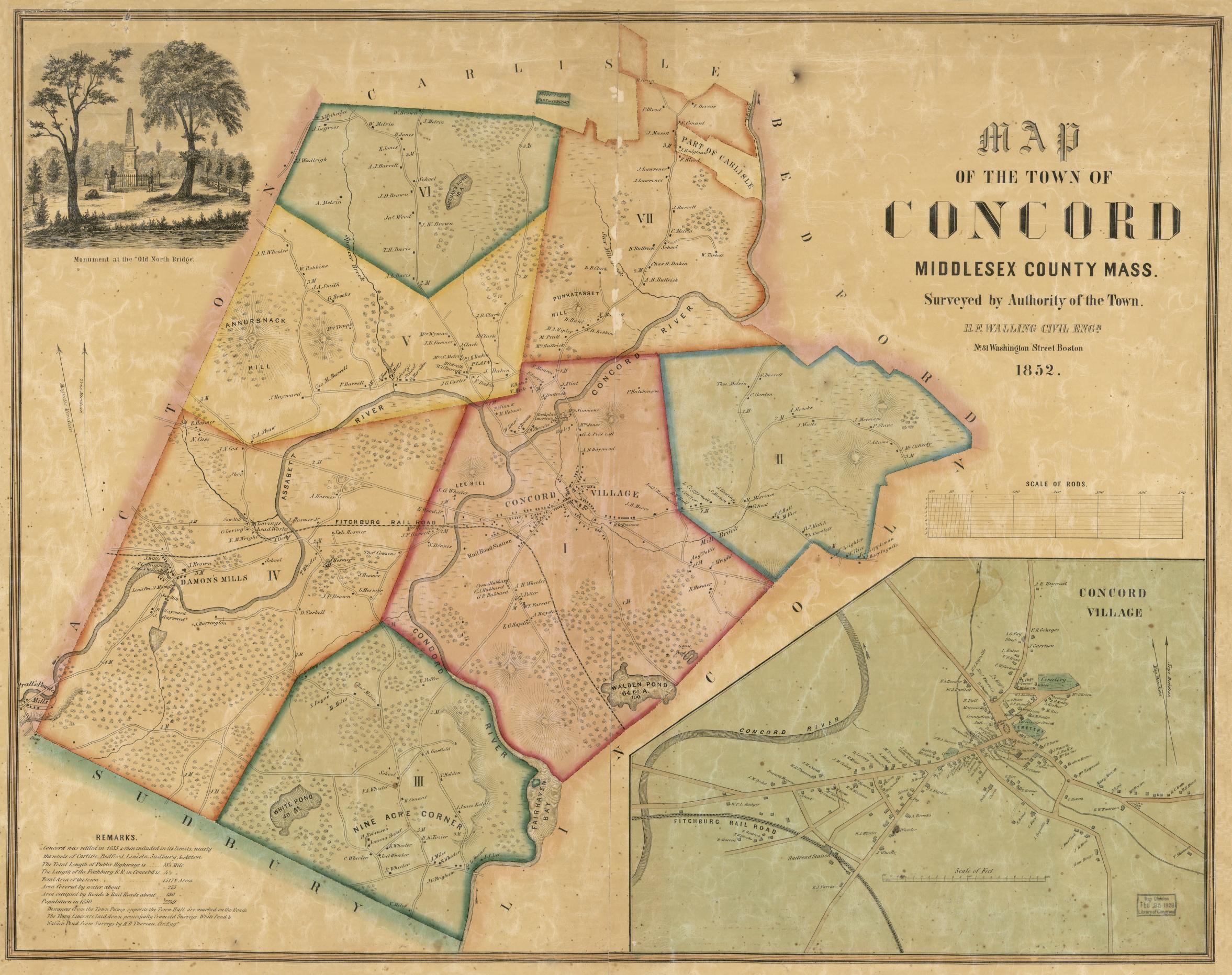
Figure 1: The map lists some Concord landowners including the following Black residents: Mrs. Dugan, Jenny, the wife of Thomas Dugan who inherited his land after his death, E. Dugan, Elisha Dugan, one of Jenny and Thomas Dugan’s sons, and P. Hutchinson, Peter Hutchinson Jr. Map of the Town of Concord, Middlesex County Mass. Boston: H. F. Walling, 1852. Courtesy of the Library of Congress.

Why are these burial sites so elusive? Unfortunately, the documentary paper trail is faint and fragmented. In reviewing town records, I found only a few scattered receipts showing that church sextons handled most burials before 1855. Unfortunately, there are no known church records recording who was buried where in the two oldest graveyards. A major reason for the missing information is a devastating church fire in 1901, which destroyed the building and countless records contained within. Despite years of digging through archives, the burial places of many marginalized Concord residents, regardless of race, remain unknown. With official records lost, I had to look elsewhere.

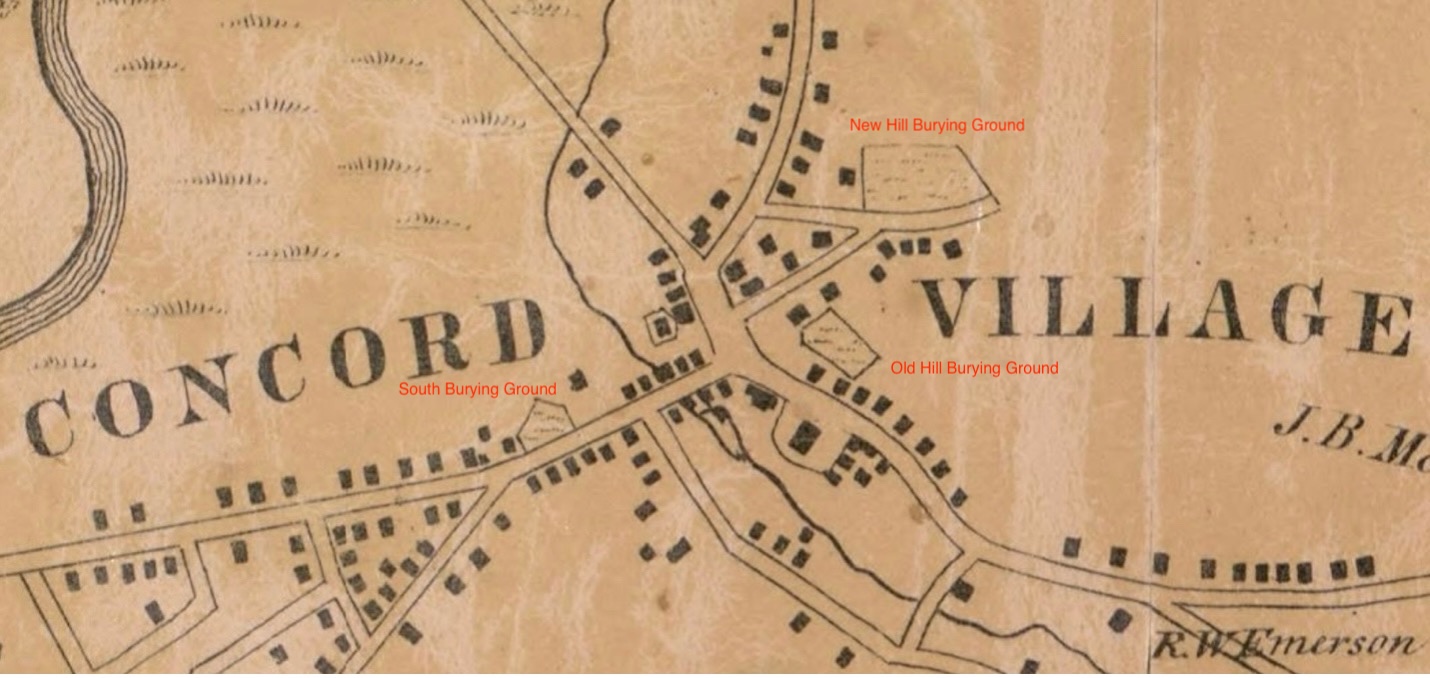
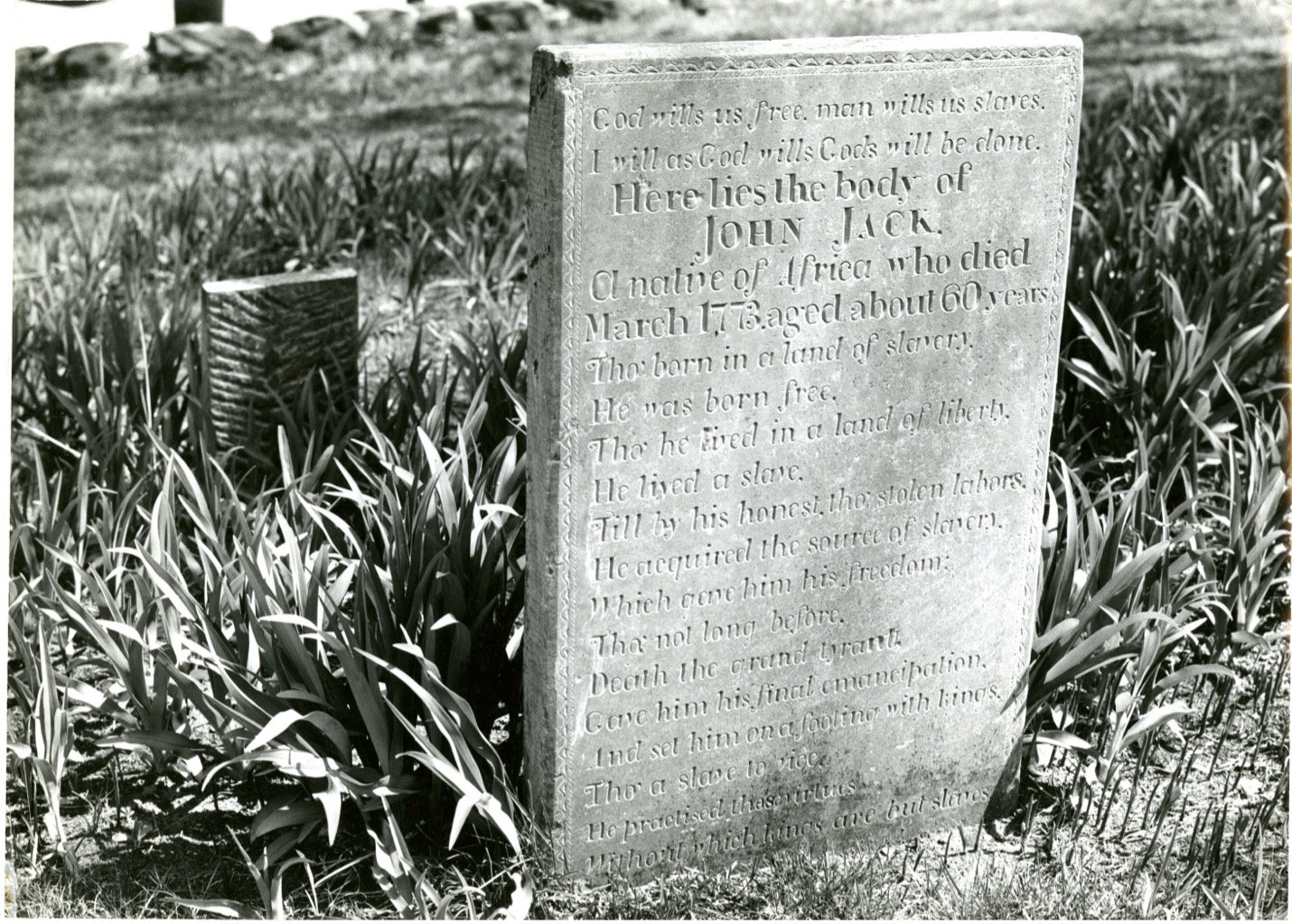
Faced with the need for alternate sources, I turned to memoirs and personal recollections, hoping that anecdotal evidence might fill in gaps. Indeed, I found a significant clue in Memoirs of Members of the Social Circle in Concord, Volume 2. In a memoir of Abiel Heywood written in March 1853, Francis R. Gourgas noted, “…we continue to observe in the burial of the two races, the blacks being consigned by themselves to a far corner of the graveyard.” Gourgas did not specify which burying ground he was referring to: Old Hill, Main Street, or New Hill. However, his words echo in the landscape of Concord’s oldest burying ground, Old Hill. In Old Hill, one tombstone belonging to a Black individual, John Jack, stands apart from most other graves in a far corner, as Gourgas described.

Figure 2: Close up selection of the map shows New Hill Burying Ground in the top right corner and Old Hill Burying Ground in the center of the image, and South Burying Ground furthest south and on the left under the D in Concord. Selection from: Map of the Town of Concord, 1852. Courtesy of the Library of Congress.

John Jack’s gravestone is a rare marker for a known burial of a Black community member from colonial Concord and is notable for the story it represents. After emancipating himself in the 1750s, John Jack purchased land in the 1760s, becoming Concord’s first documented Black landowner. When he died in 1773, he left his estate to Violet, another formerly enslaved resident, making her Concord’s second documented Black landowner.

Figure 3: Headstone and footstone of John Jack, CFPL Photograph and Image Collection. Courtesy of William Munroe Special Collections, Concord Free Public Library.

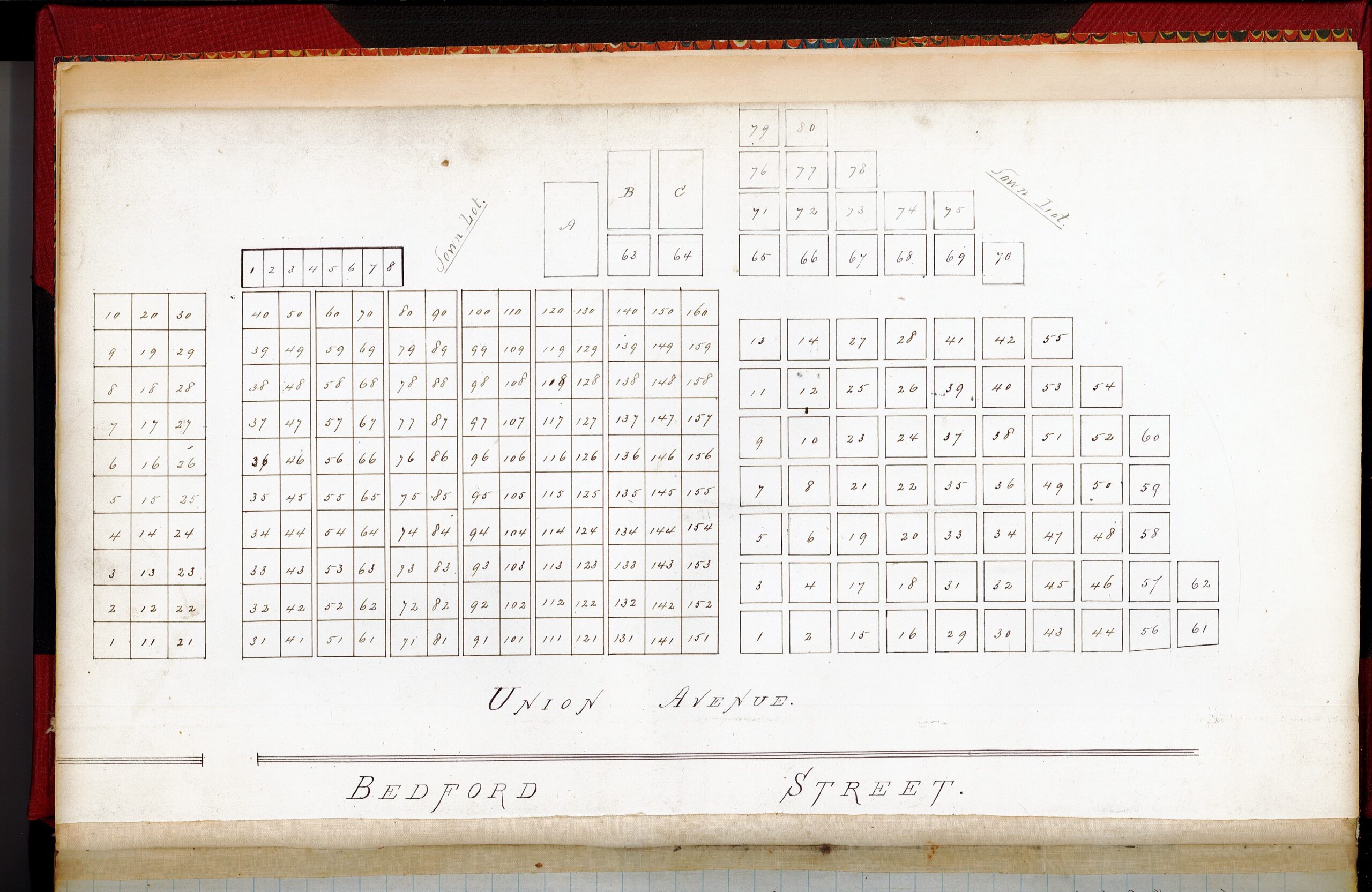
Among the approximately 800 gravestones in Concord’s two oldest burial grounds, John Jack’s is the sole marker for a Black resident. Over time, New Hill Burying Ground became the primary cemetery. Initially, New Hill was laid out with 160 lots, with additional lots added in subsequent years. The first internment took place there on July 13, 1823.

Figure 4: Lot Map for New Hill Burying Ground. Courtesy of the Town of Concord Archives.

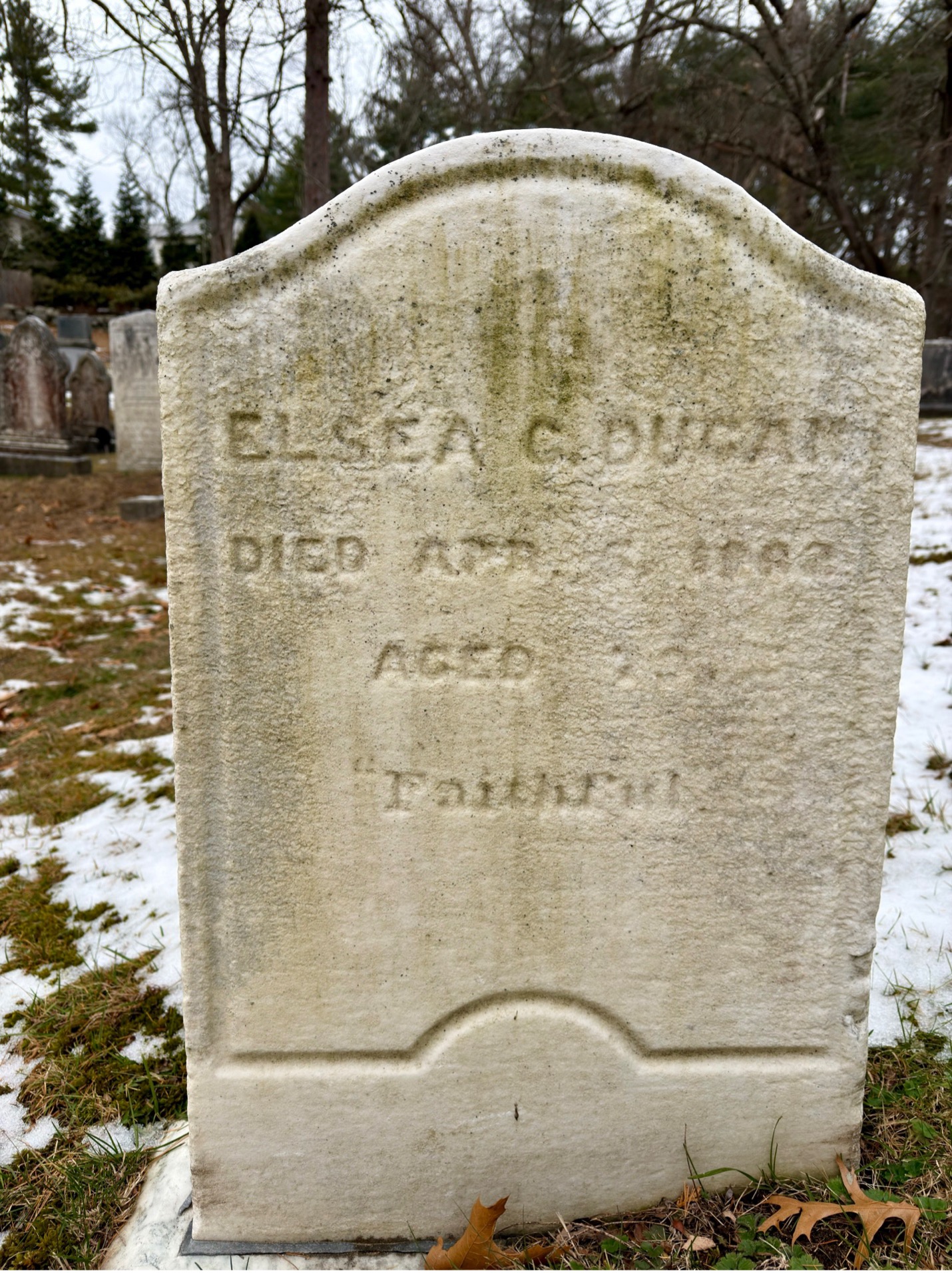
Within the expanded lots at New Hill Burying Ground, two gravestones commemorate Black residents. The first is that of Elsea Catharine Dugan, daughter of Thomas Dugan. She was a free Black single woman who died in 1882 and was buried in Lot 39 East. Her probate indicates payments of $59.50 for her funeral expenses and $25.00 for a headstone inscribed with her name and the word “Faithful.”

Figure 5: Elsea C. Dugan’s Gravestone. Photo by Beth van Duzer (2023).

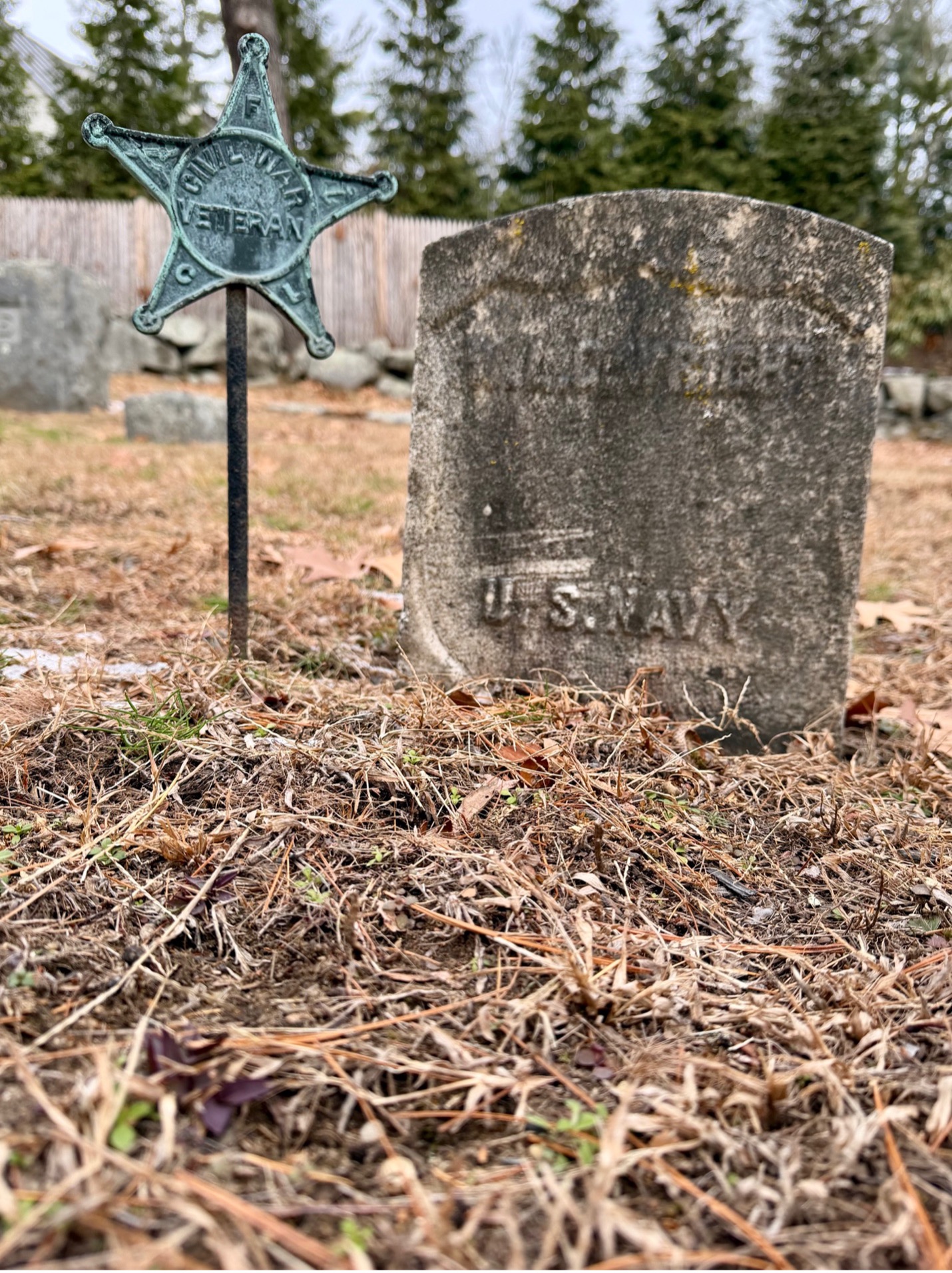
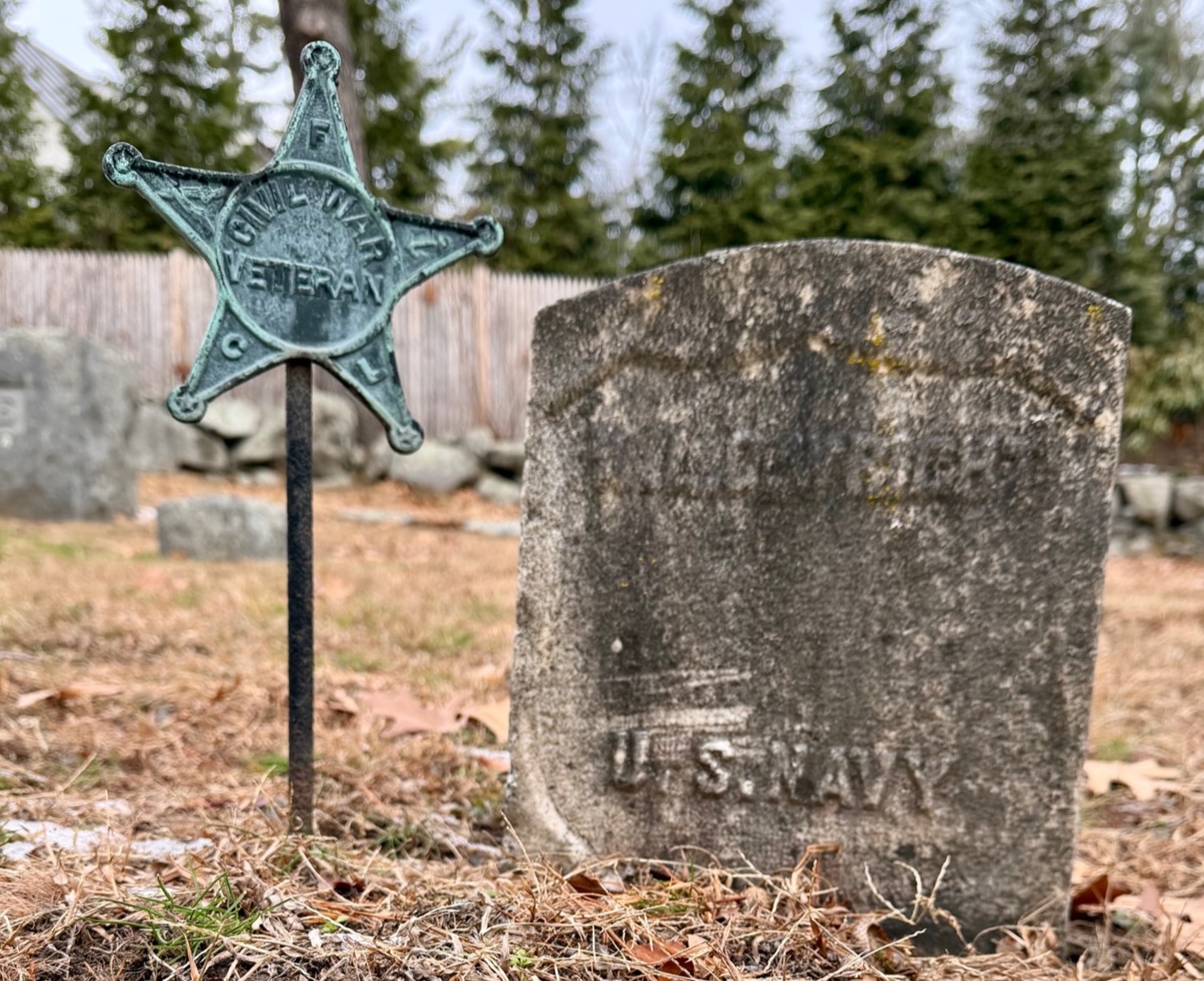
The other belongs to William Lloyd Garrison Wright, who served in the U.S. Navy during the Civil War and died on March 19, 1890. His grave in Lot 76, owned by the Grand Army Post, is marked with a military headstone.

Figure 6: William Lloyd Garrison Wright’s Military Headstone. Photo by Beth van Duzer (2025).

Clearly, these few gravestones cannot account for the many generations of Concord’s Black community who lived, worked, and died in the town from its founding in 1635 through the end of the 19th century. To address this discrepancy and identify additional individuals, I consulted a vital record book.

Although a vital record book may seem like dry reading, it actually holds part of the rich history of Concord’s Black community, which makes it an exciting resource. The Concord, Massachusetts Births, Marriages, Deaths, 1635 – 1850 vital records book, painstakingly compiled and published in the late 1800s, contains birth, marriage, and death information from multiple sources. As such, this tome serves as an important starting point for research on past residents. Although the volume documents the deaths of sixty Black individuals, of those, only John Jack’s burial location is known and marked.

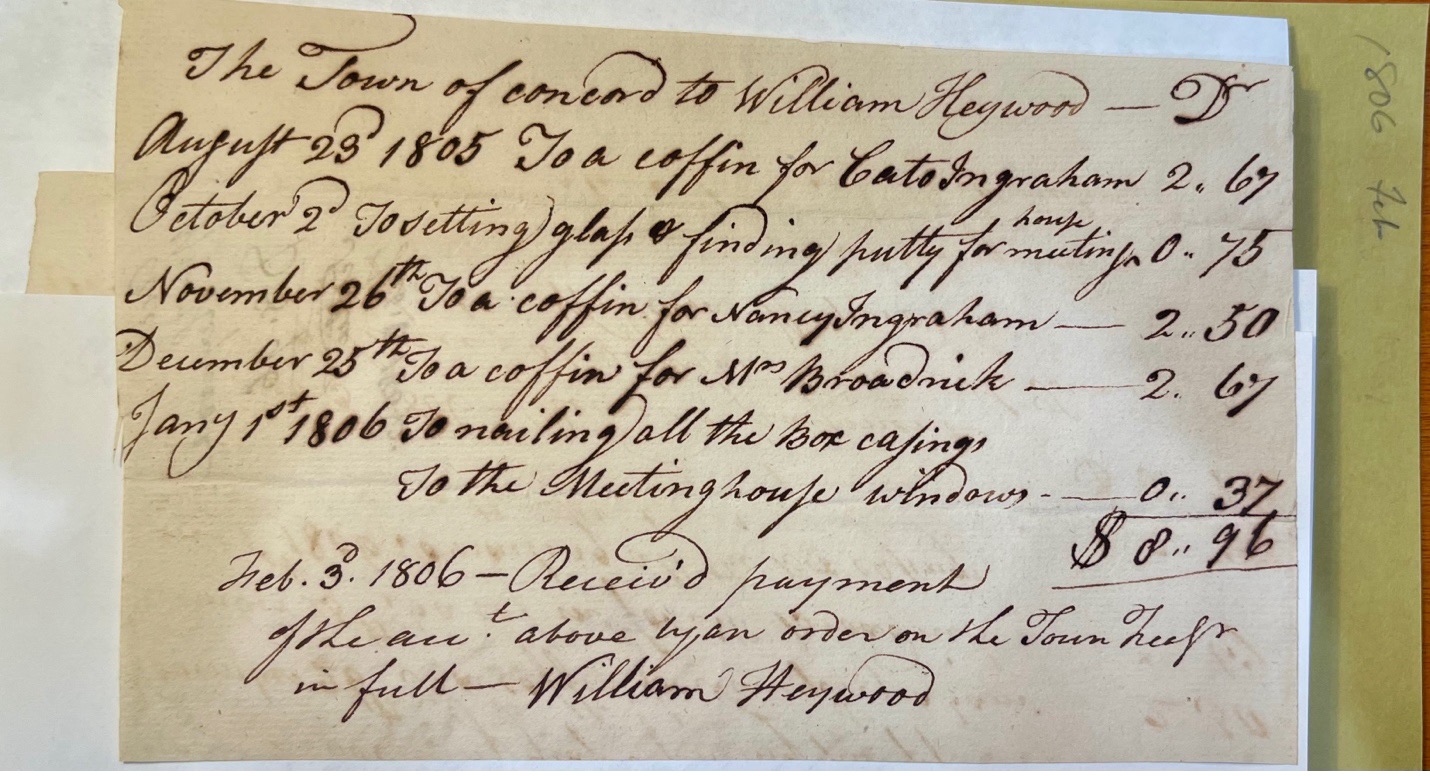
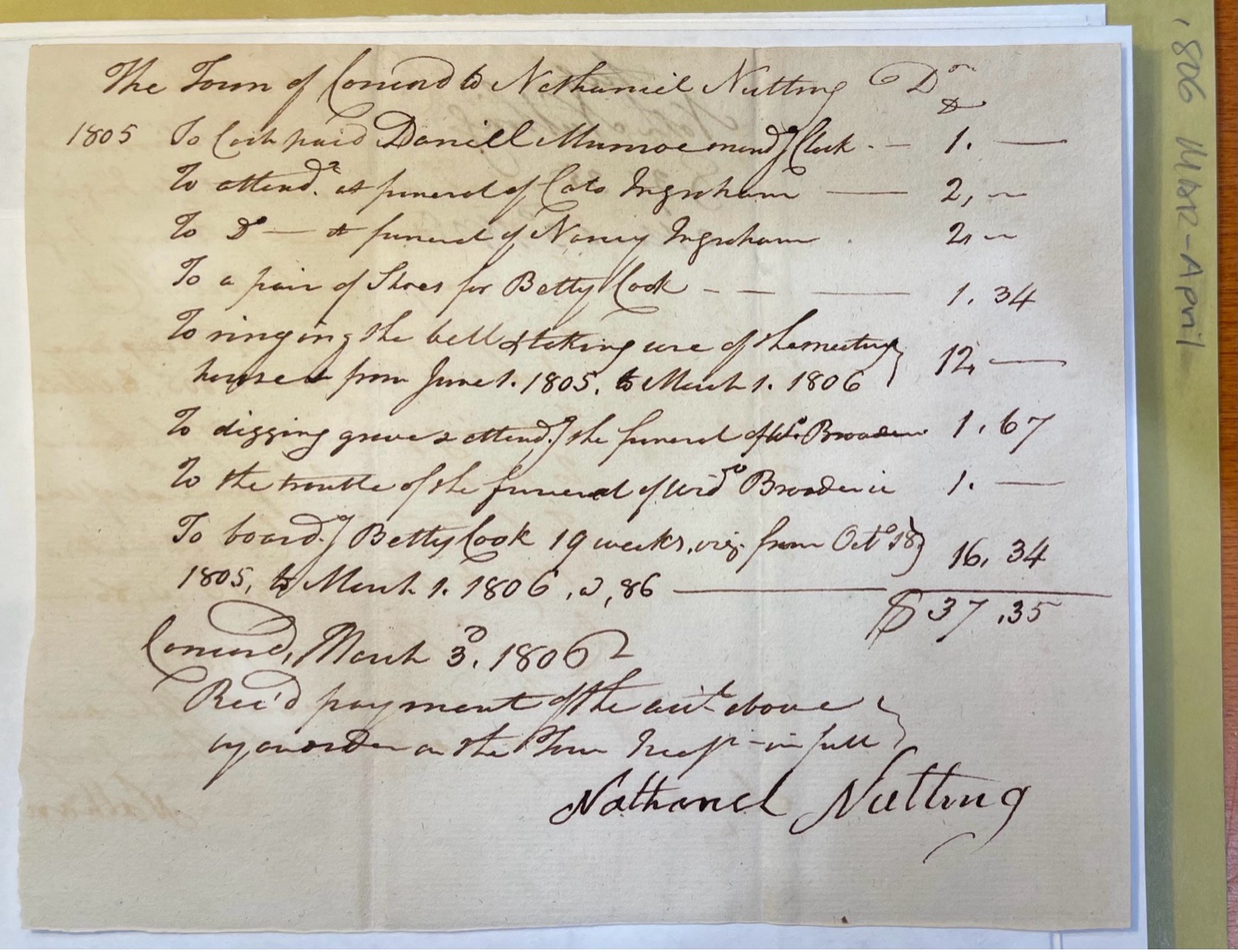
My search for additional clues continued in the Town of Concord Archives. In these records, I found that from 1757 to 1823, at least sixty-three individuals classified as “town poor,” including five Black residents, were buried in Concord. However, no receipt specified which burying ground contained the remains of any of the town’s poor. It seems that, after the poor were buried, these individuals and their burial locations were lost to time.

Figure 7a: Receipt from the Town of Concord Archives. These receipts document payments to a person who attended the funerals of Cato Ingraham and his daughter Nancy Ingraham, and to another who made their coffins. The burial locations are not listed. Photos by Beth van Duzer (2025). Courtesy of the Town of Concord Archives.
Figure 7b: Receipt from the Town of Concord Archives. These receipts document payments to a person who attended the funerals of Cato Ingraham and his daughter Nancy Ingraham, and to another who made their coffins. The burial locations are not listed. Photos by Beth van Duzer (2025). Courtesy of the Town of Concord Archives.

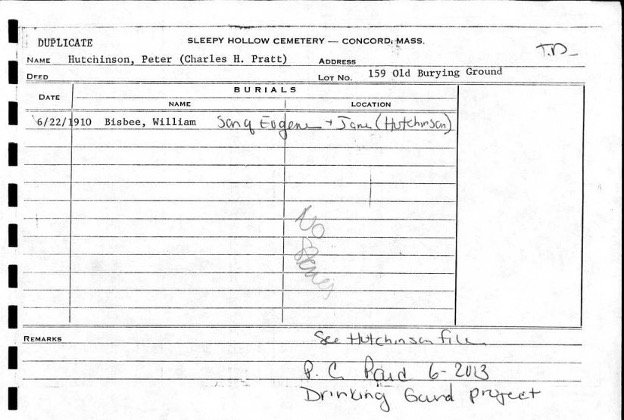
In the early 2000s, a breakthrough occurred in the ongoing search for missing burial information. Historians found, thanks to a rediscovered lot card, that Lot 159, one of the original 160 lots in New Hill Burying Ground, was the plot of the family of Peter Hutchinson Jr., a free Black man who lived in a house known as the Robbins House. The cemetery record indicated that his grandson, William Bisbee, was buried in Lot 159 in 1910. Based on Hutchinson’s ownership of the lot, historians inferred that he and his family were also interred there.

Figure 8: A duplicate lot card for William Bisbee, grandson of Peter Hutchinson Jr. Courtesy of Town of Concord Archives.

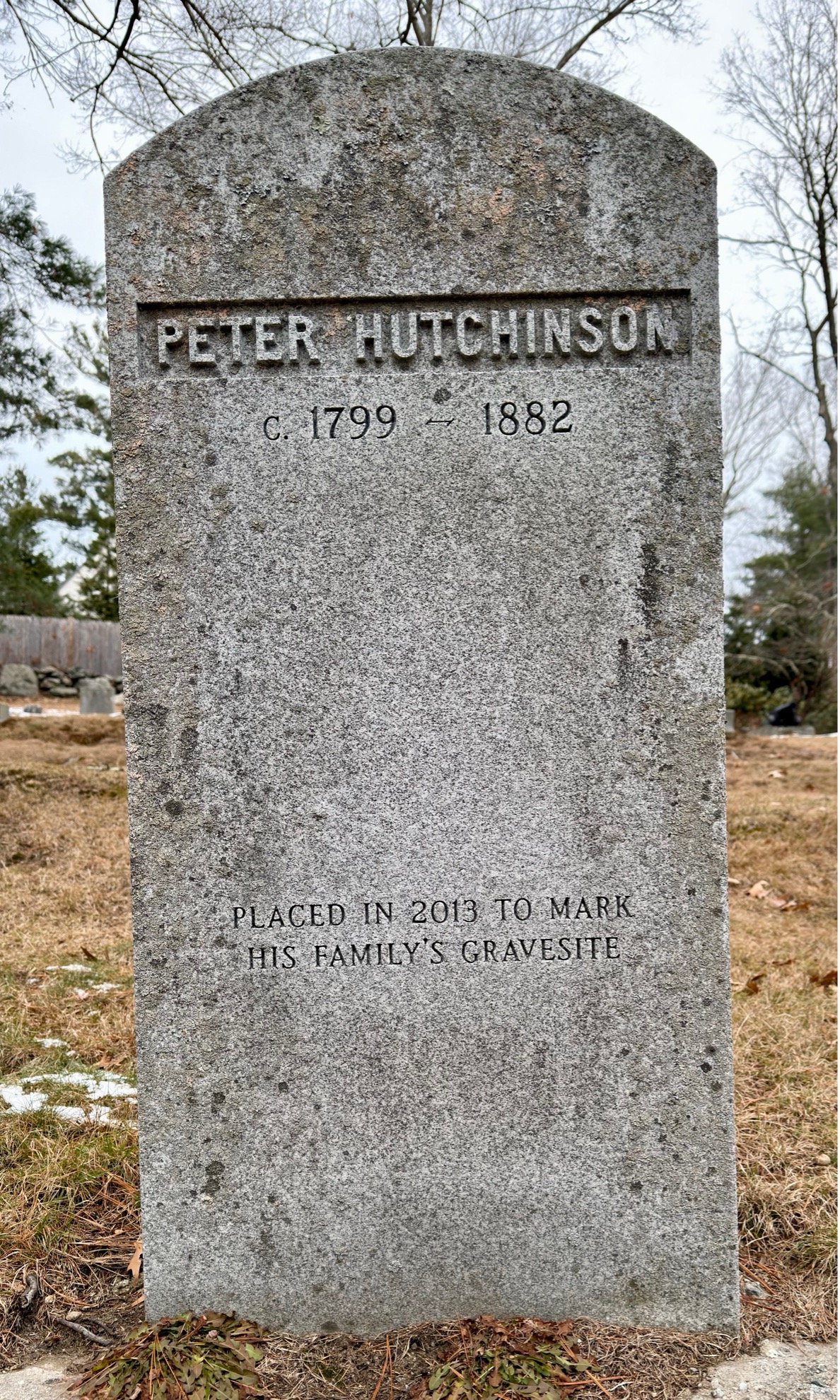
In 2013, Lot 159 received long overdue recognition. The Friends of Sleepy Hollow Cemetery, together with the Robbins House, a museum dedicated to Concord’s Black history, installed a marker at the site for Peter Hutchinson, Jr. More than a century after the third gravestone was erected in Concord, a fourth was added to commemorate the legacy of part of Concord’s Black community in the burying grounds, with the hope that the final resting places of all Black community members will eventually be identified.

Figure 9: Peter Hutchinson Jr.’s Family Gravesite Marker. Photo by Beth van Duzer (2025).

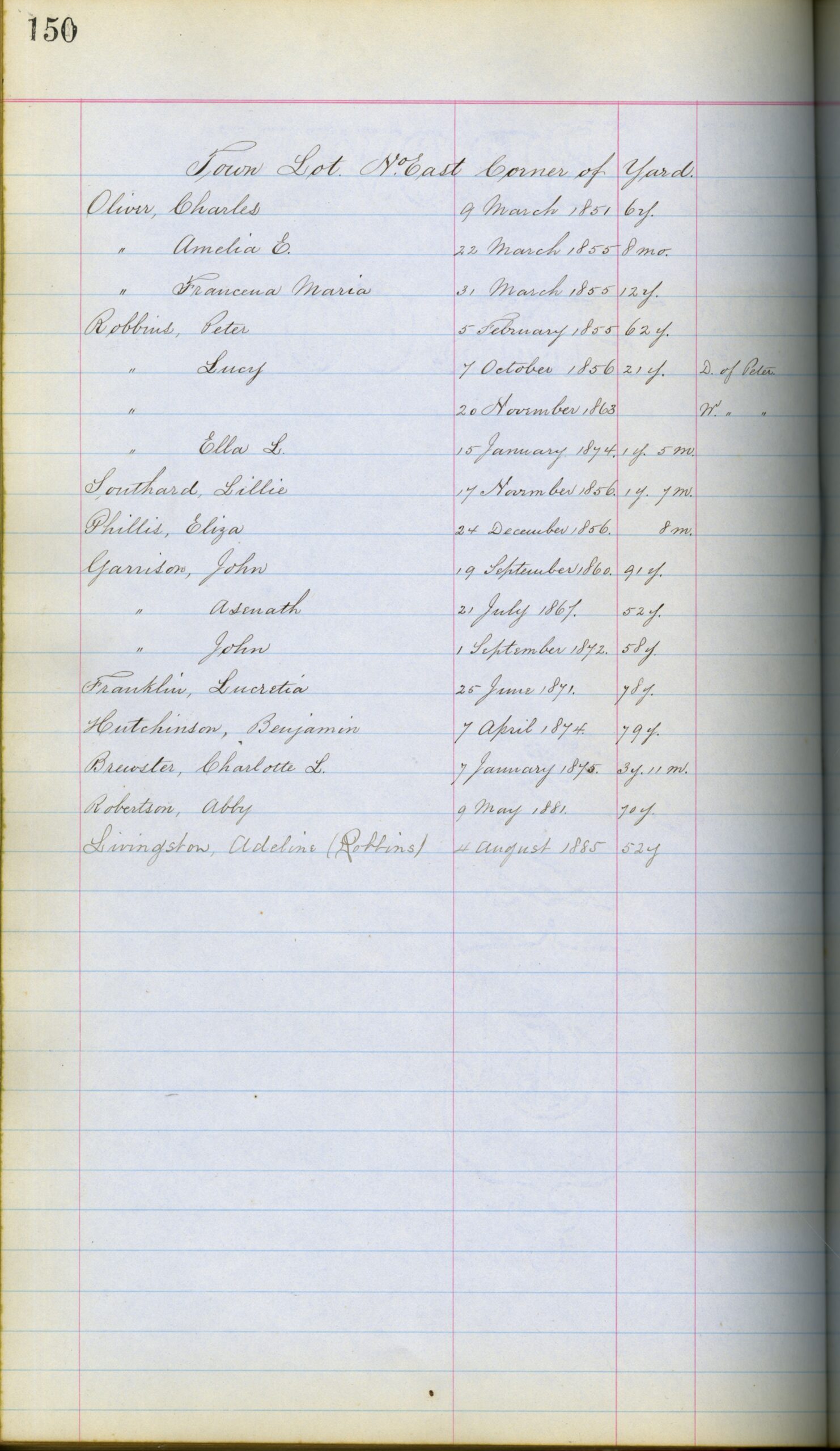
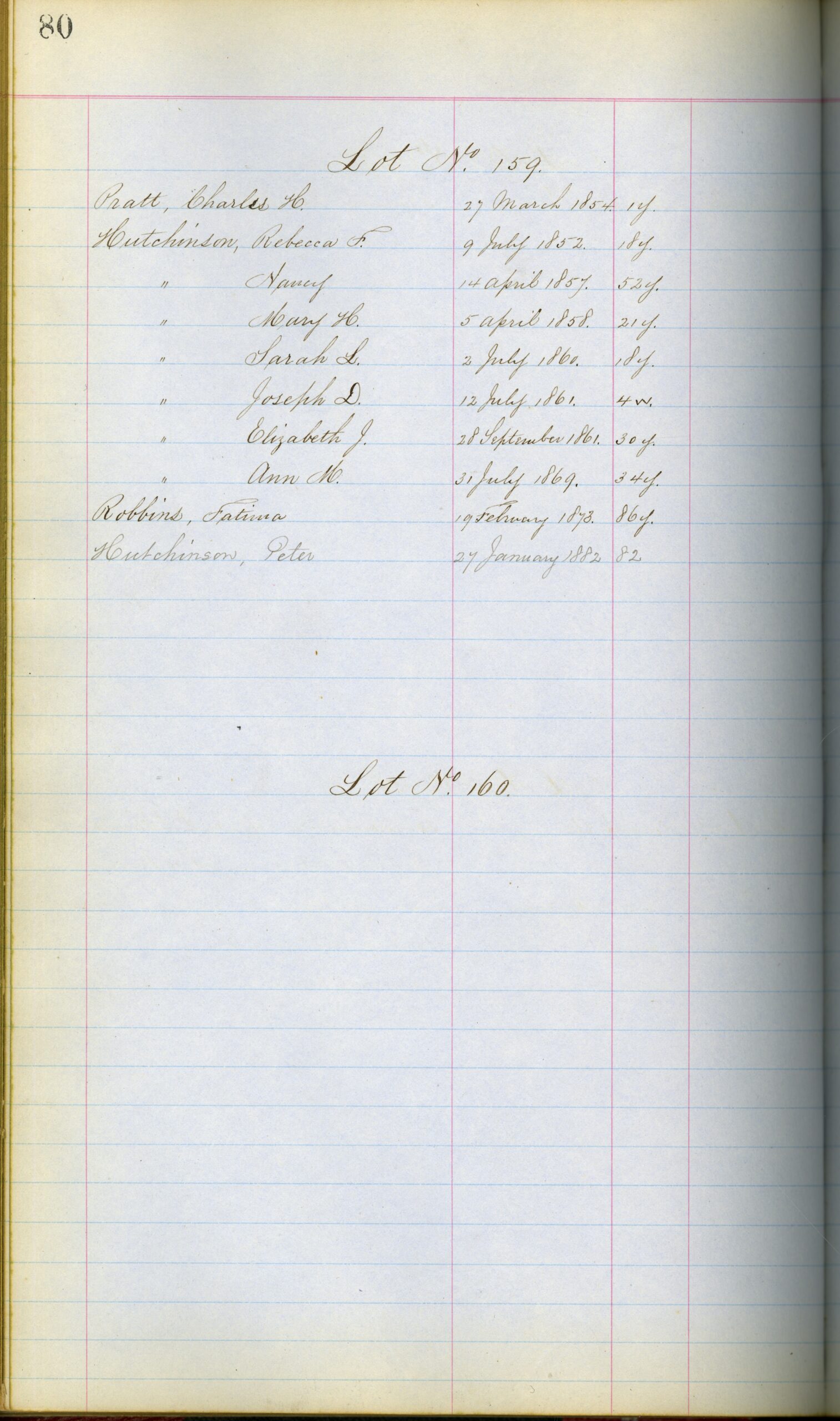
The belief that many Black residents were buried in Lot 159 or the nearby town lot prompted me to conduct further research. In the summer of 2025, while combing through archival records, Nathanial Smith, the Town of Concord Archivist, shared with me a rediscovered book containing records from Sleepy Hollow Cemetery, including its oldest section, New Hill Burying Ground. As I flipped the pages, the book fell open to a list of surnames: Garrison, Robbins, Oliver, and others from Concord’s Black community. The names were grouped together. They were buried in the same lot. This finding mirrors that of New York City’s Black burying ground and echoes Gourgas’s finding, finally confirming a pattern of communal burial for Concord’s Black population separate from others.

Figure 10: Page 150 from the rediscovered Sleepy Hollow book lists the names of Black Community members buried in the same plot. Courtesy of the Town of Concord Archives.
Figure 11: Page 80 of the rediscovered Sleepy Hollow book shows mostly family members buried in Peter Hutchinson Jr.’s lot. Courtesy of the Town of Concord Archives.

To continue the search for missing burial information, I expanded my research to include additional sources in the Town of Concord Archive. Among the files, I found a Certificate of Deaths submitted by the Pastor of the Second Parish church, listing fifteen funerals he attended in 1841 and 1842. Eight of these burials, including those of two Black residents, Nathaniel Oliver and Susan Garrison, were not recorded in the recently rediscovered Sleepy Hollow book. Since other internments were documented, the certificate was likely unavailable to the individual who copied the information in the late 1800s. The repeated discovery of scattered documents containing information not included in official records made it abundantly clear that no single source would reveal the full story.

Figure 12: This receipt from the Town of Concord Archives certifies funerals attended by Pastor James Means, including those of two members of the Black community. Photo by Beth van Duzer (2025). Courtesy of the Town of Concord Archives.

Further examination of town documents included the Town Books. Town Book VII had an entry in its index under “Burying Grounds” stating: ““Persons of colour” to be interred in the rear.” On the corresponding page, the Cemetery Committee’s report from the Town Meeting on November 1, 1824, described the layout of a new burying ground. The report specified burial locations for strangers and tomb construction, and stated, “The NorthEast corner of said burying ground within the stakes to be appropriated for burying people of colour.” This means the location of burials for the Black population was always recorded in the Town Books, corroborating the anecdotal information from the Social Circle Memoirs, the recently found book, and other official documents. The Black population was assigned to the NorthEast Corner Lot in New Hill Burying Ground. Based on this, Susan Garrison and Nathaniel Oliver were buried in the NorthEast Corner Lot with other members of their families, as it was the designated area for Black burials.

Figure 13: This is an image of the NorthEast Corner Lot, where many members of Concord’s Black community were buried beginning in the 19th century. Photo by Beth van Duzer (2025).

Official records are only part of the story. Local memory also played a role in preserving Concord’s Black history. A review of local newspapers supported my discovery of a separate lot for Concord’s Black community, albeit in a different way. The May 26, 1881, edition of The Concord Freeman, which had a section that served as a sort of gossip column, reporting who visited whom and other goings-on in town, reported: “Abby Robertson, the colored lady whose death is elsewhere reported, was brought here on Saturday for burial in the lot of John Garrison, her brother-in-law, with whom she used to live not far from where the burial took place.” Although the official record identified her resting place as the Northeast Corner, this newspaper account revealed that townspeople referred to it as John Garrison Jr.’s lot. This local knowledge further strengthens the conclusion that the lot was used by the town to bury the Garrison family and the broader Black community.

For generations, the story of Concord’s Black community focused mainly on the grave of John Jack. The later recognition of the graves of Elsea Dugan and William Lloyd Garrison Wright, and most recently, the dedication of Peter Hutchinson Jr.’s family lot, have broadened the narrative and brought long-overdue visibility to Black Concordians. The recently rediscovered Sleepy Hollow book is helping identify additional members of Concord’s Black community in their final resting places. While my efforts have not uncovered a lost cemetery like New York City’s “Negroes Buriel Ground,” they have revealed the names and burial sites of many individuals previously absent from the historical record.

Ultimately, the search for Concord’s lost graves is not solely about stones and names; it is about restoring individuals to history, one clue at a time. This progress results from my persistent efforts to piece together information from scattered references, town reports, and rediscovered books to determine where members of Concord’s Black community were laid to rest. However, the story remains incomplete; gaps persist, and the rediscovered book represents only a fragment of a much larger history. The ongoing challenge is to continue searching so that every member of Concord’s Black community may be remembered, honored, and restored to the Town’s collective memory as their burial sites are uncovered.

Further Reading:

On Black History in Concord, Massachusetts: Robert A. Gross, The Minutemen and Their World (New York: Picador, 2022), Robert A. Gross, The Transcendentalists and Their World (New York: Farrar, Straus and Giroux, 2021), and Elise Lemire, Black Walden: Slavery and Its Aftermath in Concord, Massachusetts (Philadelphia: University of Pennsylvania Press, 2009).


This article originally appeared in March 2026


Beth van Duzer is an independent historian based in Concord, Massachusetts, and the owner of Historian for Hire, LLC, which provides historical research services and walking tours. She is co-chair and clerk of the Concord250 History & Education Subcommittee and serves on the Town’s Cemetery Committee. Beth also works as an educator and research assistant at the Concord Museum. She is the author of the forthcoming book Patriots of the Revolution: Early Members of the Social Circle in Concord who Served in the American Revolution and is currently researching a new book on Concord’s Black community.

image_pdfSave to PDFimage_printPrint