


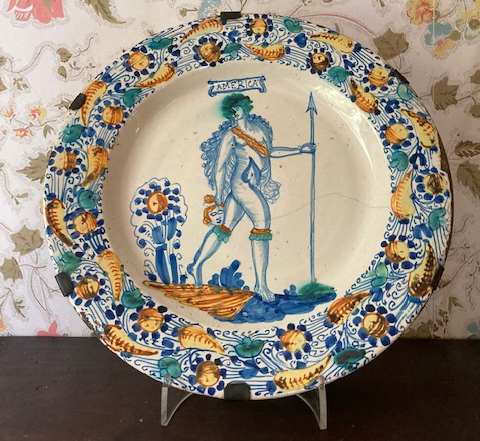
Pausing in the doorway of a local antiques shop and peering inside, I am transfixed. There, on a table near the front, sits a large ceramic dish, with colorful painted decoration. Pictured at its center is a tall woman, nude except for a pair of garters and feathered crown, caught in full stride. In one hand she holds a long spear, in the other a severed human head. I understand, intuitively, that she is Indigenous, a Native person. Over image a narrow banner framed the single word AMERICA.
Dishing Up History
In order to understand the dish, I will have to find my way through much unfamiliar territory. It will be quite a journey, full of inquiry and fresh learning.
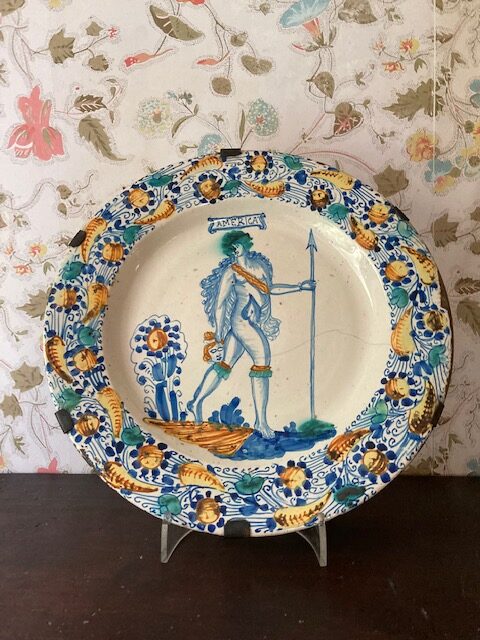
I have to stop for a minute to take it all in. AMERICA? An Indigenous woman? A severed head? Though an occasional collector of early ceramics, I have never seen anything like this.
I learn from the shop’s proprietor—a good friend and longtime feeder of my antiques habit—that the dish had been part of an estate auction a few weeks before. Its previous owner was a museum curator, whose research had uncovered some of its recent provenance. After turning up at a consignment shop in upstate New York around 1940, it became well-known to a small circle of experts. Most of them put its origin in Spain during the opening decades of the 17th century. This was not a unanimous opinion; Italy has also been suggested. At any rate, it was made somewhere within the southern Mediterranean world.
In addition, the previous owner had found its connection to a print image published in the 1580s or 1590s by a Flemish engraver named Phillips Galle. The central figure, on both dish and print, holds exactly the same stance. There is also, in both, the same AMERICA banner, the same spear, the same hand-held severed head. Certain differences reflect the transfer of medium, from engraving to ceramics. One of these involves the head. Carefully drawn with Caucasian features on the print, it could only be outlined on the dish. But color—the blond hair—marks it as European. Perhaps, I think, the maker had the print alongside while painting the dish.
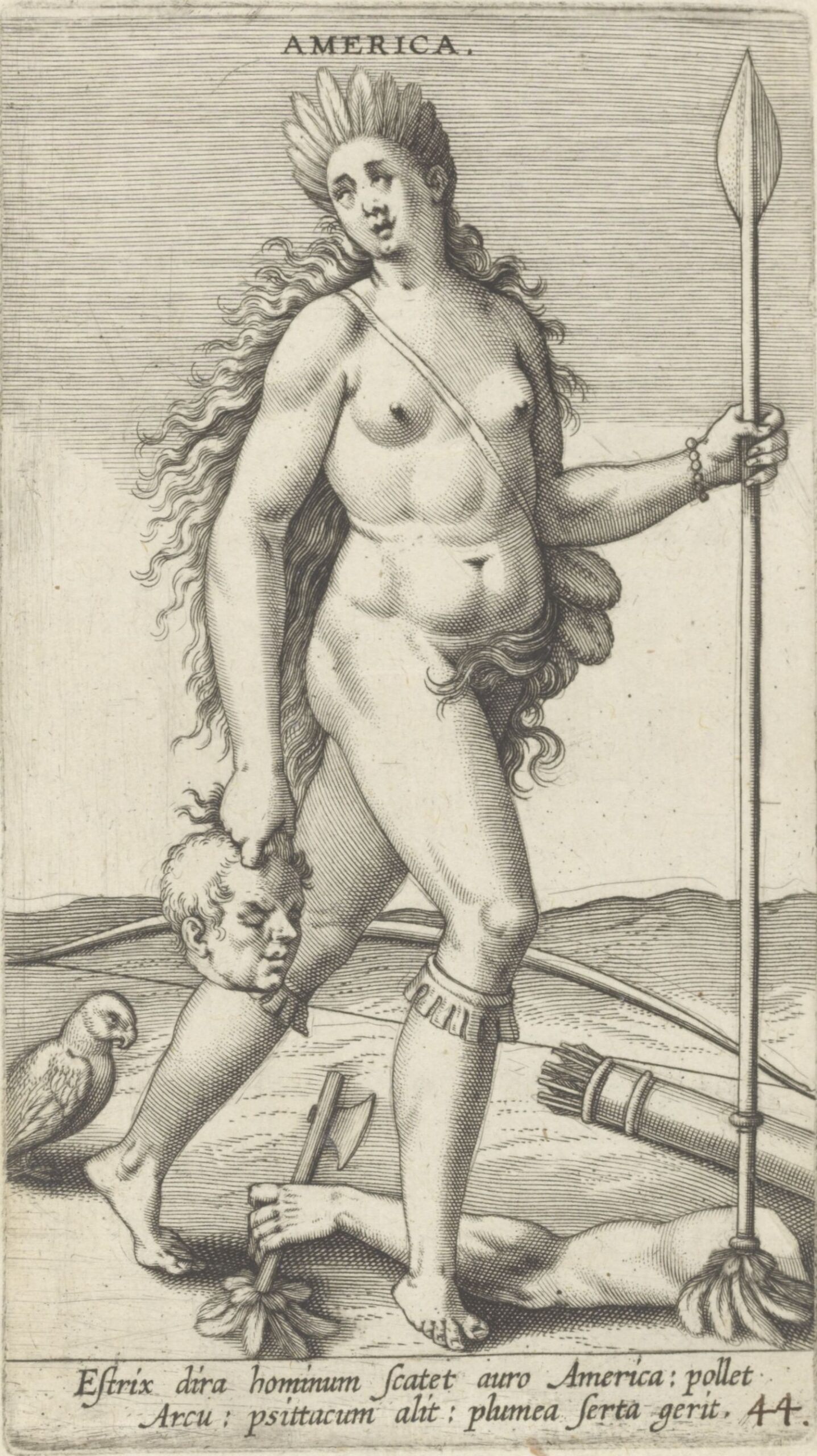
Of course, it’s the head that most commands attention. What does it mean? Just what is happening here? The historian in me is significantly aroused.
But there is a difficulty. My long scholarly career has centered on North, not South, America—on British, not Spanish or Portuguese, colonialism—on the 17th and 18th centuries, not the 16th. In order to understand the dish, I will have to find my way through much unfamiliar territory. It will be quite a journey, full of inquiry and fresh learning. Fortunately, I have friends and colleagues to guide me along the route. There is, as well, much fine scholarship for digging in at crucial points.
I learn that the Galle print was one of a set, depicting all four of the then-known continents. Each presented a personified image: a woman standing tall. Together they formed a hierarchy of cultural attainment. First, a queen-like European, sporting a crown and scepter; next, a richly gowned and groomed Asian, holding a little pot of incense; then, an African, shown naked to signify her primitive condition; finally, the Native American already described. Each of the first three makes a positive, even pleasing, impression. But the one for AMERICA is the opposite; it startles—shocks—me with its gruesome invoking of violence.
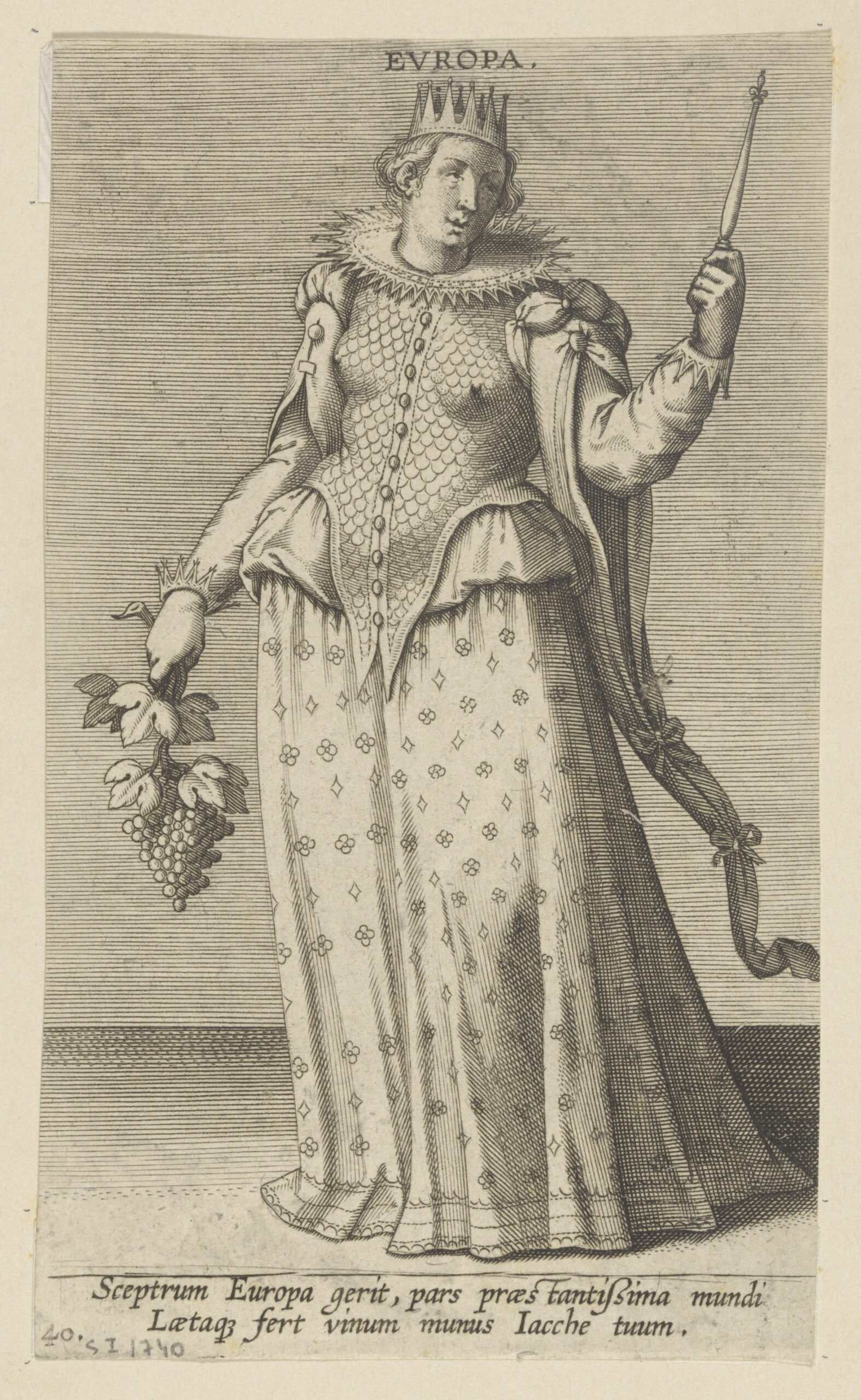
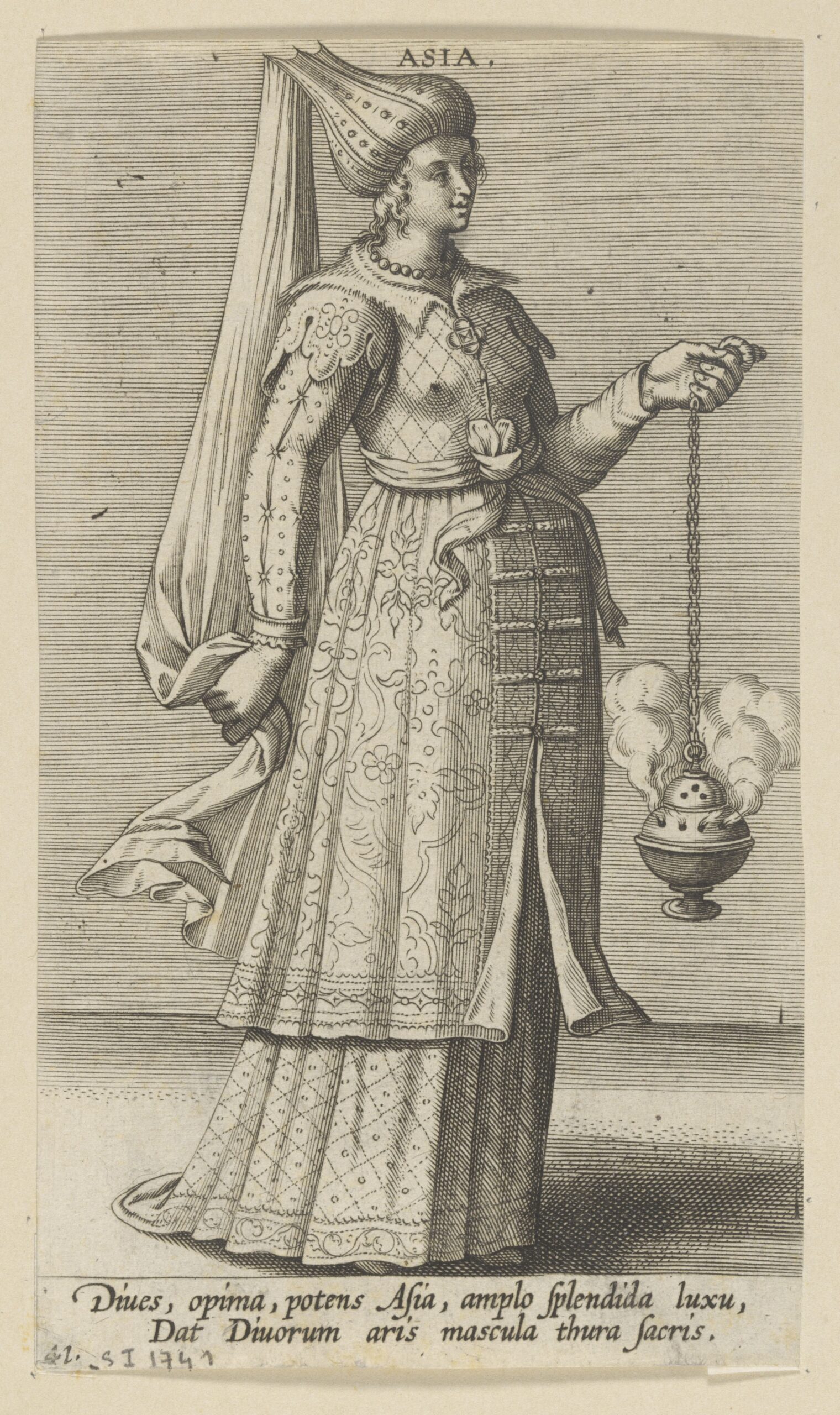
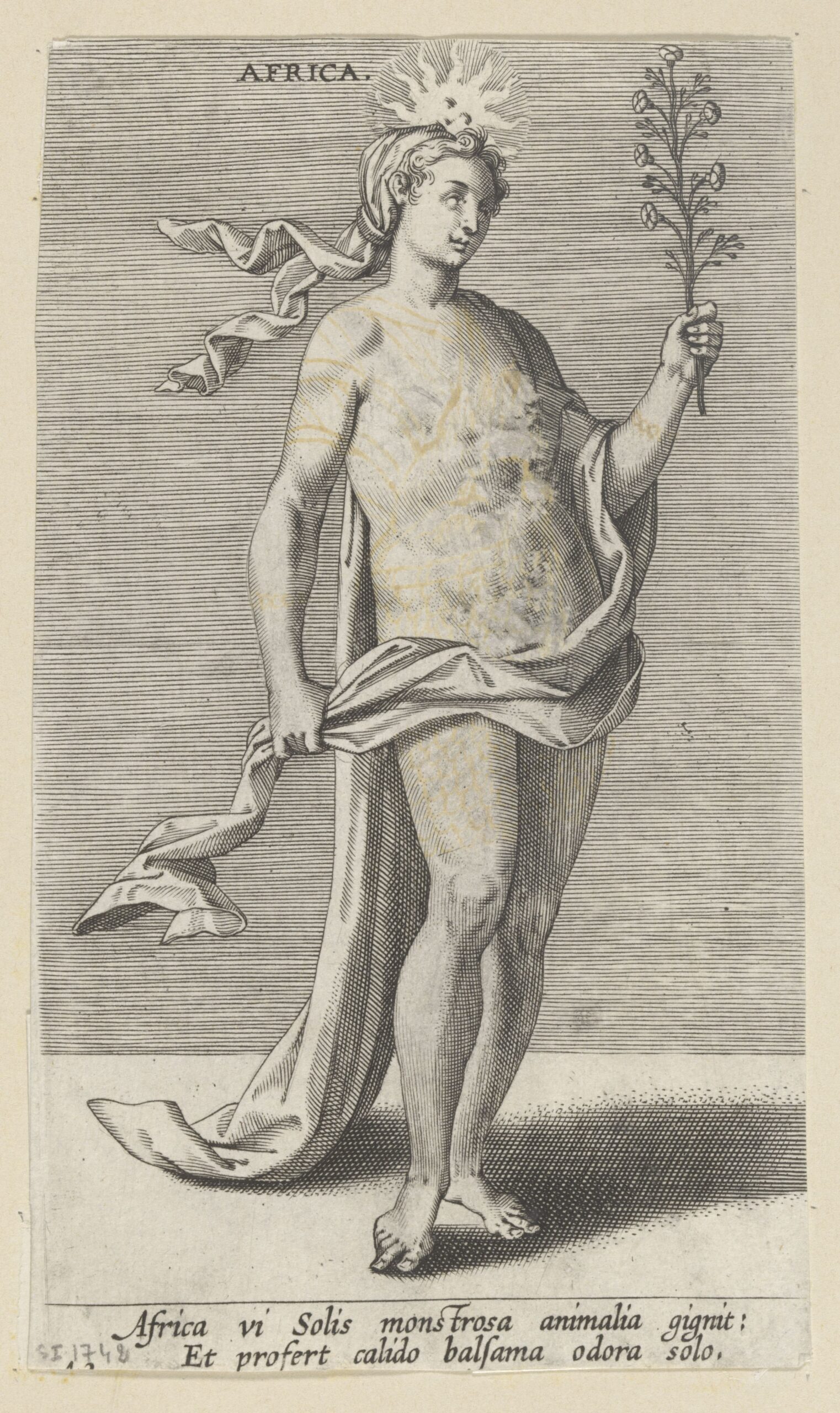
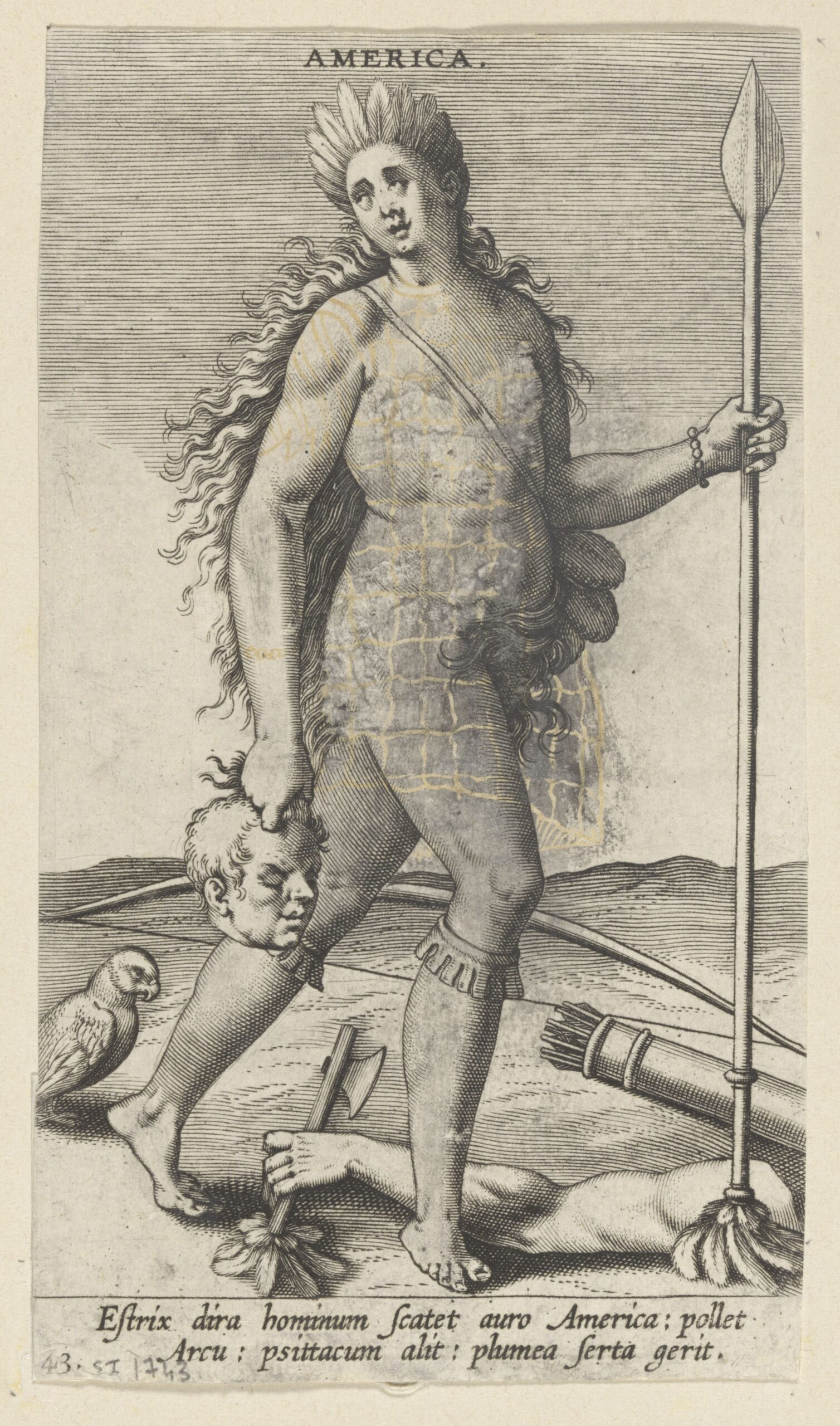
Now I have new questions. I wonder about representing whole continents as persons—and learn that this was, at the time, a familiar practice. It appeared in paintings, textiles, poetry, travelogues—and also in various event-centered contexts, such as courtly performances and political processions. More: it expressed a culture-wide preference for allegory, for expressing in symbolic form whatever was deemed most essential. So, I think, the AMERICA image was meant to convey an essence.
But why should such personifying, such essentializing, take a female form—in all four cases, not only with AMERICA. I try the question out on a historian-friend. Her reply is shrewd and compelling: continents, like women, are “acted upon, plowed, improved, fertile.” I have no better answer, nor can I find one in the scholarship.
There is a little more to take away from the Galle print. The central figure stands athwart a severed arm. A bow and a quiver of arrows lie next to it. A small parrot lurks nearby. These last are referents to America, as then imagined in Europe. They haven’t made it onto the dish, presumably because there wasn’t room to include them.
The print includes a caption, written in Latin, beneath the AMERICA figure. Estrix dira hominam Scatet auro America, pollet arcu psittacian alit. plumea serta ge. With the aid of a Latin scholar I manage a rough translation. America, a dreadful glutton of men, pours forth gold. She is mighty with the bow. She nourishes parrots. She wears a feathery garland.
A dreadful glutton of men: that sticks out. The severed head does not look edible, even for a glutton; it’s more like a trophy. A native American woman carries the severed head of a European man as a trophy: so be it. But what about the severed arm under her feet? What if both head and arm had once been parts of the same body? And if so, where’s the rest of it?
I receive a crucial tip from another historian-friend who has deep knowledge of this subject-area. For the friend, the image calls to mind a specific American group—native to Brazil—known by the name Tupinamba. The friend also suggests that during and after the 1550s, when outsiders first engaged with them, Tupinambas became for Europe a kind of archetype of Native America. Notoriously, too, they were cannibals. Now I have a clear way ahead.
***
There were many forerunners. Columbus, in his famous, fugitive journal, referred to “man eaters” said to inhabit certain islands in the Caribbean. A decade later the Florentine explorer Amerigo Vespucci, whose voyages touched the eastern rim of South America, deepened and amplified this theme. In letters to sponsors, Vespucci spun lurid tales of native people engaged in cannibal rites. When published in 1503, the letters were joined to a series of woodcut illustrations, the first visual representations. Translated soon thereafter into half a dozen languages, they would eventually spawn at least fifty published versions. According to one contemporary (English) source, they were “common reading.”
This first phase of depicting American cannibals drew on, and mixed with, much older traditions of wildness. These included hybrid humans fathered by dogs and sporting canine heads (a Medieval idea, previously connected with supposed cannibalism in Asia), hairy and beast-like “wild men” of the forest (also part of Medieval folklore), and Amazons (going all the way back to ancient Greece).
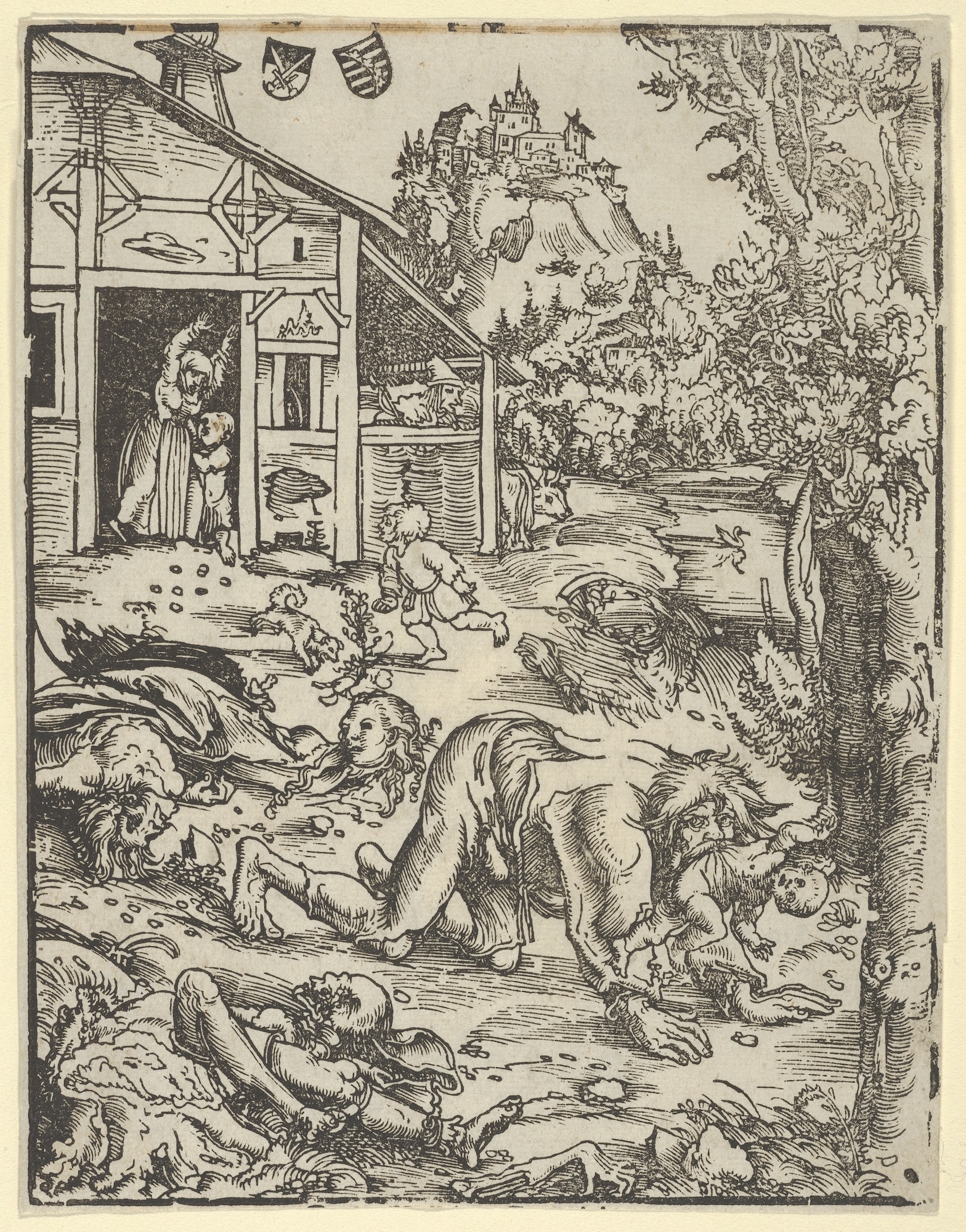
In the 1530s and ‘40s, European traders began to appear with some regularity along the South American coastline. Returning home, they would doubtless have added their bit to the growing lore of a cannibal-infested New World. Missionaries were arriving, too. In 1549 a Portuguese Jesuit named Nobrega published A Report on the Lands of Brazil, giving special attention to cannibalism. It was all part of a larger process through which Europe was, in a sense, “inventing America”.
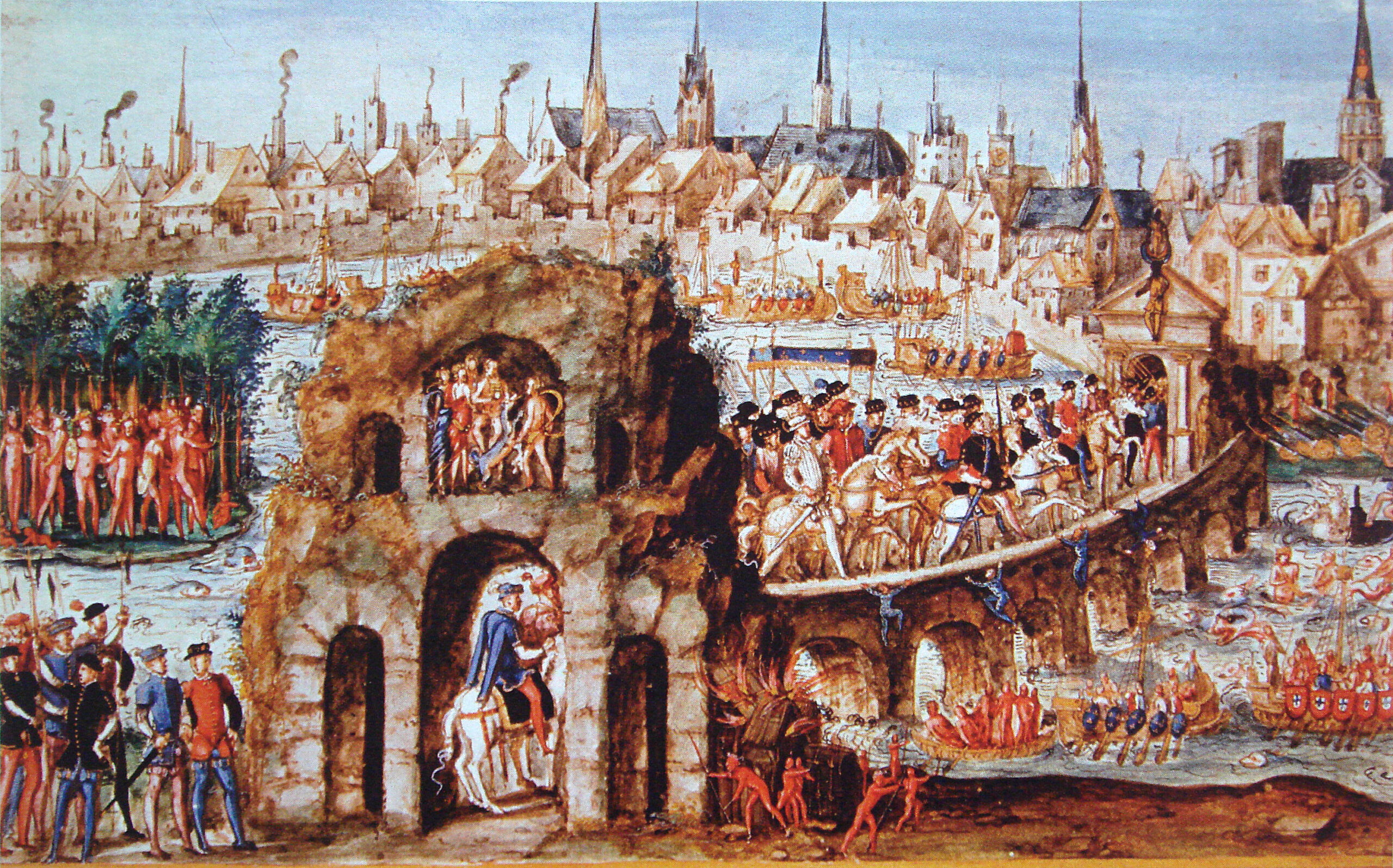
I learn, too, about related developments in Europe itself. On several occasions Tupinambas crossed the ocean in person. In 1550, a festival held to honor a visit by King Henri II in Rouen, France included a mock-up of a Brazilian village, “with 300 inhabitants… [of whom] fifty were Brazilian cannibals… all completely naked.” Another royal visit, to Noyes in 1574, sparked a similar burst of pageantry. This time the philosopher Michel de Montaigne was present—and able to converse (through interpreters?) with Tupinamba participants. Indeed, according to Montaigne, “the king himself… talked to them a good while, and they were made to see our fashions, our pomp, and the form of a great city.” Doubtless they were themselves a special attraction, with onlookers drawn from far and wide to gawk and wonder at the spectacle.
My reading points especially to the decade of the 1550s, when Brazil became the focus of a sharp colonial rivalry between France and Portugal. Both founded small settlements in the region that today surrounds Rio de Janeiro, and engaged in vigorous trade with native people. The prize was a tree species known as brazilwood, valued both as timber and (from its bark) as a source of red dye.
I read about a growing number of mid-century visitors—especially one Hans Staden, a German soldier and adventurer, and soon-to-be author of A True History and Description of a Country Belonging to a Wild, Naked, Savage Man-eating People, Situated in the New World of America. (Thus its long and expressive title, as translated from the original German.)
Staden wrote from personal experience. While living and working with Portuguese colonists, he was taken prisoner by Tupinamba warriors, carried to their village, and marked for execution and ritual consumption. However, the plans were stayed when he claimed, shaman-like, to possess extraordinary powers for predicting the future and healing the sick. After nine months of anxious residence among his captors, he escaped, found a ship bound for France, and returned home. By then he had witnessed the numerous cannibal feasts that would feature in his True History. The book was a sensation, nothing less. Its first two printings appeared in 1557. Translations into Dutch and Latin followed in rapid succession, and eventually the total of published editions would (by one count) reach eighty-three.
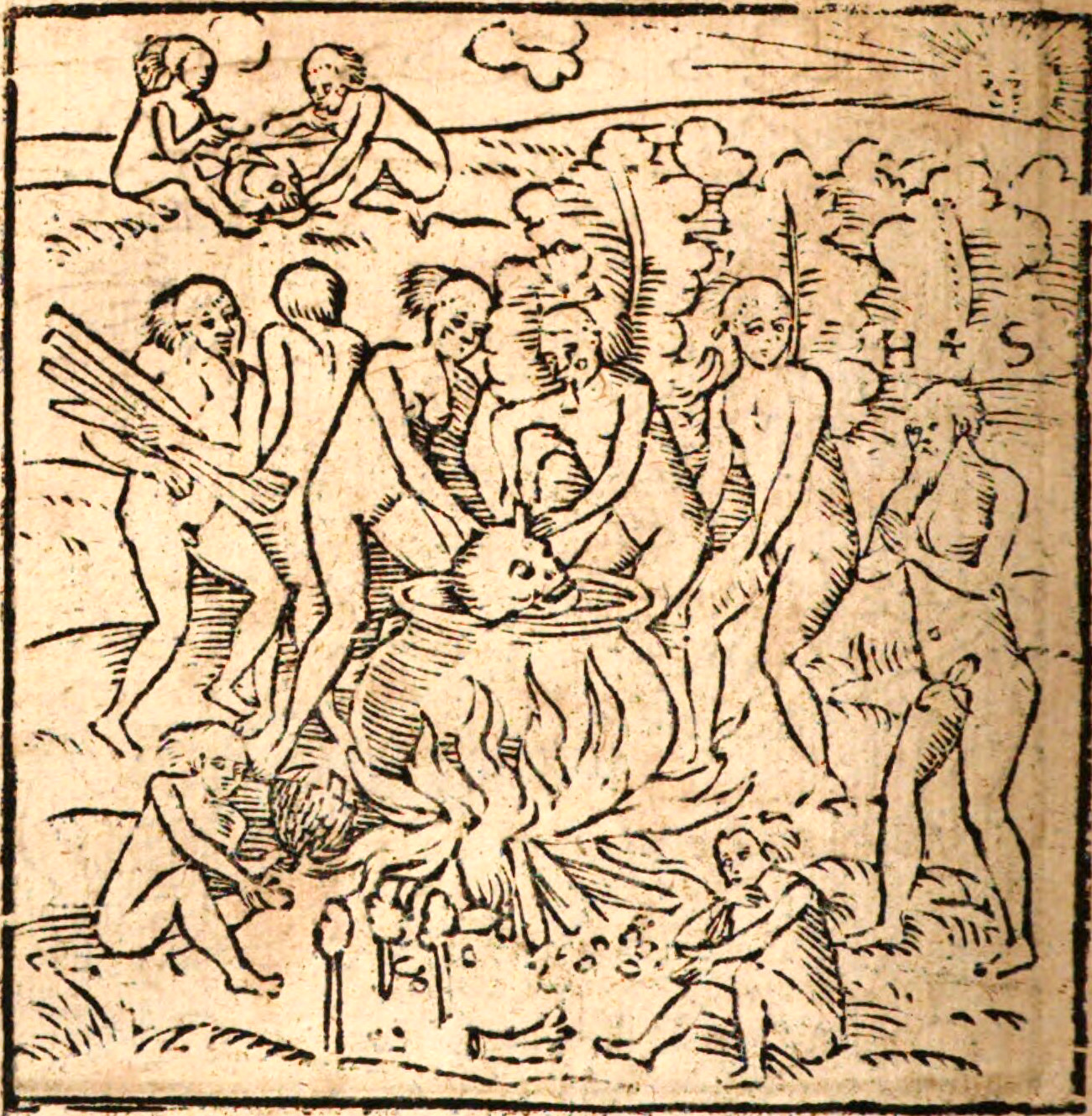
Almost simultaneously two French clerics, Andre Thevet (Catholic) and Jean de Léry (Protestant) arrived in the same region. Both became parts of ongoing missions. Both would write and publish their own first-hand accounts of the native population. And both took up the challenge of describing and interpreting cannibalism. What was the origin and meaning of such “savage” practice? How did it compare with cruelties endemic to European history and culture? Taken together, and added to the writings of their various predecessors, Staden, Thevet, and Léry initiated what some scholars today describe as a “discourse of cannibalism”. This would become a long, often highly charged, public conversation.
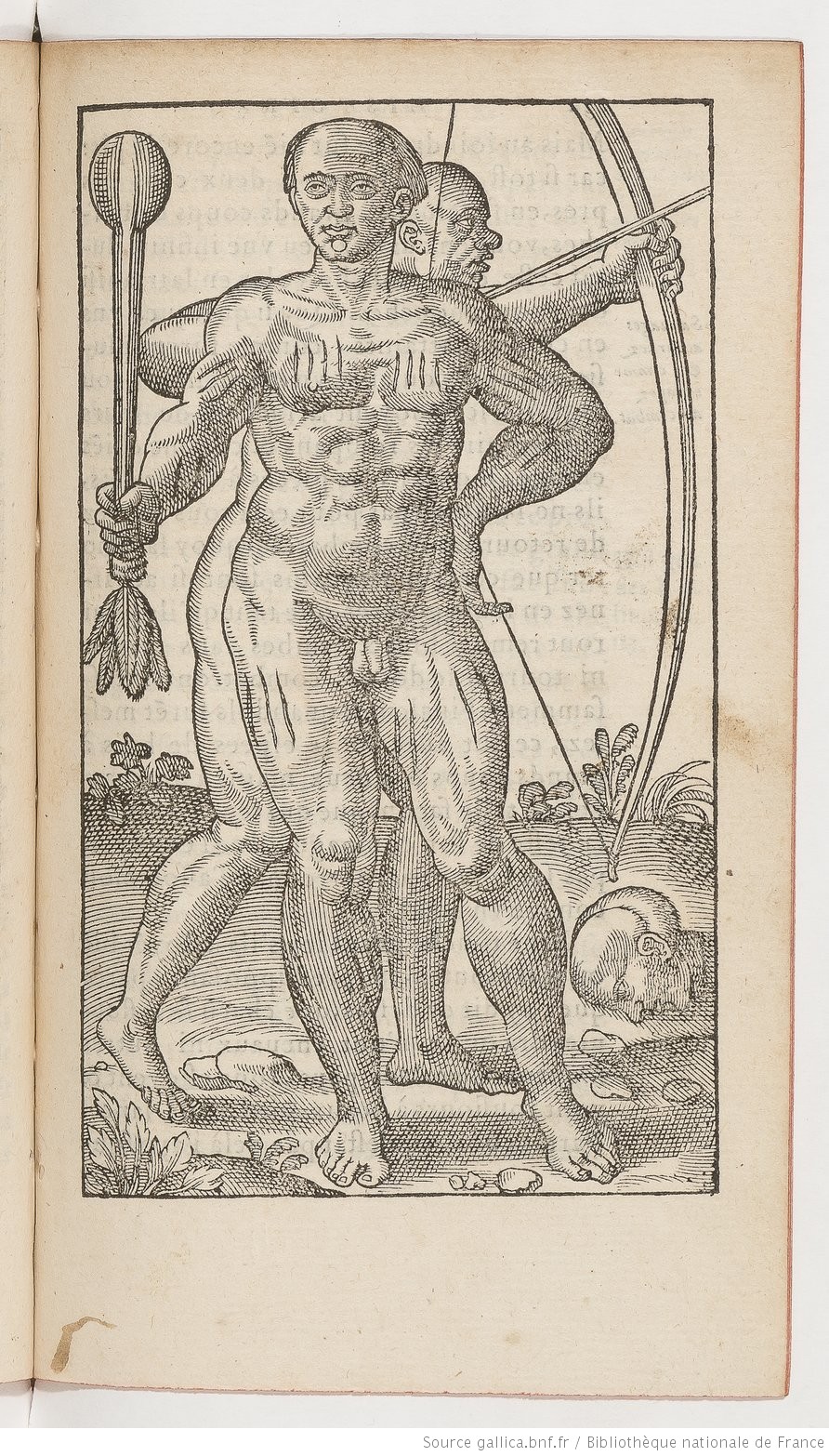
All three Brazil books brimmed with vivid detail. Staden: “The women seize him, and put him over the fire, where they scrape off his skin, making him all white.” Léry: “All assembled… beside [the roasting corpsel to receive the human fat that drips off… the big high wooden grills… Licking their fingers, they say ‘Yguatou’; that is, ‘it is good’.” Thevet: “They cut off his head and, through the hole, sucked out his brain, and the blood had not been cooked.” (The “discourse”, I can’t help thinking, might also qualify as cannibal porn.)
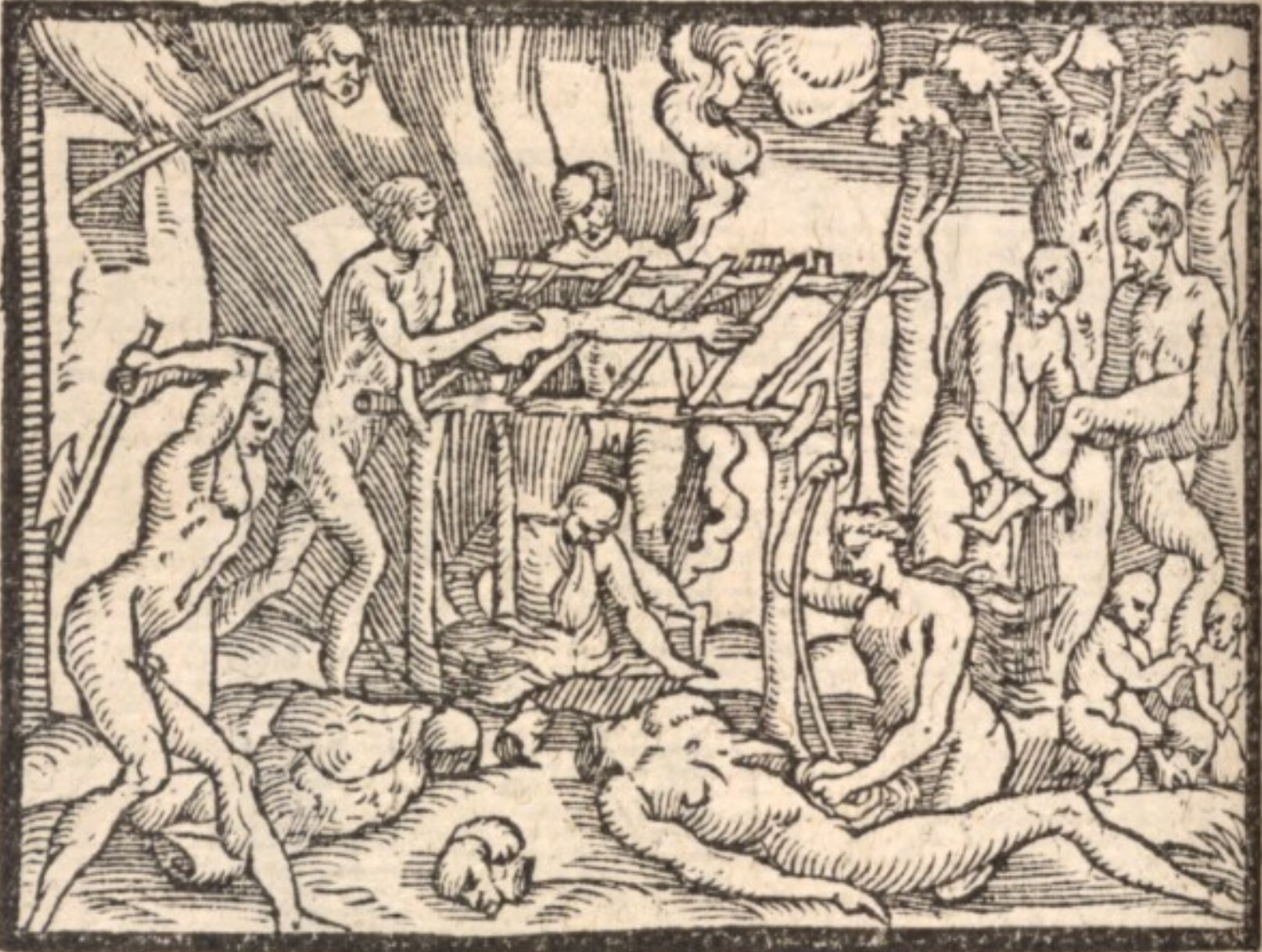
And so a kind of template was set. From now on, depictions of America, and Americans, would almost invariably include a cannibal element. Readers and viewers expected it, perhaps savored it. Examples abound, with some achieving a status equivalent to today’s “best sellers”. I create a list.
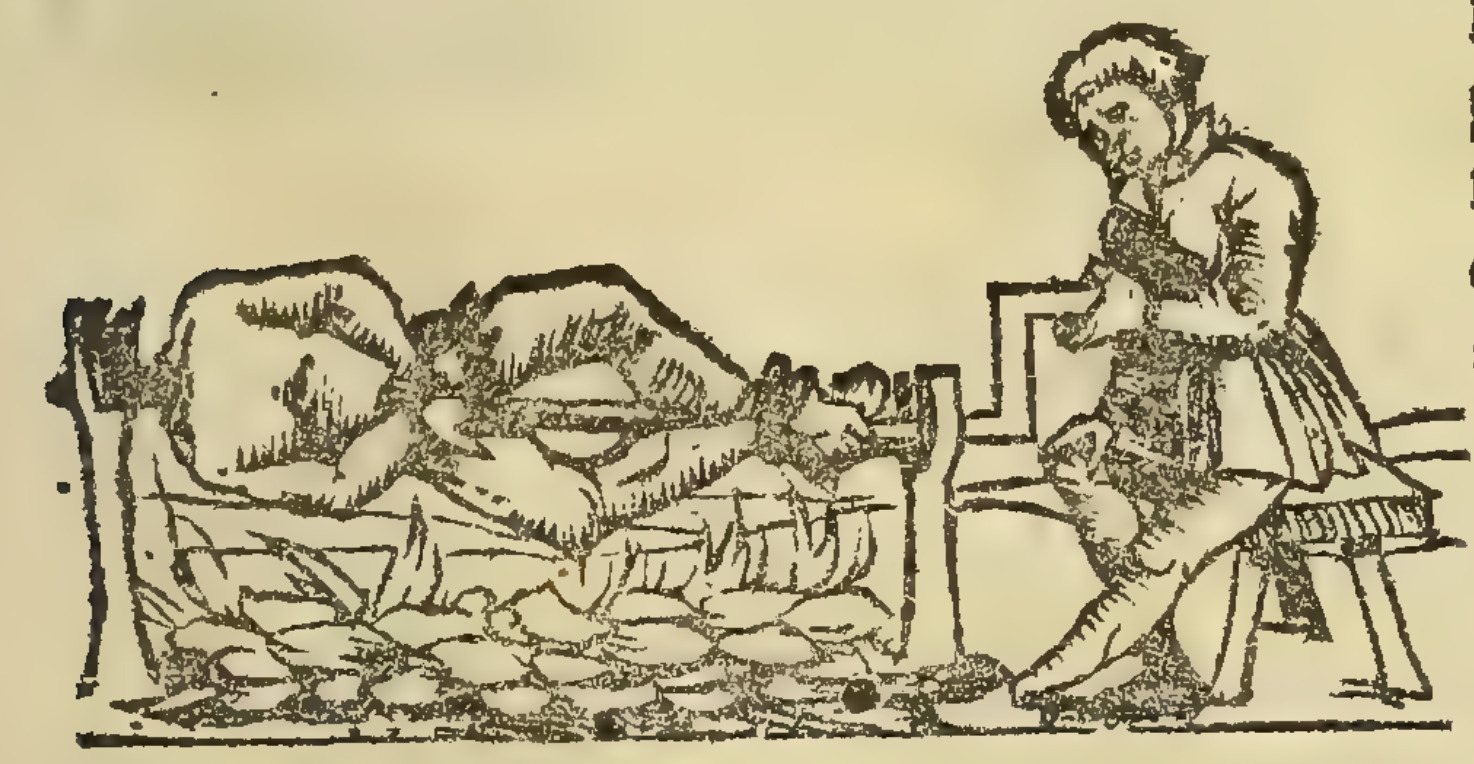
In 1554 a German polymath, Sebastian Munster, published Cosmographia Universalis, now considered the first description of the entire world. The sections on America included woodcuts of humans chopping and roasting other humans.
In 1570 a Belgian cartographer Abraham Ortelius published Theatrum Orbis Terrarum, the first modern-style atlas. The title page displayed continent-based, personified images similar to those that would appear a few years later in the Galle prints. At the bottom sat an American woman, holding up the bearded—and severed—head of a European man.
In 1603 an Italian iconographer, Cesare Ripa, published a large “emblem book” titled Iconologia including (on its frontispiece) the figure of an American woman in feathered headdress, with a severed head resting beneath her feet.
My list includes more than need be mentioned here. The capstone was part of grand compendium on American exploration and travel, published over a period of several years just before and after the century’s end, by the Flemish printer Theodor de Bry. The third of its thirteen volumes was devoted entirely to Brazil. Drawing heavily on Staden’s True History—and, to a lesser extent, on Léry—de Bry combined text with a set of twenty-eight stunning copper-plate engravings depicting Tupinamba ways, especially cannibalism. For the first time Europeans were able to envision the process—the preparation, the attendant rites, the ways and means of consuming human flesh—in full color and highly graphic form.
***
That these ideas and images should quickly attach to America does not surprise me. The invented “New World” was bound to feature difference from the Old. And, for Europeans confident in their own superior ways, difference would easily yield a trope of “savagery”. As such, it would help to justify the entire project of colonization. We will civilize them, raise them from their primitive condition, eliminate their immoral practices. Most of all, cannibalism.
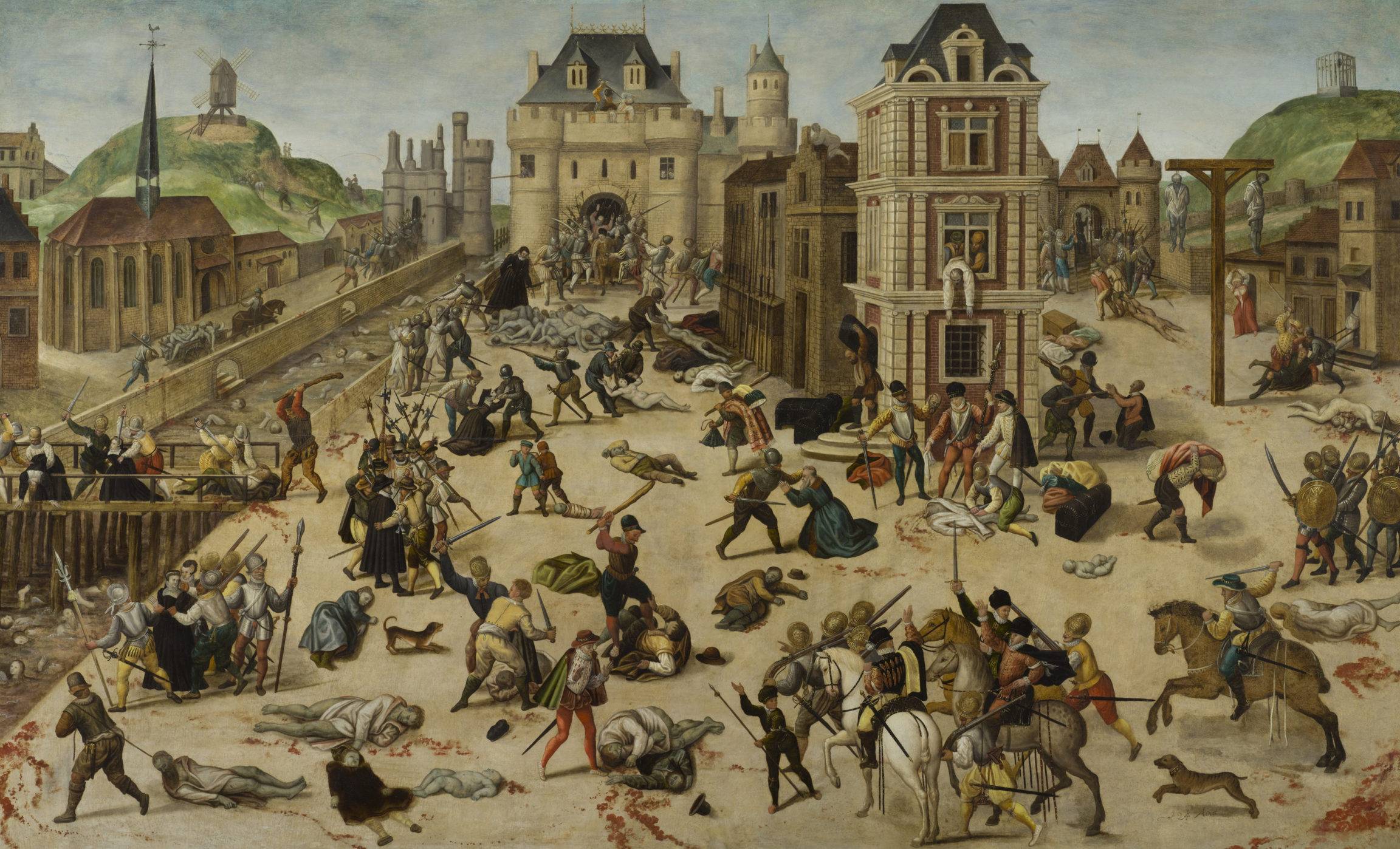
But then, as I look back through his notes on the various parts of the “discourse”, I see something I have not yet fully absorbed. Europeans of that era were drawn to the theme of cannibalism not just in America, but also as it might appear among themselves. The wars of religion supplied a cluster of arresting cases. The most notorious was the St. Bartholomew’s Day massacre in France, when Catholics were said to have consumed Protestant hearts and livers. Another involved a widely publicized siege of the city of Sancerre where starving residents had killed and eaten their own children. Accounts of these and similar episodes elicited intense fascination. There were echoes, too in the folklore of the time: think Little Red Riding Hood or Hansel and Gretel. And leading savants of the era readily joined in. Montaigne’s Essays, published in 1580, included a long and reflective chapter titled “Of Cannibals”, drawing directly on personal knowledge of the Tupinambas.
So… after much reading and reflection, I am ready to think that Europeans of the 16th century had cannibalism on the brain—a kind of cultural fixation. But why, I wonder, should this have been so? The response of the scholars most directly concerned converges on the Eucharist—the intense disputes, stretching across nearly the entire century, over the Christian communion rite. “Transubstantiation” was, and still is, the technical word for the key point at issue: Is this the actual body and blood of Christ that we are putting into our mouths? Or just a symbol? Churches would be broken apart, families and communities sundered, lives lost, in the turmoil surrounding this question.
The discourse aimed not only to explain—was cannibalism prompted by blood lust? by hunger? or by vengeance against enemies?—but also to assert its moral dimension. Whatever the explanation, it remained for all an absolute taboo, a horror, a “heart of darkness of the imagination” (as one modem scholar has put it), to which Europeans were themselves uncomfortably close.
Now I feel an added clarity around the choice of cannibalism as the best, the most definitive, way to epitomize American savagery. Put simply: it served to deflect at least some of the horror from Europe to America. By fixing on cannibalism over there, we shift our sights from its presence here. This was, in short, a means of distancing, a projection.
Finally: might one also say that it referenced—and projected—the process of colonization itself? The Old World consumes the New. Gobbles up its land. Devours its resources. Shreds its population. Cannibalizing as a metaphor for …. colonizing?
No wonder they were quick to fasten on Tupinambas and their horrific, yet endlessly fascinating, ways. And then a final step: Indigenous people in general “Tupinambized”. An entire hemisphere marked—stained—by killing and consuming their own kind.
And not only their own kind. I return to the dish, the starting point for this long journey of imagination. It was the severed head that had pushed me into action—a severed European head, dangling like a basketball from the hand of a Native woman. On seeing it for the first time, in the antiques shop, my response was that of my historian self: shock, puzzlement, curiosity. Now I must try for something else, the likely response of European selves coming upon it at around the time it was made. I picture, say, a Portuguese merchant preparing for a visit to trading partners in Rio de Janeiro. Or a young Spanish woman considering a marriage proposal from a rancher in Upper Peru. Or a Dutch sailor heading off on a long ocean voyage to one of the islands in the West Indies.
I understand that for all of them it’s more than cannibalism alone. That head is a symbol, gathering together a host of concerns about the vast and still largely unknown New World. In effect, it’s a warning: if you go there, watch out. America is a very foreign, very dangerous place.
I look for a final time at the 400-year-old dish. It seems the same as before—yet also different. Like other such artifacts subjected to inquiry, it carries the impress of all I have learned. Native Americans, European colonists, explorers, soldiers, missionaries, cannibal feasts, best-selling books, learned discourse, public pageants, agitated chatter from dock-sides to drawing rooms—nothing less (or more) than… history itself.
Further Reading:
This short essay draws on a vast literature about early European contacts with the Americas. For entering that subject, see classic studies by J. H. Eliott, The Old World and the New, 1492-1650 (Cambridge, UK, 1970); Anthony Pagden, European Encounters with the New World: From Renaissance to Romanticism (New Haven, CT, 1993) and Tzvetan Todorov, The Conquest of America: The Question of the Other, Richard Howard, trans. (Norman, OK, 1983). See also: Karen Ordahl Kupperman, ed., America in European Consciousness, 1493-1750 (Chapel Hill, NC, 1993), and Benjamin Schmidt, Innocence Abroad: The Dutch Imagination and the New World, 1570-1670 (Cambridge, UK, 2001). On the key sources cited in the essay, see: Neil L. Whitehead and Michael Harbsmeier, eds., Hans Staden’s True History: An Account of Cannibal Captivity in Brazil (Chapel Hill, NC, 2008), Jean de Léry, History of a Voyage to the Land of Brazil, Janet Whatley, ed. and trans. (Berkeley, CA, 1992), and Roger Schlesinger and Arthur P. Stabler, eds., Andre Thevet’s North America: A Sixteenth-Century View, Roger Schlesinger, trans. (Cambridge, UK, 1998). See also Theodore deBry, America: The Complete Plates, 1590-1602 (Providence, RI, n.d.). The best general study of cannibalism is Frank Lestringnant, Cannibals: The Discovery and Representation of the Cannibal from Columbus to Jules Verne, Rosemary Morris, trans. (Cambridge, UK, 1994). See also Francis Barker, Peter Hulme, and Margaret Iversen, eds., Cannibalism and the Colonial World (Cambridge, UK, 1998) and Michael Gaudio, Engraving the Savage: The New World and Techniques of Civilization (Minneapolis, 2008). On the dish itself, see Charlotte Wilcoxen, “A Spanish Puzzle,” in American Ceramics Circle Journal X (1997), 32-34.
This article originally appeared in October 2026.
John Demos is the Samuel Knight Professor of History Emeritus at Yale University. He is the author of many books and articles on early American history, including The Unredeemed Captive: A Family Story From Early America and The Heathen School: A Story of Hope and Betrayal in the Age of the Early Republic.





.jpg)